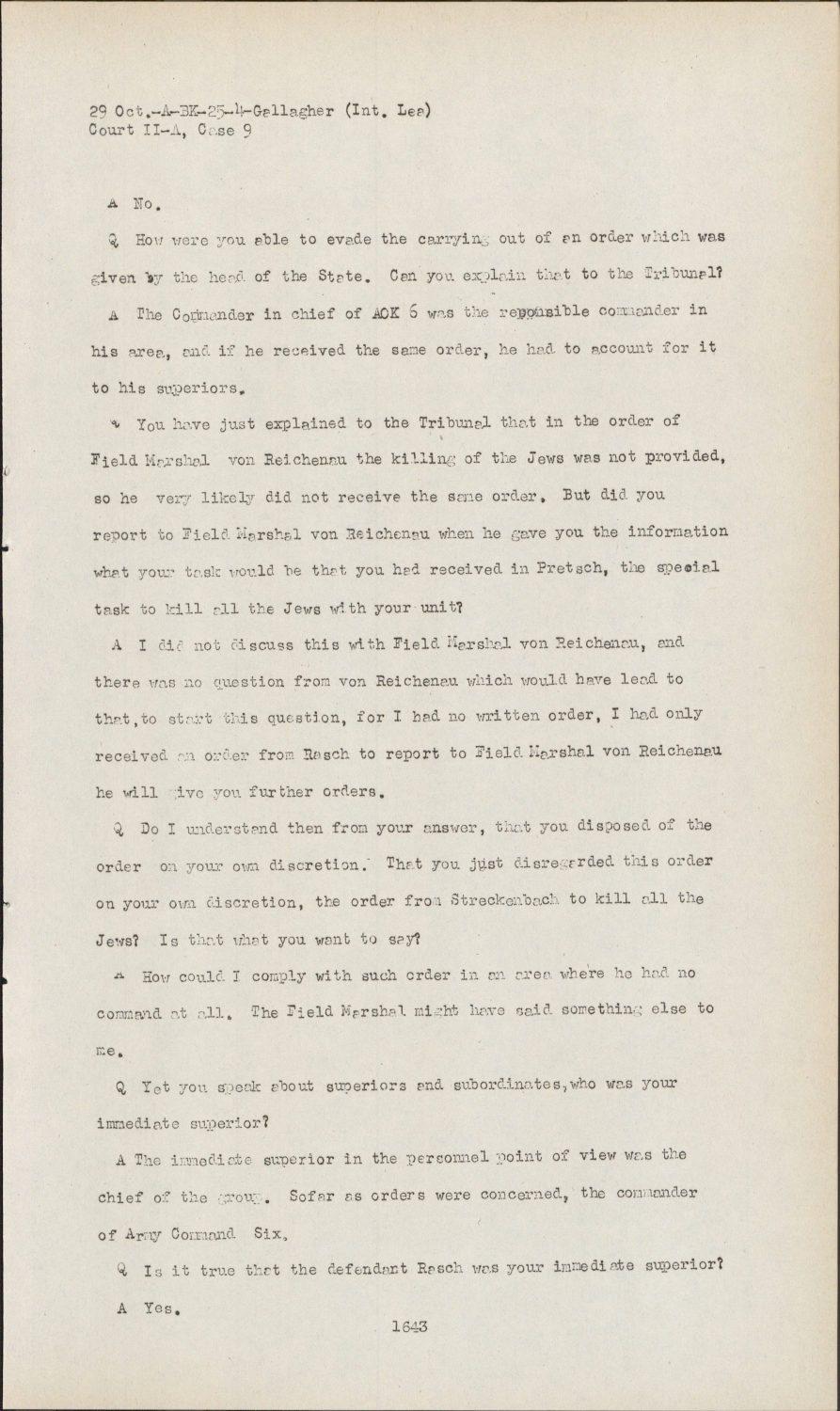
ANo.
QHow were you able to evade the carrying out of an order which was given by the head, of the State. Can you explain that to the Tribunal?
AThe Commander in chief of AOK 6 was the reponsible commander in his area, and if he received the same order, he had to account for it to his superiors.
QYou have just explained to the Tribunal that in the order of Field Marshal von Reichenau the killing of the Jews was not provided, so he very likely did not receive the sane order. But did you report to Field Marshal von Reichenau when he gave you the information what your task would be that you had received in Pretsch, the special task to kill all the Jews with your unit?
AI did not discuss this with Field Marshal von Reichenau, and there was no question from von Reichenau which would have lend to that,to start this question, for I had no written order, I had only received an order from Rasch to report to Field Marshal von Reichenau he will give you further orders.
QDo I understand then from, your answer, that you disposed of the order on your own discretion. That you just disregarded this order on your own discretion, the order from Streckenbach to kill all the Jews? Is that what you want to say?
AHow could I comply with such order in an area where he had no command at all. The Field Marshal might have said something else to me.
QYet you speak about superiors and subordinates,who was your immediate superior?
AThe immediate superior in the personnel point of view was the chief of the group. Sofar as orders were concerned, the commander of Army Command Six.
QIs it true that the defendant Rasch was your immediate superior?
AYes.
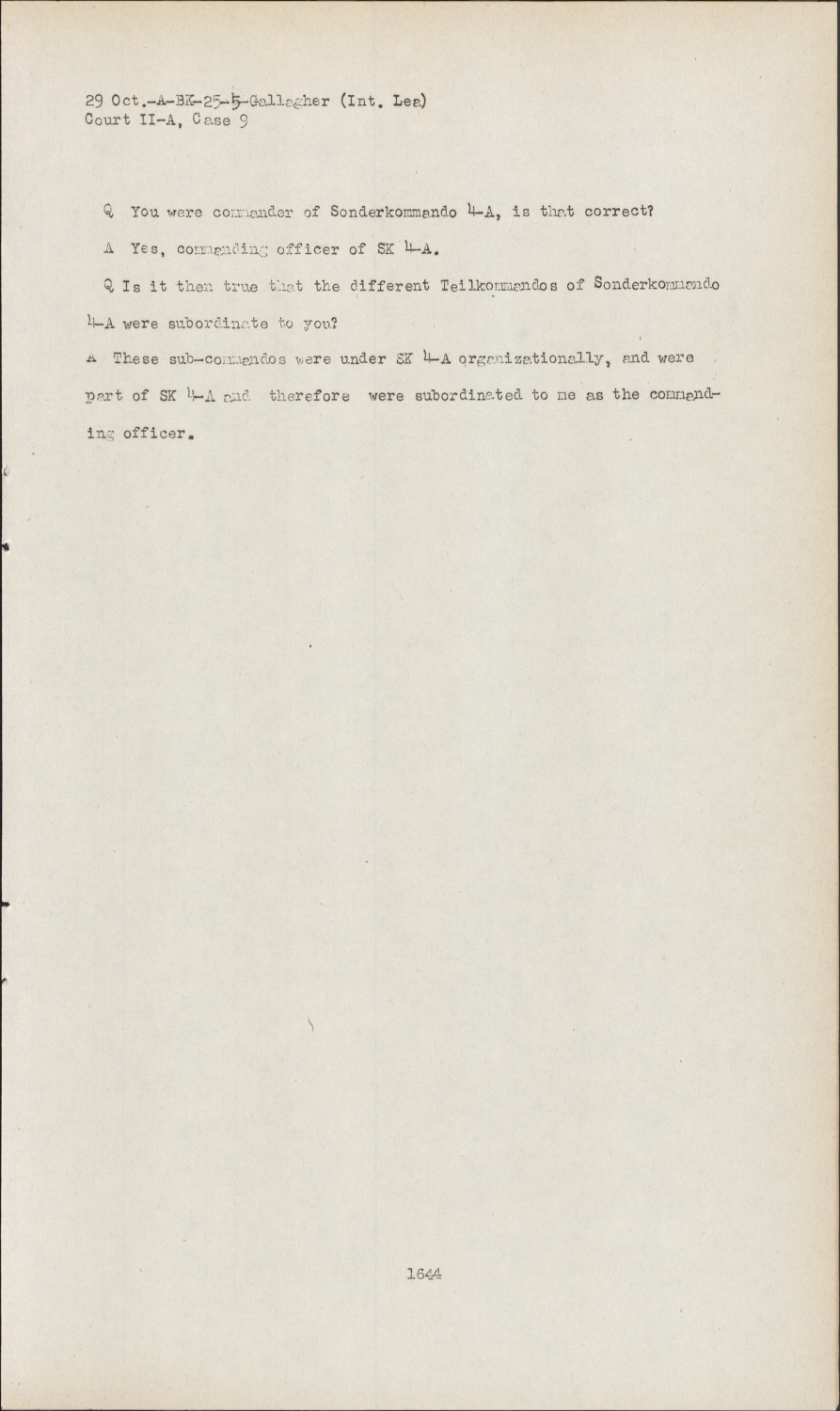
QYou were commander of Sonderkommando 4-A, is that correct?
AYes, commanding officer of SK 4-A.
QIs it then true that the different Teilkommandos of Sonderkommando 4-A were subordinate to you? A These sub-commandos were under SK 4-A organizationally, and were part of SK 4-A and therefore were subordinated to me as the commanding officer.
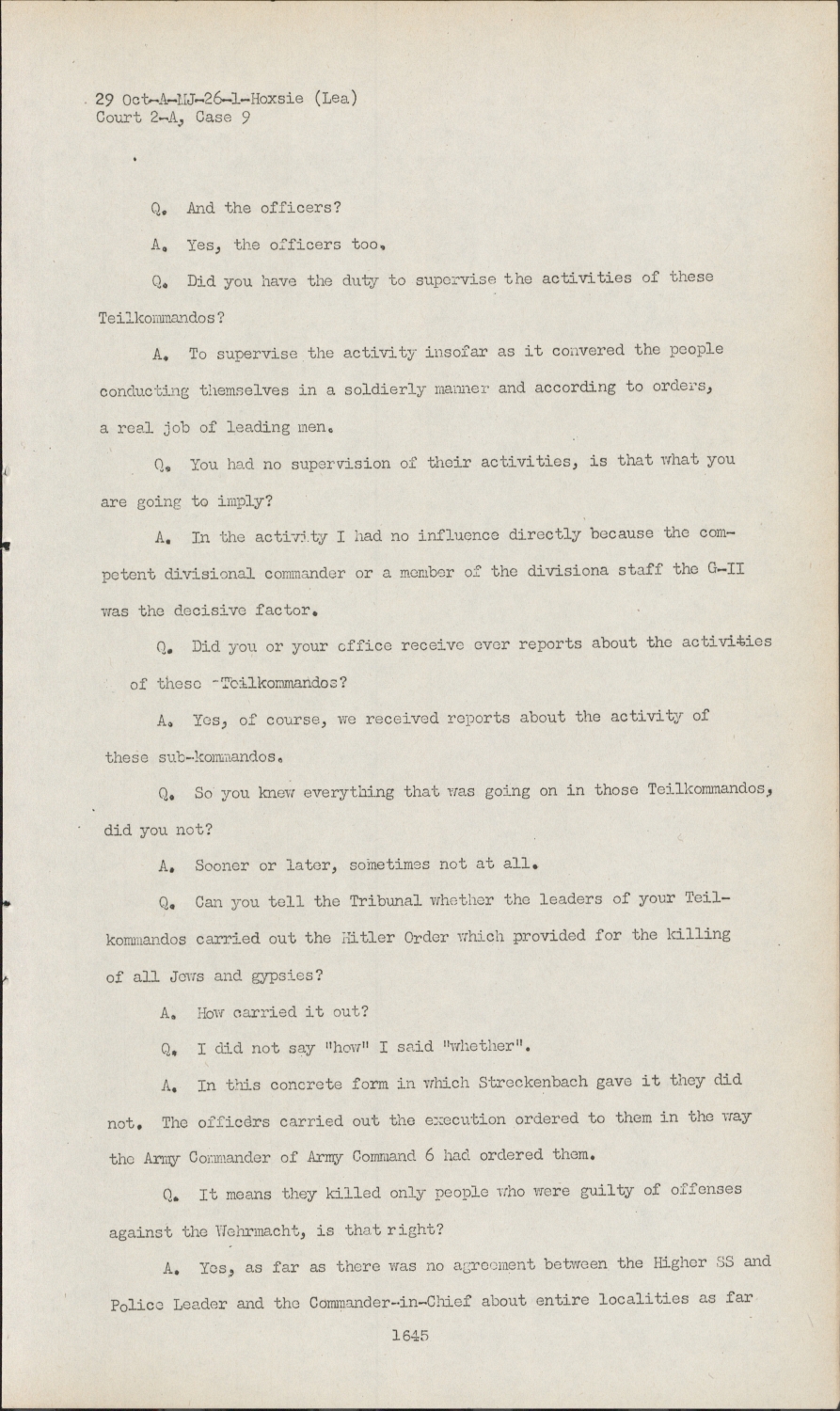
Q.And the officers?
A.Yes, the officers too,
Q.Did you have the duty to supervise the activities of these Teilkommandos?
A.To supervise the activity insofar as it convered the people conducting themselves in a soldierly manner and according to orders, a real job of leading men.
Q.You had no supervision of their activities, is that what you are going to imply?
A.In the activity I had no influence directly because the competent divisional commander or a member of the divisiona staff the G-II was the decisive factor.
Q.Did you or your office receive ever reports about the activities of these Teilkommandos?
A.Yes, of course, we received reports about the activity of these sub-kommandos.
Q.So you knew everything that was going on in those Teilkommandos, did you not?
A.Sooner or later, sometimes not at all.
Q.Can you tell the Tribunal whether the leaders of your Teilkommandos carried out the Hitler Order which provided for the killing of all Jews and gypsies?
A.How carried it out?
Q.I did not say "how" I said "whether".
A.In this concrete form in which Streckenbach gave it they did not. The officers carried out the execution ordered to them in the way the Army Commander of Army Command 6 had ordered them.
Q.It means they killed only people who were guilty of offenses against the Wehrmacht, is that right?
A.Yes, as far as there was no agreement between the Higher SS and Police Leader and the Commander-in-Chief about entire localities as far as retaliatory measures existed or from other reasons.
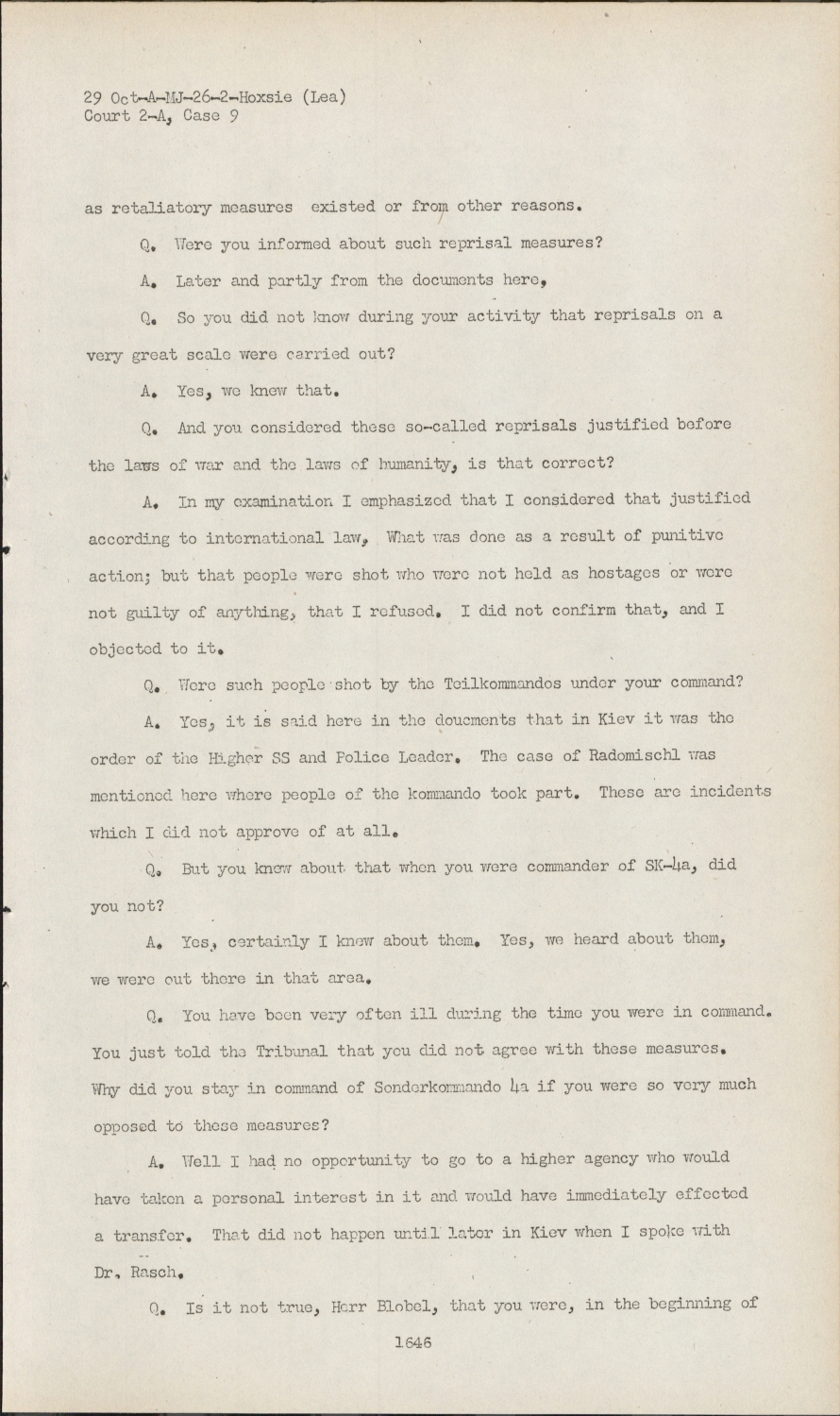
Q.Were you informed about such reprisal measures?
A.Later and partly from the documents here,
Q.So you did not know during your activity that reprisals on a very great scale were carried out?
A.Yes, we knew that.
Q.And you considered those so-called reprisals justified before the laws of war and the laws of humanity, is that correct?
A.In my examination I emphasized that I considered that justified according to international law, What was done as a result of punitive action; but that people were shot who were not hold as hostages or were not guilty of anything, that I refused. I did not confirm that, and I objected to it.
Q.Were such people shot by the Teilkommandos under your command?
A.Yes, it is said here in the doucments that in Kiev it was the order of the Higher SS and Police Leader. The case of Radomischl was mentioned here where people of the kommando took part. These are incidents which I did not approve of at all.
Q.But you knew about that when you were commander of SK-4a, did you not?
A.Yes, certainly I knew about them. Yes, we heard about them, we were out there in that area.
Q.You have been very often ill during the time you were in command. You just told the Tribunal that you did not agree with those measures. Why did you stay in command of Sonderkommando 4a if you were so very much opposed to these measures?
A.Well I had no opportunity to go to a higher agency who would have taken a personal interest in it and would have immediately effected a transfer. That did not happen until later in Kiev when I spoke with Dr. Rasch.
QIs it not true, Herr Blobel, that you were, in the beginning of of the campaign, quite ill as an effect from imbibing too much alcohol?
Is it not true that you were to be removed at that time, and did you meet an intervention with your superior, the Defendant Rasch, that you should stay in command of Sonderkommando 4a, is that right?
A.That is not right.
Q.That is not true?
A.No, at that time I was sent to the hospital at Lucks because of suspected typhoid and I was unconscious with high temperature.
Q.How were your relations to Dr. Rasch, your immediate superior?
A.I first knew Dr. Rasch at Pretsch, and then I saw him again when the order was given out at Crocow on the 25th. Thus I got to know Dr. Rasch as my superior. Outside of that I had no contact with Dr. Rasch.
Q.Did he know that you were ill?
A.Dr. Rasch later was reported about it, yes.
Q.What do you mean by later, please, after you had returned or during your illness?
A.No, on the march when the remaining kommando went to Lutsk from Skolan and changed quarters there was a dispute between an Army officer and myself- and that was reported to Dr. Rasch at the time by the kommando. How that was reported, I don't know. For that purpose he sent Hauptsturmfuehrer Dr. Beyer to the kommando.
Q.May I interrupt you? I do think my question was: did Rasch know that you were in the hospital? He was your immediate superior. I do think it should be natural that he was informed that you were not in charge of the kommando, but it is my question, and you can easily answer it with yes or no, that it was reported to him that you were not on duty, that you were in the hospital, a few kilometers from the front.
A.Yes, the kommando probably informed the Group C whenever it was possible, and since it could not maintain communications with the group, the Higher SS and Police Leader must have made the decision in Lutsk, and he must have reported to Dr. Rasch. This is how I assume it, but I don't know.
THE PRESIDENT: I am informed, Dr. Hochwald, that the film will expire in two or three minutes, so that I wouldn't want you to be right in the midst of a question and then not have it mechanically recorded, you see.
If it is agreeable to you we will recess at this point.
DR. HORLICK-HOCHWALD: Yes, Your Honor.
THE PRESIDENT: Very well. The Tribunal will recess until tomorrow morning at nine-thirty.
( The Tribunal adjourned until 30 October 1947, at 0930 hours).

Official Transcript of the American Military Tribunal in the matter of the United States of America, against Otto Ohlendorf, et al, defendants, sitting at Fuernberg, Germany on 30 Oct.
1947, at 0930-1630, Justice Musmanno, presiding.
THE MARSHAL:The Honorable, the Judges of Military Tribunal II-A.
Military Tribunal II-A is now in session. God save the United States of America and this Honorable Tribunal.
There will be order in the Court.
DR.MANDRY (for the defendant Sandberger): Your Honors, I would ask you to excuse the defendant Sandberger today and tomorrow, as I would like to prepare his defense with him.
THE PRESIDENT:You wish him to be excused now, immediately?
DR. MANDRY:Yes, end tomorrow.
THE PRESIDENT:The defendant Sandberger will be excused from attendance in Court today and tomorrow. He will be taken from the Courtroom under guard.
You may proceed, Mr. Hochwald.
PAUL BLOBEL - Resumed CROSS EXAMINATION - Continued BY MR. HOCHWALD: May it please the Tribunal.
QMr. Blobel, I asked you yesterday whether you once made an attempt to be relieved from your duties as commander of Sonderkommando 4-a. Will you tell the Tribunal whether you made such an attempt?
AWhen I was ill I asked Dr. Rasch to be relieved from my post.
QWhen was that?
AThat was in Kiev, in the beginning of October -- the first days of October.
QWhat were the reasons for your request?
A Dr. Rasch knew that I was ill and the doctor told him about my state of health and he agreed to my release.
QSo you wanted to be relieved for reasons of health, is that correct?

AYes, and this was supported by Dr. Rasch.
QYou did not try to get released as you were not conform with the tasks which you had as commander of Sonderkommando 4-a?
AThat was another reason - but one which one was not allowed to utter.
QAnd why had you such reasons... why did you not conform with those tasks?
A As I have already said, the whole assignment was not in my field of interests. And the whole assignment was revulsive to me.
QWhy... why did you have a revulsion against this task?
AI had had a different profession. I had been an architect, and I had not been active in police matters, and I had not been trained in this, and the Einsatzgruppen and the Einsatzkommandos... even when I joined the Einsatzgruppen in the army my actual task was going to be the carrying out of police measures -- police assignment.
QSo your revulsions were not for the reason that you had misgivings about these executions which were carried out by Sonderkommando 4-a, is that correct?
AOf course, I had a revulsion against them. That was part of my state of health.
QBut you considered these executions justified and necessary, is that correct?
AAs far as criminals were concerned, yes. Not the others. I have already stated that... I felt revulsive toward them from the bottom of my heart.
QYou have submitted to the Tribunal four charts showing the chain of command as far as your commando was concerned... your Exhibits 1, 2, 3 and 4. You have drawn these charts yourself, is that correct?
AYes, I did.
QDid you make these charts according to your memory?
AYes, as I have experienced it out there myself, and as it was in reality.
QThese charts are not based on any documents which you have at your disposal now , is that correct?
ADocuments as they were used in our command, and according to which our channel of command worked, and showing the communication relations of the different commands to each other.
QSo you have no documents available which would prove, besides your own memory, the correctness of this chain of command, is that correct?
ADocuments -- by this I mean orders, or other documents from the time prior to 1941.
QHave you such documents?
AI have none.
QSo it is then correct that you drew these four charts entirely according to your recollection?
AYes, they are made precisely according to the system of subordination at the time.
QBut these charts are an effect of your recollection, and not compiled from any documents which you have, is that correct?
AThese are my memories as I experienced then, and the relation as I experienced them myself while I was with AOK 6, and the subordination of Gruppe C.
QWhen you then were relieved and came back from the east, you had to report to Heydrich, is that correct?
A No, I was not forced to report to Heydrich. I had to go and see him.
QBut he spoke to you, is that right?
AThe interview with Heydrich did not take longer than three minutes, then I left. That was the first time I actually saw Heydrich in his office.
QHe was your high superior?
AYes, he was the Supreme Chief of the RSHA and thus my highest superior.
QWhen you reported to him, he reproached you for having been too soft, is that correct?
AHe used the expression "effeminate man".
QWhy did he reproach you for being too soft?
A I don't know. I discussed that with Obergruppenfuehrer Mueller and I thought about it a lot, and I assume that he drew that conclusion from the fact that I had been ill all the time, and he must have received further reports from Dr. Rasch or from other people of the same group.
QWas he of the opinion that you were not strong enough to carry out the Hitler Order?
AHe did not express himself to that effect in my presence, but during those three minutes he merely insulted me.
QSo you actually do not know why he considered you to be too soft?
AFirst I thought it was a reproach for my going home without being entitled to furlough.
QAll right. I would like to discuss with you now your activities in the Sonderkommando 4-a. Were reports sent from your Sonderkommando to Eintsatzgruppe C?
AYes, reports were sent.
QWho made these reports?
AThe reports, the simple SD reports and all the operational situation reports which were compiled either by Mueller or Radtzky or other leaders, -- they were submitted to the Group.
QDid you read these reports before they were sent off to Einsatzgruppe C?
AAs far as that was possible, yes.
QDid I understand you correctly, that you said that these reports also contained information on the activities of the Teilkommandos, is that correct?
ASub-commandos and other units, and everything that happened in this sector, was compiled in these reports.
QYou said in your direct testimony that the staff leader of Einsatzgruppe C, who was also leader of Office No. 4, Hoffmann, received this information and out of this information he made his reports to the RSHA. Is that correct?
AYes, that was Hoffman's task.
QDo you know whether defendant Rasch read these reports which were made by his staff leader before they were sent on to the RSHA?
AI don't know. I was very seldom with this Group.
QYou have described in great detail the ways and means, how Hoffmann made his reports, and about Hoffmann's activities in Einsatzgruppen, how strong he was, how much he exaggerated ... I can presume you also know what Rasch did, as you were so well informed about Hoffmann's activities in this respect.

AMy knowledge I received from Dr. Krieger, Oberregierungsrat (Government Councillor), from the time when Dr. Rasch with part of his Commando, was in Novo Ukrainka, and this Dr. Krieger compiled these reports in Shitomir and Obersturmbannfuehrer Meier added his own reports and his own figures. This I experienced myself; and I also experienced myself how these people compiled these reports, which were meant to go to Berlin.
QDid you over see Hoffmann make such a report?
AI also saw Hoffman making his reports,but I don't know whether Rasch ever read them. I do think he must have received knowledge of them.
QYou have stated here that the reports which Hoffmann made strongly exaggerated the numbers of executions carried out -- of course, as far as Sonderkommando 4-a is concerned. Is that correct?
AAs I see from these documents now, they can only have been compiled according to sectors as they were compiled by Special commandos and summed up of the events of various smaller locations and are reported as such, and those reports were then only very roughly compiled to give other events of other kinds, which these leaders reported.
QYou did know how Hoffmann made his reports, that is what you just told us ... did you ever voice any opposition against this way of reporting to Berlin?
AThere was an occasion of a report which Hoffmann in Kiev wanted when I told him that these matters had to be reported to Berlin, and this would have a completely wrong picture and Berlin would not believe it -- but it was too late. He already reported it.
QDid you report to Dr. Rasch about these astonishing facts?
ANo, I hardly ever saw Dr. Rasch. First of all he was in Shitomir all the time, then in Novo Ukrainka - he was in Novo Ukrainka first, then he came to Shitomir, then he held a raw with the Reich-Fuehrer, then he was in Berlin, and practically Hoffmann was the leader of the whole Group.
QSo you took no official steps in order to rectify these numbers?
ATo take official steps would have meant to report via the Group to the RSHA.
QDid you do that, Mr. Blobel?
ANo, I did not.
QDid I understand you correctly, that you said that you consider a number of ten to fifteen thousand people executed by Sonderkommando 4-a as the correct number?
ANo, I said that the figures ten to fifteen thousand in which the Commando took part, from one man to the whole sub-commando. This is my estimate according to the documents, according to which events have been made known to me which I did not know in this form. BY THE PRESIDENT:
QWitness, have you seen these documents before you were interrogated on June 6, 1947?
AInterrogation? Not before my interrogation.
QThen how could you have made this estimate from the documents?
AThe estimate, as I told Herr Wartenberg, was an estimate which I recollected from my own memory and I cannot vouch for the number. BY MR. HOCHWALD:
QYou heard of the order which was handed down by the Higher SS and Police leader Jeckeln to Rasch in Shitomir, did you?
AYes, the Gruppe staff passed on these reports. I think it must have been Dr. Krieger or some such person. That was before I fell ill in Shitomir.
QSo you received official information about this order, did you?
AYes, it was reported to us that the Higher police leader had been there, and that very strict measures against the Jews were ordered by him as the measure carried out up to now displeased him, he was not in agreement with such measures carried out up to then.
QDid you consider this order binding for you?
ABinding? That is a thought that has to be considered. One had to receive special orders, special executive orders.
QCan you tell me whether you considered this order binding for you? ... Will you please answer first with yes or no, and then you may explain whatever you want to.
ABinding in so far as if I was forced to an order I had to comply with it.
QSo you did consider it binding for you?
AIf it was in the way of an order, that was issued yes, binding.
QHow did you understand the order of Jeckeln about the stronger measures against the Jews? What kind of stronger measures were they?
AIt could only be the question of a so-called totality order, to apprehend the Jews living in that area for labor and those whom they didn't like were probably to be shot.
QAm I to understand from your answer that you say that Jews were to be used for labor, and if they should not comply with these reports they would be shot, is that what you want to say?
AThe order contained an order to select them, to select men of the Jewish population according to their ability to work, those who would be able to work and those who would not.
QWhat was to happen in the people who were not able to work?
AAccording to this order they were to be shot.
QYou carried out this order, did you not?
ANo one passed on the order to me to this effect.
QExcuse me, I didn't understand your answer, will you repeat it, please?
ANo such order was given to me.
QAbout three or four questions back you answered, you considered this order binding for you, and now you tell the Tribunal that nobody gave you this order, inspite of the fact that you admitted here that you were officially informed about the order. Will you explain this discrepancy between your answer, no, and your answer about two minutes ago?
AWell, that depended on conditions. In this territory, the Commander-in-Chief of AOK-VI had to approve of any operation, and on the same level of command was the higher SS and Police Leader: if these two authorities of command were in agreement with each other then the operation was carried out, because an operation was never allowed to interfere with the fighting units from any activity, and these two men had to agree upon them.
QRash was your superior, was he not?
ARasch was my superior in Group-C.
QHe handed down this order to you, is that correct?
ARasch not personally. Rasch was in Nove Ukrainka for a discussion of this order which came to us.
QAll right, but you got it from the Einsatzgruppe-C, through the Group Staff Chief, of which was Rasch, is that correct.
AYes, via the Group-staff.
QYou said that this order was binding for you. Now you explain again that this order was not binding for you. As you didn't know whether Field Marshal Richenau and Jekeln had agreed upon this order. Is that what I have to understand from your answer?
AYes, the Higher SS and Police Leader gave the order of the Reich Fuehrer to Dr. Rasch of this particular sector, the Commander-inChief of AOK-VI, was in charge who in any case had to give his agreement for any operation.
QDid you request the approval of Field Marshal Reichenau for the carrying out of this order?
AI have not talked to Field Marshal Reichenau, about this order, and at this time I did not go to AOK-VI for the reason that Group-C maintained the connection between AOK-VI itself and didn't want any overlapping of these particular channel commands.
QDid you disregard the order of Jeckelm for the simple reason that you didn't know whether the order was approved by Reichenau, but at the same time you state here that you never heard from Reichenau whether he had approved of the order or not. Is that correct? Is that what you are going to tell the Tribunal?
AI never heard about the fact that Jeckeln and Reichenau discussed these orders, because I was not present myself.
QDid you ascertain, in whatever form it might have been, whether this order was valid or not?
AIf the Group-staff had passed on this matter, then the order must have been valid but in the carrying out depended on other factors.
QSo that your ultimate answer is that the order was valid, but you did not carry it out, is that correct?
AI never received an order for carrying out these assignements.
QI do not want to repeat all these questions again, I do think it is perfectly clear to the Tribunal what you said.
I do think this ground covers it. Did you communicate this order to the offices of your teilkommandos?
AThey found out about it themselves. That was at the time when I was ill.
QBy whom were they informed.
AProbably by Group-C, or when they entered the orderly room they received the information, I think, and they might have discussed the matter with Dr. Krieger, or some other member of Group Staff C.
QThey were informed just by chance, no official channel, nor from the commander, Standartenfuehrer Blobel or nothing from his office Just by chance when they came to the office they were told by a clerk, we have received the order from Himmler to kill all the Jews who were unable to work, is that what you are going to imply?
AWell, the general frame order must have been announced to the Leaders in that form, I believe, and when orders were carried out these leaders were dependent on the Wehrmacht leader, or the Army leader in this particular sector, and these commanders of the Army unit could only receive orders from their own superiors.
QYou want to tell the Tribunal that the order of Jeckeln was valid for you but not valid for your subordinate officers, Is that just what you were going to say. Possibly you can be a little bit more specific, a little bit. I asked you very specifically a question which is extremely easy to answer, so probably you can be a little bit more specific than you are just now?
A whether this order was also valid and binding for these subcommanders or only for myself? Did I understand you correctly?
QYes.
AIt was a staff order of the Reichfuehrer, by the higher SS and Police leader, and was passed onto Group-C, and it was valid for Group C and its subordinate commanders.
QSo it was valid also for your subordinate officers, is that correct?
AYes, it, was squally binding.
QWhen you were back after your illness, and a new officer was attached to Sonderkommando-4-A, did you inform him officially about this order?
AWho was I supposed to have informs officially, you mean the sub-commando Leaders?
QLet's say, a new officer came to your commend, Sonderkommando-4-A, after the order had been issued, and after you returned to active duty after your illness again, he came in and reported to you, did you inform this officer, or did you inform him about his task with Sonderkommanndo-4-A did you inform him about the order of Jeckeln?
A yes, the man had to be informal, about the different things that had happened in the sector, and about new orders which had been gives, and this major frame order which was give out by Jeckeln was also made known to him.
QSo you did inform him, is that correct?
QThat was the new leader?
AThere was no new leader. It would have been my task to say so.
QThat was your impression about the order of Jeckeln when you received it? Did you consider such an order justified and in accordance with the laws of war?
AThe order for me was wrong.
QWhy?
ABecause it concerned people who had nothing to do with the happenings, because selections were first to be made which were supposes to be valid, and this was in direct contradiction to the general humane conception.
QDid you have a revulsion to carry out this order?
AYes, personally, yes, and others, too.
QDid you ever report to Rasch about this order?
AI was not in a position to report about these orders to Rasch, I could not even discuss them with him.
QSo you didn't do anything in order to be relieved from the carrying out of this order, and you did also not report to Rasch that you are not willing?
to carry out this order and you did also not report to Rasch thatyou were not willing to carry out this order, is that correct?
A.I was not quits as stupid as all that. I didn't want to show him my active mind, what was in my mind, there were other possibilities.
Q.Did you use the other possibilities, can you say?
A.The happy circumstances that my sub-commandos Were actually stationed in this front sector under the army units, and that one could evade the Supreme Power of the Higher SS and Police leader.
Q. and by that fact, you were able to avoid the carrying out of this order, is that what you want to say?
A.Yes, that is one of the facts which was so favorable, which put us in such a position.
Q.So you never carried out the order in spite of the fact it was valid for you, is that what you want to say?
A.No, it was not carried out by us directly, and indirectly.
Q.Indirectly, of course, it was the effect of that operation the Higher SS and police Leader was engaged in, with the AOK-VI when these two gentleman had that discussion.
Q.And in this case this order was carried out by you and your unit, is that right?
A.When the units were detailed to such assignment, they were carried out as the document here proves.
Q.And if that is what in this case Reichenau and Jeckeln agreed upon it was in accordance with the laws of war and the laws of humanity, is that what you want to say?
A.No, that is not what I want to say.
Q.You don't want to answer this question. Do you know whether thedefendant Radetsky know about the order of Jeckeln?
A.Whether he heard about this order during his work, or any reports, it is possible, but it is not necessarily so.
Q.You told the Tribunal just a few moments ago that your officers know about the order, or must have know about the order. Why do you say now that Radetsky, who was one of your officers, possibly didn't know about it?