The Tribunal had granted me this witness. He arrived here in Nurnberg last Friday and our information center informed me that the witness must absolutely leave Nurnber today already and that this term could not be prolonged. At any rate, since there was no possibility yesterday to call the witness I took an affidavit from him last evening and the witness left this morning and I ask for permission that I may introduce this affidavit later on in Document Book II. Document Book II is not completed yet. It has not yet been translated. I shall also submit a few other affidavits by witness and will add them to Document Book II and will submit them later. These affidavits I have not got as yet.
Then I have asked for another witness whom I wanted to bring in to the witness stand. The name is Krugmayer. This witness has not arrived in Nurnberg as yet, and I therefore ask for permission that I may bring him here later on the witness stand, after he has arrived here.
That concludes my evidence.
C ourt II, Case 9
THE PRESIDENT:I might say, Dr. Lummert, and to all defense counsel that if any of you find yourselves in the situation that Dr. Lummert found himself in yesterday with a witness whose stay was limited to a day that you should inform the Tribunal here in open court or even in chambers of your difficulties and we assure you that we will make every effort to see to it that the witness will be heard or proper documentation made of that fact that he is here in Nurnberg ready to testify; in some way or other we ought to be able to accommodate your requests along that line.
DR. LUMMERT:Thank you very much, Your honor.
EXAMINATION BY THE PRESIDENT:
Q Witness, in your affidavit there appears a paragraph which I don't quite thoroughly comprehend: No. 5, which says, "I received all orders regarding executions, directions and duties of Sonderkommando 7a which was subordinate to me in Dueben or in the Prinz Albrecht Palais in Berlin. During the campaign I never received any further orders". Did you not receive orders elsewhere?
AYour Honor, the formulation I used merely meant that basic orders about the extermination of the Jews, but not the instructions given by Nebe later on.
Q I see. In referring to the executions themselves, you also say in this affidavit there was no physician present, but that the leader of the execution party was responsible for the completion of the job and had to make certain that the victims were actually dead. Did this mean, since the victims fell automatically in the pro-dug grave that the officer would have to get down into the ditch to make the examination after the firing had ceased?
ANo, Your Honor, the men were shot somewhat in front of the grave and only after the shooting the men of the Kommando put them into the grave.
Q Well, then, the modus operendis of your Sonderkommando was different from that used by the defendant Blobel?
AYour Honor, at the moment I cannot remember Blobel's description.
QHis description was that the victims were lined up before this ditch and that as they were shot from the rear they fell into the ditch. They fell into the grave already prepared beforehand. That was the way he described an execution.
AYes, the manner in which I had this order carried out was different to that, as they were shot from the front, as during any military shooting and the men were so far away from the grave that they did not fall into it immediately.
QYes. Were the executees blindfolded?
ANo, Your Honor.
QI see. Yesterday you indicated that the Jews were very active in Bolshevistic Russia politically; that they supported the Communist regime; that they were very active supporters then and now. Do we take from that that you believed that the Jews were a very formidable threat to the security of Germany because of their political allegiances?
AYes, Your Honor. I believe and the investigations carried out in Peacetime gave me that impression that the Jews in the East, in Russia played a special part concerning Communist interests.
QWere you in Russia prior to 1941?
ANo, Your Honor. I already said that we had to examine and interrogate all those who had been active in Russia and who then returned to Germany.
QI understood you to say that in times of peace you investigated conditions in Eastern Russia. Did I understand you correctly?
AYes, these interrogations were carried out in peacetime in order to get political information about the Russian territory.
QYou had agents go into Russia and then come back and report to you, is that what I understand?

ANo, Your Honor, it was like this. At the time the Russians had hired many German experts and engineers in order to build up their economic sphere. These men returned after some time when the Russians believed that they could continue their own economy on their own accord. The National Socialist State realized this opportu nity in order to get information about conditions in Russia and the State Police agencies were asked to interrogate these people who returned.
QAnd from these people who returned you got the information that the Jews were a threat and a menace to the security of Germany?
AThey emphasized the strong part of Eastern Jewry in the Bolshevist regime.
QAnd therefore, you agreed with the Fuehrer Order that because of this threat to the security of the German Reich that they should be exterminated?
A Your Honor, I already explained yesterday that my ideas about the necessity of the security measures were more limited and I would not have drawn this consequence if I had been able to give instructions myself.
QWell, you agreed with the Fuehrer Order that the Jews were a menace and therefore had to be eliminated?
AYour Honor, if you remember I even made a report from Vitobsk where instead of extermination I suggested that the Jews be gathered in ghettos and be resettled after the war. That was what I, as a small private person, would have ordered, if I had been able to give orders.
QWell, then, you did not agree entirely with the Fuehrer Order?
ANo.
QAt the time, did you have this reservation, or has that come since?
ANo, Your Honor, I had that immediately, because the immense consequence of this order, as I have already described raised all these feelings within me immediately.
QYes, so that at the time you were willing to accept part of the order and reject part.
You rejected that part which called upon you to exterminate indiscriminately men, women, and children Jews?
AYes, Your Honor.
QSo far as that part of the order was concerned, you regarded Hitler being as wrong?
AYes.
QAnd so far as that part of the order was concerned you regarded Hitler as a murderer?
AWith my admiration for Adolf Hitler, Your Honor, and with the first collision of my feelings with one of his orders, my reaction was not so strong that I would have allowed myself to think in that manner.
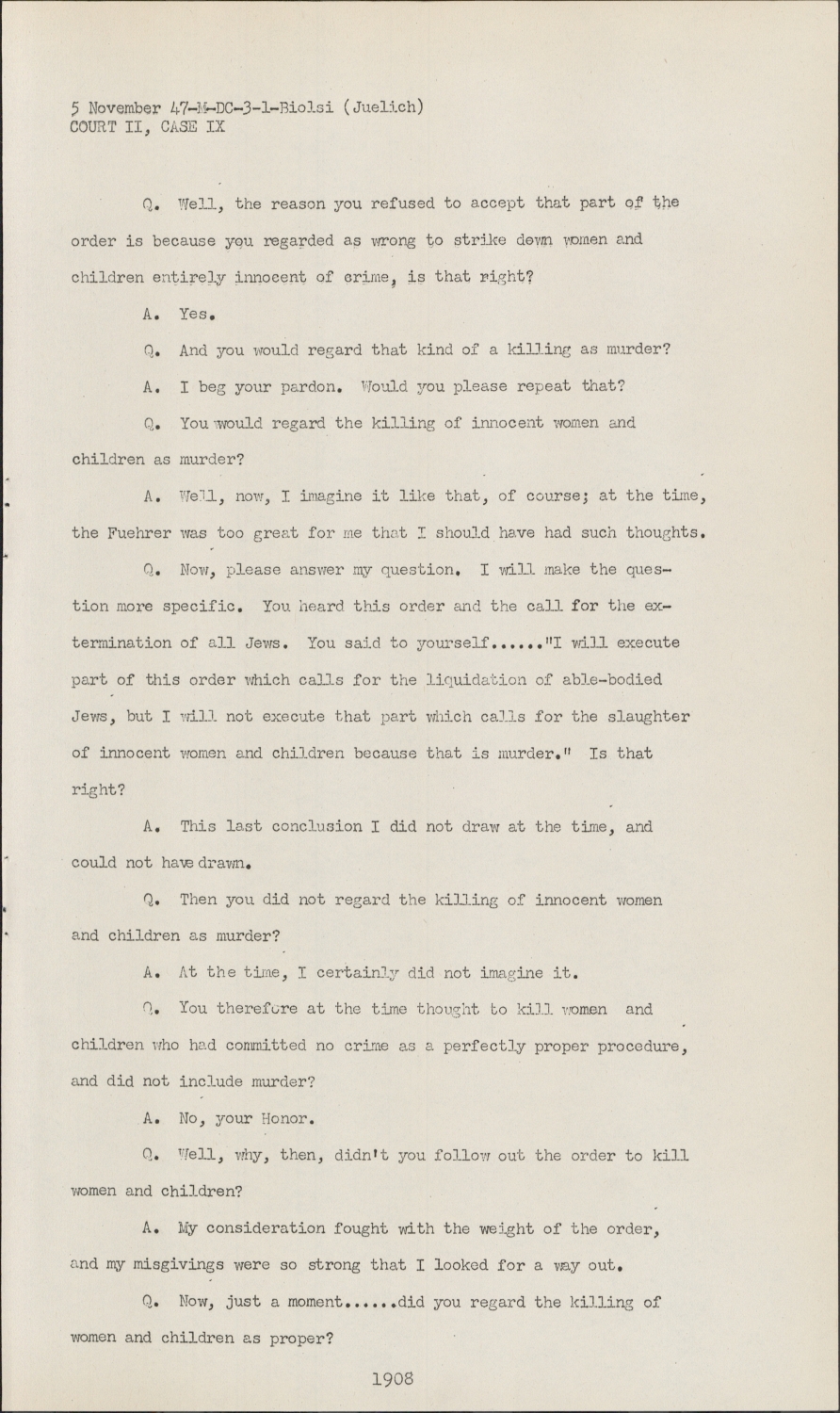
Q.Well, the reason you refused to accept that part of the order is because you regarded as wrong to strike down women and children entirely innocent of crime, is that right?
A.Yes.
Q.And you would regard that kind of a killing as murder?
A.I beg your pardon. Would you please repeat that?
Q.You would regard the killing of innocent women and children as murder?
A.Well, now, I imagine it like that, of course; at the time, the Fuehrer was too great for me that I should have had such thoughts.
Q.Now, please answer my question. I will make the question more specific. You heard this order and the call for the extermination of all Jews. You said to yourself......"I will execute part of this order which calls for the liquidation of able-bodied Jews, but I will not execute that part which calls for the slaughter of innocent women and children because that is murder." Is that right?
A.This last conclusion I did not draw at the time, and could not have drawn.
Q.Then you did not regard the killing of innocent women and children as murder?
A.At the time, I certainly did not imagine it.
Q.You therefore at the time thought to kill women and children who had committed no crime as a perfectly proper procedure, and did not include murder?
A.No, your Honor.
Q.Well, why, then, didn't you follow out the order to kill women and children?
A.My consideration fought with the weight of the order, and my misgivings were so strong that I looked for a way out.
Q.Now, just a moment......did you regard the killing of women and children as proper?
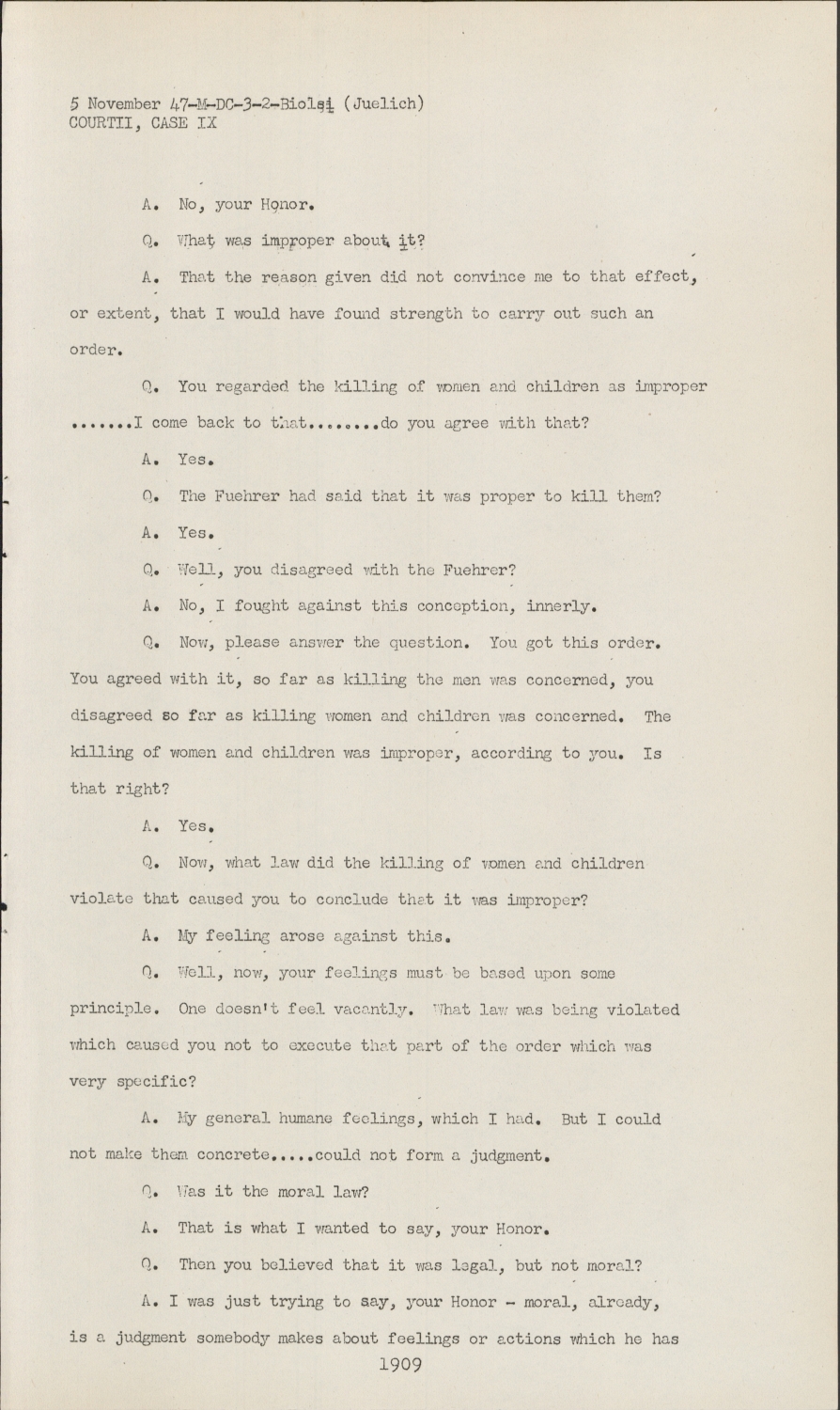
COURTII, CASE IX
A.No, your Honor.
Q.What was improper about it?
A.That the reason given did not convince me to that effect, or extent, that I would have found strength to carry out such an order.
Q.You regarded the killing of women and children as improper .......I come back to that........do you agree with that?
A.Yes.
Q.The Fuehrer had said that it was proper to kill them?
A.Yes.
Q.Well, you disagreed with the Fuehrer?
A.No, I fought against this conception, innerly.
Q.Now, please answer the question. You got this order. You agreed with it, so far as killing the men was concerned, you disagreed so far as killing women and children was concerned. The killing of women and children was improper, according to you. Is that right?
A.Yes.
Q.Now, what law did the killing of women and children violate that caused you to conclude that it was improper?
A.My feeling arose against this.
Q.Well, now, your feelings must be based upon some principle. One doesn't feel vacantly. That law was being violated which Caused you not to execute that part of the order which was very specific?
A.My general humane feelings, which I had. But I could not make them concrete.....could not form a judgment.
Q.Was it the moral law?
A.That is what I wanted to say, your Honor.
Q.Then you believed that it was legal, but not moral?
A.I was just trying to say, your Honor - moral, already, is a judgment somebody makes about feelings or actions which he has or does, and at the time I did not come to a judgment because the man who had given the order was on such a high level for me that I did not take the liberty to pass a judgment about his order owing to feelings and actions which I, as a small commando leader, had.
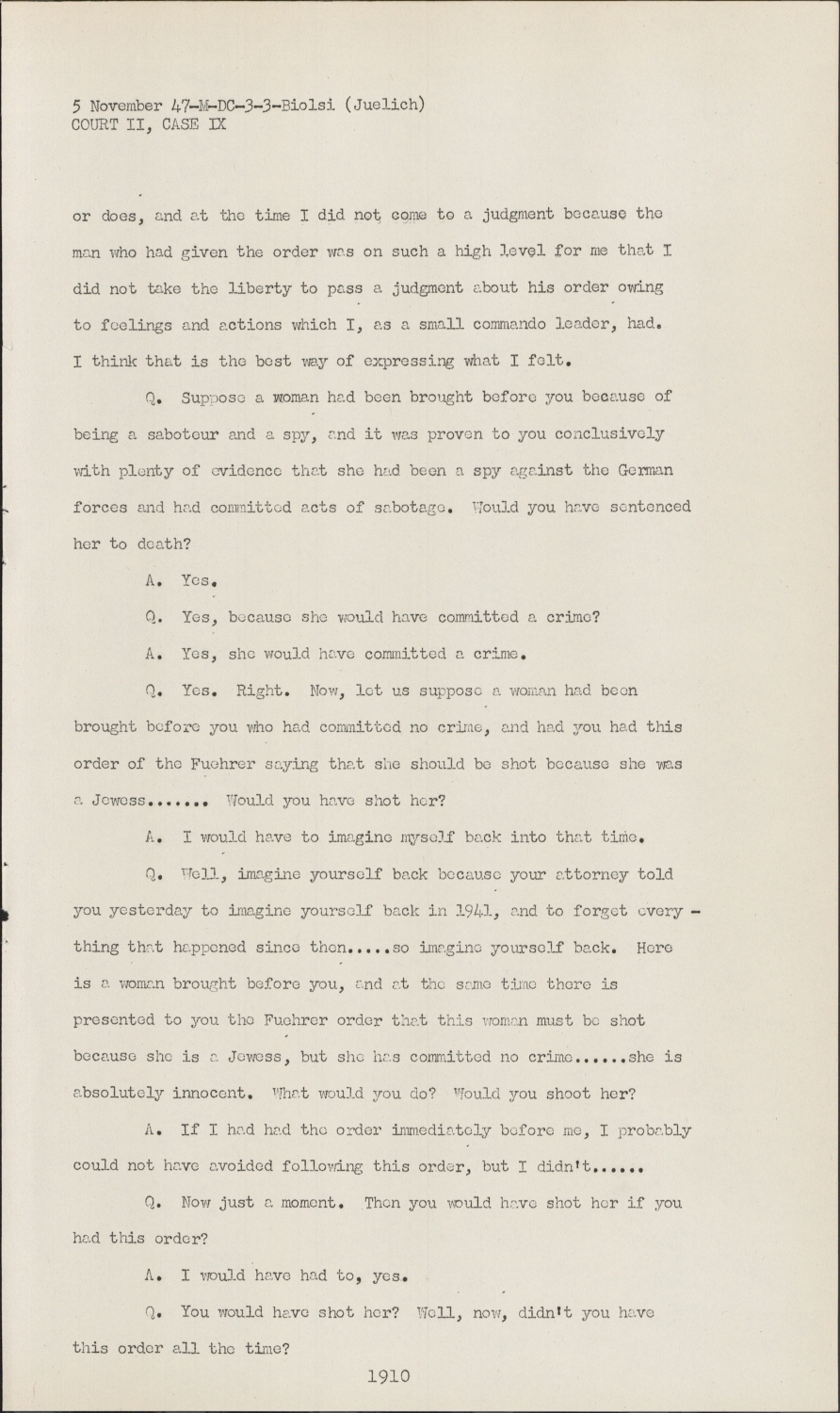
I think that is the best way of expressing what I felt.
Q.Suppose a woman had been brought before you because of being a saboteur and a spy, and it was proven to you conclusively with plenty of evidence that she had been a spy against the German forces and had committed acts of sabotage. Would you have sentenced her to death?
A.Yes.
Q.Yes, because she would have committed a crime?
A.Yes, she would have committed a crime.
Q.Yes. Right. Now, let us suppose a woman had been brought before you who had committed no crime, and had you had this order of the Fuehrer saying that she should be shot because she was a Jewess....... Would you have shot her?
A.I would have to imagine myself back into that time.
Q.Well, imagine yourself back because your attorney told you yesterday to imagine yourself back in 1941, and to forget everything that happened since then.....so imagine yourself back. Here is a woman brought before you, and at the same time there is presented to you the Fuehrer order that this woman must be shot because she is a Jewess, but she has committed no crime......she is absolutely innocent. What would you do? Would you shoot her?
A.If I had had the order immediately before me, I probably could not have avoided following this order, but I didn't......
Q.Now just a moment. Then you would have shot her if you had this order?
A.I would have had to, yes.
Q.You would have shot her? Well, now, didn't you have this order all the time?
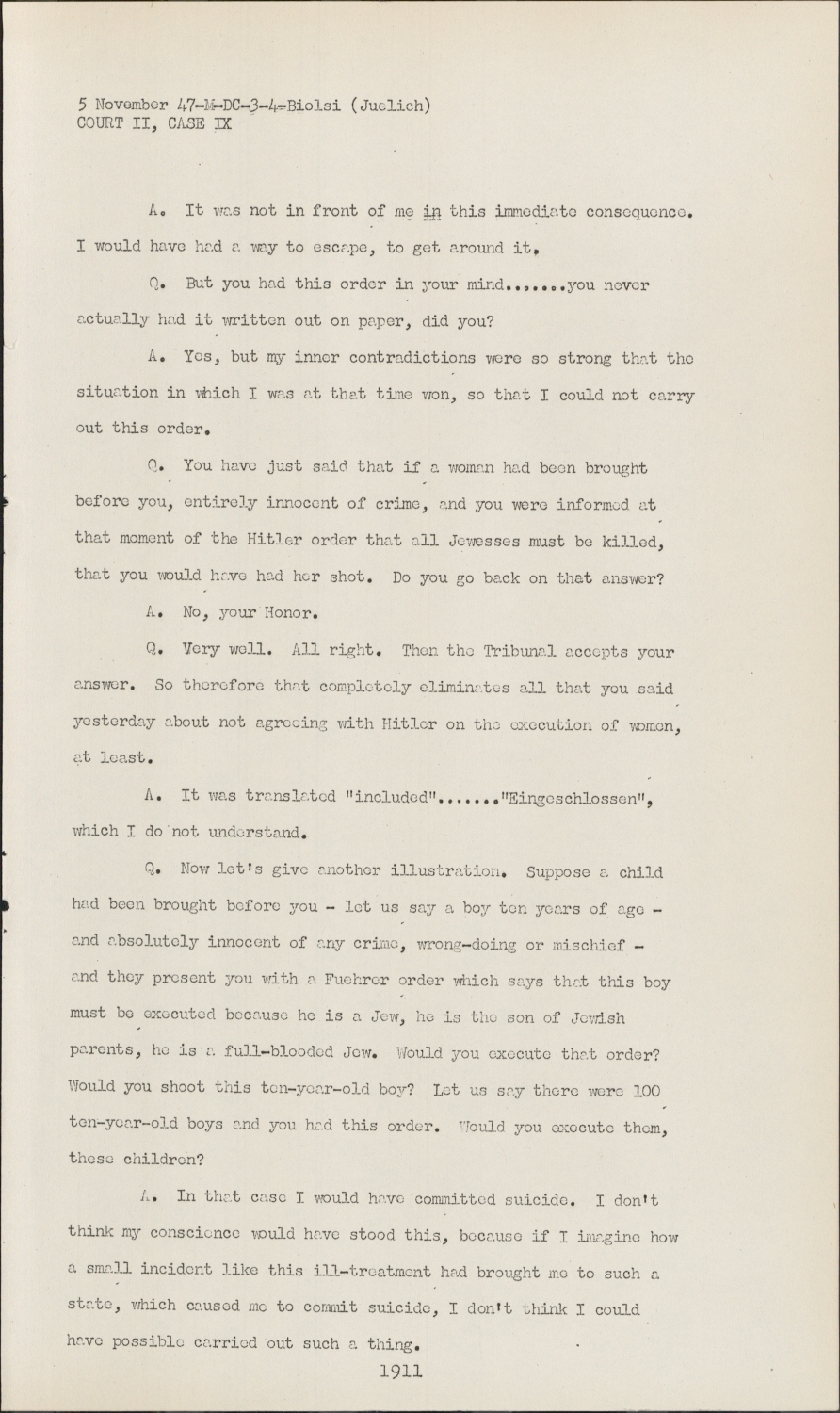
A.It was not in front of me in this immediate consequence. I would have had a way to escape, to get around it.
Q.But you had this order in your mind.......you never actually had it written out on paper, did you?
A.Yes, but my inner contradictions were so strong that the situation in which I was at that time won, so that I could not carry out this order.
Q.You have just said that if a woman had been brought before you, entirely innocent of crime, and you were informed at that moment of the Hitler order that all Jewesses must be killed, that you would have had her shot. Do you go back on that answer?
A.No, your Honor.
Q.Very well. All right. Then the Tribunal accepts your answer. So therefore that completely eliminates all that you said yesterday about not agreeing with Hitler on the execution of women, at least.
A.It was translated "included"......."Eingeschlossen", which I do not understand.
Q.Now let's give another illustration. Suppose a child had been brought before you - let us say a boy ten years of age and absolutely innocent of any crime, wrong-doing or mischief and they present you with a Fuehrer order which says that this boy must be executed because he is a Jew, he is the son of Jewish parents, he is a full-blooded Jew. Would you execute that order? Would you shoot this ten-year-old boy? Let us say there were 100 ten-year-old boys and you had this order. Would you execute them, these children?
A.In that case I would have committed suicide. I don't think my conscience would have stood this, because if I imagine how a small incident like this ill-treatment had brought me to such a state, which caused me to commit suicide, I don't think I could have possible carried out such a thing.
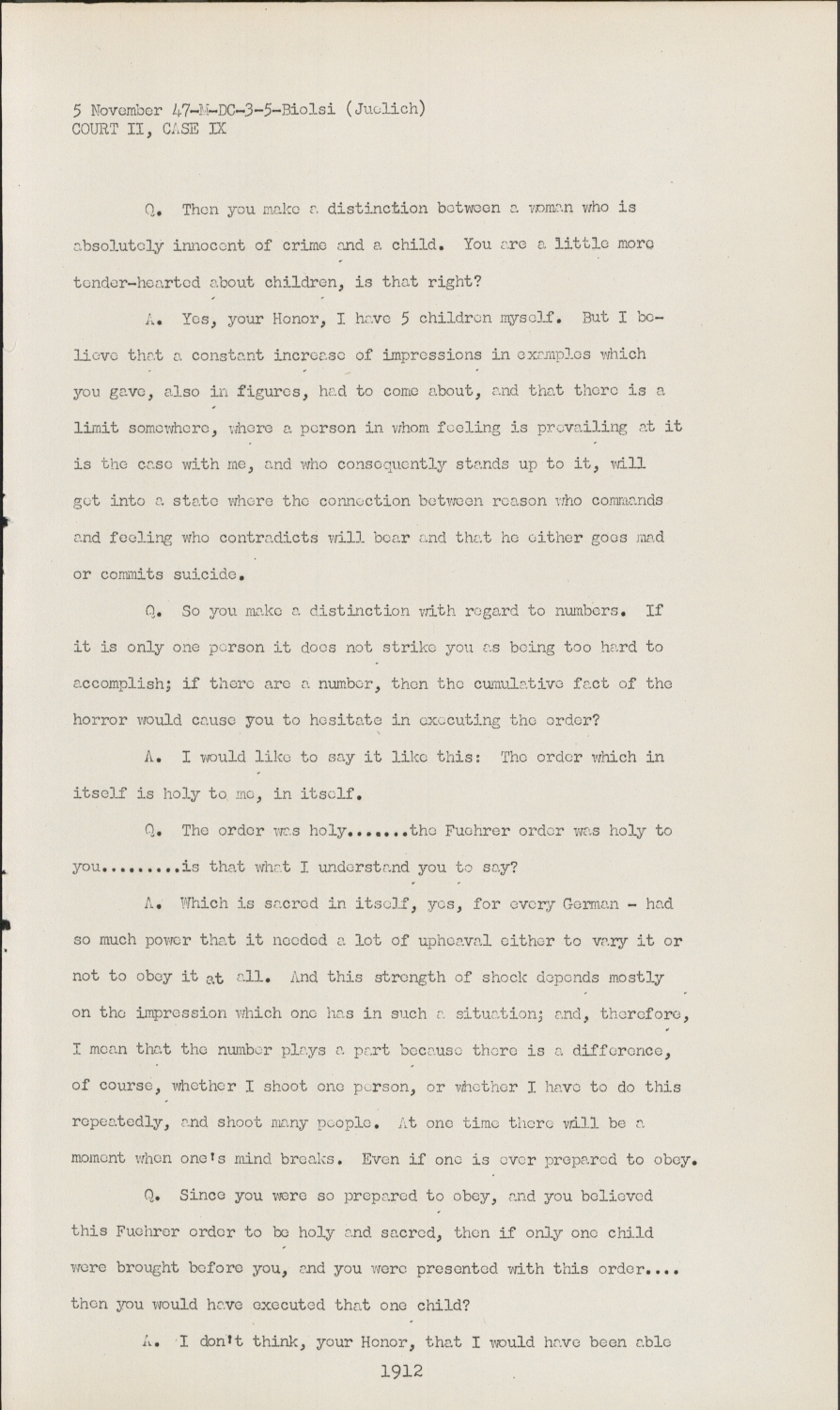
Q.Then you make a distinction between a woman who is absolutely innocent of crime and a child. You are a little more tender-hearted about children, is that right?
A.Yes, your Honor, I have 5 children myself. But I believe that a constant increase of impressions in examples which you gave, also in figures, had to come about, and that there is a limit somewhere, where a person in whom feeling is prevailing at it is the case with me, and who consequently stands up to it, Will get into a state where the connection between reason who commands and feeling who contradicts will bear and that he either goes mad or commits suicide.
Q.So you make a distinction with regard to numbers. If it is only one person it does not strike you as being too hard to accomplish; if there are a number, then the cumulative fact of the horror would cause you to hesitate in executing the order?
A.I would like to say it like this: The order which in itself is holy to me, in itself.
Q.The order was holy.......the Fuehrer order was holy to you.........is that what I understand you to say?
A.Which is sacred in itself, yes, for every German - had so much power that it needed a lot of upheaval either to vary it or not to obey it at all. And this strength of shock depends mostly on the impression which one has in such a situation; and, therefore, I mean that the number plays a part because there is a difference, of course, whether I shoot one person, or whether I have to do this repeatedly, and shoot many people. At one time there will be a moment when one's mind breaks. Even if one is ever prepared to obey.
Q.Since you were so prepared to obey, and you believed this Fuehrer order to be holy and sacred, then if only one child were brought before you, and you were presented with this order.... then you would have executed that one child?
A.I don't think, your Honor, that I would have been able to do it.
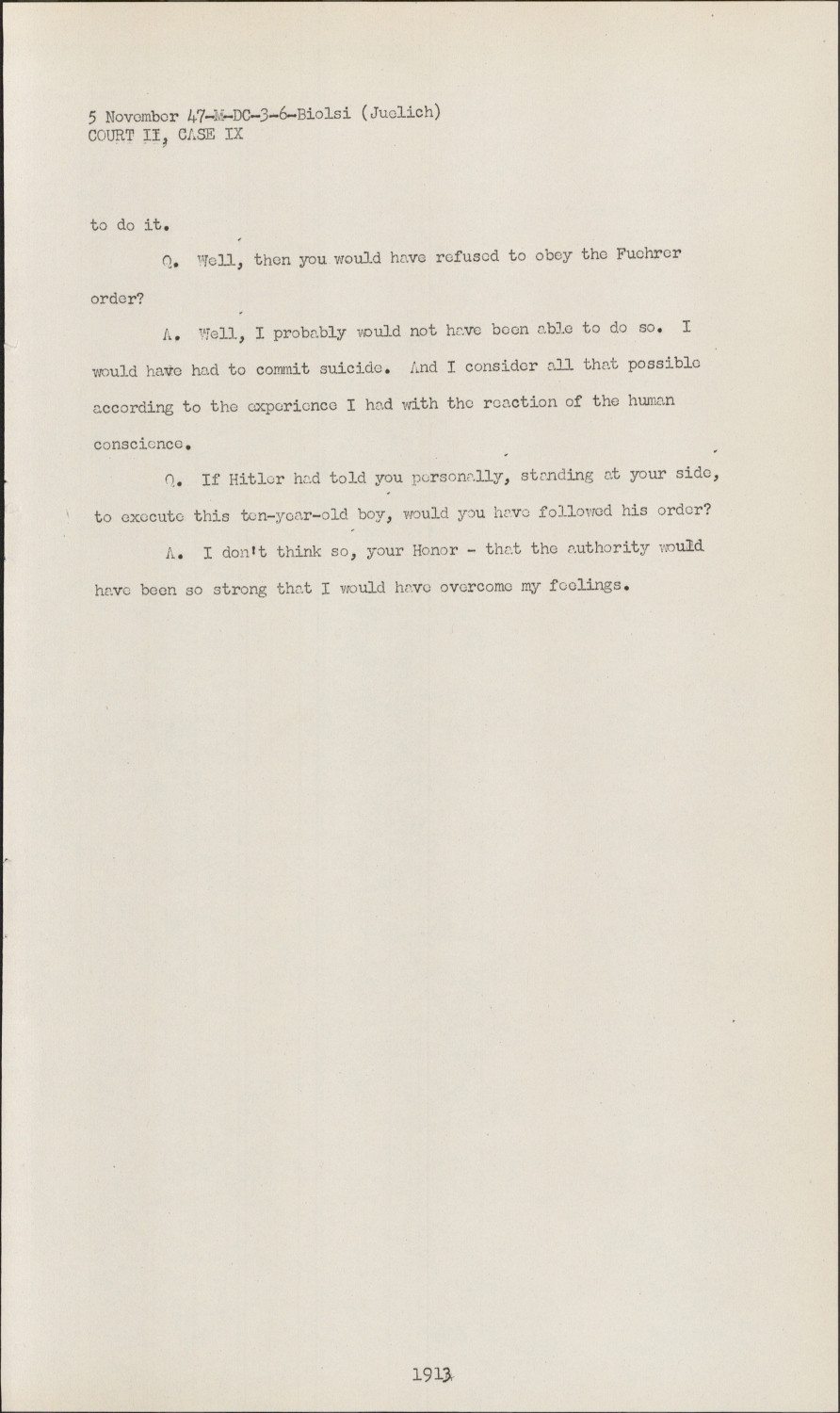
Q.Well, then you would have refused to obey the Fuehrer order?
A.Well, I probably would not have been able to do so. I would have had to commit suicide. And I consider all that possible according to the experience I had with the reaction of the human conscience.
Q.If Hitler had told you personally, standing at your side, to execute this ten-year-old boy, would you have followed his order?
A.I don't think so, your Honor - that the authority would have been so strong that I would have overcome my feelings.
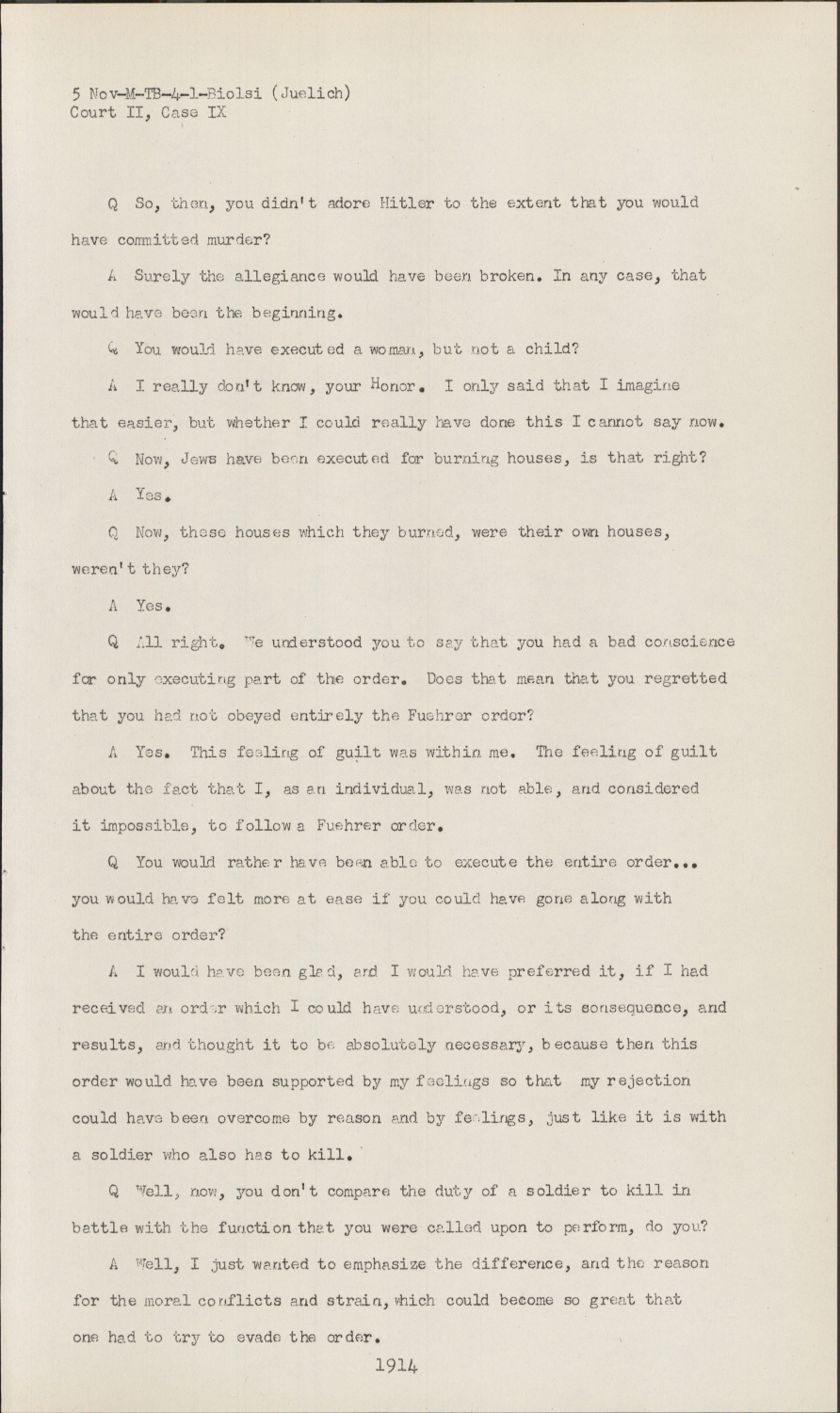
QSo, then, you didn't adore Hitler to the extent that you would have committed murder?
ASurely the allegiance would have been broken. In any case, that would have been the beginning.
QYou would have executed a woman, but not a child?
AI really don't know, your Honor. I only said that I imagine that easier, but whether I could really have done this I cannot say now.
QNow, Jews have been executed for burning houses, is that right?
AYes.
QNow, these houses which they burned, were their own houses, weren't they?
AYes.
QAll right. We understood you to say that you had a bad conscience for only executing part of the order. Does that mean that you regretted that you had not obeyed entirely the Fuehrer order?
AYes. This feeling of guilt was within me. The feeling of guilt about the fact that I, as an individual, was not able, and considered it impossible, to follow a Fuehrer order.
QYou would rather have been able to execute the entire order... you would have felt more at ease if you could have gone along with the entire order?
AI would have been glad, and I would have preferred it, if I had received an order which I could have understood, or its consequence, and results, and thought it to be absolutely necessary, because then this order would have been supported by my feelings so that my rejection could have been overcome by reason and by feelings, just like it is with a soldier who also has to kill.
QWell, now, you don't compare the duty of a soldier to kill in battle with the function that you were called upon to perform, do you?
AWell, I just wanted to emphasize the difference, and the reason for the moral conflicts and strain, which could become so great that one had to try to evade the order.

QYes, but all the time you had a guilty conscience because you had not lived up to the full extent of the Fuehrer order?
AYes. The order was so forceful as an order for me.
QAnd if you had had an opportunity, would you have expressed your regrets to Hitler that you were unable to execute the entire order which he had given to you?
AIf I had been able to do so, surely, I would gladly have expressed the reasons which caused no to do so.
QAnd you would in that way have qualified your oath of absolute allegiance to him?
AI did not get the last word.
QYou would, to that extent, have modified the oath of unquestioning allegiance which you had made to him?
AI surely would have told him that if I followed the allegiance I would never have been convinced that this relation which seemed ideal to me would have brought me into such conflicts.
QAnd you would have to that extent modified your allegiance to him?
AI could have told him, and I should have told him, that I could not obey him to the full extent.
QYes. But in spite of this modification in your mind you want on from 1941 to 1945, still being faithful to him?
AThat is in development, of course. Criticism awoke slowly owing to this first event, and solely criticism was expressed.
QBy you?
ABy me, too, your Honor.
QWere you criticising Hitler after 1941?
AOnly once was I in a situation up to then, when I had to obey an order which I considered wrong.
QWhat order was that?
AIt was the Commando order, and at the time I did not carry out this order. That was in 1944.
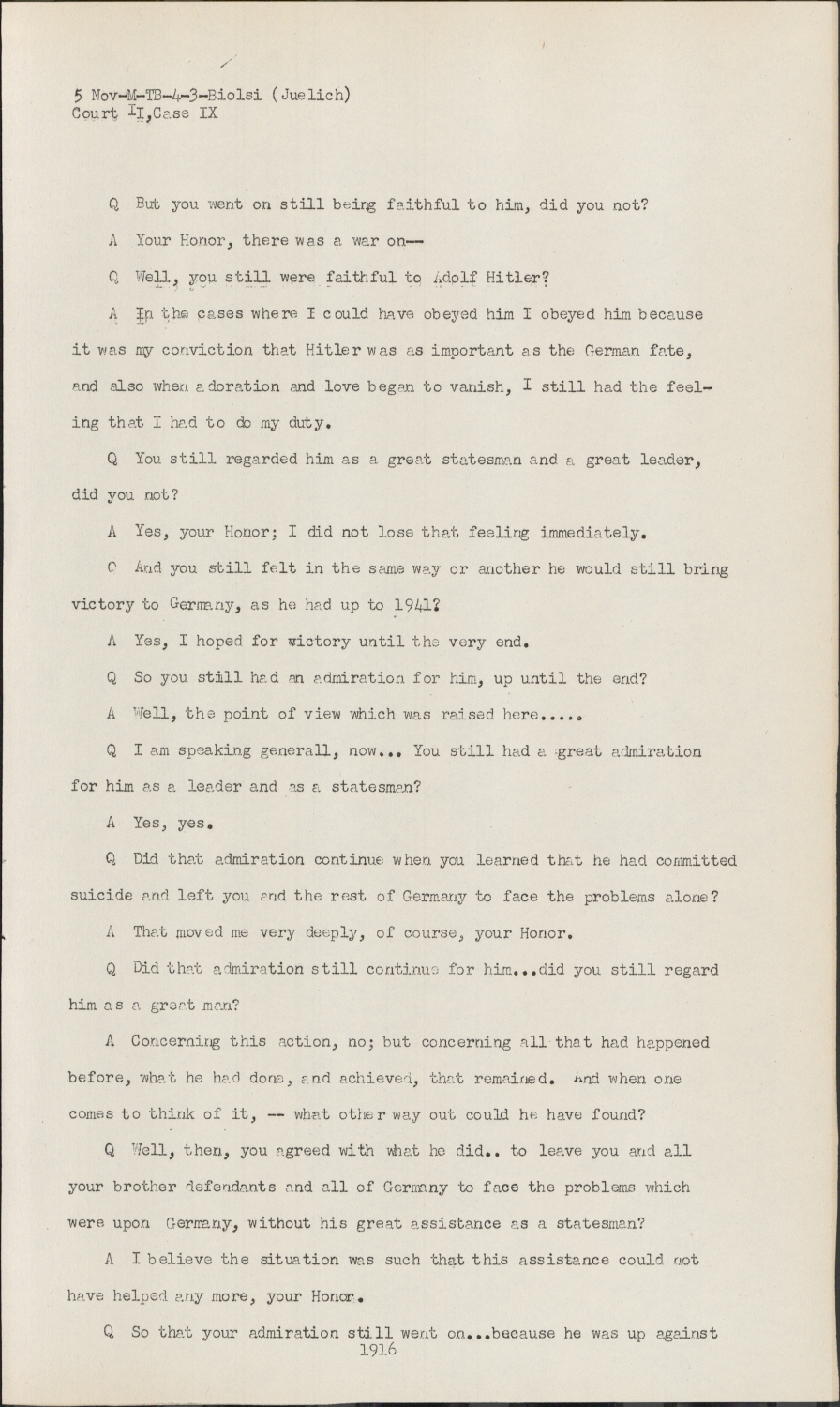
QBut you went on still being faithful to him, did you not?
AYour Honor, there was a war on-
QWell, you still were faithful to Adolf Hitler?
AIn the cases where I could have obeyed him I obeyed him because it was my conviction that Hitler was as important as the German fate, and also when adoration and love began to vanish, I still had the feeling that I had to do my duty.
QYou still regarded him as a great statesman and a great leader, did you not?
AYes, your Honor; I did not lose that feeling immediately.
QAnd you still felt in the same way or another he would still bring victory to Germany, as he had up to 1941?
AYes, I hoped for victory until the very end.
QSo you still had an admiration for him, up until the and?
AWell, the point of view which was raised here.....
QI am speaking generall, now... You still had a great admiration for him as a leader and as a statesman?
AYes, yes.
QDid that admiration continue when you learned that he had committed suicide and left you and the rest of Germany to face the problems alone?
AThat moved me very deeply, of course, your Honor.
QDid that admiration still continue for him...did you still regard him as a great man?
AConcerning this action, no; but concerning all that had happened before, what he had done, and achieved, that remained. And when one comes to think of it, -- what other way out could he have found?
QWell, then, you agreed with what he did.. to leave you and all your brother defendants and all of Germany to face the problems which were upon Germany, without his great assistance as a statesman?
AI believe the situation was such that this assistance could not have helped any more, your Honor.
QSo that your admiration still went on...because he was up against a situation that he could not overcome?
AHis death, the manner of his death, did not influence my feelings decisively. Only a factual investigation of everything that happened could clarify matters for me. I would have considered it my duty to consider what I thought and felt, at the time, based on what has become generally known, to examine everything in my mind, and surely I would not try to revise my judgment and to change it, if I was convinced that I had followed an idol.
QWell, you still admired him and felt that he had had a bit of hard luck, but he was still a great figure in your mind and heart?
AI believe, your Honor, that nobody has bad luck, but that everything that happened is the logical consequence of positive and negative matters.
QNow, please answer this one question. Did you still admire him after April 1945, or not?
AI am convinced that many things were quite wrong, or this result could not have happened, not even concerning Hitler.
QWell, then, you did not admire him after he committed suicide?
AThere are some things, your Honor, which remain... and must, in my opinion be recognized as an achievement.
QWell, then, you still do admire him?
AOn those subjects, yes, your Honor.
QSo that even today you still admire Adolf Hitler for many of the things which he did.
ASome things, even in my present opinion, were good.
QYes; you still regard that he was a great man and had done a great deal for Germany?
AThis final statement your Honor, I would only like to make when I have opportunity to examine everything that has happened.
QWell, you certainly have had plenty of opportunity for reflection now... you went through the war, you lived in Germany, and you had two and one-half years to reflect on what has happened. Now do you still regard Adolf Hitler a great man on the stage of history, and that he did accomplish many wonderful things for Germany, and, therefore, falls into the category of a great man?

Do you believe that today?
AI cannot give a clearer reply than that a judgment now, having become more critical of events which occurred... I can only give a judgment when I have looked into things.
QWell then, you can give one of three answere: one, you do admire Hitler as a great man, a statesman and a leader; two, you do not admire him as a great man, a statesman and a leader; three, you have your doubts as to whether he was a great man, a statesman and leader. Now, which one of these three answers will you choose?
AThe last one, your Honor, is definitely the one I mean.
QVery well, yesterday your attorney presented you with a document which purported to be an excerpt from a newspaper published on 29 March 1938 regarding the annexation of Austria to Germany. You are familiar with that newspaper, are you?
AYes, your Honor.
QYou remember reading about the action of the bishops and the cardinals?
AYes.
QAnd it pleased you very much that the church, inasfar as it was represented by these ecclesiastics, favored the union between Austria and Germany?
AYes, your Honor.
QYou believed that the church was certainly competent to express its opinion on this political matter?
AYes.
QAnd you had faith in the church?
AI myself was neutral. I was not a member.....
QI am asking you, did you have faith in this expression of the church?
AMay I have that again, please? I beg your pardon, your Honor, I did not quite understand.
QI have related to you the expression of the church in Austria regarding union between Austria and Germany. You were very much pleased with this statement. You had faith in the church in expressing this statement of approval?
AYes, I considered it decisive.
QYes, and you had a great deal of respect for the church?
AYes.
QWell then, why did you leave the church?
AI had left the church before, your Honor. The reason was that my religious ideas I could not combine with the dogma of the Protestant Church.
QSo that the only time the church meant anything to you was when it expressed a political judgment which agreed with your political judgment ?
ANo, your Honor. My step was a private and personal step. As the functions and tasks of the church and their meaning for the education of the people and for the moral attitude of human beings was never doubted by me, I, therefore, believe that the declaration by the bishops in Austria was very welcome, because I realised that in the Eastern Territory, the Ostmarks in particular, the influence of the church towards the moral attitude of the people was a very strong one and that, therefore, the development of the state and the annexation could only be guaranteed if the church assisted.
QTherefore it was the political act of the church which pleased you because this is entirely a political matter.
AI believe that this event was so important that the church could not avoid taking an interest in this.
QIt was a political act on the part of the church. It had nothing to do about a man's soul and his answerability to God, did it?
AI believe a love for your native country is an inner feeling of the soul and a church should and can take an interest in this.
QBut you didn't think enough about the church for you to remain in the church. You left it yourself, didn't you?
AThis had nothing to do with the statement I made before, but it was like this: formerly the Protestant Church, to which I had belonged, for example, had among their principles a host of great spirits. For example, I had a clergyman who confirmed me who considered art and natural feelings very important and in his sermons he touched on all the great minds in German literature and philosophy.
That was a world where I liked to live. Later on the church developed to the opposite and became very orthodox and then I could not follow any more.
QTherefore, to that extent you condemned the church?
AI personally drew the consequences from this, but I am fully convinced-
QYou withdrew from the church?
AYes, I left the church.
QYes, and the only time that you thought about the church again was when the church of Austria, insofar as represented by these bishops, approved of the annexation of Austria by Germany.
ANo, your Honor, as a part of public life it has always appeared important to me even then.
QNow, just one final question. He asked you of your estimate of Hitler today, and we concluded from what you said that you entertained great doubts as to whether he was a great man or not. If he were here today, if he were in this courtroom, would you express that to him, that you have great doubts about his having done any good for Germany?
ACertainly, your Honor.
THE PRESIDENT:That is all. The defendant will be withdrawn from the witness stand.
DR. LUMMERT:I beg your pardon, your Honor.
THE PRESIDENT:Unless you have some further questions.
DR. LUMMERT:In the meantime I have looked at the document which Mr. Ferencz gave me, and I request that I may be permitted to ask him which is the section of this document which he read out yesterday?
Mr. Ferencz just told me that he did not read anything out of this document but that he merely showed the entire document to the witness, but I believe Mr. Ferencz has given the contents of a part of this document. That is what I understood, is that right?
MR. FERENCZ:Your Honor, I believe the defense counsel was here during the cross-examination when I asked the witness whether he had received an order from Himmler concerning the execution of whole families of persons who were believed to be partisans, and I showed him this document to refresh his memory.
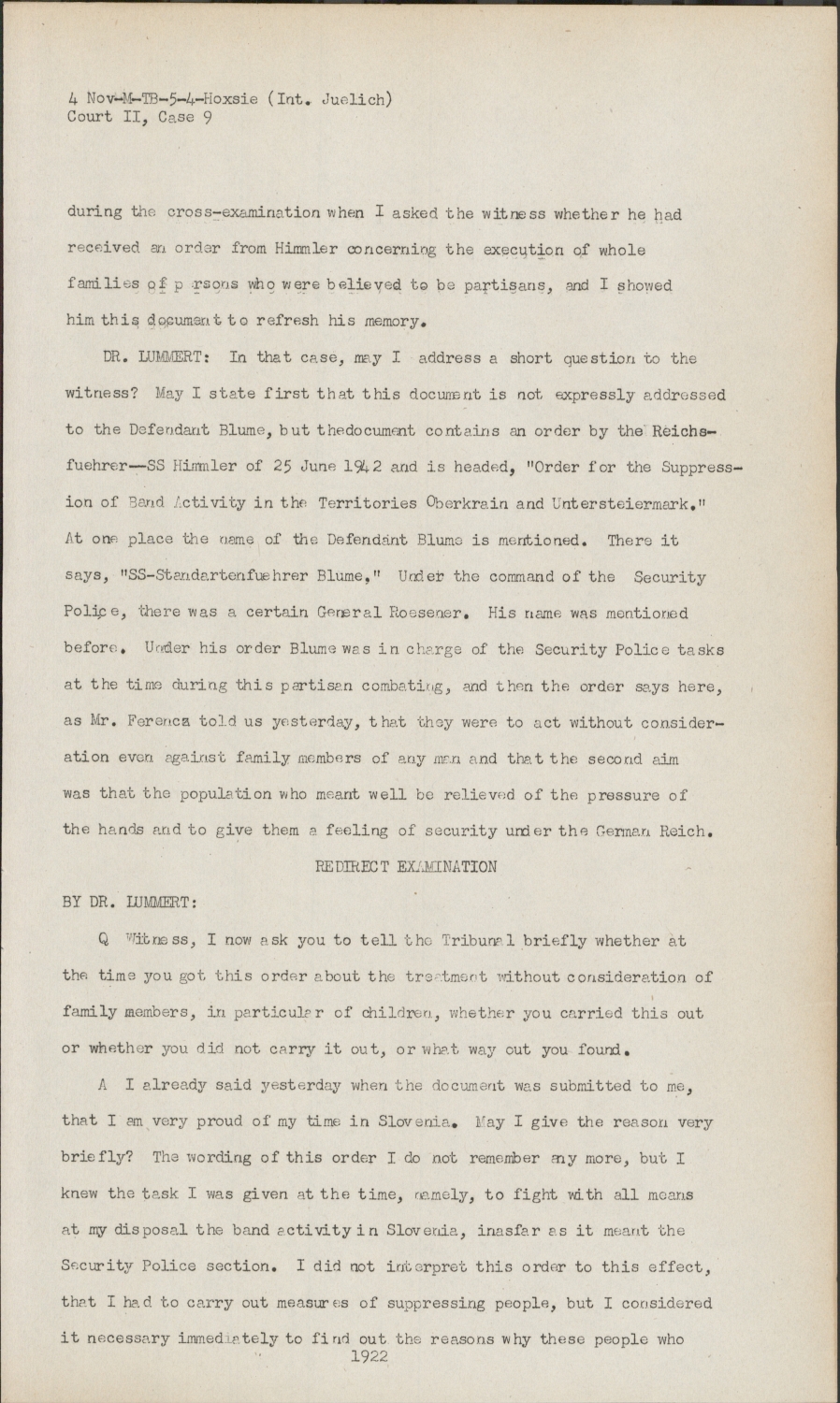
DR. LUMMERT:In that case, may I address a short question to the witness? May I state first that this document is not expressly addressed to the Defendant Blume, but thedocument contains an order by the Reichsfuehrer--SS Himmler of 25 June 1942 and is headed, "Order for the Suppression of Band Activity in the Territories Oberkrain and Untersteiermark." At one place the name of the Defendant Blume is mentioned. There it says, "SS-Standartenfuehrer Blume," Under the command of the Security Police, there was a certain General Roesener. His name was mentioned before. Under his order Blume was in charge of the Security Police tasks at the time during this partisan combating, and then the order says here, as Mr. Ferencz told us yesterday, that they were to act without consideration even against family members of any man and that the second aim was that the population who meant well be relieved of the pressure of the hands and to give them a feeling of security under the German Reich.
REDIRECT EXAMINATION BY DR. LUMMERT:
QWitness, I now ask you to tell the Tribunal briefly whether at the time you got this order about the treatment without consideration of family members, in particular of children, whether you carried this out or whether you did not carry it out, or what way cut you found.
AI already said yesterday when the document was submitted to me, that I am very proud of my time in Slovenia. May I give the reason very briefly? The wording of this order I do not remember any more, but I knew the task I was given at the time, namely, to fight with all means at my disposal the band activity in Slovenia, inasfar as it meant the Security Police section. I did not interpret this order to this effect, that I had to carry out measures of suppressing people, but I considered it necessary immediately to find out the reasons why these people who had greeted our soldiers with flowers when they arrived, had brought them into the mountains with arms, chasing them there.