DR. RIEDIGER:I submit the writing the orders as Exhibit No. 1;
and I refer to the loose page which is contained in the pad. I submit as Exhibit No. 2, two negative prints -- two negatives concerning the person of the witness Haensch. Also, as Exhibit No. 3, I submit a book containing the orders for photographs, and draw your attention to number 391, page 94, of 21 February 1942.
And also, as No. 4 I submit a photograph of the witness.
DR. HOCHWALD:The Prosecution has no objection against the submission of these exhibits, but reserves the right to have then examined at a later date by experts. The books, and, eventually, also the negatives.
THE PRESIDENT:Yes. The exhibits will be accepted, and the Secretary General is instructed that Exhibit I will include, in addition to the black pad, the photostatic page. Exhibit 2 will include, in addition to the negatives, the envelope in which the negatives were contained, and the box in which the negatives and envelope were contained.
Very well.
GUSTAVNOSSKE, a witness, took the stand and testified as follows:
JUDGE SPAIGHT:Raise your right hand, witness, and repeat after me:
I swear by God, the Almighty and Omniscient, that I will speak the pure truth, and will withhold and add nothing.
(The witness repeated the oath.)
JUDGE SPAIGHT:You may be seated.
DR.HOFFMANN (for the defendant Nosske): Your Honors, I would like to start the evidence in the case by questioning the witness himself.
THE PRESIDENT:You may proceed, Dr. Hoffmann.
DIRECT EXAMINATION BY DR. HOFFMANN:
QHerr Nosske, do you remember the first visit I had with you in the prison?
AYes.
QPlease repeat to the Tribunal what you told me at the time.
AI told you at the time, that I considered the Hitler order intenable and unethical.
QWitness, when ;you received the order at the time, did you feel to be an official, or a soldier -- or what attitude did you have concerning your office?
AI considered myself a soldier because I had been put into a military assignment, as part of the army. I was under martial law-and martial law applied to me.
QWitness, why did you consider this order immoral, being a soldier?
AIt seemed impossible to me to combine this with human conscience, in order to break up Bolshevism -- which was the aim of the war -- to kill a section of the population indiscriminately merely for that purpose.
QWitness-
AEven if I were told that the Eastern Jews were the main support of Bolshevism, I could not recognize, and could not realize, that it should be necessary for our own security to kill women and children.
QWitness, did I ask you at the time whether you could have evaded carrying out the order?
AYes.
QWhat did you reply to me at the time?
AI told you at the time that as little as any one else, who received the order in Pretzsch, could I have evaded carrying out this order. If I had said that I would never carry out this order, I would have been put before a court-martial, and would have been shot. If I had escaped, they would have seized me, and the same result would have been the consequence. And the public would never have heard why, and my relatives would have considered me dishonored, because they would only be told that I had deserted.
QWitness, could you have turned to the press?
AApart form the fact that I could not leave Pretzsch at all, II had no relations with the press, and it just did not occur to me to approach the press at all, because this would be like giving myself up to an authority, so that they could arrest me.
QSince you rejected the order on a moral basis, but yet received it -- and since you thought you could not evade it, what way-out did you find?
AI could only wait. I could not imagine at all whether, and how, such an order would ever to carried out. I could only hope that I myself would never be put into such a situation where I would have to carry out this order, or that any other circumstances might arise which might make it possible for me not carry out this order.
QWitness, I would like to talk about you career now. Please tell the Tribunal very briefly how you career was, until the year 1933/
AI was born on 29 December 1902, in Halle.
THE PRESIDENT:Dr. Hoffmann, it is so close to the recess period. Don't you think it might be well to recess now, and then take up the curriculum vitae?
DR. HOFFMANN:Yes.
THE PRESIDENT:The Tribunal will be in recess for fifteen minutes.
(A recess was taken)
THE MARSHAL:The Tribunal is again in session.
DR. HOFFMANN:Mr. President, before we start with the examination of the defendant Noske, may I first make a motion that the defendant Braune be excused form the session this afternoon, since he expects afternoon visit from his wife.
THE PRESIDENT:In order that the defendant Braune may be available when his wife arrives, he may be excused from attendance in court this afternoon. BY DR HOFFMANN:
QWitness, before the recess I asked you to tell the Tribunal about your life history up to the year of 1933?
AFrom the sixth to the tenth year of my life I attended high school for four years, afterwards, the high school in Halle. There II graduated in 1922. Since the money for my university studies was lacking, I started as an apprentice at the Halle branch of the Deutsche Bank and Diskonto Gesellschaft and, after an apprenticeship of two years, until the year of 1925, I remained in the banking business. Then I started my studies in political science and law. In 1930 I passed my first State examination; in 1933 I was in legal training as a legal referendar.
QWitness, were you until 1933 a member of any Party, or were you in any other organization?
ANo, I neither belonged to the Party, nor any organization. At this time I had no kind of political interests. I spent my leisure time rowing or with other friends without any political tendency playing any part among us.
QIn what position were you when Hitler came to power in 1933?
AAt the time Hitler took over the power I was being legally trained as a referendar in the courts. Furthermore, I was active as no auxiliary worker with an attorney for which I got paid a small amount.
QHow old were you then?
ATwenty-six years old, or rather twenty-eight.

QDid you at this time join the Nazi Party when you were a legal referendar?
AThe marches and mass meetings of the Party didn't have any attraction for me, and I did not participate in them. But when the order was given that young lawyers were to join the Party, or one of its organizations, I joined the party without any particular reluctance, but also without any special enthusiasm.
QExactly when did you join the Party?
AOn the 30th of April, 1933.
QDid you join any other organization outside the Party?
AYes, in the summer of 1933 I joined the SA. That had the following reasons. As I have already described, I worked for an attorney as an aide. This attorney was the legal consultant for an SA unit, but because of his professional activity, which kept him very busy, he could no longer perform this activity. He, therefore, asked me that I should take over this legal information service in his stcad. Connected with that was that I joined the SA.
QDid you have any rank or position in the Nazi Party or the SA?
ANo. I neither held a position nor did I do any service in the SA. I were the SA uniform, namely the uniform of a private in the SA, and I performed the service of legal consultant for this SA unit.
QWitness, I now come to your professional development. How did this develop from 1933 on until the completion of your legal training?
AIn the year 1934, that is in January, I passed my examination as assessor, which enabled me to become a judge, district attorney, or just a lawyer, but a position, or any final definite position was not connected with this. In the letters of the Ministry of Justice which confirmed to me the fact that I had passed the examination, it said that for the next few years one could not count on such a position since in Prussia at that time more than 3,000 assessors were available but any 250 could be employed annually.
QWere you financially in the position to do nothing, or did you have to earn a living?
AI was not financially in the position to live without a job. The occasional deputizing for judges who were on furlough or who were sick was not sufficient to make a living. Therefore I had to find a permanent job.
QWhat did you do to secure such a position; did you go to various authorities or agencies?
AI wrote out applications to various agencies and ministries, among them the Finance Ministry, the Ministry of Interior, and after a long time the Ministry of the Interior was the only one which reacted to such an application. I was allowed to introduce myself, and I was accepted professionally.
QWhen and where were you called?
AI was called to the district government in Aachen. The time was the 1st of June, 1935.
QWhat did your activity consist of in the district government in Aachen?
AOutside of the general administrative capacity, as it isis customary in such a district government, I was occupied with frontier matters.
QHow long did this activity last?
AThis activity lasted about two months.
QWhere were you transferred then?
AOn the basis of a ministerial decree I was transferred to the Border Police which was a part of the Gestapo and was being organizationally built up as such. This included the fact that I was active with the State Police in an informational capacity, and I performed this activity in the State Police office in Aachen, which was in the same building as the district headquarters with whom I had worked thus far.
QHow long did this position last?
AThis activity lasted until September, 1936, when my provisional year expired.
QAnd after this what happened?
AAfter the provisional year expired I was transferred to Frankfurt on the Oder River, and there I was given the directorship of the State Police Agency in Frankfurt with the special mission to carry out the organization of the Border Police which had already been approved.
QWitness, how large was the district of the State Police Agency in Frankfurt on the Oder?
AThe district was very great. It corresponded to the district area of Frankfurt on the Oder. It contained about 800,000 inhabitants.
QDid you have any misgivings, Witness, when you were transferred to the Gestapo by the Ministry of the Interior?
AApart from the fact that it was not by my own will I did not have the slightest misgivings for already during my informational work in Aachen I got to know the activity of the Gestapo in its legal foundations. The State Police had the job to prosecute political; crimes, and in this capacity it is an auxiliary organ of the State prosecution, just like the criminal police was the auxiliary organ to the State prosecution for crime.
QWitness -
AThe second mission of the State Police was counterintelligence. That is the mission to prevent the spying and detecting of state secrets. This is an activity as it is carried on in all modern states of the world, especially in the Western World, and as we know it as the Surete in France and Belgium and as the Second Bureau of the Surete, which corresponds to the counter-intelligence.
QWitness, didn't you know the funny feeling that people had about the Gestapo in Germany, was this not known to you?
AI must say honestly, no. At least I had lost this feeling when I took up my job, not because nothing could have happened to me any more, but because things only happened actually which I could approve, even if applying the strictest standard, and I could approve of it as justified and moral. Furthermore one has to consider that these were the years 1936 to 1939, that is to the outbreak of war and that here no matters can be brought in, which at a later period couldn't be approved by me, under any circumstances.
QWitness, you certainly knew that there were concentration camps in Germany, did you not?
AYes, at this time there were two concentration camps. Officially I did not hear their names, but they were known to me.
QDidn't you undertake to send people to these concentration camps?
AIt did not belong to the authority of a regional State Police Agency, or rather to the authority of a director of such an agency to send people to concentration camps. Only the Chief of the Security Police personally held this authority. As far as the regional agencies were concerned, it was only their obligation to report. Reporting was done by transmitting a carbon copy of the entire action, of the entire record, and then a duplicate of the files which was to be filed in the central index in Berlin. Sending people to a concentration camp was prepared by the Office for Protective Custody in Berlin. Suggestions were made by the expert office of the RSHA, and the order to send the person there was always signed personally by the Chief of the Security Police, that is Heydrich at the time.
For him sometimes a stamp was put in, the seal. The transfer, the transport of an inmate was done by the local police authorities who always were the transport agency for prisoners in Germany.
QWitness, do you mean to say that every order to confine someone to a concentration camp was signed by Heydrich and later Kaltenbrunner?
AKaltenbrunner signed them and I saw them.
QAnd before that Heydrich?
AYes, Heydrich, as long as I was with the State Police.
QAnd this was there, that is, with each order?
AYes, each order to confine somebody to a concentration camp was signed by him personally or the Chief of Office IV was provided with the stamp of his name in his absence, but always it bore the signature of the Chief of the Security Police.
EXAMINATION BY THE PRESIDENT:
QWitness, how long were you in the Gestapo?
AYour Honor, with interruptions, I was with the Gestapo until the 20th of September, 1944. That is to say, for this period I differentiate the following. As director of a regional State Police Agency, I was active from the fall of 1936 until the fall of 1937. That is, one year I was active as such. In between I had another occupation. Later I became again a director of a regional police agency, from July 1938, until July, 1939, and then a third time from October 1943, until September 1944.
QDuring all this time do we understand you to say that all commitments to concentration camps were signed either by Heydrich or by Kaltenbrunner?
AAbsolutely. It never happened any differently. In this case I refer to the time before the war. 1943, '44, the commitments which were connected with the regional authority of a State Police Agency also happened as a result of an individual paper which carried the facsimile stamp of Kaltenbrunner.
QWell, the application of the signature of either Heydrich or Kaltenbrunner was more or less a formality, wasn't it?
ANo, no.
Q.Now, Witness, do you want to tell us that Heydrich investigated every case of a concentration-camp consignment or commitment?
A.Your Honor, I personally was not in the RSHA in this activity, and I can only judge these circumstances from my own activity in a regional office, but later when I was active in the RSHA and got to know one or the other officials who dealt with this matter, I heard then that these commitments to concentration camps were actually signed by the chief or by the office chief.
Q.Well, Witness, what I am asking you is this, Heydrich and later Kaltenbrunner could not have investigated every commitment to a concentration camp, could they?
A.No, certainly not.
Q.All right. Then it was a mere formality, the adding of a facsimile signature with a stamp, or the signing of their name by one of may deputies?
A.Still I don't believe so, your Honor, for in view of the number, and I am now speaking for the time before the war, it was very easy and absolutely possible to have the cases brought before you, those cases which were supposed to be consigned to concentration camps, for I know from my time in Frankfurt on the Oder, and later in Graz, that in this area of 800,000 people not more than thirty to forty people were in a concentration camp.
Q.Now, just a moment, Witness, don't let's drift. In 1939, on September 1st, about how many people were in the concentration camps of Germany?
A.Your Honor, from my state police activity I never was able to find this out.
Q.Well, you know now, don't you, that there were tens of thousands at least, don't you?
A.Yes, through the Expert for Protective Custody, Dr. Berndorf, whom I met in one of the interment camps, I talked to him about what is true of the concentration camps what is not true.
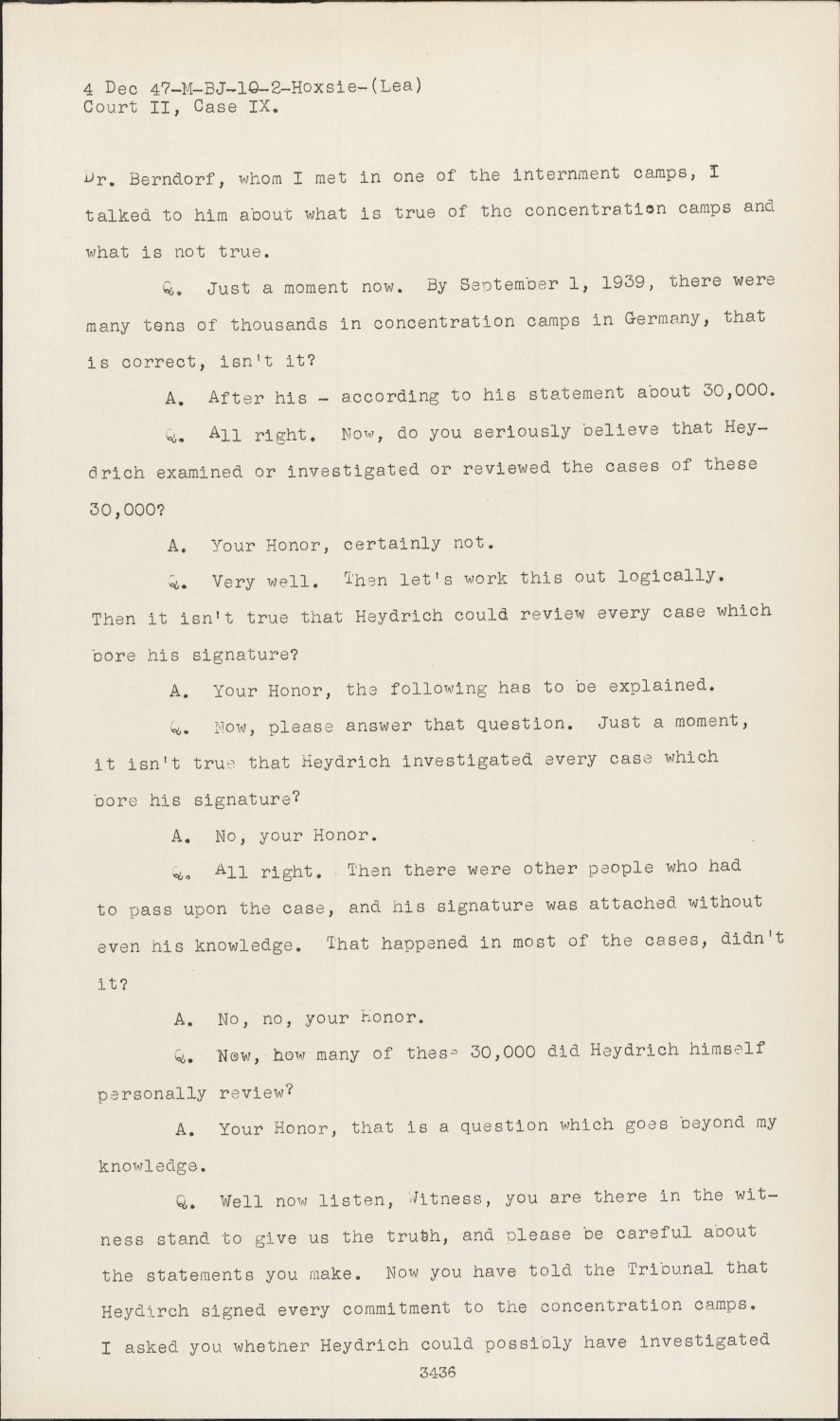
Q.Just a moment now. By September 1, 1939, there were many tens of thousands in concentration camps in Germany, that is correct, isn't it?
A.After his - according to his statement about 30,000.
Q.All right. Now, do you seriously believe that Heydrich examined or investigated or reviewed the cases of these 30,000?
A.Your Honor, certainly not.
Q.Very well. Then let's work this out logically. Then it isn't true that Heydrich could review every case which bore his signature?
A.Your Honor, the following has to be explained.
Q.Now, please answer that question. Just a moment, it isn't true that Heydrich investigated every case which bore his signature?
A.No, your Honor.
Q.All right. Then there were other people who had to pass upon the case, and his signature was attached without even his knowledge. That happened in most of the cases, didn't it?
A.No, no, your Honor.
Q.New, how many these 30,000 did Heydrich himself personally review?
A.Your Honor, that is a question which goes beyond my knowledge.
Q.Well now listen, Witness, you are there in the witness stand to give us the truth, and please be careful about the statements you make. Now you have told the Tribunal that Heydrich signed every commitment to the concentration camps. I asked you whether Heydrich could possibly have investigated every case.
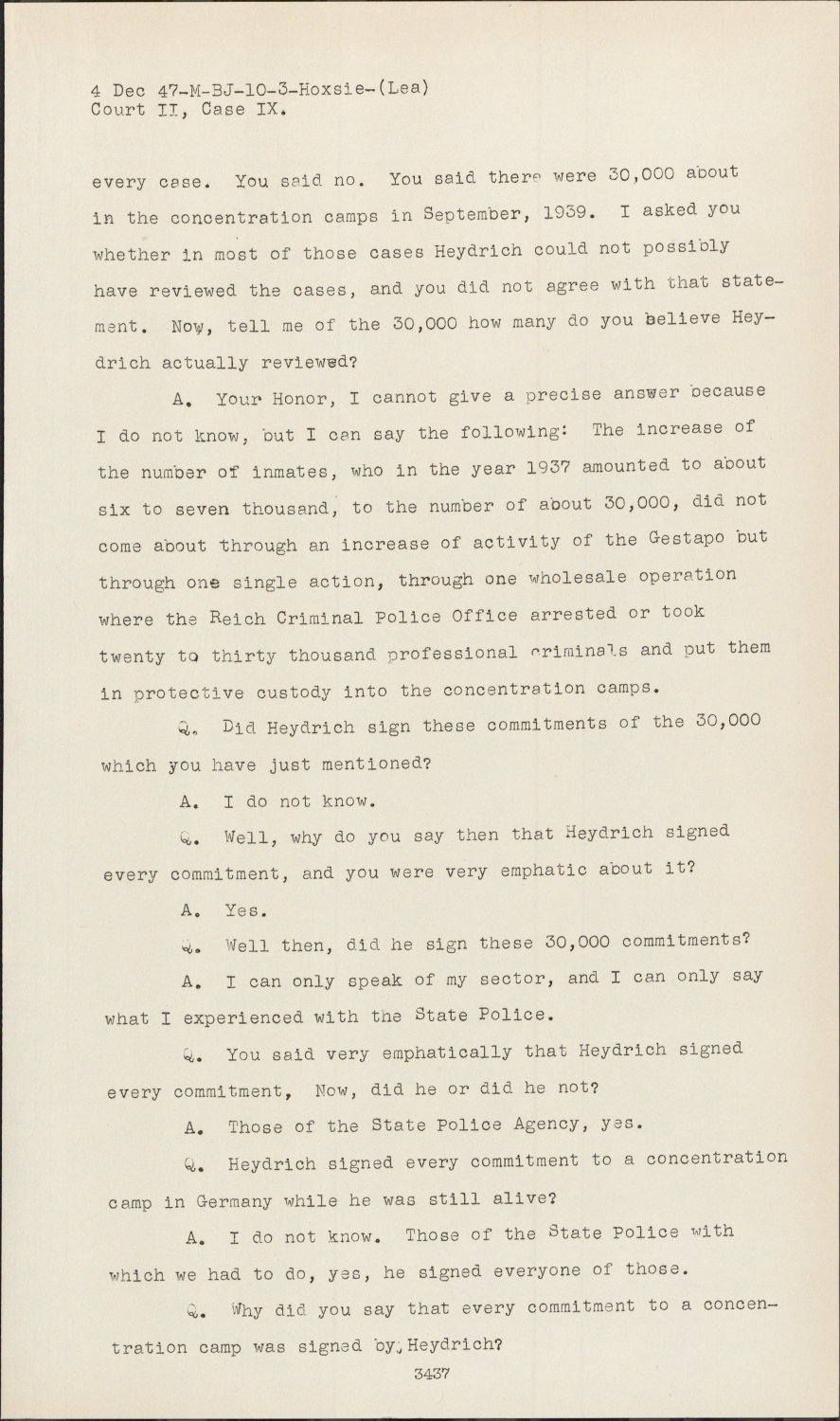
You said no. You said there were 30,000 about in the concentration camps in September, 1939. I asked you whether in most of these cases Heydrich could not possibly have reviewed the cases, and you did not agree with that statement. Now, tell me of the 30, how many do you believe Heydrich actually reviewed?
A.Your Honor, I cannot give a precise answer because I do not know, but I can say the following: The increase of the number of inmates, who in the year 1937 amounted to about six to seven thousand, to the number of about 30,000, did not come about through an increase of activity of the Gestapo but through one single action, through one wholesale operation where the Reich Criminal Police Office arrested or took twenty to thirty thousand professional criminals and put them in protective custody into the concentration camps.
Q.Did Heydrich sign these commitments of the 30,000 which you have just mentioned?
A.I do not know.
Q.Well. why do you say then that Heydrich signed
A.I can only speak of my sector, and I can only say what I experienced with the State Police.
Q.You said very emphatically that Heydrich signed every commitment, Now, did he or did he not?
A.Those of the state Police Agency, yes.
Q.Heydrich signed every commitment to a concentration camp in Germany while he was still alive?
A.I do not know. Those of the State Police with which we had to do, yes, he signed everyone of those.
Q.Why did you say that every commitment to a concentration camp was signed by Heydrich?
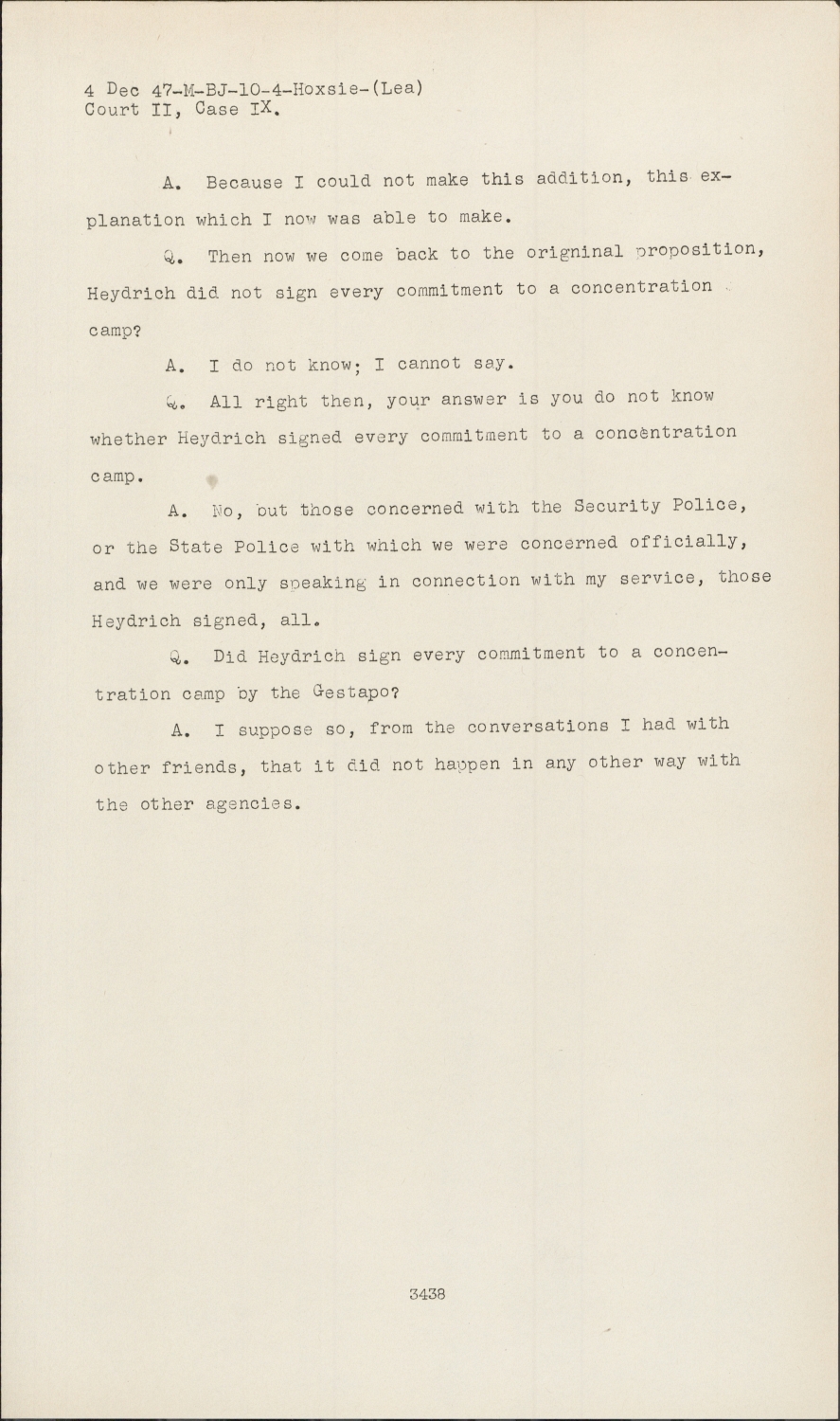
A.Because I could not make this addition this explanation which I now was able to make.
Q.Then now we come back to the original propsition, Heydrich did not sign every commitment to a concentration, camp?
A.I do not know; I cannot say.
Q.All right then, your answer is you do not know whether Heydrich signed every commitment to a concentration camp.
A.No, but those concerned with the Security Police, or the State Police with which we were concerned officially, and we were only speaking in connection with my service, those Heydrich signed, all.
Q.Did Heydrich sign every commitment to a concentration camp by the Gestapo?
A.I suppose so, from the conversations I had with other friends, that it did not happen in any other way with the other agencies.
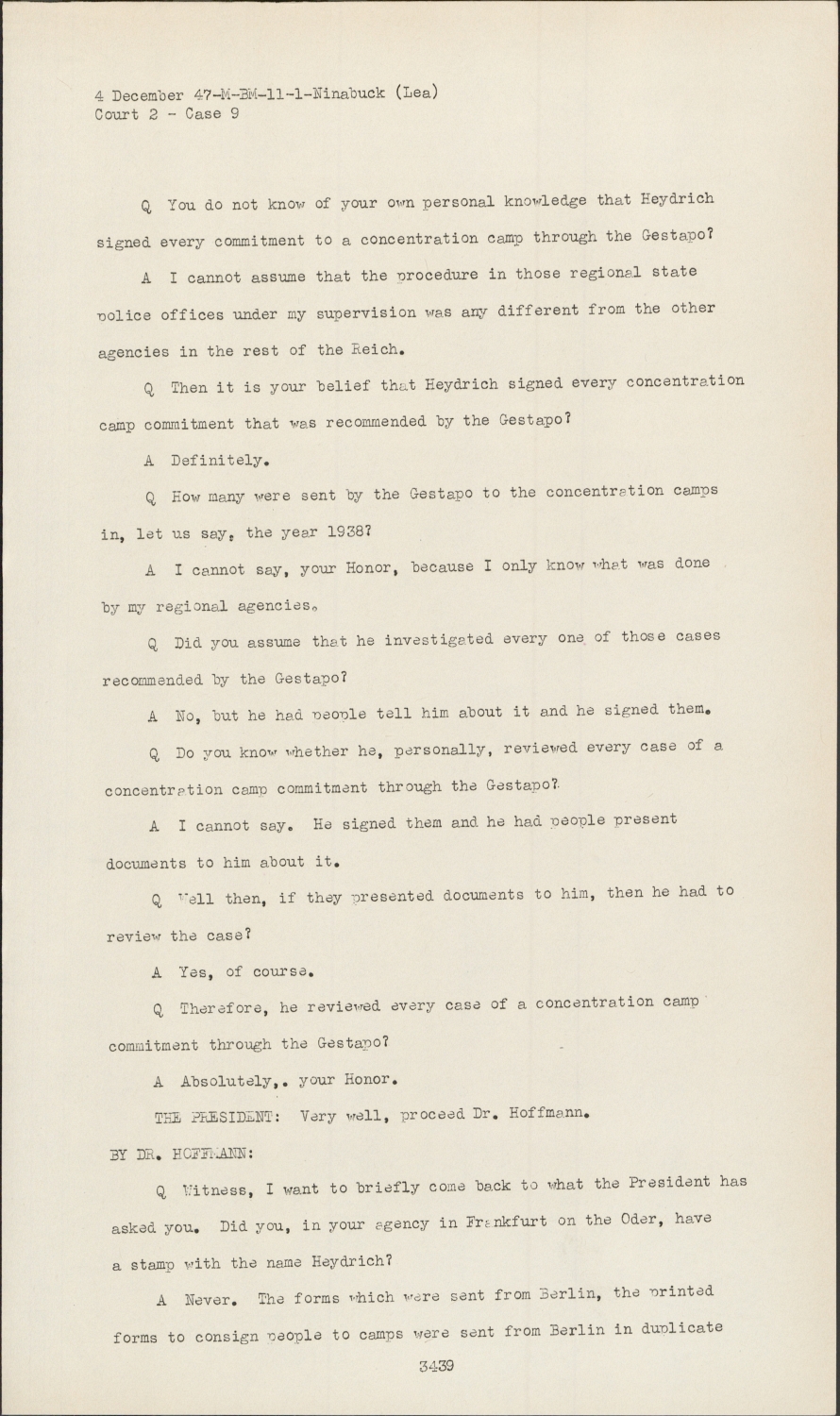
QYou do not know of your own personal knowledge that Heydrich signed every commitment to a concentration camp through the Gestapo?
AI cannot assume that the procedure in those regional state police offices under my supervision was any different from the other agencies in the rest of the Reich.
QThen it is your belief that Heydrich signed every concentration camp commitment that was recommended by the Gestapo?
ADefinitely.
QHow many were sent by the Gestapo to the concentration camps in, let us say, the year 1938?
AI cannot say, your Honor, because I only know what was done by my regional agencies.
QDid you assume that he investigated every one of those cases recommended by the Gestapo?
ANo, but he had people tell him about it and he signed them.
QDo you know whether he, personally, reviewed every case of a concentration camp commitment through the Gestapo?
AI cannot say. he signed them and he had people present documents to him about it.
Q all then, if they presented documents to him, then he had to reviewed the case?
AYes, of course.
QTherefore, he reviewed every case of a concentration camp commitment through the Gestapo?
AAbsolutely,. your Honor. THE PRESIDENT: Very well, proceed Dr. Hoffmann. BY DR. HOFFMANN:
QWitness I want to briefly come back to what the President has asked you. Did you, in your agency in Frankfurt on the Oder, have a stamp with the name Heydrich?
ANever. The forms which were sent from Berlin, the printed forms to consign people to camps were sent from Berlin in duplicate and we ourselves had nothing to do with this and could not print them outselves.
That was out of the question.
QThus you sent your cases to Berlin?
AYes.
QAnd Berlin decided?
ABerlin decided whether a man would be sent to a concentration camp or not, but I may add that a report was made about every case, no matter what the RSHA or its chief would decide in the individual case. If any crimes were committed against the State laws, the cases had to be turned over to the courts and if any doubts existed whether a court had jurisdiction, then Berlin would examine and would ask for completions and additions, renewed interrogations, and then Berlin made its decision and said the individual concerned is to be handed over to the court or is to be dismissed or is to be reprimanded or something else.
THE PRESIDENT:Dr. Hoffmann, Heydrich was made chief of the Security Police and SD on June 26, 1936. I would like to have defense counsel or prosecution counsel obtain for the Tribunal, if it is possible, the figures as to the number of people committed to concentration camps between June, 1936 and June, 1942 when Heydrich died, in view of the witness's statement that he knows that Heydrich reviewed every case of people sent to the concentration camps during that period via the Gestapo.
DR. HOFFMANN:Your Honor, may I say the following. If I remember correctly in the case against Pohl the prosecution stated the exact number of the inmates in the concentration camps until 1939 and had them submitted. May I take the liberty to look for this, and since it is a public document I don't have to submit it specially. I also remember the trial of the IMT and the interrogation of Kaltenbrunner where actually it was Said that facsimile stamps with the name Kaltenbrunner were distributed among the Berlin agencies and that the departments concerned used this facsimile stamp. May I take the liberty to look for those things, and to submit them?
THE PRESIDENT:Yes, any information which can be obtained regarding the number of people committed to concentration camps via the Gestapo will be in order. BY DR. HOFFMANN:
QWitness, will you please tell the Tribunal every briefly what you did as director of the State police agency in Frankfurt on the Oder?
AAs far as the direction of the State police agency is concerned I had the overall direction, that is, the organization and the administration which took up most of my time. In addition there was the responsible leadership of the executive activities, for every report, except for the fact that I may have been absent to the RSHA, was personally signed by me. The main activity was already in the field of counter intelligence. The counter intelligence activity of the police was carried on in agreement with the military agencies who did not themselves have any executive officers, that is, in their investigation capacity they had to rely on our officials.
QWitness, I want to ask you concretely, specifically, were you active with the supervision, shadowing and prosecution of political opponents?
AIn the form that any violations of any State or Reich laws which came to our attention had. of course. to be prosecuted.
QWhat did you d when such a matter was brought to your attention? Did you make a report?
AYes. of course, the necessary investigations were made, interrogations were conducted, and a report was made to me or the executive official and the result of the investigation was submitted.
QDid you yourself undertake arrests?
ANo, not I personally, but within the compete activity of the regional police agency arrests were necessary, but the number of the arrests was actually not large for this whole district and at this time it was an exceptional case, for the regional state police agency only had the right to arrest a man for the duration of ten days.
After these ten days had expired the arrested man would either have to be dismissed or be handed over to the courts.
QWitness, as far as your arrests are concerned, did you have any legal basis or directive or decree? On what did you base yourselves when making these arrests?
AYes, we had a legal foundation in various laws, the law about the Secret State Police which is organized on Article 48 of the Reich Constitution and then the other Reich laws, and above all the civil penal code about treason were wholly valid and were used just as they were used before Hitler took over.
THE PRESIDENT:Dr. Hoffmann, would you also try to submit to the Tribunal the directive, decree, law, order or legislation which stated that the Gestapo could hold a detainee only ten days? Upon the termination of the ten days he either had to be released or turned over to the courts. That is the statement made by the witness and we would be very grateful if you could submit to us the documentary proof of that order or decree.
DR HOFFMANN:Yes.
THE PRESIDENT:Thank you. BY DR. HOFFMANN:
QWitness, but the Gestapo also undertook arrests of Germans of the Jewish faith?
AOf course, unquestionably, but I am speaking and can only speak in this connection of my own personal activity.