AThis Fuehrer Order I first learned about here in Nurnberg. I can assure the Tribunal that not a single member of my commando, just as little as I, myself, ever knew anything about this Fuehrer Order before.
QWitness, of course you can't really assure us of that.
ANo, I can, because on these long winter evenings we discussed for hours the Jewish question and the Fuehrer Order.
QDo you mean at that time it was never discussed?
THE PRESIDENT:Well, I don't know whether I understood correctly. Did he say he did not hear the Fuehrer Order or of it until he arrived in Nurnberg?
DR. KOESSL:Your Honor, as for that Fuehrer Order which decreed the so-called final solution, he only heard about that here. The other Fuehrer Order, however, which has become the subject of this trial, concerning the elimination of Jews in the East, that, of course, he knew, but he did not know the Fuehrer Order concerning the extermination of the entire Jewish population in Europe. I think this latter order was decreed in April, 1942.
THE WITNESS:This is the one that I only found out about in Nurnberg. BY DR. KOESSL:
QDid you servo in the SS during the war?
AOnly within the SD, otherwise never. Of course, the SD is part of the SS.
QDid you receive any decoration for your assignment in Russia?
AFor this I only received the Eastern Medal, which every soldier in Russia received after having been there for some time in Russia, especially in the winter, no matter whether he was a clerk in the office or he was a cook in the kitchen or a soldier in the field.
QDid you receive no other decorations?
ANo, not in Russia, and not afterwards either.
QWhen were you promoted last?
AMy last promotion was on 30 January 1941.
QThat then was before the Russian assignment?
AYes.
QDid you, after the collapse in 1945, undertake anything in order to hush up your activity with the Special Commando 7b and your activity in the SD?
ANo, after the capitulation on the l6th of May, 1945. I voluntarily turned myself over to the English secret service in Rendsburg, and in my first short interrogation I mentioned the fact of my Russian assignment.
DR. KOESSL:This ends my direct examination, Your Honor.
My colleague, Dr. Gawlik, wanted to put a few questions to the witness, but he happens not to be here. If Your Honor agrees, I shall put the questions to the witness which my colleague Gawlik wanted to ask him.
THE PRESIDENT:We will certainly permit you to do that, and when Dr. Gawlik does actually return to the Courtroom, if you have not covered what he desires that you put to the witness, we will permit him to put those questions.
DR. KOESSL:Thank you.
THE WITNESS:May I say something? Your Honor, I have one request. I would like to point out two mistakes in the documents, and I would like to clarify them.
THE PRESIDENT:All right.
THE WITNESS:They are only two short statements which I would make. In Document 3943-PS. page 261, it says: "In the report -- "
THE PRESIDENT:Which book? Which book, do you know?
THE WITNESS:I am not in a position to say, Your Honor.
DR. KOESSL:Which is the report concerned here?
THE WITNESS:It is the report of my recall, which is wrongly stated in there. It is in the report of events of July 1942, report of events, No. 13, of 24 July 1942.
DR. KOESSL:Which is the place which you want to point out to us?
THE PRESIDENT:Have you found the book?
DR. KOESSL:No, I haven't found the book, and I can't imagine what the witness can mean. It is the location report.
THE PRESIDENT:We ought to have the document before us so we can follow his explanation. Is it your personnel record; is that the one?
THE WITNESS:Your Honor, a short while ago I copied that from the files, and I unfortunately forgot to mention the document volume in my notes.
DR. KOESSL:Which is the report of events?
THE WITNESS:No. 13 of the 24th of July, July.
DR. KOESSL:No. 13. It is possible that it is a situation and reports of events, a situation and operation report. This is the kind of report which was only issued after April and was sent to Berlin. It is on page 261.
THE PRESIDENT:But which book? That is what we are trying to determine.
Court No. II, Case No. IX.
DR. KOESSL:I think I can clarify this mistake, Your Honor, myself. I don't think we need the clarification.
PRESIDENT:It couldn't be in a document book with that page number because it is doubtful that there is a document book that goes as high as page 261.
DR. KOESSL:I think it has not been submitted, Your Honor. I would like to clarify this, and I would like to correct it tomorrow morning.
THE WITNESS:It is the collective volume--the collective reports from the occupied eastern territories.
DR. KOESSL:The volumes concerned have only been submitted in the original, and the excerpts at your disposal do not contain, of course, the entire reports, and for this reason the witness seems to be thinking of a particular point which is not contained here. I shall clarify it tomorrow morning.
PRESIDENT:Very well.
WITNESS:It says here-
PRESIDENT:Witness, we will be able to follow you much better if we have the document, and perhaps by tomorrow morning we will have it, and then you can tell us about it. You may proceed with the questions for Dr. Gawlik. BY DR. KOESSL:
QIn your affidavit of the 24th of April 1947 which is in Document Book IIB, you state that the chief of the Einsatzgruppe B, Neumann, ordered that valuables which had belonged to executed people should be turned over to the Einsatzgruppe D. Did you receive this order from Naumann himself?
ANo. I have already pointed out on one occasion that my predecessor, Obersturmbannfuehrer Rausch, told me that the chief of Einsatzgruppe B had ordered that all valuables be turned over via the Einsatzgruppe B. Involuntarily I thought of the name, Naumann, because at that time when I was told this, Naumann was the chief of the Court No. II, Case No. IX.
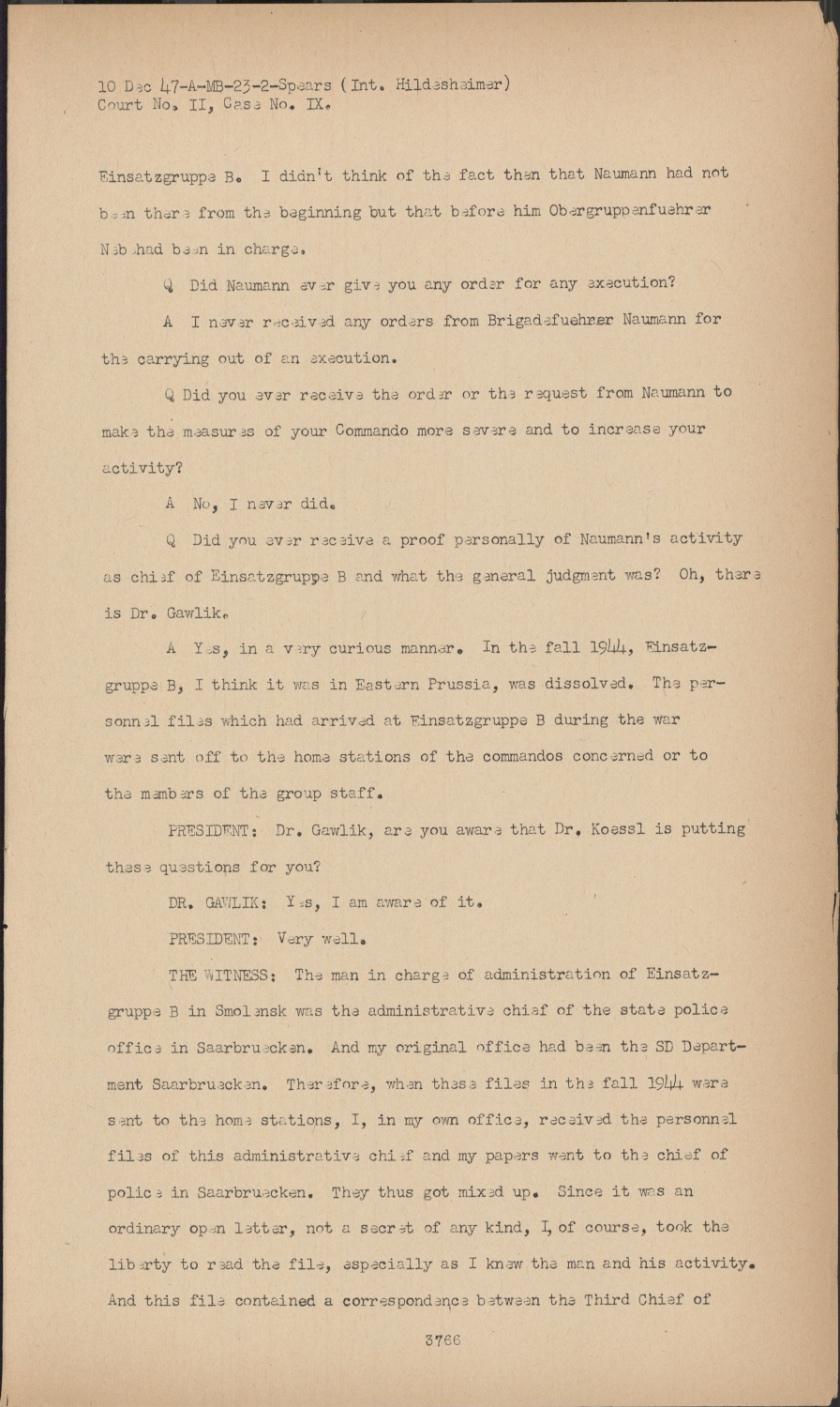
Einsatzgruppe B. I didn't think of the fact then that Naumann had not been there from the beginning but that before him Obergruppenfuahrer Nebehad been in charge.
QDid Naumann ever give you any order for any execution?
AI never received any orders from Brigadefuehrer Naumann for the carrying out of an execution.
QDid you aver receive the order or the request from Naumann to make the measures of your Commando more severe and to increase your activity?
ANo, I never did.
QDid you ever receive a proof personally of Naumann's activity as chief of Einsatzgruppe B and what the general judgment was? Oh, there is Dr. Gawlik.
AYes, in a very curious manner. In the fall 1944 Einsatzgruppe B, I think it was in Eastern Prussia, was dissolved. The personnel files which had arrived at Einsatzgruppe B during the war were sent off to the home stations of the commandos concerned or to the members of the group staff.
PRESIDENT:Dr. Gawlik, are you aware that Dr. Koessl is putting these questions for you?
DR. GAWLIK:Yes, I am aware of it.
PRESIDENT:Very well.
THE WITNESS:The man in charge of administration of Einsatzgruppe B in Smolensk was the administrative chief of the state police office in Saarbruecken. And my original office had been the SD Department Saarbruecken. Therefore, when these files in the fall 1944 were sent to the home stations, I, in my own office, received the personnel files of this administrative chief and my papers want to the chief of police in Saarbruecken. They thus got mixed up. Since it was an ordinary open letter, not a secret of any kind, I, of course, took the liberty to read the file, especially as I knew the man and his activity. And this file contained a correspondence between the Third Chief of Court No. II, Case No. IX.
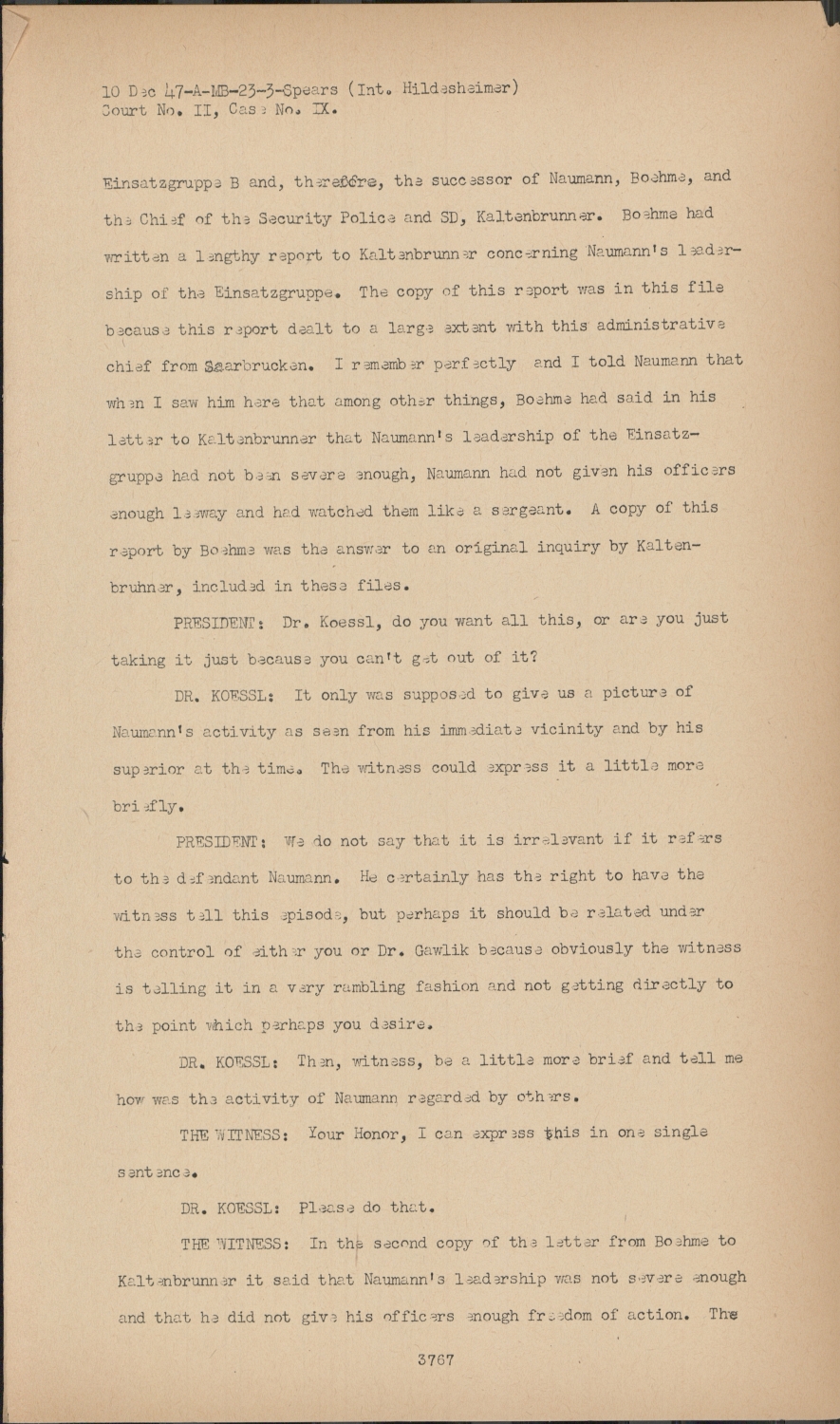
Einsatzgruppe B and, therefore, the successor of Naumann, Boehme, and the Chief of the Security Police and SD, Kaltenbrunner. Boehme had written a lengthy report to Kaltenbrunner concerning Naumann's leadership of the Einsatzgruppe. The copy of this report was in this file because this report dealt to a large extent with this administrative chief from Saarbrucken. I remember perfectly and I told Neumann that when I saw him here that among other things, Boehme had said in his letter to Kaltenbruhner that Naumann's leadership of the Einsatzgruppe had not been severs enough, Naumann had not given his officers enough leeway and had watched them like a sergeant. A copy of this report by Boehme was the answer to an original inquiry by Kaltanbruhner, included in these files.
PRESIDENT:Dr. Koessl, do you want all this, or are you just taking it just because you can't get out of it?
DR. KOESSL:It only was supposed to give us a picture of Naumann's activity as seen, from his immediate vicinity and by his superior at the time. The witness could express it a little more briefly.
PRESIDENT:We do not say that it is irrelevant if it refers to the defendant Naumann. He certainly has the right to have the witness tell this episode, but perhaps it should be related under the control of either you or Dr. Gawlik because obviously the witness is telling it in a very rambling fashion and not getting directly to the point which perhaps you desire.
DR. KOESSL:Then, witness, be a little more brief and tell me how was the activity of Naumann regarded by others.
THE WITNESS:Your Honor, I can express this in one single sentence.
DR. KOESSL:Please do that.
THE WITNESS:In the second copy of the letter from Boehme to Kaltenbrunner it said that Naumann's leadership was not severe enough and that he did not give his officers enough freedom of action. The Court No. II, Case No. IX.
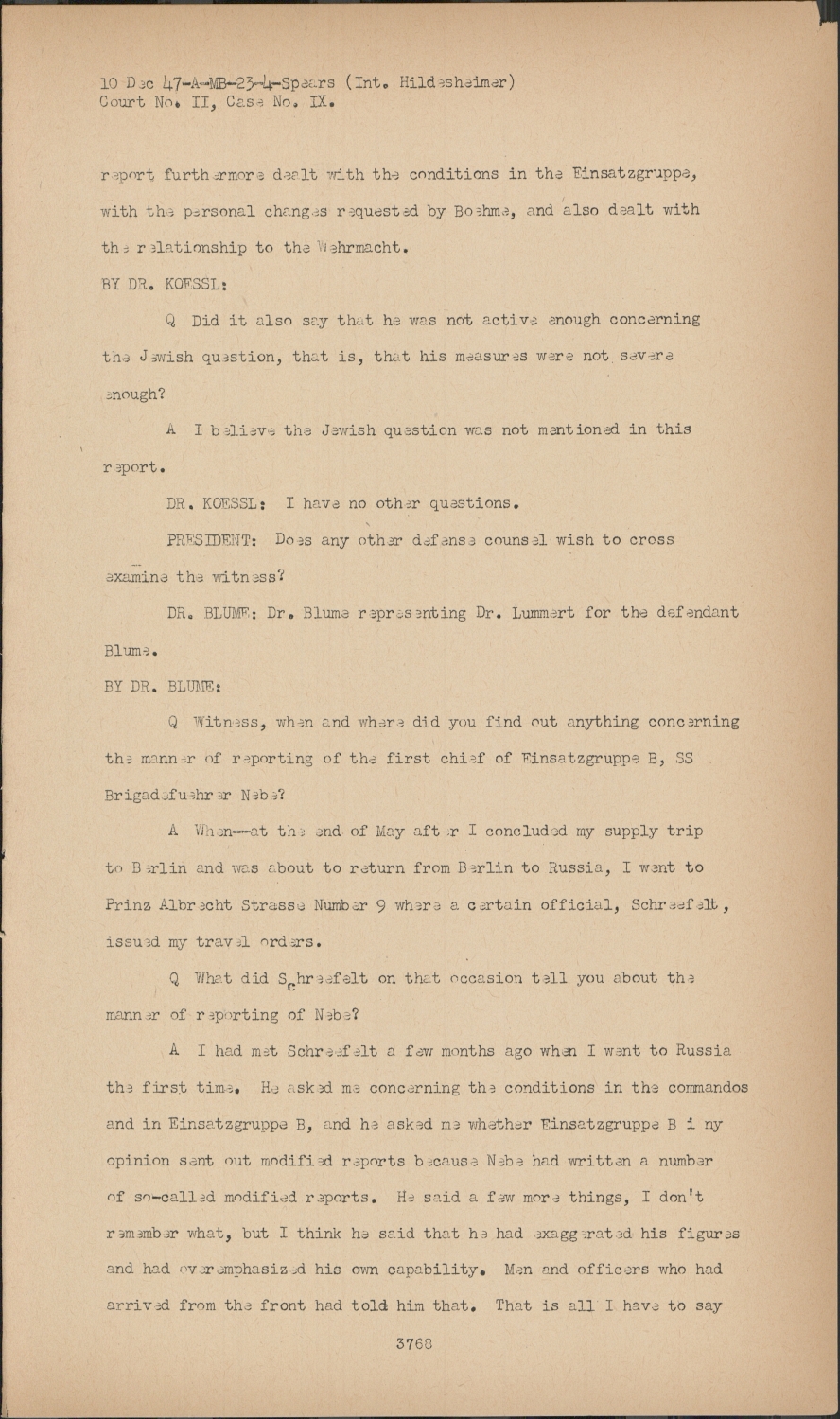
report furthermore dealt with the conditions in the Einsatzgruppe, with the personal changes requested by Boehme, and also dealt with the relationship to the Wehrmacht. BY DR. KOESSL:
QDid it also say that he was not active enough concerning the Jewish question, that is, that his measures were not severe enough?
AI believe the Jewish question was not mentioned in this report.
DR. KOESSL:I have no other questions.
PRESIDENT:Does any other defense counsel wish to cross examine the witness?
DR. BLUME:Dr. Blume representing Dr. Lummert for the defendant Blume. BY DR. BLUME:
QWitness, when and where did you find out anything concerning the manner of reporting of the first chief of Einsatzgruppe B, SS Brigadefuehrer Nebe?
AWhen--at the end of May after I concluded my supply trip to Berlin and was about to return from Berlin to Russia, I went to Prinz Albrecht Strasse Number 9 where a certain official, Schreefelt, issued my travel orders.
QWhat did Schreefelt on that occasion tell you about the manner of reporting of Nebe?
AI had met Schreefelt a few months ago when I went to Russia the first time. He asked me concerning the conditions in the commandos and in Einsatzgruppe B, and he asked me whether Einsatzgruppe B i ny opinion sent out modified reports because Nebe had written a number of so-called modified reports. He said a few more things, I don't remember what, but I think he said that he had exaggerated his figures and had overemphasized his own capability. Men and officers who had arrived from the front had told him that. That is all I have to say Court No. II, Case No. IX.
on that.
DR. BLUME:I have no further questions, Sir.
PRESIDENT:Any other defense counsel wish to cross examine? If not, Mr. Ferencz may begin the cross examination for the prosecution.
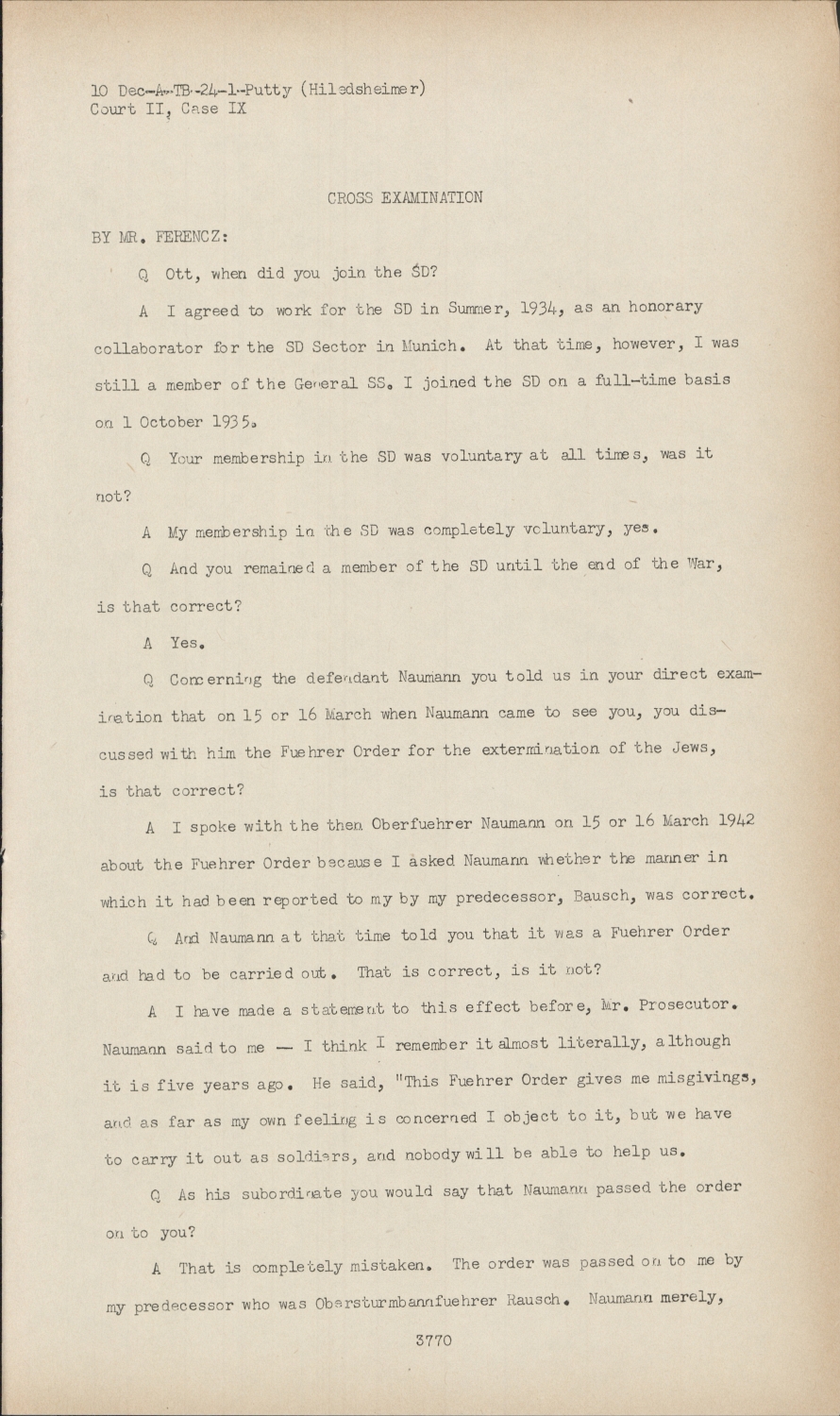
CROSS EXAMINATION BY MR. FERENCZ:
QOtt, when did you join, the SD?
AI agreed to work for the SD in Summer, 1934, as an honorary collaborator for the SD Sector in Munich. At that time, however, I was still a member of the General SS. I joined the SD on a full-time basis on 1 October 1935.
QYour membership in the SD was voluntary at all times, was it not?
AMy membership in the SD was completely voluntary, yes.
QAnd you remained a member of the SD until the end of the War, is that correct?
AYes.
QConcerning the defendant Naumann you told us in your direct examination that on 15 or 16 March when Naumann came to see you, you discussed with him the Fuehrer Order for the extermination of the Jews, is that correct?
AI spoke with the then Oberfuehrer Naumann on 15 or 16 March 1942 about the Fuehrer Order because I asked Naumann whether the manner in which it had been reported to my by my predecessor, Bausch, was correct.
QAnd Naumann at that time told you that it was a fuehrer Order and had to be carried out. That is correct, is it not?
AI have made a statement to this effect before, Mr. Prosecutor. Naumann said to me - I think I remember it almost literally, although it is five years ago. He said, "This Fuehrer Order gives me misgivings, and as far as my own feeling is concerned I object to it, but we have to carry it out as soldiers, and nobody will be able to help us.
QAs his subordinate you would say that Naumann passed the order on to you?
AThat is completely mistaken. The order was passed on to me by my predecessor who was Obersturmbannfuehrer Rausch. Naumann merely, three weeks later, confirmed the existence and the content matter of the order to me, upon my own request.
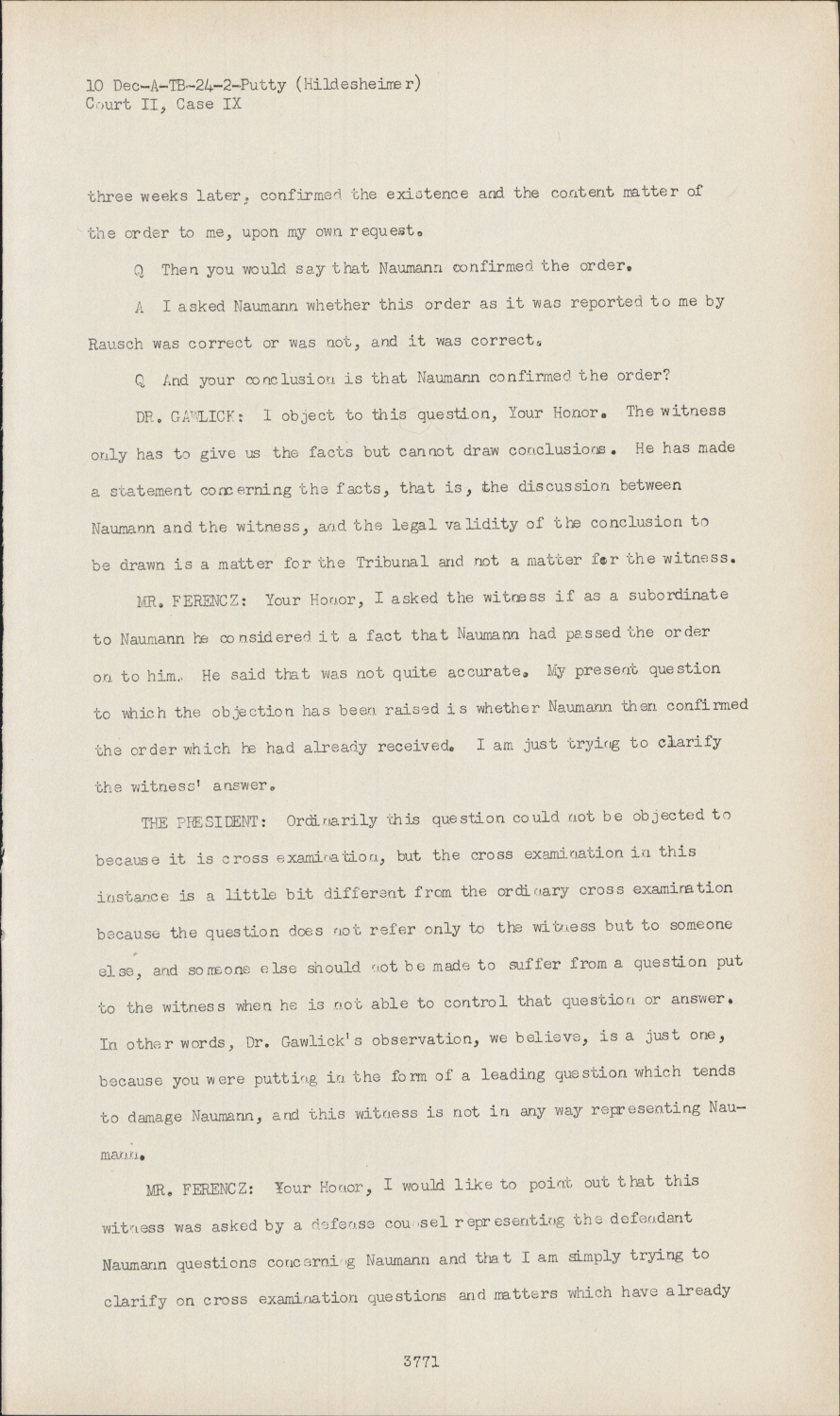
QThen you would say that Naumann confirmed the order.
AI asked Naumann whether this order as it was reported to me by Rausch was correct or was not, and it was correct.
QAnd your conclusion is that Naumann confirmed the order?
DR. GAWLICK:I object to this question, Your Honor. The witness only has to give us the facts but cannot draw conclusions. He has made a statement concerning the facts, that is, the discussion between Naumann and the witness, and the legal validity of the conclusion to be drawn is a matter for the Tribunal and not a matter for the witness.
MR. FERENCZ:Your Honor, I asked the witness if as a subordinate to Naumann be considered it a fact that Naumann had passed the order on to him. He said that was not quite accurate. My present question to which the objection has been raised is whether Naumann then confirmed the order which he had already received. I am just trying to clarify the witness' answer.
THE PRESIDENT:Ordinarily this question could not be objected to because it is cross examination, but the cross examination in this instance is a little bit different from the ordinary cross examination because the question does not refer only to the witness but to someone else, and someone else should not be made to suffer from a question put to the witness when he is not able to control that question or answer. In other words, Dr. Gawlick's observation, we believe, is a just one, because you were putting in the form of a leading question which tends to damage Naumann, and this witness is not in any way representing Naumann.
MR. FERENCZ:Your Honor, I would like to point out that this witness was asked by a defense counsel representing the defendant Naumann questions concerning Naumann and that I am simply trying to clarify on cross examination questions and matters which have already been raised on the direct examination of this defendant.
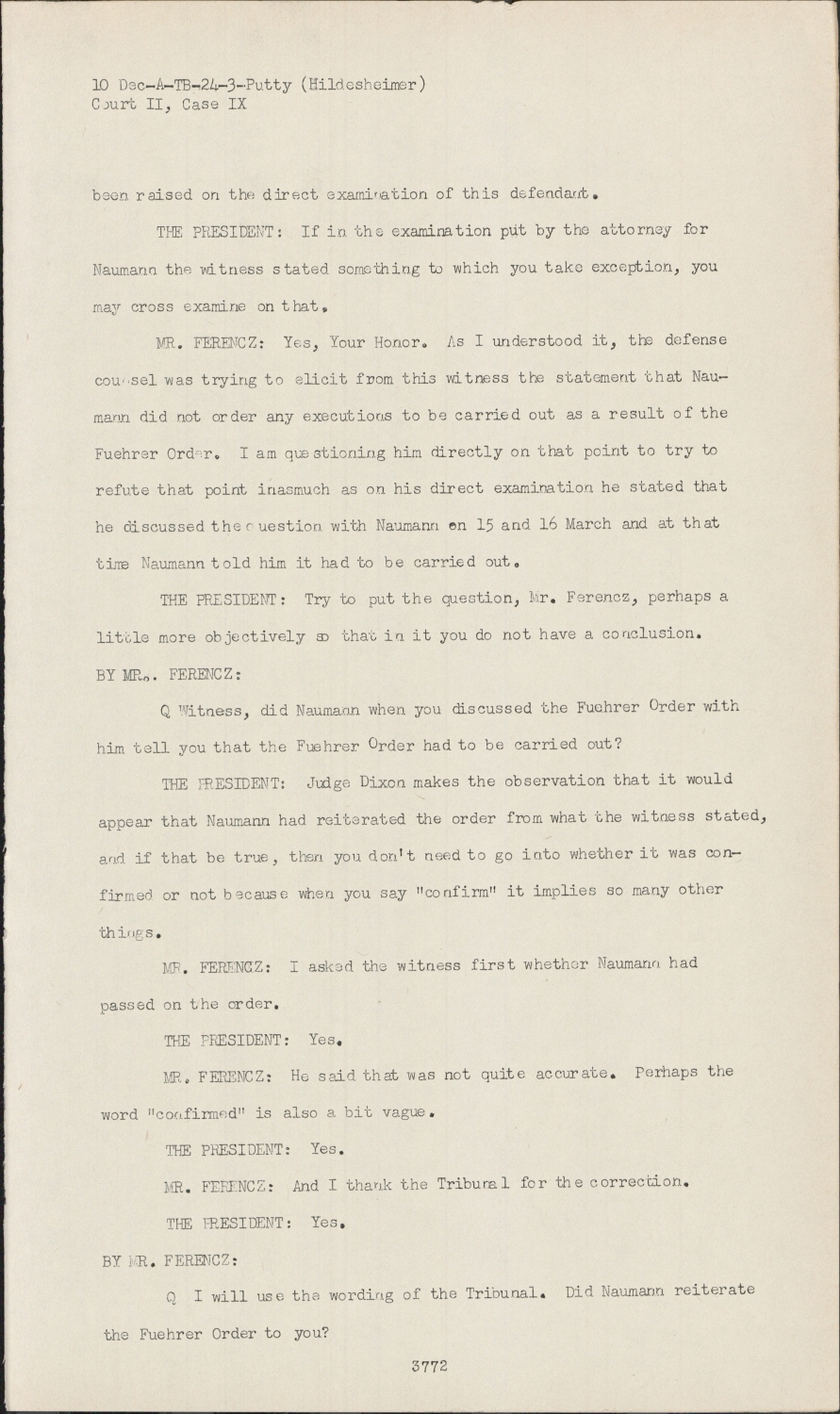
THE PRESIDENT:If in the examination put by the attorney for Naumann the witness stated something to which you take exception, you may cross examine on that.
MR. FERENCZ:Yes, Your Honor. As I understood it, the defense counsel was trying to elicit from this witness the statement that Naumann did not order any executions to be carried out as a result of the Fuehrer Order. I am questioning him directly on that point to try to refute that point inasmuch as on his direct examination he stated that he discussed the question with Naumann on 15 and 16 March and at that time Naumann told him it had to be carried out.
THE PRESIDENT:Try to put the question, Mr. Ferencz, perhaps a little more objectively so that in it you do not have a conclusion. BY MR. FERENCZ:
QWitness, did Naumann when you discussed the Fuehrer Order with him tell you that the Fuehrer Order had to be carried out?
THE PRESIDENT:Judge Dixon makes the observation that it would appear that Naumann had reiterated the order from what the witness stated, and if that be true, then you don't need to go into whether it was confirmed or not because when you say "confirm" it implies so many other things.
MR. FERENCZ:I asked the witness first whether Naumann had passed on the order.
THE PRESIDENT:Yes.
MR. FERENCZ:He said that was not quite accurate. Perhaps the word "confirmed" is also a bit vague.
THE PRESIDENT:Yes.
MR. FERENCZ:And I thank the Tribunal for the correction.
THE PRESIDENT:Yes. BY MR. FERENCZ:
QI will use the wording of the Tribunal. Did Naumann reiterate the Fuehrer Order to you?
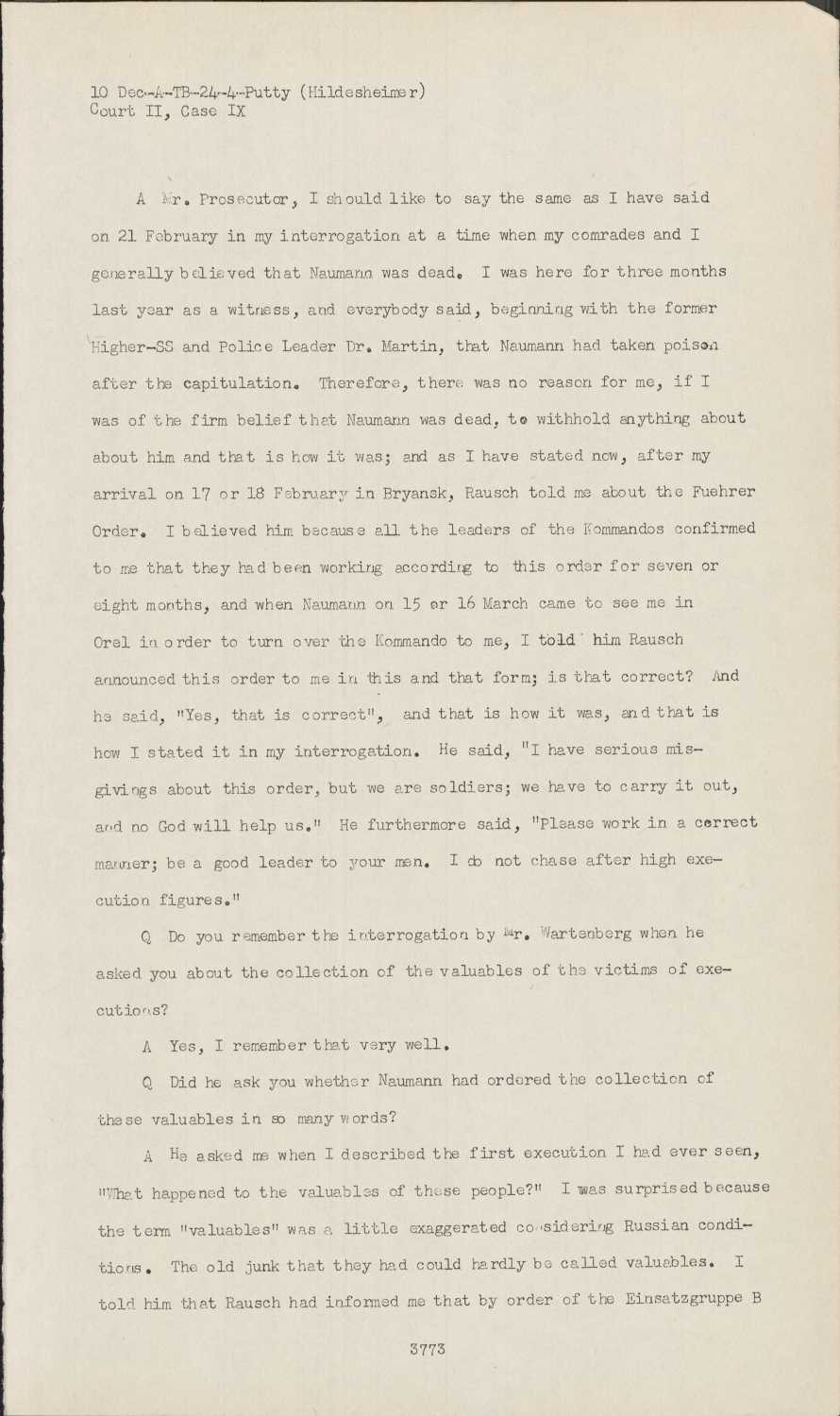
AMr. Prosecutor, I should like to say the same as I have said on 21 February in my interrogation at a time when my comrades and I generally believed that Naumann was dead. I was here for three months last year as a witness, and everybody said, beginning with the former Higher-SS and Police Leader Dr. Martin, that Naumann had taken poison after the capitulation. Therefore, there was no reason for me, if I was of the firm belief that Naumann was dead, to withhold anything about about him and that is how it was; and as I have stated now, after my arrival on 17 or 18 February in Bryansk, Rausch told me about the Fuehrer Order. I believed him because all the leaders of the Kommandos confirmed to me that they had been working according to this order for seven or eight months, and when Naumann on 15 or 16 March came to see me in Orel in order to turn over the Kommando to me, I told him Rausch announced this order to me in this and that form; is that correct? And he said, "Yes, that is correct", and that is how it was, and that is how I stated it in my interrogation. He said, "I have serious misgivings about this order, but we are soldiers; we have to carry it out, and no God will help us." He furthermore said, "Please work in a correct manner; be a good leader to your men. I do not chase after high execution figures."
QDo you remember the interrogation by Mr. Wartenberg when he asked you about the collection of the valuables of the victims of executions?
AYes, I remember that very well.
QDid he ask you whether Naumann had ordered the collection of these valuables in so many words?
AHe asked me when I described the first execution I had ever seen, "What happened to the valuables of those people?" I was surprised because the term "valuables" was a little exaggerated considering Russian conditions. The old junk that they had could hardly be called valuables. I told him that Rausch had informed me that by order of the Einsatzgruppe B these objects had to be turned over via the ordinary channel of command.
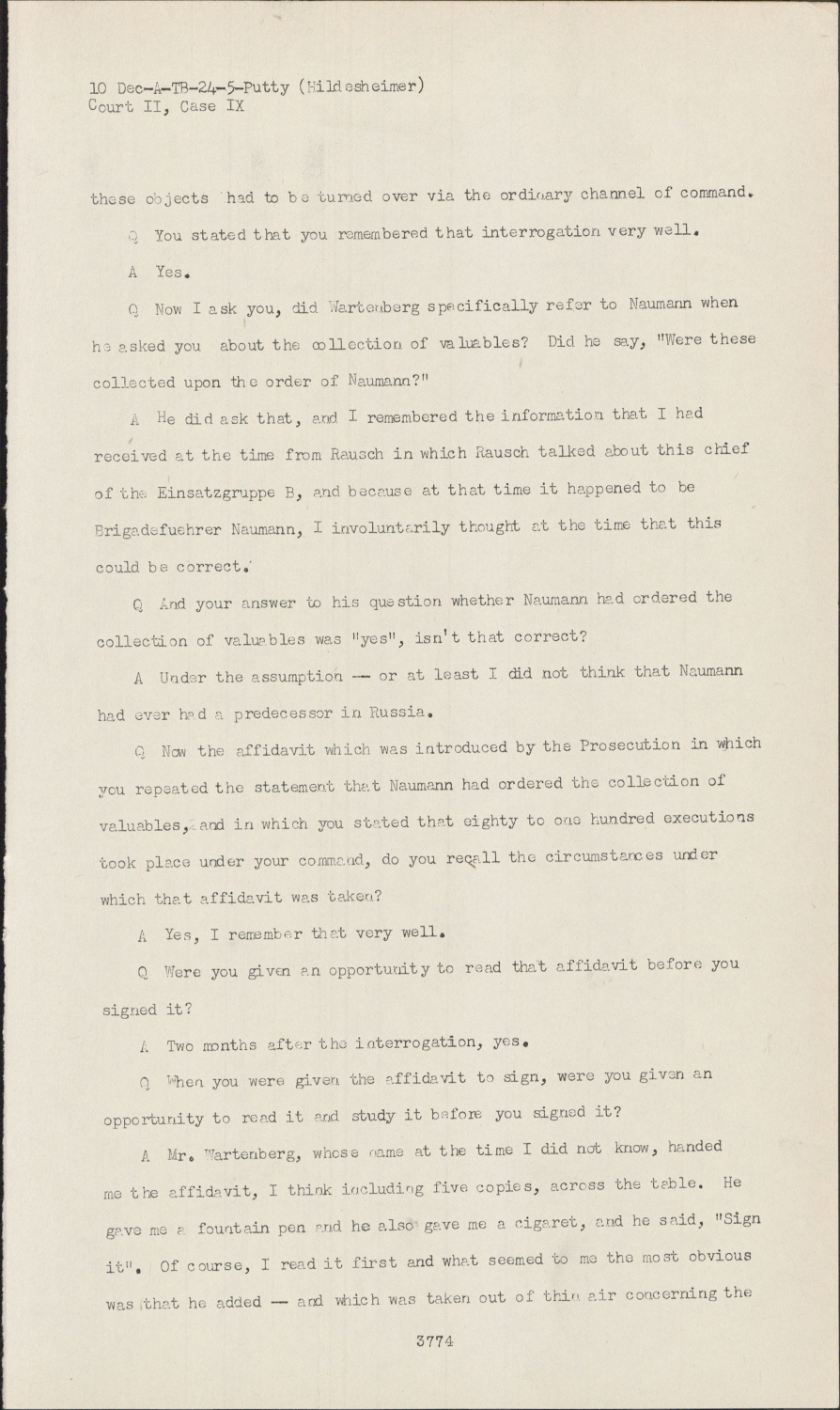
QYou stated that you remembered that interrogation very well.
AYes.
QNow I ask you, did Wartenberg specifically refer to Naumann when he asked you about the collection of valuables? Did he say, "Were these collected upon the order of Naumann?"
AHe did ask that, and I remembered the information that I had received at the time from Rausch in which Rausch talked about this chief of the Einsatzgruppe B, and because at that time it happened to be Brigadefuehrer Naumann, I involuntarily thought at the time that this could be correct.
QAnd your answer to his question whether Naumann had ordered the collection of valuables was "yes", isn't that correct?
AUnder the assumption - or at least I did not think that Naumann had ever had a predecessor in Russia.
QNow the affidavit which was introduced by the Prosecution in which you repeated the statement that Naumann had ordered the collection of valuables, and in which you stated that eighty to one hundred executions took place under your command, do you recall the circumstances under which that affidavit was taken?
AYes, I renumber that very well.
QWere you given an opportunity to read that affidavit before you signed it?
ATwo months after the interrogation, yes.
QWhen you were given the affidavit to sign, were you given an opportunity to read it and study it before you signed it?
AMr. Wartenberg, whose name at the time I did not know, handed to the affidavit, I think including five copies, across the table. He gave to a fountain pen and he also gave me a cigaret, and he said, "Sign it". Of course, I read it first and what seemed to me the most obvious was that he added - and which was taken out of thin air concerning the operation Eisbaer, - that men were shot and that Partisan suspects had been shot.
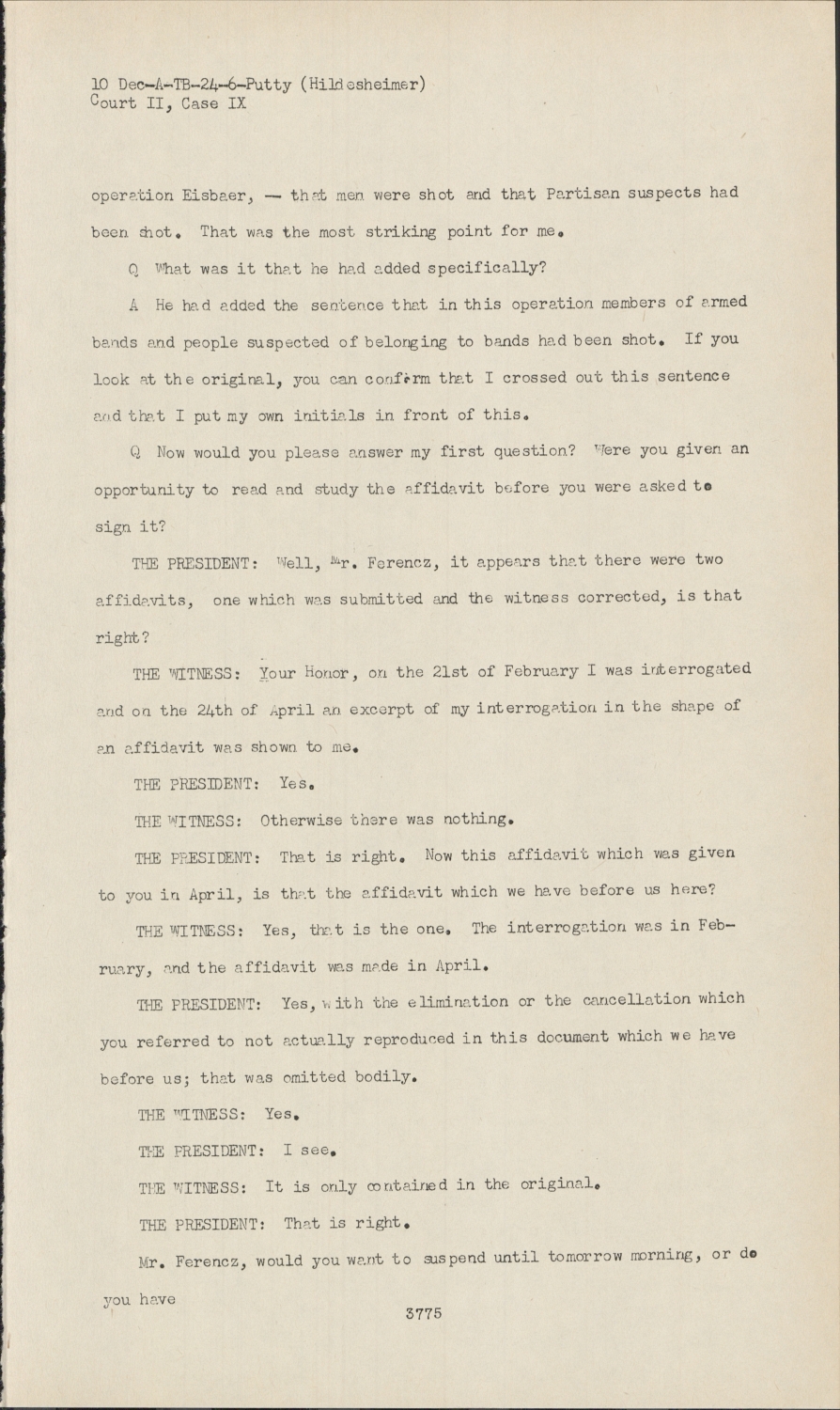
That was the most striking point for me.
Q what was it that he had added specifically?
AHe Had added the sentence that in this operation members of armed bands and people suspected of belonging to bands had been shot. If you look at the original, you can confirm that I crossed out this sentence and that I put my own initials in front of this.
QNow would you please answer my first question? Were you given an opportunity to read and study the affidavit before you were asked to sign it?
THE PRESIDENT:Well, Mr. Ferencz, it appears that there were two affidavits, one which was submitted and the witness corrected, is that right?
THE WITNESS:Your Honor, on the 21st of February I was interrogated and on the 24th of April an excerpt of my interrogation in the shape of an affidavit was shown to me.
THE PRESIDENT:Yes.
THE WITNESS:Otherwise there was nothing.
THE PRESIDENT:That is right. Now this affidavit which was given to you in April, is that the affidavit which we have before us here?
THE WITNESS:Yes, that is the one. The interrogation was in February, and the affidavit was made in April.
THE PRESIDENT:Yes, With the elimination or the cancellation which you referred to not actually reproduced in this document which we have before us; that was omitted bodily.
THE WITNESS:Yes.
THE PRESIDENT:I see.
THE WITNESS:It is only contained in the original.
THE PRESIDENT:That is right.
Mr. Ferencz, would you want to suspend until tomorrow morning, or de you have a question or two which you would prefer to put right now?
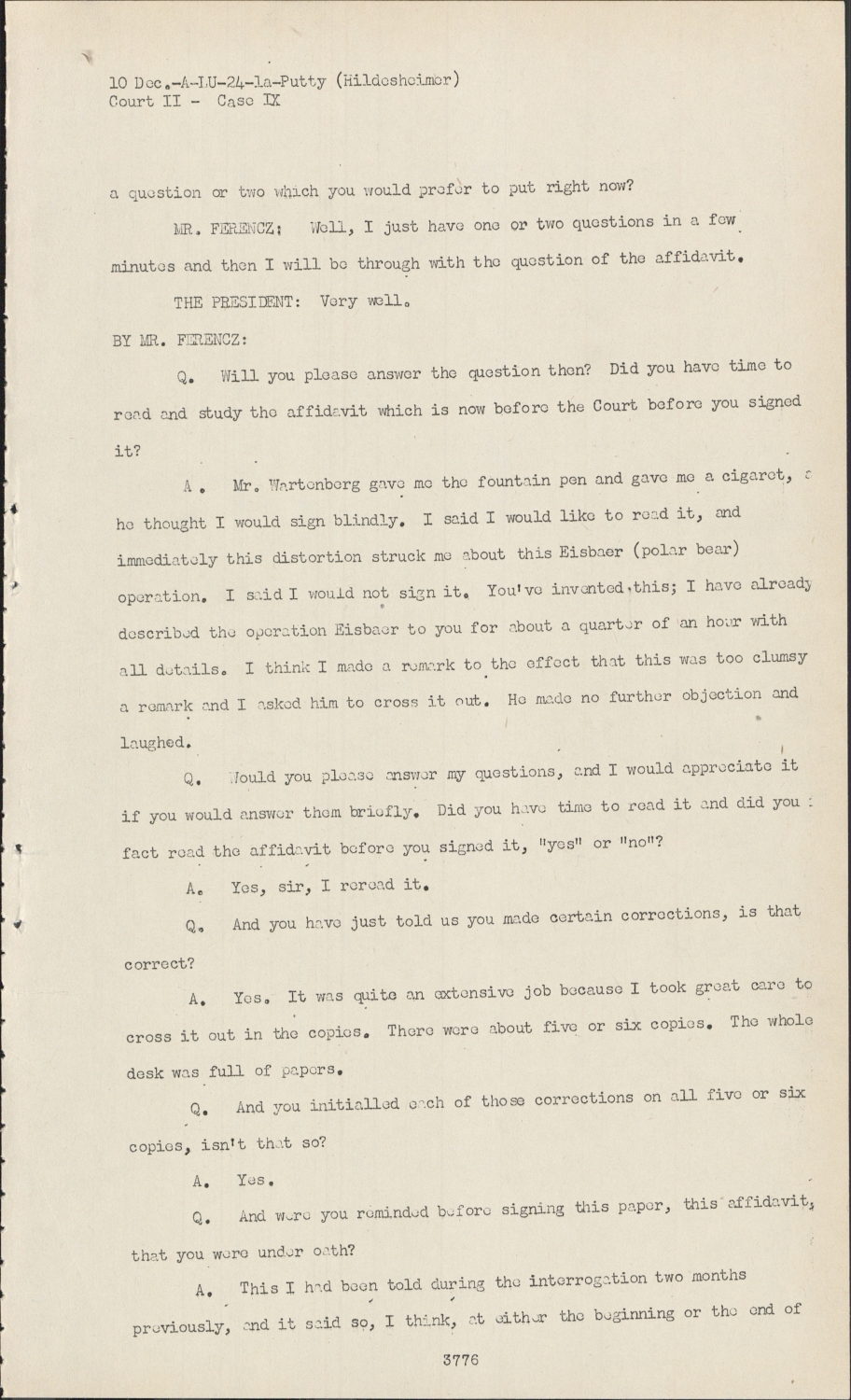
MR.FERENCZ; Well, I just have one or two questions in a few minutes and then I will be through with the question of the affidavit.
THE PRESIDENT:Very well, BY MR. FERENCZ:
Q.Will you please answer the question then? Did you have time to read and study the affidavit which is now before the Court before you signed it?
A.Mr. Wartenberg gave me the fountain pen and gave me a cigaret, a he thought I would sign blindly. I said I would like to read it, and immediately this distortion struck me about thus Eisbaer (polar bear) operation. I said I would. not sign it. You've invented this; I have already described the operation Eisbaer to you for about a quarter of an hour with all details. I think I made a remark to the effect that this was too clumsy a remark and I asked him to cross it out. He made no further objection and laughed.
Q.Would you please answer my questions, and I would appreciate it if you would answer them briefly. Did you have time to read it and did you : fact read the affidavit before you signed it, "yes" or "no"?
A.Yes, sir, I reread it.
Q.And you have just told us you made certain corrections, is that correct?
A.Yes, It was quite an extensive job because I took great care to cross it out in the copies. There were about five or six copies. The whole desk was full of papers.
Q.And you initialled each of those corrections on all five or six copies, isn't that so?
A.Yes.
Q.And Were you reminded before signing this paper, this affidavit, that you were under oath?
A.This I had been told during the interrogation two months previously, and it said so, I think, at either the beginning or the end of the affidavit, I believe so.
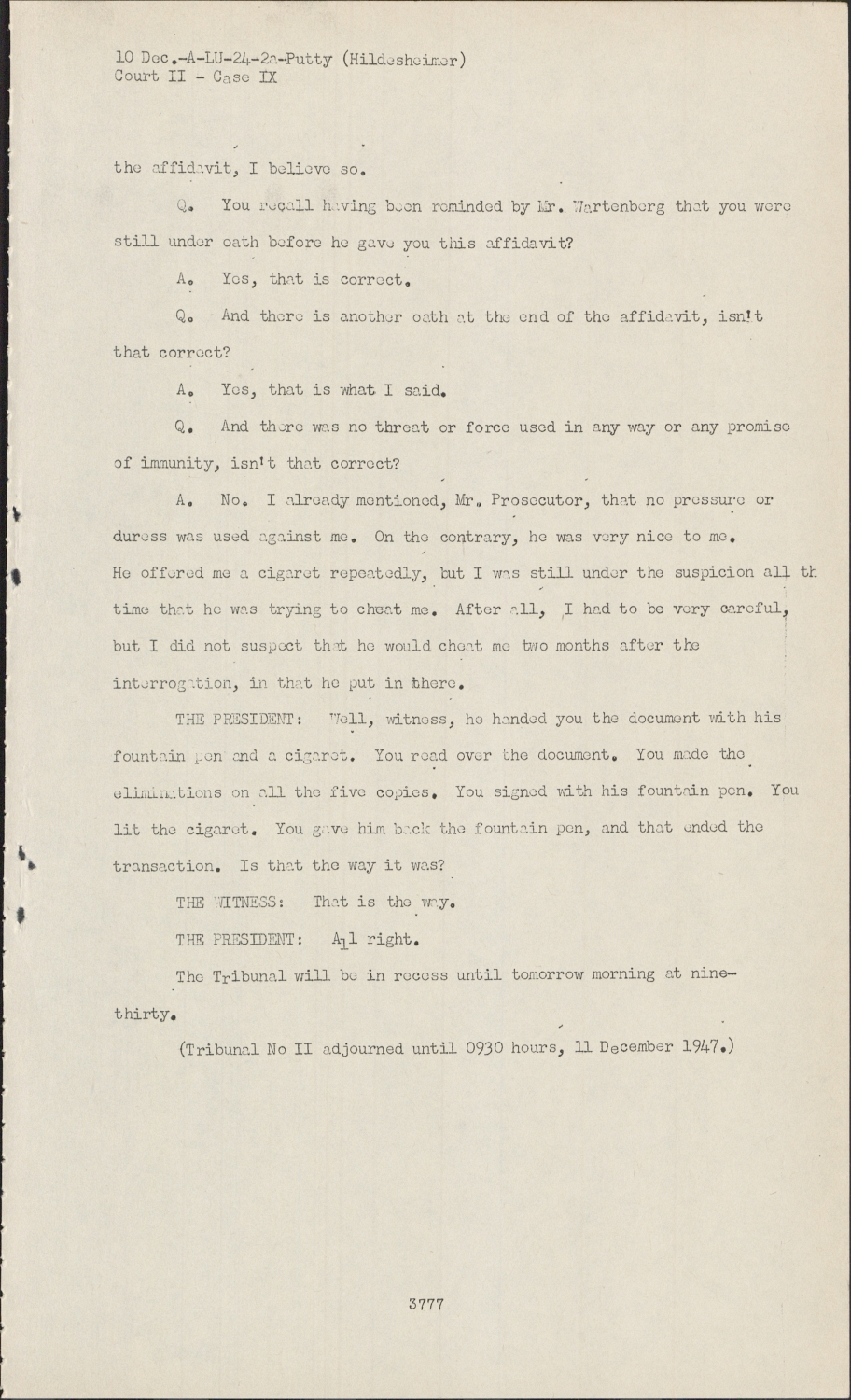
Q.You recall having been reminded by Mr. Wartenberg that you were still under oath before he gave you this affidavit?
A.Yes, that is correct.
Q.And there is another oath at the end of the affidavit, isn't that correct?
A.Yes, that is what I said.
Q.And there was no throat or force used in any way or any promise of immunity, isn't that correct?
A.No. I already mentioned, Mr. Prosecutor, that no pressure or duress was used against me. On the contrary, he was very nice to me. He offered me a cigaret repeatedly, but I was still under the suspicion all th time that he was trying to cheat me. After all, I had to be very careful, but I did not suspect that he would cheat me two months after the interrogation, in that he put in there.
THE PRESIDENT:Well, witness, he handed you the document with his fountain pen and a cigaret. You read over the document. You made there eliminations on all the five copies. You signed with his fountain pen. You lit the cigaret. You gave him back the fountain pen, and that ended the transaction. Is that the way it was?
THE WITNESS:That is the way.
THE PRESIDENT:All right.
The Tribunal will be in recess until tomorrow morning at ninethirty.
(Tribunal No II adjourned until 0930 hours, 11 December 1947.)
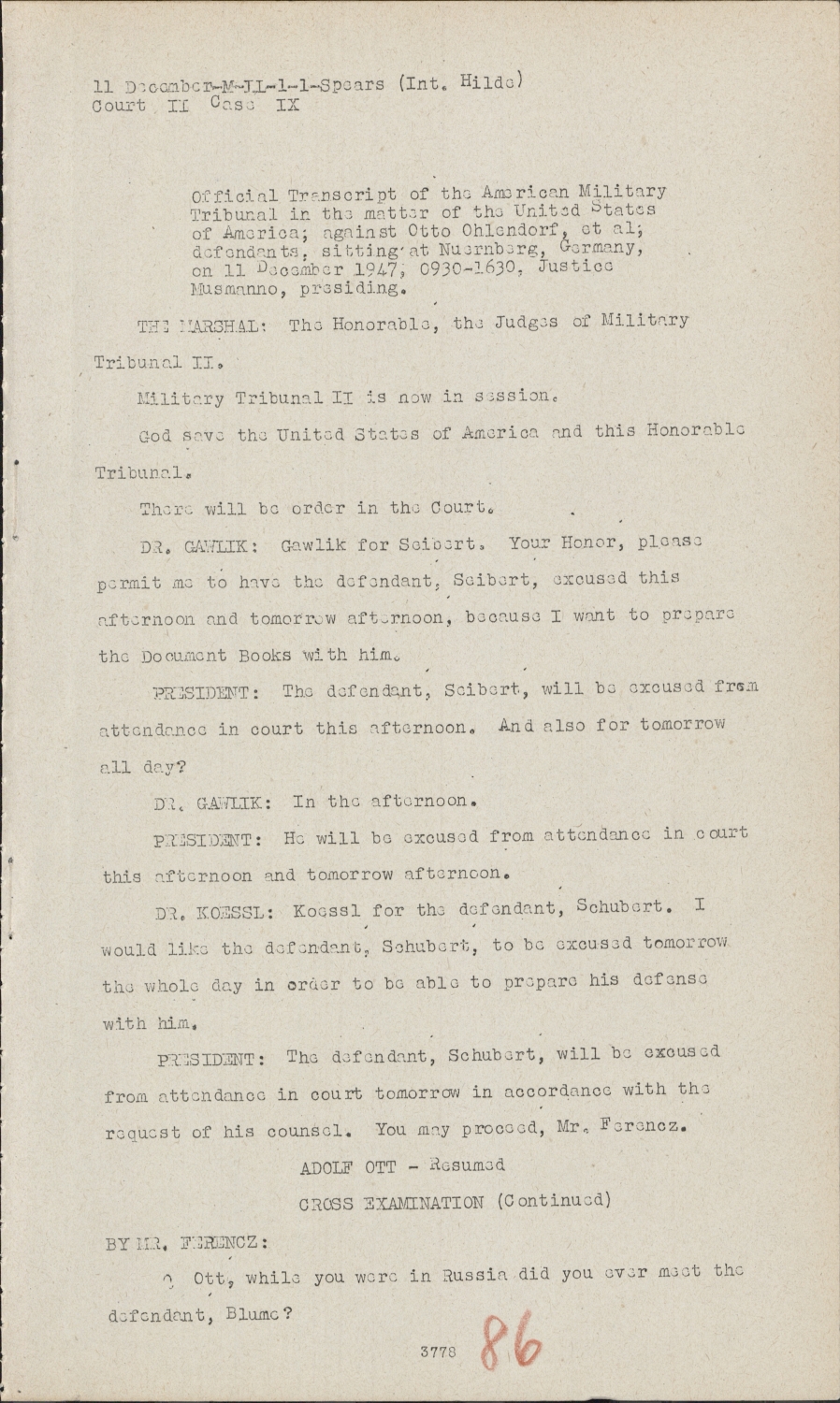
Official Transcript of the American Military Tribunal in the matter of the United States of America; against Otto Ohlendorf, et al;defendants, sitting' at Nuernberg, Germany, on 11 December 1947, 0930-1630, Justice Musmanno, presiding.
THE MARSHAL:The Honorable, the Judges of Military Tribunal II.
Military Tribunal II is now in session.
God save the United States of America and this Honorable Tribunal.
There will be order in the Court.
DR. GAWLIK:Gawlik for Seibert, Your Honor, please permit me to have the defendant, Seibert, excused this afternoon and tomorrow afternoon, because I want to prepare the Document Books with him.
PRESIDENT:The defendant, Seibert, will be excused from attendance in court this afternoon. And also for tomorrow all day?
DR. GAWLIK:In the afternoon.
PRESIDENT:He will be excused from attendance in court this afternoon and tomorrow afternoon.
DR. KOESSL:Koessl for the defendant, Schubert. I would like the defendant, Schubert, to be excused tomorrow the whole day in order to be able to prepare his defense with him.
PRESIDENT:The defendant, Schubert, will be excused from attendance in court tomorrow in accordance with the request of his counsel. You may proceed, Mr. Ferencz.
ADOLF OTT - Resumed CROSS EXAMINATION (Continued) BY MR. FERENCZ:
QOtt, while you were in Russia did you ever meet the defendant, Blume?
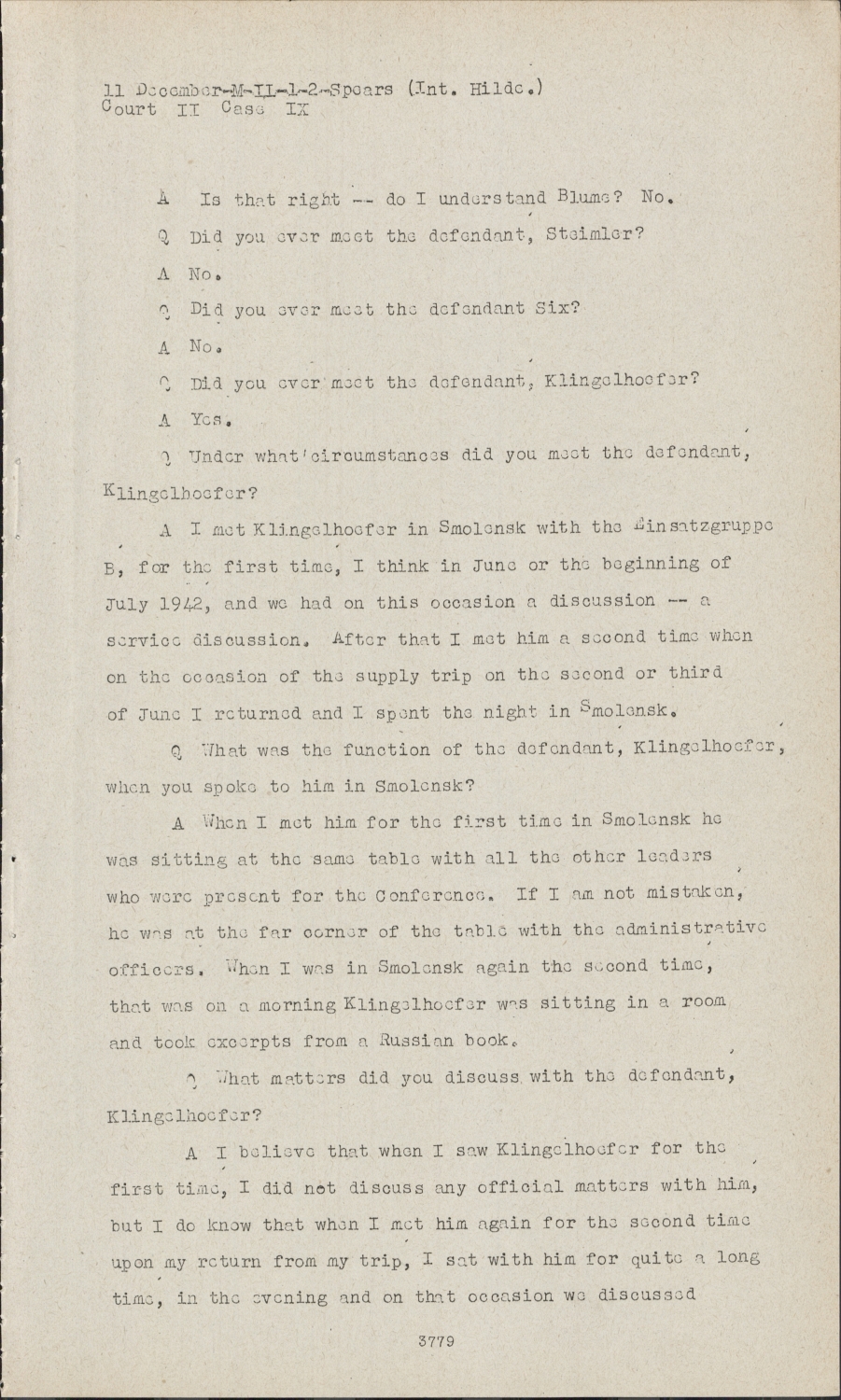
AIs that right -- do I understand Blume? No.
QDid you ever meet the defendant, Steimler?
ANo.
QDid you ever meet the defendant Six?
ANo.
QDid you ever meet the defendant, Klingelhoefer?
AYes.
QUnder what'circumstances did you meet the defendant, Klingelhoefer?
AI met Klingelhoefer in Smolensk with the Einsatzgruppe B, for the first time, I think in June or the beginning of July 1942, and we had on this occasion a discussion - a service discussion. After that I met him a second time when on the occasion of the supply trip on the second or third of June I returned and I spent the night in Smolensk.
QWhat was the function of the defendant, Klingelhoefer, when you spoke to him in Smolensk?
AWhen I met him for the first time in Smolensk he was sitting at the same table with all the other leaders who were present for the Conference. If I am not mistaken, he was at the far corner of the table with the administrative officers. When I was in Smolensk again the second time, that was on a morning Klingelhoefer was sitting in a room and took excerpts from a Russian book.
QWhat matters did you discuss with the defendant, Klingelhoefer?
AI believe that when I saw Klingelhoefer for the first time, I did not discuss any official matters with him, but I do know that when I met him again for the second time upon my return from my trip, I sat with him for quite a long time, in the evening and on that occasion we discussed matters explicitly for about two hours, particularly the problems of the Russian territory.
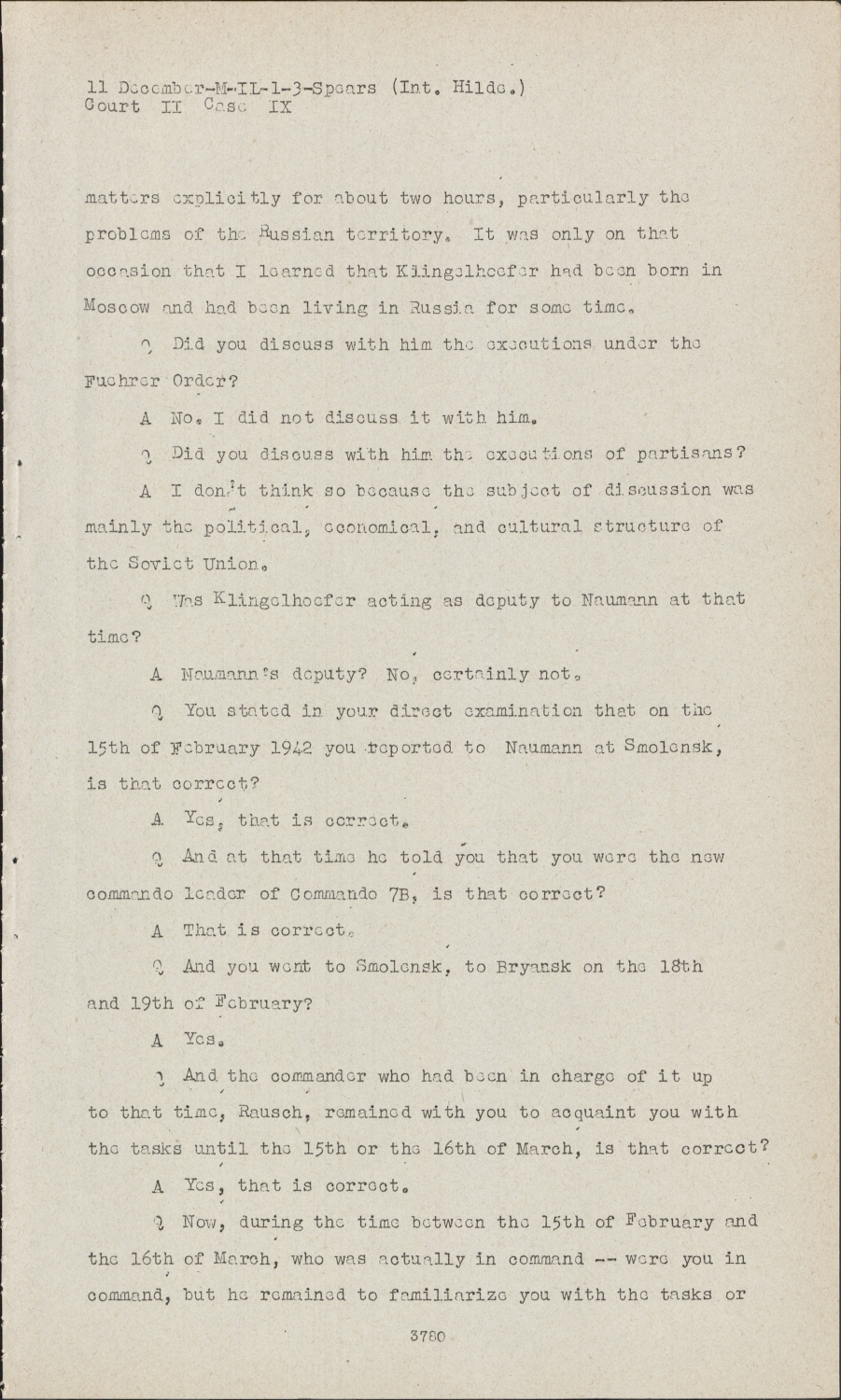
It was only on that occasion that I learned that Klingelheefer had been born in Moscow and had been living in Russia for some time.
QDid you discuss with him the executions under the Fuehrer Order?
ANo. I did not discuss it with him.
QDid you discuss with him the executions of partisans?
AI don't think so because the subject of discussion was mainly the political, economical, and cultural structure of the Soviet Union.
QWas Klingelheefer acting as deputy to Naumann at that time?
ANeumann's deputy? No, certainly not.
QYou stated in your direct examination that on the 15th of February 1942 you reported to Naumann at Smolensk, is that correct?
AYes, that is correct.
QAnd at that time he told you that you were the new commando leader of Commando 7B, is that correct?
AThat is correct.
QAnd you went to Smolensk, to Bryansk on the 18th and 19th of February?
AYes,
QAnd the commander who had been in charge of it up to that time, Rausch, remained with you to acquaint you with the tasks until the 15th or the 16th of March, is that correct?
AYes, that is correct.
QNow, during the time between the 15th of February and the 16th of March, who was actually in command -- were you in command, but he remained to familiarize you with the tasks or did he still retain the title of Commander of Commando 7B?
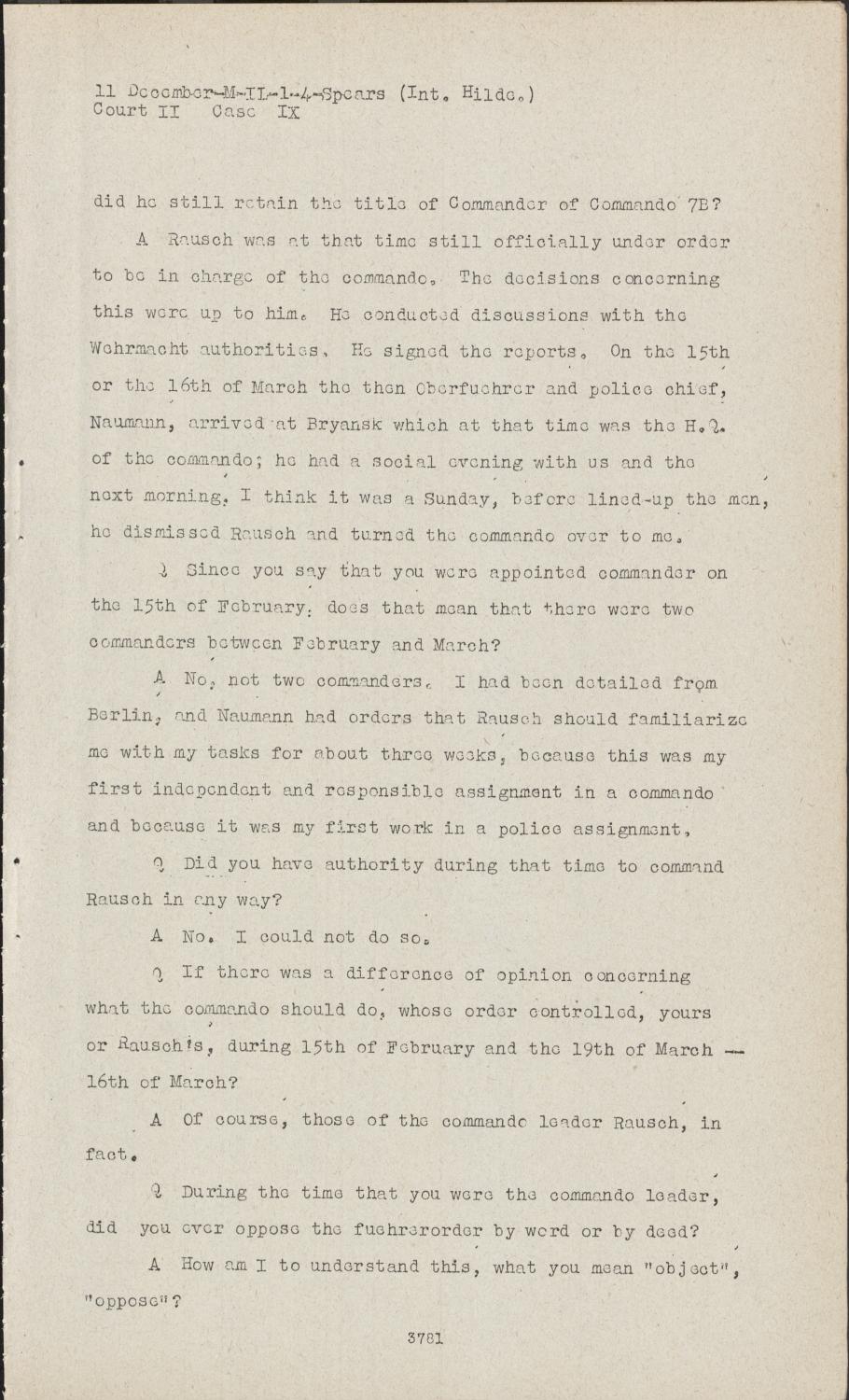
ARausch was at that time still officially under order to be in charge of the commando. The decisions concerning this were up to him. He conducted discussions with the Wehrmacht authorities. He signed the reports. On the 15th or the 16th of March the then Oberfuehrer and police chief, Naumann, arrived at Bryansk which at that time was the H.Q. of the commando; he had a social evening with us and the next morning, I think it was a Sunday, before lined-up the men, he dismissed Rausch and turned the commando over to me.
QSince you say that you were appointed commander on the 15th of February, does that mean that there were two commanders between February and March?
ANo, not two commanders. I had been detailed from Berlin, and Naumann had orders that Rausch should familiarize me with my tasks for about three weeks, because this was my first independent and responsible assignment in a commando and because it was my first work in a police assignment,
QDid you have authority during that time to command Rausch in any way?
ANo. I could not do so.
QIf there was a difference of opinion concerning what the commando should do, whose order controlled, yours or Rausch's, during 15th of February and the 19th of March 16th of March?
AOf course, those of the commando leader Rausch, in fact.
QDuring the time that you were the commando leader, did you ever oppose the fuehrerorder by word or by deed?
AHow am I to understand this, what you mean "object", "oppose"?