Now, am I correct in that, or am I not?
A.Yes.
Q.So when you signed the affidavit on July 2, 1947, you believed that the facts written up in that affidavit were correct?
A.When I signed it, I thought that that was true, but at the same time, as I have said repeatedly, Your Honor, I made the reservation which Mr. Wartenberg gave me, namely, he told me that I could make the corrections at a later date, as far as the formulation is concerned and with this reservation given to me orally, by him, I signed the affidavit.
Q.Did you, or did you not believe the facts stated in the affidavit of July 2 to be true when you signed the affidavit?
A.Not quite, Your Honor, because I made this reservation and I signed it with this reservation.
Q.You permitted yourself to sign a paper in which you went into the description of executions with reservations that you anted to make some corrections, is that what we are to understand?
A.Pardon me, Your Honor, as far as the facts given by me in this affidavit are concerned, I did not want to deny these or correct them, I merely wanted to correct the fact about my position and clarify it. I never wanted to deny the incidents and events as such.
Q.Well, then, the facts contained in this affidavit of July 2nd are correct?
A.The facts are correct, that as far as the two actions are concerned, I undertook the Tatarsk action independently and I attended also the other action, Matislawl and that I was a witness to this action, of course; these are the two actions which I experienced, and which I listed in the first affidavit and which I confirmed in the second affidavit and completed them there.
Q.And do you confirm this statement, "The executions proper were carried out by Noack under my supervision"?
A.No. I do not confirm that.
Q.Did you tell Mr. Wartenberg this?
A.I spoke about it, of course.
Q.Did you tell Mr. Wartenberg that the executions were carried out by Noack under your supervision?
A.I told Mr. Wartenberg that I did not have the order to carry out the supervision thereupon Mr. Wartenberg told me that I was the senior officer at the place and automatically it was up to me to carry out the supervision, and this formulation was put into the affidavit by Mr. Wartenberg. It was not put in by me.
Q.Did you see that particular statement when you signed the affidavit?
A.Yes, Sir.
Q.And you approved it?
A.Yes.
Q.You describe the execution in some detail. You explain how the executees would fall into the pit, then "in case it was noted that someone in the pit was still alive, he received a coup de grace". How did you determine whether a person was alive or dead, only by observing whether there was still movement in the body?
A.Your Honor, I personally never had anything to do with this matter. I merely gave this description on the basis of what I saw or heard at this execution of these 10 Jews by Noack. That is what I have described, that's all.
Q.This statement says "approximately 50 Jews were shot during these two executions". Then you saw two executions and observed the manner of death, is that right?
A.That is what can be gathered from the affidavit. That is how it was put in, but it doesn't refer to the 50 Jews when I saw, but as I later explained, it refers only to the 10 Jews when I saw.
Q.Well, you saw these 10 Jews shot?
A.I saw how the 10 Jews in Matislawl were shot, Yes.
QYes, and how did you determine whether they were actually dead or not since, they had fallen into a pit?
ANo. That was not my business. I had nothing to do with that. I later explained that a medical noncom was there who had to take care of this matter.
QAnd what did he do, did he go down into the pit and take the pulse of each executee?
AI do not know; I was too far away.
QHow far away were you?
AI cannot say offhand--I do not know.
QYou saw this execution?
AYes, I was there.
QAnd you saw them fall into the grave after they had been hit by the bullets, didn't you?
AYes.
QSo, therefore, you were close enough to observe what happened in that instance?
ANo. I don't know how to explain it. I was about 100 meters away, and I could, of course, see how the Jews fell in, but what the medical noncom did in the pit, I could not see.
QYou were 100 meters away when this execution occurred?
AApproximately, Yes.
QDid you talk to Noack?
AYes.
QWhat did you do, talk to him by field telephone?
ANO, NO. He came to see me when I approached it.
QWhere was he standing at the point of execution?
ANoack was there, and the execution command was given by the noncom. Noack had the supervision.
QHow far was Noack away from the actual scene of execution?
AI cannot say.
QHow far was Noack away from the scene of execution when he was supervising?
AWhen I arrived there Noack came to meet me.
QHow far was Noack away from the scene of the execution which he was supervising?
AAt the moment when he spoke to me, it was a hundred meters, about.
QHow far was he away at the time of the execution from the scene of the execution?
A 100 meters.
QAnd he was supervising at a distance of a hundred meters, is that what you are telling us?
ANo, Your Honor.
QWell, that is exactly what you said. Now, explain it. Noack is supervising the execution. Tell us how far he was away from the execution squad.
AAt the moment when I arrived he came up to me and at the moment when the shots were fired he was 100 meters away from the execution place. He was standing with me.
QThat is the way he supervised?
AAnd later he went back to it after he spoke to me.
QAt the most crucial moment when the shots were being fired when he was supervising the execution, he was a hundred meters away talking to you, is that what you want the Tribunal to believe?
AYes, of course.
QAll right.
AI cannot explain it any other way.
QAnd from a hundred meters' distance you observed what this noncommissioned medical officer did at a hundred meters' distance?
AI noticed that the medical noncom whom I knew, and whom I saw from a hundred meters away before, for you can recognize him a hundred meters away, I saw that he stepped into the pit, but what he did, I could only imagine, that is he would go in there to establish whether the victims were dead.
QAnd did he deliver the coup de grace to any of the victims?
ANo coups de grace were given.
QWhy did you say here, "in case it was noted that someone in the pit was still alive he received the coup de grace"?
AThat is a formulation which I chose during the first interrogation in order to refer to this incident, and when I was asked about this, I said it was customary that the victims would receive the coup de grace.
QWell, then you are quite accustomed to executions -- you are accustomed to executions, aren't you?
ANo.
QYou say it was the custom when executions took place that those who weren't killed outrightly received the coup de grace? You knew that was the custom, didn't you, from experience?
AYour Honor, that is a matter of course that a man who is still living gets a coup de grace. I didn't find that out from my own experience buy from the general usage. I did not mean to say that.
QHow do you understand "general usage". Not everybody knows that. I don't know; I never saw it; how does one know that in the event the victim is not killed outrightly and is still squirming and screaming on the ground that then someone comes along and shoots him down--how does one know that--how did you know it?
AI don't know what you mean by the question.
QWell, I will tell you what I mean by the question. How many executions did you actually witness?
AI personally saw the execution in Mstislawl which I have just reported.
QAnd how many were killed there?
ATen Jews were killed there.
QDid you see the 10 fall into the pit?
AYes, I saw it. I saw it from the distance how they fell in.
QYes. How many were there in the execution squad?
AAbout 20 men.
QAnd how many shots were fired?
AEvery man shot. I just could see the shots. I couldn't see from the badk. I merely saw that the order was given by the noncom and that they fired.
QWere the victims blindfolded or not?
ANo. They were standing there with their back towards it.
QWere they standing or kneeling--you say they were standing?
AThey were standing.
QWere they facing the grave?
AYes.
QDid they have their outer clothing off?
ANo. They were dressed, as far as I saw, they were all dressed.
QThen after the shots were fired, the 10 fell into the pit, is that right?
AThey fell in the pit, Yes.
QThen the NCO leaped into the pit, is that right?
AYes, he stepped in.
QHow deep was the pit?
AI do not know, Your Honor, I wasn't at the pit.
QCould you see his head after he had descended into the pit-the NCO's head?
ANo, I could not because the men were surrounding him. I could not see the sergeant himself. I just saw when he jumped in and when the other men surrounded him.
QHow did you know he was a sergeant?
ABecause I knew him personally. He was the medical noncom of the group staff.
QThen you recognized him at a hundred meters--you recognized the sergeant at a hundred meters?
AWell, I could see from his movements who it was--I knew the people there.
QYou could recognize this man at a hundred meters?
AYes, Yes, of course.
QAnd were there any shots fired when he was in the pit?
ANo, I didn't hear any.
QWell, then no one received the coup de grace?
ANo.
QWell, why did you put in this statement that in case it was noted that someone in the pit was still alive, he received the coup de grace?
AI already explained that for general reasons, because that was customary. I did not mean to refer to this special case, but I said that as a general statement. I didn't think of any special case.
QBecause in other executions you had seen that done?
AI saw no other executions, Your Honor.
QThat is the only execution you saw in three years in Russia?
AYes, Sir.
QHow did you happen to be at this scene of execution since you weren't ordering it?
AI said that I drove out there because Noack was taking too long, and I wanted to see what had happened because I heard that Mstislawl had been disturbed by partisans, and I thought that Noack had trouble with partisans. That is why I drove out there, in order to help him.
QYou told us that the place was infested with partisans. About how many partisans were in that area?
AI do not know, Your Honor, since I was completely new in Mstislawl. The mayor told me about it.
Court No. II, Case No. IX.
Q.You told us that the place was infested with partisans generally. About how many did you assume were in that area?
A.I cannot say.
Q.Well, do you assume that there might be hundreds?
A.It might be 50; it could be 100; it could be 200. No figures were kept.
Q.All right. 50 from 200. How many men did you have?
A.Under my command there were six men whom I had with me and Noack had about 30 men.
Q.You started out to relieve Noack with a column of six men when there might be 50 to 200 men to oppose, is that right?
A.Yes, of course, Your Honor, because at that moment I didn't think of that, whether these were five or six men, so I feared that a comrade of mine had got into trouble with his men and then I must assume that even with my six men I could help him. These were my thoughts.
Q.Were you trained as a soldier?
A.I was a soldier in the first World War, yes.
Q.Is that the reason you were taken into the Einsatzkommando because of your military training?
A.No, I was sent to the Einsatzkommando because of my linguistic knowledge. My military training was not so thorough that it would warrant this.
Q.When Nebe sent you to Tatarsk to execute Jews, to conduct an operation which in your affidavit you say was to establish an example and you knew that it would result in a killing of people, if you were so conscientiously opposed to killing, why didn't you say to Nebe, "I was brought in as a translator, not as an executioner."?
A.Your Honor, in this case I was the only officer in the Group Staff who knew the conditions and the roads in Tatarsk, because I had been there once before.
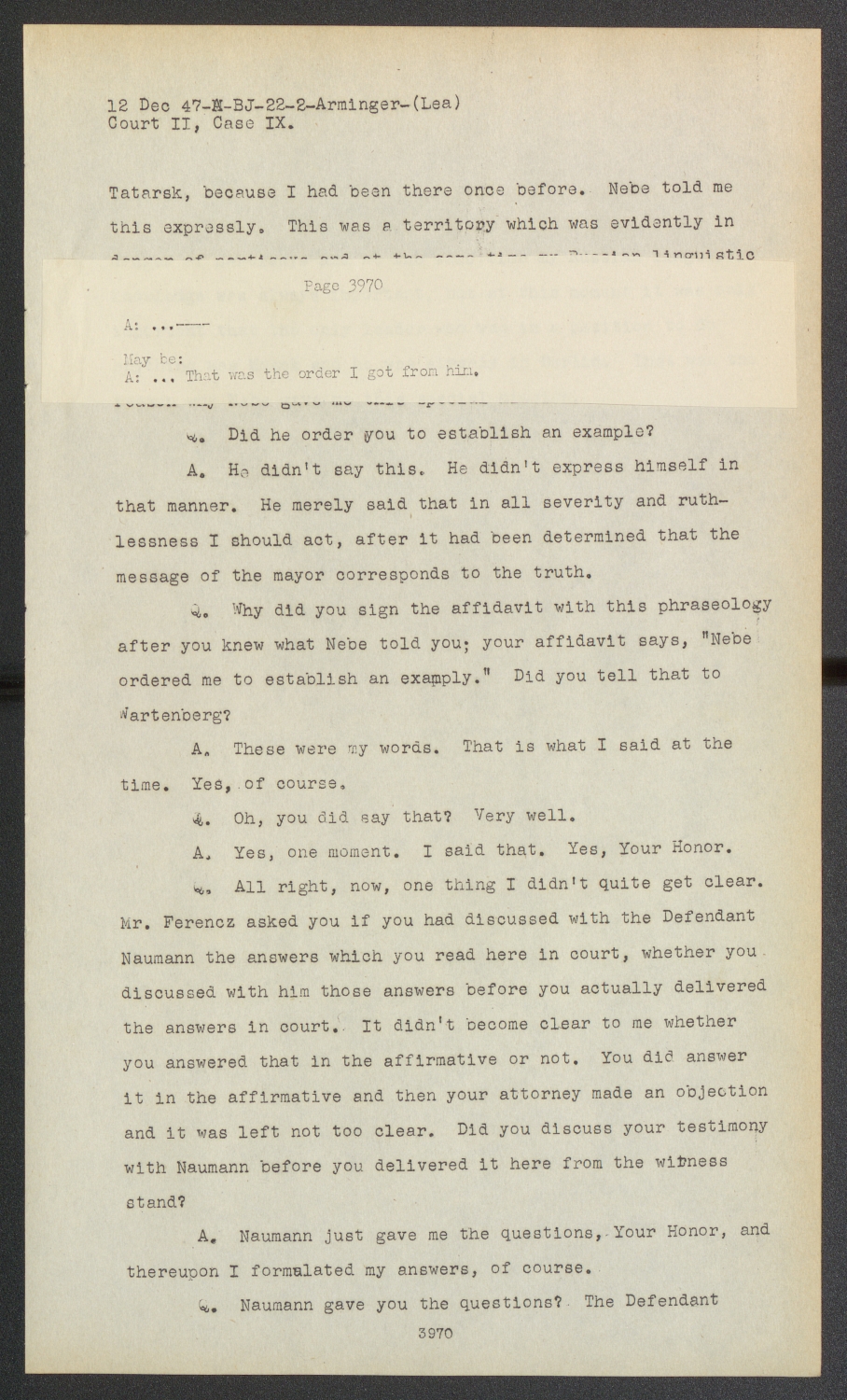
Nebe told me this expressly. This was a territory which was evidently in danger of partisays and at the same time my Russian linguistic knowledge was always important, but at this moment it was only important that the only leader who was in a position to do anything was Noack and he was already in Berlin. That was the reason why Nebe gave me this special mission.
Q.Did he order you to establish an example?
A.He didn't say this. He didn't express himself in that manner. He merely said that in all severity and ruthlessness I should act, after it had been determined that the message of the mayor corresponds to the truth.
Q.Why did you sign the affidavit with this phraseology after you knew what Nebe told you; your affidavit says, "Nebe ordered me to establish an examply." Did you tell that to Wartenberg?
A.These were my words. That is what I said at the time. Yes, of course.
Q.Oh, you did say that? Very well.
A.Yes, one moment. I said that. Yes, Your Honor.
Q.All right, now, one thing I didn't quite get clear. Mr. Ferencz asked you if you had discussed with the Defendant Naumann the answers which you read here in court, whether you discussed with him those answers before you actually delivered the answers in court. It didn't become clear to me whether you answered that in the affirmative or not. You did answer it in the affirmative and then your attorney made an objection and it was left not too clear. Did you discuss your testimony with Naumann before you delivered it here from the witness stand?
A.Naumann just gave me the questions, Your Honor, and thereupon I formulated my answers, of course.
Q.Naumann gave you the questions? The Defendant Naumann?
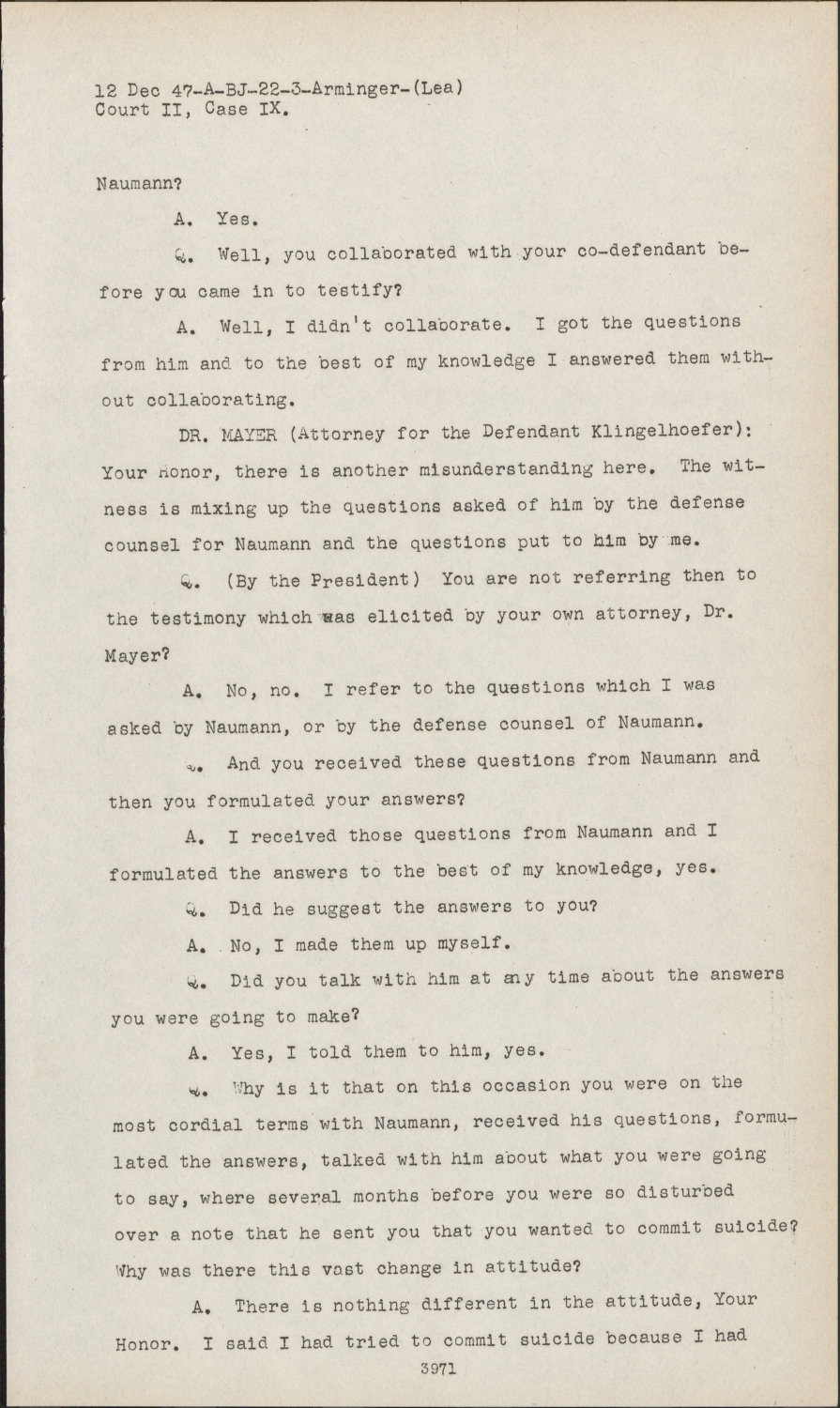
A.Yes.
Q.Well, you collaborated with your co-defendant before you came in to testify?
A.Well, I didn't collaborate. I got the questions from him and to the best of my knowledge I answered them without collaborating.
DR.MAYER (Attorney for the Defendant Klingelhoefer): Your Honor, there is another misunderstanding here. The witness is mixing up the questions asked of him by the defense counsel for Naumann and the questions put to him by me.
Q. (By the President) You are not referring then to the testimony which was elicited by your own attorney, Dr. Mayer?
A.No, no. I refer to the questions which I was asked by Naumann, or by the defense counsel of Naumann.
Q.And you received these questions from Naumann and then you formulated your answers?
A.I received those questions from Naumann and I formulated the answers to the best of my knowledge, yes.
Q.Did he suggest the answers to you?
A.No, I made them up myself.
Q.Did you talk with him at any time about the answers you were going to make?
A.Yes, I told them to him, yes.
Q.Why is it that on this occasion you were on the most cordial terms with Naumann, received his questions, formulated the answers, talked with him about what you were going to say, where several months before you were so disturbed over a note that he sent you that you wanted to commit suicide? Why was there this vast change in attitude?
A.There is nothing different in the attitude, Your Honor. I said I had tried to commit suicide because I had respect for Naumann as a comrade and that was the conflict which I developed, that on the one hand I had to do my duty and on the other hand I had respect for Naumann as a comrade whom I had to bestray in this manner.
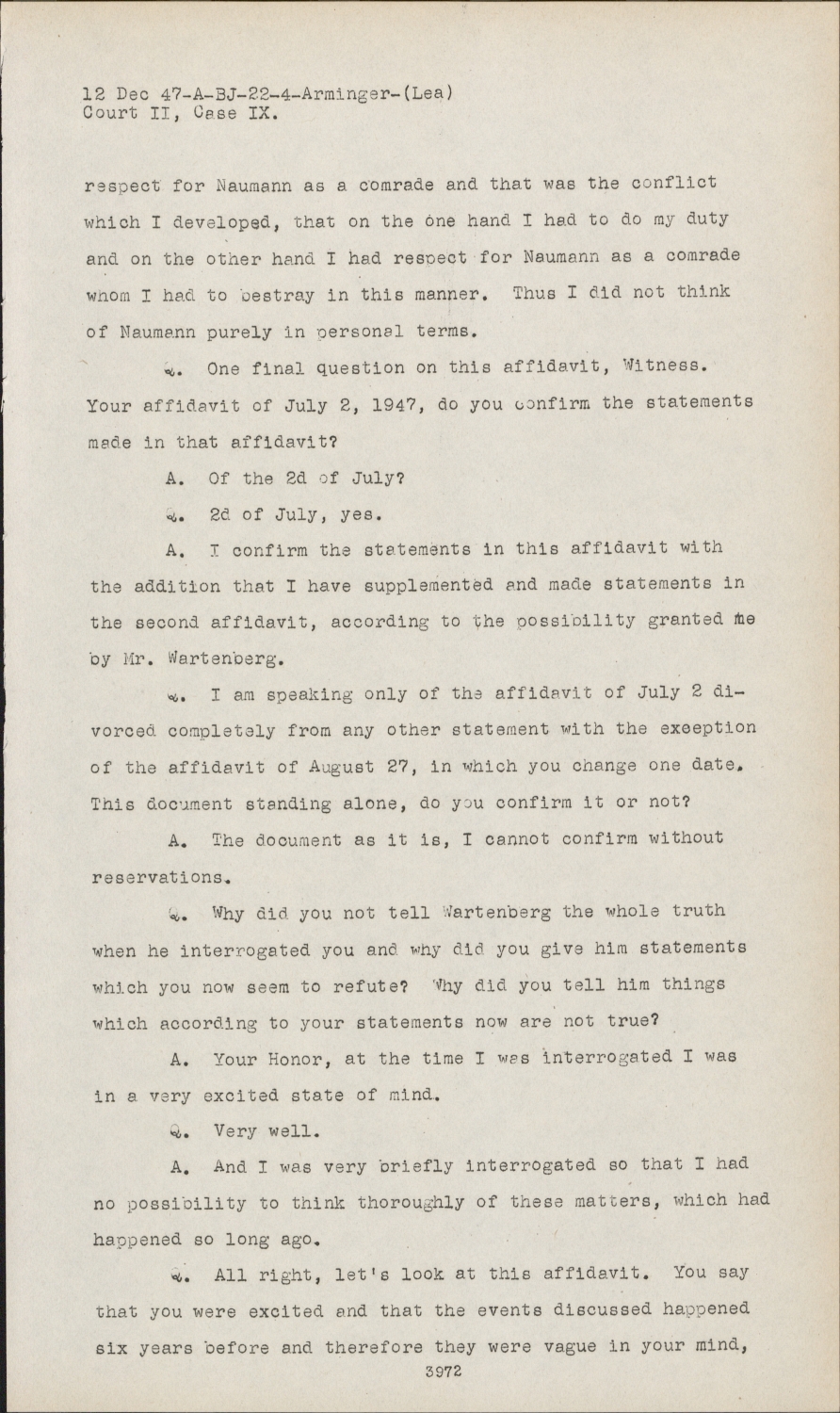
Thus I did not think of Naumann purely in personal terms.
Q.One final question on this affidavit, Witness. Your affidavit of July 2, 1947, do you confirm the statements made in that affidavit?
A.Of the 2d of July?
Q. 2d of July, yes.
A.I confirm the statements in this affidavit with the addition that I have supplemented and made statements in the second affidavit , according to the possibility granted me by Mr. Wartenberg.
Q.I am speaking only of the affidavit of July 2 divorced completely from any other statement with the exception of the affidavit of August 27, in which you change one date. This document standing alone, do you confirm it or not?
A.The document as it is, I cannot confirm without reservations.
Q.Why did you not tell Wartenberg the whole truth when he interrogated you and why did you give him statements which you now seem to refute? Why did you tell him things which according to your statements now are not true?
A.Your Honor, at the time I was interrogated I was in a very excited state of mind.
Q.Very well.
A.And I was very briefly interrogated so that I had no possibility to think thoroughly of these matters, which had happened so long ago.
Q.All right, let's look at this affidavit. You say that you were excited and that the events discussed happened six years before and therefore they were vague in your mind, is that correct?
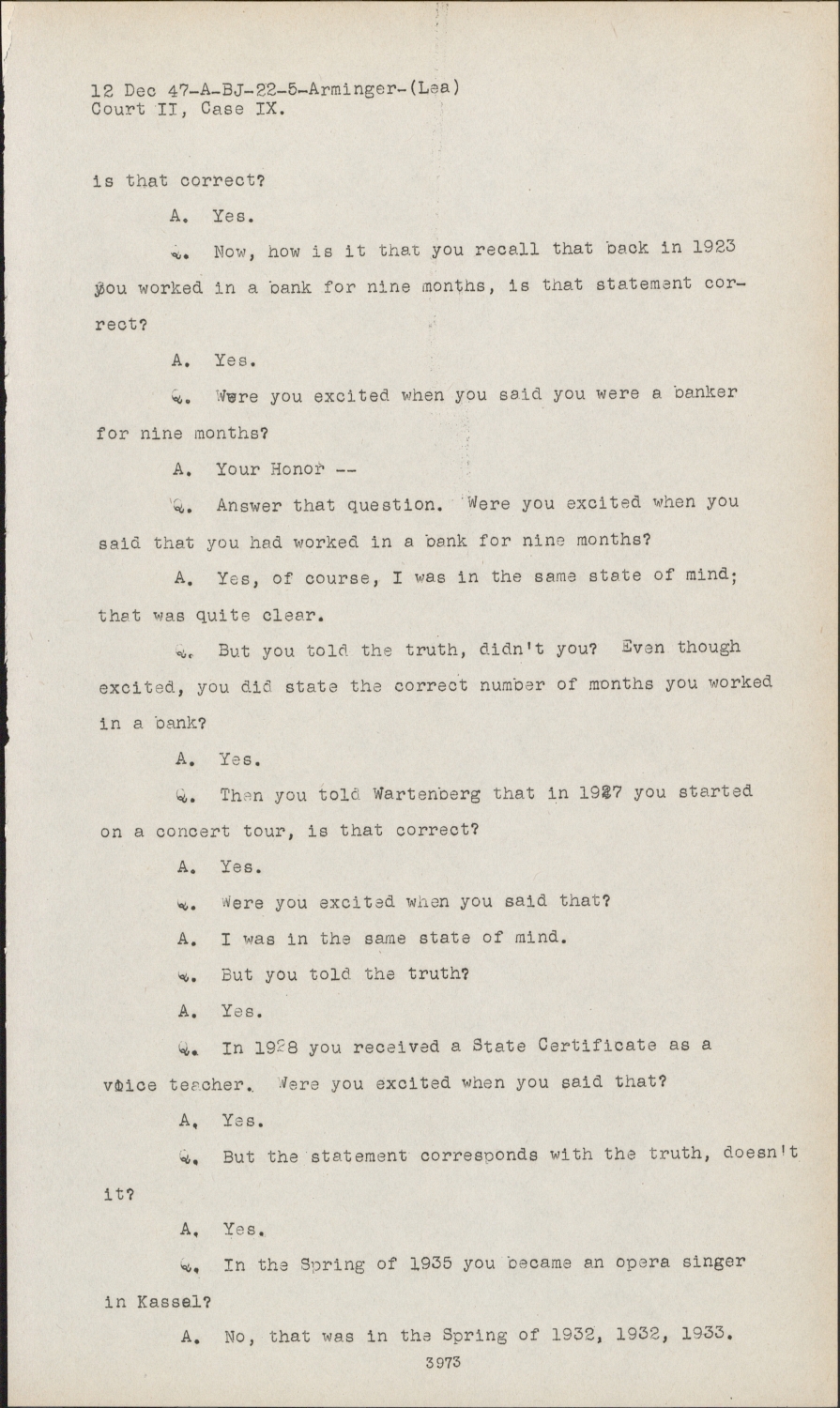
A.Yes.
Q.Now, how is it that you recall that back in 1923 you worked in a bank for nine months, is that statement correct?
A.Yes.
Q.Were you excited when you said you were a banker for nine months?
A.Your Honor -
Q.Answer that question. Were you excited when you said that you had worked in a bank for nine months?
A.Yes, of course, I was in the same state of mind; that was quite clear.
Q.But you told the truth, didn't you? Even though excited, you did state the correct number of months you worked in a bank?
A.Yes.
Q.Then you told Wartenberg that in 1927 you started on a concert tour, is that correct?
A.Yes.
Q.Were you excited when you said that?
A.I was in the same state of mind.
Q.But you told the truth?
A.Yes.
Q.In 1928 you received a State Certificate as a voice teacher. Were you excited when you said that?
A.Yes.
Q.But the statement corresponds with the truth, doesn't it?
A.Yes.
Q.In the Spring of 1935 you became an opera singer in Kassel?
A.No, that was in the Spring of 1932, 1932, 1933.
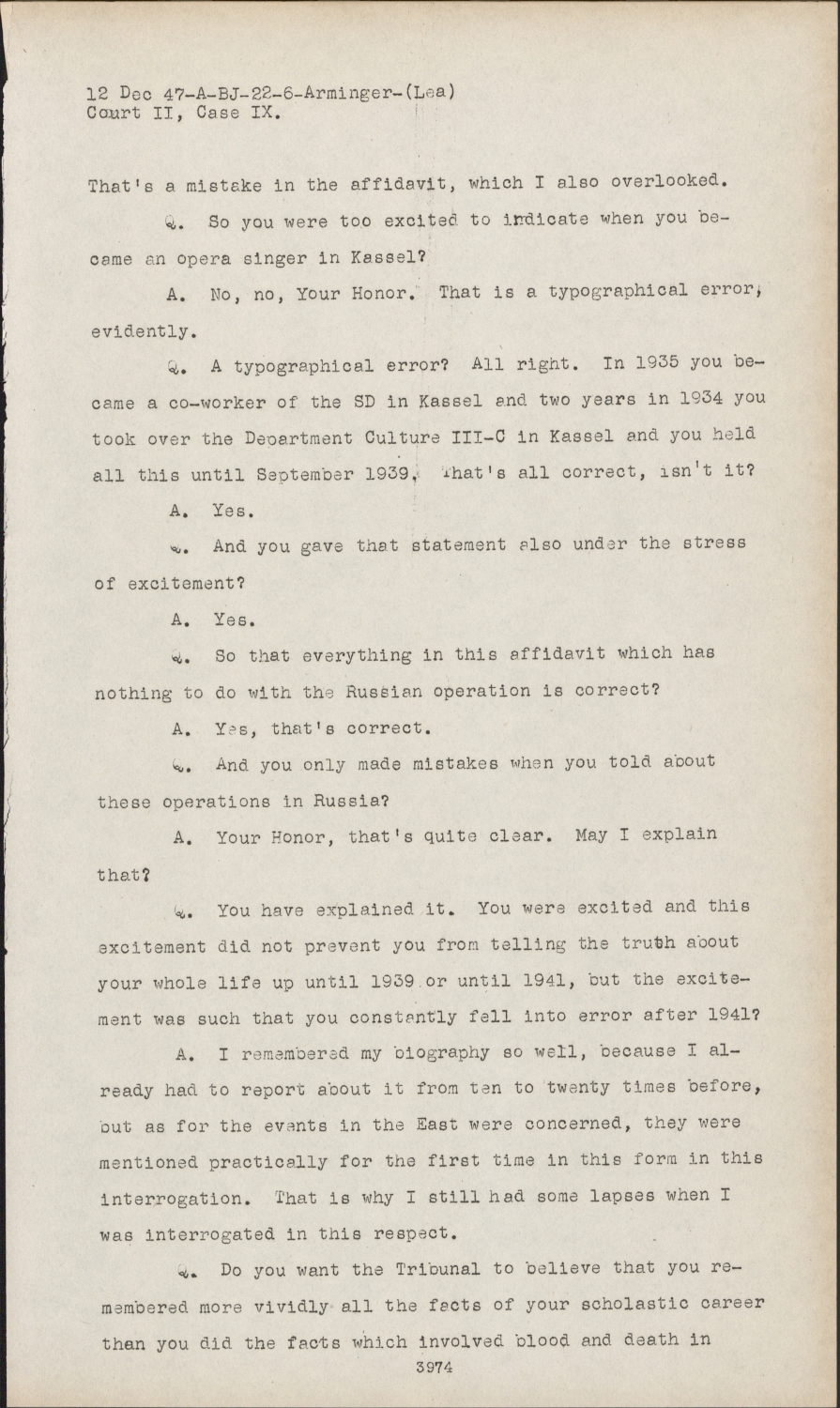
That's a mistake in the affidavit, which I also overlooked.
Q.So you were too excited to indicate when you became an opera singer in Kassel?
A.No, no, Your Honor. That is a typographical error, evidently.
Q.A typographical error? All right. In 1935 you became a co-worker of the SD in Kassel and two years in 1934 you took over the Department Culture III-C in Kassel and you held all this until September 1939, That's all correct, isn't it?
A.Yes.
Q.And you gave that statement also under the stress of excitement?
A.Yes.
Q.So that everything in this affidavit which has nothing to do with the Russian operation is correct?
A.Yes, that's correct.
Q.And you only made mistakes when you told about these operations in Russia?
A.Your Honor, that's quite clear. May I explain that?
Q.You have explained it. You were excited and this excitement did not prevent you from telling the truth about your whole life up until 1939 or until 1941, but the excitement was such that you constantly fall into error after 1941?
A.I remembered my biography so well, because I already had to report about it from ten to twenty times before, but as for the events in the East were concerned, they were mentioned practically for the first time in this form in this interrogation. That is why I still had some lapses when I was interrogated in this respect.
Q.Do you want the Tribunal to believe that you remembered more vividly all the facts of your scholastic career then you did the facts which involved blood and death in Russia.

A.Your Honor, I don't know what to answer. These events in my life were, of course, very impressionable and they were firmly in my memory, but, as for the events in the Russian assignment, I tried to forget them and to get over this period and this is the reason why I perhaps did not remember all the details.
12 Dec 1947_A_MSD_Gallagher (Juelich ) 23_1_
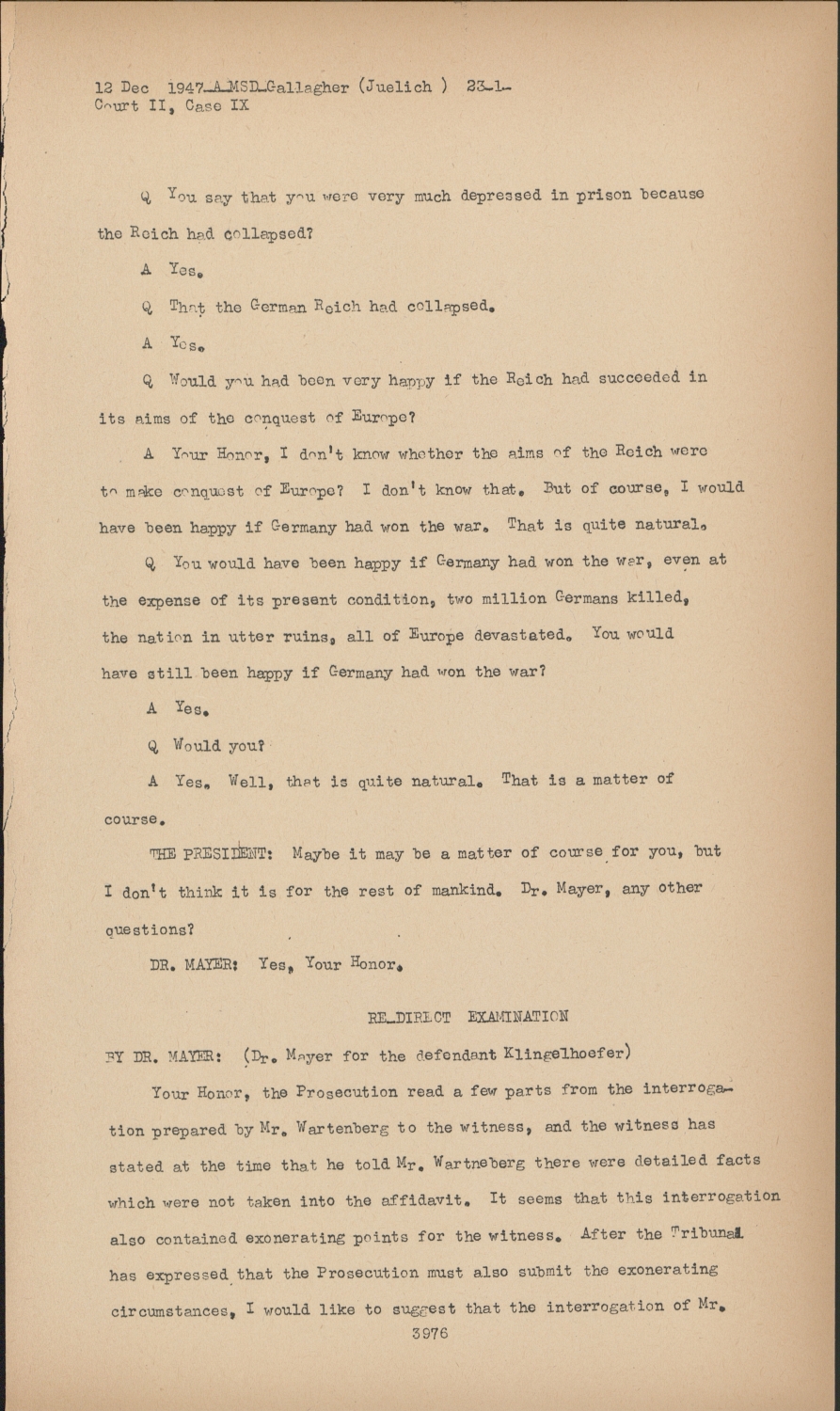
QYou say that you were very much depressed in prison because the Reich had collapsed?
AYes.
QThat the German Reich had collapsed.
AYes.
QWould you had been very happy if the Reich had succeeded in its aims of the conquest of Europe?
AYour Honor. I don't know whether the aims of the Reich were to make conquest of Europe? I don't know that. But of course, I would have been happy if Germany had won the war. That is quite natural.
QYou would have been happy if Germany had won the war, even at the expense of its present condition, two million Germans killed, the nation in utter ruins, all of Europe devastated. You would have still been happy if Germany had won the war?
AYes.
QWould you?
AYes. Well, that is quite natural. That is a matter of course.
THE PRESIDENT:Maybe it may be a matter of course for you, but I don't think it is for the rest of mankind. Dr. Mayer, any other questions?
DR. MAYER:Yes, Your Honor.
RE_DIRECT EXAMINATION BY DR. MAYER: (Dr. Mayer for the defendant Klingelhoefer) Your Honor, the Prosecution read a few parts from the interrogation prepared by Mr. Wartenberg to the witness, and the witness has stated at the time that he told Mr. Wartneberg there were detailed facts which were not taken into the affidavit.
It seems that this interrogation also contained exonerating points for the witness. After the Tribunal has expressed that the Prosecution must also submit the exonerating circumstances, I would like to suggest that the interrogation of Mr. 12 Dec 1947_A_MSD_23_2_Gallagher (Juelich) Wartenberg in its entirety be submitted, or be read.
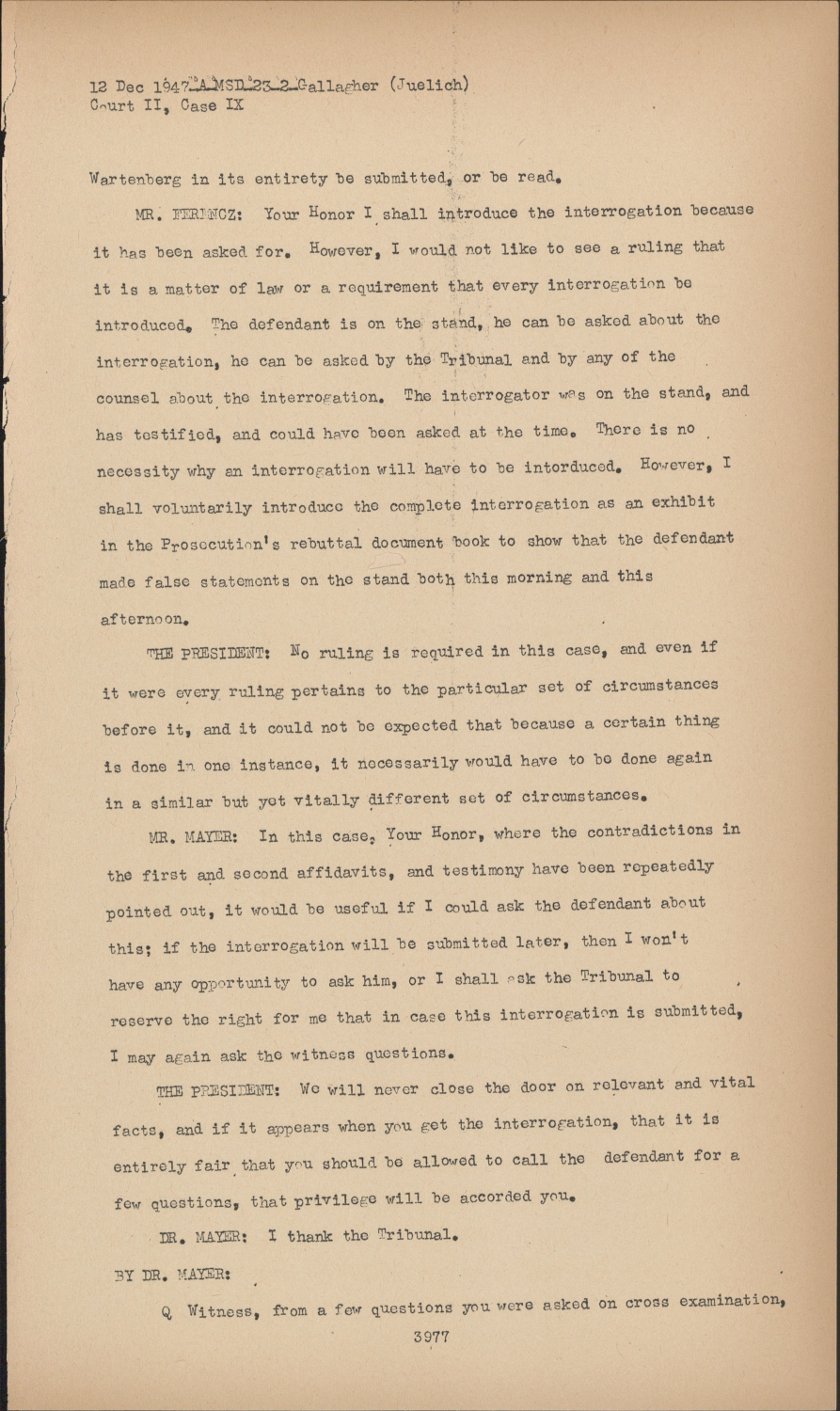
MR. FERENCZ:Your Honor I shall introduce the interrogation because it has been asked for. However, I would not like to see a ruling that it is a matter of law or a requirement that every interrogation be introduced. The defendant is on the stand, he can be asked about the interrogation, he can be asked by the Tribunal and by any of the counsel about the interrogation. The interrogator was on the stand, and has testified, and could have been asked at the time. There is no necessity why an interrogation will have to be intorduced. However, I shall voluntarily introduce the complete interrogation as an exhibit in the Prosecution's rebuttal document book to show that the defendant made false statements on the stand both this morning and this afternoon.
THE PRESIDENT:No ruling is required in this case, and even if it were every ruling pertains to the particular set of circumstances before it, and it could not be expected that because a certain thing is done in one instance, it necessarily would have to be done again in a similar buy yet vitally different set of circumstances.
MR. MAYER:In this case, Your Honor, where the contradictions in the first and second affidavits, and testimony have been repeatedly pointed out, it would be useful if I could ask the defendant about this; if the interrogation will be submitted later, then I won't have any opportunity to ask him, or I shall ask the Tribunal to reserve the right for me that in case this interrogation is submitted, I may again ask the witness questions.
THE PRESIDENT:We will never close the door on relevant and vital facts, and if it appears when you get the interrogation, that it is entirely fair that you should be allowed to call the defendant for a few questions, that privilege will be accorded you.
DR. MAYER:I thank the Tribunal. BY DR. MAYER:
QWitness, from a few questions you were asked on cross examination, 12 Dec 1947_A_MSD_23_3_Gallagher (Juelich) I think I can gather that it has not been clarified that twice, at different times, you were in Tatarsk.
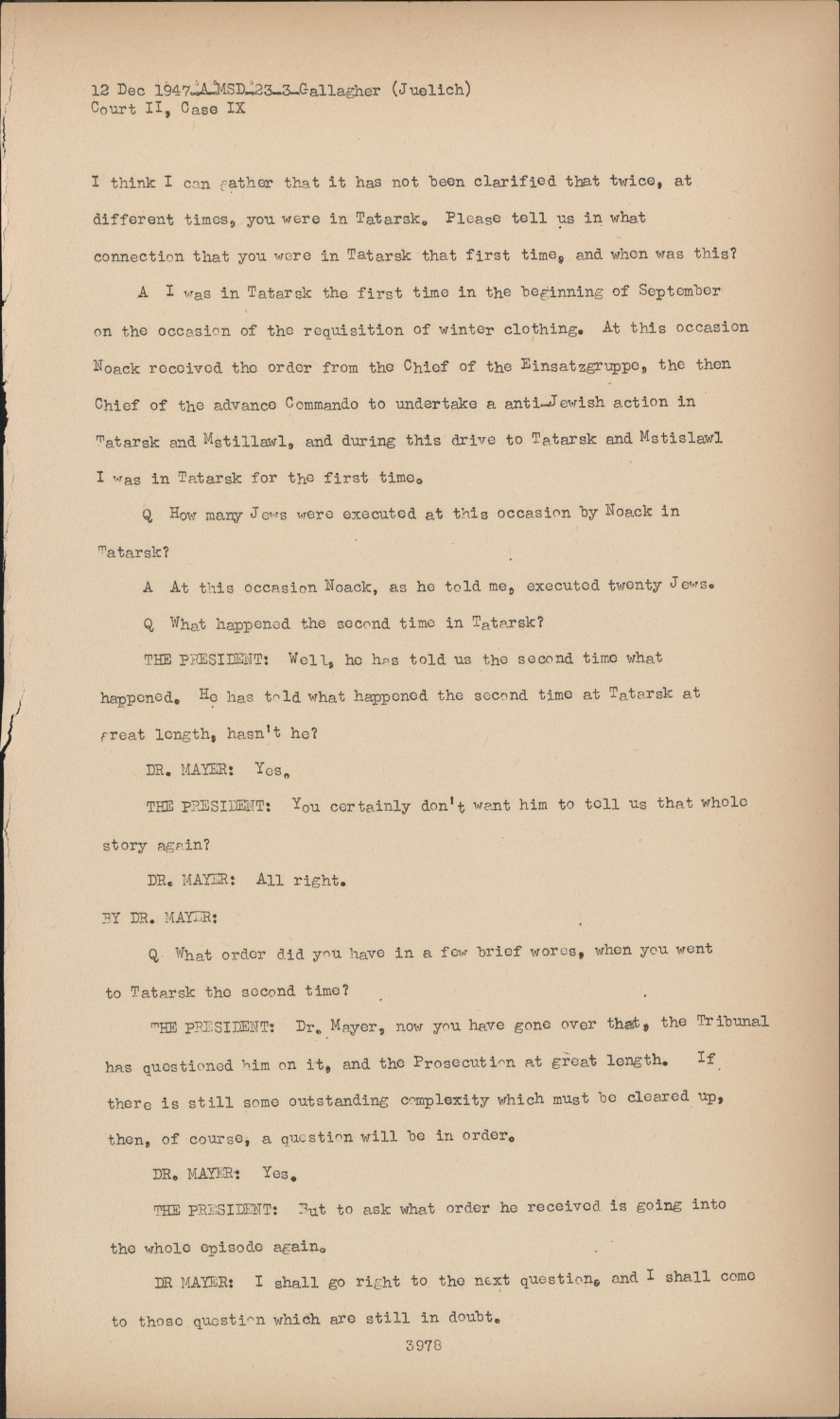
Please tell us in what connection that you were in Tatarsk that first time, and when was this?
AI was in Tatarsk the first time in the beginning of September on the occasion of the requisition of winter clothing. At this occasion Noack received the order from the Chief of the Einsatzgruppe, the then Chief of the advance Commando to undertake a anti_Jewish action in Tatarsk and Mstillawl, and during this drive to Tatarsk and Mstislawl I was in Tatarsk for the first time.
QHow many Jews were executed at this occasion by Noack in Tatarsk?
AAt this occasion Noack, as he told me, executed twenty Jews.
QWhat happened the second time in Tatarsk?
THE PRESIDENT:Well, he has told us the second time what happened. He has told what happened the second time at Tatarsk at great length, hasn't he?
DR. MAYER:Yes.
THE PRESIDENT:You certainly don't want him to tell us that whole story again?
DR. MAYER:All right. BY DR. MAYER:
QWhat order did you have in a few brief wores, when you went to Tatarsk the second time?
THE PRESIDENT:Dr. Mayer, now you have gone over that, the Tribunal has questioned him on it, and the Prosecution at great length. If there is still some outstanding complexity which must be cleared up, then, of course, a question will be in order.
DR. MAYER:Yes.
THE PRESIDENT:But to ask what order he received is going into the whole episode again.
DR MAYER:I shall go right to the next question, and I shall come to those question which are still in doubt.
12 Dec 1947_A_MSD_23_4_Gallage(Juelich) BY DR. MAYER:
QWhen you came to Tatarsk the second time, was the Fuehrer Order in regard to the Jews, as it had existed previously, still to be carried out?
AYes.
QThen what purpose did the preceding action of Noack have?
AThe action carried out by Noack previously has a Jewish action on the order of the Chief of Advance Commando_Moscow, with the limitation that at that time only those Jews unfit to work were to be shot, while the others were to be sent to a Ghetto.
QYes, did this order still exist when you came to Tatarsk?
AI don't know exactly.
QI mean, in the form that Jews fit to work were excluded from the execution on the basis of the Fuehrer Order?
AAccording to this, yes, otherwise, they would not have been alive any longer.
QNow why were thirty male Jews left in Tatarsk according to your opinion?
AWell, I already explained, these thirty Jews had remained in Tatarsk with the intention to work for the Partisans, and to be "stoogies" for the Partisans.
QHow many male Jews, in the case you established this in your interrogation, were in the Ghetto in Tatarsk before the Munity?
ASo far as I remember there were about one-hundred to onehundred and twenty, about at that time, and that was the figure before they left the Ghetto.
QWhat would have happened on the basis of your interrogations, if you would have come to the conclusion that none of the Jews apprehended by you in Tatarsk, and in the vicinity, was in contact with the Partisans?
AThen I would have sent the Jews back to the Ghetto, of course, because I had an order.
12 Dec 1947_A_MSD_23_5_Gallagher (Juelich)
THE PRESIDENT:Now you told us that. He already said that. Now is he going to tell the whole story again. He would send them back to the Ghetto. BY DR. MAYER:
QWhy wouldn't you have shot the Jews anyway?
ABecause I had no order to do so.
QDid the thirty Jews participate in threatening the Mayor?
AOf course.
QDid the fact of the participation in this threat not play any part in your decision?
AThe fact of this threat was the consequence of their contact with the Partisans, because the promise of help by the Partisans encouraged them.
THE PRESIDENT:Dr. Mayer, now don't you agree that it is unnecessary for him to tell the story all over again. The purpose of redirect examination is not to re-emphasize facts, it is only to clear up what may have been obscurated by the cross examination.
DR. MAYER:I am afraid, Your Honor, that in the excitement of cross examination, it was not possible for the defendant to describe the events correctly. By a few individual questions I would like to clarify it once more.
THE PRESIDENT:Well then put it this way, Dr. Mayer. Ask the witness if he wants to make any correction in a statement he has made because to repeat what he has already told us two or three times serves nobody at all. Ask him if he wants to make any correction or to point out where you think a correction is in order. BY DR. MAYER:
QDuring the cross examination you have stated that the Jews had been shot regardless of the result of the investigation. What did you mean to say by this? Was this also true of the time while you were busy with investigations in Tatarsk during your mission?
AThat was not true for the period when I was busy in Tatarsk with the special assignment of the investigations about the sentences.
QDid you have to carry out purely Jewish action in Tatarsk at that time?
ANo.
QWho would have been given the order to carry out such an action if Nebe had intended such an action?
AIn this case an officer from the State Police Department - -
THE PRESIDENT:Dr. Mayer, you see the difficulties you are going to get into. Now he told us only ten or fifteen minutes ago that the only reason Nebe sent him out there was that he had no other officer. Now he is telling you that if it had been purely an action of execution that some other officer would have been sent, some other officer who didn't exist.
Witness, didn't you say to the Tribunal that the reason you were sent out was because no other officer was available?
ABecause no other officer was available who knew the conditions and the road to Tatarsk.
THE PRESIDENT:Now why do you tell counsel that if it had been a different king of an action one purely involving executions they would have sent another officer. It would still have been the same roads, wouldn't it? You would still have to go over the same roads?