A.No. At the end of January I received Information from Colonel Freytag Loringhofen that his suggestion had been rejected by his superior office and he could not help me for the time being.
QWere you satisfied with this?
ANo. I went to the labor office who sent me to the office of the Mayor who had put me on the War emergency status. Here I was told that the war emergency status could only be cancelled by the office who imposed it and only they could release me. I then went to the office of the RSHA in Berlin and asked the department chief competent, Sturmbannfuehrer Trautmann, to release me. I mentioned the emergency and the need in my family, and I said that I wanted to volunteer for the Army. Trautmann listened to me and asked me to come back after two days. After a short discussion in the doorway he talked to me in a very brief manner which could not be misunderstood.
QOne more question to supplement this. You said you went to the Mayor. In which city was this?
APosen, my new domicle.
QTrautmann told you that your war emergency status could not be rescinded?
AYes and he also said that such requests by me could not be understood and I should not do this in the future.
QWhat did you do after that?
AI travelled back to Posen and dealt with tasks of the Advisory Agency on the one hand and with the attempt of setting my domestic affairs. This is what I did until I received a telegram that I was to go to Charkow. Immediately, I travelled to Charkow in the beginning of March.
QYour Honor, I now come to a new sector. This might be a good place for the recess.
THE PRESIDENT:I would think so. The Tribunal will be in recess until 1:45.
AFTERNOON SESSION (The hearing reconvened at 1345 hours, 16 December 1947)
THE MARSHAL:The Tribunal is again in session.
DR. BLUME:Dr. Blume, assistant for Dr. Lummert for Defendant Blume. Your Honor, I would like the defendant Blume to be excused tomorrow morning and tomorrow afternoon as his defense has to be prepared.
THE PRESIDENT:The defendant Blume will he excused from attendance in Court all day tomorrow, Wednesday.
DR. BLUME:Thank you, Your Honor.
WALDEMAR VON RADETZKY - Resumed EXAMINATION BY THE PRESIDENT:
QWitness, you said something about the seizure of documents on which we would like some enlightenment. These documents, enemy documents, would naturally contain information regarding activities against the German forces, activities which would call for executive measures. Would you make a report on these activities which would result in executive measures being taken against the authors of those activities?
ANo, Your Honor, I did not report about such matters. The task of seizure of documents as it was assigned to me was the following: The basic and general material which enlightens on the structure and activity of the various Soviet institutions, this has to be seized, and by the first possible way has to be transported to Berlin. All these dispatches either went directly or via, the Einsatzgruppe to Berlin, and I had to deal with this. I had to pack them, either in cases or in reams, and each case or ream had to have a register and a list pertaining to the documents giving their content matter, but these documents did not serve the purpose to combat the enemy locally, but, as far as I know, they served the purpose of elucidating the Reich Government as to the structure and government of the Soviet Union.
QWell, suppose that in these documents you came across a list of individuals who were actively working against the German Armed Forces, what would you do with this list?
AI would have passed it on to Berlin. This was according to my assignment, but I can not remember -
QAllright, let's suppose that you find in Kiev, you have seized the files, and in these files you find a report on a meeting which took place in a certain building, and in these reports there was an indication that a conspiracy was forming, a conspiracy already had been formed, that explosives were to be brought in, dynamite was to be brought in, and that certain roads were to be mined so that when the German forces traveled over them they would all be killed. This report gives the names of conspirators. Would you send that off to Berlin without doing anything?
ANo, under these circumstances it would have been my duty to inform the competent authority immediately. The simplest thing would have been to inform the kommando itself about this state of affairs.
QAnd then executive measures would be taken?
AYes.
QAnd you would be called upon to translate these documents and evaluate them?
AI don't think so, Your Honor, This would have been done be the executive authority or those who dealt with executive activities. These would have to start their work then.
QSuppose that you had found merely a list of functionaries of the Communist Party who according to the Fuehrer Order were to be executed. You find this list of Communist functionaries. What would you do with the list?
AYour Honor, I don't know. Such a case never happened.
QWhat would you do with such a list?
AAccording to my task, I would have sent this list to Berlin, because, contrary to the example you mentioned before, there was no acute danger here; but I am not able to answer this exactly, what I would have done in such a case.
QWell, suppose that you had a list of those actually identified as resisting the German Armed Forces, what would you do with that list, would you still send that on to Berlin?
ANo, I would have passed it on to the German Wehrmacht.
QWould you then counsel with the German Wehrmacht as to the meanins of the list?
ANo, I would have passed it on to the authority of the Wehrmacht,
QAnd you would have done nothing further?
ANo, Your Honor.
QSuppose they would have asked you to translate it, would you have translated it for them?
ANo, the Army had their own interpreters, and they had their own translators who had to interpret it or translate it.
QYou take a list to them. It is drawn up in Russian and you hand it to them. Wouldn't you explain that, "Here is a list of individuals who are dangerous. They are resisting the German Armed Forces. They met at a certain place. They have certain plans." Wouldn't you tell them what the report was about?
AYes, that would have been my duty.
QNow, how many times did you do just such a thing?
ASuch matters I did not carry out. As I said, the material seized by myself I regularly sent to Berlin in all the cases which I have mentioned. I think that I also read this in reports - I can't exactly remember that - this is also being confirmed by these reports of the local situation.
QDid it never happen when you seized files, in all the time you were seizing files, did it never happen that you found in those NKWD files names of individuals who were opposing the German Armed Forces or who were in the category of those listed to be executed under the Fuehrer Order?
Did that never happen once?
AYour Honor, the cases which I personally remember, the NKWD buildings were always empty because the NKWD had no reason.....
QDid you ever see any documents which contained information on enemies of the German Armed Forces?
AThat is possible. I do not remember a special case, but it is absolutely possible that that happened.
QThen what did you do with the information which appertained to those who were to be in some way made the subject of summary action on the part of the German Armed Forces?
AI am afraid I did not quite understand your question, Your Honor.
QYou say you do not exclude the possibility that you did, in some of these seizures, find documents which gave information on persons opposing the German Armed Forces, you said that, didn't you?
AYes.
QNow, what did you do with this information which pointed out certain individuals, certain organizations opposed to the occupational forces?
AYour Honor, I have already stated that those documents which were seized by me I sent off to Berlin.
QI am asking you of documents which included lists of individuals opposing the German forces, what did you do with those lists?
AYour Honor, I do not remember any case. I have already said that I never found such lists.
QThen you said you do not exclude the possibility, that you may have found some documents which called for action, for executive action on the part of the commando or on the part of the Wehrmacht. You said that, didn't you?
AYes.
QAll right, if you do not exclude that possibility you, therefore include it?
AYes.
QAll right, what would you do with that information in those cases where you would find something which called for executive action?
AYour Honor, I personally did not have the right perspective, what would be the primary condition for an executive measure and what was not. I acted according to my assignment, and personally I saw no reason to go any further than this particular assignment. It was my task to seize documents and to transport them to Berlin, and this is what I did.
QNow you can getting away from the question. I said, what did you do in those cases where you did find information acting upon which would call for executive action?
AYour Honor, I said that I did not experience such cases and I did not know about such cases. I said that I did not exclude
QYes, you did not exclude that possibility.
AYes.
QTherefore, you include the possibility?
AYes.
QHow, do you remember any particular case which called for executive action?
ANo, Your Honor.
QDid a case calling for executive action make such little impres sion on your mind, that you can't recall it?
ANo, Your Honor, it is not that I do not remember this particular thing, but it is that I do not know of any case in which I passed on a list to anybody on the basis of which -
QWhen you went into any building which had been occupied by the Russians, you immediately been to look for papers, is that right?
AYes.
QDid you gather up only the papers which referred to your department and leave the others to another department?
AI also interested myself in material which, as it was said at the time, had to be secured in the interest of the Reich.
QDid you gather up all the documents or did you gather up only those which pertained to your department of agriculture, economy, and so forth?
AI busied myself with documents pertaining to my own field of activities. I remember one particular case in which later -
QNow, just a moment, is that the only document, are those the only documents which you would pick up, those which referred to your department?
AYes, Your Honor.
QYou would leave the others there?
AI remember one particular case, I think it was in Shitomir, in which after I had been there, officials - and by officials I mean members of the Security Police - arrived and organized another supervisory control for their own purpose.
QWhen you would go into a building, could you tell, just by glancing at the filing cases, those which contained information of interest to your department?
ANo, of course I had to look at these file shelves, in order to set a proper perspective, and then I decided upon what I would take with me and upon the material which I did not need and which should remain there.
QAnd you would look at everything, wouldn't you?
AI glanced over the whole material, but then especially I looked at the material which seemed important end of special significance to me.
QWell, you would have to look at it in order to find out whether it was of importance to you, wouldn't you?
AWell, Your Honor, that does not mean that I actually read the whole material, out with a glance I can establish what I need for my own purposes, I took that material, and at the office I looked at it and made the registers and lists.
QYou want to tell us you would open up a drawer of a file end if a tomato plant was growing in there then you knew that referred to agriculture and you would take those papers, You looked in another file and if there was some indication of economy in the way of a toy train or something, you would like that file? Witness, to reduce it to its very simple element, we indicate to you that it seems very unlikely that someone charged with the grave responsibility of seizing, enemy papers would not take every paper and evaluate every paper end report to his kommando leader.
AYour Honor, the bulk of the papers, documents and files was so tremendous in Russia, I have already said that from Lutsk itself I sent a whole truckfull of material to Berlin. I had to work day and night on this together with men and officers of the Wehrmacht, and so it was impossible for me to busy myself with material which I regarded as of no consequence for my own purposes.
QAnd you regarded as of no consequence any information which referred to the security of your own comrades and of the armed forces in Russia just because it didn't fall within your department. That is what you are telling us, isn't it?
AThis wasn't my task in this particular case.
THE PRESIDENT:Proceed, Dr. Ratz.
DIRECT EXAMINATION (Continued) BY DR. RATZ:
QWitness, when did you arrive in Charkov?
AI arrived in the middle of March, 1942, in Charkov.
QWho had meanwhile been appointed commander of SK 4-A?
AThe commander was Obersturmbannfuehrer Dr. Weinmann.
QWhat was your new assignment in this kommando?
AMy new assignment was the same as it had been before, I was liaison officer with the Army and the Army groups.
QWhere were they stationed?
AThe Army was in Poltava then in Charkov. The Army group was in Poltava.
QDid you have any further tasks to deal with?
AYes, I made out other reports of an economical nature also dealing with cultural questions.
QHow did your assignment come about concerning the self-administration in Charkov?
AThis was a task that I put to myself during the first days of my stay in Charkov as I saw that the Russian municipal administration could not cope with feeding the 3 - 400,000 inhabitants and I, knowing the economical structure of the Army, could support them.
QDid you have any further discussions with Weinmann concerning your own activity?
AYes, Weinmann reproached me that I had been away from the kommando for too long. He had learned that I had not been ill but that I had been seen in Berlin. I described my futile attempt to be released to Weinmann and he, on his part, tried to convince me of the contrary of my attitude. In this discussion I asked for my release, which he refused.
QDid Weinmann make you offers of having you assigned in the Security Police and the SD?
AYes.
AYes. Starting from the point that he as a former physician had never thought himself of joing such a service BY THE PRESIDENT:
QWitness, we asked you this morning whether you were a part of the Teilkommando of SK 4A, how did you answer that question--you said "No", didn't you?
AYes, Your Honor.
QWell, how do you reconcile that with the statement in your affidavit, "I went with the Sonderkommando to Rutkoschow and from there to Lutsk where I was assigned to a Teilkommando of Sonderkommando IVA. How do you reconcile those two statements?
AYour Honor, I stated in my affidavit that I had been attached to a subcommando of the SK IVA. With that I did not say that I was in charge of this subcommando.
QWell, but you were with a Teilkommando of IVA, of Sonderkommando IVA?
AYes.
QWell, why did you deny that when I asked you that this morning, reading from Document Number 3405?
AYour Honor, I do not remember having given a negative asnwer when asked whether I was with the Suncommando.
QI asked you if you were over a member of a Teilkommando of IVA at Lukni, and you said you were never a member of a Teilkommando of IVA
ANo, Your Honor, I understand your question to be whether I was a member of the subcommando in Lukni, and to this my answer was in the negative, but yesterday in my direct examination I have stated that I was with the subcommando in Lutsk, and I said so in my affidavit.
QVery well, I might been mistaken. Proceed. BY DR. RATZ:
QWitness, my question was, did Weinmann make any offers to you concerning your appointment in the security police and the SD?
AYes. Starting at the point that he as a former physician never had thought himself to change into such a service and only when he had joined he had been convinced of its necessity and thus he also wanted to persuade me to give up my futile--or at least he regarded them as futile-attempts to leave the RuSHA and to have himself transferred. I refused his offer, as I have alreadu said. I asked for my release.
QWere there any other agencies in Charkow?
AYes. I said Dr. Kranebitter was his kommando. There was also the term SK IVA as in the army territory--there were not supposed to be any commanding agecnies as they were in the territories of civil administration. And on the part of the Einsatzgruppe the solution was found in this manner, that Kranebitter, was appointed the deputy of Weinmann in special districts in order to legalize him.
QWhat did you do in this army group?
AI represented my own agencies with the GII Freytag, and I made another attempts to join the army group direct, for the setting up of a partisan combat unit. Furthermore, I received the order-in discussions-concerning the taking up of reporting activities, for Office 6, but all counter intelligence agencies of the army resisted so that the discussions took weeks.
QWhat did you do in the army?
AThe usual thing, administration and in addition food supplies for the population of the town Charkow with the aid of the army supply officer, Lt. Col. Meyer and the counselors of the Supply Office IB.
QWhat did you do in the self-administration?
AI found the following situation. In the course of a very severe winter, the population had hoarded their supplies, but they had used them up, and they had nothing to eat. The rear territory was only in the west of the city, and the counter-intelligence wanted to limit the transport to the country in the rear territory to a minimum to have to cutt off supplies therefore, I suggested that consumers' associations should be formed who had their own territories for purchases which, as there were no transport possibilities could not be seized by the army.
In this way 60 cooperative societies came into being and checks resulted in the fact that daily on the average 300 tons of food supplies were taken into the city. Simultaneously with the investigations of the secret field police, the misgivings of the counter-intelligence were allayed. In order to regulate the prices, price committees were established, and it was achieved by the army that daily 100,000 hot meals could be supplied to workers and their families from army rations.
MR. HORLICK HOCHWALD:If the Tribunal please, I do not want to interrupt the witness again, but I do not think that this line of questioning will inform the Tribunal very much about the indictment, about the counts of the indictment and about the case before the Tribunal.
PRESIDENT:What are you trying to show by this line of questioning, Dr. Ratz, that they took care of the workers who were providing munitions for the German armed forces?
DR. RATZ:I want to clarify with this the activities of the defendant at that time in Charkow, what he did.
PRESIDENT:Well, do you want to establish by this line of testimony that the witness was concerned only with humanity ' with the feeling of the population, and that he was not at all concerned with the execution of Jews and saboteurs and looters and a-socialist and all those listed in the fuehrerorder. You are attempting to establish that contrast?
DR. RATZ:Your Honor, I shall question him immediately as to his other task he had in Charkov. BY THE PRESIDENT:
QDid you have this 300 tons of food supplies brought in yourself?
ANo, Your Honor, but I took care that this transport of this food would be regulated, otherwise, the population of the town would have starved.
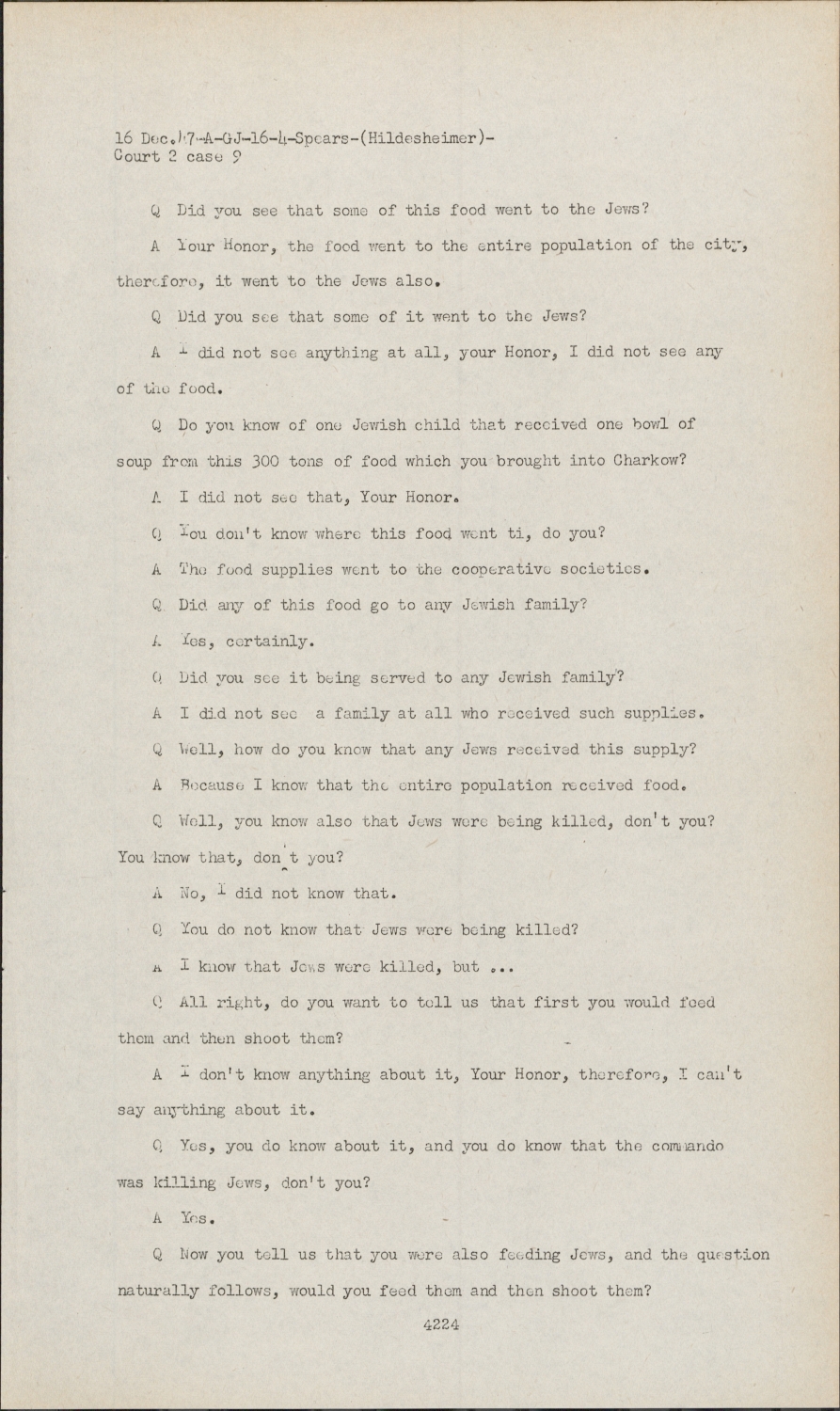
QDid you see that some of this food went to the Jews?
AYour Honor, the food went to the entire population of the city, therefore, it went to the Jews also.
QDid you see that some of it went to the Jews?
AI did not see anything at all, your Honor, I did not see any of the food.
QDo you know of one Jewish child that received one bowl of soup from this 300 tons of food which you brought into Charkow?
AI did not see that, Your Honor.
QYou don't know where this food went ti, do you?
A the food supplies went to the cooperative societies.
QDid any of this food go to any Jewish family?
AYes, certainly.
QDid you see it being served to any Jewish family?
AI did not see a family at all who received such supplies.
QWell, how do you know that any Jews received this supply?
ABecause I know that the entire population received food.
QWell, you know also that Jews were being killed, don't you? You know that, don't you?
ANo, I did not know that.
QYou do not know that Jews were being killed?
AI know that Jews were killed, but
QAll right, do you want to tell us that first you would food them and then shoot them?
AI don't know anything about it, Your Honor, therefore, I can't say anything about it.
QYes, you do know about it, and you do know that the commando was killing Jews, don't you?
AYes.
QNow you tell us that you were also feeding Jews, and the question naturally follows, would you feed them and then shoot them?
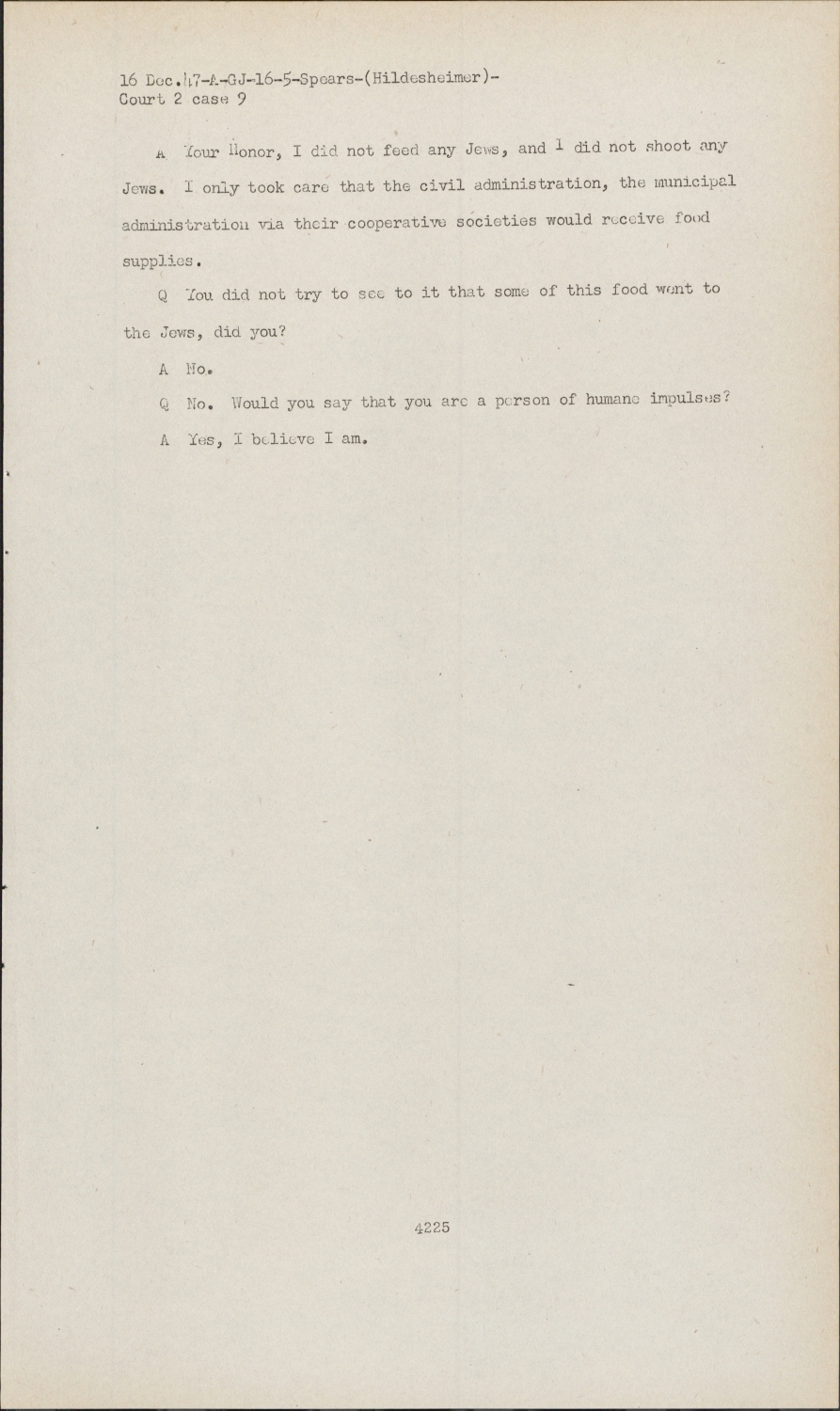
AYour Honor, I did not feed any Jews, and I did not shoot any Jews. I only took care that the civil administration, the municipal administration via their cooperative societies would receive food supplies.
QYou did not try to see to it that some of this food went to the Jews, did you?
ANo.
QNo. Would you say that you are a person of humane impulses?
AYes, I believe I am.
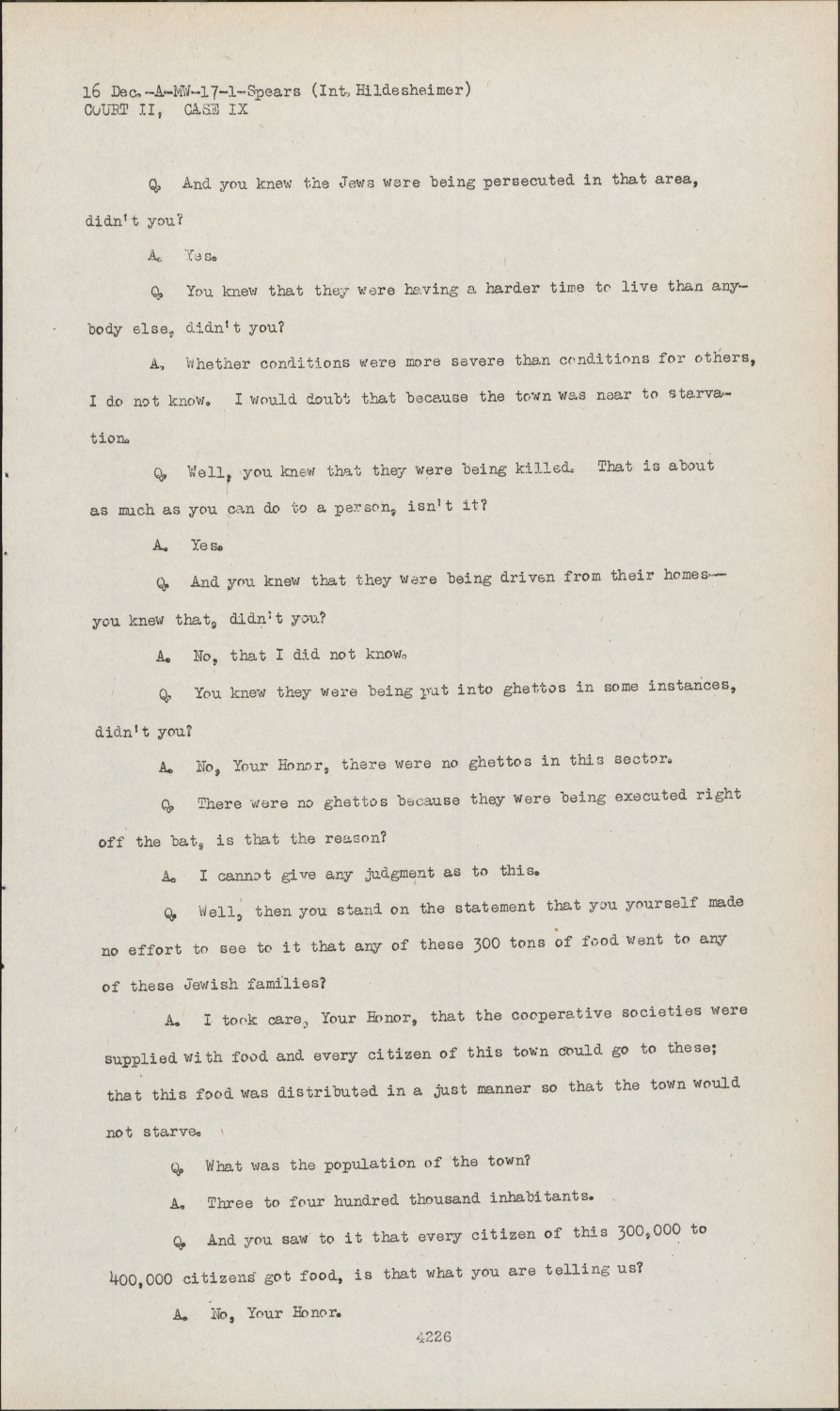
QAnd you knew the Jews were being persecuted in that area, didn't you?
AYes.
QYou knew that they were having a harder time to live than anybody else, didn't you?
AWhether conditions were more severe than conditions for others, I do not know. I would doubt that because the town was near to starvation.
QWell, you knew that they were being killed, That is about as much as you can do to a person, isn't it?
AYes.
QAnd you knew that they were being driven from their homes' you knew that didn't you?
A.No, that I did not know.
Q.You knew they were being put into ghettos in some instances, didn't you?
A.No, Your Honor, there were no ghettos in this sector.
Q.There were no ghettos because they were being executed right off the bat, is that the reason?
A.I cannot give any judgment as to this.
Q. well, then you stand on the statement that you yourself made no effort to see to it that any of these 300 tons of food went to any of these Jewish families?
A.I took care, Your Honor, that the cooperative societies were supplied with food and every citizen of this town could go to these; that this food was distributed in a just manner so that the town would not starve.
Q.What was the population of the town?
A.Three to four hundred thousand inhabitants.
Q.And you saw to it that every citizen of this 300,000 to 400,000 citizens got food, is that what you are telling us?
A.No, Your Honor.
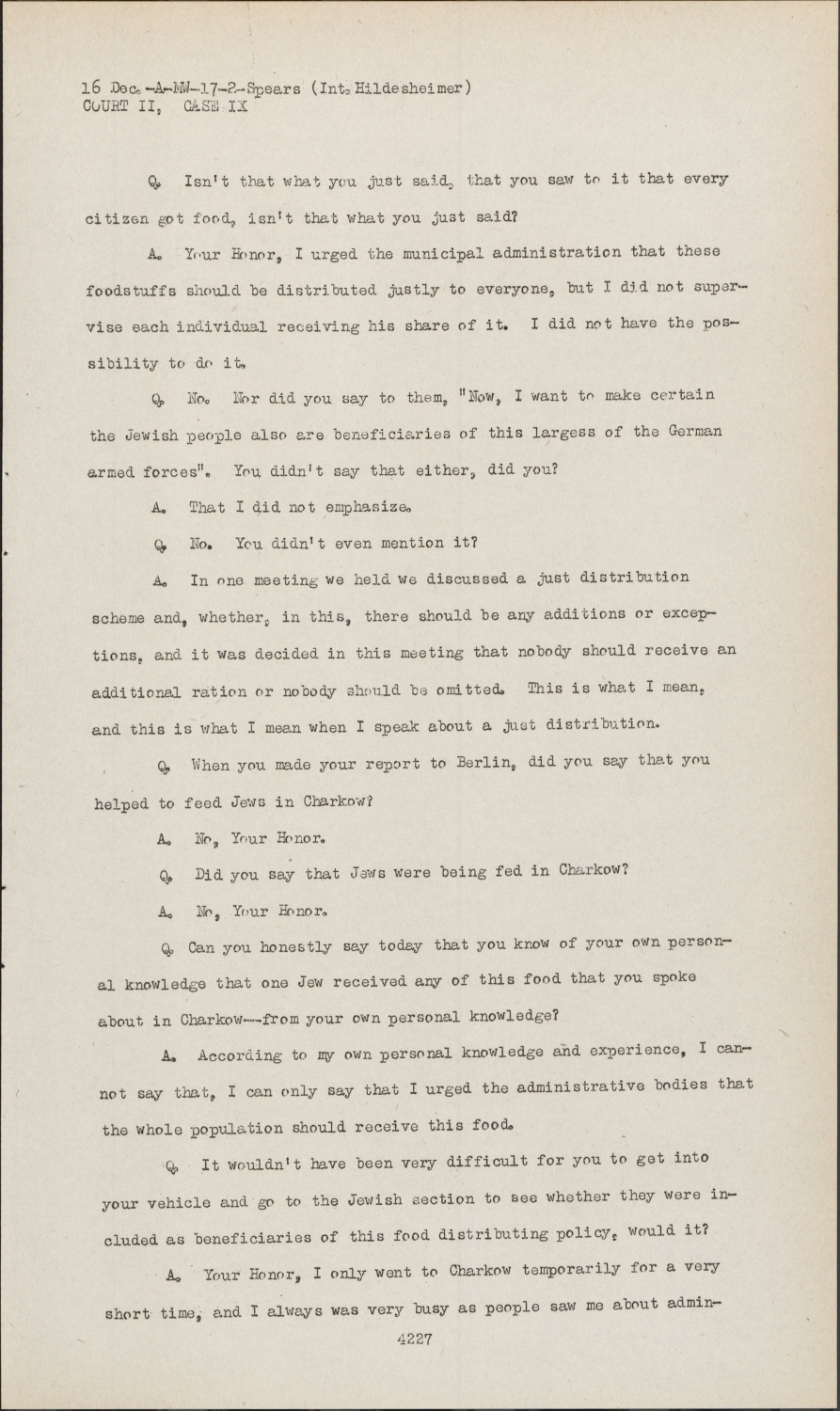
Q.Isn't that what you just said, that you saw to it that every citizen got food, isn't that what you just said?
A.Your Honor, I urged the municipal administration that these foodstuffs should be distributed justly to everyone, but I did not supervise each individual receiving his share of it. I did not have the possibility to do it.
Q.No. Nor did you say to them, "Now, I want to make certain the Jewish people also are beneficiaries of this largess of the German armed forces". You didn't say that either, did you?
A.That I did not emphasize.
Q.No. You didn't even mention it?
A.In one meeting, we held we discussed a just distribution scheme and, whether, in this, there should be any additions or exceptions, and it was decided in this meeting that nobody should receive an additional ration or nobody should be omitted. This is what I mean, and this is what I mean when I speak about a just distribution.
Q.When you made your report to Berlin, did you say that you helped to feed Jews in Charkow?
A.No, Your Honor.
Q.Did you say that Jews were being fed in Charkow?
A.No, Your Honor.
Q.Can you honestly say today that you know of your own personal knowledge that one Jew received any of this food that you spoke about in Charkow from your own personal knowledge?
A.According to my own personal knowledge and experience, I cannot say that, I can only say that I urged the administrative bodies that the whole population should receive this food.
Q.It wouldn't have been very difficult for you to get into your vehicle and go to the Jewish section to see whether they were included as beneficiaries of this food distributing policy, would it?
A.Your Honor, I only went to Charkow temporarily for a very short time, and I always was very busy as people saw me about admin istrative functions and I wanted to see that I should achieve the best results with this distribution scheme.
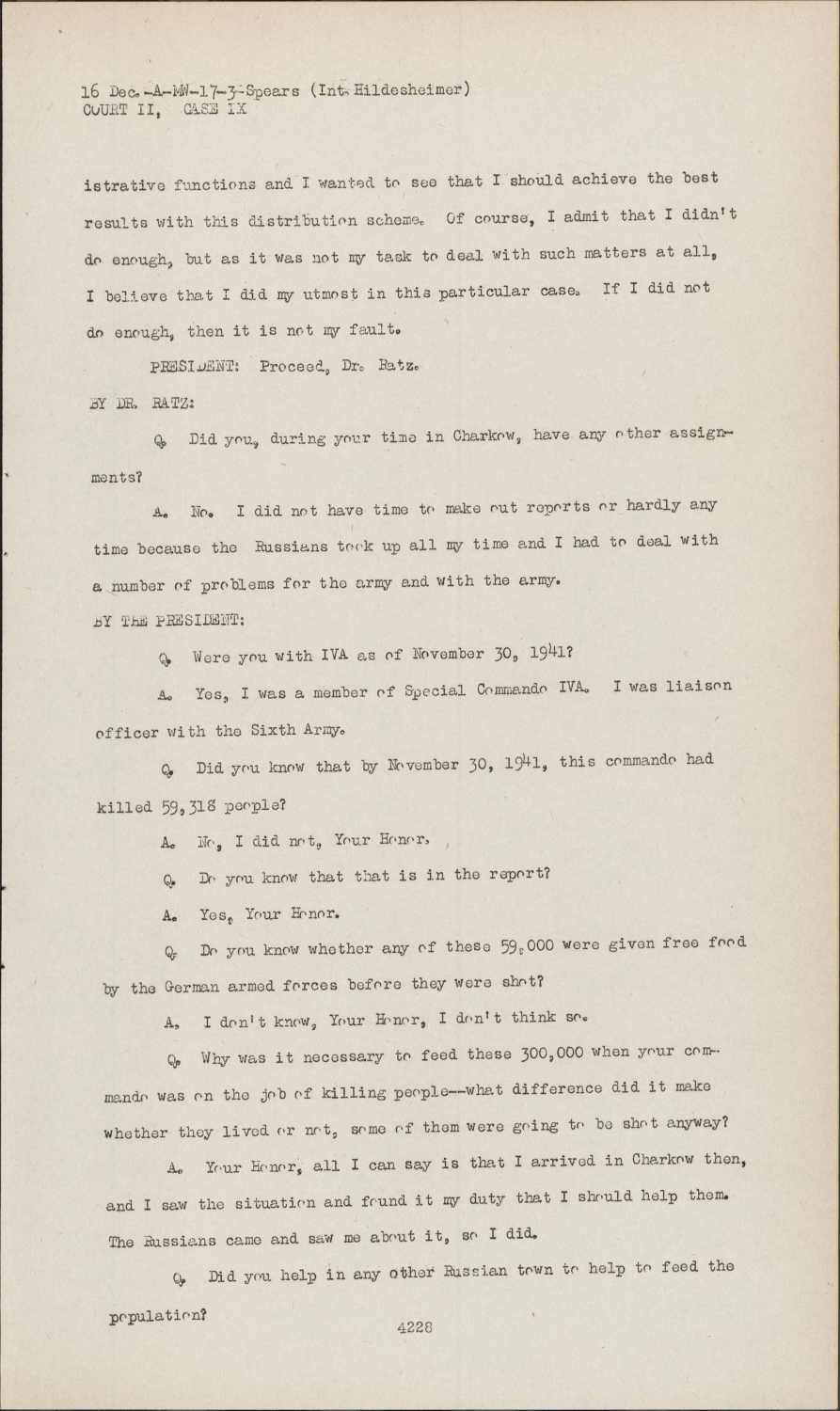
Of course, I admit that I didn't do enough, but as it was not my task to deal with such matters at all, I believe that I did my utmost in this particular case. If I did not do enough, then it is not my fault.
PRESIDENT:Proceed. Dr. Ratz. BY DR. RATZ:
Q.Did you, during your time in Charkow, have any other assignments?
A.No. I did not have time to make out reports or hardly any time because the Russians took up all my time and I had to deal with a number of problems for the army and with the army. BY THE PRESIDENT:
Q.Were you with IVA as of November 30, 1941?
A.Yes, I was a member of Special Commando IVA. I was liaison officer with the Sixth Army.
Q.Did you know that by November 30, 1941, this commando had killed 59,318 people?
A.No, I did not, Your Honor.
Q.Do you know that that is in the report?
A.Yes, Your Honor.
Q.Do you know whether any of these 59,000 were given free food by the German armed forces before they were shot?
A.I don't know, Your Honor, I don't think so.
Q.Why was it necessary to feed these 300,000 when your commando was on the job of killing people--what difference did it make whether they lived or not, some of them were going to be shot anyway?
A.Your Honor, all I can say is that I arrived in Charkow then, and I saw the situation and found it my duty that I should help them. The Russians came and saw me about it, so I did.
Q.Did you help in any other Russian town to help to feed the population?
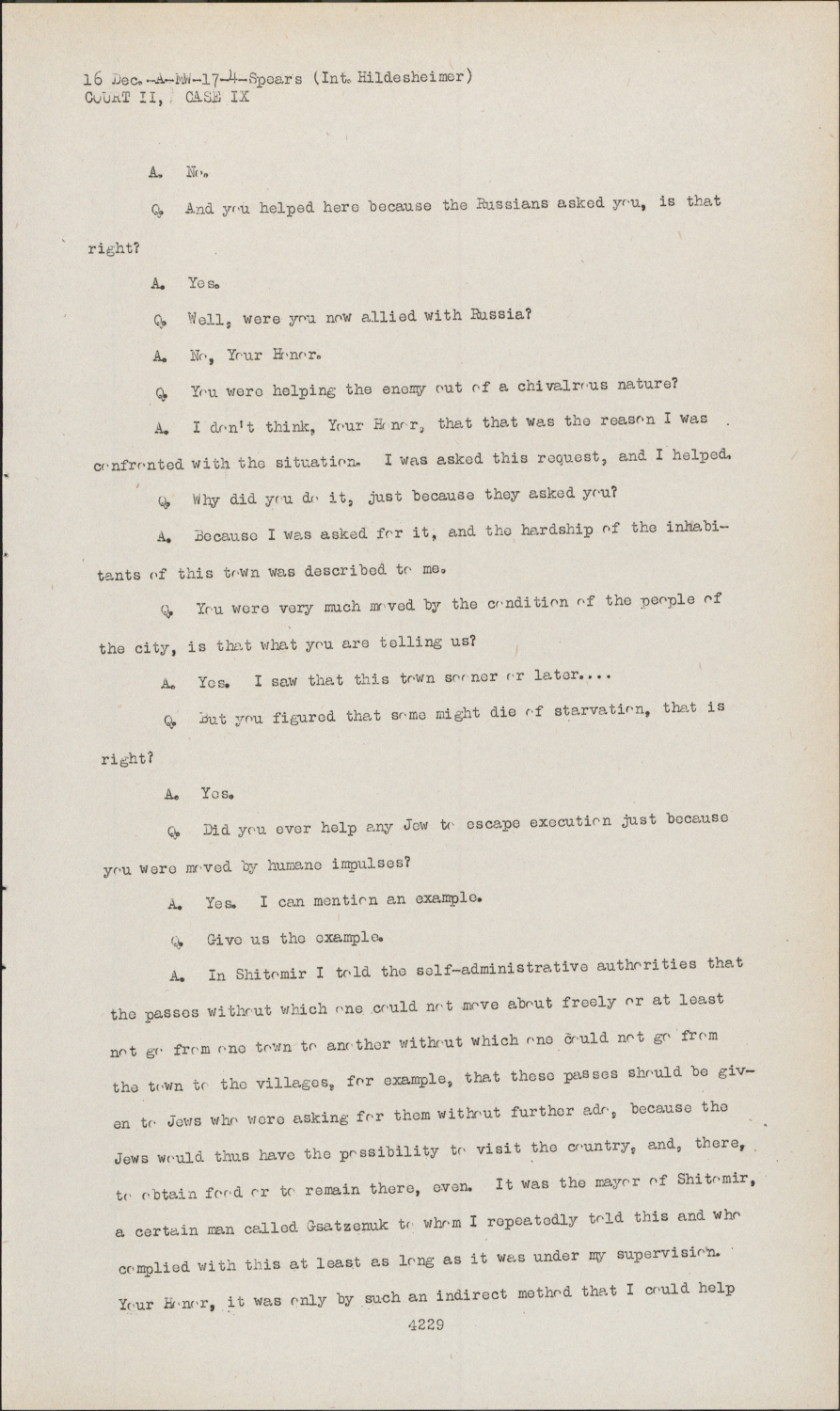
A.No.
Q.And you helped here because the Russians asked you, is that right?
A.Yes.
Q.Well were you now allied with Russia?
A.No, Your Honor.
Q.You were helping the enemy out of a chivalrous nature?
A.I don't think, Your Honor, that that Was the reason I was confronted with the situation. I was asked this request, and I helped,
Q.Why did you do it, just because they asked you?
A.Because I was asked for it, and the hardship of the inhabitants of this town was described to me.
Q.You were very much moved by the condition of the people of the city, is that what you are telling us?
A.Yes. I saw that this town sooner or later....
Q.But you figured that some might die of starvation, that is right?
A.Yes.
Q.Did you ever help any Jew to escape execution just because you were moved by humane impulses?
A.Yes. I can mention an example.
Q.Give us the example.
A.In Shitemir I told the self-administrative authorities that the passes without which one could not move about freely or at least not go from one town to another without which one could not go from the town to the villages, for example, that these passes should be given to Jews who were asking for them without further ado, because the Jews would thus have the possibility to visit the country, and, there, to obtain food or to remain there, even. It was the mayor of Shitomir, a certain man called Gsatzenuk to when I repeatedly told this and who complied with this at least as long as it was under my supervision. Your Honor, it was only by such an indirect method that I could help at all, in any way whatsoever.
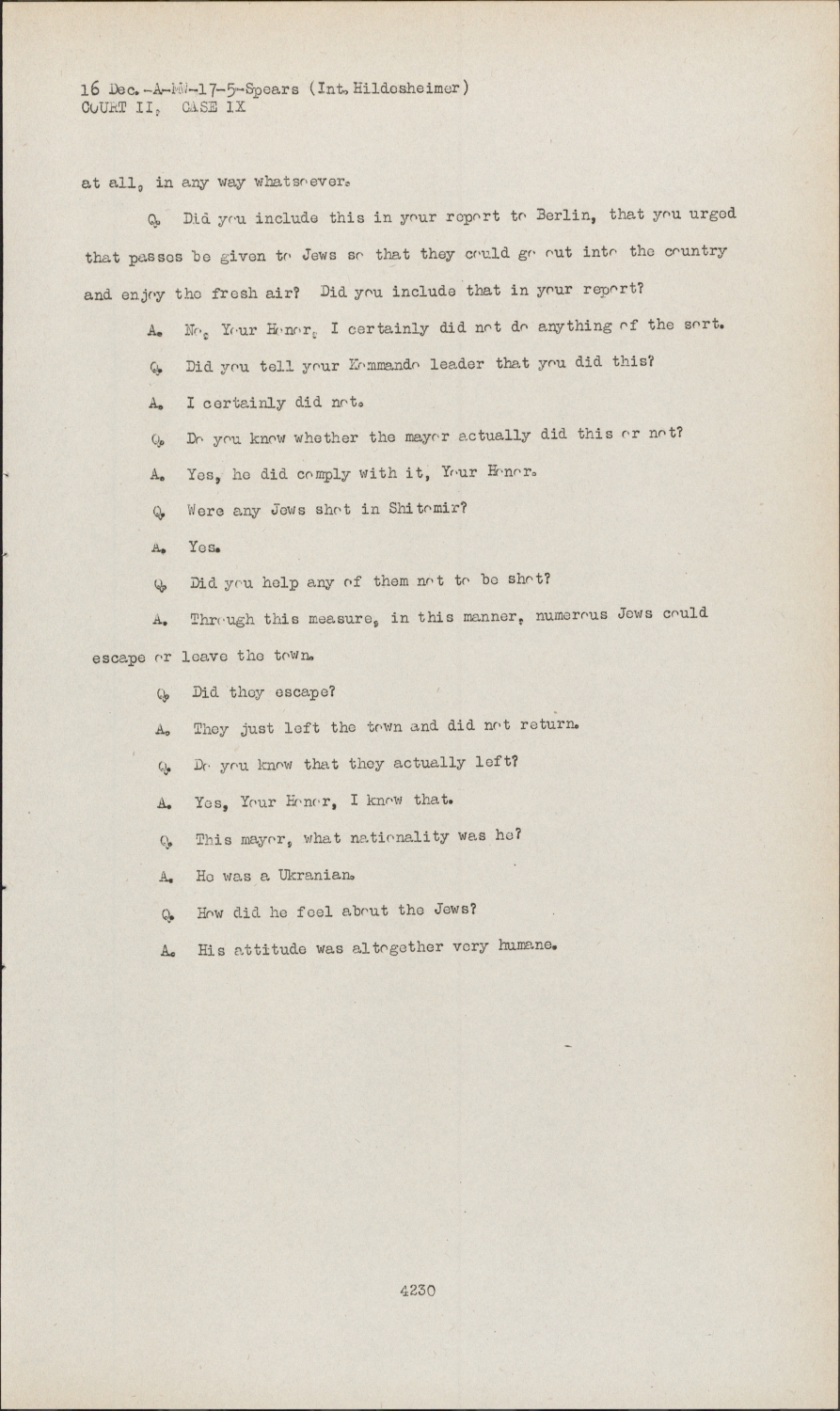
Q.Did you include this in your report to Berlin, that you urged that passes be given to Jews so that they could go out into the country and enjoy the fresh air? Did you include that in your report?
A.No. Your Honor. I certainly did not do anything of the sort.
Q.Did you tell your Kommando leader that you did this?
A.I certainly did not.
Q.Do you know whether the mayor actually did this or not?
A.Yes, he did comply with it, Your Honor.
Q.Were any Jews shot in Shitomir?
A.Yes.
Q.Did you help any of them not to be shot?
A.Through this measure, in this manner, numerous Jews could escape or leave the town.
Q.Did they escape?
A.They just left the town and did not return.
Q.Do you know that they actually left?
A.Yes, Your Honor, I know that.
Q.This mayor, what nationality was he?
A.He was a Ukranian.
Q.How did he feel about the Jews?
A.His attitude was altogether very humane.
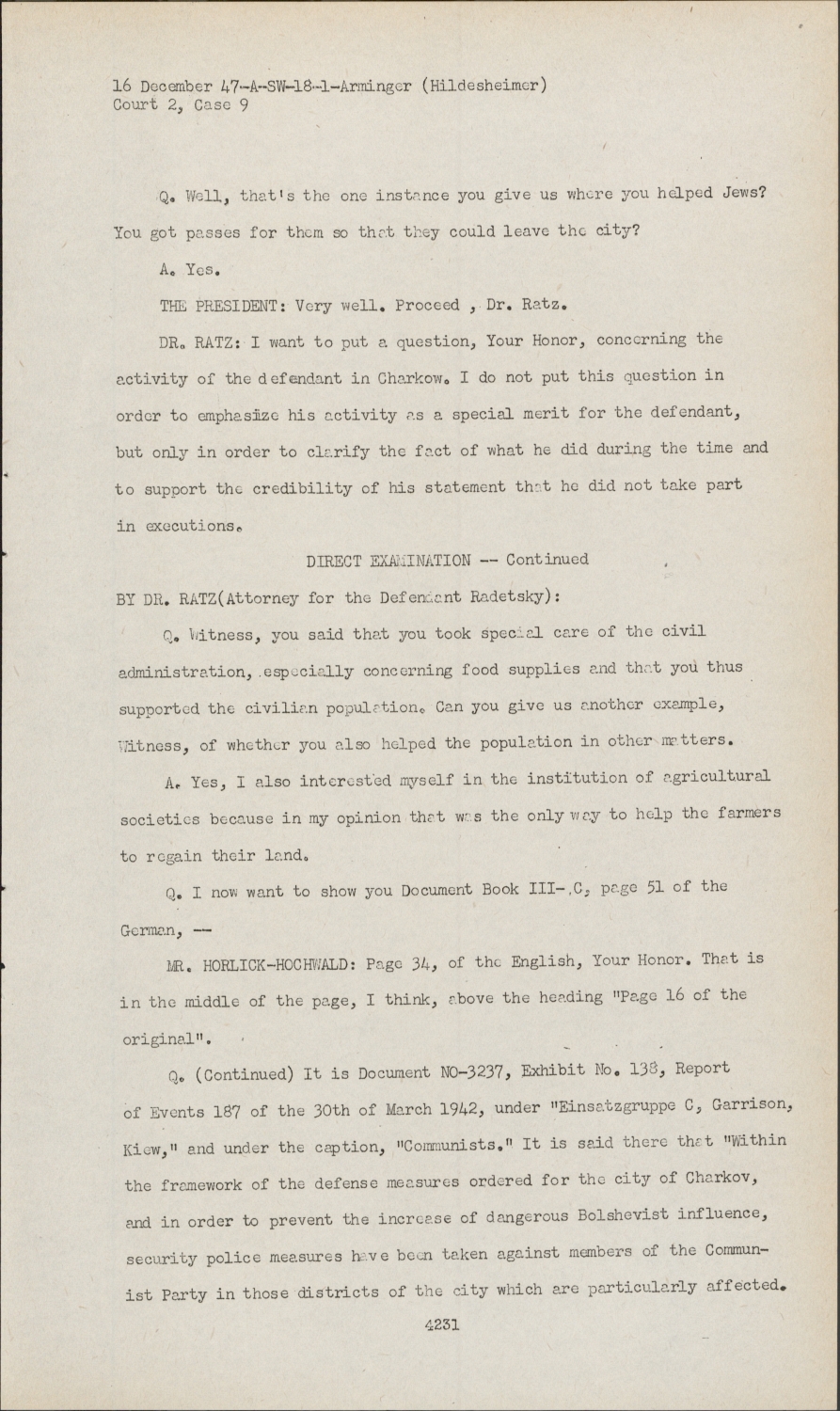
Q.Well, that's the one instance you give us where you helped Jews? You got passes for them so that they could leave the city?
A.Yes.
THE PRESIDENT:Very well. Proceed, Dr. Ratz.
DR. RATZ:I want to put a question, Your Honor, concerning the activity of the defendant in Charkow. I do not put this question in order to emphasize his activity as a special merit for the defendant, but only in order to clarify the fact of what he did during the time and to support the credibility of his statement that he did not take part in executions.
DIRECT EXAMINATION -- Continued BY DR. RATZ(Attorney for the Defendant Radetsky):
Q.Witness, you said that you took special care of the civil administration, especially concerning food supplies and that you thus supported the civilian population. Can you give us another example, Witness, of whether you also helped the population in other matters.
A.Yes, I also interested myself in the institution of agricultural societies because in my opinion that was the only way to help the farmers to regain their land.
Q.I now want to show you Document Book III-.C, page 51 of the German, -
MR.HORLICK-HOCHWALD: Page 34, of the English, Your Honor. That is in the middle of the page, I think, above the heading "Page 16 of the original".
Q. (Continued) It is Document NO-3237, Exhibit No. 138, Report of Events 187 of the 30th of March 1942, under "Einsatzgruppe C, Garrison, Kiew," and under the caption, "Communists." It is said there that "Within the framework of the defense measures ordered for the city of Charkov, and in order to prevent the increase of dangerous Bolshevist influence, security police measures have been taken against members of the Communist Party in those districts of the city which are particularly affected.