himself.
QBut I suppose that the commanding officer would not just sit down and write the reports with a pencil, and take them personally to the group. There must have been an orderly room, where reports must have been filed. Did you have an orderly room?
AIn this sense there was no orderly room. May I add that the general keeping of the files about the administration and executive was not even customary in the centralized agencies at home. In addition, the commando during my membership in it was on the march, and this march was not of the type that the commando would move as one entity from one place to another, but that it was split up in various subcommandos or detachments which would take up quarters at various places independently of each other. The same thing is true for the various experts, who are designated by the Prosecution as staff officers. Thus, the subcommandos, and these research analysts kept their own files in order to have them right with them when they needed them.
QHerr Ruehl, you know that the Prosecution contends that you were a deputy of the commanding officer, or as it was phrased at one time, that you were the second in command of the commando. Will you please comment on that?
AI was neither appointed the deputy of the commanding officer, nor was I ever active as such; nor did I ever have the function of socalled second in command. My functions were quite clearly delineated, and they were limited to jobs of my administrative officer, which I have already mentioned.
QThe Prosecution also claims that you were a captain. Were you as a captain, or senior officer, the highest ranking officer after the commanding officer, so that, therefore, you had special powers.
ANo, as one can see from the personnel files submitted by the Prosecution, I was not a captain at that time, but a 1st Lieutenant, and as such I was neither the highest ranking officer, nor the senior officer after the commanding officer, and as such I would not have had Court No. II, Case No. IX.
any special power to command towards a higher ranking officer, or towards an officer of an equivalent rank in my commando.
DR. LINCK:May I make a remark about this, Your Honor. I want to point to these personnel files which the witness refers to. They are to be found in volume III-D, English page 90. This is Document 4808, Prosecution Exhibit No. 171. BY DR. LINCK:
QHerr Ruehl, you mentioned that so far as you recall you heard farther details about the mission of the Kommando in Chernovitz. Now we are in Chernovitz. What did you hear about that there?
APersterer said that the Einsatzgruppen had the job of maintaining the security of the area, and that particular order of the Fuehrer pertaining to espionage, sabotage and Communist activity, looting, and other acts of violence would have to be stopped by all means, and that those who participated in it were to be shot. Special attention was to be given to Bolshevist functionaries, and to leading Jews, since they were bearers of Bolshevism, and, thus, ware considered to be the greatest source of danger for the security of the occupied territory.
QAnd these statements by Persterer, did you just take them as they were, or did you think about them at all. Did you perhaps express such thoughts, Will you please tell us?
THE PRESIDENT:Doctor, let's have the date, please. Just when was this speech made by the commanding officer?
THE WITNESS:May I answer that?
THE PRESIDENT:Yes.
THE WITNESS:This is not a general announcement, Your Honor, because I came only later....
THE PRESIDENT:Well, just tell me when it was that the commanding officer of the commando told you what you have just related. Just give us the date?
THE WITNESS:I can not give you the exact date. It might have Court No. II, Case No. IX.
been 10 or 11 August.
THE PRESIDENT:All right. Of August?
THE WITNESS:Yes - no, pardon me, in July.
THE PRESIDENT:Very well. You can now answer the question which your counsel had put to you, if you will. BY DR. LINCK:
QAnother question, Herr Ruehl. Did I understand you correctly to say that this announcement of Persterer was made to you, not in the form of a general announcement to the commando, which might have taken place before?
AI don't know to what extent he informed the entire commando about this order. I doubt that he did. I assume, however, that he informed all the officers about it.
QIf I understand it correctly, it was a type of belated orientation of your own person, because you arrived late. Will you then answer my question about your reaction as to this?
AAlthough I know I would have nothing to do with carrying out of this order, I was still affected by it, because on the basis of my peaceful training, and activity, I had definite ideas about the job of the police, and I had definite ideas about how a criminal case was to be prosecuted and here I was confronted with an entirely new situation. I discussed this with Persterer. He said that these measures were not to be judged by the usual European standards. That the Bolshevists would not recognize any kind of International Law, and they would force us to such measures by their manner of conducting the war. Furthermore, we would soon have plenty of opportunity to convince ourselves of this. Moreover, the Army had similar orders about the Bolshevist commissars.
QHerr Ruehl, I want this quite clear now. According to your testimony her, if I understand you correctly, this order of Persterer's only told you that certain acts are to be investigated and to be severely punished. That nevertheless certain acts would have to have Court No. II, Case No. IX.
been committed. I would like to know whether he discussed anything about people being killed for their membership in a race, something for which they could not be held responsible. In other words, that he said a Jew should be executed merely because he was a Jew, or a Gypsy merely because he was a Gypsy?
ANo, nothing was said about that, neither on this occasion nor did he later tell me anything about it during any time.
QBut how do you explain that?
AAs I now know from the testimony of General Ohlendorf, Persterer was expressly forbidden to carry out the Fuehrer's Order to its full extent in the Rumanian sovereign territory. Therefore, in my opinion that was no cause for him to announce such an order to us, as it was not valid for this area.
Court No. II, Case No. IX.
QBut you finally left Rumania, didn't you?
AYes.
QWhat happened then? Why didn't he then tell you about it?
AI am of the opinion that nevertheless he used the possibility to withhold these measures in the interest of reconstructing of the economy. May I repeat? He evidently made use of the possibility to relegate these measures in the interest of reconstructing of economy in the administration. That this possibility existed until the visit of Reichsfuehrer SS Nikolajew in September, or the beginning of October, and that this possibility was made use of to a large extent was confirmed by Ohlendorf and Nosske, The way I can see these things today, there was in addition the fact that so far as the commanding officers are concerned, that first Mogilew was very badly destroyed, and, therefore, there was a great need for additional manpower, for building up operations, reconstructing operations; secondly, that for a time after this the commando was committed in the rural areas, in which the commando X-A had been active before. This is true of the Ananjew, as well as for Alexandrowka; thirdly, that in the area of the Nogarisch Stepp, and in Skatowsk, so far as I was informed, there ware no Jews at all. At any rate I didn't see any.
QHerr Ruehl, do you wish to say by this that during your membership in the commando, you got no knowledge of measures which would have caused you to conclude that an order for the execution of all Jews, Gypsies, etc., existed. My question is quite extensive. Will you please think it over?
AYes, I could say that. I learned about various executions, but in these cases according to what I heard, these were justified individual actions, that is to say, cases where the crime had been proven.
QI will now show you several documents. First of all Document Book II-*.
Court No, II, Case No. IX.
THE PRESIDENT:Doctor Linck, if you are now going to take up documents, don't you think this might be an appropriate time to have a recess?
DR. LINCK:It would be very appropriate, yes.
THE PRESIDENT:Very well, the Tribunal will be in recess fifteen minutes.
(Recess)
THE MARSHAL:The Tribunal is again in session.
DR.STUEBINGER for the defendant Braune: Your Honor, I am sorry that I am not in my robe.
THE PRESIDENT:I still recognize you as a good lawyer even without your robe.
DR. STUEBINGER:I have a very brief request. The defendant Braune has been ill since Saturday and I could not speak to him. I would like him to be excused, therefore, from the session this afternoon and ask that he be brought to room 57.
THE PRESIDENT:The defendant Braune will be excused from attendance in Court this afternoon and will be taken to room 57 where he may consult with his attorney, with or without robe.
Dr. Linck, in your opening statement you referred to the fact that the present witness, your client, had appeared at the International Military Tribunal trial. Would you be so kind as to furnish us with the reference in the transcript to his testimony so that we might glance at it. That is, if you know it.
DR. LINCK:Yes, your Honor,
THE PRESIDENT:You may continue now with the direct examination. BY DR. LINCK:
Q.I want to show you some documents, witness, Herr Ruehl, first of all in Document Book II-D, it's on English page 45, German 48. It is document NO-587 and it is Prosecution Exhibit 92. It is the report by the leader of Special Kommando 10-b Persterer to the Army Group South of 9 July 1941. At that time Special Kommando 10-b on the 7 and 8 of July carried out a large scale search for Communists and Jews and on 9 July 100 Jewish Communists were shot within the course of this operation. Does this COURT II CASE IX concur with your statement and what do you have to say?
A.This report, as well as the contents of it; I have only found out about in Nurnberg here. I have already said I arrived in Chernowitz a few days after the Kommando arrived as I was stationed three or four days in Poltawa. Therefore, at the earliest I arrived in Chernowitz on 9 or 10 July. Therefore, I cannot say anything based on my own observations concerning this. In spite of this, however, I think that this shooting which is mentioned in this report of 100 Jewish Communists is incorrect and I shall give the reasons why. I think it is inaccurate. First of all, even if such measures were not generally discussed it seems to me comparatively improbable that about such an extraordinary measure I should not have heard at least something, a measure which after all was carried out at the same locality by the Kommando just before I arrived or which is supposed to have been carried out at such time. Second, it is very significant that Perster who was with the Army Group which was far away and had no possibility to carry out such an investigation that he should have made a report to the Army Group and that on the other hand should not have told anything to his immediate superior, the Group chief. Neither in his report, as becomes evident from the report of 11 July, which is two days later, nor during the inspection by the Group chief a few days later in Chernowitz itself, because he could have established the inaccuracy of this report at the proper place and at the proper time. Therefore, I am of the same opinion as Herr Ohlendorf who thought that it was here a tactical measure in order to be able to prove some kind of activity under any circumstances.
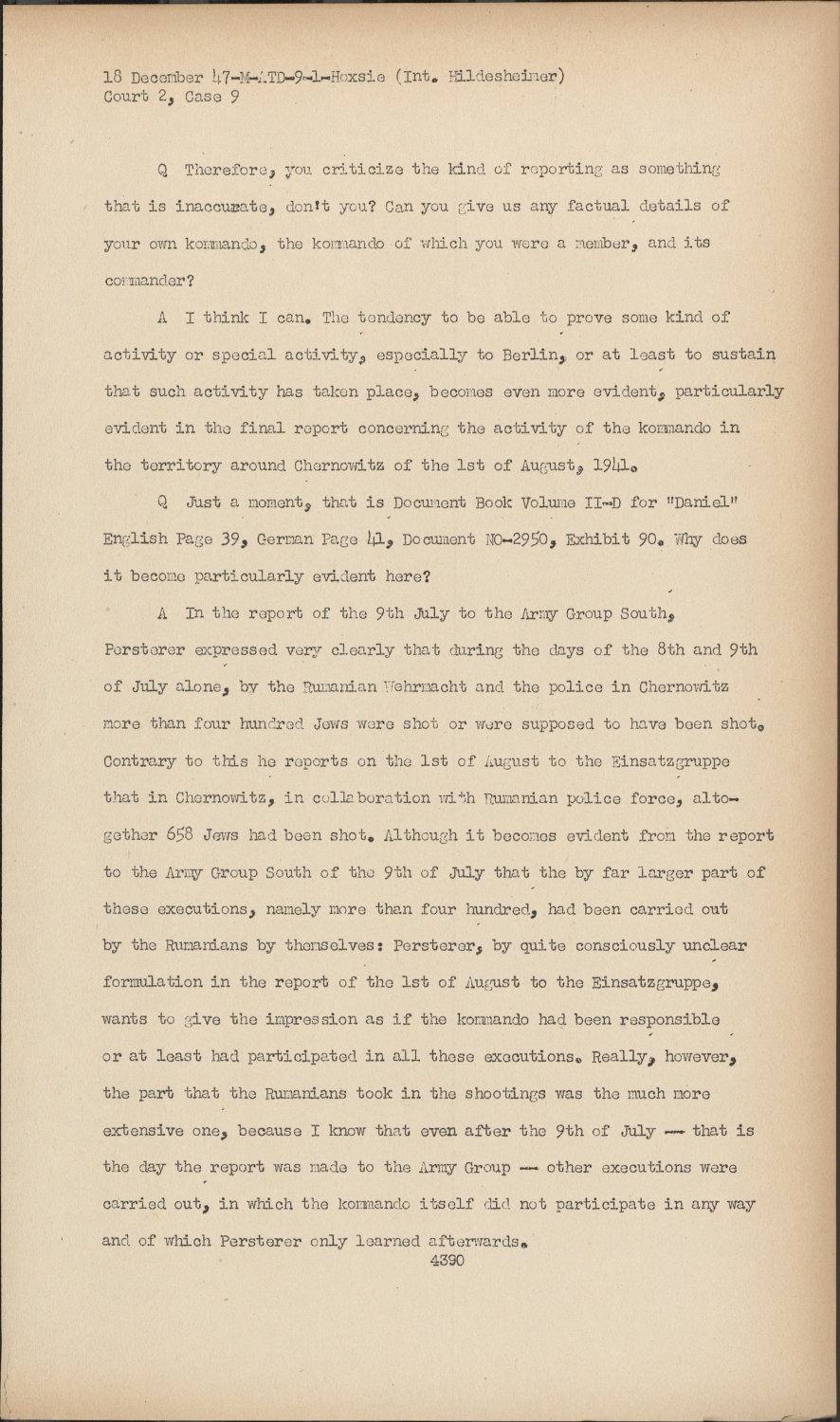
QTherefore, you criticize the kind of reporting as something that is inaccurate, don't you? Can you give us any factual details of your own kommando, the kommando of which you were a member, and its commander?
AI think I can. The tendency to be able to prove some kind of activity or special activity, especially to Berlin, or at least to sustain that such activity has taken place, becomes even more evident, particularly evident in the final report concerning the activity of the kommando in the territory around Chernowitz of the 1st of August, 1941.
QJust a moment, that is Document Book Volume II-D for "Daniel" English Page 39, German page 41, Document NO-2950, Exhibit 90. why does it become particularly evident here?
AIn the report of the 9th July to the Army Group South, Persterer expressed very clearly that during the days of the 8th and 9th of July alone, by the Rumanian Wehrmacht and the police in Chernowitz more than four hundred Jews were shot or were supposed to have been shot. Contrary to this he reports on the 1st of August to the Einsatzgruppe that in Chernowitz, in collaboration with Rumanian police force altogether 658 Jews had been shot. Although it becomes evident from the report to the Army Group South of the 9th of July that the by far larger part of these executions, namely more than four hundred, had been carried out by the Rumanians by themselves: Persterer, by quite consciously unclear formulation in the report of the 1st of August to the Einsatzgruppe, wants to give the impression as if the kommando had been responsible or at least had participated in all these executions. Really, however, the part that the Rumanians took in the shootings was the much more extensive one, because I know that even after the 9th of July - that is the day the report was made to the Army Group - other executions were carried out, in which the kommando itself did not participate in any way and of which Persterer only learned afterwards.
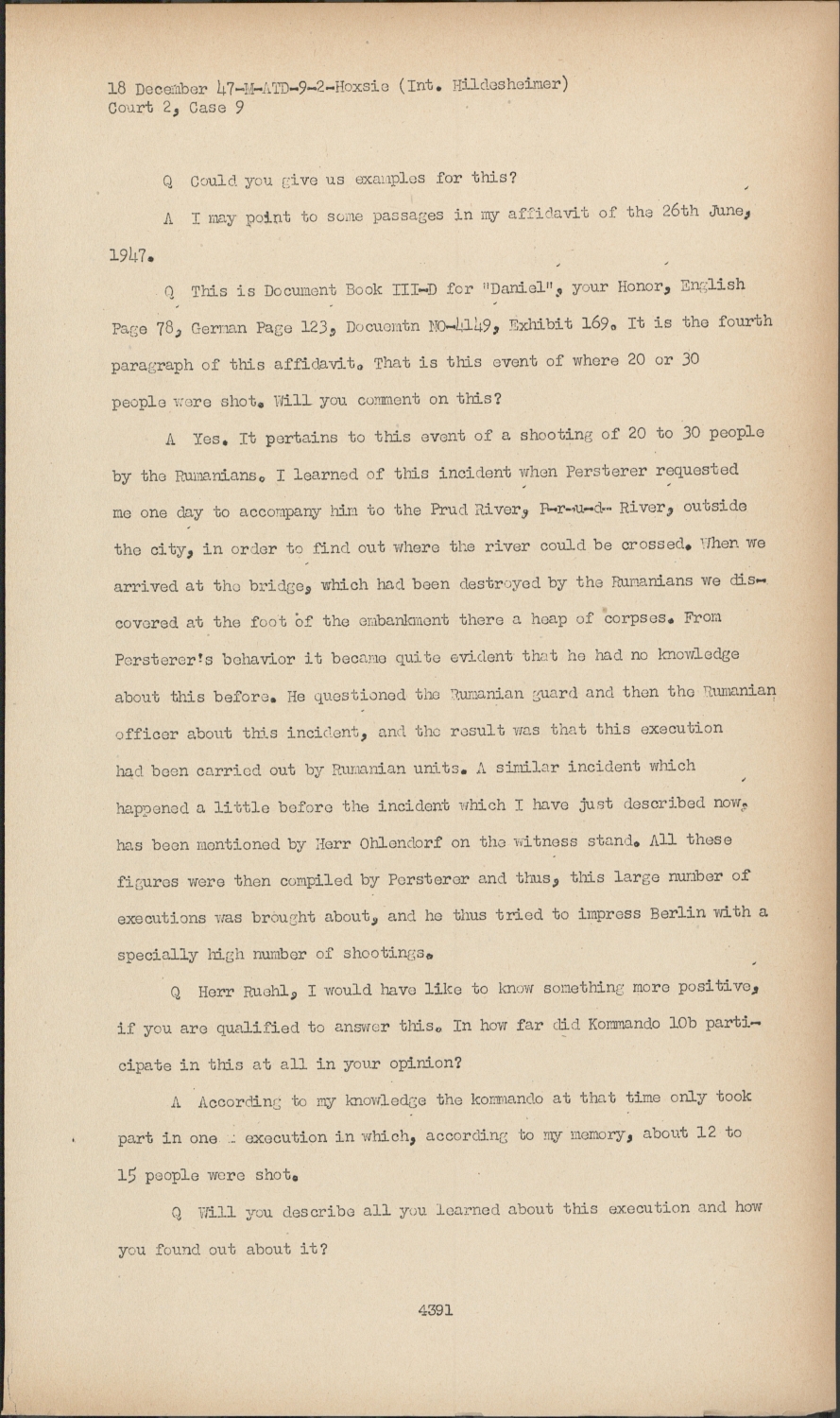
QCould you give us examples for this?
AI may point to some passages in my affidavit of the 26th June, 1947.
QThis is Document Book III-D for "Daniel", your Honor, English Page 78, German Page 123, Document NO-4149, Exhibit 169. It is the fourth paragraph of this affidavit. That is this event of where 20 or 30 people were shot. Will you comment on this?
AYes, It pertains to this event of a shooting of 20 to 30 people by the Rumanians. I learned of this incident when Persterer requested me one day to accompany him to the Prud River, P-r-u-d- River, outside the city, in order to find out where the river could be crossed. When we arrived at the bridge, which had been destroyed by the Rumanians we discovered at the foot of the embankment there a heap of corpses. From Persterer's behavior it became quite evident that he had no knowledge about this before. He questioned the Rumanian guard and then the Rumanian officer about this incident, and the result was that this execution had been carried out by Rumanian units. A similar incident which happened a little before the incident which I have just described now. has been mentioned by Herr Ohlendorf on the witness stand. All these figures were then compiled by Persterer and thus, this large number of executions was brought about, and he thus tried to impress Berlin with a specially high number of shootings.
QHerr Ruehl, I would have like to know something more positive, if you are qualified to answer this. In how far did Kommando 10b participate in this at all in your opinion?
AAccording to my knowledge the kommando at that time only took part in one execution in which, according to my memory, about 12 to 15 people were shot.
Q will you describe all you learned about this execution and how you found out about it?
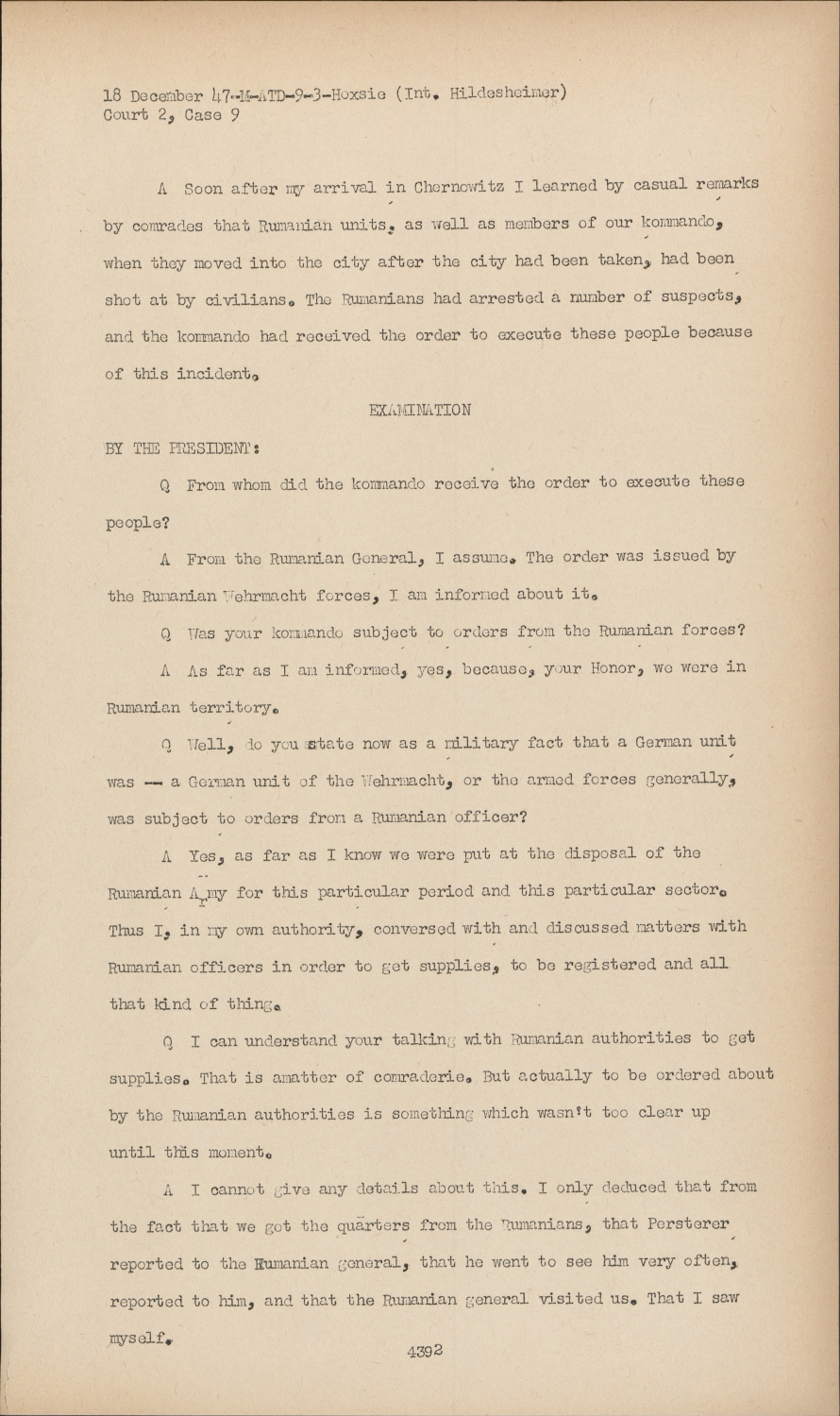
ASoon after my arrival in Chernowitz I learned by casual remarks by comrades that Rumanian units, as well as members of our kommando, when they moved into the city after the city had been taken, had been shot at by civilians. The Rumanians had arrested a number of suspects, and the kommando had received the order to execute these people because of this incident.
EXAMINATION BY THE PRESIDENT:
QFrom whom did the kommando receive the order to execute these people?
AFrom the Rumanian General, I assume. The order was issued by the Rumanian Wehrmacht forces, I am informed about it.
QWas your kommando subject to orders from the Rumanian forces?
AAs far as I am informed, yes, because, your Honor, we were in Rumanian territory.
QWell, do you state now as a military fact that a German unit was -- a German unit of the Wehrmacht, or the armed forces generally, was subject to orders from a Rumanian officer?
AYes, as far as I know we were put at the disposal of the Rumanian Army for this particular period and this particular sector. Thus I, in my own authority, conversed with and discussed matters with Rumanian officers in order to get supplies, to be registered and all that kind of thing.
QI can understand your talking with Rumanian authorities to get supplies. That is a matter of comraderie. But actually to be ordered about by the Rumanian authorities is something which wasn't too clear up until this moment.
AI cannot give any details about this. I only deduced that from the fact that we got the quarters from the Rumanians, that Persterer reported to the Rumanian general, that he went to see him very often, reported to him, and that the Rumanian general visited us. That I saw myself.
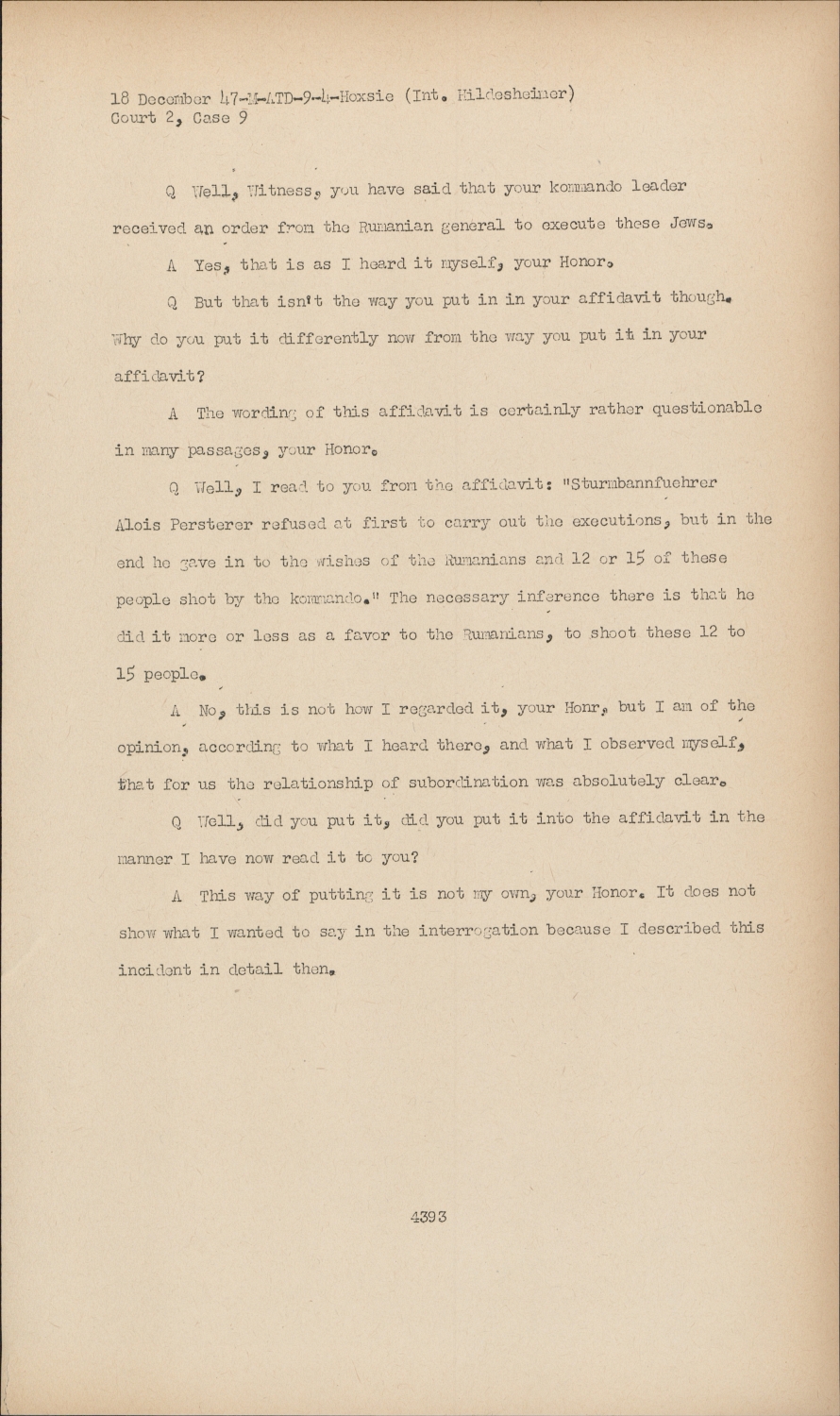
QWell, Witness, you have said that your kommando leader received an order from the Rumanian general to execute these Jews.
AYes, that is as I heard it myself, your Honor.
QBut that isn't the way you put in in your affidavit though. Why do you put it differently now from the way you put it in your affidavit?
AThe wording of this affidavit is certainly rather questionable in many passages, your Honor.
QWell, I read to you from the affidavit: "Sturmbannfuehrer Alois Persterer refused at first to carry out the executions, but in the end he gave in to the wishes of the Rumanians and 12 or 15 of these people shot by the kommando." The necessary inference there is that heard did it more or less as a favor to the Rumanians, to shoot these 12 to 15 people.
ANo, this is not how I regarded it, your Honr, but I am of the opinion, according to what I heard there, and what I observed myself, that for us the relationship of subordination was absolutely clear.
QWell, did you put it, did you put it into the affidavit in the manner I have now read it to you?
AThis way of putting it is not my own, your Honor. It does not show what I wanted to say in the interrogation because I described this incident in detail then.
QDidn't this discrepancy from your own thoughts about the matter catch your eye when you read the affidavit prior to signing it?
AIt struck me, your Honor, but I did not regard it as so decisive as to quarrel with Mr. Wartenberg about this little incident.
THE PRESIDENT:Will you please continue, Dr. Linck?
DIRECT EXAMINATION - Continued BY DR. LINCK:
QDo you know positively and concretely that your kommando came fully under the subordination of the Rumanians?
AI do not know anything about the subordination in detail. I only know that Persterer reported to the Rumanian general, that he went to see him on many occasions according to my knowledge, thus in order to report to him, and I also know that he went to see the Rumanian civil governor. I deduced it, as I say, from my own activity, because the Rumanians would not have supplied him anything if it hadn't been their duty to do so.
QYes. In order to come back to this matter which you know from hearsay, about these 12 to 15 people.
I now ask you Ruehl, do you know who arrested these people who were later on shot? We learned yesterday that between a negative answer and no knowledge there is a tremendous difference. Please consider and think it over whether you know it or were told about it or whether you know it from hearsay and tell the Tribunal so that the Tribunal must not conclude that you experienced it yourself. Do you know anything about who arrested these people?
AFrom my own knowledge I could not say anything. I know the incident only from hearsay, except the fact that this execution actually did take place.
QYou, therefore, say that you were actually told that these people in this instance...... the kommando when they moved into Chernowitz, is that correct?
MR. WALTON:The Prosecution must object to this line of questioning. There had been no feature prior to this time of anybody shooting at a kommando, and the Prosecution objects to suggesting a line of testimony to the witness. If these incidents were connected with it, I think the witness, since he is testifying from his general knowledge in the area, could give us all the facts that he heard about. I don't like the defense counsel to suggest the answer to the witness.
THE PRESIDENT:I do think, Dr. Linck, that your question was a little leading.
DR. LINCK:I only wanted to summarize the whole matter. I thought it had already been said. I will put the question in another form then.
Q (By Dr. Linck) Just describe very briefly, Witness, what you learned concerning this operation.
ASoon after my arrival in Chernowitz I heard through remarks by comrades that Rumanian troops, as well as members of our kommando, when they moved into the town after it had been turned over to us, had been fired at by civilians. Furthermore, I heard that the Rumanians thereupon arrested a number of suspects, and the kommando was given the order from the army, from the Rumanians, to shoot these people because of this action. As far as I remember, 50 to 60 people were mentioned in this connection. I also learned that the commander objected to this order, or at least tried to rescind this order, point out that this was a matter to be dealt with by the Rumanians themselves. The reason for this could have been parly that he was not convinced that all these people were actually participants in this incident. I also learned that the Rumanian generals urged the carrying out of this order, and, thereupon, Persterer asked for an investigation in order to be able to sift out the perpetrators. These investigations were carried out by Departments 4 and 5 as far as I know, and on this occasion, according to my memory, 12 to 15 of those arrested were found guilty and were shot by order of the Rumanians.
The others, as far as I know, were released.
QDid you take part in any of these investigations in this form whatsoever?
ANo, I have already stated that it was Departments 4 and 5 who carried out the investigation.
QHow did you find out about it?
ADo you mean of the fact of the investigation or the investigations, or what?
QThe fact that there were investigations and the result which you just described to us from hearsay.
AThe fact that investigations were executed, carried out, I found out through remarks by Hauptsturmfuehrer Finger who was the competent officer in Department 4.
QHauptsturmfuehrer Finder was the departmental chief in No. 4, was he?
AYes.
QDid he give you any details about the results of these investigations, did you see any reports or files?
ANo, I did not learn anything about this at all. I did not find out about details. I only heard and received knowledge of the fact that investigations had taken place. I did not see reports.
QMy question, Herr Ruehl, whether you had anything to do with this operation, does not only refer to investigations and results but also the actuall carrying out of the execution order. Did you include that in your answer?
AYes. That was not my task.
QYou also did not take part in the carrying out of the sentence?
ANo, the decision was probably made by the commander.
QWhat I want to ask you, do you know of any further executions carried out by Kommando 10b in Chernowitz?
ANot in Chernowitz.
QI shall now show you report of events of 1st August, 1941. It is Document Book II-D, your Honors, English Page 37, German page 40, Document 2950, Prosecution's Exhibit No. 90. There in Paragraph 2, I think it is on Page 39 of the English version if I remember correctly, there is talk about 50 Communists who have been arrested, of whom 16 have been liquidated. What do you know about that?
AI cannot comment on this at all. As far as I know Departments 4 and 5 carried out investigations and examinations and interrogations, but executions I did not hear about. Admittedly, Department 4 did it at another place geographically speaking. They were far from our own offices in another building, in another part of town, so that I did not really have the occasion to look at what they did.
QTherefore, not all the work of the kommando was done in this little hotel you spoke about when you arrive in Chernowitz?
ANo.
QTo go further, Herr Ruehl, did you during your stay in Chernowitz find out anything about executions which your unit carried out in other places during the time in question?
AYes, I learned of another execution which is also reported in paragraph 5 of my affidavit.
DR. LINCK:IIID, page 76, of the English text, Your Honor -I am sorry, it is page 78 in the English document book. BY DR. LINCK:
QPlease describe the incident, Witness.
AComparatively soon after my arrival in Chernowitz I heard of a detachment of the commando that was in a place in the locality, the name of which I do not remember. In order to clarify the murder of German airmen. After these men who had been assigned to this place returned, I heard the following. Shortly after the outbreak of the war in this locality which in those days was in Russian hands, as far as I remember, two wounded German airmen had made a forced landing and had been captured by the Russians. When those people were led into the prison the Jewish population had collected and ill-treated these prisoners during the transport to the prison, but the Russian guards had managed to take these German airman into prison. There, however, shortly after this, another turmoil had started and riots had broken out and the Jews had asked for these two German airmen or at least that is what is supposed to have happened. Finally, the Jews had managed to break into the prison, had taken these German prisoners into the streets and had beaten them to death in the most bestial manner. This state of affairs and the perpetrators had been established by extensive investigations and interrogation in collaboration with Rumanian and Hungarian army agencies, the perpetrators had been shot. As far as I remember, in this connection, a number of 20 to 30 people to be executed was named.
QDo you also know this from hearsay or did you participate in any way in the investigation or the interrogation?
AI did not even participate in this journey, therefore, I cannot answer this question at all.
QBut you could have seen a report about it afterwards, is that the case?
ANo. As I say, I only know it from hearsay. The stories that people told after they returned, they were still very much excited about the fact they had established there.
QHerr Ruehl, I asked you whether you found out anything about executions which had been carried out in other places during your stay in Chernowitz, you said "No", with the exception of this particular incident which you know from hearsay, is that correct?
AYes.
QNow, I want to put something else to you. In the report of the 14th of July, Volume IID, English page 43, it is Document 4135, Exhibit 91, it is stated, I quote, "In Hodin 10b carried out a number of tasks, Members of the Russian intelligentsia, in party and state, Jewish agents, teachers, lawyers, rabbies, were arrested in a number of raids with the help of Ukrainians and were treated accordingly". In the same document in the final report of the first of August, English page 39, document 2950, Exhibit 90, the same operation is being reported about again. I quote, "In the vicinity of Chernowitz, Hodin had been passed whereby 150 Jews and Communists have been liquidated". Will you comment on this, please?
AThis incident had not been known to me until I was interrogated in Nuernberg -- that is, I never visited Hodin nor do I remember ever having heard that a detachment of our commando had ever been assigned to this place, therefore, I am unable to give any information as to whether this report is correct and in agreement with the facts.
QI want to point out another paragraph from this report of the 14th of July where it says, I quote, "The following directives were passed on to 10b, influence the Rumanians to be more severe concerning Jewish questions.
Jewish meetings must be interrupted and polots must be found out in order to influence Rumanian procedure against Jewish intelligentsia and in order to take up our own positions against it." Can you comment on this?
AThis can only have been an order from the group chief to the commander because only he could carry out such orders. I myself was never informed about this order, and I see no reason why I, as an administrative officer and obersturmfuehrer could in any way have influenced the Rumanian police or the Rumanian Wehrmacht. I never heard anything about the fact that the commando really raided Jewish meetings. I can only say from my own observation that the commander had a number of Jewish liaison men with whom he apparently cooperated extremely well.
QHow long did you remain in Chernowitz?
AAccording to my memory, I left Chernowitz the 7th or 8th of August or thereabout. After, a few days before that, detachments of our commando had moved to Kamnitz Podolsk and Mogilew-Podolsk, the departmental expert of Department 3 and I received the order to go to Mogilew with the technical personnel of our commando. Mogilew had been named as the next garrison of our commando. There we arrived two days later. We were billeted in the unit which had already been stationed there, and there we took up our usual assignments.
QI must come back to your affidavit which has been quoted before, but a little more in detail. I want to point out again that it is Book IIID, the English page 76. According to this, you came in contact with a problem in Mogilew which in itself had nothing to do with the tasks of an administrative leader. By this I mean the retransfer of Jews who had been taken to German territory by the Rumanians and were not to be transported back to Rumanian territory. How did you learn about this fact, Witness?
AEarly on this journey from Chernowitz to Mogilew Podolsk between the Prut and the Dniestr rivers we came upon a long line of civilian population who seemed to me to consist mainly of Jews, and which was escorted by Rumanian army units. Then, upon my arrival in Mogilew I questioned the officer who was already stationed there concerning this, he informed me that the Rumanians had transported a number of Jews across the Dniestr river and had left them there to their fate helplessly in German operational territory. He had, of course, prevented further deportation of Jews to German territory, but the Jews who had been deported before were the subject of considerable worry to him because, as they were completely helpless, they were roaming the country stealing and begging and thus were a danger to the security and orderliness of the rear army territory and, of course, there were therefore current actions between them and the Ukranian population. Furthermore, there was the danger of epidemics and diseases as there were neither hospitals nor physicians nor drugs. Therefore, he had informed the commander of the state of affairs.
QThis is actually the information you received from the local commando in Podolsk?
AYes. That is what he told me.
QDid you investigate the situation thereupon -- did you order any measures to be taken?