AThat can be misunderstood, Your Honor, I agree, but at the time when I knew all that was connected to it, I didn't realize this.
QWell, do we understand it now that you saw on the road great number of refugees and then you didn't see then you didn't see them again. That ended that episode.
AYes, that is one.
QAnd then later on you spoke with Ohlendorf regarding an entirely different group of people?
AYes, those were those people, Your Honor, who already before had been expelled by the Rumanians and had been brought across the bridge and already existed in that territory.
QWell, what was the purpose of talking about this first group of Jews that you saw?
AAll I was trying to show, Your Honor, was how I got to know this problem. Mr. Wartenberg told me that I should tell him about it and I told him in the same broad manner as I expressed it here and then he took a few sentences of that statement.
QWell, this carivan which you saw on your way to Mogilew Podolsk and which consisted of roughly of about 1,000 people, came to your attention and then passed out of your view and out of your life and you don't know what eventual fate these 1,000 people met.
ANo, I don't know that, Your Honor.
QWas this in Rumanian territory that you saw these people?
AYes, that was between, if I may explain this, Your Honor; the border ran along the the Dnjestr River and I overtook these people in the territory between Prut, that is the river Prut and the Dnjestr, which is near Mogilew. In this territory I overtook this carivan. Where they were going to I didn't know. That is why I discussed the matter with Lipps and aksed him what was going on and I then heard what the Rumanians had done previously.
QBut you don't know whatever happened to these thousand people?
ANo, Your Honor.
QWell, I think that's where the confusion arose. The impression was gained that you then later saw these 1,000 people elsewhere.
ANo, I did not see them again, Your Honor.
Q So far as you know, this first group of 1,000 people never did get into German territory insofar as you know, in German occupied territory?
ANo, I hear nothing about that, Your Honor, and as I said, an agreement existed between the two armies that across the Dnjestr, which was the border of interest, any traffic was prohibited, any moving of population either way was prohibited, and, in violating this agreement, the Rumanians had used the opportunity of no German troops being there brought those people across the bridge and that was what Lipps found.
QYou say in your affidavit, Witness, we have this statement: "On my arrival at Mogilev-Podolsk, I was told that this transport consisted of Jews who originated from Bessarabia and the Bucovina and had been driven from their homes in order to be left to their fate after having passed the border." Then comes this: "I attempted to get these people together at Mogilew-Podolsk in order to take them abck in a group transport."
AThat can be easily misunderstood, I agree, Your Honor. At the moment when I signed it, I did not notice that.
QIt not only can be easily misunderstood, but it would be hard to understand it in any other way, isn't that right?
AYes.
THE PRESIDENT:Proceed.
CROSS-EXAMINATION-Continued. BY MR. WALTON:
QWitness, what route did the transport from Mogilew-Podolsk take to get to the Dnjestr River? Did it pass through any Russian cities?
AI cannot say that, Mr. Walton, he would have taken the nearest road.
QWhat cities would it be likely to pass through in order to get to the area of Einsatzkommando 12?
AUnfortunately, I cannot say that either, because I do not know that territory.
QWas Sonderkommando 10-B ever connected with another transport of Jews that you know of?
A 10-B?
QYes.
ANo, I only know of this one.
QIsn't it a matter of fact that 10-B took 400 Jews out of a transport at Ananjew and shot them?
AI head nothing about that.
QDidn't Sonderkommando 10-B have the duty to guard the approaches to an execution of the Jews, including old men, women and children, six kilometers from Chessan?
AWhere?
QFrom Chessan.
AChessan, do you mean? I do not remember that any of our people were in Chessan. I myself was not there and I do not know that in Charnowitz any of our unit were assigned.
Court No. II, Case No. IX.
Q.Your commanding officer, Alois Pesterer was an efficient officer, wasn't he?
A.Yes, but I don't know how as a subordinate that I can pass judgment on this. I think Herr Ohlendord could have given better judgment on it. He was a soldier, that was my impression.
Q.He would make inspection trips to the subcommandos of his Command some distance from his headquarters, didn't he?
A.Yes, he was on the way quite a lot.
Q.When he was away from his headquarters, whom did he leave in charge?
A.No commando existed practically, because if he visited the subcommando, the commando was divided into several commandos.
Q.Whom did he leave in charge of his office while he was away?
A.I don't know whether he asked anybody in particular, but the next senior officer was Hauptsturmfuehrer Finger.
Q.That name is F-I-N-G-E-R, is it not?
A.Yes.
Q.Whenever a commando changed its location, who was in charge of the movement?
A.The commando-chief himself.
Q.At what town did you leave the commando in October 1941?
A.In Skadowsk.
Q.Is it not a fact that Persterer introduced you to the whole commando as his deputy at Dueben, and you remained so until you got to Skadowsk?
A.No.
Q.Didn't Persterer like his alcoholic beverages?
A.I didn't notice that.
Q.Isn't it a fact --
THE PRESIDENT:Mr. Walton, if that is a charge in the Indictment, I think we will have to exclude it.
MR. WALTON:Unfortunately Sir, this is a basis being laid to show that this man was incapable of performing his duties, and other people had to perform them, and, it is the contention of the Prosecution that this man was his deputy, and we intend to prove it, perhaps, not by this witness, I agree.
THE PRESIDENT:Very well, you may proceed, Mr. Walton. BY MR. WALTON:
Q.Isn't it a fact that Persterer was a great many times too drunk to perform his duties, was he not?
A.No. I strongly object to that in the interest of the deceased. And I can assure you that is such a thing had occurred even once, Herr Ohlendorf wouldn't have stood for this, that would have been the end of his career as a commando leader, insofar as I got to know Herr Ohlendorf.
Q.When you left the commando, wasn't your place taken by Finger?
A.As far as I know a new Obersturmfuehrer arrived who was to take over my job.
Q.Will you repeat the answer please, it didn't come through?
A.As far as I know an Obersturmfuehrer arrived, and I assume he took over my job, but I am not certain.
Q.Well, are you certain that Finger didn't take over your job?
A.I would almost like to exclude that possibility, put I am not certain.
Q.Alright. Let's turn to the fifth paragraph of your affidavit, which is in Document Book III-D, page 76 of the English, page 121 of the German, and it is Document NO-4149, Prosecution's Exhibit No. 171.
The part we will discuss, Your Honors, is on page 78 of the English text, and page 124 of the German, paragraph 5. Isn't it a fact that this incident was left out of the first affidavit Mr. Wartenberg drew up for you to sign, and you wrote him an account of this incident, a note, and discussed it on his next interrogation?
A.May I correct this, namely, that so far as this correction is concerned I had made already before the first draft of the affidavit, and in the meantime I remembered this, and I didn't want that one could gain the impression that I tried to keep the matter out or to keep it a secret, that is why on my own I sent it to Mr. Wartenberg.
Q.Why was the number of thirty Jews decided upon for the killing of two German pilots?
A.I beg your pardon. Why?
Q.Why was the actual number of thirty Jews decided upon for the killing of two German pilots?
A.I can not tell you anything about the things that happened there, and the details. Neither can I name the figure I am not certain, I only remember vaguely that it was something like twenty or thirty people that was concerned.
Q.Who decided upon this number?
A.Who finally decided it there I can not say, whether the Obersturmfuehrer Schukert, or just the local commander there who did it. I can not say.
Q.Who gave this order or these orders to Schukert to round up these Jews?
A.If I may go back to your sentence; so far as I know, Schukert received instructions that the case of murdering the two German Army pilots was to be investigated as matter of course, this event which I have described.
Q.That is what I want to know, who gave him these instructions or orders?
A.He could only have gotten them from Persterer.
Q.Isn't it a matter of fact that because Persterer was unable, due to absence, or because of his failing to give these orders, you as his deputy gave the necessary orders to avenge the death of these two pilots?
A.Certainly not.
Q.Did you ever issue any orders that resulted in the execution of Jews?
A.No.
Q.Of Communists?
A.No.
Q.Or of Krimchaks, or Gypsies?
A.I never saw any, and, therefore, had no oppurtunity even if I wanted to.
Q.Did you ever issue any orders of abetting the the execution of Jews, or any undesirables?
A.No, that would not have been my task any more apart from that I didn't know at that time that such general order existed.
Q.Now, I understand that you were awarded the Army War Meritorious Service Cross with swords. What year was this award made?
A.In the year of 1941.
Q.Did you receive this metal after your return from Russia?
A.Unfortunately not. I got it already before, and may I tell you which office awarded it to me. I was awarded this from the office in Brunn, for my work in counter espionage. If you knew the meaning of this merit or this distinction I think you wouldn't regard it as very important.
Q.Were you proud of this metal when you received it?
A.I said already, Mr. Walton, if I may repeat it again, this war meritorious service cross second class in Germany, is of secondary importance for almost every air warden got it who wore his helmet three times during raids at home.
I think there is no special reason for being very proud of then, and may I tell you that afterwards I didn't even wear the ribbon because I was ashamed of it.
Q.Well, I wanted to get that answer, and it took you a little time to give me the facts.
A.I hope I have explained it.
Q.You were promoted to Hauptsturmfuehrer in January 1942, weren't you?
A.Yes.
Q.Didn't your foreign service influence your promotion?
A.I hardly think so. It was new. It was in the course of ---
Q.How often did a promotion occur in the SS, in the officers ranks?
A.There was no general regulation for this.
Q.Were you not seated in the dock when it was testified to here that four years was the normal promotional procedure from one rank to another? One of your co-defendants testified to that effect?
A.I can only tell you, Mr. Walton, that I don't know any directives saying that promotions were to be given within a certain period. I believe that was dependent on individual levels, which depended on the ranks.
Q. would you have received this promotion if you had not had foreign service?
A.No doubt I would have been entitled to this and would have been promoted,
Q.Were you familiar with the directive issued by Himmler himself that no one would be promoted in the SS until he had had foreign service, or front line Service?
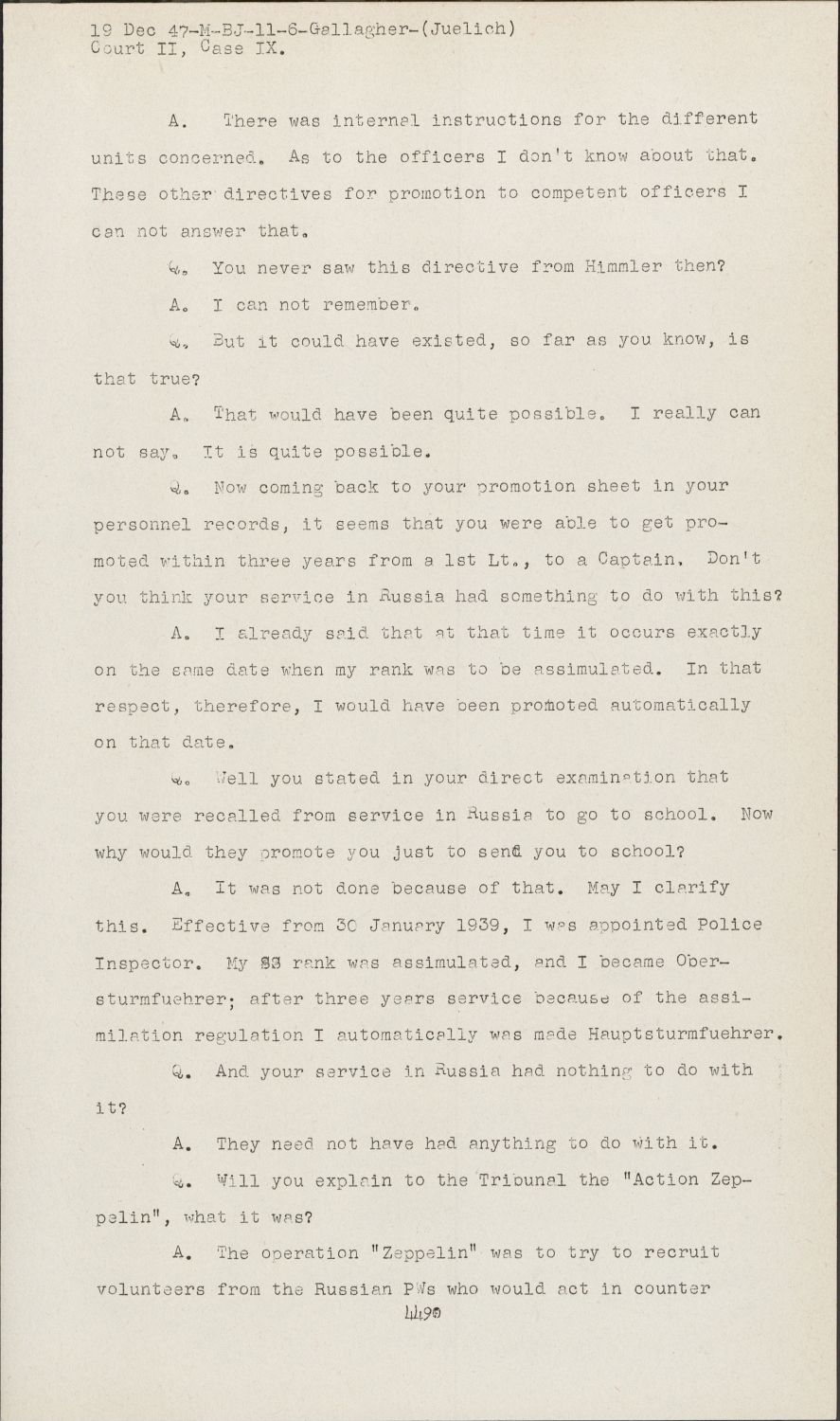
A.There was internal instructions for the different units concerned. As to the officers I don't know about that. These other directives for promotion to competent officers I can not answer that.
Q.You never saw this directive from Himmler then?
A.I can not remember.
Q.But it could have existed, so far as you know, is that true?
A.That would have been quite possible. I really can not say. It is quite possible.
Q.Now coming back to your promotion sheet in your personnel records, it seems that you were able to get promoted within three years from a 1st Lt., to a Captain. Don't you think your service in Russia had something to do with this?
A.I already said that at that time it occurs exactly on the same date when my rank was to be assimulated. In that respect, therefore, I would have been promoted automatically on that date.
Q.Well you stated in your direct examination that you were recalled from service in Russia to go to school. Now why would they promote you just to send you to school?
A.It was not done because of that. May I clarify this. Effective from 30 January 1939, I was appointed Police Inspector. My SS rank was assimulated, and I became Obersturmfuehrer; after three years service because of the assimilation regulation I automatically was made Hauptsturmfuehrer.
Q.And your service in Russia had nothing to do with it?
A.They need not have had anything to do with it.
Q.Will you explain to the Tribunal the "Action Zeppelin", what it was?
A.The operation "Zeppelin" was to try to recruit volunteers from the Russian PWs who would act in counter intelligence in the East against Russia.
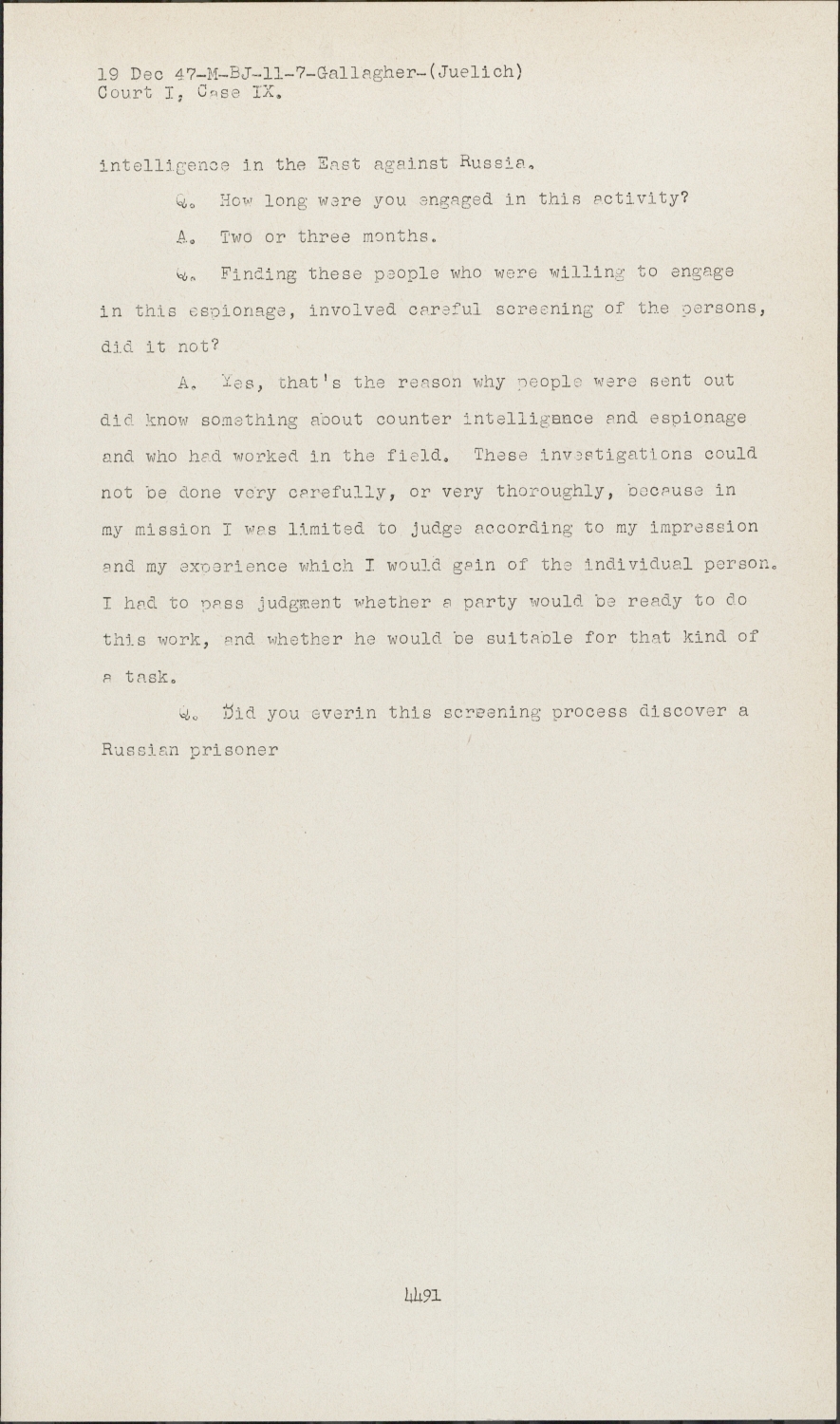
Q.How long were you engaged in this activity?
A.Two or three months.
Q.Finding these people who were willing to engage in this espionage, involved careful screening of the persons, did it not?
A.Yes, that's the reason why people were sent out did know something about counter intelligence end espionage and who had worked in the field. These Investigations could not be done very carefully, or very thoroughly, because in my mission I was limited to judge according to my impression and my experience which I would gain of the individual person I had to pass judgment whether a party would be ready to do this work, and whether he would be suitable for that kind of a task.
Q.Did you everin this screening process discover a Russian prisoner Court No. II, Case No. IX.
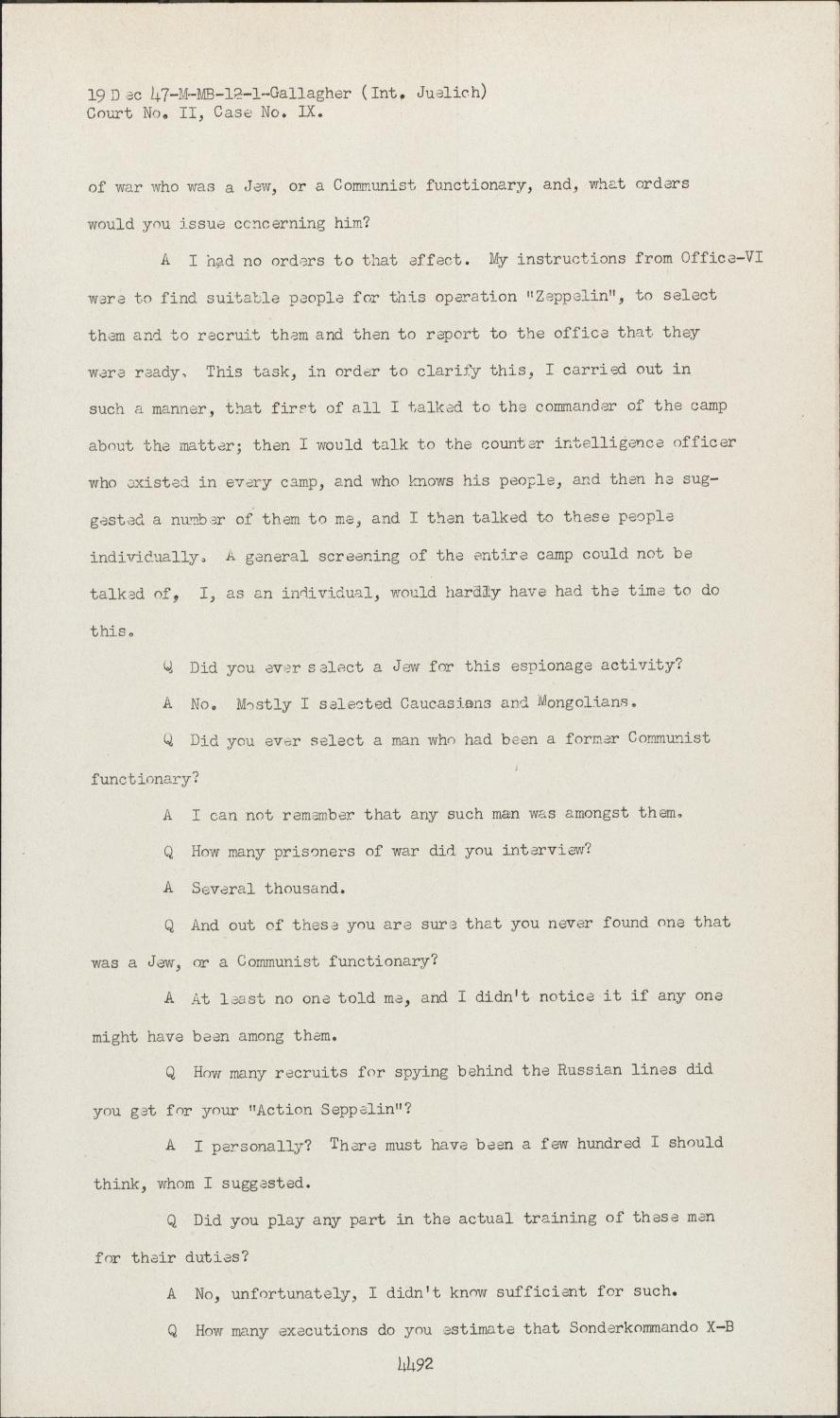
of war who was a Jaw, or a Communist functionary, and, what orders would you issue concerning him?
AI had no orders to that affect. My instructions from Office-VI were to find suitable people for this operation "Zeppelin", to select them and to recruit them and then to report to the office that they were ready. This task, in order to clarify this, I carried out in such a manner, that first of all I talked to the commander of the camp about the matter; then I would talk to the counter intelligence officer who existed in every camp, and who knows his people, and then he suggested a number of them to me, and I then talked to these people individually. A general screening of the entire camp could not be talked of, I, as an individual, would hardly have had the time to do this.
QDid you ever select a Jew for this espionage activity?
ANo. Mostly I selected Caucasians and Mongolians.
QDid you ever select a man who had been a former Communist functionary?
AI can not remember that any such man was amongst them.
QHow many prisoners of war did you interview?
ASeveral thousand.
QAnd out of these you are sure that you never found one that was a Jew, or a Communist functionary?
AAt least no one told me, and I didn't notice it if any one might have been among them.
QHow many recruits for spying behind the Russian lines did you get for your "Action Zeppelin"?
AI personally? There must have been a few hundred I should think, whom I suggested.
QDid you play any part in the actual training of these men for their duties?
ANo, unfortunately, I didn't know sufficient for such.
QHow many executions do you estimate that Sonderkommando X-B Court No. II, Case No. IX.
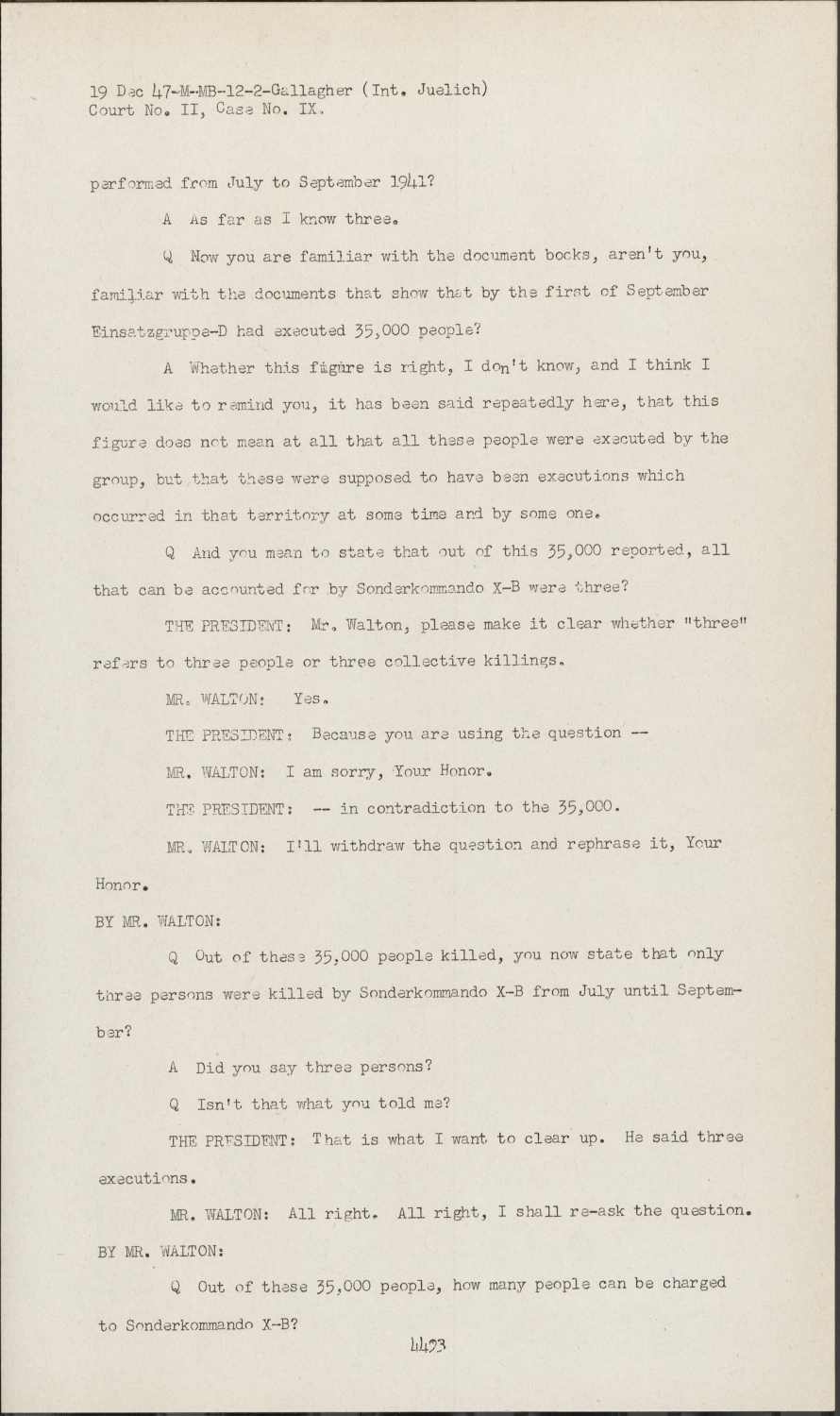
performed from July to September 1941?
AAs far as I know three.
QNow you are familiar with the document books, aren't you, familiar with the documents that show that by the first of September Einsatzgruppe-D had executed 35,000 people?
AWhether this figure is right, I don't know, and I think I would like to remind you, it has been said repeatedly here, that this figure does not mean at all that all these people were executed by the group, but that these were supposed to have been executions which occurred in that territory at some time and by some one.
QAnd you mean to state that out of this 35,000 reported, all that can be accounted for by Sonderkommando X-B were three?
THE PRESIDENT:Mr. Walton, please make it clear whether "three" refers to three people or three collective killings.
MR. WALTON:Yes.
THE PRESIDENT:Because you are using the question -
MR. WALTON:I am sorry, Your Honor.
THEPRESIDENT: -- in contradiction to the 35,000.
MR. WALTON:I'll withdraw the question and rephrase it, Your Honor. BY MR. WALTON:
QOut of these 35,000 people killed, you now state that only three persons were killed by Sonderkommando X-B from July until September?
ADid you say three persons?
QIsn't that what you told me?
THE PRESIDENT:That is what I want to clear up. He said three executions.
MR. WALTON:All right. All right, I shall re-ask the question. BY MR. WALTON:
QOut of these 35,000 people, how many people can be charged to Sonderkommando X-B?
Court No. II, Case No. IX.
AI can not tell you, Mr. Walton.
THE PRESIDENT:Well, witness, how many were included in the three executions?
THE WITNESS:That I can not tell either quite exactly, because I only heard about the third execution afterwards, without hearing any figure about it on that occasion.
QWell, do you know how many were included within the first two executions.
AIn the first execution, if I remember correctly, there were twelve to fifteen people.
QAnd in the second execution?
AIn the second execution there were twenty to thirty.
QYou have no idea how many there were in the third?
AI really can not say. It must have been -- it must have been a limited number of persons, I think.
THE PRESIDENT:Proceed. BY MR. WALTON:
QDid your commando ever receive an inspection trip from General Ohlendorf?
AYes.
QHow many?
AAs far as I can recall, two.
QDid Seibert ever make an inspection of Sonderkommando X-B?
ASo far as I know the first time, but I am not quite certain, he came together with the group-chief.
QDid he ever make one alone?
ANo, I can not remember of ever having seen that.
QWho was the chief of Leiter-III in Sonderkommando X-B?
AObersturmfuehrer Buckert.
QDo you know whether Seibert ever had conferences with 1st Lt. Buckert?
AI think I can say that because in Chernovitz, he must have Court No. II, Case No. IX.
been there, but I can not say really.
QDid you have any official contact yourself with Seibert?
AI believe I only talked to Herr Seibert once about an investigation concerning two German villages.
QDid you ever receive -
A -- but I didn't get any instructions from him.
QDid you ever receive any correspondence signed by Seibert?
ANo.
QWhat position in Einsatzgruppe-D Headquarters did you consider Seibert to hold while you were a member of Sonderkommando X-B?
AHe was Chief-III.
QDid you consider him a deputy of General Ohlendorf?
ANo, because indeed as far as I can recollect, there was a roll call, which the group-chief himself conducted there, and if I am not very much mistaken, and my recollection is not wrong, that he appointed as his deputy, if necessary to do so, Obersturmbannfuehrer Setzen.
MR. WALTON:Your Honor, I have only a few more questions but I want to go into the statements made by him yesterday concerning the signing of his affidavit,
THE PRESIDENT:Well, we can do that after lunch.
MR. WALTON:Yes.
THE PRESIDENT:Dr. Hoffmann?
DR. HOFFMANN:Your Honor, I can only get a definite reply between two and three o'clock. The Secretary General will inquire by phone whether the witness has set off or not.
THE PRESIDENT:Well, we will hold it in obeyance until you report to us, Dr. Hoffmann. The Tribunal will be in recess until 1:45.
THE MARSHAL:The Tribunal will be in recess until 1345 hours.
(Whereupon recess until 1345 hours, 19 December 1947.)
AFTERNOON SESSION (The hearing reconvened at 1345 hours, 19 Dec 1947) CROSS EXAMINATION - Continued FELIX RUEHL - resumed
THE MARSHAL:The Tribunal is again in session.
DR. KOESSEL FOR HOFFMANN:Your Honors, the defendant Nosske was excused yesterday to take part in a conference with his counsel this afternoon but he is still at the moment in the room here. I would like your Honor to arrange that he be excused.
THE PRESIDENT:The Marshal is directed to take the defendant Nosske to room 57 where he may confer with his counsel.
DR. KOESSEL:As the defense counsel of the defendant Schubert I would like to trouble the Tribunal with one question. According to rumors there is supposed to be no session tomorrow morning and the whole state of affairs seems to be rather difficult, especially as a witness has appeared for the defendant Haensch. There is the danger that the examination of the defendant Schubert in the witness stand will be cut into two parts and will not be finished before the Christmas holidays. I would, therefore, ask the Tribunal because of this danger not to call the defendant Schubert to the witness stand. There are a number of colleagues who want to submit documents books. I am one of them. I should like to submit my document books, also for the defendant Haensch and for Dr. Hoffmann. So I think there is quite a lot that has to be done.
THE PRESIDENT:What you are really trying to do is to have the rumor include this afternoon some time.
DR. KOESSEL:No, it wasn't that. I only wanted to be certain that I shall not have to call the defendant Schubert to the witness stand.
THE PRESIDENT:Tomorrow?
DR. KOESSL:That one would come to an agreement, to a ruling, that the examination will not be interrupted, not that part of it will take place before the Christmas holiday and the other part after the Christmas holiday.
THE PRESIDENT:If a rumoris repeated often enough it becomes a fact and if two or three or more defense counsel tell me about this rumor there will be no way to hold court tomorrow. Suppose we see what developes during the next hour and perhaps we can have the rumor crystalize into some kind of fact.
DR. KOESSL:Very well.
MR. WALTON:Your Honors, before I conclude the cross examination of the defendant Felix Ruehl I should like at this time to answer to the ruling of the Tribunal made on 9 December that on the question of the admission of the affidavit of a deceased witness the Prosecution and the defense should file suitable briefs. At this time and in open Court I desire to tender the brief in the required number of English and German copies to the Secretary General for filing.
THE PRESIDENT:Do you know whether defense counsel have prepared a brief in reply?
MR. WALTON:It is my understanding, sir, that they are working on it. They have had English copies two days or so but I want to give them as I can the advantage of the copies prepared in German - that they have both as of today.
THE PRESIDENT:Very well. BY MR. WALTON:
QWitness, let me direct your attention to your interrogations prior to the date that you received the Indictment in this case. At the interrogation in which you signed the affidavit which appears in Document Book III-D you stated in your examination that you objected to errors and inconsistencies contained in this affidavit and Mr. Wartenberg stated that you would be given an opportunity to make corrections, is this true?
AYes.
QNow, I ask you once again, you being under oath when you reply, do you again state that you objected to signing an erroneous affidavit and only signed on the promise that you would be given an opportunity to make corrections?
AI have already said, Mr. Walton, that in the first affidavit which was shown to me I asked for so many corrections to be made and that I myself dictated one paragraph as Mr. Wartenberg kept on dictating something quite different from what I stated, so that a now affidavit had to be made out. The now affidavit was again not entirely according to my statement and I told Mr. Wartenberg so. Whereupon Mr. Wartenberg told me "You still will have an opportunity to do so if this is going to be used against you."
QI ask you if you objected to signing this second affidavit that was prepared and only signed on the promise that you would be given the opportunity to make corrections? Is that a true statement of facts?
AAt the moment I cannot say with certainty whether that was after the first or second draft but I want to persist to say that Mr. Wartenberg stated that if this should be the source of any errors whatsoever and if this is going to be used against you there is enough opportunity during the procedure to clear this up and I was convinced of this affirmation.
QDo you remember the date that you signed this affidavit?
AAs far as I remember it was on the 26th.
QOf June?
AYes.
QWas there a stenographer present when you signed this affidavit?
AI think so.
QA female stenographer? Did she take notes?
AI did not observe that. As far as I know she did not write.
QWell, let me read you the transcript - it is very short - of the stenographic notes from 26 June 1947 from 1500 hours to 1530 hours. "The interrogation 1243-D was conducted on 26 June 1947 from 1000 to 1030 hours. In this interrogation the affidavit was submitted. Due to the many corrections the affidavit had to be re-written and could not be signed."
And then the stenographic notes go on:
"What is your name?
"A Felix Ruehl.
"Q Are you the same Ruehl whom I have interrogated often before? I remind you that you are still under oath.
"A Yes.
"Q I have had the affidavit re-written. Please read it and sign it."
The stenographic notes for the 26 June 1947, 1500-1530, then ends with these wores:
"The witness reads the affidavit and signs it."
Did those events transpire?
AA part of that is mi sing without the slightest doubt because I am absolutely certain, you may believe me or not, that I discussed this affidavit with Mr. Wartenberg.
QOn the second affidavit did you make a single correction or addition?
AAs far as I know not.
QNow to sum up your testimony both on direct and on cross examination I assume from what you have stated that you were given a certain function in Sonderkommando 10-B and you were effectively blocked off from all other activities as if Persterer had put blinders on your eyes and you saw nothing that transpired either to the right or to the left and your whole attention and your whole eyesight was directed at your own task and that the executions of which you have any knowledge whatsoever are those which you found out only in casual, conversation with your comrades, is that the substance of your testimony?
AI think that what I said was even more than what I actually dealt with within the frame of my own competence and I told you those things that I learned about myself. I cannot tell you any more. Mr. Walton.
QProsecution has no further questions.
THE PRESIDENT:Is there any re-direct examination? Dr. Linck?
RE-DIRECT EXAMINATION BY DR. LINCK:
QA few very brief questions, witness, in order to clarify your membership in the organization of the SS. Were you a member of the General-SS?
AYes, from 1932 to 1936 as far as I know.
QDid you remain a member of the General-SS when you joined the Police?
AI was formally kept on the list officially as a member of the SS. Then I was taken into the Reich Security Main Office and I was then kept on the files of the SD and thus I left the General-SS.
QDid you carry out any activity in this special formation of the SS, the SD?
ANot a day.
QDid you do any service?
ANo.
QDid you pay membership fees?
ANo.
QWas there any SS service in this special SS formation, the SD?
AI am not aware of any.
QWhat was this formation then, your service? What was its function?
AI did not see any particular assignments for me in it, as I was wearing the uniform.
QDid you mean to say that the agency took care and was a welfare organization of unifomred men of the SD?
AThere was in the SD as such a particular field of activity, but I had nothing to do with that.
QThank you. Your Honor, I have no further questions.
I should only like to make a small remark in order to protect myself and in order not to appear as stupid, that I raised no objection during the whole cross examination because my client made me promise him to let him answer all the questions even thos which seemed inadmissible. It wasn't easy for me to comply with this promise, but I kept my promise.
MR. WALTON:If the counsel wants to testify let him testify and take the stand and be swonr. I don't think the matters have any bearing on the issues in this case, nor does the information add one bit to the duty or the ability of the Tribunal to decide the case. I don't think it is a proper remark for the Tribunal. I don't think counsel is acting in his place as counsel to reveal confidential communication between himself and his client.
THE PRESIDENT:I am sure that Dr. Linck did not intend to offend any one by the statement which he volunteered and which was sincerely made but I don't think it necessary to pursue the statement any further.
DR. LINCK:Thank you, your Honor. May I on this occasion ask the Tribunal whether it would be agreeable if I would answer the question which I have received about the IMT. It was a question which was asked by the Tribunal in connection with my opening statement.
THE PRESIDENT:Yes, you had stated in your opening remarks that the witness had appeared and I asked you if you could refer the Tribunal to the page in the transcript.