QCould Seibert go to the files any time he wanted to just like General Ohlendorf and take out there from any document which he needed in his work?
A of course, yes.
QAnd he did not have to ask your permission or he did not have to present permission from General Ohlendorf, did he?
AHe did not have to do that, but, of course, he told me what he wanted to look at.
MR. WALTON:Your Honor, it is a convenient place for me to stop.
THE PRESIDENT:Yes, very well. The Tribunal will be in recess until tomorrow morning at nine-thirty.
(An adjournment was taken until 6 January, 1942, at 0930 hours.)
Official Transcript of the American Military Tribunal in the matter of the United States of America, against Otto Ohlendorf, et al.
, defendants, sitting at Nurnberg, Germany, on 6 January 1948, 0930 1630, Justice Musmanno, presiding
THE MARSHAL:The Honorable, the Judges of Military Tribunal II.
Military Tribunal II is now in session. God save the United States of America and this Honorable Tribunal.
There will be order in the Court.
MR. GLANCY:May it please the Tribunal-
THE PRESIDENT:Mr. Glancy.
MR. GLANCY:The Prosecution is in receipt of the original of document number 3428-PS which was introduced as Prosecution Exhibit 111.At the time it was introduced and frequently at times later the defense counsel for Dr. Strauch objected to its authenticity and requested that we send to New York for its original and we are pleased to announce we have it in our possession for the perusal and scrutiny of the Tribunal and defense counsel.
I expected Dr. Gick to be present in Court but I see he is not here.
I will give it to the Secretary General for the perusal of the Court and will notify Dr. Gick that it is present.
THE PRESIDENT:Have you made arrangements to photostat this document?
MR. GLANCY:The photostat is now in evidence - the photostat of the original.
THE PRESIDENT:Well, what I had in mind was that this document being so valuable that it might not hurt to have a photostat of the one which actually arrived now.
MR. GLANCY:Yes, sir.
THE PRESIDENT:We cannot exclude the possibility that argument might be made that the original photostat was not of the document that you now have and it wouldn't hurt any one to have this photostat and considering the difficulty which had to be undergone to get this document makes reason for just having a photostat of the document itself.
MR. GLANCY:Yes, sir. I shall make arrangements to have it photostated.
At the present time we need it for the archives but will turn it over to the secretary General at which time arrangements will be made to have it returned to New York.
THE PRESIDENT:When you contact Dr. Gick inform him what transpired this morning and then if there is any motion he wants to make he can make it regardless of the stage of the trial at that time.
MR. GLANCY:Yes, sir, very well.
HEINZ SCHUBERT - resumed
CROSSEXAMINATION - continued BY MR. WALTON:
QMr. Schubert, yesterday at the close of the session we were discussing your affidavit which appears in Document Book I on page 17 of the English, page 19 of the German and is document No-2716, Prosecution Exhibit #4. I would appreciate it very much if you would turn to paragraph 7 of that document and indicate when you have found the place.
THE PRESIDENT:He is very familiar with that Document I don't think you need to wait any time until he locates it.
I think he could locate that in his sleep after the discussion we had yesterday about it.
BY MR. WALTON:
QYes, sir. Now you state in this document and I quote, or rather, you state in this document that these written reports contained among other things and I quote:
" number of places destroyed and number of persons killed". Would these reports contain information that a Jewish synagogue was burned by units of the Einsatzgruppe?
ASomething like that is not contained in the text of my Document Book - that a synagogue was burned.
I never said that.
QI am quite aware of that fact but you did say that these reports, and by these reports you referred to operational situation reports, contained among other things the number of places destroyed and the number of persons killed.

Now you said that, didn't you?
AYes, I said that and that is what is written in the affidavit.
QNow, when you speak of the number of places destroyed I ask you the question would these reports in these number of places destroyed which they speak of contain such information that a Jewish synagogue was burned by units of the Einsatzgruppe?
ANO, Mr. Prosecutor, that isn't how it is meant and apart from this wording I don't know any report where any such report might be contained.
I don't know of any such reports. Something quite different is meant here.
This wording refers to that part of the reports of the Einsatzgruppe which deals with the military situation in that territory where Einsatzgruppen D was active during certain times.
I said already yesterday that communications were made in this connection and are contained in these reports which described military operations and actions carried out, or rather the situation as we knew about it according to the reports which we received.
Part of this was, for example, that it was reported - just to give you an example 0 that in the Crimea one of the first reports said that the location Ushun had been completely destroyed and did not exist any longer.
But this refers to the previous combat action and it says here in this connection there were those persons killed.
Them in fact it would have been better to write - after it had been written - the persons killed during these military actions That is what is mean here.
QBy persons killed you mean the number of enemy killed, is that right?
AI don't refer that only to the enemy who was killed but to any persons killed.
That might have been civilian people or enemy soldiers or might have been our own losses.
I only speak of casualties here and these are casualties.
QI can understand what you said about casualties. It is in the very next sentence of that paragraph.
But I was speaking particularly about the phrase " total amount of persons killed". Now would that phrase include executions as well as people killed in open combat?
AMr. Prosecutor, this wording here does not refer to executions carried out at all but exclusively to what I said before and in the case of the Prosecution unfortunately this wording has been understood to mean the same as executions mentioned before.
This was never meant and I think I can say, therefore, that expression is not in the affidavit either.
QAll right. Let's consider the operational situation reports of which you had personal knowledge.
I believe you stated yesterday that in the written reports which went to Berlin the totals of the number of persons killed for the period of the reports was sometimes contained in them.
did you not?
AA total figure for a certain period of reporting. Of course, you are right.
I cannot exclude the fact that in these reports communica tions about executions were contained.
QNow you knew from these reports which contained information about executions that thousands of people were being killed monthly by units of the Einsatzgruppe, didn't you?
AMutilated, I never heard that Mr. Prosecutor. I merely know the fact that executions were carried out.
QLet me repeat the question. I think the translation was a little bit different from what I meant.
From reading the copies, the file copies, of these reports - and by reports I mean the operational situation reports - which contained information about executions you knew that thousands of people were being executed monthly, didn't you?
AMr. Prosecutor, that monthly thousands of people were executed I would not like to say.
Here I can only stick up for the fact that I Knew about executions which had been carried out but I would not like to say and I cannot say that monthly thousands of people were executed.
I am not able to say that.
QWould you say hundreds of people were executed monthly?
AI believe, Mr. Prosecutor, you asked whether I would say hundreds?
The translator said I said hundreds were killed.
QWould you say that hundreds of people were being executed monthly according to reports which you saw?
AMr. Prosecutor, I cannot determine this for a certain figure fro a month.
Occasionally I saw figures and heard of figures which were less than 100 and I also saw figures which were more than 100 but I cannot determine this for a certain period of time.
I am unable to do this.
QWell, at least, there were more than one person per month executed by units of the Einsatzgruppe, weren't there?
AOf course.
QNow who was it that generally gave you these reports to be filled?
AThere was no special order for this Mr. Prosecutor. This was part of my task as part of conducting the business in the office.
QMr. Schubert, I am asking you for the name of the person in the Gruppenstab which generally, which usually handed you, or placed on your desk, or put in your office the file copy of the operational sit uation report for you to file.
Who was this person?
AMr. Prosecutor, perhaps I may briefly explain the way we worked.
After the report had been made, that is written and sent off, copies of these reports were left in the office - they were filled in the office.
They came from that person who originally wrote the report, that is dictated or worded it.
QWho was that person?
AThat might have been the chief of the Einsatzgruppe himself or that might have been co-defendant Seibert.
QNow you could have answered that when I first asked the question without trying to dodge the question.
I merely asked who the man was who left these copies in your office.
Let's pay attention and answer promptly.

Now, in paragraph 8 of this affidavit you make a statement to the effect that when General Ohlendorf and Seibert were both away from headquarters you, as you state there, and I quote:
"looked after the house". Approximately how long did these inspection trips last?
AThat varied very much, Mr. Prosecutor. These official trips might have taken one week or they might have lasted only 1,2,or 3 days.
That varied.
QNow did you ever receive any mail or any orders during the time when Seibert and General Ohlendorf were both away which demanded the immediate attention of the commander during this period when you were looking after the house?
AI do not recall any such case, Mr. Prosecutor. Of course, I received mail even when Herr Ohlendorf and Seibert were both away at the same time because the work went on just the same and in the office mail still arrived during that time as well but I cannot say that I ever had any reason in some particular case to inform Herr Ohlendorf who was absent I do not know of any such example.
THE PRESIDENT:You may proceed Mr. Walton.
BY MR. WALTON:
QNow if you had received an order from Heydrich in Berlin or from the commander of the 11th Army and General Ohlendorf and Seibert were both away and you knew they would not return for a week or so what would you have done with this order?
AMr. Prosecutor, in such a case, that is an emergency situation for me, if that had arisen - since I did not have authority to decide myself in such a case - in that case I would have been able to contact Herr Ohlendorf immediately and would have informed him about that.
QYou mean to say that you could have contacted General Ohlendorf if he was on a journey which was some three or four hundred kilometers away - at the time you got his order he was enroute you could have contacted him then, too?

AIf he was enroute it was very difficult, Mr. Prosecutor, because in his vehicle he did not have a radio instrument to keep up contact with the gruppenstaff but I knew in general where Herr Ohlendorf went to and could always try to reach him and that was a technical possibility.
QNow you were present, were you not, when Seibert said that he accompanied General Ohlendorf to Prague at one time. Suppose during that time the same emergency had arisen, to whom would you have referred this order for action? It took a long time to get from the Crimea to Prague, and you know they are on their way and you get an order which demands immediate action, to whom would you refer?
AMr. Prosecutor, in every case, in each and every case, there was one definite way of receiving instructions from Berlin, from the chief of the Security Police himself if any such emergency arose. There was always their radio communication. The distance didn't make any difference. In a short period of time through the radio a decision can be reached from Berlin to the Crimea in a very short time.

QHad a decision of the Chief of the Security Police in Berlin come out, as the adjutant of General Ohlendorf, and it be requested, it would be transmitted to you by radio, would it not, after the Chief of the Security Police was informed that you were the only officer present and that General Ohlendorf and Seibert were gone?
Would Heydrich's decision come back to you over the radio?
AI don't think that the Chief of the Security Police would have put me in charge of carrying out this decision because my rank was too low.
QNo, I don't mean that. We take our same example. Fro purposes of this example General Ohlendorf and Seibert cannot be reached.
You receive an order which demands immediate action.
You acquaint the Chief of the Security Police with the fact that you are the only one in staff headquarters, that your chief and that Seibert are away, and request guidance or direction to whom this order would be referred to in Einsatz gruppe D. Now, the question I ask you is this, after the Chief of the Security Police was acquainted with that fact, would his answer, that is to whom this matter would be referred, come back to you over the radio?
AMr. Prosecutor, it would not have come to me personally, but it would have come to Einsatzgruppe D, and in such case I would have informed the officer who dealt with this subject, who deputize for the Chief of the Einsatzgruppe during that time, I would have reported it to him, and I would have to find out which territory and sphere this decision did concern, and I would have informed that officer, who deputized for the Chief of the Einsatzgruppe in a certain territory, that is the kommando chief there fore.
QThat is the answer that I wanted. If this matter was a matter which concerned Einsatzkommando 10a and Heydrich said, "Refer that to the area where 10a is," you would then have taken Heydrich's answer and referred it to Seetzen, the commander of 10a, would you not?
AIn practice it probably would have been different, Mr. Prosecutor, because from Berlin, in such case, the Einsatzkommando 10a would have been informed themselves directly from Berlin, and between Berlin and Einsatz kommando 10a there was a radio communication, without having to contact the Einsatzgruppe in such a case, in particular as there was nobody with the Einsatzgruppe at that time who could make a decision, and there fore they never had to be informed about this.

The kommando chief of 10a was a Standartenfuehrer.
I cannot imagine that any officer in Berlin in the staff of Heydrich or any other officer who gave such instructions would have sent these instructions via a lower officer to the Standarten fuehrer, if he had been able to reach the Standartenfuehrer immediately.
QAll right, we will take another example. Suppose that in the first instance orders came from Berlin, from Heydrich's office, which said that the area covered by Einsatzgruppe D shall be cleaned of Jews within the next thirty days and that Einsatzgruppe D would then move for ward.
Now, both General Ohlendorf and Seibert are away, and they cannot be reached.
This is a matter which you open and you decide and which effects every kommando leader in Einsatzgruppe D, and according to your testimony you acquaint the Berlin office with the fact that the command ing officer and the deputy for the staff are both away and request instruct ions what to do with this order.
Now, I ask you, would instructions come back to you from Berlin to the effect that it would be your responsibility to forward this order to the commanding officers of the various kommandos?
AMr. Prosecutor, such instructions were never received and theoreti cally I cannot imagine a thing like that, but even if such an order had come, and I consider this question too hypothetical, then there was the commander in chief to the Army to whom I would have had to turn in such a case, if I had been the only one, the only officer present with the Einsatzgruppe at that time.
Such a situation, however, never arose.
QYou mean to tell me that the commander of the 11th Army, a Wehrmacht units, would consider himself bound by orders form Heydrich at Berlin?
AThat is not what I am trying to say, Mr. Prosecutor.
QWouldn't the commander of the 11th Army say, "This is a Security Police order; it means nothing to me.
My commanding general is the only man who can order me to do anything," and he refuses to help, and you know that the units of Einsatzgruppe D can carry out this order and the quickest way for you to handle it would be to forward this order to the various Einsatzkommandos, wouldn't it?
AI did not quite understand the question.
QAll right. I will go back to our same example. Heydrich has ordered that the entire area at present occupied by the units of Einsatz gruppe D shall be freed or cleaned of Jews.
General Ohlendorf and Seibert are both away from headquarters.
We will state even this order comes in over the radio marked "Urgent". Would you sit down and inform Berlin that no one was in staff headquarters but you, or would you, as you say, go to the 11th Army, and if I understood your answer correctly, you would appeal to the commanding general of the 11th Army, but the commanding general of the 11th Army sends you word through his adjutant or his officer that this is a police or Security Police matter which he cannot concern himself with.
I am asking you, would you then dis seminate by the quickest possible means this order to the various kom mandos, the various commanders of the Einsatz and Sonderkommandos?
DR. KOESSL:Your Honor, I object against this question which in a hypothetical question, and it is such a hypothetical question which in practice could not have been practiced at all.
The hypothetical questions which have come up, up to now, I have not objected to because I could at least imagine that such a case might arise, but this case is quite impossible, because the order which is supposed to have been handed on in practice is the Fuehrer Order itself with instructions to an entirely from one day to another.
This is so entirely impossible, and entirely impossible supposition, that I consider this hypothetical question as impossible and not admissible.
THE PRESIDENT:Well, Dr. Koessl, you are indicating that it is im possible, but you weren't with the Einsatzgruppe D. You are arguing factually.
You are not arguing legally or logically now. It is up to the witness whether such a situation is impossible.
How do you know whether it is impossible or not?
DR. KOESSL:Your Honor, the order is the same as the Fuehrer Order which was to be sent on, according to the assumption of the Prosecutor, and it took several years to carry out the Fuehrer Order and even then it had not been carried out completely.
I, therefore, think it is quite logical.
THE PRESIDENT:But, Dr. Koessl, the witness stated that in any given situation with his chief absent that he would contact the commanding general of the 11th Army.
Now, the witness has stated that. Mr. Walton went one step further and said, which is not impossible, "Suppose the commanding general indicated that he was disconcerned about this matter, it did not fall within the purview of his activities."
What is impossible about that?
If the commanding general says, "This is not my field; this is a Security Police measure," what is impossible about that?
DR. KOESSL:The order based on this hypothetical question is the Fuehrer Order itself, namely, all Jews are to be executed immediately, that is, they are to be executed in that territory.
It only differs from the Fuehrer Order by the word " immediately" and the word " immediately" makes the Fuehrer Order logically impossible.
In practice, therefore, the entire question, the entire hypothetical question is an unimaginable case.
THE PRESIDENT:Well, it is not unimaginable. You say that the only change is that the word "immediately" is added.
Well, that is a very important change.
A program may be outlined for a period of time, and then there can be a supplemental order that that program should be accelerated or should be achieved at once, and furthermore, Dr. Koessl, the important thing here is that the witness himself has volunteered that he would sub mit such a situation to the commanding general so that now we want to know what would happen in the event the commanding general said, "This is not my problem; it is the Einsatzgruppe's problem."
So, let us hear the witness, what he will say.
DR. KOESSL:Yes.
THE WITNESS:May I answer to this now, your Honor?
THE PRESIDENT:Yes.
AIf in this assumed situation the commander in chief of the Army would have said that he was not competent to deal with this, but I can not imaging this because he was responsible for that territory, but if he had done this, this entire matter would have been handed back to Berlin by me.
I could not have decided at all.
Q (By Mr. Walton) Suppose when you handed it back to Berlin you got the order, addressed to you, to pass on to the commanders of the various subunits of Einsatzgruppe D, would you have done so?
AIf I had received orders from Berlin to hand on this order?
QYes, would you have done so?
AThen this communication would automatically have gone to the kom mando chiefs and I would not have had to forward it.
It would have been addressed to these kommandos immediately.
Q.Now you have an order. There is no point in them sending another order to the various kommandos when your radio station was closer to the kommandos than Berlin.
So an officer on the staff of Heydrich radios you personally, "Pass the order on to the five kommandos, of the subunits."
Would you do so?
A.Mr. Prosecutor, here again I would like to point out that it was technically impossible to do so in such a case.
In such a case one radio massage would have been sent to everybody.
That is, all the persons who are to receive this massage were there at the same time because they are being addressed at the same time over the radio.
In this case every kommando chief receives this order himself for his own territory.
It is unthinkable for me that a situation should arise where I Should have been asked even to hand on such an order.
Q.You haven't answered my question yet. I am not talking about the feet that it never happened.
I ask you the simple question if an officer on Heydrich's staff, in view of the fact that General Ohlendorf and Seibert were away, radioed you to pass on Heydrich's order to the commanders of the subunits of Einsatzgruppe D, would you have done so?
Now, you can answer that yes or no. You have given your explanation.
A.Mr. Prosecutor, If all other possibilities which I have mentioned would not have been given, and I would only have had to decide to carry out this order or not, then, of course, I would have had to carry it out, and I would have carried it out.
Q.Thank you very much. Now, when General Ohlendorf was every on official business or leave and Seibert was in the headquarters and orders came from Berlin or from the Army which affected a whole group, and that came to your desk and you opened it and saw what it was, to whom would you give it?
A.You now talk about the order, if I had received that, the order we just discussed?
Q.Not particularly any order. Suppose that you get an order from Heydrich which says that all men of Einsatzgruppe D, officers and men, will be paid henceforward on the 28th of the month.
General Ohlendorf is away from his headquarters.
This is a matter which affects the whole Einsatzgruppe from the general on down.
Nobody is in headquarters staff but you and Seibert, and, of course, enlisted men.
To whom would you give this information?
A.Mr. Prosecutor, in that case I would have made a difference, or decided this order had to be handed on immediately, that is, provided that it had to be handed on immediately.
Then Ulrich, the administrative chief, would have received it but the clerk would have done this who received the incoming mail, handed it out and gave information to those who required it.
I would not have been needed for this.
Q.Suppose this request came from Berlin to the effect that the Einsatzgruppe D should report on the number of people killed for the last ten days of the month, they have lost the report in Berlin.
To whom would you have handed this matter?
A.May I repeat the question in order to make sure that I understood it correctly?
Berlin gives me an order to inform them how many persons had been killed during the last ten days in the territory of the Einsatzgruppe, is that right?
Q.That is right. Now, you are in your office and you open the mail and that request is in front of you.
I want to know to whom you would give that letter for action on that request?
A.I would not have been able to hand it on to anyone because it was addressed to the Einsatzgruppe.
Probably I would have submitted it to the chief after he returned.
Q.You mean to say that if that order had come down the last of March or during the month of April and General Ohlandorf was to be away for six weeks you would take no action on a matter of that kind until he returns?
A.Of course I would have done something. If Herr Ohlendorf had been on an official trip, then this incoming mail would have been handed on to the next one who at that time, at the start of the Einsatzgruppe, deputized for Herr Ohlendorf, in this case Herr Seibert.
Q.That is what I want to know. Now, did General Ohlendorf ever issue any written orders to any of the kommandos?
A.I cannot remember any definite order but already yesterday I said that I know the order, that Herr Ohlendorf gave instructions about the manner of carrying out executions.
Surely there were other instructions, only I don't know whether I could call them orders.
Q.All right. Did he ever issue any written instructions or orders to a particular kommando leader?
A.I cannot say that any more now, Mr. Prosecutor. I cannot remember any one case.
Q.Well, it is possible, isn't it?
A.I cannot exclude that possibility.
Q.Now, you had the responsibility to see that these orders were dispatched to the person they would be addressed to out at the group staff headquarters?
A.For the fact that they were sent off or that they had been written, technically I think I can assume responsibility with a calm conscience because that was my work.
That was the task of the office as I had been given it.
Q.Would you keep a copy in the file of this order?
A.Of course.
Q.Now, if the general was away and Seibert was in the head quarters, can you remember whether or not he ever issued any written orders, or instructions to a kommando leader?
A.Mr. Prosecutor, If Herr Ohlendorf was absent and Herr Seibert was present with the staff of the Einsatzgruppe then nothing changed in the usual habits while Seibert continued to do that work he always did.
Q.Then he had -
A.And in that capacity he also conducted correspondence with the various kommandos.
Q.Can you recall any subjects which he treated in his orders during the time when General Ohlendorf was absent?
A.I cannot remember any definite case, Mr. prosecutor, but I know the reports which were made out by Herr Seibert.
Q.I am not talking about the reports now. I am talking about communications with the kommandos.
I am not talking about his reports either to the Army or to Berlin.
I am talking about his separate communi cations with the komnmando fuehrers.
Do you recall any subjects which he treated in his instructions or orders to the kommando leaders?
A.Here I cannot remember any definite case at the moment, Mr. Prosecutor.
I really don't know what I could tell you here.
Q.You have answered the question I asked you. Do you remember if Seibert in this instance over gave orders for a kommando to change its location or its base of operations?
A.I do not remember any such order nor do I remember that during the time concerned kommandos changed their base of operations.
In any case at the moment I cannot think of that.
Q.Did you ever see any orders or instructions issued by this acting commander which concerned the Jewish question at all?
A.May I ask to have the question again, please? I did not quite understand it.
Q.Did you ever see any orders or instructions issued by Herr Seibert which concerned the Jewish question?
A.Such orders I do not know of.
Q.Did any kommando leader over call at group headquarters when the general was away and Seibert was there?
A.That certainly occurred, Mr. Prosecutor.
Q.With whom did they discuss official business?
A.The kommando chief? With whom?
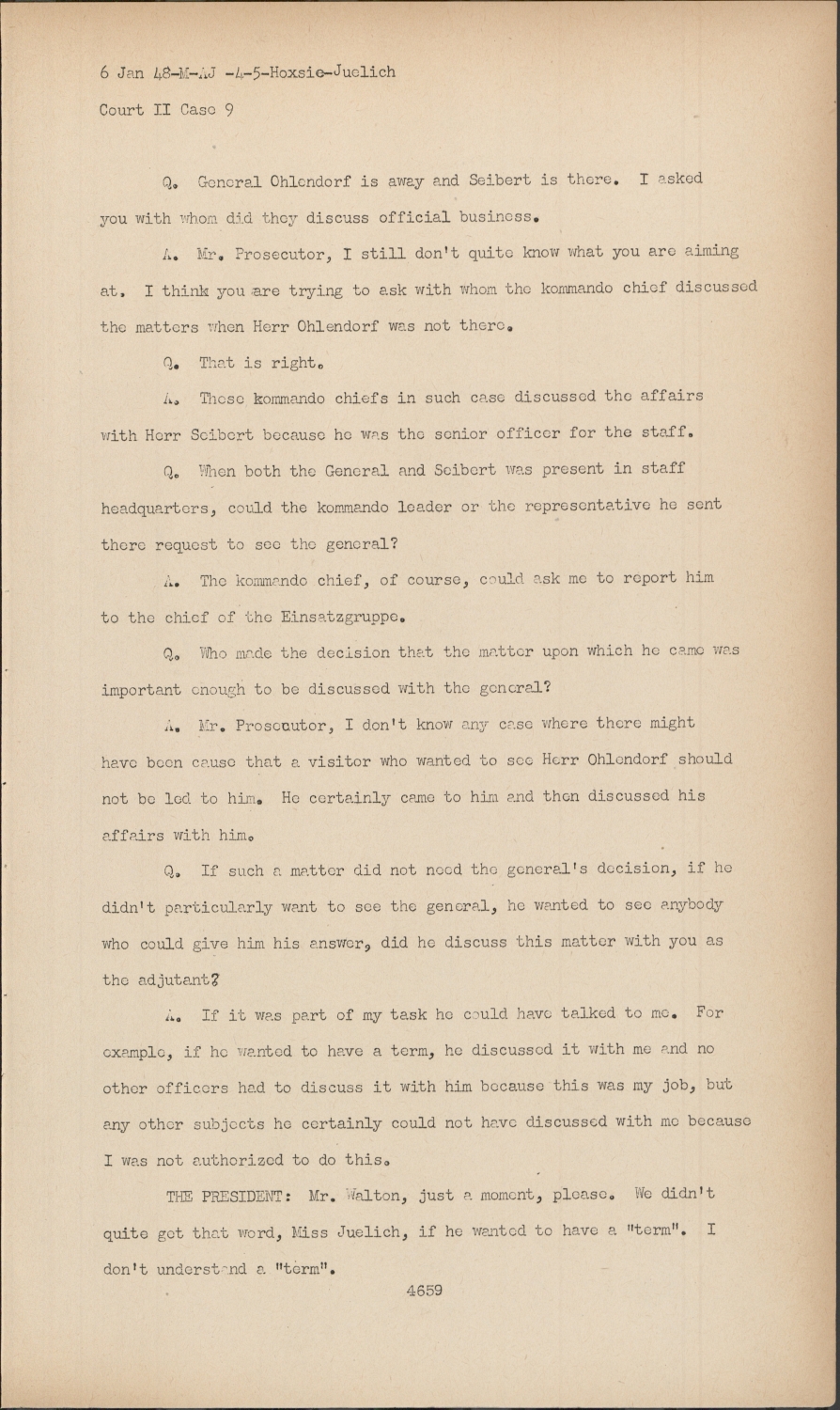
Q.General Ohlendorf is away and Seibert is there. I asked you with whom did they discuss official business.
A.Mr. Prosecutor, I still don't quite know what you are aiming at.
I think you are trying to ask with whom the kommando chief discussed the matters when Herr Ohlendorf was not there.
Q.That is right.
A.These kommando chiefs in such case discussed the affairs with Herr Seibert because he was the senior officer for the staff.
Q.When both the General and Seibert was present in staff headquarters, could the kommando leader or the representative he sent there request to see the general?
A.The kommando chief, of course, could ask me to report him to the chief of the Einsatzgruppe.
Q.Who made the decision that the matter upon which he came was important enough to be discussed with the general?
A.Mr. Prosecutor, I don't know any case where there might have been cause that a visitor who wanted to see Herr Ohlendorf should not be led to him.
He certainly came to him and then discussed his affairs with him.
Q.If such a matter did not need the general's decision, if he didn't particularly want to see the general, he wanted to see anybody who could give him his answer, did he discuss this matter with you as the adjutant?
A.If it was part of my task he could have talked to me. For example, if he wanted to have a term, he discussed it with me and no other officers had to discuss it with him because this was my job, but any other subjects he certainly could not have discussed with me because I was not authorized to do this.
THE PRESIDENT:Mr. Walton, just a moment, please. We didn't quite get that word, Miss Juelich, if he wanted to have a "term". I don't understand a "term".
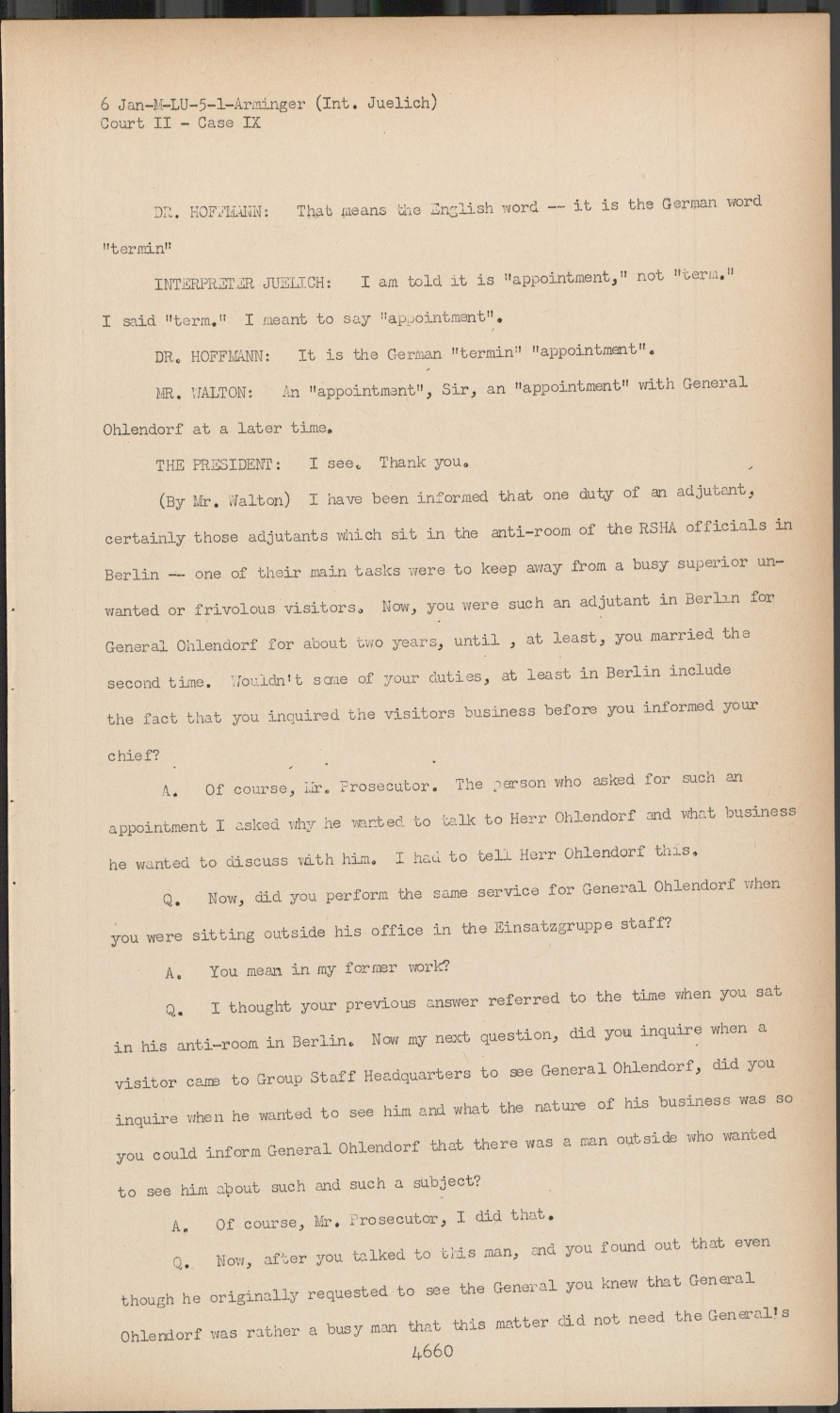
DR. HOFFMANN:That means the English word -- it is the German word "termin"
INTERPRETER JUELICH:I am told it is "appointment, " not "term."
I said "term." I meant to say "appointment".
DR. HOFFMANN:It is the German "termin" "appointment".
MR. WALTON:An "appointment", Sir, an "appointment" with General Ohlendorf at a later time.
THE PRESIDENT:I see. Thank you.
(By Mr. Walton) I have been informed that one duty of an adjutant, certainly those adjutants which sit in the anti-room of the RSHA officials in Berlin -- one of their main tasks were to keep away from a busy superior un wanted or frivolous visitors.
Now, you were such an adjutant in Berlin for General Ohlendorf for about two years, until, at least, you married the second time.
Wouldn't some of your duties, at least in Berlin include the fact that you inquired the visitors business before you informed your chief?
A.Of course, Mr. Prosecutor. The person who asked for such an appointment I asked why he wanted to talk to Herr Ohlendorf and what business he wanted to discuss with him.
I had to tell Herr Ohlendorf this.
Q.Now, did you perform the same service for General Ohlendorf when you were sitting outside his office in the Einsatzgruppe staff?
A.You mean in my former work?
Q.I thought your previous answer referred to the time when you sat in his anti-room in Berlin.
Now my next question, did you inquire when a visitor came to Group Staff Headquarters to see General Ohlendorf, did you inquire when he wanted to see him and what the nature of his business was so you could inform General Ohlendorf that there was a man outside who wanted to see him about such and such a subject?
A.Of course, Mr. Prosecutor, I did that.
Q.Now, after you talked to this man, and you found out that even though he originally requested to see the General you knew that General Ohlendorf was rather a busy man that this matter did not need the General's decision, to whom would this visitor be referred by you?
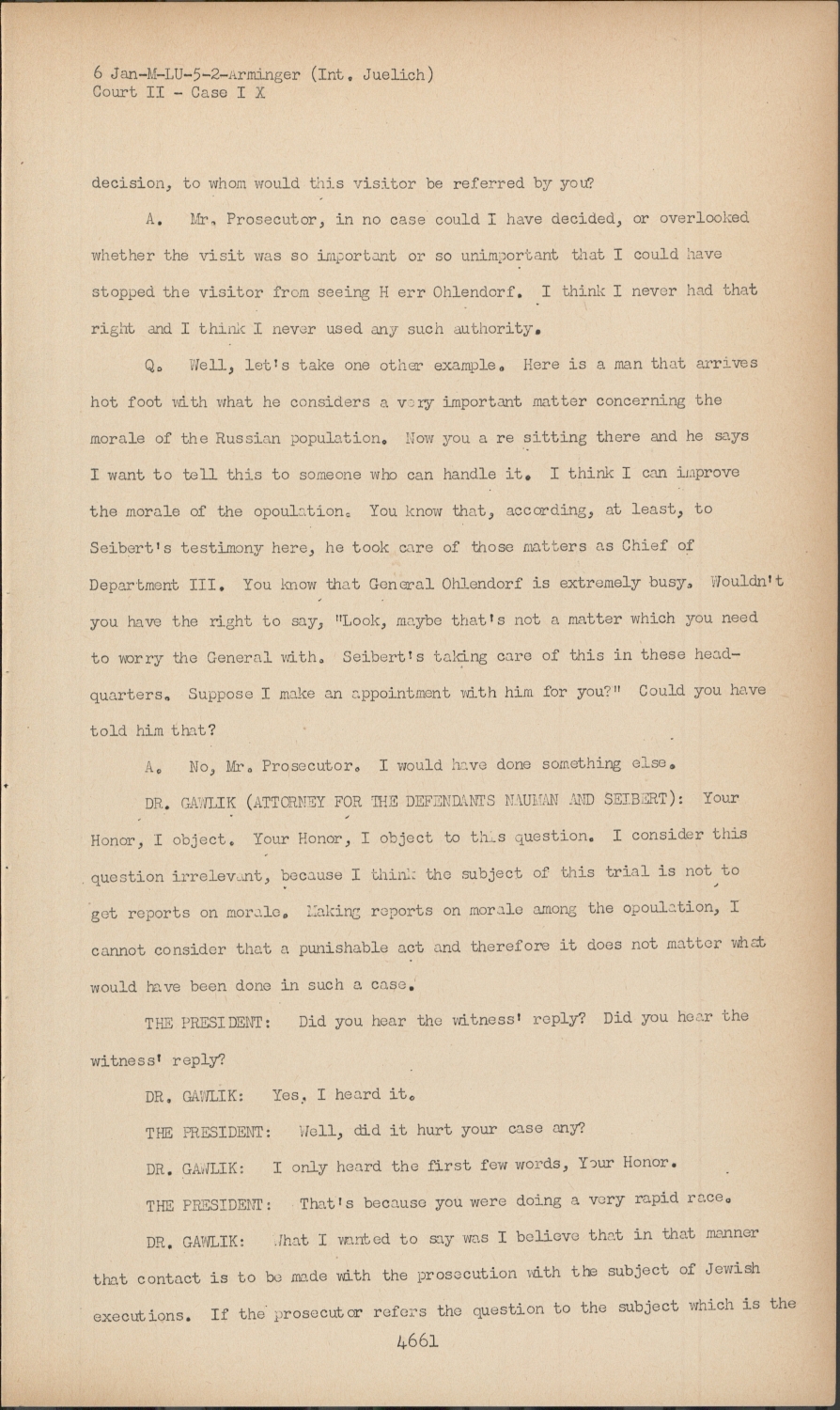
A.Mr. Prosecutor, in no case could I have decided, or overlooked whether the visit was so important or so unimportant that I could have stopped the visitor from seeing H err Ohlendorf. I think I never had that right and I think I never used any such authority.
Q.Well, let's take one other example. Here is a man that arrives hot foot with what he considers a very important matter concerning the morale of the Russian population. Now you a re sitting there and he says I want to tell this to someone who can handle it. I think I can improve the morale of the opoulation. You know that, according, at least, to Seibert's testimony here, he took care of those matters as Chief of Department III. You know that General Ohlendorf is extremely busy, Wouldn't you have the right to say, "Look, maybe that's not a matter which you need to worry the General with. Seibert's taking care of this in these headquarters. Suppose I make an appointment with him for you?' Could you have told him that?
A.No, Mr. Prosecutor. I would have done something else.
DR.GAWLIK (ATTORNEY FOR THE DEFENDANTS NAUMAN AND SEIBERT): Your Honor, I object, Your Honor, I object to this question. I consider this question irrelevant, because I think the subject of this trial is not to get reports on morale. Making reports on morale among the opoulation, I cannot consider that a punishable act and therefore it does not matter what would have been done in such a case.
THE PRESIDENT:Did you hear the witness* reply? Did you hear the witness' reply?
DR. GAWLIK:Yes, I heard it.
THE PRESIDENT:Well, did it hurt your case any?
DR. GAWLIK:I only heard the first few words, Your Honor.
THE PRESIDENT:That's because you were doing a very rapid race.
DR. GAWLIK:What I wanted to say was I believe that in that manner that contact is to be made with the prosecution with the subject of Jewish executions. If the prosecutor refers the question to the subject which is the subject of this trial, then I have no objections, but I do not see why investigations about the morale of the Russian population has anything to do with this at all.