THE MARSHAL:The Tribunal is again in session.
DIRECT EXAMINATION Continued BY DR. BELZER (ATTORNEY FOR MATHIAS GRAF):
QWitness, you were chief of Office III in the RSHA?
AYes.
QReferring to your position, I would like to ask you a few questions: Do you know that during the war emergency duties had to he carried out by the SD?
AYes.
QDid a person on emergency service have the opportunity to object to this duty or to reject it?
ANo.
QIn order to do emergency service for the SD, did the person who did the emergency duty have to be a member of the SS or a member of the Party?
ANo.
QWho assigned the people for emergency duty in the SD?
AThe emergency duty for the regional agencies was carried out by the regional agencies themselves.
QWas the emergency service an assistance service and did the person carrying out such emergency service become a member of the SD?
ANo. the SD he became active on behalf of his emergency duty.
QCould a person on emergency duty reject being drafted to Dueben or Schmiedeberg?
ANo, by being detailed to the Office of the Chief of the Security Police and SD he came under his jurisdiction.
QWhen in May 1941 the commands were put together in Schmiedeberg, was there a mass meeting held by Heydrich or Streckenbach?
AHeydrich carried out a role call and not Streckenbach.
QDuring this roll call, were they the tasks of the Einsatzkommando advertised?
ANot concerning the order of executions.
QDuring the discussions on the Fuehrer Order and other orders concerning the assignment for these Eastern areas apart form the Einsatzgruppen leaders and the Einsatzkommando leaders, were there subordinate leaders present also?
ANo.
DR. BELZER:I have no further questions, Your Honor.
DIRECT EXAMINATION --CONTINUED BY DR. SURHOLT (ATTORNEY for the Defendant Rasch):
QWitness, do you know, or, can you confirm that Rasch was only a member of Office I?
ANo, I do not know that and I cannot confirm that.
QRasch came from the. Ministry of the I terior to the SD, did he not? Until then he had not joined any part of the SS. He became Untersturmfuehrer automatically when joining the SS. Did this make him a member of the Waffen SS or the General SS?
ACertainly not the Waffen SS. There was no General Waffen SS.
QIn 1941, Rasch be came inspector of the Security Police and the SD in Koenigsberg. The Prosecution has submitted a document in Volume III_C, Exhibit No. 131, German page 13, Document No. 3253. There it says -
THE PRESIDENT:You are reading too rapidly.
Q "Since the Fuehrer has appointed you Brigadier General of the Police with the document handed to you on 19 Feburary 1940. I herewith assign you as from 1 December 1940 to a position provided in the budget of Brigadiers General of the Policepay group PA allocated to the State Police Headquarters at Koenigsberg." Witness, can you tell me whether the meaning of this document is of importance; with regard to budget purposes, so that a position was assigned to him where he could be paged by the fiscus, or does it also result in his being drafted into the State Police in Koenisberg?
AThis document only reveals that a position provided for in the budget was transferred to him.
This has nothing to do with the function as such.
QCould Himmler stand contradiction?
AHardly.
QIf anyone had been an Brigadefuehrer since 1940 and had not been promoted, could that be considered as normal?
AI cannot answer that question, because it might be normal, as well as abnormal?
QIs that a sign of disapproval?
AI couldn't say that.
QWere not the SS leaders advanced automatically within fixed intervals and according to a certain schedule?
AOne cannot say that either.
DR. SURHOLT:Thank you.
DIRECT EXAMINATION--CONTINUED BY DR. FICHT (Attorney for Defendant Biberstein):
QWitness, during the direct examination you said to your defense counsel-when discussing documents and it was mentioned whether the number of 90,000 killed were correct or not, you explained the following: "After a certain period, activity of the Einsatzgruppe in the Fast no longer to k place. In connection with this, I would like to ask you what period did you mean by this?
AI then meant the time of the withdrawal, when the armies flowed back to the area of civil administration.
QWitness, have you ever with your Einsatzgruppen been at Rostov or surroundings, even if only temporarily?
AAs far as I remember, parts of Einsatzkommando 10 temporarily were in Rostov for a short time.
QWhen was that, approximately?
AI cannot tell you that.
Q 1941 or 1942. Can you express yourself to that effect?
AI cannot remember when Rostov was occupied for the first time.
QIf I tell you that the German troops in 1941 had already been in Rostov and then had to clear out and only in 1942 occupied Rostov again, can you then answe this question whether special atrocities had been committed there?
AI am sorry to say, I cannot give you any information on that.
QI have no further questions, your Honor. BY DR. MAYER (for the defendant Braune):
QI just want to ask one more question. BY MR. WALTON:
May it please the court I don't quite see the materiality of this in that Dr. Mayer has been given the opportunity already to cross-examine the witness.
THE INTERPRETOR:I'm sorry, channel 3 is not working.
THE PRESIDENT:Let us first see what Dr. Mayer intends to present. He may be merely asking for the correct time. We don't know.
MR. WALTON:That's true; I only wanted him to confine himself to something that had taken place before. I am objecting to anything that has already been discussed.
THE PRESIDENT:Your objection is well taken. Let us see what he is going to ask. The sound system seems to be functioning now, Dr. Mayer.
DR. MAYER:I only wanted to address one question to complete my former question. The question itself refers to a document submitted by the Prosecution.
THE PRESIDENT:Was that within your knowledge when you questioned the Defendant Ohlendorf before?
DR. MAYER:Yes, I knew the document.
THE PRESIDENT:Why was it you did not put this query at that time?
DR. MAYER:I simply did not address the question because I had forgotten it during the examination.
THE PRESIDENT:That seems to be the privilege of an attorney, to forget a question, so we will allow it. BY DR. MAYER: Thatk you very much.
QIt refers to Document NOKW 584, Exhibit No. 165 in the German volume III D, pages 104 and 105. This document itself deals with retaliation measures against partisans in Eupatoria and I ask the witness to inform himself of the text on which the action was based and to state his opinion on it and also what orders he gave to Braune at the time.
AMay I have the document, please.
THE PRESIDENT:What was that document again, Dr. Mayer?
DR. MAYER:Exhibit 165, in the German Document Book III D, pages 104 and 105.
THE PRESIDENT:What is the document number itself?
DR. MAYER:The document is NOKW 584.
AI exactly remember this occurrence. The ICAO of the Army and Major Riesen came to me on behalf of the truz in order to obtain an order that my Einsatz Commando carried out a retaliation measure in Eupadoria. It was a retaliation measure for occurrences which have been descried previously by me when the Russians had cut the throats of wounded soldiers. I rejected the carrying out of this retaliation measure because I did not consider it to be my task to carry out retaliation measures of this kind for the Army. Major Riesen asked me for persons who could be put at his disposal in Eupadoria. I said I was prepared to do this because the retaliation measure itself as described to me by Major Riesen I did not approve of. The Commander in Chief had ordered that the entire population capable of war service in Eupatoria be shot. Owing to our stay in Eupatoria it was known that among this population there was a great number of persons who were not suspected of being partisans or who could be considered to endanger our security. For that reason I sent Braune along in order to select from the male population those persons who could not he considered dangerous but could assist Major Riesen with advice.
Braune returned from Eupatoria disgusted. The Army had not prepared the execution properly and therefore very unpleasant occurences had taken place and Braune had to take a hand in order to re-establish order to avoid even greater unpleasantness.
QI have another little question. What connection did Braune have with Riesen?
AHe was given to Riesen as assistant Riesen in this case held a kind of a superior position.
QDid Dr. Braune also approach him about the views of the Commandant Mueller.
ACommandant Mueller had received Major Riesen Souchon ironically because rightly he considered him a white collar officer rather than an officer who would fight at the front and he received him with the words that for this action he did not require an order from the Commander in Chief. This statement may he explained by the fact that already at the beginning of the war through Keitel orders had been given to Army sections which in this case gave the officers the opportunity ever without the orders from the Supreme Commander to carry out such actions.
QI have no further questions. BY DR. ASCHENAUER:
Herr President, I retained a few questions because of the difficulties in the record. May I put them prior to the cross examination?
QIn the Prosecution's evidence on page 330, which is the memorandum of 30 September, it says: Krimschacken are people of Jewish descent, who were living in this area for several hundred years, however, the Einsatzgruppe considered them undesirable. In this connection may I address two Questions. Did the Einsatzgruppe classify the Krimschacken - May I assist your memory with an excerpt of a document which Was not submitted here, Exhibit 325 presumably from the SS trials and may I ask what the decision obtained from Berlin?
A.The Prosecution themselve did explain that the classification of the Krimschacken was not necessary because the prosecution themselves described them as of Jewish origin. Therefore, the Fuehrer order concerned them. Thus, the Einsatzgruppe was not content with this result because at the Crimea, apart from the Crimean Karaims problem the question of the Karaims also existed. It consisted of the following: The Krimschacken are of Jewish origin but have given up their Jewish creed and spoke Turkish. The Karaimen, mostly, are not of Jewish origin but had the Jewish confession. The Einsatzgruppe twice to keep both groups out of the liquidations. The order of the 5th of December 1941 shows this. The following facts were written down here. The Karaims, according to their own statement, have nothing in common with the Jews except their confession. They are supposed to originate iron the moguls who formerly lived in the area of the Black Sea. During the czaristic days, in contrast to the Jews, they had all Civil rights and they are still proud of this, even now. The Krimschacken according to statements by the Jews are supposed to be Jews who left Italy about 400 years ago and came to the Crimea and spoke the Tatarian language. The Krimschacken themselves maintain to be a branch of the Tatarian people. One may presume that both sides are right and that there are immigrants from Italy Who, in the course of the centuries mixed with the Tatars, accepted their language and their customs but retained then confession. When the Einsatzgruppe enquired from Berlin it was decided that the Krimschacken are to as treated as Jews
Q.This finishes the direct examination as far as I am concerned.
THE PRESIDENTDefendant Ohlendorf is now available to the Prosecution for cross-examination on the entire defendant's case.
MR. HEALTH:May I state my name for the record. James E. Heath for the Prosecution.
INTERPRETOR:I'm sorry, your Honor, the German channel is out again.
THE PRESIDENT:You may proceed Mr. heath, I think it is all right now. BY MR. HEALTH: Thank you Sir.
Q.Mr. Ohlendorf, We can begin for this moment exactly where you left off. You spoke of the Krimschacken decision in Berlin, the decision that because those people were of the same blood--------
INTERPRETOR:I'm sorry, the German channel is off again. BY MR. HEALTH
Q.Mr. Ohlendorf, you spoke of two classes of people, the Krimschacken and the Karaimen------
MR. HEALTH:I think it is kaputt again your Honor.
THE PRESIDENT:Mr. Heath, it seems that a few minutes will elapse before channel 3 may be reactivitated so we will take advantage of the noon recess and then you can begin afresh immediately after the noon recess. The court will be in recess until 130.
(A recess was taken until 1330 hours)
AFTERNOON SESSION
THE MARSHAL:The Tribunal is again in session.
MR HEATH:May I proceed, Your Honor?
THE PRESIDENT:Proceed, Mr. Heath.
OTTO OHLENDORF - Resumed CROSS EXAMINATION - Continued BY MR. HEATH:
QMr. Ohlendorf, to speed this examination I'd like to attempt to agree with you upon one or two points. First, we shall not quarrel about numbers, You have indicated that Einsatzgruppe D under your command slaughtered something less than 90,000 human beings. I understood you to suggest to the Court that this figure is exaggerated although it appears in an affidavit which you have given. I ask you now to give the Court the best estimate you possibly can of the minimum number of human beings who were killed under your command by Einsatzgruppe D.
AIn my direct examination I have already said that I cannot give any definite figure, and that even the testimony in my affidavit shows that in reality I could not name any figure. Therefore, I have named a figure which has been reported "approximately". The knowledge which I have gained by this day through the documents and which I have gained through conversations with my men, make me reserve the right to name any figure and strengthen this reservation. Therefore, I am not in a position to give you a minimum figure, either. In my direct examination I have said that the numbers which appear in the documents are at least exaggerated by one half, but I must repeat that I never knew any definite figure and therefore cannot give you any such figure.
QYou can not give us a minimum figure?
AIf the Prosecution wishes I am, of course, prepared to give my reasons why I cannot give any figure.
QWell, let me ask you -- perhaps I can help you ... In any event, I can indicate to the Court one reason why you might have doubt about the numbers.
In 1943 the Reichsfuehrer SS Himmler addressed the SS Major Generals at Posen. You are aware of that speech, are you not?
AYes, I have heard it myself,
QPerhaps you recall his complaint, and I will read it to you: "I come now to a fourth virtue, which is very rare in Germany - to truthfulness. One of the greatest evils which has spread during the war is the lack of truthfulness in messages, reports, and statements, which subordinate departments in civil life in the State, the Party and the Services sent in to the departments over them," Of course, that was in 1943.
Did you exaggerate the reports which you sent to the RSHA?
AI certainly did not, but I had to rely on those things which were reported to me, and I know that double countings could not be avoided, and I also knew that wrong numbers were reported to mo, I have avoided to pass on such double countings or wrong statements because the neighboring units did not know their figures and, nevertheless the reporting of wrong figures was not prevented - and especially the reporting of strange figures - figures of other units were not prevented. The the report from Chernovitz is certainly the reporting of such strange figures, namely, the reporting of such actions which were done by the Roumanians in Chernovitz.
QWill you tell the Court what bookkeeping and record making system was maintained in Einsatzgruppe D to keep track of the people slaughtered?
AIn Einsatzgruppe D there were the various reports which were sent from the Commandos to the Einsatzgruppe, and these reports were gone over and the figures contained in them were sent to the RSHA.
QWell, it is quite obvious that that is what happened. But tell us now who reported for Einsatzkommando 12, say, during the first six months of its operations the killings by Einsatzkommando 12, to you?
AEinsatzkommando 12 itself.
QAnd who was the man who reported to you?
AThey were usually signed by the Einsatzkommandoleader himself, in this case by the then Sturmbannfuehrer Nosske.
QVery well, you relied on Nosske for truthful reporting of the numbers killed by his unit?
AI had no possibility to examine these executions for Nosske, for example, was 200 or 250 kilometers away from me.
QWitness, I don't mean to cut you off, but I think if I ask you now to attempt to make your answers as responsive as possible, I shall attempt to make my questions as explicit as possible - and I believe we both shall benefit. So - I ask you again - now why you did not check up on Nosske, but simply the question ... Did you rely on Nosske for truthful reports of the slaughters committed by Einsatzkommando 12?
AI didn't understand the last part of the question. Only the last part of the translation.
QWell, I repeat -
THE PRESIDENT:Please repeat the question, Mr. Heath, BY MR. HEATH:
QDid you rely on Nosske for truthful reports of the numbers of persons slaughtered by Einsatzkommando 12 while it was under his command?
AI was of the opinion that these reports were truthful. In the case of Nosske however, in one case it was brought to my attention that the report was not truthful. But that was relatively at an early stage in Nikolajev.
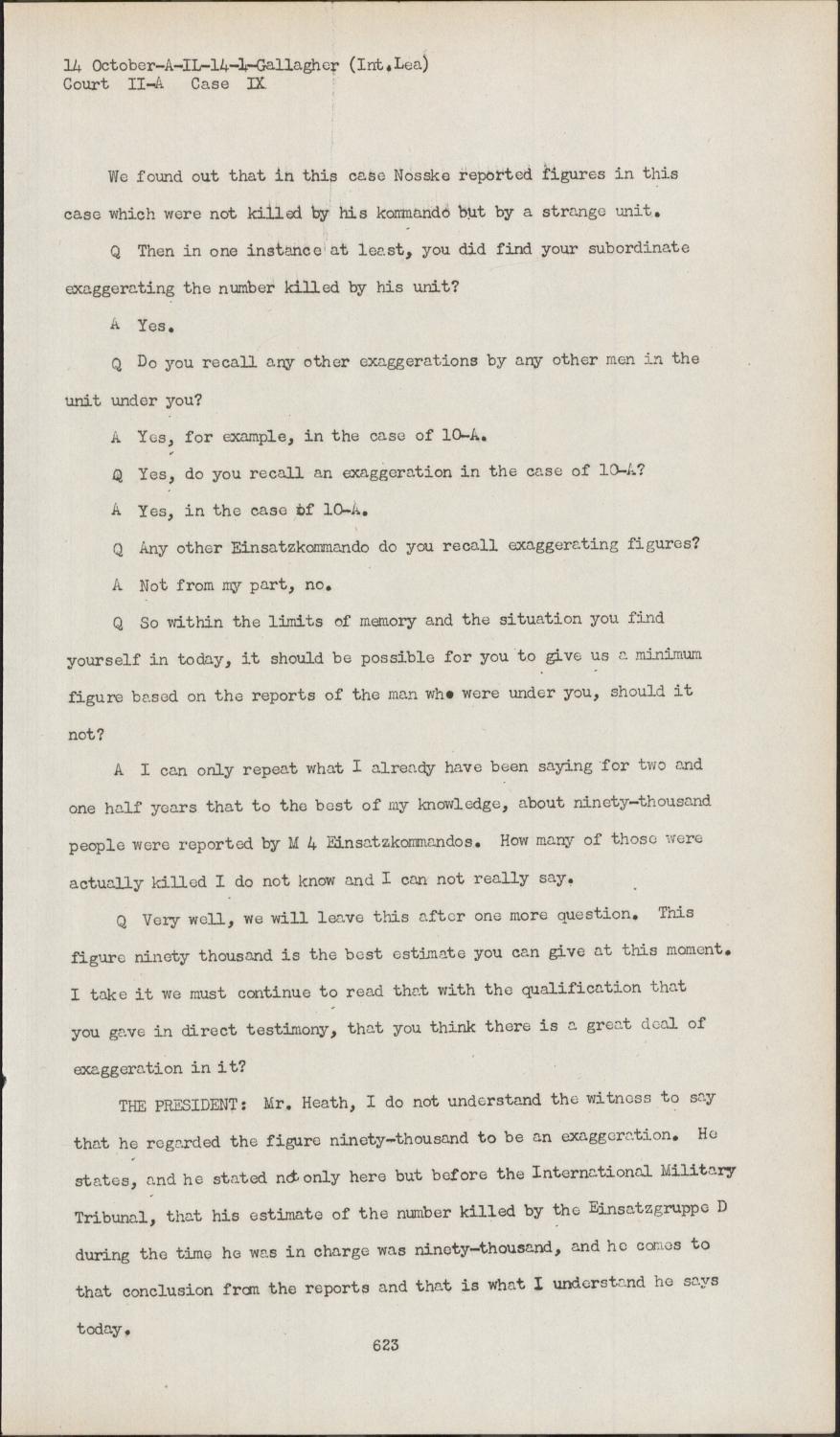
We found out that in this case Nosske reported figures in this case which were not killed by his kommando but by a strange unit.
QThen in one instance at least, you did find your subordinate exaggerating the number killed by his unit?
AYes.
QDo you recall any other exaggerations by any other men in the unit under you?
AYes, for example, in the case of 10-A.
QYes, do you recall an exaggeration in the case of 10-A?
AYes, in the case of 10-A.
QAny other Einsatzkommando do you recall exaggerating figures?
ANot from my part, no.
QSo within the limits of memory and the situation you find yourself in today, it should be possible for you to give us a minimum figure based on the reports of the man who were under you, should it not?
AI can only repeat what I already have been saying for two and one half years that to the best of my knowledge, about ninety-thousand people were reported by M 4 Einsatzkommandos. How many of those were actually killed I do not know and I can not really say.
QVery well, we will leave this after one more question. This figure ninety thousand is the best estimate you can give at this moment. I take it we must continue to read that with the qualification that you gave in direct testimony, that you think there is a great deal of exaggeration in it?
THE PRESIDENT:Mr. Heath, I do not understand the witness to say that he regarded the figure ninety-thousand to be an exaggeration. He states, and he stated not only here but before the International Military Tribunal, that his estimate of the number killed by the Einsatzgruppe D during the time he was in charge was ninety-thousand, and he comes to that conclusion from the reports and that is what I understand he says today.
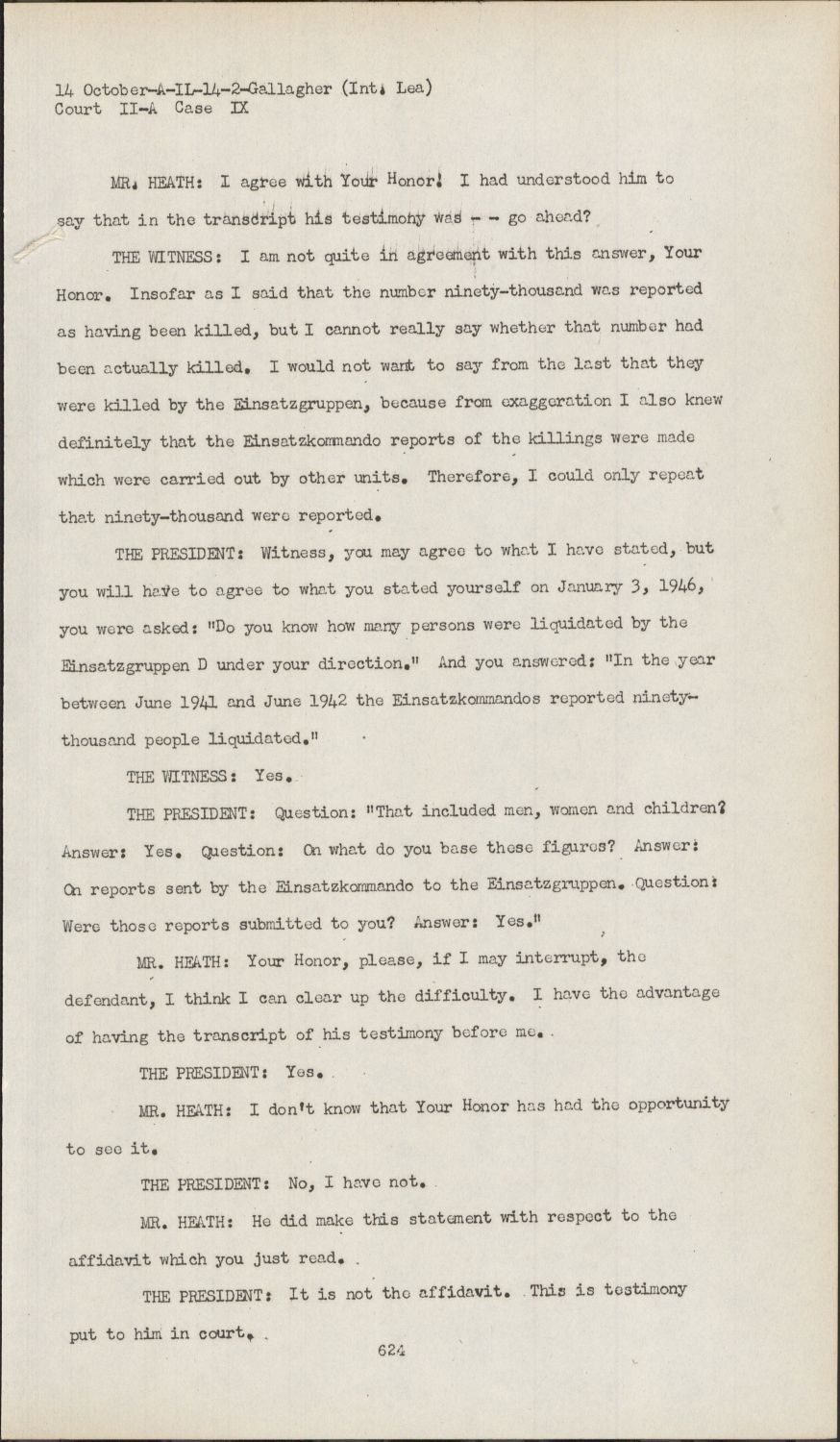
MR. HEATH:I agree with Your Honor: I had understood him to say that in the transcript his testimony was - - go ahead?
THE WITNESS:I am not quite in agreement with this answer, Your Honor. Insofar as I said that the number ninety-thousand was reported as having been killed, but I cannot really say whether that number had been actually killed, I would not want to say from the last that they were killed by the Einsatzgruppen, because from exaggeration I also knew definitely that the Einsatzkommando reports of the killings were made which were carried out by other units. Therefore, I could only repeat that ninety-thousand were reported.
THE PRESIDENT:Witness, you may agree to what I have stated, but you will have to agree to what you stated yourself on January 3, 1946, you were asked: "Do you know how many persons were liquidated by the Einsatzgruppen D under your direction." And you answered: "In the year between June 1941 and June 1942 the Einsatzkommandos reported ninetythousand people liquidated,"
THE WITNESS:Yes.
THE PRESIDENT:Question: "That included men, women and children? Answer: Yes, Question: On what do you base these figures? Answer: On reports sent by the Einsatzkommando to the Einsatzgruppen. Question: Were those reports submitted to you? Answer: Yes."
MR. HEATH:Your Honor, please, if I may interrupt, the defendant, I think I can clear up the difficulty. I have the advantage of having the transcript of his testimony before me.
THE PRESIDENT:Yes.
MR. HEATH:I don't know that Your Honor has had the opportunity to sec it.
THE PRESIDENT:No, I have not.
MR. HEATH:He did make this statement with respect to the affidavit which you just read.
THE PRESIDENT:It is not the affidavit. This is testimony put to him in court.
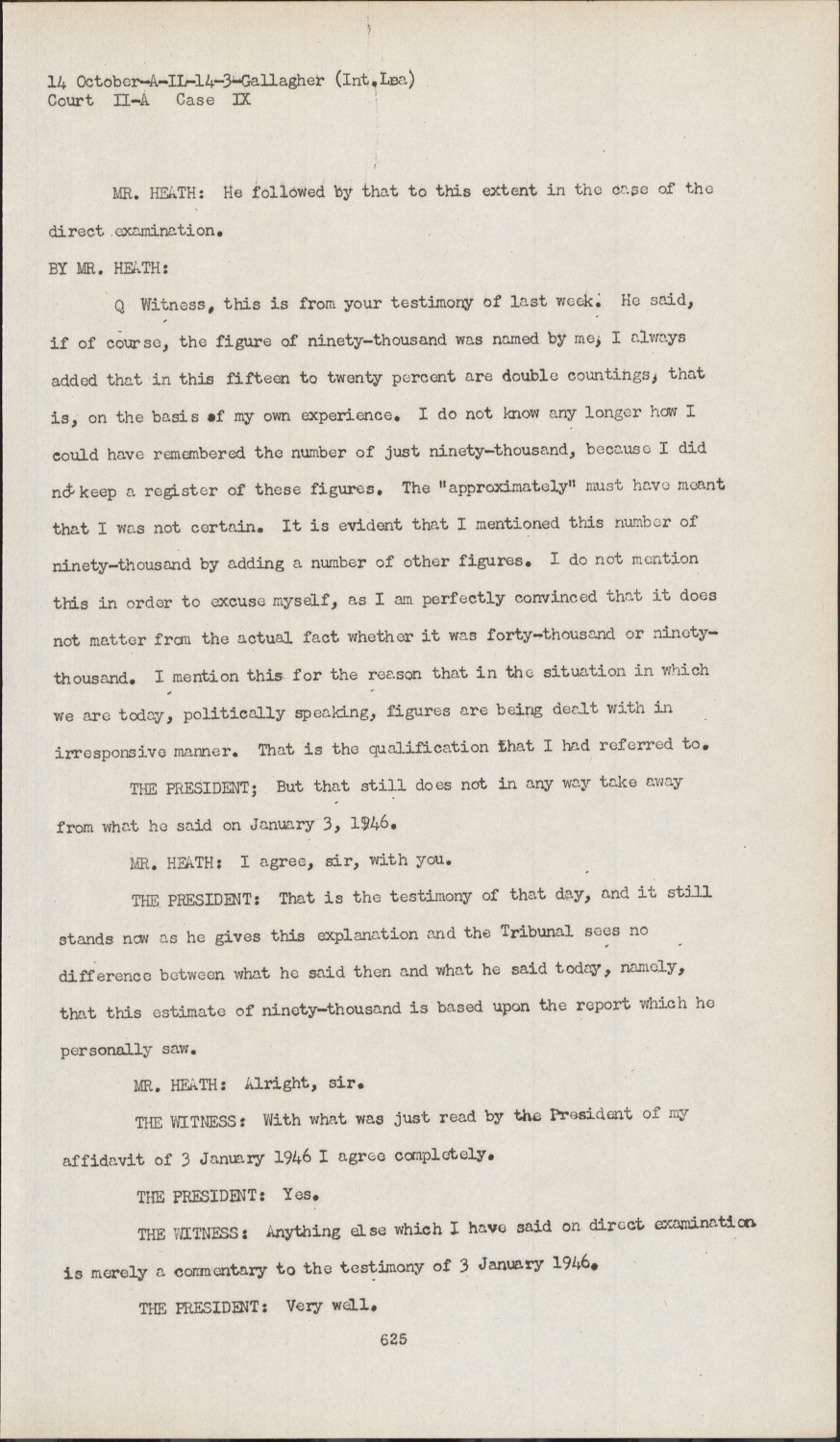
MR. HEATH:He followed by that to this extent in the case of the direct examination. BY MR. HEATH:
QWitness, this is from your testimony of last week. He said, if of course, the figure of ninety-thousand was named by me, I always added that in this fifteen to twenty percent are double countings, that is, on the basis of my own experience. I do not know any longer how I could have remembered the number of just ninety-thousand, because I did not keep a register of these figures. The "approximately" must have meant that I was not certain. It is evident that I mentioned this number of ninety-thousand by adding a number of other figures. I do not mention this in order to excuse myself, as I am perfectly convinced that it does not matter from the actual fact whether it was forty-thousand or ninetythousand. I mention this for the reason that in the situation in which we are today, politically speaking, figures are being dealt with in irresponsive manner. That is the qualification that I had referred to.
THE PRESIDENT:But that still does not in any way take away from what he said on January 3, 1946.
MR. HEATH:I agree, sir, with you.
THE PRESIDENT:That is the testimony of that day, and it still stands now as he gives this explanation and the Tribunal sees no difference between what he said then and what he said today, namely, that this estimate of ninety-thousand is based upon the report which he personally saw.
MR. HEATH:Alright, sir.
THE WITNESS:With what was just read by the President of my affidavit of 3 January 1946 I agree completely.
THE PRESIDENT:Yes.
THE WITNESS:Anything else which I have said on direct examination is merely a commentary to the testimony of 3 January 1946.
THE PRESIDENT:Very well.
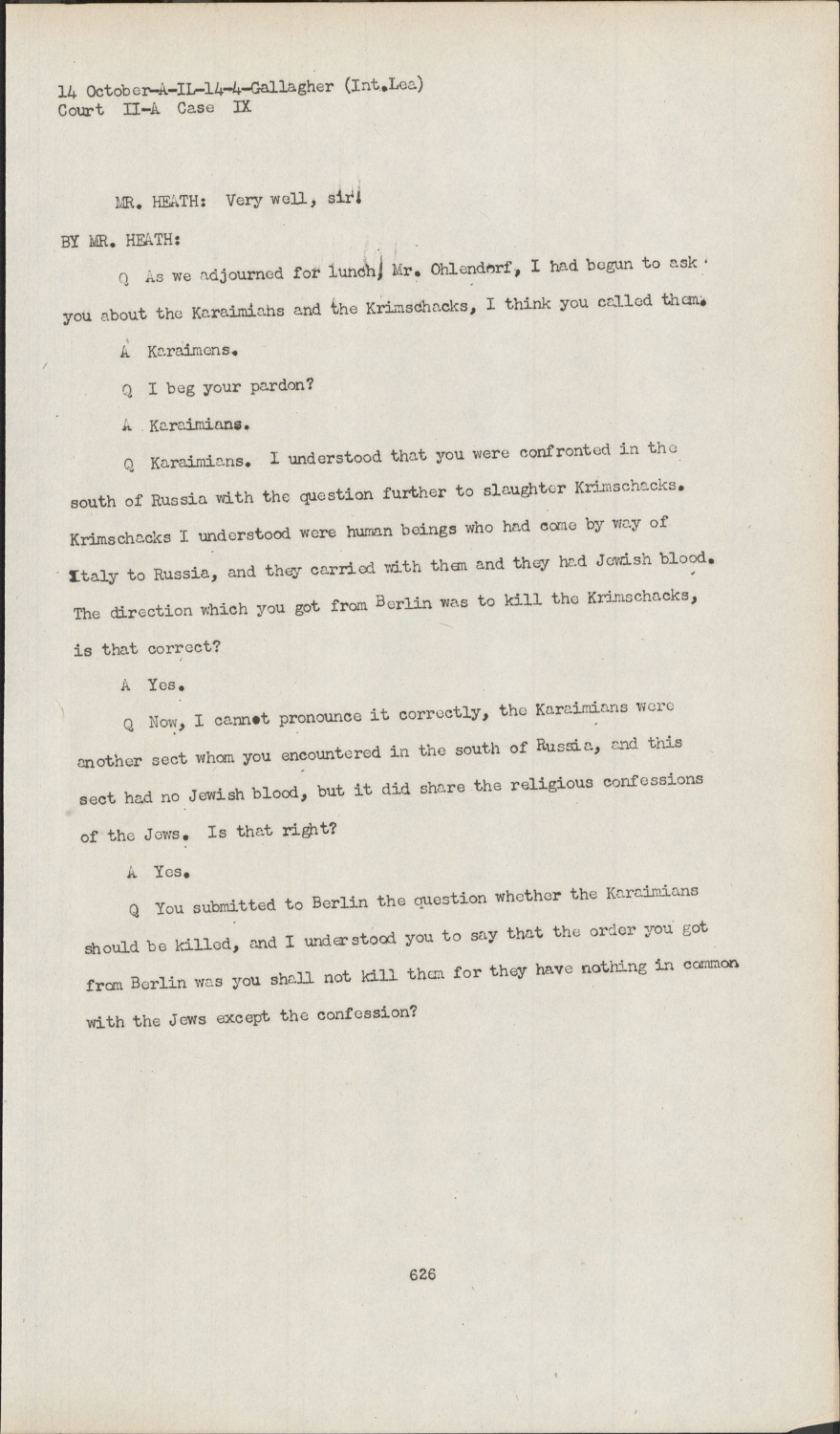
MR. HEATH:Very wall, sir; BY MR. HEATH:
QAs we adjourned for lunch, Mr. Ohlendorf, I had begun to ask you about the Karaimians and the Krimschacks, I think you called them.
AKaraimens.
QI beg your pardon?
AKaraimians.
QKaraimians. I understood that you were confronted in the south of Russia with the question further to slaughter Krimschacks. Krimschacks I understood were human beings who had come by way of Italy to Russia, and they carried with them and they had Jewish blood. The direction which you got from Berlin was to kill the Krimschacks, is that correct?
AYes.
QHow, I cannot pronounce it correctly, the Karaimians were another sect whom you encountered in the south of Russia, and this sect had no Jewish blood, but it did share the religious confessions of the Jews. Is that right?
AYes.
QYou submitted to Berlin the question whether the Karaimians should be killed, and I understood you to say that the order you got from Berlin was you shall not kill them for they have nothing in common with the Jews except the confession?
AYes.
QNow during your direct examination you told this court that you had no idea, and that you have no cause today to think that there was any plan to exterminate the Jewish race in existence, nor that you had any information of putting it into effect. Is that right?
AYes.
QWill you explain to the court, please, what difference there was between the Karaimians and the Krimschecks, except Jewish blood?
AI understand your question completely. In reference to the Eastern Jews, in the case of the Jews who were found in the Eastern Campaign it was the order that these Jews are to be killed for the reason that they were considered carriers of Bolshevism, and, therefore, considered as endangering the security of the German Reich, This concerned the Jews who were found in Russia, and it was not known to me that the Jews in all of Europe were being killed, but on the contrary I knew that down to my dismissal these Jews ware not killed, but it was attempted by all means to get them to emigrate. The fact that the KarKaraimians were not killed showed that the charge of the Prosecution that persons were persecuted for their religion is not correct, for the Karaimians had that Jewish religion, but they could not be killed because they did not belong to the Jews in Russia, and because they did not belong to the Jewish Race.
QI think, witness, you answered exactly what I had anticipated in the last sentence, "They did not belong to the Jewish Race," is that right?
AYes, that is right.
QThey were found in Russia?
AYes.
QBut they participated in the Jewish Confession in Russia?
AThe Karaimians had the Jewish Faith, yes.
QBut your Race Authorities in Berlin could find no trace of Jewish blood in them?
AYes.
QSo they came absolutely under the Fuehrer Decree; or the Streckenbach Order to kill all Jews?
AYes.
QExcept for blood?
ABecause they were of Jewish origin. For you must understand the Nazi Ideology as you call it. It was the opinion of the Fuehrer that in Russia and in Bolshevism, the representatives of this blood showed themselves especially suitable for this idea, therefore, the carriers of this blood became especially suitable representatives of the Bolshevism. That is not on account of their faith, or their religion, but because of their human make-up and character.
QAnd because of their blood, right?
AI can not express it any more definitely than I stated, from their nature and their characteristics. Their blood, of course, has something to di with it.
QLet's see, if I can understand it; we got a lot of time, I hope. What was the distinction except blood?
ABetween whom?
QBetween the Karaimians and the Krimschecks?
AThe difference of the blood, yes.
QOnly the difference in blood, is that so?
AYes.
QSo the criterion and the test which you applied in your slaughter was blood?
AThe criteria which I used were the orders which I got, and it has not been doubted during the entire trial, that in this Fuehrer Order the Jews were designated as the ones who belonged to that circle in Russia and who were to be killed.
QVery well, witness, let's not quibble. Let's come back again. What you followed was the Fuehrer order, Now I leave you out of it for a moment, your own idea of what should be killed and what should not be killed.
THE PRESIDENT:I disagree with you, Mr. Heath, that the witness has quibbled. I think he has stated very clearly that his orders were to kill all Jews, that was the criterion which he followed. If he was a Jew he was killed, if he was not a Jew then they might figure some other reason to kill him but he wouldn't be killed because he was a Jew.
MR HEATH:Yes, Your Honor, I am attempting to get him to say the word blood and not the word Jews. That is the reason I was saying he is quibbling, but I am perfectly happy to leave it where it is.
THE PRESIDENT:I think he has been rather forthright.
MR. HEATH:Very well. BY MR HEATH:
QLet's see, Mr. Ohlendorf, let's go for a moment to this order which you got at Pretsch in the Spring of 1941. Did you have any knowledge whatever of the purposes of the Einsatzgruppen before you went to Pretsch?
AWe merely knew that the Einsatzgruppen were to be set up.
QBut you did not know what they were to do?
ANo, apart from the fact that one has a definite idea about missions in which people of the Security Police and the SD were working that is, of course, true.
QDid you at that time have any idea that the mission of the Security Police would be to slaughter Jews and Gypsies?
AI could no longer say today that I had such an idea, but I don't believe so. In my opinion the order about the killing of the Jews was known to me for the first time in Pretsch, that is, for the Russian campaign.
QIf you had known that that was going to be the prupose of the Einsatzgruppen to kill all Jews and Gypsies and certain other categories, you would remember it today -- would you not, Mr. Ohlendorf?

AI can no longer say.
QYou were three times ordered to join the Einsatzgruppen, were you not?
AYes.
QAnd. twice you refused?
AYes.
QThe order in the first instance came from Heydrich?
AYes.
QThe second order for you to become a member of the Einsatzgruppe came from Heydrich?
AYes.
QYou refused both the first and the second order?
AYes.
QWhy?
AFor two reasons. For one thing, because I had not been a soldier and did not have any interest in the military, secondly, because I was not a policemen, and had no interest for police work, and police work was against my nature, and third, because I had a genuine job to do in Berlin which I knew would not be replaced once I left it, and I wanted to do a job in which I could do the best I had.
QThe first refusal, how did you refuse, will you tell us the circumstances, excuse me, Ohlendorf was your military superior, was he not?
THE PRESIDENT:Ohlendorf you say? BY MR HEATH:
QI mean, Heydrich?
AYes.
QYou had an immense conviction that every order, every military order must be obeyed without a question?
AThat is expressing it very generally.
QIt is quite general, but to be specific, you killed all these people you have told us because you were ordered to do it, not because you wished to do it?