If you were commanding Officer at the time, and it was the procedure to send these valuables to your staff headquaters, and there was no indication on your part that this order was rescinded, then, in fact, you did order the sending of the valuables?
THE. WITNESS:Yes, I actually had these valuables passed on as was ordered.
THE PRESIDENT:You ordered that the valuables be sent from the places of execution to your headquaters?
THE WITNESS:No, that had already been ordered when I took ever the command. That already was customary before.
THE PRESIDENT:And you know that that order was in effect?
THE WITNESS:Yes, I know that.
THE PRESIDENT:And you carried on the procedure which had been established prior to your asking over Einsatzgruppe B?
THE WITNESS:Yes.
THE PRESIDENT:So, therefore, Ott is correct in saying that it was by your command, because you were the current commander.
THE WITNESS:Yes, Ott meant the chief of Einsatzgruppe B. Of course, I assume that he didn't know whether Nebe ordered it, or whether I did. Therefore, he probably used my name.
THE, PRESIDENT: Very well.
DR. GAWLIK:Your Honor, may I make a short statement about my presentation of evidence, to make it more comprehensible. The defendant does not dispute that he knew about this. But Tribunal II in the verdict against MILCH has already stated that knowledge alone is net punishable, but the defendant must either have participated, he must have killed himself, or he must have given an order to kill, or he must have the had the possibility to intervene in this order, or committed a sin of omission. That is the line of my evidence. The knowledge alone is not being disputed here.

THE PRESIDENT:You are just about two months ahead of the time for that argument. That comes at the end of the trial.
BY DR. GAWLIK:
QI submit to you from volume II-B page 12 of the English text, page 10 of the German text, the Exhibit No. 59, Document NO-2825. This concerns the Situational Report, 14 November 1941, under No. IX, on page 14 of the German Document Book -- I don't know what page of the English Document Book, it is page 15. It says the liquidations during the report period reached the following figure: 45,467. What was the report prior which this situational report of 14 November 1941 covered?
AThe report period went until 23 October 1941.
QWhere does it say that?
AOn page 13 of the German text the date is mentioned, in the next to the last paragraph, 23 October. The other dates are all older. This is the latest date given there.
QPerhaps you can give the other dates too?
A 11 October, 14 October, 16 October, 18 October, 20 October, 14th, 17th, 21st, 9th, 19th and 23rd of October.
QDoes this document show that for this period down to 23 October 1941, there are reports still missing?
AIt also said here that under the last paragraph No. IX, "According to reports at hand the reports of SKM, Sonderkommando-XVII and Sonderkommando-IX, and the OKW, Oberkommando der Wehrmacht, are still missing, and you may see that these three kommandos will appear in yet later reports. One can see from the documents that between the events that happened in Russia, and the appearance of this in that situational report, between these two there is a lapse of a period of four or five weeks. After I have looked at the documents, it appears to me that the time is even greater than five weeks.
QDuring the report period covered here, who was chief of Einsatzgruppe-B?
AThe report period runs down to 23 October, that was Nebe's time.
QThe Prosecution has said the following about this document: "This report describes the activity which probably took place before Naumann took over command." That is page 155 of the German report. Please comment on this.
AThis activity didn't only probably take place, but definitely it took place before.
QThe Prosecution has further stated about this document that it is a report which was made out by Naumann two weeks after he took over Einsatzgruppe B. Is that correct?
ANo, that is not correct. I have already said I did not take over the command until 30 November.
QSo, therefore, do you bear any responsibility for the liquidations of the people mentioned in this document?
ANo.
QWere you in Smolensk during this period?
ANo, not yet.
QWere you in Russia at all during this time?
ANo, not yet.
QThe Prosecution has further stated about this document, that since the liquidation of 45,000 persons has been described by the Einsatzgruppe, the defendant Naumann must have known the purpose and the functions of this unit whose command he took over and held. I will ask you, therefore, did you know of this report of 14 November 1941?
ANo.
QDid you have any knowledge of the liquidations of 45,000 people mentioned in this document when you took over the command?
ANo, this was before my time.
QWhat can you say generally about the numbers mentioned in this situational report?
AI remember a discussion with the Chief of Office-I, Gruppenfuehrer Streckenbach, which took place during my first visit in Russia, I am sorry - during my first visit in Berlin, after I had taken over the Einsatzgruppe-B. At that time Streckenbach told me that various Einsatzgruppen reported figures which were considerably exaggerated, and, I remember that he really said some people don't seem to be concerned about a zero or two.
He mentioned in accordance with this the name of my predecessor.
QThe Prosecution in its presentation of evidence mentioned especially the special action named under figure five, in then against forced labor inmates in the camp in Megilow. Tell me when this liquidation took place for the record?
AThis liquidation took place on 15 October 1941, according to the document.
QDid you hear anything about those liquidations?
ANo, it was before my time.
QWere the purposes and the functions of the Einsatzgruppen the liquidation of inferior people?
ANo, such mission was not given to the Einsatzgruppen, sofar as I know. If this happened at the time, Nebe was in command, I can not explain how Nebe happened to give such orders.
QNow I submit to you a document from volume II-B. It is on page 36 of the English, page 31 of the German text. It is Exhibit No. 62, Document No. NO-2824. Did the liquidations covered by this report take place during the time you were in command of Einsatzgruppe-B?
ANo, it was before my time. When commenting on the previous document I already stated that between the events in Russia and their the appearance of the situational report, a period of four to five weeks elapsed. This difference can be explained by the fact that after the event in Russia reports had to be made out by the detachment, and the detachment had to pass on this document to kommando, when the occasion presented itself, not immediately and the kommando had to gather up these reports from the various detachments, and had to collect them into the Einsatzgruppe, that is, to the staff of the Einsatzgruppe. That was not possible every day, the transport and gasoline situation made it impossible; thus a vehicle was used only when the various numbers of requests made that justifiable.
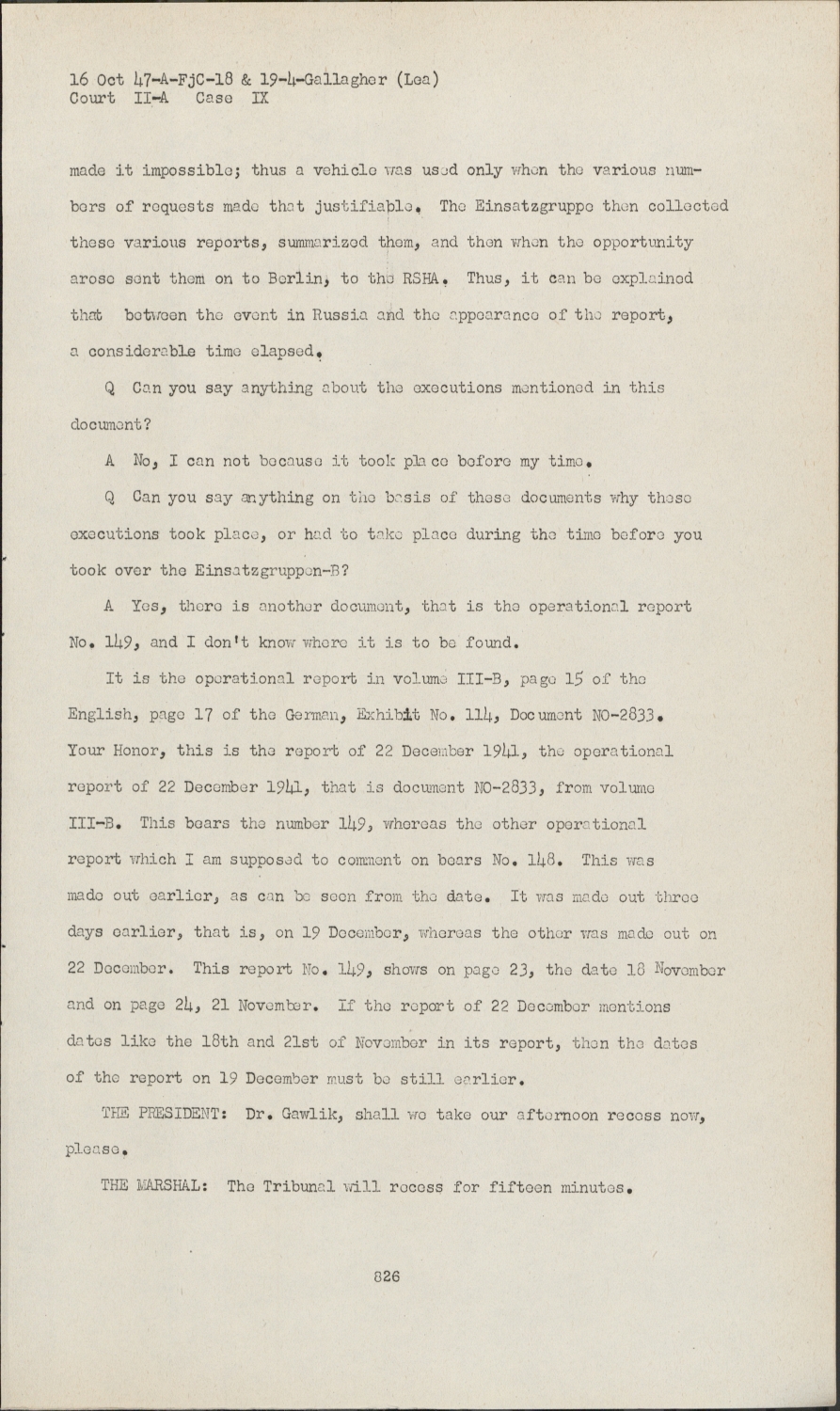
The Einsatzgruppe then collected these various reports, summarized them, and then when the opportunity arose sent them on to Berlin, to the RSHA. Thus, it can be explained that between the event in Russia and the appearance of the report, a considerable time elapsed.
QCan you say anything about the executions mentioned in this document?
ANo, I can not because it took place before my time.
QCan you say anything on the basis of these documents why these executions took place, or had to take place during the time before you took over the Einsatzgruppen-B?
AYes, there is another document, that is the operational report No. 149, and I don't know where it is to be found.
It is the operational report in volume III-B, page 15 of the English, page 17 of the German, Exhibit No. 114, Document NO-2833. Your Honor, this is the report of 22 December 1941, the operational report of 22 December 1941, that is document NO-2833, from volume III-B. This bears the number 149, Whereas the other operational report which I am supposed to comment on bears No. 148. This was made out earlier, as can be seen from the date. It was made out three days earlier, that is, on 19 December, whereas the other was made out on 22 December. This report No. 149, shows on page 23, the date 18 November and on page 24, 21 November. If the report of 22 December mentions dates like the 18th and 21st of November in its report, then the dates of the report on 19 December must be still earlier.
THE PRESIDENT:Dr. Gawlik, shall we take our afternoon recess now, please.
THE MARSHAL:The Tribunal will recess for fifteen minutes.
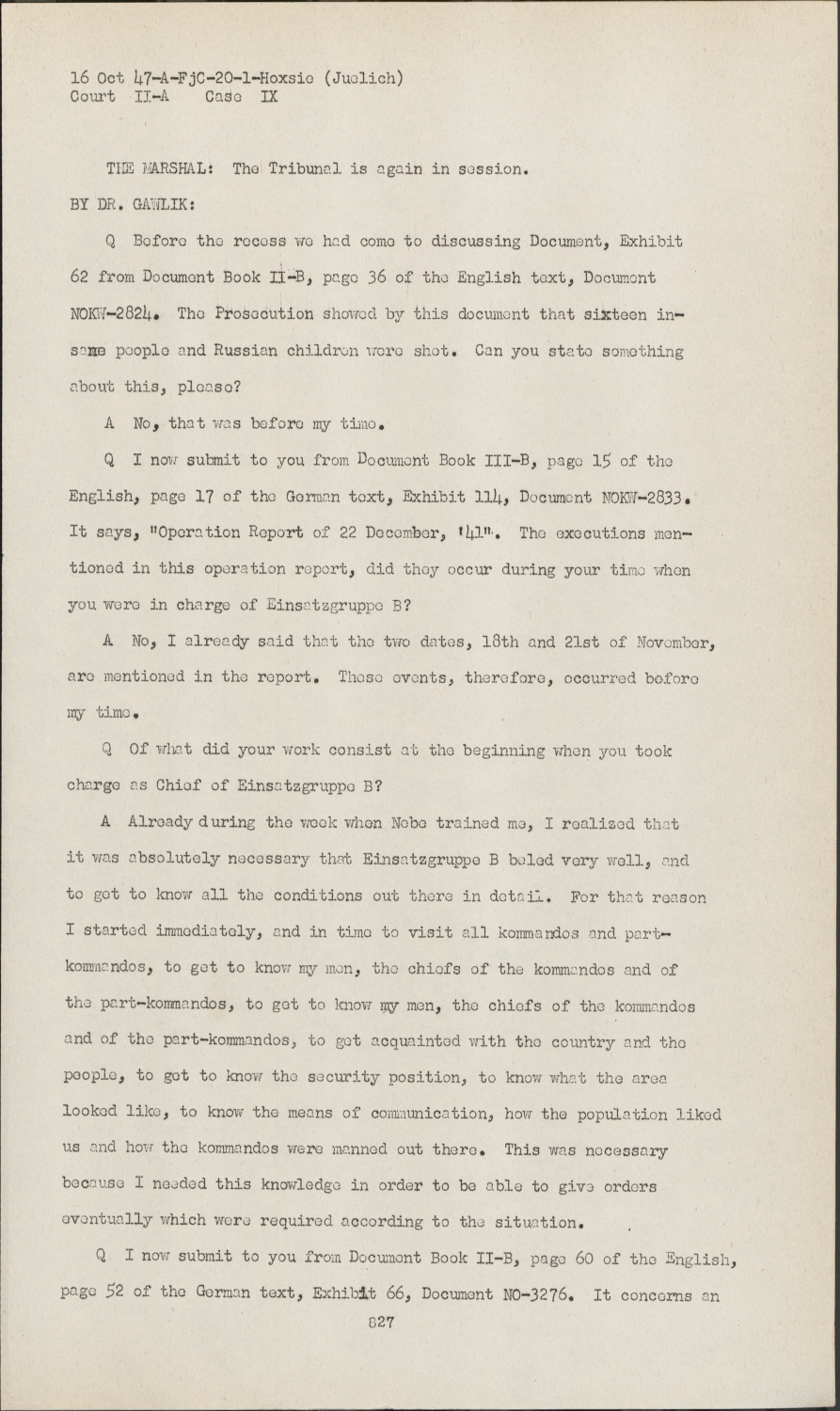
THE MARSHAL:The Tribunal is again in session. BY DR. GAWLIK:
QBefore the recess we had come to discussing Document, Exhibit 62 from Document Book II-B, page 36 of the English text, Document NOKW-2824. The Prosecution showed by this document that sixteen insame people and Russian children were shot. Can you state something about this, please?
ANo, that was before my time.
QI now submit to you from Document Book III-B, page 15 of the English, page 17 of the German text, Exhibit 114, Document NOKW-2833. It says, "Operation Report of 22 December, 41". The executions mentioned in this operation report, did they occur during your time when you were in charge of Einsatzgruppe B?
ANo, I already said that the two dates, 18th and 21st of November, are mentioned in the report. These events, therefore, occurred before my time.
QOf what did your work consist at the beginning when you took charge as Chief of Einsatzgruppe B?
AAlready during the week when Nebe trained me, I realized that it was absolutely necessary that Einsatzgruppe B beled very well, and to get to know all the conditions out there in detail. For that reason I started immediately, and in time to visit all kommandos and partkommandos, to get to know my men, the chiefs of the kommandos and of the part-kommandos, to get to know my men, the chiefs of the kommandos and of the part-kommandos, to get acquainted with the country and the people, to get to know the security position, to know what the area looked like, to know the means of communication, how the population liked us and how the kommandos were manned out there. This was necessary because I needed this knowledge in order to be able to give orders eventually which were required according to the situation.
QI now submit to you from Document Book II-B, page 60 of the English, page 52 of the German text, Exhibit 66, Document NO-3276. It concerns an operation report, No. 194, of 21 April 1942.
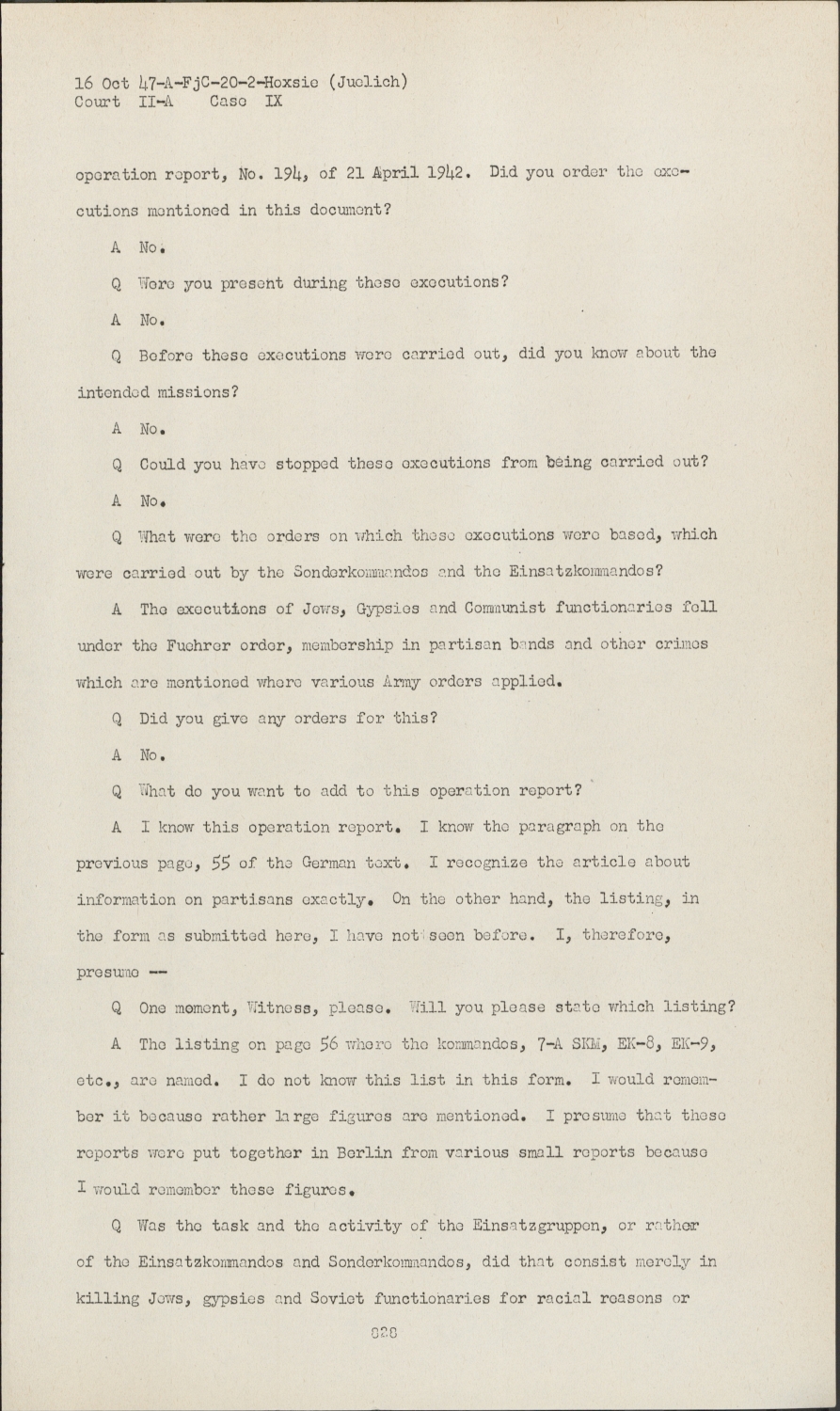
Did you order the executions mentioned in this document?
ANo.
QWere you present during these executions?
ANo.
QBefore these executions were carried out, did you know about the intended missions?
ANo.
QCould you have stopped these executions from being carried out?
ANo.
QWhat were the orders on which these executions were based, which were carried out by the Sonderkommandos and the Einsatzkommandos?
AThe executions of Jews, Gypsies and Communist functionaries fell under the Fuehrer order, membership in partisan bands and other crimes which are mentioned where various Army orders applied.
QDid you give any orders for this?
ANo.
QWhat do you want to add to this operation report?
AI know this operation report. I know the paragraph on the previous page, 55 of the German text. I recognize the article about information on partisans exactly. On the other hand, the listing, in the form as submitted here, I have not seen before. I, therefore, presume -
QOne moment, Witness, please. Will you please state which listing?
AThe listing on page 56 where the kommandos, 7-A SKM, EK-8, EK-9, etc., are named. I do not know this list in this form. I would remember it because rather large figures are mentioned. I presume that these reports were put together in Berlin from various small reports because I would remember those figures.
QWas the task and the activity of the Einsatzgruppen, or rather of the Einsatzkommandos and Sonderkommandos, did that consist merely in killing Jews, gypsies and Soviet functionaries for racial reasons or because of their political opinions?
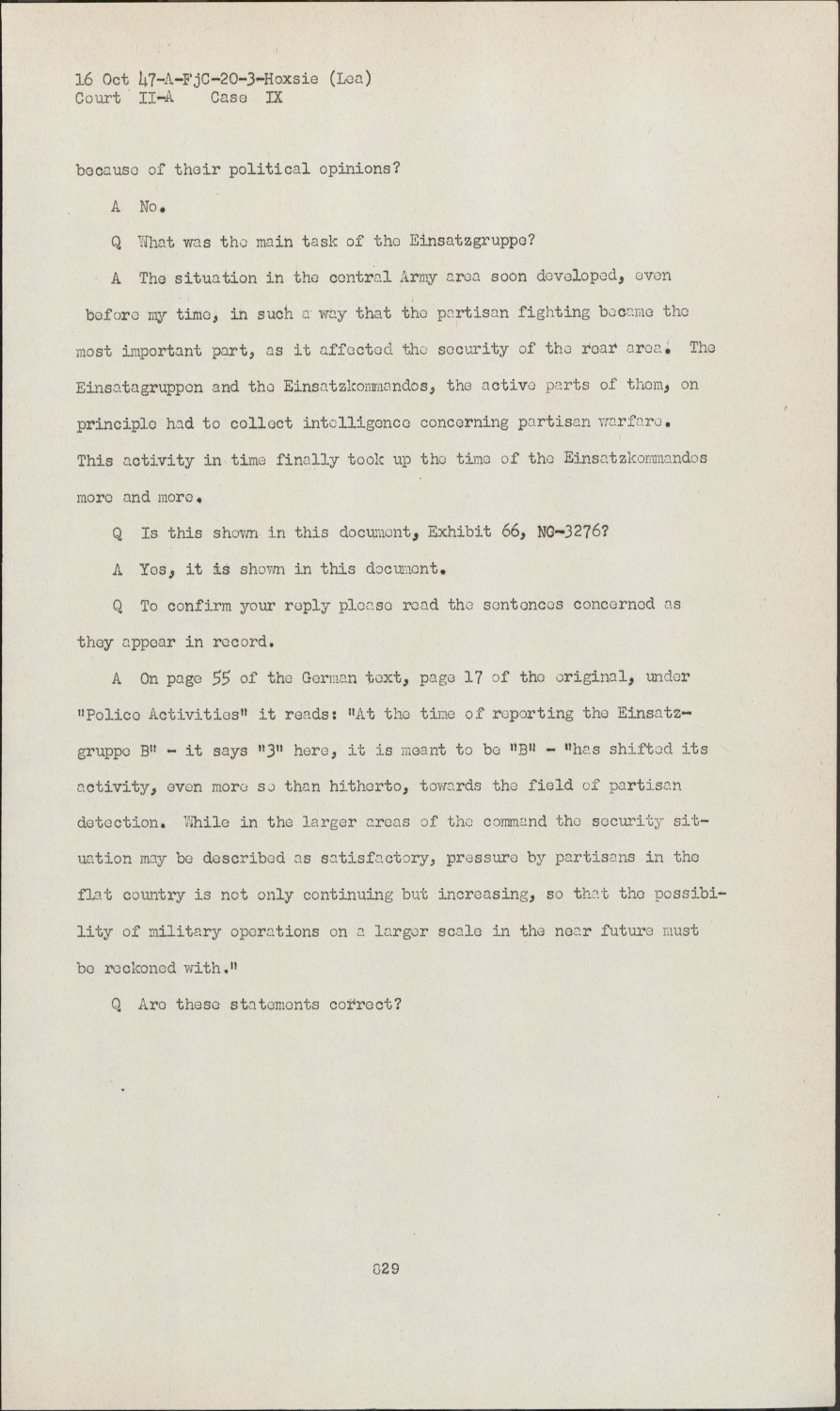
ANo.
QWhat was the main task of the Einsatzgruppe?
AThe situation in the central Army area soon developed, even before my time, in such a way that the partisan fighting became the most important part, as it affected the security of the roar area. The Einsatagruppen and the Einsatzkommandos, the active parts of them, on principle had to collect intelligence concerning partisan warfare. This activity in time finally took up the time of the Einsatzkommandos more and more.
QIs this shown in this document, Exhibit 66, NO-3276?
AYes, it is shown in this document.
QTo confirm your reply please read the sentences concerned as they appear in record.
AOn page 55 of the German text, page 17 of the original, under "Police Activities" it reads: "At the time of reporting the Einsatzgruppe B" - it says "3" here, it is meant to be "B" - "has shifted its activity, even more so than hitherto, towards the field of partisan detection. While in the larger areas of the command the security situation may be described as satisfactory, pressure by partisans in the flat country is not only continuing but increasing, so that the possibility of military operations on a larger scale in the near future must be reckoned with."
QAre these statements correct?
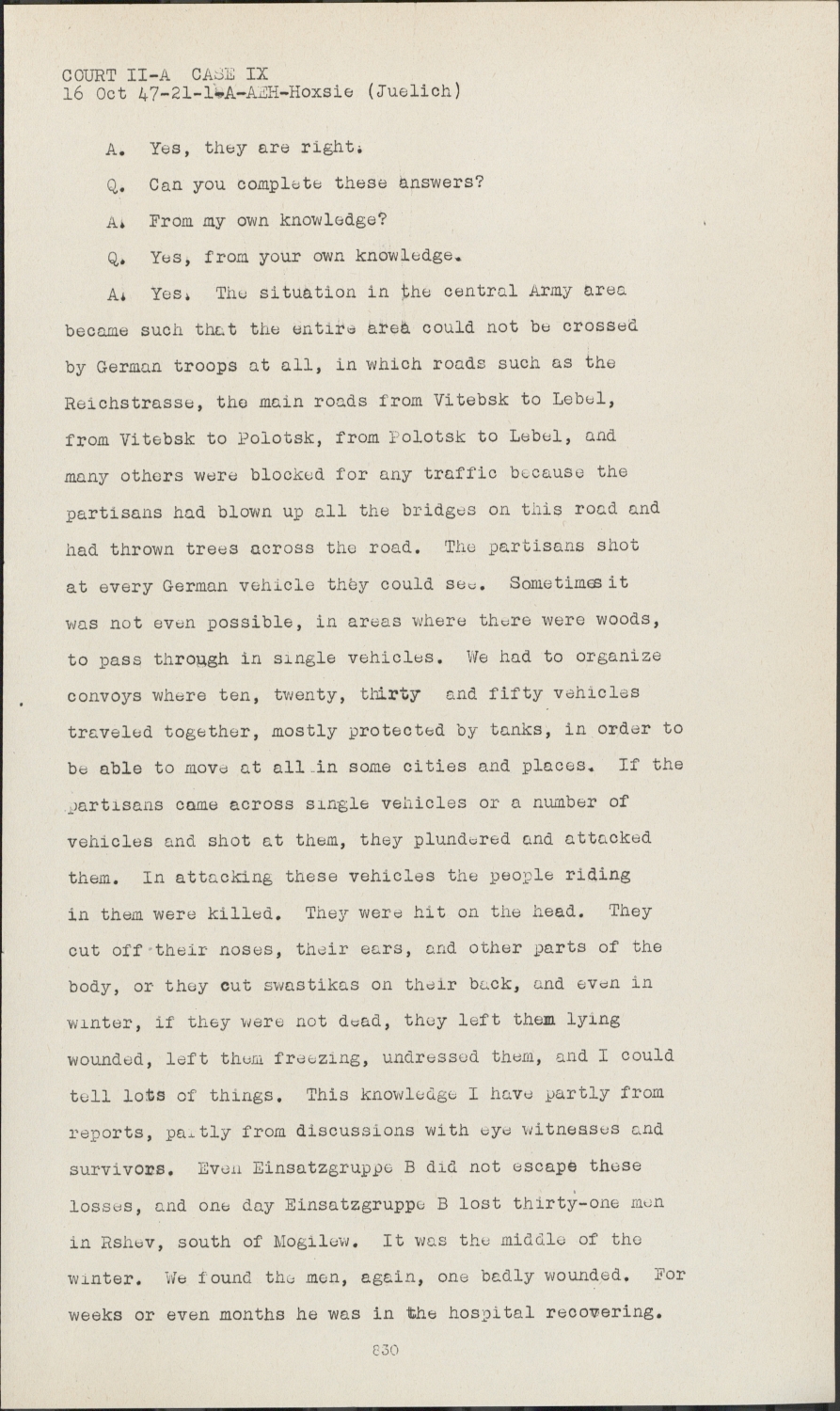
A.Yes, they are right.
Q.Can you complete these answers?
A.From my own knowledge?
Q.Yes, from your own knowledge.
A.Yes, The situation in the central Army area became such that the entire area could not be crossed by German troops at all, in which roads such as the Reichstrasse, the main roads from Vitebsk to Lebel, from Vitebsk to Polotsk, from Polotsk to Lebel, and many others were blocked for any traffic because the partisans had blown up all the bridges on this road and had thrown trees across the road. The partisans shot at every German vehicle they could see. Sometimes it was not even possible, in areas where there were woods, to pass through in single vehicles. We had to organize convoys where ten, twenty, thirty and fifty vehicles traveled together, mostly protected by tanks, in order to be able to move at all in some cities and places. If the partisans came across single vehicles or a number of vehicles and shot at them, they plundered and attacked them. In attacking these vehicles the people riding in them were killed. They were hit on the head. They cut off their noses, their ears, and other parts of the body, or they cut swastikas on their back, and even in winter, if they were not dead, they left them lying wounded, left them freezing, undressed them, and I could tell lots of things. This knowledge I have partly from reports, partly from discussions with eye witnesses and survivors. Even Einsatzgruppe B did not escape these losses, and one day Einsatzgruppe B lost thirty-one men in Rshev, south of Mogilew. It was the middle of the winter. We found the men, again, one badly wounded. For weeks or even months he was in the hospital recovering.
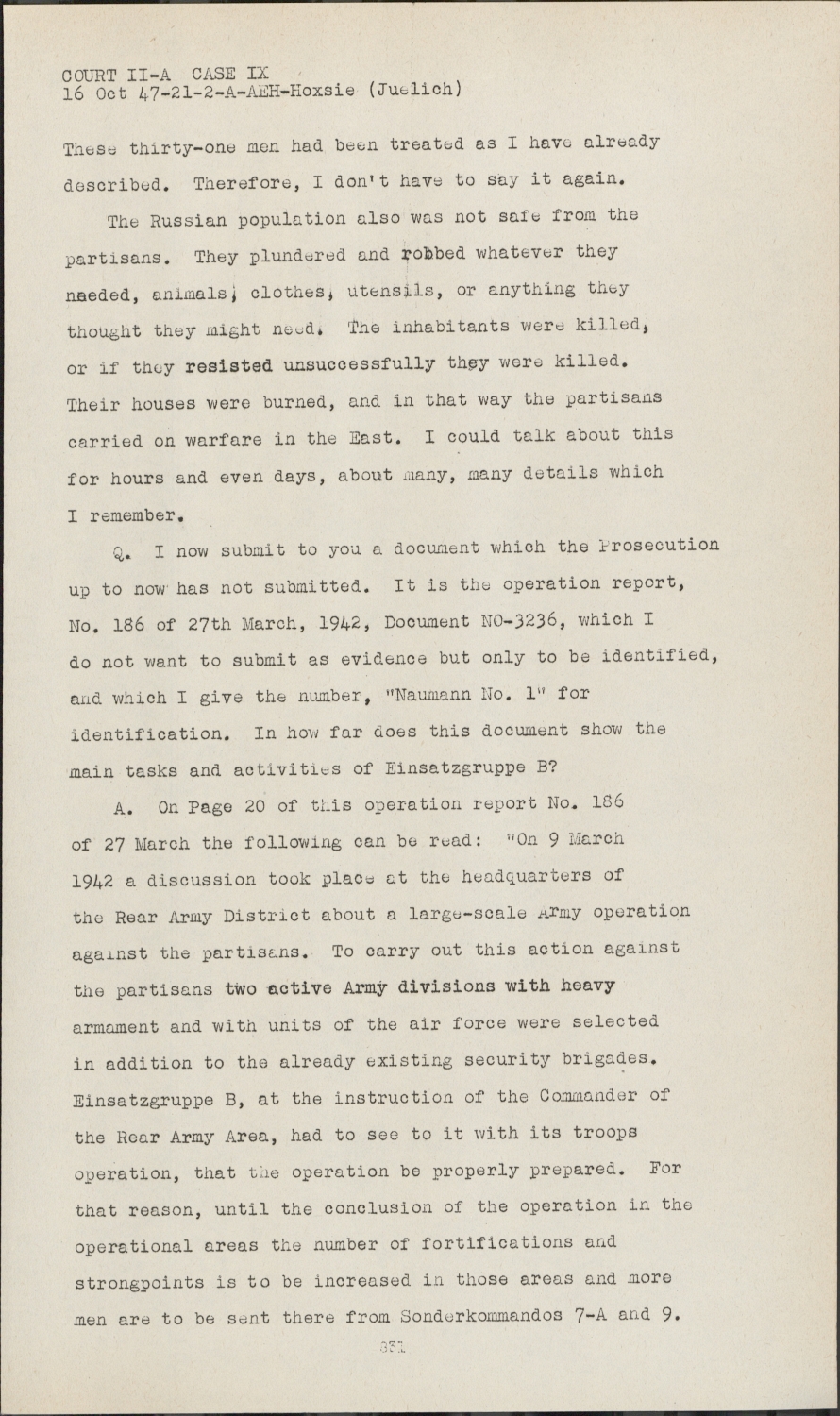
COURT II-A CASE IX These thirty-one men had bean treated as I have already described. Therefore, I don't have to say it again.
The Russian population also was not safe from the partisans. They plundered and robbed whatever they needed, animals, clothes, utensils, or anything they thought they might need. The inhabitants were killed. or if they resisted unsuccessfully they were killed. Their houses were burned, and in that way the partisans carried on warfare in the East. I could talk about this for hours and even days, about many, many details which I remember.
Q.I now submit to you a document which the Prosecution up to now has not submitted. It is the operation report, No. 186 of 27th March, 1942, Document NO-3236, which I do not want to submit as evidence but only to be identified, and which I give the number, "Naumann No. 1" for identification. In how far does this document show the main tasks and activities of Einsatzgruppe B?
A.On Page 20 of this operation report No. 186 of 27 March the following can be read: "On 9 March 1942 a discussion took place at the headquarters of the Rear Army District about a large-scale Army operation against the partisans. To carry out this action against the partisans two active Army divisions with heavy armament and with units of the air force were selected in addition to the already existing security brigades. Einsatzgruppe B, at the instruction of the Commander of the Rear Army Area, had to see to it with its troops operation, that the operation be properly prepared. For that reason, until the conclusion of the operation in the operational areas the number of fortifications and strongpoints is to be increased in those areas and more men are to be sent there from Sonderkommandos 7-A and 9.
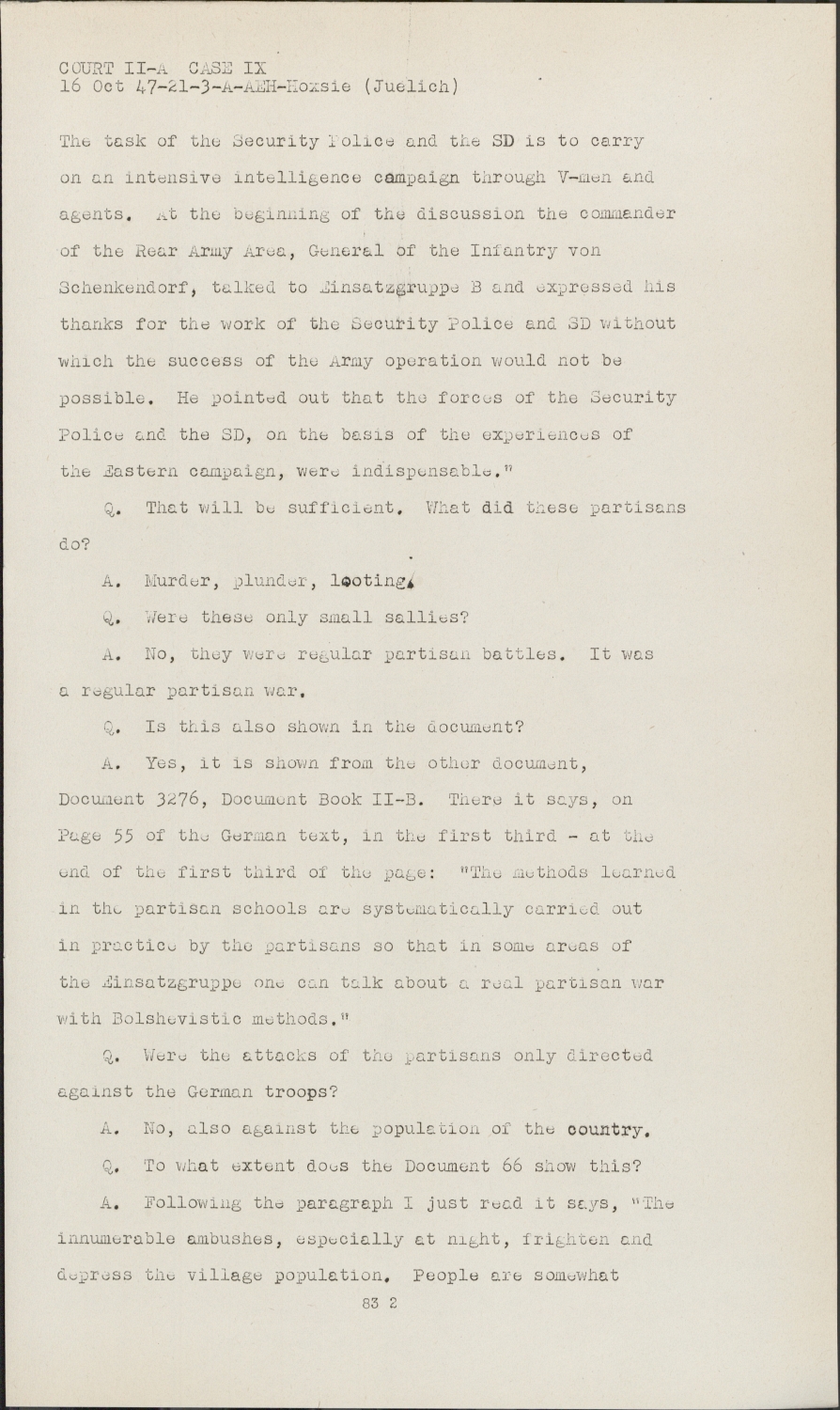
COURT II-A CASE IX The task of the Security Police and the SD is to carry on an intensive intelligence campaign through V-men and agents. At the beginning of the discussion the commander of the Rear Army Area, General of the Infantry von Schenkendorf, talked to Einsatzgruppe B and expressed his thanks for the work of the Security Police and SD without which the success of the Army operation would not be possible. He pointed out that the forces of the Security Police and the SD, on the basis of the experiences of the Eastern campaign, were indispensable."
Q.That will be sufficient. What did these partisans do?
A.Murder, plunder, looting.
Q.Were these only small sallies?
A.No, they were regular partisan battles. It was a regular partisan war.
Q.Is this also shown in the document?
A.Yes, it is shown from the other document, Document 3276, Document Book II-B. There it says, on Page 55 of the German text, in the first third - at the end of the first third of the page: "The methods learned in the partisan schools are systematically carried out in practice by the partisans so that in some areas of the Einsatzgruppe one can talk about a real partisan war with Bolshevistic methods."
Q.Were the attacks of the partisans only directed against the German troops?
A.No, also against the population of the country.
Q.To what extent does the Document 66 show this?
A.Following the paragraph I just read it says, "The innumerable ambushes, especially at night, frighten and depress the village population. People are somewhat COURT II-A CASE IX disappointed by the allegedly insignificant activity of the German agencies in combatting the partisans.
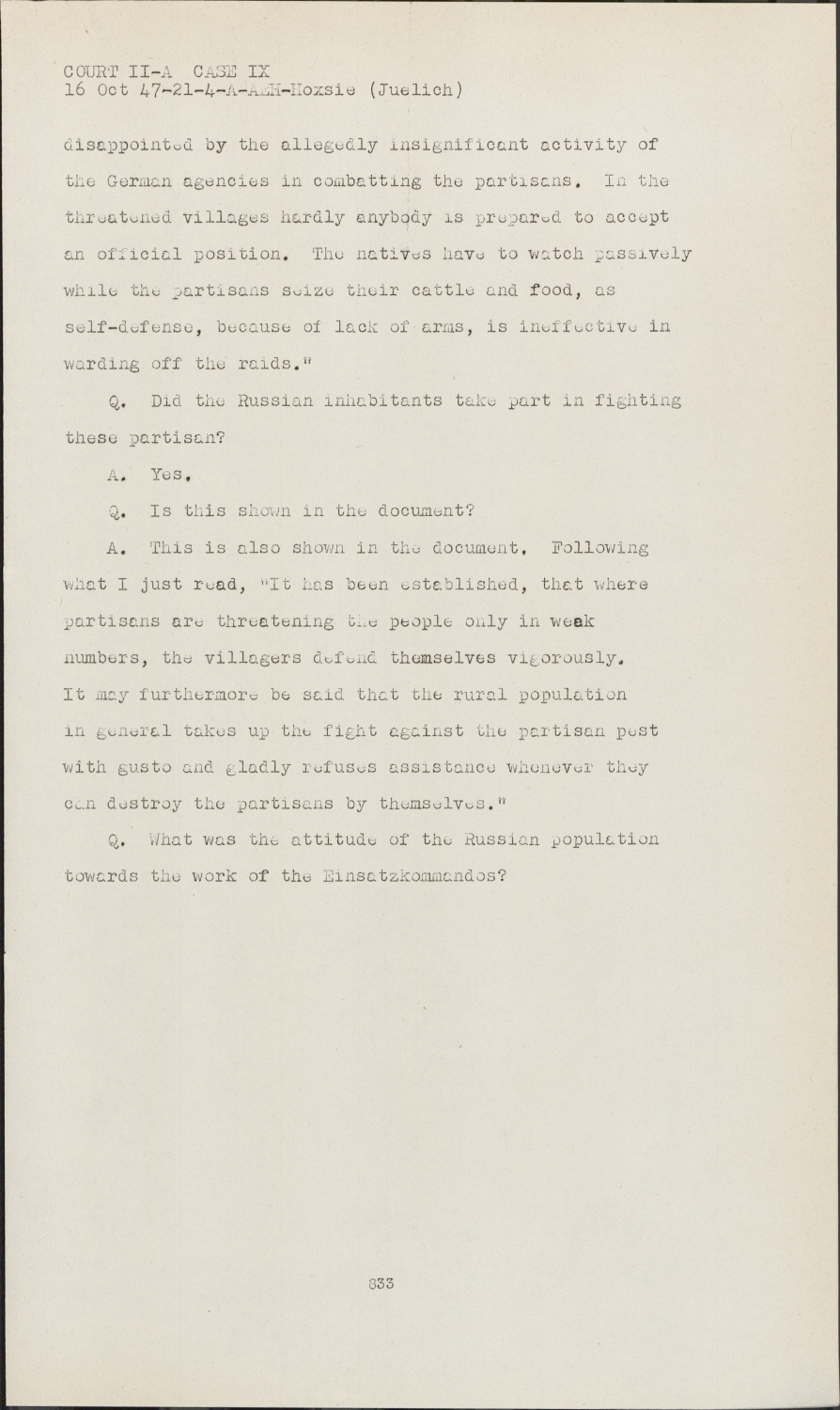
In the threatened villages hardly anybody is prepared to accept an official position. The natives have to watch passively while the partisans seize their cattle and food, as self-defense, because of lack of arms, is ineffective in warding off the raids."
Q.Did the Russian inhabitants take part in fighting these partisan?
A.Yes.
Q.Is this shown in the document?
A.This is also shown in the document. Following what I just read, "It has been established, that where partisans are threatening the people only in weak numbers, the villagers defend themselves vigorously. It may furthermore be said that the rural population in general takes up the fight against the partisan pest with gusto and gladly refuses assistance whenever they can destroy the partisans by themselves."
Q.What was the attitude of the Russian population towards the work of the Einsatzkommandos?
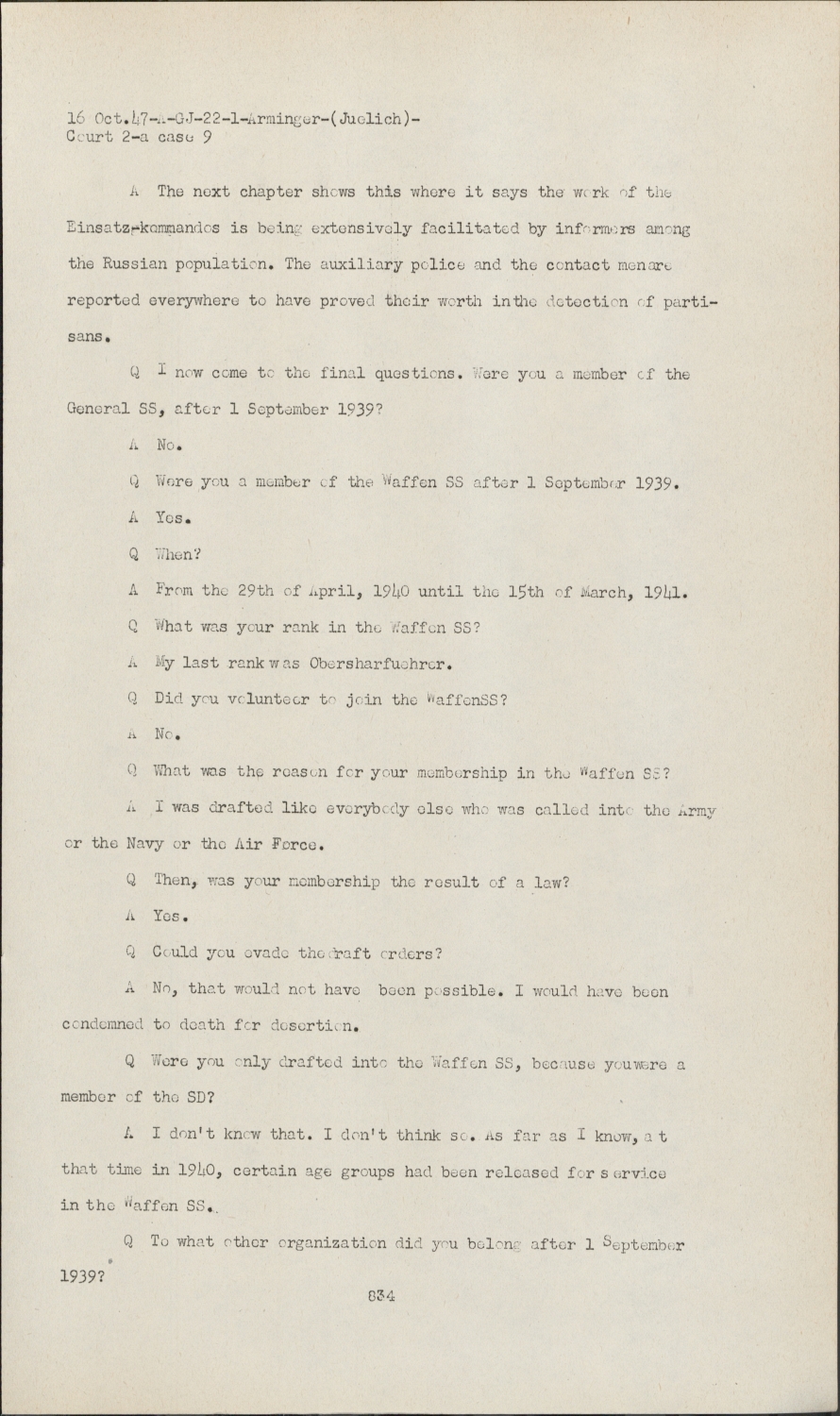
AThe next chapter shows this where it says the work of the Einsatz-kommandos is being extensively facilitated by informers among the Russian population. The auxiliary police and the contact menare reported everywhere to have proved their worth in the detection of partisans.
QI now come to the final questions. were you a member of the General SS, after 1 September 1939?
ANo.
QWere you a member of the Waffen SS after 1 September 1939.
AYes.
QWhen?
AFrom the 29th of April, 1940 until the 15th of March, 1941.
QWhat was your rank in the Waffen SS?
AMy last rank was Obersharfuehrer.
QDid you volunteer to join the WaffenSS?
ANo.
QWhat was the reason for your membership in the Waffen SS?
AI was drafted like everybody else who was called into the Army or the Navy or the Air Force.
QThen, was your membership the result of a law?
AYes.
QCould you evade the draft orders?
ANo, that would not have been possible. I would have been condemned to death for desertion.
QWere you only drafted into the Waffen SS, because you were a member of the SD?
AI don't knew that. I don't think so. As far as I know, at that time in 1940, certain age groups had been released for service in the Waffen SS.
QTo what other organization did you belong after 1 September 1939?
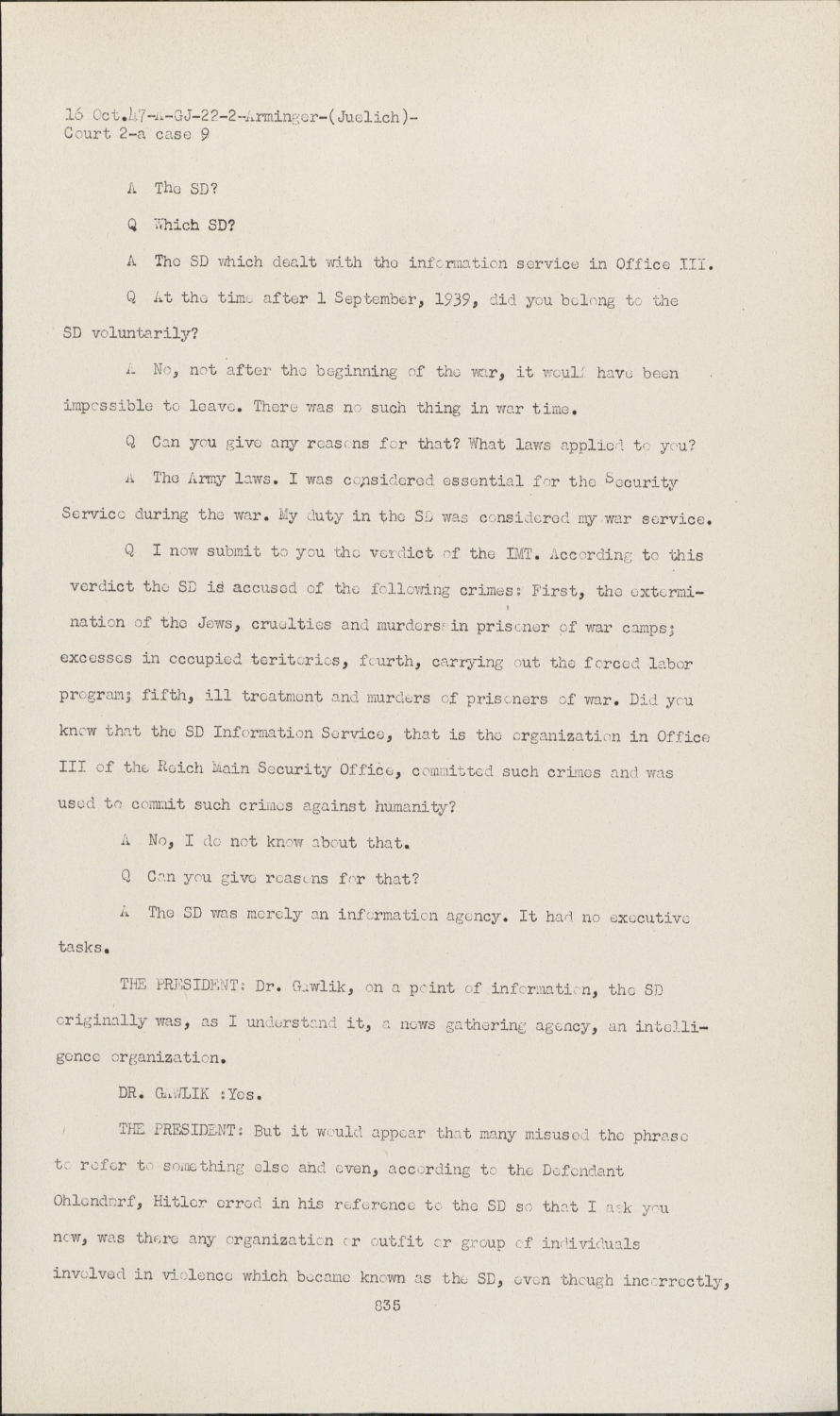
AThe SD?
QWhich SD?
AThe SD which dealt with the information service in Office III.
QAt the time after 1 September, 1939, did you belong to the SD voluntarily?
ANo, not after the beginning of the war, it would have been impossible to leave. There was no such thing in war time.
QCan you give any reasons for that? What laws applied to you?
AThe Army laws. I was considered essential for the Security Service during the war. My duty in the SD was considered my war service.
QI now submit to you the verdict of the IMT. According to this verdict the SD is accused of the following crimes:
First, the extermi nation of the Jews, cruelties and murders in prisoner of war camps; excesses in occupied teritories, fourth, carrying out the forced labor program; fifth, ill treatment and murders of prisoners of war.
Did you knew that the SD Information Service, that is the organization in Office III of the Reich Main Security Office, committed such crimes and was used to commit such crimes against humanity?
ANo, I do not know about that.
QCan you give reasons for that?
AThe SD was merely an information agency. It had no executive tasks.
THE PRESIDENT:Dr. Gawlik, on a point of information, the SD originally was, as I understand it, a news gathering agency, an intelligence organization.
DR. GAWLIK :Yes.
THE PRESIDENT:But it would appear that many misused the phrase to refer to something else and even, according to the Defendant Ohlendorf, Hitler erred in his reference to the SD so that I ask you new, was there any organization or outfit or group of individuals involved in violence which became known as the SD, even though incorrectly, so far as the original organizational chart was concerned?

DR. GAWLIK:Yes, Your Honor. This name SD included -- that was -the concept was not clarified and by SD one often described the Security Police and the Secret State Police, and the Criminal Police. The reasons for this were that all the officials of the criminal Police who were active in the areas occupied by Germany, were to be given uniform, and unfortunately it was quite common in Germany that the high-ranking leaders wanted power.
Now Heydrich wanted to show that these are the people who belonged to him and therefore he gave them a gray uniform and all these people were insignia on their sleeve with the word "SD", Security Service, but they were Secret State Police officials and Criminal Police Officials, so that in the occupied territories every secret state police official and every Criminal Police official was described as an SD man.
This is shown in the submitted documents. For example, the Grebe document, which was submitted to the IMT. It describes persons who doubtlessly were Gestapo and Secret Police members, as SD members, and therefore, when one talked about police measures, one often meant SD. Keitel explained this in an affidavit before the IMT. He stated, there, if he did not know which police division was competent, he merely said, "Security Service", people had the opinion that the Police looked after the public order and the security and therefore, and therefore, it was the security Service, while this Security Service of Office III is quite a different thing.
It had no executive power. It could not even arrest a man.
THE PRESIDENT:Very well.
Q (By Dr. Gawlik) In your capacity as Oberhauptsturmfuehrer in the SD after 1 September 1939, did you commit any crimes against humanity or any war crimes?
ANo.
QDid you commit any other crimes against humanity or war crimes?
ANo.
DR. GAWLIK:Your Honor, I have no further questions.
THE PRESIDENT:Cross-examination on the part of Defense Counsel?
DR.KOESSL (Attorney for the Defendant Ott): Would you permit me to ask a few questions, please.
DIRECT EXAMINATION BY DR. KOESSL ( Attorney for the Defendant Ott):
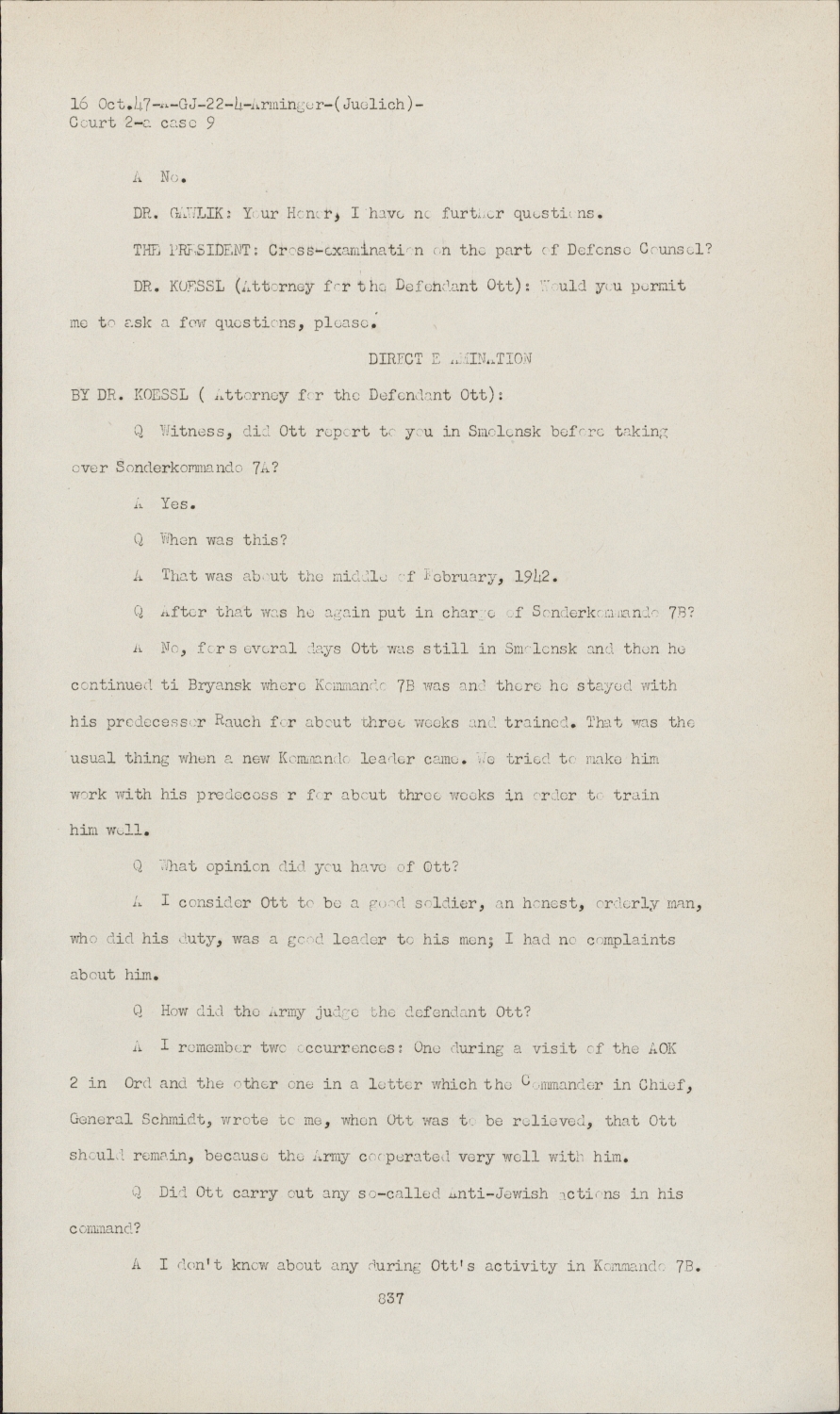
QWitness, did Ott report to you in Smolensk before taking over Sonderkommando 7A?
AYes.
QWhen was this?
AThat was about the middle of February, 1942.
QAfter that was he again put in charge of Sendorkommando 7B?
ANo, for several days Ott was still in Smolensk and then he continued ti Bryansk where Kommando 7B was and there he stayed with his predecessor Rauch for about three weeks and trained. That was the usual thing when a new Kommando leader came. We tried to make him work with his predecessor for about three weeks in order to train him well.
QWhat opinion did you have of Ott?
AI consider Ott to be a good soldier, an honest, orderly man, who did his duty, was a good leader to his men; I had no complaints about him.
QHow did the Army judge the defendant Ott?
AI remember two occurrences: One during a visit of the AOK 2 in Ord and the other one in a letter which the Commander in Chief, General Schmidt, wrote to me, when Ott was to be relieved, that Ott should remain, because the Army cooperated very well with him.
QDid Ott carry out any so-called Anti-Jewish actions in his command?
AI don't know about any during Ott's activity in Kommando 7B.
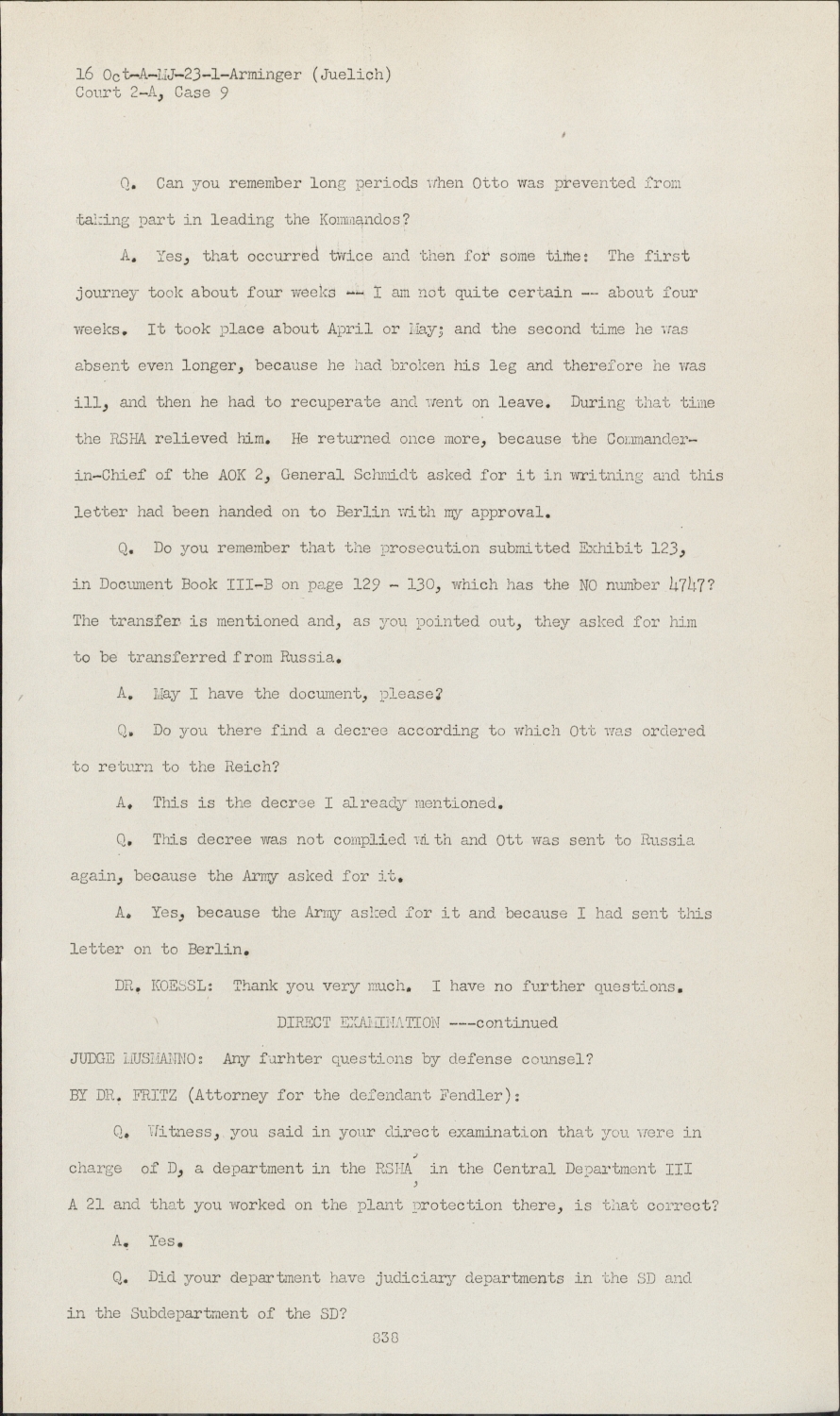
Q.Can you remember long periods when Otto was prevented from taking part in leading the Kommandos?
A.Yes, that occurred twice and then for some time: The first journey took about four weeks -- I am not quite certain -- about four weeks. It took place about April or May; and the second time he was absent even longer, because he had broken his leg and therefore he was ill, and then he had to recuperate and went on leave. During that time the RSHA relieved him. He returned once more, because the Commanderin-Chief of the AOK 2, General Schmidt asked for it in writning and this letter had been handed on to Berlin with my approval.
Q.Do you remember that the prosecution submitted Exhibit 123, in Document Book III-B on page 129 - 130, which has the NO number 4747? The transfer is mentioned and, as you pointed out, they asked for him to be transferred from Russia.
A.May I have the document, please?
Q.Do you there find a decree according to which Ott was ordered to return to the Reich?
A.This is the decree I already mentioned.
Q.This decree was not complied with and Ott was sent to Russia again, because the Army asked for it.
A.Yes, because the Army asked for it and because I had sent this letter on to Berlin.
DR. KOESSL:Thank you very much. I have no further questions.
DIRECT EXAMINATION ---continued JUDGE MUSMANNO: Any furhter questions by defense counsel? BY DR. FRITZ (Attorney for the defendant Fendler):
Q.Witness, you said in your direct examination that you were in charge of D, a department in the RSHA, in the Central Department III A 21 and that you worked on the plant protection there, is that correct?
A.Yes.
Q.Did your department have judiciary departments in the SD and in the Subdepartment of the SD?
A.Yes, departments and some subdepartments were concerned with this.
Q.Did a department unit in III 21 also work in a subdivision plant protection?
A.Of course.
Q.Did those members of the 3D who worked on plant protection have any executive police powers?
A.No, they did not have that.
Q.Therefore, if I understand you correctly, a departmental chief in III 21 in a subdivision of the SD did not have any executive power.
A.Definitely not.
DR. FRITZ:I have no further questions.
DIRECT EXAMINATION -- Continued
BY DR.STRESS: (Attorney for the Defendant Schulz)
Q.Witness, at the beginning of your examination, you stated that you did not learn anything about the execution order in Bruisk or Dueben, but even later. How do you know that this execution order in Bruisk, Dueben or Schmideberg was announced?
A.I heard about that for the first time through Gruppenfuehrer Heydrich before I left for Russia.
Q.Was it told to you by anyone else?
A.Nebe discussedit with me, of course.
Q.When did your departure to Russia take place? When did you discuss it with Heydrich?
A.Between the 1st of November and 21st of November, between my assignment and the date of my departure.
Q. 1941?
A.Yes, 1941, closer to the 20th than to the 1st.
DR. STRESS:Thank you.
DIRECT EXAMINATION----continued
BY DR. ERICH KARLMAYER (Attorney for the Defendant Steimle):
Q.Witness, do you know the defendant Steimle?
A.Yes.
Q.Since when did you know him?
A.I met him in Russia.
Q.On what occasion did you meet him?
A.During my visit to his position in Reshev.
Q.What position did he hold at the time?
A.He was in charge of Sonderkommando 7a.
Q.What position did he hold under you?
A.He was under me.
Q.For how long was Steimle under you?
A.Only for a short time, approximately until the middle of December 41
Q.Can you describe briefly Steimle's activity in Sonderkommando 7a while you were there?
A.I remember something about this, owing to a visit I paid to Steimle in Kalinin and Reshev soon after I took my office. On that occasion Steimle talked about the work there and I remember that in the narrow front near Kalinin considerable espionnage activity was going on. He described to me one case in particular in which a Russian female student carried out espinonnage and gave messages to missions. This I remember of the activity of Sonderkommando 7a at the time when I worked there and visited Steimle.
Q.Did you, during the time Steimle was subordinated to you, hear about execution acts of any sort, particularly against Jews? Were they reported to you?
A.The time when Steimle was my subordinate was so short that I know that during that time no such actions were reported.
Q.During your activity asChief of Einsatzgruppe B did you hear whether Sonderkommando 7a under Steimle before you started to work there carried out such actions?