Everyone in his sphere, in his group.
QIf a decision had to be made, and the Office Chief could not he reached, who made the decision as deputy to the Office Chief?
AThis decision could only be made by that Gruppenleiter in whose sphere this question fell.
QHow did you sign your reports?
AReports which I signed myself, I signed: "Acting For", because in this sphere of the Group Economics I was the deputy to the Office Chief. This did not only apply to me, but it was the same with any other Group leader.
QThis signature, "Acting For" - does it not prove that you were the deputy of the Office Chief?
ANo, but I was deputy for my sphere, for my Group Economics only, and if the Group Chief signed "Acting For" for his branch, for law and administration, then he was deputy for the Office Chief of his branch, Law and Administration.
QDuring your entire time of work there were you active in any other group or in any office of the RSHA?
ANo. I was never ordered to go there to receive information, not even when I started my work, but I resumed my activity immediately in the Department Economics at the time.
QWhat was your work in the SD in the Group Economics after your return from Russia?
AThe work was exactly the same. I had the same position as I had before my assignment in Russia. Now, as ever, I had to observe, and to report, the effects of the decrees and measures by the Ministries of Economics and other agencies on the population and in the economic sphere. It was always the some task.
QDid you ever deal with any executive measures at all?
ANo, that was not part of my task.
QPlease look at Document Book III-D, page 48 of the English, page 81 of the German, Exhibit 161, Document No. 2858.
This is your affidavit. Under paragraph 2 you state that in the fall of 1933 you joined the NSDAP. Do you want to add anything to this statement?
AIn March 1933 I reported in writing from Goettingen to the local group of the Party in Hannover, my old home town, and in April 1933 I was accepted in the Party. In the actual active life of the Party I was never able to take part. I never got to know the local group.
QWhere were you in May 1945?
AIn May 1945 I was in Flensburg because part of Office III had received an order to go to Northern Germany.
QWere you taken prisoner there?
AIn Flensburg, together with several co-workers, together with members of the last Doenitz government - I officially reported to the English military authorities. The English liaison officer with the Doenitz government asked me after the capitulation to secure material and experts for negotiations by English and American officers, both members of this last government.
I was in Hamburg repeatedly... In Luebeck, and Kiel, and other cities - with the approval of the English authorities, with papers which have been transferred to Nuernberg here among my personal files. On 23 May 1945 I was arrested, together with the members of this last government, and came to a prisoner-of-war camp, and I have been in prison ever since.
DR. GAWLIK:Your Honor, thank you. I have no further questions.
THE PRESIDENT:Do any of defense counsel wish to cross examine?
EXAMINATION BY DR. KOESSL (for Defendant Schubert):
QWitness, did Schubert make reports independently, and on his own authority?
ASchubert could not make reports on his own authority. Naturally he did make some reports, as the occasion arose, about personnel, and the personnel situation, and these reports were utilized in the entire reporting service.
QCould you give me an example, in what manner Schubert took part in reporting?
AHe compiled documents about the personnel situation, or administrative situations, and from time to time he utilized this in a report.
QWere there independent reports about the personnel situation?
AThese items were added to a report, and I made the report. Then Schubert gave me the documents for this, which have been accepted.
QDo I understand you correctly.... these were contributions to that part of reports which were called, the so-called "Local Reports"?
AThese were contributions which were added to these reports.
QThese reports only concerned the organizational and personnel situation?
AYes. While being questioned by Mr. Wartenberg I explained this to him unambiguously, and Mr. Wartenberg told me that this could be shown from my affidavit, where it says, "from time to time or as the occasion arose" and that was all that concerned Schubert.
QWe are now concerned with general reports and the manner in which you described the reports, and as they were not submitted as documents.
ANo, no such reports were concerned.
QYou testified yesterday that the awarding of promotions to be given to relatives of people who had taken part in the war was part of your task. Can you tell us why Schubert received the Iron Cross, Second Class?
ASchubert took part in several actions and operations against troops who had been wounded, in which I also took part. That was in March and April 1942. Apart from that he had also taken part in anti-partisan fighting; and that was the basis which led to a recommendation for a distinction of merit. This recommendation, of course, did not originate from me. The officer of the Army who was concerned, who was in charge during this combat action, that is, the Battalion Commander of the German Battalion, or in one case it was the Battalion Commander of a Rumanian Battalion.
.. they made the recommendations, and these recommendations were submitted to the Eleventh Army, to the G-1 officer there. BY THE PRESIDENT:
QWas the Iron Cross purely a combat decoration?
AYes, Your Honor.
QIt was never awarded for administrative achievements?
AThe Iron Cross was never awarded for administrative distinction. If I may add, at the beginning of the war, and during the first World War, the Iron Cross was awarded - first as a distinction for bravery, and secondly to higher troop officers in the staffs, but only from the staff of an army upwards. The operation officer of that army received it without having taken part in the fighting. The second way was prohibited, as far as I remember, in 1941 or 1942, and from that time onwards the Iron Cross was only given for actual bravery in combat.
QWhat was the specific exploit which you performed which earned you the Iron Cross?
AIn January 1942 I was going to Feodosia in order to be put in charge of Kommando 10, or rather, I was to look for it.
QWhy were you to look for it?
ABecause we from the Army knew that the Russians had landed again in Feodosia, and that the city had been captured by the Russians, the city where the Kommando had been. And I looked for the Kommando in order to find out whether they got away at all. I found this Kommando in a locality called the Stari Krim, that is on the road from Simferopol and Feodosia, about 20 kilometers to the west of Feodosia. The Russians had already advanced very close to this locality. There I found the Kommando leader and the major in the general staff, Stephanus, of the Eleventh Army, and this major was in charge of the entire Kommando 10-B, and had already joined them under the leadership of his kommando leader.
As soon as I arrived he gave me the order to set up an armed reconnaissance troop, and to see to it that the troops who were withdrawing to the left and the right of the street would be put into a position again, and I arranged that.
QAnd for that you got the Iron Cross?
ANo, Your Honor, I carried out this task. I brought back reconnaissance reports - how far the Russians had advanced. Secondly, when I had put the German and Rumanian soldiers back into a position, in these positions, I fought with the unit myself, and advanced with this very unit until we recaptured the city of Feodosia.
QWhat weapon did you use at the front?
AApart from the infantry arms, there was only anti-aircraft. No other big guns existed. The Russians had already captured them because they were at the coast for advance purposes. The situation was so grave that the commander in chief of the army at that time himself considered the Crimea lost because apart from technical companies, no large units existed any more.
QWell, then, you had command of a detachment actually in combat?
AYes, Your Honor.
QHow many men did you have under you?
AI had one platoon.
QWere they riflemen?
AYes, they were infantry riflemen.
Q.Well now, while you were in charge of this detachment, were you still part of the Einsatzgruppen?
A.Yes, owing to the agreement between the Chief of the Security Police and the Commander-in-Chief of the Army, we always had the right to assign units of the Einsatgruppen and also to give orders to individuals if the military situation required it.
Q.So that while you were with the Einsatzgruppen you did more than merely make up reports?
A.Yes, I did more than just write reports, Your Honor.
Q.I noticed in the personnel record that you received the Sword of Honor. What was the exploit which brought about this decoration?
A.I received the Sword of Honor of the SS already before the war, as far as I remember. It was awarded after a certain period of time of membership with this formation-a measure merely based on time without having to show any special merits.
Q.Was this given to all those who had achieved a certain seniority in SS ranks?
A.Yes, Your Honor, all leaders.
Q.How many years were required to earn the Sword of Honor?
A.I may be mistaken but I estimate two or three years membership in the SS, Your Honor, as leader.
Q.Did you actually get a sword?
A.A sword?
Q.Well, the personnel record calls the decoration a "Sword of Honor." Did they actually give you a sword?
A.As a weapon I received a real officer's sword.
Q.How long was this sword?
A.The sword was rather uncomfortable, Your Honor. I preferred to wear my officer's sword because it was much COURT II CASE IX shorter and it was much easier to carry.
Q.Well, they had to give out a lot of swords then, didn't they?
A.Yes. I, myself, had four swords at home: 2 from the Army, one long sword, and a short one--a dagger--the officer's dagger. I had the same again for the SS: the long sword, and an SS leader's dagger.
Q.Did you ever use these swords to attack anybody?
A.No, never, Your Honor.
Q.Well, I see you also received the Yule Candlesticks. Now what did you do to get the Yule Candlesticks?
A.Your Honor, these Yule Candlesticks were the same gift by the SS for every SS leader at yuletide. If one had become an SS leader, according to his files, he automatically had these candlesticks sent to him, and he received a new candle every year for each candlestick. This all happened according to the files.
Q.Well, between all your swords and all your candles you must have had quite a collection?
A.I only had one candlestick.
Q.All right, you may proceed, please. BY DR. KOESSL:
Q.Witness, Schubert received the Iron Cross for bravery in combat against the armed enemy?
A.Yes.
Q.Who awarded Schubert the Iron Cross?
A.The commander-in-chief of the 11th army personally issued the award and signed it for this distinction for Schubert.
Q.With the permission of the Tribunal, I would like to address a few more questions as deputy for Dr. Hoffmann for the defendant Nosske.
THE PRESIDENT:You may. BY DR. KOESSL:
Q.Witness, under whom was the area of Transnistria? Under whose sovereignty?
A.The territory of Transnistria was to the northwest of Nikolaev and was under the sovereignty, after August of 1941 approximately, of the Rumanians. It was Rumanian sovereign territory.
Q.Which offices of the ethnic German settlement offices were located in Transnistria?
A.At first Commando 12 had to deal with these ethnic German settlements; later on this commando was relieved by a commando of the ethnic German office.
Q.Who made agreements with the Rumanians which were regulated by the conditions of the ethnic German office?
A.The final arrangments were made by the chief Hoffmeier--Oberfuehrer Hoffmeier--for ethnic German office with the Rumanian General.
Q.Did the German army command also take part in these agreements?
A.The Army command also had to take part, yes.
Q.Between the Rumanian and the German army staff, did they make any agreements after the territory of Transnistria had already been declared Rumanian sovereign territory?
A.I don't know that; I cannot give any details about that.
Q.Thank you. I have no further questions.
THE PRESIDENT:Any other defense counsel desire to cross examine? You may proceed, Mr. Walton.
CROSS EXAMINATION BY MR. WALTON:
Q.Did you testify on direct examination that you had gone to the officers' training school and had successfully passed your officer's examination?
A.Yes.
Q.This was in the year 1935, was it not?
A.Yes.
Q.When you left the army for work in the SD, did you not state on direct examination that you were put on a reserve officer's status?
A.The status of a reserve officer, yes.
Q.Now from the facts which you related yesterday, service in the SD was a voluntary act on your part, was it not?
A.At the time, if I may say that, I had received instructions by the District III--or rather it had been intended that I, as a Lieutenant, was to go to the infantry regiment 46 in Spandau. The Military Command III assigned me to the infantry regiment 46 in Spandau. The Military Command III assigned me to Spandau near Berlin. I did not want to remain this type of officer, but because I could not realize my aims to go into the economic department of the army, I therefore agreed that the SD main office should release me from the Military Command III--and they approved this, yes.
Q.You applied for relief from active duty in Military Command III in order to go into the SD, is that not true?
A.I went voluntarily; whether I personally made an application, I don't remember now.
Q.Then you entered the SD service voluntarily, you say?
A.Yes.
Q.Now, I believe you testified further yesterday that when you first came to service in the SD your rating compared COURT II CASE IX with a private first-class, or you were given the rating of Unterscharfuehrer in the SD when you reported?
A.My first rank in the SD was Unterscharfuehrer, yes.
Q.And also you spoke yesterday that you were promised a commensurate rating with the rank that you held in the army if you would come into the SD for service?
A.Yes.
Q.Well, didn't you feel when you left the army as a lieutenant and was given only a low ranking non-commissioned officer's rating in the SS that you were unfairly treated?
A.Yes, I not only believed this but I also expressed this continuously.
Q.Then why did you stay in the SS?
A.Mr. Prosecutor, I did not join the SS but I went into the economic department of the SD as referent for a certain task, and this was the profession which I had chosen.
Q.In other words, you were willing to undertake any task since you had determined to make your career with the SS and the SD, were you not?
A.No, that is quite wrong, Mr. Prosecutor, for I agreed to it for that reason of transfer because here the economic department was being set up, and national economic experts, lawyers, technicians, and so forth, were required. I would never have acepted any other position.
Q.Did you continue your military training as a reserve officer after you went on an inactive status?
A.Yes.
THE PRESIDENT:Mr. Walton, I don't know that an answer has been forthcoming to your question about a willingness to take a non-commissioned officer's status in the SD an against a commissioned officer's status in the Wehrmacht.
MR. WALTON:Sir, I understood the witness to say that COURT II CASE IX this department was being set up; that in effect he wanted to get in the department as it started; and therefore he went in while he acted as a referent or SD referent.

His SD rank was merely Unterscharfuehrer. Now that is what I gather; I don't know whether the Tribunal got that.
BY THE PRESIDENT:
QWell, witness, let's get it very specific. In the army you were an officer?
AYes, Your Honor.
QWhen you entered the SD you were a non-commissioned officer?
AI became referent and therefore had the position and the rank of an officer, but I received the rank as NCO and not as had been promised me as an officer; but several promotions followed, only spaced a few months apart so that this rank should become the same as my position as referent and should be a similar one.
QThen your career in the SD service loomed much more attractively to you than a career in the army?
AMore interesting in so far as it was my aim that in the army too I would work in an economic department because I had always been interested in economics. BY MR. WALTON:
QNow at the outbreak of the war you were a trained reserve officer, is that correct?
AYes.
QWhy were you not called for active service as a Wehrmacht officer?
AIn August until the beginning of September 1939--the dates in the document are not quite right here--I was in my home regiment-that is in the infantry regiment No. 33 in Zerbst near Anhalt--and from this battalion I was recalled to Berlin by wire.
QAfter this recall, did you ever serve a day as a Wehrmacht officer or as a reserve officer in the Wehrmacht?
AAfter I had been recalled?
QYou said that with your home infantry regiment 33, when war broke out a telegram from Berlin came and recalled you to Berlin.
AYes.
QNow I assume that meant to recall you back to your position in the SD.
AYes.
QNow the next question I ask you: did you, after you had been recalled from your regiment, ever at any time see active service from 1939 to 1945 as a Wehrmacht reserve officer?
ANo.
QThen you, at 31 years of age, a trained reservist and a former regular army man, was not called to service because your services were deemed more valuable in the SD, is that correct?
AThis was not up to me, Mr. Prosecutor. If it had been up to me I would have remained with the troops right from the start.
QLet me interrupt you for a minute. Is that your opinion why you did not serve with the Wehrmacht for which you had been trained because you were valuable to the SD?
ANo, Mr. Prosecutor, this happened because the mobilization orders provided that in case of war I immediately be put at the disposal of the RSHA I already knew this before the war--and one received a notice about this which stated this suite explicitly.
QCould you have requested to be released from service in the SD and go with your regiment?
ATwo or three times after my return to Berlin I tried to do this until I was prohibited from making any further applications. Heydrich already threatened me with punishment if I made any more such applications. BY THE PRESIDENT:
QWell, that is after your service in Russia? You say, when you returned to Berlin?
ANo, Your Honor, that was before Russia.
QWell, you say after you returned to Berlin. Please give us the date.
AFrom Russia?
QNo. We understood you to say that-
AI beg your pardon.
QWe understood you to say that after you returned to Berlin you tried to join the Wehrmacht and were prohibited from doing so. I am only asking the date that took place.
AIt was in the last days of August or the first or second of September 1939. BY DR. WALTON:
QNow in your direct examination you stated that in 1935 you joined the SD but that you did not join the SS, is that true?
AI joined the SD, and owing to that I became part of the SS formation--the SD.
QThen let me call your attention to Document Book III, Page 48, which is Document 2858, Prosecution Exhibit 161, which is your own affidavit. Now in Paragraph 2, the second sentence thereof, it states, and I quote: "In the beginning of the year 1936 I joined the SS; my SS number is 272375."
AYes.
QWas this a voluntary act on your part?
AThat was a voluntary act, yes; only in this formulation there is missing the expression: SD, and that is why it might be misleading; but it was a. voluntary action.
QDid you continue to belong to both the SS and the SD after 1 September 1939?
AYes.
QNow after you got to Berlin in the last days of August 1939 under orders from the RSHA, did you ever make any attempt to have those orders rescinded and to go on duty with your 33rd infantry regiment?
AYes, Mr. Prosecutor.
QHow soon after you reached Berlin did you make this effort?
AI made it already in Zerbst with my regiment and my battalion commander. General Von Herr would have liked very much to take me along and I, myself, urgently desired to remain with him.
QNow your rank in the army reserve at this time was that of a lieutenant, was it not?
AYes.
QNow what was your SS rank when you joined the Einsatzgruppe D two years later in 1941?
ASS-Sturmbannfuehrer.
QThat SS rank is higher than the rank of a lieutenant in the army, is it not?
AYes.
QSo in effect by remmaining with the SD and the SS you enjoyed higher rank and higher pay, did you not?
AMr. Prosecutor, if I had not been at least a captain or a major in 1941--and if I had remained on active duty in the army, I would have dropped in grade but I left the active service and went into the administrative service and owing to that I could not he promoted any further.
QWell as long as you held the rank of a reserve officer of lieutenant, you still at some time was subject to redraft back in the army at your rank of lieutenant, were you not?
AYes.
QBut as long as you were on active service with the SD you continued to rise in rank, didn't you?
AYes, because it was not the rank of an active troop leader-a regular troop leader--but this major's rank can only he compared with an officer in the army administrative department.
QIt still would mean more pay to you then a lieutenant in the reserve, would it not?
ASalary? Pay? Of course.
QNow did you know before you reported for duty with the Einsatzgruppe D that you would serve with your old chief, General Ohlendorf?
AYes, I knew that.
QYou considered that a fortunate circumstance in your career, did you not?
AI beg your pardon, I didn't quite understand. I would not say "career," but apart from that I had no regrets, of course.
QNow, who told you first about the Fuehrer Order?
DR. GAWLIK:I object to that question. The subject was discussed in detail yesterday. The witness replied to the question when he first heard about the Fuehrer decree, and I asked this question myself, and your Honor also addressed this question. I, therefore, consider this question irrelevant. The witness stated the localities where and under what circumstances this happened.
MR. WALTON:I did not ask him where, your Honor.
THE PRESIDENT:You do not need to argue this point. Dr. Gawlik, this is cross-examination. He can ask him every question you asked if he wants to. In cross-examination he can go over the same field. That is entirely proper. Answer the question.
Q (By Mr. Walton) I will repeat the question, Colonel. Who was the first men who told you about the Fuehrer Order?
AThat was through a discussion on the way to our garrison with the Kommando Chief Zapp.
QDid you see General Ohlendorf after he came back to his Einsatzgruppen headquarters in Pretsch, after he had attended this meeting of group leaders and commando leaders at which this order was given by Streckenbach and Mueller?
AI cannot say when I met him because I am not certain until now when this discussion took place in Pretsch, and I already said that I remained in Berlin and every day as required I traveled to Dueben.
QIn your opinion is not the Fuehrer Order a rather unusual order, as well as a very large order?
AYes.
QThe day it is given in your opinion it would at least be the chief topic of conversation, and this order would be in the front of everyone's mind who was a member of the Einsatzgruppe, wouldn't it?
AMr. Prosecutor, it was like this: A very strong prohibition had been issued not to discuss any matter which concerned somebody else at that moment. In all offices this had been posted in writing.
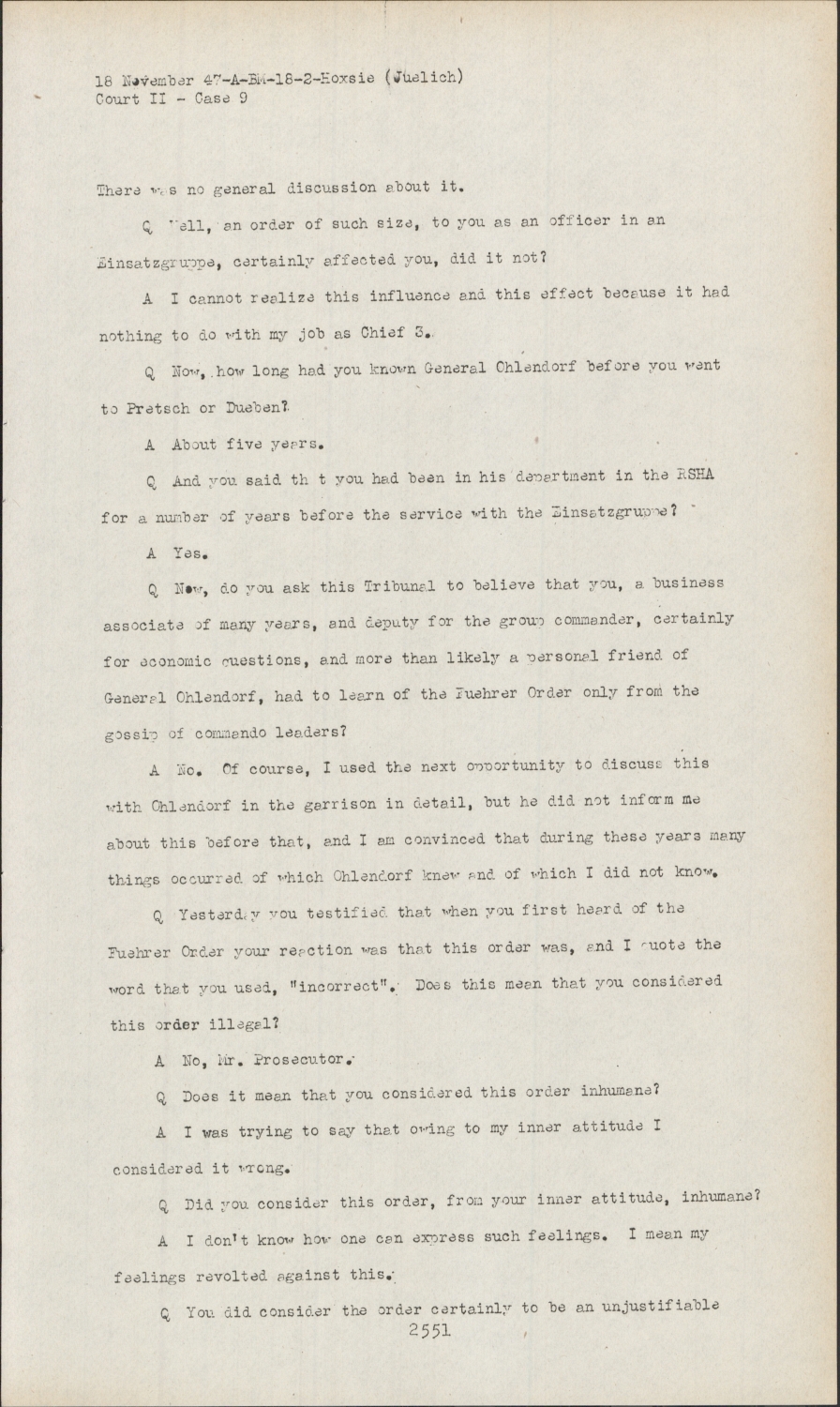
There was no general discussion about it.
QWell, an order of such size, to you as an officer in an Einsatzgruppe, certainly affected you, did it not?
AI cannot realize this influence and this effect because it had nothing to do with my job as Chief 3.
QNow, how long had you known General Ohlendorf before you went to Pretsch or Dueben?
AAbout five years.
QAnd you said th t you had been in his department in the RSHA for a number of years before the service with the Einsatzgruppe?
AYes.
QNow, do you ask this Tribunal to believe that you, a business associate of many years, and deputy for the group commander, certainly for economic questions, and more than likely a personal friend of General Ohlendorf, had to learn of the Fuehrer Order only from the gossip of commando leaders?
ANo. Of course, I used the next opportunity to discuss this with Ohlendorf in the garrison in detail, but he did not inform me about this before that, and I am convinced that during these years many things occurred of which Ohlendorf knew and of which I did not know.
QYesterday you testified that when you first heard of the Fuehrer Order your reaction was that this order was, and I quote the word that you used, "incorrect". Does this mean that you considered this order illegal?
ANo, Mr. Prosecutor.
QDoes it mean that you considered this order inhumane?
AI was trying to say that owing to my inner attitude I considered it wrong.
QDid you consider this order, from your inner attitude, inhumane?
AI don't know how one can express such feelings. I mean my feelings revolted against this.
QYou did consider the order certainly to be an unjustifiable order, did you not?
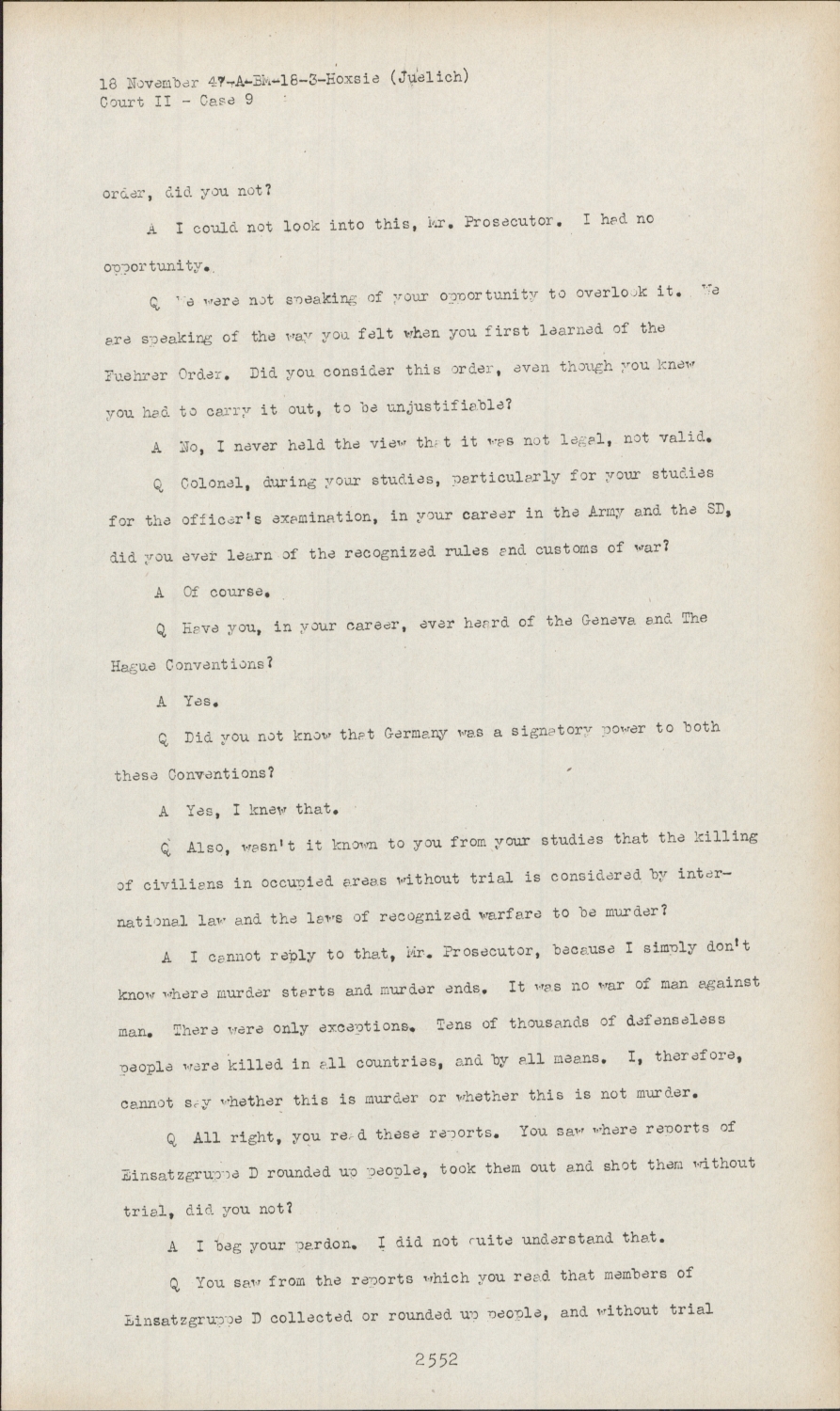
AI could not look into this, Mr. Prosecutor. I had no opportunity.
QWe were not speaking of your opportunity to overlook it. We are sneaking of the way you felt when you first learned of the Fuehrer Order. Did you consider this order, even though you knew you had to carry it out, to be unjustifiable?
ANo, I never held the view that it was not legal, not valid,
QColonel, during your studies, particularly for your studies for the officer's examination, in your career in the Army and the SD, did you ever learn of the recognized rules and customs of war?
AOf course.
QHave you, in your career, ever heard of the Geneva and The Hague Conventions?
AYes.
QDid you not know that Germany was a signatory power to both these Conventions?
AYes, I knew that.
QAlso, wasn't it known to you from your studies that the killing of civilians in occupied areas without trial is considered by international law and the laws of recognized warfare to be murder?
AI cannot reply to that, Mr. Prosecutor, because I simply don't know where murder starts and murder ends. It was no war of man against man. There were only exceptions. Tens of thousands of defenseless people were killed in all countries, and by all means. I, therefore, cannot say whether this is murder or whether this is not murder.
QAll right, you read these reports. You saw where reports of Einsatzgruppe D rounded up people, took them out and shot them without trial, did you not?
AI beg your pardon. I did not quite understand that.
QYou saw from the reports which you read that members of Einsatzgruppe D collected or rounded up people, and without trial sentenced then and shot them to death, did you not?
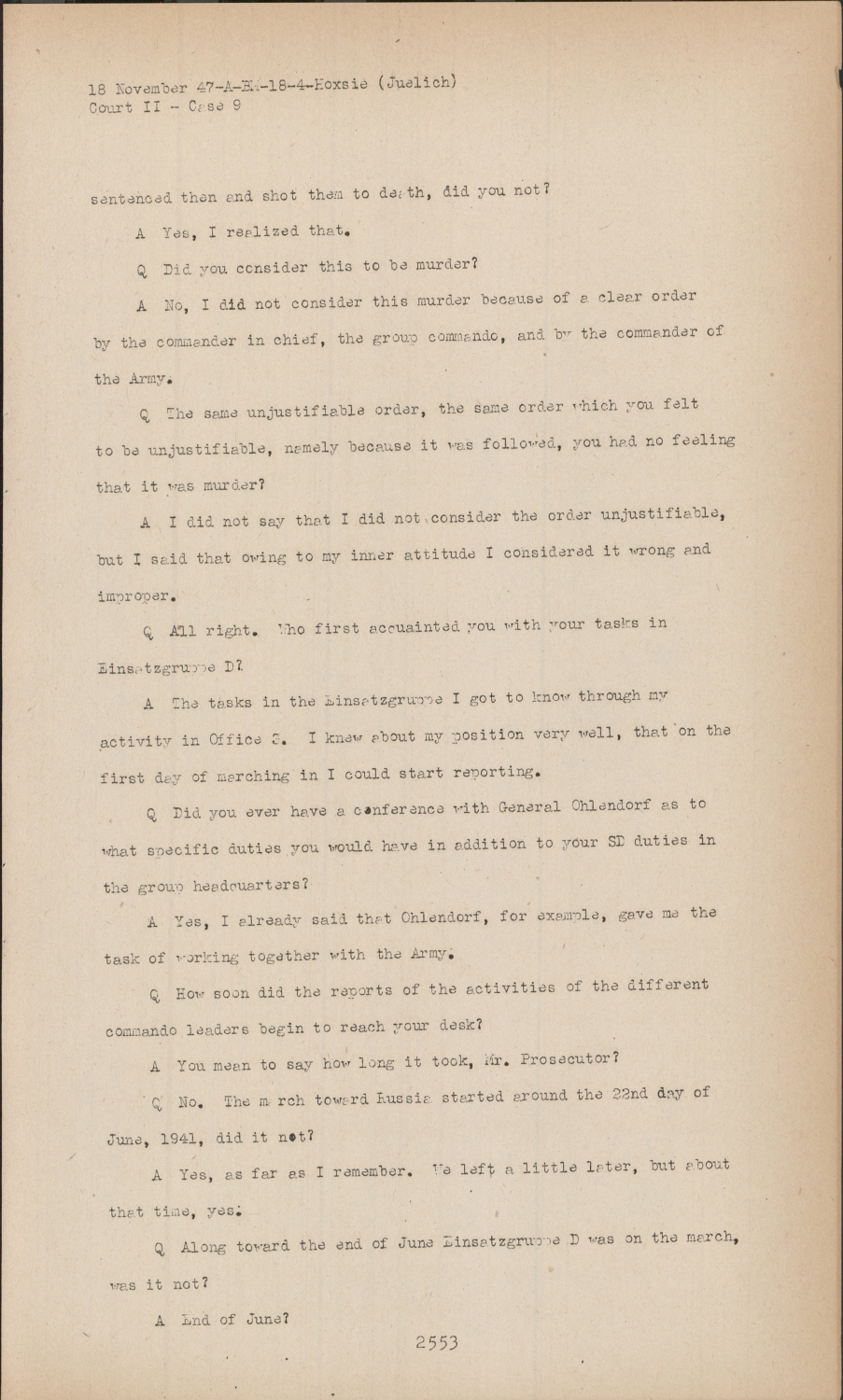
AYes, I realized that.
QDid you consider this to be murder?
ANo, I did not consider this murder because of a clear order by the commander in chief, the group commando, and by the commander of the Army.
QThe same unjustifiable order, the same order which you felt to be unjustifiable, namely because it was followed, you had no feeling that it vas murder?
AI did not say that I did not consider the order unjustifiable, but I said that owing to my inner attitude I considered it wrong and improper.
QAll right. Who first accuainted you with your tasks in Einsatzgruppe D?
AThe tasks in the Einsatzgruppe I got to know through my activity in Office 3. I knew about my position very well, that on the first day of marching in I could start reporting.
QDid you ever have a conference with General Ohlendorf as to what specific duties you would have in addition to your SD duties in the group headquarters?
AYes, I already said that Ohlendorf, for example, gave me the task of working together with the Army.
QHow soon did the reports of the activities of the different commando leaders begin to reach your desk?
AYou mean to say how long it took, Mr. Prosecutor?
QNo. The march toward Russia started around the 22nd day of June, 1941, did it not?
AYes, as far as I remember. we left a little later, but about that time, yes.
QAlong toward the end of June Einsatzgruppe D was on the march, was it not?
AEnd of June?