THE MARSHAL:The Tribunal is again in session.
DR. MAYER:Dr. Erich Mayer for Klingelhoefer. Your Honor, I ask the High Tribunal that the defendant, Klingelhoefer, be excused tomorrow. Tuesday, and the day after, Wednesday, in the order to prepare his examination and excused from the sessions.
PRESIDENT:The defendant, Klingelhoefer, will be excused from court tomorrow, Tuesday, and the following day, Wednesday, in order that he may prepare his defense.
DR. MAYER:Thank you, Your Honor.
WERNER BRAUNE - Resumed CROSS EXAMINATION (Continued) BY MR. WALTON:
QDoctor, before the afternoon recess we were discussing Document Book IIID, page 62 of the English, page 104 of the German, Document NOKW 584, which is prosecution's exhibit 165. Doctor, did you hear me cite this document before?
AYes,Yes I did.
QLet me call your attention to the beginning of page 105 which is about two-thirds of the way down, of the page 62 of the English text, Your Honor, where Major Risen says "These", and he refers to the 1184 man who were picked out, "were marched in close ranks and guarded by 90 soldiers of the anti-aircraft unit, some SS leaders, and me, in a more then one hour's march, to the place of execution and shot there". Now, you have testified that there was only one SS leader there, being yourself. Did you march with these condemned men to their place of execution?
AI want to make it quite clear between Simferopol and Eupatoria I was the only SS leader who went along. On the place of execution, as far as I remember, the men of the subcommando-
PRESIDENT:Witness, Mr. Walton asked you a very simple question, did you march with the men to be executed--now please answer that question.

THE WITNESS:Yes, Your Honor.
PRESIDENT:All right, now give us the next question. BY MR. WALTON:
QThen your testimony in direct examination that you only witnessed one execution, that one at Simferopol, is not exactly correct, is that true now?
AI do not remember that it says in my affidavit that I only witnessed one, but it is possible that when I talked to Mr. Wartenberg I said it to mean that I personally only witnessed one execution of Jews. Here a retaliation measure was concerned, shooting of partisans and saboteurs. I expressly told Herr Wartenberg at the time that I was quite prepared to answer him quite openly about this as I had done about the event in Simferopol.
QDoctor, what estimation can you make of the number of people executed your commando during your term as commander of the unit?
AMr. Prosecutor, I have already repeatedly I cannot name any figure.
QWere you held in prison in Oslo, Norway?
AYes, I already said that I was in prison in Norway for almost two years, and for 15 months in single cell.
QYou were held in Akershuus prison in Norway, weren't you?
AAt first in Akershuus until the middle of September 1946, then for a very brief time I came into a camp and was told that no procedings against me was to be expected, then two comrades escaped from this camp, 25 men of us were returned to the prison because of this.
QYou have answered my question that you were held in Akershuus prison?
ANo, not yet, Mr. Prosecutor. I returned to Akershuus October 1946. After another four weeks I came to the examination prison, Molokar. I don't want to give the impression that I was only in Akershuus. Their proceedings were discontinued and I was brought back in the internment camp.

QBut for a time you were hold in Akershuus Prison, were you not?
AYes.
QNow, were you ever interrogated after the capitulation of Germany, while you were in Akershuus Prison?
AI was interrogated there once by an English sergeant and apart from that several times by Norwegian officials, but this did not concern myself or anything I was being charged with, but I was interrogated as a witness for other matters. For my own case, I was not questioned on charges against me, On the 29th or 30th of March 1947 I was interrogated for the first time.
QNow, you state you were interrogated at least once by a British sergeant. Did this British personnel ever interrogate you on your Einsatz activities?
AYes. He asked me, whether I had been in Russia. I confirmed this. He asked me to make a report about the organization, the task, and the activities, and I did that.
QHe also asked you about some things about the subject of the registration and the execution of Jews, did he not?
ANot about details it the time. He asked me how many shootings, approximately, were carried out. Already then I told him that I could not give him a definite figure. Any figure which I might name could be wrong, and he was satisfied with this.
QDo you remember your admission during these interrogations that your unit, that is, Kommando IIB, disposed of between 1500 and 2000 Jews between November '41 and August of '42?
AI never said that. If anyone says that, he lies, or is mistaken. I know exactly how I explained to the sergeant I could say a hundred or two hundred as well as a thousand or two thousand. Any figure would be as wrong as the other one. I was never given a record of these interrogations or a transcript.

I never signed anything. I made a report in which no figure is mentioned. He did not ask me to give him any figures.
QLet me show you a copy of the Prisoner-of-War Intelligence Service Report No. 93, which is a report on the interrogation of Obersturmbannfuehrer Dr. Braune, Werner. It was made at Akershus Prison, Oslo, on the 23d of March 1946. I show you a copy of this report in German. Now glance through your personal history and see if that is generally correct. Does that reflect proper dates and the proper facts.
AI believe I have to read it from the beginning, On the first page there is the first mistake: "November 1937, employed in the SD Main Office." I never made any statement, but that I came to the SD on the 18th of November 1934. I never asserted that I was Chief of the Police Office in Koblenz, but I always asserted that I was Deputy Chief there. Then the expression gives entirely the wrong picture that I was in charge of the Executive Office of the German Student Association. An Executive Office of the German Student Association did not exist. I said what was my task there.
QOutside of those you have pointed out, the information is essentially correct, is it not?
APlease may I read through, Mr. Prosecutor? I cannot make any statement before I have read it, because I see another mistake again. It says in November 1932 I joined the SS. That is not true.
QIndicate when you have finished reading it.
AMay I not mention the mistakes as I find them. Otherwise I will have to start all over. There is the next mistake, I became SS Untersturmfuehrer in November 1935, 1935 not 1936.
Mr. Prosecutor, what values can such a statement have? Please read the sentence, "He rose to an important position in the Third Reich by entirely disregarding any moral law."
THE PRESIDENT:Witness, Mr. Walton, insofar as this document points out facts you may call upon the witness to confirm the facts, deny them or alter them.

MR. WALTON:Yes, sir.
THE PRESIDENT:But where the statement merely contains opinion, the opinion of someone else, you certainly cannot ask this witness to pass upon that opinion, and we see no probative value whatsoever in these statements by this anonymous individual as to the character of the witness, and we will inform the prosecution that the Tribunal will absolutely disregard any statement in the document passing upon the witness? character.
MR. WALTON:If Your Honors please, I haven't offered it,
THE WETWESS:Your Honor, that is whatdisgusts me so much that it is asserted here in one sentence that I completely disregarded all moral laws without giving one reason for this.
THE PRESIDENT:Witness, I think the Tribunal has come to your defense in this instance and I don't knew whether you can argue it better than the way we have put it.
MR. WALTON:May I say something at the present time, Sir?
THE WITNESS:I am very grateful, Your Honor.
MR. WALTON:I haven't offered this document at the present time into evidences I merely asked him if his personal history was correct. The next question I would like to ask him; the paragraph headed "Activity on the Russian Front," is that substantially true, and I think if I go on, Sir, I'll prove my contention that at least it wasreported that this witness told this British official that he himself or his kommando accounted for between 1,500 and 2,000 Jews.
THE PRESIDENT:Well, we have indicated that, where a definite objective fact is indicated in the document, certainly you can question him on it.
MR. WALTON:Well, I didn't ask him to read it - of course, he has a right to read it, Sir -- but I didn't ask him to comment on this man's personal estimation of the man.whom he interrogated. This was Dr. Braune at the time.
THE WITNESS:Your Honor, but I would like your permission, if this document is to be submitted, that as far as facts are stated, I can comment as to the truth.
DR.MAYER (ATTORNEY FOR THE DEFENDANT BRAUNE): Your Honor, if I have not taken part in the debate about this document until now, the only reason is that I considered it important that my client on the basis of some challenges, would show up some obvious errors and should clarify right from the start that his statements which he made here under oath are in contradiction to the statements in this document. I do not see the value of further discussions concerning this document, since the document submitted here is not in proper form and also the inconsistencies could only be proved if the witness was brought here. Therefore, I object to the further submission of this document and the explanation of its contents.
THE PRESIDENT:Mr. Walton, we are of the opinion from a quick scrutiny of this document that the prosecution should withdraw it. If the prosecution does not withdraw it, we will refuse to accept it.
MR. WALTON:As I understand it, Sir, anything of a probative value can be introduced by the prosecution on cross-examination. I think the objection to this document would be in order when it is offered into evidence. I merely want to question him.
THE PRESIDENT:You have laid the ground work for the crossexamination of the witness on his interrogation in Oslo, so that part is entirely in order, but you have not laid the ground work for authenticity and probative value of this document, in order to submit it as a document.
MR. WALTON:That is all I want, Sir.
THE PRESIDENT:We will permit you to use it in cross-examination, because the witness admits that he was interrogated, but under no circumstances in its present condition can it be accepted as a document in this trial.
MR. WALTON:I am fully aware of that, Sir, and at the time of submission the proper certificates will be attached Since I have to defend this action. Sir, I state, in my place, that this is an official communication from the War Crimes Commission in London, which was sent to us in the normal course of business, and the proper certificates of the person, who received it in the mail will accompany the document at the time it is formally introduced into evidence.
THE PRESIDENT:Certainly that type of authentication is not apparent now.
MR. WALTON:Precisely, Sir, neither is the document offered into evidence.
THE PRESIDENT:Very well,
DR. MAYER:Your Honor; I only want to point to my former explanations and I have nothing further to add, I hardly believe that the fact of the original of this document, which I do not contest, has any value here as concerning the probative value, because the form in which documents are to be submitted until new has not been kept to with this document. I contest that this document has any probative value and therefore I do not seewhy it should be discussed at all.
THE PRESIDENT:Well, Dr. Mayer, the ruling is as follows: The court will not accept it. The Tribunal will not accept the document in its present form. It may be used for the purpose of crossexamination only, because the witness has admitted submitting himself to an interrogation in Norway, Then the document is authenticated and then submitted; the Tribunal will at that time determine, whether it has any probative value and will be accepted asan exhibit in the case.
DR. MAYER:Very well. I understand.
Q (By Mr. Walton) Witness, let us proceed then to the paragraph headed "Activities on the Russian Front." Is this statement as it appears in this report of this interrogation essentially correct?

AThis paragraph "In October 1941, the prisoner via the RSHA was sent to the Eastern Front". He proceeded to Nikolajew and reported to Oberfuehrer Ohlendorf, at that time the Chief of Einsatzgruppe D. In November 1941, Einsatzkommando 11b wasgiven to his charge, which was in Odessa at the time." This paragraph is right, These are my own statements.
QAll right, new let us proceed on to the paragraph which is headed "Tasks of SD Einsatzkommando."
MR. WALTON:Page 3 of this document, Your Honor.
Q (Continued) Particularly sub-paragraph d, which is headed. "Registration and Execution of Jews." I would like for you to read that subparagraph D and when you have finished, please indicate to me so that I can ask you a question on it.
AThat is wrong too, Mr. Prosecutor. I regret very deeply that Sgt. Lessing did not forward my report as well because that would clarify the matter I told him quite unambiguously that this was a Fuehrer Order, which I did not receive in writings I don't know why he should write in spite of this statement that he maintains that this order came either direct from the Einsatzgruppe or from the Wehrmacht.
QWitness, there must be some wrong translation of this document, because in my document it says that the prisoner, which is you, denies any knowledge of a written order, "denies any knowledge". Does your document say that you deny my knowledge.
AYes, the written order. I never said that I saw a written order and one can formulate it this way, saying, no, I never saw a written order, but may I point out here, and I think you are right, Mr. Prosecutor, that in fact decisive errors were made, because obviously you mentioned the figure 15,000 to 20,000 and I now reed about 1,500 to 2,000. In fact at the time I said, and I report this now, I can not give any figure. 100 to 200 would be just as wrong as 1,000 to 2,000, whether Sgt. Lessing deduced from this that 1,500 should be right, I didn't know. I never gave him that figure.
QDid you ever tell him that as head of a unit you bore full responsibility for this atrocity?
AAt the time I did not talk about atmocities and in my direct examination here I explained that these things happened under my responsibility, as the Fuehrer order had been given,
QAll right Would you stand by the statements which you made in Norway today?
AIn that case, I ask you to submit my report so that I can comment on it. I regretted at the time and under these circumstances I regret it even more that Sgt. Lessing after the interrogation did not keep a record which he asked me to sign, because in that case, my written statement would exist now. If I had read any such a thing at the time I would have objected to it then.
QThen you state that certainly in this respect that 1,500 to 2,000 deaths were never admitted by you while you were in Akershus prison in Norway?
AI can only repeat or confirm what I said before. I cannot say anything more. I explained that I did not know any figure. As an example I said that 100 to 200 might be just as wrong as 1,000 to 2,000.
MR. WALTON:The prosecution has no further questions at this time.
EXAMINATION BY THE PRESIDENT:
QWitness, do we understand by what you just said that you didn't mention any figures at all to the the interrogating official in Oslo?
AI replied to Sgt. Lessing questions, "Well Mr. Braune, how many were there approximately?" I answered, "Well, Sgt. Lessing, I cannot give you a figure. 100 to 200 may be just as wrong as 1,000 to 2,000." That was my reply and he was satisfied.
QWe didn't understand that the illustration which you gives us here was a more repetition of the illustration you had given to the interrogating official. Witness, you participated in the actions against the partisans in the Crimea didn't you?
AYes.
QDid you take an active part in the fighting of the partisans?
AYour Honor, the last great operation I remember where two divisions were assigned -
QPlease answer the question directly. You did take an active part?
AYes, Your Honor.
QDid you lead any detachment into action against the partisans?
ANo, I did not lead any detachment, Your Honor. I had no military training and in that case, in spite of my shoulders troubles, I went along with the Battalion just like any enlisted man. I had no right to give orders, but a Rumanian major had this authority, but in that case, I took part like a simple enlisted man.
QWell, if you took part as an enlisted man, then you must have done some fighting?
AYes, Your Honor. With this Battalion I marched for two days up and down mountains, through woods....
QAll right and when you fought did you use a pistol or a rifle or a carbine?
AAs it was most suitable for fighting in the woods. I had a machine rifle for close range fighting and also my pistol.
QAnd did you have occasion to use those weapons at times?
AYes, on one occasion, once when we tried to get on a mountain where there were some ruins on tap, behind which partisans were hiding, we suddenly were attacked by machine guns. Apart from that grenades were thrown at us from another place.
QAnd did you retaliate with grenades when grenades were thrown at you.
ANo, your Honor, I did not have any hand grenades. Apart from that we were not so close to them, but we also fought with automatic rifles and also with machine guns, I believe. The partisans then withdrew after they had been fighting about a quarter of an hour and they retired and we pursued them. One of my comrades managed to shoot one of the partisans when escaping, but apart from that they managed to get down the other side of the mountain.
QWere you over close enough that grenades could be used in disposing of the partisans?
ANo, Your Honor, No. Your Honor. That was the only occasion, when we actually came in contact with the enemy. Apart from that the partisans always left.
QBut you did act as a soldier in these combats?
AYes, Your Honor.
QAnd then how do you reconcile that with the statement that you could not join the Wehrmacht because of your physical condition? If you could use a pistol, fire a carbine, go on long marches, climb hills, what prevented you from making a good Wehrmacht soldier?
AYour Honor, I can only reply to you, the Army examined me. The Army found that my shoulder joints were injured and this so seriously that even when I dressed and undressed I dislocated my shoulder joints and that at night when sleeping during dreams I also dislocated them.

I passed through several university clinics because of this and owing to this fact the Army found me unfit.
QWell, can you explain, why you should dislocate your shoulder putting on your shirt and yet be able to fire a carbine and a rifle and not have any difficulty?
AYour Honor, may I assume you that constantly two comrades were with me and particularly my driver, who also witnessed how I did. located my arm in the Caucasus.
QBut you did fire the gun?
AI was present and therefore I did it, even if I might dislocate my arm. I regarded it my duty to stand by my men.
QVery well. Looking over your personal record, it seems that you obtained some decorations and you received the usual Yule Candlestick, is that right?
AYour Honor, at the moment I don't have the document in front of me, but, in fact, I did get the Yuletide Candlestick.
QNow, you can't tell me you can't remember what medals you received. You would certainly be the only soldier in the world who didn't remember that.
AI do remember that.
QSo you received the Deathhead Ring, the Sword of Honor, and the Yuletide Candlestick.
AYes, I got all three , Your Honor.
QNow was this Yule Candlestick bestowed because of the executions which took place just before Christmas, 1941?
AYour Honor, I received the Yuletide Candlestick, I believe it was Christmas 1935, at the latest, 1936, as far as I remember, because when I married I already had it.
QYou did not receive any decoration for the action in the Crimea?
AFor the operation in the Crimea? No, I did not. If I learned it correctly, I was recommended for the Iron Cross Second Class, because of my participation in the Anti-Partisan fight, but I never received the Iron Cross.

Later on, when I was at home, I got a War Merit Cross, Second Class. At the time I don't know how many hundreds of thousands or millions of Germans had it already who had never been at the front.
QDo you consider yourself a religious person?
AI think I can answer this question in the affirmative with a clear conscience.
QYou left the church?
AYes, Your Honor.
QNow, do you celebrate Christmas every year?
AI have celebrated it every year, Your Honor.
QWhen you celebrate Christmas, does it hove a religious significance or is it merely a period of celebration without any religious implication?
AI am conscious of it, Your Honor, that Christmas is a festival of Christian origin, but I believe every German knows that it is the most beautiful festival among German families and I always celebrated it in that spirit, I feel.
QAnd did you celebrate Christmas 1941 in the field with your men?
AI remember the Christmas celebration very well which Herr Ohlen-dorf conducted and I like to remember it.
QAnd did it have a religious significance?
AWell, Your Honor, there was no clergyman present and he did not give a sermon. I believe those who heard Ohlendorf speak about religious matters only once will confirm that he was very well able to touch upon religious questions.
QDid he make a speech on that day, on Christmas Day of 1941?
AYes, he talked to us.
QAnd did he talk on religious matters?
AYour Honor, I cannot give any details of the words any more. I don't know whether he mentioned Christ, but I know Herr Ohlendorf's attitude on all this.
QWhat was his attitude as he delivered it in his speech? What did he say that was of a religious significance?
AYour Honor, I really cannot give details any more.
QDid anybody offer any prayers on Christmas Day of 1941?
AYour Honor, I do not know. I was not present, but I feel certain that in those days in particular many persons said prayers, because the situation in which we were was such that we did not know whether we would still be living within the next few days, whether we would fall into the hands of the Russians.
QWere any prayers offered for the thousands of Jews that you had just killed ten days before?
A.Your Honor, I don't know whether anyone prayed for these many thousands of Jews.
Q.- All right. Now... when the order came down from the Army that you had to kill these ten thousand Jews before Christmas, was any objection offered that it was highly inopportune to kill these defenseless people during the religious period?
A.- No, your Honor, nobody mentioned this to me.
Q.- Did you have any misgivings about ordering the execution of these Jews on the Eve of Christmas which you, as a religious person, celebrated every year?
A.- Your Honor, the order had come from the Army. Perhaps I would have preferred it at the time if it had not come at Christmas time, about two weeks before Christmas. Perhaps if the decision had been left to us the measures would have been carried out later. Our thoughts at the time were home with wife and children.
Q.- Were there any women and children among those Jews who were executed just before Christmas?
A.- I already said, Your Honor, I never saw any children. There were women among them.
Q.- You know that children were executed, don't you?
A.- Yes, Your Honor. That was the most difficult part of this order, for us.
Q.- Now, in all the time that you were an Einsatzkommando leader, did you, at any time, just out of sheer sympathy, release some defenseless woman or some whimpering child of the Jewish faith, who was scheduled for execution?
A.- Your Honor, I did not see any whimpering child. I said how hard it was for us, and for me, and my men, to have this order carried out.
Q.- Well, you know that if children -
A.- No, no exceptions were made to that effect, as you mention.
Q.- Yes. And you know that since children were killed, that they certainly wouldn't go to their death laughing -- since you seem to take objection to the phrase "whimpering child."
A.- No, your Honor, I do not object to it. I don't think that anyone went laughing -- that none of these many hundreds and thousands of women and children who had to die in this war.
Q.- You joined the SS or the SD - and then eventually the SS, voluntarily?
A.- I volunteered on the 18th of November 1934, to join the special formation of the SS - which is called the SD.
Q.- And you joined the National Socialist Party voluntarily?
A.- Yes, I had on 1 July -- that is, I applied to become a member on 15th of May 1931.
Q.- And you were familiar with the National Socialist program?
A.- I knew it, your Honor, yes.
Q.- And you knew that it was definitely anti-semitic?
A.- Your Honor, perhaps it would be necessary to explain the idea of anti-semitism here... but I know that this program attacked Jewry.
Q.- Yes. And you know that the program called for the disfranchissement of the Jews?
A.- Your Honor, I don't know what You mean by disfranchisement.
Q.- That they were deprived of the right of citizenship, and the right to vote.
A.- Yes, they lost their civic rights because of the Nurngerg laws, through a national law.
Q.- Yes. And you know that in most instances they lost their property?
A.- Your Honor, if I remember it correctly - until 1941 the emigration of the Jews from Germany was assisted and favored -- I cannot say how much money they were allowed to take along, but I think I remember that the rest of their property was to be put on a blocked account.
Q.- Well, you know that in fact they lost their valuables and their property, don't you?
A.- The final result came about because of the war, and at the end, in April or May 1942, when the final solution has been ordered... this was the final result. But, your Honor, we had no idea of this and we did not think of it when we joined the party. It was never mentioned when I came to the SD, and this final solution was never mentioned when I went to the East.
Q.- Did you know what happened on November 10, 1938?
A.- Yes, your Honor, I know that. At the time I was in Munich myself and that evening I was together with Herr Ohlendorf.
Q.- And did you approve of what happened?
A.- No, your Honor. I wish the SD report still existed which I made from Muenster at the time.....they would not only show how many people among the population thought about this, but it would also prove how we thought of it.
Q.- Well, it was very obvious to you at that time that National So cialism was leading to stricter and severer measures against the Jews, was it not?
A.- Your Honor, I don't know what you mean by more severe measures; in any case, such a solution as come about in practive, I never thought of. To be quite honest, I could not understand it.
Q.- Well, but you could see, because of your position, that from time to time stricter measures were enforced... they were being sent to concentration camps.... they had to wear certain insignie on their bodies...their property was taken away from them...Synagogues were being burned down....You could see this progression of hostility towards the Jewish race, couldn't you?
A.- Your Honor, I do not remember any case where a Jew, just because he was a Jew, was sent to a concentration camp - apart from the moment on, when they were sent to the East in order to be eliminated.
I can say with a clean conscience that I heard about this measure only after the capitulation and I admit quite openly when I heard it for the first time in Norway at first I thought it was just propaganda.
Q.- It is very difficult to comprehend how you could recognize that a Jew would be sent to his death because of his nationality, and yet not recognize that he could be sent to a concentration camp and merely be deprived of his liberty. How do you reconcile those two statements?
A.- I don't know what you mean... at the time, your Honor. Do you mean the measures in the East, your Honor?
Q.- Well,you knew that the Jews were being killed.
A.- But, your Honor, may I emphasize again, in the East it was expressly ordered as part of the entire events... a Fuehrer order was issued for the sake of security. At the time, nobody was told that the entire Jewry in Europe should be eliminated/
Q.- You know who Heydrich was, of course, don't you?
A.- Yes, your Honor.
Q.- Did you have any contact with him?
A.- I said, your Honor, that I never met Heydrich personally, and to discuss things with him. I only heard him when he made speeches during meetings.
Q.- Do you know that on July 31, 1941, he ordered the complete solution of the Jewish question?
A.- No, I do not know that, your Honor. I did not know what he meant by complete solution at the time... all I know is that at the time I was in charge of the State police office in Halle, the Jews were still there. I was never told that these Jews were to be eliminated.
Q.- You know that Heydrich sent a telegram to all officers of the Gestapo and SD on November 10, 1938, urging the pogroms, didn't you?
A.- Your Honor, I never heard about it, that in a telegram... in November 1938 he sent a telegram.
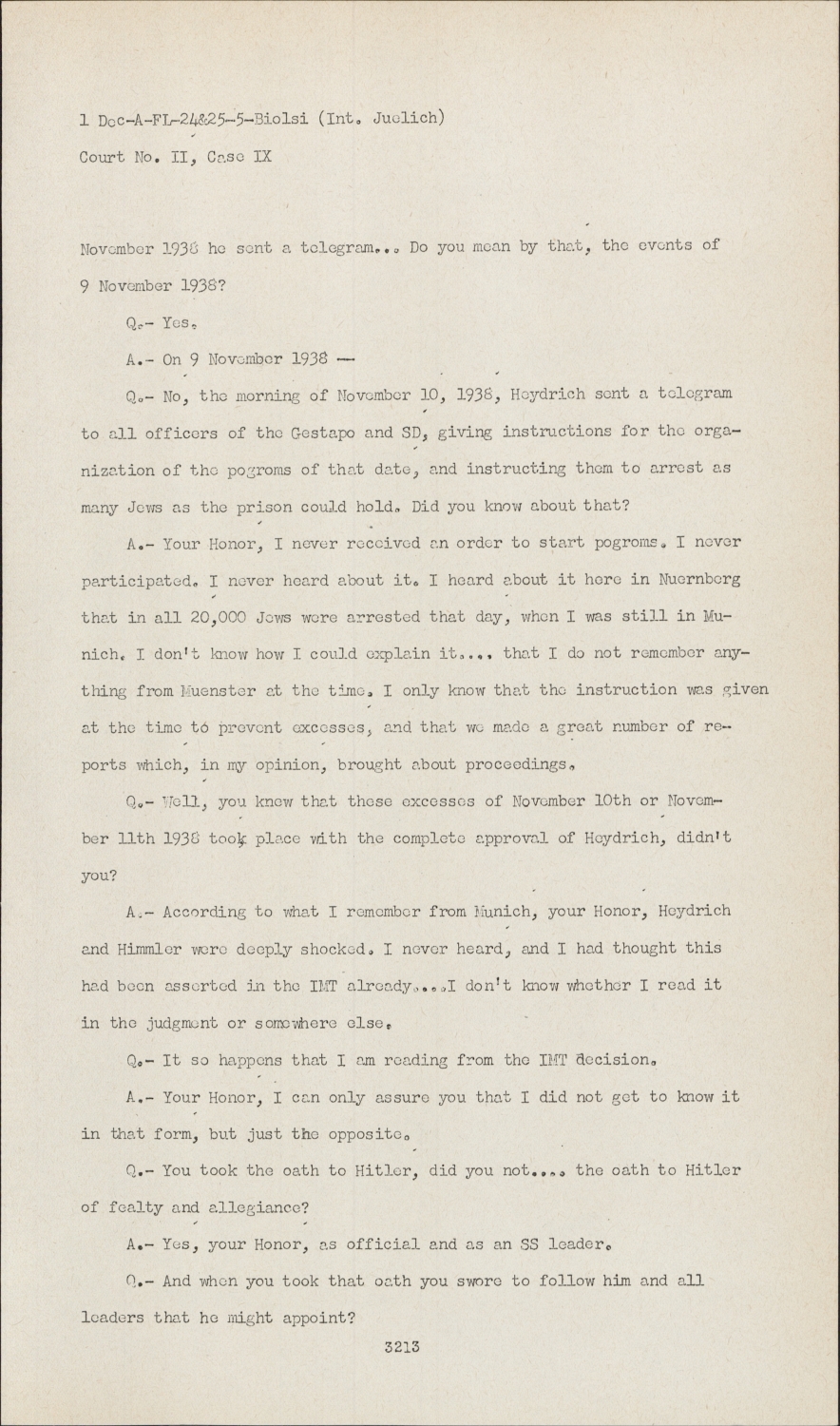
.. Do you mean by that, the events of 9 November 1938?
Q.- Yes, A.- On 9 November 1938 -Q.- No, the morning of November 10, 1938, Heydrich sent a telegram to all officers of the Gestapo and SD, giving instructions for the organization of the pogroms of that date, and instructing them to arrest as many Jews as the prison could hold.
Did you know about that?
A.- Your Honor, I never received an order to start pogroms. I never participated. I never heard about it. I heard about it here in Nuernberg that in all 20,000 Jews were arrested that day, when I was still in Munich. I don't know how I could explain it.... that I do not remember anything from Muenster at the time. I only know that the instruction was given at the time to prevent excesses, and that we made a great number of reports which, in my opinion, brought about proceedings.
Q.- Well, you knew that these excesses of November 10th or November 11th 1938 took place with the complete approval of Heydrich, didn't you?
A.- According to what I remember from Munich, your Honor, Heydrich and Himmler were deeply shocked. I never heard, and I had thought this had been asserted in the IMT already....I don't know whether I read it in the judgment or somewhere else.
Q.- It so happens that I am reading from the IMT decision.
A.- Your Honor, I can only assure you that I did not get to know it in that form, but just the opposite.
Q.- You took the oath to Hitler, did you not.... the oath to Hitler of fealty and allegiance?
A.- Yes, your Honor, as official and as an SS leader.
Q.- And when you took that oath you swore to follow him and all leaders that he might appoint?