For the reasons I have stated above this violation of the rules governing the taking of evidence will have to be taken into consideration when examining the value of that evidence.
1.) The document is not complete. Only part of document has been submitted. But the documents must be submitted complete. Wharton Evidence in Criminal Cases, p. 666:)
2.) The authenticity of a document must be proved by a witness who is to be confronted with the defendant, and sworn in about where the document has been found, the Prosecution has not furnished that proof (Wharton, ibid, page 391)
3.) The very best means of evidence must be presented. In consequence, hearsay evidence is precluded.
The document contains a statement of one Scharfuehrer Goebel. The document shows that Scharfuehrer Goebel got his information from Hauptsturmfuehrer Sachnaut. Thus, his statements are based upon information received by third persons, so that this is hearsay evidence.
4.) A person accused can only be convicted on the basis of a statement made under oath. (Whalton, ibid., p. 682.) To convict Naumann on the basis of this document would, therefore, be in contradiction to this main principle of evidnce.
Therefore, Naumann's assertion that he never gave an order for the killing of those people, may not be regarded as being refuted. In any case, there are well-founded doubts about the correctness of the facts stated in the document. These doubts have to be evaluated in favor of the defendant, according to the general principles governing the law of criminal procedure.
Incidentally, Naumann would not even have been able to give such an order, because the persons allegedly killed were members of a German organization for the so-called operation "Zeppelin". This was an operation the members of which were to be employed by Office VI of the Reich Main Security Office together with the German Wehrmacht behind the Russian front.
Thus, Naumann had no power of command, no disciplinary power over the members of that operation. This is clearly shown also by the documents submitted by the Prosecution themselves.
Since, consequently, Naumann has given no orders for executions, nor forwarded such orders to the units under his command, what matters is only the answer to the following questions: Did Naumann, before the executions were carried out, have any information about these measures? Did he have the power and the opportunity to prevent or to stop them? Did he fail to take action?
An affirmative answer to these questions would be the actual presupposition for the basis of a penal responsibility on the part of Naumann.
As for question 3:
It has not been proved that Naumann had any knowledge previous to the carrying out of the individual executions, (Rec. p. 826, 834, German, p. 819, page 828 English.) Generally, it is true, Naumann knew, as he admits himself, that executions had been carried out by units of his Kommandos. Yet, he acquired this knowledge in all cases only through the reports of the Einsatz- and Sonderkommandos about the executions which had already been carried out. But he had no information beforehand about the individual executions. In this connection it must be taken into consideration that the Einsatz- and Sonderkommandos were to a large extent independent. (Rec. OHLENDORF, p. 694 /95, OTT p. 3804/05, NAUMANN 824, 869, 822, German, 818, 858, 815 English.) This independence with that the Kommando chiefs had received, previous to the Russian campaign, the Fuehrer order, and, to be precise, in the same way as the Einsatzgruppen Chiefs themselves. The meaning of this issuing the order to the Leaders of the Einsatzkommandos can only have been to authorize them to take action without special orders by the Einsatzgruppen chiefs. If this had not been so, the order would not have been given to the Kommandofuehrers, but it would rather have had to be given in each case first to the Einsatzgruppen Chiefs.
Since a special the individual execution was not necessary, no previous notification was, in consequence, necessary. Such, a procedure would, incidentally, have probably been much too cumbersome and impossible, considering the bad communications and transport conditions in the vast Russian area, the comparatively large territories of the individual Kommando areas, and the samll strength of personnel in the individual Kommandos. That the Einsatz- and Sonderkommandos were independent to a large extent, resulted, in particular from their proper task, namely, to secure the rear areas of the Army and to fight bands and partisans which might appear. (Rec. Naumann, p. 824, 835, 836 German, p. 816, 829, 830 Engl.) From this task there resulted the necessity of taking immediat action which was not allowed to suffer any delay by waiting for instructions from the Einsatzgruppen Chief.
It is true that the Defendant Naumann had to expect executions to be carried out by units under his command on account of the order. But this general knowledge will hardly be deemed sufficient to give an affirmative answer to question 3,) But even if an affirmative answer were to be given to this question, the prerequisites would, in any event, be lacking for number 4 and 5.
A conviction would only be justified if the questions 3.), 4.) and 5.) were to be given affirmative answers, that is, all of them.
As to question 4:
Naumann had neither the power, nor the opportunity to prevent the execution of the orders issued by HITLER and forwarded by HIMMLER and HENDRICH, which had been given to the Einsatz-and Sonderkommandos before NAUMANN took over his position, and thus already existed, when he took over.
What would NAUMANN have been able to do in order to prevent the execution of these orders? Could he be expected to issue instructions to the units under his command not to execute the Fuehrer order? This would have been impossible. But would he thereby really have prevented the execution of the order? Supposing that the units under his command had complied with NAUMANN's instructions, which is very doubtful, since NAUMANN could not cancel an order given by the Fuehrer, what would have happened? The only consequence would have been that NAUMANN would at once have been removed from his post and proceedings started against him for disobedience. But would he thereby have prevented the executions for the future? Certainly not. He would no doubt have been replaced by a successor, who would have shown the obedience required. Thus, NAUMANN would have achieved as little as if by feigning illness or other reasons he had succeeded in being relieved from his position. The Fuehrer order would have remained in existence and would have been carried out, even if NAUMANN had no longer been Chief of the Einsatzgruppe. Naumann's conduct would not have been able to change that. It would have been impossible to NAUMANN to prevent the execution of the Fuehrer order, and this is what only matters in this connection.
Thus NAUMANN cannot have had the power and the opportunity to prevent the execution of the Fuehrer order.
If NAUMANN Had had the power and the opportunity to prevent the executions carried out by the Einsatz and Sonderkommandos, he would surely have used then. In particular, he would never have given such orders himself, for the execution of these orders was not consistent with the spiritual attitude of NAUMANN (Rec. p. 866, German, 855/56, English.) Besides, he never concealed this attitude of his in conversations with the Leaders of Einsatz-and Sonderkommandos. This too has been clearly shown by the evidence. The witnesses OTT and STEIMLE, for instance, have testified that in conversations he had with them, Naumann expressed a mental repudiation (Rec, Steinle, p. 2073/75 2082, German, 2028-2030, 2036, English, Ott, p. 3779, 3832, German, p. 3717, 3770, English.) Still, on these occasions Naumann always remarked that he saw no way of evading the Fuehrer order.
As to question 5:
Since, as has been shown, Naumann did not have the power or the opportunity to prevent the execution of the Fuehrer order or to stop it, there is no basis for a criminal responsibility on the part of NAUMANN. But even if this question were to be answered in the affirmative, a criminal responsibility on the part of NAUMANN would be non-existent, because to have omitted to prevent such a thing does not constitute quilt. It is true, that even an omission can constitute a punishable offense. This is a general principle, both in the German as well as in the American Jurisprudence and practice of law. But, according to those principles the omission can only constitute a punishable offense, when a legal obligation existed to take action. In this connection I refer to Wharton's opinion in his book "Criminal Law" of 1932.
In vol. I, p. 222, Wharton explained that an omission must be based on a violation of duties, in order to be a punishable offense. Omissions are, in his opinion, no basis for a criminal proceeding, unless they constitute a failure in the execution of an obligation which had specially been imposed on the accused. This obligation to act must, as is also generally recognized, be founded upon the law. As to the correctness of this opinion, I refer likewise to the fundamental explanations of Wharton in the book quoted above, where on page 226 he explains that a simple negligence to give assistance is no punishable offense, unless it happened in the course of acting against an obligation specially assumed or imposed. On page 255 of the aforementioned book he amplified that idea by declaring that the failure to give assistance could constitute a punishable offense only if and when this giving of assistance was a legal obligation. Such an obligation, however, did not exist on the part of Naumann. Naumann had such an obligation neither by law nor by agreement, On the contrary, the obligation that had been imposed upon him, was not to prevent the execution of the orders issued by Hitler. In so far his conduct cannot be called guilty.
But even if such an obligation to take action were assumed from general principles of humanity, Naumann would have been unable to act because he was in a state of emergency which made it impossible to carry out the obligations. Such a condition of constraint, however, rules out any guilt, This is in accordance with the generally recognized principles of jurisprudence. May I, in this connection refer again to the conclusive explanations of Wharton in the aore-mentioned book I), where the author explains that the defense may oppose the Prosecution with the contention that the crime has been committed under constraint and force, out of fear of immediate death. Wharton assumes rightly that in such cases, nobody may be found guilty of a crime unless he had the intent and will to commit it.
There is no doubt that Naumann was in a state of emergency as it is presupposed in these explanations. As has been said above, he would only have been able to prevent the executions for a short time through an order which he would have had to give in opposition to the existing order of Hitler, the then chief of state. Apart from the fact that that measure, as I have stated above, would not have had the slightest effect, it would have had the consequence that Naumann would have been prosecuted for serious insubordination. (Rec. Naumann, p. 820 German, p. 813, English) There can be no doubt about the result of such criminal proceedings in view of the severe penalties the SS- and Police Courts used to inflict. Not only Naumann, but practically all the defendants have testified on the witness stand that the death penalty would have been the inexorable penalty for that insubordination. (Rec. Ohlendorf, p. 750, Braune p. 3103/04, 3098, Naumann, p. 820 German, p. 813 Engl.)
Other defendants have declared that there was no possibility to refuse the execution of the orders. (Rec. Ohlendorf, p. 563-65, Braune p. 3110, Sandberger, 2206, Nosske, p. 3480, Klingelhoefer, p. 3959, Steimle, p. 2088/2203.)
If individual defendants have stated that they would have been able to refuse execution of the Fuehrer order, this does not refute the statements made by the afore-mentioned persons; for what matters in each case are the particular circumstances of the individual case.
Thus, Naumann was in a state of emergency, to be precise, in such a state of emergency that no possibility was left to him to act in a way different from what he actually has done.
I have set forth that Naumann did not participate in the carrying through of the Fuehrer Order and that he himself did not give orders for executions.
Even if such a participation could, however, be considered as proven, a punishment because of this would be impossible since Naumann's behaviour would be due to an order issued by Hitler.
That this order did exist and that it existed during the whole period in which Naumann was Chief of the Einsatzgruppe B, cannot be doubted according to the results of the evidence presented. As regards this I particularly refer to the testimony of Ohlendorf (Records pages 533, 524) Blume (Records p. 1811), Nosske (p. 3503-05), who gave a detailed description of the way in which the Fuehrer Order was given to the commanders of the Einsatzgruppen and Einsatzkommandos in Pretsch.
For the examination of the question as to whether, and to what degree, the plea of acting on higher orders precludes punishment, it is first of all of decisive importance according to which law this objection is to be judged.
During the proceedings against Flick and others the Military Tribunal IV declared that it wasnot a tribunal of the USA and therefore did not have to apply American principles, but that it was an international tribunal and that therefore the facts were to be judged according to International Law. (Page 3 of the decision of 22 December 1947). I must suppose that this principle applies generally to the Military Tribunals here and that therefore in this trial the plea of acting on superior orders is to be judged according to the International Law in force at the time of the action.
As I shall set forth, the plea of acting on superior orders was thusfar admissible in International Law. This result cannot be altered either by the London Charter or the Control Council Law No. 10. Charter and Control Council Law No. 10 therefore can only be applied inasmuch as they coincided with the hitherto recognized rules of International Law. No new International Law could, however, be created by the Charter and the Control Council Law No. 10 since individual states cannot establish International Law, but only the community of nations can do so. This is a generally recognized principle of International Law which took root in practice as well as in theory. For the correctness of this conception I particularly mention the statements of the Professor for International Law, Norman J. Padelford, who, in an article published in April 1938, commented upon the Washington Agreement of 1922 and thereby came to the conclusion that, in spite of the consensus of opinion of the five powers present at the Conference, these were not entitled to establish new rules of International Law.
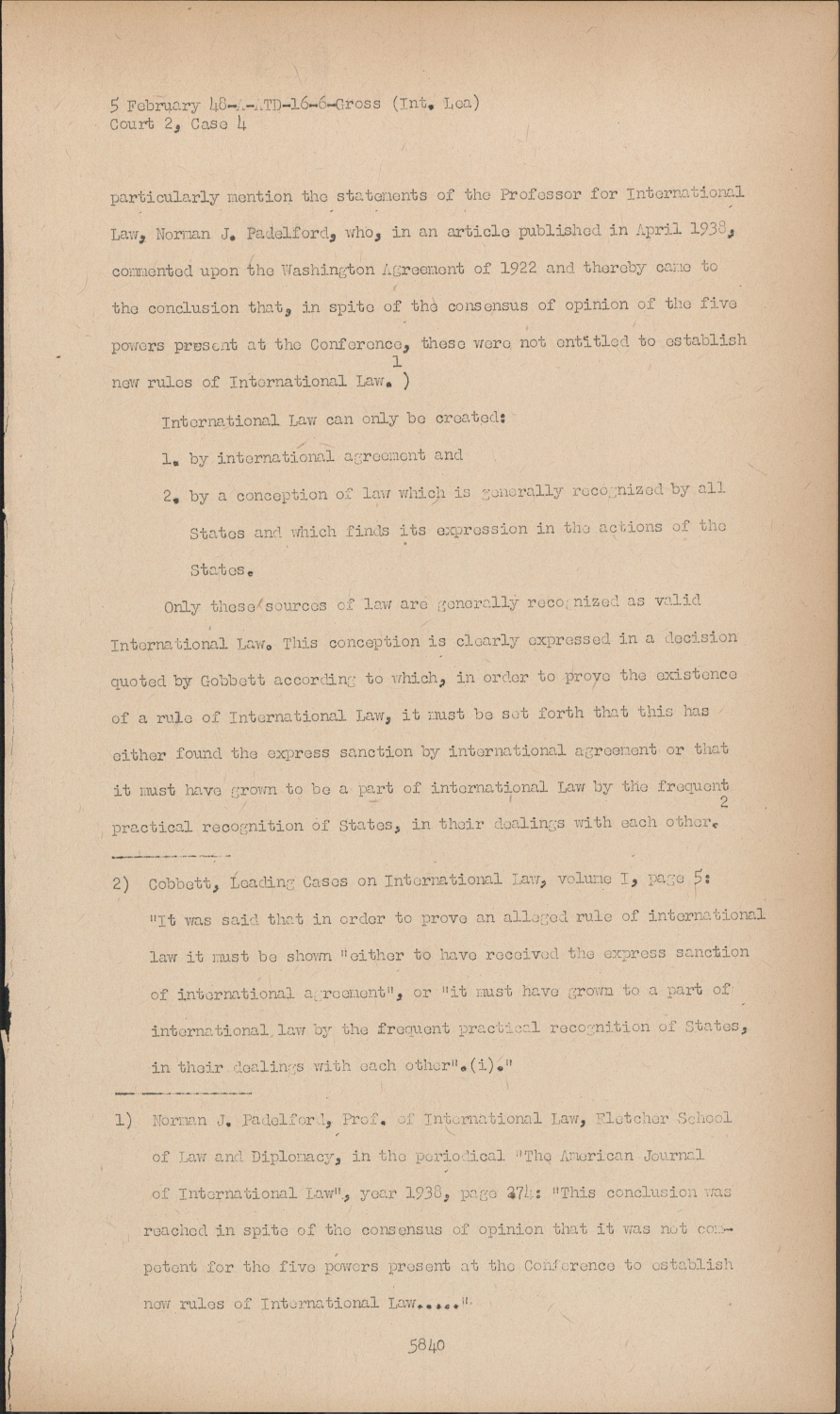
1) International Law can only be created:
1. by international agreement and 2. by a conception of law which is generally recognized by all States and which finds its expression in the actions of the States.
Only these sources of law are generally recognized as valid International Law. This conception is clearly expressed in a decision quoted by Gobbett according to which, in order to prove the existence of a rule of International Law, it must be set forth that this has either found the express sanction by international agreement or that it must have grown to be a part of international Law by the frequent practical recognition of States, in their dealings with each other.2 ------------2) Cobbett, Leading Cases on International Law, volume I, page 5:
"It was said that in order to prove an alleged rule of international law it must be shown "either to have received the express sanction of international agreement", or "it must have grown to a part of international law by the frequent practical recognition of States, in their dealings with each other".(i)." --------------1) Norman J. Padelford, Prof.
of International Law, Fletcher School of Law and Diplomacy, in the periodical "The American Journal of International Law", year 1938, page 274:
"This conclusion was reached in spite of the consensus of opinion that it was not com petent for the five powers present at the Conference to establish new rules of International Law.
...."
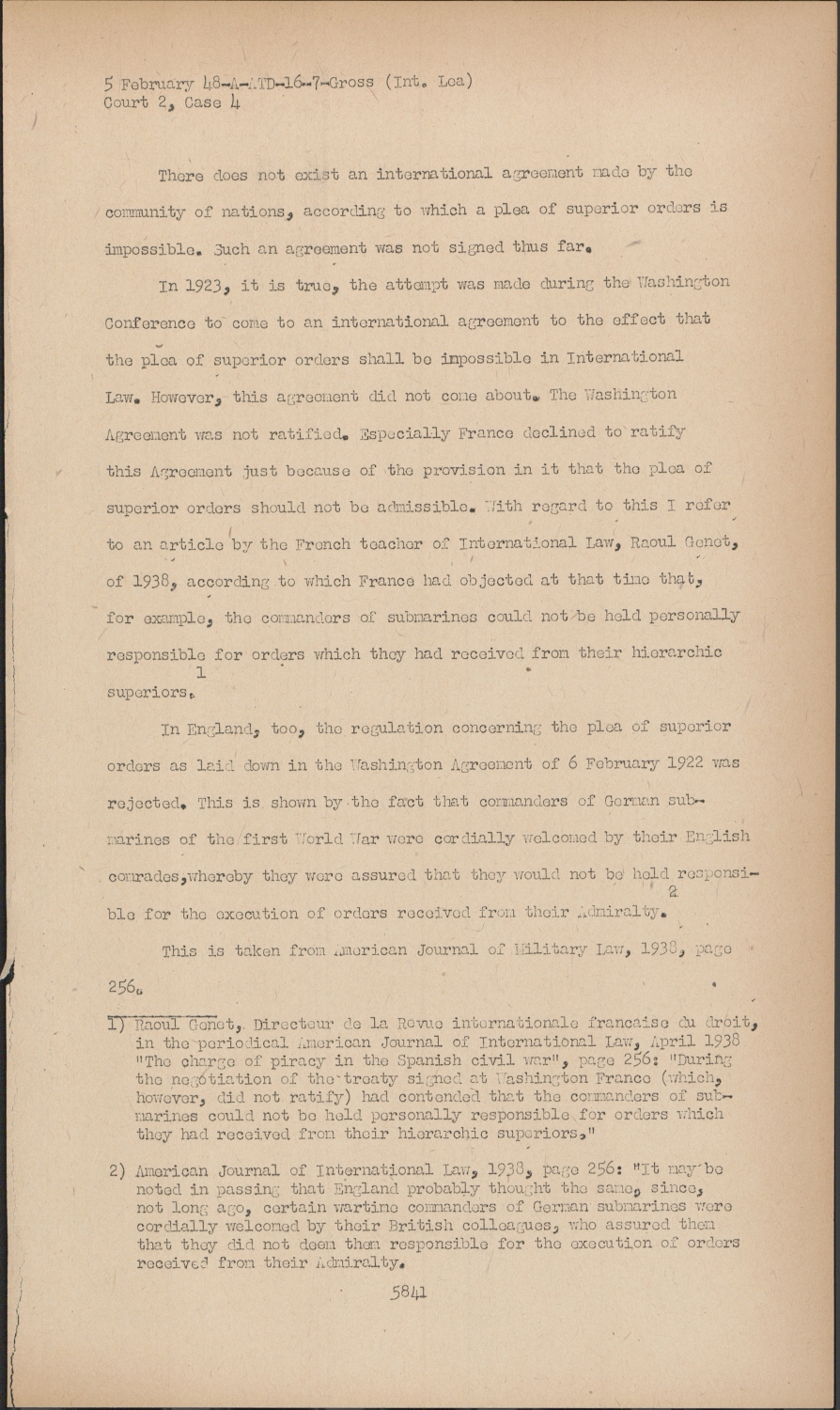
There does not exist an international agreement made by the community of nations, according to which a plea of superior orders is impossible. Such an agreement was not signed thus far.
In 1923, it is true, the attempt was made during the Washington Conference to come to an international agreement to the effect that the plea of superior orders shall be impossible in International Law. However, this agreement did not come about. The Washington Agreement was not ratified. Especially France declined to ratify this Agreement just because of the provision in it that the plea of superior orders should not be admissible. With regard to this I refer to an article by the French teacher of International Law, Raoul Genet, of 1938, according to which France had objected at that time that, for example, the commanders of submarines could not be held personally responsible for orders which they had received from their hierarchic superiors.1 In England, too, the regulation concerning the plea of superior orders as laid down in the Washington Agreement of 6 February 1922 was rejected.
This is shown by the fact that commanders of German submarines of the first World War were cordially welcomed by their English comrades,whereby they were assured that they would not be held responsible for the execution of orders received from their Admiralty.2 This is taken from American Journal of military Law, 1938, page 256.
-----------1) Raoul Genet, Directeur de la Revue internationale francaise du droit, in the periodical American Journal of International Law, April 1938 "The charge of piracy in the Spanish civil war", page 256:
"During the negotiation of the treaty signed at Washington France (which, however, did not ratify) had contended that the commanders of sub marines could not be held personally responsible for orders which they had received from their hierarchic superiors."
2) American Journal of International Law, 1938, page 256: "It may be noted in passing that England probably thought the same, since, not long ago, certain wartime commanders of German submarines were cordially welcomed by their British colleagues, who assured them that they did not deem them responsible for the execution of orders received from their Admiralty.
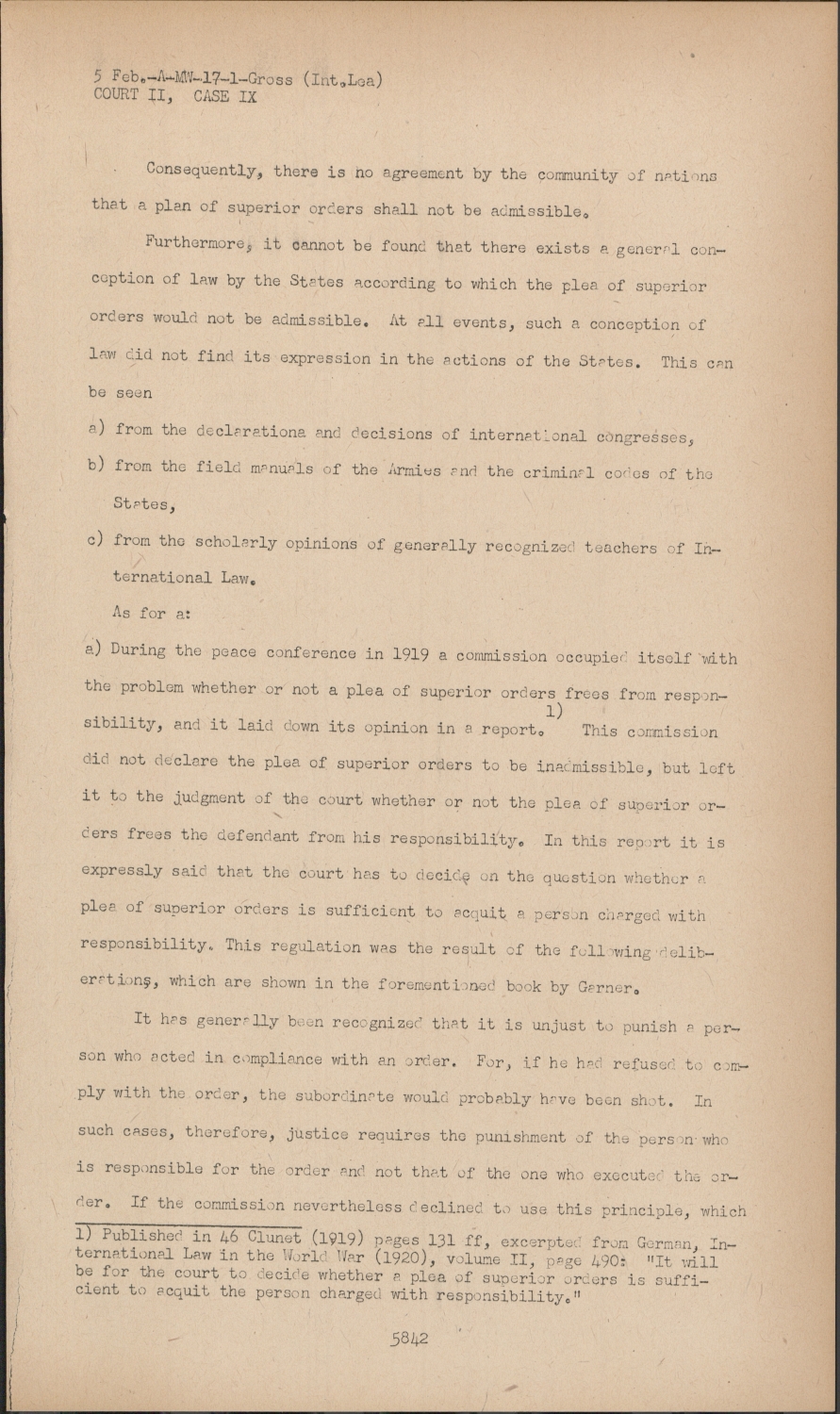
Consequently, there is no agreement by the community of nations that a plan of superior orders shall not be admissible.
Furthermore, it cannot be found that there exists a general conception of law by the States according to which the plea of superior orders would not be admissible. At all events, such a conception of law did not find its expression in the actions of the States. This can be seen a) from the declarations and decisions of international congresses, b) from the field manuals of the Armies and the criminal codes of the States, c) from the scholarly opinions of generally recognized teachers of In ternational Law.
As for a: a) During the peace conference in 1919 a commission occupied itself with the problem whether or not a plea of superior orders frees from responsibility, and it laid down its opinion in a report.1) This commission did not declare the plea of superior orders to be inadmissible, but left it to the judgment of the court whether or not the plea of superior orders frees the defendant from his responsibility. In this report it is expressly said that the court has to decide on the question whether a plea of superior orders is sufficient to acquit a person charged with responsibility. This regulation was the result of the following deliberations, which are shown in the forementioned book by Garner.
It has generally been recognized that it is unjust to punish a person who acted in compliance with an order. For, if he had refused to comply with the order, the subordinate would probably have been shot. In such cases, therefore, justice requires the punishment of the person who is responsible for the order and not that of the one who executed the order. If the commission nevertheless declined to use this principle, which ------------------------1) Published in 46 Clunet (1919) pages 131 ff, excerpted from German, International Law in the World War (1920), volume II, page 490: "It will be for the court to decide whether a plea of superior orders is sufficient to acquit the person charged with responsibility."
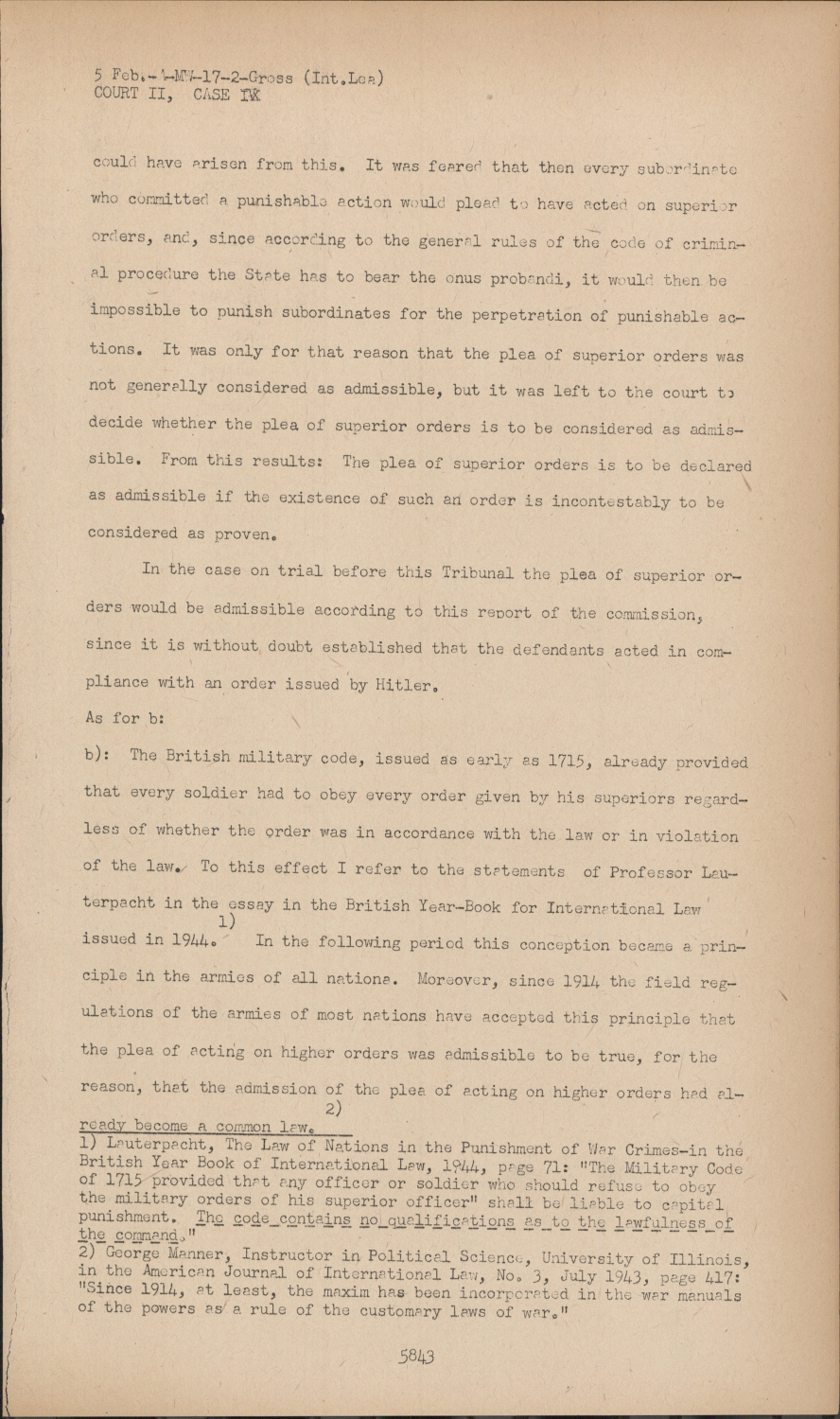
could have arisen from this. It was feared that then every subordinate who committed a punishable action would plead to have acted on superior orders, and, since according to the general rules of the code of criminal procedure the State has to bear the onus probandi, it would then be impossible to punish subordinates for the perpetration of punishable actions. It was only for that reason that the plea of superior orders was not generally considered as admissible, but it was left to the court to decide whether the plea of superior orders is to be considered as admissible. From this results: The plea of superior orders is to be declared as admissible if the existence of such an order is incontestably to be considered as proven.
In the case on trial before this Tribunal the plea of superior orders would be admissible according to this report of the commission, since it is without doubt established that the defendants acted in compliance with an order issued by Hitler. As for b: b): The British military code, issued as early as 1715, already provided that every soldier had to obey every order given by his superiors regardless of whether the order was in accordance with the law or in violation of the law. To this effect I refer to the statements of Professor Lauterpacht in the essay in the British Year-Book for International Law issued in 1944.1) In the following period this conception became a principle in the armies of all nations. Moreover, since 1914 the field regulations of the armies of most nations have accepted this principle that the plea of acting on higher orders was admissible to be true, for the reason, that the admission of the plea of acting on higher orders had already become a common law. 2) -----------------------------1) Lauterpacht, The Law of Nations in the Punishment of War Crimes-in the British Year Book of International Law, 1944, page 71: "The Military Code of 1715 provided that any officer or soldier who should refuse to obey the military orders of his superior officer" shall be liable to capital punishment. The code contains no qualifications as to the lawfulness of the command." 2) George Manner, Instructor in Political Science, University of Illinois, in the American Journal of International Law, No. 3, July 1943, page 417: "Since 1914, at least, the maxim has been incorporated in the war manuals of the powers as a rule of the customary laws of war."
In the same way, the British Manual of Military Penal Law and also the Rules of Land Warfare have explicitly declared the plea of acting on higher orders as admissible. Up till April 1944 the provision was contained in par. 443, Chapter XIV of the British Manual that soldiers cannot be considered war criminals if, by acts they were ordered to carry out by their governments or their superiors, they had violated recognized laws of war. This provision explicitly precluded a punishment by the enemy. To this effect I refer to the statements in Law Reports of Trials of War Criminals, Volume I, page 18, 1947, where, with reference to the fundamental statements made by Oppenheim in his book International Law (volume II, page 454, 5th edition), it is furthermore established that in such a case the enemy can only call to account the officials or commanders for the issue of such orders.1) In regard to the contents the Article 347 of the American Rules of Land Warfare corresponded with the provision of par.
4432) of the British manual. According to this provision, members of the American armed forces must not be punished if they had committed a punishable act on orders or even with the approval of their government or commanders. The commanders themselves rather could only be called to account.
In both provisions the fact is significant that no distinction was made between a lawful and an unlawful order and that the subordinate person did not even have the right and much less so the obligation to examine the lawfulness and legality of an order. ------------------------L) Law Reports of Trials of War Criminals, Vol. I, 1947, S. 18: "Until April, 1944, Chapter XIV of the British Manual of Military Law contained the much discussed statement (Par. 443) that "members of the armed forces who commit such violations of the recognized rules of warfare as are ordered by their Government, or by their commander, are not war criminals and cannot therefore be punished by the enemy. He may punish the officials or commanders responsible for such orders if they fall into his hands, but otherwise he may only resort to other means of obtaining redress.."This statement was based on the 5th edition of Oppenheim's International Law, Vol II, page 454." 2) "Individuals of the armed forces will not be punished for these offenses in case they are committed under the order or sanction of their government or commanders. The commanders ordering the commission of such acts, or under whose authority they are committed by their troops, may be punished by the belligerent into whose hands they may fall."
The provision contained in par. 483 of the British Manual (British Manual of Military Law) was rescinded on 15 April 1944. Since that time the plea of acting on higher orders is no longer admissible.
A similar amendment of the American field regulations was published on 15 November 1944 through the Change No. 1 of the Rules of Land Warfare.
In this respect one cannot help thinking that the amendment was evidently made in view of the impending end of the war and the contemplated trials of war criminals.
DR. GAWLIK:Your Honors, after I wrote these lines and after I handed in my final plea I received the book by Sheldon Glueck, "War Criminals, their Prosecution and Punishment", 1944 and I found this opinion confirmed in the book. My colleague Aschenauer has already commented in detail on this book. Therefore, I shall not go into any detail but I call the attention of the Tribunal to several sentences from this book which I shall ask the interpreter to read.
INTERPRETER:From page 141 of Sheldon Glueck's book. "The provisions in the American rules quoted above seemingly protects them against punishment not only in the case of orders of their Government (and perhaps acts of State) but also as in doing the prohibited act, they obeyed the order of a military superior, even though they knew their acts to be contrary to the laws and customs of legitimate warfare."
DR. GAWLIK:Even Glueck who, as the book shows, is not at all proGerman and who attempts to establish a procedure for the trial of war criminals, cannot get over the exclusion of the plea of superior orders. If Neumann in 1943 or 1944 would have been put before an American Military Tribunal for the charges made against him now he could not, on the basis of this regulation 347, in the rules of land warfare, have been punished according to this rule. I emphasize expressly that this regulation also applies to enemy nationals. Through the change in this regulation this plea of acting on superior orders, could only be amended to refer to those actions committed after 15 November 1944 but not to those committed before that.
The retroactive application of this regulation would have the same significance as one of the laws promulgated by the Nazi on the occasion of the burning of the Reichstag, namely the retroactive admissibility of the death penalty for arson. At that time the world raised a hullaballoo, they spoke of a violation of the law, they spoke of the beginning of the dissolution of the legal state and one could say that those people were right. I have too great a confidence in this Tribunal and, therefore, I do not believe that they will build up their judgment on such an insecure position.
I shall continue in the final plea:
Moreover, Winthrop, the well known Professor of the American Military Penal Code and author of the book Military Law and Precedents, admits the plea of acting on higher orders and expresses the opinion that an order precludes the punishment.1) As a reason for this opinion, held by him, he asserts that obedience was the fundament of every army and that the subordinated person was therefore not under the obligation to decide by himself about the question whether an order given to him was lawful or unlawful. Such a conduct by the subordinated persons would, according to Winthrop's point of view, mean insubordination and would lead to undermining of military discipline.2) In this connection, Winthrop also refers to a decision by the Supreme Court which likewise comes to the same result. It is said in this decision that it would mean the end of every discipline if, for instance, sailors aboard a warship on the high seas would. on the basis of their personal sense of justice, have the - - - - - - - - - - - - - - 1) Winthrop, page 296: "That the act charged as an offence was done in obedience to the order - verbal or written - of a military superior, is, in general, a good defense at military law." 2) Winthrop, page 296: "But for the inferior to assume to determine the question of the lawfulness of an order given him by a superior, would in itself, as a general rule, amount to insubordination, and such an assumption carried into practice would subvert military discipline."
possibility to shake off the power of command of their commander by reasoning that they considered the execution of the order an unlawful act.1) Therefore, it can be established as a principle of International Law that the obligation for obedience on the part of the soldier, and such was Naumann during his time of duty in Russia, is not preceded by the obligation to examine whether the order is in violation of any law, especially the laws of war.
The Tribunal in examining this legal question, will not disregard especially the existing conditions in Germany, I can understand that repeatedly it may have appeared inconceivable to the Tribunal if defendants in this trial, interrogated as witnesses in their own defense, have again and again referred to the fact that it was their duty to carry out the order and that they had no authority to decide about the legality of the order.
Germany is a state in which for centuries obedience has been preached as the supreme duty of the citizen. The army and the civil servants were the pillars of the German state. It was the supreme duty of both to obey and unconditionally comply with the orders given by superior authorities. This is a fact which is based on the historical conditions of Germany, especially on the historical development of the past 150 years, a development which is completely different from that of the United States.
The principle that obedience was the supreme duty of every citizen was emphatically advocated especially in the National Socialist Fuehrer state. The individual citizen was not entitled to voice his own opinion. Neither was he permitted to express any criticism on measures taken by the state administration. --------------------------1) Supreme Court in leading case in the Navy, Dinsman von Wilkes, 7 Howard, 403, quoted by Winthrop, page 296: "There would be an and of all discipline if the seaman and marines on board a ship of war on a distant service were permitted to act upon their own opinion of their rights, and to throw off the authority of the commander whenever they supposed it to be unlawfully exercised."
The conditions in Germany therefore were completely different from those in a free democracy. To be true, it is correct that the provisions of the British Manual and the similar provision in the Rules of Land Warfare of the United States, with respect to the plea of acting on higher orders, have undergone a change in as far as the plea of acting on higher orders was no longer admitted to the extent as this was the case in the past. However, during the period in which Naumann was chief of the Einsatzgruppe B, namely from the end of November 1941 till March 1943, the old provisions of the aforementioned field regulations were still fully valid.
The opinion held by me, concerning the admissibility of the plea of acting on higher orders, is not refuted either by Par. 47 of the German Military Penal Code which in this connection has been repeatedly mentioned in this court-room.
The provision of Par. 47 of the Military Penal Code cannot be applied if only for the reason that it is not applicable to orders given by the chief executive of the state. This interpretation results in particular from the meaning of this provision. The provision of Par. 47 of the Military Penal Code always presupposes the possibility to refuse obedience must have the possibility to complain to the superior officer of the person who had given the order so that he might find justice there. Only in this case can he make use of the provision of Par. 47 of the Military penal Code. If the soldier does not have this possibility, then his refusal to obey an order entails a severe punishment without examining the lawfulness of the order, and the unlawful act, as ordered, cannot be prevented. The provision of Par. 47 of the Military Penal Code therefore applies, for instance, to the common soldier who refuses to carry out an unlawful order given to him by his lieutenant, because he then has the possibility to complain to the superior officer of the lieutenant. Moreover, an unlawful order given by a general can be rejected since in this case the possibility is given that he who received the order can turn to the general's superior. This possibility, however, does not exist if any orders, which henceforth are found to be unlawful, have been decreed by the chief executive of the state. And this possibility by no means exists if the orders are issued by a dictator who combines in his hand all instruments of power of the state, as this was the case with Hitler, a dictator who, by use of all means at his disposal, would have actually executed the orders he decreed. What action should the defendants take against the orders given to them by Hitler? How could they have prevented the execution of these orders? Whom could they approach in order to find justice in respect to the unlawful orders given by Hitler? Under the present circumstances it is simple to assert that the defendants ought not to have carried out the order.
No answer, however, can be given to the question what action they ought to have taken, in the situation in which they were at that time, to prevent the execution of the order. Even according to the prevailing German law itself unlawful orders are effective.1* Also according to the French penal code the soldier is obligated to obey an order of the legitimate authorities, regardless of whether the order is lawful or not. The soldier solely has a right to complain after the execution of the order. In this connection I refer to the statement by Cobbett.2* Moreover Garner, who in his statements refers, among others, to the view of Professor Nast of the Nancy University and to the example mentioned by the latter, has come to the same result.3* -------------------1* So binding, manual of the penal code (1885), page 804, furthermore Girginoff, page 18, Battenberg, page 3, 73, Frank, page 143 and Eberh.
Schmidt, page 58. Very clearly in this meaning RMG. 1, 63:
evidently also Rittau, decree 2, (page 98 ibid.) 2* Cobbett, Volume II, page 176/77: "By the French penal code the civilian is immune if the order is lawful and commanded by the legitimate authority (p). But it has been held that the soldier is bound to obey the order of the legitimate authority, whether lawful or not.
He may also protest afterwards." 3* Garner, Volume II, page 486: "Article 64 of the French criminal code lays down the ruel that an act committed by a person who has been constrained by force is neither a crime or a misdemeanor (Delit.)
Professor NAST of the University of Nancy has expressed the opinion that the immunity would cover the case of a soldier who is compelled to commit an act in violation of the laws of war and that therefore German soldiers who were compelled by their commanders to participate in the spoliation of French industrial establishments and the removal of their machinery to Germany, although the acts were contrary to the Hague Con vention, were not liable to arrest and trial by the French courts.
1" Professor Nast has added further explanations to this question.
In this he comes to the conclusion that the sedes materiae of French law is Article 64 of the Penal Code, according to which an act committed under duress does not constitute a crome. Among these acts Prof. Nast also includes cases in which a soldier has to carry out orders. In this connection Nast also mentions the Belgian and Dutch Criminal Codes, which contain the same provisions. In this connection he refers particularly to Article 43 of the Dutch Criminal Code, according to which a defendant is expressly exonerated by orders from superior authorities.1) As for Authors' Hypotheses: The hypotheses adopted in legal literature are not sources of international law. This is generally recognized in international law. I particularly call attention to the explanations of Wharton, who refers to statements by Chief Justice Cockburn. There it is said that authors in the field of international law, no matter how valuable their efforts may always be with respect to the interpretation and definition of fundamental legal provisions, cannot make any laws, because laws, in order to be binding, require the agreement of the nations, which can take place by treaty or through suitable statements by the respective governments, or even through established tradition.2) A conviction, therefore, cannot be based on the fact that individual scholars of international law adopt the viewpoint that the appeal to a superior order is inadmissible. -------------------1) Prof. Nast, Revue Generale de Droit International Public, 26 (1919, p. 123:
"The crucial sedes materiae in French law appears to be Article 64 of the Criminal Code according to which an act committed under duress (which apparently includes the case of a soldier bound to obey orders) is neither a crime nor a misdemeanor.
Art. 327 excludes liability in case of acts "ordonnes par la loi et commandes par l'authorite."
So does Article 190, Articles 70 and 71 of the Belgian Penal Code reproduce substantially Articles 64 and 327 of the French Penal Code.
Article 43 of the Dutch Criminal Code re cognizes generally the defense of superior orders, while Art.
40 lays down the general exception of duress". 2) Wharton, Elements of International Law:
p. 23: "Writers on international law", says Lord Chief Justice Cockburn, "however, valuable their labors may be in elucidating and ascertaining the principles and rules of law, cannot make the law.
To be binding, the law must have received the assent of the nations who are to be bound by it.
This assent may be express, as by treaty or the acknowledged concurrence of government, or may be implied from established usage". (e). Moreover, the question of the admissibility of the appeal to the superior order is very much contested in legal literature.