Court No. IIA, Case No. 9.
QDo you recall when Braune's Kommando arrived in the Crimes?
AHe arrived there considerable time after me, about the end of November, that is, with his commander., with only a few vehicles. The rest had got stack in the mud, and he was able only to follow slowly.
QWhere did the Dr.. Braune establish his command post?
QIn the headquarters of the Einsatzgruppen.
AThis was in Simferopol?
AYes.
QWas there already another Kommando active in Simferopol?
ABefore 11-B, a sub-kommando of 10-A, sub-kommando of 10-B, and a sub-command of 11-A were in the Crimea?
QWere these part Kommandoes already active?
AYes, of course.
QHow did the executions of Jews and Gypsies come about in Simferopol?
AThe Army High Command demanded that liquidations of the Jews in Simferopol be carried out before Christmas, This directive of the Army was handed to me by a liaison officer, and Braune thereupon negotiated with the Army since we were not in a position to carry, out these liquidations. Thereupon, the Army agreed to create the conditions necessary which happened, and, thus, the liquidations took place before Christmas 1941.
QIs it correct that the Army kept its promise, and actually lent its support to carrying out of these executions?
AThe Army supplied the trucks, for the transportation of the Jews, the drivers, the gasoline, the military police to guard in that area.
QWhat do you know about Dr. Braune's attitude concerning the Fuehrer's Order in general?
ABraune is a very soft sensitive man. Since I was with him for months I know that he carried out these things only with difficulty, and by overcoming his great reluctance.
Court No. IIA, Case No. 9.
QWhat was Braune's main activity in Simferopol?
ASimferopol was at the edge and also at the same time in the middle of the great partisan movements, and thus, his commandos hunted down partisans. Furthermore, he occupied himself with intelligence service, because he was predestined for this by his background.
QWhen did you again see Dr. Braune after your return to Berlin?
AIt must have been in late Fall 1942 when he was ordered back, and to take up a position in the Academic Exchange Service, and in the student field. On my suggestion he was transferred to this activity.
QWhat do you know about Braune's recourse to the RSHA, and his transfer to Norway.
AWith the situation during the war which became more and more complicated, the younger officers from the RSHA were all drafted, and, thus, Kaltenbrunner wanted officers who were under his jurisdiction, and who were active in other agencies to return to the RSHA. Thus, he wrote the letter to the then superior of Braune, Scheel, and demanded that Braune be released. Braune was then ordered back to the RSHA. Even though Mueller, Chief of the Gestapo, was against it, Braune was detailed to Norway in the capacity of Commander by Kaltenbrunner.
QDid you speak with Dr. Braune before he reported for Norway?
AYes, I did. He reported away to me before he left.
QDid you give him certain directives for his personal conduct in his new position at that time?
AYes, I did. I was especially concerned with Norway. For a long time we from the "SD" had carried on a fight with Terboven. Through the unfortunate system of the agencies of the Commander, they were very much dependent on the Reich Commissioner as I already explained. The Commander in his opinions had adopted himself completely to the Reich Commissioner Terboven. So that I, in order to be able to Court No. IIA, Case No. 9.inform myself, sent my own man to Norway.

The tensions were so great that Terboven had one of these men dismissed. I told Braune about these conditions, and I demanded that he should resist Terboven, and that he should take care that so far as possible the politics of violence carried on by Terboven be stopped, and that a reasonable agreement with Norwegians should be reached. Braune agreed to this.
QDo you know any details about the activity of Braune in the sense of your instructions?
AYes, In March 1945 there was a dispute between Terboven and the commander of Norway. Because of the resistance of Braune against the large scale action which had been ordered by Terboven to be carried out by the Security Police, which had been refused by the RSHA also, the commander had now come into a position when he also had to resist the Reich Commissioner. Thus, a dispute developed which as a result of the activity of Braune was brought about. He thus conducted himself in accordance with my instructions.
QFrom the preceding years, do you know of any such protest measures on the part of Scheele against Terboven?
AI already said before I had been worried that it was not so.
QHow do you explain that the conduct of Scheele had suddenly changed?
AHe was pressed into a tactical situation by Braune, so that he could no longer get out of it.
QNow I want to leave the field of Norway, and I would like to ask you a few questions about the landing of the Russians in Jewpatoria in January 1942? Witness, do you recall the landing?
AYes, of course.
QWere these landings preceded by other landings, and what results did these landings have?
ABefore that landings took place in Feodosia and Kertsch, also on the penninsula of the eastern side of the Crimea, and from Court No. IIA, Case No. 9.these bases it was attempted to make the partisan movements successful.
QDo you recall what the attitude of the civilian population was when the Russians conquered Jewpatoria?
AAfter the landing of the Russians, inmates of the hospitals had tried to fell Jewpatoria. These trucks with wounded people were met by the Russians, and they cut all the throats of these wounded people. The civilian population showed great joy about these things, and they resorted to celebration around these dead people.
MR. FERENCZ:Your Honor, I must object at this point, and ask what relevency this testimony has to the charges in this case.
THE PRESIDENT:The objection is well put. Will you please answer that question as to the relevency of this line of questioning.
MR. MAYER:I consider this question necessary in order to show in what difficult situation the Einsatzgruppen found themselves in the Crimea, and, it also is to show how strong the partisan resistance was against the Einsatzgruppen, and how big the partisan movement was in that area, especially, after the landing of the Russians, and, especially how it effected the civilian population, and thus created a dangerous strategical situation. I also want to show by means of these questions how close the collaboration of the Einsatzgruppen was with the Army, and. finally, also to what extent my client received orders from the Army. In that respect I consider these questions as of probative value, but I leave the decision to the Tribunal.
THE PRESIDENT:Certainly you may put any questions which refer directly to your client. You may show what conditions he had confronted with when he arrived in any certain area or locality. You may show what directly was brought to him in the way of information, but we can not lose time in a general history of a "situation of anywhere not immediately connected with your client.
DR. MAYER:Yes, Your Honor. I shall leave this field, and in conclusion I would like to ask the witness Ohlendorf to give a judgment of Braune with whom he worked so long.
Court No. IIA, Case No. 9.
THE PRESIDENT:Did you nay a judgment?
DR. MAYER:A purely personal judgment, A judgment of his personality.
THE PRESIDENT:If you us? the word judgment
DR. MAYER:Or recommendation which he would make out of his superior.
THE PRESIDENT:Yes. You use the word judgment, and you are then encroaching upon the duties of the Tribunal.
DR. MAYER:I did not mean that, but I meant purely a personal relation to his subordinates.
AI have known Braune for nine years. I got to know him as a very decent, true and straight character, who was so stubborn in his character that quite apart from the welfare of his own person, he tried to act according to this genuineness and straightforwardedness; he was a good patriot, and believed that he found his calling in the SD, thus, with all passion he through himself into the work of the SD. He was one-hundred percent reliable, and one knew that wherever he worked, there would be decency and a clean attitude.
DR. MAYER:I have no further questions to ask the witness.
THE PRESIDENT:When you say that you knew that he could be counted upon for one-hundred percent as to reliability, I take it that you mean that he would carry out whatever directions he received with regard to liquidations, or of anything else he was directed to do.
THE WITNESS:I did not quite understand this, Your Honor.
THE PRESIDENT:In your summation of Braune's character, I understood you to say that he was one-hundred percent reliable. By that I understood that you mean that he was one-hundred percent reliable to the Reich?
ANo, no, but reliability of his character. If a job was given to him one did not have to bother about whether it was carried out or not. If he said, yes, he meant, yes.
THE PRESIDENT:Yes.
DR. LINK:Dr. Link for the defendant Ruehl. I have a few questions with the permission of the Tribunal, to put to the witness Ohlendorf. BY DR. LINK:
QHerr Ohlendorf, do you know Ruehl from his membership in the Einsatzgruppen-D?
AYes, together with other men - one moment, please. I am mistaken. Yes, I know him from his activity in the Einsatzkommando 10-B.
QWhat position did he hold in this Einsatzkommando?
AI had destined Ruehl for the job of business manager with the Kommando 10-B. Since he had these qualities which the kommando leader of 10-3 did not have, the leader of Kommando 10-B did not keep order, any official business matter was against his nature, and, thus, I ordered Ruehl to see that order was kept within this kommando. Without his holding the title, he was practically the administrative chief of the Kommando.
QHerr Ohlendorf, when you say he practically had the functions of an administrative chief, may I ask you whether he had any power of command over this Kommando, or any part of this Kommando in this function?
ANo, he had no such command over the Kommando. Mot even over parts of it.
QDid you at any time designate Ruehl as a deputy for the commander Persterer?
ANo, that would have been very difficult, because Ruehl did not have the seniority after Persterer, Ruehl was Obersturmfuehrer, that is, a 1st Lieutenant, and there was another man who was a captain, and who in the Kommando itself was the leader of the Department IV. Thus, were any one to be designated as deputy of the Kommando, it would have been automatically this leader of Department IV, because he was a captain.
QCould you also exclude the fact that Persterer himself made Ruehl his deputy; would you know anything about this?
AI was with Ruehl when he exersiced his function, and, therefore; I know that he was not deputy of Persterer. Also that he was not the designated person to be such by Persterer.
QHerr Ohlendorf, may I remind you that the Prosecution mentioned a case of Ruehl once actually appearing as a deputy of the Kommando Leader. This assumption by the Prosecution is mentioned in connection with the transporting of a number of Jews back to Rumania territory. I therefore, ask you, can you remember that Persterer had reported to you at any time about the situation which had prevailed or developed in his area as a result of the fact that the Rumanians had transported a large number of Jews into the area occupied by the German Army? Do you remember that?
AYes, very exactly.
QHow was that situation developed?
APersterer came to see me with Ruehl in order to get a dicision from me what was to be done with the Jews who had been transported across the Dnestr River, into the German area by the Romanians. He had brought Ruehl along because Persterer himself did not go back to Mogilew, but had still another mission to complete. I told Persterer that the Jews driven across the River by the Rumanians were to be brought back into the Rumanian territory, and that it was to be prevented that the Russians would drive any more Jews into our area. The situation in the area of Mogilew was so difficult, because the city of Mogilew was completely destroyed. Therefore, the famine prevailed, and it was not possible to prevent plunderings and revolts, for these Jews had been completely plundered by the Rumanians. They had no baggage with them at all. Therefore, hurry was great, and thus Ruehl wont back to Mogilew-Podolsk and -- he was to see to it that the Jews were to be sent back into the Rumanian territory, which was their homeland. The fact that Ruehl came to see me is nothing special for in contrast to what the Prosecution assumed it has not a question of a lieutenant coming to sec his general but of a leader coming to see his superior; everybody had this possibility who had any type of mission, and such mission could be given to any one, even if he had not been a leader, and even if he had not been a leader, he certainly would have the opportunity of speaking to me, for that is what I was there for.

QHerr Ohlendorf, we know from one document, according to the explanation of my client that he then handed your order on to a SubKommando at the suggestion of Persterer. Did I understand you correctly that this fact would lead one to assume that Ruehl had any power of command, or any activity as Deputy?
ARuehl merely passed on my order to the Sub-Kommando, yes.
QIn this same matter has any other report made to you because the first order could not be executed at once?
ARuehl came back once more because the Rumanians refused to take back the Jews into their territory, but we were dependent on the Rumanians because there was only one bridge at that time, and the Rumanians threatened to shoot if we tried to bring back the Jews into their land. Ruehl informed me of this and now I ordered Kommando 12 to negotiate at another bridge near Jampol and which had just been completed at that time, but it had not yet been handed over to the Rumanians, and thus Kommando 12 received the order to see to it that these Jews would now be brought back into their homeland via that bridge, and that happened.
QThe fact, Herr Ohlendorf, that Ruehl, in respect to the second report appeared before you and that this was not Pesterer, would you explain this in the same way as you explained the first conference?
AThe Commander of the Sub-Kommando had very much to do in Mogilev because of the situation I have described, and thus Ruehl had to take his place in order to tell me about the results of the negotiations with the Rumanians.
QWas this order then carried out?
AYes.
QIs this whole matter concerning this special circle of persons in any connection with the basic order under discussion?
ANo, it was one of the exceptions of this order which because of the conduct of the Rumanians I had ordered namely we would under no circumstances undertake to execute people by order of the Rumanians.
QMy last question, Herr Ohlendorf, can you remember what the reaction of the victims themselves were, namely the Jews?
ANo, I saw nothing of it, I don't know.
THE PRESIDENT:The Tribunal will now be in recess for fifteen minutes.
(A recess was taken.)
THE MARSHAL:The Tribunal is again in session.
DIRECT EXAMINATION Continued BY DR. BELZER (ATTORNEY FOR MATHIAS GRAF):
QWitness, you were chief of Office III in the RSHA?
AYes.
QReferring to your position, I would like to ask you a few questions: Do you know that during the war emergency duties had to he carried out by the SD?
AYes.
QDid a person on emergency service have the opportunity to object to this duty or to reject it?
ANo.
QIn order to do emergency service for the SD, did the person who did the emergency duty have to be a member of the SS or a member of the Party?
ANo.
QWho assigned the people for emergency duty in the SD?
AThe emergency duty for the regional agencies was carried out by the regional agencies themselves.
QWas the emergency service an assistance service and did the person carrying out such emergency service become a member of the SD?
ANo. the SD he became active on behalf of his emergency duty.
QCould a person on emergency duty reject being drafted to Dueben or Schmiedeberg?
ANo, by being detailed to the Office of the Chief of the Security Police and SD he came under his jurisdiction.
QWhen in May 1941 the commands were put together in Schmiedeberg, was there a mass meeting held by Heydrich or Streckenbach?
AHeydrich carried out a role call and not Streckenbach.
QDuring this roll call, were they the tasks of the Einsatzkommando advertised?
ANot concerning the order of executions.
QDuring the discussions on the Fuehrer Order and other orders concerning the assignment for these Eastern areas apart form the Einsatzgruppen leaders and the Einsatzkommando leaders, were there subordinate leaders present also?
ANo.
DR. BELZER:I have no further questions, Your Honor.
DIRECT EXAMINATION --CONTINUED BY DR. SURHOLT (ATTORNEY for the Defendant Rasch):
QWitness, do you know, or, can you confirm that Rasch was only a member of Office I?
ANo, I do not know that and I cannot confirm that.
QRasch came from the. Ministry of the I terior to the SD, did he not? Until then he had not joined any part of the SS. He became Untersturmfuehrer automatically when joining the SS. Did this make him a member of the Waffen SS or the General SS?
ACertainly not the Waffen SS. There was no General Waffen SS.
QIn 1941, Rasch be came inspector of the Security Police and the SD in Koenigsberg. The Prosecution has submitted a document in Volume III_C, Exhibit No. 131, German page 13, Document No. 3253. There it says -
THE PRESIDENT:You are reading too rapidly.
Q "Since the Fuehrer has appointed you Brigadier General of the Police with the document handed to you on 19 Feburary 1940. I herewith assign you as from 1 December 1940 to a position provided in the budget of Brigadiers General of the Policepay group PA allocated to the State Police Headquarters at Koenigsberg." Witness, can you tell me whether the meaning of this document is of importance; with regard to budget purposes, so that a position was assigned to him where he could be paged by the fiscus, or does it also result in his being drafted into the State Police in Koenisberg?
AThis document only reveals that a position provided for in the budget was transferred to him.
This has nothing to do with the function as such.
QCould Himmler stand contradiction?
AHardly.
QIf anyone had been an Brigadefuehrer since 1940 and had not been promoted, could that be considered as normal?
AI cannot answer that question, because it might be normal, as well as abnormal?
QIs that a sign of disapproval?
AI couldn't say that.
QWere not the SS leaders advanced automatically within fixed intervals and according to a certain schedule?
AOne cannot say that either.
DR. SURHOLT:Thank you.
DIRECT EXAMINATION--CONTINUED BY DR. FICHT (Attorney for Defendant Biberstein):
QWitness, during the direct examination you said to your defense counsel-when discussing documents and it was mentioned whether the number of 90,000 killed were correct or not, you explained the following: "After a certain period, activity of the Einsatzgruppe in the Fast no longer to k place. In connection with this, I would like to ask you what period did you mean by this?
AI then meant the time of the withdrawal, when the armies flowed back to the area of civil administration.
QWitness, have you ever with your Einsatzgruppen been at Rostov or surroundings, even if only temporarily?
AAs far as I remember, parts of Einsatzkommando 10 temporarily were in Rostov for a short time.
QWhen was that, approximately?
AI cannot tell you that.
Q 1941 or 1942. Can you express yourself to that effect?
AI cannot remember when Rostov was occupied for the first time.
QIf I tell you that the German troops in 1941 had already been in Rostov and then had to clear out and only in 1942 occupied Rostov again, can you then answe this question whether special atrocities had been committed there?
AI am sorry to say, I cannot give you any information on that.
QI have no further questions, your Honor. BY DR. MAYER (for the defendant Braune):
QI just want to ask one more question. BY MR. WALTON:
May it please the court I don't quite see the materiality of this in that Dr. Mayer has been given the opportunity already to cross-examine the witness.
THE INTERPRETOR:I'm sorry, channel 3 is not working.
THE PRESIDENT:Let us first see what Dr. Mayer intends to present. He may be merely asking for the correct time. We don't know.
MR. WALTON:That's true; I only wanted him to confine himself to something that had taken place before. I am objecting to anything that has already been discussed.
THE PRESIDENT:Your objection is well taken. Let us see what he is going to ask. The sound system seems to be functioning now, Dr. Mayer.
DR. MAYER:I only wanted to address one question to complete my former question. The question itself refers to a document submitted by the Prosecution.
THE PRESIDENT:Was that within your knowledge when you questioned the Defendant Ohlendorf before?
DR. MAYER:Yes, I knew the document.
THE PRESIDENT:Why was it you did not put this query at that time?
DR. MAYER:I simply did not address the question because I had forgotten it during the examination.
THE PRESIDENT:That seems to be the privilege of an attorney, to forget a question, so we will allow it. BY DR. MAYER: Thatk you very much.
QIt refers to Document NOKW 584, Exhibit No. 165 in the German volume III D, pages 104 and 105. This document itself deals with retaliation measures against partisans in Eupatoria and I ask the witness to inform himself of the text on which the action was based and to state his opinion on it and also what orders he gave to Braune at the time.
AMay I have the document, please.
THE PRESIDENT:What was that document again, Dr. Mayer?
DR. MAYER:Exhibit 165, in the German Document Book III D, pages 104 and 105.
THE PRESIDENT:What is the document number itself?
DR. MAYER:The document is NOKW 584.
AI exactly remember this occurrence. The ICAO of the Army and Major Riesen came to me on behalf of the truz in order to obtain an order that my Einsatz Commando carried out a retaliation measure in Eupadoria. It was a retaliation measure for occurrences which have been descried previously by me when the Russians had cut the throats of wounded soldiers. I rejected the carrying out of this retaliation measure because I did not consider it to be my task to carry out retaliation measures of this kind for the Army. Major Riesen asked me for persons who could be put at his disposal in Eupadoria. I said I was prepared to do this because the retaliation measure itself as described to me by Major Riesen I did not approve of. The Commander in Chief had ordered that the entire population capable of war service in Eupatoria be shot. Owing to our stay in Eupatoria it was known that among this population there was a great number of persons who were not suspected of being partisans or who could be considered to endanger our security. For that reason I sent Braune along in order to select from the male population those persons who could not he considered dangerous but could assist Major Riesen with advice.
Braune returned from Eupatoria disgusted. The Army had not prepared the execution properly and therefore very unpleasant occurences had taken place and Braune had to take a hand in order to re-establish order to avoid even greater unpleasantness.
QI have another little question. What connection did Braune have with Riesen?
AHe was given to Riesen as assistant Riesen in this case held a kind of a superior position.
QDid Dr. Braune also approach him about the views of the Commandant Mueller.
ACommandant Mueller had received Major Riesen Souchon ironically because rightly he considered him a white collar officer rather than an officer who would fight at the front and he received him with the words that for this action he did not require an order from the Commander in Chief. This statement may he explained by the fact that already at the beginning of the war through Keitel orders had been given to Army sections which in this case gave the officers the opportunity ever without the orders from the Supreme Commander to carry out such actions.
QI have no further questions. BY DR. ASCHENAUER:
Herr President, I retained a few questions because of the difficulties in the record. May I put them prior to the cross examination?
QIn the Prosecution's evidence on page 330, which is the memorandum of 30 September, it says: Krimschacken are people of Jewish descent, who were living in this area for several hundred years, however, the Einsatzgruppe considered them undesirable. In this connection may I address two Questions. Did the Einsatzgruppe classify the Krimschacken - May I assist your memory with an excerpt of a document which Was not submitted here, Exhibit 325 presumably from the SS trials and may I ask what the decision obtained from Berlin?

A.The Prosecution themselve did explain that the classification of the Krimschacken was not necessary because the prosecution themselves described them as of Jewish origin. Therefore, the Fuehrer order concerned them. Thus, the Einsatzgruppe was not content with this result because at the Crimea, apart from the Crimean Karaims problem the question of the Karaims also existed. It consisted of the following: The Krimschacken are of Jewish origin but have given up their Jewish creed and spoke Turkish. The Karaimen, mostly, are not of Jewish origin but had the Jewish confession. The Einsatzgruppe twice to keep both groups out of the liquidations. The order of the 5th of December 1941 shows this. The following facts were written down here. The Karaims, according to their own statement, have nothing in common with the Jews except their confession. They are supposed to originate iron the moguls who formerly lived in the area of the Black Sea. During the czaristic days, in contrast to the Jews, they had all Civil rights and they are still proud of this, even now. The Krimschacken according to statements by the Jews are supposed to be Jews who left Italy about 400 years ago and came to the Crimea and spoke the Tatarian language. The Krimschacken themselves maintain to be a branch of the Tatarian people. One may presume that both sides are right and that there are immigrants from Italy Who, in the course of the centuries mixed with the Tatars, accepted their language and their customs but retained then confession. When the Einsatzgruppe enquired from Berlin it was decided that the Krimschacken are to as treated as Jews
Q.This finishes the direct examination as far as I am concerned.
THE PRESIDENTDefendant Ohlendorf is now available to the Prosecution for cross-examination on the entire defendant's case.
MR. HEALTH:May I state my name for the record. James E. Heath for the Prosecution.
INTERPRETOR:I'm sorry, your Honor, the German channel is out again.
THE PRESIDENT:You may proceed Mr. heath, I think it is all right now. BY MR. HEALTH: Thank you Sir.
Q.Mr. Ohlendorf, We can begin for this moment exactly where you left off. You spoke of the Krimschacken decision in Berlin, the decision that because those people were of the same blood--------
INTERPRETOR:I'm sorry, the German channel is off again. BY MR. HEALTH
Q.Mr. Ohlendorf, you spoke of two classes of people, the Krimschacken and the Karaimen------
MR. HEALTH:I think it is kaputt again your Honor.
THE PRESIDENT:Mr. Heath, it seems that a few minutes will elapse before channel 3 may be reactivitated so we will take advantage of the noon recess and then you can begin afresh immediately after the noon recess. The court will be in recess until 130.
(A recess was taken until 1330 hours)
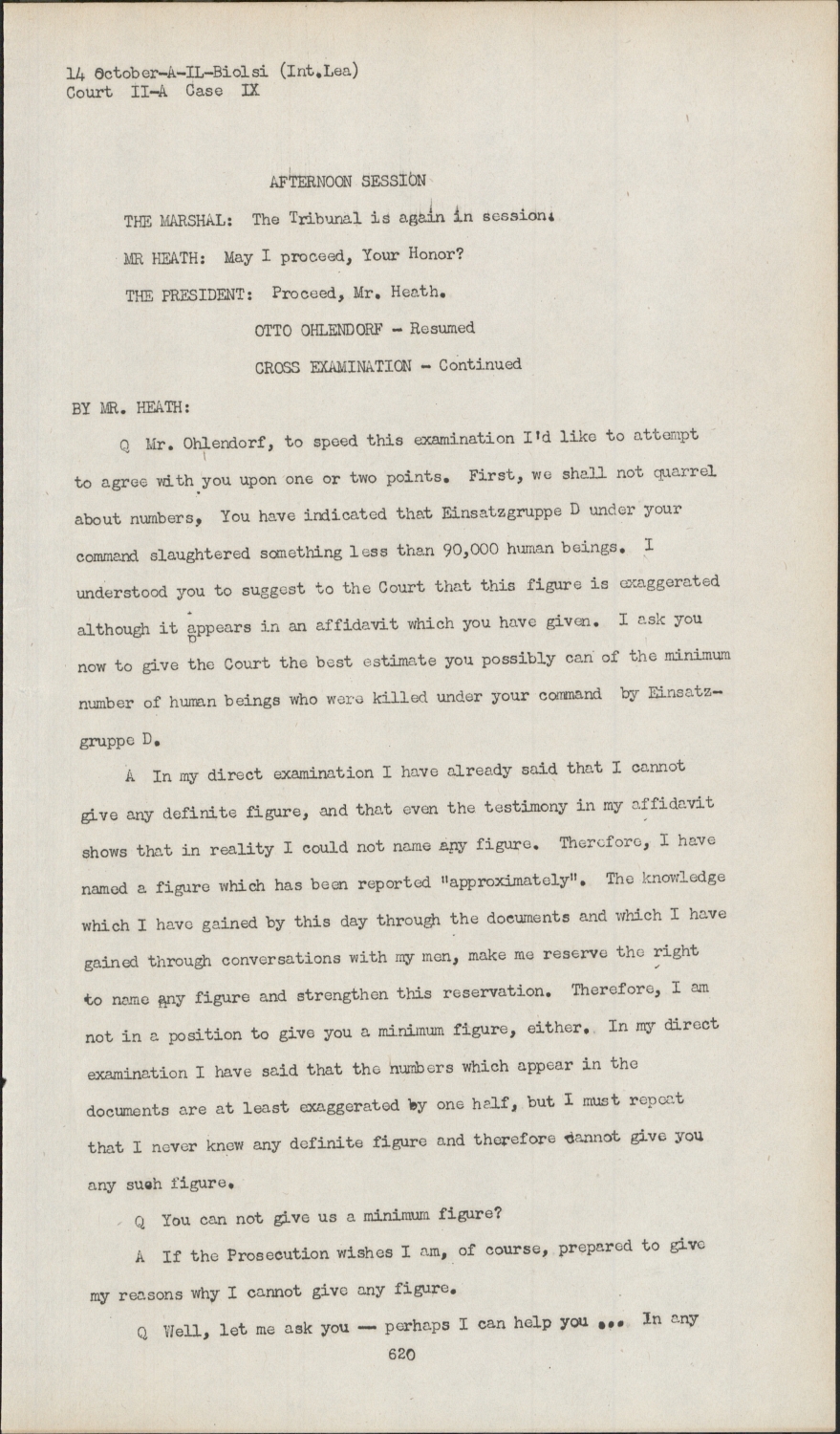
AFTERNOON SESSION
THE MARSHAL:The Tribunal is again in session.
MR HEATH:May I proceed, Your Honor?
THE PRESIDENT:Proceed, Mr. Heath.
OTTO OHLENDORF - Resumed CROSS EXAMINATION - Continued BY MR. HEATH:
QMr. Ohlendorf, to speed this examination I'd like to attempt to agree with you upon one or two points. First, we shall not quarrel about numbers, You have indicated that Einsatzgruppe D under your command slaughtered something less than 90,000 human beings. I understood you to suggest to the Court that this figure is exaggerated although it appears in an affidavit which you have given. I ask you now to give the Court the best estimate you possibly can of the minimum number of human beings who were killed under your command by Einsatzgruppe D.
AIn my direct examination I have already said that I cannot give any definite figure, and that even the testimony in my affidavit shows that in reality I could not name any figure. Therefore, I have named a figure which has been reported "approximately". The knowledge which I have gained by this day through the documents and which I have gained through conversations with my men, make me reserve the right to name any figure and strengthen this reservation. Therefore, I am not in a position to give you a minimum figure, either. In my direct examination I have said that the numbers which appear in the documents are at least exaggerated by one half, but I must repeat that I never knew any definite figure and therefore cannot give you any such figure.
QYou can not give us a minimum figure?
AIf the Prosecution wishes I am, of course, prepared to give my reasons why I cannot give any figure.
QWell, let me ask you -- perhaps I can help you ... In any event, I can indicate to the Court one reason why you might have doubt about the numbers.