The Tribunal also finds that the defendant was a member of the criminal organizations SS and Gestapo under the conditions defined by the Judgment of the International Military Tribunal and is, therefore, guilty under Count III of the Indictment.
JUDGE SPEIGHT:The defendant Franz Six.
FRANZ SIX Franz Six studied at the Realschule, graduated from the classical high school at Mannheim in 1930 and then matriculated at the University of Heidelberg where he specialized in sociology and political science, receiving the degree of doctor of philosophy in 1934.
He then taught at the University at Koernigsberg (where he also took up the position of press Director of the German Student's Association). In 1936 he received the high academic degree of Dr. phil. habil. from the University of Heidelberg, and became Dozent in the faculty of law and political science at Koenigsberg; later, he passed examinations for the Venia Legendi at the University of Leipzig. By 1938, he was Professor at the University of Koenigsberg, and by 1939, he had obtained the chair for Foreign Political Science at the University of Berlin and was its first Dean of the faculty for foreign countries.
It is to be supposed that with this formidable array of scholastic achievements, duly enumerated by the defendant himself, the youth who came to him for guidance and instruction could expect in him a comparable degree of achievement in moral honesty. Unfortunately, this may not have been true, and therein is a tragedy of its own. A school teacher is bound in conscience to hold himself impeccable in deportment because of the example he constantly presents the future citizens of the State. The example afforded by Six left something to be desired. Reference will be made to the defendants own words on the witness stand in support of this observation.
In the early part of his testimony, on October 29, 1947, Six related to the Tribunal the tale of his student days at the University of Heidelberg. He said:
"I carried on my studies at Heidelberg for four years on an average of twenty marks a month.
I needed eleven marks to live in an attic, and that left, me nine marks to live on.
Nine marks, that meant thir ty pfennigs a day, at ten pfennigs for four rolls in the evening, and ten pfennigs for cigarettes, and this I lived through -- for four years in the midst of Heidelberg Student Romanticism, where the main problems were welfare and donation and then I asked myself whether society was still healthy, if it finds so much complacency, and how it can reconcile this complacency with so much distress."
Then on his own words he solved the enigma: "The answer which I gave myself was joining the Nazi Party."
The fact of the matter was, however, as his own personnel record, showed, he had become a Nazi in 1930, that is, even before he matriculated at the University of Heidelberg, so that whatever advantages, benefits and comforts derived from National Socialism were already due to him at Heidelberg. Thus, by failing to tap the munificent resources which Nazism offered, while already a full-fledged Nazi, Six suffered needlessly during those four sad years at Heidelberg.
There is another illustration. Six declared he had no animosity toward Jews and advanced his respect for two certain Jewish university professors as proof of this assertion, He was then asked whether it disturbed him that these two Jews, because of their race, were persecuted. He replied that he regarded it as "highly unpleasant" that these people should have been "affected by the new laws and regulations". Whereupon the inquiry was made as to whether he was offended by the persecution of thousands and millions of the brothers and sisters of these two professors. He answered: "What do you mean by persecution? When did the persecution begin?" When this was explained to him he conceded that the burning down of the Jewish synagogues on November 9, 1938, was a "shame and a scandal". Counsel for the Prosecution now inquired if he regarded the Fuehrer-Order, which called for the physical extermination of all Jews, as a "shame and a scandal". Here he saw a difference.
The synagogues had been burned down without an order and therefore the destruction was a "Shame and a scandal". The Fuehrer-Order, however, to destroy human beings, issued from the Chief of State and consequently could not be a shame and a scandal. He later conceded that the execution of women and children was deplorable, but the killing of male Jews was proper because they were potential bearers of arms.
A great German scholar, Wilhelm von Humboldt, who founded the University of Berlin at which Six was professor and Dean, had, as far back as 1809, defined "the limits beyond which the activities of the State must not go." Obviously Six did not agree with the doctrine that there could be a limit to the activities of the State, The name of Adolf Hitler apparently throw a shade over the light of his learning, and thus, for him there was nothing wrong, even mass killings, so long as the order therefor originated with the Fuehrer.
Six became a member of the SA in 1932 and of the SS and SD in 1935. In this last named organization he attained the grade of Brigadier General. On June 20, 1941 he was appointed Chief of the Vorkommando Moscow. According to the defendant the task of this kommando was to secure the archives and files of Russian documents in Moscow when the German troops should arrive there. The defendant arrived in Smolensk on July 25, 1941 and remained there until the latter part of August when he returned to Berlin.
It is the contention of the prosecution that the defendants duties were not as innocuous as made out by him. The prosecution submits that the Vorkommando Moscow was ussed in liquidating operations while under the command of Six. Further, that the seizing of documents in Russia was done not for economic and cultural purposes, but with the object of obtaining lists of Communist functionaries who had themselves become candidates for liquidation.
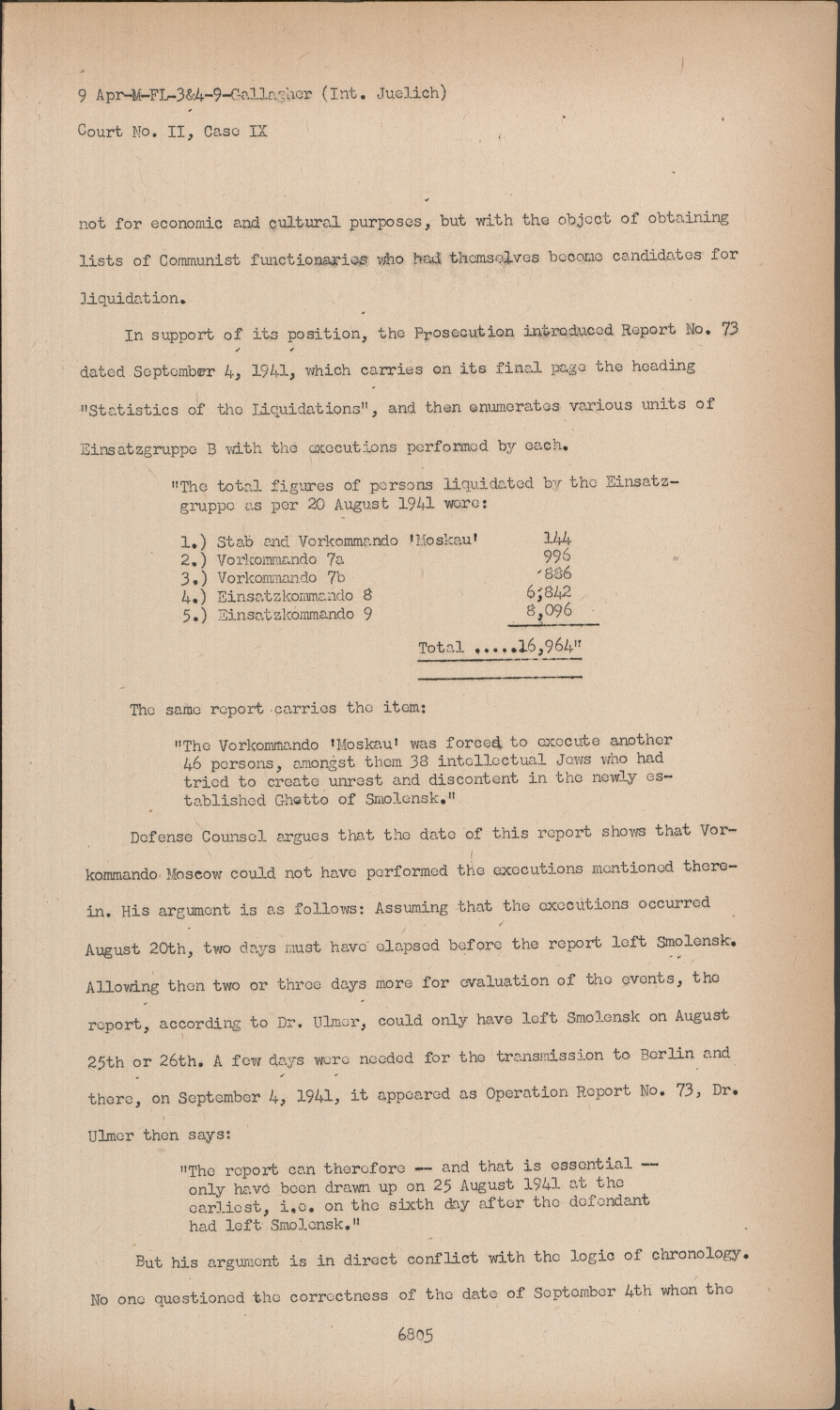
In support of its position, the Prosecution introduced Report No. 73 dated September 4, 1941, which carries on its final page the heading "Statistics of the liquidations", and then enumerates various units of Einsatzgruppe B with the executions performed by each.
"The total figures of persons liquidated by the Einsatz gruppe as per 20 August 1941 were:
1.) Stab and Vorkommando 'Moskau' 144
2.) Vorkommando 7a 996
3.) Vorkommando 7b 886
4.) Einsatzkommando 8 6,842
5.) Einsatzkommando 9 8,096 ---------Total .....16,964" ----------------------------------The same report carries the item:
"The Vorkommando 'Moskau' was forced to execute another 46 persons, amongst them 38 intellectual Jews who had tried to create unrest and discontent in the newly es tablished Ghetto of Smolensk."
Defense Counsel argues that the date of this report shows that Vorkommando Moscow could not have performed the executions mentioned therein. His argument is as follows: Assuming that the executions occurred August 20th, two days must have elapsed before the report left Smolensk. Allowing then two or three days more for evaluation of the events, the report, according to Dr. Ulmer, could only have left Smolensk on August 25th or 26th. A few days were needed for the transmission to Berlin and there, on September 4, 1941, it appeared as Operation Report No. 73, Dr. Ulmer then says:
"The report can therefore -- and that is essential -
only have been drawn up on 25 August 1941 at the earliest, i.e. on the sixth day after the defendant had left Smolensk."
But his argument is in direct conflict with the logic of chronology. No one questioned the correctness of the date of September 4th when the report was published in Berlin.
Therefore, the longer the time required for the submission of the report to Berlin, the further back must be the happening of the events narrated therein, and thus the further back into the period when Six was incontrovertibly in Smolensk. The usual argument presented in matters of this kind has been that the delay between the event and the eventual publishing of the report was a longer one rather than a shorter one. In this case the date in the document itself indicates a delay of only 14 days. If Dr. Ulmer argues that the lapse of time was longer than 14 days, then the events in question occurred prior to August 20th when no one questions that Dr. Six was present in Smolensk.
The defendant denies having anything to do with Einsatzgruppe B, and specifically states that he never made any reports to Einsatzgruppe B. Report No. 34 declares, under the heading of Einsatzgruppe B:
"Smolensk, according to the report by Standartenfuehrer Dr. Six, is a thoroughly destroyed as Minsk.
... It was therefore not possible to have the entire Vorkommando follow to Smolensk."
Report No. 11, dated July 23, 1941 listed Vorkommando Moscow as one of the units of Einsatzgruppe B. Furthermore, Six admitted having supplied Einsatzgruppe B with some of his interpreters.
The defendant has described himself as a "pure" scientist. His duties were so scientific that in April 1944 he made a speech in Krumhubel at a session of consultants on the Jewish question in which he was reported as follows:
"Ambassador Six speaks then about the political structures of world jewry.
The physical elimination of Eastern Jew ry would deprive Jewry of its biological reserves.
... The Jewish question must be solved not only in Germany but al so internationally."
At this same session:
"Embassy counsellor v. Thadden speaks about the Jewish political situation in Europe end about the state of the Anti-Jewish executive measures.
.. (As the details of the state of the executive measures in the various countries, reputed by the consultant, are to be kept secret, it has been decided not to enter them in the protocol.)
" Six admitted having been present and having addressed the meeting but denied making the remarks attributed to him.
Six claimed that Office VII of the RSHA, over which he was chief, had no special section devoted to the Jewish situation, but it developed that the organizational chart of the RSHA very clearly described Section VII-B-1 as dealing with Free Masonry and Jewry.
Six declared that he opened and protected the churches of Smolensk so that the population could worship, and then Inter stated that he protected these churches mainly for the reason that "there were archives there and valuable treasures."
When asked by Prosecution counsel if he had been promoted because of exceptional service with the Einsatzgruppe, he denied that his promotion had anything to do with special merit, but the letter from Himmler specifically stated:
"I hereby promote you, effective 9 November 1941 to SS-Oberfuehrer for outstanding service in Einsatz.
Signed: H. HIMMLER."
When asked about his succeeding promotion he said further that it was "quite unimaginagle" that "special merits in the past should be mentioned" in the "promotion". Whereupon the Prosecution introduced the following document:
"Memorandum: The Reich Main Security Office requests the promotion of SS-Oberfuehrer Dr. Six to Brigade fuehrer, effective 31 January 1945.
..SIPO Einsatz;
22 June 1941 -- 28 August 1941, East Einsatz... On 9 November 1941, Six was promoted by the RF-SS to SS-Oberfuehrer for outstanding service in Security Police Einsatz in the East."
Six testified that he tried to be discharged from the SD and the SS prior to 1939, but it is incongruous to say the least that one who joins the Nazi Party voluntarily because he believes it to be the salvation of Germany, joins the SA voluntarily, becomes a brigadier general in the SS, and joins the SD voluntarily, should seek to leave it when Germany was riding the crest of the high wave running toward ever continuing and ever more glorious victories and triumphs.
Despite the finding that Vorkommando Moscow formed part of Einsatzgruppe B and despite the finding that Six was aware of the criminal purposes of Einsatzgruppe B, the Tribunal cannot conclude with scientific certitude that Six took an active part in the murder program of that organization. It is evident, however, that Six formed part of an organization engaged in atrocities, offenses and inhumane acts against civilian populations. The tribunal finds the defendant guilty under Counts I and II of the Indictment.
The Tribunal also finds that the defendant was a member of the criminal organizations SS and SD under the conditions defined in the Judgment of the International Military Tribunal and is, therefore, guilty under Count III of the Indictment.
JUDGE DIXON:The defendant Paul Blobel.
PAUL BLOBEL It was the contention of the Prosecution that SS-Colonel Paul Blobel commanded Sonderkommando 4a from June 1941 to January 1942, and in that capacity is responsible for the killing of 60,000 people.
Defense Counsel in his final plea, argued that the maximum number of persons executed by Sonderkommando 4a cannot have exceeded 10,000 to 15,000 which in itself, it must be admitted, would anywhere be regarder as a massacre of some proportions, except in the annals of the Einsatzgruppen.
Defense Counsel maintains that the reports which chronicled the 60,000 killings are subject to error. He points out first that the reports are not under oath. This overlooks the fundamental fact that the reports are strictly military documents and that every soldier who collects, transmits and receives reports is under oath. He then states that the reports were compiled and issued by an office unfamiliar with the subject covered in the reports.
But this is to say that a military headquarters is stranger to its own organization. But the crowning objection to the reliability of the reports is the conjecture that possibly headquarters did not have a map with which to check the locations!"
Then, if the reports are assumed to be correct, it is argued that the defendant was under the jurisdiction of the Army, coming directly under the orders of Field Marshal von Reichenau of AOK 6. The Tribunal has already spoken on the defense of Superior Orders. But Blobel asserts that the persons executed by his kommando were investigated and tried, and that Field Marshal von Reichenau had reviewed every case. There is nothing in Blobel's record which would suggest that his bare statement would be sufficient to authenticate a proposition which, on its face, is unbelievable. It is enough to refer to the massacre at Kiev where 33,771 Jews were executed in two days immediately after an alleged incendiary fire, to disprove Blobel's utterance in this regard. Incidentally Blobel, whose kommando took an active part in this mass killing, said that the number reported was too high. "In my opinion", he states, "not more than half of the mentioned figure were shot".The defendant stated further that all his shootings were done in accordance with International Law.
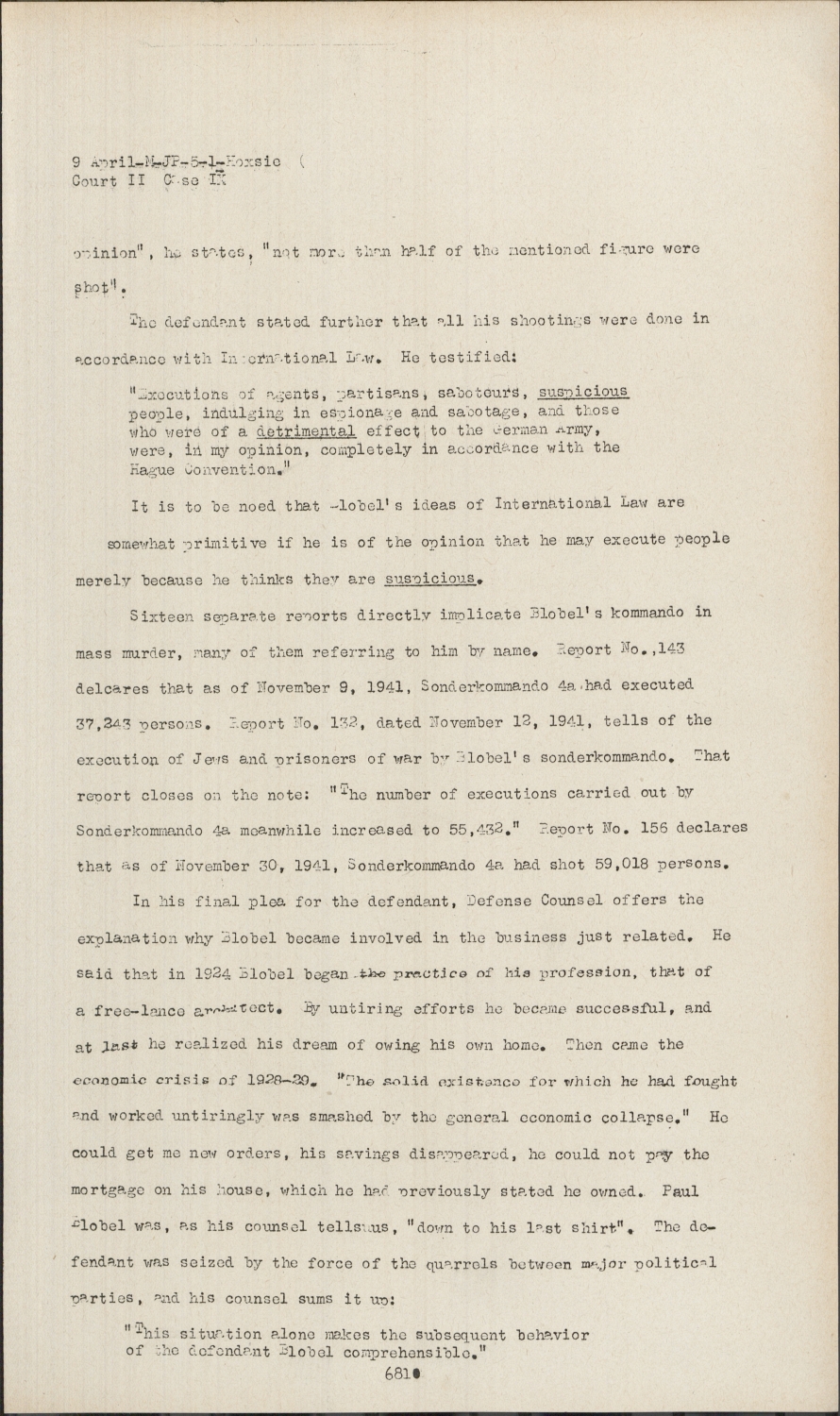
He testified:
"Executions of agents, partisans, saboteurs, suspicious people, indulging in espionage and sabotage, and those who were of a detrimental effect to the German Army, were, in my opinion, completely in accordance with the Hague Convention."
It is to be need that Blobel's ideas of International Law are somewhat primitive if he is of the opinion that he may execute people merely because he thinks they are suspicious.
Sixteen separate reports directly implicate Blobel's kommando in mass murder, many of them referring to him by name. Report No.,143 delcares that as of November 9, 1941, Sonderkommando 4a had executed 37,243 persons. Report No. 132, dated November 12, 1941, tells of the execution of Jews and prisoners of war by Blobel's sonderkommando. That report closes on the note: "The number of executions carried out by Sonderkommando 4a meanwhile increased to 55,432." Report No. 156 declares that as of November 30, 1941, Sonderkommando 4a had shot 59,018 persons.
In his final plea for the defendant, Defense Counsel offers the explanation why Blobel became involved in the business just related. He said that in 1924 Blobel began the practice of his profession, that of a free-lance architect. By untiring efforts he became successful, and at last he realized his dream of owing his own home. Then came the economic crisis of 1928-29. "The solid existence for which he had fought and worked untiringly was smashed by the general economic collapse." He could get me now orders, his savings disappeared, he could not pay the mortgage on his house, which he had previously stated he owned. Paul Blobel was, as his counsel tells us, "down to his last shirt". The defendant was seized by the force of the quarrels between major political parties, and his counsel sums it up:
"This situation alone makes the subsequent behavior of the defendant Blobel comprehensible."
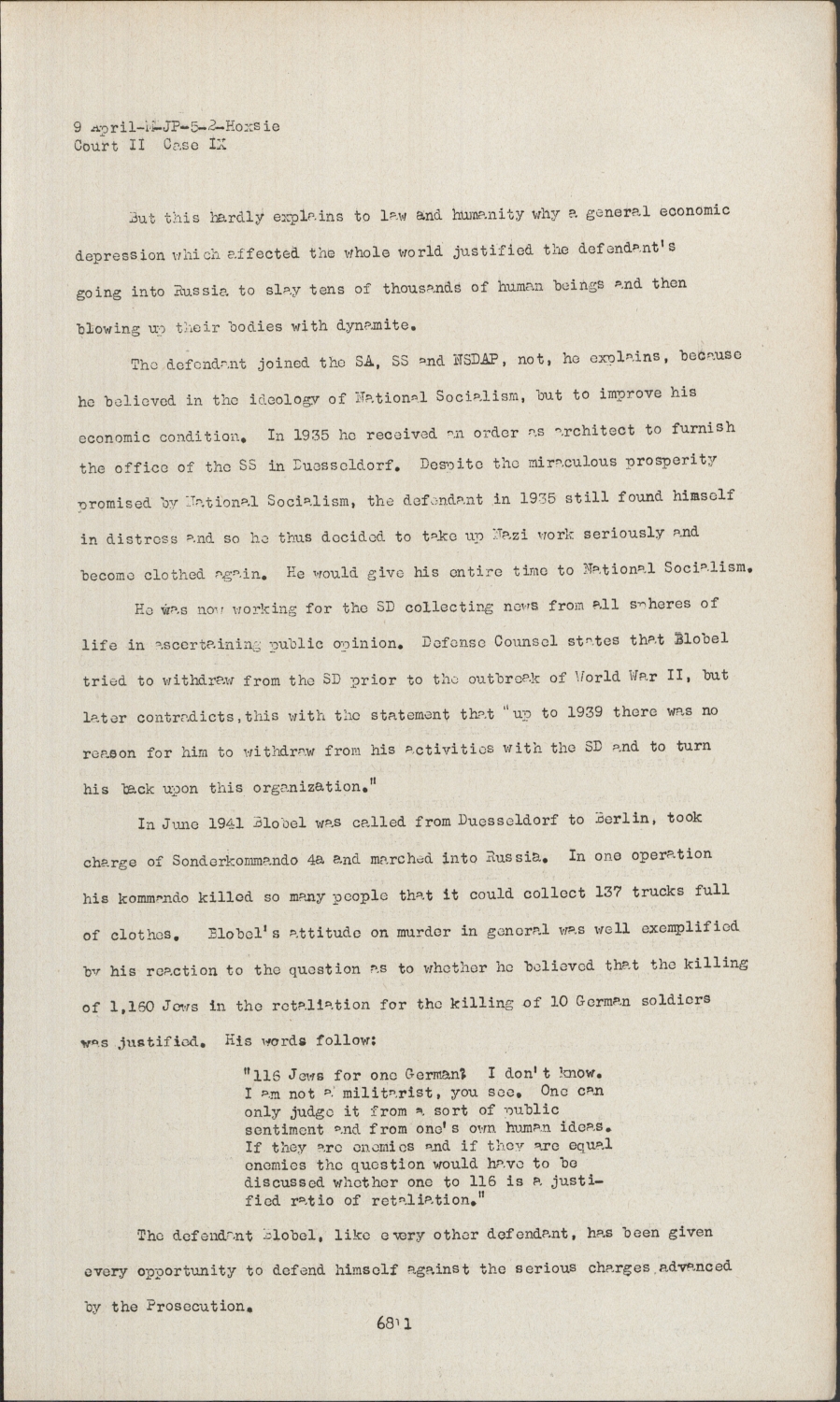
But this hardly explains to law and humanity why a general economic depression which affected the whole world justified the defendant's going into Russia to slay tens of thousands of human beings and then blowing up their bodies with dynamite.
The defendant joined the SA, SS and NSDAP, not, he explains, because he believed in the ideology of National Socialism, but to improve his economic condition. In 1935 he received an order as architect to furnish the office of the SS in Duesseldorf. Despite the miraculous prosperity promised by National Socialism, the defendant in 1935 still found himself in distress and so he thus decided to take up Nazi work seriously and become clothed again. He would give his entire time to National Socialism.
He was now working for the SD collecting news from all spheres of life in ascertaining public opinion. Defense Counsel states that Blobel tried to withdraw from the SD prior to the outbreak of World War II, but later contradicts, this with the statement that "up to 1939 there was no reason for him to withdraw from his activities with the SD and to turn his back upon this organization."
In June 1941 Blobel was called from Duesseldorf to Berlin, took charge of Sonderkommando 4a and marched into Russia. In one operation his kommando killed so many people that it could collect 137 trucks full of clothes, Blobel's attitude on murder in general was well exemplified by his reaction to the question as to whether he believed that the killing of 1,160 Jews in the retaliation for the killing of 10 German soldiers was justified. His words follow:
"116 Jews for one German? I don't know.
I am not a militarist, you see. One can only judge it from a sort of public sentiment and from one's own human ideas.
If they are enemies and if they are equal enemies the question would have to be discussed whether one to 116 is a justi fied ratio of retaliation."
The defendant Blobel, like every other defendant, has been given every opportunity to defend himself against the serious charges advanced by the Prosecution.
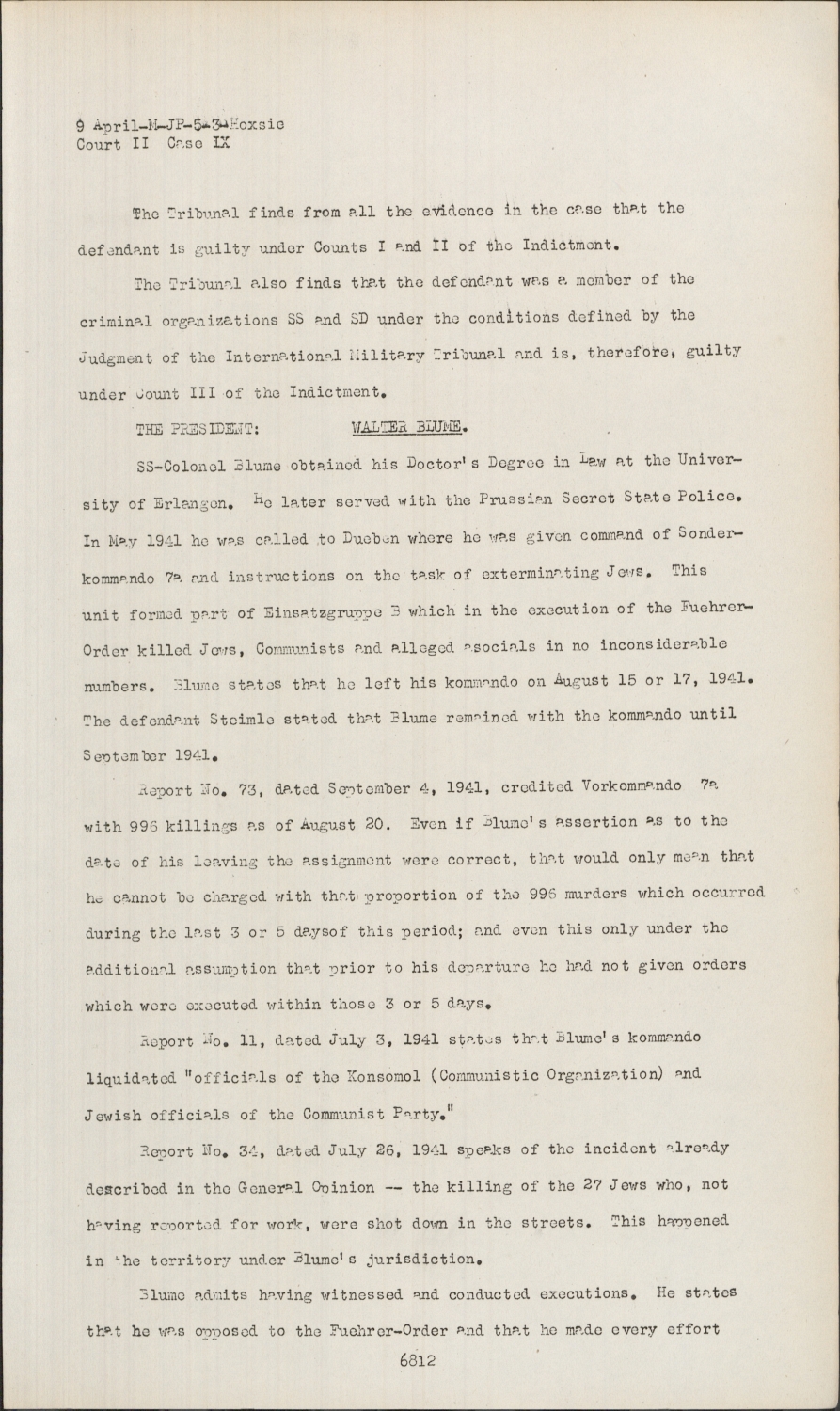
The Tribunal finds from all the evidence in the case that the defendant is guilty under Counts I and II of the Indictment.
The Tribunal also finds that the defendant was a member of the criminal organizations SS and SD under the conditions defined by the Judgment of the International Military Tribunal and is, therefore, guilty under Count III of the Indictment.
THE PRESIDENT: WALTER BLUME.
SS-Colonel Blume obtained his Doctor's Degree in Law at the University of Erlangen. He later served with the Prussian Secret State Police. In May 1941 he was called to Dueben where he was given command of Sonderkommando 7a and instructions on the task of exterminating Jews. This unit formed part of Einsatzgruppe B which in the execution of the FuehrerOrder killed Jews, Communists and alleged asocials in no inconsiderable numbers. Blume states that he left his kommando on August 15 or 17, 1941. The defendant Steimle stated that Blume remained with the kommando until September 1941.
Report No. 73, dated September 4, 1941, credited Vorkommando 7a with 996 killings as of August 20. Even if Blume's assertion as to the date of his leaving the assignment were correct, that would only mean that he cannot be charged with that proportion of the 996 murders which occurred during the last 3 or 5 daysof this period; and even this only under the additional assumption that prior to his departure he had not given orders which were executed within those 3 or 5 days.
Report No. 11, dated July 3, 1941 states that Blume's kommando liquidated "officials of the Konsomol (Communistic Organization) and Jewish officials of the Communist Party."
Report No. 34, dated July 26, 1941 speaks of the incident already described in the General Opinion -- the killing of the 27 Jews who, not having reported for work, were shot down in the streets. This happened in the territory under Blume's jurisdiction.
Blume admits having witnessed and conducted executions. He states that he was opposed to the Fuehrer-Order and that he made every effort to avoid putting it into effect, But the facts do not support this assertion, From time to time during this trial various defendants have stated that certain reports were incorrect, that the figures were exaggerated, even falsified.
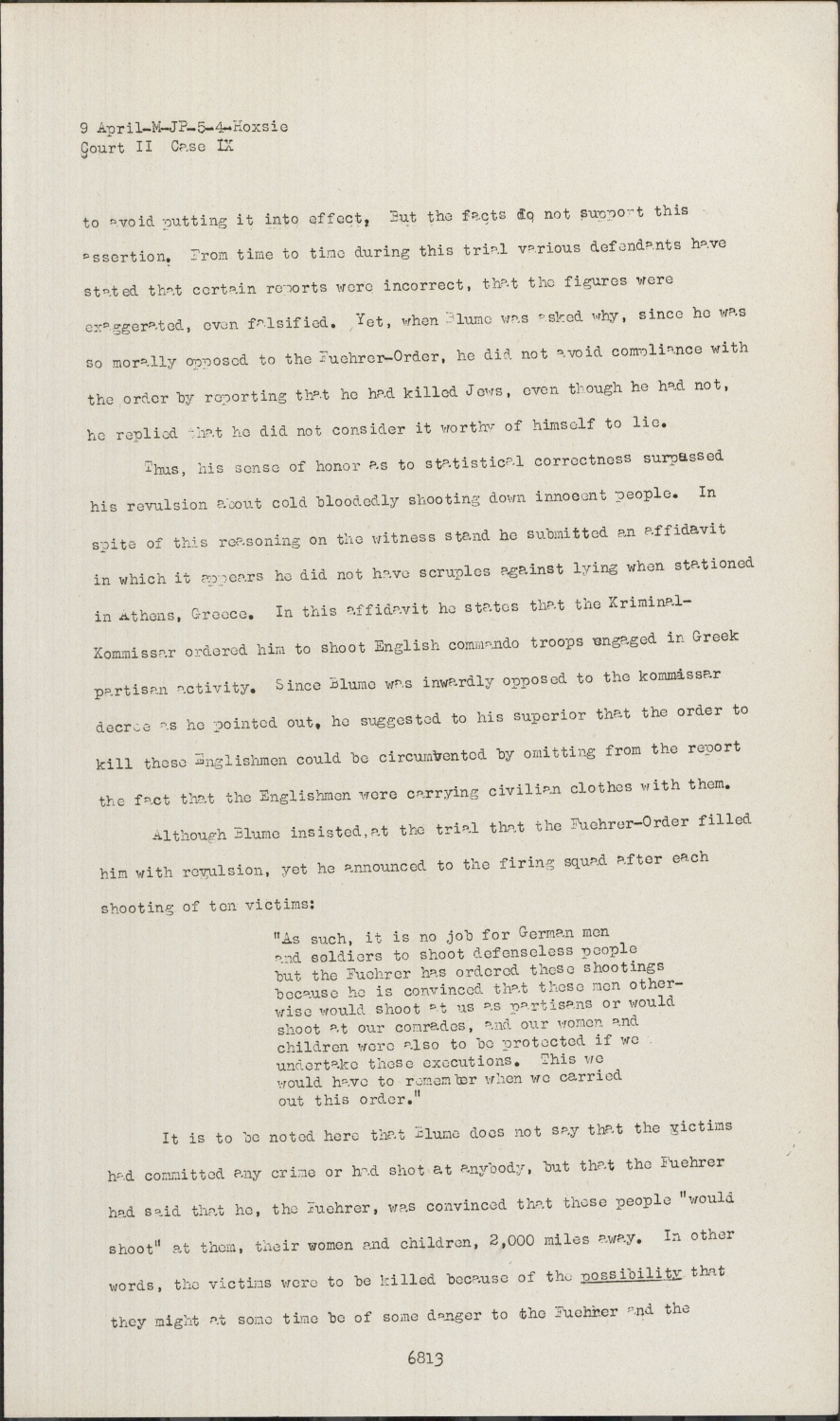
Yet, when Blume was asked why, since he was so morally opposed to the Fuehrer-Order, he did not avoid compliance with the order by reporting that he had killed Jews, even though he had not, he replied that he did not consider it worthy of himself to lie.
Thus, his sense of honor as to statistical correctness surpassed his revulsion about cold bloodedly shooting down innocent people. In spite of this reasoning on the witness stand he submitted an affidavit in which it appears he did not have scruples against lying when stationed in Athens, Greece. In this affidavit he states that the KriminalKommissar ordered him to shoot English commando troops engaged in Greek partisan activity. Since Blume was inwardly opposed to the kommissar decree as he pointed out, he suggested to his superior that the order to kill these Englishmen could be circumvented by omitting from the report the fact that the Englishmen were carrying civilian clothes with them.
Although Blume insisted, at the trial that the Fuehrer-Order filled him with revulsion, yet he announced to the firing squad after each shooting of ten victims:
"As such, it is no job for German men and soldiers to shoot defenseless people but the Fuehrer has ordered these shootings because he is convinced that these men other wise would shoot at us as partisans or would shoot at our comrades, and our women and children were also to be protected if we undertake these executions.
This we would have to remember when we carried out this order."
It is to be noted here that Blume does not say that the victims had committed any crime or had shot at anybody, but that the Fuehrer had said that he, the Fuehrer, was convinced that these people "would shoot" at them, their women and children, 2,000 miles away. In other words, the victims were to be killed because of the possibility that they might at some time be of some danger to the Fuehrer and the executioners.
Blume says that he made this speech to case the feelings of the men, but in effect he was convincing them that it was entirely proper to kill innocent and defenseless human beings. If he was not in accord with the order, he at least could have refrained from propagandizing his men on its justness and reasonableness, and exhortation which could well have persuaded them into a zestful performance of other executions which might otherwise have been avoided or less completely fulfilled.
Blume's claims about revulsion to the Fuehrer-Order are not borne out by his statement:
"I was also fully convinced and am so even now, that Jewry in Soviet Russia played an important part, and still does play an important part, and it has the especial support of Bolshevis tic dictatorship, and still is."
While carrying in the town of Wilna with his kommando, Blume instructed the local commander to arrest all Jews and confine them to a ghetto. Since the local commander of Wilna was not Blume's subordinate, Blume was not called upon to issue the order for the incarceration of the Jews which only brought them one step closer to execution under the Fuehrer-Order. Blume's explanation that he hoped the Fuehrer-Order might be recalled is scarcely adequate. He could have done nothing. Duty did not require him to incarcerate these Jews.
When the defendant stated that he had ordered the execution of three men charged with having asked the farmers not to bring in the harvest he was asked whether such an execution was not contrary to the rules of war:
"Q. Are you familiar with the rules of war?
"A. In this case I acted by carrying out the Fuehrer-Order which decreed that saboteurs and functionaries were to be shot.
"Q. Did you regard a person who told a farmer not to assist the Nazi invaders as a saboteur, because he refused to help the Nazis and that was worthy of the death sentence which you invoked?
"A. Yes.
"Q. Are you familiar with the rules of war?
"A. I already stated that for me the directive was the Fuehrer-Order.
That was my war law."
The defendant stated several times that he was aware of the fact that he was shooting innocent people and admitted the shooting of 200 people by his kommando.
Blume is a man of education. He is a graduate lawyer. He joined the NSDAP voluntarily, swore allegiance to Hitler voluntarily and became director of a section of the Gestapo voluntarily. He states that he admired, adored and worshipped Hitler because Hitler was successful not only in the domestic rehabilitation of Germany, as Blume interpreted it, but successful in defeating Poland, France, Belgium, Holland, Norway, Yugoslavia, Greece, Luxembourg and other countries. To Blume these successes were evidence of great virtue in Hitler. Blume is of the notion that Adolf Hitler "had a great mission for the German people."
In spite of his declared reluctance to approve the Fuehrer-Order he would not go so far as to say that this order which brought about the indiscriminate killing of men, women and children, constituted murder and the reason for the explanation was that Hitler had issued the order and Hitler, of course, could not commit a crime. In fact Blume's great sense of guilt today is not that he brought about the death of innocent people but that he could not execute the Fuehrer-Order to its limit:
"Q. We understood you to say that you had a bad conscience for only executing part of the order.
Does that mean that you regretted that you had not obeyed entirely the Fuehrer Order?
"A. Yes. This feeling of guilt was within me.
The feeling of guilt about the fact that I as an individual, was not able, and consider ed it impossible, to follow a Fuehrer-Order."
Dr. Lummert, Blume's lawyer, made a very able study of the law involved in this case. His arguments on Necessity and Superior Orders have been treated in the General Opinion. Dr. Lummert, in addition, has collected a formidable list of affidavits on Blume's character. They tell of Blume's honesty, good nature, kindness, tolerance and sense of justness, and the Tribunal does not doubt that he possessed all these excellent attributes at one time. One could regret that a person of such excellent moral qualities should have fallen under the influence of Adolf Hitler. But on the other hand one can regret even more that Hitler found such a resolute person to put into execution his murderous program. For let it be said once for all that Hitler with all his cunning and unmittigated evil would have remained as innocuous as rambling crank if he did not have the Blumes, the Blobels, the Braunes and the Bibersteins to do his bidding, -- to mention only the B's.
The Tribunal finds the defendant guilty under Counts I and II of the Indictment.
The Tribunal also finds that the defendant was a member of the criminal organizations SS, SD and Gestapo under the conditions defined by the Judgment of the International Military Tribunal and is, therefore, guilty under Count III of the Indictment.
MARTIN SANDBERGER SS-Colonel Martin Sandberger studied jurisprudence at the Universities of Munich, Freiburg, Cologne and Tuebingen.
He worked as an assistant judge in the Inner Administration of Wuerttemberg and became a Government Councillor in 1937. In October 1939 he was chief of the Immigration Center and in June 1941 was appointed chief of Sonderkommando ia of Einsatzgruppe A. He left for Estonia on the 23rd day of that month. On December 3, 1941 he became Commander of the Security Police and SD for Estonia. He returned to Germany in September 1943. During this long period of 26 months he had ample opportunity to be involved in the execution of the Fuehrer-Order which he originally heard in Pretzsch end which was fully discussed again in Berlin before he left for the East.
Despite the defendant's protestations from the witness stand, it is evident from the documentary evidence and his own testimony, that he went along willingly with the execution of the Fuehrer-Order. Hardly had his kommando reached its first stopping place before it began its criminla work. Operational Report No. 15 reads:
"Group leader entered Riga with Ein satzkommando 1a and 2."It then describes the destruction of synagogues, the liquidation of 400 Jews and the setting up of groups for the purpose of fomenting progroms.
Sandberger seeks to deny responsibility for the executions, although it has been demonstrated that not only he was in Riga at the time they occured, but he actually had a conversation about them with the Einsatzgruppe Chief Stahlecker before he left Riga.
This same report shows that a teilkommando of Sandberger's unit, Einsatzkommando 1a, was assigned to an operation in Dorpat; and it is interesting to note that a subsequent report (No 88, dated September 19, 1941) tells of an execution in Dorpat of 405 persons of whom 50 were Jews. This report closes with the significant statement:
"There are no more Jews in prison."
A report dated October 15, 1941 on executions in Ostland included one item under Esthonia of 474 Jews and 684 Communists. The defendant also denies responsibility for these killings, placing the credit or blame for them on the German Field Police and Esthonian Home Guard. It is a fact, however, that the Esthonia Home Guard was under Sandberger's juridiction and control for specific operations, as evidenced by the same report:
"The arrest of all male Jews of over 16 years of age has been nearly finished.
With the exception of the doctors and the elders of the Jews who were appointed by the special kommandos, they were ex ecuted by the self-Protection Units under the control of the Special Detachment 1a. Jewesses in Pernau and Reval of the age groups from 16 to 60 who are fit for work were arrested and put to peat-cutting or other labor.
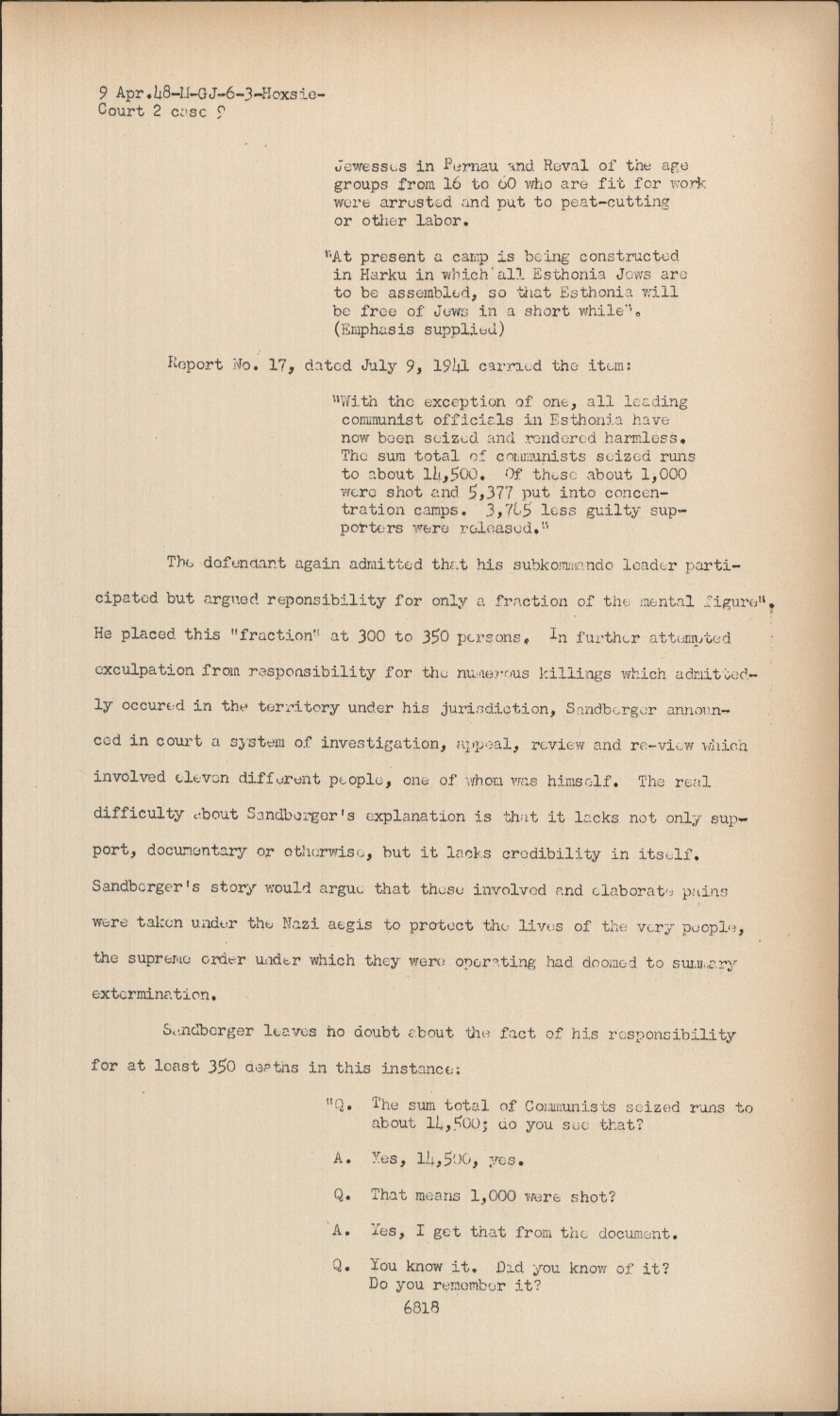
"At present a camp is being constructed in Harku in which all Esthonia Jews are to be assembled, so that Esthonia will be free of Jews in a short while".(Emphasis supplied) Report No. 17, dated July 9, 1941 carried the item:
"With the exception of one, all leading communist officials in Esthonia have now been seized and rendered harmless.
The sum total of communists seized runs to about 14,500.
Of these about 1,000 were shot and 5,377 put into concen tration camps.
3,785 less guilty sup porters were released."
The defendant again admitted that his subkommando leader participated but argued, reponsibility for only a fraction of the mental figure". He placed this "fraction" at 300 to 350 persons. In further attempted exculpation from responsibility for the numerous killings which admittedly occured in the territory under his jurisdiction, Sandberger announced in court a system of investigation, appeal, review and re-view which involved eleven different people, one of whom was himself. The real difficulty about Sandberger's explanation is that it lacks not only support, documentary or otherwise, but it lacks credibility in itself. Sandberger's story would argue that these involved and elaborate pains were taken under the Nazi aegis to protect the lives of the very people, the supreme order under which they were operating had doomed to summary extermination.
Sandberger leaves no doubt about the fact of his responsibility for at least 350 deaths in this instance:
"Q. The sum total of Communists seized runs to about 14,500; do you see that?
A. Yes, 14,500, yes.
Q. That means 1,000 were shot?
A. Yes, I get that from the document.
Q. You know it. Did you know of it?
Do you remember it?
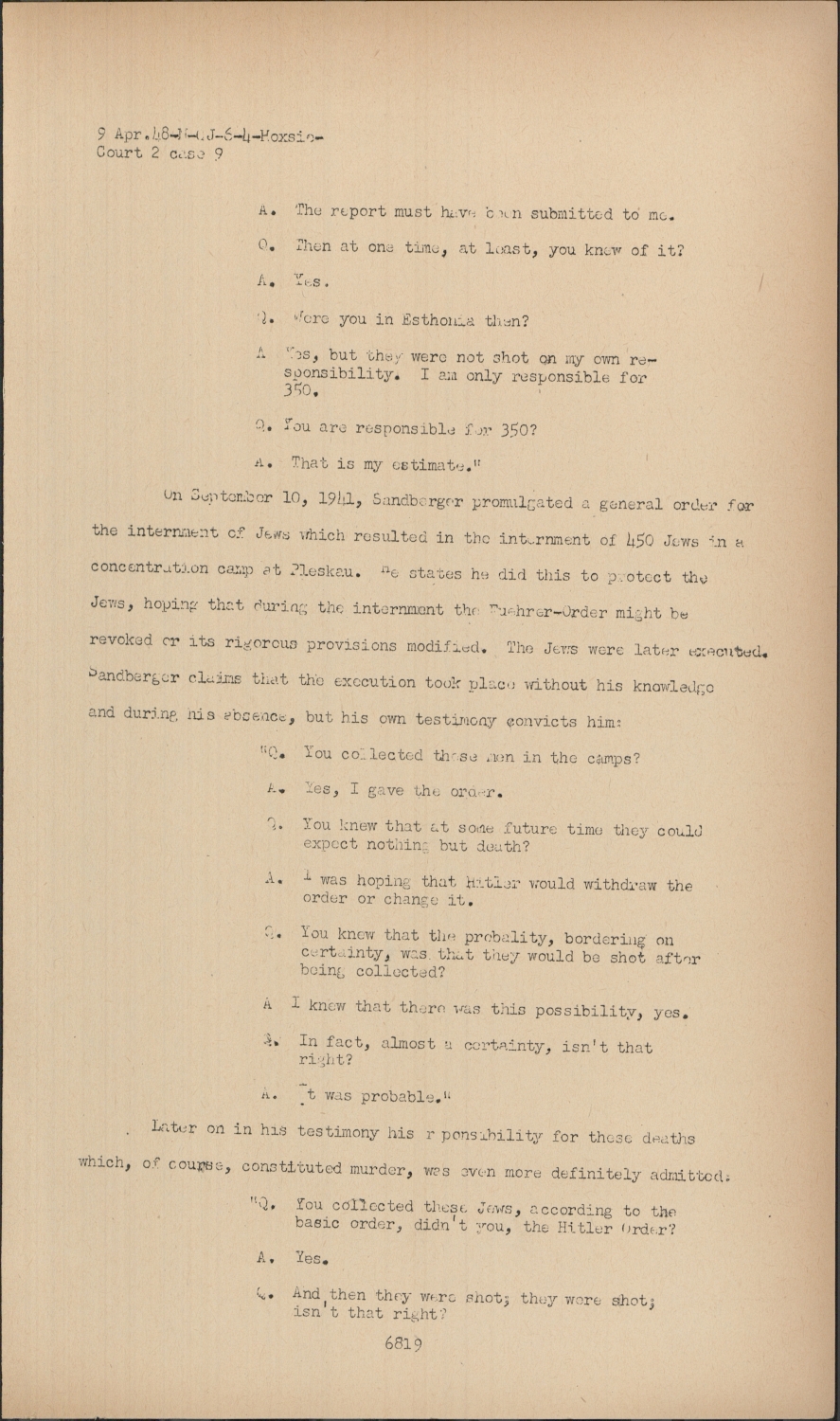
A. The report must have bun submitted to me.
Q. Then at one time, at least, you knew of it?
A. Yes.
Q. Were you in Esthonia then?
A Yes, but they were not shot on my own re sponsibility.
I am only responsible for Q. You are responsible for 350?
A. That is my estimate."
On September 10, 1941, Sandberger promulgated a general order for the internment of Jews which resulted in the internment of 450 Jews in a concentration camp at Pleskau. He states he did this to protect the Jews, hoping that during the internment the Fuehrer-Order might be revoked or its rigorous provisions modified. The Jews were later executed. Sandberger claims that the execution took place without his knowledge and during his absence, but his own testimony convicts him:
"Q. You collected these men in the camps?
A. Yes, I gave the order.
Q. You knew that at some future time they could expect nothing but death?
A. I was hoping that Hitler would withdraw the order or change it.
Q. You knew that the probality, bordering on certainty, was that they would be shot after being collected?
A I knew that thorn was this possibility, yes.
Q. In fact, almost a certainty, isn't that right?
A. It was probable."
Later on in his testimony his responsibility for those deaths which, of course, constituted murder, was even more definitely admitted.
"Q. You collected these Jews, according to the basic order, didn't you, the Hitler Order?
A. Yes.
Q. And then they were shot; they were shot;
isn't that right?
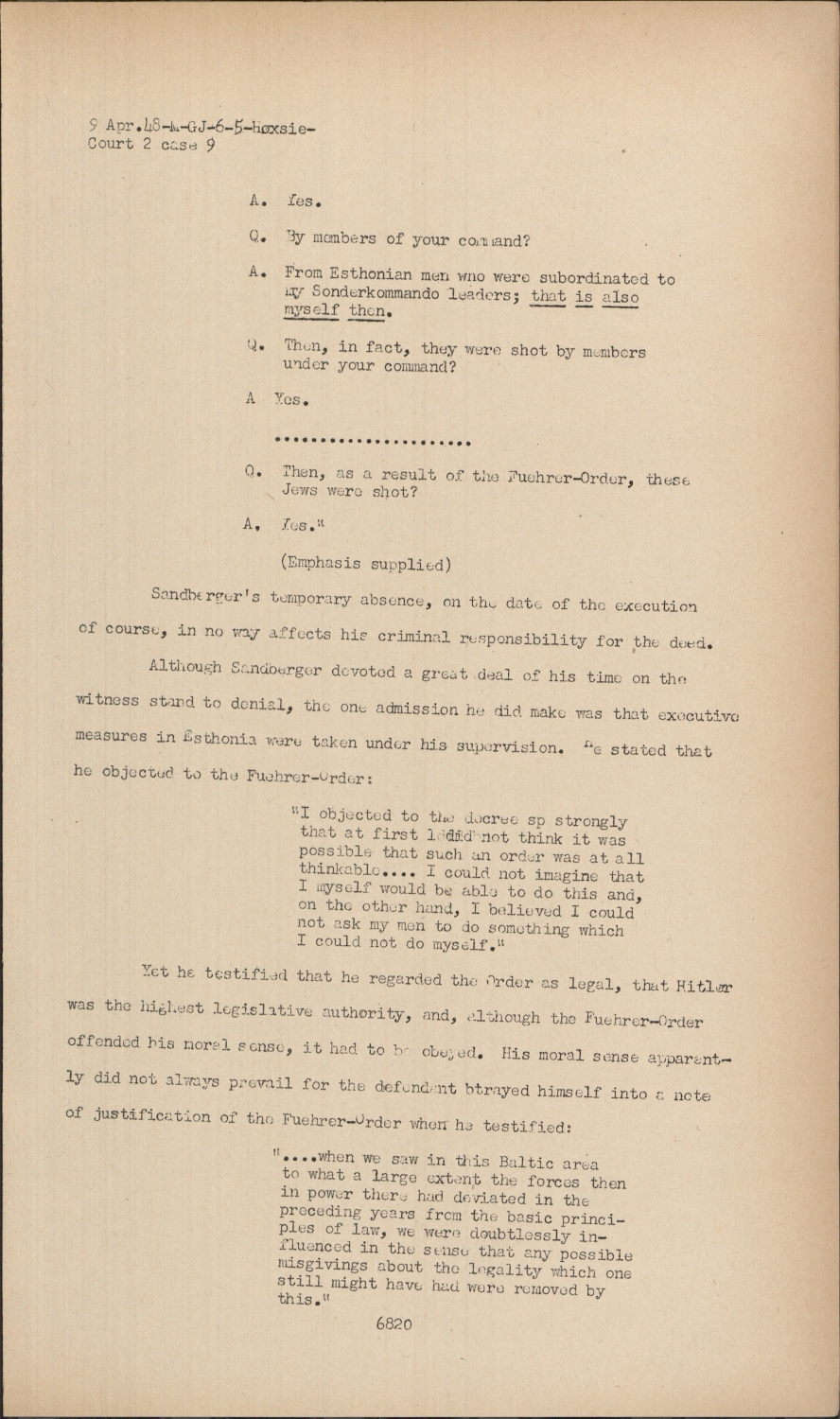
A. Yes.
Q. By members of your command?
A. From Esthonian men who were subordinated to my Sonderkommando leaders; that is also myself then.
Q. Then, in fact, they were shot by members under your command?
A Yes.
......................
Q. Then, as a result of the Fuehrer-Order, these Jews were shot?
A. Yes."
(Emphasis supplied)
Sandberger's temporary absence, on the date of the execution of course, in no way affects his criminal responsibility for the deed.
Although Sandberger devoted a great deal of his time on the witness stand to denial, the one admission he did make was that executive measures in Esthonia were taken under his supervision. He stated that he objected to the Fuehrer-Order:
"I objected to the decree sp strongly that at first l did not think it was possible that such an order was at all thinkable.
... I could not imagine that I myself would be able to do this and, on the other hand, I believed I could not ask my men to do something which I could not do myself."
Yet he testified that he regarded the Order as legal, that Hitler was the highest legislative authority, and, although the Fuehrer-Order offended his moral sense, it had to be obeyed. His moral sense apparently did not always prevail for the defendant btrayed himself into a note of justification of the Fuehrer-Order when he testified:
"....when we saw in this Baltic area to what a large extent the forces then in power there had deviated in the preceding years from the basic princi ples of law, we were doubtlessly in fluenced in the sense that any possible misgivings about the legality which one still might have had were removed by this."
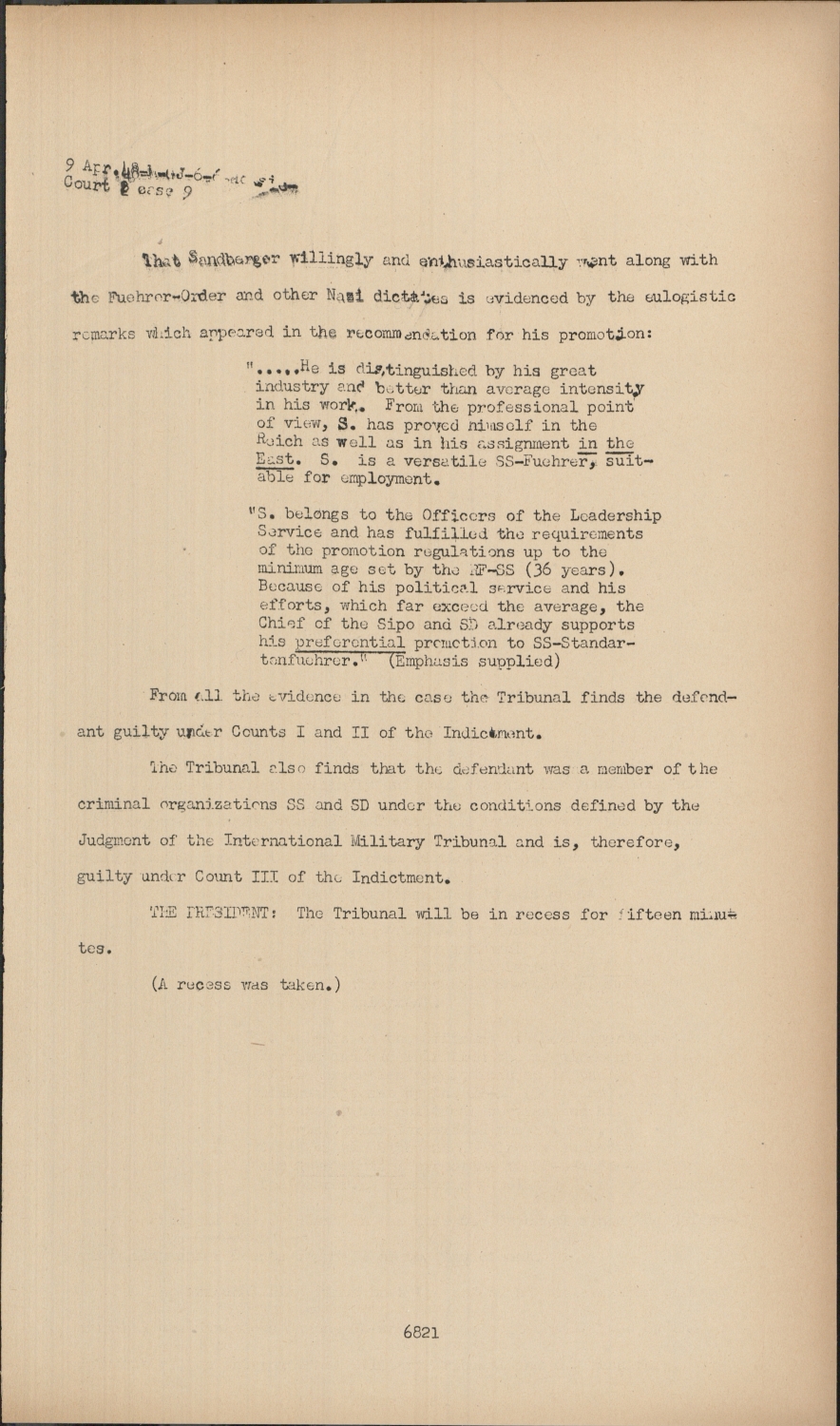
That Sandberger willingly and enthusiastically went along with the Fuehrer-Order and other Nazi dictates is evidenced by the eulogistic remarks which appeared in the recommendation for his promotion:
".....He is distinguished by his great industry and better than average intensity in his work.
From the professional point of view, S. has proved himself in the Reich as well us in his assignment in the East.
S. is a versatile SS-Fuehrer, suit able for employment.
"S. belongs to the Officers of the Leadership Service and has fulfilled the requirements of the promotion regulations up to the minimum age set by the RF-SS (36 years).Because of his political service and his efforts, which far exceed the average, the Chief of the Sipo and SD already supports his preferential promotion to SS-Standar tanfuehrer."
(Emphasis supplied) From all the evidence in the case the Tribunal finds the defendant guilty under Counts I and II of the Indictment.
The Tribunal also finds that the defendant was a member of the criminal organizations SS and SD under the conditions defined by the Judgment of the International Military Tribunal and is, therefore, guilty under Count III of the Indictment.
THE PRESIDENT:The Tribunal will be in recess for fifteen minutes.
(A recess was taken.)