Q. You were a member of the SS, were you not ?
A.In November 1939 when the coordination decree came out, I became a member of the SS.
Q.To enter the SS, you had to send in an application, did you not ?
A.We were directed by the office to make a formal application.
Q.And this application was similarly subjected to a political screening was it not ?
A.I assume so.
Q.And when you were in Duesselforf, as delegate of the Chief of the Gestapo services, you had under yourorders some Boundary Police Commissariat.
A.Yes.
Q.Is it exact that the Commissariat had exactly the same functions as the Foreign Offices of the Gestapo ?
A.No, not in the beginnings In the beginning they had only the task of the Border police. at the period when I was there, the political tasks of the police were taken care of by the Landrat.
Q.You are speaking of what period ?
A.I speak of the period of 1939 to 1940 -- until September 1940.
Q.I remind you of a circular of the Hessen and Reich Ministry of the Interior of 8 may 1947, published in the bulletin of 1937 of the Ministry of the Interior, Reich and Hessen, page 754, which stipulates in its third article that the police tasks at the frontier of the Reich are taken over by the boundary Commissariats and Officers. That is correct, is it not ?
A.Yes, that is correct. We had to distinguish between the inner political tasks and the tasks of counter-intelligence up there. The tasks of counterintelligence, of course, were handled by the Border police, but not the tasks of the inner political nature because the officials of the Border Police die not have the necassary training to make criminal investigations independently.
Q.The same paragraph continues that the boundary commissariates of the Police are considered as being Gestapo offices and are assimilated to the "Aussendienst Stelle" A. I can not understand the word.
Oh, yes -- "Aussendienst Stelle".
The Border Police was subordinated to the State Police office, Department III, which was dealing, with counter-intelligence tasks because counter-intelligence tasks had as an object to counter efforts from abroad and so it goes without saying that the Border Police had the primary tasks of all police units along the border. I have explained that the Border Police essentially had nothing to do with inner political tasks of the police,
Q.You said to us just now that the shipments to concentration camps were done on the request of the local Gestapo services. Is that true ?
A.If an individual was to be sent to concentration camp, the Gestapo office had to make a demand, and then the Gestapo office or the RSHA-if they decided for protective custody, then the individual could be sent to the concentration camp, because that was done along the usual channels of police administration.
Q.So it is a fact, witness, that shipments to concentration camps were made on the initiative of the local offices of the Gestapo ?
A.On the demand of the local office of the Gestapo/
Q.And the local Gestapo services made these requests and at the same time arrested the individual ?
A.Yes.
Q.These Frontier Offices, did they equally have the right to make request for shi pment to cencentration camps ? a. The Border Police had only the task to arrest at the border. They did not make any decisions independently. If the Border Police arrested an individual, all they did was to send the report to the Gestapo office, which continued to deal with the matter. The officials of the border Police were essentially beginners who could not carry out any investigation of a general nature. The Border Police office was not an independent office that could make such requests. At first the Border Police were in no way different from these before 1933.
Q.I would like to show you, witness, a document which is nevertheless of 1944 and which comes from the Gestapo office.
That is 1,063-PS. Is it a fact that this letter was also sent to the Frontier Commissariat to indicate to them that there was no reason to send arrested Eastern workers to Buchenwald concentration camp ?
A.Excuse me; I did not quite understand the question because I was reading.
Q Is it correct that this letter addressed to the frontier commissariat indicates the -
QThat can be seen from the contents. It is clear, of course, that the State Police office also sends its principal directives to the border. The contents of this letter deal with the treatment of individuals which had been caught and that, of course, occurred also along the border. That letter has to do with the fact that a police office, if it has caught any such individuals, has to transfer or pass on all information when they pass on the entire case.
QIt is correct, is it, that this document indicates that requests for shipment to concentration camps which would come from frontier offices have to pass via Duesseldorf?
AYes. of course. To my knowledge, the Border Police Commissariat could not have any direct connection with the Gestapo main office.
QSo it is correct that the Frontier Commissariat could themselves file concentration requests for shipment to concentration camps?
AOnly to the State Police Office at Duesseldorf. But I must add that the document was dated 1944, and that since 1940 I was no more in Germany in Gestapo work, and I cannot say whether there were any changes concerning the mission of the Border Police Commissariat during my absence. This document does not give any cause to assume so, because I assume that the same decree was also sent to the Landrat.
THE PRESIDENT:In general, the Tribunal thinks that there is no use cross examining the witness about documents which aren't his own documents and about which he knows nothing. You can put the documents in. BY M. MONNERAY:
QDo you know the institution of the secret police?
AIn the country there was only the gendarmerie, and in the smaller terms, the so-called communal criminal police.
QI believe there is a mistranslation there.
A secret field police. What institution is known to me, yes.
I did not understand the question at first.
QIs it correct that most of the members of this military police came from the police?
AThe units of the Secret Field Police, Geheime Feldpolizei, were composed of several police officials, but mostly soldiers which had been ordered to do that job, and the groups of the Secret Field Police, Geheime Feldpolizei, which were transferred to Denmark. I estimate that within one unit there were about ten to fifteen per cent of officials, whereas the rest were soldiers which had been ordered for that duty and before that never had anything to do with the police.
QThis correct, that most of the officers of the police come from the police?
AThe leaders of these commandos and the staff were mostly police officials, as far as I can remember, mostly officials from the criminal police,
M. MONNERAY:With the permission of the Tribunal I will hand in two documents, which are affidavits F964 and F965, which become exhibits RF 1535 and RF 1536, These documents indicate for two regions of France that the great majority of the officers of this Military Police came from the police originally. BY M. MONNERAY:
QIs it correct that hostages in the occupied countries were handed over to the SIPO?
AI didn't understand, that question.
QIs it exact, that in the occupied territories hostages were handed ever by the Army to the SIPO?
AThat varied in the different territories. As far as I know, the hostages in France were shot by *---* forces; in Norway, upon order of the Reich Commissioner Terboven, as much as I know, by the SIPO, the Secret Police. I could not say how it was in Belgium.
QHave you received reports on third degree interrogations indicating how rigorous these interrogations were?
AYou mean reports during my term of office?
QThis was in Berlin.
ANo, I have said that as an official basis of information we only found out what had been printed in the Norwegian White Book. Apart from that, nothing was known to me.
M. MONNERAY:I will allow myself to submit to the Tribunal a report from the Commander of the SIPO and SD of July 6, 1944 from Marseilles concerning arrests of members of the French resistance, of the interrogation of these members, and of the ensuing decease. This is document F 979, which becomes 1537 RF. With the permission of the Tribunal I would like to read an extract of this document.
"The arrested men from one to sixteen were killed -- "
THE PRESIDENT:What page of the document? M. MONNERAY: On Page 2 of the French translation, Mr. President, an extract.
"The arrested from one to sixteen, as well as 43 prisoners *---* under number 16 were killed in an attempted escape on 13 June 1944. Number 13 and 15 were killed in the neighborhood of Salon on 15 June 1944 in an attempted escape. Number 17 is still necessary to the special section AF." And further on, "Number 21 died in our hands." BY M. MONNERAY:
QConcerning the Nacht und Nebel decree, you said to us that the Gestapo services in Berlin were opposed to it.
AYes.
QI would like to submit to you Document PS 668, which has already beer submitted as PS 504.
AI have explained that the State Police, for purely professional reasons, were against that decree. But since it was a decree which has been ordered and issued by the leadership of the state, of course the decree had to be carried out by the State Police just as it had to be carried out by other offices.
QAnd your office IV D 4 which signed this document chose the most rigorous solution?
AThe solution which was indicated by the decree.
QThe army had requested, had asked your service to suggest the solution, hadn't it?
ADo you mean the solution that was mentioned in this one special case.
or the decree in general?
QI ask you, witness, whether it is correct that the Army requested from you that you should offer a solution to the problem of knowing whether the parents of a deceased Frenchman had to be advised concerning his decease or not, and also I ask youwhether it is true that you chose the most strict and rigerous solution?
AFrom this document I can only gather that apparently an inquiry was sent by the OKW, and that on the part of the Gestapo office the answer was given as far as it was necessary on the basis of this decree.
QIs it correct that on Page 2 the Army answers you that it agrees with your proposal?
AApparently.
QDid you yourself give instructions, personal instructions, concerning the application of the Nacht und Nebel decree?
AThat was not my task. I had as minsterial instanz only to pass on instructions to these beneath me, and not to others.
QDid you have any connection with the concentration camp services?
AI only had connections to the concentration camps from the time on when I was charged with the care for the French ministers, because first Prime Minister Reynaud and Mandel lived in the cells of Oranienburg, and I had to see them there frequently in order to find out what they needed. And the same thing was the case later with the concentration camp Buchenwald where M. Blum and M. Mandel were quartered in a small house, a shack, in the settlement where prisoners were quartered. And concerning the castle of Gutter, the guards had been posted there taken from units of the concentration camp Dachau. Those were the only cases, the only connection that I had indirectly with the administration of concentration camps.
THE PRESIDENT:It is time to adjourn.
(A recess was taken until 1400 hours.)
(The Tribunal reconvened at 1400 hours).
AFTERNOON SESSION
THE PRESIDENT:It will perhaps be convenient to counsel for the organizations to know that the Tribunal proposes to take all the oral evidence, by witnesses for the organizations, first, and then that they should comment upon their documents afterwards, because some of the documents and many of the affidavits have not yet been gotten ready. I think that will probably be for the convenience of the organizations.
The Tribunal propses to sit on Saturday morning in open session until one o'clock.
KARL HEINZ HOFFMANN -- Resumed.
CROSS EXAMINATION -- Continued. BY M. MONNERAY:
Q.You told us a while ago that the protection of certain French political people had nothing to do with the question of concetration camps.
A.No.
Q.Did you make out rules and regulations for the concentration camps?
A.I do not recall.
M. MONNERAY:I should like to show the witness, with the permission of the Tribunal, Document PS-2521, which will become Exhibit RF-1538. This document is not in the document book. BY M. MONNERAY:
Q.On page 2 of this document, we find an extract of the Nacht und Nebl decree for the use of the concentration camp organi zation. This document comes from Office 44.
A.Yes. That is a translation of the Nacht und Nebel decree to Inspector of K.L. I cannot remember when the execution of the Nacht und Nebel decree in K.L. was being carried through. I assume that the reason was the difficult execution of this matter in the various departments.
Q.This document is signed by you, is it not?
A.By Dr. Hoffmann; and there is a seal there, too. It is quite possible that I signed that.
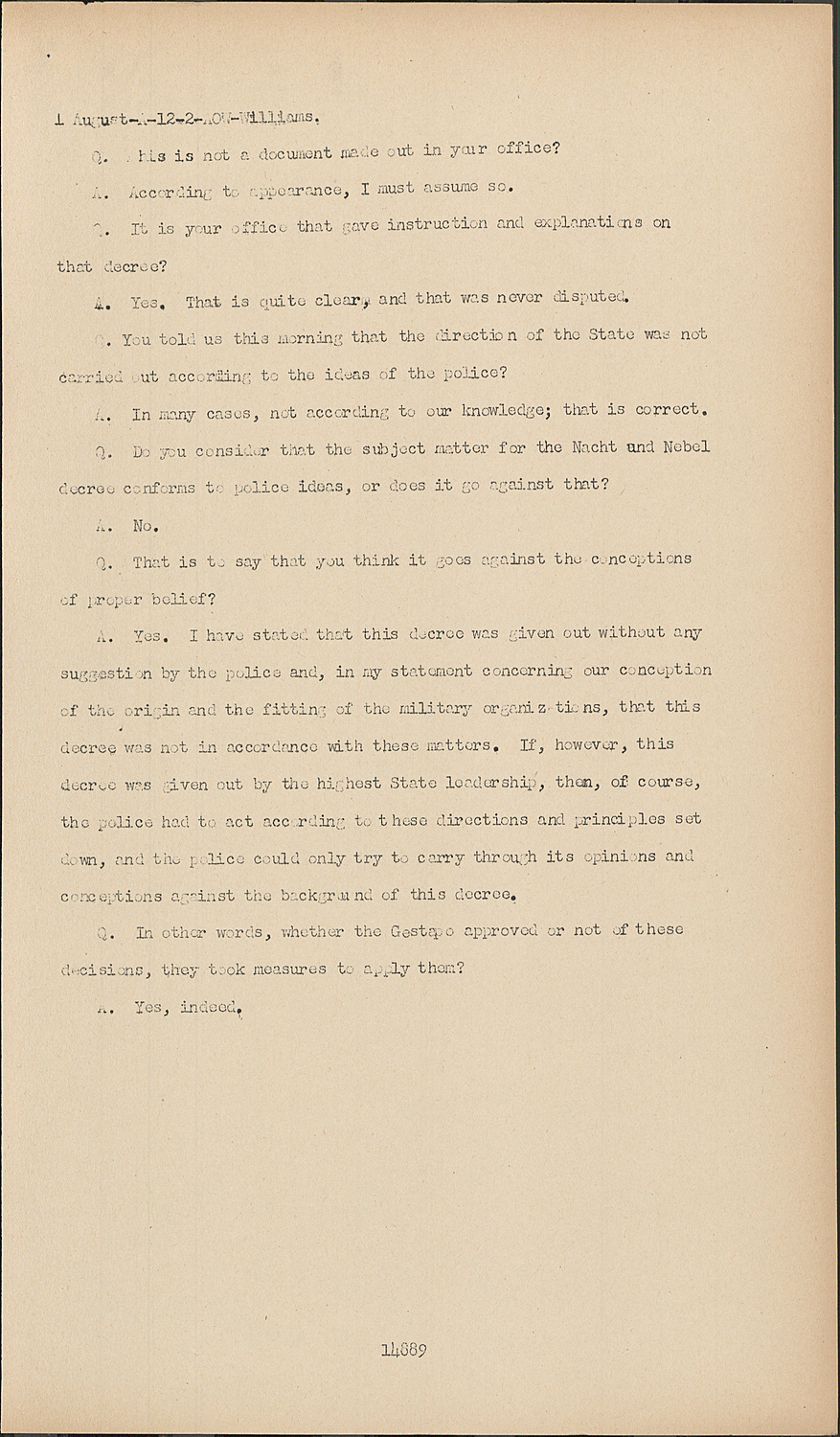
Q. This is not a document made out in your office?
A.According to appearance, I must assume so.
Q.It is your office that gave instruction and explanations on that decree?
A.Yes. That is quite clear, and that was never disputed.
Q.You told us this morning that the direction of the State was not carried out according to the ideas of the police?
A.In many cases, not according to our knowledge; that is correct.
Q.Do you consider that the subject matter for the Nacht and Nebel decree conforms to police ideas, or does it go against that?
A.No.
Q.That is to say that you think it goes against the conceptions of proper belief?
A.Yes. I have stated that this decree was given out without any suggestion by the police and, in my statement concerning our conception of the origin and the fitting of the military organizations, that this decree was not in accordance with these matters. If, however, this decree was given out by the highest State leadership, then, of course, the police had to act according to these directions and principles set down, and the police could only try to carry through its opinions and conceptions against the background of this decree.
Q.In other words, whether the Gestapo approved or not of these decisions, they took measures to apply them?
A.Yes, indeed.
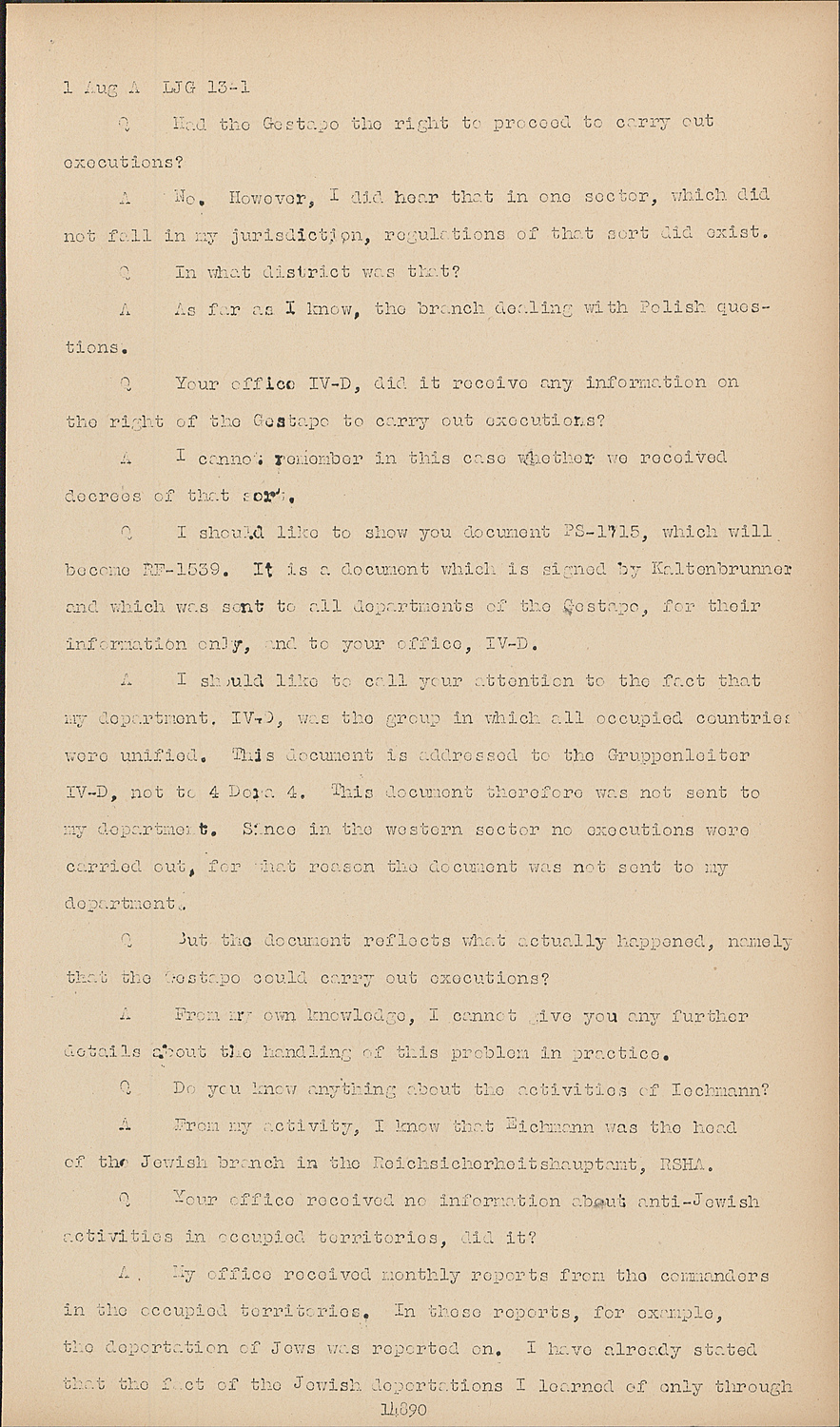
Q Had the Gestapo the right to proceed to carry out 1 Aug A LJG 13-1 executions?
ANo. However, I did hear that in one sector, which did not fall in my jurisdiction, regulations of that sort did exist.
QIn what district was that?
AAs far as I know, the branch dealing with Polish questions.
QYour office IV-D, did it receive any information on the right of the Gestapo to carry out executions?
AI cannot remember In this case whether we received decrees of that sort.
QI should like to show you document PS-1715, which will become RF-1539. It is a document which is signed by Kaltenbrunner and which was sent to all departments of the Gestapo, for their information only, and to your office, IV-D.
AI should like to call your attention to the fact that my department. IV-D, was the group in which all occupied countries were unified. This document is addressed to the Gruppenleiter IV-D, not to 4 Dora 4. This document therefore was not sent to my department. Since in the western sector no executions were carried out, for that reason the document was not sent to my department.
QBut the document reflects what actually happened, namely that the Gestapo could carry out executions?
AFrom my own knowledge, I cannot give you any further details about the handling of this problem in practice.
QDo you know anything about the activities of Iechmann?
AFrom my activity, I knew that Eichmann was the head of the Jewish branch in the Reichsicherheitshauptamt, RSHA.
QYour office received no information about anti-Jewish activities in occupied territories, did it?
AMy office received monthly reports from the commanders in the occupied territories. In these reports, for example, the deportation of Jews was reported on. I have already stated that the fact of the Jewish deportations I learned of only through these reports.
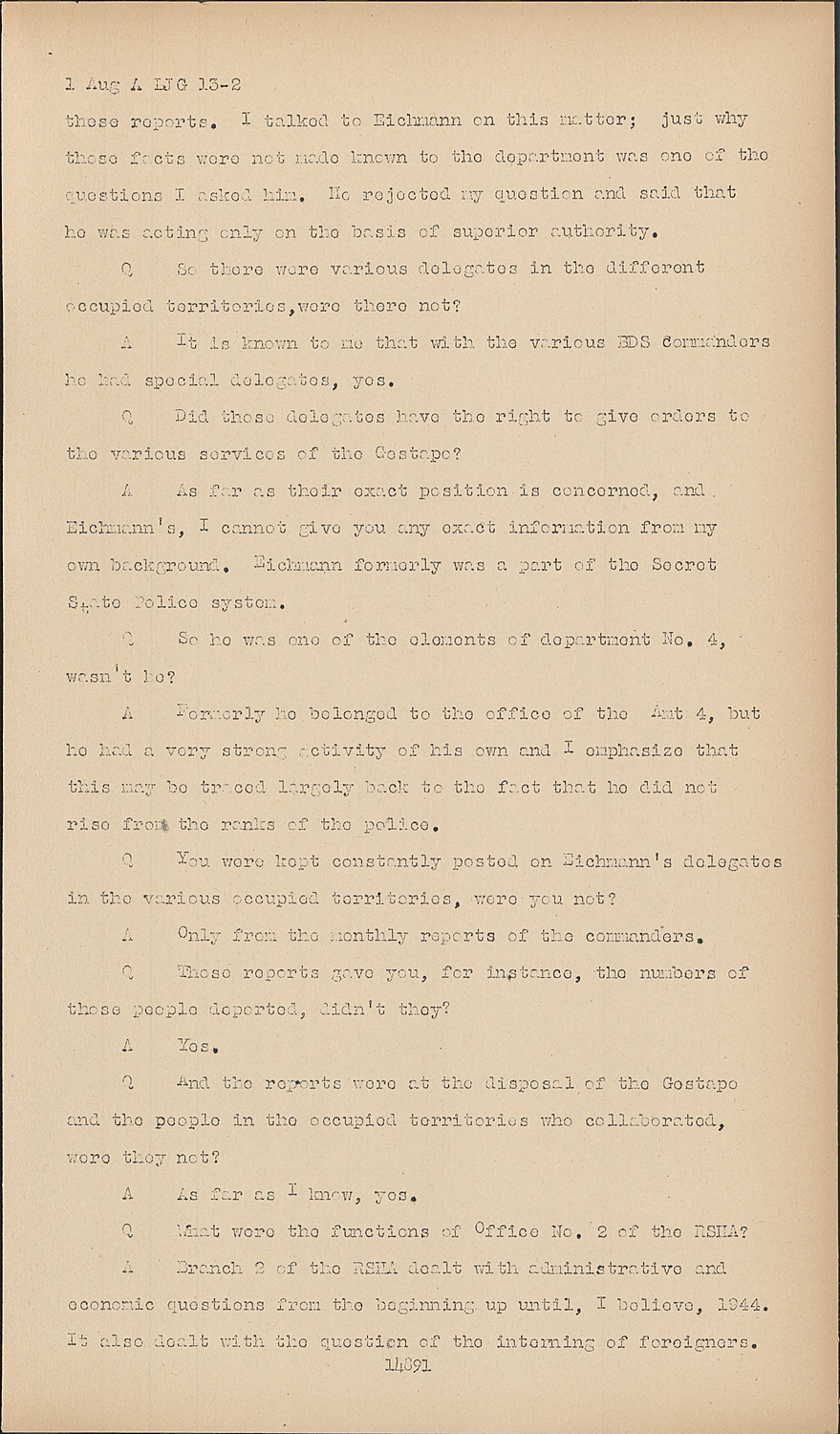
I talked to Eichmann on this matter; just why 1 Aug A LJG 13-2 the se facts were not made known to the department was one of the questions I asked him.
He rejected my question and said that he was acting only on the basis of superior autherity.
QSo there were various delegates in the different occupied territories, were there not?
AIt is known to no that with the various BDS commanders he had special delegates, yes.
QDid these dele gates have the right to give orders to the various services of the Gestapo?
AAs far as their exact position is concerned, and Eichmann's, I cannot give you any exact information from my own background, Eichmann formerly was a part of the Secret State Police system.
QSo he was one of the elements of department No. 4, wasn't he?
AFormerly he belonged to the office of the Amt 4, but he had a very strong activity of his own and I emphasize that this may be traced largely back to the fact that he did not rise from the ranks of the police.
QYou were kept constantly posted on Eichmann's delegates in the various occupied territories, were you not?
AOnly from the monthly reports of the commanders.
QThese reports gave you, for instance, the numbers of these people deported, didn't they?
AYes.
QAnd the reports were at the disposal of the Gestapo and the people in the occupied territories who collaborated, were they not?
AAs far as I know, yes.
QWhat were the functions of office No. 2 of the RSHA?
ABranch 2 of the RSHA dealt with administrative and economic questions from the beginning up until, I believe, 1944. It also dealt with the question of the interning of foreigners.
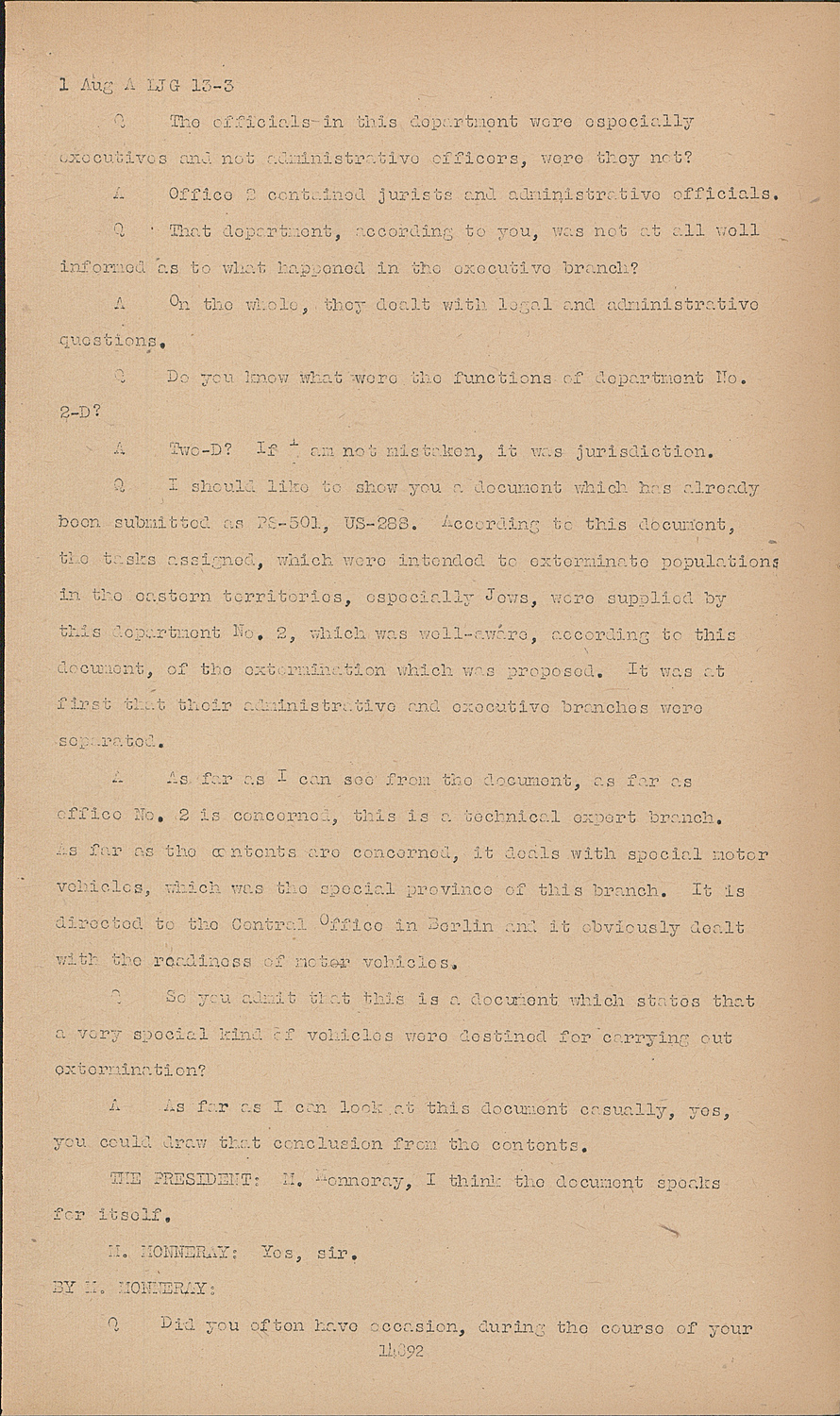
Q The officials in this department were especially 1 Aug A LJG 13-3 executives and not administrative officers, were they not?
AOffice 2 contained jurists and administrative officials.
QThat department, according to you, was not at all well informed as to what happened in the executive branch?
AOn the whole, they dealt with, legal and administrative questions.
QDo you know what were the functions of department No. 2-D?
ATwo-D? If I am not mistaken, it was jurisdiction.
QI should like to show you a document which has already been submitted as PS-501, US-288. According to this document, the tasks assigned, which were intended to exterminate populations in the eastern territories, especially Jews, were supplied by this department No. 2, which was well-aware, according to this document, of the extermination which was proposed. It was at first that their administrative and executive branches were separated.
AAs far as I can see from the document, as far as office No. 2 is concerned, this is a technical expert branch. As far as the contents are concerned, it deals with special motor vehicles, which was the special province of this branch. It is directed to the Central office in Berlin and it obviously dealt with the readiness of motor vehicles.
QSo you admit that this is a document which states that a very special kind of vehicles were destined for carrying out ox termination?
AAs far as I can look at this document casually, yes, you could draw that conclusion from the contents.
THE PRESIDENT:M. Monneray, I think the document speaks for itself.
M. MONNERAY:Yes, sir. BY M. MONNERAY:
QDid you often have occasion, during the course of your activity in the Gestapo, that the direction of the State asked 1 Aug A LJG 13-4 you to accomplish tasks contrary to what you would call police duties?
AThis feeling that certain tasks were transmitted to us which were in contradiction to our political activities, during my period of activity in Berlin as well as later in Denmark, I had these feelings regarding certain questions; but in this connection, I must remark that looked at these questions only from the point of view of a police official and could only judge them and define my attitude on that basis. It was unknown to me what had caused the leadership to make the decisions which were transmitted to us.
Q. You did not consider, then, as criminal, for instance, the order to exterminate certain categories of Soviet prisoners ?
A.I must say quite frankly that I could not understand any order like that at all. For police reasons we could not express this declaration at all.
But nevertheless, the Gestapo lent itself to the carrying out of these orders, didn't they ?
A.I cannot tell you that from my own experience.
M. MONNERAY:I have no further questions.
DR. MERKEL:A few brief questions, Mr. President.
RE-DIRECT EXAMINATION BY DR. MERKEL:
Q.Dealing with the membership of the organizations which were assimilated into the Gestapo were they incorporated into the SS or was it only an external measure ?
A.I did not perform any formal service with the SS nor the SD or with anyone after my formal entry into the SS in 1939.
QIn the protective custody decree of the SD, were the concentration camps into which people were to be taken mentioned ?
A.I believe I recall that, yes, but I cannot tell you exactly.
Q.Who carried out the arrests against people who were still at liberty after the protective custody decree was issued ?
A.Either from the officials of the STAPO or from the regular police or Ortspolice.
Q.Who accompanied the trainleads of internees, into the concentration camps ?
A.As far as I -remember, this transportation was handled by the regular members of the police who accompanied the transports. This was in accordance with regular schedules in the entire Reich area.
Q.Did you or your office know about the true conditions existing in concentration camps, the actual conditions ?
A. No.
THE PRESIDENT:What do you mean by "regular schedules"? Do you mean special transports or do you mean ordinary trains ? WITNESS: There were special cars for prisoners which had been used, by the police and were used for the transportation of regular prisoner and regular internees. These cars were attached to regular trains and express trains and the internees were transported in these trains. There was no special transportation. By DR. MARKED:
Q.Were the concentration camps under the jurisdiction of the Gestapo ?
A.No. Concentration camps were under the Inspectorate of the Concentration Camas at Oranienburg, and as far as I know, this Inspectorate was under the Inspectorate and Administrative office in the SS Chief Office.
Q.The document just submitted by the Prosecution, 2521-PS, speaks for itself, does it not, by the fact that the return across is the SS Wirtschaft Verwaltungs Hauptamt in Oranienburg and it is addressed to the commander of all Concentration Camps ?
A.Yes.
Q.Did, you know about the destruction of' Jews at Auschwitz ?
A.No, only after the capitulation did I hear about these things.
Q.Did you know that the activities of Eichmann had a direct connection with the destruction of Jews at Auschwitz ?
A. as long as I was in office, and before the capitulation, I had not heard anything about problems of that nature.
Q.When was the first time that you had reliable knowledge about these things ?
A.After the capitulation:
DR.Marked: I have no further questions to put to the witness.
RECROSS EXAMINATION BY JUSTICE BIDDLE:
Q. witness, you spoke of a decree under which the Gestapo were permitted to use third degree methods in Denmark, right ?
A.Yes.
Q. Was that decree in writing ?
A.That was a written decree of the head of the Security licence of the SD.
Q.And was it signed ?
A.Yes.
Q.Who signed it ?
A.As far as I recall, the first decree was signed by-Heydrich and the second one on behalf of Mueller, and I cannot tell you...
Q.What was the date of the first decree ?
A.I believe it dates from 1937.
Q. what month ?
A.That I cannot tell you at this time.
Q.What was the ate of the second decree ?
A. 1942.
Q.Did you see both decrees yourself ?
A.Yes.
Q. what was in the first decree ?
A.The contents of the first decree were that in the further combatting of organizations inimical to the Reich, if no other means were at their disposal, that the persons involved would be able to be beaten with a stick for a certain number of times. After a certain number, a physician had to be called in. This directive could not be used in extraction a confession in the case of any one individual. The approval, therefore, had to be had from the head of the Security Police and. SD.
Q.Wait a minute. Was the decree limited to any particular territory or did it cover all the occupied territories ?
A.The decree of 1937 applied to the Reich Territory and I believe it applied to the activities of the SIPO in these regions. where It was stationed but I cannot tell you of any limitations Q. were there any other methods of third degree which were allowed as well as beatings in that first decree ?
A.No. After the second decree, only measures approved were measures which were more moderate than blows by sticks. Standing at interrogations, for instance, or exercises which would tire them - measures like that, but don't recall any others.
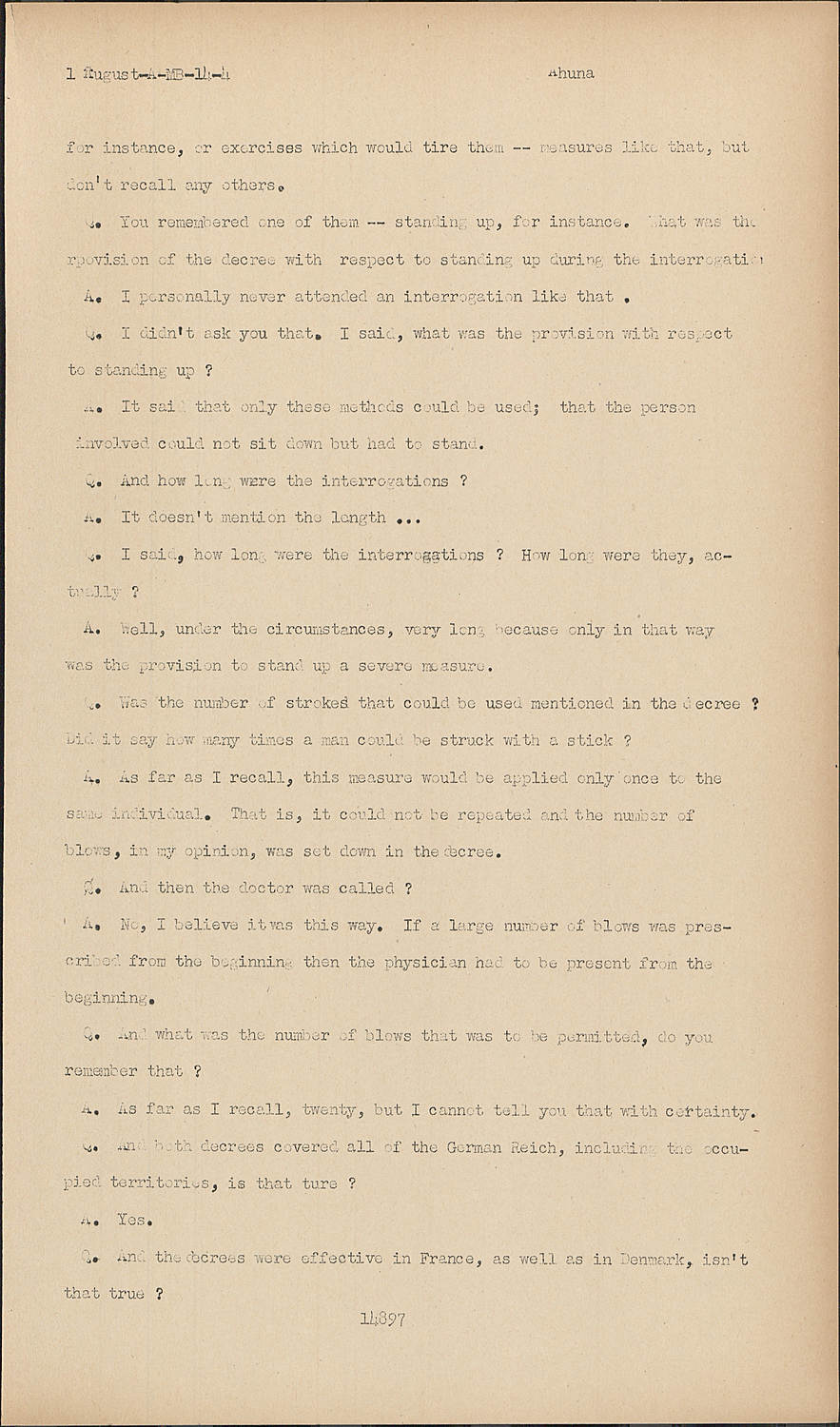
Q.You remembered one of them - standing up, for instance. What was the provision of the decree with respect to standing up during, the interrogation
A.I personally never attended an interrogation like that.
Q.I didn't ask you that. I said, what was the provision with respect to standing up ?
A.It said that only these methods could be used; that the person involved could not sit down but had to stand.
Q.And how long were the interrogations ?
A.It doesn't mention the length...
Q.I said, how long were the interrogations ? How long were they, actually ?
A.Well, under the circumstances, very long, because only in that way was the provision to stand up a severe measure.
Q.Was the number of stroked that could be used mentioned in the decree ? did it say how many times a man could be struck with a stick ?
A.As far as I recall, this measure would be applied only once to the same individual. That is, it could not be repeated and the number of blows, in my opinion, was set down in the decree.
Q.And then the doctor was called ?
A.No, I believe it was this way. If a large number of blows was prescribed from the beginning then the physician had to be present from the beginning.
Q.And what was the number of blows that was to be permitted, do you remember that ?
A.As far as I recall, twenty, but I cannot tell you that with certainty.
Q.And both decrees covered all of the German Reich, including the occupied territories, is that ture ?
A.Yes.
Q.And the decrees were effective in France, as well as in Denmark, isn't that true ?
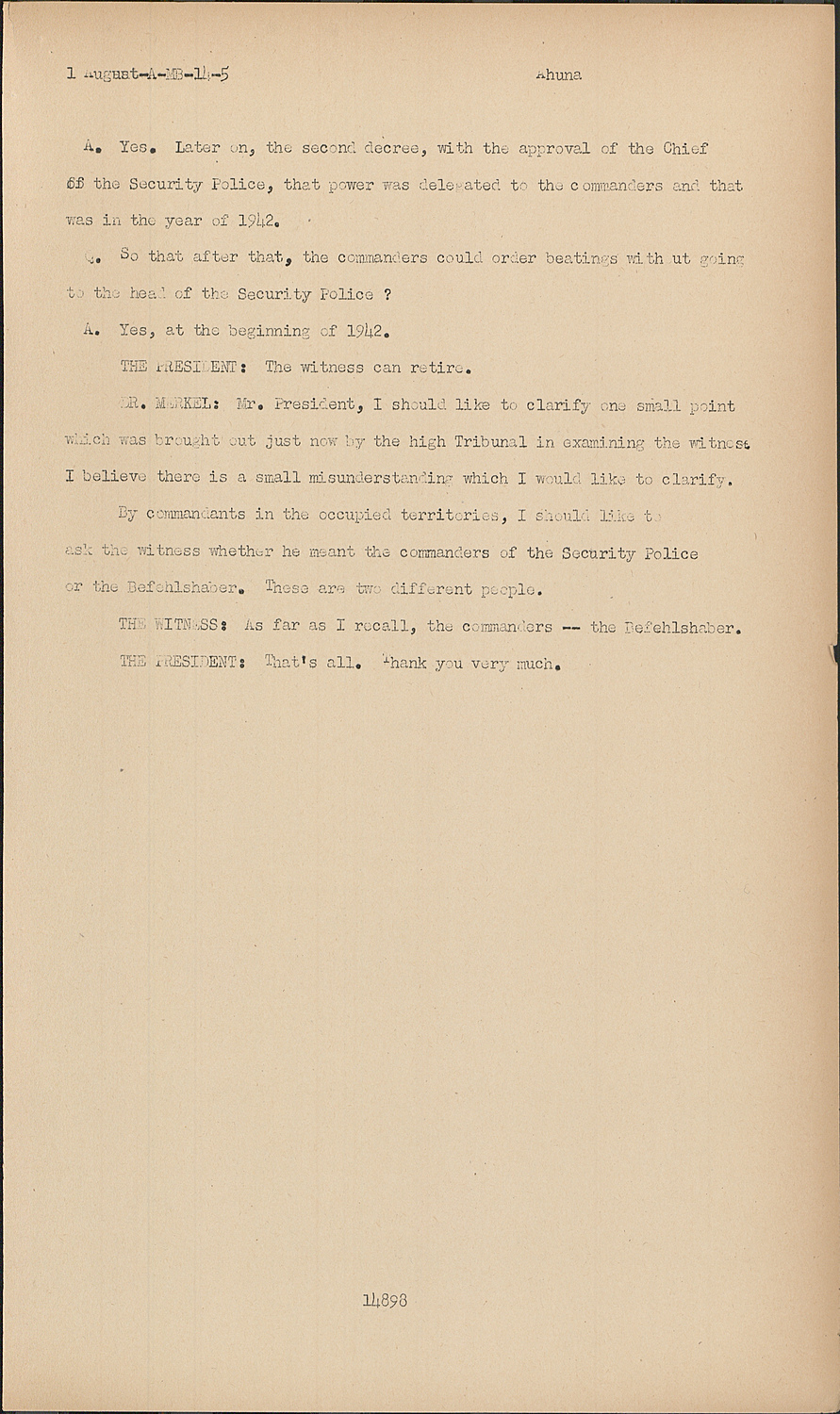
A. Yes. Later on, the second decree, with the approval of the Chief of the Security Police, that power was delegated to the commanders and that was in the year of 1942.
Q.So that after that, the commanders could order beatings with out going to the head of the Security Police ?
A.Yes, at the beginning of 1942.
THE PRESIDENT:The witness can retire.
DR. MARKED:Mr. President, I should like to clarify one small point which was brought out just now by the high Tribunal in examining the witness I believe there is a small misunderstanding which I would like to clarify.
By commandants in the occupied territories, I should Like to ask the witness whether he meant the commanders of the Security Police or the Befehlshaber. These are two different people.
THE WITNESS:As far as I recall, the commanders - the Befehlshaber.
THE PRESIDENT:That's all. Thank you very much.
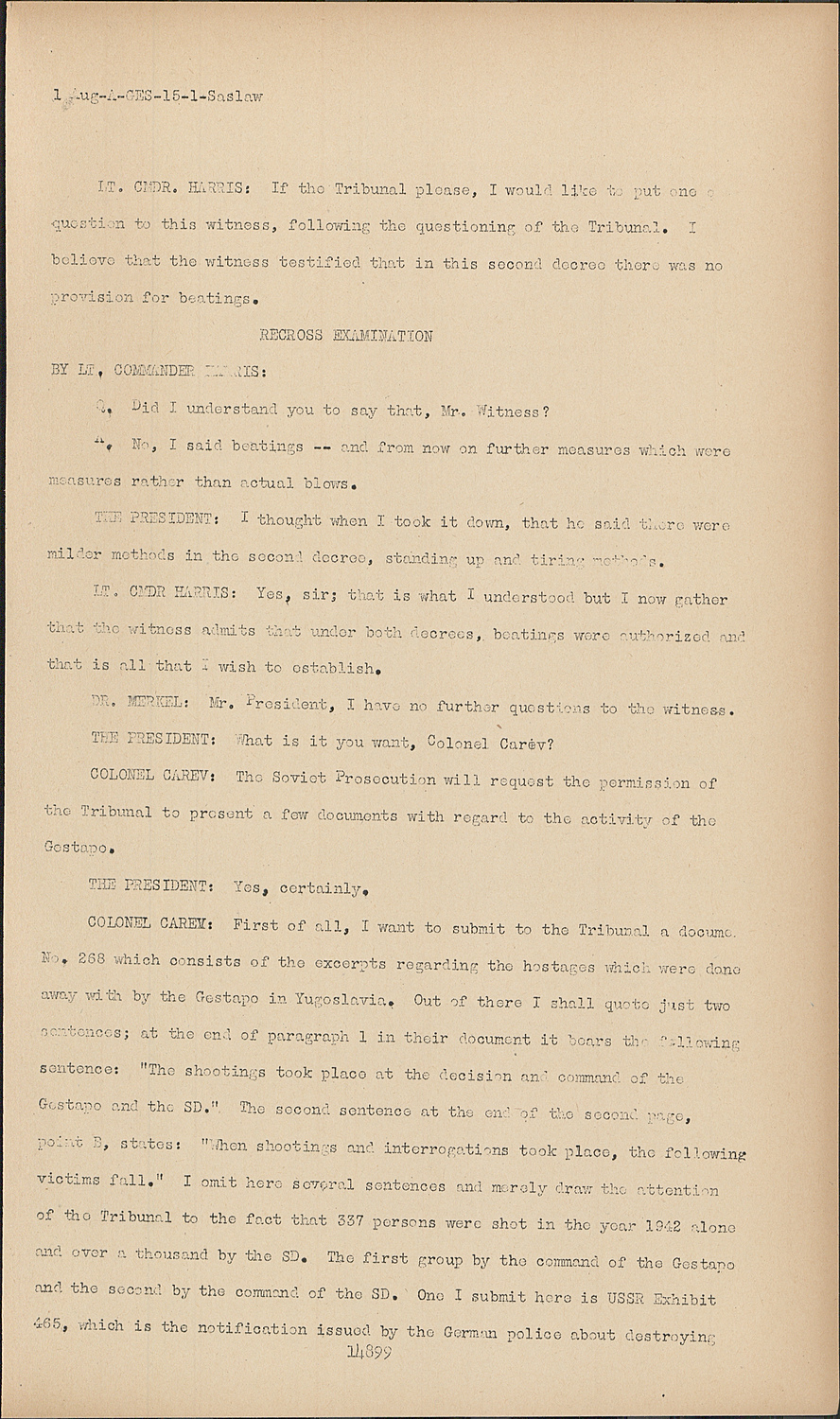
LT. CMDR. HARRIS: If the Tribunal please, I would like to put one question to this witness, following the questioning of the Tribunal,. I believe that the witness testified that in this second decree there was no provision for beatings.
RECROSS EXAMINATION BY LT. COMMANDER HARRIS:
Q.Did I understand you to say that, Mr. Witness?
A.No, I said beatings - and from now on further measures which were measures rather than actual blows.
THE PRESIDENT:I thought when I took it down, that he said there were milder methods in the second decree, standing up and tiring methods.
LT. CMDR HARRIS:Yes, sir; that is what I understood but I now gather that the witness admits that under both decrees, beatings were authorized and that is all that I wish to establish.
DR. MARKED:Mr. President, I have no further questions to the witness.
THE PRESIDENT:What is it you want, Colonel Carev?
COLONEL CAREV:The Soviet Prosecution will request the permission of the Tribunal to present a few documents with regard to the activity of the Gestapo.
THE PRESIDENT:Yes, certainly.
COLONEL CAREV:First of all, I want to submit to the Tribunal a document. No. 268 which consists of the excerpts regarding the hostages which were done away with by the Gestapo in Yugoslavia. Out of there I shall quote just two sentences; at the end of paragraph 1 in their document it bears the Allowing sentence: "The shootings took place at the decision and command of the Gestapo and the SD." The second sentence at the end of the second page, point B, states: "When shootings and interrogations took place, the following victims fall." I omit here several sentences and merely draw the attention Tribunal to the fact that 337 persons were shot in the year 1942 alone and over a thousand by the SD. The first group by the command of the Gestapo and the second by the commend of the SD. One I submit here is USSR Exhibit 465, which is the notification issued by the German police about destroying a number of villages in Slovenia and of shooting all the male populations of those villages for helping the partisans.
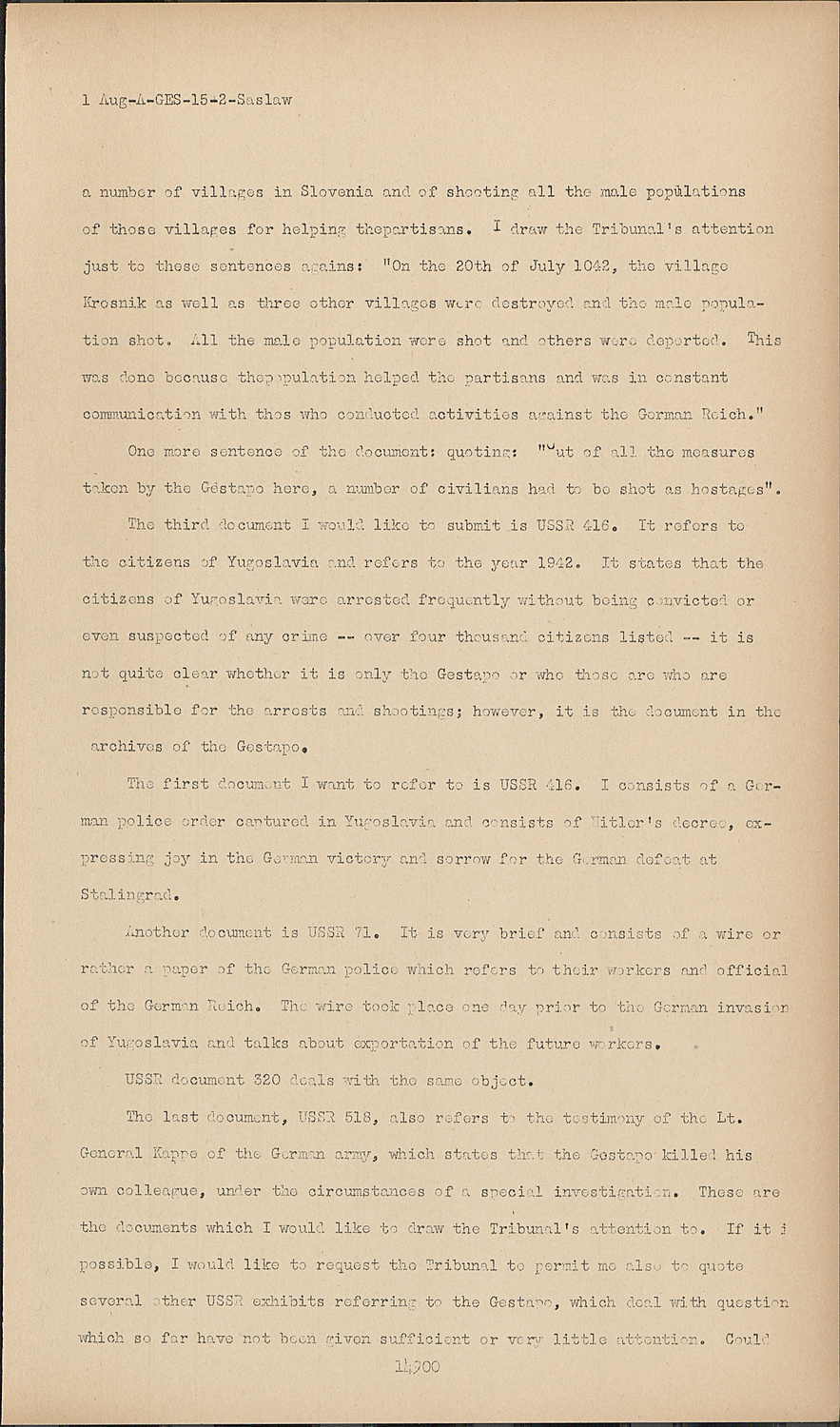
I draw the Tribunal's attention just to these sentences against "On the 20th of July 1042, the village Krosnik as well as three other villages were destroyed and the male population shot. All the male population were shot and others were deported. This was done because the population helped the partisans and was in constant communication with these who conducted activities against the German Reich."
One more sentence of the document: quoting: "Out of all the measures taken by the Gestapo here, a number of civilians had to be shot as hostages".
The third document I would like to submit is USSR 416. It refers to the citizens of Yugoslavia and refers to the year 1942. It states that the citizens of Yugoslavia ware arrested frequently without being convicted or even suspected of any crime - over four thousand citizens listed - it is not quite clear whether it is only the Gestapo or who these are who are responsible for the arrests and shootings; however, it is the document in the archives of the Gestapo.
The first document I want to refer to is USSR 416. I consists of a German police order captured in Yugoslavia and consists of Hitler's decree, expressing joy in the German victory and sorrow for the German defeat at Stalingrad.
Another document is USSR 71. It is very brief and consists of a wire or rather a paper of the German police which refers to their workers and official of the German Reich. The wire took place one day prior to the German invasion of Yugoslavia and talks about exportation of the future workers.
USSR document 320 deals with the same object.
The last document, USSR 518, also refers to the testimony of the Lt. General Kappe of the German army, which states that the Gestapo killed his own colleague, under the circumstances of a special investigation. These are the documents which I would like to draw the Tribunal's attention to. If it is possible, I would like to request the Tribunal to permit me also to quote several other USSR exhibits referring to the Gestapo, which deal with question which so far have not been given sufficient or very little attention. Could I please refer to several other documents?