This letter was dated 17 June 1944. That executions were carried out by the SD pursuant to the said Hitler order of 18 October 1942, while Kaltenbrunner was Chief of the Security Police and SD is indicated by document 526-PS, heretofore received as USA Exhibit 502. That was the order introduced this morning, I'm sure the Tribunal recalls. The policy of the police to protect civilians who lynched allied flyers was effective during the period that Kaltenbrunner served as Chief of the Security Police and SD.
I now offer document 2990-PS as exhibit next in order, USA Exhibit 526. This is an affidavit of Walter Schellenberg, the former Chief of Amt VI of the RSHA, and provides in paragraph 7 -- this is all I'm going to read from the affidavit:
"In 1944, on another occasion but also in the course of an Amtschef conference, I heard fragments of conversation between Kaltenbrunner and Mueller. I remember distinctly the following remarks of Kaltenbrunner:
'All offices of the SD and the Security Police are to be informed that programs of the populace against English and American terror fliers are not to be interfered with. On the contrary, this hostile mood is to be fostered.'" The seventh crime for which Kaltenbrunner is responsible as Chief of the Security Police and SD is the taking of civilians of occupied countries to Germany for secret trial and punishment and the punishment of civilians of occupied territories by family methods.
The fact that this crime continued after 30 January 1943 is shown by document 835-PS, which is offered as exhibit next in order, USA Exhibit 527. This is a letter from the high command of the armed forces to the German Army's commission under date 2 September 1944. The document begins, and I quote:
"Conforming to the decrees, all non-German civilians in occupied territories who have endangered the security and readiness for action of the occupying power by acts of terror and sabotage or in other ways, are to be surrendered to the Security Police and SD.
Only those prisoners are accepted who were legally sentenced to death or were serving a sentence of confinement prior to the announcement of these decrees.
Included in the punishable acts which endanger the security or readiness of action of the garrison power are those also of a political nature."
The eighth crime for which Kaltenbrunner is responsible as Chief of the Security Police and SD is the crime of executing and confining persons in concentration camps for crimes allegedly committed by their relatives. That this crime continued after 30 January 1943 is indicated by document L-37, heretfore received in evidence as USA Exhibit 506. That was received this morning. That is the letter of the Kommandeur of Sipo and SD at Radom, dated 19 July 1944, in which it was stated that the male relatives of assassins and saboteurs should be shot and the female relatives over 16 years of age sent to concentration camps.
I refer again to Document L-215, which has heretofore been received in evidence as USA Exhibit 243, and specifically to the case of Junker, who was ordered by Kaltenbrunner to be committed to Sachsenhausen concentration camp by the Gestapo "because as a relative of a deserter, he is expected to endanger the interest of the German Reich if allowed to go free."
The ninth crime for which Kaltenbrunner is responsible as Chief of the Security Police and SD is the clearance of Sipo and SD prisons and concentration camps. I refer the Tribunal to Document L-53, which was received in evidence as USA Exhibit 291. This was the letter from the Kommandeur of the Sipo and SD, Radom, dated 21 July 1944 in which it is stated that the Kommandeur of the Sipo and SD of the General Government had ordered all Sipo and SD prisons to be cleared and, if necessary, the inmates to be liquidated. I now offer Document 3462-PS as exhibit next in order, USA Exhibit 528. This is the sworn interrogation of Bertus Gerdes, the former Gaustabsamtsleiter under the Gauleiter of Munich. This interrogation was taken in the course of an official military investigation of the U.S. Army. To this interrogation Gerdes was ordered to state all he knew about Kaltenbrunner. I'm only going to read a very small portion of his reply, beginning on the third paragraph of page 2.
"Giesler told me that Kaltenbrunner was in constant touch with him because he was greatly worried about the attitude of the foreign workers and especially inmates of concentration camps Dachau, Muehldorf and Landsberg, which were in the path of the approaching Allied armies. On a Tuesday in the middle of April 1945, I received a telephone call from Gauleiter Giesler asking me to be available for a conversation that night.
In the course of our personal conversation that night, I was told by Giesler that he had received a directive from Kaltenbrunner by order of the Fuehrer to work out a plan without delay for the liquidation of the concentration camp at Dachau and the two Jewish labor camps in Landsberg and Muehldorf. The Directive proposed to liquidate the two Jewish labor camps at Landsberg and Muehldorf by use of the German Luftwaffe, since the concentration area of these camps had previously been the targets of repeated enemy air attacks.
This action received the code name of 'Wolke Al'".I now pass to the second paragraph of page 3, continuing quoting from this interrogation.
"I was certain that I would never let this directive be carried out. As the action Wolke Al should have become operational already for some time, I was literally swamped by couriers from Kaltenbrunner and moreover I was supposed to have discussed the details of the Muehldorf and Landsberg actions in detail with the two Kreisleiter concerned. The couriers who were in most cases SS officers usually SS lieutenants, gave me terse and strict orders to read and initial. The orders threatened me with the most terrible punishment including execution if I did not comply with them. However, I could always excuse my failure to execute the plan because of bad flying weather and lack of gasoline and bombs. Therefore, Kaltenbrunner ordered to have Jews in Landsberg marched to Dachau in order to include them in the Dachau exterminati operations, and that the Muehldorf action was to be carried out by the Gestapo "Kaltenbrunner also ordered an operation -Wolkenbrand - for the concentration camp Dachau which provided that the inmates of the concentration camp at Dachau were to be liquidated by poison with the exception of Aryan nationals of the Western Powers.
"Gauleiter Giesler received this order direct from Kaltenbrunner and discussed in my presence the procurement of the required amounts of poison with Dr. Harrfeld, the Gau Health Chief. Dr. Harrfeld promised to procure these quantities when ordered and was advised to await my further directions. As I was determined to prevent the execution of this plan in any event, I gave no further instructions to Dr. Harrfeld.
"The inmates of Landsberg had hardly been delivered at Dachau when Kaltenbrunner sent a courier declaring the action Wolkenbrand was operational.
"I prevented the execution of the Wolke Al and Wolkenbrand by giving Giesler the reason that the front was too close and asked him to transmit this on to Kaltenbrunner.
"Kaltenbrunner therefore issued directives in writing to Dachau to transport all Western European prisoners by truck to Switzerland and to march the remaining inmates into Tyrol, where the final liquidation of these prisoners was to take place without fail."
THE PRESIDENT:The Court will adjourn now.
(Whereupon at 1700 hours the hearing of the Tribunal adjourned to reconvene at 1000 hours on 3 January 1945).
Official transcript of the International Military Tribunal, in the matter of:
The United States of America, the French Republic, the United Kingdom of Great Britain and Northern Ireland, and the Union of Soviet Socialist Republics, against Hermann Wilhelm Goering, et al, Defendants, sitting at Nurnberg, Germany, on 3 January 1946, 1000-1245, Lord Justice Lawrence, presiding.
LT. HARRIS:If the Tribunal will recall, at the end of the last session, we had finished reading a portion of the sworn interrogation of the Gaustabsamtsleiter under the Gauleiter of Munich, and had touched on the point where he said that Kaltenbrunner issued directives to Dachau to transport Western European prisoners by truck to Switzerland and to march the remaining inmates into Tyrol.
I now offer as exhibit next in order the first five pages of the interrogation report of Gottlieb Berger, Chief of the Head Office of the SS, made under oath on 20 September 1945 in the course of these proceedings. You will find these pages at the end of the document book. This is offered as Exhibit U.S.A. 529. These pages have been translated into German and made available to the Defendant.
THE PRESIDENT:Does it have a number?
LT. HARRIS:It has no PS number sir. It is at the very end of the document book. I wish to read only one question and answer from these pages, and I refer to the last question and answer on page 3 of the exhibit:
"Q Assuming, only for the purposes of this discussion, that these atrocities that we hear about are true, who do you think is primarily responsible?
"A The first one, the Commandant; the second one Gluecks, because he was practically responsible for all the interior direction of the camps.
If one wants to be exact, one would have to find out how the information service between the camp commandant and Gluecks actually operated. I want to give you the following example: during the night of the 22nd and 23rd of April, I was sent to Munich. As I entered the city, I met a group of perhaps 120 men dressed in the suits of the concentration camps. I asked the guard who was with them: 'What about these men.' He told me that these men were marching by foot to the Alps.
Firstly, I sent him back to Dachau.
Then I wrote a letter to the Commandant, to send no more people by foot to any place, but whenever the Allies advanced further, to give over the camp completely. I did that on my own responsibility, and I told him that I came straight from Berlin, and that I can be found in my service post in Munich. The Commandant, or his deputy, telephoned at about twelve o'clock and told me that he had received this order from Kaltenbrunner after he had been asked by the Gauleiter of Munich, the Reichskommissar."
The tenth crime for which Kaltenbrunner is responsible as Chief of the Security Police and SD is the persecution of the Jews. This crime, of course. continued after 30 January 1943 -- and evidence has heretofore been received that these persecutions continued until and were accelerated toward the end of the war. Kaltenbrunner took a personal interest in such matters as is indicated by Document 2519-PS which is offered as exhibit next in order, U.S. Exhibit 530. This exhibit consists of a memorandum and an affidavit, and I invite the attention of the Tribunal to the affidavit. Quoting from the affidavit:
"I, Henri Monneray, being first duly sworn, depose and say that since 12 September 1945 I have been, and I am the member of the French Staff for the prosecution of axis criminality, and have been pursuing my official duties in this connection in Nurnberg, Germany since 12 October 1945.
"In the course of my official duties, at the instruction of the French Chief Prosecutor, I examined the personal document of the Defendant --"
THE PRESIDENT:Is it necessary to read all of this? What is the object of this affidavit?
LT. HARRIS:To show that this document was derived from the personal effects of the Defendant Kaltenbrunner.
THE PRESIDENT:From the personal possessions?
LT. HARRIS:From the personal possessions, yes.
THE PRESIDENT:You can leave out the immaterial parts.
LT. HARRIS: Very good, sir.
Passing to the last sentence of the affidavit:
"Said Document 2519-PS is the document which I found in the envelope containing Kaltenbrunner's personal papers."
I now read the memorandum, quoting:
"Radio message to Gruppenfuehrer SS-Major General Fegelein Headquarters of the Fuehrer through Sturmbannfuehrer SS-Major Sansoni, Berlin.
"Please inform the Reichsfuehrer SS and report to the Fuehrer that all arrangements against Jews, political and concentration camp internees in the Protectorate have been token care of by me personally today. The situation there is one of calmness, fear of Soviet successes and hope of an occupation by the Western enemies.
Kaltenbrunner"
THETRIBUNAL: (Mr. Biddle): That is not dated?
LT. HARRIS:This is not dated.
The eleventh crime for which Kaltenbrunner is responsible is the persecution of the churches. It is unnecessary to present specific evidence that this crime continued after 30 January 1943, since this was one of the fundamental purposes of the Security Police and SD, as has already been shown.
These are the crimes for which the Defendant Kaltenbrunner must answer. As to his intent, there is no need to go outside the record before this Tribunal. On December 1, 1945, in these proceedings, the witness Lahousen was asked on cross-examination: "Do you know Mr. Kaltenbrunner?" After describing his meeting with Kaltenbrunner on a day in Munich when a university student and his sister were arrested and executed for distributing leaflets from the auditorium, Lahousen said -- and I wish to refer only to two sentences on page 724 of the transcript -- quoting:
"I can easily reconstruct that day. It was the first and last time I saw Kaltenbrunner, whose name has been known to me. Of course, Kaltenbrunner mentioned this subject to Canaris, and witnesses were there and everybody was under the terrible impression of what had happened, and Kaltenbrunner spoke about that to Canaris in a manner of which cynicism we would be a very mild description.
This is the only thing I can say to this question."
Kaltenbrunner was a life-long fanatical Nazi. He was the leader of the SS in Austria prior to the Anschluss and played a principal role in the betrayal of his native country to the Nazi conspirators. As higher SS and police leader in Austria after the Anschluss, he supervised and had knowledge of the activities of the Gestapo and the SD in Austria.
The Mauthausen concentration camp was established in his jurisdiction and he visited it several times. On at least one occasion he observed the gas chamber in action. With this knowledge and background he accepted in January 1943, appointment as Chief of the Security Police and SD, the very agencies which sent such victims to their deaths. He held that office to the end, rising to great prominence in the SS and the German Police and receiving high honors from Hitler. Like other leading Nazis, Kaltenbrunner sought power; to gain it, he made his covenant with crime.
COL. STOREY:If the Tribunal please, next will be some witnesses, and Col. Amen will handle the interrogation.
COL. JOHN H. AMEN:May it please the Tribunal, I wish to call, as a witness for the prosecution, Mr. Otto Ohlendorf. Your Lordship will note that his name appears under Amt III on the chart on the wall.
THE PRESIDENT:What did you say appeared?
COL. AMEN:The name of this witness appears under Amt III of the chart, RSHA, the large square, the third section down.
THE PRESIDENT:I see it.
Otto Ohlendorf, will you repeat this oath after me: I swear by God, the Almighty and Omniscient, that I will speak the pure truth and will withhold and add nothing.
THE WITNESS OHLENDORF:I swear by God, the Almighty and Omniscient, that I will speak the pure truth and will withhold and add nothing.
BY COL. AMEN:
QWhere were you born?
AIn Kohen Egelsen.
QHow old are you?
AThirty-eight years old.
National
QWhen, if ever, did you become a member of the Socialist Party?
A 1925.
QWhen, if ever, did you become a member of the SA?
AFor the first time in 1926.
QWhen, if ever, did you become a member of the SS?
AI must correct myself. I answered the first question as if I were speaking of my membership in the SS.
QWhen did you become a member of the SA?
AIn the year 1925.
QWhen, if ever, did you join the SD?
AIn 1936.
QWhat was your last position in the SD?
A Amt Chief of Amt III in the RSHA.
QTurning to the chart on the wall behind your back, will you tell the Tribunal whether you can identify that chart in any way.
AThis chart was seen previously by me and worked on by me and can consequently be identified by myself.
QWhat, if anything, did you have to do with making up that chart?
AThis chart was made during my interrogation.
COL. AMEN:For the information of the Tribunal, that is U.S.A. Exhibit 493, the chart of which the witness speaks.
QWill you tell the Tribunal whether that chart correctly portrays the basic organization of the RSHA, as well as the position of Kaltenbrunner, the Gestapo, and the SD in the German Police system?
AThe organization, as represented in that chart, is a correct representation of the organization of the RSHA. It serves correctly the position of the SA as well as the State Police, the Criminal Police, and the SD.
QReferring once more to the chart, please indicate your position in the RSHA and state for what period you continued to serve in that capacity.
A (At this point the witness pointed to Amt III on the chart.)
QWhat were the positions of Kaltenbrunner, Mueller, and Eichmann in the RSHA, and state for what periods of time each of than continued to serve in his respective capacity?
AKaltenbrunner was Chief of the Sicherheits Polizei and the SD; as such, he was also Chief of the RSHA, The Internal Organizational Term for the SD and The Sicherheits Polizei. Kaltenbrunner occupied this position from 30 January 1943 until the end of the war. Mueller was Chief of Amt IV, the Gestapo. He took part in the foundation of the Gestapo and occupied the Office of Chief and subsequently, and consecutively, rose to the chiefdom of Amt IV. He occupied this position until the end of the war.
Eichmann occupied a position in Amt IV under Mueller and worked on the Jewish problem from 1940 on. To my knowledge, he occupied this position also until the conclusion of the war.
QWill you tell us for what period of time you continued to serve as Chief of Amt III?
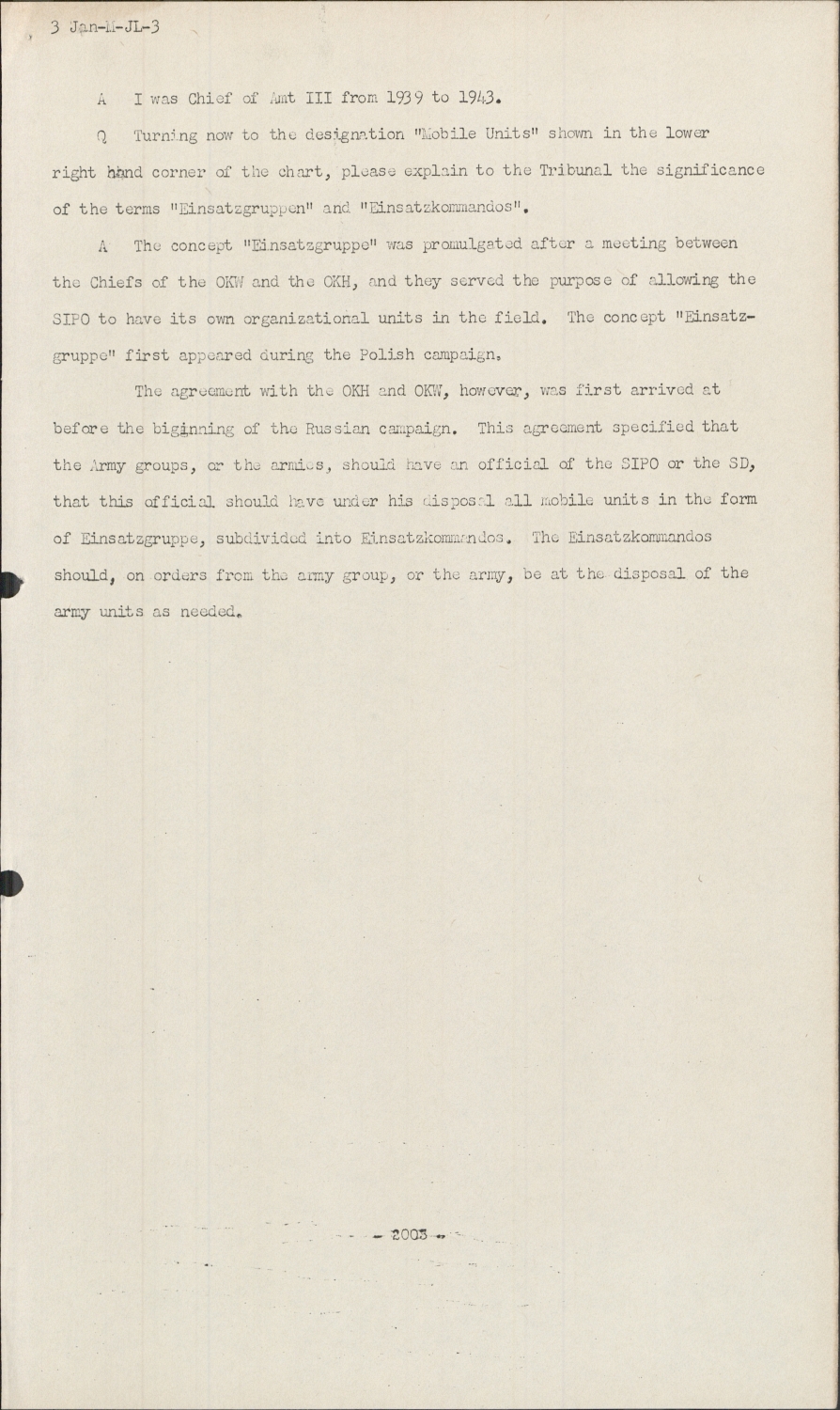
A I was Chief of Amt III from 1939 to 1943.
QTurning now to the designation "Mobile Units" shown in the lower right hand corner of the chart, please explain to the Tribunal the significance of the terms "Einsatzgruppen" and "Einsatzkommandos".
AThe concept "Einsatzgruppe" was promulgated after a meeting between the Chiefs of the OKW and the OKH, and they served the purpose of allowing the SIPO to have its own organizational units in the field. The concept "Einsatzgruppe" first appeared during the Polish campaign.
The agreement with the OKH and OKW, however, was first arrived at before the biginning of the Russian campaign. This agreement specified that the Army groups, or the armies, should have an official of the SIPO or the SD, that this official should have under his disposal all mobile units in the form of Einsatzgruppe, subdivided into Einsatzkommandos. The Einsatzkommandos should, on orders from the army group, or the army, be at the disposal of the army units as needed.
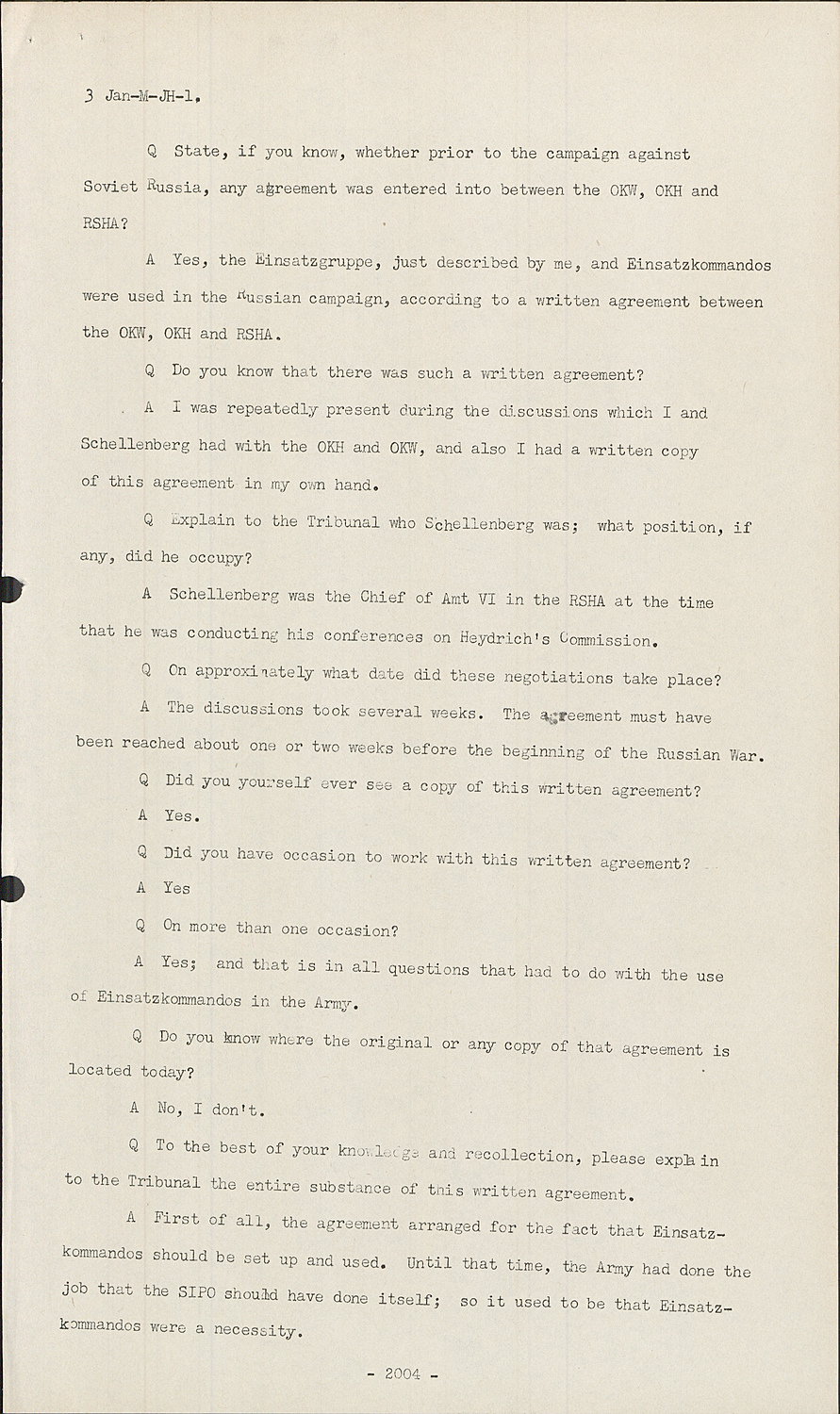
Q State, if you know, whether prior to the campaign against Soviet Russia, any agreement was entered into between the OKW, OKH and RSHA?
AYes, the Einsatzgruppe, just described by me, and Einsatzkommandos were used in the Russian campaign, according to a written agreement between the OKW, OKH and RSHA.
QDo you know that there was such a written agreement?
AI was repeatedly present during the discussions which I and Schellenberg had with the OKH and OKW, and also I had a written copy of this agreement in my own hand.
QExplain to the Tribunal who Schellenberg was; what position, if any, did he occupy?
ASchellenberg was the Chief of Amt VI in the RSHA at the time that he was conducting his conferences on Heydrich's Commission.
QOn approximately what date did these negotiations take place?
AThe discussions took several weeks. The agreement must have been reached about one or two weeks before the beginning of the Russian War.
QDid you yourself ever see a copy of this written agreement?
AYes.
QDid you have occasion to work with this written agreement?
AYes
QOn more than one occasion?
AYes; and that is in all questions that had to do with the use of Einsatzkommandos in the Army.
QDo you know where the original or any copy of that agreement is located today?
ANo, I don't.
QTo the best of your knowledge and recollection, please explain to the Tribunal the entire substance of this written agreement.
AFirst of all, the agreement arranged for the fact that Einsatzkommandos should be set up and used. Until that time, the Army had done the job that the SIPO should have done itself; so it used to be that Einsatzkommandos were a nacessity.
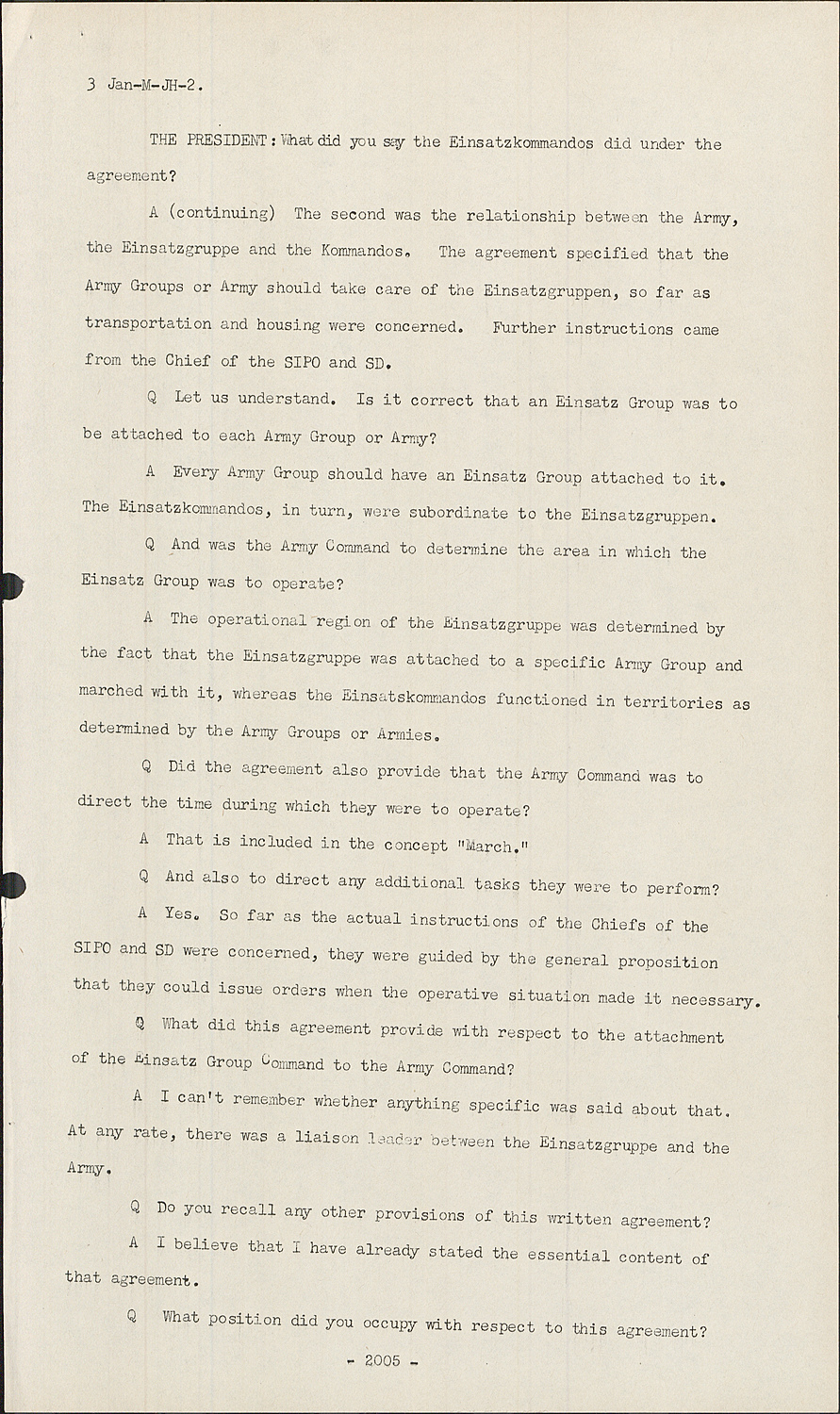
THE PRESIDENT: What did you say the Einsatzkommandos did under the agreement?
A (continuing) The second was the relationship between the Army, the Einsatzgruppe and the Kommandos. The agreement specified that the Army Groups or Army should take care of the Einsatzgruppen, so far as transportation and housing were concerned. Further instructions came from the Chief of the SIPO and SD.
QLet us understand. Is it correct that an Einsatz Group was to be attached to each Army Group or Army?
AEvery Army Group should have an Einsatz Group attached to it.
The Einsatzkommandos, in turn, were subordinate to the Einsatzgruppen.
QAnd was the Army Command to determine the area in which the Einsatz Group was to operate?
AThe operational region of the Einsatzgruppe was determined by the fact that the Einsatzgruppe was attached to a specific Army Group and marched with it, whereas the Einsatskommandos functioned in territories as determined by the Army Groups or Armies.
QDid the agreement also provide that the Army Command was to direct the time during which they were to operate?
AThat is included in the concept "March."
QAnd also to direct any additional tasks they were to perform?
AYes. So far as the actual instructions of the Chiefs of the SIPO and SD were concerned, they were guided by the general proposition that they could issue orders when the operative situation made it necessary.
QWhat did this agreement provide with respect to the attachment of the Einsatz Group Command to the Army Command?
AI can't remember whether anything specific was said about that. At any rate, there was a liaison leader between the Einsatzgruppe and the Army.
QDo you recall any other provisions of this written agreement?
AI believe that I have already stated the essential content of that agreement.
QWhat position did you occupy with respect to this agreement?
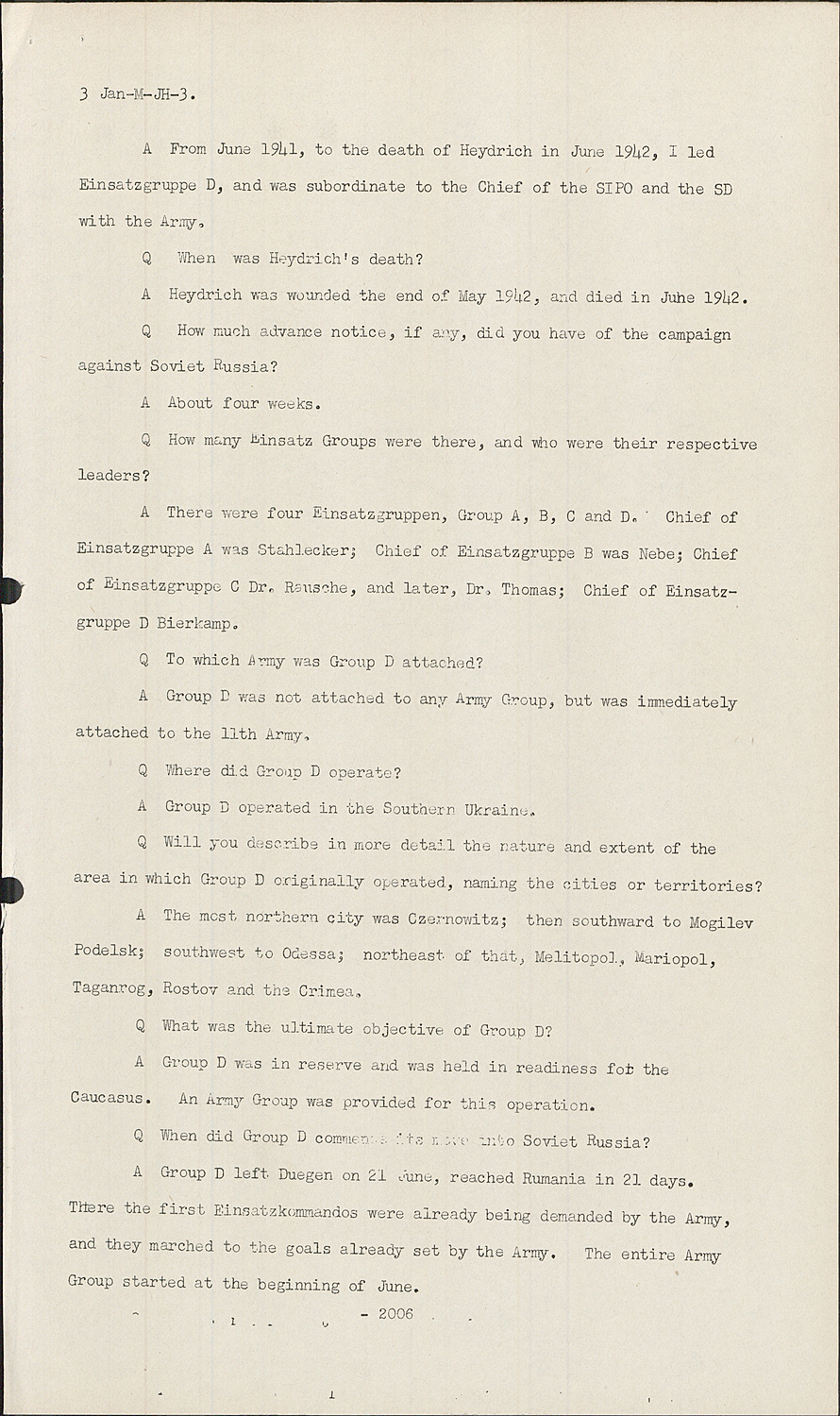
A From June 1941, to the death of Heydrich in June 1942, I led Einsatzgruppe D, and was subordinate to the Chief of the SIPO and the SD with the Army.
QWhen was Heydrich's death?
AHeydrich was wounded the end of May 1942, and died in June 1942.
QHow much advance notice, if any, did you have of the campaign against Soviet Russia?
AAbout four weeks.
QHow many Einsatz Groups were there, and who were their respective leaders?
AThere were four Einsatzgruppen, Group A, B, C and D. Chief of Einsatzgruppe A was Stahlecker; Chief of Einsatzgruppe B was Nebe; Chief of Einsatzgruppe C Dr. Rausche, and later, Dr. Thomas; Chief of Einsatzgruppe D Bierkamp.
QTo which Army was Group D attached?
AGroup D was not attached to any Army Group, but was immediately attached to the 11th Army.
QWhere did Group D operate?
AGroup D operated in the Southern Ukraine.
QWill you describe in more detail the nature and extent of the area in which Group D originally operated, naming the cities or territories?
AThe most northern city was Czernowitz; then southward to Mogilev Podelsk; southwest to Odessa; northeast of that, Melitopol, Mariopol, Taganrog, Rostov and the Crimea.
QWhat was the ultimate objective of Group D?
AGroup D was in reserve and was held in readiness for the Caucasus. An Army Group was provided for this operation.
QWhen did Group D commence its move into Soviet Russia?
AGroup D left Duegen on 21 June, reached Rumania in 21 days.
There the first Einsatzkommandos were already being demanded by the Army, and they marched to the goals already set by the Army. The entire Army Group started at the beginning of June.
Q You are referring to the 11th Army?
AYes.
QIn what respects, if any, were the official duties of the Einsatz Groups concerned with Jews and Communist Commissars?
AAs far as the question of Jews and Communists is concerned, the Einsatz Groups and Kommando leaders were hourly instructed.
QWhat were their instructions with respect to the Jews and the Communist functionaries?
AThey were instructed that in the working field of the Einsatz Group the Jews should be liquidated, as well as the political soviet Commissars.
QWhen you say "liquidated", do you mean killed?
AI mean that word "killing".
QPrior to the opening of the Soviet Campaign, did you attend a conference at Pretz?
AYes, it was a discussion of the field of work of the Einsatz Group and Kommandos, their work goals; and at this time the necessary commands were issued.
QWho was present at that conference?
AThe Chief of the Einsatz Groups and the leaders of the Kommandos.
Streckenbach transmitted the orders of Heydrich and Himmler.
QWhat were those orders?
AThose were the general orders regarding the work of the SIPO, which contributed to the liquidation that I have already mentioned.
QAnd that conference took place on approximately what date?
AThree or four days before our march into Russia.
QSo that before you commenced to march into Soviet Russia, you received orders at this conference to exterminate the Jews and Communist functionaries, in addition to the regular professional work of the Security Police and SD; is that correct?
AThat's right.
QDid you, personally, have any conversation with Himmler, respecting any communication from Himmler to the Chiefs of Army Groups and Armies, concerning this mission?
AYes. Himmler informed me before the beginning of the Russian Campaign that Hitler, in a conversation with the High Command, had stated his aim and had commanded them to act accordingly.
QSo that you can testify that the Chiefs of the Army Groups and Armie had been similarly informed of these orders for the liquidation of the Jews and Soviet functionaries?
AI believe that it is not correct in that particular form. They had no orders for liquidation. Rather, the order for the liquidation originated with Himmler, but since this liquidation took place in the operational region of the High Command of the Army, the Army was asked to support these measures. Without these instructions to the Army, the Einsatz Groups would not have been able to function in the sense that I have just described.
QDid you have any other conversation with Himmler concerning this order?
AYes, in the late Summer of 1941, Himmler was in Nikolaiev. He assembled, the leaders of the Einsatz Groups and Kommandos, and repeated to them the order for liquidation, so that the leaders and men who took part in such liquidation had no personal responsibility for their acts. The responsibility was his alone, as well as that of the Fuehrer.
QAnd you yourself heard that said?
AYes.
QDo you know whether this mission of the Einsatz Group was known to the Army Group Commanders?
AThis order and the execution of it were known to the Army leaders.
QHow do you know that?
AThrough conferences with the Army and continual discussions of these orders with Army leaders.
QWas the mission of the Einsatz Groups and the agreement between OKW, OKH and RSHA known to the other leaders in the RSHA?
AAt least a part of them knew, since a part of the leaders were also active in the Einsatz Groups and Kommandos; furthermore, also known to the leaders who had to do with organization.
QMost of the leaders came from the RSHA; did they not?
AWhich leaders?
QThe Einsatz Group.
ANo, one cannot say that. The leaders in the Einsatz Groups and Kommandos came from the entire Reich.
Q Do you know whether the mission and the agreement were also known to Kaltenbrunner?
AAfter his entry into service, Kaltenbrunner had to concern himself with these questions, and consequently must have known the background of these Einsatz Groups that were under his command.
QWho was the Commanding Officer of the 11th Army?
AAt first, von Schober; later, von Mannstein.
QWill you tell, the Tribunal in what way or ways the Commanding Officers of the 11th Army directed or supervised Einsatz Group D in carrying out its liquidation activities?
AIn order from the 1st Army came to Nikolaiev, stating that liquidation were to take place at a distance of not less than 200 kilometers from Army Headquarters.
QDo you recall any other occasion?
AIn Simferopol, the Army High Command asked the correct Einsatz Group leaders to hasten the liquidation on the grounds that in this region a famine was threatening, and there was a housing shortage.
QDo you know how many persons were liquidated by Einsatz Group D, under your direction?
AIn the year June '41 to June '42, the Einsatzkommandos announced approximately 90,000 people as liquidated.
QDid that include men, women and children?
AYes.
QOn what do you base those figures?
AOn reports submitted by the Einsatzkommandos to the Einsatz Groups.
QWere those reports submitted to you?
AYes.
QAnd you saw them and read them?
AI beg your pardon?
QAnd you saw and read those reports, personally?
AYes.
QAnd it is on those reports that you base the figures you have given the Tribunal?
AYes.