Q The numbers increased, did they?
AYes, the numbers increased.
THE PRESIDENT:All right.
COLONEL AMEN:Now, there are perhaps just a half dozen of these questions I would like to ask, because I do think they might clear up, in the minds of the Tribunal, some of the evidence which has gone before.
I shall be very brief, if that is satisfactory to the Tribunal.
THE PRESIDENT:Yes. BY COLONEL AMEN:
QWill you explain the significance of the different widths of the blue lines on the chart?
AThe thick blue line between Himmler as Chief of the SS, end the RSHA, is designed to show the intensity of the relationship between those two offices.
Here it is a question of an office in which ministerial questions of leadership as well as individual executive matters were taken up. That is to say, in the circle of operations of the SIPO and the, SD. The organizational scheme, seen from the legal point of view, represents an illegal state of affairs, namely, that the RSHA never actually had official validity.
The formal, legal situation is different from that which appears in this chart. Party and state offices are amalgamated in this chart. Under this designation neither laws nor decrees were a legal basis. None of these came from this organization. That is due to the fact that the State Police, in their ministerial capacity, were subordinate to the ministry of the Interior, whereas the SD, despite this organization, was an organ of the Party.
Therefore, if I wished to reproduce this chart as it legally should be, I should nave to set, in place of Amt IV, the Amt Political Police of the previous Hauptamt Sicherheitspolizei. This office, political police, existed formally to the very end, and it had been preceded by the Police Department of the Ministry of the Interior. At the same time, the Gestapo Amt continued to exist formally, the Central Office of the Prussian Gestapo, the leading office of all the police activities of the country.
Thus, the administrative questions were developed under the leadership of the Minister of the Interior.
So far as the emphasis on the formal existence of relevance of the Ministry of the Interior was concerned, it appeared under the heading of the Ministry of the Interior with the heading "Pol", with the corresponding designations of the relevant offices of the previous main office of the Reichssicherheitspolizei.
That is to say, "Pol-S" means Sicherheitspolizei.
The RSHA was nothing more than a camouflage designation which did not affect the actual conditions, but the Chiefs of the SD and the SIPO were included under this term "RSHA". And the SD main office, which existed until 1939, was given the opportunity of using whatever letterhead it wanted to, either the one or the other.
At the same time, an opportunity was afforded to amalgamate all the forces of the police and to operate in whatever field it was expedient to operate in.
But in this office state positions did remain, in a way, dependent on the Ministry of the Interior, and the office of the SD remained a Party Office.
The SD Main Office, or the RSHA, had formally only the significance of an SS Main Office, a main office in which the members of the SS and the SIPO and the SD belonged to the SS. But so far as the State Offices were concerned, the SS--that is to say, Himmler, as leader of the SSgave these offices no instructions. BY THE PRESIDENT:
QI am not sure that I follow altogether what you have been saying, but what you have been saying the reason why you are shown on the chart as concerned with Amt III, which refers, apparently, only to inside Germany, where, according to your evidence, you were the head of Einsatz Group D, which was operating outside Germany?
AThe fact that I led an Einsatz group had nothing to do with the fact that I was also Chief of Amt III. That was given me as an individual, and not as a leader of Amt III, In my capacity as leader of an Einsatz group I ran into altogether new experiences.
QI see. And did it involve that you left Germany and went into the area invaded in the Soviet Union?
AYes. BY COLONEL AMEN:
QWill you now explain the significance of the dotted blue lines, as compared with the solid blue lines on the right-hand side of the chart?
AThe solid line indicates a direct official channel, whereas the dotted lines signify that in these regards there was no direct, immediate chain of command.
QWas the term "SD" ever used to include both the SIPO and the SD?
AIn the course of years the term "SD" was used incorrectly. It cam to be used as an abbreviation for SIPO and SD, without actually being designed for that. "SD" was originally simply a designation for the fact that someone belonged to the SS via the SD Hapt Main Office. When the SD Main Office dissolved and was taken up in the RSHA, the question arose that the designation SD, which was also worn on arm bands, should be replaced by another designation, namely, RSHA.
Things did not reach that point because that work on camouflage, of the RSHA, would have been in danger. when, for example, I read in a Fuehrer order that in France people were to be turned over to the SD, that was a case in point of such a false designation, since there were no such offices in France; and, on the other hand, the SD, so far as its offices were concerned-- for instance, Amt III-- was simply an intelligence organ.
QBriefly, what was the relationship between the SS and the Gestapo?
AThe relationship between the SS and Gestapo were these!
"The Reichsfuehrer SS, as such, took over the leadership of the police and attempted to amalgamate the State Police and the SS, that is to say, on the one hand to employ only members of the State Police, who were active in the SS and, on the other hand, to extend the instutions of the SS, and in this way to provide possible candidates for the State Police. This amalgamation was later extended to bring about the same relationship between the SS and the Ministry of the Interior.
QAbout how many full time agents and honorary auxilliary personnel did the SD employ?
AOne may not use the concept SD in this connection. It is necessary to discriminate between Amt III and Amt VI. Amt III, as the interior intelligence organ, had three thousand main officers, including men and women. On the other hand, the internal intelligence service worked with honorary personnel, that is to say with men and women who could divide the internal intelligence services with their experiences in their service. I would judge that the number of them was roughly one thousand.
QWill you briefly give the Tribunal a general example of how a typical transaction was handled through the channels indicated on the chart?
AFirst, a general example in order to make things clear. Himmler discovered through experience that more and more saboteurs were being dropped from planes in Germany and were endangering transportation and factories. He told this to Kaltenbrunner and instructed him to make his subdivisions aware of this fact and to take measures to see to it that these saboteurs should be eliminated as soon and as completely as possible.

Kaltenbrunner instructed Amt IV, that is to say the State Police, with the preparation of the necessary order to the regional offices.
This order was drawn up by the appropriate office in Amt IV and was transmitted by Mueller, or what is more probable, because of the importance of the question and the necessity of bringing the attention of the other offices to this fact, gave the order to Kaltenbrunner, who signed it and passed it On to the regional offices in the Reich.
On the basis of this order, for example, it was determined that the State Police offices should report on the measures they were taking, as well as on their effects.
These reports went back through the same channels from the regional offices to the experts in Amt IV, thence to the Chief of Amt IV, thence to the Chief of the RSHA Kaltenbrunner, and thence to the Chief of the German Police Himmler.
QAnd finally, will you give a specific example of a typical transaction handled through the channels indicated on the chart?
AThe example of the arrest of the leaders of the left parties after the events of the 20th of July.
This order was also transmitted from Himmler to Kaltenbrunner.
Kaltenbrunner passed it on to Amt IV and this order was formulated by Amt IV, signed by Kaltenbrunner and sent to the regional offices.
The reports were returned from the subordinate offices back to the higher offices along the same channels.
COLONEL AMEN: May it please the Tribunal. The witness is now available to other Counsel.
I understand that Colonel Pokrovsky has some questions that he wishes to ask on behalf of the Soviets.
DIRECT EXAMINATION BY COLONEL POKROVSKY.
QWitness, there is a very important matter for clarification of questions or of a report on which the Soviet Delegation is at present working.
Therefore, at the pleasure of the Court, I would like to ask you, witness, several questions.
You said that you had been present as an inspector twice at the mass executions.
On whose orders have you been as an inspector at the executions?
THE PRESIDENT: I did not get the answer to that question.
The answer has not come through here.
AI was at the executions on my own initiative.
QBut you said that you were present in the capacity of an inspector.
AI said for inspections.
QWas it on your initiative?
AYes.
QAt the executions was one of the chiefs always present?
AWhenever it was possible I sent one of the members of the staff of the Einsatz groups to the executions, but because of the large distance covered by the Einsatz groups that was not always possible.
QFor what purpose was a person sent in the capacity of an inspector?
For what reason was a person sent for inspection purposes?
ATo determine whether or not my instructions, regarding how the executions were to take place, were actually being carried out.
QShall I understand you in such a way that the person acting as an inspector should make certain as to the execution of the order?
ANo, that is not a correct statement of fact. He should simply be a witness as to whether the conditions that I determined as those under which the executions should take place were actually being carried out.
QWhat kind of conditions have you in mind?
AFirst of all the exclusion of spectators. Secondly, the carrying out of the executions in a military way.
Thirdly, an easy carrying out of the transportation and execution in order to avoid unnecessary emotional disturbances.
Fourthly, the supervision of the handling of objects of value to avoid any exploitation.
Of course, there were individual events during these matters that I do not recall now.
At any rate, these measures were designed to avoid any mistreatment, either physical or spiritual.
QWhen you stated with reference to the observation of the disposal of the property, have you had in mind the necessity of taking away those valuables?
AObjects of value were taken away from the victims before the execution, namely by the Jewish Council of Elders, and were turned over to the Einsatz group.
QWhat kind of property have you in mind?
AFor example, gold or silver or papers of value.
QYou wanted to set out the proper direction of that property, or a most complete acquisition of those valuables?
AYes.
QYou mentioned ill-treatment. What have you meant under ill-treatment at the executions?
AIf, for example, the manner of the execution was such that it could not be avoided that people became excited the Kommandos, who had to take part in the execution, had to resort to violence.
QWhat do you understand under the forced suppression of emotional excitement?
AIf, as I just said, the carrying out of the execution in an orderly fashion it was necessary to resort to blows.
QWas it necessary to beat the victims?
A. I never saw such case but I heard of such cases.
Q.From whom?
A.In conversations with members of other Kommandos.
Q.You said that for the executions other means were presented, that is the autocars.
A.Yes.
Q.Do you know where and with whose assistance the inventor has carried out his invention?
A.I can recall only that it was within the purview of Amt II of the RSHA but I cannot say anything more about that more specifically.
Q.How many people were executed by means of those murder cars?
A.I didn't understand the question.
Q.How many people were executed by means of such myrder cars?
A.I can't give you the precise number but it was relatively few.
I should judge a few hundred.
Q.You said that in these vans mostly women and children were executed.
For what reason?
A.That was a specific command of Himmler's. In this way women and children should be spared the spiritual disturbances implicit in the mass executions and also the men who were, to a large extent, married should not be obliged to shoot down women and children.
Q.Has anybody observed the behavior of those who were executed in those murder cars?
A.Yes.
Q.Do you know that Becker had reported to the effect that the death in these murder cars was particularly painful?
A.No. I heard about Becker's report for the first time in the letter that was shown to me here in Court.
On the contrary, I know from other reports that the victims did not suffer on the instance of death.
Q.Have military units taken part in those executions?
A.As a rule, no.
Q. And as an exception?
A.I believe I recall that both in Nikolaew and Simferopol temporar ily a witness from the Army was present.
Q.For what reason, for what purpose?
A.I cannot say that, probably simply to inform himself personally.
Q.And military units were assigned in most places for the carrying out of executions?
A.The Army had officially no department that dealt with these matters particularly, since the Army was in itself against these liquidations.
Q.But, as a matter of fact -
A.Even there voluntary divisions did these things. At the moment I can remember no case from the Army itself but simply from the train follow ing the Army.
Q.You testified regarding those who were subject to annihilation.
The Einsatz group, were they executing only Jews or were also Communist officials executed?
A.Yes, political commissars, those who were politically active.
The fact of belonging to the Communist Party was not enough to expose anyone to persecution.
Q. There was no special investigation as to the specific part which such a person played in the Communist organization?
THE PRESIDENT:Will the interpreter from Russian into English hold the microphone a little further away from his mouth.
Q. (continuing) I understood that the fact of belonging to the Communist Party was sufficient for him to be executed.
A.No, I said the opposite. I said the fact of belonging to the Communist Party was not the definitive consideration and that was not enough to have him executed.
He would have had to have been performing a particular political function.
Q.Have you had any discussion with reference to those murder wagons which were sent from Berlin?
A.I didn't understand the question.
Q. Have you had an opportunity to discuss with any one of your superiors the question of the murder wagons which were sent to your unit or as to the work of those machines?
A.I still cannot understand the sense of the question.
Q.Have you had an opportunity to discuss with any one of your superiors with regard to the Einsatz group that had received the murder wagons from *---* as to their performance?
A.I cannot recall any specific discussion of that.
Q.Have you had any information with regard to the fact that members of the Einsatz groups who had been acting as executioners, did not like to use those murder wagons?
A.The Einsatz group made use of the gas vans.
Q.No, I have something else in mind. I want to clarify the question as to whether you received any information that the members of the SD, the troops did not like that form of execution and preferred others instead?
A.They preferred to use the gas vans to shooting?
Q.Just the other way, that they preferred shootings to the execution to the murder wagons?
A.As I said before,
Q.For what reasons did they prefer shootings and executions by firing squads to the use of murder wagons?
A.As I said before, the unloading of the vans subjected the men in the Einsatz Kommandos to unnecessary spiritual disturbance.
Q.What do you have in mind under the circumstances, from the psychological point of view?
A.As far as I can remember the specific psychological, circumstances, certainly bodily functions were released which made the handling of the corpses unpleasant.
Q.Do you want to say that the victims very clearly showed their sufferings which they had been submitted to?
A.Do you mean during the killing in gas vans?
Q.Yes.
A In this regard I can simply repeat what the doctor told me, that the victims of killing in the gas vans felt no pain.
QThen it can be understood that your answer to my previous question was that the unloading of those murder wagons had a very bad impression on the members of the Kommandos?
AYes, as I said before, because of the condition in which the vans were dirtied and so on.
COLONEL POKROVSKY:At the present stage of the trial I have no more questions for this witness.
THE PRESIDENT:Does the prosecutor for the French Republic desire to put any questions to the witness?
Does the counsel for Kaltenbrunner desire to cross-examine now or at a later date?
DR.KAUFMANN (Counsel for Defendant Kaltenbrunner): Perhaps I could ask a few questions now with the request that I should be allowed to make my cross examination later after I have already spoken to Kaltenbrunner.
THE WITNESS:May I address a request to the Tribunal? May I sit down?
THE PRESIDENT:Yes.
THE WITNESS:I saw Kaltenbrunner for the first time on a trip from Berlin to the headquarters of Himmler at the time when Kaltenbrunner was to be appointed Chief of the RSHA and SD. Previous to that I simply knew the fact of his existence. BY DR. KAUFMANN:
QDid you come into personal contact with Kaltenbrunner either personally, or official conversations after he had become Chief of the RSHA?
AYes, of course.
QDo you know his attitude, as an example, toward the Jewish question?
AI am not familiar with any particular attitude of Kaltenbrunner's.
QHow about the question of the Church?
AThe question of the Church -- he deployed the Course taken by the State.
He agreed, or he was of the opinion that an understanding should be reached with the Church.
QDo you know what his thoughts were on the question of the liquidation of civilians, parachute troops, and so on?
Do you know that Kaltenbrunner made efforts to make use of the SD to -
AThat was the duty of the SD even before Kaltenbrunner came, and he supported the direction that this work was taking.
QDo you know, either directly or indirectly that Kaltenbrunner had no authority to carry out executive orders, for example, that he had no authority to put people into concentration camps or to take them from concentration camps, that those things were handled exclusively by Himmler and Mueller?
AI believe this question is too general for mo to be able to answer it concretely. The question will have to be broken down.
If you ask the question whether Kaltenbrunner could bring about executive action, I must answer in the affirmative. If you then name Himmler and Mueller to the exclusion of Kaltenbrunner, then I must point out that according to the organization of the RSHA Mueller was a subordinate of Kaltenbrunner, and consquently orders from Himmler to Mueller were also orders to Kaltenbrunner and Mueller was obliged to inform Kaltenbrunner of them.
On the other hand, it is certain -- and specifically as regards the concentration camps -- the final decision as regards entry into or departure from was essentially determined by Himmler. I can say that I know absolutely that the expression that often came up, namely, "to the last washerwoman" -- Himmler had the final decision. Whether or not Kaltenbrunner had no authority at all in this regard, I can make no statement.
QHave you seen original orders of Kaltenbrunner's that ordered the liquidation of sabotage groups and so on?
ANo.
QDo you know, either directly or indirectly, that after Heydrich's death a change, which to be sure was not a formal change, but nevertheless a change, took place, as a result of which a milder course was taken by Kaltenbrunner ?
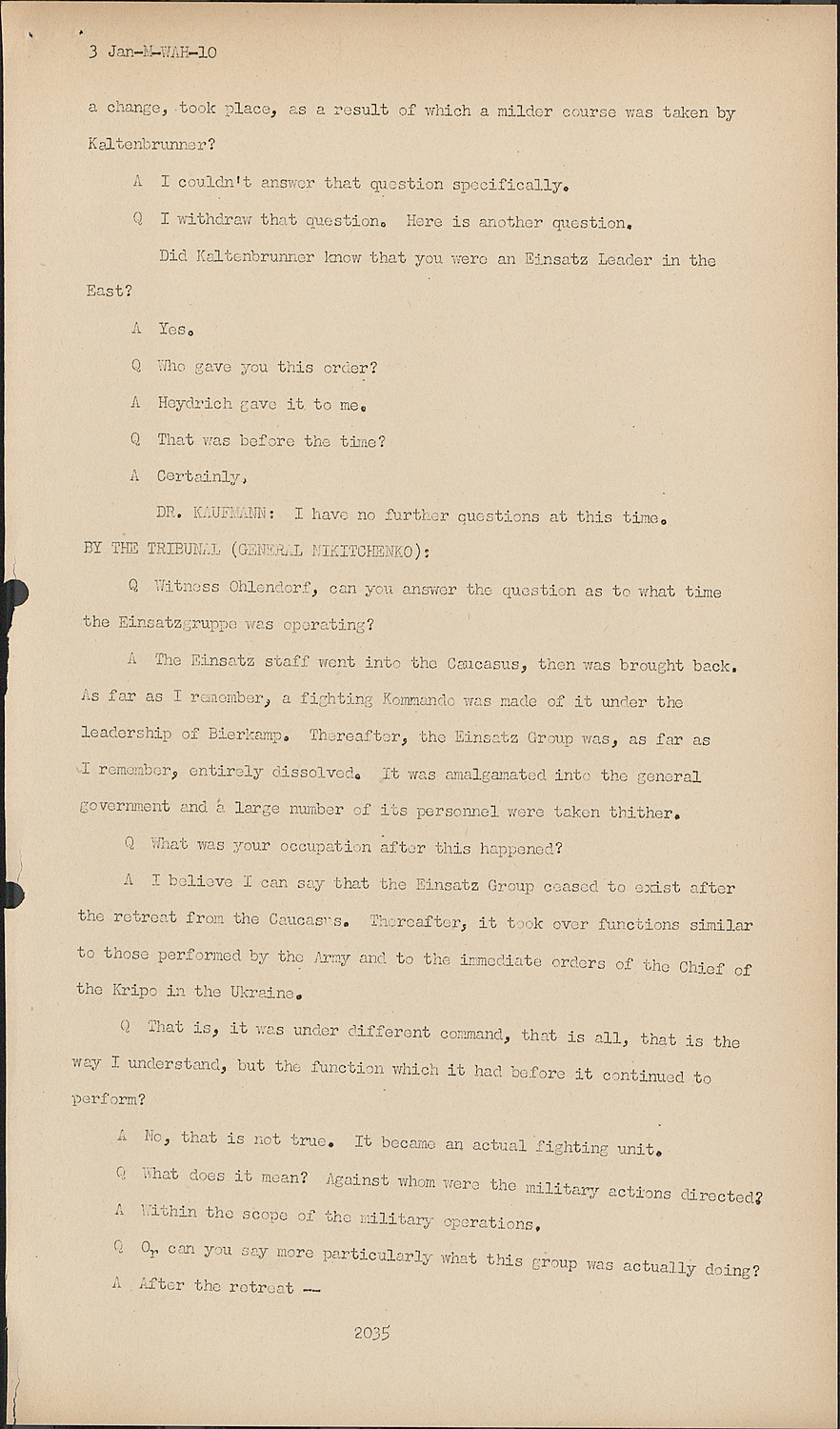
AI couldn't answer that question specifically.
QI withdraw that question. Here is another question.
Did Kaltenbrunner know that you were an Einsatz Leader in the East?
AYes.
QWho gave you this order?
AHeydrich gave it to me.
QThat was before the time?
ACertainly.
DR. KAUFMANN:I have no further questions at this time. BY THE TRIBUNAL (GENERAL NIKITCHENKO):
QWitness Ohlendorf, can you answer the question as to what time the Einsatzgruppe was operating?
AThe Einsatz staff went into the Caucasus, then was brought back. As far as I remember, a fighting Kommando was made of it under the leadership of Bierkamp. Thereafter, the Einsatz Group was, as far as I remember, entirely dissolved. It was amalgamated into the general government and a large number of its personnel were taken thither.
QWhat was your occupation after this happened?
AI believe I can say that the Einsatz Group ceased to exist after the retreat from the Caucasus. Thereafter, it took over functions similar to those performed by the Army and to the immediate orders of the Chief of the Kripo in the Ukraine.
QThat is, it was under different command, that is all, that is the way I understand, but the function which it had before it continued to perform?
ANo, that is not true. It became an actual fighting unit.
QWhat does it mean? Against whom were the military actions directed?
A within the scope of the military operations.
QOr can you say more particularly what this group was actually doing?
AAfter the retreat -

Q When you say that the function of this group has changed when it has conducted operations.
AI have no concrete experiences myself. It was used for reconaissance against the partisans and also was actually used as a fighting unit militarily.
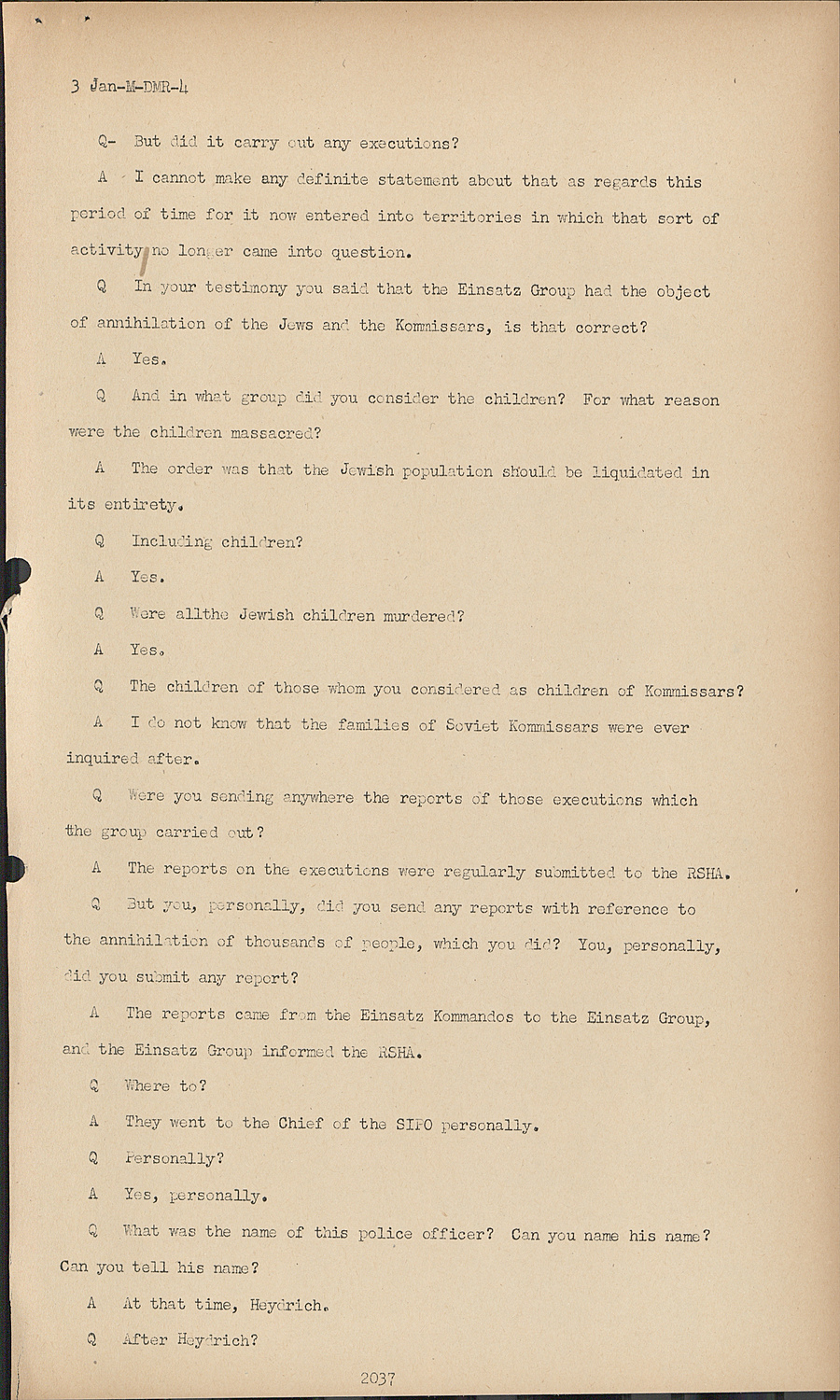
Q- But did it carry out any executions?
AI cannot make any definite statement about that as regards this period of time for it now entered into territories in which that sort of activity no longer came into question.
QIn your testimony you said that the Einsatz Group had the object of annihilation of the Jews and the Kommissars, is that correct?
AYes.
QAnd in what group did you consider the children? For what reason were the children massacred?
AThe order was that the Jewish population should be liquidated in its entirety.
QIncluding children?
AYes.
QWere allthe Jewish children murdered?
AYes.
QThe children of those whom you considered as children of Kommissars?
AI do not know that the families of Soviet Kommissars were ever inquired after.
QWere you sending anywhere the reports of those executions which the group carried cut?
AThe reports on the executions were regularly submitted to the RSHA.
QBut you, personally, did you send any reports with reference to the annihilation of thousands of people, which you did? You, personally, did you submit any report?
AThe reports came from the Einsatz Kommandos to the Einsatz Group, and the Einsatz Group informed the RSHA.
QWhere to?
AThey went to the Chief of the SIPO personally.
QPersonally?
AYes, personally.
QWhat was the name of this police officer? Can you name his name? Can you tell his name?
AAt that time, Heydrich.
QAfter Heydrich?
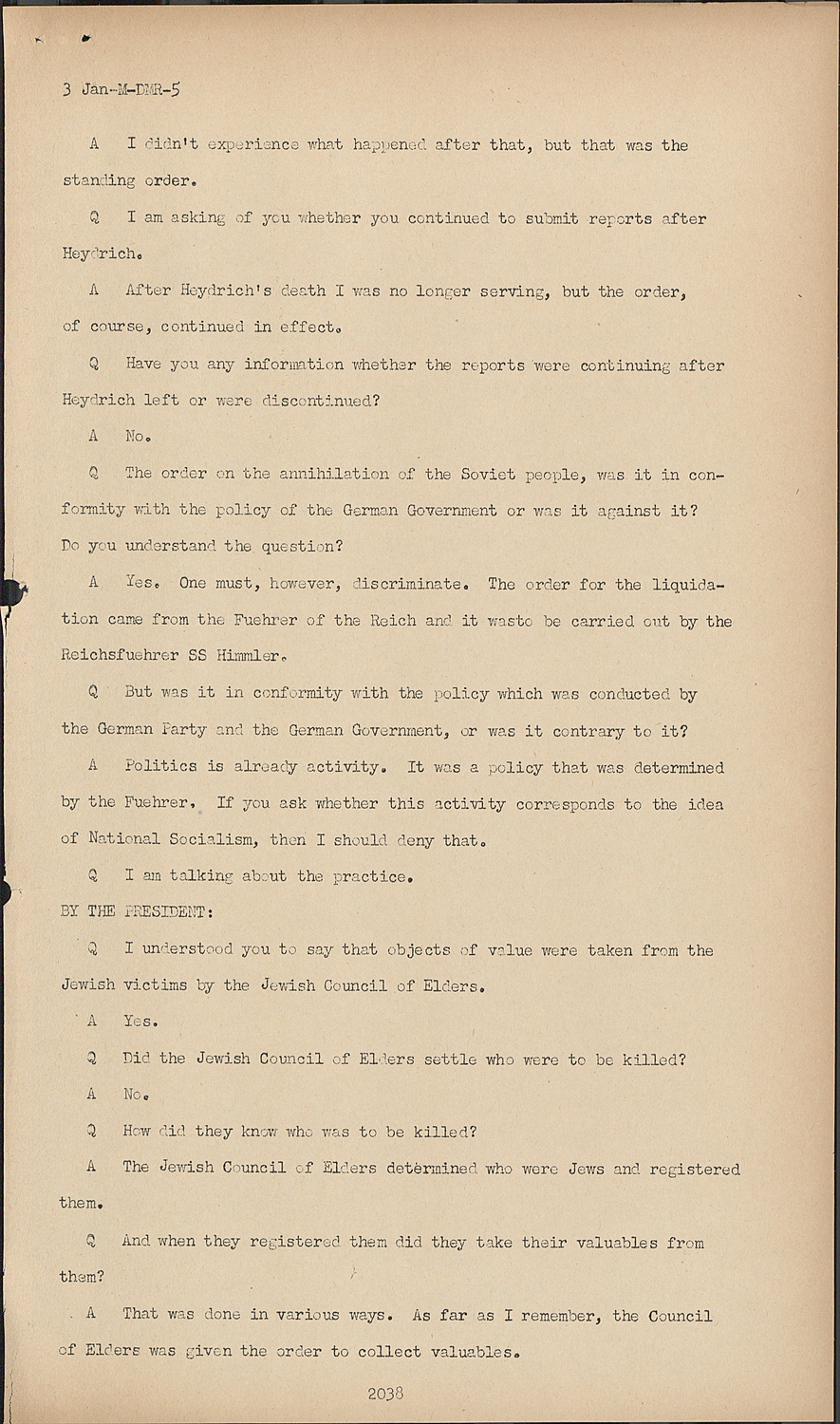
A I didn't experience what happened after that, but that was the standing order.
QI am asking of you whether you continued to submit reports after Heydrich.
AAfter Heydrich's death I was no longer serving, but the order, of course, continued in effect.
QHave you any information whether the reports were continuing after Heydrich left or were discontinued?
ANo.
QThe order on the annihilation of the Soviet people, was it in conformity with the policy of the German Government or was it against it? Do you understand the question?
AYes. One must, however, discriminate. The order for the liquidation came from the Fuehrer of the Reich and it waste be carried out by the Reichsfuehrer SS Himmler.
QBut was it in conformity with the policy which was conducted by the German Party and the German Government, or was it contrary to it?
APolitics is already activity. It was a policy that was determined by the Fuehrer. If you ask whether this activity corresponds to the idea of National Socialism, then I should deny that.
QI am talking about the practice. BY THE PRESIDENT:
QI understood you to say that objects of value were taken from the Jewish victims by the Jewish Council of Elders.
AYes.
QDid the Jewish Council of Elders settle who were to be killed?
ANo.
QHow did they know who was to be killed?
AThe Jewish Council of Elders determined who were Jews and registered them.
QAnd when they registered them did they take their valuables from them?
AThat was done in various ways. As far as I remember, the Council of Elders was given the order to collect valuables.
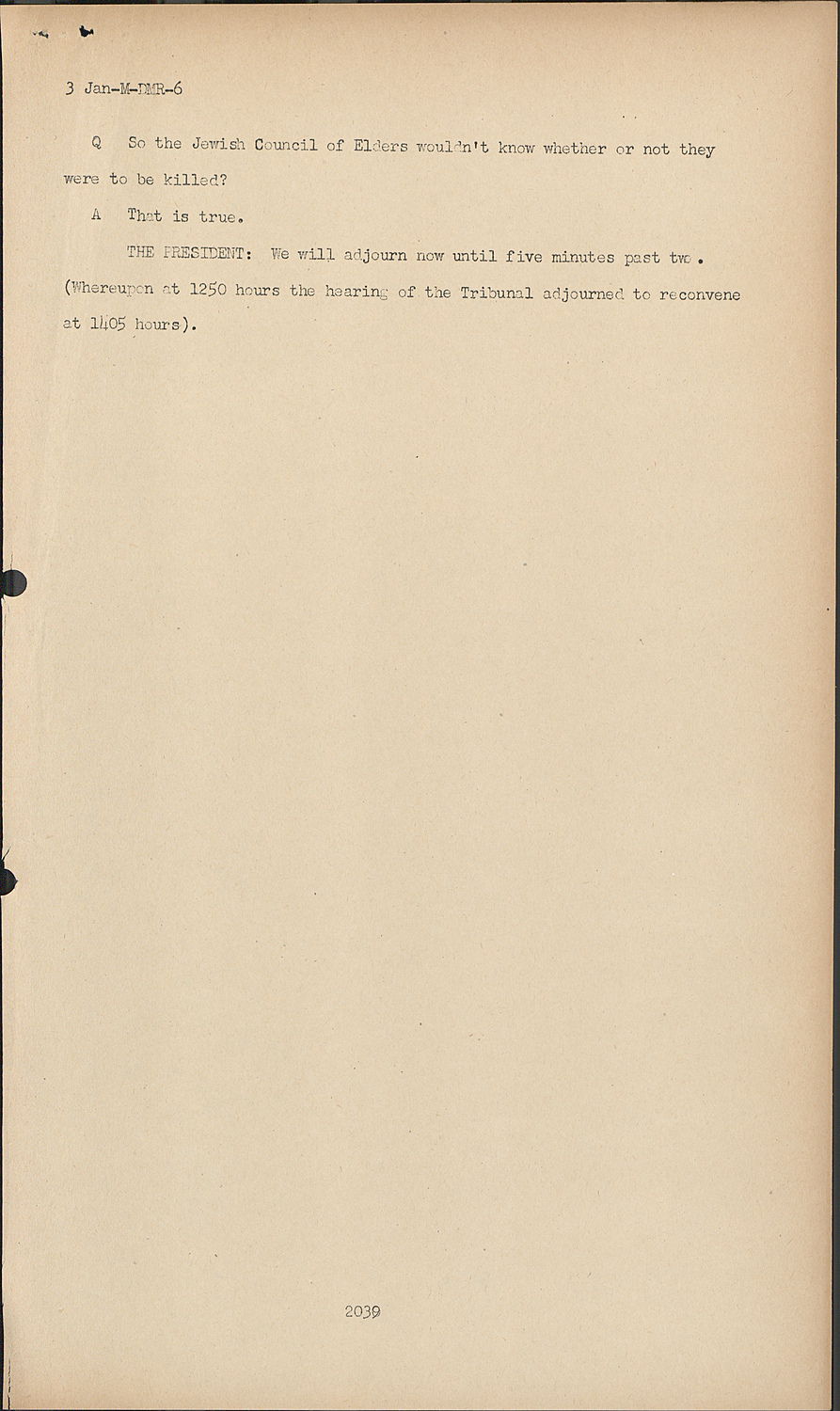
Q So the Jewish Council of Elders wouldn't know whether or not they were to be killed?
AThat is true.
THE PRESIDENT:We will adjourn now until five minutes past two. (Whereupon at 1250 hours the hearing of the Tribunal adjourned to reconvene at 1405 hours).
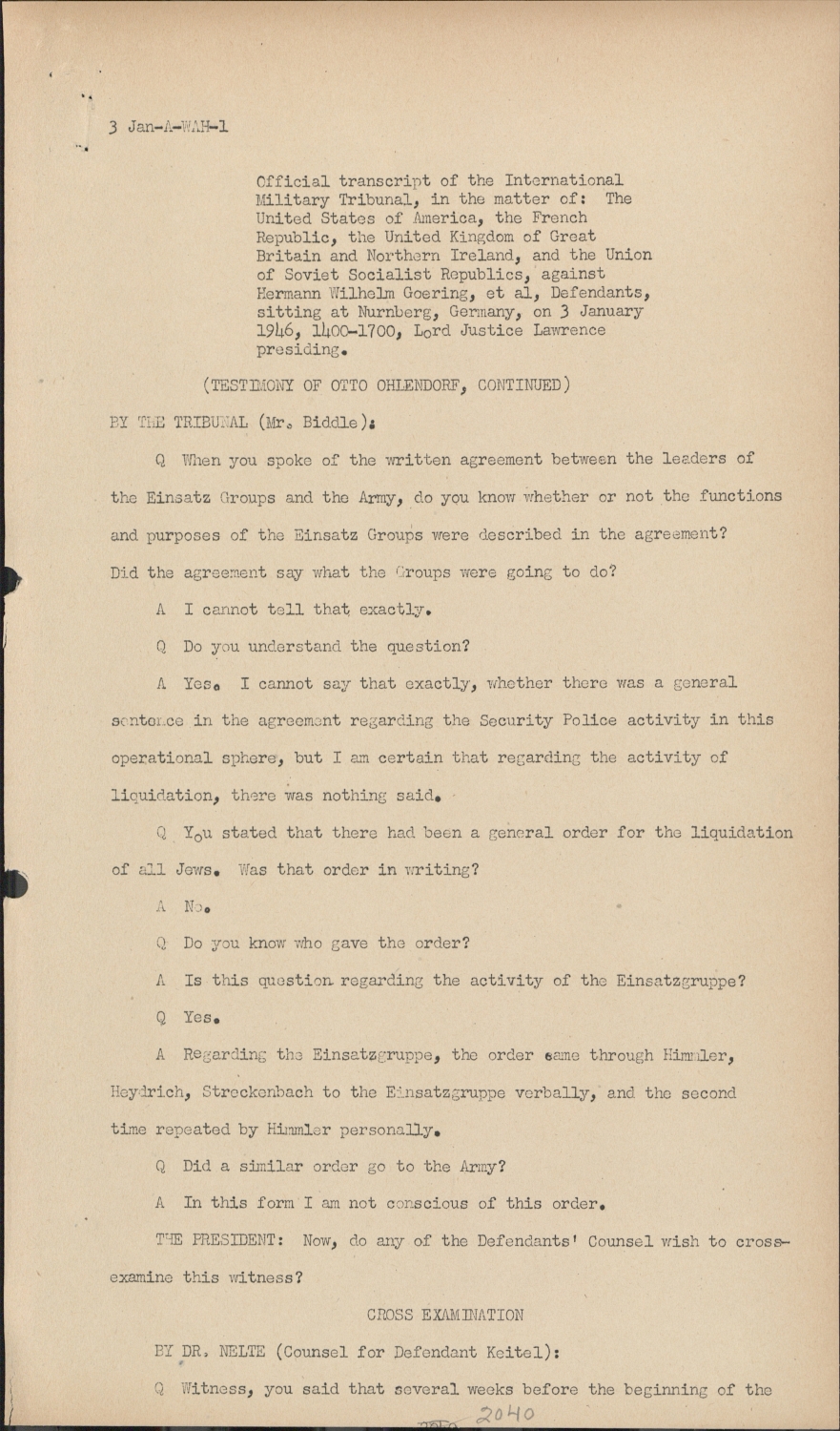
Official transcript of the International Military Tribunal, in the matter of:
The United States of America, the French Republic, the United Kingdom of Great Britain and Northern Ireland, and the Union of Soviet Socialist Republics, against Hermann Wilhelm Goering, et al, Defendants, sitting at Nurnberg, Germany, on 3 January 1946, 1400-1700, Lord Justice Lawrence presiding.
(TESTIMONY OF OTTO OHLENDORF, CONTINUED) BY THE TRIBUNAL (Mr. Biddle):
QWhen you spoke of the written agreement between the leaders of the Einsatz Groups and the Army, do you know whether or not the functions and purposes of the Einsatz Groups were described in the agreement? Did the agreement say what the Groups were going to do?
AI cannot tell that exactly.
QDo you understand the question?
AYes. I cannot say that exactly, whether there was a general sentence in the agreement regarding the Security Police activity in this operational sphere, but I am certain that regarding the activity of liquidation, there was nothing said.
QYou stated that there had been a general order for the liquidation of all Jews. Was that order in writing?
ANo.
QDo you know who gave the order?
AIs this question regarding the activity of the Einsatzgruppe?
QYes.
ARegarding the Einsatzgruppe, the order same through Himmler, Heydrich, Streckenbach to the Einsatzgruppe verbally, and the second time repeated by Himmler personally.
QDid a similar order go to the Army?
AIn this form I am not conscious of this order.
THE PRESIDENT:Now, do any of the Defendants Counsel wish to crossexamine this witness?
CROSS EXAMINATION
BY DR.NELTE (Counsel for Defendant Keitel):
QWitness, you said that several weeks before the beginning of the Russian campaign, there were conferences regarding the missions or activities of the Einsatzgruppe and Einsatzkommandos.
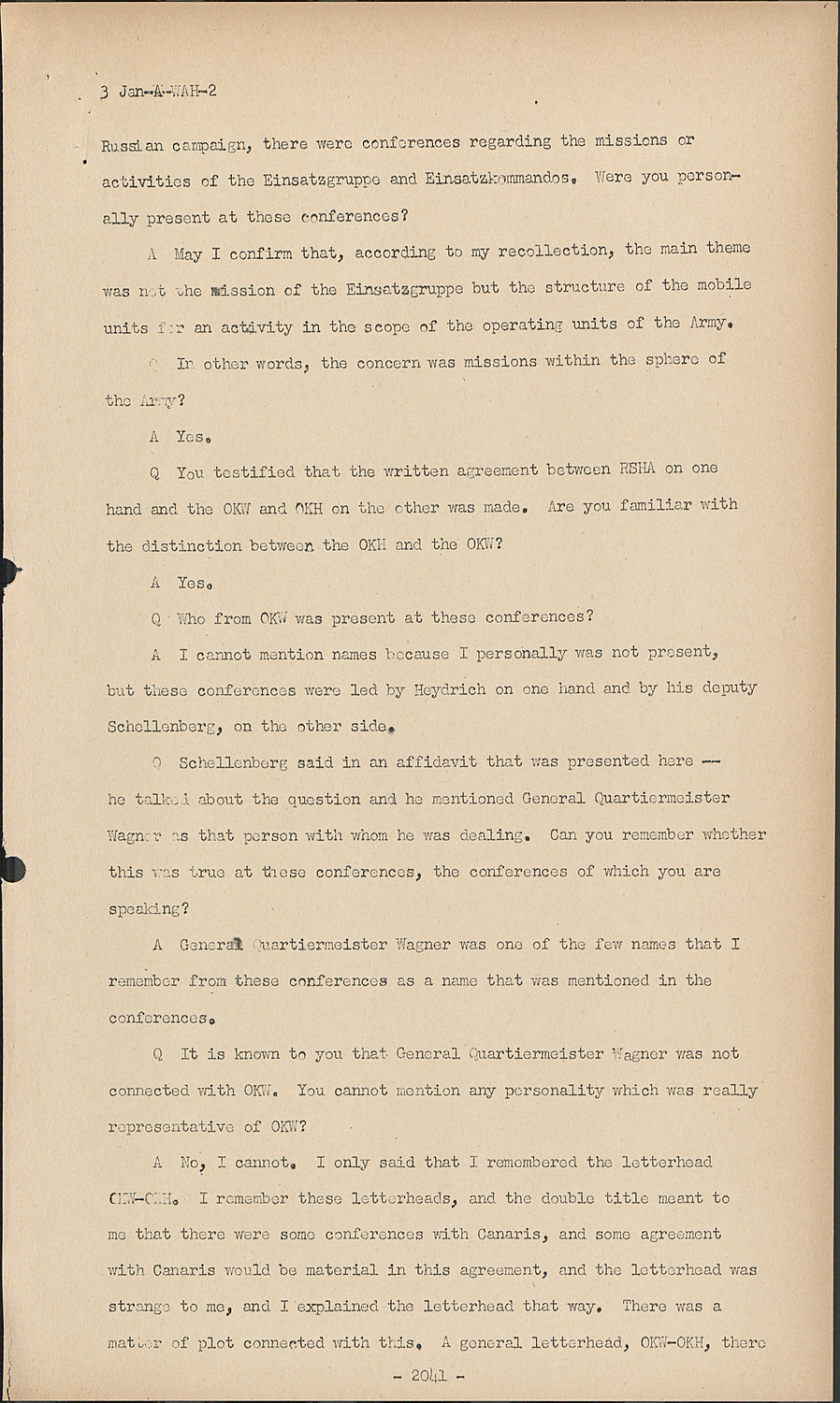
Were you personally present at these conferences?
AMay I confirm that, according to my recollection, the main theme was not the mission of the Einsatzgruppe but the structure of the mobile units for an activity in the scope of the operating units of the Army.
QIn other words, the concern was missions within the sphere of the Army?
AYes.
QYou testified that the written agreement between RSHA on one hand and the OKW and OKH on the ether was made. Are you familiar with the distinction between the OKH and the OKW?
AYes.
QWho from OKW was present at these conferences?
AI cannot mention names because I personally was not present, but these conferences were led by Heydrich on one hand and by his deputy Schellenberg, on the other side.
QSchellenberg said in an affidavit that was presented here he talked about the question and he mentioned General Quartiermeister Wagner as that person with whom he was dealing. Can you remember whether this was true at these conferences, the conferences of which you are speaking?
AGeneral Quartiermeister Wagner was one of the few names that I remember from these conferences as a name that was mentioned in the conferences.
QIt is known to you that General Quartiermeister Wagner was not connected with OKW. You cannot mention any personality which was really representative of OKW?
ANo, I cannot. I only said that I remembered the letterhead OKW-OKH. I remember these letterheads, and the double title meant to me that there were some conferences with Canaris, and some agreement with Canaris would be material in this agreement, and the letterhead was strange to me, and I explained the letterhead that way. There was a matter of plot connected with this. A general letterhead, OKW-OKH, there was no such thing.