Himmler had further con ferences with Standartenfuehrer Becher, and Pecher had conferences with Dr. Kastner, and Eichmann wanted to bring those conferences to nought.
He wanted to have results - that is, to have as many Jews as possible to Auschwitz.
THE PRESIDENT:Need we go into all these conferences? Can't you take us on to other matters?
COL. BROOKHART:I didn't hear all of your question, sir.
THE PRESIDENT:Need we have the details about those conferences?
COL. BROOKHART:The witness is inclined to be lengthy in his answers. That has been true in his pre-trial examination. I will try ...
THE PRESIDENT:You are examining *---*
COL. BROOKHART:Yes sir.
QWas there any money involved in the meeting between Dr. Kastner and Eichmann?
AYes.
QHow much?
AIn the first conversations, Dr. Kastner gave Eichmann about three million pengos and the amounts mentioned later, I don't know exactly.
QTo whom did Dr. Kastner give this money and what became of it?
AIt was given to Eichmann and he gave it to a Treasury and this sum was given to the deputy of the SD in Hungary and the security Police.
QThese actions that you have described involving approximately 450 thousand Jews being moved from Hungary -- were there any official communications sent to Berlin concerning these movements?
AYes. For every transport that left a report was sent to Berlin. Eichmann, from time to time, gave comprehensive reports to the RSHA and the Chief of the Security Police.
QNow, with reference to the Jews that remained in Budapest, what, if any, action was taken against them?
ADr. Salasy took over the government in Hungary.
THE PRESIDENT:We have not yet heard, have we, what happened to those Jews in Hungary? If we have, I have missed it.
COL. BROOKHART: I will ask that question now, sir.
QWhat became of the Jews to whom you have already referred - apprximately 450 thousand?
AWithout exception they were brought to Auschwitz and brought to the final solution.
QDo you mean they were killed?
AYes; with the exception of perhaps 25 or 30% who were used for purposes of work and I am referring to the conferences between Hoess and Eichmann, which took place at Budapest.
QWith reference to the Jews remaining in Budapest, what happened to them?
AIn October, November 1944, about 30 (perhaps a few thousand more) were taken out and brought to Germany. They were to be used for defensive work in Vienna and to work on those fortifications. Mostly women were involved.
These Jews had to take the road from Hungary to the German border by foot - almost 200 kilometres. They were put into March Groups and followed specially-designated routes.
Their shelter and nutrition on this march was very bad. Most of them took sick and were exhausted. I had the mission from Eichmann to take over these groups at the German border and to bring them to the Gauleitung Lower Danube for purposes of work. In many cases the taking over of these workers was turned down by me, because the people were totally exhausted and in a very poor state, because of illness. Eichmann forces me to take over even these people and threatened that he would turn me over to Himmler, so that I would be turned over and put into a concentration camp if I were to make further political trouble, and through these matters, I was removed from Eichmann's department.
A small part of these people were put into the work camps on the Lower Danube and they died through exhaustion.

A small percentage, perhaps twelve-thousand were taken to Vienna, the boundary part to the west, and but three thousand were taken to Bergen and Belsen, and then into Switzerland.
Those were Jews that had come from Germany,
Q.Summarizing the countries of Greece, Hungary and Slovakia, approxi mately how many Jews were affected by measures of the secret police, and the SD in those countries, about which you have personal knowledge?
A.In Slovakia there were about sixty-six thousand. In Greece about sixty-four thousand.
In Hungary more than half a million.
Q.In the countries of Silesia and Bulgaria, about which you have some knowledge, how many Jews were thus affected?
A.In Bulgaria I know of about eight thousand. In Croatia I know only about three-thousand of a group were brought in the summer of '42 from Auschwitz.
Q.Were meetings held of the specialist on the Jewish problem from Amt IV-A for the terms which appear on this sheet, to which you made reference earlier?
A.Yes. Eichmann had the habit every year to have a large meeting in Berlin of all the people who were working for him.
Those meetings were usually in November, and our man who were working for him in a foreign country had to report about the activities.
In the year of 1944, a meeting didn't take place, that I know, because at that time Eichmann was still in Hungary.
Q.In connection with the Jews, about which you have personal knowledg how many were subject to the final solution; that is, the beginning of the year?
A.The exact number is very, very hard to determine. I should take certain things to go by, and these conversations between Eichmann and Hoess in Vienna, in which he said that some Jews who were transported from Greece to Auschwitz, only a few who were fit to work.
But the Jews from Slovakia and Hungary who were about fit to work was from twenty-five to thirty percent.
It is very hard for me to give a total figure exactly.
Q. In meetings with the other specialists over the Jewish problem, and with Eichmann, did you gain any knowledge, or information, as to the total number of Jews killed under this program?
A.Eichmann personally always talked about at least four million Jews.
Sometimes he mentioned a figure of five million. My own personal estimate, I would say was at least four-million Jews which were covered by the so-called final solution.
How many of those actually remained alive, I am in no position to say.
Q.When did you last see Eichmann?
A.I saw Eichmann last the end of February 1945 at Berlin. At that time he mentioned that if the war ended he would commit suicide.
Q.Had he been referring at that time to the number of Jews that had been killed?
A.Yes. He made a special point of that, and he said that he would -
he would laugh at the fact that he had five million people of his conscious, and that this knowledge was special thought to him.
COLONEL BROOKHART:The witness is available for any cross examination.
THE PRESIDENT:Does any other prosecuting counsel wish to examine the witness?
MR. ROBERTS:I have no further questions to ask.
The PRESIDENT: Does the Soviet Prosecutor wish to ask any questions?
COLONEL POKROWSKI:At this stage no questions does the Soviet Union wish to ask.
THE PRESIDENT:Does the French Prosecutor wish to ask any questions?
(No response)
MR. SERVATIUS:Mr. Servatius speaking for the defendant Sauckel.
CROSSEXAMINATION - by MR. SERVATIUS:
Q.Now, you mentioned, of course, the labor by Jews, the taking of Jews from Slovakia at Auschwitz, where they were used for work.
Then later, you mentioned those Jews from Hungary that came to the southeast wall fortification.
Do you know whether a man in charge, Chief of Labor, Sauckel, was connected with this office as a result of that, or his direction is in any way connected with these things?

A.So far as the Jews from Slovakia are concerned, Sauckel had nothing to do with these.
It was an internal matter for the inspector of the concentration camp system of these Jews, the taking of Jews for the southeast wall fortification.
I can not count quickly enough to answer this question.
I do not know how far Sauckel was connected with this.
The Jews which were taken from Hungary borders to work he turned over to the Gauleiter of the lower Danube.
MR. SERVATIUS:I have not further questions to ask the witness.
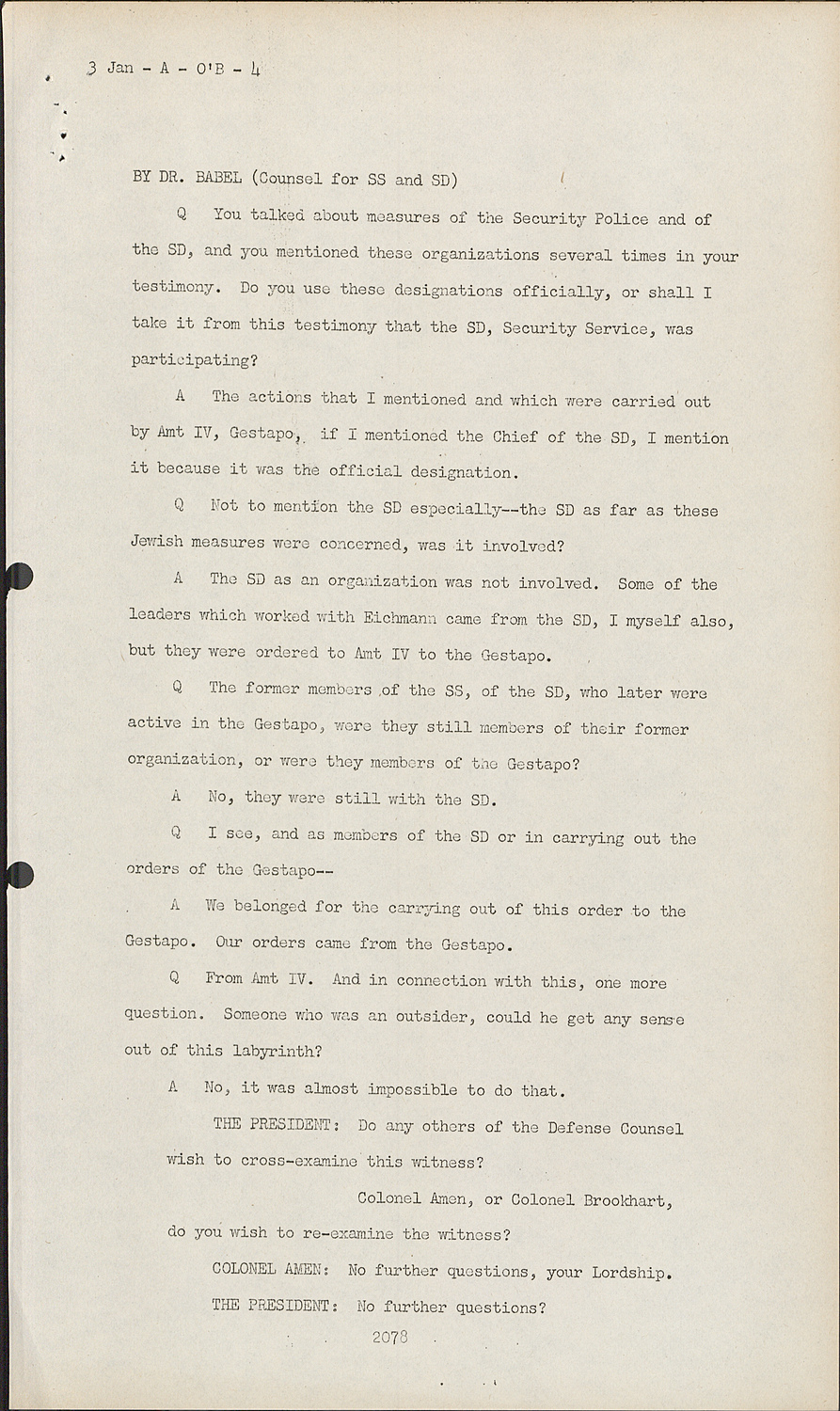
BY DR. BABEL (Counsel for SS and SD)
QYou talked about measures of the Security Police and of the SD, and you mentioned these organizations several times in your testimony.
Do you use these designations officially, or shall I take it from this testimony that the SD, Security Service, was participating?
AThe actions that I mentioned and which were carried out by Amt IV, Gestapo, if I mentioned the Chief of the SD, I mention it because it was the official designation.
QNot to mention the SD especially--the SD as far as these Jewish measures were concerned, was it involved?
AThe SD as an organization was not involved. Some of the leaders which worked with Eichmann came from the SD, I myself also, but they were ordered to Amt IV to the Gestapo.
QThe former members of the SS, of the SD, who later were active in the Gestapo, were they still members of their former organization, or were they members of the Gestapo?
ANo, they were still with the SD.
QI see, and as members of the SD or in carrying out the orders of the Gestapo -
AWe belonged for the carrying out of this order to the Gestapo.
Our orders came from the Gestapo.
QFrom Amt IV. And in connection with this, one more question.
Someone who was an outsider, could he get any sense out of this labyrinth?
ANo, it was almost impossible to do that.
THE PRESIDENT: Do any others of the Defense Counsel wish to cross-examine this witness?
Colonel Amen, or Colonel Brookhart, do you wish to re-examine the witness?
COLONEL AMEN: No further questions, your Lordship.
THE PRESIDENT: No further questions?
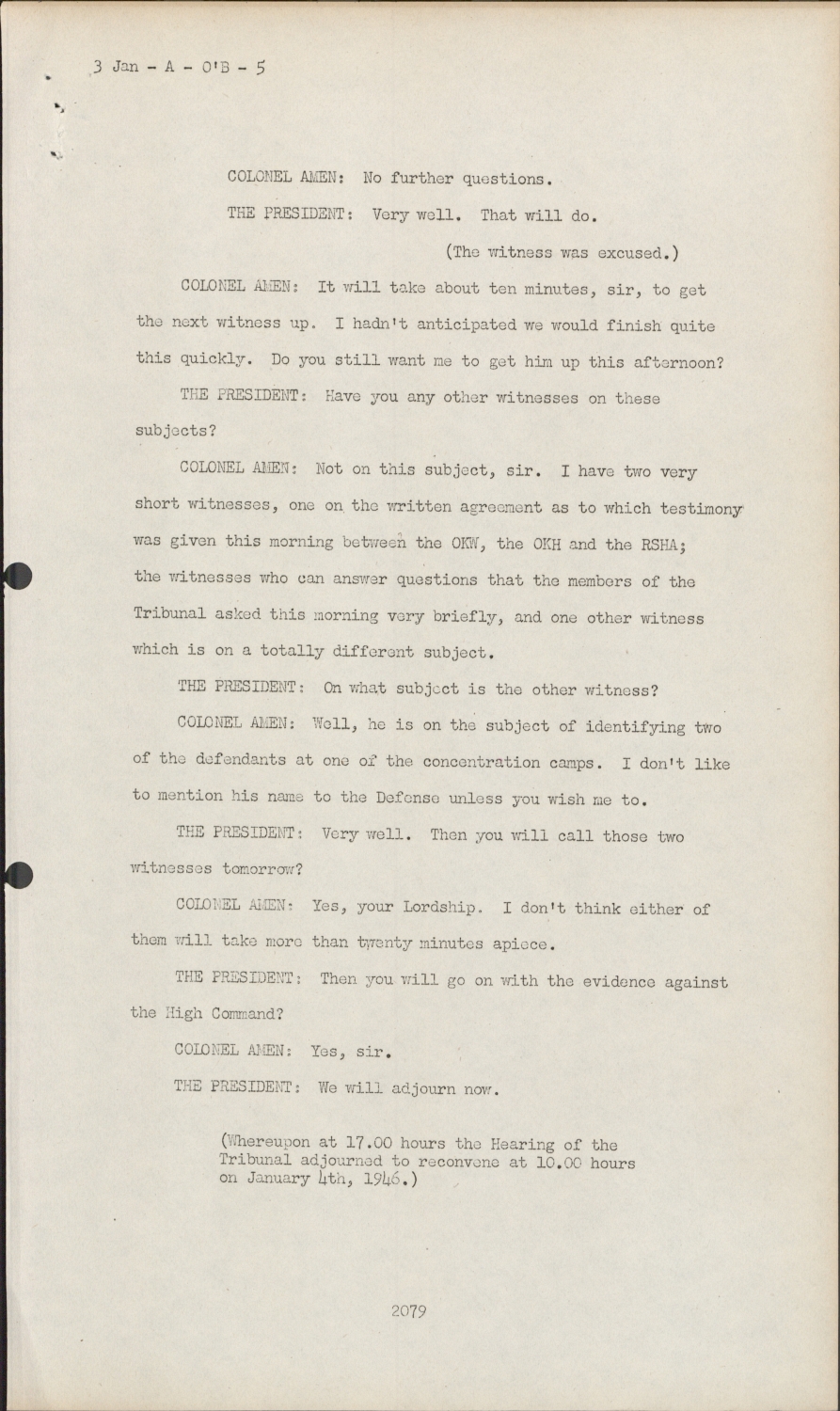
COLONEL AMEN: No further questions.
THE PRESIDENT: Very well. That will do.
(The witness was excused.)
COLONEL AMEN:It will take about ten minutes, sir, to get the next witness up.
I hadn't anticipated we would finish quite this quickly.
Do you still want me to get him up this afternoon?
THE PRESIDENT:Have you any other witnesses on these subjects?
COLONEL AMEN:Not on this subject, sir. I have two very short witnesses, one on the written agreement as to which testimony was given this morning between the OKW, the OKH and the RSHA;the witnesses who can answer questions that the members of the Tribunal asked this morning very briefly, and one other witness which is on a totally different subject.
THE PRESIDENT:On what subject is the other witness?
COLONEL AMEN:Well, he is on the subject of identifying two of the defendants at one of the concentration camps.
I don't like to mention his name to the Defense unless you wish me to.
THE PRESIDENT:Very well. Then you will call those two witnesses tomorrow?
COLONEL AMEN:Yes, your Lordship. I don't think either of them will take more than twenty minutes apiece.
THE PRESIDENT:Then you will go on with the evidence against the High Command?
COLONEL AMEN:Yes, sir.
THE PRESIDENT:We will adjourn now.
(Whereupon at 17.00 hours the Hearing of the Tribunal adjourned to reconvene at 10.
00 hours on January 4th, 1946.)
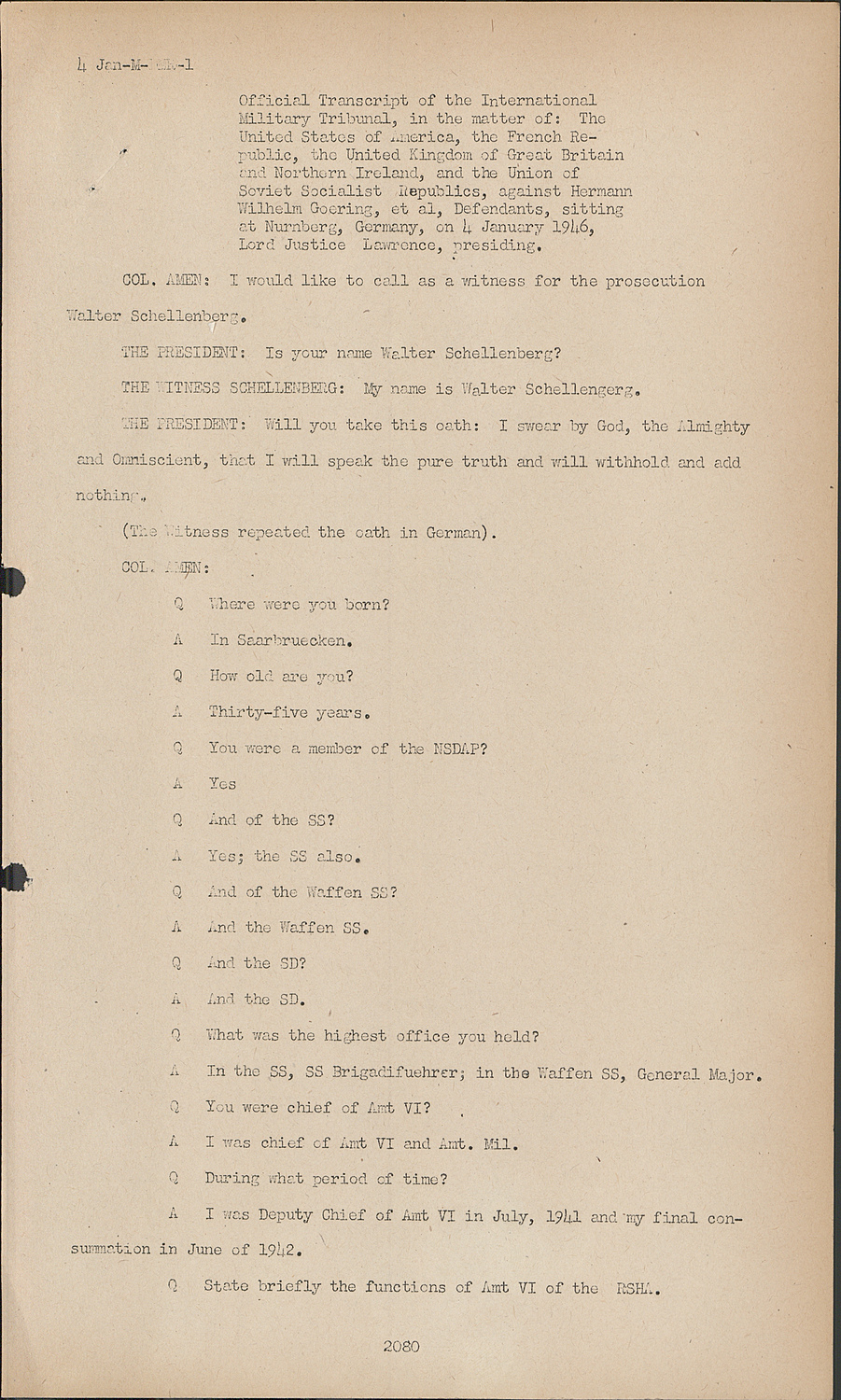
Official Transcript of the International Military Tribunal, in the matter of:
The United States of America, the French Re public, the United Kingdom of Great Britain and Northern Ireland, and the Union of Soviet Socialist Republics, against Hermann Wilhelm Goering, et al, Defendants, sitting at Nurnberg, Germany, on 4 January 1946, Lord Justice Lawrence, presiding.
COL. AMEN:I would like to call as a witness for the prosecution Walter Schellenberg.
THE PRESIDENT:Is your name Walter Schellenberg?
THE WITNESS SCHELLENBERG:My name is Walter Schellengerg.
THE PRESIDENT:Will you take this oath: I swear by God, the Almighty and Omniscient, that I will speak the pure truth and will withhold and add nothing.
(The Witness repeated the oath in German).
COL. AMEN:
Q Where were you born?
A In Saarbruecken.
Q How old are you?
A Thirty-five years.
Q You were a member of the NSDAP?
A Yes Q And of the SS?
A Yes; the SS also.
Q And of the Waffen SS?
A And the Waffen SS.
Q And the SD?
A And the SD.
Q What was the highest office you held?
A In the SS, SS Brigadifuehrer; in the Waffen SS, General Major.
Q You were chief of Amt VI?
A I was chief of Amt VI and Amt. Mil.
Q During what period of time?
A I was Deputy Chief of Amt VI in July, 1941 and my final consummation in June of 1942.
Q State briefly the functions of Amt VI of the RSHA.
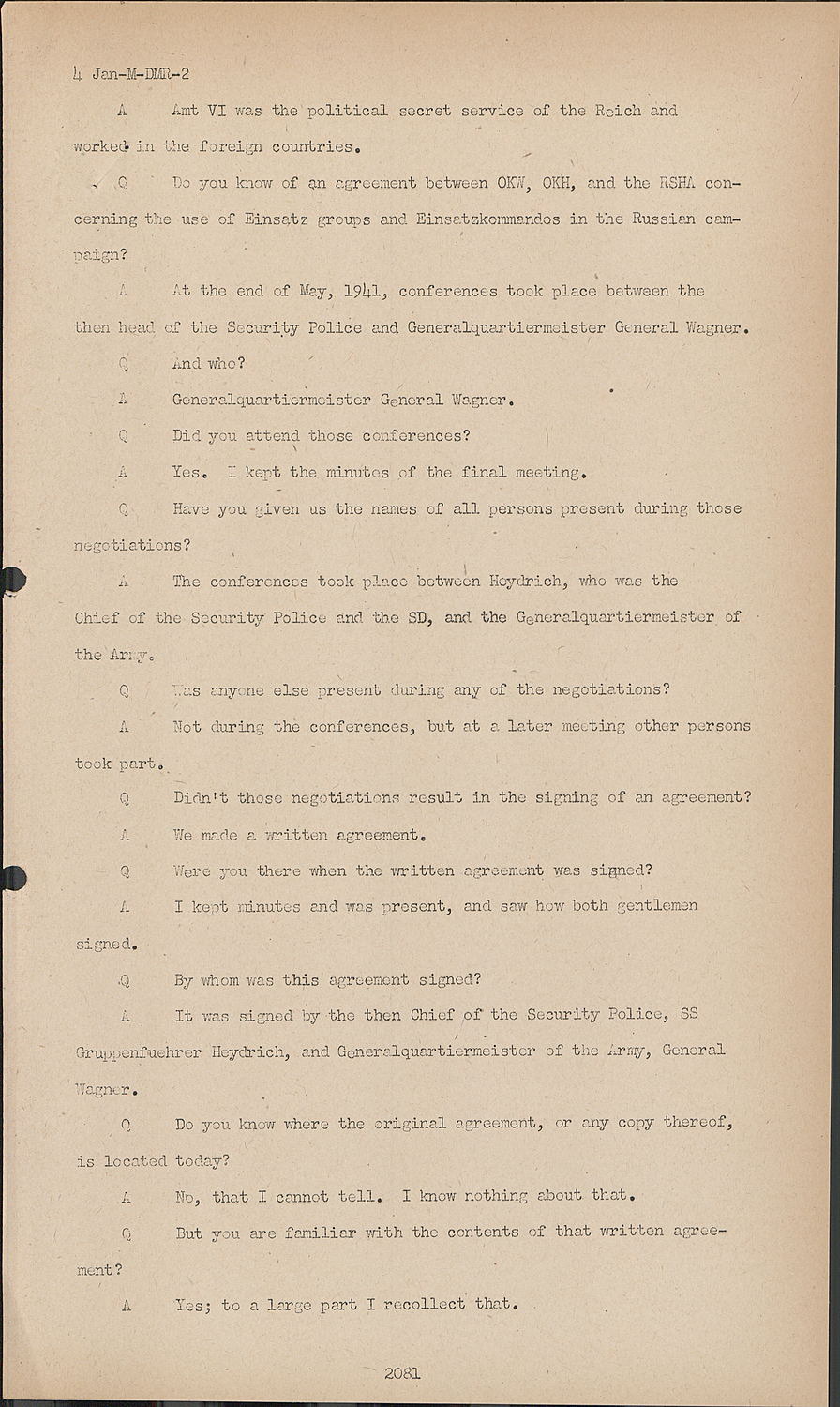
A Amt VI was the political secret service of the Reich and worked in the foreign countries.
QDo you know of an agreement between OKW, OKH, and the RSHA concerning the use of Einsatz groups and Einsatzkommandos in the Russian campaign?
AAt the end of May, 1941, conferences took place between the then head of the Security Police and Generalquartiermeister General Wagner.
QAnd who?
AGeneralquartiermeister General Wagner.
QDid you attend those conferences?
AYes. I kept the minutes of the final meeting.
QHave you given us the names of all persons present during those negotiations?
AThe conferences took place between Heydrich, who was the Chief of the Security Police and the SD, and the Generalquartiermeister of the Army.
QWas anyone else present during any of the negotiations?
ANot during the conferences, but at a later meeting other persons took part.
QDidn't those negotiations result in the signing of an agreement?
AWe made a written agreement.
QWere you there when the written agreement was signed?
AI kept minutes and was present, and saw how both gentlemen signed.
QBy whom was this agreement signed?
AIt was signed by the then Chief of the Security Police, SS Gruppenfuehrer Heydrich, and Generalquartiermeister of the Army, General Wagner.
QDo you know There the original agreement, or any copy thereof, is located today?
ANo, that I cannot tell. I know nothing about, that.
QBut you are familiar with the contents of that written agreement?
AYes; to a large part I recollect that.
Q To the best of your knowledge and recollection, please tell the Tribunal exactly what was contained in that written agreement.
AThe first part of this agreement began with the quotation of a decree by the Fuehrer.
It read as follows:
"For the safety of the fighting units before the campaign into Russia, that is at hand, all means are to be used to keep the rear safe and protected.
Based on this thought, with every means resistance is to be broken.
To support the fighting power of the Army for this task, the Security Police and the Security Service are to be called in."
If I remember correctly, as a special example of something to be protected or secured, the security of the so-called routes of supply was mentioned.
QDo you recall anything else contained in that agreement?
AThe second part of this agreement, the organization of the Army groups was mentioned.
QWhat was said about that?
AAnd the construction and the use of the Einsatz groups and the Commandos of the SD was discussed.
Four different spheres of influence or space were used or illustrated.
I remember as follows: first, the front area; secondly, the operational zone -- and it was built up into an Army area and a rear area -- third, the rear Army area; and fourthly, thearea for the civil administration that was to be put up, the Reichkommissariats.
To cover these different spheres, or areas, the spheres of influence and command were set down distinctly.
In the front, or fighting areas, the Einsatzkommandos of the SD were operating tactically and as troops.
That means they were exclusively under the jurisdiction of the Army.
In the operational zones there was only a troop subsidiary juris diction, and these rules were to apply in the third zone; and in the fourth group, the Reichkommissariat, the same rules and regulations were to apply as in the areas of the Reich proper.
In the third part of the agreement was set forth what was to be included under tactical and troop service regulations.
That meant the phrase "Truppendienstlich" was clarified, and by that we meant the disciplinary, and the matter of taking care of the welfare of the Army.
Special mention was given that the Truppendienstliche hierarchy was to take care for the supply, especially as to gasoline, food and technical reports that were to come in.
All these things were included.
QHave you now told us everything, which you recall, about that agreement?
A Yes; I cannot remember any more.
COL. AMEN: If Your Honor please, that is all. THE PRESIDENT: Does the English prosecution have any questions to ask? SIR' DAVID MAXWELL-FYFE: No. THE PRESIDENT: Does the Russian prosecution have any questions to ask? COL. POKROVSKY: No. THE PRESIDENT: Does the French prosecution have any questions to ask?
(No response). THE PRESIDENT: Do the Defendants' counsel wish to ask any questions?
CROSS EXAMINATION BY DR. KURT KAUFFMANN (Counsel for the Defendant Kaltenbrunner):
QIs it correct that Dr. Kaltenbrunner was your superior?
ADr. Kaltenbrunner was my immediate superior.
QUntil what time?
AFrom the 30th January of '43 until the end.
QDo you know his attitude on important questions of life, of National Socialism, as far as the Jewish treatment or question of the treatment of the Church?
AI personally did not have a chance to converse with him on these problems. What I know about him is the result of a few special personal observations.
QDid you receive original orders of Kaltenbrunner's that covered executions of saboteurs or concentration camp people?
ANo. All I know about it is the oral directives or orders that he sent to the Amt IV chief. These I know about, those orders.
QDid Kaltenbrunner ever indicate to you that he had agreed with Himmler on everything concerning concentration camps, and that everything that concerned the executive power was to be taken away from him, and that all that was to remain with him was the SD, as a message service, and this message service he wanted to develop to get the necessary critical faculties, which were lacking?
A I do not know about any such agreement, and what I found out about facts later is to the contrary.
QI have to ask you to keep the record straight, because you gave a negative answer. Which facts do you mean?
AI mean, for instance, one fact, that I agreed very, very reluctantly to the Reichsfuehrer SS, that concentration camps were not to be evacuated. Kaltenbrunner, in direct contact with Hitler, circumvented this decree in order to appear in a better international light.
QWere there any international agreements on that, which could be applied to existing laws, or that would be concerned with international agreements?
AI would like to interpret it in the following manner: that if international personalities gave the binding word to allied powers not to have the concentration camps evacuated, it was binding according to human law.
QThat do you mean by evacuated?
ABefore the enemy could approach, to have them arbitrarily evacuate and to have them transposed to other parts of Germany.
QThat was your opinion?
AThat no evacuation should take place, because human right did not coincide with that.
QYou did not want the concentration camps to be given over to the approaching enemy?
AYes.
QDid you know that your activity could be conclusive to have suffering brought on many people, and the people who were per se innocent?
AI didn't quite understand the question. Will you please repeat it?
QDid you ever think that your activity, and the activity of your coworkers, might be the cause for many people -- let us say Jews -- suffering greatly even though these people were innocent?
AI cannot imagine that the activity of my office would cause any such thing.
I was merely an information center.
QThen your information center had no connection to such crimes?
ANo.
Q Then in this point Kaltenbrunner would not be accused?
AYes, because he was the Chef of Amt IV of the State Police.
QI asked in this point, and by that I meant your sector; your department.
AI only represent the sector of Amt VI and Amt Mil.
QBut Kaltenbrunner was the Chief of the Amt section at the same time?
AKaltenbrunner was the Chief of the RSHA and the eight offices, or amts, were subsidiary to it. One or two of them I headed, and they were Amt VI and Amt Mil, and these two offices had nothing to do with the executive power of the State Police.
THE PRESIDENT: What I understood you to say was that you were only in a branch which was an information center; is that right?
THE WITNESS:Yes.
THE PRESIDENT:And that Kaltenbrunner was your immediate chief; is that right?
THE WITNESS:Kaltenbrunner was the chief of the RSHA.
THE PRESIDENT:Yes, he was the Chief, not only of your branch, but of the whole organization.
THE WITNESS:Yes, that's right.
DR. KAUFFMANN:I would like to question this witness later on. I would like to reserve the right to question this witness later on, after I talk with Kaltenbrunner. QUESTIONS BY DR. KUBUSCHOF (Counsel for Von Papen):
QIn the summer of '43, were you in Ankara; and did you at this time pay a visit to the German Embassy?
AYes.
QDid you, at this visit, discuss Germany and criticize German foreign policy in various ways, and at that point mention that it was absolutely advisable to have better connections with the Holy See; while at that time, Ambassador von Papen said: "That is only advisable then, according to the demands that I have made repeatedly, that the church policy be revised completely, and the persecution of the churches will cease"?
AYes, the content of the conversation is right, and in the same sense I talked with the then Ambassador, von Papen. QUESTIONS BY DR. THOM (Counsel for Rosenberg):
QYou said a little while ago that the same regulations existed in the realm of the civil administration as in the Reich.
AI said they were to apply.
QPlease answer my question again.
AI will repeat: I reproduced the agreement, but in the provisional areas of administration of the Reichskommissariat, the same regulations existed as far as the armed SD was concerned, and these applied in the same way as in the Reich.
Q Do you know through whom that was carried out?
ANo, later on I did not concern myself with these questions. QUESTIONS BY DR. BABEL (Counsel for SS and SD):
QYou were a member of the SS and of the SD, and in leading positions-
THE PRESIDENT:Will you state, for the purposes of the record, which organization you appear on behalf of?
DR. BABEL:I represent the organizations of the SS and SD.
Q (Continuing) In the RSHA, there were two departments, the Security Police and SD; how were these two departments connected, and what was the purpose of the SD?
AThat is a question that I cannot answer with one sentence.
QPerhaps I can change the question and ask a concrete one: Was the SD used with the Einsatzgruppen in the East; in what scope, and with what tasks or missions were they charged?
AI believe that the point of emphasis was the use of the personnel in the East by the Security Police which was the State Police; and the Criminal Police was there; and only supplementary units from the personnel of the SD were used.
QHow large were these supplementary contingents? How large was the SD?
AI believe that I can estimate the figures: Excluding female help, the State Police -- perhaps 40 to 45,000; the Criminal Police -- 15 to 20,000; SD in the interior, that is, Amt III with its organizational subsidiaries -- 2 to 2,500; and SD beyond Germany -- that is my Amt VI -about 400.
QAnd how was the SD used in the East?
AI can't give you particulars, because that was a matter of the personal and civil administration, and it was under the chief of the Security Police.
QDid the figures you mentioned include male members of the SD, solely, or was the female help included?
AOnly male members. I excluded the female help.
Q Yesterday a witness mentioned approximately the same figure of 3,000, but he thought the female help was included.
AAs I said, I mentioned SD in the interior, 2 to 3,000.
QWhat was the hierarchy of the Waffen SS?
AAs to the hierarchy of the Waffen SS, I cannot give you a responsible answer, because I was not concerned with that question.
QYou were a member of the Waffen SS and of the SD.
AI was a member of the Waffen SS since January '45, according to higher orders, because I had large numbers of military men through Amt Mil, and I had to have military rank to cover my activities.
QDo you know what happened in other cases, also?
AThat question is beyond me.
DR. BABEL:Thank you.
REDIRECT EXAMINATION QUESTIONS BY COL. AMEN:
QDo you know of any specific case where Kaltenbrunner ordered clearance of any concentration camp, contrary to Himmler's wishes?
AYes.
QWill you tell the Tribunal about that?
AI cannot give you the exact date. I believe it was the beginning of April 1945. The son of President Muesi of Switzerland had brought his father into Switzerland, and had returned by auto himself to the concentration camp at Buchenwald; and he wanted to call for a Jewish family which I had liberated personally. He came to the camp while we were evacuating it at top speed, and under the worst possible circumstances. Three days before, I had discussed and promised the non-evacuation of the camp to his father, and this declaration was also meant for Eisenhower; and since he had gone to Switzerland in the meantime, he was doubly disappointed and surprised because the promise was not kept. Muesi Jr. came to me personally in my office; was deeply insulted and accused me bitterly. I couldn't understand the circumstances, and immediately contacted the secretary of Himmler and protested against these proceedings. The actual fact, as mentioned to me by Muesi Jr. was certified as correct, but it was unexplained since Himmler had not given these orders, or was not supposed to have given these orders, and a halt was ordered immediately by all means.
Himmler personally certified the same over the phone. I believe it was on the same day, after an official meeting, I informed Kaltenbrunner of the state of affairs, and relieved his mind about this renewed breach of international promises. At this point of the conversation I paused, and the Chief of the State Police, Gruppenfuehrer Mueller, entered into the conversation, and said that he, according to an order of Kaltenbrunner's, three days ago, had already begun the evacuation of the most important internees of the several camps.
Kaltenbrunner replied: "Yes, that is right.
A decree of the Fuehrer is involved, which was recently confirmed by him, that is, the Fuehrer, and all important internees, accord ing to that decree, were to be evacuated to the southern part of the Reich."
Then, in a cynical way, in dialect, he said to me: "Tell your old man"-that was Muesi, Sr. -- "there will still be enough left in the concentration camps, and you will have to be satisfied with that."
I believe that was on the 10th of April, 1945.
COL. AMEN:That is all, may it please the Tribunal. QUESTIONS BY THE TRIBUNAL (General Nikitchenko):
QCan you say right now what were the functions of the chief amt of the Security Police?
AThat I cannot answer in one sentence. I believe-
QWhat were the aims?
AThe RSHA was a comprehensive grouping of the Security Police; that means State Police.
QWe know about this organization on the basis of the documents which are at the disposal of the Court, but what were its functions?
AI just wanted, a minute ago, to explain its functions. Its functions were as follows: That was a matter of Security Police activity, Criminal Police activity, security measure, internally and in foreign countries; that is, in Germany and abroad.
QWould it be correct to formulate the functions as follows: to suppress those whom the Nazi Party considered its enemies?
ANo, I don't believe that. A statement of that type is too one-sided.
QBut all these functions were also performed.
AThey were, perhaps, in a certain part connected with the State Police.
QHas this part of the functions, then, been changed after Kaltenbrunner took office?
ANo, there was no change.
QHave those functions, to which you were referring right now, been changed since the time that Kaltenbrunner took office as Chief of the Security Police?