Q I have asked can you confirm the fact that the measures which were carried out by the Wehrmacht under the administration of the districts which were occupied by the Germans were directed to the purpose of reducing the number of Slavs and Jews to thirty millions?
Do you understand the question now?
AI am of the opinion that these methods would have led to the extermination of thirty million if it had been continued in the same way, and if by the development of the situation this had not been altered completely.
COLONEL POKROWSKI:I have no more questions to put to the witness at this sitting of the Tribunal.
THE PRESIDENT:Does the Defense have any questions?
CROSS-EXAMINATION BY DOCTOR EXNER (counsel for the General Staff of the OKW):
QYou said you were chief of the anti-partisan activity?
AChief of the anti-partisan unit.
QIf there were such chaotic circumstances there why didn't you alter the system?
ABecause I never had any authority.
QWhy?
ABecause I was never entrusted with this authority. I was not allowed to command or empowered with disciplinary powers, nor was I a judge.
QDid you make a report to your superior officer?
AEvery day. I had permanent office with Himmler.
QDid you make any proposals about changes?
AVery often.
QAnd why were these not realized?
AI think I expressed myself quite clearly before, because I am of the opinion that this change was not desired.
Q You also, as you have told us, made reports to your superior authority about the dead and wounded and the prisoners of the enemy after such action.
Tell me what proportion, approximately what proportion were the prisoners to the dead on the enemy side?
AThat varied. You can't take all the operations together. It was a fact that the prisoners were very much more numerous than the dead, but not in the years in which the orders had been given that prisoners were not to be taken at all.
QYou say that the system was stricter at first and milder later on?
AYes, it was milder in a way because there were clearer orders where the prisoners were to be transported, and that had not been the case at first.
QCan you tell me of any orders that you received from military authorities and which were directed to the elimination of millions of Slavs?
AI have already answered this question. I said there was no such written order.
QDo you know that the reports that you made to Himmler about the action that you took were presented by Himmler to the Fuehrer?
AMay I be a little bit more explicit in answering it? At first I had a permanent staff in Himmler's office. My chief of staff was there permanently while I was at the front. Between the Wehrmacht office, OKW, and OKH, and my own staff there was constant contact which was about the reports of the partisans' activities and which did not first come to me. But there were a number of channels which went by OKH, that is to say, the Wehrmacht reported just as much to us as we reported to the Wehrmacht. When these reports were collected in my staff every day these reports were passed to Himmler who passed them on.
QTo whom?
AThe generals of the Wehrmacht. They have already confirmed that these reports reached them.
QWere there Jews in these partisan groups?
AWithout question. In some partisan groups there were, corresponding to the Jewish population, that some Jews participated.
QIn some cases. Was that perhaps more an exception?
AYes, it was an exception.
QTherefore, I do not quite understand how the actions against the partisans should lead to the elimination of the Jews.
A I did not say that. We were talking about the question of the Einsatz groups before.
QTell me, do you know the regiment Duerrlewanger? Do you remember that?
AThat is the brigade Duerrlewanger, which I explained to the prosecutor a while ago.
QWas that at one time under your command in the year 1941?
AYes.
QWas it a formation of the Army?
AIt did not belong to the Waffen SS, but it came from the Wehrmacht.
QCan you tell me who was present at Himmler's speech?
AThere were about twelve group leaders--gruppenfuehrers of the SS.
QWere officers of the Wehrmacht there?
ANo.
DOCTOR EXNER:Thank you. DOCTOR KRAUS (counsel for Defendant Schacht):
QOn the 18th of August 1935 you were present in Koenigsberg when the former Reichsbank president, Schacht, made a speech at the affair?
AYes.
QWhat was your profession at the time?
AI was Oberabschnittsfuehrer.
QWere you present in your professional capacity?
AYes, as Oberabschnittsfuehrer of the SS.
Q.You suddenly left the room in the middle of the speech in protest, didn't you?
AYes, in the middle of the speech I left the room.
QWas that in protest?
AYes.
QThen that is to say that you did not agree with the speech?
AIt purposes. That was not on account of the speech, but in pretest. On account of the speech, no.
QMay I ask you then why you protested?
AIt is well known that in East Prussia I was in sharp opposition to Gauleiter Koch, which led to his being suspended. I was in such sharp opposition to Koch that I did not understand how Reich Minister Schacht could compliment such a man I considered to be completely corrupt.
QWas it a protest against the attitude of Schacht or indirectly against Koch?
A I think Schacht must know that it was a protest against Koch. I was able to explain that to him.
BY DOCTOR SERVATIUS (counsel for Defendant Sauckel):
QMr. Witness, you said that a change came in the treatment of the partisans. It was ordered, you said, that the partisans were to be sent to labor service, From whom did this order come?
AI can't remember that in detail. I only know that Sauckel traveled around the East and made speeches and said it would be best if these people who had been taken prisoner in the partisan war, if they came to labor service.
QI asked you who gave the order. Was it from Himmler or from the organization Sauckel?
ANo. The organization Sauckel could of course not give orders about the partisans. I imagine that organization Sauckel had caused this to be done, but the orders come from Himmler.
QWhere was this organization Sauckel? What did it consist of?
AIt was generally known that the organization was there for finding labor to put in the armament industry in the Reich.
QYou spoke of an organization, but you don't know of a real organization?
AOh, no, not an independent organization such as you are suggesting.
QDo you know that Sauckel had no executive powers of his own?
ANo, I didn't know that.
THE PRESIDENT: I want the attention of the Defendant's Counsel. Unless Counsel and the witness speak slowly and make adequate pauses between the questions and the answers, it is impossible for the interpreters to interpret properly, and the only result is that the questions and answers do not come through to the Tribunal, nor do the Defendant's Counsel get the benefit of the true meaning of the answers which have been given in the examination in chief, and everything that you may think you gain by rapidity of cross-examination, you lose by the inadequacy of the translation; and I will repeat, that you should pause at the end of your sentences and at the end of your question, so as to give the interpreter's voice time to come through.
BY DR.STAHMER (Counsel for Defendant Goering):
QAs the witness, you said that from 1942 on, you were Chief of the Anti-partisan Groups. As such, you were devoted to the fighting of the partisans in the East?
AYes, that is true, for the fighting of partisans.
QNow, you did soy that there was some lack of clarity as to what should be understood under the term "partisan"; the concept of "partisan" was unclear and had been for some time. Is that correct?
AIn its essential meaning, yes. In my opinion, there must be drawn a distinction between partisans and those suspected of partisan activities. Troops do not always make this distinction. A partisan was a man who was particularly sought after and a trained man and also very well armed. It was always important to me that this concept should be particularly regarded and similarly it should not be indiscriminately said, as we say that one gets fire from wood or from a forest or from a house, that anyone could be called a partisan. Partisans were used to disappearing rapidly after a successful action; they relied on surprise. That is when the troops took counter measures and were not particularly schooled, and this concept had not been completely clarified and the result was that the troops said the shooting took place at such and such a village and therefore it was done by partisans; but according to my opinion, a partisan was that, person who was taken prisoner or killed with a weapon in his hand. All other people could not be characterized as partisans.
QNow, what did you do in a positive way in order to clarify this concept of "partisan?"
AAs I previously said, in 1941, even before I was chief of the Anti-partisan Forces, not only by me but also by General Schenkendorf, a large and continuous number of memos was handed in with regulations and we handled this matter. For instance, in central army groups, such memoranda were handed in all the time. Schenkendorf and I, together, worked out a series of regulations with the fighting of partisans which was never published. My Staff, immediately after I was appointed Chief of the Anti-partisan Forces-that is to say, the beginning of 1943--immediately took up its work and again worked out another series of regulations for the fighting of partisans. It lasted, however, quite a while before those regulations were actually published, mainly in the year 1944 when it was really already too late.
Q who published these regulations?
AThese regulations were published as a regular Wehrmacht regulation in the year 1944.
QWhat was its content?
AIt was entitled "Bandenkampfverschrift" (Regulations for the Fighting of Partisans).
QWhat was its contents?
AIts content in toto was the fighting of partisans, reconnaissance, differentiating between large, small and medium groups, and so forth.
QThese regulations appeared in 1944. Was it theretofore your job to conduct the fighting against partisans in the entire East? How did you inform your forces how they should behave?
AFirst of all I had no authority to issue commands. I have already said so. Secondly, they never took the formulated partisan bands. They were simply occasional groups of men who got together. It was not the case that I had troops whose only purpose was the fighting of partisans. Moreover--and I should like to emphasize this--the document that appointed me Chief of the Anti-partisan Forces intended the fighting of partisans for the appropriate persons, either the Higher SS Officer or the Wehrmacht Officer who would come in to question in that field of regulation. I myself in that regulation simply had the capacity as Inspector. Despite my continuous request for -
THE PRESIDENT: You must go slowly and pause between your sentences.
QAs General of the Waffen SS you must have had power to issue commands?
AI only had authority to issue commands when I conducted an undertaking
QBut you were appointed for the fighting of partisans and you must have had units?
ANo, I had no such units.
QThen with what did you conduct your fighting of partisans?
AFrom time to time, I went to the Commander-in-Chief in question and talked the question over with him and requested the necessary troops, if they were not given to me, as often happened, directly by the OKW or the OKH.
QYou requested, in other words, troops. If they were not given to you; then those troops were under your command?
ANo, only when I actually lead the attack. Either the General of the Wehrmacht in question or if it was in a field in which there was a civil government, the SS Police Leader in question. That was one of the regulations for the use of Anti-partisan groups that I could only request authority to issue commands if I had the endorsement of the Higher SS or Wehrmacht Officers. In places where only groups overlapped, in such regions where two armed groups overlapped, I could take the authority.
Q Did you ever conduct an action yourself?
AI did in the year 1943.
QIn what way?
AThis undertaking took place in the autumn of 1943, in the region of Idrizza Polotsk. I flew, first of all, to the central army group and talked these matters over with General Krebs and then went to the central armed group, another armed group, and talked the same things over with Field Marshal Kuechler. Kuechler had called together all the troops of the forward and rear areas and something was done by the central army groups with its forces in each of them; in other words, some esprit de corps. I belonged to the staff in control of this corps and had as liaison officer Melentin. Then I myself carried out the undertaking. In the meantime, the front had been broken through in the Nebe's Sector and I came to the independent decision to make a new front against these Russian soldiers who had broken through, and in this way I became the front line-I and my unit.
QYou said previously that you had been decorated with the Knight's Cross. Did you receive this decoration for that activity?
ANo, as I said before, I received that decoration in the year 1941 for the front line service: 1941 in front of Moscow, later by Wilikuluki, later by the uprising in Warsaw, and from then on I lead an SS Corps.
QDid you not know that you were particularly praised by Hitler and Himmler, particularly for your ruthless and severe fighting of partisans?
AI received no particular decoration for my fighting of partisans. I received all my decorations in the Wehrmacht and for my services at the front line. I would be glad to name the names.
Q The Brigade Duerrlewanger was an SS Brigade?
AThe Brigade Duerrlewanger did not belong to the Waffen SS. It was an organization which at best could be classified with the Allgemeine SS.
QDid the Commander Duerrlewanger belong to the SS?
AYes.
QDid you not yourself suggest that criminals should be collected and used for the fighting of partisans?
ANo. CROSS EXAMINATION BY DR. THOMA (Counsel for Defendant Rosenberg):
A witness, do you know that the civil government in Ruthenia often protested against the anti-partisan activities?
AYes.
QThe civil authority was subordinate to the Reich Kommisar, and he in turn was subordinate to Rosenberg?
AYes.
QWitness, if I understood you correctly, you objected to the way in which the anti-partisan movement was carried out, in which many innocent people ware killed, and also objected to the Reichsfuehrer SS Himmler's orders?
AYes.
QHow can you reconcile that with your conscience that the orders stating the regulations for partisan movement and also for the use of Einsatz groups were-
THE PRESIDENT:The question had not come through then on the interpreter's voice before you began to answer. You must give greater pauses between the question and answer.
Q (continuing) Did you understand my question?
AYes, now I understand.
Q How did you reconcile it with your conscience to be an inspector and to remain an inspector of the anti-partisan forces?
AI did not reconcile that with my conscience. But I actually strove to achieve this position because I saw in the years '41 and '2, along with Schenkendorf, that things could not continue as they were. And Schenkendorf, my immediate superior, suggested to me, or rather suggested me.
QBut you knew that you could achieve nothing with these suggestions ?
ANo, I didn't and couldn't know that.
QAt any rate, you did not achieve, anything?
AI don't believe that. My opinion is that if someone else had been in that position, much more misfortune would have taken place than actually did.
QDo you believe that Himmler's regulations, in which he demanded that thirty million Slavs should be exterminated--do you believe that was his opinion, or was it a part of the whole National Socialistic attitude toward life?
AI am to-day of the mind that the logical consequences of that attitude was such a regulation.
QTo-day--what was your opinion at that time?
AIt is difficult for a German to make this confession and it took me a long while.
QHow does it happen that a few days ago a witness appeared in this Tribunal, namely Ohlendorf, who admitted that under his command of Einsatz groups, ninety thousand people were killed, and the Court was informed this did not correspond to National Socialist ideology?
AI am of the opinion, when for years, for decades, the doctrines as preached that the Slavic race is an inferior race and Jews not even human, then such an explosion was inevitable.
Q Nevertheless, the fact remains, along with the attitude * *---* - * - *---* - * that you may have had at that time, you also had a conscience?
AToday also, and that is the reason I am here.
THE PRESIDENT:Dr. Exner, are you cross-examining on behalf of some other Defendant, or what?
DR.EXNER (Counsel on behalf of Defendant Jodl): I should like to ask two or three questions that seem to me, or that my client stated during the intermission is important to him.
THE PRESIDENT:You have already cross-examined, have you not?
DR. EXNER:Yes, but I now have three new questions. We were not able to prepare ourselves for this cross-examination.
THE PRESIDENT:Very well. CROSS EXAMINATION BY DR. EXNER:
QWitness, you said an order came in the year 1944 regarding the fighting of partisans and during this intermission I have read in the document book provided us by the Prosecution, under 1786-PS, and there I found mentioned a regulation regarding the fighting of partisans, of 27 November, 1942. Do you know anything about this?
ANo.
QIt must exist, since here it is. It is not known to you?
ANo.
QPlease tell me whether you know of a Russian regulation regarding partisans?
AYes.
QCould you tell us something of its contents?
AI cannot any longer recall.
QDo you know where this regulation is to be found?
ANo.
DR. EXNER:Thank you.
THE TRIBUNAL (Mr. Biddle): Do you know how many members of the Wehrmacht were used at any one time in this antipartisan activity?
What was the largest number of troops?
THE WITNESS:Large undertakings were called, that is to say, undertakings in the strength of one division upwards. I believe the largest number might have been a number such as three divisions.
THETRIBUNAL (Mr. Biddle): I mean all the troops on the Eastern Front at any one time used in these anti-partisan activities?
THE WITNESS:I cannot answer that because these troops were never under my direction at one time. They were there with individual operations simultaneously and continually;
large and small operations. Day by day and every day reports of these activities came in.
TEETRIBUNAL (Mr. Biddle): Do you know how many Einsatz groups were used?
THE WITNESS:I know of three, one for each army group.
THE PRESIDENT:Do you want to re-examine?
COLONEL TAYLOR:No, sir.
THE PRESIDENT:Then the witness may go.
COLONEL TAYLOR:Your Lordship, that concludes the evidence under Counts Three and Four of the Indictment and I have only a few more words by way of general conclusion.
I ask the Tribunal to bear in mind the German High Command is not an evanescent thing, the creature of a decade of unrest, or a school of thought or tradition which is shattered and utterly discredited. The German High Command and military tradition have in the past achieved victory and survived defeat. They have met with triumph and disaster, and they have survived through a singular durability.
An eminent American statesman and diplomat, Dr. Sumner Welles, has written, and I quote from his book "The Time for Decision", page 261:
"...the authority to which the German people have so often and so disastrously responded was not in reality the German Emperor of yesterday, or the Hitler of today, but the German General Staff.
"Whether their ostensible ruler is the Kaiser, or Hindenburg, or Adolf Hitler, the continuing loyalty of the bulk of the population is given to that military force controlled and guided by the German General Staff."
I think that this emphasizes the historical importance of the decision which this Tribunal is called upon to make. But we are not now indicting the German General Staff at the bar of history, but on specific charges of crimes against International Law and the dictates of the conscience of mankind, as embodied in the Charter, which governs this Court.
The picture we have seen is that of a group of men with great power for good or ill, who chose the latter; who deliberately set out to arm Germany to the point where the German will could be imposed on the rest of the world and who gladly joinced forces with the most evil forces at work in Germany.
"Hitler produced the results which all of us warmly desired" we are told by Blomberg and Blaskowitz, and that is obviously the truth. The converse is no less clear; the military leaders furnished Hitler with the means and might which were necessary to his survival, to say nothing of the accomplishment of those purposes which seem to us so ludicrously impossible in 1032 and so fearfully imminent in 1942.
I have said that the German militarists were inept as well as persistent. Helpless as Hitler would have been without them, he succeeded in mastering them. The generals and the Nazis were allies in 1933. But it was not enough for the Nazies that the generals should be voluntary allies; Hitler wanted them permanently and completely under his control. Devoid of political skill or principle, the generals lacked the mentality or morality to resists. On the day of the death of President Hindenburg in August 1934, the German officers swore a new oath. Their previous oath had been to the fatherland; now it was to a man, Adolph Hitler. It was not until a year later the Nazi emblem became part of their uniform, and the Nazi flag their standard. By a clever process of infiltration into key positions, Hitler seized control of the entire military machine.
We will no doubt hear those generals ask what they could have done about it. We will hear that they were helpless, and that to protect their jobs and families and their own previous lives, they had to follow Hitler's decisions. No doubt this became true, but the generals were a key factor in Hitler's rise to complete power and a partner in his criminal aggressive designs. It is always difficult and dangerous to withdraw from a criminal conspiracy. Never has it been suggested that a conspirator may claim mercy on the ground that his fellow conspirators threatened him with harm should be withdrawn from the plot.
In many respects the spectacle which the German General Staff, and High Command group presents today is the most degrading of all the groups and organizations charged before this court. The bearers of a tradition The bearers of a tradition not devoid of valour and honour, they emerge from this war stained both by criminality and ineptude.
Attracted by the militaristic and aggressive Nazi policies, the German generals found themselves drawn into adventures of a scope they had not foreseen. From crimes in which almost all of them participated willingly and approvingly were born others in which they participated because they were too ineffective to alter the governing Nazi policies, and because they had to continue collaboration to save their own skins.
Having joined the partnership, the General Staff, and the High Command group planned and carried through manifold acts of aggression which turned Europe into a chanelhouse, and caused the Armed Forces to be used for foul practices, foully executed, of terror, pillage, murder and wholesale slaughter. Let no one be heard to say that the military uniform shall be their cloak, or that they may find sanctuary by pleading membership in the profession to which they are in eternal disgrace.
COLONEL STOREY:If the Tribunal, please, the next subject will be the presentation of supplemental evidence concerning the persecution of the churches as presented by Colonel Wheeler.
COLONEL LEONARD WHEELER JR:The material now to be submitted comprises, first, supplemental proof on the suppression of the churches within Germany - the Evangelical Churchs, the Catholic Church, and the Bibelforscher, or Bible Researchers; and, second acts of suppression in the annexed and occupied territories - Austria, Czechoslovakia and Poland. A large part of this proof will be from the official files of the Vatican.
I now submit to the Court United States trial brief "H" Supplemental" on "Suppression of the Christian Churches in Germany and in the Occupied Territories", and document Book "H - Supplemental", containing English translation of all the documents referred to in the supplemental brief, or to be referred to in my oral presentation. I'll take up first the supplemental proof on the suppression of the churches in Germany.
Hitler announced in March 1933, a distinction in his policy toward politics and morals, on the one hand, and religion on the other.
I offer in evidence the document number 3387-PS, USA Exhibit No. 566. It is a speech by Hitler to the Reichstag on March 23, 1933, quoted in the Voelkischer Beobachter, March 24, 1933, page one, column seven of the German newspaper. I quote from this speech:
"While the government is determined to carry through the political and moral purging of our public life, it is creating and insuring prerequisites for a truly religious life.
The government sees in both Christian confessions the factors most important for the maintenance of our Folkdom.
It will respect agreements concluded between them and the states.
However, it expects that its work will treat all other denominations with equal objective justice.
However, it can never condone that belonging to a certain denomina tion, or to a certain race might be regarded as a license to commit or tolerate crimes.
The Government will devote its care to the sincere living together of Church and State."
Toward the Evangelical Churches, the Nazi conspirators proceeded at first with caution, and an appearance of legality. They set up a new constitution of the German Evengelical Church, which introduced the innovation of a single Lutheran Reichs Bishop, who assumed all the administrative functions of the old agencies of the Churches. I refer to document 3433-PS, the decree concerning the Constitution of the German Evangelical Church, dated July 14, 1933, appearing in the Reichsgesetzblatt 1933, Part I, page 471, and I request that the Court take judicial notice of it.
It is too well known to require documentation that the new Reichs Bishop, Bishop Mueller, heeded the voice of his Nazi masters. One of his first steps was to maneuver the Evangelical Youth Association into the Hitler Jugend under the defendant von Schirach in December 1933. I refer to document No. 1458-A-PS, already in evidence as part of Document Book D Transcript for November 23, page 255. It is an excerpt from von Schirach's book, "The Hitler Youth, Idea and Formation."
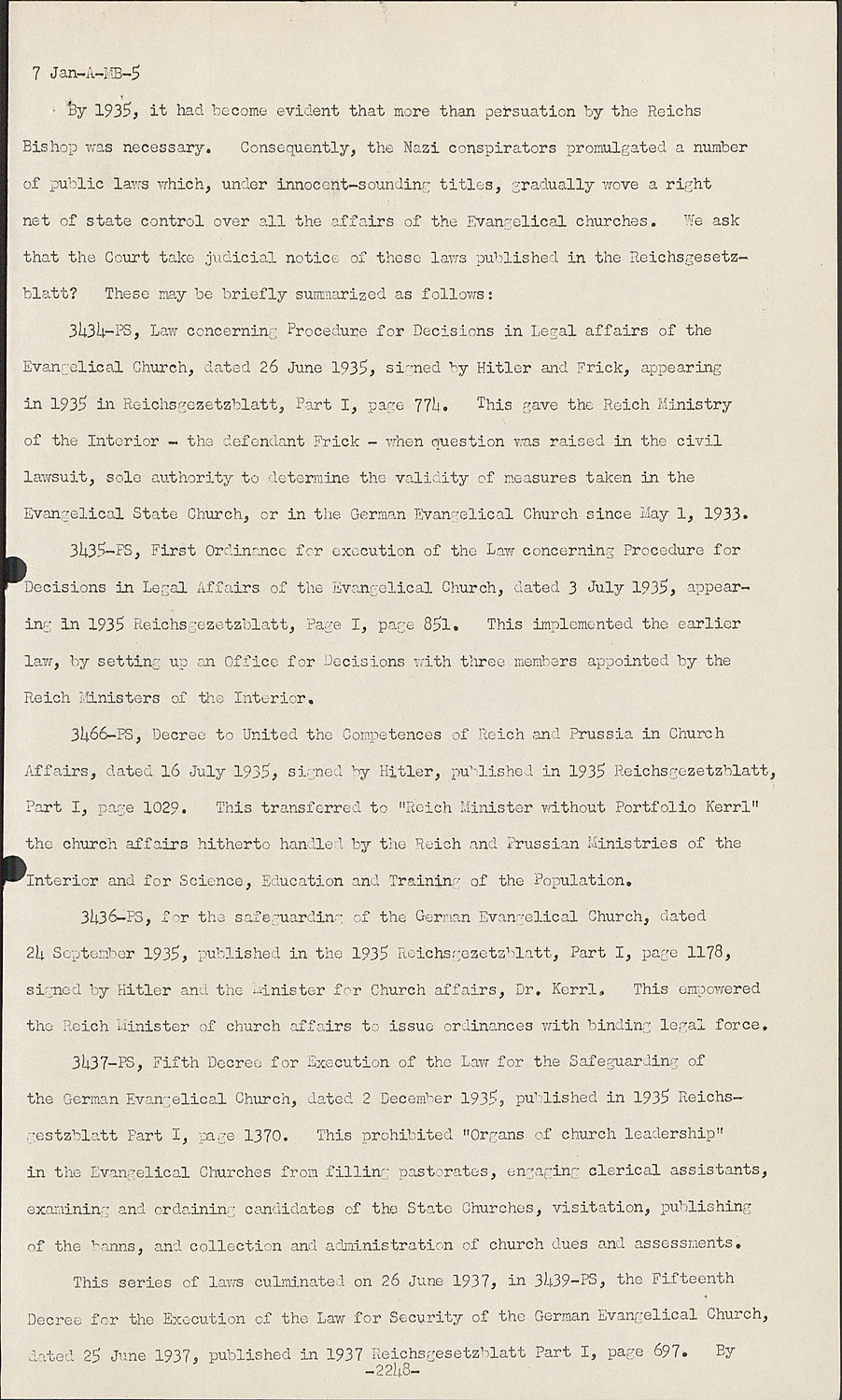
By 1935, it had be come evident that more than persuation by the Reichs Bishop was necessary.
Consequently, the Nazi conspirators promulgated a number of public laws which, under innocent-sounding titles, gradually wove a right net of state control over all the affairs of the Evangelical churches. We ask that the Court take judicial notice of these laws published in the Reichsgesetzblatt? These may be briefly summarized as follows:
3434-PS, Law concerning Procedure for Decisions in Legal affairs of the Evangelical Church, dated 26 June 1935, signed by Hitler and Frick, appearing in 1935 in Reichsgezetzblatt, Part I, page 774. This gave the Reich Ministry of the Interior - the defendant Frick - when question was raised in the civil lawsuit, sole authority to determine the validity of measures taken in the Evangelical State Church, or in the German Evangelical Church since May 1, 1933.
3435-PS, First Ordinance for execution of the Law concerning Procedure for Decisions in Legal Affairs of the Evangelical Church, dated 3 July 1935, appearing in 1935 Reichsgezetzblatt, Page I, page 851. This implemented the earlier law, by setting up an Office for Decisions with three members appointed by the Reich Ministers of the Interior.
3466-PS, Decree to United the Competences of Reich and Prussia in Church Affairs, dated 16 July 1935, signed by Hitler, published in 1935 Reichsgezetzblatt, Part I, page 1029. This transferred to "Reich Minister without Portfolio Kerrl" the church affairs hitherto handled by the Reich and Prussian Ministries of the interior and for Science, Education and Training of the Population.
3436-PS, for the safeguarding of the German Evangelical Church, dated 24 September 1935, published in the 1935 Reichsgezetzblatt, Part I, page 1178, signed by Hitler and the Minister for Church affairs, Dr. Kerrl. This empowered the Reich Minister of church affairs to issue ordinances with binding legal force.
3437-PS, Fifth Decree for Execution of the Law for the Safeguarding of the German Evangelical Church, dated 2 December 1935, published in 1935 Reichsgestzblatt Part I, page 1370. This prohibited "Organs of church leadership" in the Evangelical Churches from filling pastorates, engaging clerical assistants, examining and ordaining candidates of the State Churches, visitation, publishing of the banns, and collection and administration of church dues and assessments.
This series of laws culminated on 26 June 1937, in 3439-PS, the Fifteenth Decree for the Execution of the Law for Security of the German Evangelical Church, dated 25 June 1937, published in 1937 Reichsgesetzblatt Part I, page 697. By Decree for the Execution of the Law for Security of the German Evangelical Church dated 25 June 1937, published in 1937 Reichsgesetzblatt Part I, page 697.
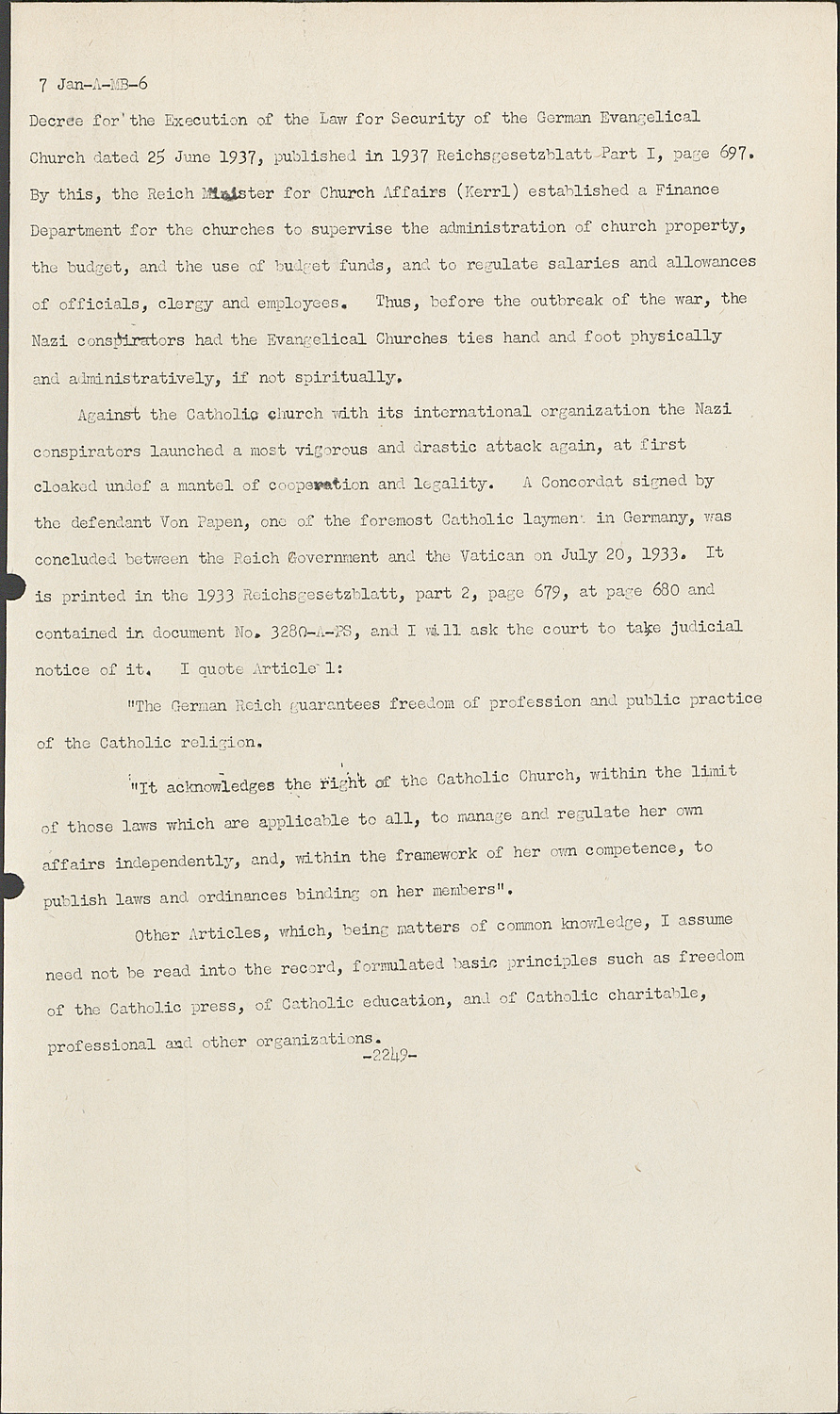
By this, the Reich Minister for Church Affairs (Kerrl) established a Finance Department for the churches to supervise the administration of church property, the budget, and the use of budget funds, and to regulate salaries and allowances of officials, clergy and employees. Thus, before the outbreak of the war, the Nazi conspirators had the Evangelical Churches ties hand and foot physically and administratively, if not spiritually.
Against the Catholic church with its international organization the Nazi conspirators launched a most vigorous and drastic attack again, at first cloaked undef a mantel of cooperation and legality. A Concordat signed by the defendant Von Papen, one of the foremost Catholic laymen in Germany, was concluded between the Reich Government and the Vatican on July 20, 1933. It is printed in the 1933 Reichsgesetzblatt, part 2, page 679, at page 680 and contained in document No. 3280-A-PS, and I will ask the court to take judicial notice of it. I quote Article 1:
"The German Reich guarantees freedom of profession and public practice of the Catholic religion.
"It acknowledges the right of the Catholic Church, within the limit of those laws which are applicable to all, to manage and regulate her own affairs independently, and, within the framework of her own competence, to publish laws and ordinances binding on her members".
Other Articles, which, being matters of common knowledge, I assume need not be read into the record, formulated basic principles such as freedom of the Catholic press, of Catholic education, and of Catholic charitable, professional and other organizations.
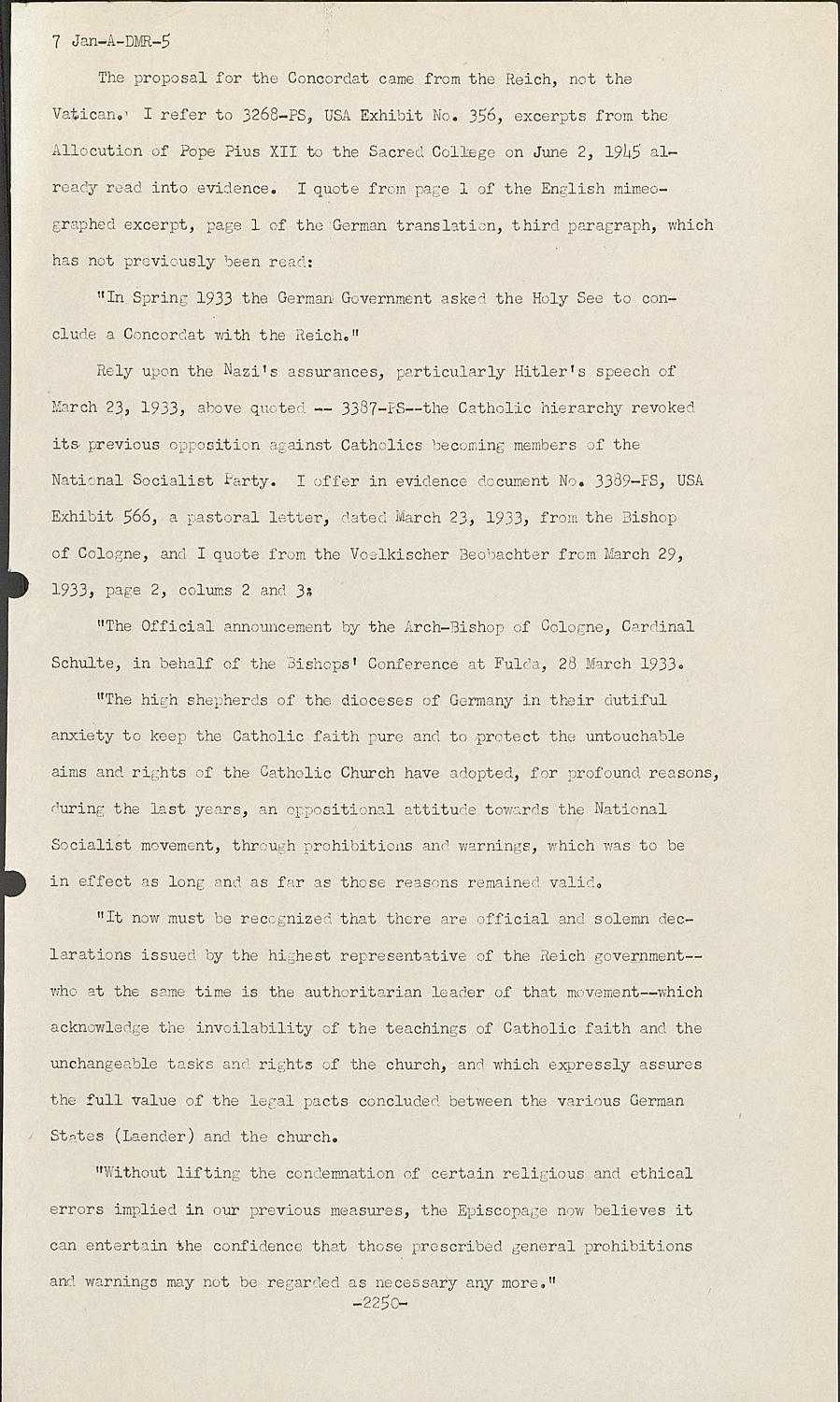
The proposal for the Concordat came from the Reich, not the Vatican.
I refer to 3268-PS, USA Exhibit No. 356, excerpts from the Allocution of Pope Pius XII to the Sacred College on June 2, 1945 already read into evidence. I quote from page 1 of the English mimeographed excerpt, page 1 of the German translation, third paragraph, which has not previously been read:
"In Spring 1933 the German Government asked the Holy See to conclude a Concordat with the Reich."
Rely upon the Nazi's assurances, particularly Hitler's speech of March 23, 1933, above quoted -- 3387-PS--the Catholic hierarchy revoked its previous opposition against Catholics becoming members of the National Socialist Party. I offer in evidence document No. 3389-PS, USA Exhibit 566, a pastoral letter, dated March 23, 1933, from the Bishop of Cologne, and I quote from the Voelkischer Beobachter from March 29, 1933, page 2, colums 2 and 3:
"The Official announcement by the Arch-Bishop of Cologne, Cardinal Schulte, in behalf of the Bishops' Conference at Fulda, 28 March 1933.
"The high shepherds of the dioceses of Germany in their dutiful anxiety to keep the Catholic faith pure and to protect the untouchable aims and rights of the Catholic Church have adopted, for profound reasons, during the last years, an oppositional attitude towards the National Socialist movement, through prohibitions and warnings, which was to be in effect as long and as far as those reasons remained valid.
"It now must be recognized that there are official and solemn declarations issued by the highest representative of the Reich government-who at the same time is the authoritarian leader of that movement--which acknowledge the invoilability of the teachings of Catholic faith and the unchangeable tasks and rights of the church, and which expressly assures the full value of the legal pacts concluded between the various German States (Laender) and the church.
"Without lifting the condemnation of certain religious and ethical errors implied in our previous measures, the Episcopage now believes it can entertain the confidence that those prescribed general prohibitions and warnings may not be regarded as necessary any more."
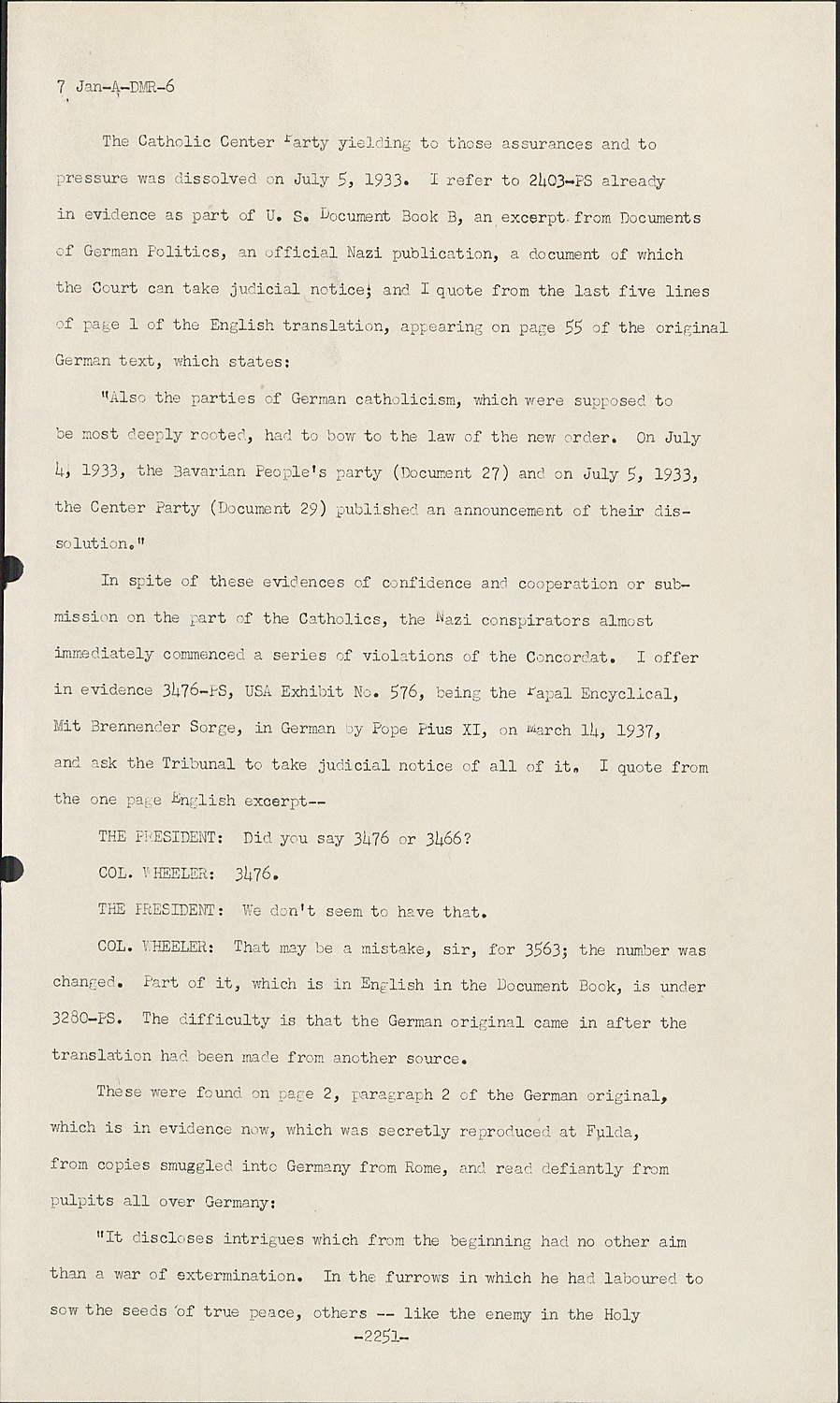
The Catholic Center Party yielding to those assurances and to pressure was dissolved on July 5, 1933.
I refer to 2403-PS already in evidence as part of U. S. document Book B, an excerpt from Documents of German Politics, an official Nazi publication, a document of which the Court can take judicial notice; and I quote from the last five lines of page 1 of the English translation, appearing on page 55 of the original German text, which states:
"Also the parties of German Catholicism, which were supposed to be most deeply rooted, had to bow to the law of the new order. On July 4, 1933, the Bavarian People's party (Document 27) and on July 5, 1933, the Center Party (Document 29) published an announcement of their dissolution."
In spite of these evidences of confidence and cooperation or submission on the part of the Catholics, the Nazi conspirators almost immediately commenced a series of violations of the Concordat. I offer in evidence 3476-PS, USA Exhibit No. 576, being the Papal Encyclical, Mit Brennender Sorge, in German by Pope Pius XI, on March 14, 1937, and ask the Tribunal to take judicial notice of all of it. I quote from the one page English excerpt-
THE PRESIDENT:Did you say 3476 or 3466?
COL. WHEELER: 3476.
THE PRESIDENT:We don't seem to have that.
COL. WHEELER:That may be a mistake, sir, for 3563; the number was changed. Part of it, which is in English in the Document Book, is under 3280-PS. The difficulty is that the German original came in after the translation had been made from another source.
These were found on pare 2, paragraph 2 of the German original, which is in evidence now, which was secretly reproduced at Fulda, from copies smuggled into Germany from Rome, and read defiantly from pulpits all over Germany:
"It discloses intrigues which from the beginning had no other aim than a war of extermination. In the furrows in which he had laboured to sow the seeds of true peace, others -- like the enemy in the Holy Scripture (Matt.