xiii.25) -- sowed the tares of suspicion, discord, hatred, calumny, of secret and open fundamental hostility to Christ and His Church, fed from a thousand different sources and making use of every available means.
On them and on them alone and on their silent and vocal protectors rests the responsibility that now on the horizon of Germany there is to be seen not the rainbow of peace but the threatening storm-clouds of destructive religious wars."
"Anyone who has any sense of truth left in his mind and even a shadow of the feeling of justice left in his heart will have to admit that, in the difficult and eventful years which followed the Concordat, every word and every action of Ours was ruled by loyalty to the terms of the agreement; but also he will have to recognize with surprise and deep disgust that the unwritten law of the other party has been arbitrary misinterpretation of agreements, evasions of agreements, evacuation of the meaning of agreements, and finally more or less open violation of agreements."
DR. ALFRED SEIDL (COUNSEL FOR HANS FRANK): The representative for the prosecution previously declared that a part of the material that is being here considered and is to be presented in the matter of the opposition to the church has been made available to the defense.
The defendant Hans Frank directed a written memorandum to me that contains a question and I should not like to withhold this question from the Tribunal.
The question is as follows:
THE PRESIDENT: None of your question has come through.
DR. SEIDL: I shall repeat my question:
Is the Vatican a signatory to the Charter of the International Military Tribunal?
Secondly, did he dilever the material as co-defendant?
The third question: Does he have to answer to this Tribunal as defendant?
The Defendant Hans Frank justifies these questions with the statement that his further membership in the Catholic Church is dependent on the answers to these questions.
THE PRESIDENT: I think it is desirable that the Tribunal under stand your objection.
The first question that you ask is: Is the Vatican a signatory to the Charter?
Is that right?
DR. SEIDL: Yes.
THE PRESIDENT: Your second question was shat? What was your second question?
DR. SEIDL: Whether the Vatican contributed to the material being here presented as a co-prosecutor.
THE PRESIDENT: You third?
DR. SEIDL: The third question was -- and it is directed first of all to the prosecution -- whether the Vatican recognizes the principles under which this trial is being conducted.
THE PRESIDENT: Whether the Vatican recognizes the principles upon which the trial is being conducted?
Will you repeat the question, please.
Repeat the question.
DR. SEIDL: The last question?
THE PRESIDENT: Yes.
DR. SEIDL: Has the Vatican familiarized itself with the material being presented at this trial and does it participate in the principles under which the trial is being conducted as a co-prosecutor?
And, as the reason for his questions, the Defendant Hans Frank states that his further membership in the Catholic Church depends on the answers to these questions.
(Discussion by the Court off the record.)
THE PRESIDENT: In the opinion of the Tribunal, the observations which have just been made by counsel on behalf of the Defendant Frank are entirely irrelevant and any motion which it is so intended to support is denied, and the Prosecution will therefore continue.
COLONEL WHEELER: I now offer in evidence the first of a number of documents which the Vatican has supplied to the prosecution in this case from its own files, and which authoritatively state the acts of suppression of the Church by the Nazi conspirators.
This first Vatican document, which deals in part with acts of suppression within Germany, is Document No. 3261-PS, U.S.A. Exhibit No. 568, a verbal note of the Secretariate of State of His Holiness the Pope to the German Embassy, dated January 18, 1942.
I read the certificate accompanying this document:
"The Vatican, November 13th, 1945.
"I, Domenice Tardini, Secretary of Extraordinary Ecclesiastical Affairs, hereby certify that the attached document consisting of nine printed pages and entitled:
Verbal note of the Secretariate of State of His Holiness to the German Embassy (January 18th, 1942)' (pp, 3-11) is a true and correct translation into the English language from the Italian language of a carbon copy of a document now in the possession of the Secretariate of State of his Holiness, the original of which was dispatched to the German Embassy.
"(Signed) Domenico Tardini" The paper in the document books, your Honors, is a mimeographed copy of the same printed document which we received from the Vatican.
We did not have enough printed documents to put them in the document books.
On page 2 of the English mimeographed text is this verbal note, paragraphs 3 and 4, appearing on page 2 of the German translation. The papal Secretary of State describes, -- I quote - "Measures and acts which gravely violate the rights of the Church, being contrary not only to the existing Concordats but to the principles of international law ratified by the Second Hague Conference"-
THEPRESIDENT (Interposing): Did you say you were reading the third paragraph?
COLONEL WHEELER:Paragraphs 3 and 4, yes, sir.
THE PRESIDENT:Page 2?
COLONEL WHEELER:Yes, Your Honor. It is the third paragraph on page 2. It starts in the middle of the paragraph with the last word on the 7th line of the third paragraph.
THE PRESIDENT:It is very difficult for us to find it if you don't tell us it beings in the middle of the paragraph.
COLONEL WHEELER:I'm sorry, sir.
THE PRESIDENT:What does it begin with?
COLONEL WHEELER:The last word of that line is "measures", beginning "yet, despite this keen difficulty," sir.
THE PRESIDENT:Yes, I see.
COLONELWHEELER: " -- but often -- and this is much more grave -to the very fundamental principles of divine law both natural, and positive."
The next paragraph specifies these measures. I quote.
"Let is suffice to recall in this connection, among other things, the changing of the Catholic State elementary schools into undenominational schools; the permanent or temporary closing of many minor seminaries, of not a few major seminaries and of some theological faculties; the suppression of almost all the private schools and of numerous Catholic boarding schools and colleges; the repudiation, decided unilaterally, of financial obligations which the State, Municipalities, etc.
had towards the Church; the increasing difficulties put in the way of the activity of the religious Orders and Congregations in the spiritual cultural and social field and above all the suppression of Abbeys, monasteries, convents and religious houses in such great numbers that one is led to infer a deliberate intention of rendering impossible the very existence of the Orders and Congregations in Germany."
The Nazis did not overlook other sects or denominations in their efforts to suppress Christian religion in Germany. They persecuted, the "Bibelforscher" or Bible Research -
THE PRESIDENT:Perhaps, as you are going to another church, it would be better to break off until tomorrow morning.
(Whereupon at 1700 hours the hearing of the Tribunal adjourned, to reconvene at 1000 hours, January 8, 1946.)
Official Transcript of the International Military Tribunal, in the matter of:
The United.
States of America, The French Republic, the United Kingdom of Great Britain and Northern Ireland, and the Union of Soviet Socialist Republics against Hermann Wilhelm Goering, et al, Defendants, sitting at Nurnberg, Germany, on 8 January 1946, 1000-1245, Lord Justice Lawrence, presiding.
COL. WHEELER:The Nazis did not overlook ether sects or denominations in their efforts to suppress Christian religion in Germany. They persecuted the "Bibelforscher" or Bible Research Workers as well. There has already been introduced and read, into evidence Document No. D-84, USA Exhibit No. 236, showing that members of this sect were not only prosecuted in the courts, but also seized and sent to concentration camps even after serving or remitting of their judicial sentences.
In Document No. 2928-PS, USA Exhibit 239, included in USA Document Book A, further evidence of persecution of Bibelforschers appears.
THE PRESIDENT:I think you are going a little bit fast. We are not going to refer to D-84?
COL. WHEELER:I am not going to read from it, sir.
THE PRESIDENT:Then you go to 2928-PS?
COL.WHEELER: 2928-PS, in the Document Book, sir.
THE PRESIDENT:Are you going to read from there?
COL. WHEELER:I was going to read a few lines from that.
THE PRESIDENT:Very well.
COL. WHEELER:This document is an affidavit by Matthias Lex, VicePresident of the National Union of Shoemakers. In describing his experience in Dachau concentration camp he says, and I quote from the third page of his affidavit.
THE PRESIDENT:The third page?
COL. WHEELER:Paragraph 9, 11 lines from the bottom.
THE PRESIDENT:Yes.
COL.WHEELER: "I include in the political prisoners the Bibleresearchers"-
THE PRESIDENT:That is not at the beginning of paragraph 9?
COL. WHEELER: That is near the end of the page, sir.
THE PRESIDENT:Paragraph 9 you said, didn't you?
COL. WHEELER:Of 2928-PS; paragraph 9 is a long paragraph, and there is a list of names of individuals at the camp, and it is on the second page of that list, at the bottom of the page, about ten lines up from the bottom of that page. This is a long paragraph, and starts after No. 33, the name of one of the men in the camp, and I am just reading that one sentence: "I include in the political prisoners the Bible-researchers ('Bibelforscher') whose number I estimate at over 150."
I want to read further from the last line of that page and the next few lines of the next page:
"The following groups were kept entirely isolated: The members of the so-called 'Punishment-Companies' ('Strafkompanien'), who were in a concentration camp for a second time and after about 1937 also the 'Bibelforscher'. Members of the 'Punishment-Companies' were such prisoners who had committed disciplinary or slight offenses against the camp regulations. The following groups lived separately but could mix with the other groups during the day, either while working or while strolling through the camp: Political prisoners, Jews, Anti-Socials, Gypsies, Felons, Homosexuals, and before 1937 also the Bible-Researchers."
I refer also to Document No. 1531-PS. This is not in the Document Book; USA Exhibit No. 248, which is already in evidence. This was an order by the RSHA in 1942, authorizing third-degree methods against Jehovah's Witnesses. That was read by Colonel Storey.
I now turn to acts of suppression in the annexed and occupied territories. In Austria, Bishop Paulus Rusch of Innsbruck has written an illuminating report on this subject. I offer this sworn statement in evidence--3278-PS, USA Exhibit No. 569. This is a report on the fighting of National Socialism in the Apostolic Administration of Innsbruck-Foldkirch, of Tyrol and Vorarlberg. In this the Bishop declares, and I start on the first page of the English text and of the German translation:
"After having seized power Nationalsocialism immediately showed the tendency to exclude Church from publicity."
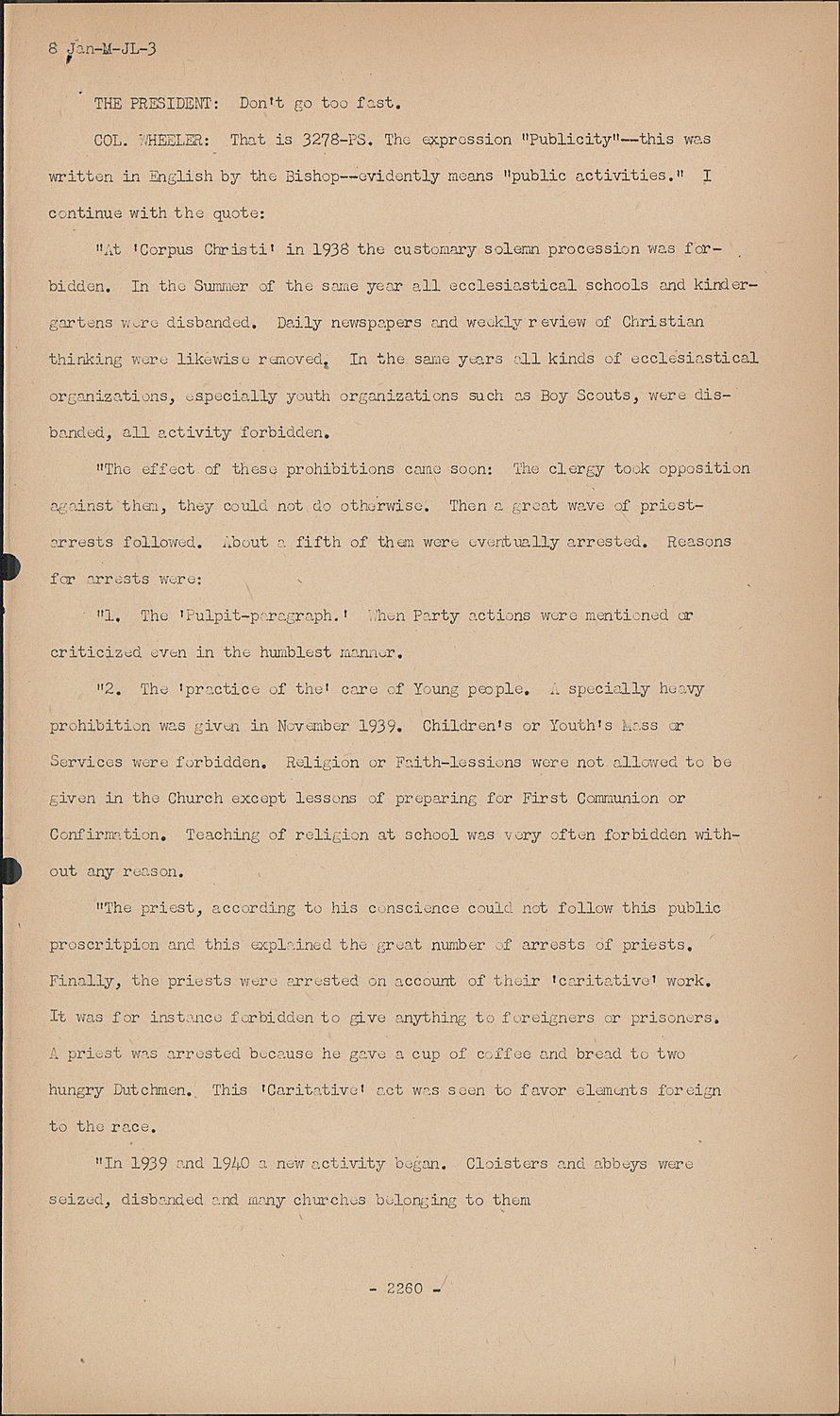
THE PRESIDENT: Don't go too fast.
COL. WHEELER:That is 3278-PS. The expression "Publicity"--this was written in English by the Bishop--evidently means "public activities." I continue with the quote:
"At 'Corpus Christi' in 1938 the customary solemn procession was forbidden. In the Summer of the same year all ecclesiastical schools and kindergartens were disbanded. Daily newspapers and weekly review of Christian thinking were likewise removed. In the same years all kinds of ecclesiastical organizations, especially youth organizations such as Boy Scouts, were disbanded, all activity forbidden.
"The effect of these prohibitions came soon: The clergy took opposition against them, they could not do otherwise. Then a great wave of priestarrests followed. About a fifth of them were eventually arrested. Reasons for arrests were:
"1. The 'Pulpit-paragraph.' When Party actions were mentioned or criticized even in the humblest manner.
"2. The 'practice of the' care of Young people. A specially heavy prohibition was given in November 1939. Children's or Youth's Mass or Services were forbidden. Religion or Faith-lessions were not allowed to be given in the Church except lessons of preparing for First Communion or Confirmation. Teaching of religion at school was very often forbidden without any reason.
"The priest, according to his conscience could not follow this public proscritpion and this explained the great number of arrests of priests. Finally, the priests were arrested on account of their 'caritative' work. It was for instance forbidden to give anything to foreigners or prisoners. A priest was arrested because he gave a cup of coffee and bread to two hungry Dutchmen. This 'Caritative' act was seen to favor elements foreign to the race.
"In 1939 and 1940 a new activity began. Cloisters and abbeys were seized, disbanded and many churches belonging to them closed.
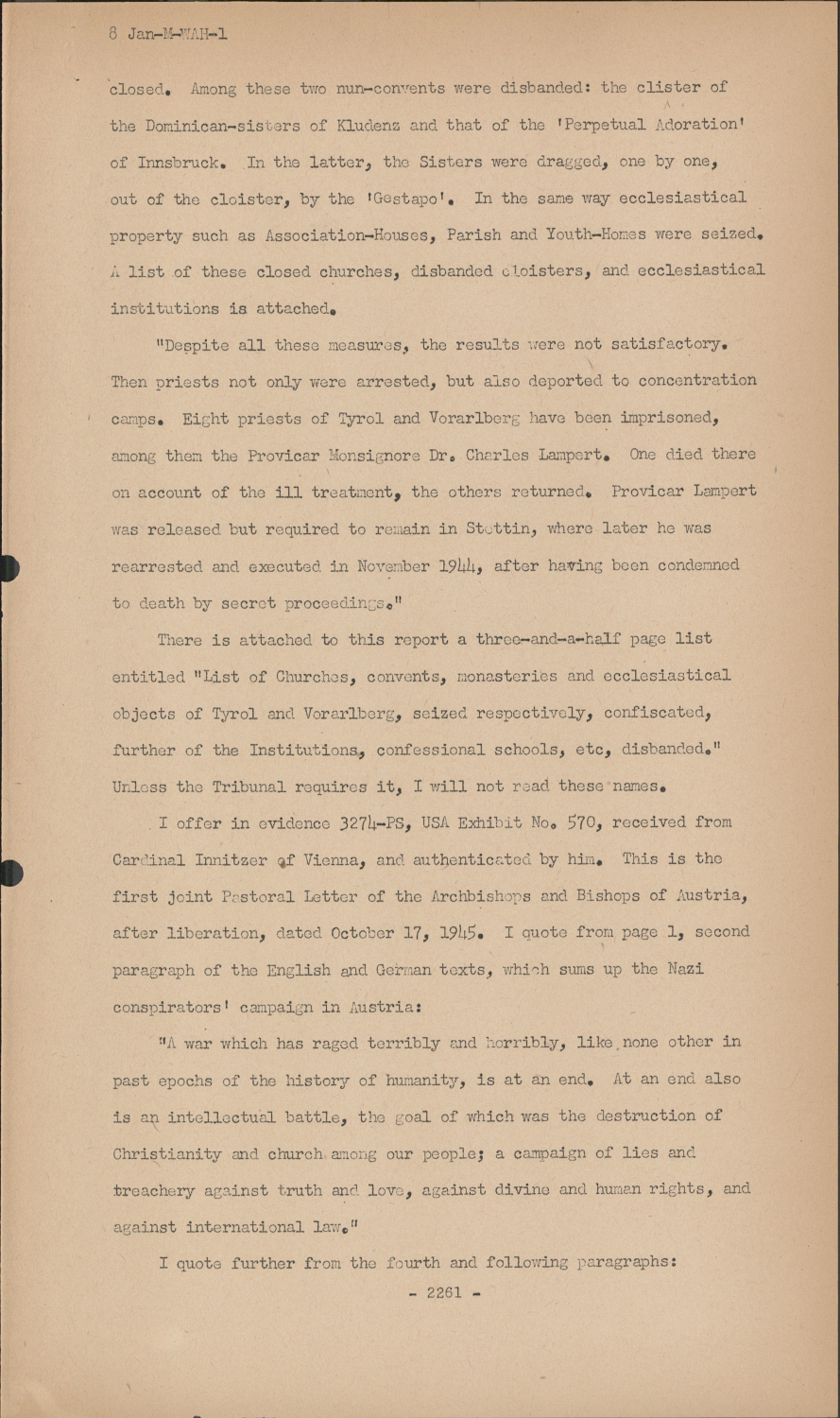
Among these two nun-convents were disbanded: the clister of the Dominican-sisters of Kludenz and that of the 'Perpetual Adoration' of Innsbruck.
In the latter, the Sisters were dragged, one by one, out of the cloister, by the 'Gestapo'. In the same way ecclesiastical property such as Association-Houses, Parish and Youth-Homes were seized. A list of these closed churches, disbanded cloisters, and ecclesiastical institutions is attached.
"Despite all these measures, the results were not satisfactory. Then priests not only were arrested, but also deported to concentration camps. Eight priests of Tyrol and Vorarlberg have been imprisoned, among them the Provicar Monsignore Dr. Charles Lampert. One died there on account of the ill treatment, the others returned. Provicar Lampert was released but required to remain in Stettin, where later he was rearrested and executed in November, 1944, after having been condemned to death by secret proceedings."
There is attached to this report a three-and-a-half page list entitled "List of Churches, convents, monasteries and ecclesiastical objects of Tyrol and Vorarlberg, seized respectively, confiscated, further of the Institutions, confessional schools, etc, disbanded." Unless the Tribunal requires it, I will not read these names.
I offer in evidence 3274-PS, USA Exhibit No. 570, received from Cardinal Innitzer of Vienna, and authenticated by him. This is the first joint Pastoral Letter of the Archbishops and Bishops of Austria, after liberation, dated October 17, 1945 I quote from page 1, second paragraph of the English and German texts, which sums up the Nazi conspirators' campaign in Austria:
"A war which has raged terribly and horribly, like none other in past epochs of the history of humanity, is at an end. At an end also is an intellectual battle, the goal of which was the destruction of Christianity and church among our people; a campaign of lies and treachery against truth and love, against divine and human rights, and against international law."
I quote further from the fourth and following paragraphs:
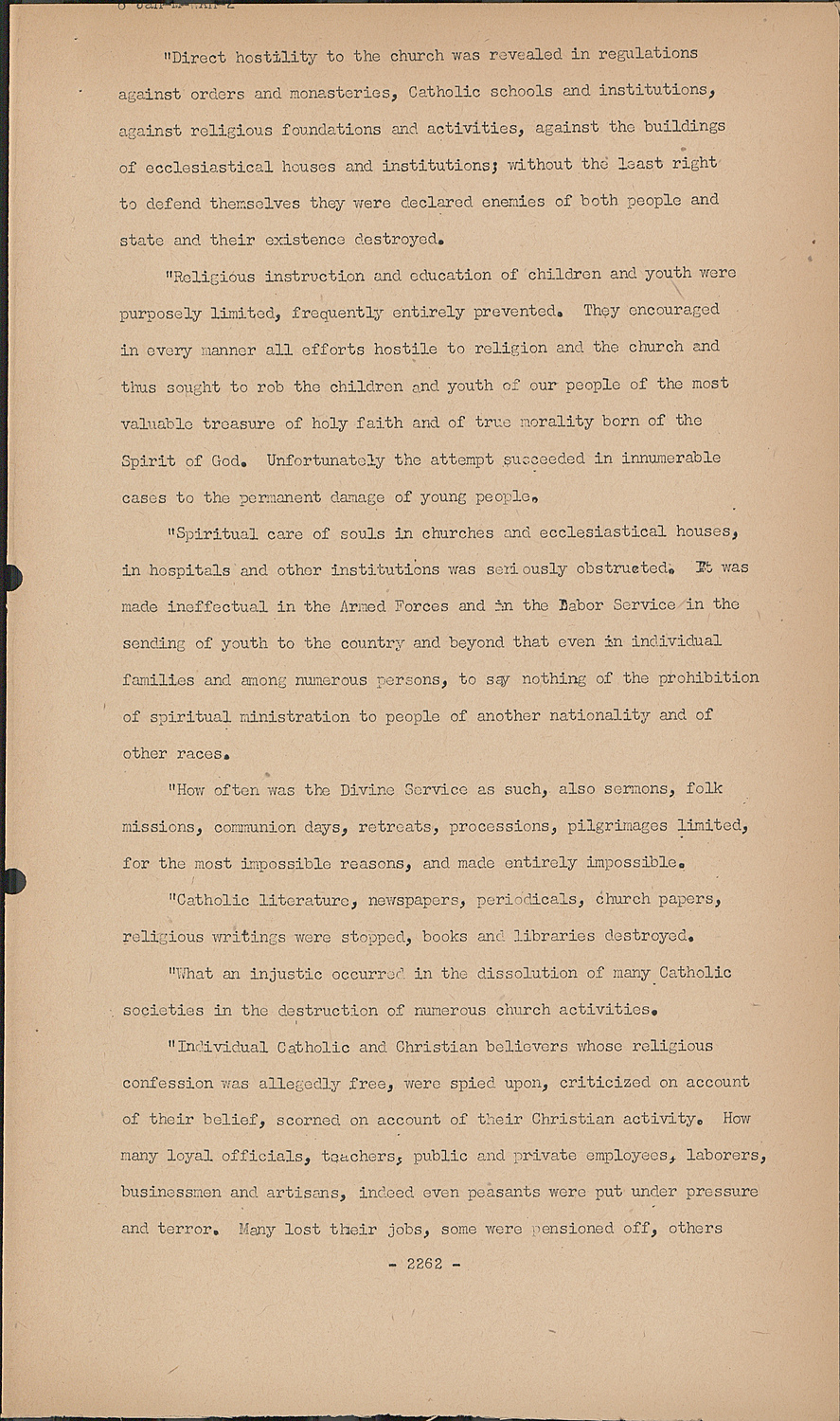
"Direct hostility to the church was revealed in regulations *---* against orders and monasteries, Catholic schools and institutions, against religious foundations and activities, against the buildings of ecclesiastical houses and institutions; without the least right to defend themselves they were declared enemies of both people and state and their existence destroyed.
"Religious instruction and education of children and youth were purposely limited, frequently entirely prevented. They encouraged in every manner all efforts hostile to religion and the church and thus sought to rob the children and youth of our people of the most valuable treasure of holy faith and of true morality born of the Spirit of God. Unfortunately the attempt succeeded in innumerable cases to the permanent damage of young people, "Spiritual care of souls in churches and ecclesiastical houses, in hospitals and other institutions was seriously obstructed.
It was made ineffectual in the Armed Forces and in the Labor Service in the sending of youth to the country and beyond that even in individual families and among numerous persons, to say nothing of the prohibition of spiritual ministration to people of another nationality and of other races.
"How often was the Divine Service as such, also sermons, folk missions, communion days, retreats, processions, pilgrimages limited, for the most impossible reasons, and made entirely impossible.
"Catholic literature, newspapers, periodicals, church papers, religious writings were stopped, books and libraries destroyed.
"What an injustic occurred in the dissolution of many Catholic societies in the destruction of numerous church activities.
"Individual Catholic and Christian believers whose religious confession was allegedly free, were spied upon, criticized on account of their belief, scorned on account of their Christian activity. How many loyal officials, teachers, public and private employees, laborers, businessmen and artisans, indeed even peasants were put under pressure and terror. Many lost their jobs, some were pensioned off, others dismissed without pension, demoted, deprived of their real professional activity.
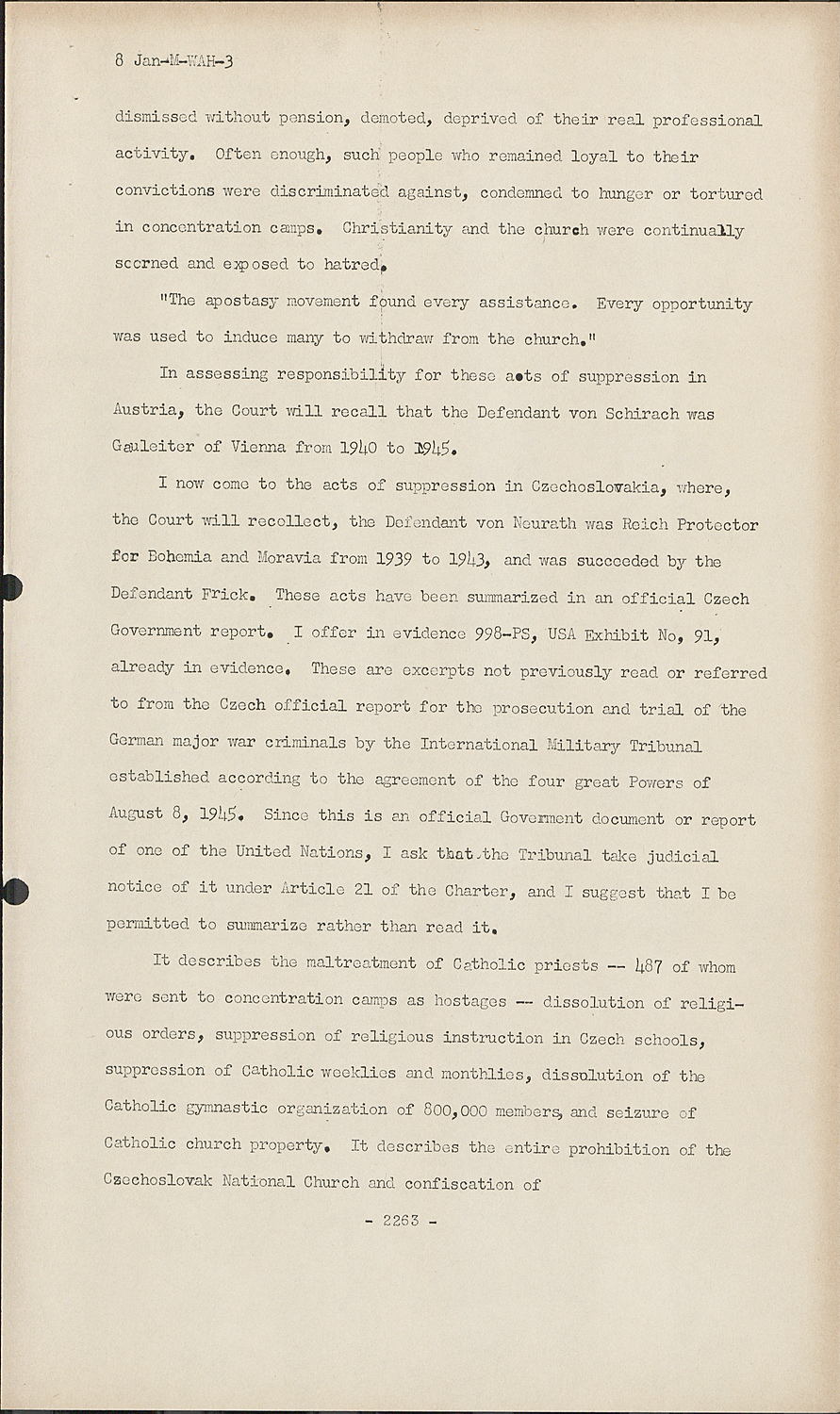
Often enough, such people who remained loyal to their convictions were discriminated against, condemned to hunger or tortured in concentration camps. Christianity and the church were continually scorned and exposed to hatred.
"The apostasy movement found every assistance. Every opportunity was used to induce many to withdraw from the church."
In assessing responsibility for these acts of suppression in Austria, the Court will recall that the Defendant von Schirach was Gauleiter of Vienna from 1940 to 1945.
I now come to the acts of suppression in Czechoslovakia, where, the Court will recollect, the Defendant von Neurath was Reich Protector for Bohemia and Moravia from 1939 to 1943, and was succeeded by the Defendant Frick. These acts have been summarized in an official Czech Government report. I offer in evidence 998-PS, USA Exhibit No. 91, already in evidence. These are excerpts not previously read or referred to from the Czech official report for the prosecution and trial of the German major war criminals by the International Military Tribunal established according to the agreement of the four great Powers of August 8, 1945. Since this is an official Government document or report of one of the United Nations. I ask that the Tribunal take judicial notice of it under Article 21 of the Charter, and I suggest that I be permitted to summarize rather than read it.
It describes the maltreatment of Catholic priests -- 487 of whom were sent to concentration camps as hostages -- dissolution of religious orders, suppression of religious instruction in Czech schools, suppression of Catholic weeklies and monthlies, dissolution of the Catholic gymnastic organization of 800,000 members, and seizure of Catholic church property. It describes the entire prohibition of the Czechoslovak National Church and confiscation of all its property in Slovakia, and its crippling in Bohemia.
The report describes the severe restriction on freedom of preaching by the Protest ants, and the persecution and imprisonment and execution of ministers and suppression of Protestant church youth organizations and theological schools, and shows the complete subordination and later dissolution of the Czech Orthodox Church.
It states that all Evangelical teachers lost their employment.
The repressive measures adopted by the Nazi conspirators in Poland against the Christian Church were even more drastic and sweeping.
The Vatican documents now to be introduced describe persecutions of the Catholic Church in Poland into three areas:
First, the Incorporated Territories, especially the Warthegau; second, the Gouvernment General;and third, the Incorporated Eastern Territories.
The Court will recall that the incorporated territories comprised territories adjacent to the old Reich, chiefly the Reich District Warthe land or Warthegau, which included particularly the cities of Poznan and Lodz, and the Reich district Danzig, West Prussia.
The occupied Polish territories, which were organized into the Gouvernment General, comprised the remainder of Poland, seized by the German forces in 1939, and extending to the new boundary with the Soviets, formed at that time.
This included Warsaw and Cracow. After the Nazis attacked the Union of Soviet Socialist Republics in June 1941, the parts of old Poland lying further to the East and then overrun were included in the so-called Occupied Eastern Territories.
For the purpose of tying in the defendants' responsibility for the persecutions occurring in their respective areas, the Court will bear in mind that the defendant Frick was the official chiefly responsible for the reorganization of the Eastern territories.
The defendant Frank was head of the Gouvernment General from 1939 to 1945.
The defendant Seyss Inquart was Deputy Governor General there from 1939 to 1940.
And the defendant Rosenberg was Reich Minister for the Occupied Eastern Territories from July 17, 1941, to the end.
I now offer in evidence Document Number 3263-PS, USA Exhibit Number 571, headed "Memorandum of the Secretariate of State to the German Embassy regarding the Religious Situation in the 'Warthegau', October 8, 1942". This document bears a certificate of authenticity from the Vatican, signed by the Papal Secretary of Extraordinary Ecclesiastical Affairs, corresponding to that accompanying 3261-PS, read in evidence a few minutes ago.
Unless the Court requires otherwise, I suggest that it is not necessary to read each of these series, which are all similar to each other. I quote from 3263-PS, the first paragraph:
"For quite a long time the religious situation in the region called 'Warthegau' gives cause for very grave and ever-increasing anxiety. There, in fact, the Episcopate has been little by little almost completely eliminated; the secular and regular clergy have been reduced to proportion that are absolutely inadequate, because they have been in large part deported and exiled; the education of clerics has been forbidden; the Catholic education of youth is meeting with the greatest opposition; the nuns have been dispersed; insurmountable obstacles have been put in the way of affording people the helps of religion; very many churches have been closed; Catholic intellectual and charitable institutions have been destroyed; ecclesiastical property has been seized."
On March 2, 1943, the Cardinal Secretary of State addressed to the defendant von Ribbentrop, Foreign Minister of the Reich, a note setting forth in detail the persecutions of Bishops, priests and other ecclesiastics and suppression of the exercise of religion in the occupied Polish provinces. This document is so explicit and so authoritative that it deserves extensive quotation. I accordingly offer it in evidence, Document Number 3264-PS, USA Exhibit Number 572. It is headed: "A Note of His Eminence the Cardinal Secretary of State to the Foreign Minister of the Reich about the religious situation in the 'Warthegau', and in the other Polish provinces subject to Germany". It bears a Vatican certific of authenticity like that of 3261-PS. It is signed L.Card.Maglione.
I quote from this note, starting with Page 1, the third paragraph of the English mimeographed text and of the German translation:
"The place where, above all, the religious situation, by its unusual gravity, calls for special consideration is the territory called the 'Reichsgau Wartheland'."Six bishops resided in that region in August 1939; now there is left only one.
In fact:
"The Bishop of Lodz (Litzmannstadt) and his Auxiliary were, in the course of the year 1941, confined first in a small district of the diocese and then expelled and exiled in the "Generalgouvernment.
' "Another Bishop, Mgr.
Michael Kozal, Auxiliary and Vicar General of Wladislavia, was arrested in the autumn of 1939, detained for some time in a prison in the city and later in a religious house in Lad, and finally was transferred to the concentration camp at Dachau.
"Since His Eminence the Cardinal Archbishop of Gniezno and Poznan and the Bishop of Wladislavia, who had gone away during the period of military operations, were not allowed to return to their Sees, the only Bishop who now remains in the 'Warthegau' is His Excellency Mgr. Valentine Dymek, Auxiliary of Poznan; and he, at least up to November 1942, was interned in his own house."
I pass now to Page 2, fourth paragraph of the English text, the fifth paragraph of the German text:
"If the lot of their Excellencies the Bishops has been a source of anxiety for the Holy See, the condition of an immense number of priests and religious has caused it and still causes it no less grief.
"In the territory now called 'Warthegau', more than two thousand priests exercised their ministry before the war; they are now reduced to a very small number.
"According to accounts received from various quarters by the Holy See, in the first months of the military occupation not a few members of the secular clergy were shot or otherwise put to death, while others - some hundreds - were imprisoned or treated in an unseemly manner, being forced into employments unbecoming their state and exposed to scorn and derision.
"Then, while numbers of ecclesiastics were exiled or constrained in some other way to take refuge in the 'General-gouvernment', many others were transferred to concentration camps. At the beginning of October 1941, the priests from the dioceses of the 'Warthegau' detained in Dachau already numbered several hundreds; but their number increased considerably in that month following a sharp intensification of police measures which culminated in the imprisonment and deportation of further hundreds of ecclesiastics. Entire 'Kreise' (districts) remained thus completely deprived of clergy. In the city of Poznan itself the spiritual, care of some 200,000 Catholics remained in the hands of not more than four priests.
"No less painful was the fate reserved for the regular clergy. Many religious were shot or otherwise killed; the great majority of the others were imprisoned, deported or expelled.
"In the same way, far-reaching measures were taken against the institutions preparing candidates for the ecclesiastical state.
The diocesan seminaries of Gniezno and Posnan, of Wladislavia, and of Lodz were closed. The seminary in Poznan for the training of priests destined to work among Polish Catholics abroad was also closed.
"The novitiates and houses of formation of the religious Orders and Congregations were closed.
"Not even the Nuns were able to continue their charitable activities without molestation. For them were set up a special concentration camp at Bojanowo, where towards the middle of 1941 about four hundred sisters were interned and employed in manual labor. To a representation of the Holy See made through the Apostolic Nunciature in Berlin your Reichministry for Foreign Affairs replied in the Memorandum Pol. III 1886 of September 28 of the same year, that it was only question of a temporary measure, taken with the consent of the Reichslieutenant for Wartheland, in order to supply the lack of housing for Polish Catholic Sisters. In the same memorandum it was admitted that as a result of reorganization of charitable institutions many Catholic sisters were without employment.
"But, in spite of the fact that this measure was declared to be temporary, it is certain that towards the end of 1942 some hundreds of Nuns were still interned at Bojenowo. It is established that for some time the religious were deprived even of spiritual help.
"Likewise in the matter of education and religious instruction of youth, no attention was paid in the 'Warthegau' to the rights of the Catholic Church.
"All the Catholic schools were suppressed."
I turn now to Page 4-
THE PRESIDENT:Who was the Foreign Minister of the Reich at the time that document was sent?
COLONEL WHEELER:The defendant von Ribbentrop.
THE PRESIDENT:Ribbentrop.
COLONEL WHEELER:I turn to Page 4, the tenth paragraph of the English text, Page 5, fourth paragraph of the German text:
"The use of the Polish language in sacred functions, and even in the Sacrament of Penance, was forbidden.
Moreover-- and this is a matter worthy of special mention and is at variance with the natural law and with the dispositions accepted by the legal systems of all nations--for the celebration of marriage between Poles the minimum age limit was fixed at 28 years for men and 25 years for women.
"Catholic action was so badly hit as to be completely destroyed. The National Institute, which was at the head of the whole Catholic Action Movement in Poland, was suppressed; as a result all the associations belonging to it, which were flourishing, as well as all Catholic cultural, charity and social service institutions were abolished.
"In the whole of the 'Warthegau' there is no longer any Catholic press and not even a Catholic bookshop.
"Grave measures were repeatedly taken with regard to ecclesiastical property.
"Many of the churches closed to public worship were turned over to profane uses. From such an insult not even the Cathedrals of Gniezne, Poznan, Wladislavia and Lodz were spared. Episcopal residences were confiscated, the real estate belonging to the seminaries, convents, diocesan museums, libraries and Church funds were confiscated or sequestered."
I pass now to the third full paragraph on page 5, a two-line paragraph:
"Even before ecclesiastical property was affected, the allowances to the clergy had been abolished."
Now, reading from Page 6, the fourth'full paragraph of the English text:
"The administrative regulations published by the Lieutenant's office for the application of the Ordinance of September 13, 1941 made the situation of the Catholics in that region still more difficult.
"For example, on November 19, 1941 came a decree of the Reichslieutenant by which among other things it was set forth that, as from the previous September 13, the property of the former juridical persons of the Roman Catholic Church should pass over to the 'Romischkatholischen Kirche deutscher Nationalist im Reichsgau Wartheland' in so far as, on the request of the above-mentioned 'Religionsgesellschaft' such property shall be recognized by the Reichslieutenant as 'non-Polish property.
' In virtue of this decree practically all the goods of the Catholic Church in the 'Warthegau' were lost."
Now I pass to page 7, the second full paragraph:
"If we pass from the 'Warthegau' to the other territories in the east, we unfortunately find there, too, acts and measures against the rights of the Church and of the Catholic faithful, though they vary in gravity and extension from one place to another.
"In the Provinces which were declared annexed to the German Reich and joined up with the Gaue of East Prussia, of Danzig-West Prussia and of Upper Silesia, the situation is very like that described above in regard to Seminaries, the use of the Polish mother-tongue in sacred functions, charitable works, associations of Catholic Action, the separation of the faithful according to nationality. There, too, one must deplore the closing of churches to public worship, the exile, deportation, the violent death of not a few of the Clergy (reduced by two-thirds in the diocese of Culma and by at least a third in the diocese of Katowice), the suppression of religious instruction in the schools, and above all the complete suppression in fact of the Episcopate. Actually, after the Bishop of Culma, who had left during the military operations, had been refused permission to return to his diocese, there followed -- in February 1941 -the expulsion of the Bishop of Plock and his Auxiliary, who both died later in captivity; the Bishop, the venerable octogenarian Mgr. Julian Anthony Nowowiejski died at Dzialdowo on May 28, 1941, and the Auxiliary, Mgr. Leo Wetmanski, 'in a transit camp' on October 10th of the same year.
"In the territory called the 'Generalgouvernement' as in the Polish provinces which had been occupied by Soviet troops in the period between September 1939 and June 1941, the religious situation is such as to cause the Holy See lively apprehension and serious preoccupation.

Without pausing to describe the treatment meted out in many cases to the clergy (priests imprisoned, deported and even put to death), the confiscation of ecclesiastical property, the closing of churches, the suppression even of associations and publications of simply and exclusively religious character, the closing of the Catholic secondary and higher schools and of the Catholic University of Lublin, let it suffice to recall two series of specially grave measures:
those which affect the Seminaries and those which weigh on the Episcopate.
"When the buildings of the various Seminaries had been completely or in part occupied, the intention for some time (November 1940-February 1941) was to reduce these institutions for the training of priests to two -those of Cracow and Sandomir; then the others were permitted to reopen, but only on condition that no new students were admitted, which in practice inevitably means that all these institutions will soon be closed."
I skip one paragraph here.
Mention has several times been made already of ecclesiastics deported or confined in concentration camps. The majority of them were transferred to the Altreich, where their number already exceeds a thousand."
THE PRESIDENT:What was the Altreich?
COLONEL WHEELER:The Altreich is the Old Reich of Germany.
THE PRESIDENT:Yes.
COLONELWHEELER: "When the Holy See asked that they should be liberated and be permitted to emigrate to neutral countries of Europe or America (1940), the petition was refused; it was only promised that they should all be collected in the concentration camp at Dachau, that they should be dispensed from too hard labor, and that some should be permitted to say Mass, which the others could hear.
"The treatment of the ecclesiastics interned at Dachau, which, for a certain time, in 1941, was in fact somewhat mitigated, worsened again at the end of that year. Particularly sorrowful were the announcements which for many months, in 1942, came from that camp of the frequent deaths of priests, even of some young priests among them."