A No; at least, the visitors did not come to the Surgical Department.
QBut you were informed and prepared?
AYes. All departments had to be prepared, even if the visit did not come to their department. That is, several times it happened to me that a visit was announced, and then, for one reason or another, nothing came of it.
QWitness, as regards these observations of yours that you have related to us today, have you been interrogated on them several times?
AI was interrogated on these matters for the first time before the Military Court at Dachau.
QDid you at that time say something to indicate-
A (Interposing): I repeat, at the Military Court at Dachau.
QDid you say something to the effect that Funk had been present at Dachau?
AYes, I said the same thing to the Military Court at Dachau, also as regards Funk.
QBut is it true, witness--I ask again whether it is really true, because you are here as a witness under oath. I ask again if that is true.
AYes.
QYou were interrogated the day before yesterday?
AYes.
QDid you, at that time, also make these statements about Funk?
AI said the same thing while I was being examined by the Prosecution.
QIs that also in the document that you signed?
AI signed no protocol.
QYou signed no protocol?
ANo; I simply signed what was just read by the Prosecution.
QWell, that is a protocol.
AYes, but in that protocol there is no mention of these visits.
QThat was asked me orally, and the prosecuting attorney had informed me that these matters would be taken up in cross-examination during the Court's session.
Q Were you also told where the defendants sit in the Tribunal?
ANo. Before the Court session I was shown pictures of the defendants and I was asked to identify the various people before the Court. The three whom I mentioned today I was able to identify and to state that I had seen them personally. Funk and the ethers I did not name as ones whom I had seen. I did not say that I had personally seen, nor did I say that could identify them.
QBut when the pictures were shown to you you saw these defendants in the pictures?
AYes.
QNow, if I understand you correctly, you knew today precisely where Funk or Frick or anyone else was actually sitting?
AFunk I do not know personally, because I did not see him at that time.
QDid the pictures that were shown to you at Dachau, did not those pictures say--were you not told, "This is Funk; look at him and tell me if you recognize him"?
ANo; that was done entirely differently.
QHow?
AThe individual pictures were shown to me and I was to say which of those individuals I had seen at the camp at Dachau. Of those people I named the aforementioned three. Of the others--as to the other pictures there was no discussion whatsoever.
QDr. Blaha, during your previous interrogation you were asked by the President, or one of the prosecuting attorneys--you made a statement, I believe, in the Czech language.
A No.
QWhat then?
AIn German.
QNow, everyone heard that that was not German; it was apparently Czech.
AYes, the original sentences.
QI ask you to state and to repeat the sense pretty literally of what you actually said at that time, because that interests us from the point of view of the Defense.
AI believe that an English translation of this Czech statement was included in the protocol.
QPlease repeat what you said then.
AI said that I am ready, because it is technically impossible to use my native tongue, that I was ready to speak in German, because all these matters that occurred during the last seven years and that are now the object of the trial took place in German surroundings, and also the special and technical expressions that were used in the camp can only be said in German and cannot be translated into any other language.
Such expressive terns cannot be turned into other languages.
DR. SAUTER:I have no further questions, Mr. President.
BY DR.THOMA (Counsel for Defendant Rosenberg):
QWitness, was there a demand of silence for the inhabitants of the concentration camp at Dachau?
ANo. Of course, if someone was let out of the camp by the Gestapo--and those were very few cases particularly in the case of the Germans--then it was necessary.
.
THE PRESIDENT (interposing): More slowly, please.
A (continuing) .. then the person who was let out had to sign a statement with the so-called duty to silence.
BY DR. THOMA:
Could the people who inhabited the camp and who worked outside the camp, could they talk about conditions in the camp?
AYes, there were opportunities, because the people worked in the same rooms and factories as civilians.
That was so in the German munitions industry, on the plantations, and in all factories in Munich and surroundings.
QIf I understood you correctly, you said previously that the people who delivered things to the camp also had an opportunity to observe the conditions in this camp.
AYes. Many of these people saw the whole plantation, as well as the various manufactories and factories.
They went through these institutions and saw the life there in all its details.
QAnd what did they see there in the way of torture and mistreatment?
ANo, they saw how they worked; they saw what their appearance was and what was done there.
For instance, I can remember one example very specifically.
At that time I was working on the herb plantation.
We were pulling a heavy steam roller;
16 men and an excursion of girls passed. When they passed the leader said very loudly, so that we might all hear it, "Look, those people are so lazy that they would rather pull that roller alone than take the trouble to hook a horse to it."
QWitness, when did you have occasion to tell other people about those terrible cruelties that you saw in the camp?
The first occasion after you left the camp?
APlease repeat.
QWhen did you first have an opportunity after your liberation from the concentration camp to tell an outside person something about the terrible cruelties?
AImmediately after my liberation. I was at that time, as chief physician of the concentration camp, interrogated by the American investigating court, and it was to this court that I told for the first time these things, and I also offered then various proofs, the case histories and the story of these experimental stations.
All these things I turned over to the Americans before they were destroyed by fire.
QSo that the Prosecuting Attorneys believed the statements you made without any further question?
AYes.
QWitness, you said that the Defendant Rosenberg was showed to you in the concentration camp when he was there.
AYes.
QWhen was that?
AIn the year 1941; first half of 1941.
QFirst half?
AI believe so, yes.
QCan you remember?
AI arrived at Dachau in April, so it was perhaps from April to July.
I believe that it was so.
Q Was Rosenberg at that time in uniform?
AYes.
QIn what uniform?
AI believe it was an SS uniform.
QSo, an SS uniform.
ABut I cannot say that very precisely, but he was in uniform.
QAll right, you remember that it was an SS uniform, a black uniform?
ANo, at that time the SS did not any longer wear the black uniform because before the beginning of the war they wore field uniforms and others and it was a gray uniform.
QA gray uniform?
A ell, whether it was gray or yellow or brown I don't remember any more.
QThat is rather important, just whether it was brown, yellor, or gray. Was it a field uniform?
AI do not any longer remember because from 1939 on I wasin the concentration camp and was not familiar with the various German uniforms and categories of the Army and so forth.
QBut you just said that during the war they changed the uniform.
AYes, the people in the Gestapo also changed their uniforms. When I was taken prisoner in 1939, all Gestapo personnel wore this black uniform. After the beginning of the war, most of them wore either green or gray uniforms.
QMay I ask you again: Did Rosenberg have a civilian or war uniform on?
AI believe it was a war uniform.
QThe Defendant Rosenberg was pointed out to you by another comrade?
AYes.
QAt what distance?
AWell, he was going down the camp street. That was perhaps 30 or 40 meters; 30 steps, 30 paces, 30 meters.
QAnd had you previously seen pictures of Rosenberg? Was the name Rosenberg already familiar to you?
A Yes.
QAnd when this comrade showed you Rosenberg, did it happen this way, that he said, "This is Rosenberg"? Did you recognize him already from having seen him in the cinema?
AI can't remember that now. When he showed him to me I did remember that I had already seen pictures of him in newspapers and recognized him in that way.
QCould I ask you to describe to me the precise event, where you were standing, who was there, what road Rosenberg took, and exactly what happened?
AI recognized in his company the Camp Commander Pierkowski, then the Lagerfuehrer Ziel, and Hoffmann. I recognized all of them.
QYou were in your room and were locking out the window?
ANo, we were on the so-called Block Street, on which the visit passed.
QWhat was said to you?
A "Look, there goes Rosenberg."
QWas Rosenberg alone?
ANo, he was with the others whom I mentioned.
QThat is to say, only with the camp commander?
ANo, with many other people.
QThat is to say, he had a staff with him?
AI don't know whether that was Rosenberg's staff, but there were many people with him.
QWitness, the defendant Rosenberg assures me most definitely that he has never been to the concentration camp at Dachau. Is any error possible here?
AI do not believe that I have made a mistake. The German who told me that that was Rosenberg knew him very well.
QHow do you know that?
ABecause he told me that so definitely. Otherwise, I have no other way of determining that.
THE PRESIDENT:Dr. Thoma.
DR. THOMA:Yes.
THE PRESIDENT: You will forgive me if I point out to you that this is intended to be an expeditious trial and that it is not right to take up too much time upon small points like this.
DR. THOMA:My Lord, I ask the permission to remark that the decision whether or not Rosenberg was at the concentration camp is a very important question of decisive significance. BY DR. PANNENBECKER (Counsel for the Defendant Frick):
QThe Defendant Frick states that he was never in Dachau Concentration Camp. I should like, therefore, in order to clarify the question, to ask the following question:
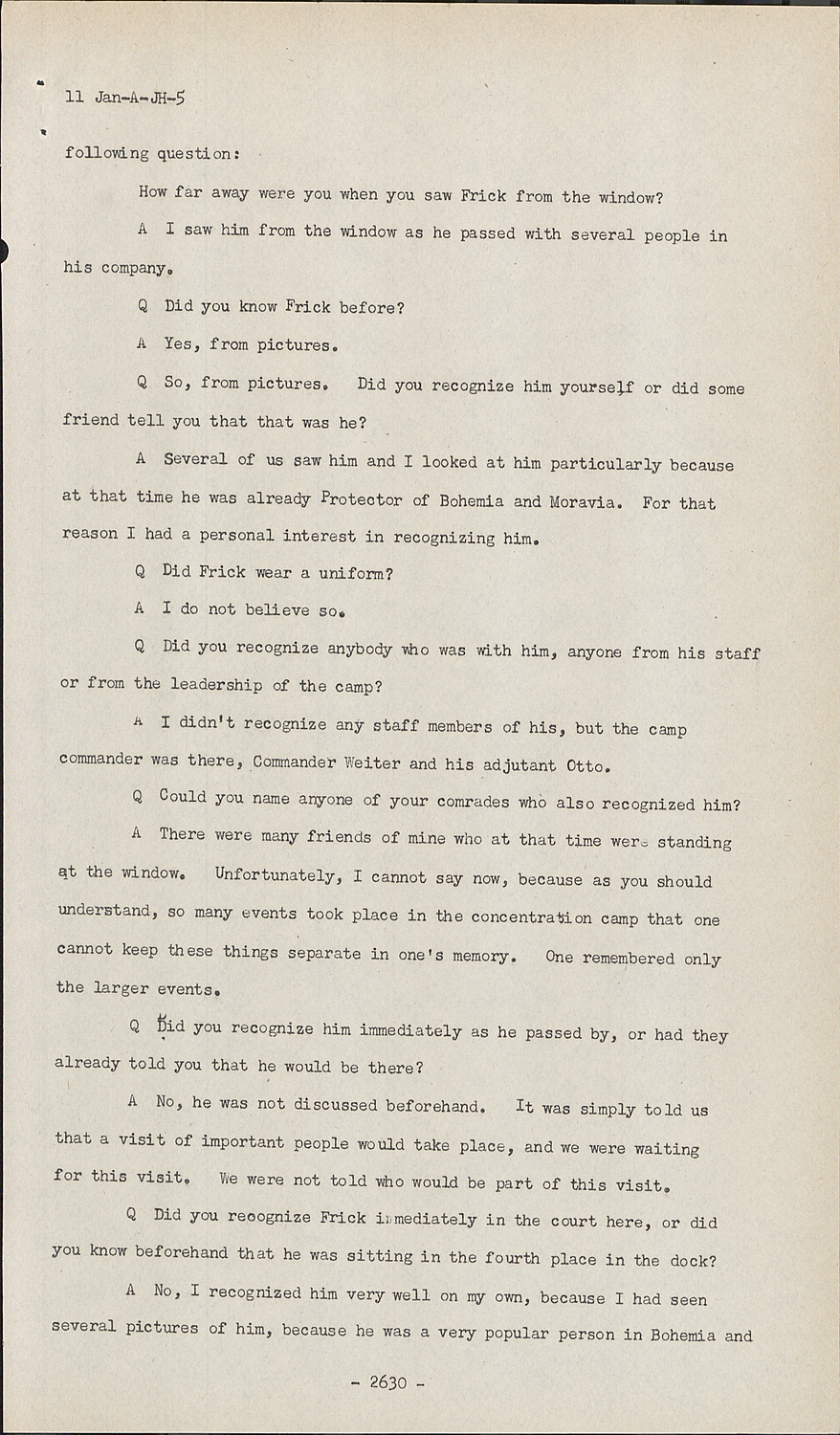
How far away were you when you saw Frick from the window?
AI saw him from the window as he passed with several people in his company.
QDid you know Frick before?
AYes, from pictures.
QSo, from pictures. Did you recognize him yourself or did some friend tell you that that was he?
ASeveral of us saw him and I looked at him particularly because at that time he was already Protector of Bohemia and Moravia. For that reason I had a personal interest in recognizing him.
QDid Frick wear a uniform?
AI do not believe so.
QDid you recognize anybody who was with him, anyone from his staff or from the leadership of the camp? a I didn't recognize any staff members of his, but the camp commander was there, Commander Weiter and his adjutant Otto.
QCould you name anyone of your comrades who also recognized him?
AThere were many friends of mine who at that time were standing at the window. Unfortunately, I cannot say now, because as you should understand, so many events took place in the concentration camp that one cannot keep these things separate in one's memory. One remembered only the larger events.
QDid you recognize him immediately as he passed by, or had they already told you that he would be there?
ANo, he was not discussed beforehand. It was simply told us that a visit of important people would take place, and we were waiting for this visit. We were not told who would be part of this visit.
QDid you recognize Frick immediately in the court here, or did you know beforehand that he was sitting in the fourth place in the dock?
ANo, I recognized him very well on my own, because I had seen several pictures of him, because he was a very popular person in Bohemia and Moravia.
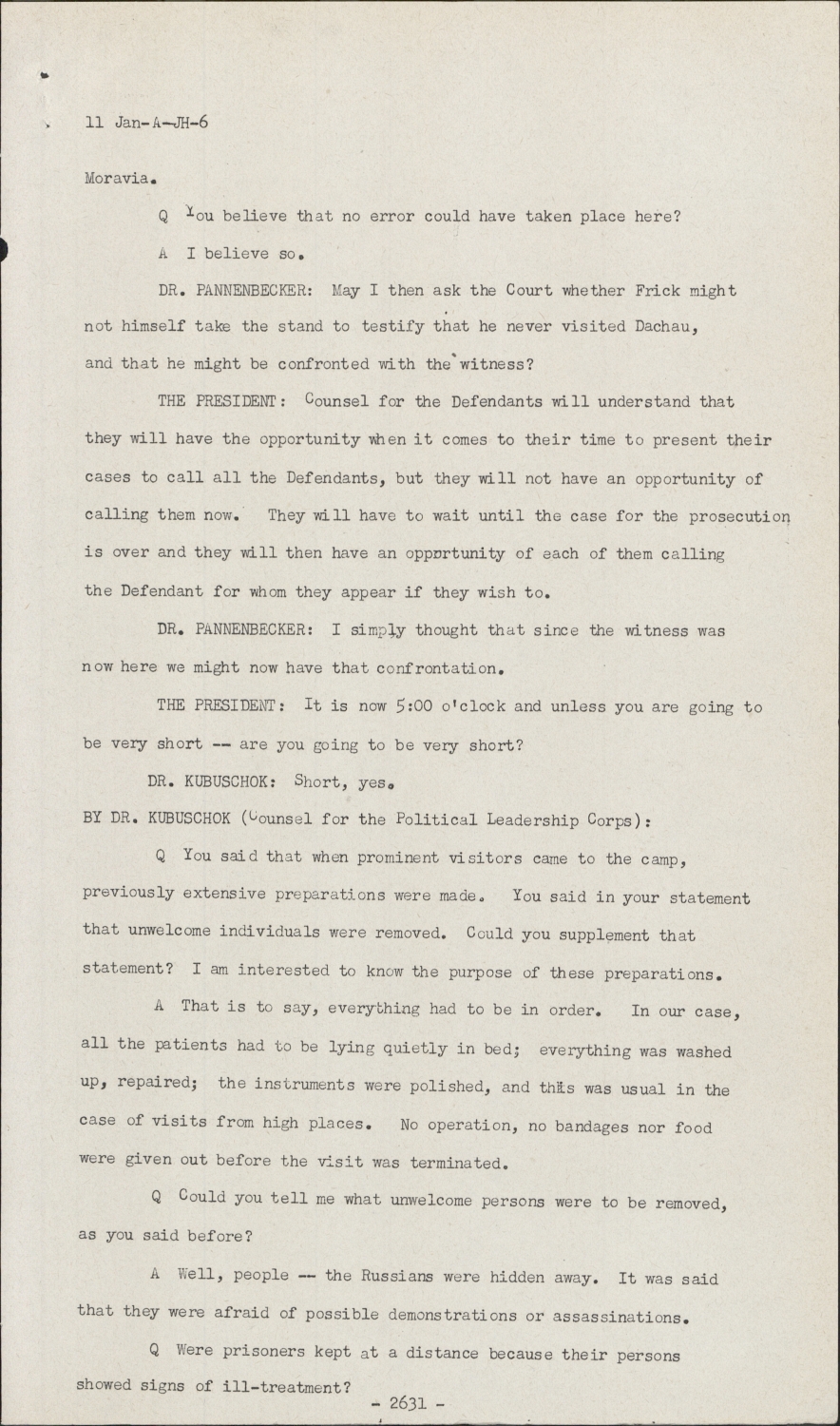
QYou believe that no error could have taken place here?
AI believe so.
DR. PANNENBECKER:May I then ask the Court whether Frick might not himself take the stand to testify that he never visited Dachau, and that he might be confronted with the witness?
THE PRESIDENT:Counsel for the Defendants will understand that they will have the opportunity when it comes to their time to present their cases to call all the Defendants, but they will not have an opportunity of calling them now. They will have to wait until the case for the prosecution is over and they will then have an opportunity of each of them calling the Defendant for -whom they appear if they wish to.
DR. PANNENBECKER:I simply thought that since the witness was now here we might now have that confrontation.
THE PRESIDENT:It is now 5:00 o'clock and unless you are going to be very short -- are you going to be very short?
DR. KUBUSCHOK:Short, yes. BY DR. KUBUSCHOK (Counsel for the Political Leadership Corps):
QYou said that when prominent visitors came to the camp, previously extensive preparations were made. You said in your statement that unwelcome individuals were removed. Could you supplement that statement? I am interested to know the purpose of these preparations.
AThat is to say, everything had to be in order. In our case, all the patients had to be lying quietly in bed; everything was washed up, repaired; the instruments were polished, and this was usual in the case of visits from high places. No operation, no bandages nor food were given out before the visit was terminated.
QCould you tell me what unwelcome persons were to be removed, as you said before?
AWell, people -- the Russians were hidden away. It was said that they were afraid of possible demonstrations or assassinations.
QWere prisoners kept at a distance because their persons showed signs of ill-treatment?
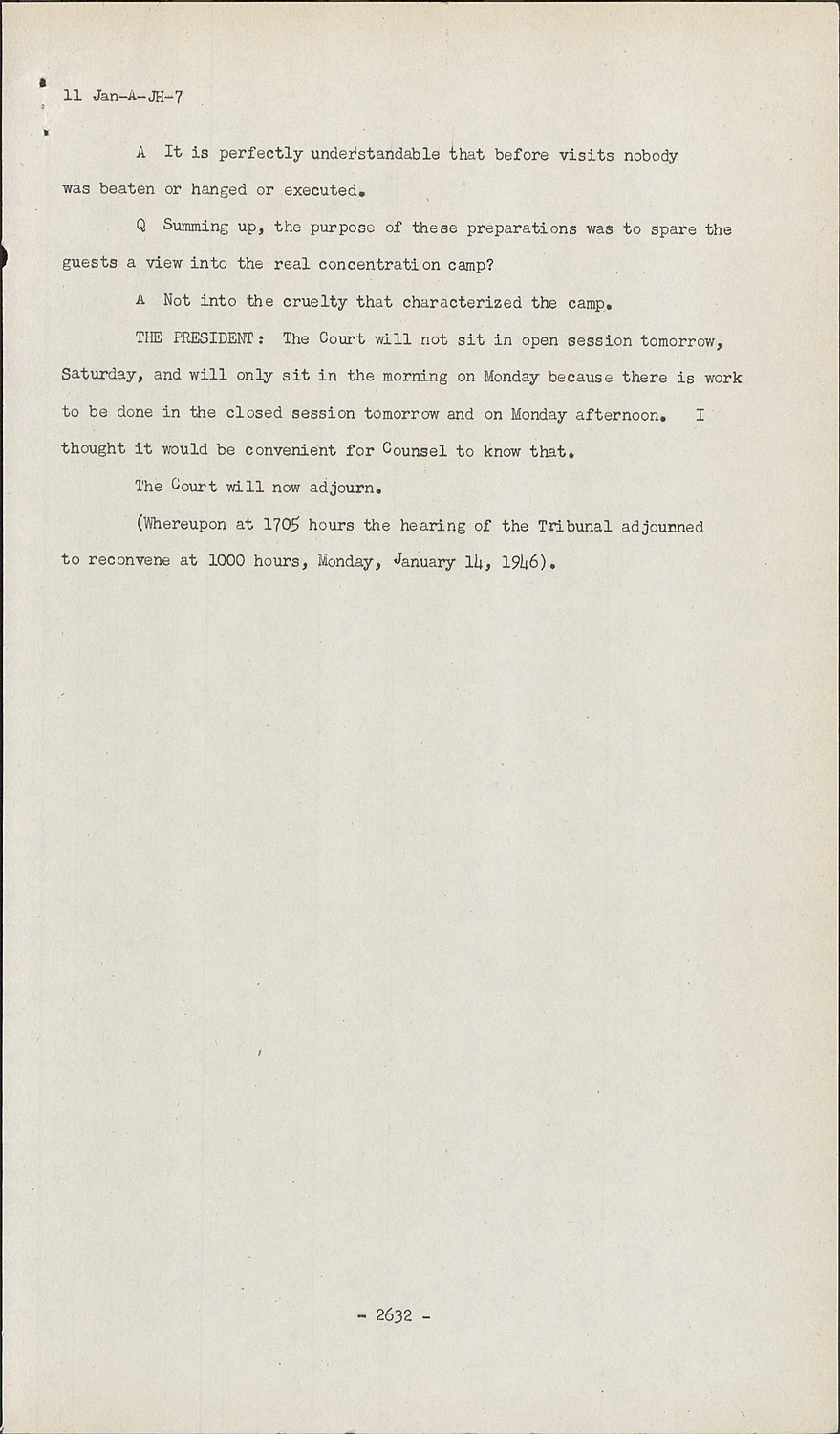
A It is perfectly understandable that before visits nobody was beaten or hanged or executed.
QSumming up, the purpose of these preparations was to spare the guests a view into the real concentration camp?
ANot into the cruelty that characterized the camp.
THE PRESIDENT:The Court will not sit in open session tomorrow, Saturday, and will only sit in the morning on Monday because there is work to be done in the closed session tomorrow and on Monday afternoon. I thought it would be convenient for Counsel to know that.
The Court will now adjourn.
(Whereupon at 1705 hours the hearing of the Tribunal adjourned to reconvene at 1000 hours, Monday, January 14, 1946).
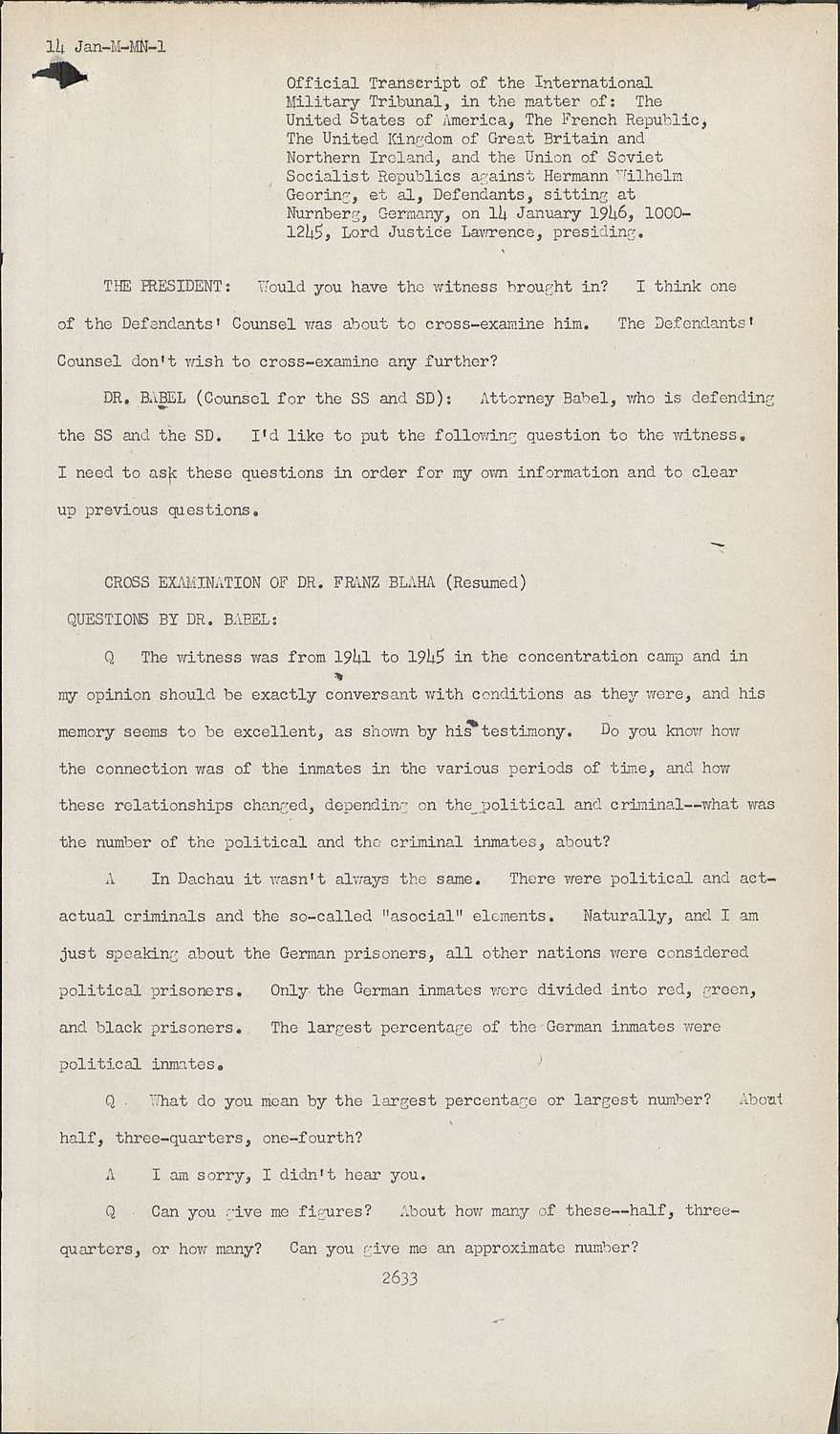
Official Transcript of the International Military Tribunal, in the matter of:
The United States of America, The French Republic, The United Kingdom of Great Britain and Northern Ireland, and the Union of Soviet Socialist Republics against Hermann Wilhelm Georing, et al, Defendants, sitting at Nurnberg, Germany, on 14 January 1946, 1000 1245, Lord Justice Lawrence, presiding.
THE PRESIDENT:Would you have the witness brought in? I think one of the Defendants' Counsel was about to cross-examine him. The Defendants' Counsel don't wish to cross-examine any further?
DR.BABEL (Counsel for the SS and SD): Attorney Babel, who is defending the SS and the SD. I'd like to put the following question to the witness, I need to ask these questions in order for my own information and to clear up previous questions.
CROSS EXAMINATION OF DR. FRANZBLAHA (Resumed) QUESTIONS BY DR. BABEL:
QThe witness was from 1941 to 1945 in the concentration camp and in my opinion should be exactly conversant with conditions as they were, and his memory seems to be excellent, as shown by his testimony. Do you know how the connection was of the inmates in the various periods of time, and how these relationships changed, depending on the political and criminal -- what was the number of the political and the criminal inmates, about?
AIn Dachau it wasn't always the same. There were political and actactual criminals and the so-called "asocial" elements. Naturally, and I am just speaking about the German prisoners, all other nations were considered political prisoners. Only the German inmates wore divided into red, green, and black prisoners. The largest percentage of the German inmates were political inmates.
QWhat do you mean by the largest percentage or largest number? About half, three-quarters, one-fourth?
AI am sorry, I didn't hear you.
QCan you give me figures? About how many of these--half, threequarters, or how many? Can you give me an approximate number?
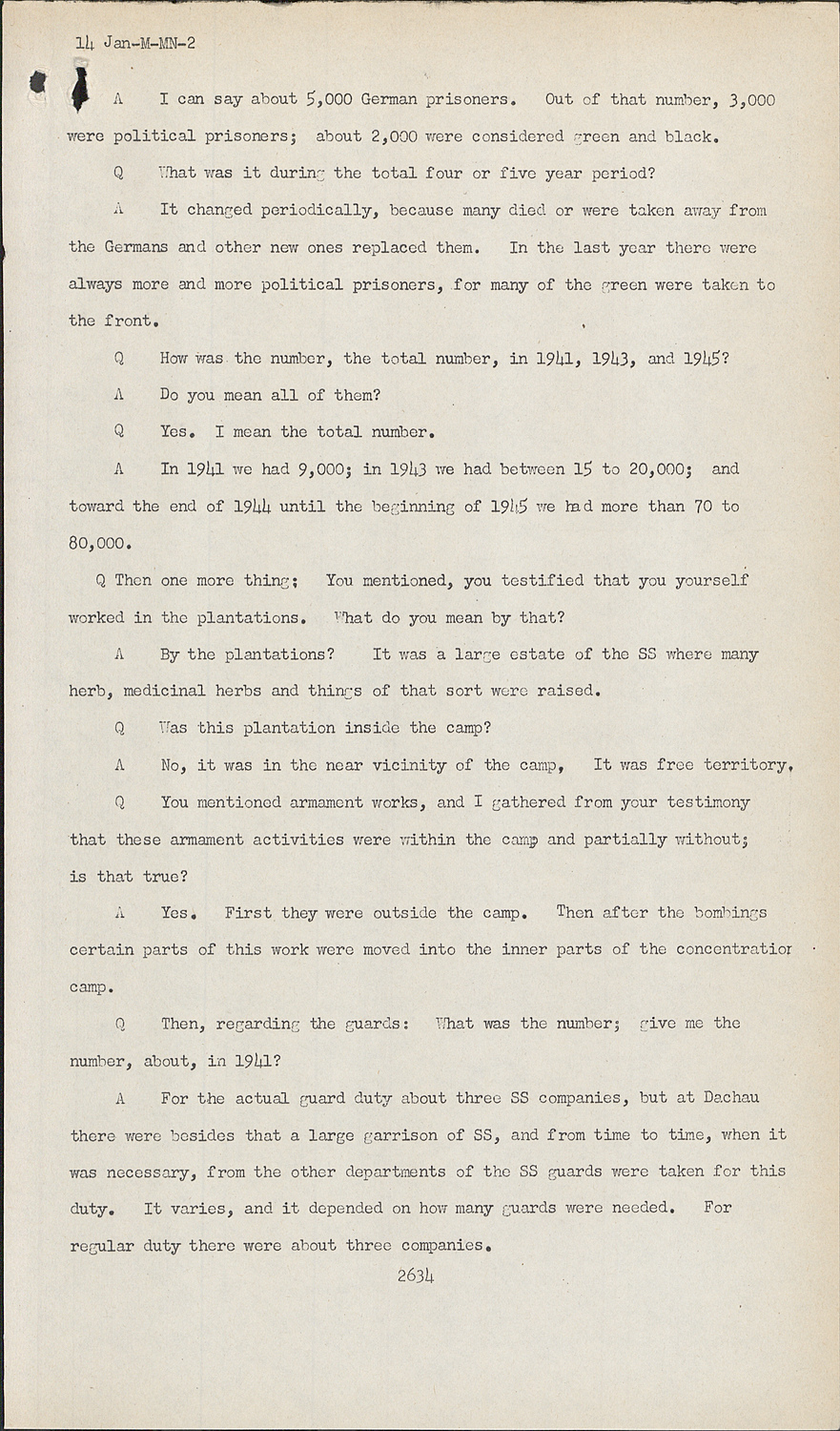
A I can say about 5,000 German prisoners. Out of that number, 3,000 were political prisoners; about 2,000 were considered green and black.
QWhat was it during the total four or five year period?
AIt changed periodically, because many died or were taken away from the Germans and other new ones replaced them. In the last year there were always more and more political prisoners, for many of the green were taken to the front.
QHow was the number, the total number, in 194, 1943, and 1945?
ADo you mean all of them?
QYes. I mean the total number.
AIn 1941 we had 9,000; in 1943 we had between 15 to 20,000; and toward the end of 1944 until the beginning of 1945 we had more than 70 to 80,000.
QThen one more thing; You mentioned, you testified that you yourself worked in the plantations. What do you mean by that?
ABy the plantations? It was a large estate of the SS where many herb, medicinal herbs and things of that sort were raised.
QWas this plantation inside the camp?
ANo, it was in the near vicinity of the camp, It was free territory.
QYou mentioned armament works, and I gathered from your testimony that these armament activities were within the camp and partially without; is that true?
AYes. First they were outside the camp. Then after the bombings certain parts of this work were moved into the inner parts of the concentration camp.
QThen, regarding the guards: What was the number; give me the number, about, in 1941?
AFor the actual guard duty about three SS companies, but at Dachau there were besides that a large garrison of SS, and from time to time, when it was necessary, from the other departments of the SS guards were taken for this duty. It varies, and it depended on how many guards were needed. For regular duty there were about three companies.
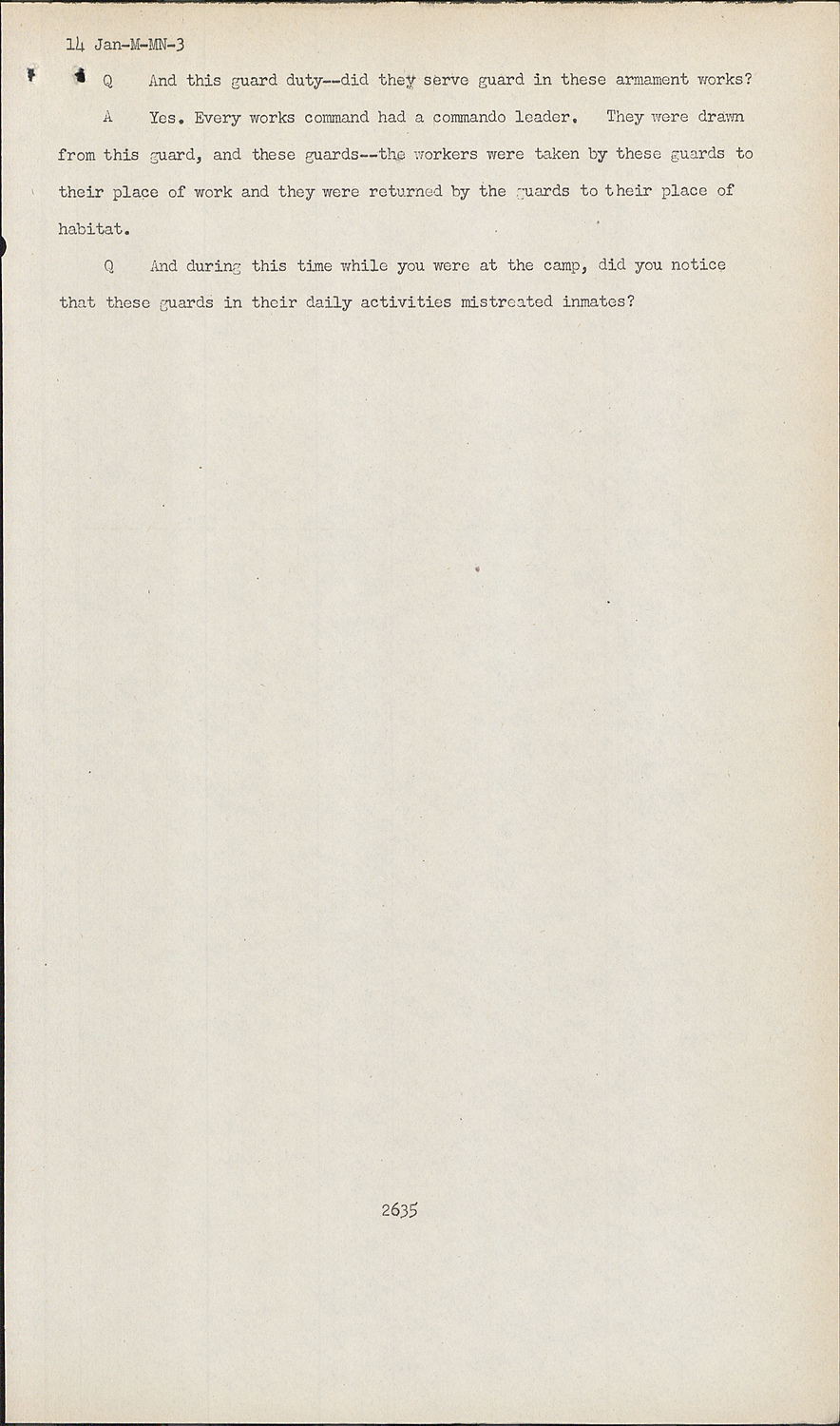
Q And this guard duty--did they serve guard in these armament works?
AYes. Every works command had a commando leader. They were drawn from this guard, and these guards--the workers were taken by these guards to their place of work and they were returned by the guards to their place of habitat.
QAnd during this time while you were at the camp, did you notice that these guards in their daily activities mistreated inmates?
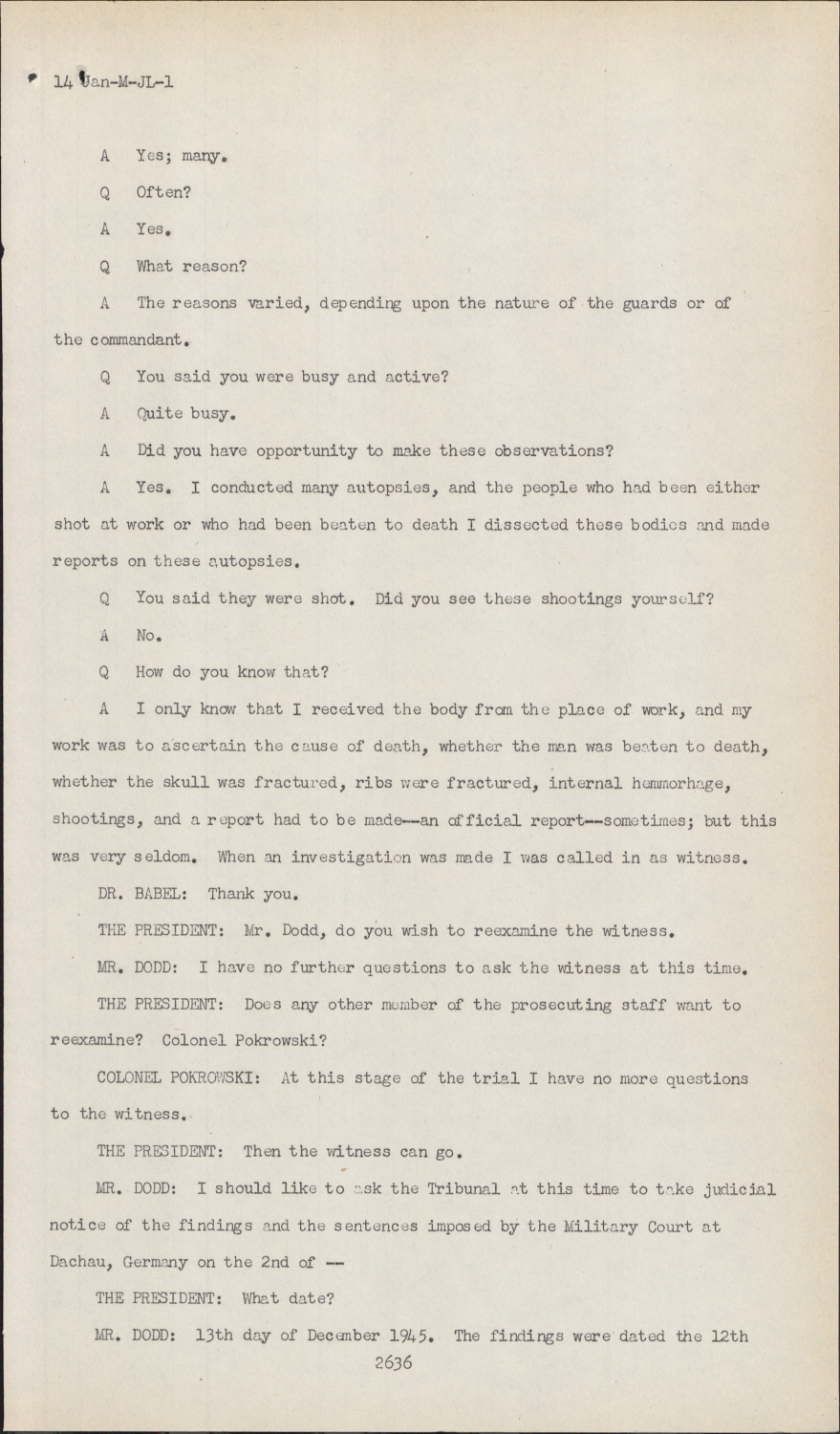
A Yes; many.
QOften?
AYes.
QWhat reason?
AThe reasons varied, depending upon the nature of the guards or of the commandant.
QYou said you were busy and active?
AQuite busy.
ADid you have opportunity to make these observations?
AYes. I conducted many autopsies, and the people who had been either shot at work or who had been beaten to death I dissected these bodies and made reports on these autopsies.
QYou said they were shot. Did you see these shootings yourself?
ANo.
QHow do you know that?
AI only know that I received the body from the place of work, and my work was to ascertain the cause of death, whether the man was beaten to death, whether the skull was fractured, ribs were fractured, internal hemmorhage, shootings, and a report had to be made--an official report--sometimes; but this was very seldom. When an investigation was made I was called in as witness.
DR. BABEL:Thank you.
THE PRESIDENT:Mr. Dodd, do you wish to reexamine the witness.
MR. DODD:I have no further questions to ask the witness at this time.
THE PRESIDENT:Does any other member of the prosecuting staff want to reexamine? Colonel Pokrowski?
COLONEL POKROWSKI:At this stage of the trial I have no more questions to the witness.
THE PRESIDENT:Then the witness can go.
MR. DODD:I should like to ask the Tribunal at this time to take judicial notice of the findings and the sentences imposed by the Military Court at Dachau, Germany on the 2nd of -
THE PRESIDENT:What date?
MR.DODD: 13th day of December 1945. The findings were dated the 12th and the sentences on the 13th.
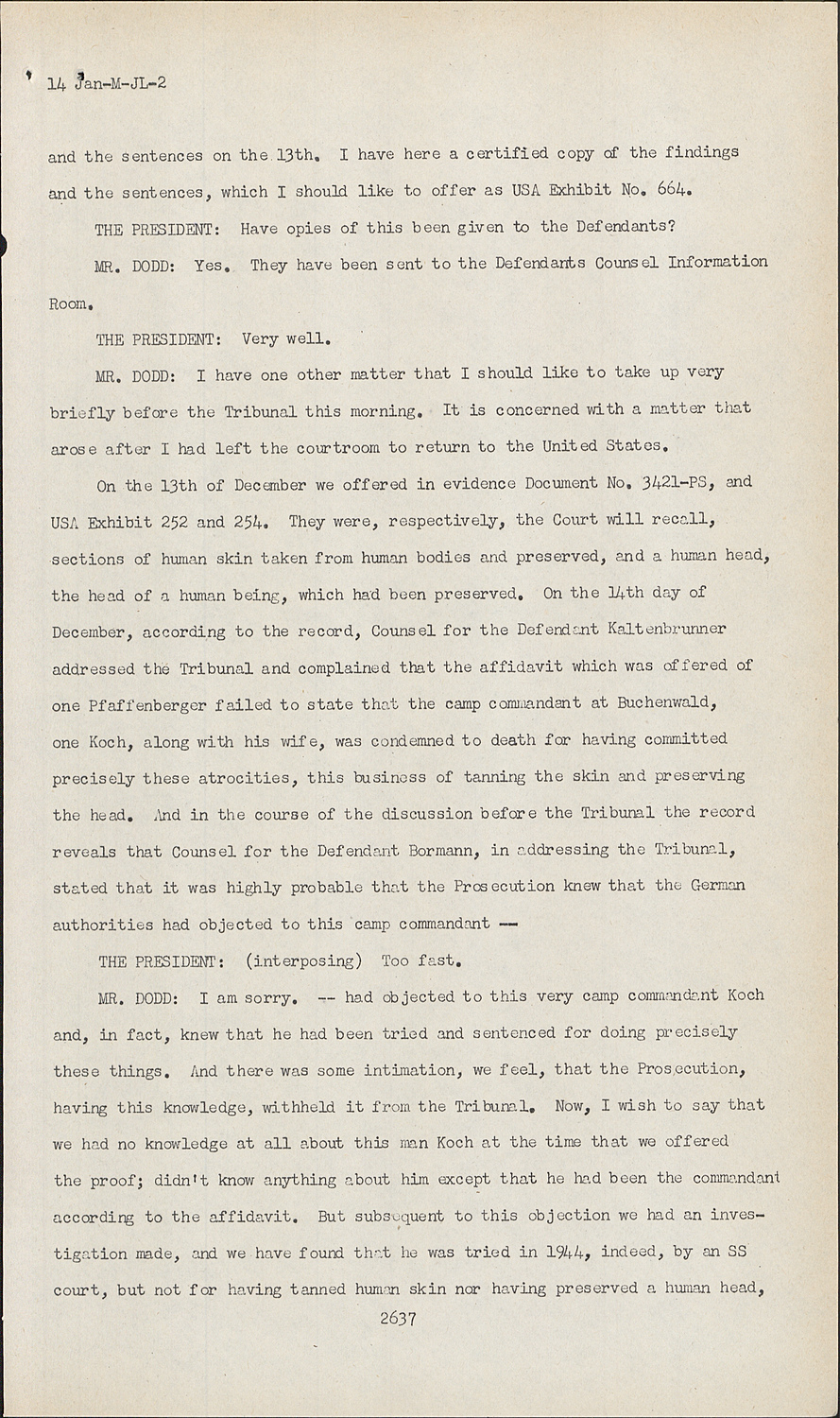
I have here a certified copy of the findings and the sentences, which I should like to offer as USA Exhibit No. 664.
THE PRESIDENT:Have opies of this been given to the Defendants?
MR. DODD:Yes. They have been sent to the Defendants Counsel Information Room.
THE PRESIDENT:Very well.
MR. DODD:I have one other matter that I should like to take up very briefly before the Tribunal this morning. It is concerned with a matter that arose after I had left the courtroom to return to the United States. On the 13th of December we offered in evidence Document No. 3421-PS, and USA Exhibit 252 and 254. They were, respectively, the Court will recall, sections of human skin taken from human bodies and preserved, and a human head, the head of a human being, which had been preserved. On the 14th day of December, according to the record, Counsel for the Defendant Kaltenbrunner addressed the Tribunal and complained that the affidavit which was offered of one Pfaffenberger failed to state that the camp commandant at Buchenwald, one Koch, along with his wife, was condemned to death for having committed precisely these atrocities, this business of tanning the skin and preserving the head. And in the course of the discussion before the Tribunal the record reveals that Counsel for the Defendant Bormann, in addressing the Tribunal, stated that it was highly probable that the Prosecution knew that the German authorities had objected to this camp commandant -
THEPRESIDENT: (interposing) Too fast.
MR. DODD:I am sorry. -- had objected to this very camp commandant Koch and, in fact, knew that he had been tried and sentenced for doing precisely these things. And there was some intimation, we feel, that the Prosecution, having this knowledge, withheld it from the Tribunal. Now, I wish to say that we had no knowledge at all about this man Koch at the time that we offered the proof; didn't know anything about him except that he had been the commandant according to the affidavit. But subsequent to this objection we had an investigation made, and we have found that he was tried in 1944, indeed, by an SS court, but not for having tanned human skin nor having preserved a human head, but for having embezzeled some money, for, what the judge tells us who tried him, was the charge of general corruption, and for having murdered someone with whom he had some personal difficulties.
Indeed, the judge, a Dr. Morgen, tells us that he saw the tatooed human skin and he saw a human head in Commandant Koch's office, and that he saw a lamp shade there made out of human skin.
But there were no charges at the time that he was tried for having done these things.
I would also point out to the Tribunal that, we say, the testimony of Dr. Blaha sheds further light on whether or not these exhibits, 252 and 254 were isolated instances of that atrocious kind of conduct. We have not been able to locate the affiant. We have made an effort to do so but we have not been able to locate him thus far.
THE PRESIDENT:Locate whom?
MR. DODD:The affiant Pfaffenberger, the one whose affidavit was offered.
THE PRESIDENT:Very well, Mr. Dodd.
DR.KAUFMANN (Counsel for Defendant Kaltenbrunner): The statement just made is undoubtedly significant, but it would be of significance if we had the proof and the documents which served to convict the commandant and his wife, for Kaltenbrunner told me that in the whole SS it was known that the Commandant Koch and his wife were also--and I emphasize "also"---they had been made responsible, and it was known in the whole SS that the size, the magnitude of the penalty was determined by the determination of inhuman demeanor.
THE PRESIDENT:Wait a minute. As you were the Counsel who made the allegation that the Commandant Koch had been put to death for his inhuman treatment, it would seem that you are the party to produce the judgment.
DR. KAUFMANN:I never saw the sentence in my own hand. I depended on the information which Kaltenbrunner gave me personally and verbally.
THE PRESIDENT:It was you who made the assertion. I don't care where you got it from. You made the assertion; therefore it is for you to produce the document.
DR. KAUFMANN:Yes, sir.
COL. PHILLIMORE:May it please the Tribunal: Briefs and document books have been handed in. The documents in the document book are in the order in which I shall refer to them, and the references to them in the briefs are also in that order. On the first page of the brief is set out the extract from Appendix A of the Indictment, which deals with the criminality of this Defendant.

THE PRESIDENT:Are you dealing first of all with Raeder or with Doenitz?
COL. PHILLIMORE:With Doenitz. My learned friend, Elwyn-Jones, will deal with Raeder later.
THE PRESIDENT: The tribunal will adjourn for ten minutes.
(A recess was taken from 1030-1040)
COL. PHILLIMORE:My Lord, may I proceed?
THE PRESIDENT:Very well.
COL. PHILLIMORE:Briefs and documents books have been handed in. The documents are in the document book in the order in which I shall refer to them, and the references in the brief to the documents are in that same order. On the first page of the brief is set out the extract from the Indictment as Appendix A, which deals with the allegations against this defendant. It sets out the positions he held, and charges him first with promoting the preparations for war, set forth in Count I; secondly, with participating in the military planning and preparation for wars of aggression and wars in violation of international treaties, agreements, and assurances, set forth in Count I and II of the Indictment; and, thirdly, with authorizing, directing, and participating in the war crimes, set forth in Count III of the Indictment, including particularly the crimes against persons and property on the high seas.
Now, if at any place I appear to trespass on Count III, it is with the consent and courtesy of the chief prosecutor for the French Republic.
My Lord, on the second page of the brief are set out first the positions held by the Defendant Doenitz , and the document in question is the first document in the document book, 2887-PS, which has already been put in as United States Exhibit No. 12. The members of the Tribunal will see that after his appointment in 1935 as commander of the Weddigen U-boat flotilla -- that was, in fact, the flotilla to be formed after the World war in 1918. The defendant, who was in effect then commander of U-boats, rose steadily in rank as the U-boat arm expanded until he became an admiral. And then on the 30th of January 1943 he was appointed Gross Admiral and Succeeded the Defendant Raeder as commander-in-chief of the German Navy, retaining his command of the U-boat arm. Then on the 1st of May 1945 he succeeded Hitler as leader of Germany.
My Lord, as appears from a number of documents which I shall put in evidence, the defendant was awarded the following decorations: