This mission will be accomplished by Reichsleiter and Gauleiter Fritz Sauckel in the capacity of general plenipotentiary for the employment of labor in the framework of the Four-Year-Plan. In this capacity he is directly responsible to the Four-Year Plan."
I would like to point out that the defendant Sauckel has developed the same theme. At the Congress of Gauleiter and Reichsleiter, held February 5 and 6 1943 at Posen, he expressed himself in plain terms: he justified compulsory recruitment by National-Socialist philosophy and by the necessity of associating all the European peoples in the struggle carried on by Germany. His speech constitutes document 1739 PS. I submit it under No. 6 and 10 and I request the Court to take judicial notice of it and to accept the following passages in evidence against the defendant Sauckel. The following passages--first page 5 of the German text, fourth paragraph--are found in the first page of the French translation:
"The remarkable violence of the war has forced me to immobilize in the name of the Fuehrer the numerous foreigners for labor in the domain of the German war economy, and to force them to give considerable production. The purpose of this utilization is to insure in the labor domain the material means necessary to war in the struggle for life and liberty, in the first place, of our people, and also for the preservation of our Western culture for those peoples who are quite different from the parasitical Jews and bureaucrats, who lead a life which will consist of work and effort and who possess honest will and force. Such is the enormous difference between, on the one hand, the work which was demanded at one period by the power and Jewish authority in the Treaty of Versailles and the Young Plans, which took the form of slavery and tributary efforts, and, on the other hand, the utilization of labor which, in my capacity as a National Socialist I have the honor to prefer and to carry out, and which represents a participation in the struggle by Germany for the liberty of Germany and for the liberty of friendly nations."
The compulsory recruitment of foreign workers did not have as its only object the maintenance of the level of German industrial production.
There was also the conscious desire to weaken the human potential of the occupied countries.
The idea of extermination by work was familiar to the theorists of National-Socialism and to the leaders of Germany; it constituted one of the bases of the policy of domination of the invaded territories. I lay before the Court the proof that the National-Socialist conspirators envisaged the destruction by work of whole ethnical groups. A discussion which took place on 14 September 1942 between Goebbels and Thierack is significant. It constitutes Document 682 P.S., which I file with the Tribunal under the No. 11, from which I take the following passage:
"Concerning the extermination of the associates, Doctor Goebbels is of the opinion the following groups must be exterminated: Jews and nomads, without any discrimination; Poles who have three or four years of legal penalty to carry out; Czechoslovakians and Germans who have been condemned to death or forced labor for life or have been placed in protective custody for life."
The idea of extermination by work was not applied to ethnical groups alone, the disappearance of which was desired by the defendants; it also led to the employment of foreign manual labour in the German war industry up to the extreme limit of the individual strength. I will revert to this aspect of the policy of forced labour when I lay before the Tribunal the treatment of foreign workers in Germany, the cruelty of which they were the object. The reprisals aimed at them sprang from this main conception of National Socialism, that the human strength of the occupied countries must be employed without other limitation than that of their extermination, which is the final motive.
The defendants have not only admitted the principle of compulsory recruitment of foreign workers; they have followed a consistent policy of putting their principle into practice, applying in it the same concrete manner in the various occupied territories. To do this they resorted to identical methods of recruitment; they set up everywhere the same recruitment administration and promulgated the same orders. In the first place, it was a question of inciting the foreign workers to work in their own countries for the army of occupation and the services connected with it.
The German military and civil authorities organized workyards in order to carry out on the spot work useful to their war policy.
The workyards or shops of the Todt organization, which were under the direction of the defendant Speer, after the death of their founder, and those of the Wehrmacht, Luftwaffe, Kriegsmarine, and the N.S.K.K. organization, employed numerous foreign workers in all areas of Western Europe.
But the essential undertaking of the German labour services was the deportation of foreign workers to the munition factories of the Reich. The most varied means have been used to this end. They have been built up into a recruiting policy which can be analysed as follows: In the beginning, this policy took on the cloak of legality. The use of labour took the form of requisition as under the terms of Article 52 of the Appendix to the fourth Hague Convention; it was also effected by means of voluntary recruitment of workers, to whom the German recruiting offices offered labour contracts.
I shall provide the Tribunal with proof that the labour requisitions effected by the National Socialist authorities were a deliberate misinterpretation of the letter and spirit of the international convention by virtue of which they were carried out. I shall show that the voluntary character of the recruitment of certain foreign workers was entirely fictitious; in reality their work contracts were made under the pressure which the occupation authorites brought to bear on their will.
The Defendants lost no time in flinging aside their mask of legality.
They compelled the prisoners of war to do work forbidden by international conventions.
I shall show how the work of prisoners of war was incorporated in the general plan for the employment of labor from the occupied areas.
After all, it is through force that the Defendants brought to fruition their recruitment plans.
They did not hesitate to resort to violent methods.
Thus they established the compulsory labor service in the areas which they occupied.
Sometimes they directly promulgated orders bearing the signature of military commanders or Reich Commissars.
This is the case with Belgium and Holland.
Sometimes they forced the authorities in fact, authorities which they had set up in the occupied areas, to take legislative measures.
This is particularly the case with France and Norway.
Sometimes they simply took direct action, that is, they transferred foreign workers to factories in Germany without providing a written order for this.
This happened in Denmark.
Finally in certain occupied areas where they began to carry out Germanization the Defendants made the inhabitants of these territories a part of the labor service of the Reich.
It happened thus in the French provinces of Haut-Rhin, Bas-Rhin, Moselle, and in Luxembourg.
The policy of compulsory labor was asserted and systematized from the day when the Defendant Sauckel was appointed General Plenipotentiary for the Employment of Labor.
Member of the National Socialist Party since its formation, Member of the Diet of Thuringia, Obergruppenfuehrer of the criminal organizations SS and SA, the Defendant Sauckel was Gauleiter and Reichsstatthalter of Thuringia.
On March 21, 1942, he was appointed General Plenipotentiary for the Employment of Labor by a decree of the Fuehrer.

This decree is counter-signed by Lammers, in his capacity as Reichsminister and Chief of the Chancery, and by the Defendant Keitel.
The responsibility of the latter is proved by his counter-signature.
The Defendant Keitel has associated himself, by Sauckel's choice, with the policy of compulsory labor, of which he has approved the principle and the methods.
I have already read this decree to the Tribunal. I would remind you that it placed Sauckel, in his capacity as General Plenipotentiary for the Employment of Labor, under the immediate orders of the Delegate for the Four Year Plan, the Defendant Goering.
The latter bears a direct responsibility in the prosecution of the plan for recruitment of compulsory labor.
I shall produce numerous proofs of this.
I ask the Tribunal to authorize me to produce as first proof the decree signed by the Defendant Goering the day after the appointment of the Defendant Sauckel.
This decree, dated March 27, 1942, was published in the Reichsgesetzblatt 1942, Part I, page 180.
I file it with the Tribunal under the number 12.
Goering by this decree did away with all the administrative offices of the Four Year Plan which had been charged with the recruitment of labor.
He transmits their powers to Sauckel's department, thus confirming his appointment.
The powers of Sauckel between 1942 and 1944 were considerably reinforced by decrees of Hitler and Goering.
These decrees gave full significance to the Defendant Sauckel's title of Plenipotentiary.
They gave him administrative autonomy and even legislative competency such as he could not aspire to had he confined himself to executive tasks.
The importance of the political part which he played during the last two years of the war increases by that amount the weight of the responsibility devolving upon him.
I would particularly draw the attention of the Tribunal to the decrees of the Fuehrer of September 30, 1942, and of March 30, 1943, and to the decree of the Defendant Goering of May 25, 1942.
I will not read these decrees, which have been commented on by my American colleague, Mr. Dodd.
I submit them in support of my argumentation.
I will first refer to the decree of the Defendant Goering of May 25, 1942.
It was published in the Reichsgesetzblatt 1942, Part I, page 347.
He delegates to Sauckel part of the powers relating to labor held by the Minister of Labor.
I submit it to the Tribunal under the number 13.
Hitler's decree of September 30, 1942, gave Sauckel considerable power over the civil and military authorities of the territories occupied by the German armed forces.
It made it possible for the Defendant to introduce into the staffs of the occupying authorities personal representatives, to whom he gave his orders direct.
The decree is counter-signed by Lammers and by the Defendant Keitel.
This appears in the collection of the directive decrees of 1940, second volume, page 58, and I submit it under the number 14.
In the carrying out of this decree representatives of Sauckel's department were in fact introduced into the Headquarters Staffs of the military commands.
The interrogation of General von Falkenhausen, Military Governor of Belgium and Northern France, gives, in this connection, a proof which I would ask the Tribunal to be good enough to remember.
General von Falkenhausen was interrogated November 27, 1945, by the head of the Investigation Section of the French Delegation.
I submit his evidence to the Tribunal under the number 15.
I read the following extract from page 2, the seventh paragraph, of the French translation, and page 2, the fifth paragraph, of the German translation.
"Q Can the witness tell us what were the limits between his own powers and the powers of the Arbeitseinsatz?
"A Up to a certain moment there existed in my department a labor service which concerned the hiring of voluntary workers.
I no longer remember the exact date--perhaps autumn 1942--this labor service was placed under the orders of Sauckel, and the only thing I had to do was to carry out the orders which came through this way.
I don't remember, but Raeder, who is also in prison-
Raeder was a civilian official in the staff of General von Falkenhausen.
He is very well informed about the dates and can undoubtedly give us a better idea than I can.
"Q Before the question of labor was entirely entrusted to Sauckel's organization, did there exist in the General Staff or in its services an officer who was in charge of this question?
Afterwards was there a delegate from Sauckel's service in this department?
"A Until Sauckel came into power there was, in my service, Raeder, who directed the Bureau of Labor in my office.
This labor office functioned as an employment office in Germany, that is to say, it concerned itself with the requests for labor, which would naturally be voluntary.
"Q What took place when this change happened?
"A After this change the office continued to exist, but the orders were given directly by Sauckel to the Arbeitseinsatz by passing through my intermediary, or by passing through my hands."
THE PRESIDENT:Would this be a convenient time to break off for ten minutes?
Before the Tribunal adjourns I want to announce that the Tribunal will sit tomorrow, Saturday, until 1 o'clock.
(Whereupon, a recess was taken from 1120 to 1130 hours).
MR. HERZOG:I have just reminded the Tribunal of the legislative framework on which the activity of the Defendant Sauckel was exercised. This framework was reinforced by the varied decrees of the defendant. The first document attests that Sauckel deliberately assumed the responsibility of the general policy of recruiting of foreign workers -- the decree of the 22nd of August, 1942, which appeared in the Reichsgesetzblatt, 1942, Part I, page 332. This decree poses the principle of forced recruiting and makes the necessary provisions for all the human potential of the occupied territories to be put in the service of the German war machine.
Sauckel forces the inhabitants of the invaded countries to participate in the war of Germany against their Fatherland. It is not only a violation of international law, it is a crime against the rights of peoples. I submit the decree to the Tribunal under Number 17 and I shall read it.
"Ordinance Number 10 of the General Delegate for the Utilization of Labor Relative to the Employment of Labor in the Occupied Territories under date of 22 August, 1942.
"In order to mobilize the labor of the occupied territories in the new organization of the utilization of labor on the European plan, it is necessary to assure a maximum return as well as a useful and rational distribution of this force, in order to satisfy the labor needs of the Reich and of the occupied territories. By virtue of the full powers which are conferred upon me, I order:
"First: By virtue of the decree of the Fuehrer, under date of 21 March 1942, relative to the General Delegate for the utilization of labor and of the ordinance of the Charge D'Admission for the Four Year Plan, under date of 27 March, 1942, relative to the application of this decree, I likewise have competency to employ, as it may be necessary, the labor of occupied territories, as well as all the necessary measures to augment their efficiency.
The German services being competent to utilize the labor and the policy of salaries, as the people under me will utilize the labor and will take all necessary measures to agument the efficiency according to my directives."
"Second: This ordinance extends to all the occupied territories, all the territories occupied during the war by the Wehrmacht, if they are under a German administration.
"Third: The labor available in the occupied territories must be utilized in the first place; for the satisfaction of the primeneeds, the warneeds of German. This labor must be utilized in the occupied territories in the following order:
"(a) For the necessary needs of the army, of the services of occupation and of the civilian services.
"(b) For the German armament needs.
"(c) For the food needs and the agricultural needs.
"(d) For industrial needs other than these of armament, in which Germany is interested.
"(e) For the industrial needs concerning the population of the territory in question."
I here end the quotation.
The second document demonstrates the will of the Defendant Sauckel to insure the responsibility of the treatment of foreign workers. It is an agreement concluded on June 2, 1943, with the Chief of the German Labor Front. I shall not read this document to the Tribunal. The document has been discussed by Mr. Dodd. I recall that it was published in the Reichsgesetzblatt in1942, Part I, page 588. I submit it in support of my declaration under Number 18.
Designated by Hitler and by the Defendants Keitel and Goering, in order to pursue, under the control of the latter, the policy of recruitment of compulsory labor, the Defendant Sauckel has consequently carried out his task in virtue of the responsibilities which he had assumed.
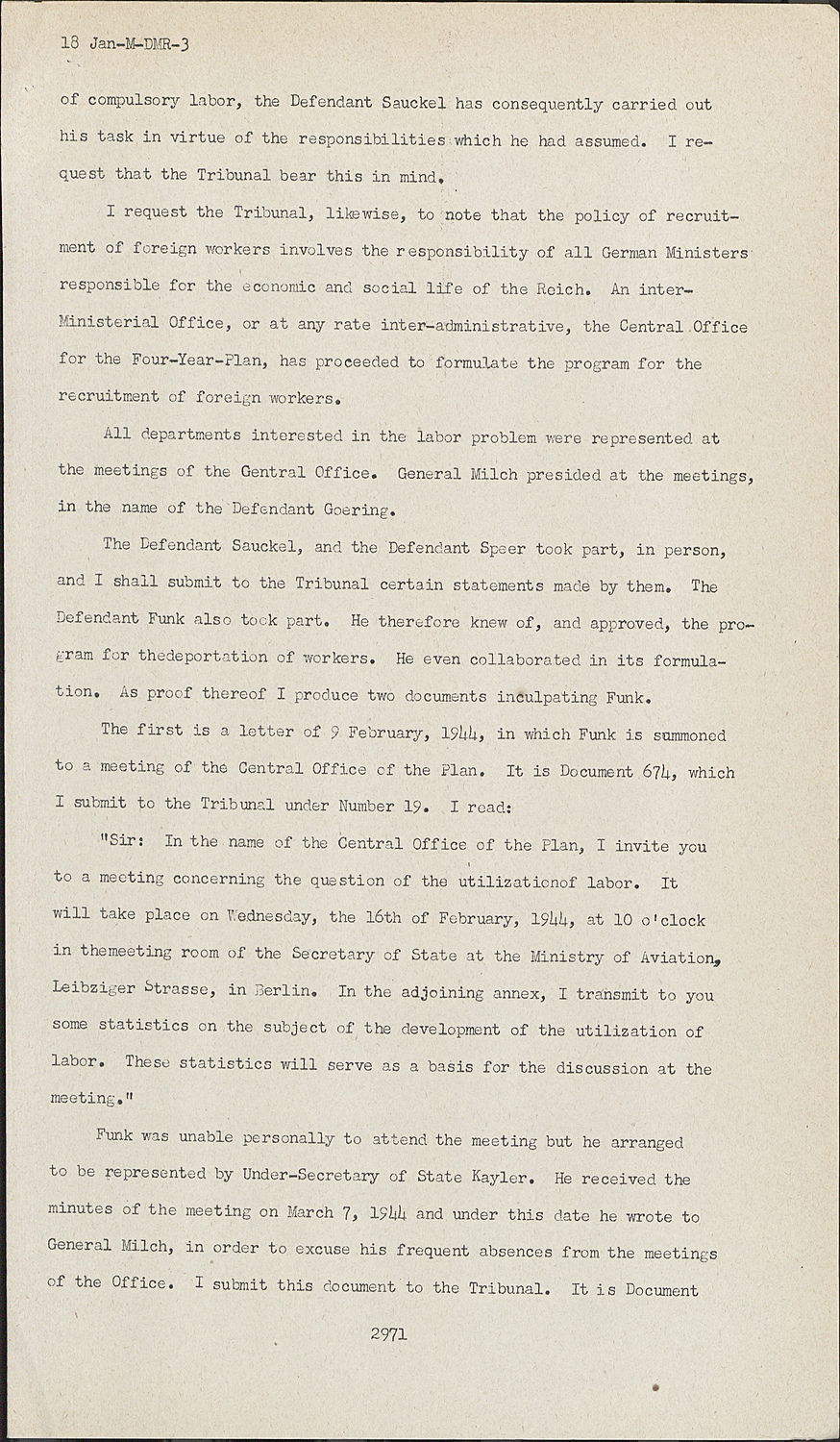
I request that the Tribunal bear this in mind.
I request the Tribunal, likewise, to note that the policy of recruitment of foreign workers involves the responsibility of all German Ministers responsible for the economic and social life of the Reich. An interMinisterial Office, or at any rate inter-administrative, the Central Office for the Four-Year-Plan, has proceeded to formulate the program for the recruitment of foreign workers.
All departments interested in the labor problem were represented at the meetings of the General Office. General Milch presided at the meetings, in the name of the Defendant Goering.
The Defendant Sauckel, and the Defendant Speer took part, in person, and I shall submit to the Tribunal certain statements made by them. The Defendant Funk also took part. He therefore knew of, and approved, the program for thedeportation of workers. He even collaborated in its formulation. As proof thereof I produce two documents inculpating Funk.
The first is a letter of 9 February, 1944, in which Funk is summoned to a meeting of the Central Office of the Plan. It is Document 674, which I submit to the Tribunal under Number 19. I road:
"Sir: In the name of the Central Office of the Flan, I invite you to a meeting concerning the question of the utilizationof labor. It will take place on Wednesday, the 16th of February, 1944, at 10 o'clock in themeeting room of the Secretary of State at the Ministry of Aviation, Leibziger Strasse, in Berlin. In the adjoining annex, I transmit to you some statistics on the subject of the development of the utilization of labor. These statistics will serve as a basis for the discussion at the meeting."
Funk was unable personally to attend the meeting but he arranged to be represented by Under-Secretary of State Kayler. He received the minutes of the meeting on March 7, 1944 and under this date he wrote to General Milch, in order to excuse his frequent absences from the meetings of the Office. I submit this document to the Tribunal. It is Document 675, which I submit under Number 20.
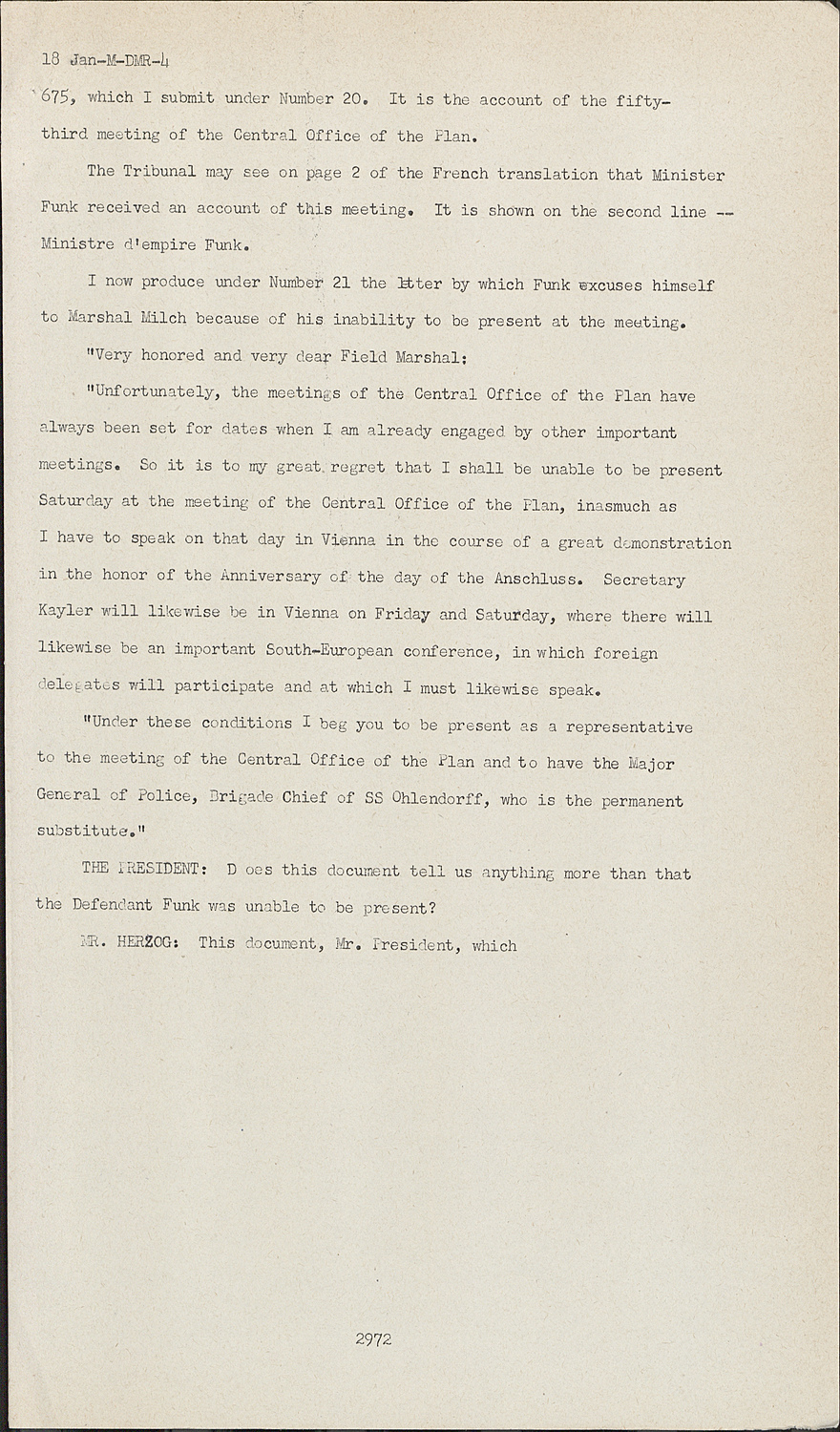
It is the account of the fifty-
third meeting of the Central Office of the Plan.
The Tribunal may see on page 2 of the French translation that Minister Funk received an account of this meeting. It is shown on the second line -Ministre d'empire Funk.
I now produce under Number 21 the letter by which Funk excuses himself to Marshal Milch because of his inability to be present at the meeting.
"Very honored and very dear Field Marshal:
"Unfortunately, the meetings of the Central Office of the Plan have always been set for dates when I am already engaged by other important meetings. So it is to my great regret that I shall be unable to be present Saturday at the meeting of the Central Office of the Plan, inasmuch as I have to speak on that day in Vienna in the course of a great demonstration in the honor of the Anniversary of the day of the Anschluss. Secretary Kayler will likewise be in Vienna on Friday and Saturday, where there will likewise be an important South-European conference, in which foreign delegates will participate and at which I must likewise speak.
"Under these conditions I beg you to be present as a representative to the meeting of the Central Office of the Plan and to have the Major General of Police, Brigade Chief of SS Ohlendorff, who is the permanent substitute."
THE PRESIDENT:Does this document tell us anything more than that the Defendant Funk was unable to be present?
MR. HERZOG:This document, Mr. President, which was given to me by my American colleagues, who asked me to use it in the case on obligatory labor, because they have not had time to use it in their charge against Funk, is presented to the Tribunal, to wit:
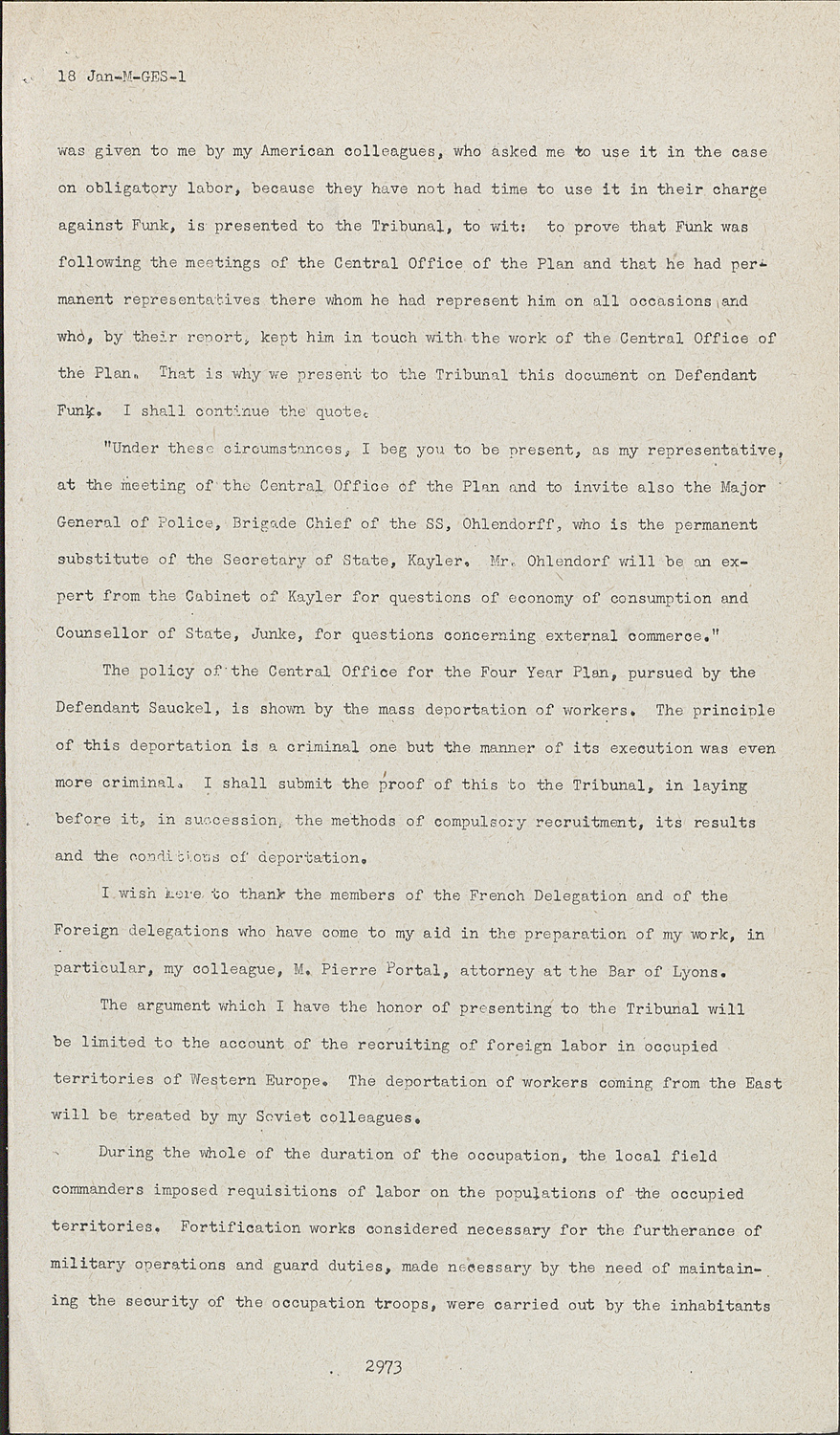
to prove that Funk was following the meetings of the Central Office of the Plan and that he had permanent representatives there whom he had represent him on all occasions and who, by their report, kept him in touch with the work of the Central Office of the Plan. That is why we present to the Tribunal this document on Defendant Funk. I shall continue the quote.
"Under these circumstances, I beg you to be present, as my representative, at the meeting of the Central Office of the Plan and to invite also the Major General of Police, Brigade Chief of the SS, Ohlendorff, who is the permanent substitute of the Secretary of State, Kayler. Mr. Ohlendorff will be an expert from the Cabinet of Kayler for questions of economy of consumption and Counsellor of State, Junke, for questions concerning external commerce."
The policy of the Central Office for the Four Year Plan, pursued by the Defendant Sauckel, is shown by the mass deportation of workers. The principle of this deportation is a criminal one but the manner of its execution was even more criminals I shall submit the proof of this to the Tribunal, in laying before it, in succession, the methods of compulsory recruitment, its results and the conditions of deportation.
I wish here to thank the members of the French Delegation and of the Foreign delegations who have come to my aid in the preparation of my work, in particular, my colleague, M. Pierre Portal, attorney at the Bar of Lyons.
The argument which I have the honor of presenting to the Tribunal will be limited to the account of the recruiting of foreign labor in occupied territories of Western Europe. The deportation of workers coming from the East will be treated by my Soviet colleagues.
During the whole of the duration of the occupation, the local field commanders imposed requisitions of labor on the populations of the occupied territories. Fortification works considered necessary for the furtherance of military operations and guard duties, made necessary by the need of maintaining the security of the occupation troops, were carried out by the inhabitants of the occupied areas.

The labor requisitions affected not only individuals taken in islotation but entire groups.
In France, for instance, they affected, in turn, groups of Indo-Chinese workers, workers from North Africa, foreign workers, and "Youth workshops." I produce in evidence an extract from the report on forced labor and the deportation of workers drawn up by the Institute of Market Analysis of the French Government. This report hears the Number 515 and I submit this to the Tribunal, under Number 22. This document, because of its importance, is present in the document book. I quote first of all page 17 of the French text and 17, likewise, of the German translation.
I read the second paragraph before the end...
THE PRESIDENT:Is this it? (indicating)
MR. HERZOG:No, it is the document in the blue book, on page 17.
"6. The Forced Recruitment of Constituted Groups:
"Finally, a last procedure utilized by the Germans on a number of occasion during the whole course of the occupation for direct forced labor, as well as for indirect forced labor, the requisition of constituted groups already trained and disiplined and consequently an excellent contribution.
"(a) Indo-Chinese Labor: This formation of colonial workers had been intended from the beginning of the hostilities to satisfy the needs of French industry in non-specialized labor, recruited and under the control of officers and non-commissioned officers of the French Army, transformed into civilian functionaries after the month of July 1940. Indo-chinese labor was, from 1945 on, obliged to do forced labor, directly as well as indirectly, in a partial manner."
I skip the table on page 19.
"The North African work between August 17 and November 6, 1942. The home country received two contingents of workers from North Africa; one composed 5,560 Algerians; the other 1,825 Moroccans. These workers Were immediately obliged to do direct forced labor, which brought the number of North African workers enrolled in the Todt organization to 17,582.
"(c) Foreign labor: The law of July 11, 1938, concerning the organization of the nation in time of war provided for the cases of foreigners living in France, obliging them to provide labor, enrolled by officers and non commissioned officers transformed to civilian functionaries by the law of the 9 October, 1940.
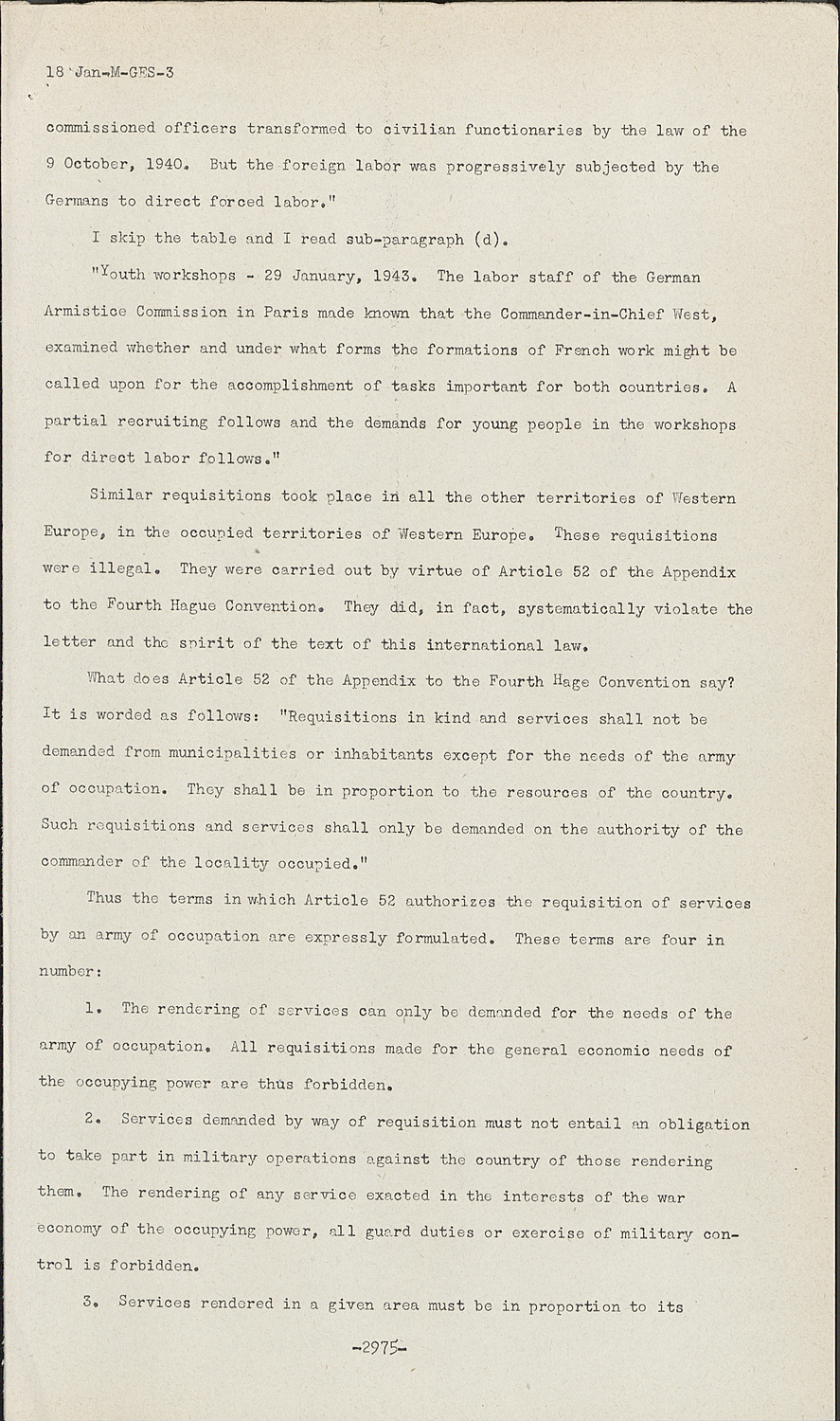
But the foreign labor was progressively subjected by the Germans to direct forced labor."
I skip the table and I read sub-paragraph (d).
"Youth workshops - 29 January, 1943. The labor staff of the German Armistice Commission in Paris made known that the Commander-in-Chief West, examined whether and under what forms the formations of French work might be called upon for the accomplishment of tasks important for both countries. A partial recruiting follows and the demands for young people in the workshops for direct labor follows."
Similar requisitions took place in all the other territories of Western Europe, in the occupied territories of Western Europe. These requisitions were illegal. They were carried out by virtue of Article 52 of the Appendix to the Fourth Hague Convention. They did, in fact, systematically violate the letter and the spirit of the text of this international law.
What does Article 52 of the Appendix to the Fourth Hage Convention say? It is worded as follows: "Requisitions in kind and services shall not be demanded from municipalities or inhabitants except for the needs of the army of occupation. They shall be in proportion to the resources of the country. Such requisitions and services shall only be demanded on the authority of the commander of the locality occupied."
Thus the terms in which Article 52 authorizes the requisition of services by an army of occupation are expressly formulated. These terms are four in number:
1. The rendering of services can only be demanded for the needs of the army of occupation. All requisitions made for the general economic needs of the occupying power are thus forbidden.
2. Services demanded by way of requisition must not entail an obligation to take part in military operations against the country of those rendering them. The rendering of any service exacted in the interests of the war economy of the occupying power, all guard duties or exercise of military control is forbidden.
3. Services rendered in a given area must be in proportion to its economic resources, the development of which must bot be hampered.
It follows that any requisitioning of lable is contrary to international law if it results in the impeding of prevention of the normal utilization of the riches of the occupied country.
4. Finally, labor requisitions must, under the provisions of the second paragraph of Article 52, be carried out in the area of the locality under the administration of the occupation authority who has signed the requisition order. The transfer of conscripted workers from one part of the occupied area to another, and, even more, their deportation to the country of the occupied power are prohibited.
Labor requisitions exacted by German civilian and military authorities in the occupied areas did not honor the spirit of Article 52.
They were carried out to satisfy either the needs of German economy or even the needs of military strategy of the enemy forces. They deliberately refused to acknowledge the need of ensuring facilities for a reasonable utilization of local resources; they finally took the form of migrations of workers. The case of those workers who were conscripted from all countries of Western Europe and formed an integral part of the Todt organization to help in building the system of fortifications known under the name of the "Atlantic Wall" may be taken as a typical example.
This violation of international agreements is a flagrant one; it called forth repeated protests from General Doyen, delegate of the French authorities with the German Armistice Commission. I ask the Tribunal to accept as evidence the letter of General Doyen, 25 May 1941. This letter constitutes Document 283, and it is placed before the Tribunal as session Document 23. I read:
"Wiesbaden, 25 May 1941. The General de Corps d'Armee Doyen, President of the French Delegation at the German Armistice Commission to Monsieur le General der Artillerie Vogl, President of the German Armistice Commission. "On several occasions, and notably in my letters No. 14,263/A.E. and 14,887/A.E. of 26 February and 8 March, I have had the honor of protesting to you against the vise in which the French labor was being called upon to be employed within the framework of the Todt organization in the execution of military work on the coast of Bretagne.
"I have today the duty of calling your attention to other cases in which the occupation authorities have recourse to the recruiting of French civilians to carry out services of a strictly military character, cases which are even more grave than those which I have already called to your attention.
"If, indeed, as concerns the workers engaged by the Todt organization, it may be argued that certain ones among them accepted voluntarily an employment for which they are being remunerated, although in practice most often they were not given the possibility of refusing this employment, this argument can by no means be invoked when the prefets themselves obliged at the expense of the departments and the communities of imposing guard services at important points, such as bridges, tunnels, works of art, telephone lines, munitions depots, and areas surrounding aviation fields.
"The accompanying note furnishes some examples of the guard services which thus have been imposed upon Frenchmen, services which before this were assumed by the German Army and which normally called upon them since it is a question of participating in watches or of preserving the German Army from risks flowing from the state of war existing between Germany and Great Britain."
I here end my quotation.
The occupying authorities, before the resistance which it encountered, were anxious that their orders regarding the requisitions of labor should be obeyed. The measures which they took to this end are just as illegal, just as criminal as the measures taken for the requisition itself. The National-Socialist authorities in occupied France proceeded by legislative means. They promulgated ordinances by which sentence of death could be pronounced against persons disobeying requisition orders. I submit two of these ordinances to the Tribunal as evidence. The first was given in the early months of the occupation, October 10, 1940. It was published in the Verordnungsblatt on the 17th of October 1940, page 108. I submit it to the Tribunal under the No. 24, and I read it:
"Ordinance relative to protection against acts of sabotage by virtue of the Four Powers which have been conferred upon me by the Fuehrer and Oberster Befehlshaber der Wehrmacht, I decree the following:
"I. Whoever intentionally does not fulfill or fulfills adequately the tasks of supervision which are conferred to him by the Chief of the Military Administration in France or by a service undertaken by the latter shall be condemned to death."
I skip paragraph 2, and I'll read paragraph 3.
"In less serious cases concerning infractions provided in paragraphs I and 2 of the present ordinance and in case of neglect, the guilty may be punished by reclusion or imprisonment."
The second ordinance of the Military Commander in France to which I refer is dated January 31, 1942; it was published in the Verordnungsblatt of the Militarbefehlsabers in Frankreict of 3 February 1942, page 338. I will read it to the Tribunal. I submit it under the No. 25. That reads as follows:
"Ordinance of 31 January 1942 concerning the requisitions of service and requisitions in goods.
"By virtue of the plenary powers which have been conferred, one by the Fuehrer and Oberster Befehlshaber der Wehrmacht, I order the following:
"I. First, anyone who does not carry out these services or the requisitions in goods which are imposed upon them by the Militarbefehlshaber in Frankreich or an authority designated by him or who accomplishes them in such a manner as to make the object of the services or requisitions fail shall be punishable by forced labor, imprisonment, or fine, A penalty of amendment may be uttered in addition to a penalty to forced labor or imprisonment.
"2. In serious cases the penalty of death may be inflicted." These orders were protested by the French authorities. General Doyen protested on several occasions against the first of these without his protest having any effect. I refer again to his letter of the 25th of May 1941, which I have just submitted to the Tribunal, and I read on page 4 of the French translation. This is paragraph 3.
"I am charged with protesting formerly to you against such practices and to beg you to intervene so that an immediate end may be put to this. From the 16th of November, in letter No. 7,843/AE, I already protested against the ordinance that was decreed on the 10th of October 1940 by the Chief of the Military Administration in France, which provided the death penalty against any person failing to carry out or carrying out inadequately the tasks of surveillance imparted by the occupation authorities. I protested then that this requirement, as well as its punishment, were contrary to the spirit of the Armistice Convention, whose object was to relieve the French population from any participation in the hostilities. I had limited myself to this protest in principle because at the time no concrete case in which such task of surveillance might have been imposed had been called to my attention, but it was not possible to accept as justifying the ordinance in question.
"In arguments which you furnished me in your letter No. 1361 of 6 March, you pointed out there, at Article 43 of the Hague Convention, that the occupying power had the authority to legislate, but the power to which you refer in this very article is subject to two qualifications: There can be legislation only to establish and to assure as far as possible public order and the necessities of public life. On the other hand, the ordinances decreed must--"
THE PRESIDENT:You have given sufficient evidence to show that General Doyen protested to the gentl eman. Read all the argument which was put forward on the one side or the other.
MR. HERZOG:I shall then stop this quotation, Mr. President.
The German ordinances which I have just read to the Tribunal thus contained formal violations of the general principles of the criminal legislation of civilized nations; they were made in contradiction of Article 52 at the fourth convention of the Hague, and in contradiction, also, were Article 43, on which they were supposed to be based. They were, therefore, illegal and they were criminal since they provided death sentences which no international law justifies.
The system of labor requisition furnishes the first example of the criminal character of the methods pursued by the defendants in the execution of their recruiting plan of foreign labor.
The National Socialist authorities then had recourse to a second procedure to give an appearance of legality to the recruiting of foreign workers. They called upon workers who were so-called volunteers. From 1940 on, the occupation authorities opened recruiting offices in all the large cities of the occupied territories.
These offices were placed under the control of a special service instituted to this effect within the general staff of the Commanders-in-Chief of the occupation zones.
The Tribunal knows that these services from 1940 to 1942 functioned under the control of the General. From 1942 on, and, more precisely, from the day when the defendant Sauckel became the plenipotentiary of labor, they received their orders directly from the latter. General vonFalkenhausen, Commander-in-Chief in Belgium and in the north of France, declared in the testimony which I just now read to the Tribunal that from the summer of 1942 on he had become the simple intermediary in charge of transmitting the instructions given by Sauckel to Arbeitseinsatz.
Thus the policy of the German employment offices set up in the occupied areas was carried out on the sole responsibility of the defendant Sauckel from 1942, under the responsibility of defendant Sauckel, being his direct chief, the delegate to the Four-Year Plan, the defendant Goering. I ask the Tribunal to make note of this.
The task of the employment offices was to organize the recruiting of workers for the factories and workshops set up in Europe by the Todt organization and by the Wehrmacht, Kriegsmarine, Luftwaffe, and other German organizations. It was also their task to obtain for the German munition factories the amount of foreign labor needed. Workers recruited in this way signed a labor contract. Thus they had, theoretically, the status of free workers and ware apparently volunteers. The occupation authorities always made a point of the voluntary nature of the recruiting carried out by the employment offices. But the lines taken by their propaganda systematically took no account of what they were actually doing. In fact, the voluntary character of this recruiting was entirely fictitious. The workers of the areas who agreed to sign German labor contracts were subject to physical and moral pressure.
This pressure took several forms: it was sometimes collective and sometimes individual; in all its forms it was heavy enough to deprive the workers who suffered under it of their freedom of choice. The nullity of contracts entered into under the reign of violence is a fundamental principle of the common law of civilized nations.