When the amount of work was not reached the chief guard would beat the whole row of women one after another so that the last women would wait petrified with horror, waiting for their turn.
When one wanted to go to the infirmary one needed the SS authorization. The SS very seldom gave it and if the doctor dispensed the woman from work for a few days it very often happened that the sick woman was fetched in her bed by the SS to put put back at the machine.
The atmosphere was frightful because one couldn't open the windows because of the blackouts and there was no ventilation whatsoever. All those who worked at the "Schneiderei eins" after a few months would become skeleton-like; would begin to cough; their sight began to fail; they had nervous fits caused by the fears of the blows.
I know the conditions of this workshop very well because my friend, Marie Rubiano, a young French girl, who had spent three years in the Kettbus prison, on arriving in Ravensbruecke had been sent to the "Schneiderei eins" and each evening she would tell me of her martyrdom. One day, exhausted, she was allowed to go to the Revier and on that day the German Schwester Erika was in a less bad humor than usual and she was sent to be examined. Her two lungs were very badly diseased. She was sent to the block of the tuberculars. This block was particularly terrible because tuberculars, not being considered as workers who could be recovered, they were not taken care of and there was not even personnel to wash them. There were hardly any medicines.
Little Marie was put into the room of those who were considered hopeless. She spent a few weeks there and she had not even the courage to struggle to live. I must say that the atmosphere of this room was particularly depressing. There were very many of them, several to a beds and beds in three tiers, in a superheated atmosphere, lying be-tween prisoners of different nationalities, so that they could not even talk to one another.
Also, the silence of this antechamber of death was broken only by the moans of the German women who did the services and from time to time by the smothered sobs of the little girl who was thinking of her mother, of her country that she would never see again.
Yet, Marie Rubino did not die fast enough for the SS, so that one day, Dr. Winkelmann, the specialist of selections in Ravensbrueck, put her on the black-list and on the 9th of February, 1945, with seventy-two other tubercular women, six of whom were French, she was lifted into the truck for the gas chamber.
During this period in all the infirmaries, the selections were made and all the sick were sent to the gas chamber, all who seemed unlikely to recover so that they could be used for work.
The Ravensbrueck gas chamber was just behind the wall of the camp, beside the crematorium. When the trucks came to fetch the prisoners we heard the sound of the motor through the camp and it would stop just beside the crematorium, whose chimney reached above the high walls of the camp. At the time of the liberation I went to this place and I visited the gas chamber, which was a wooden barracks, hermetically sealed and within there was still the unpleasant odor of the gas. The gas that was used -- I know in Auschwitz in any case -- was the same that was used to gas the blocks against lice. They left little pale green crystals as traces. After opening the windows of the block they were swept out. I know these details because the men used for the disinfection of blocks against lice were in contact with those who gassed human beings and they told them it was the same gas.
QWas this the only means used to exterminate the prisoners in Ravensbrueck?
ANo. At Block 10 there was likewise experimentation with white powder. One day the German Schwester Martha arrived in the block and distributed to twenty patients a powder. After this the patients fell into a deep sleep. Five or six were seized with fits of vomiting and this is what saved their lives.
In the course of the night little by little the sound of breathing stopped and the patients died.
I know this because I went every day to visit French women in this block, because two of the nurses were French and the woman doctor, Louise Le Porte of Bordeaux, could likewise testify to this.
QWas it often that this happened?
ADuring my stay this was the only case within the infirmary itself but the system was likewise used at the Jugendlager, called thus because it was a former reform school for young German delinquents.
Towards the beginning of the year 1944 Dr. Winkelmann, no longer satisfied with making selections in the Revier, these selections were likewise made in the blocks. All the prisoners had to answer roll-call in bare feet and show their chests and their legs. All those who were too old, ill, too thin, or whose legs were swollen with edma, were set aside, and then sent to this Jugendlager, which was a quarter of hour away from the camp of Ravensbrueck. I visited it upon the liberation.
In the blocks an order had been sent out to the effect that the old women and the patients who could not work should be enrolled for the Jugendlager, where they would be much better off; where they would not have to work; where there would be no roll-call. We found out later, through some people who worked at the Jugendlager -- the chief of the camp was a woman I knew from Auschwitz, named Bensenvitz -- and from a few of these survivors, one of whom is Irene Auclaire, a French woman living in Drance 17, Rue de la Liberte, who was repatriated at the same time that I and of whom I had taken care after the liberation. Through her we found out details about the Jugendlager.
QCould you tell us Madam, if you can answer this question, the SS doctors who made this selection, were they acting on their own or were they obeying orders?
AThey were obeying orders received, since one of them, Dr. Lukas, refused to participate in the selections and was withdrawn from the camp and from Berlin was sent Dr. Winkelmann, who replaced him.
QAre youpersonally aware of this fact?
A He is the one who said it to the chief of the block when he left and Dr. Louise Le Porte.
QCould you give us some information on the condition in which the men of the camp at Ravensbrueck were in on the morning of the liberation?
AI think it is better to speak first of the Jugendlager, because, chronologically, this comes before.
At the Jugendlager the women, I mean the old women and the ill who had left our camp, were put in blocks where there was no water and where there were no conveniences, on piles of straw on the ground, so close together that one couldn't pass between them, so that at night it was impossible to sleep because of the coming and going and the prisoners would dirty one another as they passed. The straw was rotten and swarming with lice. Those who could stand up would make the roll-call for several hours. In the month of February their coats were taken away from them, and they would continue to answer roll-call, which greatly increased the death rate.
They received by way of food only a thin slice of bread and a half quart of retabaga soup and the only drink that they had for twenty-four hours was half a quart of tea. They had no water to wash nor to drink, nor to wash their eating utensils.
In the Jugendlager there was likewise an infirmary where all those who could no longer stand up were placed. During the calls, periodically, the "Aufsehrein" would choose prisoners who would be undressed and who were allowed to keep only their shirts. Their coats were given back to climb into trucks and they would go off to the gas chambers. A few days later the coats would come back to the camp, that is to say, the clothing storeroom. There were marked "Mitwerder." The prisoners who worked at this store told us that "Mitwerder" did not exist, that it was a nomenclature for the gas chambers.
At the infirmary periodically white powder was distributed and the sick would die like those in Block 10, of which I spoke a while ago.
THE PRESIDENT:The details of the witness' evidence as to Ravensbrueck seems to be very much alike, if not the same, as at Auschwitz. Wouldn't it be possible to now, after hearing this amount of detail, to deal with the matter more generally, unlessthere is some substantial difference between Ravensbrueck and Auschwitz.
M. DUBOST:I think there is a difference which the witness has pointed out to us, which is that in Auschwitz the prisoners were simply exterminated; that it was simply an extermination camp, whereas at Ravensbrueck they were interned to work, were exhausted with work to the point where they died.
THE PRESIDENT:If there are any other distinctions between the two, no doubt you will lead the witness, I mean ask the witness about those other distinctions.
M. DUBOST:I shall do so. (By M. Dubost)
QCould you tell the Tribunal in what condition the men's camp was found at the time of the liberation and how many survivors there were?
AWhen the Germans left they left two thousand sick women and a certain number of volunteers, including myself to take care of them. They left us without water and without light. Fortunately the Russians arrived the following day. We therefore went to the men's camp and there we found a sight which is impossible to describe. They had been for five days without water. There were eight hundred seriously ill, three doctors and seven nurses, who were unable to pull the dead from the sick. Thanks to the Red Army we were able to transport these sick into clean blocks and to give them food and care. But unfortunately I can give the figure only for the French.
There were four hundred when we found the camp and there were only one hundred and fifty who were able to return to France; for the others it was too late in spite of the care we gave them.
QWere you present at the executions and do you know under what conditions were they carried out?
AI did not assist at any executions. I know only that the last one that took place was on the 22 of April, a week before the arrival of the Red Army. The prisoners were sent, as I said, to the Kommandantur; then their clothes would return and their cards were taken out of the file.
QIs this situation in these camps exceptional or do you consider it was a part of a system?
AIt is difficult to give an exact idea of the concentration camps when one has not been in them once because one can only cite examples of horror but one cannot give the impression of this slow monotony. When one asks what was the worst, it is impossible to answer because everything was atrocious. It is atrocious to die of hunger, to die of thirst, to be ill, to see around you all your companions dying without being able to do anything; to think of those children of one's country that one will never see again and at times we wondered ourselves if it was not a nightmare, so completely unreal did this life seem to us, so horrible.
We had a will for months and years; all that we could hope for was that a few of us would be able to come out to be able to tell the world what the Nazis were like. Everywhere as in Auschwitz, as in Ravensbrueck, the companions who were in other camps related the same facts; the systematic will, the implacable will to utilize men as slaves and when they could no longer work, to kill them.
Q Have you anything more to state?
I thank you.
M. DUBOST:If the Tribunal wishes to question the witness, she is at your disposal.
GENERAL RUDENKO:I have no questions.
DR. MARX:I speak for counsel of the SS, Attorney Babel. Attorney Babel is prevented this morning from appearing here, since he has to attend a conference with General Mitchell.
My Lords, I should like to take this occasion to ask the witness a few questions dealing with this matter. BY DR. MARX:
QMadam Courtourier, you declared you were arrested by the French Police.
AYes.
QWhy were you arrested?
ABecause of resistance activity.
QI didn't hear the answer.
AActivity in the resistance movement.
QActivity in the resistance movement. Now, a further question. Your testimony shows--please wait until my question is completed.
What preconceptions did you have, and what attitude did you take?
AWhat was that? What did you say? I don't understand the question.
QWhat position did you occupy? Did you ever occupy an official position?
AWhere?
QFor example, as a teacher or lecturer?
ABefore the war?
QBefore the war, yes.
AI don't see what the question has to do with that. I was a journalist.
QYes. The matter is thus: In your testimony you showed great fluency in style and expression, and I should like to know whether you had such a position as teacher or lecturer.
ANo, I was a photographic reporter.
QHow do you explain that you yourself came through these experiences so well that you are now in a good state of health?
A First of all, I was liberated a year ago. In a year once has time to recover.
Then, next, I was ten months, as I indicated, in quarantine, and I had the luck not to die of typhus, although I had it and was ill for three months and a half.
On the other hand, at Ravensbrueck, in the last months, as I know German, I worked to make the roll-call of the Revier so that I didn't have to be subjected to the bad weather. Out of 250, only 52 of us were left at the end of four months. I was lucky enough to come back.
QYes. Does your testimony concern itself only with your own observations, or did you also give testimony that was hearsay?
AEach time I pointed out in my statement when this was the case. I never said anything that was not verified at the sources, and by several persons, but the major part of my statement is based on a personal experience.
QHow is to be explained that you have precise statistical knowledge, for instance, that 700,000 Jews arrived from Hungary?
AI told you that I had worked in the offices, and, as concerned Auschwitz, that I was a friend of the Secretary of the Oberhaufseherin, whose name and address I gave to the Tribunal.
QThe assertion has been made that only 350,000 Jews came from Hungary, according to the testimony of the Gestapo Chief, Eichmann.
AI don't want to argue with the Gestapo, I have good reason to know that what it declares is not always true.
QHow were you treated personally? Were you treated well?
ALike the others.
Q Like the others.
You said before that the German people knew of what went on in Auschwitz. What are your grounds for this statement?
AI base it, on the one hand, on the fact that when we left, the Lorraine soldiers of the Wehrmacht said to us, in the train, "If you knew where you were going you would not be in such a hurry"--.
THE PRESIDENT:Madam, you are going too fast.
A (Continuing): I have this information, on the one hand, from the fact that the Lorraine soldiers of the Wehrmacht, who transported us to Auschwitz, told us, "If you knew where you were going, you would not be in a hurry to get there." On the other hand, from the fact that the German women who came out of quanantine together and worked in factories had knowledge of these facts, and they all said that they would tell on the outside.
Third, from the fact that in all the factories where Haeftlings, prisoners, worked, they were in contact with German civilians, as well as with the Aufseherin. They had relations with their families and friends, and often would tell what they had seen.
QOne more question. Until 1942 you were able to observe the behavior of German soldiers in Paris. Did these German soldiers behave altogether decently, and didn't they pay for what they took?
AI have no idea whether they paid for their requisitions.
As for the proper treatment, too many of my people were shot or massacred for me to wish to express an opinion on this subject.
DR. MARX:I have no further question to put to the witness.
THE PRESIDENT:If you have no further questions, there is nothing more to be said.
DR. MARX:Very well, I am finished.
THE PRESIDENT:There is too much laughter in the Court; I have already spoken about that.
I thought you said you had no further questions.
DR. MARX:I simply wanted to make the provision for attorney Babel that he might later take the witness under cross-examination, if that is possible.
THE PRESIDENT:Babel did you say?
DR. MARX: Yes.
THE PRESIDENT:I beg your pardon; yes, certainly. When will Dr. Babel be back in his place?
DR. MARX:I presume that he will be back this afternoon. He is in the building. However, he must first read the protocol deposed by the witness.
THE PRESIDENT:We will consider the question. If Dr. Babel is here this afternoon we will consider the matter, if Dr. Babel makes a further application.
Does any other of the Defendants' counsel wish to ask any questions of the witness?
(No response)
M.Dubost, have you any questions you wish to ask on re-examination?
M. DUBOST:I have no further questions to ask.
THE PRESIDENT:Then the witness may retire.
-----
M. DUBOST:If the Tribunal will allow, we shall now hear from Mr. Veith, another witness. JEAN FREDERIC VEITH took the stand.
THE PRESIDENT:Are you calling this witness on the treatment of prisoners in concentration camps?
M. DUBOST:Yes, Mr. President, and also because this witness can give us information on ill-treatment which certain war prisoners had been victim of in concentration camps. It is not merely a question of concentration camps, but of soldiers who had been transported to concentration camps and who had received the same treatment as civilians.
THE PRESIDENT:Well, you won't lose sight of the fact that there has been practically no cross-examination of the witnesses you have already called about the treatment in concentration camps? The Tribunal, I think, feels that you could deal with the treatment in concentration camps somewhat more generally than the last witness.
Are you not hearing what I say?
M. DUBOST:Yes, I hear it very well.
THE PRESIDENT:The Tribunal thinks that you could deal with the question of treatment in concentration camps rather more generally now, after we have heard the details from the witnesses whom you have already called.
M. DUBOST:Is the Tribunal willing to hear this witness? BY THE PRESIDENT:
QWhat is your name?
AJean Frederic Veith.
QWill you repeat this oath?
Do you swear to speak without hate or fear?
AI swear to speak without hate or fear.
QTo say the truth, all the truth, and only the truth?
AAll the truth, and nothing but the truth.
THE PRESIDENT:Raise your right hand.
THE WITNESS:I swear it.
THE PRESIDENT:Would you like to sit down?
THE WITNESS:Thank you. BY M. DUBOST:
QWill you give your name, please? Give your first name.
AJean Veith.
I was born on the 28th of April, 1903, in Moscow.
QAre you of French nationality?
AYes.
QOf birth?
AOf French parents.
QYou were a prisoner in what camp?
AI was a prisoner in Mauthausen, from the 22nd of April, 1943, until the 22nd of April, 1945.
QDo you know about the work that was done in factories supplying the Luftwaffe with material? Who controlled these factories?
AI was in the Arbeitseinsatz Kommando, Mauthausen, from June 1943, and consequently I have seen all the matters which relate to the work.
QWho controlled the factories working for the Luftwaffe?
AThe work in Mauthausen had external camps where workers worked at Heinkel, at Messerschmitts, at Fabian, at Sauer Werke, Wien, and the working of the tunnel of the Abel Pass, which was by the Alpine-Montana.
QWho controlled this work? Was it your surveyors or engineers?
AThere was only as SS surveyance. The work was controlled by the engineers of the factories.
Q Did these engineers belong to the Luftwaffe?
AI saw, on certain days, Luftwaffe officers who came to visit the Messerschmitt factories that were in the vicinity.
QWere they able to inform themselves of the condition in which the prisoners were living and working?
AYes, certainly.
QDid you see any Nazi officials visiting the camp?
AI saw numerous officials; among others, Himmler, Kaltenbrunner, Pohl, Maurer, the chief of the Labor Bureau, and numerous other visitors, whose names I do not know.
Q who told you that Kaltenbrunner came there?
AThe office was opposite the open square, which overlooked the Kommandatur, so we could see the persons arriving; and the SS themselves would tell us "There is so and so; there is so and so."
QCould the civillian population be informed of what was going on?
AYes, it was able to be informed because at Mauthausen there was a road which was close to the quarry, one could see everything in passing on this road. Besides the workers, the prisoners worked in the factories. They were separated from the workers, but just the same they had certain contacts with them, and it was quite possible to know what their conditions were.
QCan you tell us what you know about the trip to an unknown castle of a car containing prisoners which were never seen again?
AAt a certain moment, at Mauthausen, they proceeded, by injections to eliminate the ill. It was particularly Dr. Spritzbach, who, at a given moment-- he was called Dr. Spritzbach by the prisoners because he had inaugurated the system of injections. At a given time injections ceased to be made, and at this time the people that were too ill were sent to a castle, which we later learned was called Altheim, which was officially designated as Genesungslager; that is to say, a convalescant camp. None of the people that went there ever returned. We received the lists of deaths directly from the political section of the camp. These lists were secret. All those who went to Altheim died. The figure is about five thousand.
Q Did you see war prisoners arrive at the Mauthausen Camp?
AI saw war prisoners, certainly. Their arrival at the Mauthausen Camp, first of all, happened before the political section. As I was working at the oelerei, my office overlooked the open space, which was before the political section, where the convoys arrived. These convoys were immediately selected.
Some were sent to the camp to be regi-
stered, and so on. Very often prisoners in uniform were put aside. These underwent special punishment and were directly handed over to the prison guards, passed through their hands, and nothing was further said of them.
They were not registered in the camp. It was through the political section that this happened, which was in charge of these prisoners.
QThey were war prisoners?
AThey were war prisoners. They were in uniform.
THE PRESIDENT:Don't go so fast, please.
A (continuing) They were generally men in uniform.
BY M. DUBOST:
QOf what nationality?
AEspecially Russians and Poles.
QThey were taken to your camp to be killed?
AThey were taken into our camp under action.
QCan you tell me how you found out about this action?
AWhat I know about Action K comes from the fact that I was directing the dolorite service in Mauthausen, and consequently I received all the transfer sheets of the various camps. And when there were K prisoners, who by mistake were transferred to us as ordinary prisoners, we would put on the transfer sheet, which we had to send through the Central Office of Berlin no, we did not put any numbers on these sheets. The Politische Leiter gave us no indication and even tore up the list of the names if, by chance, it reached us.
Through conversations with my companions, I found out that these K actions concerned war prisoners who were taken while attempting to escape. Later this action was extended still, to soldiers, but extended to certain individuals, particularly officers caught in the countries taken by the Germans, who had escaped but who had been captured again.
Besides, all persons who were active in any way that could be interpreted as not in conformity with the desires of the Nazi Chiefs could also be subject to Action K. These prisoners arrived at Mauthausen and would disappear; that is to say, they were brought into the prison and were immediately executed.
They would pass to the annex of the prison, which was the famous Block 20 of Mauthausen.
QYou are talking about war prisoners, are you not?
AYes. This applies in major part to war prisoners.
QCan you tell us about any particular execution of war prisoners taken to the Mauthausen camps?
AI cannot give you any names, but there are names.
QHave you seen allied officers executed who were killed within 48 hours of their arrival?
AI saw the arrival of the convoy of the 6th of September; I think that is the one you are referring to. I saw the arrival of this convoy, and in the afternoon these 47 went into the quarry clothed merely in shirts and underdrawers. Shortly after, the sound of machine guns was heard, and as I came out of the office I passed behind, pretending to bring documents into another office, and with my own eyes I saw that these poor unfortunates had been shot down. Eighteen of them were executed that very afternoon, and the others were executed the following morning. All the death certificates carried the notation afterwards, "Shot while, attempting to escape".
QDo you have the list of names?
AYes, I have the list of these prisoners.
THE PRESIDENT:Perhaps this would be the best time to break off.
(Whereupon at 1250 hours the hearing of the Tribunal adjourned, to reconvene at 1400 hours).
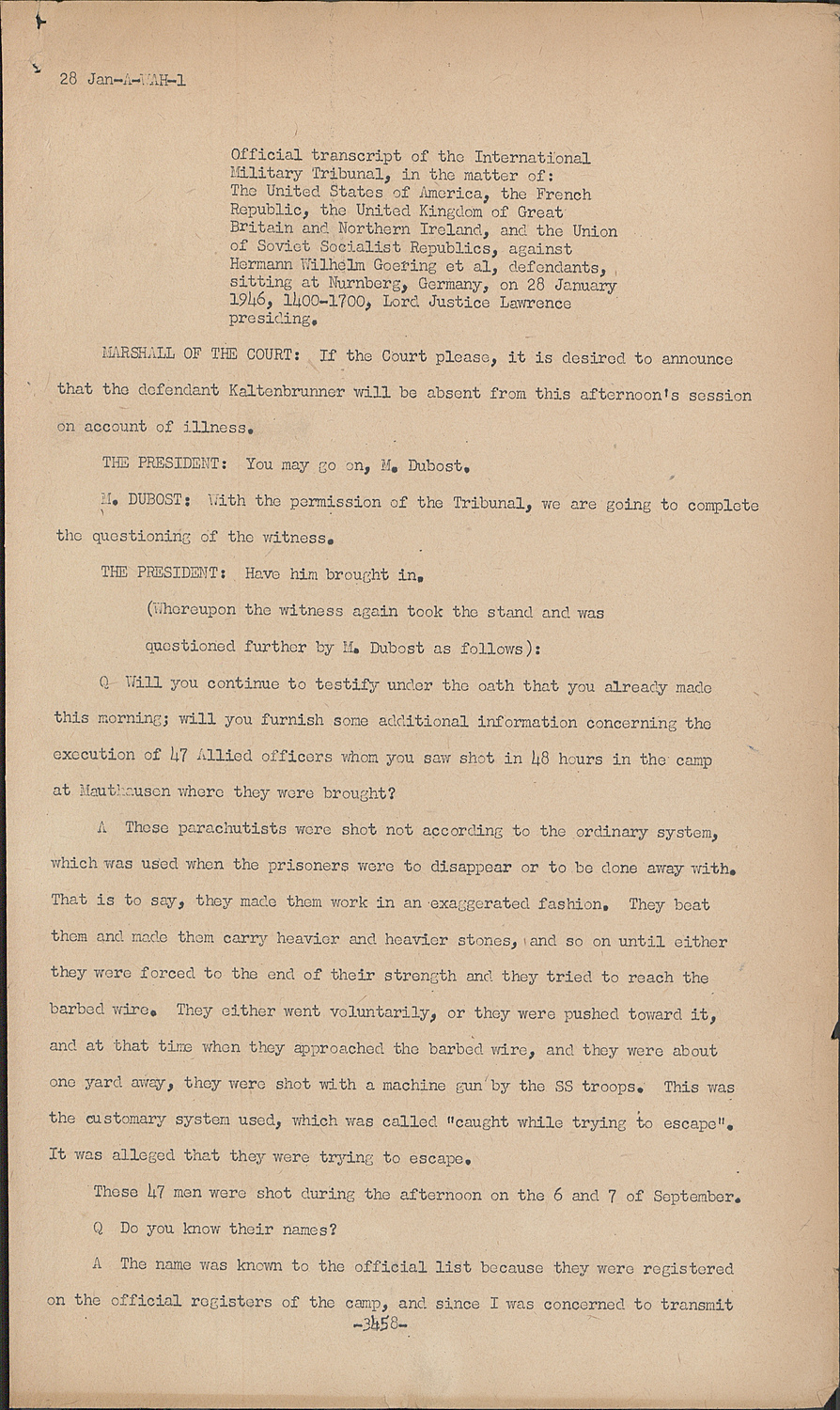
Official transcript of the International Military Tribunal, in the matter of:
The United States of America, the French Republic, the United Kingdom of Great Britain and Northern Ireland, and the Union of Soviet Socialist Republics, against Hermann Wilhelm Goering et al, defendants, sitting at Nurnberg, Germany, on 28 January 1946, 140-1700, Lord Justice Lawrence presiding.
MARSHALL OF THE COURT:If the Court please, it is desired to announce that the defendant Kaltenbrunner will be absent from this afternoon's session on account of illness.
THE PRESIDENT:You may go on, M. Dubost.
M. DUBOST:With the permission of the Tribunal, we are going to complete the questioning of the witness.
THE PRESIDENT:Have him brought in.
(whereupon the witness again took the stand and was questioned further by M. Dubost as follows):
QWill you continue to testify under the oath that you already made this morning; will you furnish some additional information concerning the execution of 47 Allied officers whom you saw shot in 48 hours in the camp at Mauthausen where they were brought?
AThese parachutists were shot not according to the ordinary system, which was used when the prisoners were to disappear or to be done away with. That is to say, they made them work in an exaggerated fashion. They beat them and made them carry heavier and heavier stones, and so on until either they were forced to the end of their strength and they tried to reach the barbed wire. They either went voluntarily, or they were pushed toward it, and at that time when they approached the barbed wire, and they were about one yard away, they were shot with a machine gun by the SS troops. This was the customary system used, which was called "caught while trying to escape". It was alleged that they were trying to escape.
These 47 men were shot during the afternoon on the 6 and 7 of September.
QDo you know their names?
AThe name was known to the official list because they were registered on the official registers of the camp, and since I was concerned to transmit or to make known all changes of names in the forces, making it known to Berlin, I saw all the lists of those who came and went.
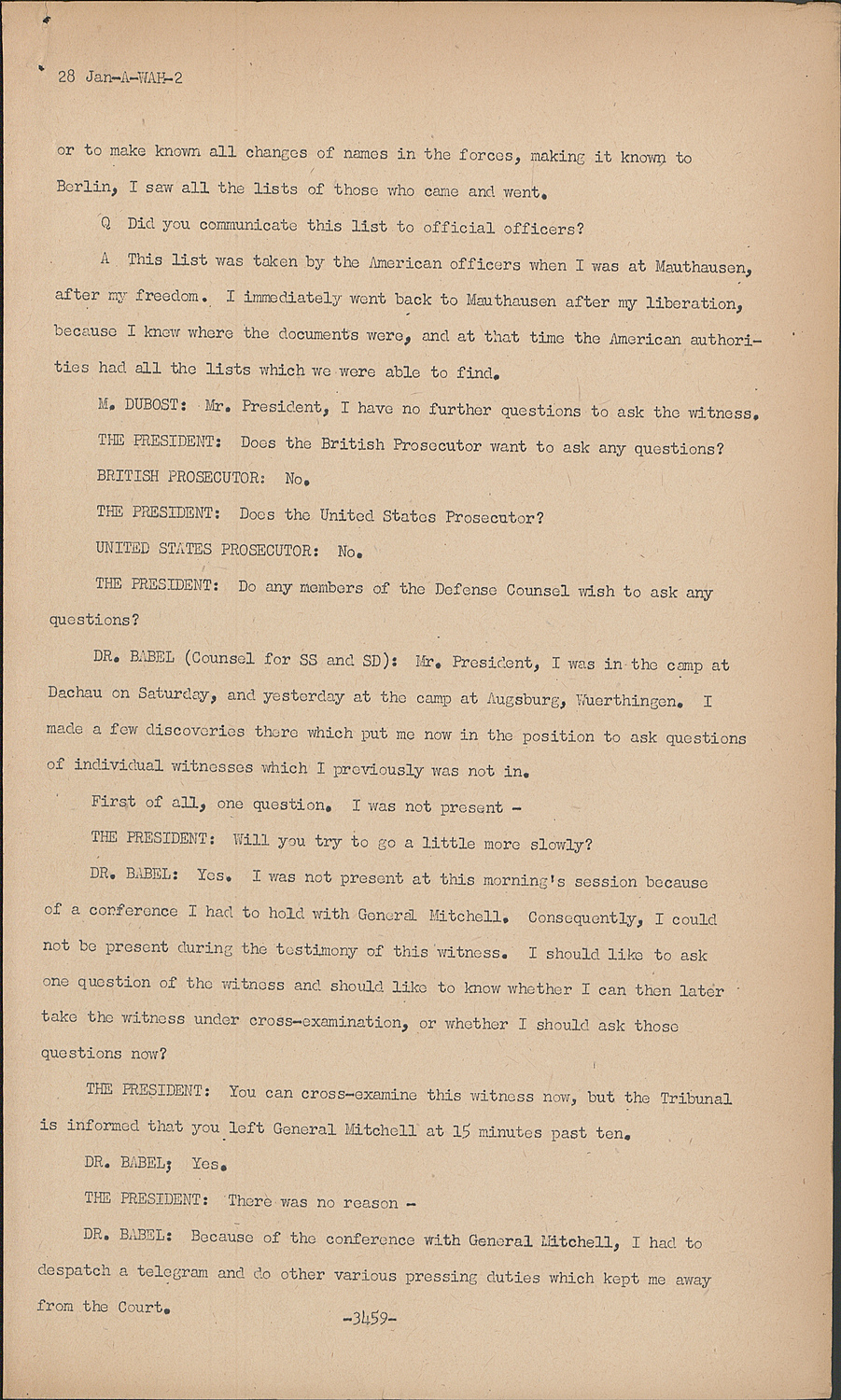
QDid you communicate this list to official officers?
AThis list was taken by the American officers when I was at Mauthausen, after my freedom. I immediately went back to Mauthausen after my liberation, because I knew where the documents were, and at that time the American authorities had all the lists which we were able to find.
M. DUBOST:Mr. President, I have no further questions to ask the witness.
THE PRESIDENT:Does the British Prosecutor want to ask any questions?
BRITISH PROSECUTOR:No.
THE PRESIDENT:Does the United States Prosecutor?
UNITED STATES PROSECUTOR:No.
THE PRESIDENT:Do any members of the Defense Counsel wish to ask any questions?
DR.BABEL (Counsel for SS and SD): Mr. President, I was in the camp at Dachau on Saturday, and yesterday at the camp at Augsburg, Wuerthingen. I made a few discoveries there which put me now in the position to ask questions of individual witnesses which I previously was not in.
First of all, one question. I was not present
THE PRESIDENT:Will you try to go a little more slowly?
DR. BABEL:Yes. I was not present at this morning's session because of a conference I had to hold with General. Mitchell. Consequently, I could not be present during the testimony of this witness. I should like to ask one question of the witness and should like to know whether I can then later take the witness under cross-examination, or whether I should ask those questions now?
THE PRESIDENT:You can cross-examine this witness now, but the Tribunal is informed that you left General Mitchell at 15 minutes past ten.
DR.BABEL; Yes.
THE PRESIDENT:There was no reason
DR. BABEL:Because of the conference with General Mitchell, I had to despatch a telegram and do other various pressing duties which kept me away from the Court.
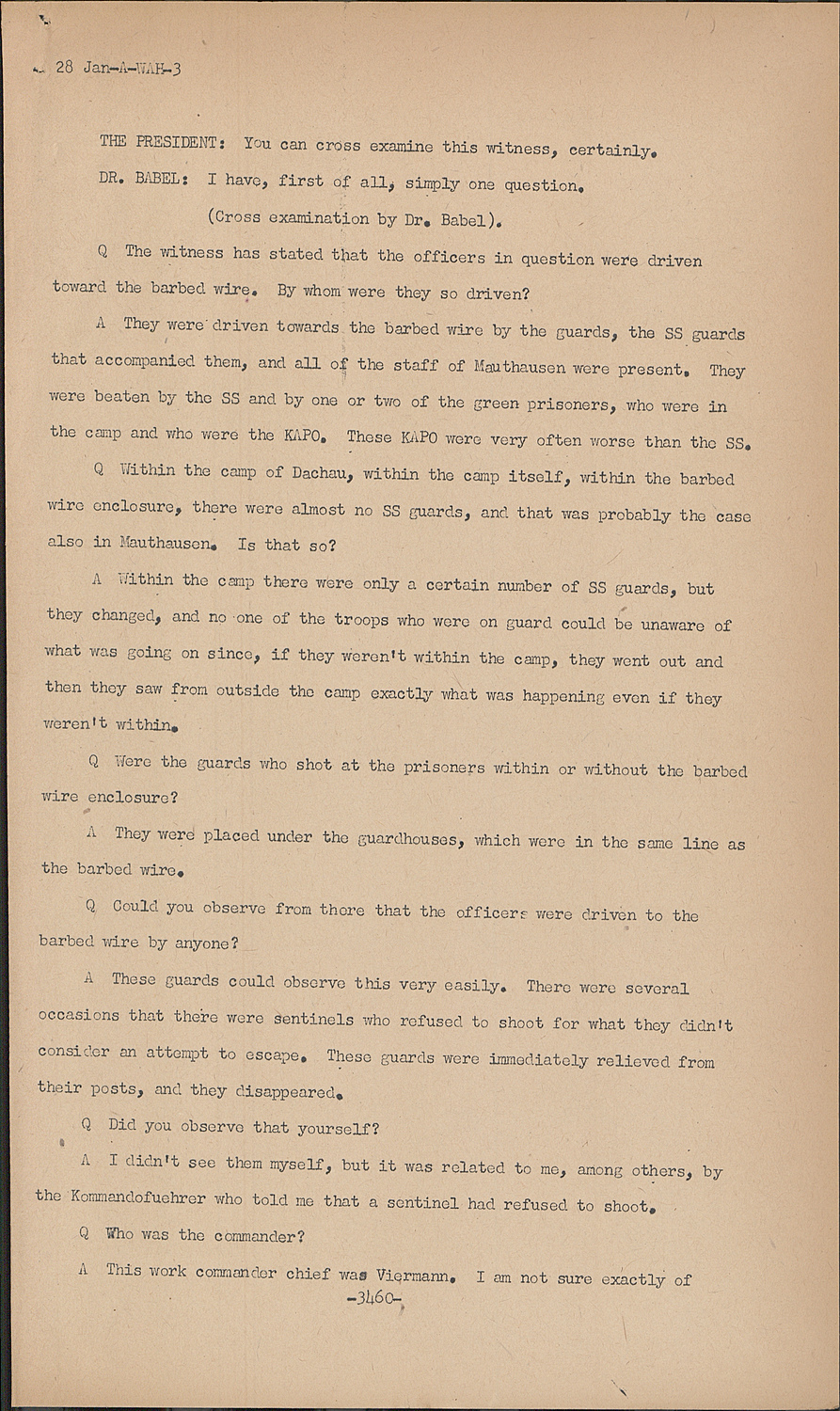
THE PRESIDENT: You can cross examine this witness, certainly.
DR. BABEL:I have, first of all, simply one question.
(Cross examination by Dr. Babel).
QThe witness has stated that the officers in question were driven toward the barbed wire. By whom were they so driven?
AThey were driven towards the barbed wire by the guards, the SS guards that accompanied them, and all of the staff of Mauthausen were present. They were beaten by the SS and by one or two of the green prisoners, who were in the camp and who were the KAPO. Those KAPO were very often worse than the SS.
QWithin the camp of Dachau, within the camp itself, within the barbed wire enclosure, there were almost no SS guards, and that was probably the case also in Mauthausen. Is that so?
AWithin the camp there were only a certain number of SS guards, but they changed, and no one of the troops who were on guard could be unaware of what was going on since, if they weren't within the camp, they went out and then they saw from outside the camp exactly what was happening even if they weren't within.
QWere the guards who shot at the prisoners within or without the barbed wire enclosure?
AThey were placed under the guardhouses, which were in the same line as the barbed wire.
QCould you observe from there that the officers were driven to the barbed wire by anyone?
AThese guards could observe this very easily. There were several occasions that there were sentinels who refused to shoot for what they didn't consider an attempt to escape. These guards were immediately relieved from their posts, and they disappeared.
QDid you observe that yourself?
AI didn't see them myself, but it was related to me, among others, by the Kommandofuehrer who told me that a sentinel had refused to shoot.
QWho was the commander?
AThis work commander chief was Viermann. I am not sure exactly of his rank.
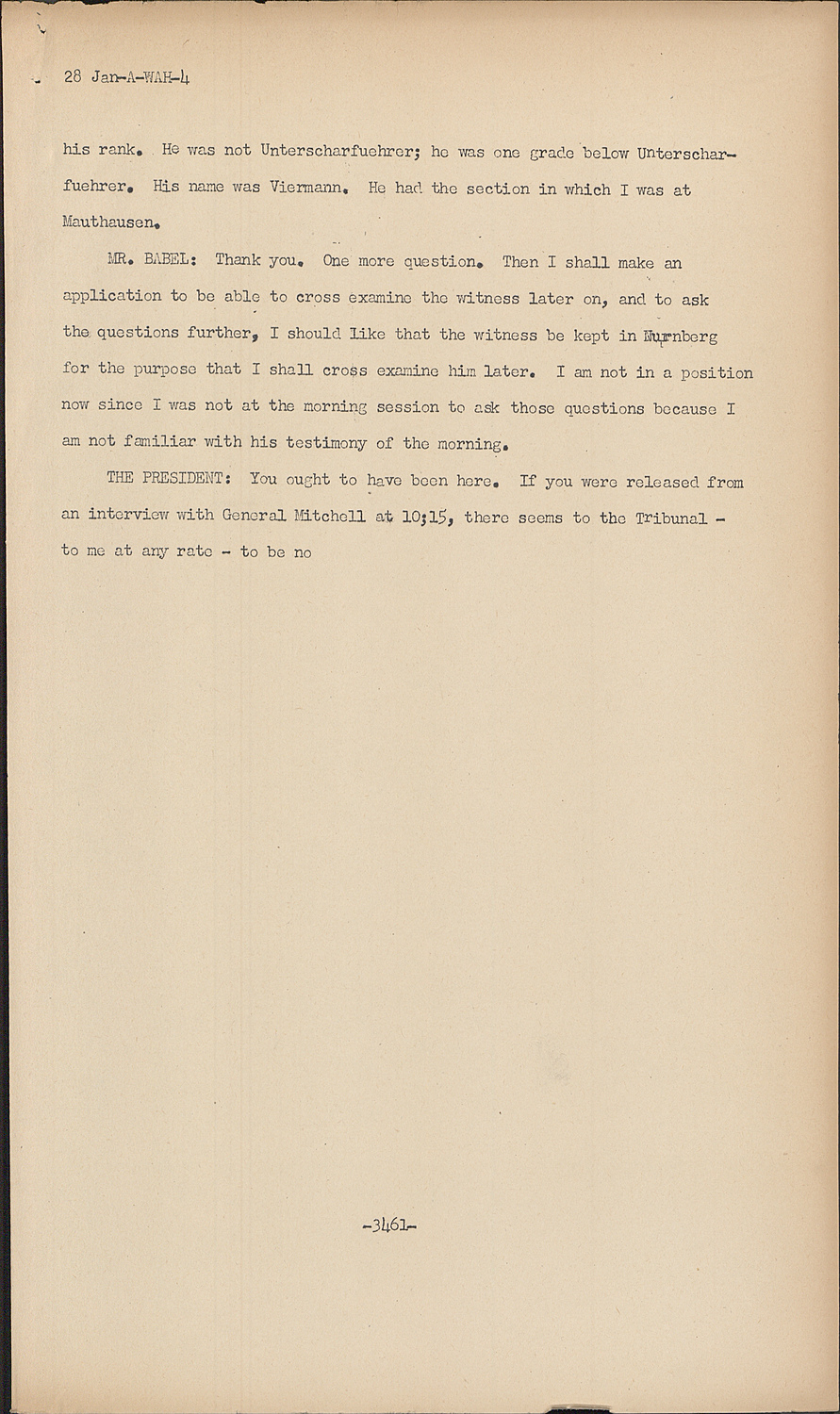
He was not Unterscharfuehrer; he was one grade below Unterschar-
fuehrer. His name was Viermann. He had the section in which I was at Mauthausen.
MR. BABEL:Thank you. One more question. Then I shall make an application to be able to cross examine the witness later on, and to ask the questions further, I should like that the witness be kept in Nurnberg for the purpose that I shall cross examine him later. I am not in a position now since I was not at the morning session to ask those questions because I am not familiar with his testimony of the morning.
THE PRESIDENT:You ought to have been here. If you were released from an interview with General Mitchell at 10;15, there seems to the Tribunal to me at any rate - to be no reason why you shouldn't have been here whilst this witness was being examined.