M. DUBOST: The letter of transmittal has a seal and the fact that the letter by which it was transmitted had a seal shows that this document is authentic.
The letter through which this document was transmitted, that letter had a seal upon it.
THE PRESIDENT:Is the explanation that you have torn off the Appendix from this document and have put in the Appendix separately?
M. DUBOST:I did not tear any document, Mr. President. I received an official document, whose authentic character is attested by the letter of conveyance or transmittal. The letter accompanying this document had an official seal.
THE PRESIDENT:Where is this letter?
M. DUBOST:The letter is at the top of the paper, at the right.
THE PRESIDENT:I see the letter now, yes.
M. DUBOST:May I continue now, Mr. President?
THE PRESIDENT:No.
This document here (indicating) has a letter attached to it. This document here (indicating) is not referred to in that letter specifically, it is not referred to particularly in the letter. Therefore, there is nothing to connect the two documents together.
M. DUBOST:There is, it seems, a manuscript note on the margin. I have not the document before me here but I think there is a namuscript note in the margin and, Mr. President, you can see it.
THE PRESIDENT:The Tribunal wishes you to put this in as one document.
I see there is a manuscript note here at the side, in writing, which refers to the Appendix. If you will put the whole thing in together -
M. DUBOST:It is all submitted as one document; all these papers are submitted as one document.
I wish to read now, to the Tribunal, extracts from two letters addressed to the German Armistice Commission at Wiesbaden by the ex-ambassador Scapini, both dated the 4th of April, 1941. The Tribunal will find them reproduced in the document book before them, pages 16, 17, 18, 19, 20, 21 and 22. It is dated the 4th of April, 1941, at the top of the page to the right, page 16.
"Mr. Scapini, Ambassador of France to his Excellency Mounsieur Abetz, German Ambassador at Paris.
"Purpose: Men captured after the Armistice Commission came into being and treated as war prisoners."
At the bottom of the page where it deals with the Geneva Convention:
"The Geneva Convention applies only to a state of war concerning captures. Now, armistice suspends war operations. Hence, any man captured after the Armistice Commission was created and treated as a war prisoner is wrongfully retained in captivity."
On pages 17, third paragraph -- Article 4 concerns the Armistice Convention. It states only that the French Armed Forces stationed in regions occupied by Germany should rapidly be brought back to the non-occupied territory and be demobilized but the Article does not say a thing which would be contrary to the Geneva Convention, that is, that they be taken into captivity.
Fifth paragraph of the same page -- "First Civilians. If it is admitted that civilians can not be treated as war prisoners by their capture before the Armistice, it is all the more a strong reason not to consider than as captured after the Armistice. I notice in relation to the subject, amongst those captured, they were carried out several months after the end of hostilities."
Then on page 18, the top of the page, concerning categories of civilians: "With reference to what you will find in my first letter, I wish to add that civilians demobilized who were going back to their homes in the occupied zone after the Armistice and were quite frequently captured on their way home and sent into captivity as a result of the initiative of local or military authorities.
"Secondly, as to soldiers, I call attention to the Convention that men who were freed after the Armistice and could not be provided, for one reason or another because of the difficult circumstances of the period, which the regular document of demobilization -- a number of them were captured and taken into captivity under the same conditions as the preceding period."
I think the Tribunal will not require the reading of that example, but if the President wishes it I shall read it.
Let us go to page 19, the second half of the page, the last paragraph.
"Civilians not subject to military requirements: It is obvious that these men could not be considered soldiers according to French law.
They can be classified, according to age, into three groups.
"(a) Men under twenty-one not yet mobilized. Example: Flanquart Alexandre, eighteen years old, captured at Courrieres by the German troops, in the Department Pas-de-Calous, at the time of the arrival of these troops in that region. His address in captivity is No. 65-381, Stalag II-B.
"(b) Men between twenty-one and forty-eight who were not mobilized, who were demobilized or who were considered unfit for service."
The Tribunal will may observe the examples without my reading them.
"There were men especially assigned to the Army; there were two kinds. I will classify them into two groups: first men especially assigned to military formations, established according to the mobilization in different ministerial departments, according to the following chart (on page 21 at the top of the page). Those assigned especially, who were kept mobilized in the positions which they held at the time of the peace in military services or establishments.
"Example: Men in artillery storage boxes, civilians especially assigned.
Contrary to the preceding, the civilians who were assigned did not truly belong to military formations and did not depend on military authority.
They were arrested too.
"Example: (I skip here several lines) Mouisset, Henri, especially assigned to the factory Marret-Bonnin."
I skip several lines -- "Address in captivity: No. 102 Stalag II-A."
Those people were not all freed, for from it. Some remained prisoners until the end of the war.
Arrest of Dutch Officers. We shall cite now document submitted under Number 304 RS, in your document book, shown on page 15 BIS. The text may be summarized in a few words.
It is the story of Dutch officers who had been freed after the capitulation of the Dutch Army and receptured shortly afterwards to be sent, in captivity, to Germany.
Paragraph 3 of this document states on the 9th of May, 1942, there was published in the Dutch newspapers a summons addressed to all career officers of the former Dutch Army who were on active service May 10, 1940, according to which they were to be present on the 15 of May, Friday, 1942, at the Barracks Chasse at Breda.
Paragraph 5 states that more than one thousand career officers came forward to this barracks and the doors were closed after them, Paragraph 7 -- A German officer of high rank in the OKW declared that the officers had not kept their word to undertake no actions against the Fuehrer and as aresult of this they were to be kept in captivity.
The following paragraph states that they were taken from the station at Breda to Nurnberg, in Germany.
Numerous obstacles were placed in the way. Six French officers who for reason of health, should have been sent back to their families. We shall cite a document already submitted under Number 297, page 23 of your document book and I read the first paragraph?
"The question of freeing French generals, war prisoners of the Germans for reasons of health or age was taken up on several occasions by French authorities."
This reproduction is not quite clear.
I continue with paragraph 2.
"The Fuehrer, always, insofar as this question is concerned, maintained an attitude of refusal as far as thei being freed was concerned as well as their hospitalization in foreign countries or neutral countries.
"Paragraph 3. A freeing or hospitalization today is even less considered In the manuscript there is no reply given to the French note.
This note, in fact, was addressed by the Supreme Commander of the German Army to the German Armistice Commission, who consulted with General Staff on the point as to whether or not to reply to the request concerning the freeing of French generals who were ill, from the de facto government of France at that time.
Much more serious measures were undertaken against our war prisoners by the German authorities, when for reasons of a patriotic nature, some of our compatriots who were imprisoned caused the Germans to feel or become sensitive to the fact that they were not willing to collaborate with Germany. The German authorities considered those of our compatriots who thug acted as not being assimilated and they were dangerous because of their courage and their determination. And the measures formulated concerning them were truly murderous.
We know of numerous examples of murders perpetrated upon the persons of war prisoners, either because they took part in commando work or because they were anti-Hitler, or they were reproached because they tried to escape or even simply because they accused them of inactive resistance acts or simply because of ethical resistance against the Nazi regime. These murders were carried out by means of deportation and the internment of these prisoners in concentration camps. While interned in these camps they forced them to live under a regime about which you know and which naturally led them to death or they killed them quite simply with a bullet in the back of the neck, which was the method which has been described by our American colleagues and which I will not need to present or go over.
In other cases they were lynched on the spot in conformity to orders given or because of the tolerant attitude of the German Government towards the population as to these acts or in other cases, they were handed over to the Gestapo.
I will she you at the end of my statement that in the last years of the occupation they had the right to carry out executions.
With the authorization of the Tribunal, we shall study two cases of extermination of combatants, captured after military action or operations; that of the commandos and that of aviators.
As the Tribunal knows men who were commandos were most always volunteers In any event, they were selected from amongst the most courageous combatants and they were the ones who showed the greatest physical aptitude for combat. We can consider them, therefore, as the elite and the order for their extermination tended to annhilate the elite and terror to reign in the ranks of the Allied Armies.
From a political point of view the execution of the commandos cannot be justified. The Germans themselves, moreover, used in a large measure, the commando operations. As far as their own men were concerned, when they became prisoners they always required that they be recognized as belligerants. However, they failed to give that quality to our men or those of the Allied Armies. Insofar as that is concerned, the major order concerning this was signed by Hitler and is dated the 18th of October, 1942, and it received most wide-spread carrying out.
This order preceded other orders of the OKW, which show that the question had been carefully studied before becoming a final order of the Chief of the German Government.
Under Number 553-PS, the Tribunal will find on page 24 of the document book, an order signed by Keitel which we submit under Number 326. This order formulates the policy that all parachutists who are in small groups or alone it is dated the 4th of August, 1942, page 25 and the Tribunal will see it is signed by Keitel, paragraph 3 - but it has already been read and the Tribunal will excuse me from reading it.
On the 7th of October, 1942, a communique of the OKW, disseminated by the press and radio, announced the decision taken by the High Command to execute all who engaged in sabotage activity.
On page 6, the Tribunal will find in the document book, extracts from the "Volkische Beobachter", 8 October 1942, it states:
"In the future all troops concerned with terrorism or sabotage among the British soldiers and their allies, will not be considered as soldiers but as bandits; will be treated as such by the German troops and shot on the field of battle without any concern whatsoever, no matter where they entered in action."
Under the number 363 we submit notes of a meeting of the General Staff of the Wehrmacht, which is dated the 14th of October 1942, paragraph three, page twenty-seven.
"In the period of total war, sabotage becomes an essential requirement of operation. It is our purpose to point out our own attitude. The enemy can prove some of our own propaganda copies."
Page twenty-nine, paragraph three, the end of the paragraph, still from the notes of this meeting, dated the 14th of October 1942, the General Staff of the Army.
"Sabotage is an essential element, and we have developed it ourselves as a means of combat."
THE PRESIDENT:What paragraph?
M. DUBOST: The third paragraph. Then the sixth paragraph.
"The intention to liquidate in the future all groups of terrorists and saboteurs who conduct themselves or act as bandits has already been received by radio. Consequently you must consider that the task of the General Staff ot the Army is only to give directives for practical execution in order that troops may know what they should do so far as these groups are concerned."
Page thirty. The Tribunal will see what were the orders which were given as far as treatment and what the German General Staff called "Groups of terrorists and Brittanic saboteurs." So far as other saboteurs are concerned, the commandos of the adversary were assured that the German General Staff never considered their own groups of commandos, terrorists, and saboteurs.
Paragraph one, fourth line:
"This order is to be applied to any group of the British Army in British uniform or not in British uniform." I cite: "We must exterminate them without any consideration or comment."
Paragraph (b). "Members of terrorist groups and sabotage groups of the British army who in uniform have conducted themselves before our troops in dishonorable fashion contrary to the law of nations must be kept in separate custody."
I skip two lines and I read: "The instructions on the treatment to be inflicted upon them will be given by the General Staff of the Army; in effect, the juridical service and the department for foreign countries."
Finally, page thirty-one, paragraph two: "A group of terrorists and saboteurs will always henceforth be considered as acting contrary to the laws of war. For example, aggressors, saboteurs, agents, soldiers in uniform or not in uniform carrying out aggressions or aggressive acts, acts of barbarism, according to the opinion of our troops."
Paragraph three. "In that event the groups will be annihilated to the last man during combat or when they try to escape," Fourth paragraph.
"It is forbidden to intern them in war prison camps."
Thus in carrying out these orders, if the British soldiery, even in uniform, were captured during these commando operations, the German troops were to be their judges and to judge whether they had acted according to the laws of war or not; and without any appeal subordinates could annihilate them to the last man even when they are not engaged in active fighting.
These orders were applied to British commandos.
We shall cite now Document 498-PS, submitted by our American colleagues under the number 364, and which confirms the information which we have just brought to the Tribunal by the reading of the preceding document. It seems useless to read this document.
THE PRESIDENT:Mr. Dubost, had the document on page thirty-one been received before? - the one you just read?
M. DUBOST:Document thirty-one, which I have just read, was not read.
THE PRESIDENT:The next one hasbeen read, has it not, 498?
M. DUBOST:Document 498, which I said to the Tribunal that I was not going to read from, was read by our American colleagues. The Tribunal will find it nevertheless in this document book on pages thirty-two and thirtythree.
THE PRESIDENT:There are two points to which I wish to draw your attention. In the first place, it is said that you are not offering these documents in evidence, you are simply reading them, and they must be offered in evidence so that the document itself may be put in evidence.
You haven't offered in evidence any of these documents; you have just been reading from them or have given them numbers.
M. DUBOST:Mr. President, they were all filed, all of them were filed except two which were already filed by our colleagues, and all were filed with a number which can be given to you immediately.
I shall ask the French secretary to give you the number of filing.
THE PRESIDENT:They have all been put in evidence already?
M. DUBOST:Excuse me, Mr. President, some were filed, and I gave them a French number under which they were filed.
THE PRESIDENT:You are saying, "have been put in evidence by some other member of the prosecution;" is that right?
M. DUBOST:That is correct, Mr. President. When I cite I even give the number by which they were filed by the American Prosecution.
THE PRESIDENT:That was filed by the American Prosecution, was it not:
498, on page 32?
M.DUBOST: 498 was filed under the number USA-501. I said that to you, sir.
THE PRESIDENT:I am speaking of 498, page 32.
M.DUBOST: 498 is the American number 501. The number 498-PS, which is in your document book on page 32, was filed by my American colleagues under the number 501.
THE PRESIDENT:Very well.
M. DUBOST:I don't want to read it. I just want to comment on it very briefly.
THE PRESIDENT:Very well. With reference to the document which preceded it on page 28, 29, 30 and 31-
M. DUBOST:I will ask the French secretary to give them to you with the number under which they were filed.
THE PRESIDENT: Have they been filed by the American Prosecutor too?
M. DUBOST:Not all. Some were filed by the American Prosecution and others were filed by me.
THE PRESIDENT:All I am pointing out-- I think, M. Dubost, that what the Tribunal wants you to do is when you put in a document-
M. DUBOST:Will you excuse me, Mr. President. I don't understand.
THE PRESIDENT:I haven't finished the sentence. What I was saying was, what the Tribunal wants you to do is, when, you put in a document, if it hasn't already been put in, give it a number and announce the exhibit number so that the record may be complete.
Is that clear?
M. DUBOST:It is clear, Mr. President, but I believe that I have done it from the beginning, since the French secretary gave you the figures.
THE PRESIDENT:You may have put numbers on the documents, but you haven't announced them in some cases.
There is another matter which I wish to state and it is this.
When I spoke before, what I asked you to do was to confine yourself to any new points, and you are now giving us evidence about commandos and about British commandos, all of which has been thoroughly gone into in previous stages of the trial, and that appears to us to be unnecessary.
M. DUBOST:If the Tribunal will pardon me, one of these documents from which I have read was submitted before.
I just reached the document which had been cited before, and I ask the Tribunal to permit me from making a commentary on it, since the document is already known by the Tribunal.
THE PRESIDENT:Well, we have had a good deal of evidence already about the treatment of commandos and sabotage groups, evidence, if I remember right, which attempted to draw some distinction between troops which were dropped from the air, for instance, close up to the battle zone, and troops that were dropped at a distance behind the battle zone.
You had quite a lot of evidence upon that subject.
If there is anything which is of special interest to the case of France we should be most willing to hear it, but we don't desire to hear cumulative evidence upon subjects which we have already had.
M. DUBOST:I didn't think that I had brought cumulative proof to the Tribunal in reading a document which had not previously been cited from, but since that is so I will not read from them further.
It must be emphasized, however, in our eyes the responsibility of Keitel, who curiously co-operated in the orders which were given for the execution of these orders which were carried out.
Document 510-PS, page 48, has not been read.
We submit it under the number 367, and we ask the Tribunal to consider it as officially filed; a document relative to the orders which were given concerning the debarkment or invasion of British attachments at Matmos and Piskopi.
The memorandum from the General Staff to the commander of the different units, No. 532-PS, which is the appendix to this document.
We submit this document under the number 367, and we ask the Tribunal to receive it as officially submitted.
Now we reach the execution of Allied aviators who were captured.
From the presentation which was made considering this question, the Tribunal has learned that a certain number of aerial operations were considered as criminal acts by the German Government, who indirectly facilitated the extermination or killing of these aviators by the population.
I don't have to go into this memorandum again. This is document 263, which has already been cited as USA 334.
Within the framework or scope of these instructions orders were given by the letter of 4 June 1944 to the Ministry of Justice, in order that they might prescribe any prosecution against German civilians who might have murdered Allied aviators.
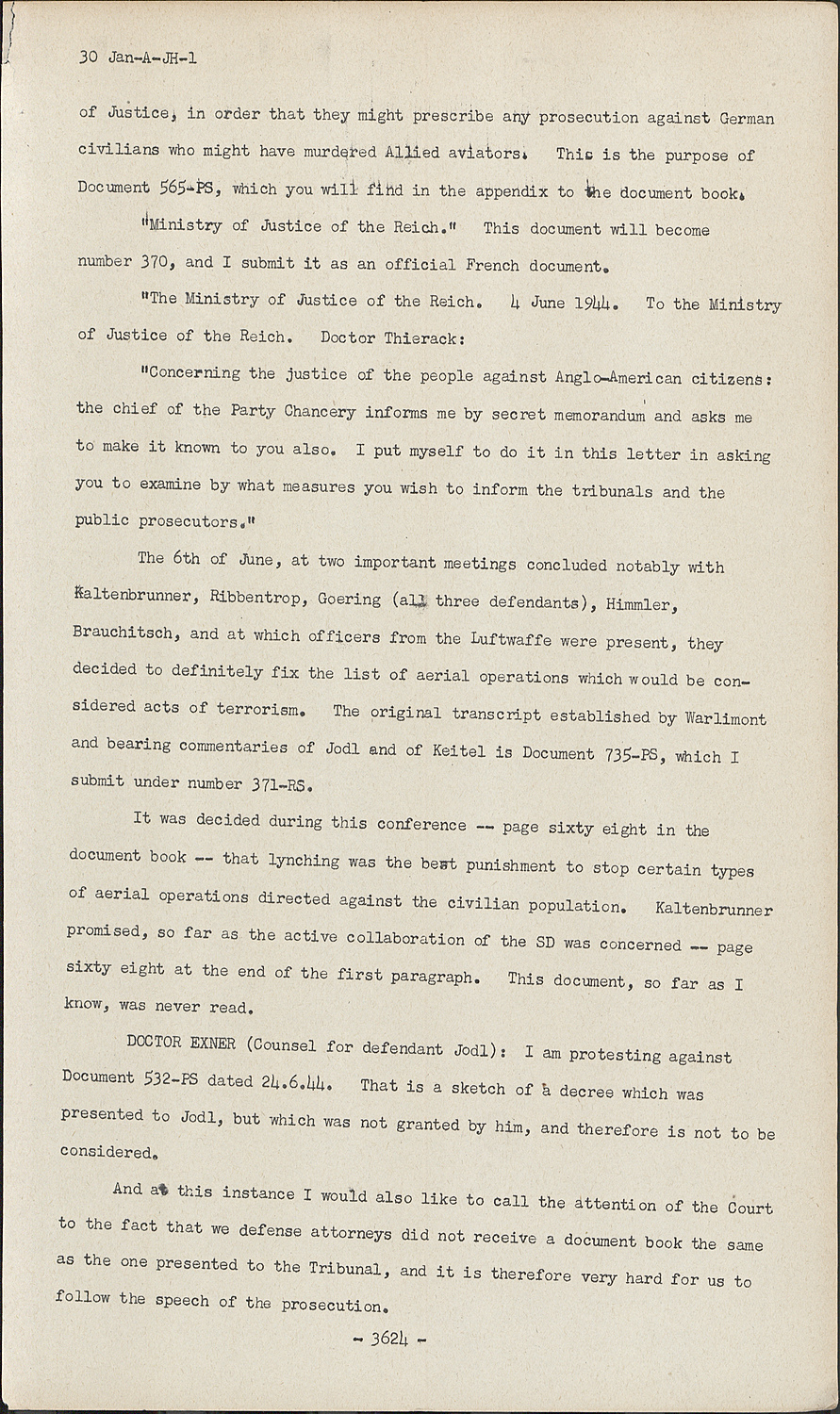
This is the purpose of Document 565-PS, which you will find in the appendix to the document book.
"Ministry of Justice of the Reich." This document will become number 370, and I submit it as an official French document.
"The Ministry of Justice of the Reich. 4 June 1944. To the Ministry of Justice of the Reich. Doctor Thierack:
"Concerning the justice of the people against Anglo-American citizens: the chief of the Party Chancery informs me by secret memorandum and asks me to make it known to you also. I put myself to do it in this letter in asking you to examine by what measures you wish to inform the tribunals and the public prosecutors."
The 6th of June, at two important meetings concluded notably with Kaltenbrunner, Ribbentrop, Goering (all three defendants), Himmler, Brauchitsch, and at which officers from the Luftwaffe were present, they decided to definitely fix the list of aerial operations which would be considered acts of terrorism. The original transcript established by Warlimont and bearing commentaries of Jodl and of Keitel is Document 735-PS, which I submit under number 371-RS.
It was decided during this conference -- page sixty eight in the document book -- that lynching was the beet punishment to stop certain types of aerial operations directed against the civilian population. Kaltenbrunner promised, so far as the active collaboration of the SD was concerned -- page sixty eight at the end of the first paragraph. This document, so far as I know, was never read.
DOCTOREXNER (Counsel for defendant Jodl): I am protesting against Document 532-PS dated 24.6.44. That is a sketch of a decree which was presented to Jodl, but which was not granted by him, and therefore is not to be considered.
And a this instance I would also like to call the attention of the Court to the fact that we defense attorneys did not receive a document book the same as the one presented to the Tribunal, and it is therefore very hard for us to follow the speech of the prosecution.
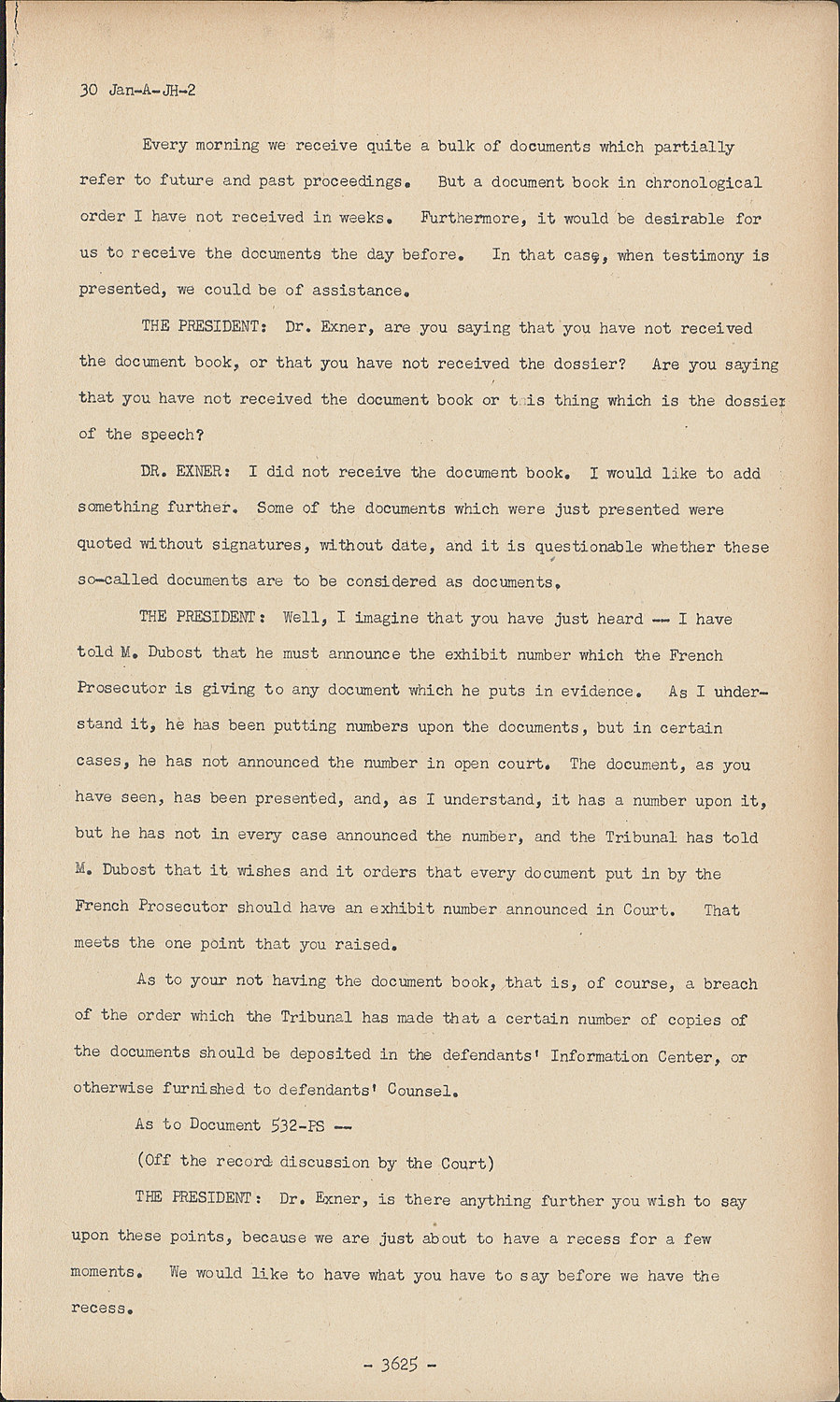
Every morning we receive quite a bulk of documents which partially refer to future and past proceedings.
But a document book in chronological order I have not received in weeks. Furthermore, it would be desirable for us to receive the documents the day before. In that case, when testimony is presented, we could be of assistance.
THE PRESIDENT:Dr. Exner, are you saying that you have not received the document book, or that you have not received the dossier? Are you saying that you have not received the document book or this thing which is the dossier of the speech?
DR. EXNER:I did not receive the document book. I would like to add something further. Some of the documents which were just presented were quoted without signatures, without date, and it is questionable whether these so-called documents are to be considered as documents.
THE PRESIDENT:Well, I imagine that you have just heard -- I have told M. Dubost that he must announce the exhibit number which the French Prosecutor is giving to any document which he puts in evidence. As I understand it, he has been putting numbers upon the documents, but in certain cases, he has not announced the number in open court. The document, as you have seen, has been presented, and, as I understand, it has a number upon it, but he has not in every case announced the number, and the Tribunal has told M. Dubost that it wishes and it orders that every document put in by the French Prosecutor should have an exhibit number announced in Court. That meets the one point that you raised.
As to your not having the document book, that is, of course, a breach of the order which the Tribunal has made that a certain number of copies of the documents should be deposited in the defendants' Information Center, or otherwise furnished to defendants' Counsel.
As to Document 532-PS -
(Off the record discussion by the Court)
THE PRESIDENT:Dr. Exner, is there anything further you wish to say upon these points, because we are just about to have a recess for a few moments. We would like to have what you have to say before we have the recess.
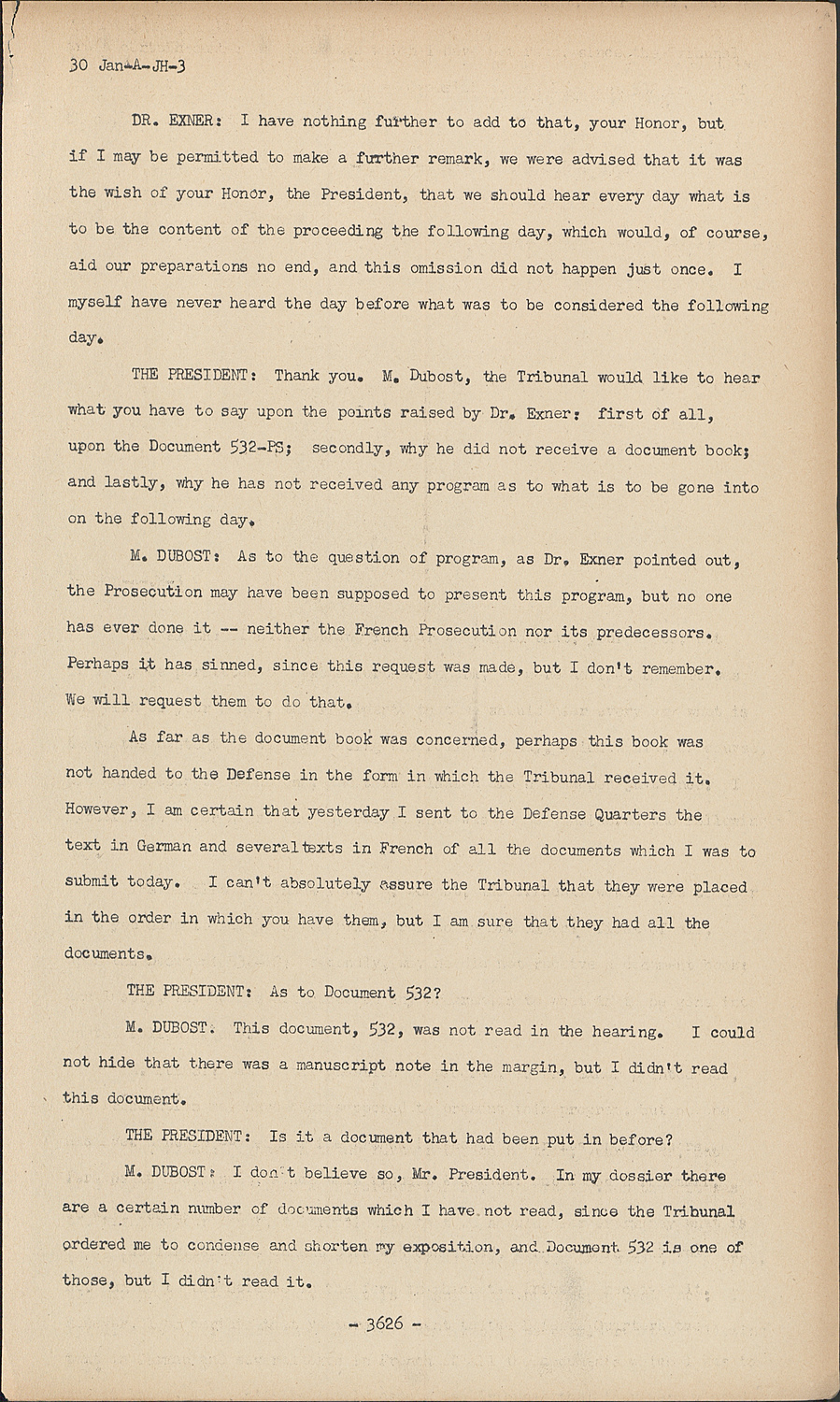
DR. EXNER: I have nothing further to add to that, your Honor, but if I may be permitted to make a further remark, we were advised that it was the wish of your Honor, the President, that we should hear every day what is to be the content of the proceeding the following day, which would, of course, aid our preparations no end, and this omission did not happen just once.
I myself have never heard the day before what was to be considered the following day.
THE PRESIDENT:Thank you. M. Dubost, the Tribunal would like to hear what you have to say upon the points raised by Dr. Exner; first of all, upon the Document 532-PS; secondly, why he did not receive a document book; and lastly, why he has not received any program as to what is to be gone into on the following day.
M. DUBOST:As to the question of program, as Dr. Exner pointed out, the Prosecution may have been supposed to present this program, but no one has ever done it -- neither the French Prosecution nor its predecessors. Perhaps it has sinned, since this request was made, but I don't remember. We will request them to do that.
As far as the document book was concerned, perhaps this book was not handed to the Defense in the form in which the Tribunal received it. However, I am certain that yesterday I sent to the Defense Quarters the text in German and several texts in French of all the documents which I was to submit today. I can't absolutely assure the Tribunal that they were placed in the order in which you have them, but I am sure that they had all the documents.
THE PRESIDENT:As to Document 532?
M. DUBOST.This document, 532, was not read in the hearing. I could not hide that there was a manuscript note in the margin, but I didn't read this document.
THE PRESIDENT:Is it a document that had been put in before?
M. DUBOST:I don't believe so, Mr. President. In my dossier there are a certain number of documents which I have not read, since the Tribunal ordered me to condense and shorten my exposition, and Document 532 is one of those, but I didn't read it.
THE PRESIDENT: I know you didn't read it, but did you purport to put it in evidence?
M. DUBOST:I didn't read it, Mr. President.
THE PRESIDENT: I know you didn't read it, but did you put it in evidence?
Did you give it a number?
M. DUBOST:It is part of this series of documents which I did not read since I wish to summarize and shorten my presentation.
THE PRESIDENT:Well, M. Dubost, I have said that I knew that you did not read it, and I have asked you -- I think twice -- whether you purported to put it in evidence. Did you give it a number?
M. DUBOST:Yes, that is correct, 368, yes.
THE PRESIDENT:The document, according to Dr. Exner, is a draft of a decree which was presented to Jodl but wasn't granted by him. Those were his words, as they came through on the translation, and, therefore, he submits that it is not to be considered, and there is nothing to show that the document was ever anything more than a draft.
If so, isn't it clear that it ought not to be received in evidence?
M. DUBOST:This is a question which the Tribunal will decide after having heard the explanation of Dr. Exner. This document didn't seem to me of major importance in my presentation, since I didn't read from it. At any rate, I could not hide from the Tribunal that there was a manuscript note on the margin, and it is certain that this manuscript note is an element to be taken into consideration, and which the Tribunal will consider whether the document should be received or not be received, after having heard the explanations of the Defense.
(Whereupon the Tribunal recessed from 1540 hours to 1605 hours.)
DR. NELTE:Dr. Nelte, defense counsel for Keitel.
Mr. President, I had occasion during the intermission to talk to my client, Keitel. The French Prosecutor had before- this intermission referred to a document and had read from a note from Admiral Darlan, addressed to the French Ambassador Scapini. This had been introduced in evidence.
The French Prosecutor seeks, as I take it from his words, to prove by this document that the German generals agreement concerning the French troops had not been kept. In consideration of the seriousness of this, I would be obliged to the French prosecution if they would declare with respect to this document, first, whether these recriminations of the French Government had been brought to the attention of the German Government.
THE PRESIDENT:Document 668, is it?
DR.NELTE: 668, yes.
THE PRESIDENT:Are you referring to Document S-668?
DR. NELTE:Yes, additional number No. 2.
THE PRESIDENT:It would be more convenient if you could refer to the document by the usual document number. The document I have is Document S-668, at the top of the document.
DR. NELTE:On my document it has been inserted in pencil.
THE PRESIDENT:Is it dated the 4th of April, 1941?
DR. NELTE:It has no date.
THE PRESIDENT:Will you hand it up?
(The paper was handed to the President.)
Yes, I follow now. What do you say about it?
DR. NELTE:The French Prosecutor had concluded from this document that what was contained in this document was also proved. I would like to point out that it is an excerpt from a note of Admiral Darlan, addressed to the French Ambassador Scapini. In other words, this document does not show whethe Ambassador Scapini had taken the necessary steps with the German Government or, furthermore, what the German Government had answered to this note. For this reason I would like to ask the French Prosecutor to declare whether he can find in his document that these very serious recriminations have been brought to the attention of the German Government, and secondly, what the German Government answered. Since that document is in possession of the Allies, it is not possible to ask Keitel to produce it.
(M. Dubost stepped before the microphone.)
THE PRESIDENT:Perhaps the most convenient course would be, if you wish to say anything about the objection which Doctor Nelte has just made, for you to say it now. As I understand it, that objection is that this document, 668, is a note by Admiral Darlan complaining that certain French troops were surrendered on the terms that they were not to be made prisoners of war, but were afterwards sent to Germany as prisoners of war. What Doctor Nelte asks is, was that matter taken up with the German Government, and if so, what answer did the German Government give?
That seems to the Tribunal to be a reasonable request for Doctor Nelte to make.
M. DUBOST:A reply has been given, Mr. President, through the reading of the appendix of Ambassador Scapini's statement addressed to Ambassador Abet.
THE PRESIDENT:My attention is drawn to the fact that the two documents to which you refer are dated the 4th of April. The document to which Doctor Nelte refers is a subsequent document, namely, one dated the 22nd of April. Therefore it does not appear from documents which were anterior to the document of 22nd April as to what happened afterward.
(There was no reply.)
THE PRESIDENT:Did that not come through to you?
M. DUBOST:Mr. President, I am not aware of this. These documents were given to me by the official French service. They are from regular parliamentary archives and were put together by the French official service.
THE PRESIDENT:Perhaps it should be investigated and found out whether the matter was taken up with the German Government and what answer the German Government gave. Not at the moment but in the course of time.
M. DUBOST:I shall have to apply to the French Government in order to discover whether in our archives there is any trace of any communications in the sense indicated, that is, by the French Government to the German Government.
THE PRESIDENT:In the event of your not being able to get any satisfactory explanation, the Tribunal will take notice of Doctor Nelte's objection, or criticism, rather, of the document.
It is pointed out to me the fact that the two earlier documents to which you are referring are documents addressed by the Ambassador of France to M. Abetz, the Ambassador of Germany, and it may be, therefore, that they are similar correspondence in reference to Document No. 668 here in the same file, which is the file that the French Government presumably has accomplished, or might have accomplished.
M. DUBOST:It is possible that is the hypothesis, and I naturally think that that was possible.
THE PRESIDENT:Therefore, you can not express yourself for the moment as to the other matter which is raised by Dr. Exner; then the Tribunal stress itself that Document 532-PS should be stricken out of the record insofar as it is in the record. For the present if the United States and the French prosecutors wish to say that the document will again probably be put in evidence at a future date, they may apply to do so. Then assume that the defendant's counsel, Dr. Exner, for instance, wishes to make any use of the document, of course, he is at liberty to do so.
In reference to the other matters which Dr. Exner raised, it is the wish of the Tribunal to assist defendants' counsel any way possible in their work, and that they are, therefore, most anxious that the rules which they have laid down as to documents should be strictly complied with, and they think that copies of the original documents certainly should contain anything the original documents do contain.
This particular Document No. 532-PS, as a copy, I think I am right in saying does not contain the marginal note in the script which the original contains. At any rate it is important that copies should contain everything which is in the originals.
Then there is another matter to which I wish to refer. I have already said that it is very important that documents, when they are put in evidence, should not only be numbered as exhibits, but that the exhibit number should be stated at the time, and also even more important, or as important, that the certificate certifying where the document comes from should also be produced for the Tribunal. Every document put in by the United States bears upon it a certificate stating where it had been found, or what was its origin, and it is important that that practice should be adopted in every case.