Therefore, I would like to ask that the Tribunal please decide whether it is necessary that the confiscation of art objects in France will be taken up once more.
THE PRESIDENT:I think Defendant's Counsel must be wrong in thinking that the U.S. Counsel said anything which meant that the French Prosecution couldn't produce evidence with reference to the spoliation of objects of art.
I can't think the United States had any authority to do that and I had understood myself that this part of the prosecution had been omitted by one of the French Counsel on account of the request of the Tribunal to shorten their argument.
Was that not so?
M. FAURE:That is quite true, Mr. President. Your inter pretation is exact.
THE PRESIDENT:I think the Tribunal would wish that the presentation should be made if the French Prosecutors wish it, and it should be made as shortly as possible.
M. FAURE:Thank you.
(Whereupon, at 17.25 hours the Hearing of the Tribunal adjourned to reconvene at 10.
00 hours on Wednesday, February 6, 1946.)
Official transcript of the International Military Tribunal in the matter of the United States of America, the French Re public, the United Kingdom of Great Britain and Northern Ireland, and the Union of Soviet Socialist Republics against Herman Wilnelm Goering et al, Defendants, sitting at Nurnberg, Germany, on 6 February 1946, 1000-1245, Lord Justice Lawrence presiding.
M. FAURE:If it please the Tribunal, M. Gerthoffer will now present the brief concerning the pillage of art works.
M. GERTHOFFER:The Economic Section of the French Delegation prepared an exposition or a statement concerning the pillage of works of art in the occupied countries of Western Europe. In order to cut short, in this presentation -- we had thought that we would not present this, in the session of the 22nd of January, but we were holding ourselves at the disposal of the Tribunal if they considered it necessary for this to be presented at a later date. However, since on the 31st of January, the American Prosecution informed us that the Defendant Rosenberg intended to maintain that the artistic treasures were only collected in order to be protected, we consider, from the documents which we have at the disposal of the Court, that there is no possible interpretation of mere protection, that this was true spoliation. I am at the Tribunal's disposal to prove this, in the brief, which I will cut short as much as possible, and in submitting the documents which we have collected.
If the Tribunal wishes, I shall make a very rapid statement.
Mr. President and gentlemen. The pillage of art works presents a cultural aspect, which I will not go over again since it was brought out by Colonel Storey On the 18th of December, 1945. I shall simply regard the subject from the economic point of viewin order not to take up the general pillage of the works of art in Western Europe.
As the Tribunal recognizes, the Nazi leaders, or the Reich leaders, seized principally, in a systematic way, works of art belonging to private citizens, most often under the pretext that these citizens were Israelites. Thus, they procured for themselves a very exact means of exchange. In Belgium, in Holland, in Luxembourg, and in France, from art galleries, public collections as well as private collections, old furniture, porcelain and jewelry were stolen.
This was not merely individual spoliation, the pillaging by soldiers, which one finds in all wars, and as we still find examples; this campaign of spoliation was carried out in a systematic and disciplined manner. The methods used were diverse. The whim or the personal act of individuals could be carried out only in the measure in which it seconded the execution of the plan prepared by the National Socialistleaders, even before the month of June 1940. The official organization for pillaging was principally the Special General Staff of Minister Rosenberg for the Occupied Territories of Western Europe and of the Netherlands. If this organization was not the only agent, it was the most important.
Colonel Storey has already drawn the attention of the Tribunal to this criminal attitude. The will or the desire of seizing works of art, as well as material wealth, was the foundation of the policy of National Socialist expansion. The attitude in Poland of the Defendant Frank has already given sufficient proof.
Beginning with the invasion of Western Europe, the idea of protecting this valuable booty appears. In their haste and their desire to seize as much as they could, several parallel authorities carried out confiscations; the military authorities first, either indirectly as in Holland, with the special services of the Devisenschutzkommando, or directly, as was the case in France, with the service called Artistic Protection. The civil authorities then, paralleling this, were entrusted with the same mission, whether it concerned the German Embassy in Paris or in the low countries, or the Office of Enemy Property in Holland, depending upon the Reich Commissar. This plurality of jurisdiction, moreover, survived the establishment of the Rosenberg General Staff.
This is the first phase of the pillage of art works. According to the official correspondence, as well as the statements of Otto Abetz, the initiative may be imputed to the Minister of Foreign Affairs, and this initiative thus comes from the Defendant Ribbentrop.
This first phase lasted from the entrance of the Germans into the countries of western Europe until the month of October 1940.
The second phase began with the appearance of the Special General Staff of Rosenberg.
It enters on the scene under the patronage of the Defendant Goering, and henceforth this latter must be considered culpable of the pillage operations.
Towards July, 1942, a third phase arose in the history of the Special General Staff. The principal culprit is the Defendant Alfred Rosenberg, the activities of the Special General Staff did not stop in Europe until the liberation. On the one hand, the archives of the Rosenberg Department fell into the hands of the French Army. On the other hand, another part, which had withdrawn to Fuessen, was seized by the American Army, which also collected the archives of the accused Rosenberg.
Such is the origin of the documents PS which are submitted to the Tribunal.
The seizure of art works began with the entrance of the German troops into Holland, Belgium and France. In Paris, beginning with the month of June, there was a service of the Embassy directed by von Kunsberg and Dr. Dirksen, parallel to a technical service of the Military Governor directed by Count Wolff Metternich. The order of seizure envisaged, thus flouting the Hague Convention, not only public property, but private property as well.
The accused Keitel gave, on the 30th of June 1940, an order to General von Bokelberg, Military Governor of Paris. I submit a copy of this order under the number 1301. Here it is:
"The Fuehrer has, according to the report of the Minister of Foreign Affairs, given the order for seizing, along with art objects, those objects of historical value in the possession of the French State, and also to seize the art works and objects of historical interest in private possession, especially in the possession of the Jews. This must not be considered an expropriation, but a transfer under our guard as a guarantee for the peace negotiations."
Identical measures soon were taken in Holland, in Belgium, and in Luxembourg.
THE PRESIDENT: That was 1301, was it not?
M. GERTHOFFER:Yes, the first document was 1301.
THE PRESIDENT:Very well.
M. GERTHOFFER:The document 1302, which was discovered by the American Army and which was registered under the number 137-PS, concerns the accused Keitel, dated the 5th of July, 1940:
"Reichsleiter Rosenberg suggested to the Fuehrer the following:
"1. State libraries and archives must be searched to find documents of value for Germany.
"2. The Chancellery, the high authorities of the Church, and the Masonic Orders will be searched to find the proof of the political maneuvers directed against us, and the material in question will be seized.
"The Fuehrer ordered that this suggestion be followed up, that the Gestapo, aided by the Archive Specialists of Reichsleiter Rosenberg, be in charge of the search.
"The Chief of the Security Police SS, SS Gruppenfuehrer Heydrich, has been informed. He will get in touch with the competent military commander to carry out this order.
These measures will be carried out in all the regions of the Netherlands Belgium, Luxembourg, and the part of France which we occupy.
It is requested that subordinate services be informed.
"Chief of the High Command," signed "Keitel".
Under number 1303 I offer in evidence the Document PS-139, which concerns Holland and is expressed in about the same terms.
Under the number 1304 I submit a copy of the Document 140-PS, which is an analogous order for Belgium.
At the same time, by the decree of the 15th of July 1940, in order to carry out Keitel's orders, this decree concerning the protection of works of art was issued in the occupied territories. This decree appeared in the German official bulletin Vobif, number 3, at pages 49 and following. I submit a copy of this decree under the number 1305, and I request the permission of the Tribunal to quote the two following paragraphs.
The first paragraph:
"Art objects which can be moved will not be removed from the place where they are at present, nor modified in any way whatsoever without the written authorization of a superior commander of the Militaerverwaltung."
Subparagraph 3:
"Moveable works of art of which the value exceeds a hundred thousand francs must be declared by their owners, or those who have them in custody, in writing, up to August 15, 1940. They must make this declaration to the Feldkommandatur who is competent, or to another authority appointed by the latter."
If the Tribunal will recall the explanations which I had the honor to give it two weeks ago, they will remember that for private property, currency and other wealth, the Germans had, at the same time, issued decrees which resembled blockade or immobilization.
In this decree, which was destined to be known by the populations of the occupied territories -- it isn't concerned yet with placing in a safe place or confiscation, but merely immobilization and a statement of their existence, preparatory measures for the future spoliation and indications of the bad faith, which we should remember.
Beginning with that period, seizures were carried out of the most famous French-Jewish art collections, seizures made under such conditions that they provoked numerous protests to the Armistice Commission at Wiesbaden.
I submit in the Document Book, under the number 1306, a letter of the French Secretary for Finance of the 18th of December 1941, containing one of these protests. In order not to take up the time of the Tribunal I will not quote, but I will merely offer in evidence the document.
A delimination of the activity, or the competence, was not made between civil authorities and military authorities. There were conflicts and rivalries. However, beginning with the month of March 1941, the Rosenberg Special General Staff took the lead in these operations. It is possible to say that it enjoyed, from 1940 to 1944, a true monopoly as far as the confiscation of works of art was concerned, not only in Luxembourg, but in Belgium, in Holland, and in France.
The Special General Staff of Rosenberg was an emanation of the Bureau of Foreign Policy of the Party. Hence, the first function, in theory, of the Special General Staff consisted in gathering political material which might be exploited in the struggle against the Jewry and the Free Masonry by the Hohe Schule, the Advance School, whose purpose Hitler defined in his order of January 29, 1940.
This is found in the American documentation under the number 136-PS, and I offer it in evidence under the number 1308, in the form of a copy.
This document is very short, and I shall read it to the Tribunal:
"The School of Higher Education" -
THE PRESIDENT:We Can't hear you Would you repeat, please?
M. GERTHOFFER:This is number 136-PS.
THE PRESIDENT:And your number is 1308?
M. GERTHOFFER:Yes.
"The Higher School -- Hohe Schule -- one day is to become the very center for doctrinal research and National Socialist education. Its creation will take place after the war. Thus, to hasten the execution or the carrying out of the work which has begun, I order that Reichsleiter Alfred Rosenberg continue to direct these preparatory works, in the fist place, in the domain of research and the establishment of a library. Party organizations and state organizations are required to give their aid in this task.
"Berlin, 29 January", signed "Hitler," Entrusted with finding and seizing the Jewish collections in the occupied countries, the Special Staff of Rosenberg was not satisfied to pillage the private collections, but its activity applied to the seizure of many trusts, notably in bank safes.
This is clear from a passage of a document which I submit under the number 1307, and from which I mil read a passage, if the Tribunal permits. This is at page 2 of the translation, and it is also found in the brief:
"26 February, 1941.
"Mr. Braumuller, acting in behalf of Mr, Rosenberg, seized two chests filled with art objects which had been inventoried and placed in the agency of the General Society at Arcachon and which was held in custody for Mr. Phillipe de Rothschild, who had not yet regained his French nationality of which he had been deprived."
The field of activity of the Rosenberg Special General Staff was not limited to the pillage of Jewish property or the property of Masons. It rapidly seized everything which had to do with the artistic patrimony of the occupied countries, patrimony which the Special General Staff appropriated by means which ware always illegal, without distinguishing between public property and private property.
This action of the Rosenberg General Staff was inspired by the orders of the Defendant Goering.
I submit, under the number 1309, a document discovered by the American Army and filed under the number 141-PS. It is an order of the Defendant Goering, dated Paris, 5 November 1940, which extended the activity of the Special General Staff.
"To insure the preservation of works of art possessed by Jews, works of art which had been put in custody in the Louvre, the following measures are envisaged:
"1. Those among the works of art which the Fuehrer has taken as his own right to dispose of as far as further assignment is concerned.
"2. The art objects which may serve to complete the collection of the Marshal of the Empire.
"3. The art objects or collections which may be utilized by the universities in the general plan of Reichsleiter Rosenberg."
THE PRESIDENT:I think this document has already been read, M. Gerthoffer. I think this document was read by Colonel Storey.
M. GERTHOFFER:It is possible, Mr. President.
I will skip over that document, then.
I submit a copy of the order of the Defendant Keitel of September 1940 under the number 1310, which is filed in the American documents as 138-PS. Here is the principal passage:
"Complementing the order of the Fuehrer transmitted to Reichsleiter Rosenberg, Masonic Orders must be searched, as well as libraries and the archives of occupied countries, for objects of value to Germany, and these objects must be safeguarded by means of the Gestapo. In order to do this the Fuehrer has decided:
"Reichsleiter Rosenberg, or his representative Reichshauptstellenleiter Ebert, has received from the Fuehrer personally exact instructions concerning the right of confiscation. He is authorized to transport into Germany objects which seem of value to him, and to place them in security. The Fuehrer has kept for himself the decision of their future use. You are requested to inform the competent services."
The activities of the Rosenberg Special General Staff were multiple.
Thus for instance, on the 18th of December, 1941, Rosenberg suggested to Hitler the seizure of Jewish property in the occupied territory of the West, to serve for the establishment of Party organizations in the regions of the East.
THE PRESIDENT:It would help us, I think, when you are passing on in your expose, if you were to say that you were passing to such and such a page. We should then be able to go on with it.
Will you do that?
M. GERTHOFFER:Yes. This is page 14 of the brief. It is a copy of a document which was discovered by the American Army, which bears the number 1-PS, which I offer in evidence in the form of a copy in the Document Book under the number 1311.
"Everywhere in the East the Administration found conditions of life dreadful, and the possibilities of provisions are so limited that it is practically impossible to buy anything more. That is why I request from the Fuehrer his approval for the seizure of all the furniture belonging to Jews who have fled, or these who are on the point of escaping from Paris, as in all the occupied territories of the West, to furnish, so far as possible, the Eastern Administration."
We are now at the bottom of page 15.
The Germans simulated their intention, and this is clear from the letter dated the 26th of February, 1942, addressed to the German Armistice Commission by the German military commander in France, of which I offer a photographic copy under the number 1312; and this is at page 16.
Here are a few extracts of this letter. "Taking into consideration the special mission, of which the Rosenberg Special General Staff is instructed, which consists in seizing the artistic property of the Jews, protests of the French Government against the acts of the Special General Staff are 'still being presented to the OKH, and the reply is made to the French Government.
by an immediate decision, that is to say, the request is transmitted to the department concerned in Berlin for an examination of the decision."
And further on in the same letter we read, "The mission of the Rosenberg Special General Staff must be as in the past kept secret, as far as the French authorities are concerned."
A letter addressed to the departmental chiefs of the military administration in Paris of April 7, 1942, which I offer in evidence under the number . 1313, shows in the same direction--here is a passage.
"Furniture belonging to Jews of English and American nationality will not be requisitioned for the time being, but only the furniture of Jews of German nationality; Jews who are nationals of the Nazi state partially or totally or those who have lost their nationality. The requisitioned objects become the property of the Reich, No receipt will be given. The right of third parties, particularly those of lessors or of owners of warehouses are considered as null and void."
And further on in the same instructions, page seventeen of the brief, sub-heading six. "The carrying out of the operations must be as discreet as possible. As for the requests coming from the local French authorities concerning operations, it must be realized verbally that this is a punitive measure ordered by higher authority. Any supplementary explanation is superflous."
And further on: "Explanations to the press concerning the use of Jewish premises which had been left vacant for the moment are not considered opportune."
Page nineteen in the brief I cite a very short passage of a letter dated June 18, 1942, signed by Rosenberg and addressed to the defendant Goering. I offer in evidence a copy of this letter under the number 1314. Here is the passage which I shall read to the Tribunal. Page twenty of the brief; page two of the document book. "Some time ago I approved the instructions given by the chief of my Einsatzstab to Doctor Lohse and to Stabfuehrer Utikal, of the Office of Paintings, in order that he might be put at your disposal for the carrying out of your personal desires."
I now come to a few explanations on the seizure operations on page twenty-two of the breif given at the first confiscation made by the military authorities. "The Devisenschutzkommando, the Germany Embassy, and the Special General Staff came on the scene only at a time in which the great collective seizures had already been completed. The greatest part of the collections of Rothschild, Kann, Weil-Picard, and Wildenstein had been seized and represented three-quarters of the total booty of the Special General Staff." As far as the methods which were used to seize these works of art are concerned, I submit to the Tribunal a document which is a letter of the Secretary of French Finance, dated the 25th of October 1941. I offer it in evidence under the number 1315; and in order not to abuse the time of the Tribunal I shall not read this document since it is quite probable that my colleague, who is concerned with individual culpability, will allude to it. Page twenty-four of the written brief.
THE PRESIDENT:How do you prove the greater part of the collections of Rothschild, Kann, Weil-Picard, and Wildenstein were confiscated in the middle of November 1940? What is the evidence of it?
M. GERTHOFFER:This is from general information which was furnished by the Fine Arts Department.
THE PRESIDENT:Have you put in a report of a government committee which states that?
M. GERTHOFFER:No, I have not the report. I didn't think it was necessary to offer that in evidence; I thought that it would be admitted that the collection of Rothschild was seized.
THE PRESIDENT:I don't think we can take judicial notice of it in the absence of some government report, and simply upon the statement.
M. GERTHOFFER:I think the question is not important.
THE PRESIDENT:Well, the Tribunal can not take any notice of statements which are not supported by evidence; therefore we shall disregard that statement.
M. GERTHOFFER: I think that the question will not be important, because soon we will see that enormous quantities of works of art were stolen by the Germans, and it would be useless.
The details are given by the owners.
THE PRESIDENT:I see that I am informed that in the document 1015-PS, which is in your second document book, the facts are stated. I don't know whether you are going to make use of that document--1323.
M. GERTHOFFER:Number 1323 is the report of Doctor Scholz of the activities of the Rosenberg General Staff. In this report details of quantities of work of art which were seized-
THE PRESIDENT:And it includes the dates October 1940 to July 1944, and includes the Rothschild collection. I don't know whether it refers also to the other collections which are mentioned in your expose.
M. GERTHOFFER:I will cite this document a little later on.
THE PRESIDENT:I only intervened for the purpose of saying that we can not take any notice of statements of fact unless there is some evidence to support them.
M. GERTHOFFER:The seizures, page twenty-four of the--these operations were analogous to seizures, properly speaking. This operation was a very great work. It will be excessively long and it is very complicated considering the labor and the lack of order and the method. Objects were brought to the Museum of Jeu de Paume and to the Louvre; often in one lot. They came from very diverse origins, which made it impossible to inventory the seizures. A great quantity of material was classified as "Unknown" so far as origin was concerned. Nevertheless, in the report of the Rosenberg General Staff of the 15th of April 1942, discovered by the American Army, which is under the number 172-PS, and of which I submit a copy under the number 1316, we can find the following passage, which concerns the detailed study of the seized material; it being a faithful account of the whole seizure operations from the financial point of view.
"The preparatory work was carried out in such a way, but once the general report had been made it might be considered as an incontestable document relating to a census operation and an operation of artistic seizures unique in its time in history," Page twenty-six in my brief, "Certain of these works of art were con-sidered by the Germans as degenerate works, and their entrance into the National Socialist territory is forbidden.
In theory they should be destroyed, but in the scope of the economy of total war these pictures, although condemned, still represented a commercial value; a certain exchange value which was quite high. Thus, carefully selected from the great collections and in private collections, these pictures were seized, and as provided for in subheading five of the decree of November 5, 1940, delivered to the French and German art commerce. In addition to these condemned pictures others were left aside since they were of less interest for official collections. These pictures furnish the matter of numerous abuses.
Now we arrive at the classical works of art. We are not concerned with secret operations which were the personal act of such-and-such members of the Rosenberg Service, but here we are concerned with official operations. Page twenty-seven.
Two kinds of operations were currently carried out by the Special General Staff--exchanges and sales.
Exchanges. In this subject, as an example, the deposition, page 27(b), of Mr. Gustav Roechling, received by Mr. Marcel Frapier, the examining magistrate, on January 6, 1943, I submit as document 317. This affidavit, of which I read an extract--"Goering, the years 1941 and 1942. I exchanged different old pictures for eighty modern pictures delivered by Lohse who told me that these exchanges were carried out upon the order of Goering, and that these pictures which have been received were to be sent to Goering. I have learned since that all the pictures given in exchange were from the Goering collection. I delivered for exchange about thirty-five pictures, and perhaps more."
This is confirmed by the defendant Rosenberg himself in the last lines of his report of April 15, 1943, filed under the number 172-PS and already cited, and of which I offer a copy under the number 1313. Here is the passage;
an interesting part of the report.
"Upon the order of the Marshal of the Empire a certain number of these products of modern and degenerate French art were taken by the Parisian Art Commerce in exchange for pictures possessing a known artistic value.
It is thus that under very interesting conditions there were acquired eighty-seven works of old Italian masters, Dutch or German old masters, having a high known value."
Numerous works of art, and pictures especially, were sold by the representatives of the Rosenberg General Staff, some in France and others in Germany and in Switzerland.
The calculation appears, if we think of the number of works of art which were in custody and which could be sold to persons and paid for in currency.
I think new that I shall give you some very short explanatory remarks for the justification which the Germans gave concerning this.
Page 29 of the brief. These justifications are first, arrangements concerning the nature of the seizures.
These are temporary measures for the preservation of the objects.
The Count Metternich, the Chief of the Service and Artistic Collection in France on July 1940 to 1942 made this point very clear in a report, of which a copy is attached, which I submit under the number 1317.
Here is a passage from this report.
THEPRESIDENT: 1318, is it?
M.GERTHOFFER: 1318, at the bottom of page 29 of the brief.
"Beginning with my arrival in France I am able to take account of the different services which do not belong to the military administration and are interested in art objects which can be transported."
And further in the same paragraph: "We do not provide for expropriation, but these objects were considered as pledges or guarantees for the future peace treaties."
No instructions in great detail were published concerning the carrying out of this decree, and the expression "under guard" has not been interpreted.
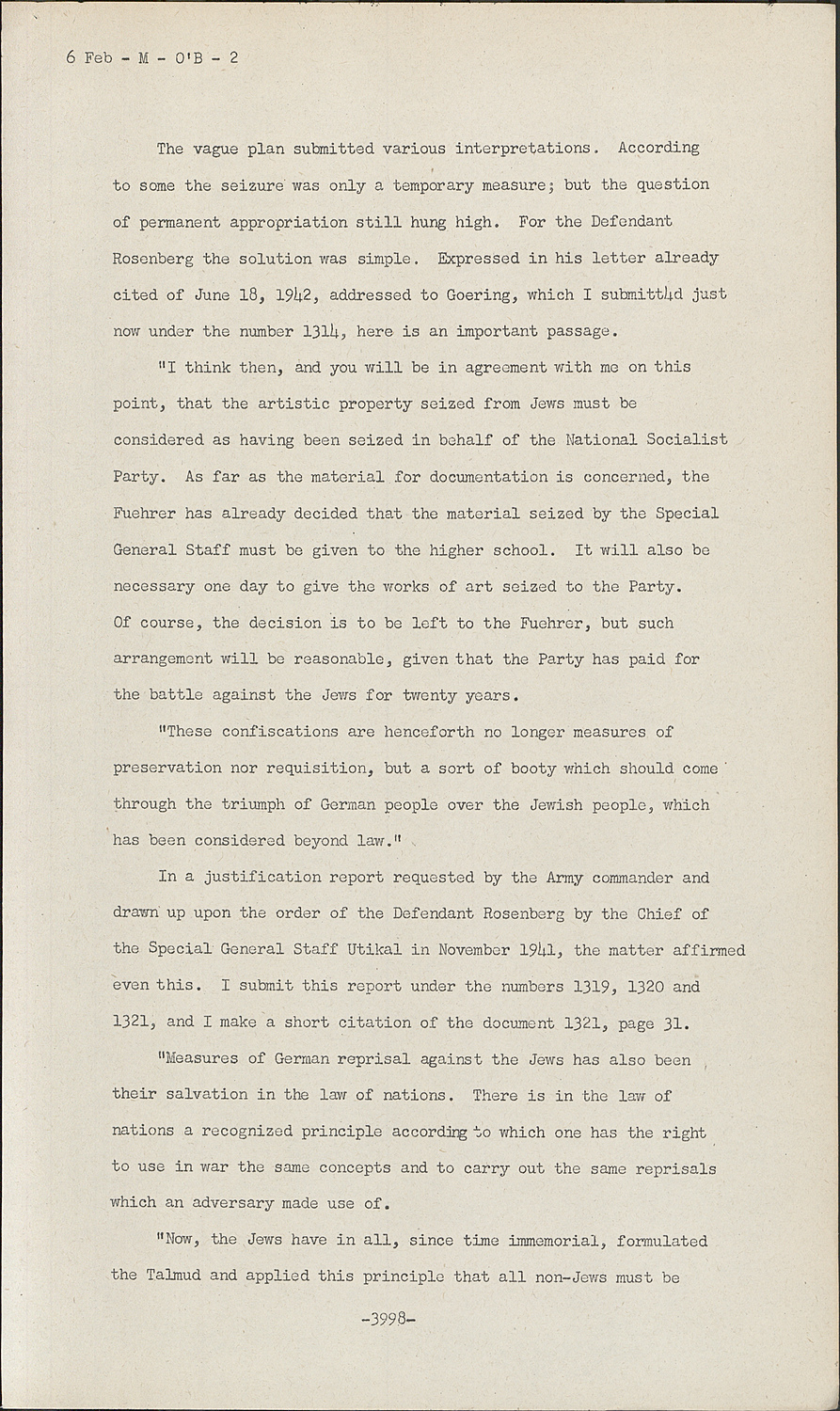
The vague plan submitted various interpretations. According to some the seizure was only a temporary measure; but the question of permanent appropriation still hung high.
For the Defendant Rosenberg the solution was simple.
Expressed in his letter already cited of June 18, 1942, addressed to Goering, which I submitted just now under the number 1314, here is an important passage.
"I think then, and you will be in agreement with me on this point, that the artistic property seized from Jews must be considered as having been seized in behalf of the National Socialist Party.
As far as the material for documentation is concerned, the Fuehrer has already decided that the material seized by the Special General Staff must be given to the higher school.
It will also be necessary one day to give the works of art seized to the Party.
Of course, the decision is to be left to the Fuehrer, but such arrangement will be reasonable, given that the Party has paid for the battle against the Jews for twenty years.
"These confiscations are henceforth no longer measures of preservation nor requisition, but a sort of booty which should come through the triumph of German people over the Jewish people, which has been considered beyond law."
In a justification report requested by the Army commander and drawn up upon the order of the Defendant Rosenberg by the Chief of the Special General Staff Utikal in November 1941, the matter affirmed even this.
I submit this report under the numbers 1319, 1320 and 1321, and I make a short citation of the document 1321, page 31.
"Measures of German reprisal against the Jews has also been their salvation in the law of nations.
There is in the law of nations a recognized principle according to which one has the right to use in war the same concepts and to carry out the same reprisals which an adversary made use of.
"Now, the Jews have in all, since time immemorial, formulated the Talmud and applied this principle that all non-Jews must be considered as cattle, and subsequently are deprived of rights; and that the property of non-Jews must be considered as the thing which has been abandoned, that is to say, as having no master or owner."
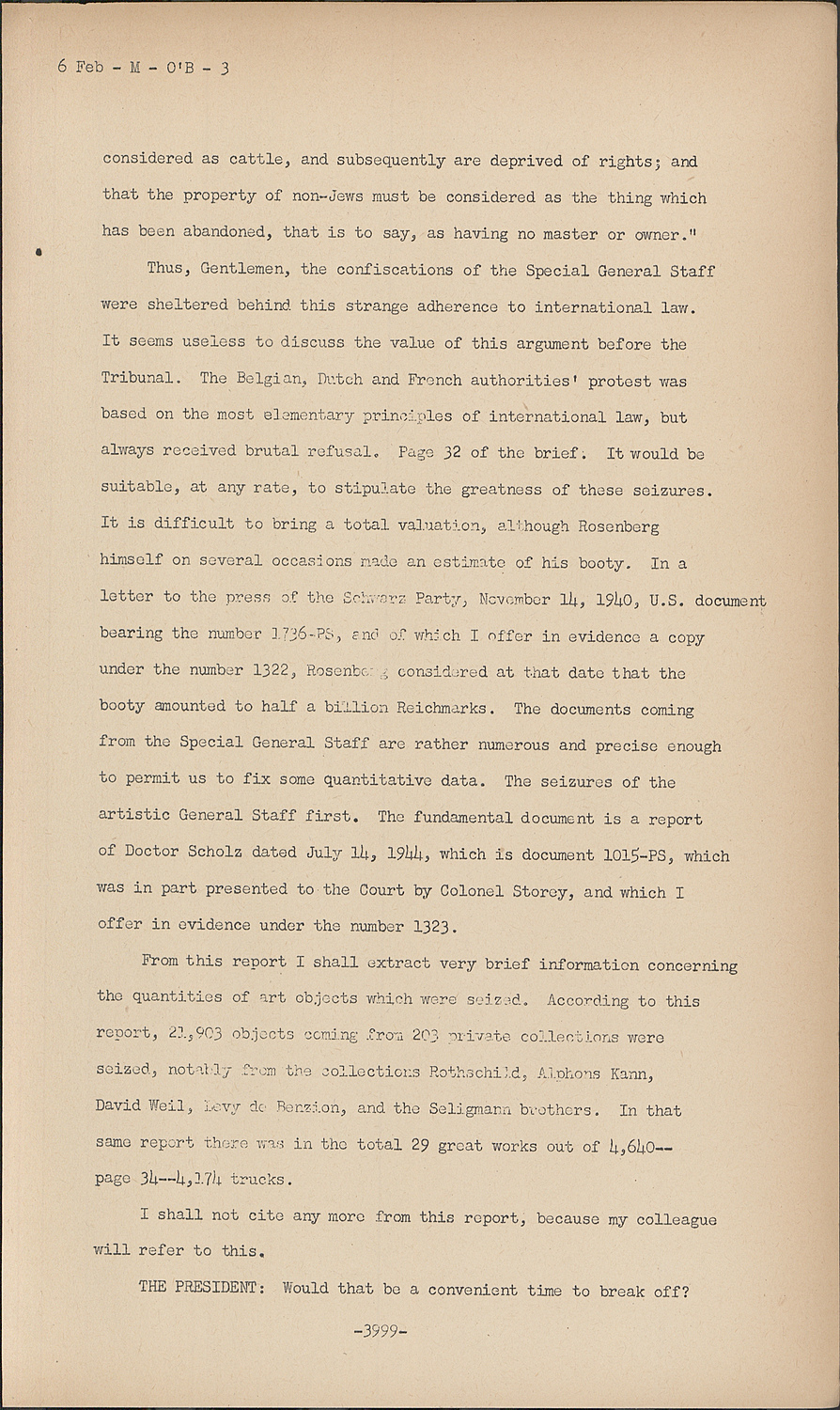
Thus, Gentlemen, the confiscations of the Special General Staff were sheltered behind this strange adherence to international law.
It seems useless to discuss the value of this argument before the Tribunal.
The Belgian, Dutch and French authorities' protest was based on the most elementary principles of international law, but always received brutal refusal.
Page 32 of the brief. It would be suitable, at any rate, to stipulate the greatness of these seizures.
It is difficult to bring a total valuation, although Rosenberg himself on several occasions made an estimate of his booty.
In a letter to the press of the Schwarz Party, November 14, 1940, U.S. document bearing the number 1736-PS, and of which I offer in evidence a copy under the number 1322, Rosenberg considered at that date that the booty amounted to half a billion Reichmarks.
The documents coming from the Special General Staff are rather numerous and precise enough to permit us to fix some quantitative data.
The seizures of the artistic General Staff first.
The fundamental document is a report of Doctor Scholz dated July 14, 1944, which is document 1015-PS, which was in part presented to the Court by Colonel Storey, and which I offer in evidence under the number 1323.
From this report I shall extract very brief information concerning the quantities of art objects which were seized.
According to this report, 21,903 objects coming from 203 private collections were seized, notably from the collections Rothschild, Alphons Kann, David Weil, Levy do Benzion, and the Seligmann brothers.
In that same report there was in the total 29 great works out of 4,640-page 34--4,174 trucks.
I shall not cite any more from this report, because my colleague will refer to this.
THE PRESIDENT:Would that be a convenient time to break off?
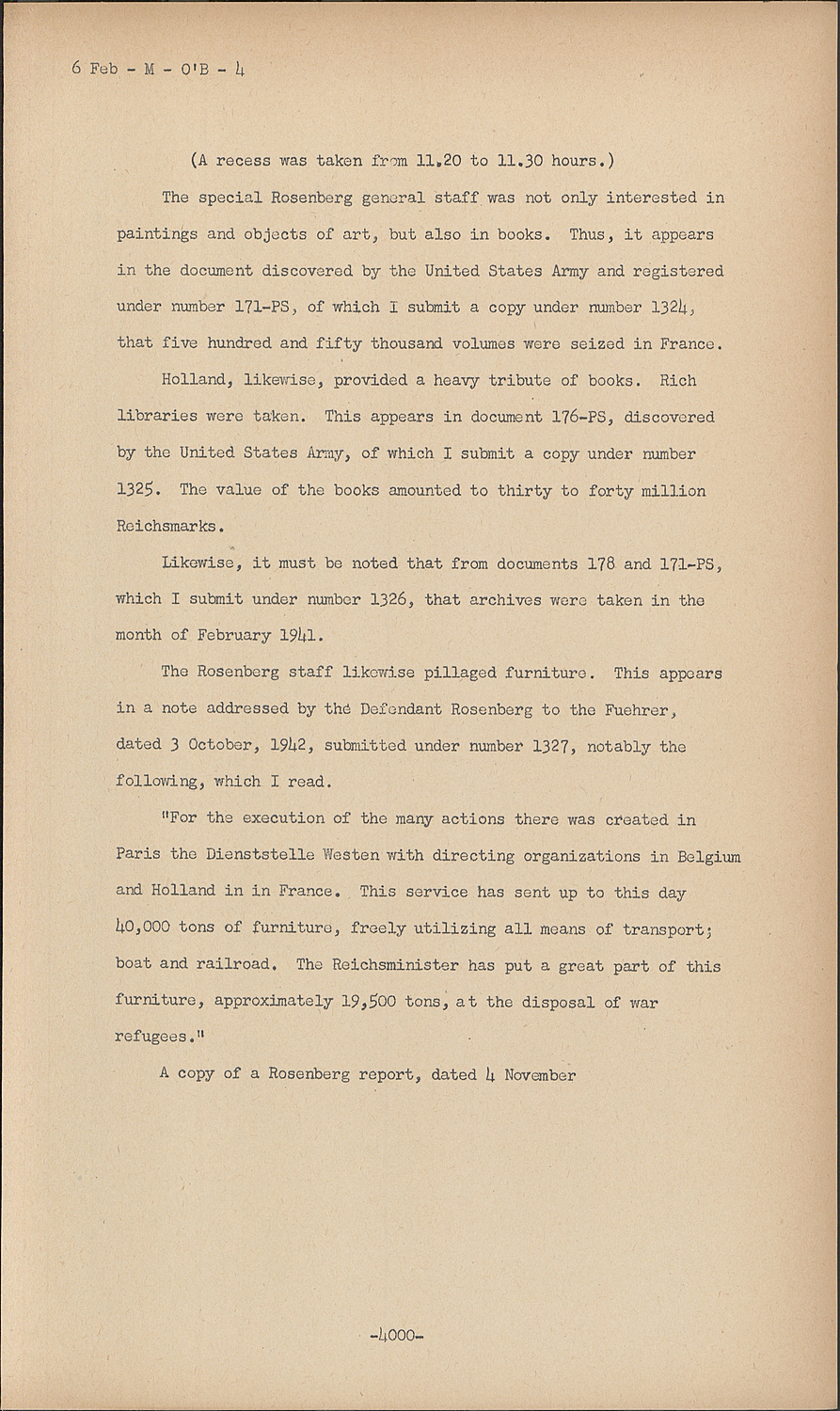
(A recess was taken from 11,20 to 11,30 hours.)
The special Rosenberg general staff was not only interested in paintings and objects of art, but also in books.
Thus, it appears in the document discovered by the United States Army and registered under number 171-PS, of which I submit a copy under number 1324, that five hundred and fifty thousand volumes were seized in France.
Holland, likewise, provided a heavy tribute of books. Rich libraries were taken.
This appears in document 176-PS, discovered by the United States Army, of which I submit a copy under number 1325.
The value of the books amounted to thirty to forty million Reichsmarks, Likewise, it must be noted that from documents 178 and 171-PS, which I submit under number 1326, that archives were taken in the month of February 1941.
The Rosenberg staff likewise pillaged furniture. This appears in a note addressed by the Defendant Rosenberg to the Fuehrer, dated 3 October, 1942, submitted under number 1327, notably the following, which I read.
"For the execution of the many actions there was created in Paris the Dienststelle Westen with directing organizations in Belgium and Holland in in France.
This service has sent up to this day 40,000 tons of furniture, freely utilizing all means of transport;boat and railroad.
The Reichsminister has put a great part of this furniture, approximately 19,500 tons, at the disposal of war refugees."
A copy of a Rosenberg report, dated 4 November 1943, Document 1737-PS dated Paris, of which I submit a copy under Number 1328, indicates that in favor of the war refugees 52,828 Jewish domiciles were seized and placed under seal.
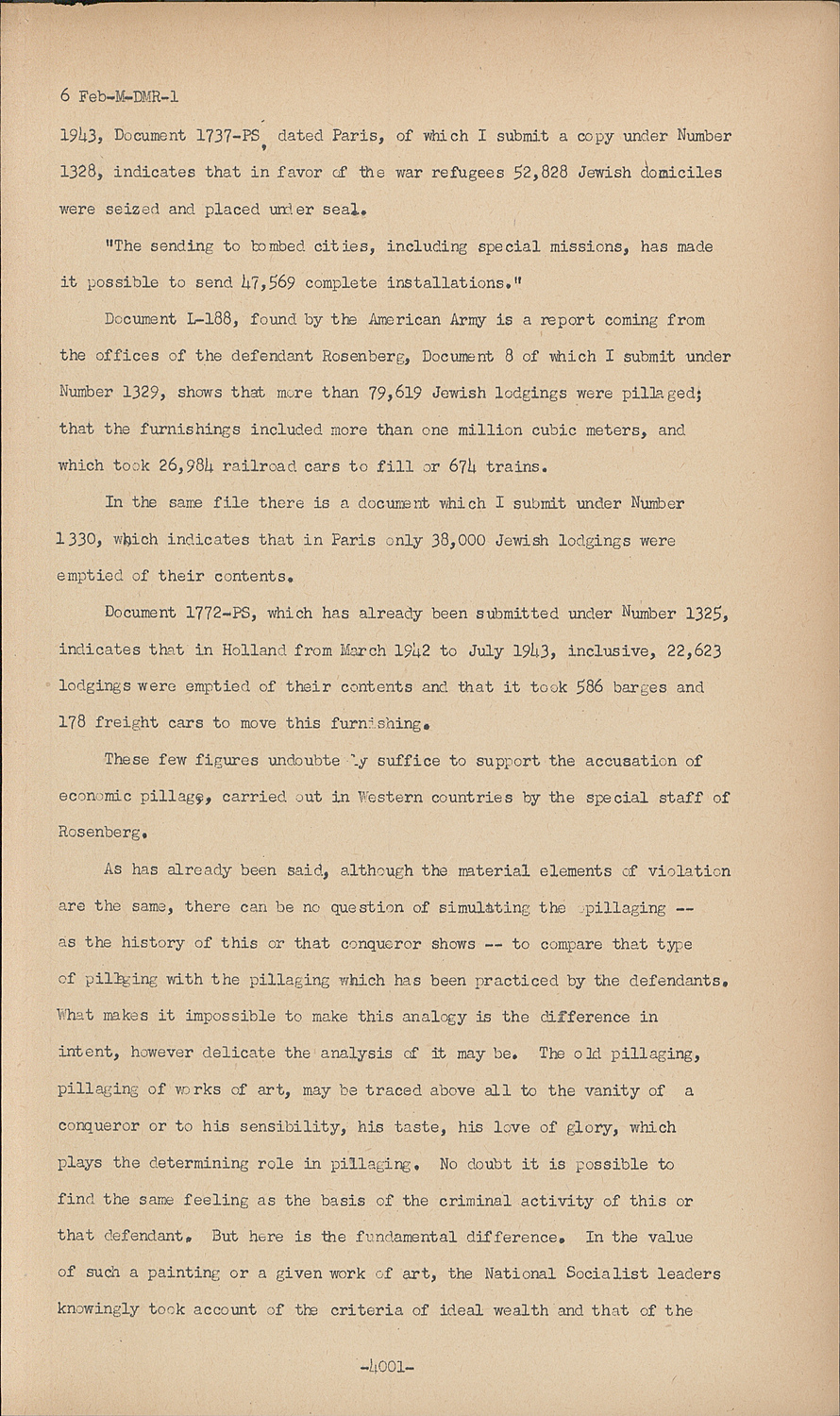
"The sending to bombed cities, including special missions, has made it possible to send 47,569 complete installations."
Document L-188, found by the American Army is a report coming from the offices of the defendant Rosenberg, Document 8 of which I submit under Number 1329, shows that more than 79,619 Jewish lodgings were pillaged; that the furnishings included more than one million cubic meters, and which took 26,984 railroad cars to fill or 674 trains.
In the same file there is a document which I submit under Number 1330, which indicates that in Paris only 38,000 Jewish lodgings were emptied of their contents.
Document 1772-PS, which has already been submitted under Number 1325, indicates that in Holland from March 1942 to July 1943, inclusive, 22,623 lodgings were emptied of their contents and that it took 586 barges and 178 freight cars to move this furnishing.
These few figures undoubtedly suffice to support the accusation of economic pillage, carried out in Western countries by the special staff of Rosenberg, As has already been said, although the material elements of violation are the same, there can be no question of simulating the pillaging -as the history of this or that conqueror shows -- to compare that type of pillaging with the pillaging which has been practiced by the defendants.
What makes it impossible to make this analogy is the difference in intent, however delicate the analysis of it may be. The old pillaging, pillaging of works of art, may be traced above all to the vanity of a conqueror or to his sensibility, his taste, his love of glory, which plays the determining role in pillaging. No doubt it is possible to find the same feeling as the basis of the criminal activity of this or that defendant. But here is the fundamental difference. In the value of such a painting or a given work of art, the National Socialist leaders knowingly took account of the criteria of ideal wealth and that of the material value; in other words of the exchange value of such works of art exchange value whether it is a question of keeping a credit which could facilitate or at least serve as a means of pressure in negotiations of a future peace treaty, as the documents presented to the Tribunal show in several cases.