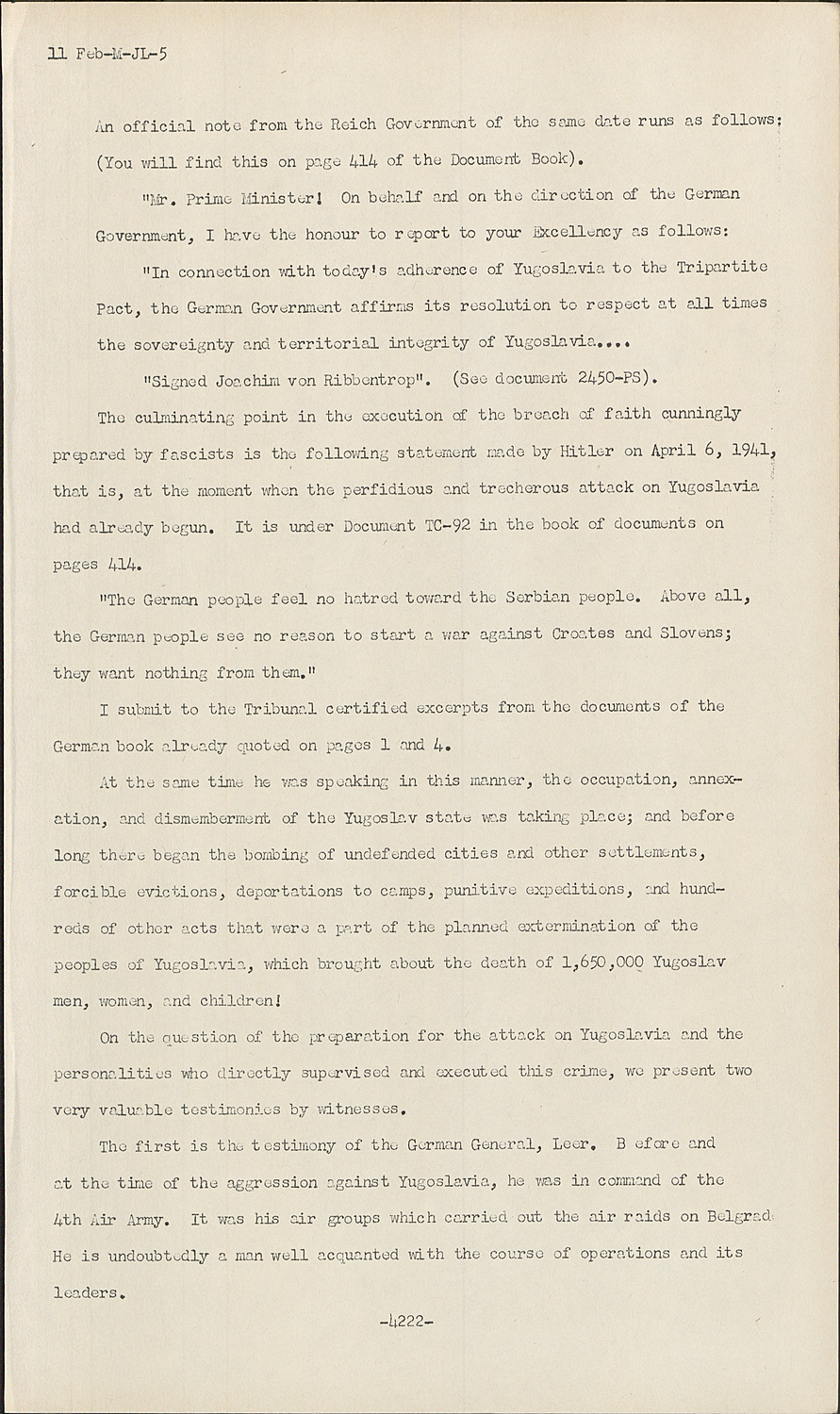
An official note from the Reich Government of the same date runs as follows;
(You will find this on page 414 of the Document Book).
"Mr. Prime Minister! On behalf and on the direction of the German Government, I have the honour to report to your Excellency as follows:
"In connection with today's adherence of Yugoslavia to the Tripartite Pact, the German Government affirms its resolution to respect at all times the sovereignty and territorial integrity of Yugoslavia.
...
"Signed Joachim von Ribbentrop". (See document 2450-PS).
The culminating point in the execution of the breach of faith cunningly prepared by fascists is the following statement made by Hitler on April 6, 1941, that is, at the moment when the perfidious and trecherous attack on Yugoslavia had already begun. It is under Document TC-92 in the book of documents on pages 414.
"The German people feel no hatred toward the Serbian people. Above all, the German people see no reason to start a war against Croates and Slovens; they want nothing from them."
I submit to the Tribunal certified excerpts from the documents of the German book already quoted on pages 1 and 4.
At the same time he was speaking in this manner, the occupation, annexation, and dismemberment of the Yugoslav state was taking place; and before long there began the bombing of undefended cities and other settlements, forcible evictions, deportations to camps, punitive expeditions, and hundreds of other acts that were a part of the planned extermination of the peoples of Yugoslavia, which brought about the death of 1,650,000 Yugoslav men, women, and children!
On the question of the preparation for the attack on Yugoslavia and the personalities who directly supervised and executed this crime, we present two very valuable testimonies by witnesses.
The first is the testimony of the German General, Leer. Before and at the time of the aggression against Yugoslavia, he was in command of the 4th Air Army. It was his air groups which carried out the air raids on Belgrad He is undoubtedly a man well acquanted with the course of operations and its leaders.
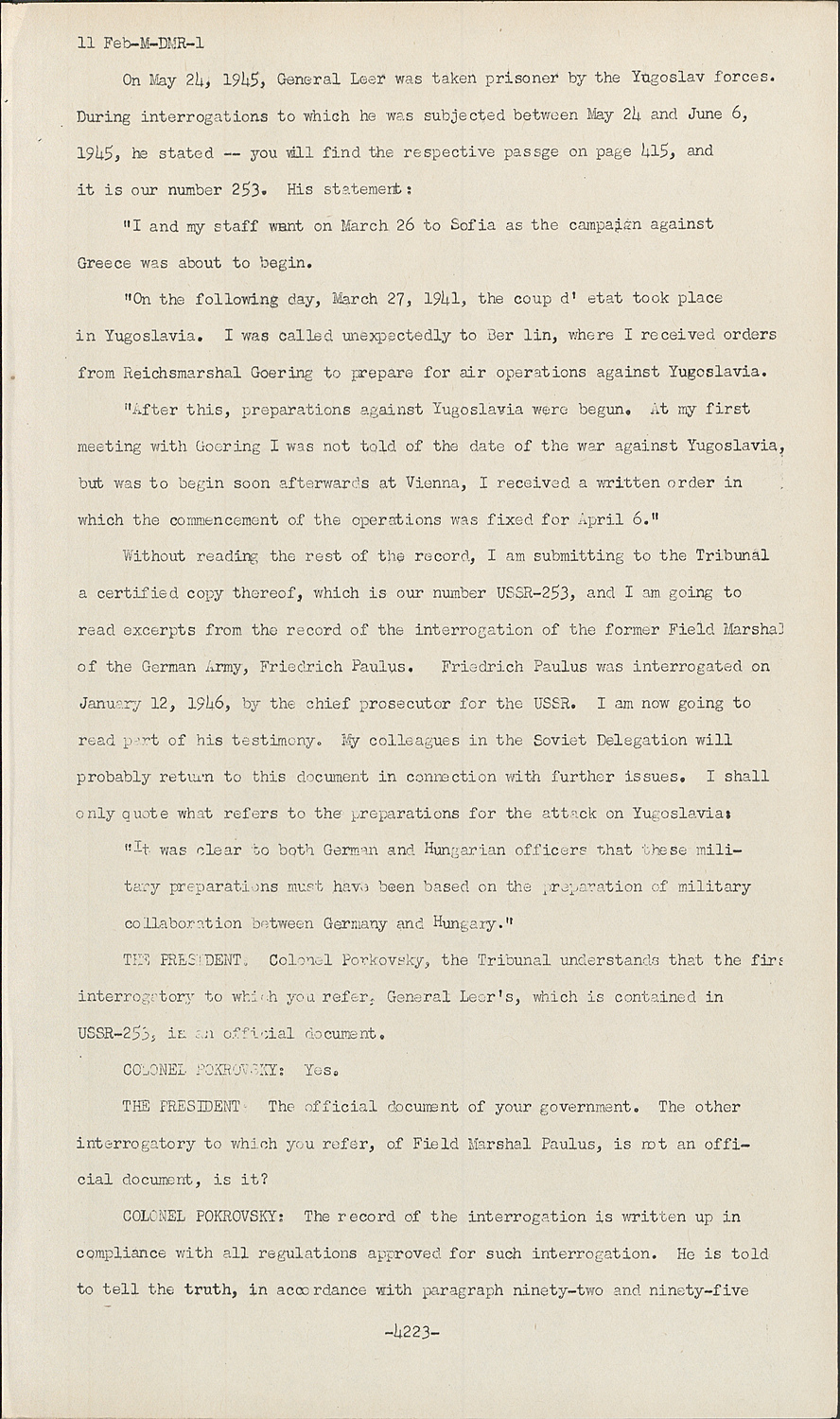
On May 24, 1945, General Leer was taken prisoner by the Yugoslav forces.
During interrogations to which he was subjected between May 24 and June 6, 1945, he stated -- you will find the respective passge on page 415, and it is our number 253. His statement:
"I and my staff want on March 26 to Sofia as the campaign against Greece was about to begin.
"On the following day, March 27, 1941, the coup d' etat took place in Yugoslavia. I was called unexpectedly to Berlin, where I received orders from Reichsmarshal Goering to prepare for air operations against Yugoslavia.
"After this, preparations against Yugoslavia were begun. At my first meeting with Goering I was not told of the date of the war against Yugoslavia, but was to begin soon afterwards at Vienna, I received a written order in which the commencement of the operations was fixed for April 6."
Without readily the rest of the record, I am submitting to the Tribunal a certified copy thereof, which is our number USSR-253, and I am going to read excerpts from the record of the interrogation of the former Field Marshal of the German Army, Friedrich Paulus. Friedrich Paulus was interrogated on January 12, 1946, by the chief prosecutor for the USSR. I am now going to read part of his testimony. My colleagues in the Soviet Delegation will probably return to this document in connection with further issues. I shall only quote what refers to the preparations for the attack on Yugoslavia:
"It was clear to both German and Hungarian officers that these mili tary preparations must have been based on the preparation of military collaboration between Germany and Hungary."
THE PRESIDENT.Colonel Porkovsky, the Tribunal understands that the firs interrogatory to which you refer, General Leer's, which is contained in USSR-253, is an official document.
COLONEL POKROVSKY:Yes.
THE PRESIDENT:The official document of your government. The other interrogatory to which you refer, of Field Marshal Paulus, is not an official document, is it?
COLONEL POKROVSKY:The record of the interrogation is written up in compliance with all regulations approved for such interrogation. He is told to tell the truth, in accordance with paragraph ninety-two and ninety-five of our Penal Code, and it represents an official document which has full probative value for the court.
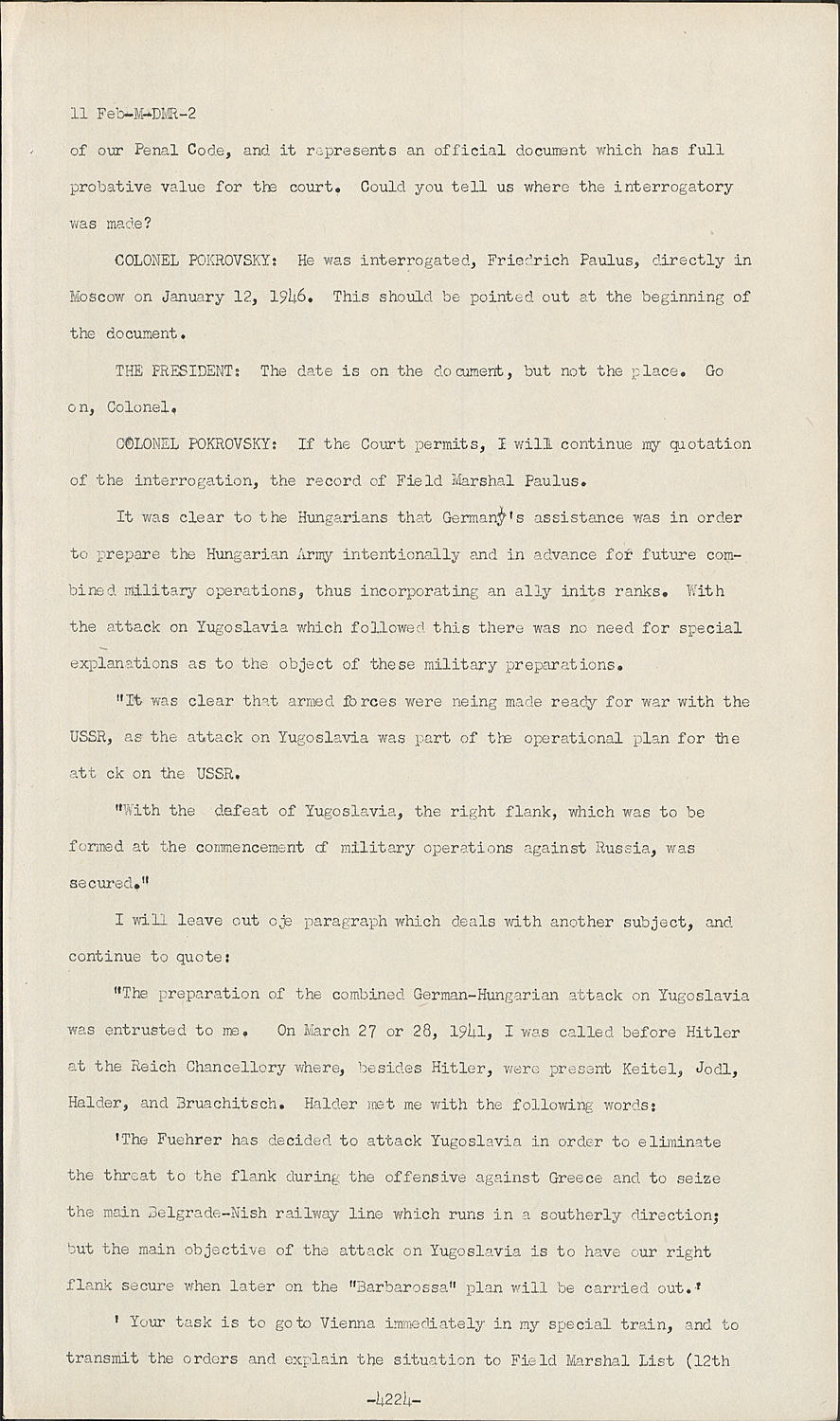
Could you tell us where the interrogatory was made?
COLONEL POKROVSKY:He was interrogated, Friedrich Paulus, directly in Moscow on January 12, 1946. This should be pointed out at the beginning of the document.
THE PRESIDENT:The date is on the document, but not the place. Go on, Colonel.
COLONEL POKROVSKY:If the Court permits, I will continue my quotation of the interrogation, the record of Field Marshal Paulus.
It was clear to the Hungarians that Germany's assistance was in order to prepare the Hungarian Army intentionally and in advance for future combined military operations, thus incorporating an ally inits ranks. With the attack on Yugoslavia which followed this there was no need for special explanations as to the object of these military preparations.
"It was clear that armed forces were neing made ready for war with the USSR, as the attack on Yugoslavia was part of the operational plan for the att ck on the USSR.
"With the defeat of Yugoslavia, the right flank, which was to be formed at the commencement of military operations against Russia, was secured."
I will leave out oje paragraph which deals with another subject, and continue to quotes "The preparation of the combined German-Hungarian attack on Yugoslavia was entrusted to me.
On March 27 or 28, 1941, I was called before Hitler at the Reich Chancellory where, besides Hitler, were present Keitel, Jodl, Halder, and Bruachitsch. Halder met me with the following words :
'The Fuehrer has decided to attack Yugoslavia in order to eliminate the threat to the flank during the offensive against Greece and to seize the main Belgrade-Nish railway line which runs in a southerly direction; but the main objective of the attack on Yugoslavia is to have our right flank secure when later on the "Barbarossa" plan will be carried out.'
' Your task is to goto Vienna immediately in my special train, and to transmit the orders and explain the situation to Field Marshal List (12th Army Group), General von Kleist (armoured group), and Colonel von Witzleben (chief of staff of the 2nd Army), who have been called there.
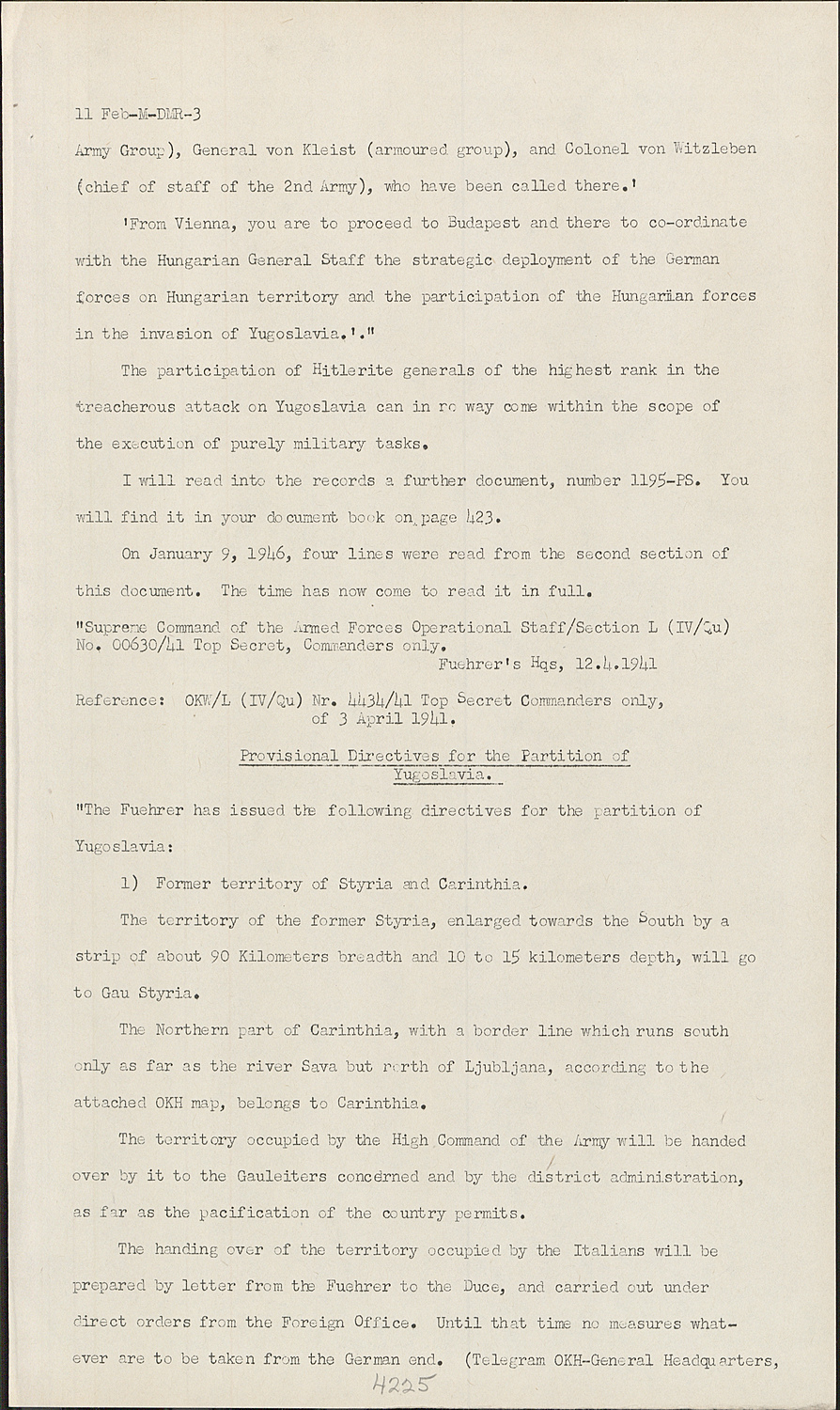
' 'From Vienna, you are to proceed to Budapest and there to co-ordinate with the Hungarian General Staff the strategic deployment of the German forces on Hungarian territory and the participation of the Hungarian forces in the invasion of Yugoslavia.
'."
The participation of Hitlerite generals of the highest rank in the treacherous attack on Yugoslavia can in no way come within the scope of the execution of purely military tasks.
I will read into the records a further document, number 1195-PS. You will find it in your document book on page 423.
On January 9, 1946, four lines were read from the second section of this document. The time has now come to read it in full. "Supreme Command of the Armed Forces Operational Staff /Section L (IV/Qu) No. 00630/41 Top Secret, Commanders only.
Fuehrer's HqS, 12.4.1941 Reference: OKW/L (IV/Qu) Nr. 4434/41 Top Secret Commanders only, of 3 April 1941.
Provisional Directives for the Partition of Yugoslavia.
"The Fuehrer has issued the following directives for the partition of Yugoslavia:
1) Former territory of Styria and Carinthia.
The territory of the former Styria, enlarged towards the South by a strip of about 90 Kilometers breadth and 10 to 15 kilometers depth, will go to Gau Styria.
The Northern part of Carinthia, with a border line which runs south only as far as the river Sava but north of Ljubljana, according to the attached OKH map, belongs to Carinthia.
The territory occupied by the High Command of the Army will be handed over by it to the Gauleiters concerned and by the district administration, as far as the pacification of the country permits.
The handing over of the territory occupied by the Italians will be prepared by letter from the Fuehrer to the Duce, and carried out under direct orders from the Foreign Office. Until that time no measures whatever are to be taken from the German end. (Telegram OKH-General Headquarters, Master Department A, Secret, No. 801/41, Secret, is hereby dealt with as well).
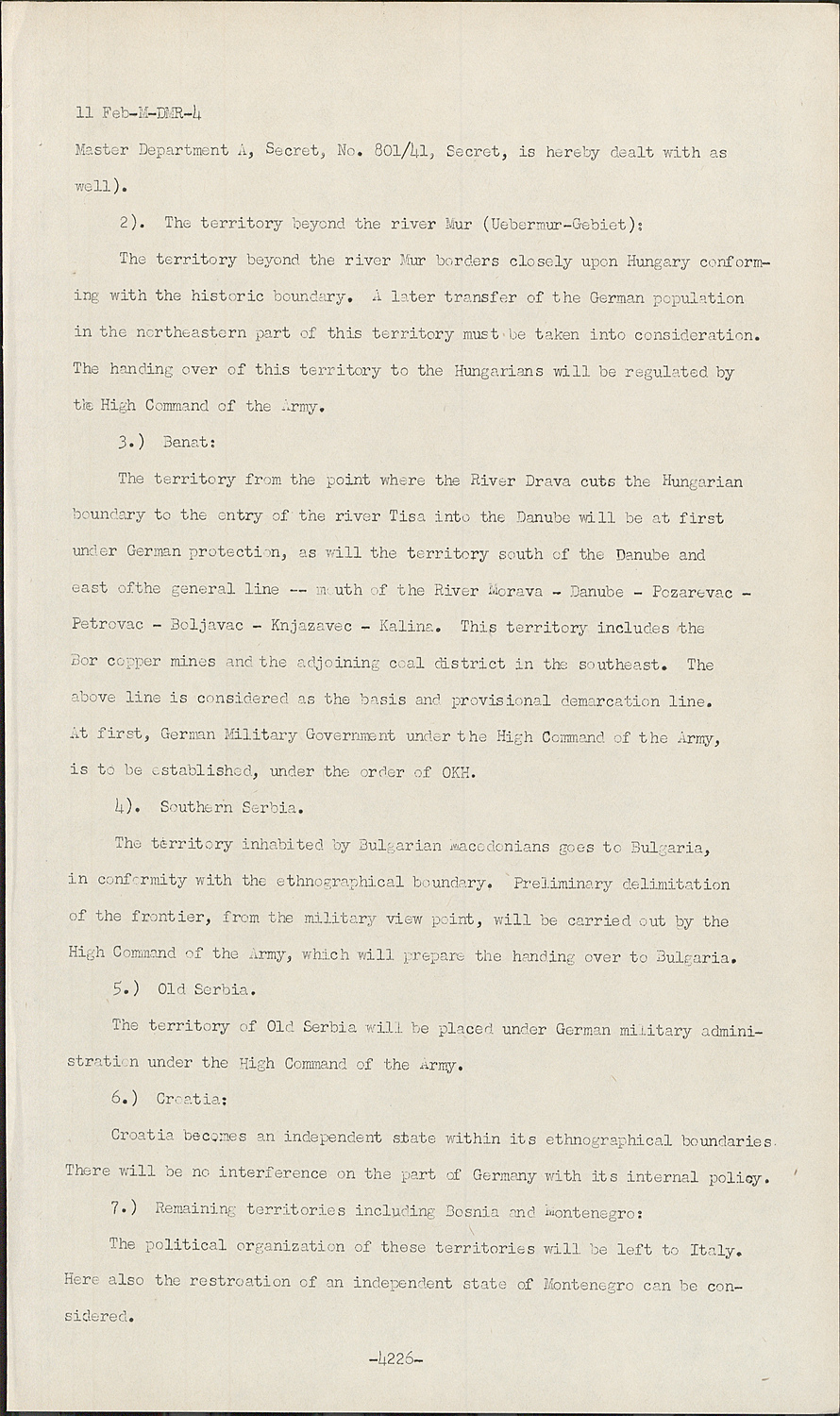
2). The territory beyond the river Mur (Uebermur-Gebiet):
The territory beyond the river Mur borders closely upon Hungary conforming with the historic boundary, A later transfer of the German population in the northeastern part of this territory must be taken into consideration. The handing over of this territory to the Hungarians will be regulated by tie High Command of the Army,
3.) Banat:
The territory from the point where the River Drava cute the Hungarian boundary to the entry of the river Tisa into the Danube will be at first under German protection, as will the territory south of the Danube and east ofthe general line -- mouth of the River Morava - Danube - Pozarevac Petrovac - Boljavac - Knjazavec - Kalina. This territory includes the Bor copper mines and the adjoining coal district in the southeast. The above line is considered as the basis and provisional demarcation line. At first, German Military Government under the High Command of the Army, is to be established, under the order of OKH.
4 ). Southern Serbia.
The territory inhabited by Bulgarian Macedonians goes to Bulgaria, in conformity with the ethnographical boundary. preliminary delimitation of the frontier, from the military view point, will be carried out by the High Command of the Army, which will prepare the handing over to Bulgaria.
5.) Old Serbia.
The territory of Old Serbia will be placed under German military administration under the High Command of the Army.
6.) Croatia:
Croatia becomes an independent state within its ethnographical boundaries There will be no interference on the part of Germany with its internal policy.
7.) Remaining territories including Bosnia and Montenegro:
The political organization of these territories will be left to Italy. Here also the restroation of an independent state of Montenegro can be considered.
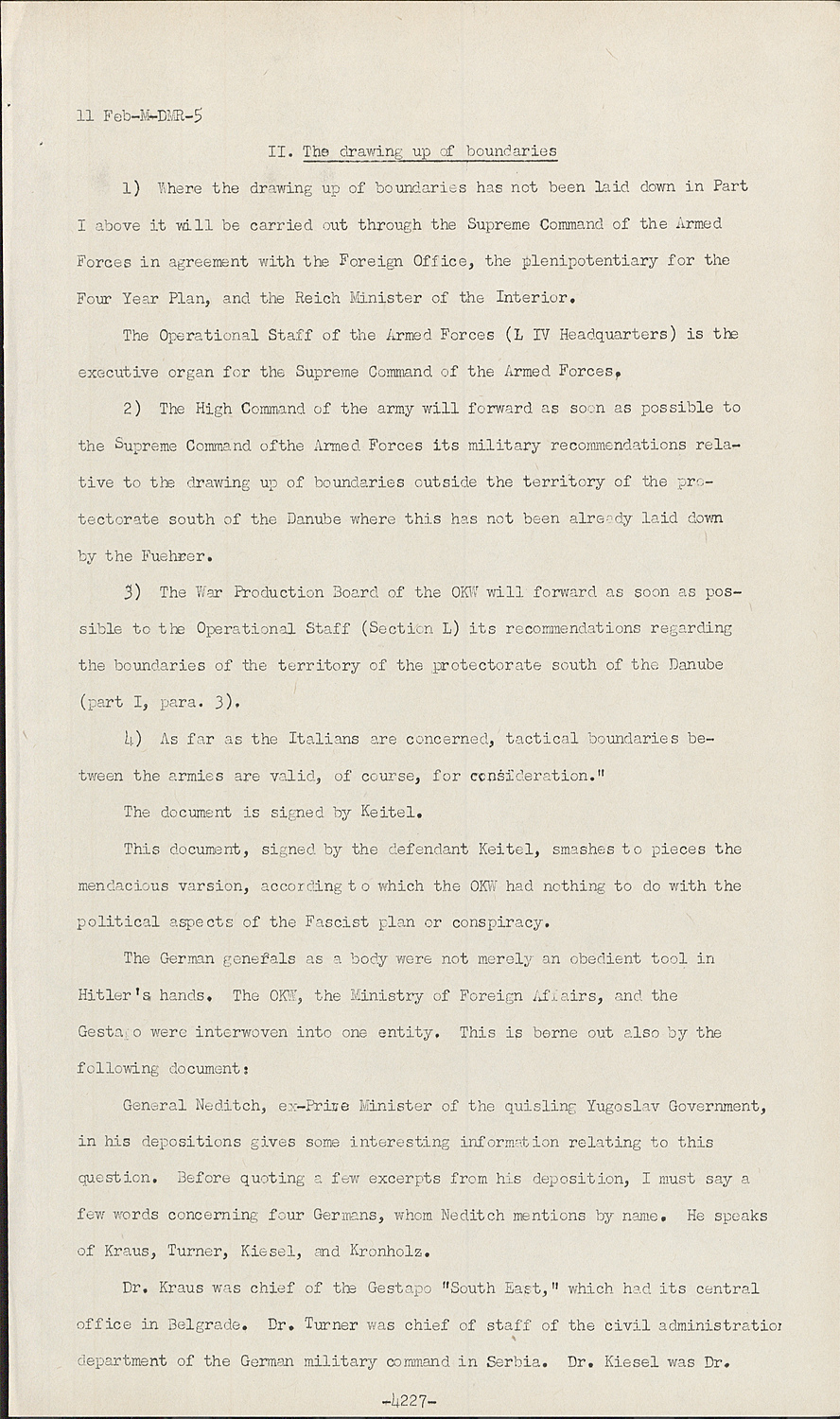
II. The drawing up of boundaries
1) Where the drawing up of boundaries has not been laid down in Part I above it will be carried out through the Supreme Command of the Armed Forces in agreement with the Foreign Office, the plenipotentiary for the Four Year Plan, and the Reich Minister of the Interior.
The Operational Staff of the Armed Forces (L IV Headquarters) is the executive organ for the Supreme Command of the Armed Forces.
2) The High Command of the army will forward as soon as possible to the Supreme Command ofthe Armed Forces its military recommendations relative to the drawing up of boundaries outside the territory of the protectorate south of the Danube where this has not been already laid down by the Fuehrer.
3) The War Production Board of the OKW will forward as soon as possible to the Operational Staff (Section L) its recommendations regarding the boundaries of the territory of the protectorate south of the Danube (part I, para. 3).
4) As far as the Italians are concerned, tactical boundaries between the armies are valid, of course, for consideration."
The document is signed by Keitel.
This document, signed by the defendant Keitel, smashes to pieces the mendacious varsion, according t o which the OKW had nothing to do with the political aspects of the Fascist plan or conspiracy.
The German generals as a body were not merely an obedient tool in Hitler's hands. The OKW, the Ministry of Foreign Affairs, and the Gestapo were interwoven into one entity. This is borne out also by the following document:
General Neditch, ex-Prime Minister of the quisling Yugoslav Government, in his depositions gives some interesting information relating to this question. Before quoting a few excerpts from his deposition, I must say a few words concerning four Germans, whom Neditch mentions by name. He speaks of Kraus, Turner, Kiesel, and Kronholz.
Dr. Kraus was chief of the Gestapo "South East," which had its central office in Belgrade. Dr. Turner was chief of staff of the civil administration department of the German military command in Serbia. Dr. Kiesel was Dr. Turner's deputy.
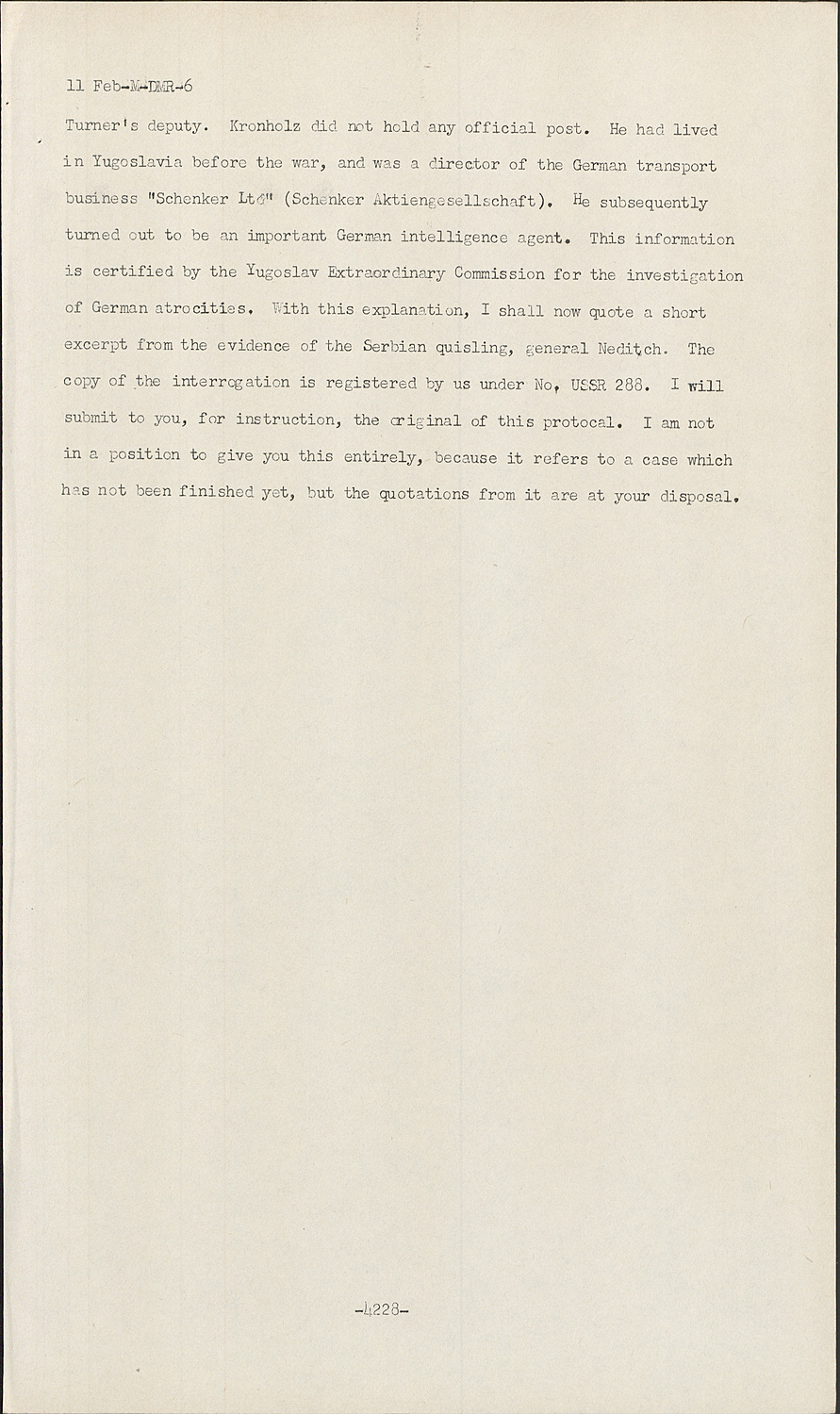
Kronholz did not held any official post. He had lived in Yugoslavia before the war, and was a director of the German transport business "Schenker Ltd" (Schenker Aktiengesellschaft). He subsequently turned out to be an important German intelligence agent.
This information is certified by the Yugoslav Extraordinary Commission for the investigation of German atrocities. With this explanation, I shall now quote a short excerpt from the evidence of the Serbian quisling, general Neditch. The copy of the interrogation is registered by us under No. USSR 288. I will submit to you, for instruction, the original of this protocal. I am not in a position to give you this entirely, because it refers to a case which has not been finished yet, but the quotations from it are at your disposal.
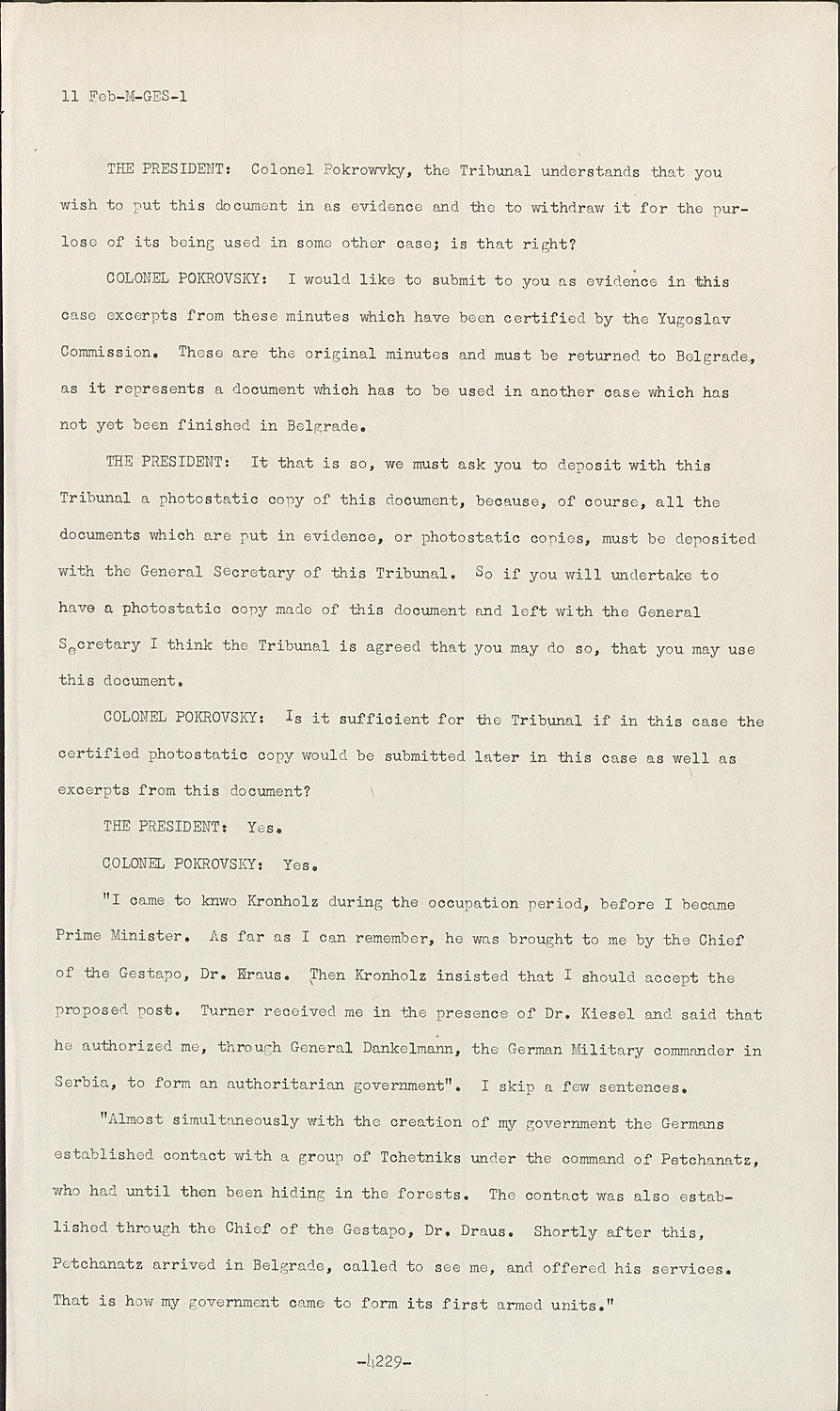
THE PRESIDENT: Colonel Pokrowvky, the Tribunal understands that you wish to put this document in as evidence and the to withdraw it for the purlose of its being used in some other case; is that right?
COLONEL POKROVSKY:I would like to submit to you as evidence in this case excerpts from these minutes which have been certified by the Yugoslav Commission. These are the original minutes and must be returned to Belgrade., as it represents a document which has to be used in another case which has not yet been finished in Belgrade.
THE PRESIDENT:It that is so, we must ask you to deposit with this Tribunal a photostatic copy of this document, because, of course, all the documents which are put in evidence, or photostatic copies, must be deposited with the General Secretary of this Tribunal. So if you will undertake to have a photostatic copy made of this document and left with the General Secretary I think the Tribunal is agreed that you may do so, that you may use this document.
COLONEL POKROVSKY:Is it sufficient for the Tribunal if in this case the certified photostatic copy would be submitted later in this case as well as excerpts from this document?
THE PRESIDENT:Yes.
COLONEL POKROVSKY:Yes.
"I came to knwo Kronholz during the occupation period, before I became Prime Minister. As far as I can remember, he was brought to me by the Chief of the Gestapo, Dr. Kraus. Then Kronholz insisted that 1 should accept the proposed post. Turner received me in the presence of Dr. Kiesel and said that he authorized me, through General Dankelmann, the German Military commander in Serbia, to form an authoritarian government". I skip a few sentences.
"Almost simultaneously with the creation of my government the Germans established contact with a group of Tchetniks under the command of Petchanatz, who had until then been hiding in the forests. The contact was also established through the Chief of the Gestapo, Dr. Draus. Shortly after this, Petchanatz arrived in Belgrade, called to see me, and offered his services. That is how my government came to form its first armed units."
A little further, Neditch continued:
"As soon as the formation of my government had been proclaimed in the beginning of September 1941, a delegation called on me with authority from Draje Mikhailovitch, to start negotiations." Neditch enumerates the terms, which are of no interest to us, and then said:
"I, for my part, accepted all these terms and offers. Draje received money and the Germans permitted it." This is the end of the quotation. Still another part of this record seems of importance to me; it concerns Neditch's visit to Hitler and Ribbentrop. Neditch stated:
"I noticed that at the meeting with Ribbentrop a demand was made that I should place all the spiritual and material resources of Serbia at the disposal of the German Reich for the prosecution of the war."
Speaking of his meeting with Hitler, Neditch stated:
"He shouted at me, emphasizing that the order concerning one hundred for one was too lenient; that it should have been increased to one thousand for one. He added also that he was prepared to exterminate the entire population if the Serbians continued to act like rebels."
The head of Fascist Germany wanted to handle the Slav countries as if they were his own personal property. In this he received the wholehearted assistance of generals, diplomats, industrialists, and intelligence officers. All aggressive action was prepared and carried out with their direct participation.
I repeat: the German generals as a body were not merely an obedient tool in Hitler's hands. The defendants Keitel, Jodl, and Goering personally participated in the planning, preparation, and perpetration of crimes against peoples and states.
Document 1195-PS added yet another proof of this fact. The above-named defendants, together with Neurath and Frick, Schirach and Frank, Seyss-lnquart, and Ribbentrop, bear direct responsibility for the gravest crimes, which I denounced before the Tribunal.
"National-Socialism cannot be separated from the idea of war". This is acknowledged, by the Hitlerites themselves. In other words, Hitlerism and aggressive war are one and the same thing.
And if it is not always the military leaders alone who plan wars, it is always they who conduct them.
The full weight of responsibility for aggression, for aggressive war, for the death of millions of people, for atrocities, for the destruction of cultural treasures and material wealth, must be borne by all the major war criminals who are sitting in the dock.
THE PRESIDENT:We will adjourn now.
(A recess was taken)
DR.NELTE (Counsel for defendant Keitel): I would like to ask the Tribunal, in a general question of proof, to make a decision. The Soviet Delegation has presented books which contain explanations and statements by generals and statesmen. We doubt that these statements by the Soviet authorities have been accompanied by an official remark or an official authorization.
The documents which have been given to me today -- USSR 149, 150, and 249 -- all three of them are only photostats of handwritten letters. They contain neither remarks where you could qualify them as affidavits, nor are they testimony before a Soviet official or officer, now are they official or government declarations or statements.
I would be grateful to the Tribunal if it would consider this question according to point 21 of the Statute, because the opinion of the defense is that such statements could only have the value of a personal representation by the prosecution but no probative value.
THE PRESIDENT:May I see the documents?
(The documents were submitted to the Tribunal)
The Tribunal have no objection to the course taken by Dr. Nelte in drawint their attention to these documents at this stage. However, they think it will be better for them to wait until the documents are actually offered in evidence before they consider whether or not they will admit them. If and when the documents are offered in evidence, they will then consider whether they will admit them or not.
COLONEL POKROVSKY:With the permission of the Tribunal, I wish to present General Zorya, who will make the presentation of materials concerning the question of aggression against the Soviet Union.
DR. LATERNSER: (counsel for the General Staff): I would like to point out that it was the opinion of the Tribunal that every defendant'S counsel should receive, in sufficient time beforehand, a copy of all documents which are submitted during the proceeding, and that this has not been done.
It is, therefore, difficult for the defense to follow the proceedings because the documents submitted have not been submitted in a sufficient quantity.
THE PRESIDENT:I don't think the Tribunal have ever imposed upon the prosecution the duty of supplying a copy of every document to every member of defendants' counsel.
You no doubt have before you a copy of the Tribunal's order upon the subject, and I believe that the order is posted upon the board in the defendants' information center. If I remember correctly, it is that a certain number of criminals or Photostatic conies shall be deposited in the information center, and that a certain number of copies of the documents shall be supplied to the defendants' counsel, and that for the rest, the defendants' counsel must rely upon the fact that every document or part of a document which is put in evidence is read in open court and therefore comes through the earphones to defendant's counsel and will appear in the shorthand notes. We have provided that copies of the shorthand notes shall be suppled to defendants' counsel as soon as possible after the day on which the evidence is given. Beyond that we have not thought it right to impose a duty upon the prosecution to supply documents to the defendants' counsel.
Is that not in accordance with your recollection?
DR. LATERNSER:Mr. Chairman, the American prosecution, the British prosecution, and also the French prosecution, in the course of the proceedings, have seen to it that of all documents so many copies have been given to the defendants' counsel that each defendant's counsel could hove one copy before him. I believe, in order to facilitate the work, that this could also have been done by the Soviet prosecution.
THE PRESIDENT:That is a belief on your part which is not strictly in accordance with the Tribunal's orders. The Tribunal has not made that order, and it may be that the United States and Great Britain have gone beyond the Tribunal's orders and have supplied a copy to each defendants' counsel.
However, as I say, the Tribunal has not as yet seen fit to impose that duty upon the prosecution.
I suppose you don't really know exactly how many copies of these Soviet documents have been deposited in the information center?
DR. LATERNSER:I don't know the exact number, At any rate, there were not so many that each defendant's counsel could have one copy of each document, which has been done by the other prosecutions.
THE PRESIDENT:Well, you no doubt understand the very great difficulties of making translations and making copies. I am sure that the Soviet prosecutors will do everything in their power to assist defendants' counsel, but, as I say, we have not imposed upon the prosecution the duty of supplying one copy of a translation into German, of each document, for each defendants' counsel. I can only express the hope that the soviet prosecutors will do the best they can.
DR. LATERNSER:I remember that on the occasion when the press got 250 copies of the documents, you, Mr. President, said that it should be possible to distribute 25 copies to the defendants' counsel, That was, at that time, the opinion of the Tribunal.
THE PRESIDENT:Teh Tribunal's orders on this subject are in writing, and you will find them in the defendants' information center. I have stated my recollection of them; if I am wrong, you can bring me a copy of the document and I will withdraw my statement.
GENERAL ZORYA: May it please your Honors, it is my task to present the documentary evidence dealing with the aggression against the Union of Soviet Socialist Republics, organized by the Fascist war criminals now sitting in the prisoners' dock.
This charge of the crime, mentioned in sub-paragraph "a", Article VI of the Charter of the International Military Tribunal, was formulated by paragraph 6, Section 4, Count I, of the Indictment in the present case, and in Section IV of the opening statement by the Chief Prosecutor from the USSR, General Rudenko.
Among the many criminal wars which German Fascism waged against freedom-loving nations, With its predatory aims, the attack on the Union of the Soviet Socialist Republics occupies a place by itself.
It can be safely said that the aggressive war against the Soviet Union was the key question of the whole Fascist conspiracy against it.
All Aggressive actions on the part of German Fascism committed prior to the attack on the USSR, and in particular the German aggression against Czechoslovakia, Poland, Yugoslavia, were, as has been shown by my colleague, Colonel Pokrovsky, just stages on the road to the attack on the Soviet Union.
The Ukrainian wheat and the coal of the Donbass, manganese of the Kola Peninsula and Caucasian crude oil, fertile steppes of the Volga region, and Byelorussian forests, played a decisive part in the criminal schemes of the Fascist aggressors.
The war against the Union of Soviet Socialist Republics was waged by Fascist Germany also with the intent of enslaving and exploiting the Soviet peoples.
In the war of Fascist Germany against the Soviet Union, the animal hatred of the Hitlerites against the Slav peoples found its full horrifying expression.
And finally, German imperialism, appearing in its Fascist edition, saw in the seizure of the wealth of the Soviet Union and in its immeasurable resources of food and raw materials a base for the realization of their far-reaching aggressive aims to achieve, first, hegemony in Europe, and, later on, hegemony in the whole world.
The well-known formula of German imperialism, "Drang nach Osten," which was mentioned in the opening statement of the Chief Prosecutor from the USSR, was at different times interpreted by the Fascist criminals in many different ways, but always in their aggressive plans the attack on the Soviet Union was given a prominent place.
"If new territory is desired," wrote Hitler in his book, "Mein Kampf," in substance it can be secured at the expense of Russia.
The new Empire must move along the paths trodden by the knights of old."
(Hitler, "Mein Kampf," Munich edition, 1930 - page 742 -which is before the Tribunal.)
The fact that having at last initiated the Fascist aggression in 1939, Hitler began the war in the West, did not substantially change this basic conception of Fascism.
Under number 789-PS the American Prosecution submitted to the Tribunal the transcript of the conference held on 23 November 1939 between Hitler and the members of the German High Command.
At this conference, Hitler, according to his own words, gave a survey of the thoughts which dominated him in connection with the forthcoming events.
In the course of this survey he declared (the place where I am reading now you will find on page 33 in the documents already in front of you):"For a long time I hesitated whether I should not begin with an attack in the East, and only then with the one in the West.
It came about by force of events that for the nearest future the East dropped out of the picture."
(Page 2 of the Russian text.)
This statement by Hitler bore witness to the fact that the attack on the Soviet Union was not eliminated from the plans of Fascist aggression, and the whole question was reduced only to the problem of selecting the most favorable moment for this attack.
It should be noted that the authors of Fascist aggression did not consider the version "West" as the most favorable version for its start.
Again, exactly five months prior to the above-mentioned conference, at the conference of 23 May, 1939 (USA exhibit No. 79).Hitler briefed his accomplices on the present situation and political aims of policy, and said--I am citing now from page 4:"If fate forces us into a conflict with the West, it would be desirable that we, by that time, possess more expanse in the East."
The vast expanses in the East, as Hitler's conspirators thought, were to play a decisive part during the conflict in the West.
Therefore, when the Fascist hordes were unable to force the Channel, stopped at its shores and had to find new ways of aggression, the conspirators immediately began to prepare for an attack on the Soviet Union, because this was the basic part of all their plans of aggression, without which they could not materialize.
I believe it is unnecessary to refer to documents of an earlier period, and particularly to quote any further from Hitler's book, "Mein Kampf," where questions connected with the predatory attack on the Soviet Union were formulated long before 1939.
This book is already before the Tribunal, and relevant parts of it were cited as evidence by our American and British colleagues.
The Soviet Prosecution desires to submit to the Tribunal a file of documents which bear witness to the fact that the aggression of Fascist Germany against the Union of Soviet Socialist Republics was committed with malice aforethought.
Among these documents there are files from various archives captured by units of the advancing Red Army, statements by Fascist leaders, published in the press, including those by several of the Defendants, and depositions by persons who were in possession of reliable information as to how the preparations for the attack on the Soviet Union were actually carried out.
The documents of the Soviet Prosecution are presented under the following sections.
1. Preparations for war in Germany itself.
2. Assuring the security of the preparations for war by intelligence activities.
3. The securing by the Fascist conspirators of the participation of the satellite countries in the aggression against the Soviet Union.
I shall begin with Section which I shall call, "Preparations for war in Germany itself."
The statements of Hitler and his accomplices demonstrate that the idea of a criminal attack on the Union of Soviet Socialist Republics had for a long time been ripe in the minds of the Fascist conspirators.
But apart from this fact, we are also interested in the question as to when this intention began to take on the concrete form of direct military preparations for the predatory war against the Soviet Union.
On the 18th of December, 1940, the directive known to the Tribunal as directive number 21, "Plan Barbarossa" (the document of the American Prosecution numbered 446-PS), received its official formulation.
When the signature of the Command appears on such a document, this is the moment which crowns long and intensive work by all the links in the chain of military administration.
This work may not have been governed by written orders. The secrecy surrounding this work often made it necessary to have recourse to verbal orders.
And, on the other hand, many orders of a routine nature, on the strength of an already existing strategic project.
acquire a corresponding purpose, although outwardly they seem to have no connection with it.
It therefore appears that, with regard to establishing the actual moment at which military plans for the attack on the Soviet Union began--
THE PRESIDENT:General Zorya, the Tribunal observes that you are about to read a deposition of General Warlimont, whom the Tribunal understands is in Nurnberg, and the Tribunal considers that, in accordance with the order that it made the other day in another case, in the case of another deposition, if the Defendant's Counsel desired, you ought to be prepared to allow General Warlimont to be submitted to the Defendant's Counsel for cross-examination.
GENERAL ZORYA:I am now reading an extract, that is, from the questioning of Warlimont which was made by General Alexandrov of the Soviet Prosecution, and if the Defense will desire to call General Warlimont for cross-examination, the Soviet Prosecution will do its best to satisfy this request.
THE PRESIDENT:That is, of course, on the supposition that I am right in saying that General Warlimont is in Nurnberg--available in Nurnberg.
Go on.
GENERAL ZORYA:I think it is a proper moment now to mention that, regarding the attack on the Soviet Union, we will use not only the documents, as not everything is always put on paper, but also testimony of persons who participated directly in making these preparations.
At this moment I should, like to refer to the deposition of General Warlimont, which the President has just mentioned.
This.
deposition, which was given by Warlimont on the 30th of November, 1945, is pre-
sented as evidence under No. 263.
Walter Warlimont, as is well known, was the chief of the Department of National Defense in OKW, and later the deputy chief of the Operational Staff.
I shall read that part of this deposition which touches on the question before us. I ask you to turn to page No. 2 of the Russian text of this document, which is on page 20 in the bunch of documents presented by the Russian Prosecution on the question, and the answers to questions put to Warlimont:
"Personally, I first heard of this plan" -- that is "Plan Barbarossa" -"on the 29th of July, 1940. On that day Colonel-General Jodl arrived in a special train at Reichenhall station, where Department 'L' of the Operational Staff was stationed. This struck one immediately, because General Jodl had, till then, never, I believe, come to see us. Besides myself, three other officers were ordered to present themselves."
I now skip several paragraphs and go to page 3, page 21 in the documents:
"I cannot repeat word by word his expressions. The text was as follows: Jodl said that the Fuehrer has decided to prepare for war against Russia. The Fuehrer based this on the fact that war had to come in one way or another, so that it would be better to prosecute this war in connection with the one already being fought, and, in any case, to start the necessary preparations for it."
I again skip several lines which are not relevant to the question we are dealing with:
At a later date I talked with Hitler. He had intended to commence the war against the Russian Union already in the Autumn of 1940, but he gave up this idea. The cause of this was that the strategic position of the troops at that time was not favorable for this purpose. The supplies to Poland were not good enough; railways and bridges were not prepared; the communication lines and airdromes were not organized. Therefore, an order was given to secure the whole transport and preparations to prepare for such an attack which will eventually be made.
To the question as to whether this order was an order of the 9th of August 1941, called "Aufbau Ost", Warlimont replied:
"Yes, this order was prepared by the staff in accordance with instructions of General Jodl. In General Jodl's opinion, the concentration could take place only after all the preparations indicated in this order had been made."
Further on in his statement, Warlimont said that Plan Barbarossa, which was called "Fritz" to start with, was presented to Hitler on the 5th of December 1940, after which it was edited and saw the light of day on the 18th of December.
I think that the testimony of a man like Friedrich Paulus, a former field marshal of the German army, who took the most direct part both in the preparations and in the execution of Plan Barbarossa, can give considerable help in the investigation of questions connected with the history of the preparation of this plan.
I present the testimony of Friedrich Paulus, dated 9 January 1946, given in a camp for prisoners of war, and marked USSR 156, and request that it be accepted as evidence.
DR.NELTE (Counsel for defendant Keitel): I just wanted to remark that I do not possess a copy of this document. It seems as if it would be the same statement which could not yet be given to the defendant's counsel. If the Soviet prosecution could give me this copy of the statement now, I would be able to see if I wanted to protest in the way in which I did in the beginning of this session.
(Whereupon copies of the document above referred to were handed to Dr. Nelte.)
DR. NELTE:According to the original which I now see before me, this is the same kind of a statement by Field Marshal Paulus. Paulus, in a letter to the Government of the Soviet Union, has expressed his opinion. The Soviet delegation has reproduced that letter and presented it in the original. This photostat does not contain an official authorization by the Soviet authorities, nor is it an affidavit which could be admitted as proof.
Therefore, I ask the Tribunal to consider generally the question which I mentioned at the beginning of this session, and to make a decision in order that the Soviet prosecution in the future may treat similar statements according to the wishes of the Tribunal.
THE PRESIDENT:Do you wish to make any answer to what Dr. Nelte has said?
GENERAL ZORYA:Yes, I do.
If it please the Tribunal, the Soviet prosecution has accepted the decision that the originals of all the documents of the Soviet Union or certified copies mil be presented. Apart from this, as to evidence of some importance and interest which has been given us by some of the witnesses, and which will be brought out by us, if the defense desires to cross examine the witnesses subsequently everything possible will be done to bring them to Nurnberg and enable them to give verbal depositions. The same thing applies to Paulus, to whose statement I shall refer. That testimony can be checked, as the representative of the defense just asked, after Paulus has been brought here.
THE PRESIDENT:Then I understood from what you said, General, that as far as the photostatic copy of Field Marshal Paulus ' statement is concerned, a certificate will be furnished -- as we indicated the Tribunal wished -that the photostatic copy is a true copy of the original, and as far as the question of producing witnesses of importance is concerned, Field Marshal Paulus will be produced as a witness for the defendants' counsel to cross examine.
That meets your objection, I think, Dr. Nelte.
DR. NELTE:The principle of this question appears there, in that official authorization should be given that the documents submitted represent the realintention of those who have made those statements. Statements are always merely a doubtful substitute for the examination of the witness himself.
The defense appreciates very well the difficulties which the Soviet Prosecution may have in bringing in witnesses. The defense realizes that and appreciates it, but in those cases in which the individuality of the witness and the importance of several questions is in the foreground, the personal questioning of the witnesses should be preferred. Wherever this is impossible, for reasons which we cannot judge, it would be desirable at any rate that these people who have made these statements should make their statements in the form of an affidavit.