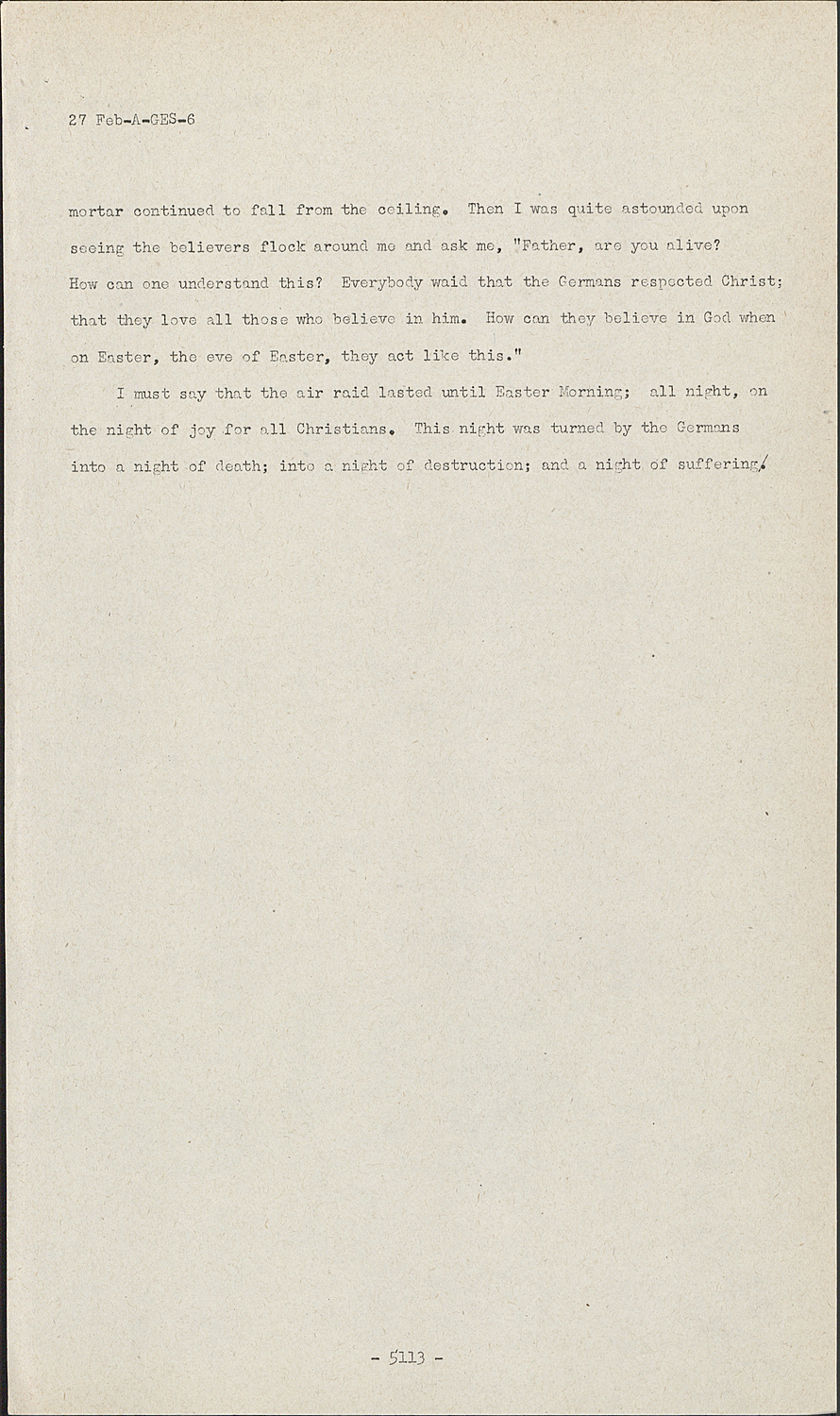
Then I was quite astounded upon seeing the believers flock around me and ask me, "Father, are you alive?
How can one understand this? Everybody waid that the Germans respected Christ; that they love all those who believe in him. How can they believe in God when on Easter, the eve of Easter, they act like this."
I must say that the air raid lasted until Easter Morning; all night, on the night of joy for all Christians. This night was turned by the Germans into a night of death; into a night of destruction; and a night of suffering.
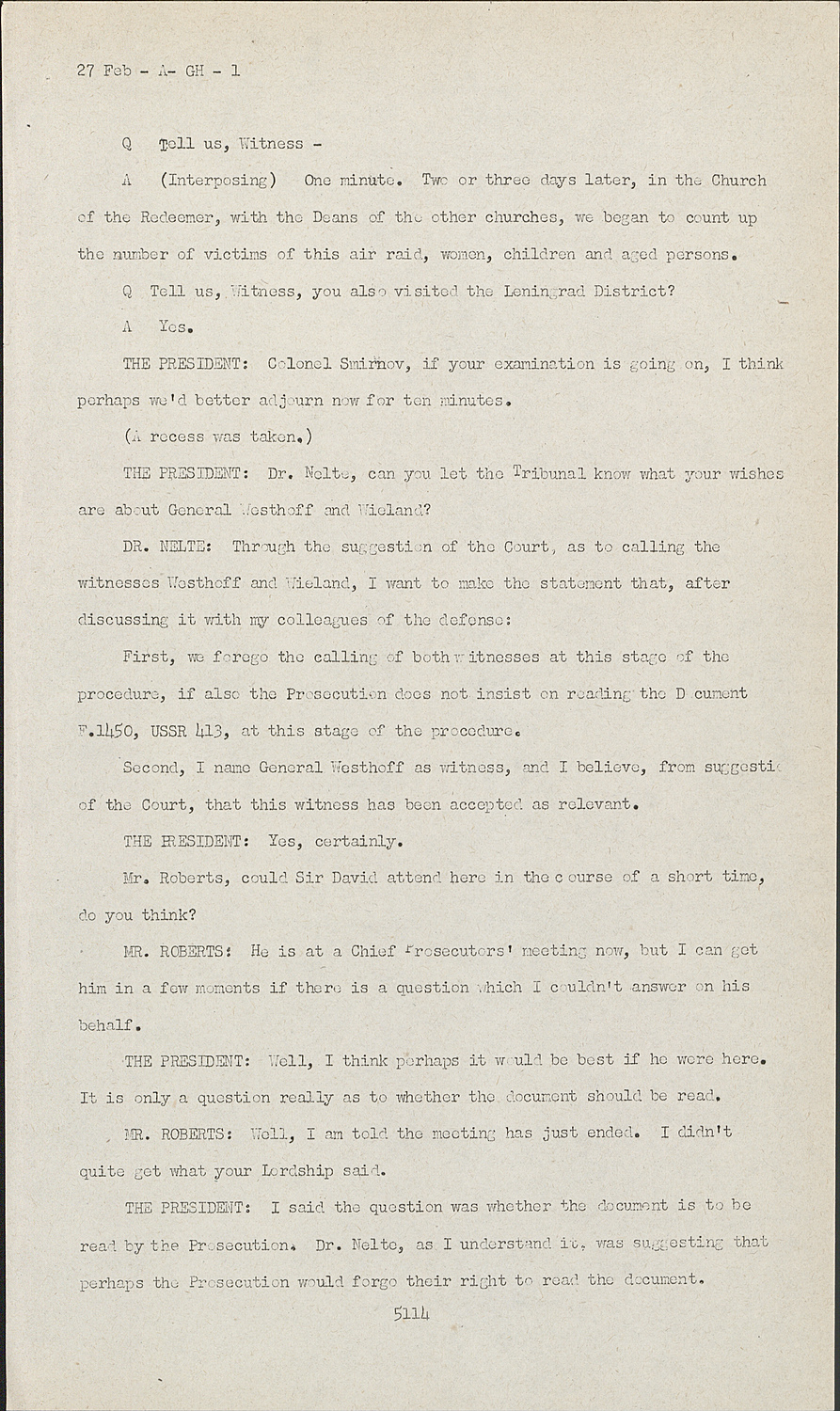
Q Tell us, Witness -
A (Interposing) One minute. Two or three days later, in the Church of the Redeemer, with the Deans of the other churches, we began to count up the number of victims of this air raid, women, children and aged persons.
QTell us, Witness, you also visited the Leningrad District?
AYes.
THE PRESIDENT:Colonel Smirnov, if your examination is going on, I think perhaps we'd better adjourn now for ten minutes.
(A recess was taken.)
THE PRESIDENT:Dr. Nelte, can you let the Tribunal know what your wishes are about General Westhoff and Wieland?
DR. NELTE:Through the suggestion of the Court, as to calling the witnesses Westhoff and Wieland, I want to make the statement that, after discussing it with my colleagues of the defense:
First, we forego the calling of both witnesses at this stage of the procedure, if also the Prosecution does not insist on reading the Document F.1450, USSR 413, at this stage of the procedure.
Second, I name General Westhoff as witness, and I believe, from suggestion of the Court, that this witness has been accepted as relevant.
THE PRESIDENT:Yes, certainly.
Mr. Roberts, could Sir David attend here in the course of a short time, do you think?
MR. ROBERTS:He is at a Chief Prosecutors' meeting now, but I can get him in a few moments if there is a question which I couldn't answer on his behalf.
THE PRESIDENT:Well, I think perhaps it would be best if he were here. It is only a question really as to whether the document should be read.
MR. ROBERTS:Well, I am told the meeting has just ended. I didn't quite get what your Lordship said.
THE PRESIDENT:I said the question was whether the document is to be read by the Prosecution. Dr. Nelte, as I understand it, was suggesting that perhaps the Prosecution would forgo their right to read the document.
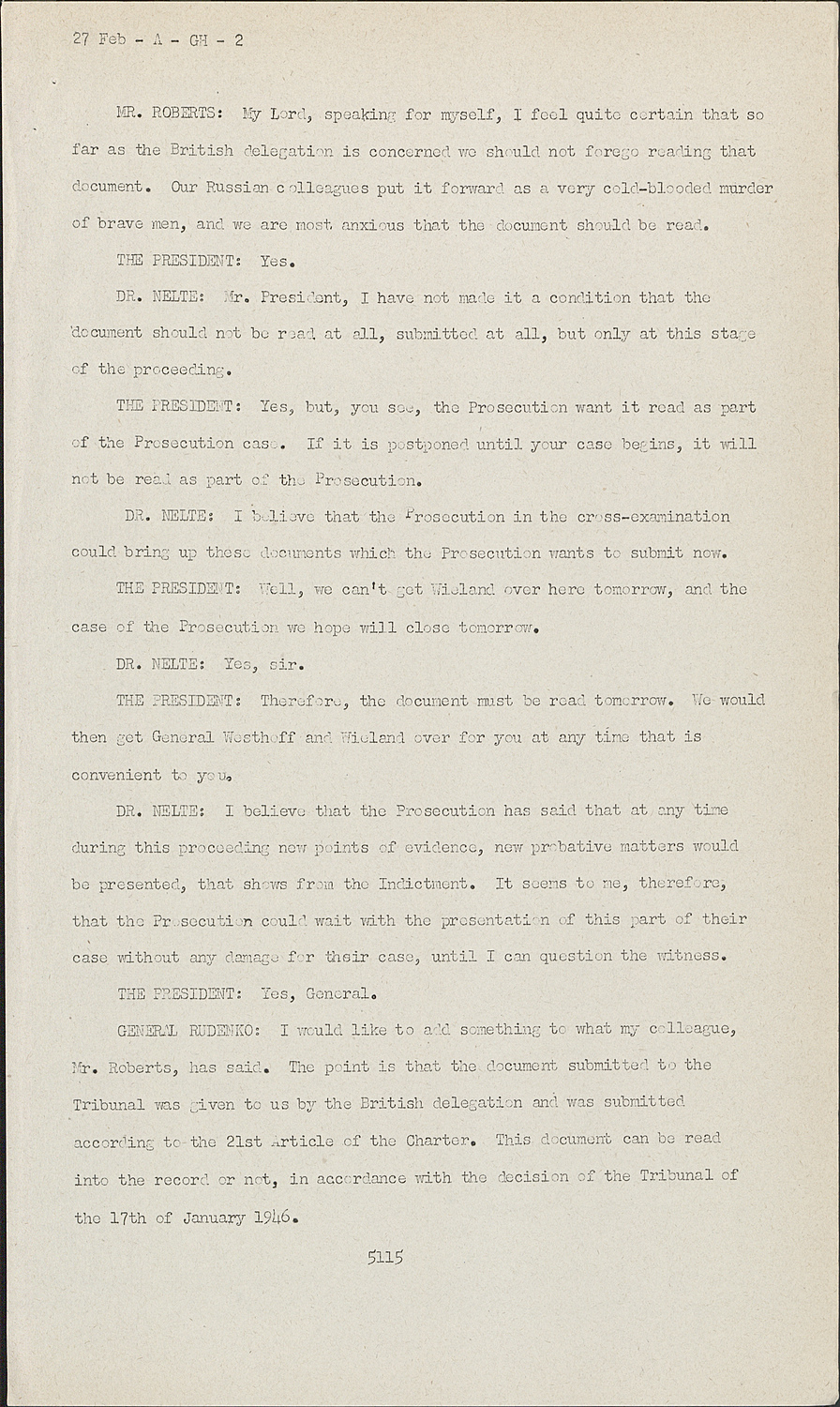
MR. ROBERTS: My Lord, speaking for myself, I feel quite certain that so far as the British delegation is concerned we should not forego reading that document.
Our Russian colleagues put it forward as a very cold-blooded murder of brave men, and we are most anxious that the document should be read.
THE PRESIDENT:Yes.
DR. NELTE:Mr. President, I have not made it a condition that the document should not be read at all, submitted at all, but only at this stage of the proceeding.
THE PRESIDENT:Yes, but, you see, the Prosecution want it read as part of the Prosecution case. If it is postponed until your case begins, it will not be read as part of the Prosecution.
DR. NELTE:I believe that the Prosecution in the cross-examination could bring up these documents which the Prosecution wants to submit now.
THE PRESIDENT:Well, we can't get Wieland over here tomorrow, and the case of the Prosecution we hope will close tomorrow.
DR. NELTE:Yes, sir.
THE PRESIDENT:Therefore, the document must be read tomorrow. We would then get General Westhoff and Wieland over for you at any time that is convenient to you.
DR. NELTE:I believe that the Prosecution has said that at any time during this proceeding new points of evidence, new probative matters would be presented, that shows from the Indictment. It seems to me, therefore, that the Prosecution could wait with the presentation of this part of their case without any damage for their case, until I can question the witness.
THE PRESIDENT:Yes, General.
GENERAL RUDENKO:I would like to add something to what my colleague, Mr. Roberts, has said. The point is that the document submitted to the Tribunal was given to us by the British delegation and was submitted according to the 21st article of the Charter. This document can be read into the record or not, in accordance with the decision of the Tribunal of the 17th of January 1946.
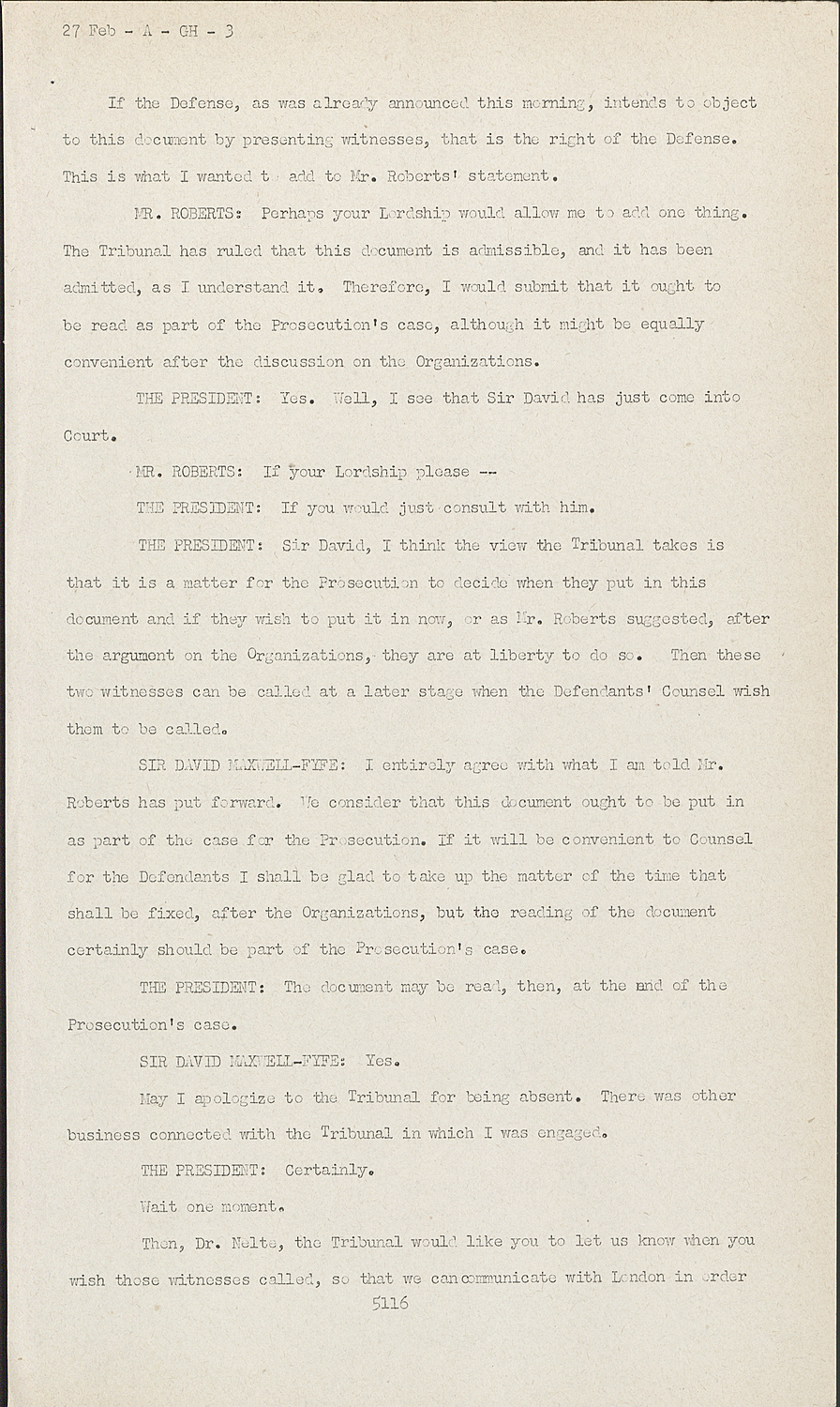
If the Defense, as was already announced this morning, intends to object to this document by presenting Witnesses, that is the right of the Defense.
This is what I wanted to add to Mr. Roberts' statement.
MR. ROBERTS:Perhaps your Lordship would allow me to add one thing. The Tribunal has ruled that this document is admissible, and it has been admitted, as I understand it. Therefore, I would submit that it ought to be read as part of the Prosecution's case, although it might be equally convenient after the discussion on the Organizations.
THE PRESIDENT:Yes. well, I see that Sir David has just come into Court.
MR. ROBERTS:If your Lordship please -
THE PRESIDENT:If you would just consult with him.
THE PRESIDENT:Sir David, I think the view the Tribunal takes is that it is a matter for the Prosecution to decide when they put in this document and if they wish to put it in now, or as Mr. Roberts suggested, after the argument on the Organizations, they are at liberty to do so. Then these two witnesses can be called at a later stage when the Defendants' Counsel wish them to be called.
SIR DAVIDMAXWELL-FYFE: I entirely agree with what I am told Mr. Roberts has put forward. We consider that this document ought to be put in as part of the case for the Prosecution. If it will be convenient to Counsel for the Defendants I shall be glad to take up the matter of the time that shall be fixed, after the Organizations, but the reading of the document certainly should be part of the Prosecution's case.
THE PRESIDENT:The document may be read, then, at the and of the Prosecution's case.
SIR DAVIDMAXWELL-FYFE: Yes.
May I apologize to the Tribunal for being absent. There was other business connected with the Tribunal in which I was engaged.
THE PRESIDENT:Certainly.
Wait one moment.
Then, Dr. Nelte, the Tribunal would like you to let us know when you wish those witnesses called, so that we can communicate with London in order that the witness Wieland may be brought over here.
DR. NELTE:The witness could appear during the presentation of my case. I could not say when that will be, when I can present my witnesses.
I believe that the Court is in a better position to decide the date on which I will be able to come before the Court with my case.
Between interrogations of witnesses which will be granted to me, I will question these witnesses also.
THE PRESIDENT:Dr. Nelte, you see these witnesses not only affect your client, but also affect the Defendant Goering and the Defendant Kaltenburnner, and therefore what the Tribunal wish is that you, in consultation with Dr. Stahmer and the Counsel for Kaltenbrunner, should let the Tribunal know what would be the most appropriate time for those witnesses to be called, so that a time may be fixed for summoning Wieland here and letting the prison authorities know about Westhof.
DR. NELTE:We have spoken about that. We have discussed it and we have agreed that the witnesses will be called during the time of my presentation.
(A brief interruption.)
I am just told by Sir David that we are therefore agreed that the documents will be presented after the case against the Organizations.
THE PRESIDENT:Yes.
Colonel Smirnov?
COLONEL SMIRNOV:May I continue with my questioning, Mr. President?
THE PRESIDENT:Yes.
BY COLONEL SMIRNOV:
QI have one last question to put to you, Witness. Tell me, when you left the city to go into the country to investigate the churches, did you ever witness the mockery of religion or its humiliation.
AYes, I did.
QWould you be kind enough to relate this to the Tribunal?
AIn June 1943, by the directive of Metropolitan Alexis, I left for the region of the Old Peterhof and Oranienbaum.
From personal observations and from my conversations with the members of the church I learned the following.
Most of what I learned, I learned when Peterhof was freed from the German occupation, and what I shall now relate may be checked with others' testimony.
In the Old Peterhof soon after the Germans destroyed the new Peterhof within ten days, the artillery fire on the enemy planes destroyed every church.
At the same time the German planes and the artillery fire were so arranged that together with the churches they were destroyed.
The parishioners and those who sought refuge in the churches were usually the inhabitants, the peaceful citizens of the region.
All the churches in the Old Peterhof, namely the Church of Znamenska, the cemetery of the same, Trinity Church and the Little Church of Lazarus near the cemetery, the Holy Museum and the church of the military cemetery--all the churches were destroyed by the Germans.
I can state with certainty that near the cemetery church and the Lazarus Church near it, as well as other churches, such as Znamenska--in those churches more than 10,000 worshippers and persons seeking refuge died.
The Germans wouldn't let the people leave the churches.
It is easy to picture the sanitary conditions of the people confined in those churches, in the basements of those churches--bad air, human excreta right in the basement of the churches, people terribly afraid, many dizzy, many sick.
Whoever tried to leave any of the church basements was immediately shot by the German Fascists.
Much time has already passed since that time, but I remember particularly one occasion which was related to me by my close relative.
I shall relate the incident.
A little girl left the basement of the Trinity Church to fetch some water.
Immediately she was shot by German snipers. The mother followed the child, but was shot right near the body of her little girl.
The citizen of Maslowa who told me that is still alive. She lives in the city of Pskov.
But there were many incidents of that kind.
Q Tell me, Witness in the other regions of the Leningrad district, did you ever witness sacred relics and other sacred objects being mocked and being insulted?
A Yes. I witnessed terrible scenes of destruction in general, but particularly I feel that I must relate to your Honors that, in the city of Pskov, in the religious museum, right on the shores of the beautiful river, I witnessed the most terrible things.
In that city, up to 60 churches of various creeds--those 60 churches, which are the monuments of national culture, of the centuries of religion, only a very few of those remain now.
Particularly terrible was the destruction of the monuments which reflect the religious culture of the many centuries of the Russian people.
For instance-
QWell, just what happened to those churches?
A That is just what I want to relate. The ancient cathedral, the largest church, with its wonderful works of art--this whole thing was plundered by the German soldiers.
Everything was carried out of it and not only from that church alone, but from all the other churches of the same city.
You won't find a single ikon left, not a single holy image, not a vestment.
Everything was taken out.
I had to return again to the cathedral of The Trinity for my visit there, but it almost cost me my life.
Just a half hour before I arrived there a mine exploded right near the altar, the gate to the altar.
The altar blew up immediately. Blood was splattered all over it.
Before my own eyes I saw three of our Soviet warriors who were killed by the mine, intentionally planted there a short while before, right at the gate of the holy altar.
And I shall make another remark here. In Pskov, which was freed from the Germans in August, 1944, another mine exploded in January 1946, and two persons died.
In the same manner was treated the church of St. Vasili on the Gorke.
There a mine was laid right at the entrance to the church.
The thing that was so surprising in all the churches was the fact that all the dirt, all the excreta were always deposited somewhere at the entrance to the church.
Out of another cathedral, for instance, the Germans made stables.
In another one they used it as a wine-cellar. In a third temple I saw coal and oil.
My heart bleeds from the plunder that I have seen, from the suffering that I have seen.
My heart bleeds when I think that these people talk about culture, that some of them said that they believed in Christ.
QWitness, I have no more questions.
AI would like to secure permission, Mr. Prosecutor, to allow me to say a few more words about what happened in Leningrad.
I won't detain you very long.
QWith regard to that, you must ask the Tribunal.
THE PRESIDENT:Very Troll.
AI secured permission, your Honors, to add a few words. This is about the mockery of the Nicola Bogojavlenski Cathedral, the greatest cathedral in Leningrad.
In that church during the blockade of Leningrad, lived the Metropolitan Alexis of the Orthodox Church.
Since I served there until the end of the war I witnessed certain things there.
In July, 1942, I witnessed a great deal of artillery fire directed at the Cathedral.
It was particularly surprising, since I could not understand what military objectives could be there in the temple, in the vicinity of the temple. The moment church services would begin, particularly on Sunday, artillery fire directed straight at the church would begin.
At the beginning of the great raid in 1943, which began with early morning and lasted until late at night, we the clergy as well as those praying in the temple could not leave it, even for a minute, as the artillery fire never stopped. Around us there was death and destruction. I saw myself how about fifty persons -- I don't know exactly how many -people who had been my parishioners -- I saw myself how they died right near the church. They had left the church before the siren sounded "safe" and were shot immediately. In this sacred temple thousands of men were murdered, thousands of men died as a result of the German planes and German fire. For thousands of them I said memorial services. An ocean of tears was shed for them as a memorial. Our Metropolitan, Alexis, escaped death by a hair's breadth when several shell fragments broke his own dwelling within the church.
I do not want to take up too much time but I do want to say that the remarkable thing was that be most intensive artillery fire always took place on holy days when crowds worshipped in the churches. Hospitals, churches and other cultural and humanitarian institutions seemed to be the special target of the German fire. It wouldtake a long time, your Honors, to relate everything which I have seen, if I could ever tell anyone the whole long book of sorrow and suffering and crime that I have seen.
But I want to say in conclusion that the Russian people and the people of Leningrad have fulfilled their duty to their Fatherland. They bore the strafing of the German planes. Throughout the German artillery bombardment there was great organization, efficiency, courage, devotion. All through it, the Church of God tried to console the parishioners by preaching the Word of God and by preaching sacrifice.
COLONEL SMIRNOV: I have no more questions of the witness, Mr. President.
THE PRESIDENT:Do any of the other members of the Prosecution wish to ask any questions?
(The answer was in the negative).
Do any of the Defense Counsel wish to put any questions ?
(The answer was in the negative).
Then the witness may retire.
COLONEL SMIRNOV:May I saw a few words by way of concluding my report?
THE PRESIDENT:You may.
COLONEL SMIRNOV:Your Honors, in his Note of the 6th of January, 1942, the Peoples Commissar for Foreign Affairs of the USSR stated that the Soviet Government considered it its duty to inform the entire civilized world and all honest citizens through the world of the monstrous crimes of the Hitlerite bandits. Victory over Fascist Germany was wen in battle by millions of honest people in this war, the greatest in scale in the history of the world. This International Tribunal was created by the will of millions of honest people, to judge the chief criminals of war, and each representative of the Prosecution feels back of him the invisible support of these millions of honest persons, in whose name he accuses the chiefs of the Fascist conspiracy.
To conclude the presentation of the evidence of the Prosecution, the honor of that task has fallen to my lot. I know that in this moment the millions of citizens of my carry together with the millions of honest persons throughout all countries of the world, await your just and speedy verdict. Let me end on that.
MR.DODO: (of the United States prosecution ). May it please the Tribunal, I have a few matters that will take but a few minutes, with respect to the record.
In the course of the presentation of the 23rd of November 1945, pertaining to economic aspects of the conspiracy, certain documents were read from, but they werenot formally offered in evidence. At that time the Tribunal indicated that sufficient time had not been allowed Counsel for the Defense to make an examination of these documents, and we did not offer them, agreeing instead that we would make them available in the Defendants' Centre.
We did so, and they have been there all of the time since.
They should be formally offered. The extracts were read. There is no necessity of going through that again.
They are as follows:
The first one referred to in the record was one bearing the number EC-14, which we offer as USA Exhibit 758.
Extracts from this document were quoted on page 297 of the record.
The next one is EC-27, which we offer as USA Exhibit 749. Extracts from this document were quoted on pages 279 and 280 of the record.
The third one is EC-28, which we offer as USA Exhibit 760. Extracts from this document were quoted on page 275 of the record.
On that page the document was erroneously offered as USA Exhibit 23, but the correct number is USA Exhibit 760.
EC-174 was quoted from on pages 303 and 304 of the record. We offer that as USA Exhibit 761.
EC-252. Extracts from that were quoted on page 303 of the record.
We offer it as USA Exhibit 762.
EC-257. Extracts from this document were quoted on page 303 of the record.
We offer it as USA Exhibit 763.
EC-404. We summarized and quoted from this document on pages 291 and 292 of the record.
We now offer it as USA Exhibit 764.
B157 was read from, and on page 299 of the record, and we now offer it as USA Exhibit No. 765.
B167 was summarized, and also extracts were quoted from it on page 298 of the record, and we offer it as USA Exhibit No. 766.
B203, extracts from it were quoted on pages 283 to 286 of the record, and we offer it as USA Exhibit No. 767.
B204, which was quoted from on pages 286 and 287 of the record is offered as USA Exhibit No. 768.
B206, extracts from this paper were quoted on pages 297 and 298 of the record, and we offer it as USA Exhibit No. 769.
Document D317, extracts were quoted from it on pages 289 and 290 of the record, and we offer it as USA Exhibit No. 770.
Now in addition to these documents Lieutenant Bryson, who presented the case for the prosecution against the individual defendant Schacht, offered in evidence the documents EC437 and 258 in their entirety on the condition that the French and Russian translations subsequently would be filed with the Tribunal.
Now EC437 was assigned as USA Exhibit No. 624, and EC 258 was assigned as USA Exhibit 625, and the Tribunal ruled on page 2543 of the record that the documents would be received in their entirety only after the translations had been completed. Copies of these documents in all four languages have been filed with the Tribunal, and in the Defendants' Information Center, and that was done a few weeks ago. In accordance with the ruling of the Tribunal, we now offer these documents in evidence in their entirety , and we assume that they will retain the numbers USA Exhibit No.624, and USA Exhibit No. 625.
Also in the Trial Brief on the individual responsibility of the defendant Schacht, which was recently submitted to the Tribunal and to the defendants' counsel, reference is made to a few documents which have not already, or heretofore, been offered in evidence.
I think there is no necessity for taking the time of the Tribunal to read from these documents, and instead we have had pertinent extracts made available in German, French, Russian and English, and, copies in all the four languages have already been distributed to the Tribunal, and placed in the Defendants' Information Center. They have these documents, and we ask that they be received in evidence. They are EC384, which we offer as USA Exhibit No. 771, and EC406, which we offer as USA Exhibit No. 772. EC456 which is offered as USA Exhibit No. 773. EC495 which is offered as USA Exhibit No. 774. EC497 which is offered as USA Exhibit No. 775.
In addition to the interrogation of the defendant Schacht, dated 11 July 1945, which is one of those referred to in the Trial Brief as USA Exhibit No. 776, and finally, with respect to this economic aspect of the file, we respectively ask that the secret minutes of the meeting of the Ministers, date 30 May 1930, which are included as State documents No. 1301-PS, and which is assigned USA Exhibit No. 123, be received in evidence in their entirety. These minutes have been made available to the Tribunal, and the defendants' counsel in all four languages.
I also wish to refer to document No. 1639-PS, which we offer as --
DR. DIX:I am Dr. Dix for the defendant Schacht. The prosecution has jus made the motion to accept in evidence a number of documents concerning the defendant Schacht, and they have to offer them at this time. These documents are contained in a supplementary volume which we received after the special case against the defendant Schacht had been finished, or a short time afterwards.
I do not intend to protest against this procedure, but in my opinion this procedure provided by the Court, and the Tribunal agreed with it, as a consequence, for the defendants counsel, that we have to follow this procedure, and we agree to that fact; but we have to be in a position also after finishing the whole case, or proof in favor of our clients at a later date to prevent introduction of such material, or of documents, if they can still add in favor of our plans.
It is necessary, however, that we should be in a position also to offer witnesses, and I should like to ask the Tribunal to make a decision to give us the information on this point.
THE PRESIDENT:I shall say, Dr. Dix, the Tribunal believes that the prosecution is entitled to apply, as they have applied, and to have any of these documents admitted in evidence, and, similarly, that the defendants will be entitled to apply to have any documents which they offer in evidence in presenting the individual defendants' cases, as they come to an end.
DR. DIX:Thank you, sir.
MR. DODD:Now I wish to refer to document bearing our number 16398-PS, which we wish to offer as USA Exhibit No. 777. For the benefit of the Tribunal this document is entitled "Mobilization Book for the Civil Administration," and a 1939 edition. It was published in February, or, about in February 1939, over the signature of the defendant Keitel, the Chief of the OKN. It is classified "Top Secret," and was distributed in 125 copies to the higher Reich Ministry, as well as to the Army, Navy and Air Force. In its original form the document runs to some 150 pages. We have had translated into English, Russian and French pages 2 to 18, which gives the essential text of the document. It appears froma statement in the document itself, that the "Mobilization Book" had previously been issued, and was revised annually. This particular book which we introduce, or offer to introduce, was effective the 1st day of April 1939, and this was the operative basis that was used for the mobilization calendar at the time the Nazis launched their aggression against Poland.
However, we wish to relate it back primarily to that part of the record dealing with the Nazi plan and preparation for the aggression, because the "Mobilization Book" or such a "Mobilization Book" had been in effect for a year prior to 1939.
Secondly, we say it ties in with the secret Nazi Defense Laws of 1935 and 1938 which are contained, in Documents 2261-PS and 2194-PS, introduced before the Tribunal as Exhibits USA Nos. 24 and 36 respectively.
Thirdly, it is another clear indication, we submit, of the Nazi plans and preparations for aggressive war. That portion of the Prosecution's case dealin with Nazi preparations for aggression was presented by Mr. Alderman of the American Prosecution staff at the morning and afternoon sessions of the Tribunal on November 27, 1945, and may be found at pages 399 to 464 of the record.
Inasmuch as this document has been translated into all four languages, we assume that it is not necessary to read it into the record, but we do wish to quote, however, directly, two extracts -- we will withdraw that. They are included in the translation and I see no necessity for reading them over the translation system.
This document was also, I might say, referred to by the Chief Prosecutor for the United States in his opening address, and it is the only document there, in referred to which has not been offered formally to the Tribunal in evidence.
I should like to take up one other matter. I wish to move to strike one piece of evidence offered by the Prosecution and by an American member of the Prosecution.
On the 15th day of January 1946, certain testimony appearing at page 2760 in the record was presented on behalf of the United States Chief Prosecutor. A further examination of this document indicates to us that there is some grave question as to its authenticity, although, of course, at the time we believed that it was authentic. We have reason now for having grave doubt about it.
Therefore, we ask that the testimony appearing on page 2760 of the record be stricken. It reads as follows -- it is only three brief paragraphs. Quoting from the record at that page, 2760:
"Now, in concluding the question of the ideological significance of the Hitler Youth, I would like to ask your indulgence while I make a short quotatio from that master ideological leader, the defendant Alfred Rosenberg, found in Document 130-PS, your document book page 122, which is offered as U.S. Exhibit 672. Rosenberg was making an answer to some inquiries of the defendant Bormann about the expediency of initiating some legal proceedings against the churches in 1939. Rosenberg replied, apparently inclosing an article which he had writt the year before, and it is from this article that I wish to quote. Quoting fro the article, from Document 130-PS:
"'We have made quite some progress in carrying the N.S. ideology to German youth. But what there is still left of Catholic youth are only small groups which will be absorbed as time goes on. The Hitler Youth is the absorbing sponge which nobody can resist.
Furthermore, our program for educational categories of our schools has been built up already with such an antiChristian and anti-Jewish tendency that the generations growing up now will be safe from the black swindle,'" That is the end of the quotation from the document.
Then the prosecutor representing the U. S. Chief Prosecutor went on to say, quoting from that page of the record:
"That is on pages 122 and 123. The quotation is from page.
123. The document begins at page 122; all underlined in red. I use that extract, your Honor, in connection with the expectancy of these conspirators themselves with respect to the Hitler Youth and what it was to do to the minds of young Germans."
That is the end of the quotation from the record.
As I said a minute ago, we cannot vouch for the authenticity of this document, and it was misunderstood when offered. Actually, it was found in the files of the defendant Rosenberg, but it amounts to a letter from the defendant Bormann to the defendant Rosenberg, enclosing what was a pamphlet or a throwaway or a scatter-paper, calling the defendant Rosenberg's attention to it, and this quotation was read from that pamphlet, so we ask that it be stricken from the record, and I assume there is no objection.
THE PRESIDENT:Has the defendant Rosenberg's counsel any objection to this being struck out of the record?
DR. THOMA:I have no objection to make, sir.
THE PRESIDENT:Then it will be struck out.
MR. DODD:I have only one last matter, which I am sure I can conclude before the usual recess time.
In the course of the presentation of the individual case against the defendant Ribbentrop, our distinguished colleague Sir David Maxwell-Fyfe, the Deputy Chief British Prosecutor, introduced Document 3358-PS as Exhibit GB-158. This was on the 9th day of January, 1946, and may be found at page 2380 of the record.
This document is a German Foreign Office circular dated the 25th day of January 1939, and it is on the subject of the "Jewish Question as a Factor in German Foreign Policy in the Year 1938." Sir David read portions of this document into the record, including the first sentence of the full paragraph appearing on page 3 of the English translation of the document.
I have discussed the matter with Sir David, and he has very graciously agreed that we might ask the permission of the Tribunal to add two more sentences to the quotation which he read, because we feel, and Sir David feels with us, that the additional two sentences which follow immediately the sentence which he read add something to the proof with reference to the persecution of the Jews as related to crimes against peace. It is desired, therefore, by the Prosecution, that the entire paragraph on page 3 of the English translation of this document be considered as in evidence by the Tribunal, and in accordance with the ruling of the Tribunal generally made as to other such situations, we submit now an English, German, French, and Russian translation of that entire paragraph to obviate the necessity of reading it, and the original, of course, is in the German language.
It is a very brief paragraph, but I don't think that the Tribunal would care to have me read it, even to take a minute or two. It is already in the record. It is only two sentences. It does not wrench anything from the text; in our opinion, it only adds a little to the proof. It you would like to have it read, I can do so.
THE PRESIDENT:Yes, I think we would.
MR. DODD:The sentence read by Sir David reads as follows:
"It is certainly no coincidence that the fateful year 1938 has brought nearer the solution of the Jewish question simultaneously with the realization of the idea of greater Germany, since the Jewish policy was both the basis and consequence of the events of the year 1938."
That is the end of the sentence, and that is what was quoted by Sir David on the 9th day of January, at page 2380. We wish to add the following, beginning right after that sentence:
"The advance made by Jewish influence and the destructive Jewish spirit in politics, economy, and culture, paralyzed the power and the will of the German people to rise again, or perhaps even in the power policy opposition of the former enemy allied powers of the World War."
And we wish to add this second sentence which follows immediately, as well:
"The healing of this sickness among the people was therefore certainly one of the most important requirements for exerting the force which in the year 1938 resulted in the joining together of greater Germany in defiance of the world."
We felt that that would add something to our proof with respect to this persecution of the Jesw.
Those are the only matters I have to bring up for the record.
THE PRESIDENT: Some time ago I wrote to Mr. Justice Jackson on behalf of the Tribunal, asking whether a list of the persons who formed the German General Staff could be submitted to the Tribunal.
Has that been done?
MR. DODD:I am familiar with that communication. I recall Mr. Justice Jacks n's showing it to me.