The domestic proceedings, such as the attempted assassination of July, of course I knew about that, but not through Amt IV.
QI am speaking of the general course of activity and not of any special exceptions, you understand.
AYes.
QYou likewise deny that Mueller, as chief of AmtIV, always conferred with you with respect to any important documents?
AYes. I not only deny it but the facts speak against it. He had direct authority from Himmler. He had no reason to discuss this matter with me before.
QI ask that the defendant be shown a document, L-50, which will become USA Exhibit 793.
THE PRESIDENT:Hasn't this been put in before?
COLONEL AMEN:No, Your Lordship, I am told it has not.
QBy the way, were you acquainted with Kurt Lindow, who makes this affidavit dated 2 August 1945?
ANo.
QAlthough he was an official in the RSHA until 1944? Let's read together paragraphs 2 and 4 only. I won't take the time of the Tribunal to read paragraphs 1 and 3. Two, you will note, reads as follows:
"On the basis of general experience as well as of individual cases I can confirm that the Gestapo (office IV) wrote, reports about practices of the administrative authorities in the concentration camps and that these were given by the chief of office IV to the Chief of the Security Police for signature and were submitted to the Reichsfuehrer Himmler."
AMay I reply to thatimmediately?
QYes.
AIt might be proper perhaps to read paragraph 1 also.
QPlease make it as brief as you can.
AParagraph 1 seems to be important, for in paragraph 1 it says that the witness Lindow, from 1938 until 1940, was in this department in which such reports were written -- that this man worked in this Department. In 1940-41 he was in counter-espionage; in 1942 and 1943 for the combatting of communism; and later in the department for education of office I. I believe, therefore, that his testimony in paragraph 2 that he knew of the activity of the Gestapo, that thorugh the chief No. IV reports were submitted to Himmler about happeneings in concentration camps, only the time 1938 to 1940 is involved.
The later period of time, from his own testimony, he has no personal experience and observations.
QWell, in other words he is not telling the truth as it was at the time when you were active in RSHA, correct?
AI have not read that much.
QI am calling your attention to two paragraphs. We have already covered 2, and now we will read 4:
"To my knowledge no chief of office or any of the officials of the RSHA authorized to sign had the right to sign in any fundamental affairs of particular political significance without consent of the Chief of the Security Police--not even during his temporary absence. From own experience I can furthermore declare that particularly the chief of office IV, Mueller, was very cautious in signing documents concerning questions of general nature and in some cases of greater importance, and that he put aside events of such nature in most cases for the return of the Chief of the Security Police, whereby alas often much time was lost.
"Signed: Kurt Lindow,"
AYes. I would like to make two statements: First, this assertion is contrary to the testimony of several witnesses who know of the extraordinary authority and independence exercised by Mueller, who testified to his independence and authority.
Point 2: The description of Lindow is applicable to that period of time in which Heydrich was active--that is, the time between 1938 and 1940, in which Lindow could observe things. But this does not apply to the period in which Himmler gave direct orders to Mueller, and it was Himmler's prerogative, for my tasks were of such scope that it was almost impossible for one man to handle the work that I did.
QI don't want to spend too much time on it now, Defendant, but the paragraphs which I read you conform to the testimony of Ohlendorf before this Tribunal, do they not?
AThe testimony as given by Ohlendorf was shown to me yesterday by my Counsel. But the testimony as given by Ohlendorf leads us clearly to see that any executive order or power, even for protective custody--and he used the term "up until the last washerwoman"--that Himmler was competent for all of these things, and he delegated this authority only to Mueller.
He did add, however, he did not know that such a limitation of power was so in my case and whether perhaps I might not have had powers, but with assurance and certainty he could not state that. And the rest of his testimony contradicts my ever having such broad authority.
QWe all know what Ohlendorf's testimony was. I merely want to ask you if you accept the testimony of Ohlendorf. You told us in the course of interrogations that you had the most contact with Ohlendorf and that you would trust him to tell the truth before any of your other associates, is that not correct?
AI do not recall the last statement. The first statement, that he was one of my chief collaborators, is of course true and justified and is proved by the fact that he was chief of the intelligence within Germany, which was a part of my intelligence service. All domestic political reports--reports about German spheres of life-I received from this Amt III. That is besides the other departments which I worked out myself.
QShortly after Easter 1934 you were under arrest in the Kaisersteinbruch detention camp?
AWhat year was that, please?
QThirty-four.
AYes; from the 4th of January until the beginning of May.
QDid you ever, in company with other GS functionaries, make an inspection of the Mauthausen camp?
AWith other SS officials? No. To my recollection I went there alone and reported to Himmler; and as I stated, yesterday he was conducting a visiting tour through Germany.
QAnd you only went in the quarry? Right?
AYes.
QWere you acquainted with Karwinski, the state secretary in the Dollfuss and Schuschnigg cabinets from September 1933 to October 1935-Karwinski?
A I saw Karwinski once. I believe at that time through the hunger strike.
He visited us at this camp. I have never seen him since or at any other time. It might be that one of his representatives visited us. That I can't say exactly.
Q I ask that the Defendant be shown document No. 3843-PS, which will be USA Exhibit No. 794.
I would like to say to the Tribunal that there is rather objectionable language in this exhibit but I do feel that in view of the charges against the Defendant, I do feel it is my duty to read it nonetheless.
If you will turn to Page 3.
AOn page 3 there are just a few lines. May I read the entire document now, please?
QIt would take much too much time, Defendant. I am only interested in the paragraph which is on page 3 of the English text, and commences, "Shortly after Easter". Do you have it?
AYes, I have the place.
Q "Shortly after Easter 1934 I received the news that the prisoners in the Kaiser-Steinbruch detention camp had gone on hunger strike. Thereupon I went there myself, in order to inform myself about the situation. While comparative calm and discipline prevailed in most of the barracks, one barrack was very disorderly. I noticed that one tall men seemed to be the leader of the resistance. This was Kaltenbrunner, at that time a candidate for attorneyat-law, who was under arrest because of his illegal activity in Austria. While all the other barracks gave up their hunger strike after a talk which I held with representatives of the prisoners, the barracks under Kaltenbrunner persisted in the strike. I saw Kaltenbrunner again in the Mauthausen camp, when I was severely ill and lying on rotten straw with many hundred other seriously ill persons, many of them dying. The prisoners, suffering from hunger edema and from the most serious intestinal sicknesses, were lying in unheated barracks in the dead of winter. The most primitive sanitary arrangements were lacking. The toilets and the washrooms were unusable for months. The severely ill persons had to relieve themselves on little marmalade buckets. The soiled straw was not renewed for weeks, so that a stinking liquid was formed, in which worms and maggots crawled around. There was no medical attention or medicines. Conditions were such that 10 to 20 persons died every night. Kaltenbrunner walked through the barracks with a brilliant suite of high SS functionaries, saw everything, must have seen everything. We were under the illusion that these inhuman conditions would now be changed, but they apparently met with Kaltenbrunner's approval for nothing happened thereafter."
Is that true or false, defendant?
AThe document which is an obvious surprise to me I can refute in every point.
QI ask just -- first, I ask you to state whether it is true of false?
AIt is not true and each detail I can refute.
QMake it as brief as possible.
AIt is important for me to make it longer than what we have here. I have to refute each word which is incriminating me.
QJust a moment. Perhaps you will wait until I have read to you two more exhibits I have along the same line. Then perhaps you can make your explanation of all three at the same time. Is that satisfactory to you?
AYes, of course.
QI ask that the defendant be shown document No. 3845-PS, which will become Exhibit No. USA-795. You have already denied, I believe, having visited or going through the crematorium at Mauthausen, correct?
AYes.
QDo you know Tiefenbacher, Albert Tiefenbacher?
ANo.
QIf you have the document you will note that he was at Mauthausen concentration camp from 1938 until 31 May 1945 and that he was employed in the crematorium at Mauthausen for three years as a carrier of dead bodies. You note that?
AYes.
QNow, passing to the lower half of the first page, you will find the question:
"Do you remember Eigruber?" Answer: "Eigruber and Kaltenbrunner were from Linz."
"Did you ever see them in Mauthausen?
"I saw Kaltenbrunner very often.
"How many times?
"He came from time to time and went through the crematorium.
"About how many times?
Answer: "Three or four times."
Question: "On any occasion when he came through, did you hear him say anything to anybody?"
Answer: "When Kaltenbrunner arrived most prisoners had to disappear, only certain people were introduced to him."
Is that true or false?
AThat is completely incorrect.
QNow I will show you the third document and then you can make a brief explanation.
I ask that the defendant be shown document No. 3846-PS which will become Exhibit No. USA-796.
I might ask you, witness, do you remember ever having witnessed a demonstration of three different kinds of executions at Mauthausen at the same time?
Three different kinds of executions?
ANo, certainly not.
QAre you acquainted with Johann Kanduth who makes this affidavit?
ANo.
QYou will note, from the affidavit, that he lived in Linz; that he wan an inmate of the concentration camp at Mauthausen from 21 March 1939 until 5 May 1945; that besides the work in the kitchen, he also worked in the crematorium from the 9th of May, and he worked the heating for the cremation of the bodies.
Now, if you will burn to the second page,at the top.
Question: "Have you ever seen Kaltenbrunner at Mauthausen on a visit at any time?"
Answer: "Yes."
"Do you remember when it was?"
"In 1942 and 1943."
"Can you give it more exactly, maybe the month?
"I don't know the date" "Do you remember only this one visit in the year 1942 or 1943?"
"I remember Kaltenbrunner three times."
"What year?"
"Between 1942 and 1943."
Question: "Tell us, in short, what did you think about these visit as of Kaltenbrunner which you described?
That is: what did you see, what did you do, and when did you see that he was or was not present at such executions?"
Answer: "Kaltenbrunner was accompanied by Eigruber, Schulz, Zeireis, Bachmaier, Streitwieser and some other people.
Kaltenbrunner went laughing into the gas chamber.
Then the people were brought from the bunker to be executed and then all three kinds of executions:
hanging, shooting in the back of the neck, and gassing, were demonstrated. After the dust had disappeared, we had to take away the bodies."
Question: "When did you see the three different kinds of executions? Were these just demonstrations or regular executions?
Answers: "I do not know if they were regular executions, or just demonstrations. During these executions, besides Kaltenbrunner, the bunkerleaders 'Hauptscharfuehrer' Seidel and Duessen were also present. The last named then led the people downstairs.
"Do you know whether these executions were announced for this day or if they were just demonstrations or if the executions were staged just for pleasure of the visitors?
"These executions were announced for this day.
"How do you know that they were set for this day? Did somebody tell you about these announced executions?
"Hauptscharfuehrer Roth, the leader of the crematorium, always had me called to his room and said to me: 'Kaltenbrunner will come today and we have to prepare everything for the executions in his presence.' Then we were obliged to heat and to clean the stoves. " Is that true or false, defendant?
AUnder my oath, I wish to state that not a single word of these exhibits is true. I might share with the first document.
QCould you note, defendant, that none of these affidavits were taken in Nurnberg, but that they all appeared to have been taken outside of Nurnberg in connection with an entirely different proceeding or investigation. Did you note that?
ANo, but it is irrelevant for the testimony, as far as I am concerned.
QYes, go ahead.
AThe witness Karwinsky states having seen me in the year 1934 in connection with the hunger strike in the detention camp Kaiser-Steinbruch. He singles out the barracks in which disorderswere taking place in which a tall man, meaning myself, was present. According to him, I was interned there because of my illegal activity.
As far as these accusations are con-
cerned, up to now, they are completely wrong.
First of all, I was not interned because of National Socialistic activities, but because of the report which we had received and Karwinsky, who was then State Secretary, and who would be familiar with this report, had said to perform National Socialistic activities at that moment was prohibited and all prohibited activities had been charged to me. Then, further, when Karwinsky came, the hunger strike was in its 9th day. We had not -
QMay I interrupt you just a moment, defendant, I am perfectly satisfied if you answer that these statements are false. If you are satisfied, I am perfectly satisfied with that answer. I do not need an explanation of all of these paragraphs when we have no way of verifying what you say.
AMr. Prosecutor, I cannot be satisfied if the High Tribunal and the world is presented with testimony and documents which are pages long and of which you contend that they are the truth, and then you incriminate me in the most grave manner. I must have the opportunity to answer with more than yes or no. I cannot just say ----
THE PRESIDENT:You'd better let him go on. We do not want to argue about it. Go on, make your comments on the document.
THE WITNESS:Karwinsky arrived on the 8th or 9th day of the hunger strike. He did not come into the barracks in which we were, but we were brought on stretchers into the administrative building. None of us were even able to walk any more. And for this fact, there are many more witnesses --490 internees who had been confined in these barracks with me were in this administrative barracks. Karwinsky talked with us and stated that if the hunger strike were to stop the government would be willing to consider a liberation or a dismissal of the internees. We had been interned without having committed any offense at all, and thegovernment had given their promise to release us three times, and prior to that, never kept the promise.
Also, we requested a written statement from Karwi nsky, either signed by hom or signed by others. We wanted this statement so that we could believe and if we could be shown it, then we would end the strike.
He refused and the hunger strike went on and we were taken to,the hospital in Vienna.
On the 11th day, the hunger strike was stopped because even the giving of water was prohibited on that day.
THE PRESIDENT:When I said you could make your comments, I didn't mean you could go on giving the details of the hunger strike.
THE WITNESS:I just wanted to point out that it is incorrect as testified by the witness; that there was -- that I was active in the resistance and that I was still in my barracks. I had to be transferred on a stretcher to the barracks. None of us could even walk at that point.
Point 2, I talked with a cousin of Karwinsky. I talked with him repeatedly. His cousin was in charge of the sickness department at Linz and he told me that his cousin, that the witness mentioned here, never had been at Mauthausen, that he was at Dachau, beginning with the day of his detention. There is a lot of difference between Mauthausen and Dachau. I was committed as a former member of the Austrian government who had committed crimes against National Socialism. Through the RSHA and Heydrich in Berlin I was committed through a Berlin agency, not through an Austrian agency. I didn't see this man afterwards. That is, beginning with the first day of his internment at Dachau.
Point 3. I think the Prosecution should determine whether or not this man doesn't confuse me with someone else. If he has confused me with someone else, the prosecution should go to the trouble of determining whether this mart was not at Dachau from the beginning. I do know that this man was at Dachau. He was arrested at Innsbruck, and at thesame time it was made known to me that he had been brought from Innsbruck to Dachau. And my jurisdiction at that time had been stopped.
THE PRESIDENT:We will adjourn now.
(The Tribunal adjourned until 1400 hours)
Official transcript of the International Military Tribunal in the matter of The United States of America, the French Republic, the United Kingdom of Great Britain and northern Ireland, and the Union of Soviet Socialist Republics against Hermann Wilhelm Goering et al, Defendants, sitting at Nurnberg, Germany on 12 April 1946, 1400-1700, Lord Justice Laurence presiding.
THE PRESIDENT:Colonel Amen, I suppose the defendant wants to say something about these other two documents. He had answered the one, had he not?
COLONEL AMEN:I do not knew whether he had finished, your Lordship. BY THE PRESIDENT:
QHad you finishedwith the affidavit or the statement of Karwinsky?
AYour Lordship, I have not quite.
AGo on then.
AI have no longer the document before me and I request that it be given back to me. May I please ask you to return the document to me?
QYes, it is coming.
(witness handed document)
AThis document has not been shown to me during previous interrogations before the trial. Otherwise I would have immediately answered with a request that the cousin of the witness Karwinsky, who was chief of theInvalid Department at Linz and who bears the same name, be called as a witness and be asked whether it is correct that he expressly told me that this Karwinsky here was detained at Dachau and never at Mauthausen. I should very much like to add that the witness Dr. Skubl, who will be appearing before the Tribunal in another matter can probably make a statement on the same matter and particularly regarding the fact that this witness, Karwinsky, its arrested near the Swiss border on the occasion of his escape after the Anschluss and that he was taken from Dachau therefrom.
The reason why he was taken to Dachau is not exactly known to me but this Dr. Skubl will be able to give information on that subject, presumably saying that this intervention from Austria in connection with a former member of the Austrian Government would have to be prevented since Himmler was of the opinion that something might be done for Karwinsky on the part of the Austrian Government.
QYour counsel can apply to call any witnesses that you want in rebuttal. He can make application for that request. It is not necessary to go into that.
AVery good, your Lorship.
I should, like to make the following statement regarding the other two documents. Its entire contents are stated herewith by me to be untrue and incorrect. Had they been put before me in the interrogations then I would, as I did in other cases, have referred to the witness Zutter and his evidence and I would, have made an urgent request that this witness be confronted with me.
Regarding the witness Zutter I have talked to the prosecutor next to Colonel Amen, mho is sitting at the table, holding the rank of major, and I have asked him at least twenty times that this witness who is making such serious statements against me be confronted with me and the Prosecutor today, Colonel Amen too, was present when I made that request, particularly when the question of Mauthausen was discus sod and these gentlemen retired to consult with a third officer and discussed in English as to whether or not Ziehreis and Zutter could not be called in at once. Both were in this prison. All this is untrue.
QI have already told you that your counsel can apply to call any witnesses that you wish in rebuttal.
AI shall ask my counsel to apply for the calling of those two witnesses.
CROSS-EXAMINATION -- continued. BY COLONEL AMEN:
QDefendant, who was responsible for the order to kill all inmates at Mauthausen concentration camp, shortly before the end of DR. KAUFFMANN: Mr. President, may I say a few words in con-nection with these two documents?
They have first been introduced into the trial at this hour and it is only now possible for me to discuss these serious accusations with the defendant. He has denied it even to me, that is that these statements are true. I think it would be a violation of my duties as a defense counsel if I would not ask immediately now that these witnesses be heard. It could be that the Prosecution later on -
THE PRESIDENT:Dr. Kauffmann, what is the point of delaying the trial? I have just said that you might make application and you know perfectly well that application has to be made in writing.
I have said twice to the witness than you, Dr. Kauffmann, his counsel can apply for the calling of any witnesses you like in in rebuttal.
What is the good of delaying the trial by getting up and making your application verbally now?
DR. KAUFFMANN:Far be it from me to delay it but I wanted to state right now that I wanted to call these witnesses and I shall certainly make application in writing.
BY COLONEL AMEN:
QDid you understand the question, defendant?
AYes. You had asked me who had given the order for the killing of the inmates at Mathausen at the end of the war and to that I reply that such an order is unknown to me.
I had given one single order to Mauthausen which stated that the entire camp and all detainees were, and without any ill-treatment, to be surrendered to the enemy.
This order was given in the presence of the witness Dr. Hoettl where it was dictated and taken to Mauthausen by courier.
I draw your attention to the statement from Hoettl in which he underlines and states that fact.
A questionnaire has been sent to a second person by my defense counsel and I am requesting a similar statement and that interrogatory is still outstanding.
QI did not ask you about that order. I asked you about an order to kill all inmates at Mauthausen concentration camp shortly before the end of the war.
Who was responsible for that order?
Were you?
ANo, I have answered that question to start with
QThis time you are acquainted with the person who tells the story, Ziehreis.
You are acquainted with him Ziehreis?
AYes, I knew Ziehreis.
QAnd you had your picture taken with him and with Himmler which is now in evidence before this Tribunal.
Do you recall that
AI have not seen the picture. It was handed to the Tribunal at a time when I was in the hospital.
QWell, never mind the picture then.
COLONEL AMEN: I ask to have the defendant be shown docu-
ment number 3870-PS, which will be 797 U.S.
Now, if the Tribunal pleases this is a fairly long document which I do not propose to read at length but it is one of the more important documents in the case and so I hope that the Tribunal will read the entire statement even though I do not bring it all out today in the interest of saving time.
THE PRESIDENT:It is a new document?
COLONEL AMEN:A new document, your Lordship.
THE PRESIDENT:Is it in German?
COLONEL ALIEN:Yes.
(witness handed document)
BY COLONEL AMEN:
QThis you will note, defendant, refers to a dying con fession of Ziehreis, as reported to the individual making the affidavit and I call your attention, first, to the last two paragraphs on the first page which we will read together.
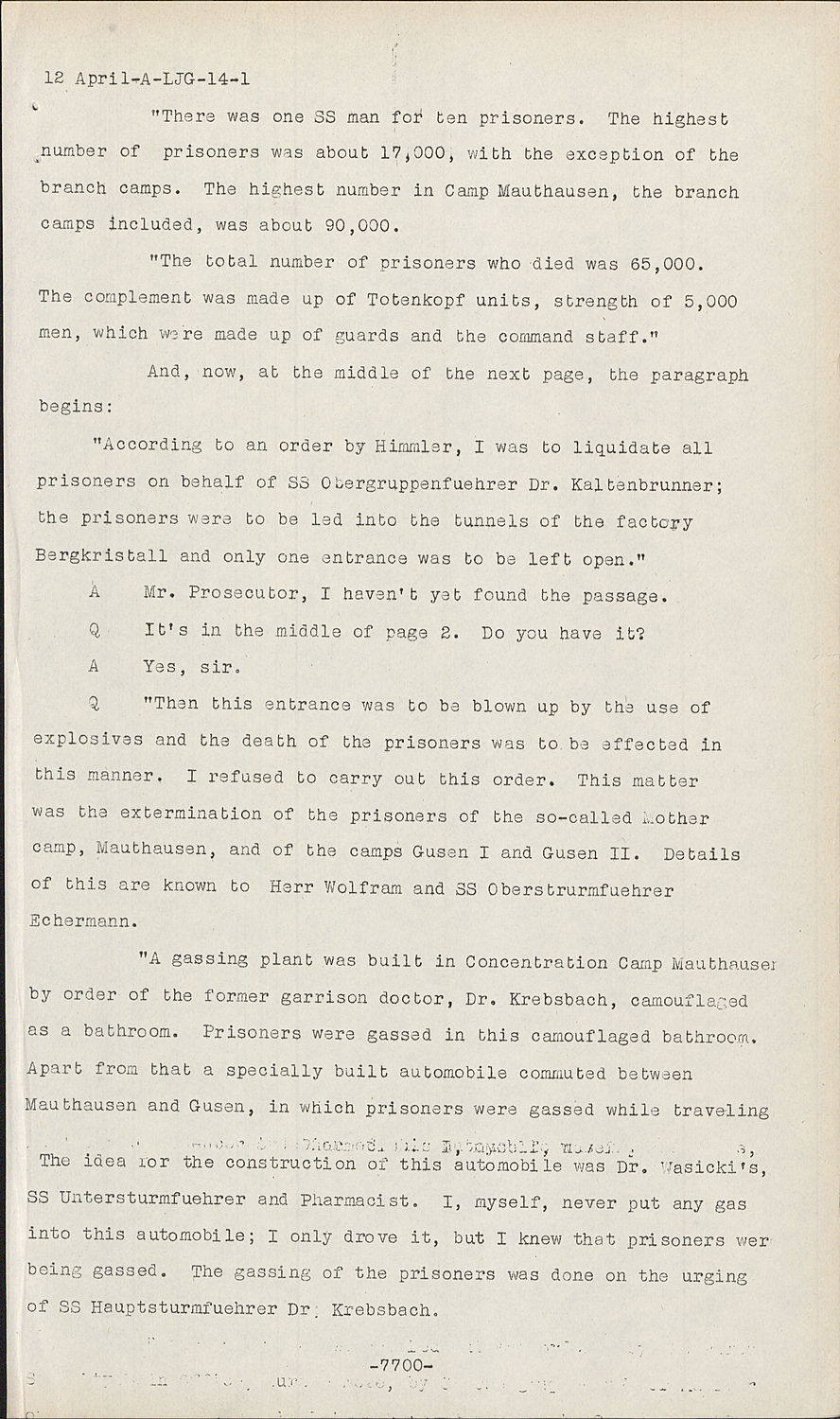
"There was one SS man for ten prisoners. The highest number of prisoners was about 17,000, with the exception of the branch camps.
The highest number in Camp Mauthausen, the branch camps included, was about 90,000.
"The total number of prisoners who died was 65,000. The complement was made up of Totenkopf units, strength of 5,000 men, which were made up of guards and the command staff."
And, now, at the middle of the next page, the paragraph begins:
"According to an order by Himmler, I was to liquidate all prisoners on behalf of SS Obergruppenfuehrer Dr. Kaltenbrunner; the prisoners were to be led into the tunnels of the factory Bergkristall and only one entrance was to be left open."
AMr. Prosecutor, I haven't yet found the passage.
QIt's in the middle of page 2. Do you have it?
AYes, sir.
Q "Then this entrance was to be blown up by the use of explosives and the death of the prisoners was to be effected in this manner. I refused to carry out this order. This matter was the extermination of the prisoners of the so-called mother camp, Mauthausen, and of the camps Gusen I and Gusen II. Details of this are known to Herr Wolfram and SS Oberstrurmfuehrer Echermann.
"A gassing plant was built in Concentration Camp Mauthausen by order of the former garrison doctor, Dr. Krebsbach, camouflaged as a bathroom. Prisoners were gassed in this camouflaged bathroom. Apart from that a specially built automobile commuted between Mauthausen and Gusen, in which prisoners were gassed while traveling The idea for the construction of this automobile was Dr. Wasicki's, SS Untersturmfuehrer and Pharmacist.
I, myself, never put any gas into this automobile; I only drove it, but I knew that prisoners were being gassed. The gassing of the prisoners was done on the urging of SS Hauptsturmfuehrer Dr. Krebsbach.
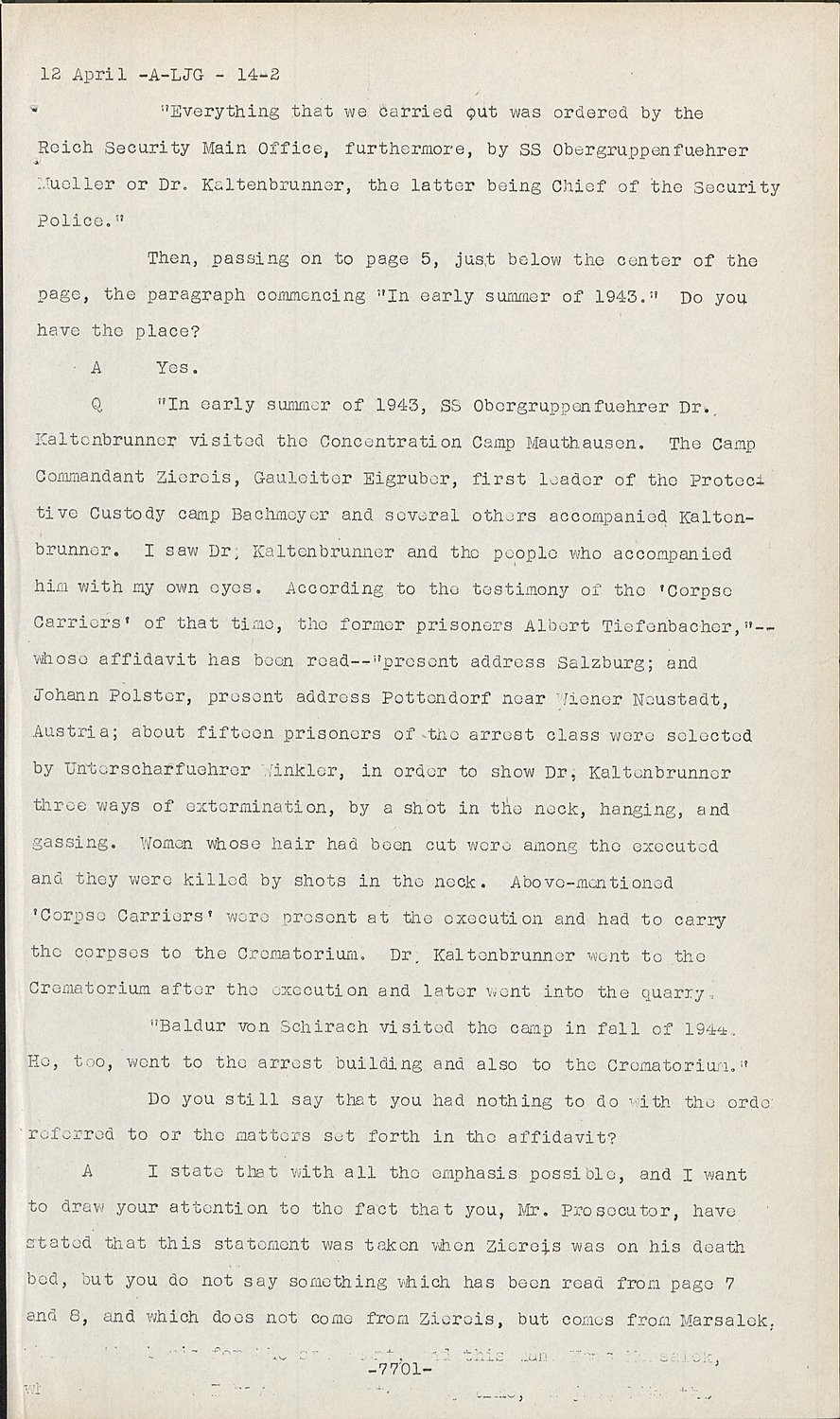
"Everything that we Carried (put was ordered by the Reich Security Main Office, furthermore, by SS Obergruppenfuehrer Mueller or Dr. Kaltenbrunner, the latter being Chief of the Security Police."
Then, passing on to page 5, just below the center of the page, the paragraph commencing "In early summer of 1943." Do you have the place?
AYes.
Q "In early summer of 1943, SS Obergruppenfuehrer Dr. Kaltenbrunner visited the Concentration Camp Mauthausen. The Camp Commandant Ziereis, Gauleiter Eigruber, first leader of the Protective Custody camp Bachmeyer and several others accompanied Kaltenbrunner. I saw Dr. Kaltenbrunner and the people who accompanied him with my own eyes. According to the testimony of the 'Corpse Carriers' of that time, the former prisoners Albert Tiefenbacher,"-whose affidavit has been read--"present address Salzburg; and Johann Polster, present address Pottendorf near Wiener Neustadt, Austria; about fifteen prisoners of the arrest class were selected by Unterscharfuehrer Winkler, in order to show Dr. Kaltenbrunner there ways of extermination, by a shot in the neck, hanging, and gassing. Women whose hair had been cut were among the executed and they were killed by shots in the neck. Above-mentioned 'Corpse Carriers' were present at the execution and had to carry the corpses to the Crematorium. Dr. Kaltenbrunner wont to the Crematorium after the execution and later went into the quarry.
"Baldur von Schirach visited the camp in fall of 1944. He, too, went to the arrest building and also to the Crematorium."
Do you still say that you had nothing to do with the order referred to or the matters set forth in the affidavit?
AI state that with all the emphasis possible, and I want to draw your attention to the fact that you, Mr. Prosecutor, have stated that this statement was taken when Ziereis was on his death bed, but you do not say something which has been read from page 7 and 8, and which does not come from Ziereis, but comes from Marsalek, who is the basis for the statement, and this man, Hans Marsalek, whom, of course, I have never not at any time, is just like the other witnesses, an ex-detainee, protective custody detainee from Mauthausen.
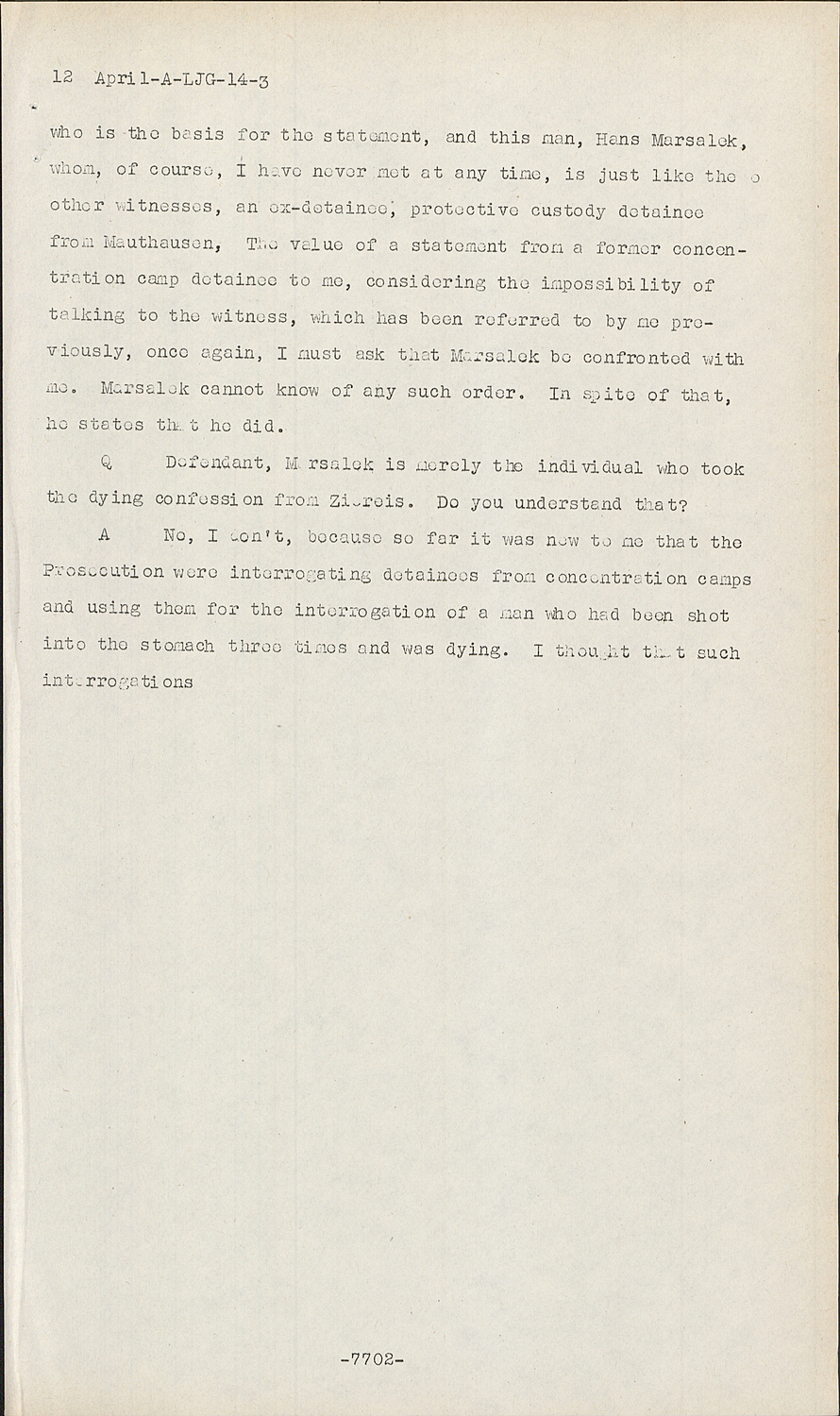
The value of a statement from a former concentration camp detainee to me, considering the impossibility of talking to the witness, which has been referred to by me previously, once again, I must ask that Marsalek be confronted with me. Marsalek cannot know of any such order. In spite of that, he states that he did.
QDefendant, Marsalek is merely the individual who took the dying confession from Ziereis. Do you understand that?
ANo, I don't, because so far it was new to me that the Prosecution were interrogating detainees from concentration camps and using them for the interrogation of a man who had been shot into the stomach three times and was dying. I thought that such interrogations would have been carried out by a man who was legally trained and who would be in a position to attach the necessary value to such statements.
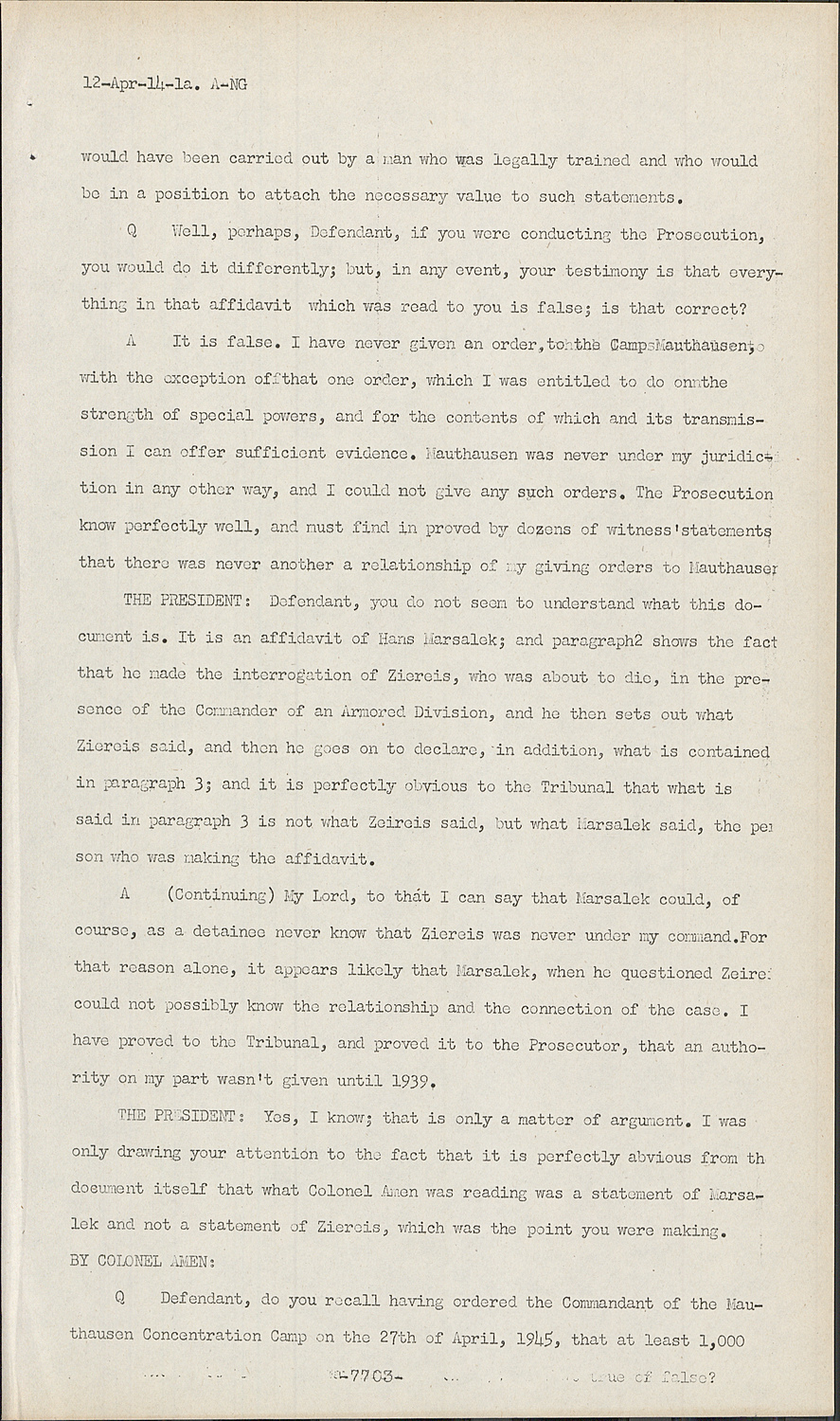
QWell, perhaps, Defendant, if you were conducting the Prosecution, you would do it differently; but, in any event, your testimony is that everything in that affidavit which was read to you is false; is that correct?
AIt is false. I have never given an order, to the Camp Mauthausen, with the exception of that one order, which I was entitled to do on the strength of special powers, and for the contents of which and its transmission I can offer sufficient evidence. Mauthausen was never under my juridiction in any other way, and I could not give any such orders. The Prosecution know perfectly well, and must find in proved by dozens of witness statements that there was never another a relationship of my giving orders to Mauthausen
THE PRESIDENT:Defendant, you do not seen to understand what this document is. It is an affidavit of Hans Marsalek; and paragraph2 shows the fact that he made the interrogation of Ziereis, who was about to die, in the presence of the Commander of an Armored Division, and he then sets out what Ziereis said, and then he goes on to declare, in addition, what is contained in paragraph 3; and it is perfectly obvious to the Tribunal that what is said in paragraph 3 is not what Zeireis said, but what Marsalek said, the per son who was making the affidavit.
A (Continuing) My Lord, to that I can say that Marsalek could, of course, as a detainee never know that Ziereis was never under my command. For that reason alone, it appears likely that Marsalek, when he questioned Zeireis could not possibly know the relationship and the connection of the case. I have proved to the Tribunal, and proved it to the Prosecutor, that an authority on my part wasn't given until 1939.
THE PRESIDENT:Yes, I know; that is only a matter of argument. I was only drawing your attention to the fact that it is perfectly abvious from th document itself that what Colonel Amen was reading was a statement of Marsalek and not a statement of Ziereis, which was the point you were making. BY COLONEL AMEN:
QDefendant, do you recall having ordered the Commandant of the Mauthausen Concentration Camp on the 27th of April, 1945, that at least 1,000 persons should be killed at Mauthausen each day?