Moving down a little bit, he says: "Imagine the formulas of Bormann's letter translated into the language of a member of the German civil administration, and you will get, roughly, the following views:
" The Slavs are to work for us. In so far as we don't need them, they may die. Therefore, compulsory vaccination and German health service are superfluous. The fertility of the Slavs is undesirable. They may use contraceptives or practice aboration, the more the better. Education is dangerous. It is enough if they can count up to 100. At best an education which produces useful stooges for us is admissible. Every educated person is a future enemy. Religion we leave to them as a means of diversion. As for food, they won't get any more than is necessary. We are the masters; we come first."
"These sentences are by no means overstatements. On the contrary they are covered, word by word, by the spirit and the text of Bormann's letter. Already at this point the question arises whether such a result is desirable in the interests of the Reich. It can hardly be doubted that these views would become known to the Ukrainian people. Similar opinions prevail even today."
Moving on, the next paragraph, with the number "2", says:"But there is no real need to assume a fictitious decree as was done in paragraph 1. The above mentioned concepts of our role in the East already exist in practice.
"The Reich Commissioner for the Ukraine has expounded his views of the Ukrainian people, in three successive speeches." And he goes on to quote those speeches, whixh have been referred to before this Tribunal.
Then, in the next paragraph, he says that very visitor and every member of the local civil administration can confirm this from his own observations, and they show particularly clearly how well the soil is prepared for the Bormann letter.
Then he goes on to quote statements that have been made by saying, "We are here among Negroes", "The population is just dirty and lazy", and so on.
And then, passing on, he says:
"I may add that Kreisleiter Knuth whom the Gauleiter still retains, in spite of the gravest accusations, declared, in conversation on the Kiev question, that Kiev ought to be depopulated through epidemics. Altogether it would be best if the superfluous part of the population starved to death."
Moving on further we come to the third paragraph down. It says:
"Finally among the district commissioners at least 80 per cent oppose the views described above. In many conferences with the general commissioners they emphasized th t the population ought to be treated decently and with understanding," and that statements opposing such policies referred to above will result in a catastrophe. That is what the next paragraph says.
And then Markull goes on to say:
"For the rest the only effect of the false concepts of the Master Race is to relax the discipline of our officials."
I will not take the time to read all of it. I am sure you are reading it. Then we move on and we come to this very significant paragraph, with a Roman numeral 5:
"Perhaps one ought to inquire whether there is not in fact an agreement between the policy hitherto pursued and the Bormann letter in the sense that the decrees quoted above and the other instructions of the ministry are to be understood merely as tactical moves, whereas in fact there is no divergence of opinion. The minister's reply"--I remind you each time the minister refers to you --"of 11 August might be considered to point in this direction."
Then he goes on to say:
"In answer to this it should be pointed out that the minister knows very well that it is not possible to rearrange a continent of the size of Russia by means of political tactics and by wearing the mask of a liberator, but only by applying a statesmanlike conception appropriate to the political condi-tions."
And so on.
And finally he says:
"Another reason why" -- I want to be fair about this document with you. He indicates that perhaps it should not be interpreted merely as a tactical maneuver, because of the inconsistency which this would imply. For in that case the word "liberation" ought never to have been mentioned and no theater should be allowed to stay open, no trade school, no university should be allowed to function.
And finally I would like to read you--not finally--but I would like to read you this significant paragraph. It states-and I think you will allow me to summarize it--that this letter of Bormann's, which originated from the field headquarters, simply cannot be issued as a ministerial decree, since it would disavow the entire policy hitherto announced by the minister-yourself.
And in this connection, a few sentences down, says Markull:
"It is necessary to point once more to the obvious similarity between the opinions professed by Koch and the instructions given in the Bormann letter."
Then, about halfway down the paragraph, it says only you can decide upon this question, and he suggests certain considerations which might be useful, recounting some difficulties.
And finally you come under Roman Numeral II, to the second paragraph.
"Without wishing to criticize in any way the statements of Party Director Bormann it is yet necessary to point out that the wording of his letter does not always bring out clearly the importance of the issue at stake. A phrase like 'brisk trade in contraceptives' had better not be brought into connection with the name of the Fuehrer.
In the same way abrupt phrases like 'vaccination of the non-German population is out of the question,' and so on, "would hardly seen to be entirely in keeping with the importance of the historical problems involved."
Finally, to go on, I want to read you this under Roman numeral III. Markull states: "The statements set out above may appear very sharp. They are, however, dictated by concern and duty."
And finally--Well, I don't think there is any necessity to read the last paragraph. It merely talks about the philosophy which is being raised in a grandiose manner by the Japanese ally in his now districts.
Now, you remember this memorandum that you received through your assistant, Leibrandt, from your subordinate, Markull?
You can answer that yes or no, by the way; that is all I want to know right now--whether or not you remember it.
Will you wait just a minute?
AI received this report from Dr. Leibrandt, and I would like to make the following explanation.
QJust before you do that--you will have an opportunity; I won't shut you up on any explanations or even attempt to--I have one or two things I would like to ask you about it, and then if you feel the need to explain them or any thing else I feel sure the Tribunal will permit you to do so.
You had written a letter in answer to the Bormann letter, hadn't you?
AYes, that is correct.
QAnd you had agreed with these--if I may use the term--shocking sugges tions of Bormann?
In your letter you had agreed with these shocking suggestions of Bormann?
Yes or no.
AI wrote an appeasing letter so that I could bring about a pause in the constant direct pressure which was brought upon me, and I would like to say that my activity, and the decrees which I issued after this letter, did not change at all in any manner; but, on the contrary, my decrees continued with a health service and brought about building.
QYou wrote this letter to the Fuehrer; you didn't write it to Bormann, did you?
Your answer went to Hitler?
AI wrote my reply to the Fuehrer, yes.
QAnd you were appeasing the Fuehrer as well were you, when you mouthed back the phases such as are repeated in this letter about the use of contra ceptives ***tion?
Wait until I finish. I was saying, in your letter to the Fuehrer *---* back those horrid suggestions of Bormann's, didn't you-those nasty ***rid suggestions of Bormann, I might say?
You wrote them to Hitler?
AI wrote a letter to the Fuehrer, but did not use the wording of Bor mann's letter.
I wrote to the Fuehrer that I was not doing anymore than could and had to be done, and I wanted to resist an attack which was coming from the headquarters that I was doing more in the eastern countries than for the German people--that I was demanding more doctors than the German people had for their sick.
But as far as health and biological propagation of the eastern peoples is concerned, that I was doing more for the eastern territories than the German doctors could do for the German people and its propagation.
The attack had reached such proportions that Koch accused me that I was following a policy of immigration, and that was the reason why the conflict arose shortly there after and was brought to the Fuehrer.
QJust so there will be no doubt about this--I don't want there to be any misunderstanding and nobody else does--are you telling us that you didn't write back almost word for word what Bormann wrote to you?
AI do not have the letters here verbatim.
QBut you have the Markull memorandum here, which says that the minister not only raises no objections against Bormann's principles or even his phrase ology.
Now surely one of your subordinates would not be impertinent enough to write you a memorandum like that unless it was perfectly true that you had done so?
AMy collaborators always had the courage to stand up even contrary to what I demanded of them.
They told me their opinions. Dr. Leibrandt came to me full of care and concern and said to me, "Mr. Reichminister, that is not in accord with what we are doing."
I said, "Dr. Leibrandt, please calm yourself. I have written an appeasing explanation.
Nothing will be changed. I will speak to the Fuehrer later personally about these matters."
QYour subordinate was not afraid to tell you that you had written such a letter in which you agreed word for word with Bormann.
I have no trouble with you on that score.
That is all I am trying to get you to tell this Tribunal, because it is true that you did write back expressing these word for word sentences.
AThat is not correct. I must say that this memorandum which Dr. Leibrandt gave me, he read over this memorandum and said that there seems to be one gentleman who believes that I cannot do anything else but what I consider right.
But in this case I have a special problem and a special conflict, and I will insist on my position.
That may be shown in the documents I read yesterday.

May I define my position as to this?
QAnswer this question: Who were you appeasing, Hitler or Bormann, or both of them?
AFirst of all my collaborator, Leibrandt, showed him that my ministerial decrees in that sense would never be published.
Point 2: I gave out decrees about the school system, which was to redevelop that system.
THE PRESIDENT: Wait a minute. That is not an answer to the ques tion.
You said that you wrote an appeasing answer. The question is whom were you trying to appease.
Was it Hitler or was it Bormann or was it both?
A (continued) Yes; both of them; yes.
MR. DODD: Mr. President, would this be a convenient time?
THE PRESIDENT: Yes.
(A recess was taken.)
DR. SEIDL: Dr. Seidl for the defendant Dr. Frank. Mr. President, I have stated yesterday that the document books for Frank I have already translated, but I have just found out now about the document books, that the document books are not yet bound by the office which should have done it and for that reason, I did not receive permission from another office yet.
Perhaps the Tribunal could speed that up that is, the binding of the document books, because otherwise the whole translation is unusable.
THE PRESIDENT:Very well.
MR. DODD:I didn't know there was any delay but I will see to it right away that they get it as far as we are able to do it.
THE WITNESS:May I say something to this document? This memorandum, such as it is stated in the beginning, is based on the fiction, the idea of a possible ministerial decree. It uses phrases which Bormann had used in his letter but my letter which I have sent to the Fuehrer could not possibly contain these phrases but they will contain modifying statements to the extent that I myself in the Occupied Eastern Territories did not do what I am accused of now; that is to say, that I do not state any consideration of German population but that I established departments for education, for schools, and so on; that these departments, I would have to modify; but( that Bormann made these statements, used these phrases, it is unfortunate the way in which he liked to express himself, which we had to find out during the later years.
May I say briefly that he himself states, that apparently the minister covers the content of these things, but I went to point out one decisive point; that is, that here, these opinions, which Bormann mentions, were also mentioned in the surroundings of Koch and against these personal things of Koch -- in these tragic years -- my entire efforts were directed, especially to train the entire corps of administrative leaders and that can be seen from point 3, paragraph 3, where you will find it. Among the district commissars there are at least eighty percent against the opinions -
MR. DODD:I think we all know what is in it. If you have any explanation, I think you ought to make it.
THE WITNESS:Yes. On page 4, it says the greater majority of the administrative leadership corps puts its hope to the minister -- that is, myself, -- and I have tried and attempted to justify these hopes of the administrative leadership corps, that I would attempt to educate them by these decrees with regard to thousands of people in the Eastern Territories, whom they did not know, these thousands who, of course, in a fight against Bolshevism, could not always determine how things were in the East; and may I quite concretely point out that the author here says that the decree of the minister of the 17th of March, underlines and emphasizes former decrees in a sharper form.

The decree of the 13th May 1943 goes against the opinion that the Ukrainians were no people at all and against a false master standpoint. These are two decrees which I have not received and which are here; and furthermore, I assume, Mr. Prosecutor, I say concretely that he points out that, of course, the minister -- that is, myself -- knows very well that such a continent has to be treated differently than the suggestions would warrant it. As a consequence of that attitude, I have to say, after that exchange of correspondence between Koch and Bormann, I have started a definite school administration in the Ukraine with a definite organization. BY MR. DODD:
QI am not interested in that. Just a minute.
AWell, I have to answer these accusations.
MR. DODD:That is no answer to this, if your Honor please, and no explanation of this document. He is launching off on one of these long speeches againabout what he did after the document was received or after he wrote the letter, and I ask that he be instructed to answer that question and not to go on into statements about what he did in the administration in the Ukraine.
I don't think it is pertinent.
THE WITNESS:But I have spoke to the Fuehrer, I have spoke to the Fuehrer personally about this and I told him that this note of May 1943 --that note was also in my file --- I told him that it was impossible, with these phrases, to work in the East.
THE PRESIDENT:If there is a letter in your file or if there is not a letter in your file, your counsel can re-examine you upon cross examination, but you cannot in cross examination go into long explanations. You must answer the question yes or no and explain, if you must explain, shortly. You have been explaining this document for a long time. BY MR. DODD:
QWhen did you first meet Erich Koch?
AErich Koch?
QYes.
AThat may have been in the twenties. I don't know, 1928 or 1927.
QApparently you have known him, then, a great many years?
AI know him, yes. I haven't seen him often but as Gauleiter I talked to him on and off.
QWhen did he become a Gauleiter?
AI believe in the year 1928 he because Gauleiter in East Russia, but the dates I could not say for sure, when he was appointed Gauleiter.
QThat is all right. I want an approximate date. Did you have much to do with him from the time that he was appointed Gauleiter, let us say until 1949?
AWell, during the fighting years, I had practically nothing to do with him. Later after 1943, I talked to him several times.
QYou had a pretty good knowledge, I assume, in any event, of his general reputation among his friends and acquaintances?
A IKnew Koch had a very sudden temperament, going from one extreme to the other and not steady, and not quite reliable in carrying out a definite steady policy.
QI take it from your answer, that you were not aware, however, before he became the Reich Commissioner for the Ukraine, of his temperament in this way, that you didn't know that he did these terrible things, which he did do, while Reich Commissioner in the Ukraine, did you?
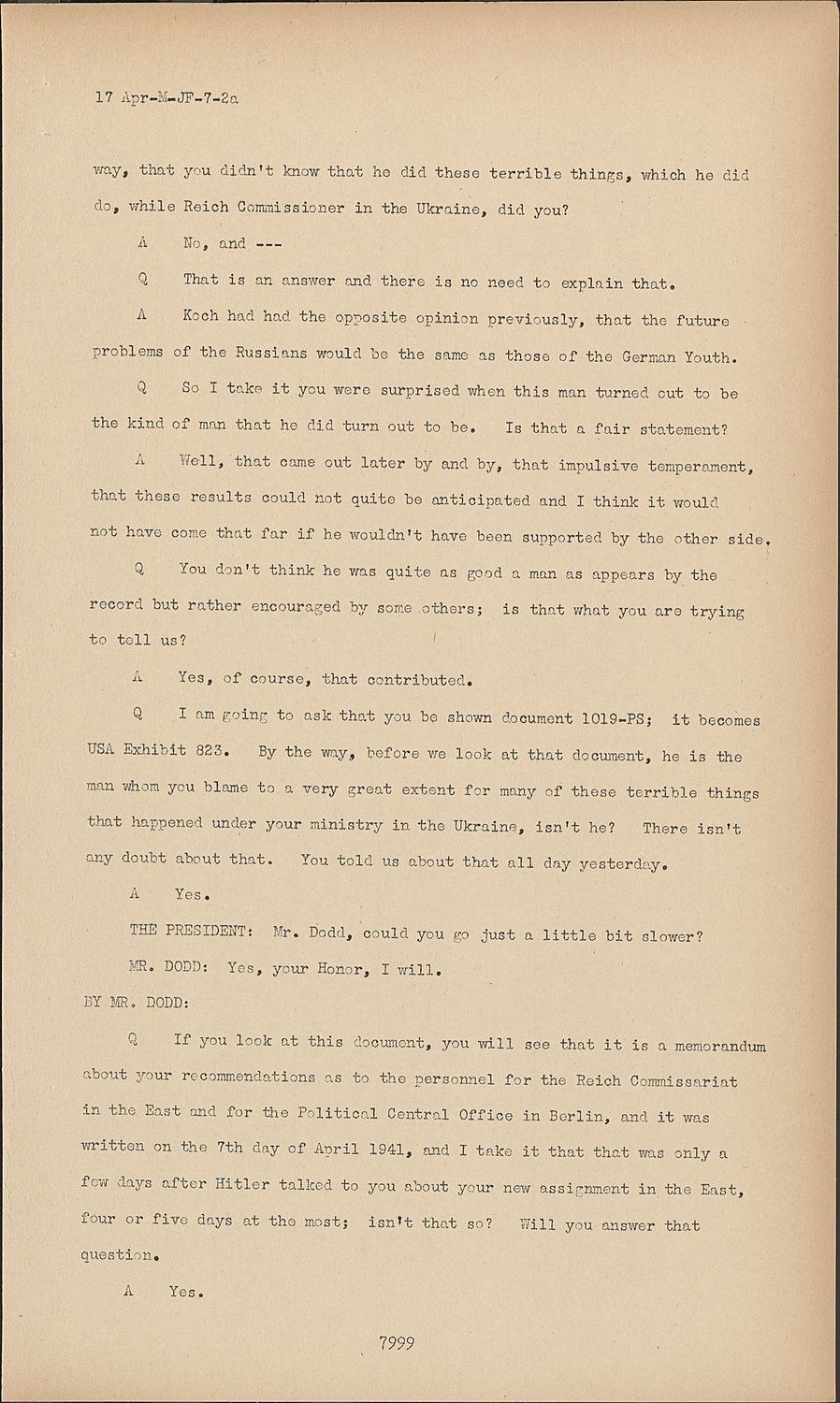
ANo, and --
QThat is an answer and there is no need to explain that.
AKoch? had had the opposite opinion previously, that the future problems of the Russians would be the same as those of the German Youth.
QSo I take it you were surprised when this man turned out to be the kind of man that he did turn out to be. Is that a fair statement?
AWell, that came out later by and by, that impulsive temperament, that these results could not quite be anticipated and I think it would not have come that far if he wouldn't have been supported by the other side.
QYou don't think he was quite as good a man as appears by the record but rather encouraged by some others; is that what you are trying to tell us?
AYes,of course, that contributed.
QI am going to ask that you be shown document 1019-PS; it becomes USA Exhibit 823. By the way, before we look at that document, he is the man whom you blame to a very great extent for many of these terrible things that happened under your ministry in the Ukraine, isn't he? There isn't any doubt about that. You told us about that all day yesterday.
AYes.
THE PRESIDENT:Mr. Dodd, could you go just a little bit slower?
MR. DODD:Yes, your Honor, I will. BY MR. DODD:
QIf you look at this document, you will see that it is a memorandum about your recommendations as to the personnel for the Reich Commissariat in the East and for the Political Central Office in Berlin, and it was written on the 7th day of April 1941, and I take it that that was only a few days after Hitler talked to you about your new assignment in the East, four or five days at the most; isn't that so? Will you answer that question.
AYes.
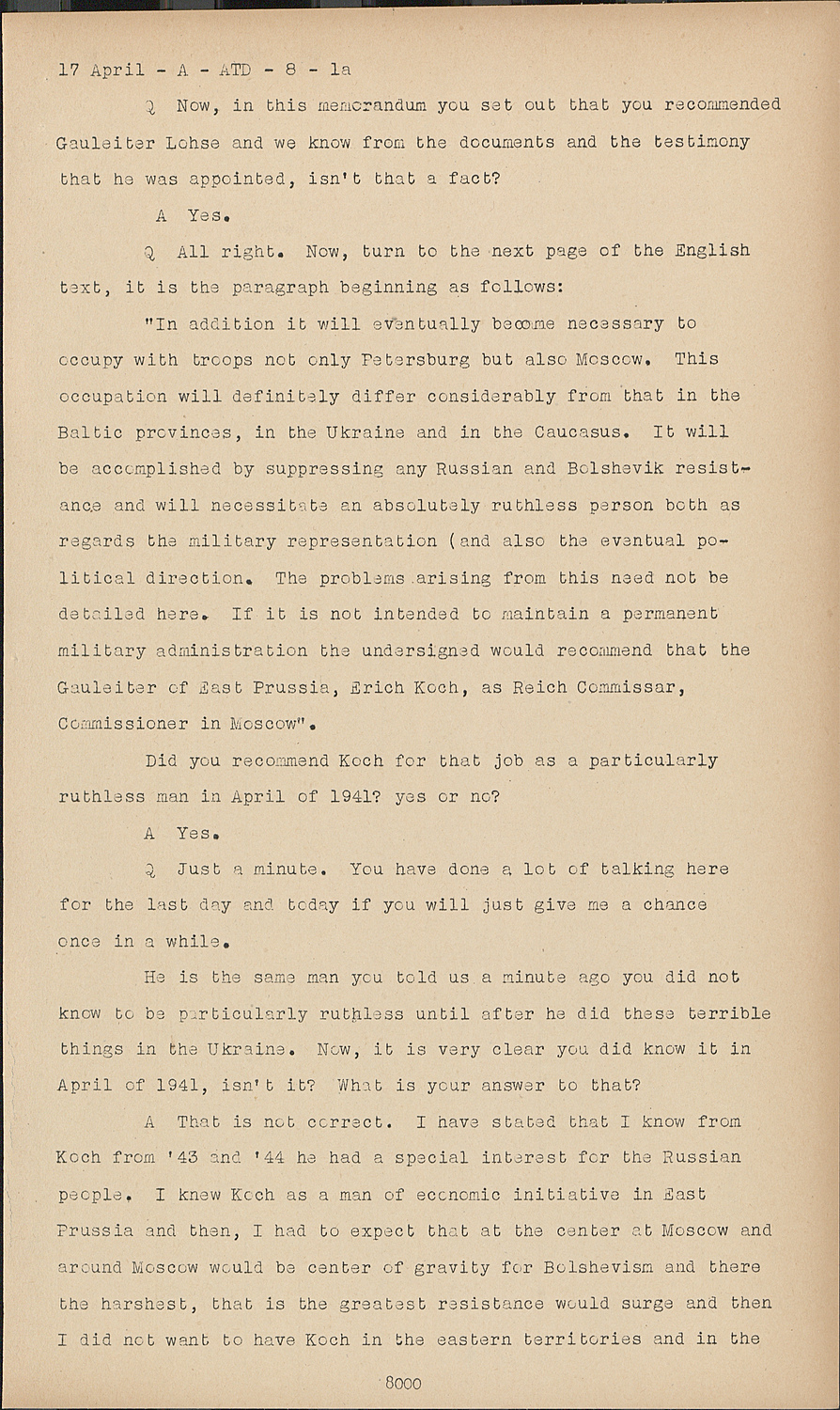
Q Now, in this memorandum you set out that you recommended Gauleiter Lohse and we know from the documents and the testimony that he was appointed, isn't that a fact?
AYes.
QAll right. Now, turn to the next page of the English text, it is the paragraph beginning as follows:
"In addition it will eventually become necessary to occupy with troops not only Petersburg but also Moscow. This occupation will definitely differ considerably from that in the Baltic provinces, in the Ukraine and in the Caucasus. It will be accomplished by suppressing any Russian and Bolshevik resistance and will necessitate an absolutely ruthless person both as regards the military representation (and also the eventual political direction. The problems arising from this need not be detailed here. If it is not intended to maintain a permanent military administration the undersigned would recommend that the Gauleiter of East Prussia, Erich Koch, as Reich Commissar, Commissioner in Moscow".
Did you recommend Koch for that job as a particularly ruthless man in April of 1941? yes or no?
AYes.
QJust a minute. You have done a, lot of talking here for the last day and today if you will just give me a chance once in a while.
He is the same man you told us a minute ago you did not know to be particularly ruthless until after he did these terrible things in the Ukraine. Now, it is very clear you did know it in April of 1941, isn't it? What is your answer to that?
AThat is not correct. I have stated that I know from Koch from '43 and 44 he had a special interest for the Russian people. I knew Koch as a man of economic initiative in East Prussia and then, I had to expect that at the center at Moscow and around Moscow would be center of gravity for Bolshevism and there the harshest, that is the greatest resistance would surge and then I did not want to have Koch in the eastern territories and in the Ukraine because there I did not anticipate such resistance.

There was Koch's attitude to the Russian people and then I knew he had initiative and finally I knew he was well supported and that a job in the east was expected of him, any job in the east, either by the Juehrar or the Reich Marshal.
QWhen you were looking for a ruthless man you suggested Koch as early as April of 1941.
AThis expression concerns initiative and, of course, also I had the opinion that he would fight any Bolshevik resistance, yes, but not in the sense that he would suppress foreign culture or try to exterminate it.
QThe proof of the matter is that you had some peculiar and odd interest in the Ukraine and you had somebody else in mind for that job but you knew Koch was a bad actor and you wanted him in another part of Russia, is it not?
ANo, for the Ukraine I wanted Backe and my Stableiter Schickedanz, as can be seen from the document. I wanted Backe as State Secretary because he was a German from the Caucasus and speaks Russian, knows the entire southern area and could have worked very well there. I did not get him and I was forced to accept Koch and I would like to say, against my personal protest in the meeting of the 16th of July.
QWell, if that is your answer I do not care to go any further with it.
With respect to your attitude towards the Jewish people, in your Frankfort speech in 1933 you suggested that they all leave Europe and leave Germany, did you not?
AThis phrase -
QAll you need to say is yes or no. Did you do that or not in your speech in Frankfort in 1938 -
AYes, but I only can answer yes or no on a correct quotation.
QI do not think you need to explain anything at all. I merely asked you whether you said that in Frankfort in your Party Day speech.

A Yes, essentially that is correct.
QNow, in your Party Day speech to which you made reference yesterday, you said you used harsh language about the Jews. In those days you were objecting to the fact that they were in certain professions, I suppose, and things of that character. Is that a fair statement?
AI have said yesterday that in two speeches I demanded a chivalrous solution and I said one could not, one should not be able to accuse us of extermination of the Jewish people from abroad, that is foreign nations
QYes, very well, Did you ever talk extermination of the Jews?
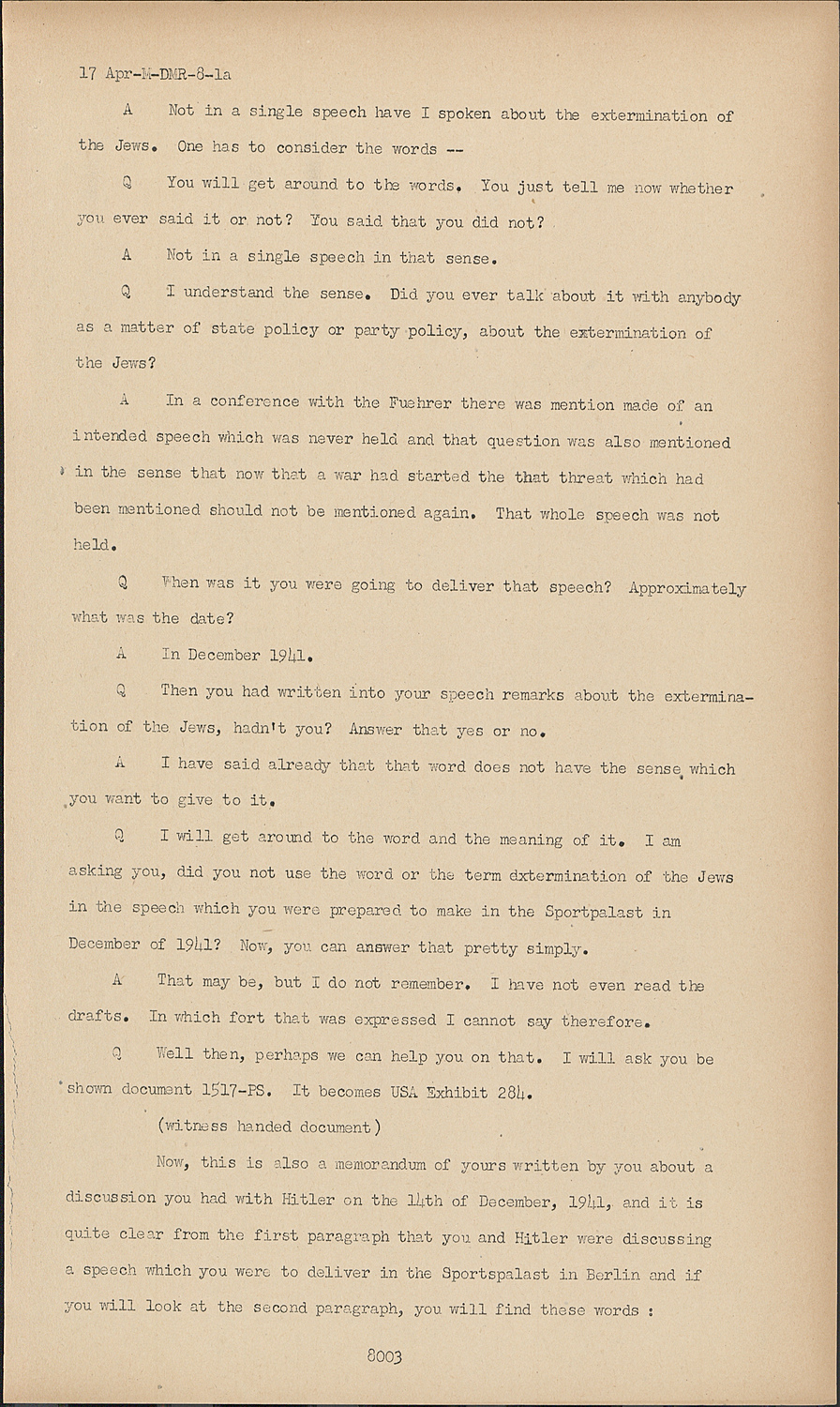
A Not in a single speech have I spoken about the extermination of the Jews.
One has to consider the words -
QYou will get around to the words. You just tell me now whether you ever said it or not? You said that you did not?
ANot in a single speech in that sense.
QI understand the sense. Did you ever talk about it with anybody as a matter of state policy or party policy, about the extermination of the Jews?
AIn a conference with the Fuehrer there was mention made of an intended speech which was never held and that question was also mentioned in the sense that now that a war had started the that threat which had been mentioned should not be mentioned again. That whole speech was not held.
QWhen was it you were going to deliver that speech? Approximately what was the date?
AIn December 1941.
QThen you had written into your speech remarks about the extermination of the Jews, hadn't you? Answer that yes or no.
AI have said already that that word does not have the sense which you want to give to it.
QI will get around to the word and the meaning of it. I am asking you, did you not use the word or the term extermination of the Jews in the speech which you were prepared to make in the Sportpalast in December of 1941? Now, you can answer that pretty simply.
AThat may be, but I do not remember. I have not even read the drafts. In which fort that was expressed I cannot say therefore.
QWell then, perhaps we can help you on that. I will ask you be shown document 1517-PS. It becomes USA Exhibit 284.
(witness handed document)
Now, this is also a memorandum of yours written by you about a discussion you had with Hitler on the 14th of December, 1941, and it is quite clear from the first paragraph that you and Hitler were discussing a speech which you were to deliver in the Sportspalast in Berlin and if you will look at the second paragraph, you will find these words:

"I remarked on the Jewish question that the comments about the Now York Jews must perhaps be changed somewhat after the conclusion (of matters in the East). I took the standpoint, not to speak of the extermination (Ausrottung) of the Jews.
The Fuehrer affirmed this and said that they had burdened the war upon us and that they had brought the destruction; it is no wonder if the results would strike them first."
Now, you have indicated that you have some difficulty with the meaning of the word and I am going to ask you about the word "ausrottung." I am going to ask you be shown -- you are familiar with the Standard German-English dictionary, Cassell's, I suppose, are you? Do you know this work, ever heard of it?
ANo.
QThis is something you will be interested in. Will you look up and read out to the Tribunal wheat the definition of "ausrottung" is?
AI do not need a foreign dictionary in order to explain what in the German language the word "ausrottung" may mean in various meanings. One can exterminate an idea, a system, a social order and as a final consequence, also a group of human beings, certainly. Those are the same varieties which are contained in that word and for that I do not need an English -German dictionary. The translations from German into English are so often wrong and just as in that last document you have submitted to me I heard again the translation of "Herrenrasse" and in the document itself it is not even mentioned. There is the meaning of a false Herrenmenschentum -
QAll right, I am not interested in that. Let us stay on this term of "ausrottung." I take it then that you agree it does mean to wipe out or to kill off, as it is understood, and that you did use the term in speaking to Hitler.
AHere I have to read a different translation again, with a new German translation and so I cannot even find out what you have just wanted to say in English.
QAre you very serious in pressing this apparent inability of yours to agree with me about this word or are you trying to kill time?

Don't you know thatthere are plenty of people in this Court room who speak German and who agree that that word does mean to wipe out, to extirpate?
AIt means to overcome first and then as to its use not with respect to individuals but only as a juridical, historical and traditional word it has always been used with respect to the German people and we have not believed that the consequences could be taken to mean the shooting of sixty millions of Germans.
QI want to remind you that this speech of yours in which you use the term "ausrottung" was made about six months after Himmler told Hoess, whom you heard on this witness stand, to start exterminating the Jews. That is a fact, is it not?

A No, that is not correct, because Adolph Hitler said in his statement before the Reichstag that here a now world war by the immigrants would be star ted by their attacks; that the consequence would be an extermination.
That has been taken as a political fact and, apparently, a similat political threat was made by me before the war against America broke out. And now, when the war broke out, I have apparently said that, since it has come to it already, there is no use to speak of it any more.
QWell, actually, the Jews were being exterminated in the Eastern Occupied Territories at that time and thereafter, weren't they?
AThen, may I say something to the use of the words here? One speak of the Ausrottung of Jewry and between Jewry and individual Jews there is still a difference.
QI asked you if it wasn't asfact that at that time and later on Jews were being exterminated in the occupied Eastern Territories which were under your ministry? Will you answer that yes or no?
AYes, and after that you told the Tribunal or, as I understood you at least, you wanted the Tribunal to believe that that was being done by the police and without any of your people being involved in it; is that so?
AI have heard from a witness here that a District Commissar had participated in these things, and I have heard from another witness, Wilna, that in other cities reports came that the police was to carry it out. From Document 1184 I could see that a District Commissar within his capacity protested agains these "Schweinerei" as he called them.
QDr. Leibbrandt was your subordinate; he was in charge of the main Division 2 in your Ministry for the occupied Eastern Territories wasn't he?
AYes.
QAll right. Now, for the second time, I'll ask that you be shown Document 3663-PS, USA 825.
(Witness was handed the document.)
Q (Continuing.) Now, this document consists of three parts as you will notice. The first page is a letter written by Dr. Leibbrandt on the stationery of the Reich Minister for the occupied Eastern Territories and it's dated the 31st of October 1941; that's not too many days before you had your conversation with the Fuehrer about your speech and it's addressed to the Reichskommissioner for the East Ostland in Riga; that was Lohse, the man whom you recommended.
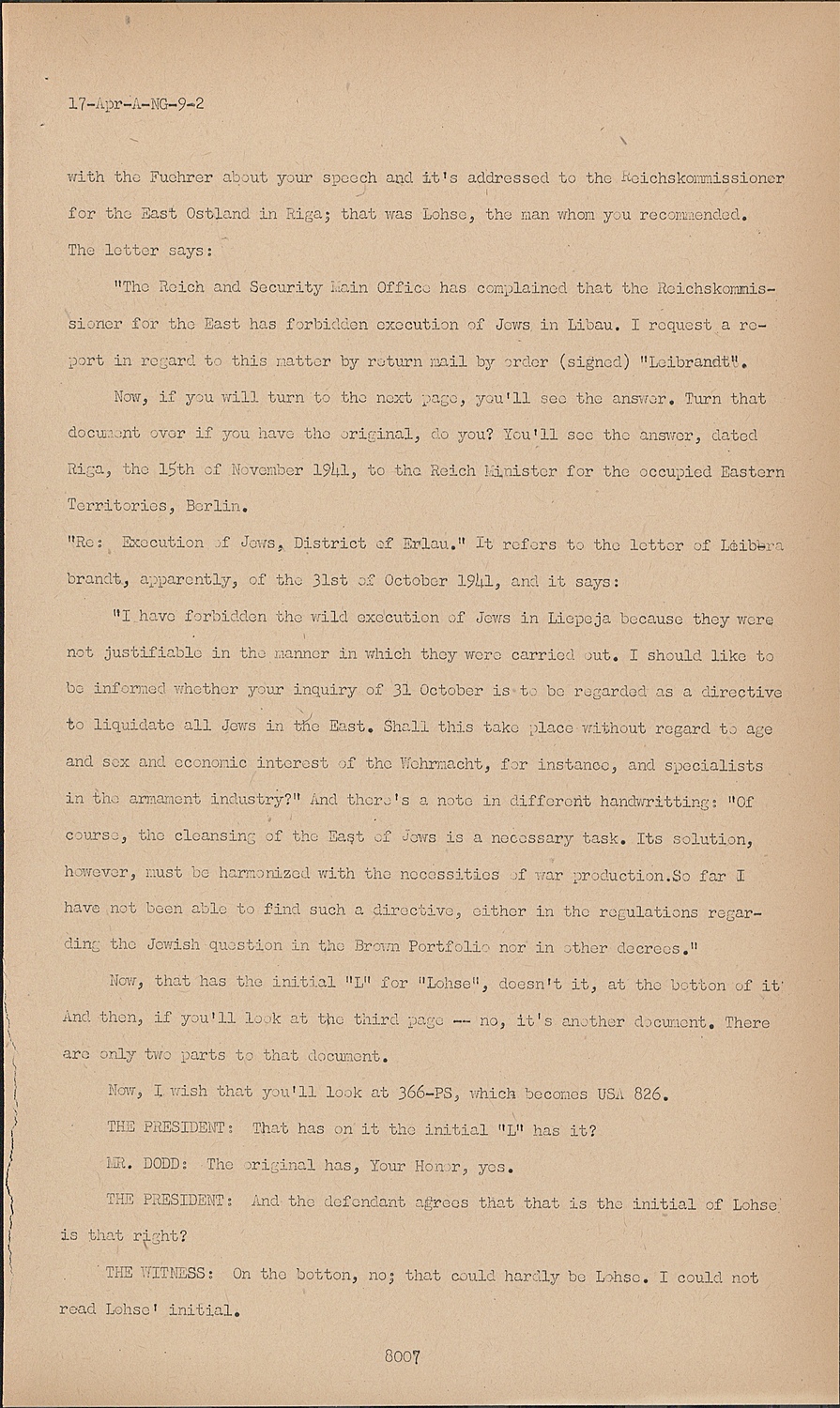
The letter says:
"The Reich and Security Rain Office has complained that the Reichskommissioner for the East has forbidden execution of Jews in Libau. I request a report in regard to this matter by return mail by order (signed) "Leibrandt".
Now, if you will turn to the next page, you'll see the answer. Turn that document over if you have the original, do you? You'll see the answer, dated Riga, the 15th of November 1941, to the Reich Minister for the occupied Eastern Territories, Berlin. "Re: Execution of Jews, District of Erlau." It refers to the letter of Leibrandt, apparently, of the 31st of October 1941, and it says:
"I have forbidden the wild execution of Jews in Liepeja because they were not justifiable in the manner in which they were carried out. I should like to be informed whether your inquiry of 31 October is to be regarded as a directive to liquidate all Jews in the East. Shall this take place without regard to age and sex and economic interest of the Wehrmacht, for instance, and specialists in the armament industry?" And there's a note in different handwritting: "Of course, the cleansing of the East of Jews is a necessary task. Its solution, however, must be harmonized with the necessities of war production.So far I have not been able to find such a directive, either in the regulations regarding the Jewish question in the Brown Portfolio nor in other decrees."
Now, that has the initial "L" for "Lohse", doesn't it, at the botton of it And then, if you'll look at the third page -- no, it's another document. There are only two parts to that document.
Now, I wish that you'll look at 366-PS, which becomes USA 826.
THE PRESIDENT:That has on it the initial "L" has it?
MR. DODD:The original has, Your Honor, yes.
THE PRESIDENT:And the defendant agrees that that is the initial of Lohse is that right?
THE WITNESS:On the botton, no; that could hardly be Lohse. I could not read Lohse' initial.

MR DODD. Well, it's very --
THE WITNESS:I can't distinguish it as such. It could have been Leibbrandt and it could be Lohse. BY MR.DODD:
QYou're not willing to say that that second letter was from Lohse and that that's his initial on the bottom of it?
AWell, that I cannot say.
QAll right.
ABecause usually these letters are sent typewritten. It had not -
QWell, we're -
AIt is not quite clear but, essentially, it means that there was a trial against police measures and that -
QWe will go into what it means in a minute. We're just talking about the initial "L". While we're talking about the initial, will you look at it and see if there are any "R's", capital "R".
AAn "L", yes. An "R"?
QYes, "R".
AYes, there are two "R's".
QDid you put those on there?
AYes.
QYou initialled them, did you?
AWell, no; I could not distinguish that as mine, as my "R".
QYou say that it's not your "R"? We'll have to be clear about this. You'd have to know your own initial when you saw it anywhere.
AI never made such a pointed "R" on the top. You can compare it with my handwriting.
QWe'll do that; don't worry. I just want to ask you now if that's your initial or not?
AThat I could not identify as my initial.
QDo you say that it is not your initial?
AYes.
QAll right. Now, I wish you'd look at Document 3666-PS, which is also related to these other documents, and that's also a letter written on the stationery of the Reich Minister of the occupied Eastern Territories, and it's dated December 18, 1941.