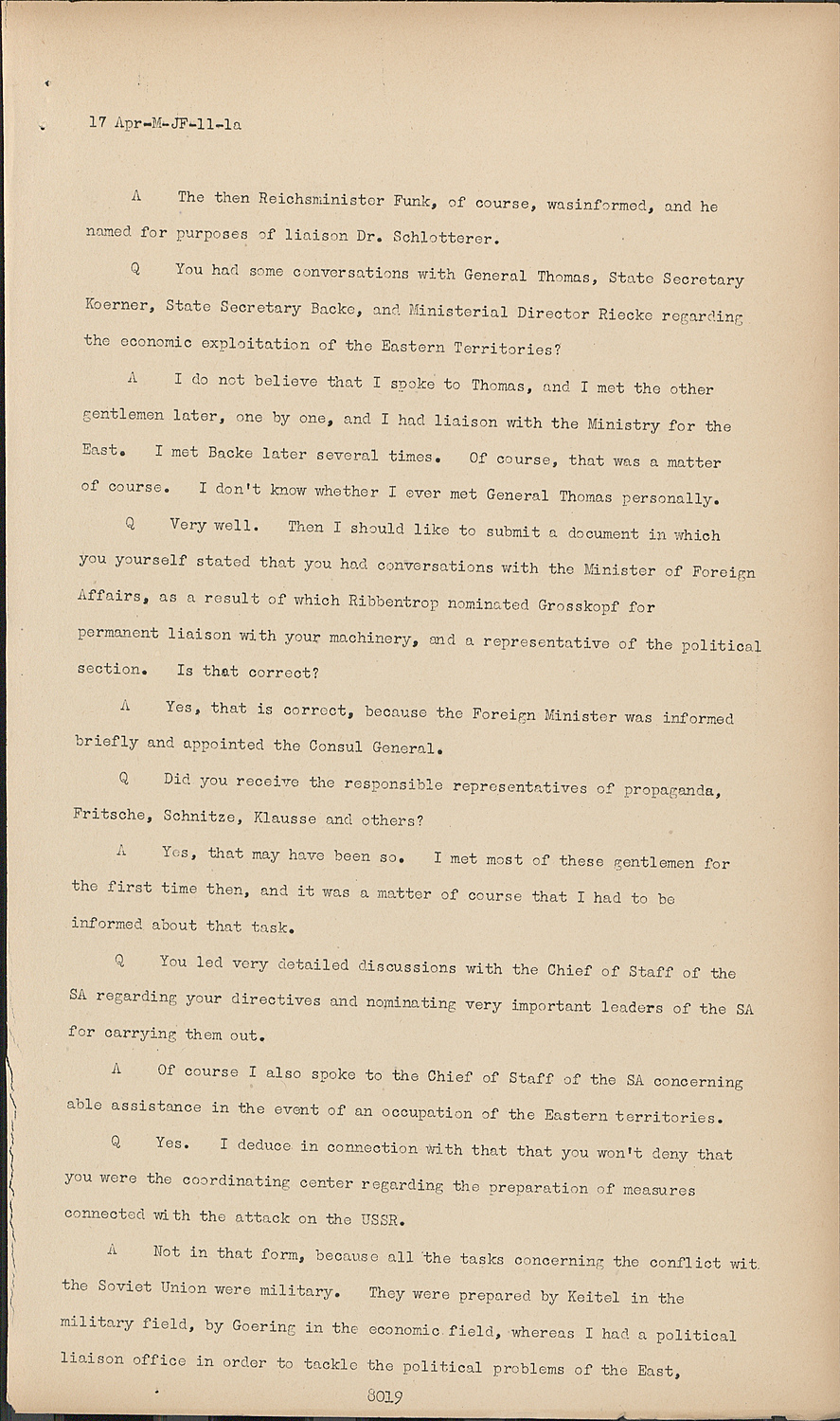
A The then Reichsminister Funk, of course, wasinformed, and he named for purposes of liaison Dr. Schlotterer.
QYou had some conversations with General Thomas, State Secretary Koerner, State Secretary Backe, and Ministerial Director Riecke regarding the economic exploitation of the Eastern Territories?
AI do not believe that I spoke to Thomas, and I met the other gentlemen later, one by one, and I had liaison with the Ministry for the East. I met Backe later several times. Of course, that was a matter of course. I don't know whether I ever met General Thomas personally.
QVery well. Then I should like to submit a document in which you yourself stated that you had conversations with the Minister of Foreign Affairs, as a result of which Ribbentrop nominated Grosskopf for permanent liaison with your machinery, and a representative of the political section. Is that correct?
AYes, that is correct, because the Foreign Minister was informed briefly and appointed the Consul General.
QDid you receive the responsible representatives of propaganda, Fritsche, Schnitze, Klausse and others?
AYes, that may have been so. I met most of these gentlemen for the first time then, and it was a matter of course that I had to be informed about that task.
QYou led very detailed discussions with the Chief of Staff of the SA regarding your directives and nominating very important leaders of the SA for carrying them out.
AOf course I also spoke to the Chief of Staff of the SA concerning able assistance in the event of an occupation of the Eastern territories.
QYes. I deduce in connection with that that you won't deny that you were the coordinating center regarding the preparation of measures connected with the attack on the USSR.
ANot in that form, because all the tasks concerning the conflict with the Soviet Union were military. They were prepared by Keitel in the military field, by Goering in the economic field, whereas I had a political liaison office in order to tackle the political problems of the East, to discuss them and to make my suggestions about the eventual political administration to the various offices, and to direct that policy.
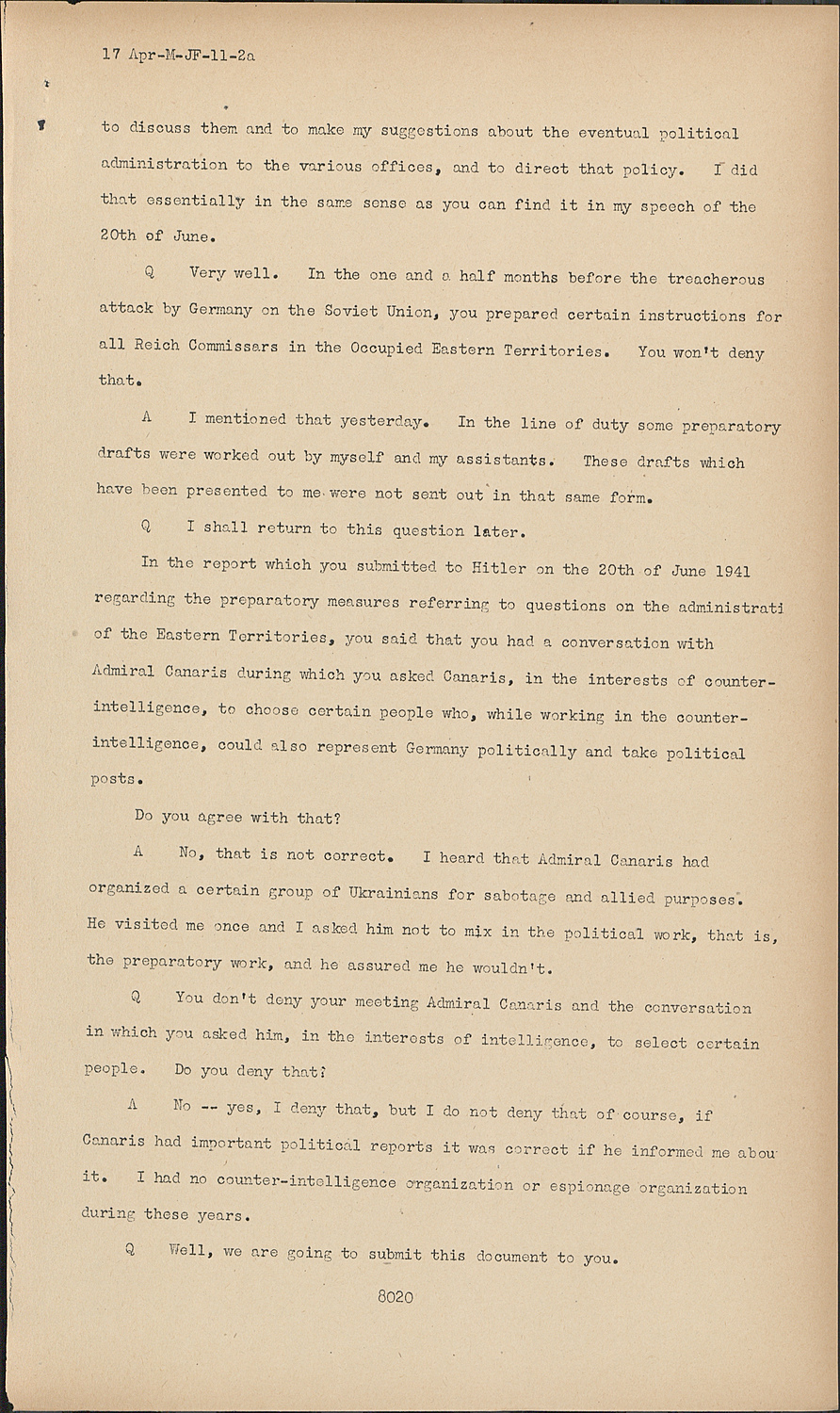
I did that essentially in the same sense as you can find it in my speech of the 20th of June.
QVery well. In the one and a half months before the treacherous attack by Germany on the Soviet Union, you prepared certain instructions for all Reich Commissars in the Occupied Eastern Territories. You won't deny that.
AI mentioned that yesterday. In the line of duty some preparatory drafts were worked out by myself and my assistants. These drafts which have been presented to me were not sent out in that same form.
QI shall return to this question later.
In the report which you submitted to Hitler on the 20th of June 1941 regarding the preparatory measures referring to questions on the administrate, of the Eastern Territories, you said that you had a conversation with Admiral Canaris during which you asked Canaris, in the interests of counterintelligence, to choose certain people who, while working in the counterintelligence, could also represent Germany politically and take political posts.
Do you agree with that?
ANo, that is not correct. I heard that Admiral Canaris had organized a certain group of Ukrainians for sabotage and allied purposes. He visited me once and I asked him not to mix in the political work, that is, the preparatory work, and he assured me he wouldn't.
QYou don't deny your meeting Admiral Canaris and the conversation in which you asked him, in the interests of intelligence, to select certain people. Do you deny that?
ANo -- yes, I deny that, but I do not deny that of course, if Canaris had important political reports it was correct if he informed me about it. I had no counter-intelligence organization or espionage organization during these years.
QWell, we are going to submit this document to you.
GENERAL RUDENKO: Mr. President, perhaps we can declare a recess now, because I will have a series of questions to put to the defendant.
THE PRESIDENT:Very well.
(A recess was taken until 1400 hours.)
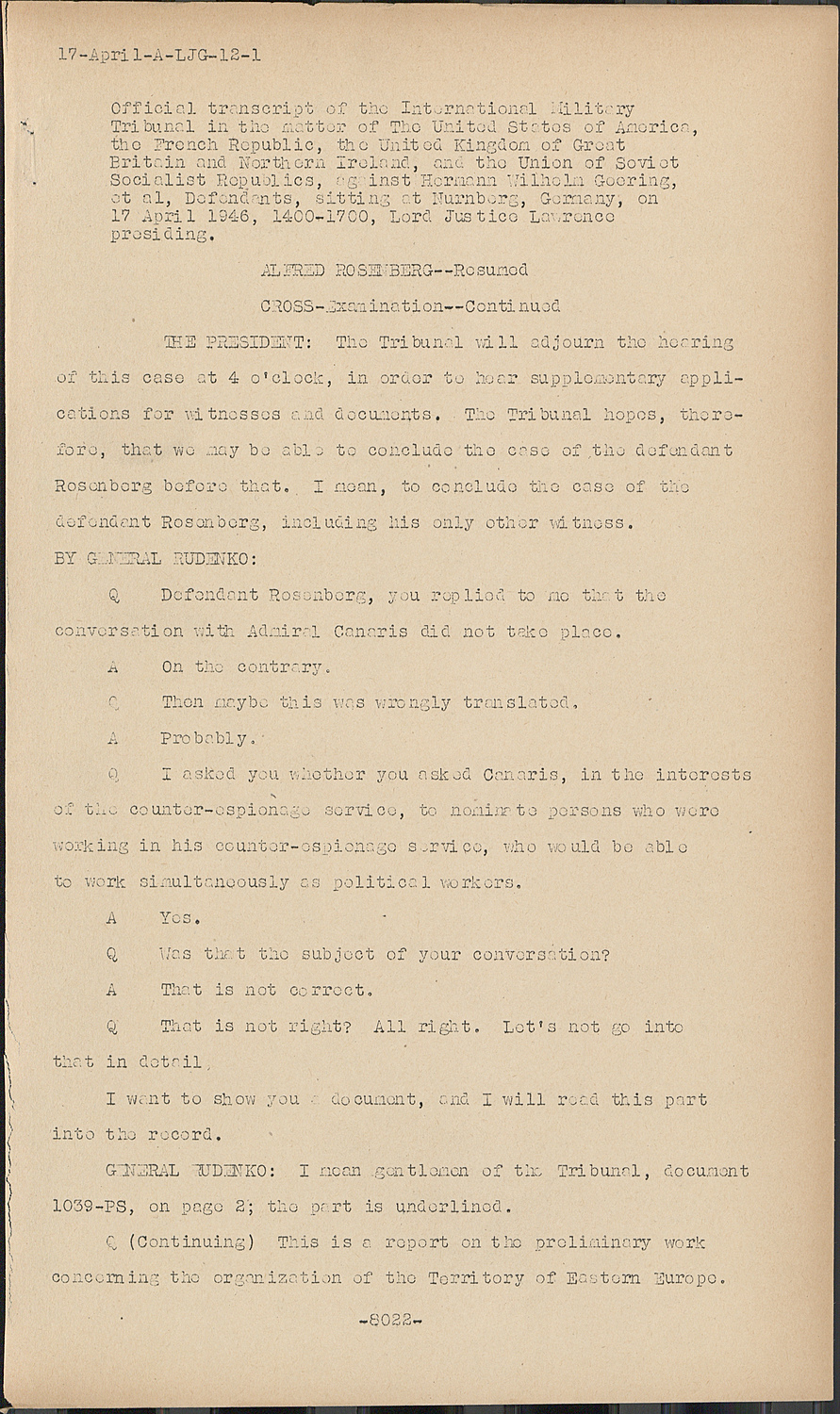
Official transcript of the International Military Tribunal in the matter of The United States of America, the French Republic, the United Kingdom, of Great Britain and Northern Ireland, and the Union of Soviet Socialist Republics, against Hermann Wilhelm Goering, et al, Defendants, sitting at Nurnberg, Germany, on 17 April 1946, 1400-1700, Lord Justice Lawrence presiding.
ALFRED ROSENBERG--Resumed CROSS-Examination--Continued
THE PRESIDENT:The Tribunal will adjourn the herring of this case at 4 o'clock, in order to hear supplementary applications for witnesses and documents. The Tribunal hopes, therefore, that we may be able to conclude the case of the defendant Rosenberg before that. I mean, to conclude the case of the defendant Rosenberg, including his only other witness. BY GENERAL RUDENKO:
QDefendant Rosenberg, you replied to me that the conversation with Admiral Canaris did not take place.
AOn the contrary.
QThen maybe this was wrongly translated.
AProbably.
QI asked you whether you asked Canaris, in the interests of the counter-espionage service, to nominate persons who were working in his counter-espionage service, who would be able to work simultaneously as political workers.
AYes.
QWas that the subject of your conversation?
AThat is not correct.
QThat is not right? All right. Let's not go into that in detail.
I want to show you document, and I will read this part into the record.
GENERAL RUDENKO:I mean gentlemen of the Tribunal, document 1039-PS, on page 2; the part is underlined.
Q (Continuing) This is a report on the preliminary work concerning the organization of the Territory of Eastern Europe.
I read:
"A talk took place with Admiral Canaris, during which we agreed that persons of my office would in no wry outer into contact with representatives of the peoples of Eastern Europe. I asked him; in the interests of the counter-espionage work, to name persons who, whilst working as agents of the counterespionage service, could simultaneously be able to stand forward as political workers, in order that they be utilized in this way in the future.
"Admiral Canaris said that of course he would take my request into consideration and would not recognize any political groups among the immigrants, and that he intended to act in the spirit of my statements."
A. That is in accord with what I said.
THE PRESIDENT:General, I think you are going a little too fast.
Q.All right. I understand. I ask you, do you confirm this quotation?
A.Yes, in the German verbatim but not in the Russian translation. I understand Russian also and can determine that the interpretation is not entirely correct. For it says here that I, in connection with this confidential relationship, could not negotiate with other countries for a perhaps later collaboration in a civil administration, and point 2 was that Admiral Canaris had contacted groups of Ukraine or Russian people and that I was asking him beyond counter-intelligence, that is, not to do espionage work for me or that I wanted to do espionage work, that he perhaps would tell me about people whom I could use later in a civil administration -- people of other countries. That was the sense of this conversation. And at the end he agreed that he, of his own accord, did not carry out political work.
Q.Defendant, this is absolutely not different from the Russian text. What you just told us now means the same in Russian.
A.The German into the Russian interpretation must have been that. I can only recognize the text that I have in front of me not any translation which is not in accord with the sense that I mentioned here. The text is being interpreted as though I were trying to carry on espionage work. I only asked Canaris, since I could not carry on political negotiations with the eastern people, to tell me about beyond and above his official capacity what people of the eastern regions, under certain circumstances, might work in the civil administration for me. That was the sense. The translation is not entirely correct.
Q.Very well. But you confirm the German text?
A.Yes.
Q.It means you were connected with counter-espionage?
A.No, that is not correct. I only received Admiral Canaris and told him that in his official capacity which he had to carry out not to deal with political plans, for that was my sphere.
Q.All right; very well. You heard the warning of the President of the Tribunal to answer briefly, and I beg you to do so.
A.I will try to answer briefly if the question is put to me factually.
Q.Next question: I will put to you several questions concerning the aims of the war against the Soviet Union. Do you admit that Nazi Germany, having prepared and pursued war against the Soviet Union, aimed at plundering the economic riches of the Soviet Union, exterminating the people, sending them into slavery, and the dislocation of the Soviet Union? Do you admit this or not?
A.As far as questions are being put to me at one time -
Q.I ask you: Please answer briefly. Do you admit the aims of the aggression as I have put them to you?
THE PRESIDENT:You can answer that question yes or no.
A.I must answer no to all four questions.
Q.All right. Let's turn to a few documents in this connection. I have document 2718-PS, which is an account of a meeting, and a memorandum dated the 2nd of May, 1942.
(A document is handed to the witness.)
Will you please follow? This document reads as follows:
"War will last if all armed forces, after three years of war, shall be supplied --"
THE PRESIDENT:Is that the beginning of the document?
GENERAL RUDENKO:Yes. We have an English text here.
THE PRESIDENT:My copy begins "as already announced, there are transmitted the reply letter of Hitler to the Duce in the presence of Ciano at 0910 hours." Is that the document?
GENERAL RUDENKO:I do not hear the translation.
THE PRESIDENT:What is the number of the document?
GENERAL RUDENKO: 2718-PS.
THE PRESIDENT:I have the wrong document. BY GENERAL RUDENKO:
Q.Will you please follow: "War can last if all armed forces, after three years of war, will be supplied with foodstuffs from Russia. There is no doubt but that as a result many millions of people will die from hunger if we take out of this country everything that we need."
Do you deny that?
A.Neither did I write this nor did I participate in these sessions, and I cannot determine whether anyone of my collaborators know anything about this meeting. It says at the top that it was a secret matter, two copies, first to the files 1-A, and the second to GEN. Two people in the armed forces knew about this.
Q.Do not go into that in detail. You do not knew about this?
A.This document has been submitted twice already.
Q.Take the next one. Let's go on to the next one.
THE PRESIDENT:The question was whether you knew of this document.
A.No.
Q.Next document, which determines the aims of the war. This is an instruction to the cive-commissars of the Baltic countries and of Byelorussia. You state the following. I am reading now document 1029-PS. The part which I will read is marked on the m argin:
"The task of the Reich plenipotentiary for Latvia, Estonia, Lithuania, and Byelorussia must be the creation of a German protectorate, in view of later transforming these regions into a fundamental part, and an organic part, of the great German empire, by germanizing of those elements, the colonization by a percentage of the German race, and extermination of undesirable elements." Do you remember this instruction? Please reply first.
A.Yes, I am familiar with this document. I remarked already yesterday that at the beginning all sorts of drafts were made in my office which were not approved by me. The corrections were made by me.
Q.I asked you very clearly, do you know this instruction or not?
A.But I also heard the wrong translation. Nothing is mentioned about destruction, but colonization is, and the Russian interpretation again said destruction. If it is interpreted and translated that way then the question appeared in the Russian translation as an affirmation, and that is a wrong translation which is being given out which I can follow only because I speak Russian.
THE PRESIDENT:Defendant, you can be heard perfectly well without shouting.
THE WITNESS:I beg your pardon.
Q.You are only correcting an error in the translation, but as regards the rest -- germanization and colonization -- is that right? Does that sound right or not?
A.Even as that it is not translated correctly. Here it says colonization of German peoples, and now you are translating germanization and colonization. These are two substantives which give an entirely different context, and I would like to add that this draft by a collaborator of mine was not actually issued and no instructions are concerned with here.
Q.But I asked you, was there such a draft or was there not such a draft
A.I am not disputing the existence of that draft in my office and its submission to my office.
Q.All right. We pass on. This instruction concerns the aims of the war. It is an instruction for all Reich commissars of the occupied territories of the cast, dated 8th of May, 1941. This is document 1030-PS. I will only read a short excerpt, which states -- I quote on page 4. This excerpt is marked on the margin. In this instruction you stated that this coming struggle would be a struggle for the supplying of Germany from all Europe with raw materials and foodstuffs. Do you confirm this?
A Yes; as a matter of course, this document was presented in my office as a draft.
That is correct and I am not disputing that.
QI will remind you again, please reply briefly. You confirmed this point and you answered yes.
AThis document, yes.
QAll right. This statement was made before the attack upon the Soviet Union. I will not submit the document to you as it has already been presented to the Tribunal several times -- I mean a conference which took place in Hitler s office on the 19th of June 1941. This is document L-2021. You assisted or were present at this conference, were you?
AYes.
QHitler said that all the Baltic States would have to be an integral part of the Reich and the same referred to the Crimea, and maybe regions as well as the Volga Districts and also Baku area. Do you recall these statements of Hitler?
AI am just seeing this document for the first time, as a copy of Bormann's; at that time, the Fuehrer explained fundamentally with explanations of a rather pationate nature. I did not take any note of that conference but, of course, he did speak about the Crimea and he mentioned that because of the tremendous power of the Soviet Union, later, no bearers of arms should be there.
QI do not ask why. I ask you, did he say that?
THE PRESIDENT:General Rudenko, you are going to fast. You must wait until the man is finished.
GENERAL RUDENKO:He is going into too many details, Mr. Presidents that is why I interrupted. BY GENERAL RUDENKO:
QYou agreed with Hitler's idea concerning the seizure of these territories.
AWe can see from the document, and you can see from my speech, how I pictured the self-determination of peoples in a new order of States and opposite and contrary to the exposition of the Fuehrer, I did speak.
QI am asking you whether you agreed with these proposals of Hitler or whether you objected to them.
A And it may be proved that I protested and even in the record it is shown.
THE PRESIDENT:The Tribunal isn't concerned with whether or not it can be proved. The question is, did you agreed or not. You can answer that, I suppose. Did you agreed or did you not agree?.
THE WITNESS:I agreed to many points and rejected other points, but this is a compilation of at least ten points.
THE PRESIDENT:Well, that is an answer. BY GENERAL RUDENKO:
QAll right. We will return to this question later. I am now turning to your own directives which you issued as Minister of the Occupied Territories in the East. They were already presented to t he Tribunal as NO. 356-PS and 347-PS. First of all, I would like to put to you one question. What is this "brown file"?
AThe "brown file" as far as the civil administration of the Eastern Ministry is concerned, it was compiled by this Ministry in request of the Economy Department for personnel welfare, of the technical supply for officialin the East and in the Ukraine. It was a first attempt at a general regulation
QAll right, and on the "green file" all right. Now, let us turn to your directives. Document 437-PS. We will directly show you this document.
Will you notice the part which has been underlined, on page 39, if I am not mistaken.
I will read this paragraph. "The first task of this civil administration in the Occupied Territories of the East is with respect to the interests of the Reich. The stipulations of the Hague Convention regarding land warfare, which foresees the administration of occupied territories, territories occupied by a foreign power, are not in effect for the USSR can be considered destroyed; therefore, all measures which the German administration will deem necessary or convenient to apply will be admitted."
Do you agree that this exposes your secret designs, although you somehow proclaim the Soviet Union as destroyed too hastily?
AIn the Russian translation I heard the word "plundering", but the word "plundering" is not found in the German text at all. If the German text is translated in that way, that everywhere -
QI interrupt you and say that word "plundering" is not in the Russian text, which I just read into the record; so I believe you are simply inventing or at least you did not hear rightly.
AMay I say a few words in this connection, please?
QI ask you, did you write this?
AI did not write it but it was a circular letter which was published in the Eastern Territories and I am responsible officially for the "green brief case" or folder, but I would like to say a few words of explanation. The explanation about the situation of international law in the East, that explanation was given to me from the Fuehrer's headquarters, that the position of the Soviet Union, as far as the Hague Convention is concerned, that the stipulations did not apply in this case; and point 2, this document contains many pages and it is impossible for me therefore to read it in its entirety; but on the second page, I see a paragraph which shows very obviously in what effect the wording was, and the verbatim is -
QDefendant Rosenberg, one minute, please.
THE PRESIDENT:We must try and conduct this cross examination in an orderly fashion. Now, what is thequestion? What is your question?
GENERAL RUDENKO: I put to him the question, whether he admitted that he knew of the task put before the civilian administration in the Occupied Territories as they are laid out in the quotation which I justread.
He said that he did know. I have exhausted my questions. The document is in possession of the defense and the defense will be able to quote other parts of this document, which is a very long document, when it wishes, and we won't quote it in order to save the time of the Tribunal.
THE PRESIDENT:You answered the question. I understood what the question was, and that you were told that the Hague Convention did not apply to Russia.
THE WITNESS:Yes. The next to the last paragraph, the most important condition, that is, for the development in the East, is the treatment of the country and of the people in this accord. The war against the Soviet Union is to be carried on with the securing of foodstuffs and that the German objective is to be one of order. The occupied country is not to be considered as an object of exploitation, even if the German food supply and war economy needs and demands larger areas, and in a large scope, and I believe I may be ableto say that we are taking into consideration the necessities of the inhabitants, a consideration which cannot be expressed more unequivocably and more significantly. BY GENERAL RUDENKO:
QVery well. I will put to you the question as to how you treated the population, although you must Have heard quite a lot about this treatment during the past five months. We pass on. I asked you about the Crimea and you said that, yes, Hitler proposed to annex the Crimea to Germany. Do you remember that you did not only approve of these plans but you also thought out fresh names for towns; for instance, Simferopol was to be called "Ottenburg" and Sevastopol was to become "Theodorichafen." Do you remember that?
AYes. The Fuehrer told me that a change of names was to be considered by me, just as we had talked about the changing of names of other cities.
Q Yes, of course.
DR. THOMA:Mr. President, I am expected to conclude my entire case at four o'clock. I am not quite certain how I can do that.
THE PRESIDENT:The Tribunal hasn't laid that down as a condition. I didn't make any order about it. I only said that the Tribunal hoped, and the "hope" was addressed more to the prosecution than it was to the defense.
DR. THOMA:Mr. President, if I may be permitted to say, the Soviet Prosecutor has submitted documents again which I already submitted yesterday and on which the defendant has answered already yesterday. I am referring to PS-1029 and 30. The defendant already took the position yesterday.
THE PRESIDENT: You are wasting the time of the Court by making this entire interposition.
BY GENERAL RUDENKO:
QThus you admit the change of the names of Crimean towns.
Next question -- you also occupied yourself with the transformation of the Caucasus and you had organized a special Staff K, is that so?
AYes.
QFurthermore, you selected a Georgian prince, an adventurer from amongst the emigres, a PrinceMichansky, is that true?
AYes, that is true. We did mention that, we spoke about him but he was turned down as a candidate in this case.
QHe was rejected, is that so? Very well.
As regards the transformation of the Caucasus on 29 June, 1942 you compiled a special report, is that true?
AIt may be, yes, I believe that is true. It is quite a lengthy report.
QAnd I will show you this report in order to draw your attention to one short excerpt.
GENERAL RUDENKO:I have in view, Mr. President, a document which has already been submitted as U.S.S.R. Exhibit 58. BY GENERAL RUDENKO:
QPlease pay attention to page 7 and an excerpt which is marked and which says first that the Germans must seize the entire oil.
"As regards our participation and exploitation and purchase of the oil we will be able to come to an agreement subsequently." Will you find that spot?
AOn page seven of the text I find the passage, yes, I have found it.
QDo you confirm this statement was made by you?
AThis document is a memorandum issued by my office and I affirm and confirm that it is correct.
QVery well.
AMay I make two remarks in addition?
We are not talking about an oppression of a people but an assurance of authnomy and the mitigation for these people but I cannot draw up all points when I look at only one passage because this document has fourteen pages.
Q Defendant Rosenberg, I will ask you now in regard to the tasks of the Germans as to this oil business.
Will you look at page 14 of this same report? This is how you define these tasks:
"The problems of the East consist in transferring the Baltic peoples to a German cultural basis and to prepare on a vast scale the military frontiers of Germany. The task as to the Ukraine is to assure Germany and Europe with food-stuffs and the task in the Caucasus is in the first place a political tusk and a means to an extension of continental Europe from the Caucasus to the middle East and the German supervision thereof."
AYes.
QYou do not deny that these were the plans, actual plans?
AI affirm that it is set down correctly and that it is in accord with the eastern policy as had been the case before 1940 for at that time the Ukraine was a country of exports, raw materials and foodstuffs.
QYes, you also know that part as to the Ukraine.
I will put the last question concerning aggression. After having seen these documents which you do not deny, do you admit the aggressive and plundering character of Germany's war against the Soviet Union and your personal responsibility for the preparation and the commission of this aggression? Answer briefly. Do you admit this or do you not?
ANo, but I did not consider this a war of aggression on our part, in other wards vice versa.
QOf course but we will not go into that.
I have a few questions to put to you concerning the administration and Germany policy in these territories.
Who was the highest figure in the German administration and Reich Commissariate?
AAs far as the administration and the giving of laws in the eastern countries is concerned the Minister for the Eastern Occupied Countries was competent and the Reich Commissar for Territorial Government.
THE PRESIDENT:General Rudenko, the Tribunal has already heard all about the administration, the former administration and personnel of the administration.
GENERAL RUDENKO:I have only two or three questions to put in this respect. BY GENERAL RUDENKO:
QCould the General Commissar issue orders for the execution of hostages?
AAt this moment I cannot recall whether he had such authority by law or whether that came under the police but I cannot answer with assurance for at the moment I do not recall a decree to that effect but it is not entirely impossible.
QIt is possible? Very well.
I would like to remind you that you personally foresaw this possibility of issuing such an order. I will, however, not show you the document and we will pass to another subject.
A lot has been said here about German policy in occupied territories. I will therefore only put another few questions to you.
First of all, as regards the Ukraine, you here describe the situation in such a light to show that Koch was the sole person responsible whereas you were, on the contrary, the benefactor of the Ukrainian people.
ANo, that is not correct, I did not say I was their benefactor.
QIn your document which has been submitted by your defense counsel and I will therefore not submit it to you, Ro 19, you recollect that you wrote in a letter to Reich leaders of the police in November 1942:
"Koch stated the Ukraine is for us only an object of exploitation and that she must pay the expenses of the war and that the population must be utilized for the solution of military problems as a people of second grade, even it we have to starve it out."
This was the policy of Koch in the Ukraine. Documents which were submitted by your counsel and which I will show you -
A.May I please answer? I do not have the document in front of me and do not recall the exact wording but I do know it was a letter written by Riecke to me in which he asked me -
Q.Koch?
A. Yes -- complained and he used rather drastic language and in which he stated both of us would be satisfied with a well-balanced order of work.
THE PRESIDENT:The Tribunal has been all over this matter of Koch as to the Ukraine today and so it is not helping the Tribunal to so over it again.
GENERAL RUDENKO:All right, Mr. President. BY GENERAL RUDENKO:
Q.You have stated here repeatedly as regards the atrocities and extermination of the Soviet population that you were not informed and that these were police measures. Did I understand you correctly?
A.No, that is not exactly true. I was informed of many battles with partisans and bands and I was told about some shootings and also I was told about the fact that German agricultural leaders, German officials and police men had been attacked by these partisans and bands and had been murdered by the thousands.
Q.Very well. We know that the partisans who fought against enemies of the country were called by you bandits. I do not argue that. But I am speaking of the extermination of the civilian population, of old men, women and children. Did you know about that?
A.We were especially interested and we tried very much to spare the civilian population and protect them and when we heard about exaggerated measures by the police we put the most severe demands to them that even though the battle was raging very violently those considerations would be followed and the police told us that it was easy to make those demands but i the partisans murder and burn five hundred men with their families and we are attacked from the rear their, of course, there are definite conflicts that follow.
Q Il will remind you that in your directive concerning occupied territories and organization of administration and the primary task for administration, you personally planned as your first task the police measures which were not explained.
Do you deny this now? I ask you, do you deny this now?
AIf it is document 1065, seven measures were to be token, the first one I cannot tell you at the moment. I ask that you submit this document to me. Please submit it to me.
QI will show you the first point "A", the police measures which is in the very first place.
THE PRESIDENT:Has this document been put to him?
GENERAL RUDENKO:Yes.
THE PRESIDENT:What is the use of going into it again?
GENERAL RUDENKO:Because he asked for it. I would only like to say that the defendant tried to say that he was not informed and that these were purely police measures. I am now going to prove that he put as his primary task the commission of these police measures.
AIt goes without question that in occupied territories the police in the middle of such a war have to take police measures of security. And the third point is the supply of the population with food stuffs in order to avoid famine. I repeat, supply of the population in order to avoid famine, the outbreak of famine.
QVery well. Very well. Be sure about this; we talked about this in detail yesterday. I have a few last questions to put to you. First of all, I would like to ask you about the Zuman incident. The document has already been submitted to the record, but I consider it my duty to put to you this question concerning the shooting of the Soviet citizens for the pure reason that a shooting place was needed. You remember this document?
AYes; I have given an extensive explanation yesterday.
THE PRESIDENT: General Rudenko, this has been gone into before before the Tribunal.
Why should the Tribunal's time be taken up by going over and over again on the same grounds? We have said that we would not have things done cumulatively.
GENERAL RUDENKO:A few details of this question ore of great importance, and the defendant did not explain then, and I wish very much -- I feel very strongly.
THE PRESIDENT:Very well, the Tribunal will adjourn to consider the matter.
(A recess was taken.)
THE PRESIDENT:First of all, the Tribunal will rise tomorrow at half past four, Now, as to this question, the Tribunal thinks that the matter has been sufficiently gone into, but, if there is any particular point which has not been dealt with before, a question may be asked in that connection.
GENERAL RUDENKO:Very well, Mr. President. BY GENERAL RUDENKO:
QDefendant Rosenberg, on the 2nd of April 1943, you addressed a letter to Himmler regarding this incident, regarding the shooting of hundreds of Soviet citizens in the region of Zuman because this place was necessary as a hunting ground.