Q And did the State Police have anything to do with the ad-
ministration of the concentration amps?
ANo. It may be that at the beginning concentration camps here and there wer administered by the Secret State Police directly for a short period, but that was probably only the case in individual instances. But it was the principle even at that time, and later on, generally, that concentration camps were administered by the economic and administrative central department.
QDo you know anything about who gave orders for the total liquidation of concentration camps?
ANo, I know nothing about that.
QCan you say anything about the basis of protective custody, on the strenth of which protective custody could be decreed after 1933?
AProtective custody was based on the decree from the Reich President for the protection of the nation, and the state, dated February 1933, in which a number of basic rights of the Weimar Constitution were rescinded.
QWas there a decree from the Ministry of the Interior later on which dealt with protective custody, I mean at the end of '36 or the beginning of '37?
AYes. At that time protective custody procedure was ruled on by this decree from the Ministry of the Interior, but the legal basis as such remeined in force. At that time, protective custody was confined to the Secret State Police. Before that, a number of other service departments, whether rightly or wrongly, had the right to decree protective custody. To prevent this, protective custody matters were transferred to the Secret State Police at that time.
QIs it correct that for some time you were working in France, and in what capacity were you there?
AIt was late in the summer of 1943 that I was in France as the commander of the Security Police in France, or from individual commanders, stating that in the caae of interrogation of prisoners of war, ill treatment and cruelties which actually did occur during interrogations?
A It is possible that a number of such cases of ill treat-
ment did occur which either did take place although they were forbidden, or which were carried out by members of other service authorities in France who did not belong to the Security Police.
QDid you, when you were acting in France, hear of any such illtreatment either officially or by hearsay?
AAs far as members of the German police or armed forces are concerned, I have never heard of such ill treatment, but I heard of ill treatment carried out by groups consisting of Frenchmen who were acting by order of some German authority
QWere there so-called Gestapo prisons in France?
A. No. The Security Police in France did not have prisons of their own.
Their prisoners were transferred to the detention camps of the Genman armed forces or detention institutions of the German armed forces.
Q.One last question: The Prosecution has listed a large number of crimes against humanity and the law of warfare which have been committed with participation on the part of the Security Police. Can one say that these crimes were perfectly obvious and must have been known to all members of the State Police, or was it the case that these crimes were only known to a small circle of persons who had the task of carrying out the measures concerned? What was the situation in that connection?
A.I didn't quite understand the question from the beginning. Were you referring to France or to the Security Police generally in the Reich?
Q.I was referring to the Security Police generally.
A.Any ill treatment or torturing was not permitted, and according to my knowled e, it was even less known generally or to a larger circle of persons I, for instance, knew nothing of it.
DR. MERKEL:I have no further questions.
THE PRESIDENT:We will adjourn now for ten minutes.
(A recess was taken)
THE PRESIDENT:Does the Prosecution wish to cross examine? Is there nothing you wish to ask arising out of Dr. Merkel's cross examination, Dr. Deidl?
DR. SEIDL:I have only one more question to the witness. BY DR. SEIDL:
Q.Witness, in paragraph 4 of the decree of 3 June 1942, the following is ordered, and I quote literally.
"The SS and police leaders in the districts, in the same way as the State Secretary for Security, are subordinate immediately to the governors of the district."
It does not say that the entire police organization is subordinate, only the police leaders.
Now, I ask you whether orders which had been issued by the commanders of the Security Police and the SD were forwarded to the governors or immediately to the officers of the Security Police in the district?
A.These orders were always sent immediately to the commanding officers of the SD and Security Police. They could not be given any directives.
Q.If I understand you correctly, you intend to say that the channel within the Security Police and the SD had absolutely nothing to do with the administrative organization of the Government General.
A.Yes.
DR. SEIDL:I have no more questions to the witness.
THE PRESIDENT:The witness can retire.
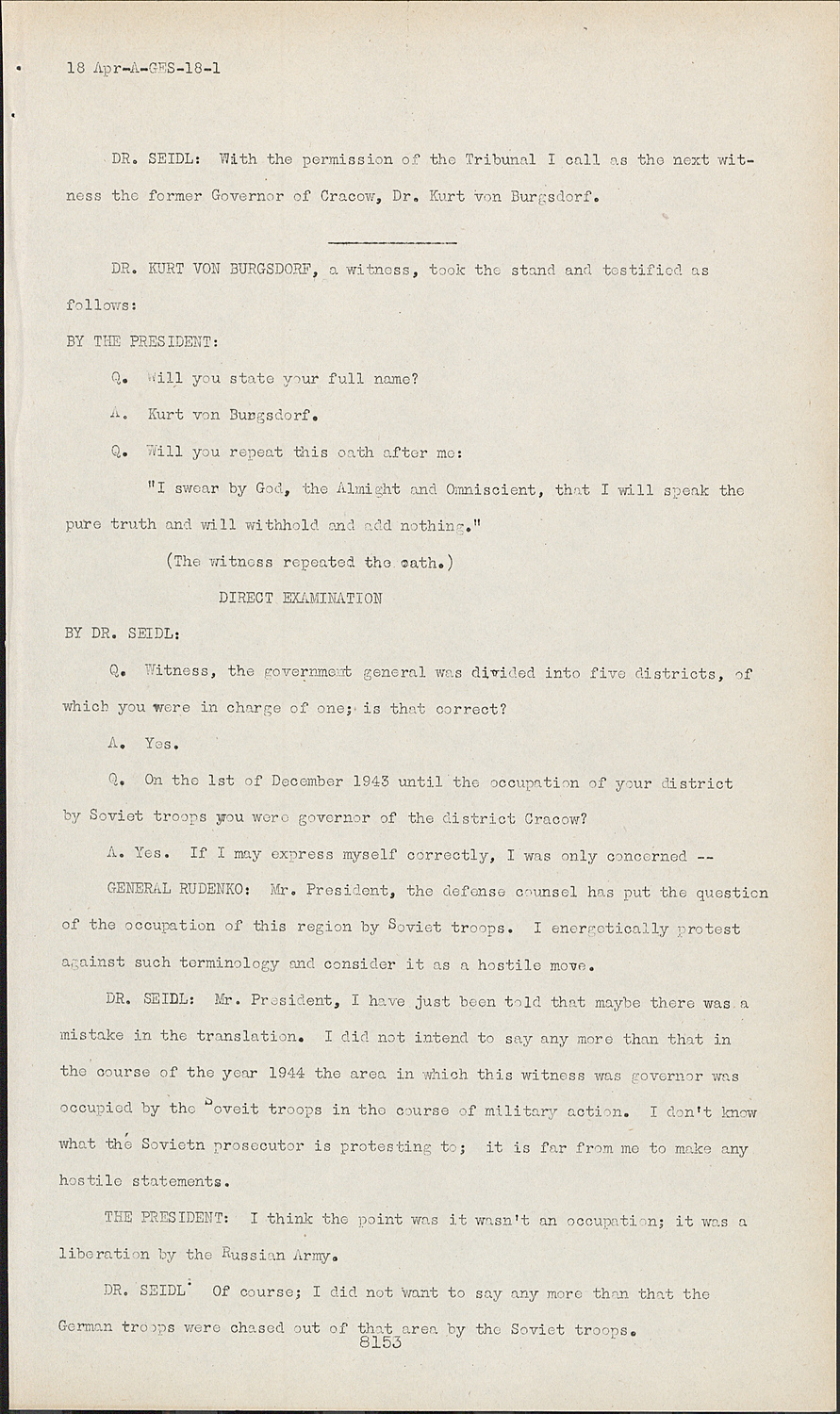
DR. SEIDL: With the permission of the Tribunal I call as the next wit-
ness the former Governor of Cracow, Dr. Kurt von Burgsdorf.
DR. KURT VONBURGSDORF, a witness, took the stand and testified as follows: BY THE PRESIDENT:
Q.Will you state your full name?
A.Kurt von Burgsdorf.
Q.Will you repeat this oath after me:
"I swear by God, the Almight and Omniscient, that I will speak the pure truth and will withhold and add nothing."
(The witness repeated the oath.)
DIRECT EXAMINATION BY DR. SEIDL:
Q.Witness, the government general was divided into five districts, of which you were in charge of one; is that correct?
A.Yes.
Q.On the 1st of December 1943 until the occupation of your district by Soviet troops you were governor of the district Cracow?
A.Yes. If I may express myself correctly, I was only concerned -
GENERAL RUDENKO:Mr. President, the defense counsel has put the question of the occupation of this region by Soviet troops. I energetically protest against such terminology and consider it as a hostile move.
DR. SEIDL:Mr. President, I have just been told that maybe there was a mistake in the translation. I did not intend to say any more than that in the course of the year 1944 the area in which this witness was governor was occupied by the Soveit troops in the course of military action. I don't know what the Sovietn prosecutor is protesting to; it is far from me to make any hostile statements.
THE PRESIDENT:I think the point was it wasn't an occupation; it was a liberation by the Russian Army.
DR. SEIDL:Of course; I did not want to say any more than that the German troops were chased out of that area by the Soviet troops.
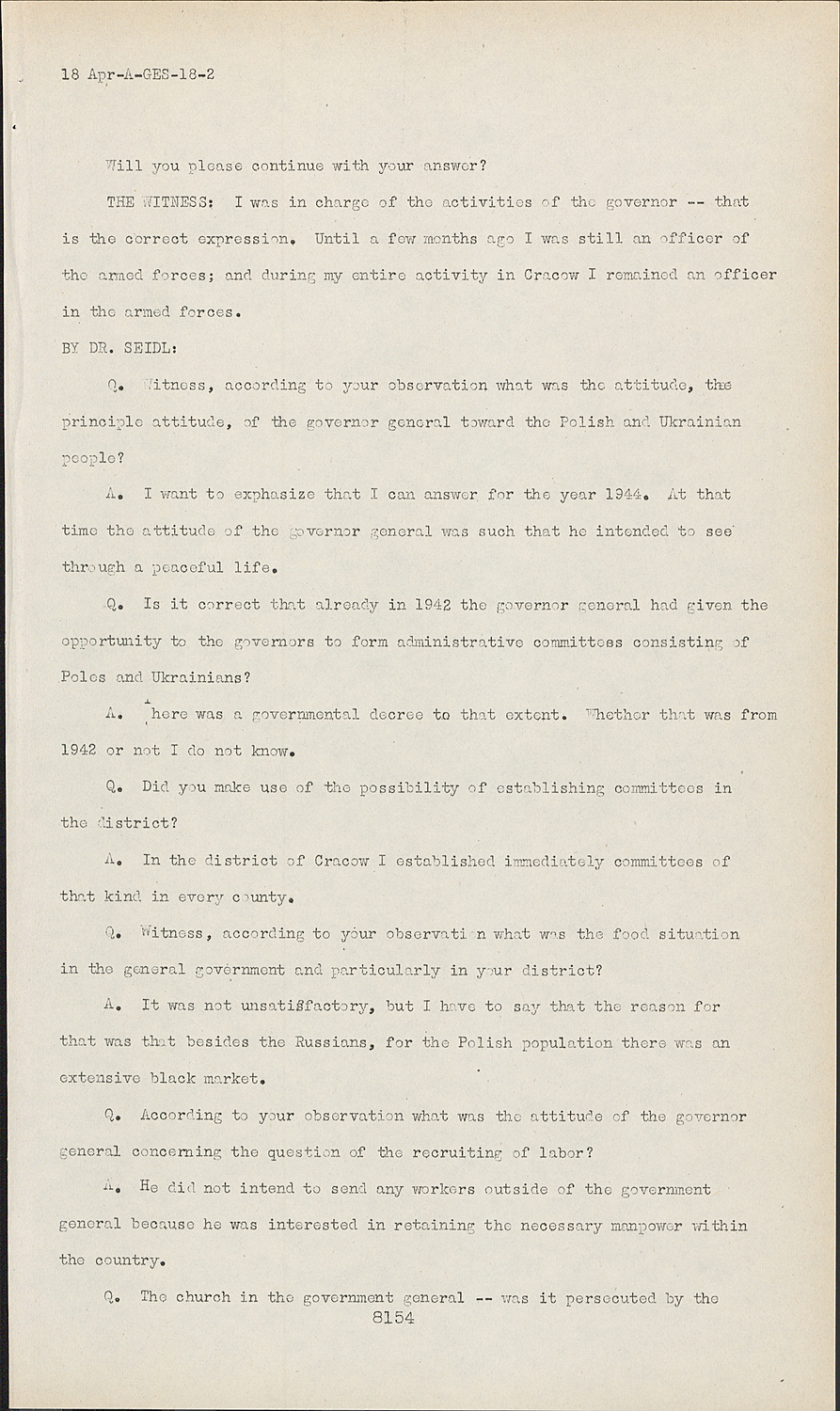
Will you please continue with your answer?
THE WITNESS:I was in charge of the activities of the governor -- that is the correct expression. Until a few months ago I was still an officer of the armed forces; and during my entire activity in Cracow I remained an officer in the armed forces. BY DR. SEIDL:
Q.Witness, according to your observation what was the attitude, the principle attitude, of the governor general toward the Polish and Ukrainian people?
A.I want to exphasize that I can answer for the year 1944. At that time the attitude of the governor general was such that he intended to see through a peaceful life.
Q.Is it correct that already in 1942 the governor general had given the opportunity to the governors to form administrative committees consisting of Poles and Ukrainians?
A.There was a governmental decree to that extent. Whether that was from 1942 or not I do not know.
Q.Did you make use of the possibility of establishing committees in the district?
A.In the district of Cracow I established immediately committees of that kind in every county.
Q.Witness, according to your observation what was the food situation in the general government and particularly in your district?
A.It was not unsatisfactory, but I have to say that the reason for that was that besides the Russians, for the Polish population there was an extensive black market.
Q.According to your observation what was the attitude of the governor general concerning the question of the recruiting of labor?
A.He did not intend to send any workers outside of the government general because he was interested in retaining the necessary manpower within the country.
Q.The church in the government general -- was it persecuted by the governor general, and what was, according to your observation, the attitude of the governor general?
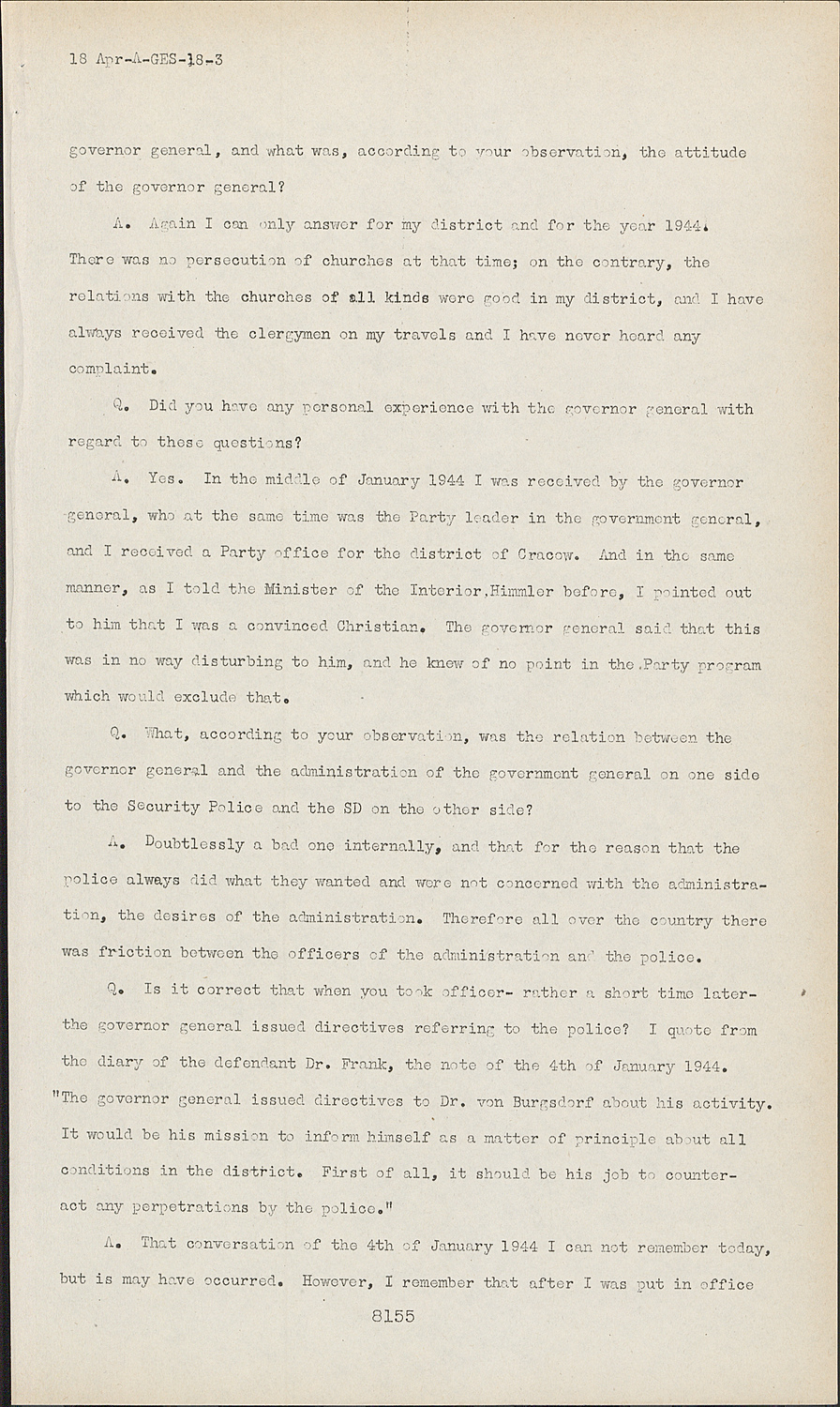
A.Again I can only answer for my district and for the year 1944. There was no persecution of churches at that time; on the contrary, the relations with the churches of all kinds were good in my district, and I have always received the clergymen on my travels and I have never heard any complaint.
Q.Did you have any personal experience with the governor general with regard to these questions?
A.Yes. In the middle of January 1944 I was received by the governor general, who at the same time was the Party leader in the government general, and I received a Party office for the district of Cracow. And in the same manner, as I told the Minister of the Interior,Himmler before, I pointed out to him that I was a convinced Christian. The governor general said that this was in no way disturbing to him, and he knew of no point in the Party program which would exclude that.
Q.What, according to your observation, was the relation between the governor general and the administration of the government general on one side to the Security Police and the SD on the other side?
A.Doubtlessly a bad one internally, and that for the reason that the police always did what they wanted and were not concerned with the administration, the desires of the administration. Therefore all over the country there was friction between the officers of the administration and the police.
Q.Is it correct that when you took officer- rather a short time laterthe governor general issued directives referring to the police? I quote from the diary of the defendant Dr. Frank, the note of the 4th of January 1944. "The governor general issued directives to Dr. von Burgsdorf about his activity. It would be his mission to inform himself as a matter of principle about all conditions in the district. First of all, it should be his job to counteract any perpetrations by the police."
A.That conversation of the 4th of January 1944 I can not remember today, but is may have occurred. However, I remember that after I was put in office November 1943 I had gone to see the governor general once more and told him that I had heard that the relations with the police were quite unfavorable and causing great difficulty for the administration.
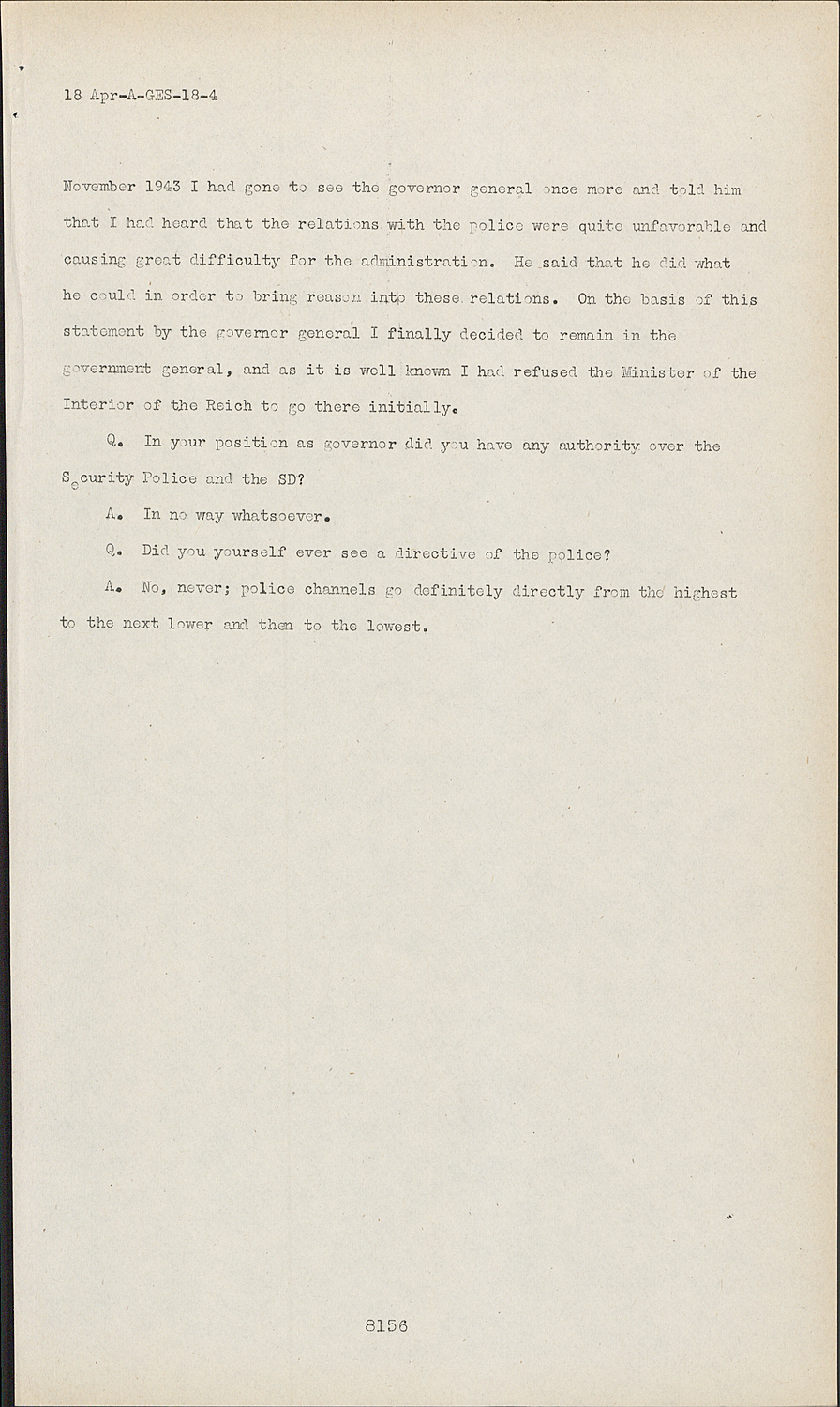
He said that he did what he could in order to bring reason into these, relations. On the basis of this statement by the governor general I finally decided to remain in the government general, and as it is well known I had refused the Minister of the Interior of the Reich to go there initially.
Q.In your position as governor did you have any authority over the Security Police and the SD?
A.In no way whatsoever.
Q.Did you yourself ever see a directive of the police?
A.No, never; police channels go definitely directly from the highest to the next lower and then to the lowest.
officials; from the supreme commander of the Security Police to the commanders.
QIn your activity as governor did you have anything to do with the administration of concentration camps?
ANever.
QDo you know who administered the concentration camps?
ANo, not from my own knowledge, but I have heard that there was some central office in Berlin with the Reich Fuehrer SS Himmler.
QWhen did you hear for the first time of the concentration camp Majdanek?
AAbout two weeks ago; a fortnight ago.
QYou want to tell the Tribunal under oath -
AYes.
Q --that you, although you were governor of Cracow in the occupied Polish territory, that not before your captivity did you find out about it?
AYes, I am convinced; I am absolutely sure that I only heard about it from you.
QWhen did you for the first time hear of the concentration camp Treblinka?
AFrom you also on the same occasion.
QWitness, the governor general is accused by the prosecution of having decreed a law for courts martials in the year 1943. What at that time was the situation concerning security in the government general?
AAgain I can only judge that for the year 1944. As German troops came back from the East, had to retire from the East, it became worse and worse, so that in my district in an increasing measure a regular administration could no more be carried out.
QAccording to your observation, what was the development of economy in the agricultural sector and the sector of trade, and can one way that in considerable of war-time conditions the governor general had done everything to improve conditions?
AEconomy in my district was doing very well in 1944 both in the trades and in agriculture. There were industries which had been transferred from the Reich to the government general, and as far as agriculture is concerned the administration brought in seed and livestock;also horses were raised in my district to a large extent.
QThe defendant Dr. Frank has been accused with regard to public health and hygienic conditions, -- not to have done everything that was necessary. What can you say about that point?
AI can say that in my district--1944 again--hospitals were improved and some new ones installed. But especially in the field of fighting epidemics a great deal had been done. Typhus, dysentery, and typhoid were greatly reduced by vaccination.
QThe defendant Dr. Frank was also accused of neglecting education. Do you know anything about that, about conditions in the government general?
AWhen I came into the government general there were no higher schools left. Thereupon and on the basis of other experiences I suggested immediately to reinstate higher Polish schools. I contacted the president of the then department Hauptabteilung who told me these plans existed already with the government, and in everyone of my monthly reports I pointed the necessity of re-establishing these schools, and because of that during a very short period a lot of specialists, technicians, and doctors attended.
QNow, one last question. There was a so-called work district of the NSDAP in the government general, and you were the leader of that district for Cracow. What was the relation between the governor general and the leader of the Party Chancellery Bormann?
AI believe that I can say without exaggeration that it was a miserable one. As a district leader that office was connected with that of the government. I witnessed the last great struggle of the governor general against Bormann. The governor general--and with full right from his point of view--considered it necessary to keep the Party office separated from the administrative office. He was afraid that otherwise there would be too much interference not only by the police but also by the Party,and that he wanted to prevent. Bormann on the other hand, also in the government general, wanted to re-establish the predominance of the Party over the state, and that caused the most serious conflict.
DR. SEIDL:I have no further questions.
THE PRESIDENT: Do any of the other defense counsel wish to ask any other questions?
DR. LUEDINGHAUSEN:Dr. Luedinghausen, counsel for von Neurath, BY DR. LUEDINGHAUSEN:
QWitness, you were once Undersecretary in the Government of the Protectorate of Bohemia and Moravia? When was that?
AFrom the end of March 1939 until the middle of March 1942.
QAnd to whom were you immediately subordinate, to State Secretary Frank or to the Reich Proectorate.
AState Secretary Frank.
QFrom where do you have your knowledge about the activity of von Neurath as Reich Protector?
AFrom speeches and personal conversations.
QWhat kind of work did you have to do as Undersecretary?
AI was in charge of the administration proper.
QWas the Police and SS subordinate to you?
ANo.
QTo whom were they subordinate?
ATo State Secretary Frank.
QWhat was the position of State Secretary Frank to von Neurath? What was the position of State Secretary Frank in relation to von Neurath?
AYou mean officially?
QOfficially, yes, of course.
AVon Neurath tried at first to get along with Frank but the stronger Frank's position became, the more impossible it became for von Neurath. State Secretary Frank, and later Minister Frank, was backed up by the entire power of SS and the Police and he also had the backing of Hitler.
QFrom whom did Frank get his orders?
AAccording to my knowledge, from Himmler: however, I witnessed once or twice that he was called, directly by Hitler about, his directives.
QAnd that happened by sidetracking von Neurath?
AI could not say that but I assume.
QWas it possible for Frank that he independently, within his sphere, could act without having the approval of von Neurath?
A Whether he could, whether he could I could not decide but at any rate he did so.
QWere von Neurath and Frank of the same opinion concerning the policy toward the Czech people; were von Neuratch and Frank of one opinion concerning the policy toward the Czech people?
ANo. Von Neurath could not do anything, being confronted with the power of Himmler and Hitler.
QWhat was the policy of von Neurath himself?
AI have just in the beginning - just in the beginning I spoke very much about these things with von Neurath. He hoped and believed, on the basis of the decree of the 15th of March, to achieve a reasonable and peaceful cooperation between Germans and Czechs in the Protectorate.
QBut due to the increasing power of Frank, that failed, didn't it?
AYes.
QDo you remember that in the middle of November 1939, serious disturbances broke out among the students in Prague?
AYes.
QDo you also remember that on the day after these incidents, von Neurath and Frank flow to Berlin?
AYes.
QDo you remember that Frank alone returned from Berlin on the same day?
AThat Frank returned on the same day, I believe I can remember but I do not remember whether he came alone.
QSo you wouldn't know if von Neurath returned with him?
ANo.
QDo you know anything else concerning the incidents connected with the student disturbances and what the consequences were?
AThe consequences, as much as I remember, several students were executed and the schools were closed.
QDo you know whether that was on the order of Hitler?
AYes.
QDo you know anything about the attitude of von Neurath toward the Catholic and Protestant church?
AHis attitude was always perfect and there was no difficulties with the churches as long as I was there.
QDo you happen to know that von Neurath was in special contact with the Arch-Bishop of Prague until the latter's death?
ANo, I don't knew anything about that.
QDo you nave any knowledge whether, during the term of office of von Neurath, with his approval or upon his orders, art treasures of any kind, pictures, monuments, sculptures, libraries, or such, from State or private property, had been confiscated and had been brought out of the country?
AUpon his orders, such things certainly have never happened. Whether he approved at any specific time, I do not know but I do not believe so. I remember one incident in the Maltese (?) Palace, where some Reichoffice -and I don't remember today which it was -- removed art. Here, von Neurath immediately did everything in order to repair the damage.
QDo you know that the customs union whichhad been ordered between the Protectorate and Germany, was not carried out for a long time, upon orders of von Neurath?
AYes. I know about that definitely; however, I have to add that also State Secretary Frank at that time was against that customs union, because just as von Neurath, he believed that the economy of the Protectorate would experience difficulties and damage from the stronger economy of Germany.
QWhile von Neurath was Reich Protector, were there any forcible deportation of workers?
AI am convinced that did not happen. Workers were recruited but in a definitely regular manner. That happened already while I was still in the Protectorate.
QAnd do you know anything as to whether von Neurath made provisions for travel to be dependent upon his official approval in or out of the Protectorate?
AWhether or not von Neurath did it, I do not know. At any rate, it was necessary to get approval.
THE PRESIDENT:Try to keep it a bit slower and try to go a little bit slower. This light is continually coming on.
Q Do you know anything about the closing of middle schools?
AYes.
QWhat do you remember about them?
AI remember that the closing of middle schools was a consequence, a necessary consequence, of the closing of colleges. There had been too many little schools in the Protectorate. Not all of them were closed. Specialist schools, trade schools, were approved and probably also reestablished.
QDo you know anything about the attitude of von Neurath toward the intended Germanization of Czechoslovakia, intended by Himmler?
AYes, I know about the memorandum which von Neurath sent to Hitler about that whole affair, and that memorandum was intended to counteract those plans by Himmler of a forced Germanization. Von Neurath was of the opinion, as he told me frequently, that such tendencies and intentions of Germanization were not desirable in the interest of the Protectorate.
DR. VON LUEDINGHAUSEN: I have no more questions.
THE PRESIDENT: Does the Prosecution wish to cross examine?
CROSS-EXAMINATION BY MR. DODD:
QTell us, please, when you first joined the National Socialist Party?
AThe 1st of May 1933.
QAnd did you achieve office in any of its affiliated organizations?
AI am an SA Grupenfuehrer, as an honorary degree.
QAny other honors?
AThen for a few years, such as I had done it in the democratic time, I was charged with legal affairs of the Gau Saxonia.
QWeren't you also an Oberbannfuehrer in the H. J.,the Hitler Jugund?
AYes, I became Oberbannfuehrer in the presence of the then Jugand Fuehrer Baldur von Schirach. But that was purely a matter of politeness which had no consequences.
I Would like to say one more thing. Since you speak of party offices, as it was said before, in consequence of my position as Governor in Cracow, from January 1944 until the end, that is, the middle of January 1945, I wan district leader.
QYou also received the Golden Badge of the Hitler Youth, did you not?
ANo.
QWeren't you in some way associated with Reinhard Heydrich when you were in Prague?
ANo. I was with Heydrich until the middle of March 1942. Then, as was generally known, on account of the tendencies of Heydrich, I left the Protectorate, and as a man of forty-five I went into the army.
QWhat position did you occupy with relation to Heydrich?
AThe same as under von Neurath; I was Understate Secretary.
QLet me put it to you this way; You told us that you never heard of Maidanek, the concentration camp?
AYes.
QAnd you never heard of Auschwitz?
AOf Auschwitz, yes.
QHad you heard of an installation known as Lublin?
AOf Lublin? Not of the concentration camp but of the City of Lublin, of course.
QDid you know of a concentration camp by the name of Lublin?
ANo.
QYou did know, I assume, of many other concentration camps by name?
AOf German camps, yes -- of Dachau and Buchenwald.
MR. DODD: That is all.
THE PRESIDENT: Have you any questions?
DR. SEIDL: I have no more questions to the witness.
THE PRESIDENT: Who is your next witness?
DR. SEIDL: The next witness would to the former secretary of the Governor General Kraffczyk.
However, If I understood the Tribunal yesterday, this session will end at 4.30?
THE PRESIDENT: The Tribunal will adjourn now until Tuesday morning.
(A recess was taken until Tuesday, April 23.)
____________ Official transcript of the International Military Tribunal in the matter of the United States of America the French Republic, the United Kingdom e of Great Britain and Northen Ireland, and the Union of Soviet Socialist Republics against Her mann Wilhelm Goering, et al, Defendants, sitting at Nurnberg, Germany, on 23 April 1946, 1000 1245, Lord Justice Lawrence presiding.
THE PRESIDENT:Dr. Seidl.
DR.SEIDL (Counsel for Hans Frank): Mr. President, the witness Strube, chief of the Central Department and in charge of food in the Government General, will not be needed by me, and with the permission of the Tribunal, I am now calling witness Dr. Joseph Buehler.
____________
JOSEPHBUEHLER, a witness, took the stand and testified as follows: BY THE PRESIDENT:
QWill you state your full name, please?
AJoseph Buehler.
QWill you repeat this oath after me:
I swear by God, the Almighty and Omniscient, that I will speak the pure truth, and will withhold and add nothing.
(The witness repeat the oath.)
THE PRESIDENT:You may sit down.
DIRECT EXAMINATION BY DR. SEIDL:
QWitness, since when do you know defendant Dr. Hans Frank, and what were the positions in which you worked under him?
AI have known Frank since October 1, 1930, In the Civil Service I worked with him since the end of March,933. I have served under him in his capacity as Minister of Justice in Bavaria, and later as Reich Commissioner for Justice, and later still in his capacity as Minister. Beginning at tge end of September 1939 Frank employed me in the Government General.
QIn what capacity were you working at the end in the Government General
AApproximately since the second half of 1940 I was Secretary of State in the Government of the Government General.
QWere you yourself a member of the Party?
A I have been a Party member since the first of April 1933.
QDid you have any functions in the Party or any of the affiliated organizations of the Party, that is to say, the SA or the SS?
AI have never exercised any functions within the Party. I was never a member of the SA or the SS.
QI shall now come to the time during which you as Secretary of State were the chief of the government in the Government General. Will you please tell me what the relations between the Government on one side and the Higher SS and Police Leader on the other side were?
APerhaps I may first of all say in brief that my sphere of jurisdiction did not touch upon the police matters, matters relating be the Party or military matters in the Government General.
Relations between the Governor General and the Higher SS and Police Leader who was attached to him by the Chief of the German Police and SS, that being Obergruppenfuehrer Krueger, were right from the beginning, disturbed by very deep differences of opinion. These differences of opinion concerned both the conception regarding the task and position of the police in an orderly State system, as well as, in particular, the position and tasks of the police in the Government General.
The Governor General represented the view that the police must be the servant and the organ for the executive of the State, and that, according to that view, he and the State Departments would be giving orders to the police. From this arrangement it would arise that the Police would simultaneously have to have its tasks and influence limited to some extent.
The Higher SS and Police Leader Krueger, on the other hand, represented the view that the police would have executive tasks originating from the State, but that even in the carrying out of these tasks it would not have to be bound to the instructions coming from administrative sources. He considered that here one was concerned with actual police questions and tasks, the decisions for which could not be made by administrative sources who were not suited for making them.
Regarding the power to give orders to police, it was Krueger's view that because of the power and the type of activity of the police in all occupied territories, such orders could only come centrally from Berlin, and that orders in the Government General could only exclusively come through him.
As far as the sphere of influence of the police was concerned, it was Krueger's opinion that the views of the Governor General regarding the limitarions of the sphere became superfluous, simply because he, as Higher SS and Police leader, was simultaneously the deputy of the Reichsfuehrer SS in his capacity as Reich Commissioner for the strengthening of German nationalism.
As far as the police in the Polish policy were concerned, it was Krueger's view that during work in a foreign theater, the point of view of the police would have to be put into first place. He considered that everything could be achieved and everything could be prevented by means of the police system. This overestimate of the powers of the police sector led, for instance, to the fact that during later argument regarding respective spheres of influence which took place between the police and the administration, the tasks listed for the police included such matters as foreign national problems.
QDo you know that as early as '39 the Reichsfuehrer SS Himmler issued an interim decree, according to which all police matters were his own affair or the affair of his Higher SS and Police leader?
AThat this was the case became clear to me from the actions taken by the police. I did not see a decree of that type, but I can say this upon this matter: The police, in the Government General, acted exactly as I described it before.
QWitness, in 1942, a decree of the Fuehrer created a Secretariat of State for the Security System. Who brought about the creation of that institution and what position did the Governor General hold in that connection? What views did he have?
AThis decree was preceded by a frightful campaign of hatred against the person of the Governor General. The Secretariat for the Security System was considered by the police to be an important step in the fight for the removal of the Governor General. The matters contained in that decree hadn't been transferred to the police at that instant, or at least the majority of them, not as late as that.