Q The diary of the Defendant Dr. Frank has about ten to twelve thou-
sand typewritten pages. Who kept this diary -- he, himself, or somebody else.
AAccording to my observations, that diary was kept by stenographer first by stenographer Dr. Meitinger; later by two stenographers, Kauk and Mohr, and it was kept in that manner, that these stenographers during the conferences, were in the room and took notes.
QIs it correct that these stenographers sometimes get reports from other sides about what had been spoken, had been mentioned at the conference.
AI have often notices that these stenographers did not take pains to jot down literally everything but only put down conclusions, according to the sense. I have also experienced that I was asked as to what the Governor General had meant in any particular instance.
QDid the Governor General read these diary notes later?
AAs I know the Governor General -
THE PRESIDENT:How can this witness tell whether he read the notes later?
DR. SEIDL:Mr. President, the witness, Dr. Buehler, was the closest collaborator.
THE PRESIDENT:If you wanted to put that sort of question, you should have asked the defendant Frank. BY DR. SEIDL:
QA further question, witness. According to your observations, what caused the Governor General not to destroy that diary but when he was arrested to turn it ever?
AOn the 15th of March.-
THE PRESIDENT:That, again, is a matter which rests in the mind of Dr. Frank, not of this witness; why he did not destroy it.
DR. SEIDL:He answered the question already, and I am not going to put that question any more. BY DR. SEIDL:
QNow, one last question. In 1942, following the speeches made by Dr. Frank, he was deprived of all his Party offices. What were the consequences for his position as Governor General?
A I have also referred to that. It weakened his authority considera-
bly and the administration in the Government General became increasingly difficult.
QIs it correct to say that the Governor General repeatedly in writing or orally has offered his resignation?
AYes; applications for his resignation, I have frequently written myself and I know that he has asked for it also frequently.
DR. SEIDL:I have no more questions.
THE PRESIDENT:Do any other defendants' counsel wish to ask any questions?
DR. SERVATIUS:Dr. Servatius, for Sauckel. BY DR. SERVATIUS:
QWitness, is it correct that the largest and greatest majority of the Polish workers who came to Germany, came before April 1942, into the Reich, that is, before Sauckel got into office?
A. I could not make any definite statement about that, but I know that the recruitment of labor went on with lesser and lesser results, that the main quotas probably came during the first years.
Q.The quotas of labor which had been demanded by the Governor General, were they reduced by Sauckel in consideration of the fact that so many Poles were already working in the Reich?
A.I know of one case, yes; the deputy of Suackel talked to me about it, President Strube.
Q.Is it true that from the Polish area, Himmler for his own purposes recruited workers, and that is to say, without knowledge of Sauckel and without sticking to the directives which Sauckel had issued?
A.I assume that that happened. Whenever I was told about raids against workers, I tried to clear those up, and the police said "That is the labor authority," and the labor people said "It is the police." But I know that once at a visit in Warsaw he has spoken about the loafers standing around, and I consider it quite possible that these raids, these manpower raids in Warsaw, occurred without cooperation and without information of the labor authorities by the police.
Q.Do you know about the directives by Sauckel?
A.I have not seen them in detail, and I don't remember them very well. I only know that Sauckel had stated on the occasion of a visit in Cracow that he had not ordered any violence.
Q.Was that a speech, an address?
A.No; that was a conference.
Q.Do you recall an address which Sauckel made in Cracow to the various\ officials?
A.He spoke as a Party speaker.
Q.Did he say anything about the treatment of the workers at that occasion?
A.These statements were made in a conference which preceded the visit to the Governor General.
Q.And what did he say?
A. My people had told him, and his people, that arrests had occurred, and he answered that as far as he was concerned he had not ordered any violence, and disputed definitely that arrests of people from movies or other places of assembly had ever been ordered or caused, by him.
Q.Do you know the structure of the labor administration, manpower administration, in the Government General?
A.The manpower department was part of my field.
Q.Did Sauckel have any immediate influence into the execution?
A.He not only had influence, but he sent a plenipotentiary who was not under my authority.
Q.Was it possible for that plenipotentiary to go about with the recruitment?
A.If he wanted, yes.
Q.In what manner? Could he give any directives or immediate orders?
A.The recruitment columns were not under my authority. They had been established by Sauckel. I have tried on several occasions to get these people within my organization, and these attempts were always counteracted with the argument that these recruitment columns had been put in action in all the occupied territories, that they could not be tied down to one particular area.
In other words, the plenipotentiary of Sauckel in the Government General was in charge of the main department; Labor President Strube was on one hand dependent on the directives of Sauckel, on the other hand, he was also subordinate to me and responsible to me as far as he acted as president of the main department, Labor.
Q.This forced recruitment that was necessary -- with what personnel was that done? Could the recruitment columns do that?
A.I do not know that. The plenipotentiary always disputed the fact of forced recruitment.
DR. SERVATIUS:I have no more questions.
THE PRESIDENT:Do any of the defendants counsel wish to ask questions? Does the Prosecution desire to cross examine?
BY COLONEL SMIRNOV:
QMr. Witness, I would like to learn just exactly what was your official position in 1940, from 1940 and up to the moment of the liberation of Poland. Were you Frank's first deputy?
AFrom the beginning with the end of September until November 1939, I served the Governor General in a leading position in his staff. In November 1939, I became chief of the office of the Governor General, that is, the Central Administrative Office of the Governor General, in Cracow. During the second half of the year 1940 the designation of that function was changed into State Secretary of the Government, and I was Secretary of State of the Government General until I left Cracow on the 18th of January 1945.
QIn that case you were the first deputy of Frank. That is, when he was absent you would take his place.
AMy field was definitely limited. I had administrative matters to take care of. Under my authority were not the police, the Party, not the armed forces, and not the various Reich offices within the area of the Government General. The deputy of the Governor General was Seyss-Inquart, Reichsminister Seyss-Inquart.
QAnd after Seyss-Inquart left?
AAfter the departure of Seyss-Inquart there was a vacuum, and I could not state the month any more, but, I think in 1941 I was designated the deputy of the Governor General, but that appointment was only made with modifications. I was supposed to be the deputy of the Governor General only when he was neither present in the area nor -
Q (Interposing) Please do not describe it in such detail. Answer me briefly. When Frank left, who took over his duties?
AI answer in the way my conscience tells me to. Whenever Frank was not in the area and could not be reached outside of the area, then I was supposed to be his deputy.
QI understand. In that case you took his place when he was away. Correct?
AYes, whenever he could not be reached outside either, outside of the area.
Q Yes. That is just what I asked you about. I would like the defendant to be shown the stenographic report of a conference of the 25th of January, I believe it is, which includes the list of those who were present.
The Tribunal will find the place which -
THE PRESIDENT:What year? You say the 25th of January.
COLONELSMIRNOV: 1943. The Tribunal will find it on page 27, USSR 232, paragraph 6. BY COLONEL SMIRNOV:
QThat is your signature there among the list of those present?
AMy signature, yes.
QThat means you were present at that conference.
A 1943, yes.
QI shall quote three sentences. Please give the defendant the original. Quoting three sentences from the speech of Dr. Frank "I would like to emphasize one thing.
We must not be too soft when we hear about 70,000 persons being shot. These persons are also victims of the war. Let us think, first of all, of us who are here on the list of war criminals of President Roosevelt. I have the honor of being war criminal number one on that list, which means that we are now conspirators on the scaleof world, history."
Your name is mentioned second on the list of those present. Do you think that Frank had considerable reason to consider you one of the very active war criminals on that list?
AAbout such statements of the Governor General I have said all that is necessary.
THE PRESIDENT:Witness, that is not an answer to the question The question was, do you consider yourself to be one of those criminals?
THE WITNESS:I do not consider myself a criminal. BY COLONEL SMIRNOV:
QIf you do not consider yourself a war criminal, will you then recollect who personally -- I emphasize the word "personally" -- was quite active in conducting one of the most cruel operations with regard to the Polish population? I am talking about the decree of the 2nd of October 1942. Were you not one of the participants and perpetrators of that decree?
A Which measures? Which decree? I would like to be shown it.
QI am talking about the decree signed October 2, 1943, USSR No. 335, the decree about introducing special courts martial conducted by the secret police.
AThe draft of this decree did not come from my office or my field of influence.
QYou deny your participation in perpetrating and putting into effect that decree?
AYes. The decree comes from the police.
COLONEL SMIRNOV:The place which I want to quote, Mr. President, you will find on page 35, the fourth paragraph of the document I mentioned, the USSR document. BY COLONEL SMIRNOV:
QWere you not the person who, together with Dr. Weh, at the time when even Frank was indecisive about signing that decree, tried to convince him to sign that decree introducing frankly terroristic measures and legalizing police authority?
Quoting page 1012 of the minutes of the conference taken by Dr. Buehler and by advisor Dr. Weh:
"The subject of the conversation is the draft of a decree re the combatting of attacks on the German work of reconstruction in the General Government, submitted to the Governor General by Dr. Weh.
"After a short explanation by Secretary of State Dr. Buehler and Dr. Weh, the Governor General withdraws his objections and signs the draft decree."
Were you not the person?
AI ask the interpreter to repeat the question.
QI am asking you: Were you not the person who influenced Frank to sign that decree as quickly as possible?
ANo.
QNo. That means the minutes are false?
ANo.
QIn that case, how do you expect me to understand you?
A Yes, I can explain that. The draft for that decree had been made by SS Oberfuehrer Bierkamp and had been presented to the Governor Genera.
The Governor General -
Q (Interposing): Will you please -
THEPRESIDENT (Interposing): He is in the middle of his answer. You must let the man answer. What were you saying? You were saying the draft had been made by somebody?
THE WITNESS:The draft had been submitted to the Governor General by Bierkamp who had just come into the Government General. The Governor General returned it to him and gave him the order to have it modified in the legislati department, and when it was presented to the Governor General, the objections of the Governor General were as to whether the legislative department had worked it out or not. I cannot assume the material responsibility for this draft, and I did not have to. BY COLONEL SMIRNOV:
QIn that case, you simply explained to Frank that the project of the decree had not yet been sufficiently worked out, is that it?
AYes, by the legislative department.
QAnd after that the Governor General signed the decree?
AApparently.
QWere you not the person who, at the meeting of the 23rd of October, 1943, when a letter of Count Ronokier was discussed, mentioned the practical implications of this cruel decree of the 2nd of October, stating that the application of the decree would allow, in the future, the masking of shooting of hostages and would give the shooting of hostages a legal cover, so to speak?
AI ask that the question be repeated. I only understood part of it.
QWere you not the person who, at the meeting of the 23rd of October 1943, spoke about the practical implications of the decree of the 2nd of October, stating that it would allow masking the shooting of hostages as that would then be covered by a legal decree, so to speak?
AIt is not quite clear to me. May I repeat what I understood?
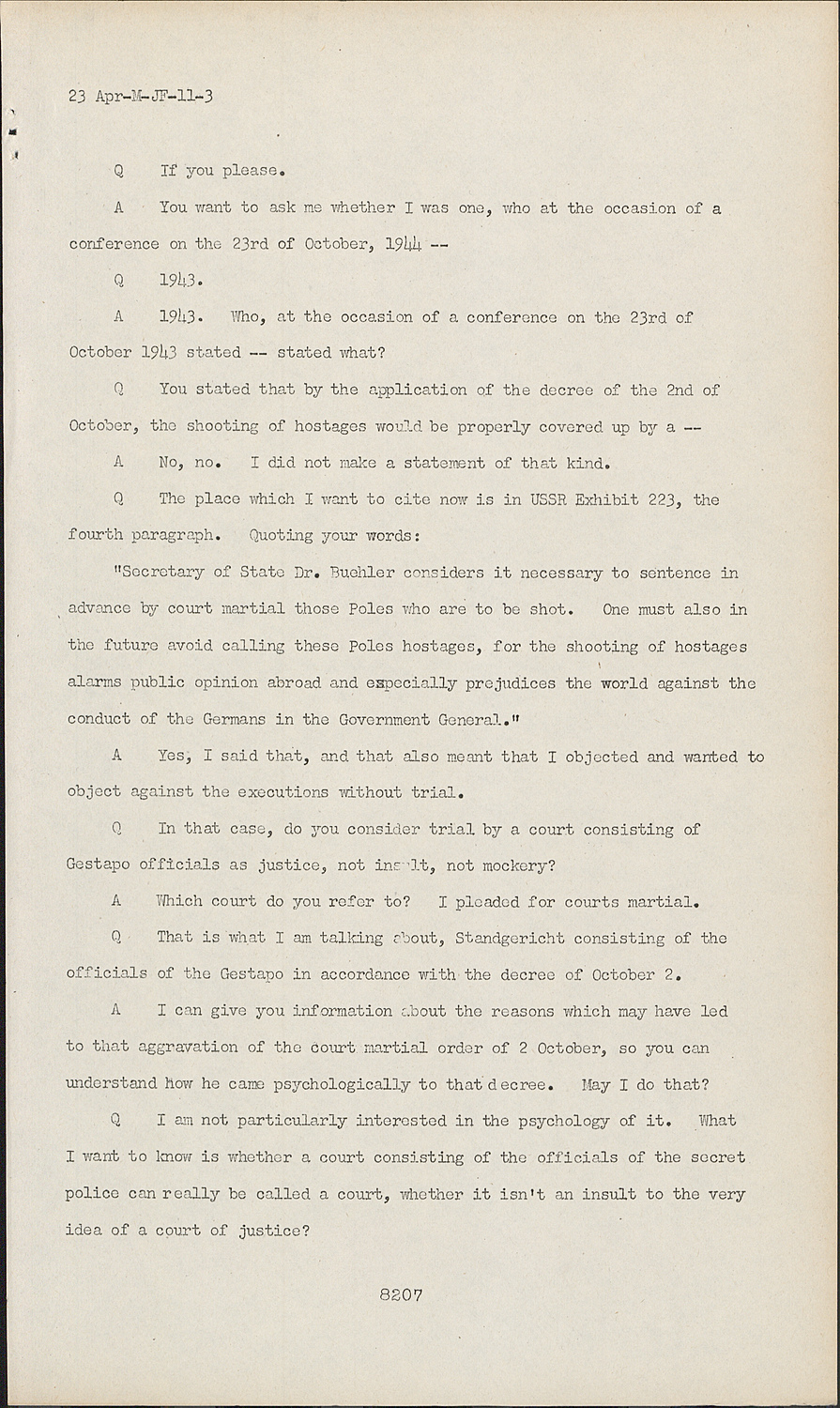
Q If you please.
AYou want to ask me whether I was one, who at the occasion of a conference on the 23rd of October, 1944 -
Q 1943.
A 1943. Who, at the occasion of a conference on the 23rd of October 1943 stated -- stated what?
QYou stated that by the application of the decree of the 2nd of October, the shooting of hostages would be properly covered up by a -
ANo, no. I did not make a statement of that kind.
QThe place which I want to cite now is in USSR Exhibit 223, the fourth paragraph. Quoting your words:
"Secretary of State Dr. Buehler considers it necessary to sentence in advance by court martial those Poles who are to be shot. One must also in the future avoid calling these Poles hostages, for the shooting of hostages alarms public opinion abroad and especially prejudices the world against the conduct of the Germans in the Government General."
AYes, I said that, and that also meant that I objected and wanted to object against the executions without trial.
QIn that case, do you consider trial by a court consisting of Gestapo officials as justice, not insult, not mockery?
AWhich court do you refer to? I pleaded for courts martial.
QThat is what I am talking about, Standgericht consisting of the officials of the Gestapo in accordance with the decree of October 2.
AI can give you information about the reasons which may have led to that aggravation of the court martial order of 2 October, so you can understand how he came psychologically to that decree. May I do that?
QI am not particularly interested in the psychology of it. What I want to know is whether a court consisting of the officials of the secret police can really be called a court, whether it isn't an insult to the very idea of a court of justice?
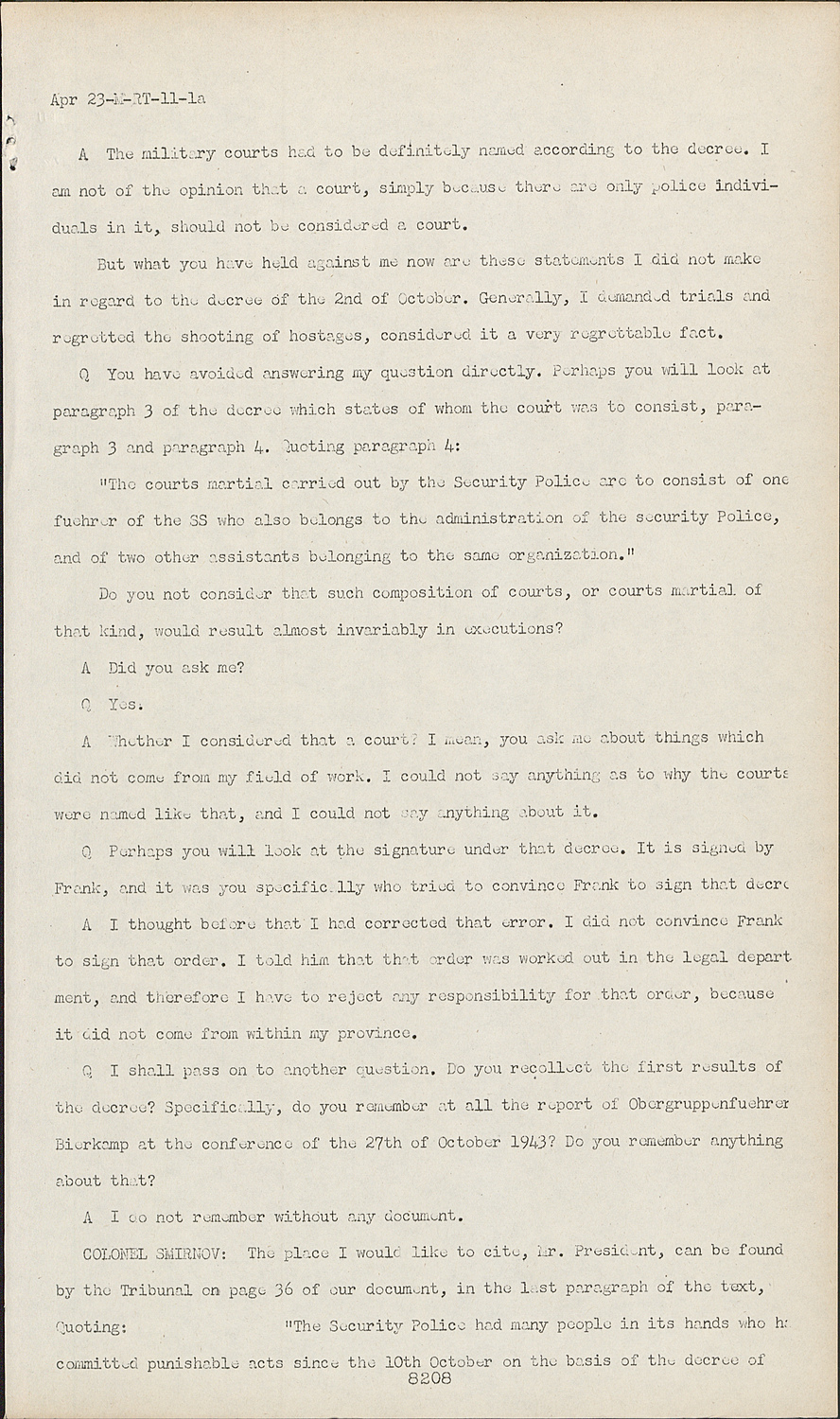
A The military courts had to be definitely named according to the decree. I am not of the opinion that a court, simply because there are only police individuals in it, should not be considered a court.
But what you have held against me now are these statements I did not make in regard to the decree of the 2nd of October. Generally, I demanded trials and regretted the shooting of hostages, considered it a very regrettable fact.
QYou have avoided answering my question directly. Perhaps you will look at paragraph 3 of the decree which states of whom the court was to consist, paragraph 3 and paragraph 4. Quoting paragraph 4:
"The courts martial carried out by the Security Police are to consist of one fuehrer of the SS who also belongs to the administration of the security Police, and of two other assistants belonging to the same organization."
Do you not consider that such composition of courts, or courts martial of that kind, would result almost invariably in executions?
ADid you ask me?
QYes.
AWhether I considered that a court? I mean, you ask me about things which did not come from my field of work. I could not say anything as to why the courts were named like that, and I could not say anything about it.
QPerhaps you will look at the signature under that decree. It is signed by Frank, and it was you specifically who tried to convince Frank to sign that decree
AI thought before that I had corrected that error. I did not convince Frank to sign that order. I told him that that order was worked out in the legal department, and therefore I have to reject any responsibility for that order, because it did not come from within my province.
QI shall pass on to another question. Do you recollect the first results of the decree? Specifically, do you remember at all the report of Obergruppenfuehrer Bierkamp at the conference of the 27th of October 1943? Do you remember anything about that?
AI do not remember without any document.
COLONEL SMIRNOV:The place I would like to cite, Mr. President, can be found by the Tribunal on page 36 of our document, in the last paragraph of the text, Quoting: "The Security Police had many people in its hands who has committed punishable acts since the 10th October on the basis of the decree of that date.
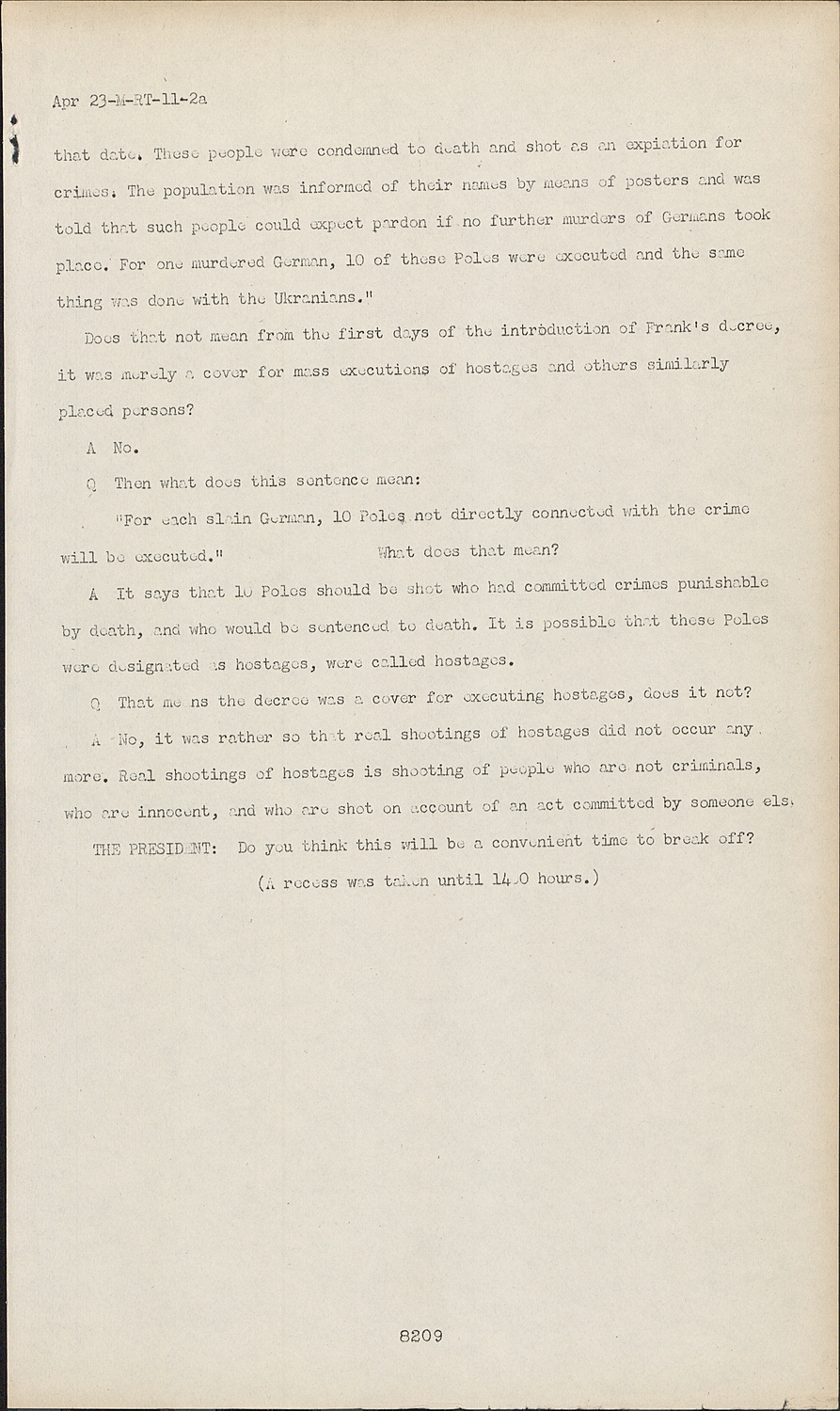
These people were condemned to death and shot as an expiation for crimes.
The population was informed of their names by means of posters and was told that such people could expect pardon if no further murders of Germans took place. For one murdered German, 10 of these Poles were executed and the same thing was done with the Ukranians."
Does that not mean from the first days of the introduction of Frank's decree, it was merely a cover for mass executions of hostages and others similarly placed persons?
ANo.
QThen what does this sentence mean:
"For each slain German, 10 Poles not directly connected with the crime will be executed." What does that mean?
AIt says that 10 Poles should be shot who had committed crimes punishable by death, and who would be sentenced to death. It is possible that these Poles were designated as hostages, were called hostages.
QThat means the decree was a cover for executing hostages, does it not?
ANo, it was rather so that real shootings of hostages did not occur any more. Real shootings of hostages is shooting of people who are not criminals, who are innocent, and who are shot on account of an act committed by someone else
THE PRESIDENT:Do you think this will be a convenient time to break off?
(A recess was taken until 1400 hours.)
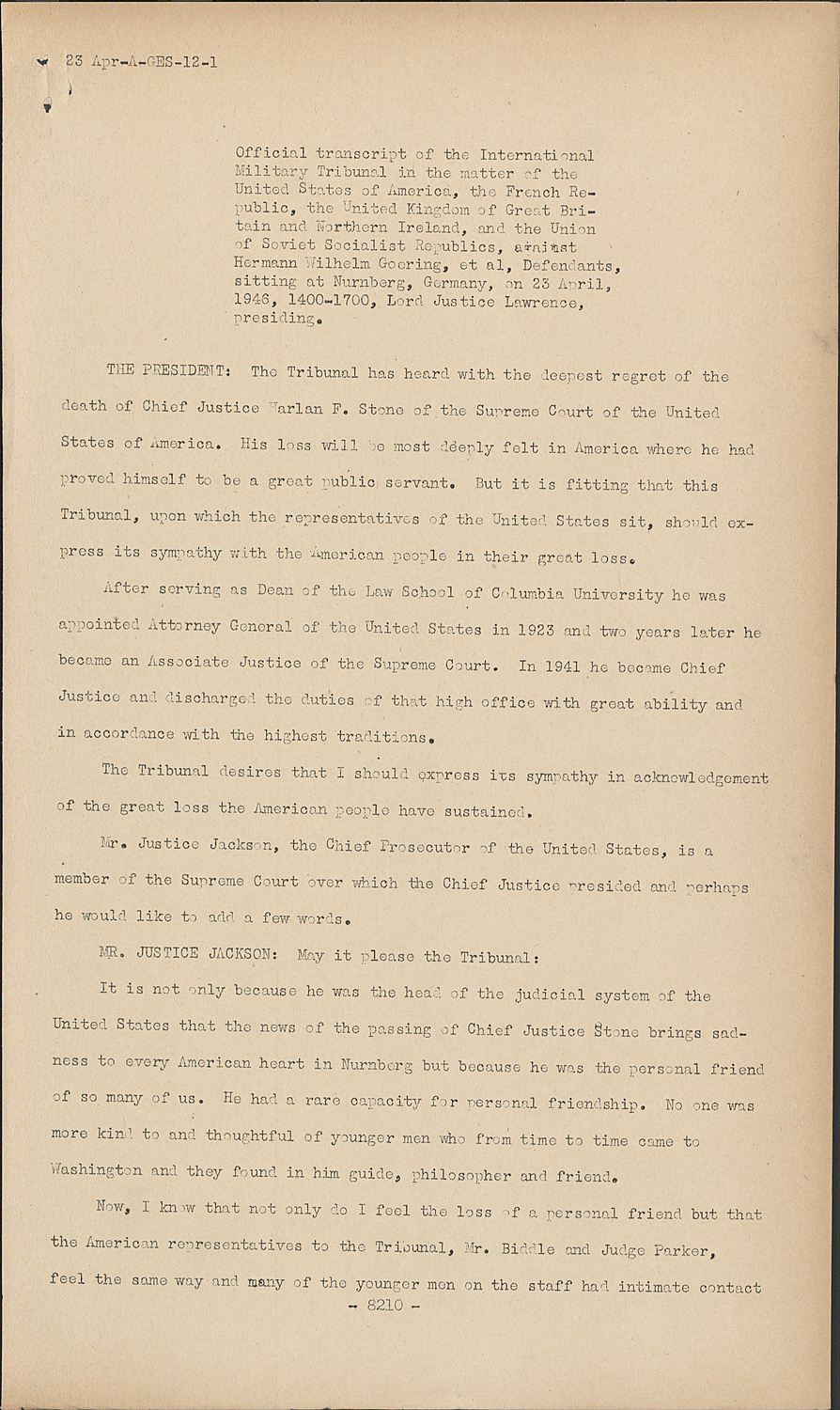
Official transcript of the International Military Tribunal in the matter of the United States of America, the French Re public, the United Kingdom of Great Bri tain and Northern Ireland, and the Union of Soviet Socialist Republics, against Hermann Wilhelm Goering, et al, Defendants, sitting at Nurnberg, Germany, on 23 April, 1946, 1400-1700, Lord Justice Lawrence, presiding.
THE PRESIDENT:The Tribunal has heard with the deepest regret of the death of Chief Justice Harlan F. Stone of the Supreme Court of the United States of America. His loss will be most deeply felt in America where he had proved himself to be a great public servant. But it is fitting that this Tribunal, upon which the representatives of the United States sit, should express its sympathy with the American people in their great loss.
After serving as Dean of the Law School of Columbia University he was appointed Attorney General of the United States in 1923 and two years later he became an Associate Justice of the Supreme Court. In 1941 he became Chief Justice and discharged the duties of that high office with great ability and in accordance with the highest traditions.
The Tribunal desires that I should express its sympathy in acknowledgement of the great loss the American people have sustained.
Mr. Justice Jackson, the Chief Prosecutor of the United States, is a member of the Supreme Court over which the Chief Justice presided and perhaps he would like to add a few words.
MR. JUSTICE JACKSON:May it please the Tribunal:
It is not only because he was the head of the judicial system of the United States that the news of the passing of Chief Justice Stone brings sadness to every American heart in Nurnberg but because he was the personal friend of so many of us. He had a rare capacity for personal friendship. No one was more kind to and thoughtful of younger men who from time to time came to Washington and they found in him guide, philosopher and friend.
Now, I know that not only do I feel the loss of a personal friend but that the American representatives to the Tribunal, Mr. Biddle and Judge Parker, feel the same way and many of the younger men on the staff had intimate contact with the Chief Justice which you might not expect if you had not known Harlan Stone.
As Attorney General he took over the Department of Justice at one of its most difficult periods and imparted to it the impress of his integrity, an impress which stayed with it and was traditional in the department, as we all know.
As a Justice of the Court he was a forward-looking man, open-minded, always patient to hear the arguments of both sides and to arrive at his decision with that complete disinterestedness and detachment which is characteristic of the just judge. He presided with great fairness and with kindness to his associates and to those who appeared before him.
It is the passing of a man who exemplified in public life those sturdy qualities which we have come to associate with the New Englander.
The consolation of his friends lies in this: He died exactly as he would have chosen to die, in full possession of his faculties and in the discharge of his duties.
I express great appreciation that this Tribunal has seen fit to take note of his passing and to allow us to record on behalf of the American Bar our appreciation of his talents and character.
THE PRESIDENT:Colonel Smirnov.
COLONEL SMIRNOV:Before asking further questions of the witness I would like to make the following announcement.
In the questions put by Dr. Seidl it was stated that the document was false which is the official appendix to the report of the Government of the Polish Republic in the field of cultural valuables.
The Soviet Prosecution does not feel that it can say anything more about this but would like the Tribunal to note that this is an official appendix to the the official report of the Government of the Polish Republic and thus can hardly be doubted.
May I continue with my questions now, please?
THE PRESIDENT:Did you say anything then?
WITNESS BUEHLER:I was going to ask something. Was it a document that contained a list of art treasures?
THE PRESIDENT:Is that the document, Colonel Smirnov, a document which contains a list of art treasures?
WITNESS BUEHLER:No, I do not mean that.
COLONEL SMIRNOV:No, Mr. President, it refers to the loss relating to cultural valuables, such as a list of libraries and similar damage.
THE PRESIDENT:It is U.S.S.R. 93, is it not, the document you are referring to?
COLONEL SMIRNOV:It is an appendix to the document U.S.S.R. 93.
THE PRESIDENT:Yes, It deals with certain directives. That was the evidence that was given this morning.
COLONEL SMIRNOV:This is a list of cultural losses, an official appendix. It does not conatin directives but gives the financial sums which have been suffered by the public libraries of Poland.
THE PRESIDENT:Is there anything you want to say about it?
WITNESS BUEHLER:Yes; I do not think the description just given applies to the document which I had in mind. The document which I doubt contains directives regarding the cultural policy on Germany's part in the Government General. It does not concern itself with art treasures,or a listing of library property.
THE PRESIDENT:Yes. What I took that you said this morning was that the directives which you thought were referred to in the document did not appear to have been made or at any rate you had not heard of them and you thought they might be forgeries.
WITNESS BEUHLER:I doubted the document, yes.
THE PRESIDENT:The Tribunal will consider the document.
COLONEL SMIRNOV:May I ask the next question?
THE PRESIDENT:Yes.
JOSEPH BUEHLER -- Resumed.
CROSS- EXAMINATION--Continued. BY COLONEL SMIRNOV:
QYou have shown that you personally and at the invitation of the government general had no direct connection with the actions undertaken by the police; is that right?
AMay I hear that question again, please?
QYou affirm that you neither personally nor the administration of the govern ment general had close connections with police actions. Have I understood you correctly?
AWe had daily contact with the police, but we had considerable differences of opinion. Apart from that the police were not under my jurisdiction; the chief of the police was in no way under my orders.
QIn that case the police were not included in your duties?
ANo, it was not one of my duties.
Q bVwey well. In that case how can you explain that no one but you especially has carried on successful negotiations with the police about successful utilization of the property of Jews who were executed in the camps? Do you remember those negotiations with the police?
AI didn't quite understand you. Regarding the what?
QI am asking you this: If you had no direct connection with the police then how can you explain the fact that you, specifically you, were the person who was carrying on successful negotiations with the police about utilization of the Jewish property of the persons slain in the camps?
AI do not remember any such negotiations and I couldn't have conducted them The administration was of course that source which by orders from the Four Year Plan had to carry out the part to confiscate Jewish property.
COLONEL SMIRNOV:Mr. President, may I have the permission of submitting the document given to us by the American prosecution No. 2819-PS? The document describes the relationship between the government general and the economic department. It is addressed to Warsaw from Lublin. I am quoting the title of the document:
"The transfer of Jewish property to the administration of the government general.
"I am informing you herewith that on the 25th of February 1944 in the presence of the state secretary Dr. Buehler and other higher authorities of the SS and the police Obergruppenfuehrer Korte as well as the departmental chiefs the question was discussed of the transfer of the property of Jews which is now in storage which will be transferred to the administration of the government general.
The decision reached on the subject was that the transfer should take place in the near future. The property which has been confiscated by the security police and the SD shall be transferred directly into my department. Please get in touch with the Obergruppe and the police with regard to the procedure." BY COLONEL SMIRNOV:
QTell me, now, even after this, you affirm that you had no dealings with the police?
AI had to work together with the police daily. I don't want to deny it for a moment, but I hadn't a right to give orders to the police.
QIn any case the property of the slain Jews of Poland, on the basis of your dealings with the police, was being transferred to the government general? On the basis of your negotiations with the police this property was transferred; is that not so?
ANo, that is not correct. The property wasn't mentioned which originated from these Jews, but property questioned was property which was in a bad state originating from Jews, and which in accordance with decrees was being taken over by the police and removed from the jurisdiction of their administration.
QBut could the police of the SD be in possession of the property of the Jews who were not slain?
AWhy not? Right from the beginning the police had taken over Jewish problems Subsequently they appropriated their property in a particular manner too.
QDid the storehouse of Auschwitz also keep the property of the Jews who were not yet executed, who were still alive?
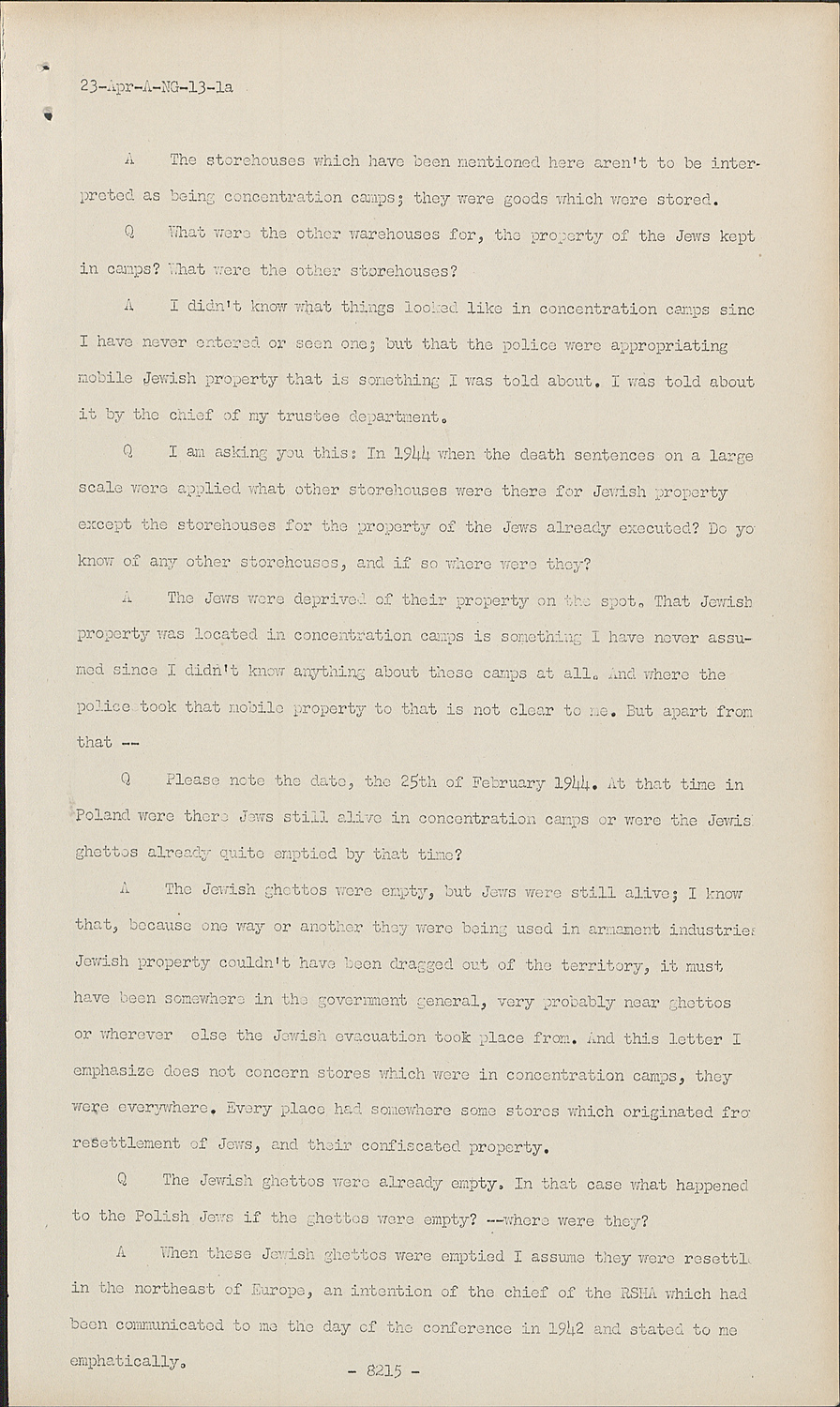
A The storehouses which have been mentioned here aren't to be inter-
preted as being concentration camps; they were goods which were stored.
QWhat were the other warehouses for, the property of the Jews kept in camps? What were the other storehouses?
AI didn't know what things looked like in concentration camps since I have never entered or seen one; but that the police were appropriating mobile Jewish property that is something I was told about. I was told about it by the chief of my trustee department.
QI am asking you this: In 1944 when the death sentences on a large scale were applied what other storehouses were there for Jewish property except the storehouses for the property of the Jews already executed? Do yo know of any other storehouses, and if so where were they?
AThe Jews were deprived of their property on the spot. That Jewish property was located in concentration camps is something I have never assumed since I didn't know anything about these camps at all. And where the police took that mobile property to that is not clear to me. But apart from that -
QPlease note the date, the 25th of February 1944. At that time in Poland were there Jews still alive in concentration camps or were the Jewis ghettos already quite emptied by that time?
AThe Jewish ghettos were empty, but Jews were still alive; I know that, because one way or another they were being used in armament industries Jewish property couldn't have been dragged out of the territory, it must have been somewhere in the government general, very probably near ghettos or wherever else the Jewish evacuation took place from. And this letter I emphasize does not concern stores which were in concentration camps, they were everywhere. Every place had somewhere some stores which originated fro resettlement of Jews, and their confiscated property.
QThe Jewish ghettos were already empty. In that case what happened to the Polish Jews if the ghettos were empty? --where were they?
AWhen these Jewish ghettos were emptied I assume they were resettled in the northeast of Europe, an intention of the chief of the RSHA which had been communicated to me the day of the conference in 1942 and stated to me emphatically.
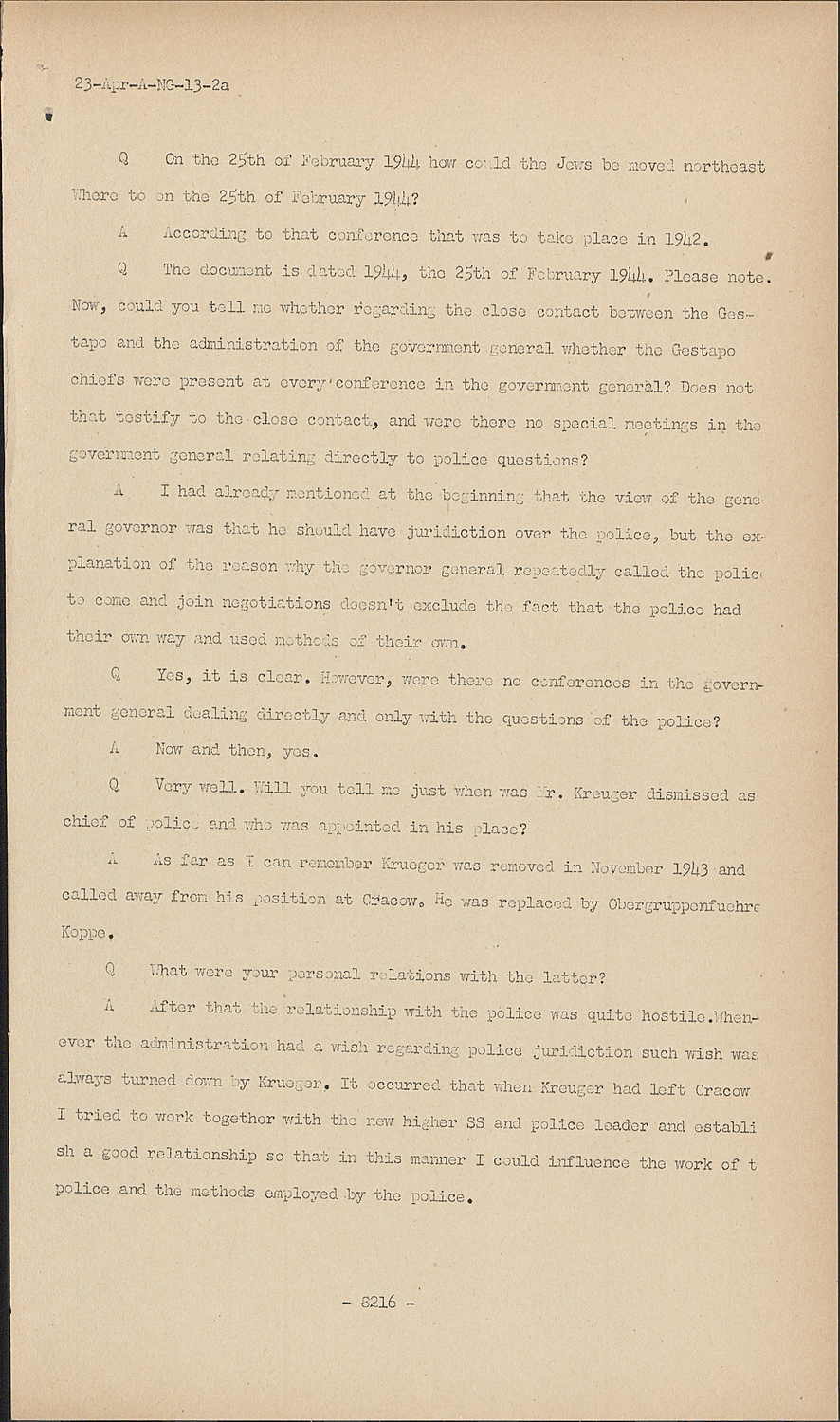
Q On the 25th of February 1944 how could the Jews be moved northeast Where to on the 25th of February 1944?
AAccording to that conference that was to take place in 1942.
QThe document is dated 1944, the 25th of February 1944. Please note. Now, could you tell me whether regarding the close contact between the Gestapo and the administration of the government general whether the Gestapo chiefs were present at every conference in the government general? Does not that testify to the close contact, and were there no special meetings in the government general relating directly to police questions?
AI had already mentioned at the beginning that the view of the general governor was that he should have juridiction over the police, but the explanation of the reason why the governor general repeatedly called the police to come and join negotiations doesn't exclude the fact that the police had their own way and used methods of their own.
QYes, it is clear. However, were there no conferences in the government general dealing directly and only with the questions of the police?
ANow and then, yes.
QVery well. Will you tell me just when was Mr. Kreuger dismissed as chief of police and who was appointed in his place?
AAs far as I can remember Krueger was removed in November 1943 and called away from his position at Cracow. He was replaced by Obergruppenfuehrer Koppe.
QWhat were your personal relations with the latter?
AAfter that the relationship with the police was quite hostile.Whenever the administration had a wish regarding police juridiction such wish was always turned down by Krueger. It occurred that when Kreuger had left Cracow I tried to work together with the new higher SS and police leader and establish a good relationship so that in this manner I could influence the work of the police and the methods employed by the police.
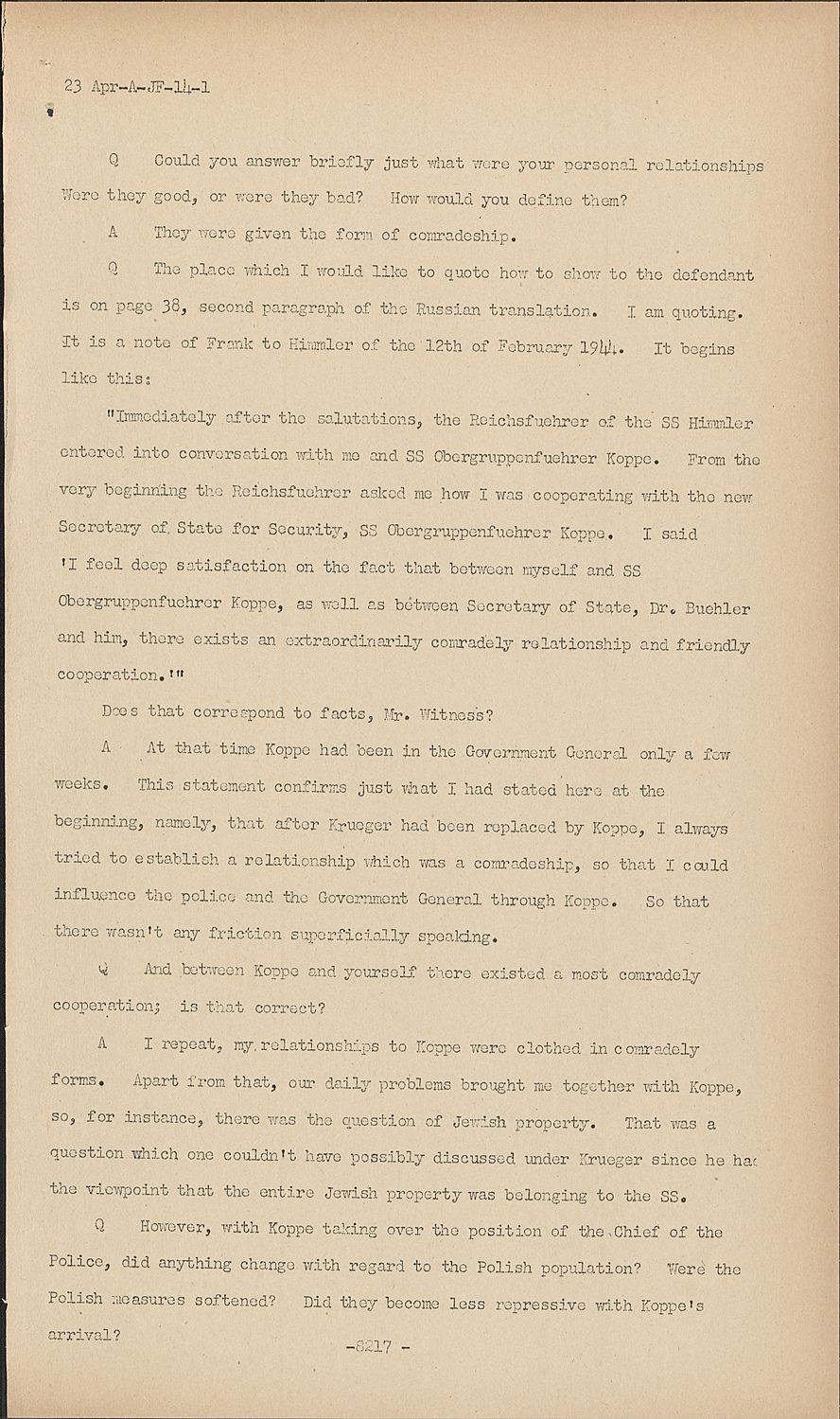
Q Could you answer briefly just what were your personal relationships Were they good, or were they bad?
How would you define them?
AThey were given the form of comradeship.
QThe place which I would like to quote how to show to the defendant is on page 38, second paragraph of the Russian translation. I am quoting. It is a note of Frank to Himmler of the 12th of February 1944. It begins like this:
"Immediately after the salutations, the Reichsfuehrer of the SS Himmler entered into conversation with me and SS Obergruppenfuehrer Koppe. From the very beginning the Reichsfuehrer asked me how I was cooperating with the new Secretary of State for Security, SS Obergruppenfuehrer Koppe. I said 'I feel deep satisfaction on the fact that between myself and SS Obergruppenfuehrer Koppe, as well as between Secretary of State, Dr. Buehler and him, there exists an extraordinarily comradely relationship and friendly cooperation.'" Does that correspond to facts, Mr. Witness?
AAt that time Koppe had been in the Government General only a few weeks. This statement confirms just what I had stated here at the beginning, namely, that after Krueger had been replaced by Koppe, I always tried to establish a relationship which was a comradeship, so that I could influence the police and the Government General through Koppe. So that there wasn't any friction superficially speaking.
QAnd between Koppe and yourself there existed a most comradely cooperation; is that correct?
AI repeat, my relationships to Koppe were clothed in comradely forms. Apart from that, our daily problems brought me together with Koppe, so, for instance, there was the question of Jewish property. That was a question which one couldn't have possibly discussed under Krueger since he had the viewpoint that the entire Jewish property was belonging to the SS.
QHowever, with Koppe taking over the position of the Chief of the Police, did anything change with regard to the Polish population? Were the Polish measures softened? Did they become less repressive with Koppe's arrival?
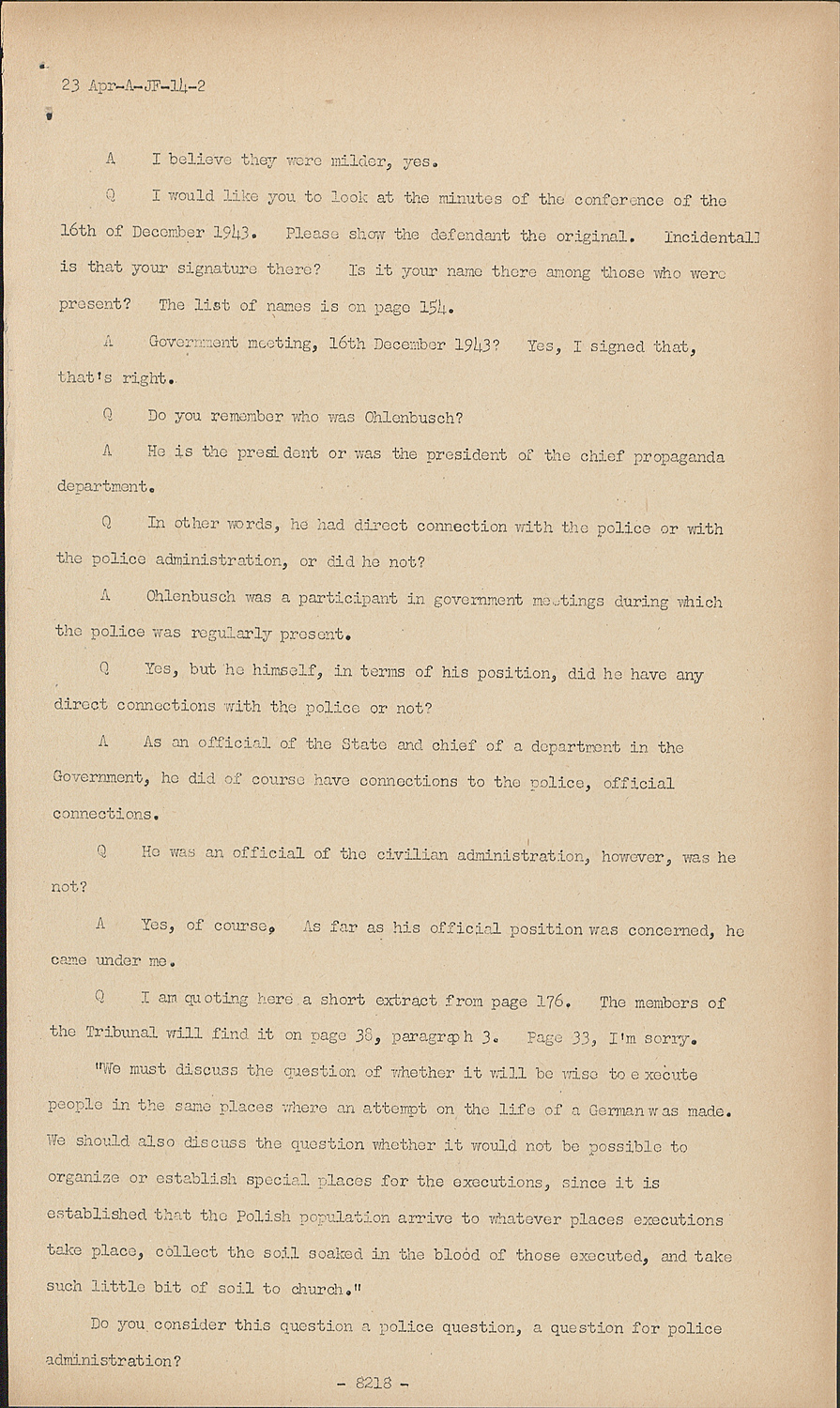
A I believe they were milder, yes.
QI would like you to look at the minutes of the conference of the 16th of December 1943. Please show the defendant the original. Incidentall is that your signature there? Is it your name there among those who were present? The list of names is on page 154.
AGovernment meeting, 16th December 1943? Yes, I signed that, that's right.
QDo you remember who was Ohlenbusch?
AHe is the president or was the president of the chief propaganda department.
QIn other words, he had direct connection with the police or with the police administration, or did he not?
AOhlenbusch was a participant in government meetings during which the police was regularly present.
QYes, but he himself, in terms of his position, did he have any direct connections with the police or not?
AAs an official of the State and chief of a department in the Government, he did of course have connections to the police, official connections.
QHe was an official of the civilian administration, however, was he not?
AYes, of course. As far as his official position was concerned, he came under me.
QI am quoting here a short extract from page 176. The members of the Tribunal will find it on page 38, paragraph 3. Page 33, I'm sorry.
"We must discuss the question of whether it will be wise to execute people in the same places where an attempt on the life of a German was made. We should also discuss the question whether it would not be possible to organize or establish special places for the executions, since it is established that the Polish population arrive to whatever places executions take place, collect the soil soaked in the blood of those executed, and take such little bit of soil to church."
Do you consider this question a police question, a question for police administration?