
AYes. I would have had to initial it if I had seen it.
QWell, whether that is so or not, I am not concerned about right now. Instead, I wait you to listen while I read on excerpt from it. If you would like to see the document you can have it, but I hardly think it is necessary.
You recall that in that document one of your memoranda is referred to, isn't it? Do you remember? Do you remember that Posse said:
"It was pointed out that the General Plenipotentiary for the Economy is primarily interested to introduce into the legislation for war finance, the idea of financing war expenditures by anticipating future revenues, to be expected after the war."
AYes.
QAll right. That is all I have to ask about that document. We can move right along here.
Referring again to your own direct testimony, I understood you to tell the Tribunal that in so far as the war against Poland was concerned, you didn't really know until some time in August that there was even a likelihood of war with Poland; some time in August you thought it would be settled by diplomatic means. Isn't that so?
AIn probability not. Danger of war had wxisted, was dormant, for months, but that war was immediately ahead could be assumed in August.
QHad you been planning or making economic plans for war with Poland for more than a year before the attack on Poland? You can answer that yes or no.
AI don't know that.
QYou mean you don't Know whether you did or not? What do you mean by that kind of an answer? Don't you remember?
AI don't remember.
Q All right. Then I can help you.
There is a document 3324-PS, which is already in evidence. You must remember it; it is USA Exhibit 551. That is a speech that you made. Don't you remember saying in there that you had been planning in secret for well over a year for the war on Poland?
Do you remember that? Would you like to see the document?
AYes, please.
QThe sentence is here:
"Although all the economic and financial departments were harnessed in the tasks and work of the Four-Year Plan, under the leadership of the General Field Marshal Goering, the war economic preparation of Germany has also been advanced in secret."
Do you remember that?
AYes, now I know.
QYou will notice it says here "for well over a year", and you went on to say this had been done under you.
Is that true?
AYes, that was the activity of the General Plenipotentiary for Civilian Economy. That I explained.
QAll right. Well, that is all right. I just wanted to get your -
A (Interposing) But of Poland I did not speak.
QWell, that is the only war that was on when you made this speech. It was October 1939.
AYes, but the preparations were not for a specific war.
QAll right.
AIt was general preparations.
QNow, actually you and Goering were even in a contest for power to some extent, weren't you? Was the Goering door one of those that you were also trying to get in?
You can answer that very simply. You told us you were trying to get in those various doors, but you would get up there and never get in. I now ask you if the Goering door was one of those.
AI don't believe that I was so ambitious or that I wanted to get Goering's post. That was far from me.
QI didn't say that you wanted to get his post, but you wanted to get some of his authority, didn't you? Or don't you remember? Maybe that is the solution.

A No.
QWell, your man Posse was interrogated here by representatives of the Prosecution and the document is No. 3894-PS. He was asked these questions:
"Question: What was the nature of the conflict between the Plenipotentiary for Economy and the Four-Year Plan?
"Answer: The struggle for power.
"Question: The struggle for power between Funk and Goering?
"Answer: The struggle for power between Funk and Goering, between Funk and the Ministry for Agriculture and the ministry for Communications.
"Question: How was the struggle finally resolved?
"Answer: Never. It was a struggle always continuing under the surface."
Then we move on:
"Question: Did Funk, who had very important powers as Minister of Economics and later as Reichsbank President and as Chief Plenipotentiary for the Economy, actually exercise these powers?
"Answer: Yes. But the powers of Goering were stronger.
"Question: Nevertheless, Funk did exercise important powers?
"Answer: Yes, as President of the Reichsbank, Minister of Economics, and Plenipotentiary for Economy."
Posse was your chief deputy, wasn't he?
AYes, but Posse had a position which was somewhat aside, because my deputies were Landfreid and Puhl as far as the Reichsbank was concerned.
QWell, all right.
AThey would know more than Posse.
QYou don't think he really knew what he was talking about when he said you were in the struggle for power? Is that your answer?
ANo.
MR. DODD:That becomes USA Exhibit 843. We haven't offered it up to now. BY MR. DODD:
QNow, Mr. Witness, I want to ask you about when you first heard of the impending attack on Russia.
I understood you to tell the Tribunal that you heard about it sometime -- I think you said -- in May.
Is that right? Or June?
AWhen Rosenberg was charged with it.
QWell, that is what we want to know. When Rosenberg, in April of 1941, was appointed, you knew then there was to be an attack on Russia, didn't you? But this morning I don't think you made that statement. Isn't that right, Mr. Funk?
AYes, yes, I said that as reason for that appointment we were told that the Fuehrer considered a war with Russia to be likely.
QYes, but you know what you told the Tribunal this morning. You said that Lammers sent you notice of Rosenberg's appointment because of your interest in improving the trade relations with Russia. That is the answer you made this morning. Now, that wasn't so, was it?
AYes, Lammers has said that here, too.
QI don't care what Lammers said. I am asking you now if it isn't a fact that you were told by Lammers because you were to cooperate with Rosenberg in making ready for the occupation of those territories after the attack began. Now you can answer that very simply. Isn't that true?
ANo.
QNow, we'll see. You know, on another occasion you have given another answer, by the way, I might say parenthetically. Do you remember telling the interrogator that you first heard from Hess about the impending attack on Russia? Do you remember you gave that answer at one time as the source of your first knowledge? Do you remember telling us that?
ANo.
QI'll tell you about that in a minute. We will stay now on this Rosenberg business.
There is a document No. 1031-PS and it is dated May 28, 1941, which would be a little more than a month after the Rosenberg appointment, "Top Secret Notes; Meeting with Reichsminister Funk." Do you know what you were talking about that day, about counterfeiting money for use in Russia and the Ukraine and the Caucasus?
Do you remember it. You don't remember it? Well, you had better take a look at the document. It is No. 1031-PS, which becomes USA Exhibit 844.
Don't you remember the day that your Reichsbank Director Wilhelm said it shouldn't appear that you were counterfeiting so-called ruble bills for use in the occupied countries?
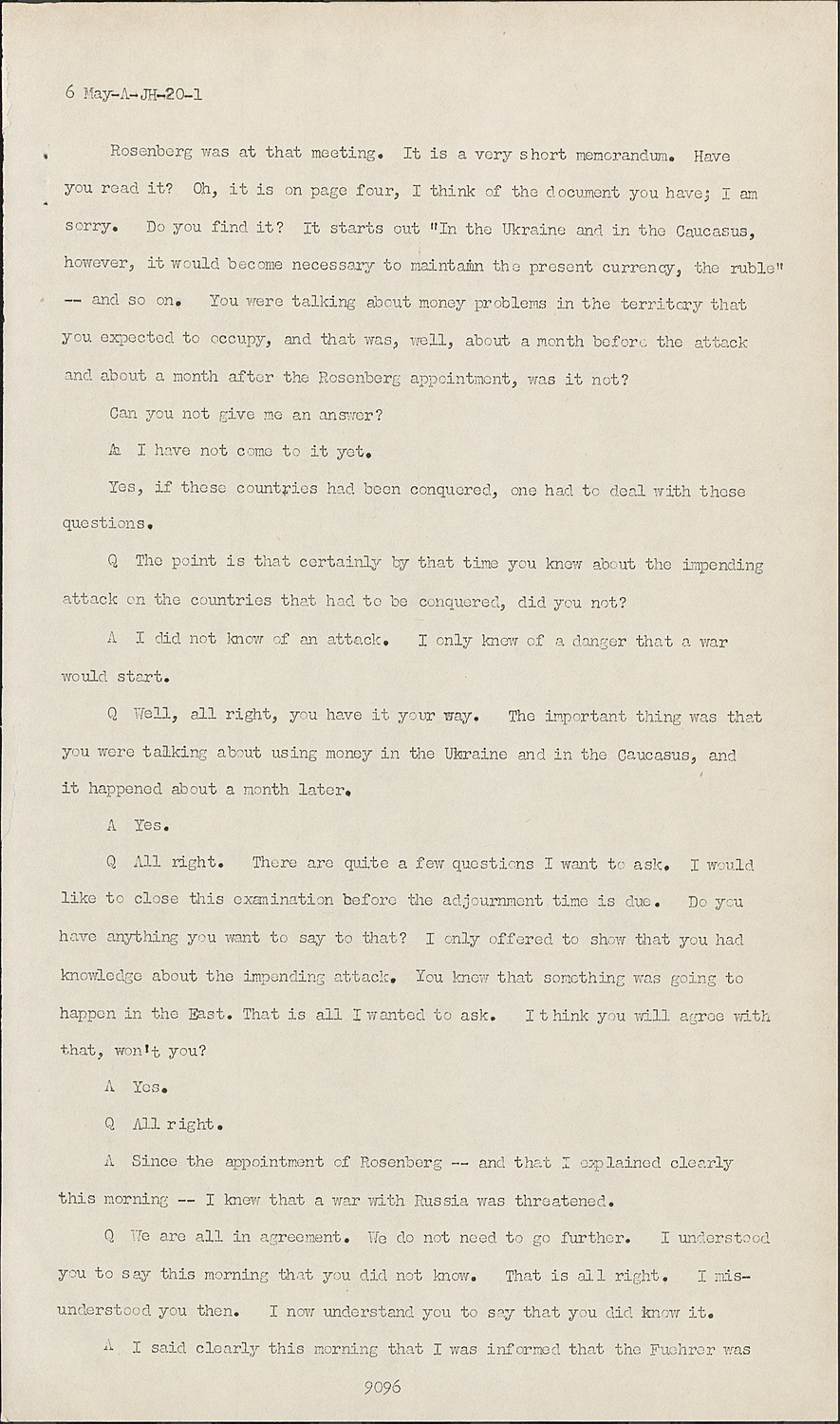
Rosenberg was at that meeting. It is a very short memorandum. Have you read it?
Oh, it is on page four, I think of the document you have; I am sorry. Do you find it? It starts out "In the Ukraine and in the Caucasus, however, it would become necessary to maintain the present currency, the ruble" -- and so on. You were talking about money problems in the territory that you expected to occupy, and that was, well, about a month before the attack and about a month after the Rosenberg appointment, was it not?
Can you not give me an answer?
AI have not come to it yet.
Yes, if these countries had been conquered, one had to deal with these questions.
QThe point is that certainly by that time you know about the impending attack on the countries that had to be conquered, did you not?
AI did not know of an attack. I only know of a danger that a war would start.
QWell, all right, you have it your way. The important thing was that you were talking about using money in the Ukraine and in the Caucasus, and it happened about a month later.
AYes.
QAll right. There are quite a few questions I want to ask. I would like to close this examination before the adjournment time is due. Do you have anything you want to say to that? I only offered to show that you had knowledge about the impending attack. You know that something was going to happen in the East. That is all I wanted to ask. I think you will agree with that, won't you?
AYes.
QAll right.
ASince the appointment of Rosenberg -- and that I explained clearly this morning -- I knew that a war with Russia was threatened.
QWe are all in agreement. We do not need to go further. I understood you to say this morning that you did not know. That is all right. I misunderstood you then. I now understand you to say that you did know it.
AI said clearly this morning that I was informed that the Fuehrer was expecting a war with Russia, but I am not clear about this document, as to who has written it.
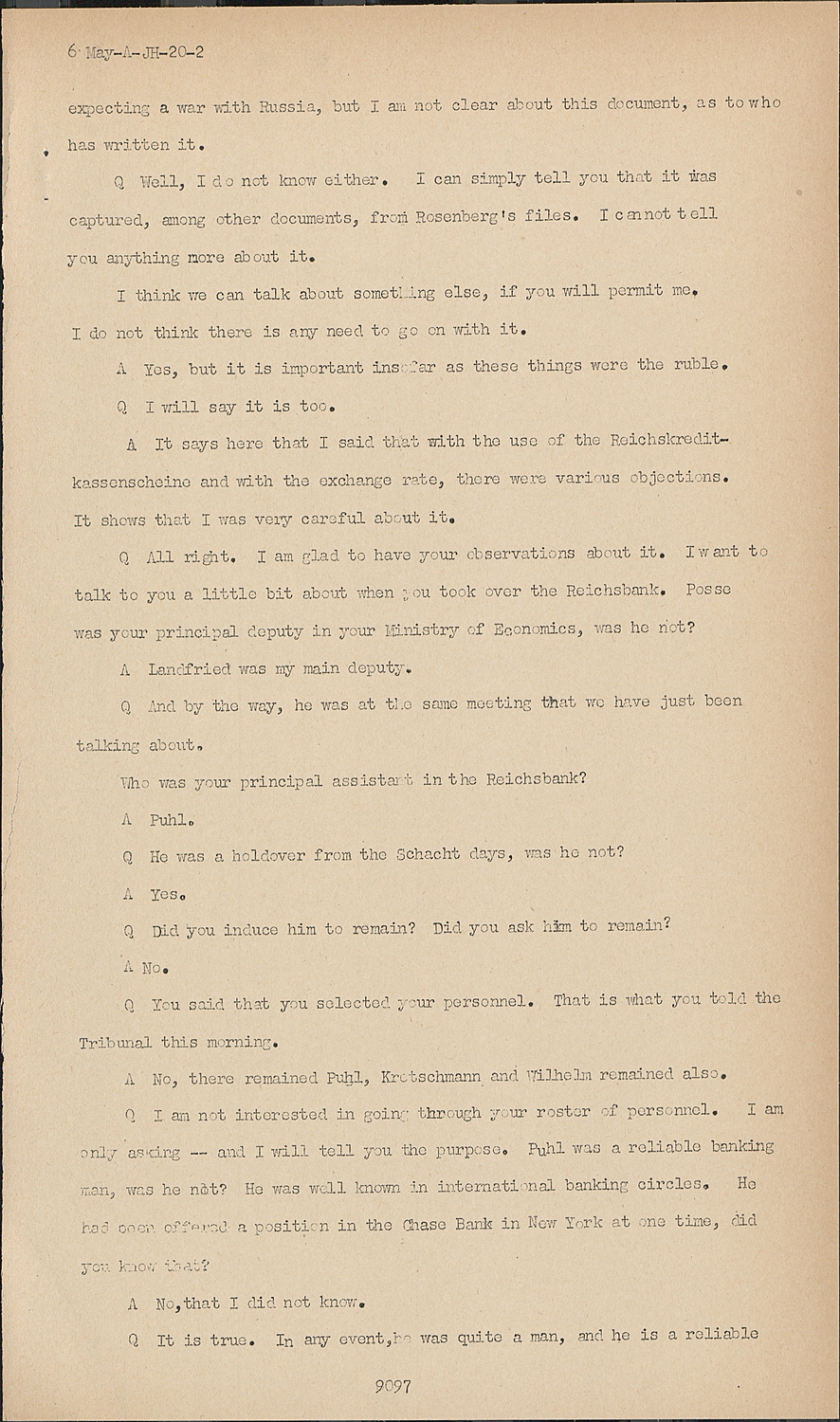
QWell, I do not know either. I can simply tell you that it was captured, among other documents, from Rosenberg's files. I cannot tell you anything more about it.
I think we can talk about something else, if you will permit me. I do not think there is any need to go on with it.
AYes, but it is important insofar as these things were the ruble.
QI will say it is too.
AIt says here that I said that with the use of the Reichskreditkassenscheine and with the exchange rate, there were various objections. It shows that I was very careful about it.
QAll right. I am glad to have your observations about it. I want to talk to you a little bit about when you took over the Reichsbank. Posse was your principal deputy in your Ministry of Economics, was he not?
ALandfried was my main deputy.
QAnd by the way, he was at the same meeting that we have just been talking about.
Who was your principal assistant in the Reichsbank?
APuhl.
QHe was a holdover from the Schacht days, was he not?
AYes.
QDid you induce him to remain? Did you ask him to remain?
ANo.
QYou said that you selected your personnel. That is what you told the Tribunal this morning.
ANo, there remained Puhl, Kretschmann and Wilhelm remained also.
QI am not interested in going through your roster of personnel. I am only asking -- and I will tell you the purpose. Puhl was a reliable banking man, was he not? He was well known in international banking circles. He had been, offered a position in the Chase Bank in New York at one time, did you know that?
ANo, that I did not know.
QIt is true. In any event,he was quite a man, and he is a reliable man, is he not?
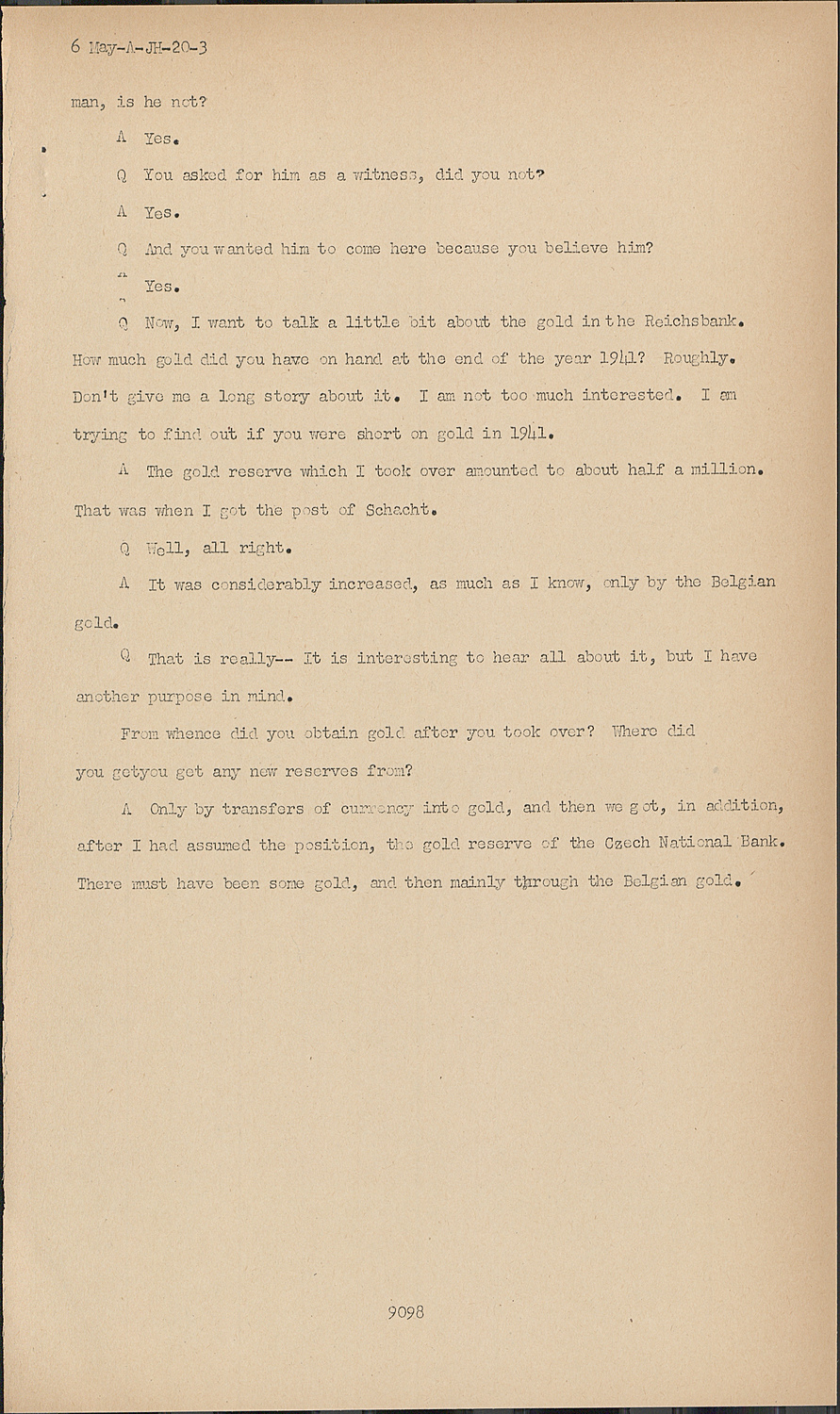
AYes.
QYou asked for him as a witness, did you not?
AYes.
QAnd you wanted him to come here because you believe him?
AYes.
QNow, I want to talk a little bit about the gold in the Reichsbank. How much gold did you have on hand at the end of the year 1941? Roughly. Don't give me a long story about it. I am not too much interested. I am trying to find out if you were short on gold in 1941.
AThe gold reserve which I took over amounted to about half a million. That was when I got the post of Schacht.
QWell, all right.
AIt was considerably increased, as much as I know, only by the Belgian gold.
QThat is really-- It is interesting to hear all about it, but I have another purpose in mind.
From whence did you obtain gold after you took over? Where did you getyou get any new reserves from?
AOnly by transfers of currency into gold, and then we got, in addition, after I had assumed the position, the gold reserve of the Czech National Bank. There must have been some gold, and then mainly through the Belgian gold.

Q All right. Now, of course, gold became very important to you as a matter of payment in foreign exchange.
You had to pay off in gold alone in 1942 and 1943, did you not? Is that so?
AIt was very difficult to pay in gold.
QI know it was.
ABecause the countries with which we still had business relations introduced gold embargoes. Sweden refused to accept gold. Only in Switzerland could we still do business by transfer of gold.
QI think you have established that you had to use gold as foreign exchange in 1942 and 1943. When did you start to do business with the SS, Mr. Funk?
ABusiness with the SS? I have never done that.
QAre you sure about that? I want you to take this very seriously. It is about the end of your examination, and it is very important to you. I ask you again when did you start to do business with the SS?
AI have never done business with the SS. I can only say the same that I said in the previous interrogation: That is that one day Puhl informed me that a deposit had been received from the SS. First, I assumed that it was a regular deposit, that is, a deposit which would remain locked and which would not hinder us further, but then Puhl told me later that deposits of the SS should be used by the Reichsbank, and I assumed that there were gold coins or currency, but in the main, gold coins, which every other German citizen had had to turn in, and so I thought they were taken from inmates of concentration camps and turned over to the Reichsbank. There were also valuables which had been taken from the inmates of concentration camps that did not go to the Reichsbank but to the Reich Finance Minister.
QJust a minute. Were you in the habit of having gold teeth deposited in the Reichsbank?
ANo.
QBut you did have it from the SS, did you not?
AThat I do not know.
QYou don't know.

MR. DODD: Well, now, if Your Honor please, we have a very brief film, and I think we can show it before we adjourn, and I would like to show it to the witness before I examine him further on the gold business in the Reichsbank.
It is a picture taken by the Allied Forces when they entered the Reichsbank, and it willshow gold teeth and bridges and so forth in their vaults.
AI do not know a thing about it.
QI think perhaps before I show the film I would like to -- I think I can do it in the time; I do want to complete this this afternoon -- I want to read you an affidavit from this man Puhl, whom you told me a few minutes ago was a creditable and well informed man and whom you called as a witness. This affidavit is dated 5 May 1946.
DR. SAUTER:Mr. President, I protest against the reading of this affidavit by Mr. Puhl. This affidavit most probably--I do not know--was taken here in Nurnberg. We do not know its contents. The Prosecution surprises us today with an affidavit of which we know nothing, and within ten minutes a dozen documents are thrown at us of which the Prosecution asserts they are only short documents, whereas, for instance, one affidavit among them contains twelve pages. It is quite impossible for us in the course of this extreme speed with which this examination has taken place to follow these statements and those documents at all. Therefore, I have to protest against the use of an affidavit of that kind at this moment.
HR. DODD:Well, this affidavit was taken at Baden-Baden, Germany, on 3 May. We have been trying for a long time to put this part of this case together, and we have finally succeeded. Certainly, we did not turn it over to Dr. Sauter because we wanted to use it for just the purpose I am trying to put it to now. It is an affidavit of his assistant Puhl, whom he called as a witness and from whom he expects to have an interrogatory. It has to do with a very important part of his case.
I might say that if we are permitted to use it, certainly Dr. Sauter will have a chance to re-examine and he will have all night to study it if he would like to look it over.

THE PRESIDENT: Are you wanting to cross-examine the witness about this document?
MR. DODD:Yes, I want to read it to him and ask him a couple of questions about it. It is the basic for two or three questions of crossexamination, to impeach him for statements he has already made about the gold.
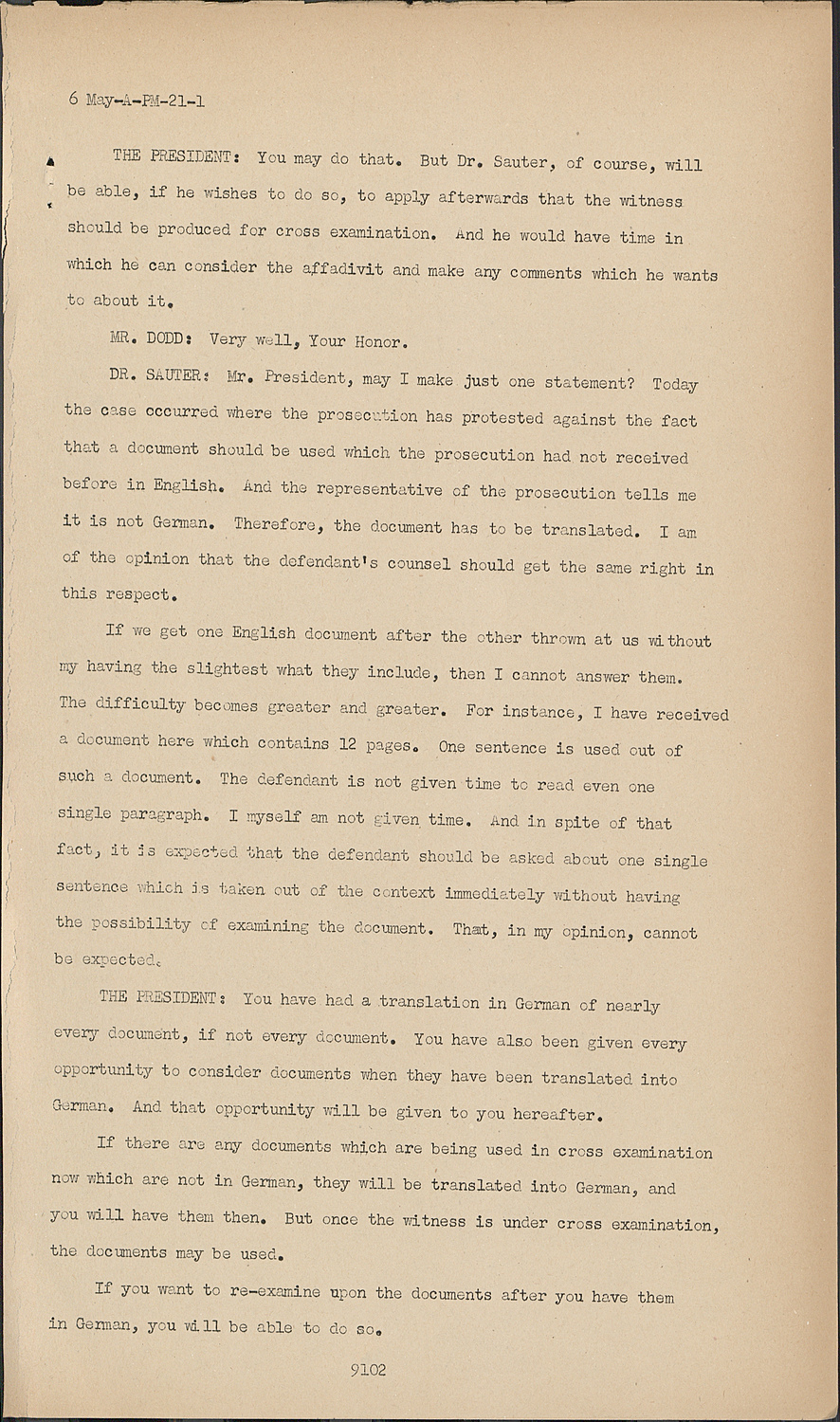
THE PRESIDENT: You may do that. But Dr. Sauter, of course, will be able, if he wishes to do so, to apply afterwards that the witness should be produced for cross examination.
And he would have time in which he can consider the affadivit and make any comments which he wants to about it.
MR. DODD:Very well, Your Honor.
DR. SAUTER:Mr. President, may I make just one statement? Today the case occurred where the prosecution has protested against the fact that a document should be used which the prosecution had not received before in English. And the representative of the prosecution tells me it is not German. Therefore, the document has to be translated. I am of the opinion that the defendant's counsel should get the same right in this respect.
If we get one English document after the other thrown at us without my having the slightest what they include, then I cannot answer them. The difficulty becomes greater and greater. For instance, I have received a document here which contains 12 pages. One sentence is used out of such a document. The defendant is not given time to read even one single paragraph. I myself am not given time. And in spite of that fact, it is expected that the defendant should be asked about one single sentence which is taken out of the context immediately without having the possibility of examining the document. That, in my opinion, cannot be expected.
THE PRESIDENT:You have had a translation in German of nearly every document, if not every document. You have also been given every opportunity to consider documents when they have been translated into German. And that opportunity will be given to you hereafter.
If there are any documents which are being used in cross examination now which are not in German, they will be translated into German, and you will have them then. But once the witness is under cross examination, the documents may be used.
If you want to re-examine upon the documents after you have them in German, you will be able to do so.
MR. SAUTER: Mr. President, the defendant's counsel also has an interest not to delay the proceedings.
But it does not help me if later, if ten days or two weeks from now I shall have to approach you, Mr. President, with the request that I could question the witness again. We are happy once we are through with the examination of the witness.
But this fashion in which Mr. Dodd does it, we cannot follow; I cannot follow, and the defendant cannot, either. One cannot expect the defendant to answer a single sentence which has been taken out of the context, and to make a statement about it, if he has no chance to examine the document as a whole.
THE PRESIDENT:Mr. Dodd.
MR. DODD:May I proceed to examine on the document?
THE PRESIDENT:Mr. Dodd, have you got any objection to his seeing the document?
MR. DODD:Yes, I have. I think it would be a new rule. Ever since this defense opened, we have presented documents for the purpose of impeaching the credibility of various witnesses, and used these documents. And it goes to the very foundation of cross examination. If we have to turn such documents over to the defense, before we cross examine, the whole purpose of cross examination is defeated.
THE PRESIDENT:Mr. Dodd, if you are putting the document in and putting it to the witness as a document, then his counsel is entitled, I should purport, to have it at the same moment.
MR. DODD:We are perfectly willing to give him a G erman copy right now. It is here for him. And we were ready with it when we came in the court room.
THE PRESIDENT:In German?
MR. DODD:Yes, Mr. President.
THE PRESIDENT:I think the best thing will be for us to adjourn now, and then you will hand to Dr. Sauter when you use the document a translation of it in German.
MR. DODDS:Yes; tomorrow morning, when we use it.
THE PRESIDENT:When you use it.
MR. DODDS:Very well, sir.
The tribunal adjourned until 7 May, 1946, 1000 hours.
Official transcript of the International Military Tribunal in the matter of:
The United States of America, the French Republic, The United Kingdom of Great Britain and Northern Ireland, and the Union of Soviet Socialist Republics, against Hermann Wilhelm Goering et al, Defendants, sitting at Nurnberg, Germany on 7 May 1946, 1000-1300 Lord Justice Lawrence presiding.
WALTHER FUNK -- Resumed.
CROSS EXAMINATION -- Continued. BY MR. DODD:
QMr. Witness, you had a converende with Dr. Sauter last night after we recessed court, did you, for about an hour?
AYes.
QNow we were talking yesterday when the Tribunal closed about the gold deposits in the Reichsbank, and I had asked you when you started to do business with the SS and, as I recall, you said you didn't do any business with the SS. And then we went along a little further and you did say that the SS did deposit some materials, some property belonging to people in concentration camps. Do I properly understand your testimony to have been, in substance, as I have stated it?
ANo. I said that Mr. Puhl -- I don't remember in what year -told me one day that the SS had delivered a gold deposit and he also told me -- and he said it somewhat ironically -- it would be best that we don't try to ascertain what this deposit is. As I said it yesterday, it was impossible to ascertain what is deposited because when somebody deposited something the Reichsbank had no right to look into it to see of what it consisted. Only later, when Mr. Puhl made another report to me, I began to realize that when he used the word "deposit" it was a wrong term; it was not a deposit but it was a delivery of gold. That is a great difference. And I personally assumed, since they are always speaking about a gold deposit, that this gold consisted of gold coins or other foreign currency or possibly small bars of gold or something similar which had been brought in from the inmates of the concentration camps just like everybody in Germany had to deliver these things and that the Reichsbank was given this gold to use it.
Since you mentioned this matter I remember another fact of which I was not conscious until now. However, I have been asked about it in my interrogation and during this interrogation I could not say yes to it because at that time I did not remember this fact. I was asked during my interrogation whether I had the agreement of the Fuehrer of the Reich that the gold which was delivered to the Reichsbank could be utilized by the Reichsbank. I said I don't remember this. However, if Mr. Puhl makes such a statement under oath, I can disagree with it. However, it is a matter of fact that if gold is delivered which belongs to the Reichsbank that then the Reichsbank has the right to utilize such gold. I never spoke at most more than twice or three times about this fact to Mr. Puhl, of these -- what these deposits or these deliveries consisted and what was done with these deliveries, how they were utilized I don't know. Mr. Puhl never informed me about that.
QWell now, let's see. You were not ordinarily in the habit in the Reichsbank of accepting jewels, eye glasses, spectacles, watches, cigarette cases, pearls, diamonds or gold dentures, were you, accepting that sort of material for deposit in your bank?
ANo; but that is entirely impossible, in my opinion, that the bank had a right to do that, because these things were supposed to be delivered at an entirely different place. If I am correctly informed about the legal position, it was supposed to be delivered to the Ministry of the Interior. Diamonds, jewels and ornaments were not the concern of the Reichsbank because we were not authorized to sell this kind of stuff.
QThat is exactly right.
AIf that has happened then the Reichsbank did that illegally. The Reichsbank was not authorized to do that.
QAnd then is it your statement that if it was done you did not know anything about it?
ANo.
QYou did not?

A No.
QYou were frequently in the vaults of the Reichsbank, weren't you? You were frequently in the vaults of the bank yourself?
AYes, I was, where the gold bars were located.
QI will come to the gold bars in a minute. I just want to establish that you were in the vaults frequently and your answer, as I understand it, is yes, that you were?
AIt was the usual thing that if someone came to visit us, particularly foreign visitors, to show there the rooms where the gold was kept and we usually showed them the gold bars. The usual gag that was spoke, whether you could lift a gold bar or not. But anything other than gold bars I have never seen in my place.
QHow heavy were these gold bars that you had in the vaults?
A Those were the usual gold bars which were used in commerce between banks.
I think they vary in weight. I think the gold bars had a weight of about 20 kilograms. Of course, you can figure it out.
QThat is an answer. When you were in the vaults you never saw any of these materials that I mentioned a few minutes ago -- jewels, cigarette cases, watches and all that business?
ANo, never. I have been in these vaults at the most four or five times, and only to show them to visitors, because it was a spectable.
QOnly four or five times from 1941 to 1945?
AI assume so. It wasn't more often, I only went down there with visitors, particularly foreign visitors.
QAre you telling the Tribunal that us head of the Reichsbank you never made an inspection, so to speak, of the vaults, never took a look at the collateral? Didn't you never make an inspection before you made your certifications as to what was on hand? Certainly every responsible banker does that regularly, doesn't he? What is your answer?
ANo, never. The business of the Reichsbank is not conducted by the President. That is conducted by the Directorate. I never bothered with individual transactions, even gold transactions. I never bothered with the disposition of small gold shipments. If there were large shipments of gold arriving the Directorate reported to me, because the Directorate conducts the business, and I believe these detailed transactions are known only to the individual director of that particular department.
QNow, did you ever do any business with pawnshops?
AWith pawnshops. Do you know what a pawnshop is? There must be a German word for that.
SOME VOICE:Pfandleihe.
QYou know what they are, don't you?
AWhere you pawn something?

Q Yes.
ANo, never did any business with them.
QAll right, we will get to that a little later too.
Right now, since you don't seem to recall that you ever had any such materials as I have described, I ask that we have an opportunity to show you a film which was taken of some materials in your vaults when the Allied Forces arrived there.
(To the President) I would ask, Mr. President, that the Defendant be permitted to come down, where he can watch the film, so that his memory will be properly refreshed.
THE PRESIDENT:Yes, you may have him brought down.
(The Defendant Funk was brought down to a seat near his Counsel, Dr. Sauter. The film was shown, after which the Defendant Funk resumed his regular seat in the witness-box.)
THE PRESIDENT:Mr. Dodd, at some stage, I take it you will offer evidence as to where the film was taken, how it was made, by whom.
MR. DODD:Yes, I will. There will be an affidavit as to the circumstances under which the film was made, who was present, and why; but for the information of the Tribunal at the moment, it was taken in Frankfurt when the Allied Forces captured that city and went into the Reichsbank vaults.
BY MR. DODD:
QNow, Mr. Witness, having seen these pictures of materials that were found in your Reichsbank vaults a year ago, or a little earlier than a year ago at this time, you now recall that you did have such material on hand over a period of a little more than three years?
AI have never seen anything of this sort. I also have the impression that a large part of these things which were shown in the picture came from deposits, because these people, thousands of them, had locked deposits which they delivered to the Reichsbank, in which they wanted to hide their jewels and their other treasures before they had to deliver them; for instance, such as foreign money, gold coins. They deposited this with us. We had thousands of closed deposits into which the Reichsbank was not authorized to look.
I never saw a single item such as these shown in the film, and I cannot imagine where these things came from, to whom they belong, and to what use they were put.
QI asked you yesterday, and I ask you again now, did you ever hear of anybody's depositing his gold dentures in a bank for safe-keeping.
A (No response)
QYou saw that film, and you saw the gold bridgework, or mouthplates, did you not, and the other dental wrk? Certainly nobody ever deposited that with a bank. Is that a fact?
AAs far as the teeth are concerned, this is a special occasion. Where these teeth came from I do not know. They were not reported to me. I do not know what was done with those teeth. I am convinced that items of this sort, when they were delivered to the Reichsbank, were to be turned over to the Office for Valuable Metal, because the Reichsbank did not deal with goldwork for this reason: We were not authorized to use this metal. I do not believe the Reichsbank had the technical facilities to go to work on this metal.
QAnd not only did people not deposit gold teeth, but they never deposited eyeglass rims, did they, such as you saw in the picture?
AThat is right. These things are not regular deposits. That is a matter of course.