
MR. DODD: Well, now, if Your Honor please, we have a very brief film, and I think we can show it before we adjourn, and I would like to show it to the witness before I examine him further on the gold business in the Reichsbank.
It is a picture taken by the Allied Forces when they entered the Reichsbank, and it willshow gold teeth and bridges and so forth in their vaults.
AI do not know a thing about it.
QI think perhaps before I show the film I would like to -- I think I can do it in the time; I do want to complete this this afternoon -- I want to read you an affidavit from this man Puhl, whom you told me a few minutes ago was a creditable and well informed man and whom you called as a witness. This affidavit is dated 5 May 1946.
DR. SAUTER:Mr. President, I protest against the reading of this affidavit by Mr. Puhl. This affidavit most probably--I do not know--was taken here in Nurnberg. We do not know its contents. The Prosecution surprises us today with an affidavit of which we know nothing, and within ten minutes a dozen documents are thrown at us of which the Prosecution asserts they are only short documents, whereas, for instance, one affidavit among them contains twelve pages. It is quite impossible for us in the course of this extreme speed with which this examination has taken place to follow these statements and those documents at all. Therefore, I have to protest against the use of an affidavit of that kind at this moment.
HR. DODD:Well, this affidavit was taken at Baden-Baden, Germany, on 3 May. We have been trying for a long time to put this part of this case together, and we have finally succeeded. Certainly, we did not turn it over to Dr. Sauter because we wanted to use it for just the purpose I am trying to put it to now. It is an affidavit of his assistant Puhl, whom he called as a witness and from whom he expects to have an interrogatory. It has to do with a very important part of his case.
I might say that if we are permitted to use it, certainly Dr. Sauter will have a chance to re-examine and he will have all night to study it if he would like to look it over.

THE PRESIDENT: Are you wanting to cross-examine the witness about this document?
MR. DODD:Yes, I want to read it to him and ask him a couple of questions about it. It is the basic for two or three questions of crossexamination, to impeach him for statements he has already made about the gold.
THE PRESIDENT: You may do that. But Dr. Sauter, of course, will be able, if he wishes to do so, to apply afterwards that the witness should be produced for cross examination.
And he would have time in which he can consider the affadivit and make any comments which he wants to about it.
MR. DODD:Very well, Your Honor.
DR. SAUTER:Mr. President, may I make just one statement? Today the case occurred where the prosecution has protested against the fact that a document should be used which the prosecution had not received before in English. And the representative of the prosecution tells me it is not German. Therefore, the document has to be translated. I am of the opinion that the defendant's counsel should get the same right in this respect.
If we get one English document after the other thrown at us without my having the slightest what they include, then I cannot answer them. The difficulty becomes greater and greater. For instance, I have received a document here which contains 12 pages. One sentence is used out of such a document. The defendant is not given time to read even one single paragraph. I myself am not given time. And in spite of that fact, it is expected that the defendant should be asked about one single sentence which is taken out of the context immediately without having the possibility of examining the document. That, in my opinion, cannot be expected.
THE PRESIDENT:You have had a translation in German of nearly every document, if not every document. You have also been given every opportunity to consider documents when they have been translated into German. And that opportunity will be given to you hereafter.
If there are any documents which are being used in cross examination now which are not in German, they will be translated into German, and you will have them then. But once the witness is under cross examination, the documents may be used.
If you want to re-examine upon the documents after you have them in German, you will be able to do so.
MR. SAUTER: Mr. President, the defendant's counsel also has an interest not to delay the proceedings.
But it does not help me if later, if ten days or two weeks from now I shall have to approach you, Mr. President, with the request that I could question the witness again. We are happy once we are through with the examination of the witness.
But this fashion in which Mr. Dodd does it, we cannot follow; I cannot follow, and the defendant cannot, either. One cannot expect the defendant to answer a single sentence which has been taken out of the context, and to make a statement about it, if he has no chance to examine the document as a whole.
THE PRESIDENT:Mr. Dodd.
MR. DODD:May I proceed to examine on the document?
THE PRESIDENT:Mr. Dodd, have you got any objection to his seeing the document?
MR. DODD:Yes, I have. I think it would be a new rule. Ever since this defense opened, we have presented documents for the purpose of impeaching the credibility of various witnesses, and used these documents. And it goes to the very foundation of cross examination. If we have to turn such documents over to the defense, before we cross examine, the whole purpose of cross examination is defeated.
THE PRESIDENT:Mr. Dodd, if you are putting the document in and putting it to the witness as a document, then his counsel is entitled, I should purport, to have it at the same moment.
MR. DODD:We are perfectly willing to give him a G erman copy right now. It is here for him. And we were ready with it when we came in the court room.
THE PRESIDENT:In German?
MR. DODD:Yes, Mr. President.
THE PRESIDENT:I think the best thing will be for us to adjourn now, and then you will hand to Dr. Sauter when you use the document a translation of it in German.
MR. DODDS:Yes; tomorrow morning, when we use it.
THE PRESIDENT:When you use it.
MR. DODDS:Very well, sir.
The tribunal adjourned until 7 May, 1946, 1000 hours.
Official transcript of the International Military Tribunal in the matter of:
The United States of America, the French Republic, The United Kingdom of Great Britain and Northern Ireland, and the Union of Soviet Socialist Republics, against Hermann Wilhelm Goering et al, Defendants, sitting at Nurnberg, Germany on 7 May 1946, 1000-1300 Lord Justice Lawrence presiding.
WALTHER FUNK -- Resumed.
CROSS EXAMINATION -- Continued. BY MR. DODD:
QMr. Witness, you had a converende with Dr. Sauter last night after we recessed court, did you, for about an hour?
AYes.
QNow we were talking yesterday when the Tribunal closed about the gold deposits in the Reichsbank, and I had asked you when you started to do business with the SS and, as I recall, you said you didn't do any business with the SS. And then we went along a little further and you did say that the SS did deposit some materials, some property belonging to people in concentration camps. Do I properly understand your testimony to have been, in substance, as I have stated it?
ANo. I said that Mr. Puhl -- I don't remember in what year -told me one day that the SS had delivered a gold deposit and he also told me -- and he said it somewhat ironically -- it would be best that we don't try to ascertain what this deposit is. As I said it yesterday, it was impossible to ascertain what is deposited because when somebody deposited something the Reichsbank had no right to look into it to see of what it consisted. Only later, when Mr. Puhl made another report to me, I began to realize that when he used the word "deposit" it was a wrong term; it was not a deposit but it was a delivery of gold. That is a great difference. And I personally assumed, since they are always speaking about a gold deposit, that this gold consisted of gold coins or other foreign currency or possibly small bars of gold or something similar which had been brought in from the inmates of the concentration camps just like everybody in Germany had to deliver these things and that the Reichsbank was given this gold to use it.
Since you mentioned this matter I remember another fact of which I was not conscious until now. However, I have been asked about it in my interrogation and during this interrogation I could not say yes to it because at that time I did not remember this fact. I was asked during my interrogation whether I had the agreement of the Fuehrer of the Reich that the gold which was delivered to the Reichsbank could be utilized by the Reichsbank. I said I don't remember this. However, if Mr. Puhl makes such a statement under oath, I can disagree with it. However, it is a matter of fact that if gold is delivered which belongs to the Reichsbank that then the Reichsbank has the right to utilize such gold. I never spoke at most more than twice or three times about this fact to Mr. Puhl, of these -- what these deposits or these deliveries consisted and what was done with these deliveries, how they were utilized I don't know. Mr. Puhl never informed me about that.
QWell now, let's see. You were not ordinarily in the habit in the Reichsbank of accepting jewels, eye glasses, spectacles, watches, cigarette cases, pearls, diamonds or gold dentures, were you, accepting that sort of material for deposit in your bank?
ANo; but that is entirely impossible, in my opinion, that the bank had a right to do that, because these things were supposed to be delivered at an entirely different place. If I am correctly informed about the legal position, it was supposed to be delivered to the Ministry of the Interior. Diamonds, jewels and ornaments were not the concern of the Reichsbank because we were not authorized to sell this kind of stuff.
QThat is exactly right.
AIf that has happened then the Reichsbank did that illegally. The Reichsbank was not authorized to do that.
QAnd then is it your statement that if it was done you did not know anything about it?
ANo.
QYou did not?

A No.
QYou were frequently in the vaults of the Reichsbank, weren't you? You were frequently in the vaults of the bank yourself?
AYes, I was, where the gold bars were located.
QI will come to the gold bars in a minute. I just want to establish that you were in the vaults frequently and your answer, as I understand it, is yes, that you were?
AIt was the usual thing that if someone came to visit us, particularly foreign visitors, to show there the rooms where the gold was kept and we usually showed them the gold bars. The usual gag that was spoke, whether you could lift a gold bar or not. But anything other than gold bars I have never seen in my place.
QHow heavy were these gold bars that you had in the vaults?
A Those were the usual gold bars which were used in commerce between banks.
I think they vary in weight. I think the gold bars had a weight of about 20 kilograms. Of course, you can figure it out.
QThat is an answer. When you were in the vaults you never saw any of these materials that I mentioned a few minutes ago -- jewels, cigarette cases, watches and all that business?
ANo, never. I have been in these vaults at the most four or five times, and only to show them to visitors, because it was a spectable.
QOnly four or five times from 1941 to 1945?
AI assume so. It wasn't more often, I only went down there with visitors, particularly foreign visitors.
QAre you telling the Tribunal that us head of the Reichsbank you never made an inspection, so to speak, of the vaults, never took a look at the collateral? Didn't you never make an inspection before you made your certifications as to what was on hand? Certainly every responsible banker does that regularly, doesn't he? What is your answer?
ANo, never. The business of the Reichsbank is not conducted by the President. That is conducted by the Directorate. I never bothered with individual transactions, even gold transactions. I never bothered with the disposition of small gold shipments. If there were large shipments of gold arriving the Directorate reported to me, because the Directorate conducts the business, and I believe these detailed transactions are known only to the individual director of that particular department.
QNow, did you ever do any business with pawnshops?
AWith pawnshops. Do you know what a pawnshop is? There must be a German word for that.
SOME VOICE:Pfandleihe.
QYou know what they are, don't you?
AWhere you pawn something?

Q Yes.
ANo, never did any business with them.
QAll right, we will get to that a little later too.
Right now, since you don't seem to recall that you ever had any such materials as I have described, I ask that we have an opportunity to show you a film which was taken of some materials in your vaults when the Allied Forces arrived there.
(To the President) I would ask, Mr. President, that the Defendant be permitted to come down, where he can watch the film, so that his memory will be properly refreshed.
THE PRESIDENT:Yes, you may have him brought down.
(The Defendant Funk was brought down to a seat near his Counsel, Dr. Sauter. The film was shown, after which the Defendant Funk resumed his regular seat in the witness-box.)
THE PRESIDENT:Mr. Dodd, at some stage, I take it you will offer evidence as to where the film was taken, how it was made, by whom.
MR. DODD:Yes, I will. There will be an affidavit as to the circumstances under which the film was made, who was present, and why; but for the information of the Tribunal at the moment, it was taken in Frankfurt when the Allied Forces captured that city and went into the Reichsbank vaults.
BY MR. DODD:
QNow, Mr. Witness, having seen these pictures of materials that were found in your Reichsbank vaults a year ago, or a little earlier than a year ago at this time, you now recall that you did have such material on hand over a period of a little more than three years?
AI have never seen anything of this sort. I also have the impression that a large part of these things which were shown in the picture came from deposits, because these people, thousands of them, had locked deposits which they delivered to the Reichsbank, in which they wanted to hide their jewels and their other treasures before they had to deliver them; for instance, such as foreign money, gold coins. They deposited this with us. We had thousands of closed deposits into which the Reichsbank was not authorized to look.
I never saw a single item such as these shown in the film, and I cannot imagine where these things came from, to whom they belong, and to what use they were put.
QI asked you yesterday, and I ask you again now, did you ever hear of anybody's depositing his gold dentures in a bank for safe-keeping.
A (No response)
QYou saw that film, and you saw the gold bridgework, or mouthplates, did you not, and the other dental wrk? Certainly nobody ever deposited that with a bank. Is that a fact?
AAs far as the teeth are concerned, this is a special occasion. Where these teeth came from I do not know. They were not reported to me. I do not know what was done with those teeth. I am convinced that items of this sort, when they were delivered to the Reichsbank, were to be turned over to the Office for Valuable Metal, because the Reichsbank did not deal with goldwork for this reason: We were not authorized to use this metal. I do not believe the Reichsbank had the technical facilities to go to work on this metal.
QAnd not only did people not deposit gold teeth, but they never deposited eyeglass rims, did they, such as you saw in the picture?
AThat is right. These things are not regular deposits. That is a matter of course.

Q But there were some objects that obviously were in the process of being melted, down.
You saw that. Practically the last scene in that film showed something that locked as if it had been in the process of being melted, did it not? You saw that?
Would you answer me, please, yes or no? Did you see it?
AI cannot answer correctly to this. I do not know whether they were melting it down. I have no knowledge of these technical matters. However, it is completely news to me, and it has not been known to me until now that the Reichsbank did ay melting down of metals. That is technical work.
QNow, let us see what your assistant, Mr. Puhl, says about that, the man who you told us yesterday was a very credible gentleman, and whom you asked permission to call as a witness in your behalf. I am holding in my hand an affadavit executed by him on the third day of May, 1946, at Baden-Baden, Germany.
"EMIL P U H L, being duly sworn, deposes and says:
1. My name is EMIL P U H L. I was born on 28 August 1889 in Berlin, Germany. I was appointed a member of the Board of Directors of the Reichsbank in 1935 and Vice President of the Reichsbank in 1939, and served in these positions continuously until the surrender of Germany.
2. In summer of 1942, WALTER F U N K, the President of the Reichsbank and the Reich Minister of Economics had a conversation with me and later with Mr. Friedrich Wilhelm, who was a member of the Board of Directors of the Reichsbank. FUNK told me that he had arranged with Reichsfuehrer H I M M L E R to have the Reichsbank received on safe deposit gold and jewels for the SS. F U N K directed that I should work out the arrangements with P O H L, who, as head of the Economic Section of the SS was in charge of the administration of the economic aspects of the concentration camp program.
3. I asked FUNK what the source was of the gold, jewels, banknotes, and other articles to be turned over by the SS. F U N K replied that it was confiscated property from the Eastern occupied territories but that I should ask no further questions. I protested against the Reichsbank handling this material. F U N K stated that we were to go ahead with the arrangements for handling the material, and that we were to keep the matter absolutely secret.
4. I arranged subsequently with one of the responsible officials in charge of the cash and vault departments for receiving the material, and reported the matter to the Board of Directors of the Reichsbank at its next meeting. P O H L of the Economic Section of the SS, on the same day telephoned me and asked if I had been advised of the matter. I said I would not discuss it by telephone. He came to see me and reported that the SS had some jewelry on hand for delivery to the Reichsbank for safe keeping. I arranged with him for delivery and from then on deliveries were made from time to time, from August 1942 over the following years.
5. The material deposited by the SS included jewelry, watches, eye glass frames, dental gold and other gold items in great abundance taken from Jews, concentration camp victims and other persons by the SS. This was brought to our knowledge by SS personnel who attempted to convert this material into cash and who obtained in this connection theassistance of the Reichsbank personnel with F U N K's approval and knowledge.
In addition to jewels and gold and other such items the SS also turned over banknotes, currency and securities to the Reichsbank to be handled in the usual legal procedure established for such items. As far as the jewelry and gold were concerned, F U N K told me that H I M M L E R and von K R O S I C the Reich Minister of Finance had reached an agreement that the gold and similar material was on deposit for the account of the Reich and that the proceeds resulting fromthe sale thereof would be credited to the Reich Treasury.
6. From time to time, in the course of my duties, I visited the vaults of the Reichsbank and observed what was in storage. F U N K, in the course of his duties, also visited the vaults from time to time.
7. The Golddiscont Bank, at the direction of F U N K, also established a revolving fund which finally reached 10 to 12 million reichsmarks for the use of the Economic Section of the SS to finance production of materials by concentration camp labor in factories operated by the SS.
I am conversant with the English language and declare that the statements made herein are true to the best of my knowledge and belief."
Document No. 3944-PS It is signed by Emil Puhl and witnessed properly.
MR. DODD:Mr. President, I would like to offer this affidavit as U.S.A. Exhibit 846 and the film as U.S.A. Exhibit 845. BY MR. DODD:
QNow, Mr. Witness, having heard this affidavit from a close associate and your brother director on the Board of Directors of the Reichsbank, and the man who you admitted yesterday was a credible and truthful man, what do you now say to this Tribunal about your knowledge of what was going on between your bank and the SS?
AI declare that this affidavit by Mr. Puhl is not true. About the entire matter regarding these gold deposits, I spoke to Mr. Puhl at most three times, and I believe only twice. Regarding valuable stones and jewelry I never exchanged words with Puhl at all. It is incredible to me that a man who certainly functions, also in his talk, with the SS --that is, Mr. Puhl, -- now tries to put the blame on me.
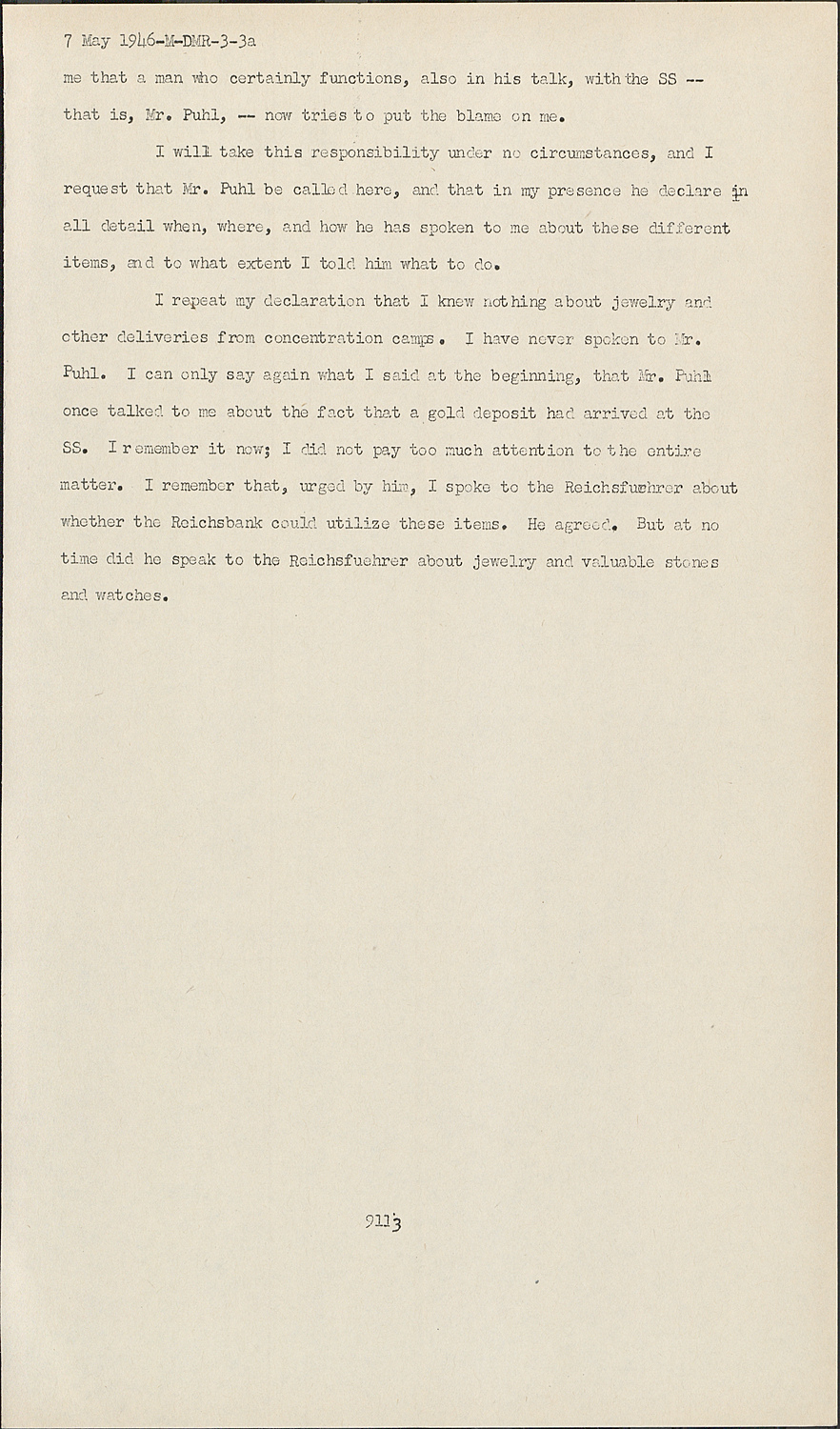
I will take this responsibility under no circumstances, and I request that Mr. Puhl be called here, and that in my presence he declare in all detail when, where, and how he has spoken to me about these different items, and to what extent I told him what to do.
I repeat my declaration that I knew nothing about jewelry and other deliveries from concentration camps. I have never spoken to Mr. Puhl. I can only say again what I said at the beginning, that Mr. Puhl once talked to me about the fact that a gold deposit had arrived at the SS. I remember it now; I did not pay too much attention to the entire matter. I remember that, urged by him, I spoke to the Reichsfuehrer about whether the Reichsbank could utilize these items. He agreed. But at no time did he speak to the Reichsfuehrer about jewelry and valuable stones and watches.
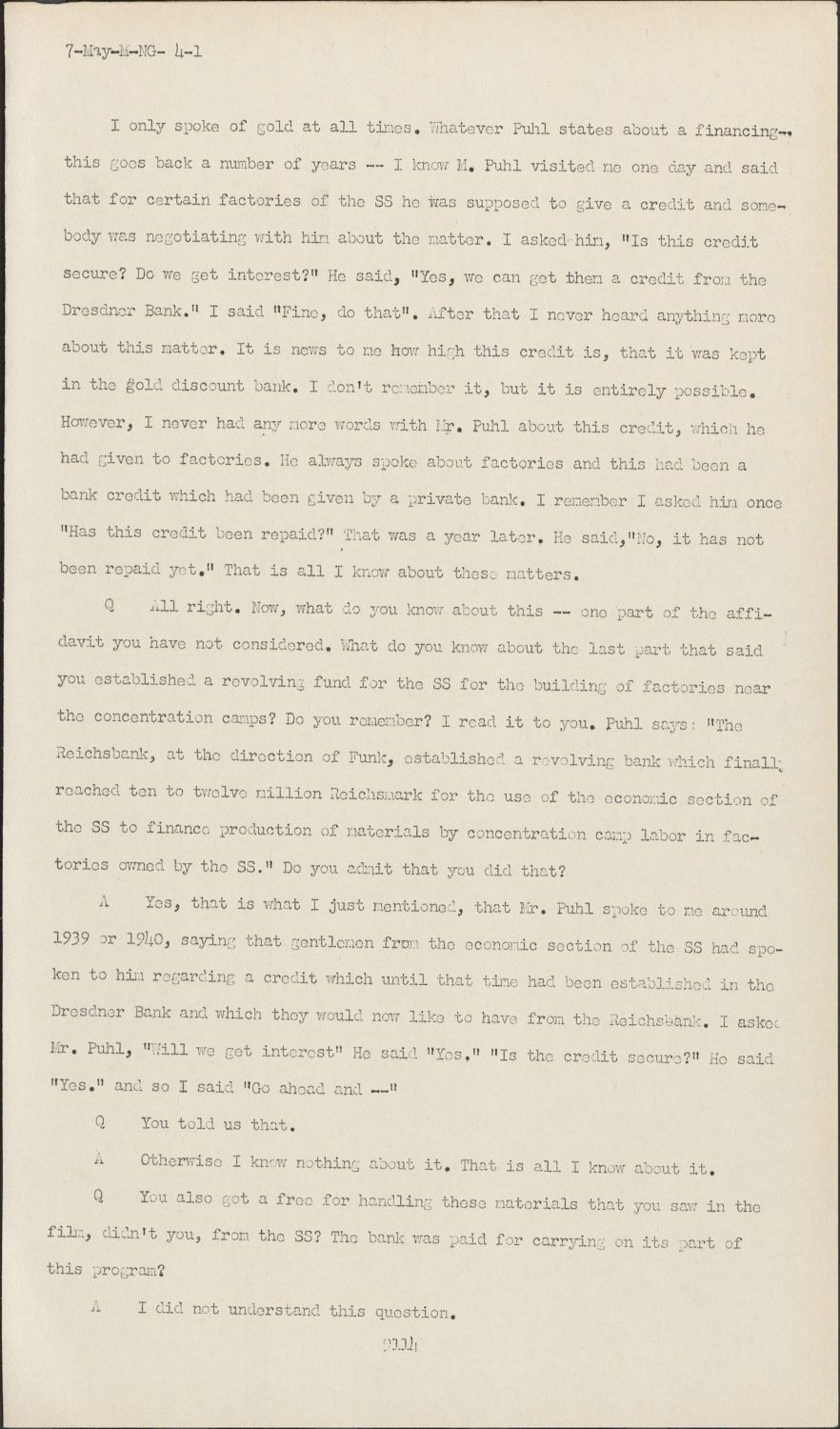
I only spoke of gold at all times. Whatever Puhl states about a financing-
this goes back a number of years -- I know M. Puhl visited me one day and said that for certain factories of the SS he was supposed to give a credit and somebody was negotiating with him about the matter. I asked him, "Is this credit secure? Do we get interest?" He said, "Yes, we can get then a credit from the Dresdner Bank." I said "Fine, do that". After that I never heard anything more about this matter. It is news to me how high this credit is, that it was kept in the gold discount bank. I don't remember it, but it is entirely possible. However, I never had any more words with Mr. Puhl about this credit, which he had given to factories. He always spoke about factories and this had been a bank credit which had been given by a private bank. I remember I asked him once "Has this credit been repaid?" That was a year later. He said,"No, it has not been repaid yet." That is all I know about these matters.
QAll right. Now, what do you know about this -- one part of the affidavit you have not considered. What do you know about the last part that said you established a revolving fund for the SS for the building of factories near the concentration camps? Do you remember? I read it to you. Puhl says: "The Reichsbank, at the direction of Funk, established a revolving bank which finally reached ten to twelve million Reichsmark for the use of the economic section of the SS to finance production of materials by concentration camp labor in factories owned by the SS." Do you admit that you did that?
AYes, that is what I just mentioned, that Mr. Puhl spoke to me around 1939 or 1940, saying that gentlemen from the economic section of the SS had spoken to him regarding a credit which until that time had been established in the Dresdner Bank and which they would now like to have from the Reichsbank. I asked Mr. Puhl, "Will we get interest" He said "Yes." "Is the credit secure?" He said "Yes." and so I said "Go ahead and --"
QYou told us that.
AOtherwise I know nothing about it. That is all I know about it.
QYou also got a free for handling these materials that you saw in the film, didn't you, from the SS? The bank was paid for carrying on its part of this program?
AI did not understand this question.
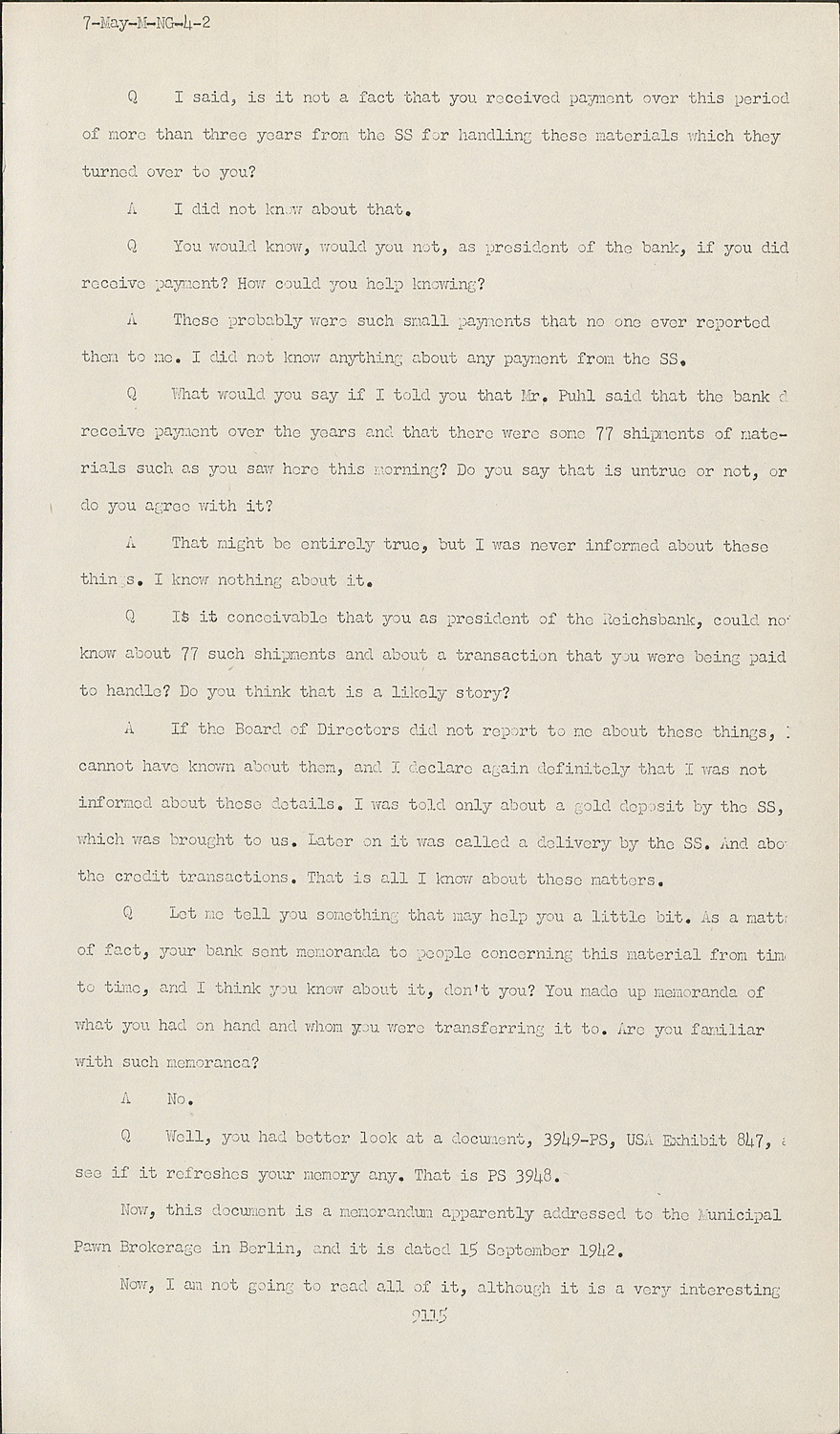
Q I said, is it not a fact that you received payment over this period of more than three years from the SS for handling these materials which they turned over to you?
AI did not know about that.
QYou would know, would you not, as president of the bank, if you did receive payment? How could you help knowing?
AThese probably were such small payments that no one ever reported then to me. I did not know anything about any payment from the SS.
QWhat would you say if I told you that Mr. Puhl said that the bank d receive payment over the years and that there were some 77 shipments of materials such as you saw here this morning? Do you say that is untrue or not, or do you agree with it?
AThat might be entirely true, but I was never informed about these things. I know nothing about it.
QIt it conceivable that you as president of the Reichsbank, could not know about 77 such shipments and about a transaction that you were being paid to handle? Do you think that is a likely story?
AIf the Board of Directors did not report to me about these things, cannot have known about them, and I declare again definitely that I was not informed about these details. I was told only about a gold deposit by the SS, which was brought to us. Later on it was called a delivery by the SS. And abo the credit transactions. That is all I know about these matters.
QLet me tell you something that may help you a little bit. As a matter of fact, your bank sent memoranda to people concerning this material from time. to time, and I think you know about it, don't you? You made up memoranda of what you had on hand and whom you were transferring it to. Are you familiar with such memoranca?
ANo.
QWell, you had better look at a document, 3949-PS, USA Exhibit 847, a see if it refreshes your memory any. That is PS 3948.
Now, this document is a memorandum apparently addressed to the Municipal Pawn Brokerage in Berlin, and it is dated 15 September 1942.
Now, I am not going to read all of it, although it is a very interesting document, but as you can see on there, the memorandum says "We submit to you the following valuables with the request for the best possible utilization."
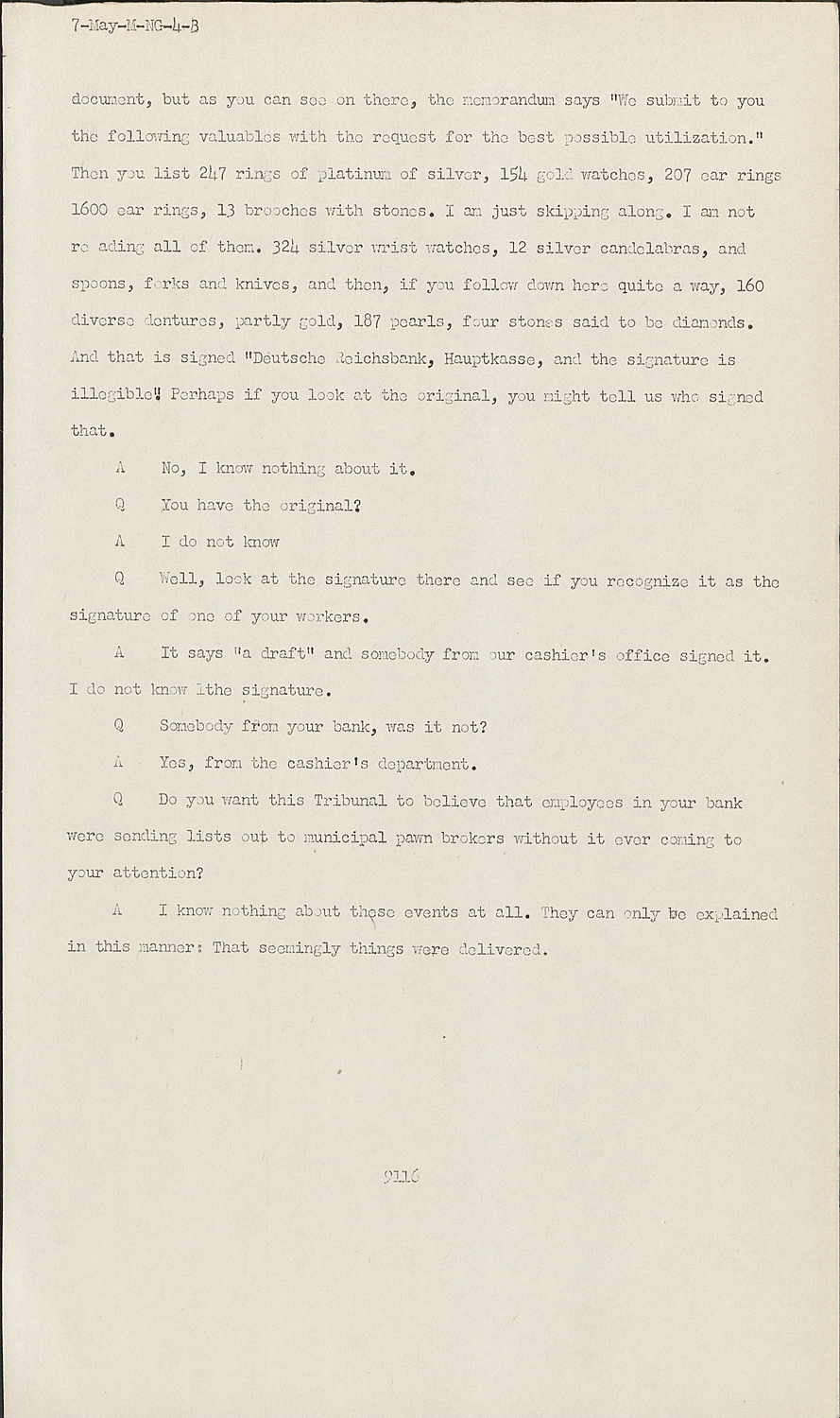
Then you list 247 rings of platinum of silver, 154 gold watches, 207 ear rings 1600 ear rings, 13 brooches with stones. I am just skipping along. I am not reading all of them. 324 silver wrist watches, 12 silver candelabras, and spoons, forks and knives, and then, if you follow down here quite a way, 160 diverse dentures, partly gold, 187 pearls, four stones said to be diamonds. And that is signed "Deutsche Reichsbank, Hauptkasse, and the signature is illegible". Perhaps if you look at the original, you might tell us who signed that.
ANo, I know nothing about it.
QYou have the original?
AI do not know
QWell, look at the signature there and see if you recognize it as the signature of one of your workers.
AIt says "a draft" and somebody from our cashier's office signed it. I do not know the signature.
QSomebody from your bank, was it not?
AYes, from the cashier's department.
QDo you want this Tribunal to believe that employees in your bank were sending lists out to municipal pawn brokers without it ever coming to your attention?
AI know nothing about these events at all. They can only be explained in this manner: That seemingly things were delivered.
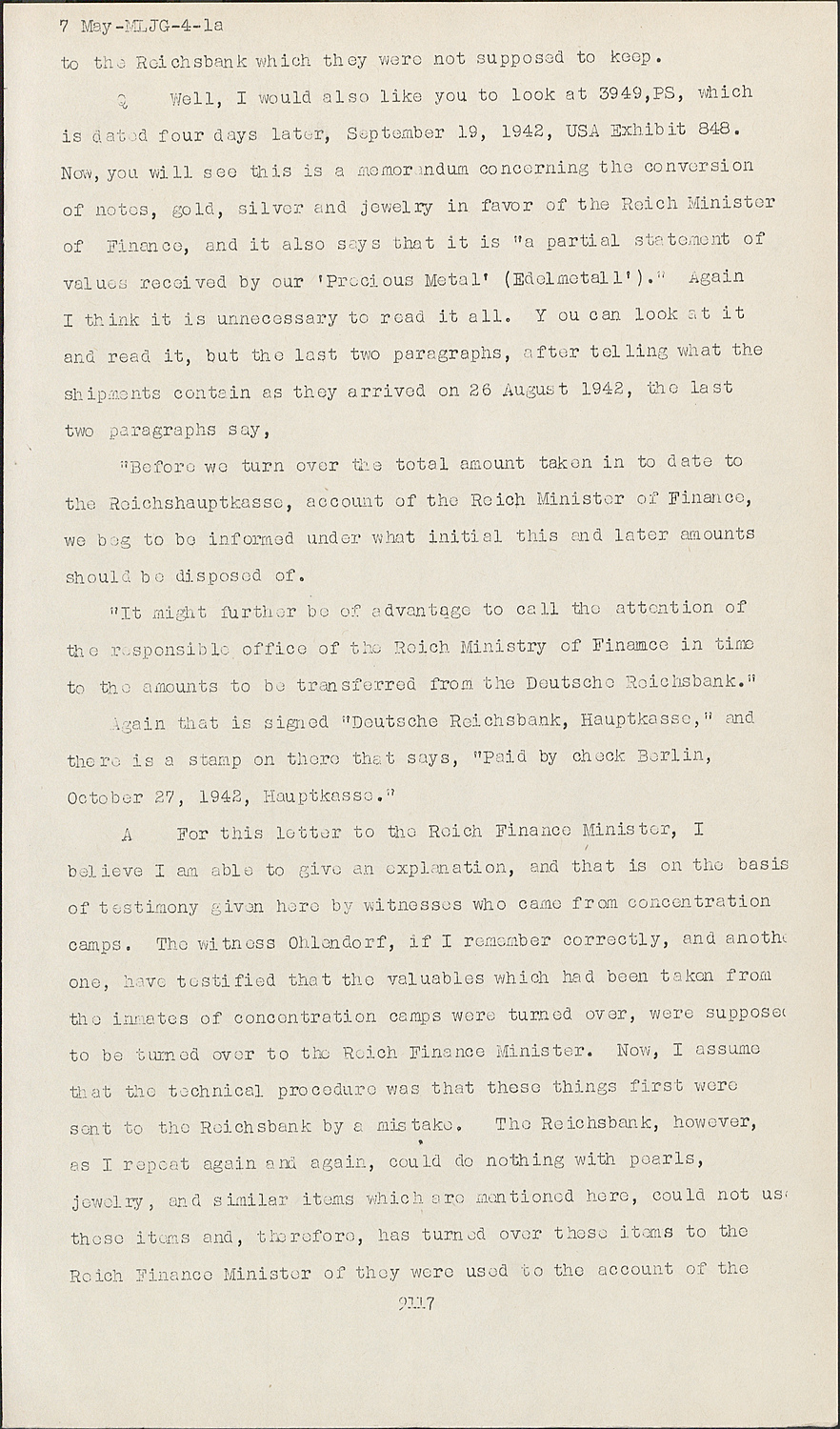
to the Reichsbank which they were not supposed to keep.
QWell, I would also like you to look at 3949, PS, which is dated four days later, September 19, 1942, USA Exhibit 848. Now, you will see this is a memorandum concerning the conversion of notes, gold, silver and jewelry in favor of the Reich Minister of Finance, and it also says that it is "a partial statement of values received by our 'Precious Metal' (Edelmetall' )." Again I think it is unnecessary to read it all. You can look at it and read it, but the last two paragraphs, after telling what the shipments contain as they arrived on 26 August 1942, the last two paragraphs say, "Before we turn over the total amount taken in to date to the Reichshauptkasse, account of the Reich Minister of Finance, we beg to be informed under what initial this and later amounts should be disposed of.
"It might further be of advantage to call the attention of the responsible office of the Reich Ministry of Finance in time to the amounts to be transferred from the Deutsche Reichsbank."
Again that is signed "Deutsche Reichsbank, Hauptkasse," and there is a stamp on there that says, "Paid by cheek Berlin, October 27, 1942, Hauptkasse."
AFor this letter to the Reich Finance Minister, I believe I am able to give an explanation, and that is on the basis of testimony given here by witnesses who came from concentration camps. The witness Ohlendorf, if I remember correctly, and another one, have testified that the valuables which had been taken from the inmates of concentration camps were turned over, were supposes to be turned over to the Reich Finance Minister. Now, I assume that the technical procedure was that these things first were sent to the Reichsbank by a mistake. The Reichsbank, however, as I repeat again and again, could do nothing with pearls, jewelry, and similar items which are mentioned here, could not use these items and, therefore, has turned over those items to the Reich Finance Minister of they were used to the account of the Reich Finance Minister.

In other words, this merely is an account-
ing by the Reichsbank for the Reich Minister. That is, I believe, the meaning of this document.
QWell, indeed, you did hear Ohlendorf say that these unfortunate people who were exterminated in these camps had their possessions turned over to the Reich Finance Minister. I believe he testified to that effect here. Now, you also-
AThat is what I heard here. These things were now to me. However, I did not know-
QYou have told us that twice already.
A --that the Reichsbank dealt with these matters in such detail.
QAre you telling us that you did not know they dealt With them in such detail or you did not know they dealt with them at all? I think that is important. What is your answer, that you didn't know they went into them in such detail or that you didn't know anything about it?
AI personally had nothing to do with it at all.
QDid you know about it?
ANo.
QYou never heard of it?
AI did not know at all that any jewelry, watches and cigarette cases came from concentration camps to the Reichsbank. That is now to me.
QDid you know that anything came from concentration camps to the Reichsbank? Anything at all?
AYes, the gold, of course.
QGold teeth?
AI have said that--No.
QWhat gold from the concentration camps?
AThe gold of which Mr; Puhl had reported to me, and I assumed that those were coins and other gold which had to be deposited at the Reichsbank anyway, according to the legal regulations, and which the Reichsbank could utilize. Otherwise, I know nothing about it.
QWhat did Himmler say to you and what did you say to Himmler when you had this conversation, as you tell us, about this gold from the concentration camp victims? I think the Tribunal might be interested in that conversation. What did he say, and what did you say, and where was the conversation hold?
AWhere the conversation was hold I do not remember anymore. I saw Himmler very rarely, perhaps once or twice a year. I assume that it was on the occasion of a visit in the fieldquarters of Lammers, where Himmler's field quarters was also located. I am sure it happened there. On that occasion we spoke very, very briefly.