I issued the order: "Schacht, Group Eisbaer, Wuerdemann and Wilamowitz, proceed to Hartenstein immediately." Hartenstein was the commander of the group. Later, I had to have several boat deviate from their course because their distance was too great. The one that was furthest away and received orders to participate in the rescue was 700 miles away. Therefore, he could reach the part only after about two days.
First of all, Hartenstein, who was the commander who had sunk the ship -- I had asked Hartenstein whether the Laconia had sent out wireless messages because I hoped that thereby American rescue ships would approach. He confirmed it and, besides, Hartensin, himself, sent the following wireless message in English.
DR. KRANZBUEHLER:That is on page 36, Mr. President, under time figure 0600.
A (continuing) "If any ship will assist the shipwrecked Laconia crew, I will not attack her, providing I am not being attacked by ship or air force.
Then in conclusion, to be brief, I gained the impression from the reports of the U-boats that with great devotion they started the rescue.
QHow many U-boats were there?
AThere were three or four submarines. I received reports which mentioned the figures of those rescued between one hundred and two hundred. I believe Hartenstein had 156 in one submarine, 131 in another. I received reports about supply and taking over the crews of lifeboats; once thirty-five Italians and twenty-five Englishmen and four Poles, and, another time, thirty Italians and twenty-four Englishmen; the third time, twenty-six Italians and thirty-nine Englishmen and three Poles. I received reports about the towing of lifeboats, and all these reports caused me the greatest concern because I knew quite well that could not end well.
My concern at that time was expressed in four different messages to the submarines. "Take only as many lifeboat survivors so that you will still have your chance for diving." It is clear that, if such a narrow space in the U-boat is crowded, additionally by 100 to 200 people, the U-boat is absolutely in danger as such, not to speak about the possibility for fighting Furthermore, I sent the message:
"All boats--"
THE PRESIDENT:Are these messages in the document?
DR. KRANZBUEHLER:Yes.
THE PRESIDENT:Well, where are they? Why did he not refer to the time of them?
DR. KRANZBUEHLER:These ate all messages which are contained in the three diaries. The first message is on page 36, Mr. President, under datetime group 0720. I will read it.
"Wireless message received:" That is a message from Admiral Doenitz. "Hartenstein remain near place of sinking. Secure all clear for diving. Detailed boats to take over only as many as to remain clear for diving."
A (Continuing) Then I sent another message:
"Safety of U-boat is not to be endangered under any circumstances."
DR. KRANZBUEHLER:This message is on page 40, Mr. President, under date-time group of 17 September, 0140 hours.
A (Continuing) "Take all measures ruthlessly, including discontinuance of rescue activities."
Furthermore, I sent the message:
"Boats must at all times be clear for crashdiving and underwater use."
That is under 0330 on the same page.
QOn page 37, under 0740, figure 3.
A "Beware of enemy interference by airplanes and submarines."
THE PRESIDENT:Did you say page 37?
DR. KRANZBUEHLER:Page 37.
THE PRESIDENT:What time?
DR. KRANZBUEHLER:The time 0740, figure 3.
THE PRESIDENT:Yes. BY DR. KRANZBUEHLER:
Q "All boats, also Hartenstein, take in as many people when boats under-water are completely ready for use."
AAnd that my concern was justified could be seen clearly from the report which was received from Hartenstein, which said that we had been attacked by bombs from an American bomber.
DR. KRANZBUEHLER: These messages, Mr. President, are on page 39, under time group 1311, an emergency report.
Under 2304 there is a detailed report which I should like to road.
THE WITNESS:At this occasion -
DR. KRANZBUEHLER:One moment, Great Admiral.
The report is:
"Radiogram sent: von Hartenstein to Admiral Doenitz. Bombed five time by American Liberator in low flight when towing four full boats in spite of Red Cross flag on bridge and good sight. Both periscopes at present out of order. Breaking off rescue; all off board; putting out to West. Will repair."
THE WITNESS:Hartenstein, on that occasion, as can be seen from a later report, also had 55 Englishmen and 55 Italians on board his submarine. At the occasion of the first attack by bombs, one of the lifeboats capsized, since it had been hit by a bomb, and according to his report there were great losses of those that had been rescued before.
At the second attack, one bomb exploded right under the middle of the submarine, and damaged the submarine seriously, and he reported that it was only by a miracle of shipbuilding technique that the submarine did not fall to pieces.
THE PRESIDENT:Where has he gone to now? What page is he on?
DR. KRANZBUEHLER:He is speaking about the events which are described on pages 28 and 39, Mr. President.
THE PRESIDENT:It would help the Tribunal, you know, if you kept some sort of order instead of going on to one page and then to 40, and than back to 38.
DR. KRANZBUEHLER:The reason is that we are using two different war diaries, Mr. President. BY DR. KRANZBUEHLER:
QGreat Admiral, would you tell us now what measures you took after the report by Hartenstein that he had been attacked repeatedly at the occasion of rescue measures.
AI deliberated whether after these experiences I should not break of all attempts at rescue, and beyond doubt, from the point of view of military considerations that Would have been the right thing to do, because the attack showed clearly in what way U-Boats were endangered.
That decision became more grave for me because I received a call from the Naval War Command that the Fuehrer did not want me to risk any submarines for rescues or to pull them from other areas. It came to a very temperamental conference with my staff, and as I can remember very clearly, I summed it up with the statement, "I cannot throw these people into the water."
Of course, it was clear to me that in the event of further losses which would occur, I would have to assume full responsibility, and from the military point of view continuance of rescues was wrong. Of that, I received proof from Submarine U-506 of Wuerdemann, who also reported -- I believe on the following morning -- that he was bombed by an airplane.
DR. KRANZBUEHLER:That report, Mr. President, is on page 42 in the War Diary of Wuerdemann, an entry of 17 September, under the time group 23:43. It is the last on the page, an outgoing Wireless:
"Mission on 'Annamite' completed." Then the details, "Attacked by heavy sea plane at noon. Fully ready for action."
A (Continuing): The third submarine, Schacht's, the U-507, had sent a wireless that he had so many men on board and was towing four lifeboats with Englishmen and Poles.
DR. KRANZBUEHLER:That is the report on page 40, the first report, top of the page.
A (Continuing): Thereupon, of course, I ordered him to let go of that tow because with those boats he could not dive in any way. Later, he again sent a long message, speaking about the supplying of Italians and Englishmen in the boats.
DR. KRANZBUEHLER:That is on page 41, under time group 23:10. I shall read that message:
"Transferred 163 Italians to Anamite," The Anamite was a French cruiser which had been called to rescue. "Navigation officer of Laconia and other English officer aboard ship. Seven lifeboats with about 330 Englishmen and Poles, among them 15 women and 16 children deposited at Qu.FE 9612.
Kept women and children aboard ship for one night. Supplied all shipwrecked with hot meal and drinks, clothed and bandaged as far as necessary. Sighted four more boats at sea anchor Qu. FE 9619."
Then there are some further details which are not important.
A (Continuing): Because I had ordered him to let go of the lifeboats and that report was considered a later report by us, he was admonished by another message, and from that, the Prosecution by error concluded that I had prohibited the rescue of Englishmen.
That I did not do that can be seen from the fact that I did not do anything about the many reports concerning the rescuing of Englishmen.
However, in the end I did have the impression that the Italians did not come off very well on the occasion of the rescue. That this impresssion was correct can be seen from the figures of those rescued. Of 8ll Englishmen, about 800 were rescued, and of 1,800 Italians, 450. BY DR. KRANZBUEHLER:
QGreat Admiral, I should like once more to clarify the date of that entire action. The Laconia was torpedoed on the 12th of September. When was the air attack on the lifeboats?
AOn the 16th.
QOn the night of the 16th? On the 17th?
AOn the 16th.
QOn the 16th of September. So the rescue action took how many days all together?
AFour days.
QAnd it was continued after then until when?
AUntil we turned them over to the French warships which we had requested.
QWhat is the connection, now, between this incident of the Laconia which you have just described, and the order which the Prosecution put to you as the destruction order?
AMy impression, based on the great concern which I continuously he had about the submarines, in addition to they strong feeling that the Angle-American side in spite of the.
proximity did not help, was this basic impression which I received from that event, that the time had passed when U-Boats could carry out such actions on the surface without danger.
As can be seen from the two bombing attacks, in spite of good weather, in spite of large numbers to be rescued, which were clearly visible as such to the aviators, the danger to the submarines was so great that asthe one who was responsible for the boats and the lives of the crews, I had to prohibit rescues.
In the face of the ever-present tremendous Angle-American air forceand I cannot express it any differently, and I should like to mention, as an example, that all the submarines which took part in that rescue action were lost by bombing attack at their next action -- the situation was such that it was contrary to thebasic common-sense of warfare and to any primitive law of warfare to carry out a rescue under the greatest danger for oneself and to be killed on that occasion by the enemy.
Q In the opinion of the prosecution, Great Admiral, you used, that incident in order to carry out an idea which you had had previously; that is, to kill survivors in the future.
Please, will you say anything to that.
AI could not even make a statement in the face of such an accusation. The subject was to rescue or not to rescue; the whole development of that order, however, speaks clearly against it. The fact that we had rescued with devotion and were bombed while doing so-- and it is also a fact that the U-boat Command, that is myself, was faced with the serious decision and was putting myself on the wrong side, military speaking, on the humane side-- so I have to say that I don't believe any more words have to be lost.
QGreat Admiral, I have to put to you, however, the formulation of than order. I have read it before. In the second sectence, we read: "Rescue is contras to the most primitive laws of warfare after destruction of ships and men," What do you mean by that sentence?
AThat sentence, of course, is a reason. The prosecution said that it would have been easy to order, because safety was not permitter, concerns of safety, about the predominance of the air force -- that I had order continuously, and we have seen just now, also in the case of the event of the "Laconia", I had ordered that four times. That was an old record, if I may use that expression, and I was now concerned to give a reason to the commanders of the submarines which would forestall all discretion of the commanders or on decisions of the commander because I had always made the experience that for the reasons mentioned before, the situation, since the sky was still clear, was considered too favorable by the boats and then the submarine was lost, or that one commander was no more able to make decision, such as the "Laconia" case showed; therefore under no circumstance whatsoever did I want to give the old reason which again would give the opportunity to the U-boat commander to say "Well", there is no danger from the air attack and to make his own dicision; for instance, to make up his mind, since there was no danger from the air attack; and I wanted to make sure that that discussion she should not arrive in the mind of one of these U-boat commanders or that he might say that if one rescued the enemy and at that occasion is killed by the enemy, the this contradicts the most primitive laws of warfare. I could have said that, too but I didn't want to say that either; therefore I have put that sentence here as it stands.
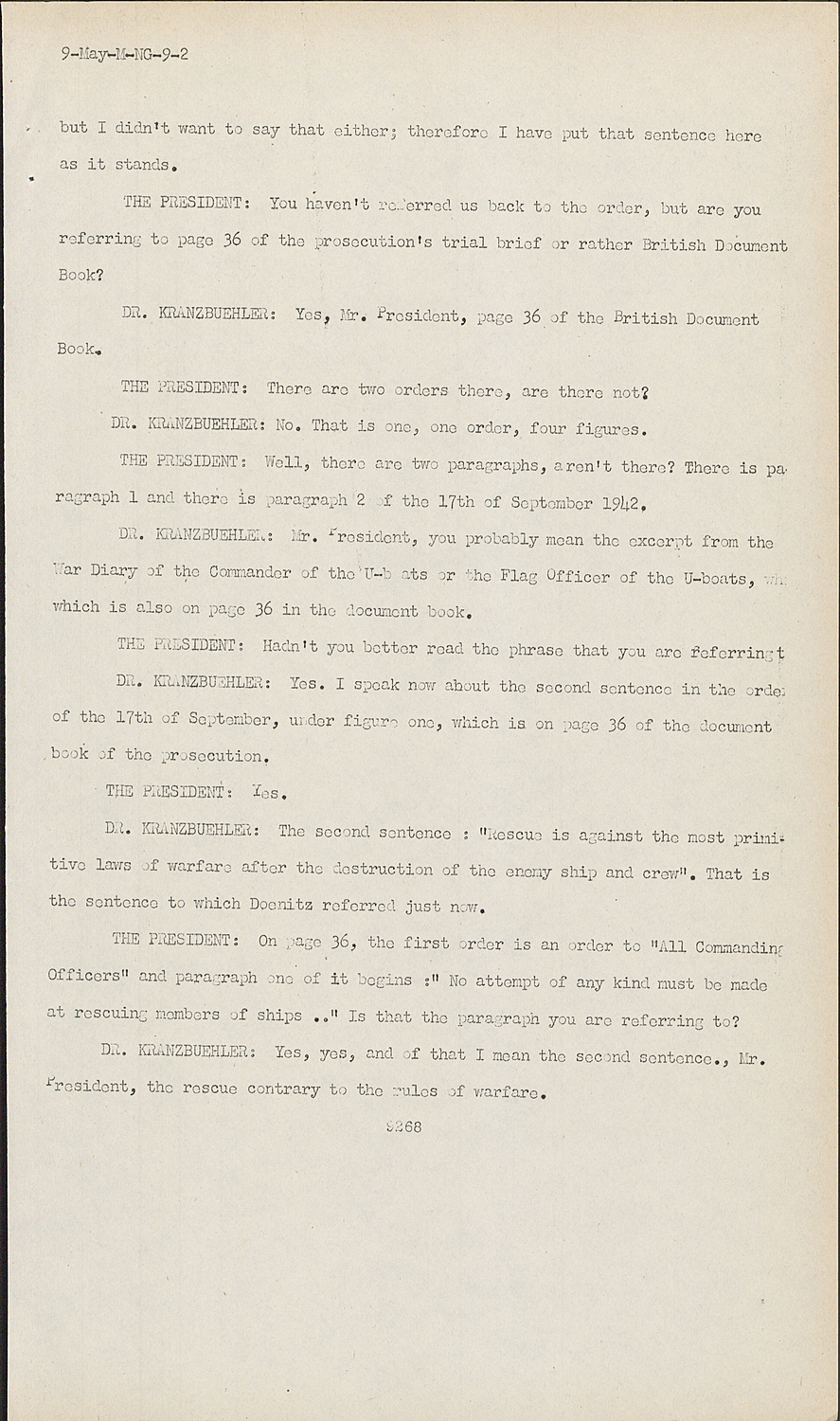
THE PRESIDENT:You haven't referred us back to the order, but are you referring to page 36 of the prosecution's trial brief or rather British Document Book?
DR. KRANZBUEHLER:Yes, Mr. President, page 36 of the British Document Book.
THE PRESIDENT:There are two orders there, are there not?
DR. KRANZBUEHLER:No. That is one, one order, four figures.
THE PRESIDENT:Well, there are two paragraphs, aren't there? There is paragraph I and there is paragraph 2 of the 17th of September 1942.
DR. KRANZBUEHLER:Mr. President, you probably mean the excerpt from the War Diary of the Commander of the U-boats or the Flag Officer of the U-boats, which is also on page 36 in the document book.
THE PRESIDENT:Hadn't you better read the phrase that you are referring
DR. KRANZBUEHLER:Yes. I speak now about the second sentence in the order of the 17th of September, under figure one, which is on page 36 of the document book of the prosecution.
THE PRESIDENT:Yes.
DR. KRANZBUEHLER:The second sentence : "Rescue is against the most primitive laws of warfare after the destruction of the enemy ship and crew". That is the sentence to which Doenitz referred just now.
THE PRESIDENT:On page 36, the first order is an order to "All Commanding Officers" and paragraph one of it begins :" No attempt of any kind must be made at rescuing members of ships .." Is that the paragraph you are referring to?
DR. KRANZBUEHLER:Yes, yes, and of that I mean the second sentence., Mr. president, the rescue contrary to the rules of warfare.
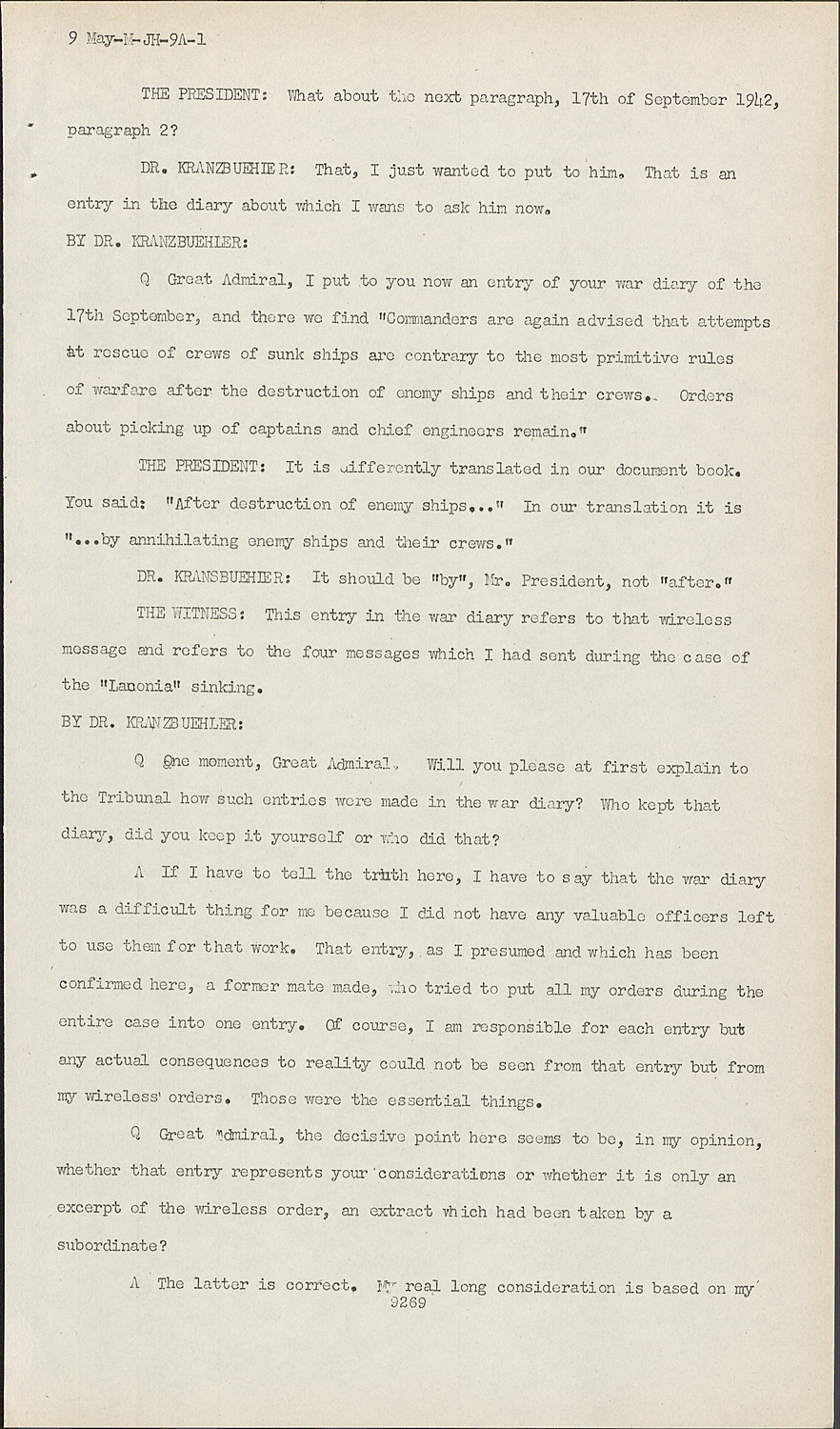
THE PRESIDENT: What about the next paragraph, 17th of September 1942, paragraph 2?
DR. KRANZBUEHIER:That, I just wanted to put to him. That is an entry in the diary about which I wans to ask him now. BY DR. KRANZBUEHLER:
QGreat Admiral, I put to you now an entry of your war diary of the 17th September, and there we find "Commanders are again advised that attempts at rescue of crews of sunk ships are contrary to the most primitive rules of warfare after the destruction of enemy ships and their crews. Orders about picking up of captains and chief engineers remain."
THE PRESIDENT:It is differently translated in our document book. You said: "After destruction of enemy ships..." In our translation it is "...by annihilating enemy ships and their crews."
DR. KRANSBUEHIER:It should be "by", Mr. President, not "after."
THE WITNESS:This entry in the war diary refers to that wireless message and refers to the four messages which I had sent during the case of the "Laconia" sinking. BY DR. KRANZBUEHLER:
QOne moment, Great Admiral. Will you please at first explain to the Tribunal how such entries were made in the war diary? Who kept that diary, did you keep it yourself or who did that?
AIf I have to tell the truth here, I have to say that the war diary was a difficult thing for me because I did not have any valuable officers left to use them for that work. That entry, as I presumed and which has been confirmed here, a former mate made, who tried to put all my orders during the entire case into one entry. Of course, I am responsible for each entry but any actual consequences to reality could not be seen from that entry but from my wireless orders. Those were the essential things.
QGreat Admiral, the decisive point here seems to be, in my opinion, whether that entry represents your considerations or whether it is only an excerpt of the wireless order, an extract which had been taken by a subordinate?
AThe latter is correct. My real long consideration is based on my concern over the call from the Naval Warfare Command, the order of the future and my serious decisions, whether I should break with that method or not, that is not even included in the entries in the war diary.
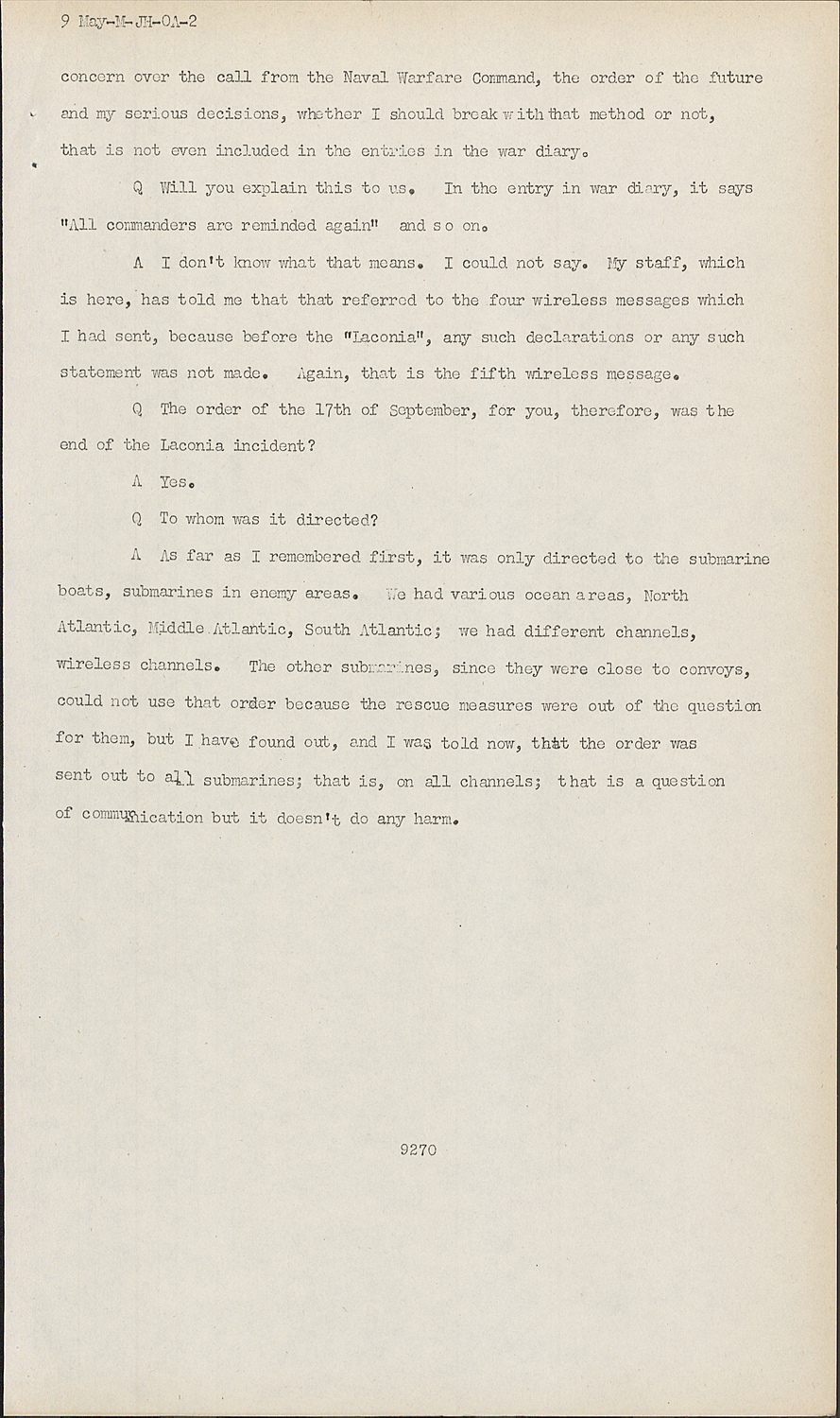
QWill you explain this to us. In the entry in war diary, it says "All commanders are reminded again" and so on.
AI don't know what that means. I could not say. My staff, which is here, has told me that that referred to the four wireless messages which I had sent, because before the "Laconia", any such declarations or any such statement was not made. Again, that is the fifth wireless message.
QThe order of the 17th of September, for you, therefore, was the end of the Laconia incident?
AYes.
QTo whom was it directed?
AAs far as I remembered first, it was only directed to the submarine boats, submarines in enemy areas. We had various ocean areas, North Atlantic, Middle Atlantic, South Atlantic; we had different channels, wireless channels. The other submarines, since they were close to conveys, could not use that order because the rescue measures were out of the Question for them, but I have found out, and I was told now, that the order was sent out to submarines; that is, on all channels; that is a question of communication but it doesn't do any harm.
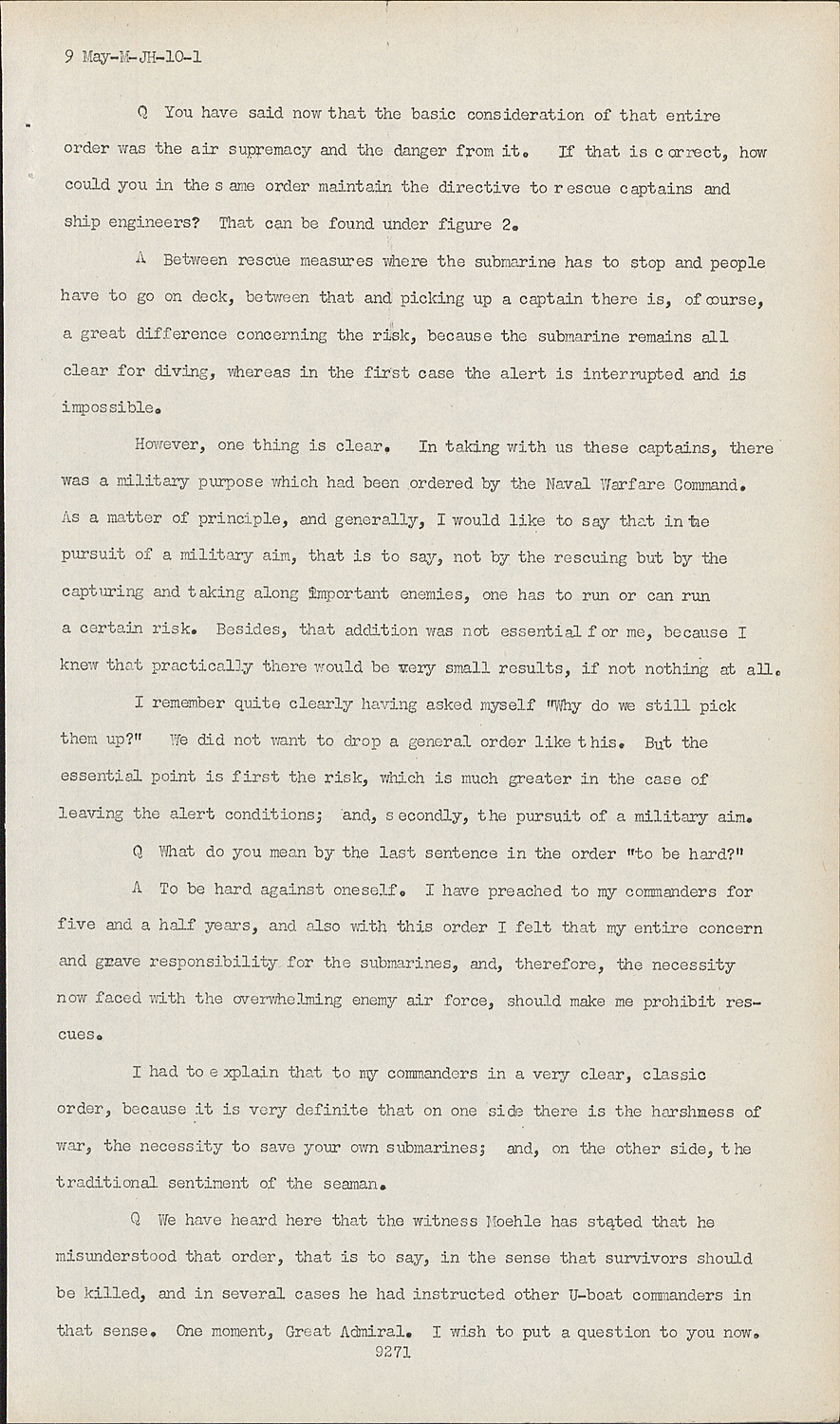
Q You have said now that the basic consideration of that entire order was the air supremacy and the danger from it.
If that is correct, how could you in the same order maintain the directive to rescue captains and ship engineers? That can be found under figure 2.
ABetween rescue measures where the submarine has to stop and people have to go on deck, between that and picking up a captain there is, of course, a great difference concerning the risk, because the submarine remains all clear for diving, whereas in the first case the alert is interrupted and is impossible.
However, one thing is clear. In taking with us these captains, there was a military purpose which had been ordered by the Naval Warfare Command. As a matter of principle, and generally, I would like to say that in the pursuit of a military aim, that is to say, not by the rescuing but by the capturing and taking along important enemies, one has to run or can run a certain risk. Besides, that addition was not essential for me, because I knew that practically there would be very small results, if not nothing at all.
I remember quite clearly having asked myself "Why do we still pick them up?" We did not want to drop a general order like this. But the essential point is first the risk, which is much greater in the case of leaving the alert conditions; and, secondly, the pursuit of a military aim.
QWhat do you mean by the last sentence in the order "to be hard?"
ATo be hard against oneself. I have preached to my commanders for five and a half years, and also with this order I felt that my entire concern and grave responsibility for the submarines, and, therefore, the necessity now faced with the overwhelming enemy air force, should make me prohibit rescues.
I had to explain that to my commanders in a very clear, classic order, because it is very definite that on one side there is the harshness of war, the necessity to save your own submarines; and, on the other side, the traditional sentiment of the seaman.
QWe have heard here that the witness Moehle has stated that he misunderstood that order, that is to say, in the sense that survivors should be killed, and in several cases he had instructed other U-boat commanders in that sense. One moment, Great Admiral. I wish to put a question to you now.
As commanding officer, don't you have to assume, according to your own principles, also the responsibility for misunderstanding of your orders?
AOf course I have the responsibility for all orders, formally and in context. Moehle, however, is the only one who had any doubts about the importance of that order. I regret that Moehle did not find occasion to clear these doubts immediately, either with myself, to whom everybody had access at all times, or with several staff of icers, who in my staff were also responsible, or partly responsible, for the drafting of these orders, or with his immediate superior on Kiel.
I am convinced that among the few U-boat commanders, to whom he told his doubts, the transmitting of these doubts had no consequences. If such consequences had occurred, of course I would assume responsibility for them.
QWhat is your position as to the case of Kapitaenleutnant Eck, which is wellknown to you, who in the spring of 1941, in connection with the sinking of the Greek steamer Peleus, actually fired on life boats?
AKapitaenleutnant Eck stated in the end of his interrogation that he neither knew about Moehle's interpretation or Moehle's doubts, nor of the message, completely reversed, of my decision in the case of U-386, That was the case which Moehle mentioned where the U-boat found life rafts with fliers, and I admonished that they shouldn't take them on board. And it was just the other way, and that was given in writing to the commander as criticism on his actions, and, contrary to that, some office said that I had admonished him as to why he had not destroyed these survivors. Eck neither knew about the interpretation or the doubts of the Moehle order, nor of this story. He acted on his own, and his aim, his tendency, was not to kill survivors but to remove the fragments; because he assumed that otherwise, on the following day, he would be spotted by Angle-American planes on the basis of these fragments, and eventually destroyed. His purpose, therefore, his aim, was an entirely different one than it is stated here in the Moehle interpretation,
QEck has said during his interrogation that he thought he could expect that you would approve of his actions. Did you ever during the war hear about that case Eck?
ANo. It was here during my interrogation when I heard about it, and that because Eck was captured during the same action.
QDo you approve of his actions now that you know of them?
AI do not approve his actions, because I said before in this respect, that is, from the point of view of soldiers' ethics, one cannot deviate.
However, I should like to say that Eck was faced with a very grave decision. He had the responsibility for his boat and his crew, and that responsibility is a grave one during war.
Therefore, if for that reason he believed "Otherwise, I shall be spotted and destroyed" -- and that reason was not unfounded, because in the same ocean area during the same time, I believe, four submarines had been destroyed by bomb. If, therefore, for that very reason he came to that decision, a German court martial would have taken that into consideration without doubt.
I believe that after the war one sees events differently, and one does not fully realize the responsibility which a small commander of that kind carries.
QBesides the case Eck, do you know of any other case during the war, or after, in which a U-boat commander fired on shipwrecked people or life rafts?
ANot a single one.
QYou know the documents of the Prosecution, do you not, which describe the sinking of the ships Noreen Mary and Antonice? Do you recognize the value of these documents as proof, according to your experience, or don't you?
ANo. I believe that they cannot stand a thorough examination. We received a large number of similar reports from the other side, and we were always of the opinion, and stated that opinion also in writing to the OKW, that one has to be extremely sceptical in dealing with these cases, because a shipwrecked person can easily believe that he is fired at.
These may be shots which are not aimed at him at all, but at the ship;
that is to say, misses of some sort.
The fact that the prosecution mentions just these two examples, shows, in my opinion, that my conviction is correct, that outside of the case of Eck no further cases occurred during the long years in the ranks of the German submarine forces.
QYou mentioned before the report to the Fuehrer of May 1942, during which the problem has been examined, or at least touched upon by the Fuehrer, whether it was permissible to kill survivors. Was that question examined again by the flag officer of submarines, or the Naval War Command?
AWhen I had become supreme commander of the navy -
QThat was in 1943?
AI received, I believe, in December of 1943, a letter from the foreign office in which I was informed that about 87% of the crews of merchant ships which had been sunk, were returning home. And that was disadvantageous. We wondered whether it was not possible to do something against it.
I had a letter sent to the Foreign Office in which I informed the foreign office that, although I had already been forced to prohibit rescues for the reasons that submarines were dangerous, other measures were out of the question for me.
QI have here an entry in the war diary of the Naval Warfare Command which deals with this case. I submit this entry as Doenitz 42. It is pages 92 to 94 in Volume 2 of the document book.
I shall read first the first and second sentences of Page 92. The entry is on the 4th of April, 1943.
"The German Foreign Office pointed to an assertion of the British Transport Minister according to which during sinkings of Merchant vessels an average of 87% of the crew were saved. To this statement the Naval War Command (SKL) made a comprehensive reply to the Foreign Office."
Then there is the stating of their position on the next page; and I should like to read a part of that.
First, under figure 1, about the number of ships that was sunk, what is the importance of that in this connection?
A That these people would certainly get home.
QFurthermore, under figure 2, mention is made that the seamen did not need a long period of training, with the exception of officers, and that they had resisted already an order to pick up captains and chief engineers. What is the meaning of that?
AA thing like that has been viewed wrongly.
QOne moment. By "a thing like that", you mean the military necessity of destruction after shipwrecks?
ACorrect. It means that there are plenty of crews available, because they could be quickly trained from unskilled manpower.
QUnder figure 4, you point to the dangers of reprisals against our own submarine crews. Did such reprisals against German U-Boat crews occur at any time during the course of the war?
AI do not know. I have not heard about reprisals in that connection. I only received the report that on theoccasiron of bomb hits on U-Boats from the air, the men swimming in the water were shot at. But whether those were individual actions or reprisals, I do not know. I would like to assume that they were individual actions.
QThe decisive point of the entire letter seems to be in Figure 3 and I should like to read that to you:
"A directive to take action against lifeboats of sunken vessels and crew members drifting in the sea would, for psychological reasons, not be tolerable for U-boat crews, since that would be contrary to the innermost feelings of all seamen.
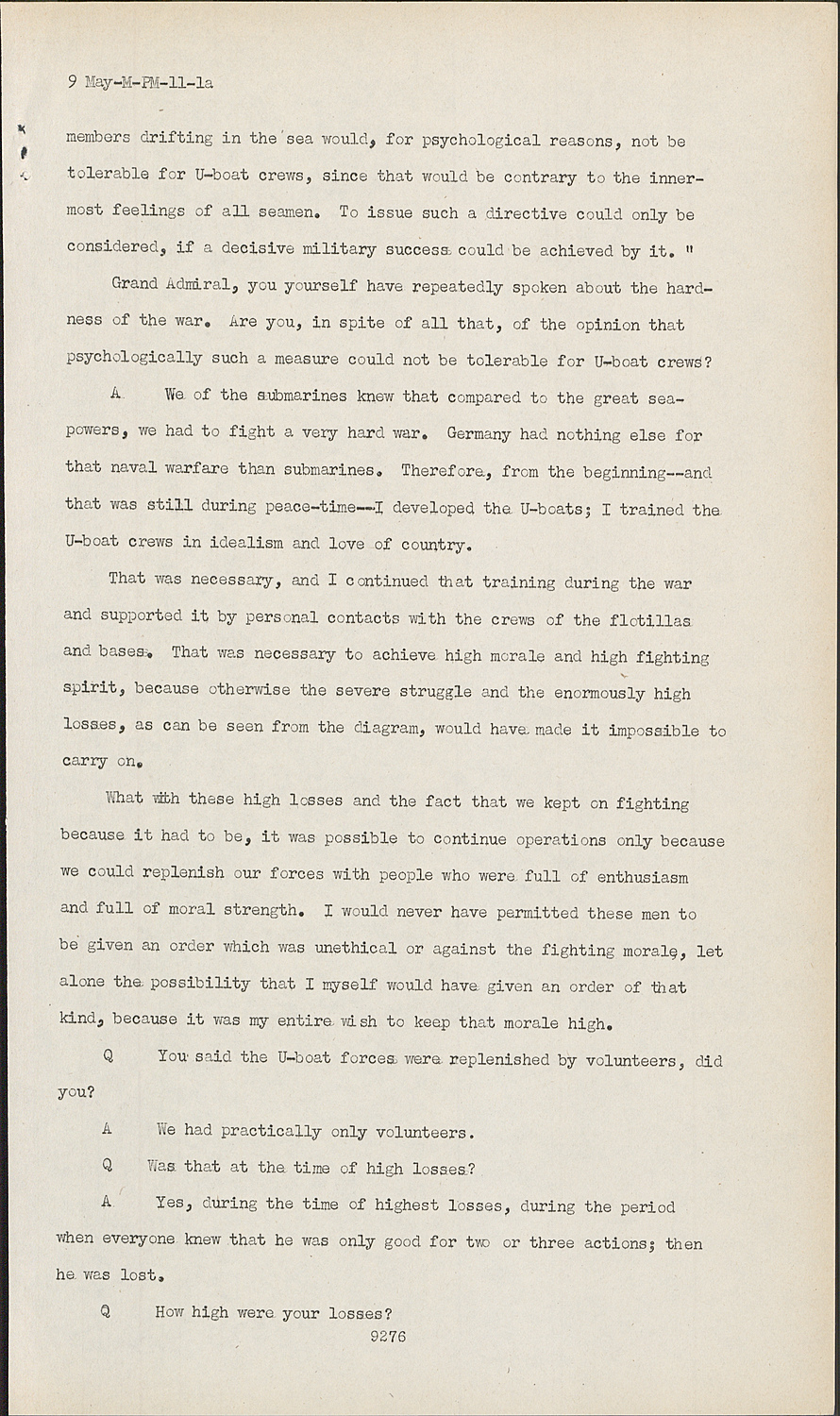
To issue such a directive could only be considered, if a decisive military success, could be achieved by it. " Grand Admiral, you yourself have repeatedly spoken about the hardness of the war.
Are you, in spite of all that, of the opinion that psychologically such a measure could not be tolerable for U-boat crews?
AWe of the submarines knew that compared to the great seapowers, we had to fight a very hard war. Germany had nothing else for that naval warfare than submarines. Therefore, from the beginning--and that was still during peace-time--I developed the U-boats; I trained the U-boat crews in idealism and love of country.
That was necessary, and I continued that training during the war and supported it by personal contacts with the crews of the flotillas and bases. That was necessary to achieve high morale and high fighting spirit, because otherwise the severe struggle and the enormously high losses, as can be seen from the diagram, would have, made it impossible to carry on.
What with these high losses and the fact that we kept on fighting because it had to be, it was possible to continue operations only because we could replenish our forces with people who were full of enthusiasm and full of moral strength. I would never have permitted these men to be given an order which was unethical or against the fighting morale, let alone the possibility that I myself would have given an order of that kind, because it was my entire wish to keep that morale high.
QYou said the U-boat forces, were replenished by volunteers, did you?
AWe had practically only volunteers.
QWas that at the time of high losses?
AYes, during the time of highest losses, during the period when everyone knew that he was only good for two or three actions; then he was lost.
QHow high were your losses?
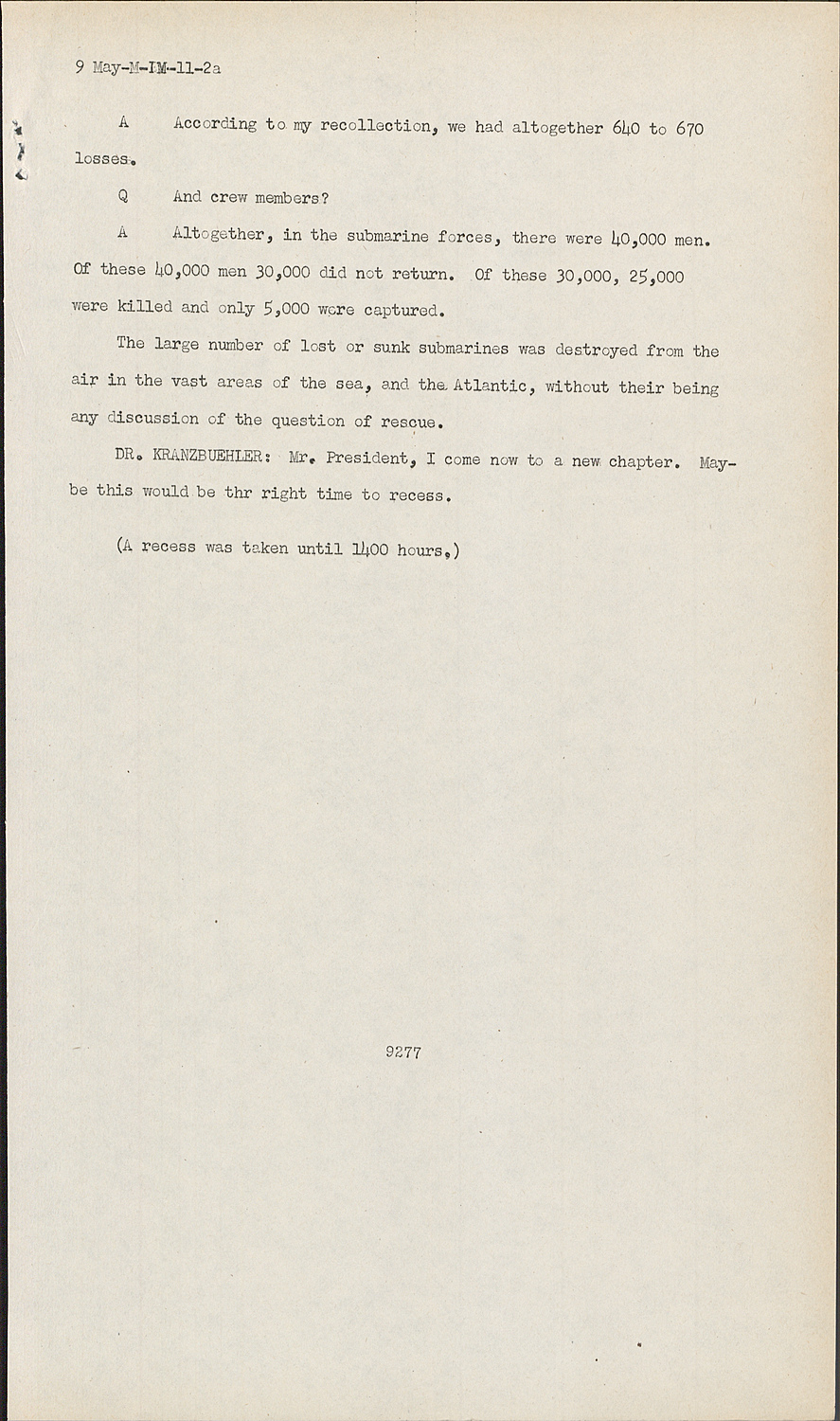
A According to my recollection, we had altogether 640 to 670 losses.
QAnd crew members?
AAltogether, in the submarine forces, there were 40,000 men. Of these 40,000 men 30,000 did not return. Of these 30,000, 25,000 were killed and only 5,000 were captured.
The large number of lost or sunk submarines was destroyed from the air in the vast areas of the sea, and the Atlantic, without their being any discussion of the question of rescue.
DR. KRANZBUEHLER:Mr. President, I come now to a new chapter. Maybe this would be the right time to recess.
(A recess was taken until 1400 hours.)
Official transcript of the International Military Tribunal in the Matter of the United States of America, the French Republic, the United Kingdom of Great Britain and Northern Ireland, and the Union of Soviet Socialist Republics, against Hermann Wilhelm Goering et al, defendants, sitting at Nuernberg, Germany, on 9 May 1946, 1400-1700, Lord Justice Lawrence presiding.
DEFENDANT DOENITZ -- Resumed DIRECT EXAMINATION -- Continued BY DR. KRANZBUEHLER:
QGrand Admiral, I am turning to the phase of the so-called conspiracy. The Prosecution is accusing you that beginning with the year 1932 on the basis of your close connection with Hitler and the party, you participated in a conspiracy to bring about aggressive wars and war crimes. Where were you in the Weeks of the seizure of power by the National Socialists in the early part of 1933?
AIn January, or I believe, it was the first of February, I went on leave to Dutch India near Ceylon, a journey which took well into the summer of 1933. This journey, which at the request of Admiral Raeder, President Hindenburg granted me.
QThereafter, you became the Commander of a cruiser?
AYes. In the Autumn of 1934 until the summer of 1935 I was active as the Commander of the Cruiser Emden. We cruised the Atlantic around Africa into the Indian Ocean and returned.
QBefore the sojourn abroad or after your return in 1935 until you were appointed Commander in Chief of the Navy in the year 1943 were you politically active in any way?
AI was active politically beginning with the first of May, 1945, when I became the head of the State, but not before then.
QThe Prosecution has submitted a document in the form of an affidavit by the Ambassador Messersmith. It has the number U.S.A.75 2nd there are printed the decisive extracts in Volume 3, Page 100. In this affidavit Ambassador Messersmith says that from 1930 until the Spring of 1934 he acted as Consul General for the United States at Berlin.
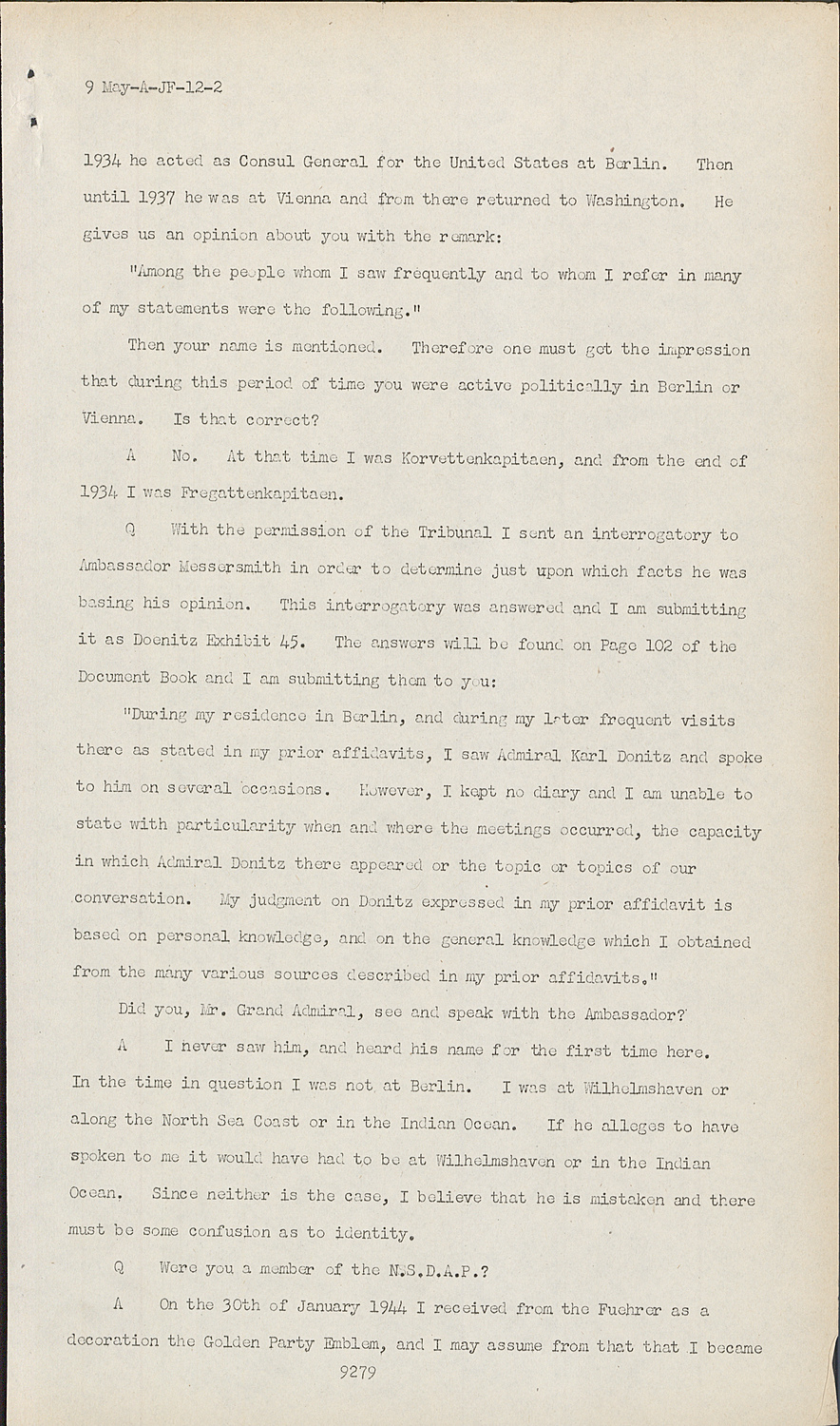
Then until 1937 he was at Vienna and from there returned to Washington.
He gives us an opinion about you with the remark:
"Among the people whom I saw frequently and to whom I refer in many of my statements were the following."
Then your name is mentioned. Therefore one must get the impression that during this period of time you were active politically in Berlin or Vienna. Is that correct?
ANo. At that time I was Korvettenkapitaen, and from the end of 1934 I was Fregattenkapitaen.
QWith the permission of the Tribunal I sent an interrogatory to Ambassador Messersmith in order to determine just upon which facts he was basing his opinion. This interrogatory was answered and I am submitting it as Doenitz Exhibit 45. The answers will be found on Page 102 of the Document Book and I am submitting them to you:
"During my residence in Berlin, and during my later frequent visits there as stated in my prior affidavits, I saw Admiral Karl Donitz and spoke to him on several occasions. However, I kept no diary and I am unable to state with particularity when and where the meetings occurred, the capacity in which Admiral Donitz there appeared or the topic or topics of our conversation. My judgment on Donitz expressed in my prior affidavit is based on personal knowledge, and on the general knowledge which I obtained from the many various sources described in my prior affidavits."
Did you, Mr. Grand Admiral, see and speak with the Ambassador?
AI never saw him, and heard his name for the first time here. In the time in question I was not at Berlin. I was at Wilhelmshaven or along the North Sea Coast or in the Indian Ocean. If he alleges to have spoken to me it would have had to be at Wilhelmshaven or in the Indian Ocean. Since neither is the case, I believe that he is mistaken and there must be some confusion as to identity.
QWere you a member of the N.S.D.A.P.?
AOn the 30th of January 1944 I received from the Fuehrer as a decoration the Golden Party Emblem, and I may assume from that that I became an honorary member of the party.