QAnd that was a special merit of Field Marshal Kesselring?
AI would say that when the History of this time is being written, at the top of the list of merits will be Pope Pius the XII. Then praise will be accorded, in the second place, to the German Wehrmacht under the leadership of von Kesselring.
DR. LATERNSER:Thank you very much. I have no further questions.
BY DR. KUBUSCHOK (Counsel for Defendant von Papen).
QIt was assorted that in the summer of '34, that the defendant, who has been made special ambassador to Vienna, from Vienna pursued a policy of aggressive expansion, including the entire southeast up into Turkey, and that, among other things, that neighboring states like Hungary and Poland received offers from himregarding total aggrandizement from the partition of Czechoslovakia. Did this policy actually exist?
AI'm sorry. I did not understand your question.
QDid this policy, which I just outlined, actually exist?
AMy observation dates only from the late summer of 1936, for before that time I was abroad. That Mr. von Papen carried on a southeastern policy from Vienna or that he was charged therewith, I did not notice. Even later, the Foreign Office could not charge him with such a mission for he was not subordinate to the Foreign Office.
QAnd this policy, as I've just outlined, did that exist in the Foreign Office when you assumed your term?
APlease repeat the question.
QDid this policy -
AWhich policy?
QAggressive expansion on the part of Germany to the southeast up into Turkey, partition of Czechoslovakia, and the relinquishing of part of Czechoslovakia to Poland and Hungary.
AIn the year '39?
Q '36, 1936.
ANo.
RECROSS-EXAMINATION BY MR. ELWYN JONES:
QWitness, I want to ask you one or two questions about the Athenia matter. You have told the Tribunal that you, yourself, saw the American charge d'affaires and informed him about the middle of September that the Athenia could not have been sunk by a German U-Boat. That is so, is it not?
A I did not see the American charge d'affaire in the middle of September, but on the same day on which I heard of the sinking, and that must have been, perhaps, the 3rd or 4th or 5th of September.
QWere you already assuring the American representatives as early as that that a U-boat could not have been responsible?
AYes, that's correct.
QAnd did yourecommend or, rather, did the German Foreign Office recommend that the Commander-in-Chief of the German Navy should receive the American naval attache and tell him the same thing, namely, that a U-boat could not have sunk the Athenia?
AThat I don't know, I only dealt with the charge d'affaire.
QI'd like you to look at a new document, D-804, which willbe Exhibit GB-477, which is an extract from the SKL file on the Athenia case. You will see that that is a report from Neubauer to the Naval Attache and it roads as follows:
"The Foreign Office has had a report of the meeting between the Commanderin-Chief of the German Navy and the American Naval Attache on the 13th of September, 1939, passed on to it by telephone; it is worded as follows:
"On the 16th of September, at about 1300 hours, the Commander-in-Chief of --"
AI'm sorry; I haven't found the place as yet.
QYou may follow the English copy, witness, if you'd loke. I read the second paragraph:
"On the 16th of September, at about 1300 hours, theCommander-in-Chief of the navy received the American Naval Attache on the advice of the Reich Foreign Minister, and told him more or less the following: He had intended for some days already -- as he know -- to write him to visit him, in order to tell him his opinion about the sinking of the 'Athenia', in view of the continued baiting about it. However he had waited for the return of the submarine that had been employed in waging war against merchant ships, at the time in question which might possibly be concerned, in order to receive reports about their activity personally. He repeated most emphatically that the sinking of the 'Athenia' was not caused by a German submarine. The ship nearest to the place of the incident was at the time actually situated about 170 sea miles away from the place of the sinking.
Besides this, the instructions according to which the commanders had to wage war against merchant shipping had after all been published. Up to date, in no case had these instructions been even slightly disregarded. On the contrary, an American captain reported a short time before about the particularly courteous and chivalrous behaviour of the submarine commanders."
Well, now, it's clear from that, is it not, that the German Foreign Office was most anxious to cover up this matter of the "Athenia" as best it could; was it not?
ANo, there was nothing to be covered up.
QWhen you discovered at the end of September that in fact it was the U-30 that had sunk the Athenia, there was then a good deal to be covered, was there not?
AI believe that I stated yesterday already that I received no knowledge to that effect.
QAre you saying that you didn't know at the end of September, on the return of the U-30, that the U-30 had in fact sunk the Athenia?
AI do not remember that in anyway at all.
QWhen did you first discover that the U-30 had sunk the Athenia?
A (No answer).
QWhen did you first discover that the U-30 had sunk theAthenia?
AAccording to my recollection, not at all during the war.
QBut I understood you to say yesterday that you thought that the publication in the Voelkischer Beobachter, accusing Winston Churchill of sinking the Athenia, was a piece of perverse imagination; is that right?
ACompletely.
QAre you clearly saying to the Tribunal that -- there you were in a responsible job -- are you saying to the Tribunal that youdid not discover the true facts about the Athenia until the end of the war, when you were directly concerned in the Foreign Office with this matter?
AI already yesterday told you everything that I know about this. It seems to me that it was realized later in the Naval Staff, that the sinking of theAthenia is to be traced back to a submarine: but I cannot recall that this fact was told to me or the Foreign Office.
QAt any rate, the defendant Raeder took no steps to correct the information that had been passed to theAmerican diplomatic representatives, did he?
AI do not recall at all that Admiral Raeder advised me or the Foreign Office of the fact.
QWell, with regard to the defendant, Raeder took no steps to correct the information that had been passed to theAmerican diplomatic representative did he?
AI do not recall at all that Admiral Raeder advised me or the Foreign Office of the fact.
QWell, with regard to the defendant, Raeder took no steps to correct the information that had been passed totheAmerican diplomatic representatives, did he?
AI do not recall at all that Admiral Raeder advised me or the Foreign Office of the fact.
QWell, with regard tothe defendant vonNeurath -
If it please the Tribunal, I'm not proposing to question the witness as to the earlier diplomatic history, as this Tribunal has indicated that it is desirable toreserve the matter for the defendants as they go into the witness's box later.
But I want to ask you a general question. What was the earliest date at which responsible officials of the Foreign Office like yourself first realized that Hitler intended to wage aggressive war?
AThat the foreign political policy of the Hitler regime was a dangerous one, that I realized for the first time in May, '33, and I realized the development. The fact that an aggressive war was planned, perhaps, in the summer of 1938, did I realize that, but that the course of the foreign policy which we were pursuing might very easily lead to war.
QAlready in April, 1938, the foreign political situation was so tense that you sent a special memorandum to all German diplomatic representatives dealing with the situation and the situation of crisis.
A That may be. May I be permitted to read the document?
QI want you to look at document 3572-PS, which is a memorandum of the 25th of April, 1938, signed by yourself, and a copy of which was sent to all the German diplomatic representatives. It will be exhibit GB-478. That document reads:
"Since the work in the field of preparation for the mobilization has made further progress within Germany in the Armed Forces and in all civiladministrations including the Foreign Office, it is necessary now that in the case of government offices abroad corresponding measures also be taken in their area of jurisdiction without delay."
And then there follows a series of instructionas to the actions that are to be taken on the commencement of the period of crisis or of actual mobilization, and there is an insistence in the last paragraph, but one:
"I request the heads of offices, without waiting for further instructions to start considering now the measures to be taken into consideration in their sphere of activity in the case of a serious situation. In the interest of absolute secrecy it must be observed strictly that the number of people informed remains as restricted as possible."
That suggests,does it not, that as early as April, 1938, you were conscious of theimminent approach of actual mobilization; is that so?
A May I ask whether this document is for the year 1938 or 1939?
I can not quite distinguish the date.
Q 25 April 1938.
AThat may be.
QNow, you yourself were opposed to Hitler's aggressive foreign policy, were you not?
AI did not quite understand your question.
QYou yourself were opposed to Hitler's aggressive foreign policy, were you not?
AI personally, you mean? Completely.
QDid you endeavor to persuade the defendant von Neurath also to oppose Hitler's aggressive foreign policy?
AMr. von Neurath at that time was not Foreign Minister at all.
QBut he continuedto be a very important functionary of the Nazi state, did he not?
AI believe that his influence was even smaller than before this period, but I did keep in contact with him, and I believe that I agreed with his opinion and he with mine.
QAnd yet he continued to serve th Nazi state, in particular, in a territory which was acquired as a result of this policy of aggression; is that not so?
AI should be grateful to you if you put this question to Mr. von Neurath rather than to me.
QNow, you were in Italy and in Rome, were you not, in March of 1944?
AYes.
QYou have given me some evidence as to the behavior of the German forces in Italy. Were you in Rome at the time of the massacres in the Adiantine caves? You remember the incident, do you not?
AYes.
QWhere 325 Italians were murdered and 57 Jews were thrown in as a bit of make-weight. You were there when that happened, weren't you?
AI believe it was 320 prisoners who were murdered in this cave which you just mentioned.
Q Were you consulted about that matter?
ANo.
QThat was an action by German forces, was it not?
AI believe the German police, rather than the German armed forces.
QAnd you know, witness, that there were many murders of that kind carried out by the SS during the period of German activity in Italy, do you not?
A i do not know about many murders which took place, but I know that the German police could do quite a bit in this connection.
QYou know that they left terror and brutality shetever they left their mark upon Italy; is that not so?
AThe German Police, yes.
MR. ELWYN JONES:I have no fuether questions.
THE PRESIDENT:Do you want to re-examine?
DR.SIEMERS: (Counsel for defendant Raeder) I have no more questions, Your Honor.
THE PRESIDENT:Then the witness can retire.
-----------------
DR. SIEMERS:Mr. President, May I please be permitted to call my witness Vice-Admiral Schulte Moenting.
-----------------
ERICHSCHULTE-MOENTING, a witness, took the stand and testified as follow: BY THE PRESIDENT:
QWill you state your full name?
AErich Schulte-Moenting.
QWill you repeat this oath after me:
I swear by God, Almighty and Omniscient, that I will speak the pure truth and will withold and add nothing.
(The witness repeated the oath.)
THE PRESIDENT:You may sit down.
DIRECT EXAMINATION BY DR. SIEMERS:
QAdmiral, please tell us briefly in what positions you were active in the year 1925 through 1945, with especial reference to the positions which were directly under Grand Admiral Raeder.
A 1925 to 1928, I Was Marine and Naval Adjutant of Reichspresident Hindenburg, and simultaneously second adjutant of the Chief of the Marine Laeders.
From 1929 until 1933 I had several different positions.
From 1933 to 1937 I was First adjutant with Raeder.
From 1937 to 1939 I had combat commands.
From 1939 to 1943 I was chief of staff with Grand Admiral Raeder. Then I became sea commander in southern France until the invasion, in connection with the commanding general in est Trojndheim.
After the collapse, I was for some months active with the British navy. Then in autumn I was interned in a general camp in England.
QIf you recall, please tell us the month in the year 1939 in which you started activity as chief of staff with Raeder.
AThe first of January 1939.
QCan you tell us briefly about the prestige of Raeder as a navy expert and especially his prestige abroad. I am referring only to navy technicalmatter
AYes, I believe that because of the many years' service that I had with Raeder, I have an overall picture. Raeder for 15 years was the head of the Navy. He was known as a navy officer. He was known in the imperial Navy, and he was the opponent of the British Admiral Baity in the Skaggerak Battle.
THE PRESIDENT:Witness, will you kindly observe that light. When the yellow light goes on, you are talking too fast. When the red light goes on, you must stop.
AHe was known through his literary activity at the time of the "Tirp* era and later after the first world war he was known for his true works about the cruiser war of the last world war, and he received a doctor's degree for and made his name in the technical field.
QThe defendant is accused of building up the navy with the intention of carrying on an aggressive war, even when the Treaty of Versailles applies as early as that.
AThat is not correct. From all my conversations which I had with Raeder the thought -- much less the word -- of an aggressive war was not mentioned. I believe that all of his actions and his directives contradict this.
Q Were there any plans of a strategic nature carried out while the Versailles Treaty was operative, regarding an aggressive war?
ANever.
QWhat basis was there for the maneuvers taken by the Navy in the years 1932 until 1939?
AThey were only for protection and defense of the coastal waters.
QWas a war with England considered as a basis for any one of those maneuvers?
ANo, that was never considered, and I believe anyone would have considered anything like that impossible and nonsensical. I do remember that at the beginning of the year 1933 Raeder issued a directive to the commanders at the front regarding manuevers, where a maneuver directed against England was considered an impossibility, and it was prohibited to carry on a maneuver like that.
QMr. Admiral, it is known that the Navy, in the 20's, and with the knowledge of the then parliamentary regime, violated the Treaty of Versailles. These questions have been discussed a great deal here, and we can be brief. I should like to question you generally, therefore.
Is it possible to deduce aggressive intentions from these violations?
ANo, I can say that is completely out of the question. The violations were so insignificant and were based only on protection and defense, so I believe it would be impossible to construe them as aggressive intentions.
QCan you tell us briefly about a few points upon which these violations took place?
AFirst of all, they were limited to the establishment of coastal defense, coastal batteries, flak batteries, the laying of mines. All of that was based on defense or protection.
QWere these violations against the Treaty of Versailles -- or, shall we say, the slight deviations -- make known to the Inter-Allied Commission in whole or in part, and did this commission in part overlook these things since these violations were really trifles?
AIn reply to that, I would like to say it was an open secret.
Q I should like to ask you, Mr. Admiral, to pause between question andanswer so that the interpreters can keep up.
Will you pause just a moment after my questions.
Will you please answer this question once more.
AI should like to say that it was an open secret.
QAs proof of these violations of the Treaty with the intention of carrying through an aggressive war, the Prosecution has submitted several times the fight of the Navy against Versailles, submitted it as Document C-150. I shall have this document submitted to you in the original.
In order to save time, and in order not to burden the Tribunal with details, I should like to ask you not to go into detail. I should like to ask you only: What do you know about this document and what is the background of this document? When did itarise, and what is your opinion?
AI know this document. It originated on the basis of the attacks of the National Socialist regime in the years 1934 and 1935, and the prior regime and the Navy were accused of not having done enough previously to defend the nation, and not exhausting the possibilities of the Treaty of Versailles. Consequently, at that time it was planned to bring out a document of justification, and this document is to be considered in that light, that it is a source of justification for something that was omitted.
This document actually never was published. It was withdrawn andnot put into circulation because it was, as I would like to say, a rather weak attempt, for there are no definite points which you might classify as rearmament.
QWas this memorandum disseminated within the Navy later on?
ANo. As I have already said, it was withdrawn from the agencies which had this memorandum, and it was intensely criticized.
QDid the withdrawal of this document originate with Raeder?
AI believe so, yes.
QOn the basis of this memorandum and another document by Assmann, the accusation has been made that the efforts of the construction firm in Holland took place under Raeder's direction, and in Finland and in Spain U-boats were being built for Germany.
Is that correct?
AThat is not correct. The U-boats which were designed by the Dutch firm and which were built abroad were not built for the German Navy, but for foreign countries.
QDo you know for whom they were built, who received the boats being built in Finland?
AI believe Turkey received one and one went to Finland.
QThen the ships were constructed for foreign orders and for a foreign country?
A yes.
QWhat advantages did the Navy have from their collaboration in the construction?
A We were only interested in maintaining the experience in U-boat construction which we had gained in the First World War, and therefore the Navy was interested in seeing that anyone who would construct U-boats should be active along these lines.
QIn your opinion, was that prohibited according to the Treaty of Versailles?
ANo, I know no paragraph which would prohibit our activity in foreign countries along those lines.
QIn the beginning of February 1933, Grand Admiral Raeder made his first report to Hitler on behalf of the Navy. Do you know what Hitler, on that occasion, laid down as being the basic points for the rebuilding of the Navy, what he told Raeder?
AYes, I recall this incident exactly, for it was the first report which the then chief of the Navy, Admiral Raeder, made to the Reichschancellor Hitler.
Hitler said to Raeder that the basis of his future policy was to be to live in peace with England and he wanted to try to reach a naval agreement with England. He said, further, that he wanted the German Navy to remain relatively small; he wanted to recognize Britain's naval superiority because of her position as a world power, and in accord with that he would try to suggest a relationship. He said that he wanted an understanding for the construction of our Navy, and he wanted us to take into consideration his political points of view. Raeder was impressed with the statements, for the agreed completely with his basic attitude.
Q With this as background, in 1935 the German-British Naval Agreement was concluded.
Looking at it generally and specifically, was the Navy, and specifically Raeder, pleased with this agreement, or did they see certain advantages in it?
ARaeder and the Navy were very very glad because of this agreement, even though, within a reasonable length of time, we were voluntarily taking upon ourselves a limitation. This agreement could be compared to the Washington conference, and we belonged to the smallest sea power. Even so, this agreement was generally hailed, for friendly relations to the British Navy were desired and we believed that if we were to follow a wise and measured naval policy, we would receive, in return, good will and faith on the part of England.
QDo you know whether Hitler, as well, hailed the agreement in that form and approved it and whether he was pleased about it?
AYes, I can affirm that. Raeder and I happened to be together with Hitler at Hamburg while this pact was concluded,and when he learned of this agreement he said this to Raeder, "This is the happiest day of my life. This morning I received word from my doctor that my throat trouble is insignificant, and now, this afternoon I receive this very glad political news."
QYou have already stated, Mr. Admiral, that the naval agreement was hailed by the Navy. Do you recall that in the year 1937 a qualified naval agreement was concluded with England? At that time, was the attitude of the Navy the same as it had been?
AYes, absolutely. The naval agreement of 1937 was only a supplementary agreement. It was an exchange of reports, and even on the U-boat tonnage we had agreed with the British.
QMr. Admiral, referring to the U-boat tonnage, in the year 1935 there was an agreement on 100 per cent of the U-boats of the British U-boat tonnage, but Germany limited herself to 45 per cent and reserved the right to perhaps increase the tonnage to 100 per cent, but in that case she would be obligated to notify England and to discuss it with the British Admiralty.
QDid this report about the increase to 100 per cent in the U-boat tonnage take place, and in what way did it?
A After we had reached 100 per cent, Admiral Cunningham came to Berlin, and on that occasion it was discussed once more.
Just how far there was written confirmation of this matter, I do not recall, but I assume that it actuallydid take place, for such was the sense of the agreement of 1937.
QOn the occasion of the visit of Admiral Cunningham in December of 1938, he explicitly gave the British agreement on the final equality of U-boats, that is, 100 per cent versus 100 per cent?
AYes, I interpreted his visit to that effect.
QDo you recall whether there was a specific conversation between Admiral Cunningham and Raeder in connection with this visit, whether any conversation took place where Admiral Cunningham rather generally discussed the relations between the German and British Navy?
AI had the personal impression that Cunningham and Raeder parted on amicable terms. At Cunningham's departure there was a breakfast for a rather limited circle, and on that occasion Cunningham expressed his pleasure at the conclusion of the naval agreement, and concluded his speech by saying that now that this question had finally been settled, in the future there should be no possibility of a war between both our navies.
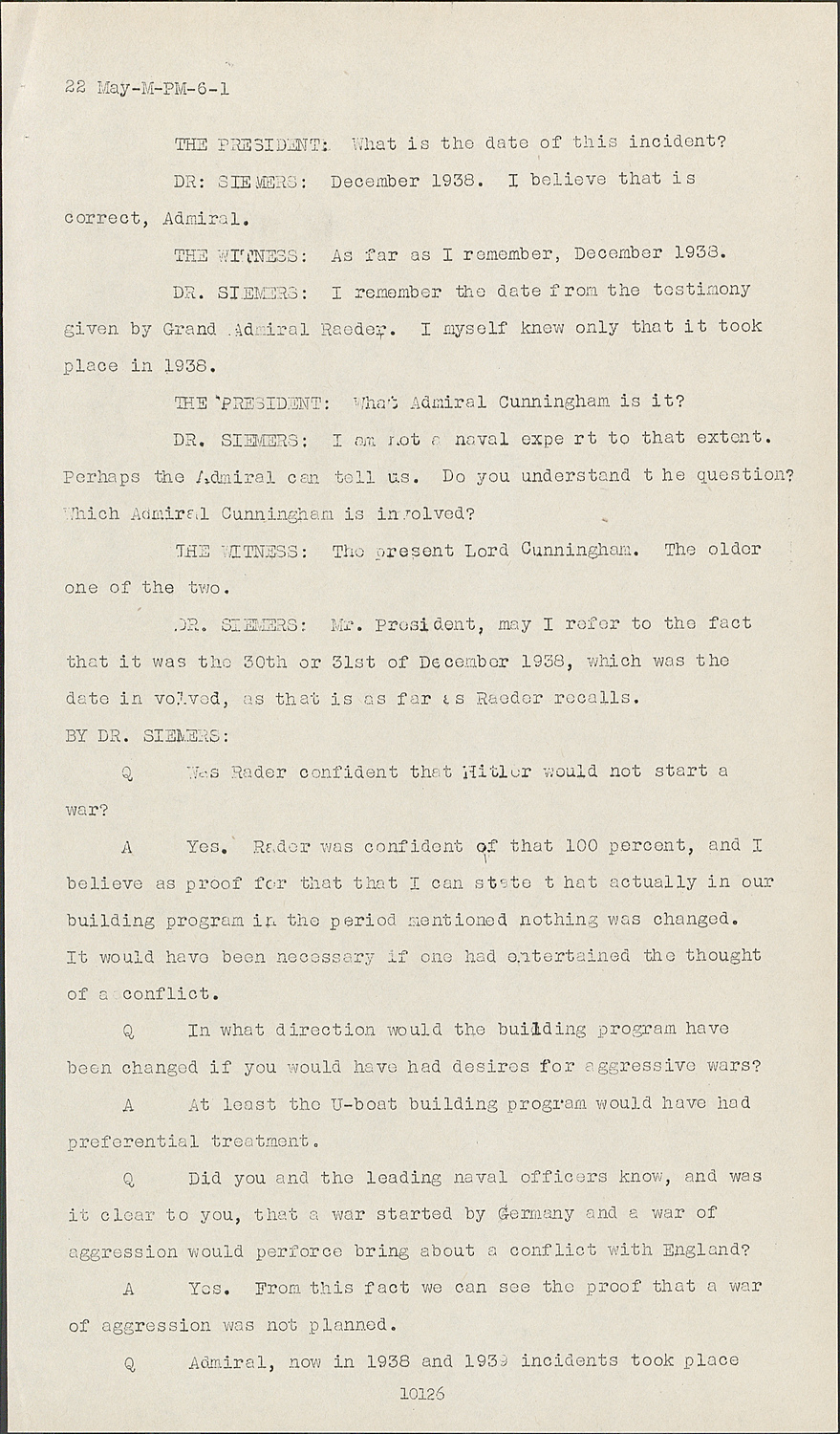
THE PRESIDENT: What is the date of this incident?
DR:SIEMERS: December 1938. I believe that is correct, Admiral.
THE WITNESS:As far as I remember, December 1938.
DR. SIEMERS:I remember the date from the testimony given by Grand Admiral Raeder. I myself knew only that it took place in 1938.
THE PRESIDENT:What Admiral Cunningham is it?
DR. SIEMERS:I am not a naval expert to that extent. Perhaps the Admiral can tell us. Do you understand the question? Which Admiral Cunningham is involved?
THE WITNESS:The present Lord Cunningham. The older one of the two.
DR. SIEMERS:Mr. President, may I refer to the fact that it was the 30th or 31st of December 1938, which was the date in volved, as that is as far is Raeder recalls. BY DR. SIEMERS:
QWas Rader confident that Hitler would not start a war?
AYes. Rader was confident of that 100 percent, and I believe as proof for that that I can state t hat actually in our building program in the period mentioned nothing was changed. It would have been necessary if one had entertained the thought of a conflict.
QIn what direction would the building program have been changed if you would have had desires for aggressive wars?
AAt least the U-boat building program would have had preferential treatment.
QDid you and the leading naval officers know, and was it clear to you, that a war started by Germany and a war of aggression would perforce bring about a conflict with England?
AYes. From this fact we can see the proof that a war of aggression was not planned.
QAdmiral, now in 1938 and 1939 incidents took place which perhaps might have caused a justifiable sceptism.
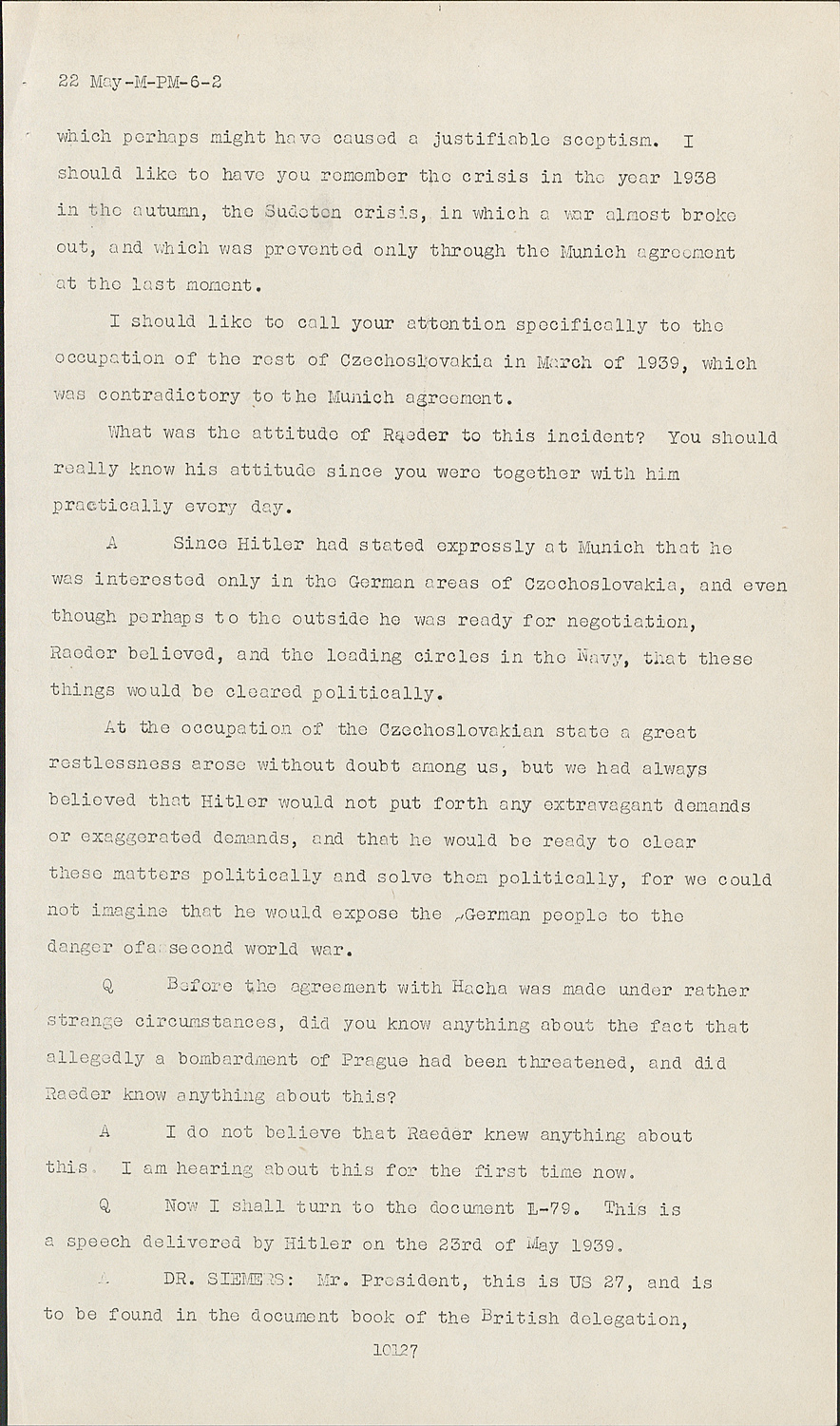
I should like to have you remember the crisis in the year 1938 in the autumn, the Sudeten crisis, in which a war almost broke out, and which was prevented only through the Munich agreement at the last moment.
I should like to call your attention specifically to the occupation of the rest of Czechoslovakia in March of 1939, which was contradictory to the Munich agreement.
What was the attitude of Raeder to this incident? You should really know his attitude since you were together with him practically every day.
ASince Hitler had stated expressly at Munich that he was interested only in the German areas of Czechoslovakia, and even though perhaps to the outside he was ready for negotiation, Raeder believed, and the leading circles in the Navy, that these things would be cleared politically.
At the occupation of the Czechoslovakian state a great restlessness arose without doubt among us, but we had always believed that Hitler would not put forth any extravagant demands or exaggerated demands, and that he would be ready to clear these matters politically and solve them politically, for we could not imagine that he would expose the German people to the danger ofa second world war.
QBefore the agreement with Hacha was made under rather strange circumstances, did you know anything about the fact that allegedly a bombardment of Prague had been threatened, and did Raeder know anything about this?
AI do not believe that Raeder knew anything about this I am hearing about this for the first time now.
QNow I shall turn to the document L-79. This is a speech delivered by Hitler on the 23rd of May 1939.
A DR. SIEMERS:Mr. President, this is US 27, and is to be found in the document book of the British delegation, Number 10, page 74.
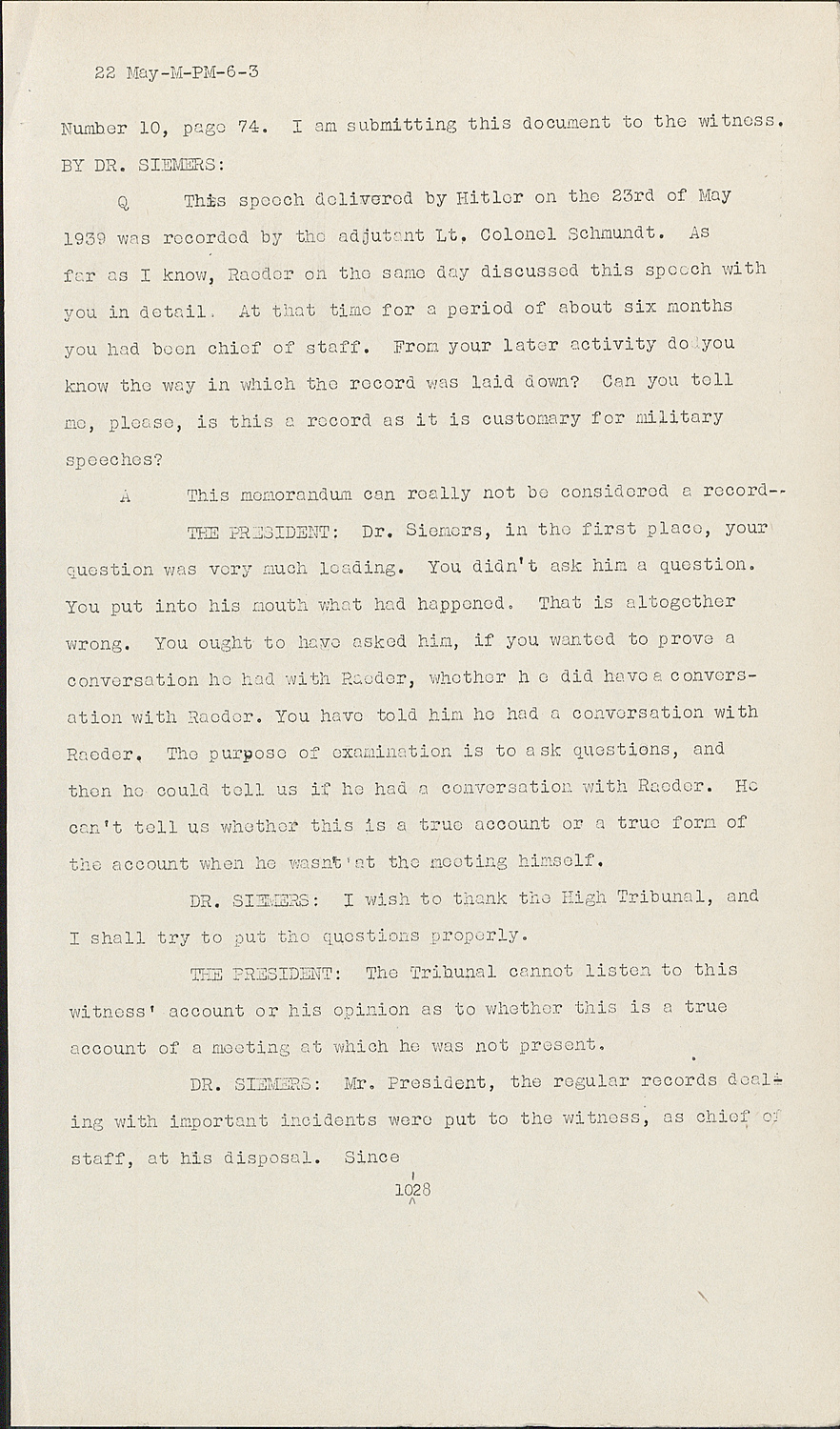
I am submitting this document to the witness.
BY DR. SIEMERS:
QThis speech delivered by Hitler on the 23rd of May 1939 was recorded by the adjutant Lt. Colonel Schmundt. As far as I know, Raeder on the same day discussed this speech with you in detail. At that time for a period of about six months you had been chief of staff. From your later activity do you know the way in which the record was laid down? Can you tell me, please, is this a record as it is customary for military speeches?
AThis memorandum can really not be considered a record-
THE PRESIDENT: Dr. Siemers, in the first place, your question was very much leading. You didn't ask him a question. You put into his mouth what had happened. That is altogether wrong. You ought to have asked him, if you wanted to prove a conversation he had with Raeder, whether h e did have a conversation with Raeder. You have told him he had a conversation with Raeder. The purpose of examination is to ask questions, and then he could tell us if he had a conversation with Raeder. He can't tell us whether this is a true account or a true form of the account when he wasnt'at the meeting himself.
DR. SIEMERS: I wish to thank the High Tribunal, and I shall try to put the questions properly.
THE PRESIDENT: The Tribunal cannot listen to this witness' account or his opinion as to whether this is a true account of a meeting at which he was not present.
DR. SIEMERS: Mr. President, the regular records dealing with important incidents were put to the witness, as chief of staff, at his disposal. Since this document is of a decisive nature, I should like to determine whether Schulte Moenting as Chief of Staff received this record or whether he just had knowledge of the contents through the immediate report by Grand Admiral Raeder.
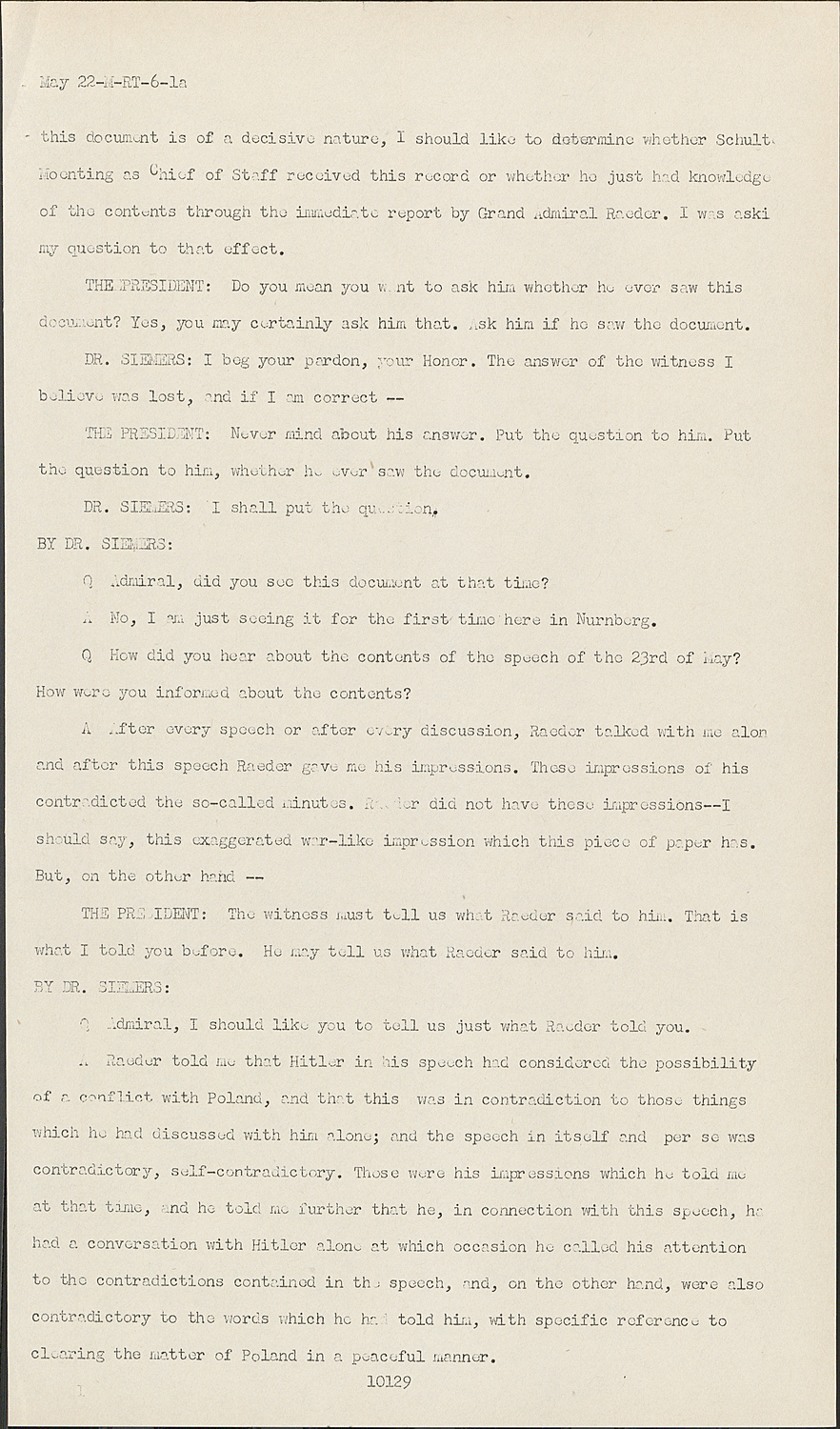
I was aski my question to that effect.
THE PRESIDENT:Do you mean you want to ask him whether he ever saw this document? Yes, you may certainly ask him that. Ask him if he saw the document.
DR. SIEMERS:I beg your pardon, your Honor. The answer of the witness I believe was lost, and if I am correct -
THE PRESIDENT:Never mind about his answer. Put the question to him. Put the question to him, whether he ever saw the document.
DR. SIEMERS:I shall put the question. BY DR. SIEMERS:
QAdmiral, did you see this document at that time?
ANo, I am just seeing it for the first time here in Nurnberg.
QHow did you hear about the contents of the speech of the 23rd of May? How were you informed about the contents?
AAfter every speech or after every discussion, Raeder talked with me alone and after this speech Raeder gave me his impressions. These impressions of his contradicted the so-called minutes. Reader did not have these impression--I should say, this exaggerated war-like impression which this piece of paper has. But, on the other hand -
THE PRESIDENT:The witness must tell us what Raeder said to him. That is what I told you before. He may tell us what Raeder said to him. BY DR. SIEMERS:
QAdmiral, I should like you to tell us just what Raeder told you.
ARaeder told me that Hitler in his speech had considered the possibility of a conflict with Poland, and that this was in contradiction to those things which he had discussed with him alone; and the speech in itself and per se was contradictory, self-contradictory. Those were his impressions which he told me at that time, and he told me further that he, in connection with this speech, he had a conversation with Hitler alone at which occasion he called his attention to the contradictions contained in the speech, and, on the other hand, were also contradictory to the words which he had told him, with specific reference to clearing the matter of Poland in a peaceful manner.