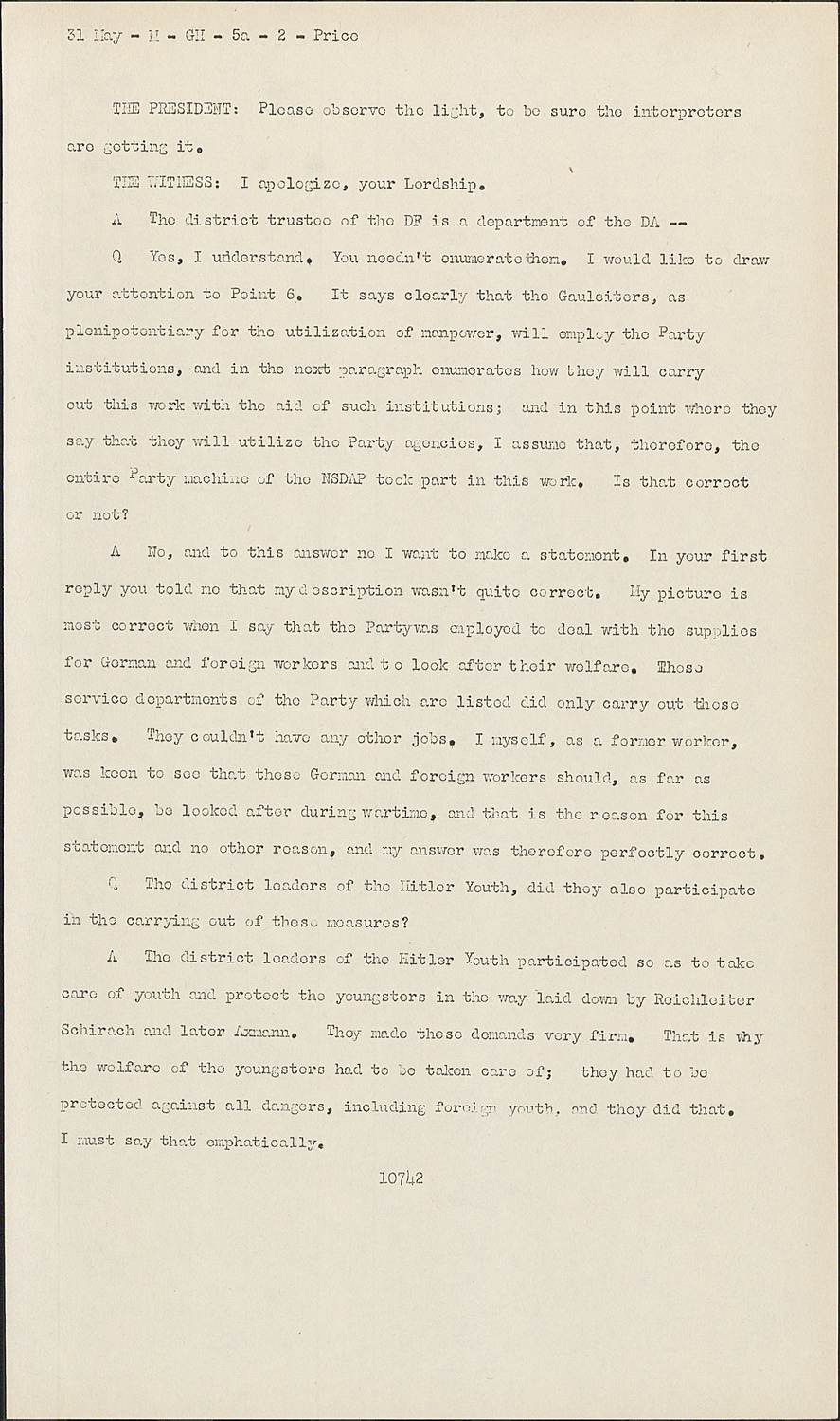
THE PRESIDENT: Please observe the light, to be sure the interpreters are getting it.
THE WITNESS:I apologize, your Lordship.
AThe district trustee of the DF is a department of the DA -
Q yes, I understand. You needn't enumerate them. I would like to draw your attention to Point 6. It says clearly that the Gauleiters, as plenipotentiary for the utilization of manpower, will employ the Party institutions, and in the next paragraph enumerates how they will carry out this work with the aid of such institutions; and in this point where they say that they will utilize the Party agencies, I assume that, therefore, the entire party machine of the NSDAP took part in this work. Is that correct or not?
ANo, and to this answer no I want to make a statement. In your first reply you told me that my description wasn't quite correct. My picture is most correct when I say that the Partywas employed to deal with the supplies for German and foreign workers and to look after their welfare. Those service departments of the Party which are listed did only carry out those tasks. They couldn't have any other jobs. I myself, as a former worker, was keen to see that those German and foreign workers should, as far as possible, be looked after during wartime, and that is the reason for this statement and no other reason, and my answer was therefore perfectly correct.
QThe district leaders of the Hitler Youth, did they also participate in the carrying out of these measures?
AThe district leaders of the Hitler Youth participated so as to take care of youth and protect the youngsters in the way laid down by Reichleiter Schirach and later Axmann. They made these demands very firm. That is why the welfare of the youngsters had to be taken care of; they had to be protected against all dangers, including foreign youth, and they did that. I must say that emphatically.
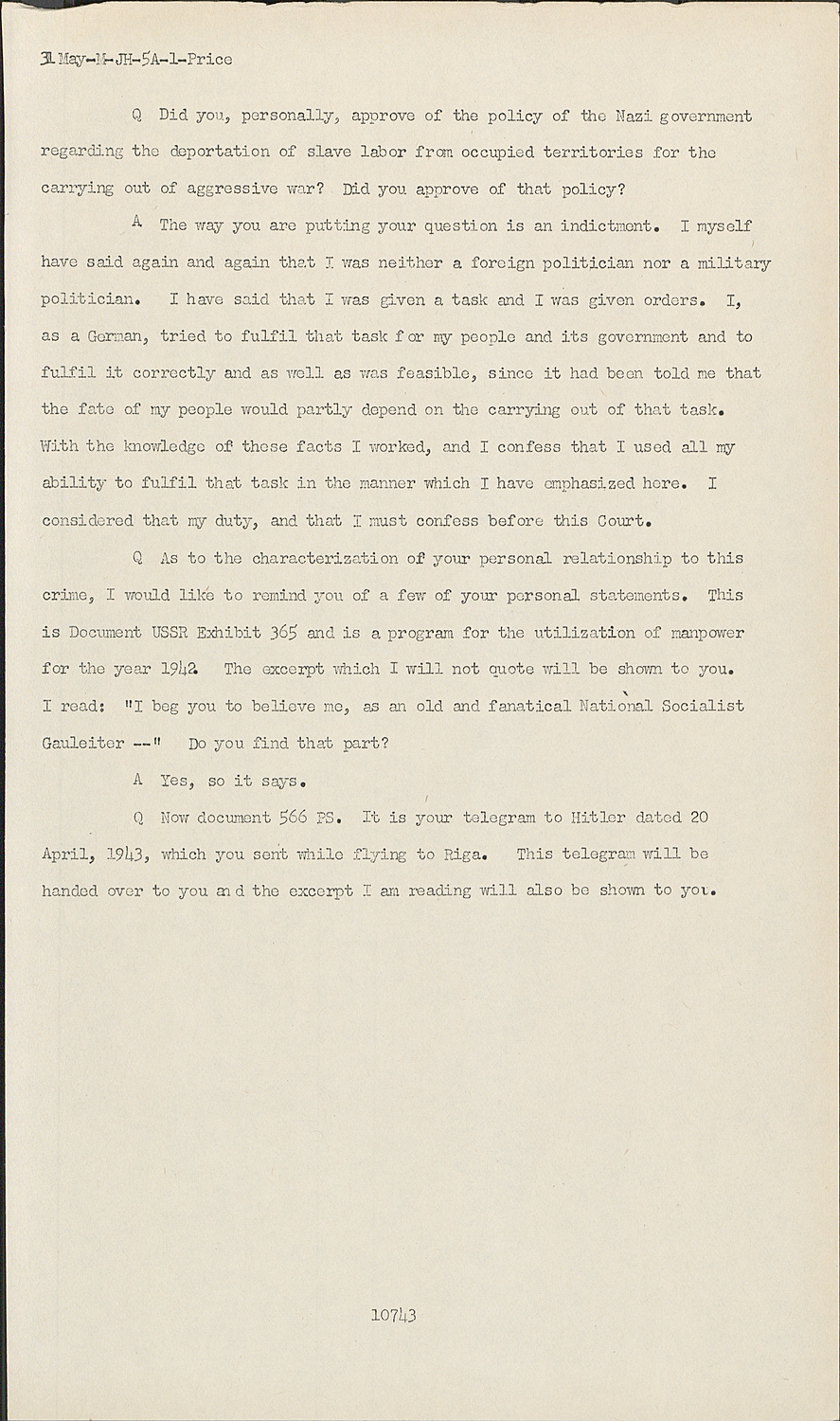
Q Did you, personally, approve of the policy of the Nazi government regarding the deportation of slave labor from occupied territories for the carrying out of aggressive war?
Did you approve of that policy?
AThe way you are putting your question is an indictment. I myself have said again and again that I was neither a foreign politician nor a military politician. I have said that I was given a task and I was given orders. I, as a German, tried to fulfil that task for my people and its government and to fulfil it correctly and as well as was feasible, since it had been told me that the fate of my people would partly depend on the carrying out of that task. With the knowledge of these facts I worked, and I confess that I used all my ability to fulfil that task in the manner which I have emphasized here. I considered that my duty, and that I must confess before this Court.
QAs to the characterization of your personal relationship to this crime, I would like to remind you of a few of your personal statements. This is Document USSR Exhibit 365 and is a program for the utilization of manpower for the year 1942. The excerpt which I will not quote will be shown to you. I read: "I beg you to believe me, as an old and fanatical National Socialist Gauleiter --" Do you find that part?
AYes, so it says.
QNow document 566 PS. It is your telegram to Hitler dated 20 April, 1943, which you sent while flying to Riga. This telegram will be handed over to you and the excerpt I am reading will also be shown to you.
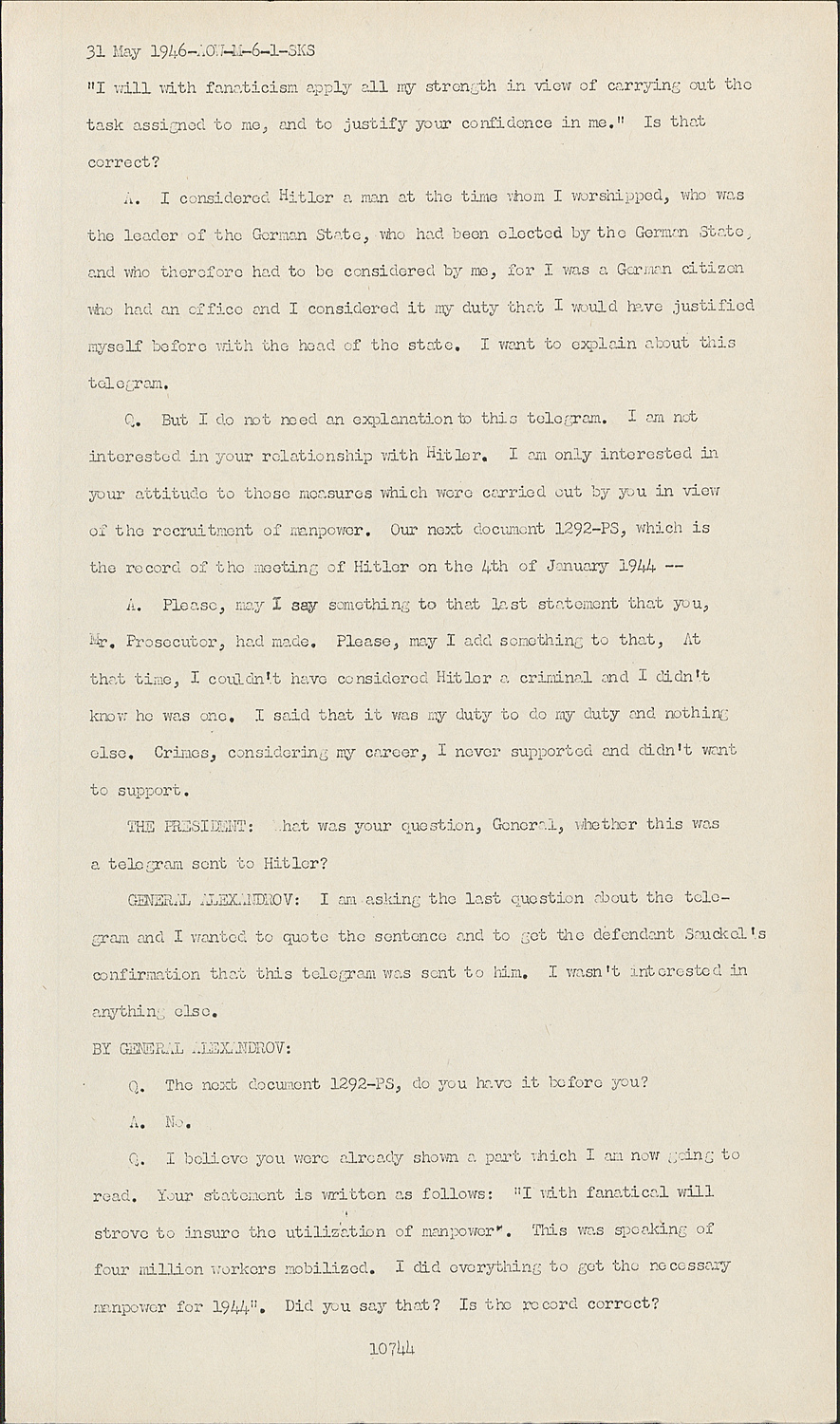
"I will with fanaticism apply all my strength in view of carrying out the task assigned to me, and to justify your confidence in me."
Is that correct?
AI considered Hitler a man at the time whom I worshipped, who was the leader of the German State, who had been elected by the German State and who therefore had to be considered by me, for I was a German citizen who had an office and I considered it my duty that I would have justified myself before with the head of the state. I want to explain about this telegram.
Q.But I do not need an explanation to this telegram. I am not interested in your relationship with Hitler. I am only interested in your attitude to these measures which were carried out by you in view of the recruitment of manpower. Our next document 1292-PS, which is the record of the meeting of Hitler on the 4th of January 1944 -
A.Please, may I say something to that last statement that you, Mr. Prosecutor, had made. Please, may I add something to that, At that time, I couldn't nave considered Hitler a criminal and I didn't know he was one. I said that it was my duty to do my duty and nothing else. Crimes, considering my career, I never supported and didn't want to support.
THE PRESIDENT:What was your question, General, whether this was a telegram sent to Hitler?
GENERAL ALEXANDROV:I am asking the last question about the telegram and I wanted to quote the sentence and to get the defendant Sauckel's confirmation that this telegram was sent to him. I wasn't interested in anything else. BY GENERAL ALEXANDROV:
Q.The next document 1292-PS, do you have it before you?
A.No.
Q.I believe you were already shown a part which I am now going to read. Your statement is written as follows: "I with fanatical will strove to insure the utilization of manpower. This was speaking of four million workers mobilized. I did everything to get the necessary manpower for 1944". Did you say that? Is the record correct?
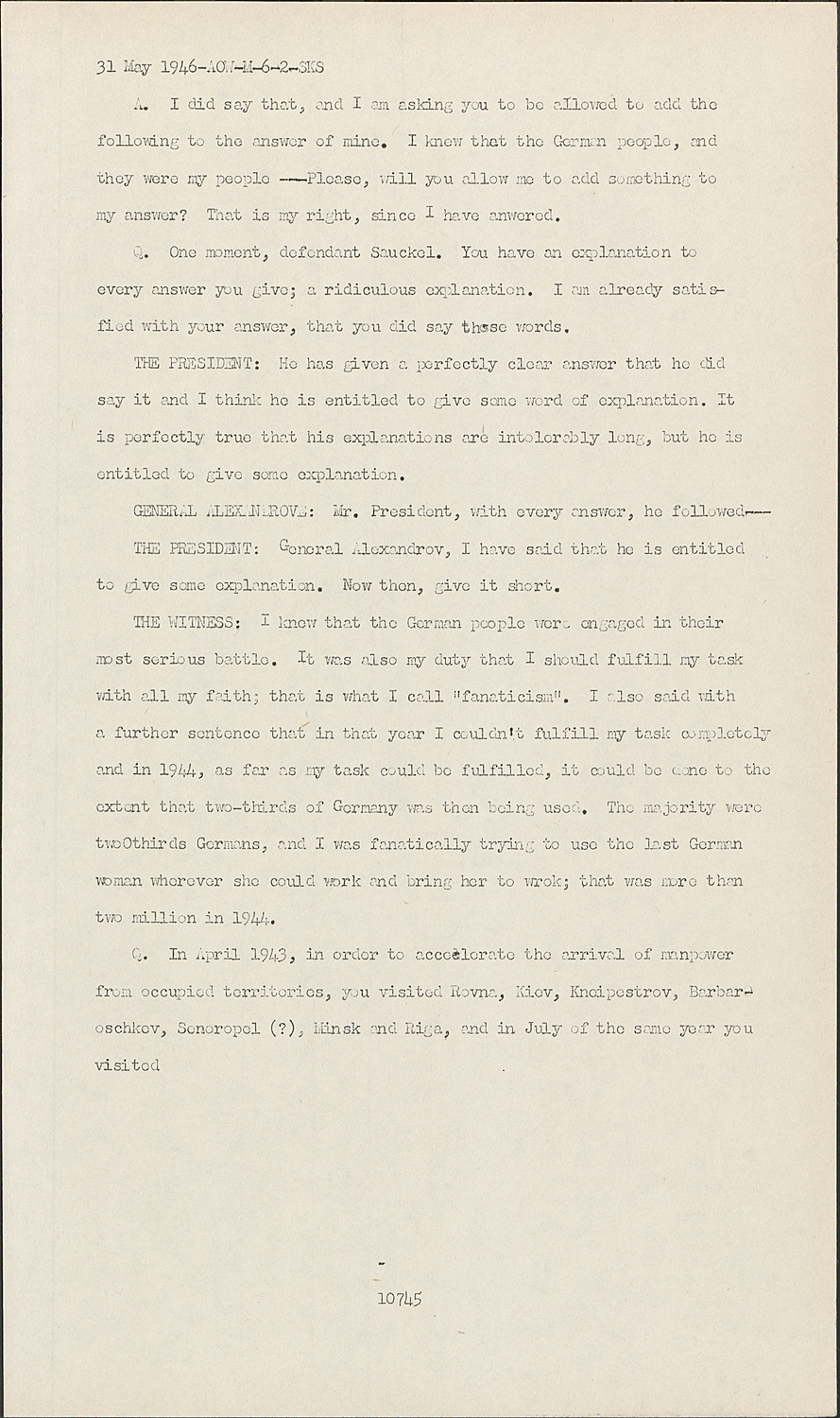
A. I did say that, and I am asking you to be allowed to add the following to the answer of mine.
I knew that the German people, and they were my people ---Please, will you allow me to add something to my answer? That is my right, since I have anwered.
Q.One moment, defendant Sauckel. You have an explanation to every answer you give; a ridiculous explanation. I am already satisfied with your answer, that you did say these words.
THE PRESIDENT:He has given a perfectly clear answer that he did say it and I think he is entitled to give some word of explanation. It is perfectly true that his explanations are intolerably long, but he is entitled to give some explanation.
GENERAL ALEXANDROVE:Mr. President, with every answer, he followed.--
THE PRESIDENT:General Alexandrov, I have said that he is entitled to give some explanation. Now then, give it short.
THE WITNESS:I knew that the German people were engaged in their most serious battle. It was also my duty that I should fulfill my task with all my faith; that is what I call "fanaticism". I also said with a further sentence that in that year I couldn't fulfill my task completely and in 1944, as far as my task could be fulfilled, it could be come to the extent that two-thirds of Germany was then being used. The majority were twoOthirds Germans, and I was fanatically trying to use the last German woman wherever she could work and bring her to wrok; that was more than two million in 1944.
Q.In April 1943, in order to acceelerate the arrival of manpower from occupied territories, you visited Rovna, Kiev, Kneipestrov, Barbaroschkev, Senoropel (?), Minsk and Riga, and in July of the same year you visited Prague, Katral, Kiev, Barbaroschkev, and Militropal.
Is that correct?
AThat is true and during those journeys, I convinced myself personally that my officers were working correctly.
QThus, you personally organized the deportation to slave labor of the peaceful population of the Occupied Territories. Is that correct, too?
AI must protest against that most severely and fanatically.
QBut, then, why did you go to all these towns? Didn't you do that so as to enforce the deportation to slave labor?
AI have visited these areas so as to convince myself personally about my offices in the town. I shouldn't say "my", but the departments that were part of the administration, how they were working and how they were carrying out the instructions -- offices of the German nation and if they were following instructions correct. I wasn't able to fulfill my instructions. That is why I went to those towns. As far as contingents were concerned, I negotiated with the heads and it is quite true that it was my task to recruit workers and to investigate conditions but as far as these visits are concerned, I inspected the offices personally to investigate their functioning and convinced myself.
QAnd also to insure the speedy deportation of manpower to Germany?
AI would see to it that the best methods were being employed in that connection. That is clearly contained in my instructions and that is before the Tribunal, on this very journey that you have mentioned.
QThat means that you especially went there only to improve the methods of recruitment? Am I to understand you thus?
AI went to these towns to convince myself whether the methods were correct and thest the methods with the service department. That is why I went, so it was my task; I didn't have to go to Russia or Kiev or any other town for that purpose. I only needed to talk to the Reich Commissioner and he was in Berlin; and I would talk to the Reich Commissioner who was in Rovna.
QYou, yourself, in your statements to your defense counsel, stated that no information as to the criminal methods of recruitment reached you and no complaints came to you. What was the reason for such a vast voyage to the Occupied Territories. I supposed that you received signals that mass deportation of slave labor was taking place. You visited more than ten cities.
A May I correct you, Mr. Prosecutor, by saying that my defense counsel asked me about that statement and that I have answered him in the affirmative, in so far as I did have complaints and where I corrected them by stopping wherever I could stop and I am having witnesses called for that reason through my defense counsel.
QYes, the witnesses are to be heard in due time but I would like to ascertain now the object of your trip. It is stated that these trips were carried out in order to improve the method of recruitment; therefore, I assume, logically, that before you arrived, certain arbitrary methods were carried out and you want there so as to correct these methods and you know them. New, answer, why did you go there and visit all these towns?
AI have already answered that question in every way and I say again that I assume, Mr. Frosecutor, that you personally have had so much administrative experience yourself to realize that in every department somewhere in the country, in every country in the world, it is obvious that instructions are inspected and investigated. It is even necessary to know that people in every human organization will make mistakes and that therefore they have to investigate it.
QDo you deny that you went there so as to improve the methods or you went there so as to accelerate the deportation to Germany -- one or two-choose.
ANo, I must say emphatically that I went on these journeys to ascertain, within the limitsof my task, how my instructions were being carried out. I told my defense counsel during examination that I had been asked by Fieldmarshal Kluge about certain deficiencies but I also went to inform myself about the instructions to these departments and the purpose of my visit was correct during the journey, and I gave my evidence for that.
THE PRESIDENT:General Alexandrov, can you tell the Tribunal how much longer you will be.
GENERAL ALEXANDROV:I am afraid to say quite exactly but I believe about two hours.
THE PRESIDENT:You aren't losing sight of the fact, are you, that we already had a thorough cross examination by the French prosecutor. The Tribunal hopes that you will try to make your cross examination as short as possible, and the Tribunal will adjourn now.
(A recess was taken).
BY GENERAL ALEXANDROV:
QDefendant Sauckel, tell us how you as General Plenipotentiary were concerned in utilization in German industry of Russian prisoners of war.
AI must reply to your question by saying that for the use of prisoners of war I had no collaborators because I did not employ prisoners of war.
QAnd you did not carry out their mobilization?
AWhen the agency concerned was carrying out administrative measures through the labor offices between the firm and the camp, or rather, the prisoner of war system, it was my task to get these prisoners of war for the firms.
QAnd what were the agencies or organizations?
AThey were the generals for the prisoner of war system in the army district, and the other was the organization of the firms or the firms themselves working through the ministries concerned. It was the Food Ministry of the Reich through which most prisoners were sent to farmers to work.
QIn other words, you did not have anything to do with it? I shall remind you-
AThrough the district labor offices, as far as they were having to act formally, I had to include them, as far as it was not done directly between the firms themselves and the camps.
QI shall now cite a few excerpts from your report to Hitler of 28 July 1943. The document is 1296 PS, page 5. In this report, part three-
AThree or two?
QThree. It is entitled "Draft of Mobilization of Soviet Prisoners of War", and you write there, and here I quote:
"Together with mobilization for labor of all civilian workers. I systematically increased mobilization or draft of Soviet prisoner; of war, being assisted by OKW."
And further on:
"I assigned great importance to the further increase of tempo and delivery of the maximum number of prisoners of war from the front to work within the Reich."
Is this correct?
AThat is correct, and it corresponds exactly to the story I have told you.
QIt does not quite correspond, You mentioned at the time that you did not have anything to do with the utilization of prisoners of war in German industry, and now in your report you give different information, and that is why I am asking you, Did you plan in advance the utilization of prisoners of war in the armament industry? That was included in your plans, was it not, and you are writing about it in this report? Isn't that so?
AI must rectify an important error on your part. In the whole world, be it for the state or privately, labor agencies were not organizations or institutions which were exploiting workers but were passing workers on. I must note that you are making a major error there. It was my job to create connections so that these prisoners of war who might be stationed in camps in the occupied territory, say in the Government General, should be transferred from the generals for the prisoner of war system to the agricultural sectors in Germany and that they were registered and distributed accordingly. The actual employment in the firms was not under my supervision, and I had nothing to do with that.
QIn other words, you participated in supplying Soviet prisoners of war for utilization in Germany industry?
AThat is not correct, considering my use of the German language and my understanding of it. Vermittlung (agency) is something quite different from exploitation. Other people will have to state their views about it. I can only speak about the transfer of these people, who were handled by the state in Germany, whereas in other countries it might be a private affair. No exploitation can be mentioned in that connection. I have not exploited one single worker.
QDid you know that the Soviet prisoners of war were being utilized in the armamant industries in Germany?

A It was known to me that Soviet prisoners of war were used in German war industry, which is a very wide conception.
It was a very large affair.
QDid you know, in particular, the directive of Field Marshal Keitel regarding the utilization of Soviet prisoners of war in the mining industry? This directive is dated 8 July 1943. Do you happen to know anything at all about it?
AI cannot recollect it in detail. Will you please be good enough to put it to me?
Q Have you read it?
AYes.
QIt is stated here that there was utilization of Soviet prisoners in the mining industry, in the interest of war. Is that correct?
A it is with reference to employment of prisoners of war in nines in Germany.
QFor what purpose? The problem is directly stated in this document.
AIt was in coal mines,
QFor what purpose? It was subject to aims and purposes? It is stated directly in the document.
ATo work.
QIn the interests of war.
AAll the German mines weren't working in the interests of war. A lot of coal from Germany was supplied to neutral countries. That was different.
QI will read the beginning of this document. Fellow me:
"For the execution of the enlarged iron and steel program, the Fuehrer has ordered on 7 July the absolute guarantee of the necessary coal production and for that purpose he has ordered to cover the requirements for manpower with prisoners of war."
Is it written there?
AI haven't quite get hold of what you read.
QDid you find the place?
AYes.
QIn such a way, the Soviet prisoners of war were to be utilized in the mining industry in the interests of war, is that correct? Isn't it stated in the document.
AYes, it says that, but I want to say that this data is not addressed to me.
QI asked you whether you knew this document and you said you did.
ANow I know it, Before that, I didn't; it didn't appear to me.
QYou told me that you knew about this directive in January, and you asked me to submit this document to you so that you could acquaint yourself with it in detail.
ANo, I told you -- I want to state that again -- that I did not remember, and asked of you would be good enough to put the document to me. The document does no have my address on it. It did not come into my hands or into my office. Q In order to fully ascertain the answer to this question, I shall submit to you document USA-206.
This is your order of the 22nd of August 1944 in regard to sup-
plying manpower from occupied territories. Do you happen to know this order?
THE PRESIDENT:What is the PS number?
GENERAL ALEXANDROV:The PS number? One minute, please. Unfortunately, I regret. I don't have the PS number. All I have is the United States exhibit number, which is 206.
THE PRESIDENT:Have the United States Prosecutors got the corresponding number to USA-206?
MR DODD:I could have it in a few minutes, Mr. President.
I don't have it right at my fingertips, but I will obtain it.
THE PRESIDENT:Thank you. BY GENERAL ALEXANDROV:
Q.Defendant Sauckel, paragraph 8 of this order states that it is valid so far as the prisoners of war are concerned. Was there such a directive?
A.Yes.
Q.Therefore, you yourself didn't differentiate between the prisoners of war and the civilian population as far as their utilization and demand in the German war industry was concerned. Do you acknowledge that?
A.I have already answered to my defense counsel, and I think I also said so yesterday, that I and the Minister of Labor of the Reich generally had a catalogue under which prisoners of war could be employed. But this paragraph 8 has nothing to do with this particular letter, because that was an instruction which didn't come to me and which wasn't addressed to me.
GENERAL ALEXANDROV:Mr. President, the document USA-206 has PS No. 3044.
Q.Beside the statements to your defense counsel which you mentioned, you also stated that during the utilization of manpower in the German war industry, the requirements of the Geneva Convention were observed.
A.Yes, and that is available in documents, that the Reich Ministry of Labor and my offices had issued instructions that the Geneva Convention was to be observed in all respects concerning prisoners of war.
Q.And here you maintain that you didn't differentiate between the Soviet prisoners of war and the civilian population, is that correct?
A.No, that isn't true at all.
Q.In other words, a violation of this convention took place as far as the utilization of prisoners of war was concerned, inasmuch as they were treated by you in the same way as the civilian population and were utilized by industry in the interests of waging war.
A.In that case, I must have misunderstood you, or you may have misunderstood me. I said particularly that I did attach importance to it and that during the time I was in office I stated that the Geneva Convention was to be observed.
I couldn't do more than that.
Q.Your defense counsel questioned you in regard to Operation Ost, and you answered in this way, and here I am citing the transcript of the record:
"Sauckel: No, I had nothing to do with this particular measure."
Now, I shall give you a letter from Alfred Meyer dated the 11th of July 1944. This document is PS-199, This letter is addressed to you. Will you please read Paragraph 1:
"That the war employment command formerly stationed in Minsk must continue under all circumstances the calling in of young White Ruthenian and Russian manpower for military employment in the Reich. In addition, the command has the mission to bring young boys of 10 to 14 years of age to the Reich."
A I have read the passage, and I want to answer to it that although the letter is adressed to me, and although I must have information of it, I nevertheless had nothing to do with that plan in my office or personally.
The case of the defendant Schirach has already brought the subject up, that these things were carried out within the authorities concerned, and the labor under my control was not actually concerned with it.
QAnd how were you concerned with the staff that was in charge of utilization of manpower? What was your relation to the staff which was in charge of manpower center? Kriegseinsatzkommando Mitte; was that your staff?
AI don't understand the question.
QThe staff which is referred to in the letter of Alfred Meyer, the staff dealing with the utilization of manpower "center".
AI can't find the word.
QIn the very beginning.
A.Kriegseinsatzkommando Mitte is completely unknown to me. I don't know who he was; I don't know what he was; I don't know whether he was a military or civilian authority. I can't tell you. I have nothing to do with that.
QIt was testified here that for people from occupied territories, workers, the Reich Security Administration introduced markings. For the Soviet citizens, it was -- you don't hear me?
AI can't understand.
QYou testified here that for people who were brought in from occupied territories, certain identification signs were introduced. For the Soviet citizens it was the marking "Ost"; for Polish people, it was the letter "P", and so on, and you testified that you were not in agreement with this.
Now, what did you do in order to rescind this mockery?
AI made an attempt to stop such markings altogether. The Reichsfuehrer SS demanded categorically, however -- and I think there is a letter -that these foreign workers be marked, the foreign workers who were going about freely in Germany at my request, and they had to be marked when they left the camp.
QI understand.
AIt was not a mockery. I want to state that emphatically. I did not consider it as mockery.
QDid you say anything at all about it to your direct superior, the defendant Goering?
AWhether I talked to Goering directly, I cannot remember today. I can only testify that again and again, at regular intervals, I tried, until in March 1944, I think, my efforts were in fact successful, when the small eastern badge was changed to a national badge on the sleeve, as had been suggested by liaison officers for the various people from the east.
QI asked you whether you spoke about this matter with Goering or whether you did not.
AI cannot recollect; maybe yes, maybe no.
THE PRESIDENT: General Alexandrov, I think you might pass on from this.
Q In answer to questions of your defense counsel and of my French colleague in regard to how Speer treated your appointment as general plenipotentiary, you mentioned that you did not know anything at all about it.
Now, you shall be given an article from a newspaper, the "Voelkischer Beobachter" This os document USSR 467 and is being submitted to the Tribunal.
(Witness handed document)
This article was published on the 28 March, 1942 in connection with your appointment as general plenipotentiary. Do you find the place wherein it states:
"The appointment of Gauleiter Sauckel was made on the wish of Reich Minister Speer because of the extraordinary work involved in the task of utilization of manpower in the armamemt industry."
Of course, one must suppose you read the article.
AI cannot positively state that at this moment, not exactly, but it is possible pr probable. I did not have much time to read newspapers but I want to tell you, Mr. Prosecutor, firstly, during the time when I was in office I had more than five million German workers from various branches of German economy introduced into the armament industry. This task was done by me and in principle referred to German workers and involved their transfer.
QWhat I was interested in was why was defendant Speer interested in your personal appointment as a general plenipotentiary. That is what I wanted to ascertain. Can you tell me anything in regard to that matter?
APrime Minister Speer was interested in my nomination -- that is something I cannot tell you about. I have already told my defense counsel that I myself was surprised at the time.
QYou maintain that on account of your own resources the Hitlerite government went on the criminal path of enslavement of civilian populations and also utilized prisoners of war. Is that correct, is that what you maintain
AI must state that I resent that conception on my part.
THE PRESIDENT:General, I have already pointed out to you twice that i is not right for you to put questions using such language as that -- criminal, crimes or violation of treaties for it involves assuming the guilt of the defendants. BY GENERAL ALEXANDROV:
QYou maintain that on account of a lack of resources within the country the Hitlerite government started on the road of mobilization and utilization in the war industry of civilian populations and also the prisoners of war, is that right?
AI have already answered this question to my defense counsel. I stated that I personally, upon being nominated, suggested a different program but that the Fuehrer and other sources were not satisfied with that and while giving me the corresponding explanations also gave me orders.
QBut you yourself replied here that so far as manpower resources in Germany was concerned they were exhausted; did you say that?
AIn carrying out my duties I pointed repeatedly that both in Germany as well as in occupied territories and because of the existing economic tasks, employment resources had been exhausted and could no longer be carried through so easily. That is shown by my statement.
QNow, I will ask you about the letter from defendant Speer, which was sent to you by Speer on the 22nd of January, 1944, and I quote from this document, which is in the document book of the defendant Speer. It is number Speer 06. In this particular document Speer draws your attention to the insufficient utilization of manpower.
DR.FLAECHSNER (Counsel for defendant Speer): In my document book I have included a letter which refers to a subject which is about to be brought up here. Whether or not I am going to use the document will only transpire as the trial progresses and I do not consider it proper that the Prosecution use my documents before I myself have had a chance to bring my case up before the Tribunal.
Please, may I have the Tribunal's decision?
THE PRESIDENT:The Tribunal think the motion should be granted and that you ought not to be allowed to use the document until the defendants' counsel have used the documents.
GENERAL ALEXANDROV:Mr. President, May I ask you then, to exclude from the transcript the preceding question which dealt with the lack of manpower resources in Germany because if this motion is granted there is no sense to the previous question.
THE PRESIDENT:Very well, if you wish it.
GENERAL ALEXANDROV:Yes, I ask that.
BY GENERAL ALEXANDROV:
QNow, your defense counsel put before you and acquainted you with document 69 during the session of May 29. This document deals with the treatment of foreign born workers. The document number is 68. I shall not go into detail as to the document and I will limit myself to your answer to defense counsel as it appears in the transcript.
I read the transcript:
"Sauckel: First of all I would like to state the fact that this document was composed on the 6th of March 1941; in other words there is a difference of one year, with reference to my stay in office.
"Since this document is being presented here I shall add to my case documents which confirm or acknowledge the fact that I automatically destroyed similar orders. Second, in such a case I could not have given such orders to any agency in the Reich."
Do you remember this testimony of yours given at the session of the 29th of May of this year?
AYes.
THE PRESIDENT:General, I am told that this is an incorrect translation. It was revoked and not destroyed. You said "destroyed" did you not?
GENERAL ALEXANDROV:I read the Russian transcript and perhaps there are certain inaccuracies in it but I do not argue against the word "revoke" because the meaning of it, after ail, remains the same.
THE WITNESS:May I ask that this story be repeated because I am not quite clear about it. BY GENERAL ALEXANDROV:
QNo, I do not want to refer to document 68. All I want to find out is whether, in reply to your defense counsel, this is what you stated. You do not argue against the transcript of your testimony which was read by me? That is the same statement you made here, What you spoke about on the 29th of May?
ANo, but I do not quite understand what the conception as to the word "destroyed" has to do with what you have just been talking about.
QWell, one must employ the term here not of destruction but of revoking or rescinding.
A That is possible.
QYou confirm your testimony which I have just read to you from the transcript?
AYes.
QNow, tell us, do you remember in what particular conditions were Ukrainian women and girls from occupied territories placed by you, people who were drafted to work in German agriculture?
I shall hand you document USSR 365 -- I beg your pardon, 383.
(Witness handed document)
THE PRESIDENT: Do you have the PS number?
GENERAL ALEXANDROV: No, sir; this is a USSR document. BY GENERAL ALEXANDROV:
QIn this document there is an appendix number 2 to your directive dated the 8th of September, 1942. That appendix is called "Instructions to housewives as to the utilization of foreign workers in agricultural and household tasks."
Do you know this document? Do you remember this instruction or notice?
AYes.
QI shall read a few excerpts in order to characterize what kind of conditions were placed by you upon these Ukrainian women and girls who were sent to work in Germany in agricultural and household tasks.
Please find Paragraph B, "Registration with the Police." Have you found that? Then, "Medical treatment and control." Have you found that? "Registration with the Police", and "Medical treatment and control."
ANo. not quite.
QParagraph B. Have you found it?
APage 4?
QIt is the paragraph that has to do with registration with the police and medical treatment and control. There is written here:
"Eastern workers must carry their registration with them, with the marking on the right side."
ABut 1 haven't got that.
QYou will find it later, because it is included in there.
ABut I must be able to follow you.
QHave you found it?
AYes.
QNow paragraph 4, which is entitled "Labor Conditions". It is written here that Eastern female workers who are being used for household work in the Reich must work under specific labor conditions.