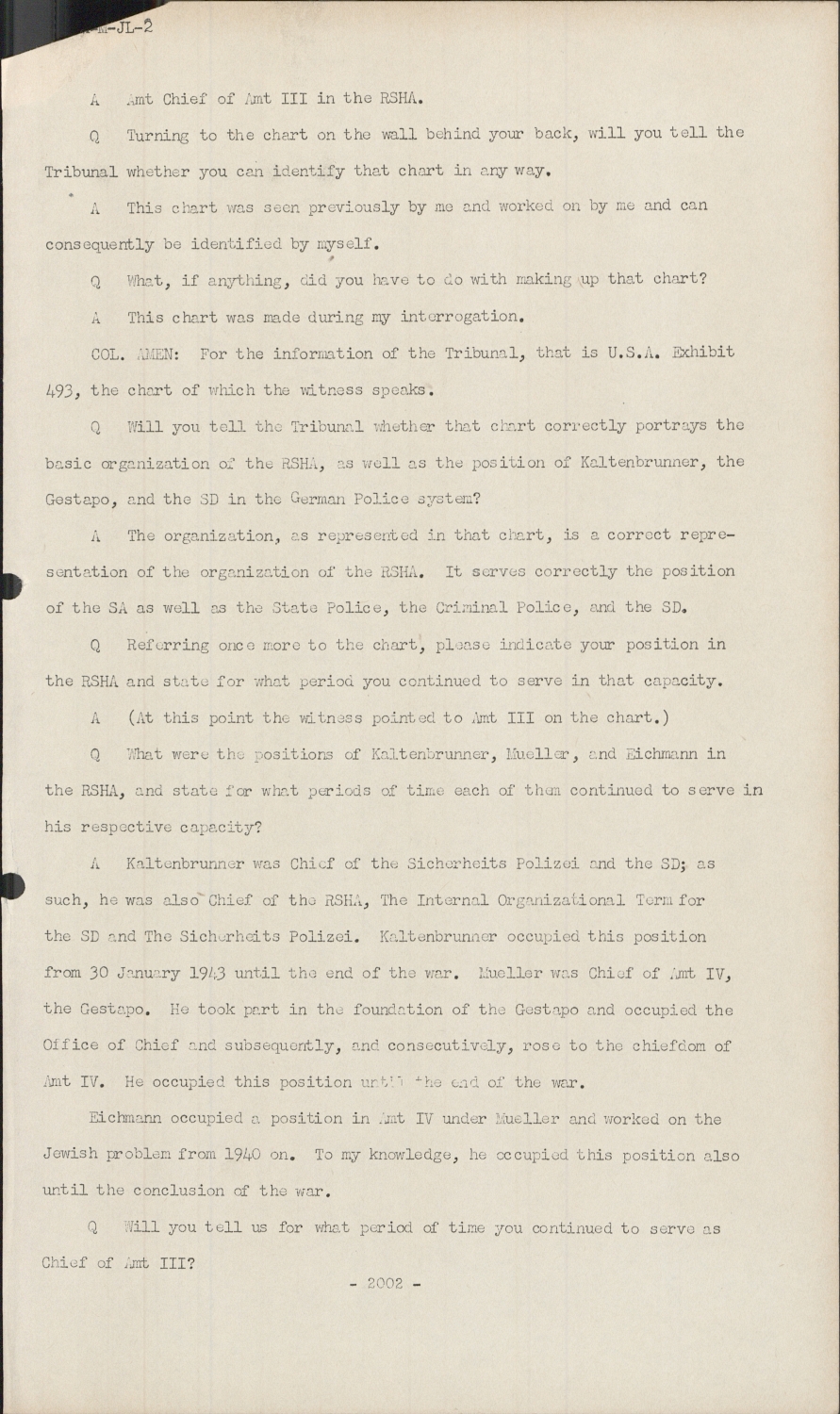
A Amt Chief of Amt III in the RSHA.
QTurning to the chart on the wall behind your back, will you tell the Tribunal whether you can identify that chart in any way.
AThis chart was seen previously by me and worked on by me and can consequently be identified by myself.
QWhat, if anything, did you have to do with making up that chart?
AThis chart was made during my interrogation.
COL. AMEN:For the information of the Tribunal, that is U.S.A. Exhibit 493, the chart of which the witness speaks.
QWill you tell the Tribunal whether that chart correctly portrays the basic organization of the RSHA, as well as the position of Kaltenbrunner, the Gestapo, and the SD in the German Police system?
AThe organization, as represented in that chart, is a correct representation of the organization of the RSHA. It serves correctly the position of the SA as well as the State Police, the Criminal Police, and the SD.
QReferring once more to the chart, please indicate your position in the RSHA and state for what period you continued to serve in that capacity.
A (At this point the witness pointed to Amt III on the chart.)
QWhat were the positions of Kaltenbrunner, Mueller, and Eichmann in the RSHA, and state for what periods of time each of than continued to serve in his respective capacity?
AKaltenbrunner was Chief of the Sicherheits Polizei and the SD; as such, he was also Chief of the RSHA, The Internal Organizational Term for the SD and The Sicherheits Polizei. Kaltenbrunner occupied this position from 30 January 1943 until the end of the war. Mueller was Chief of Amt IV, the Gestapo. He took part in the foundation of the Gestapo and occupied the Office of Chief and subsequently, and consecutively, rose to the chiefdom of Amt IV. He occupied this position until the end of the war.
Eichmann occupied a position in Amt IV under Mueller and worked on the Jewish problem from 1940 on. To my knowledge, he occupied this position also until the conclusion of the war.
QWill you tell us for what period of time you continued to serve as Chief of Amt III?
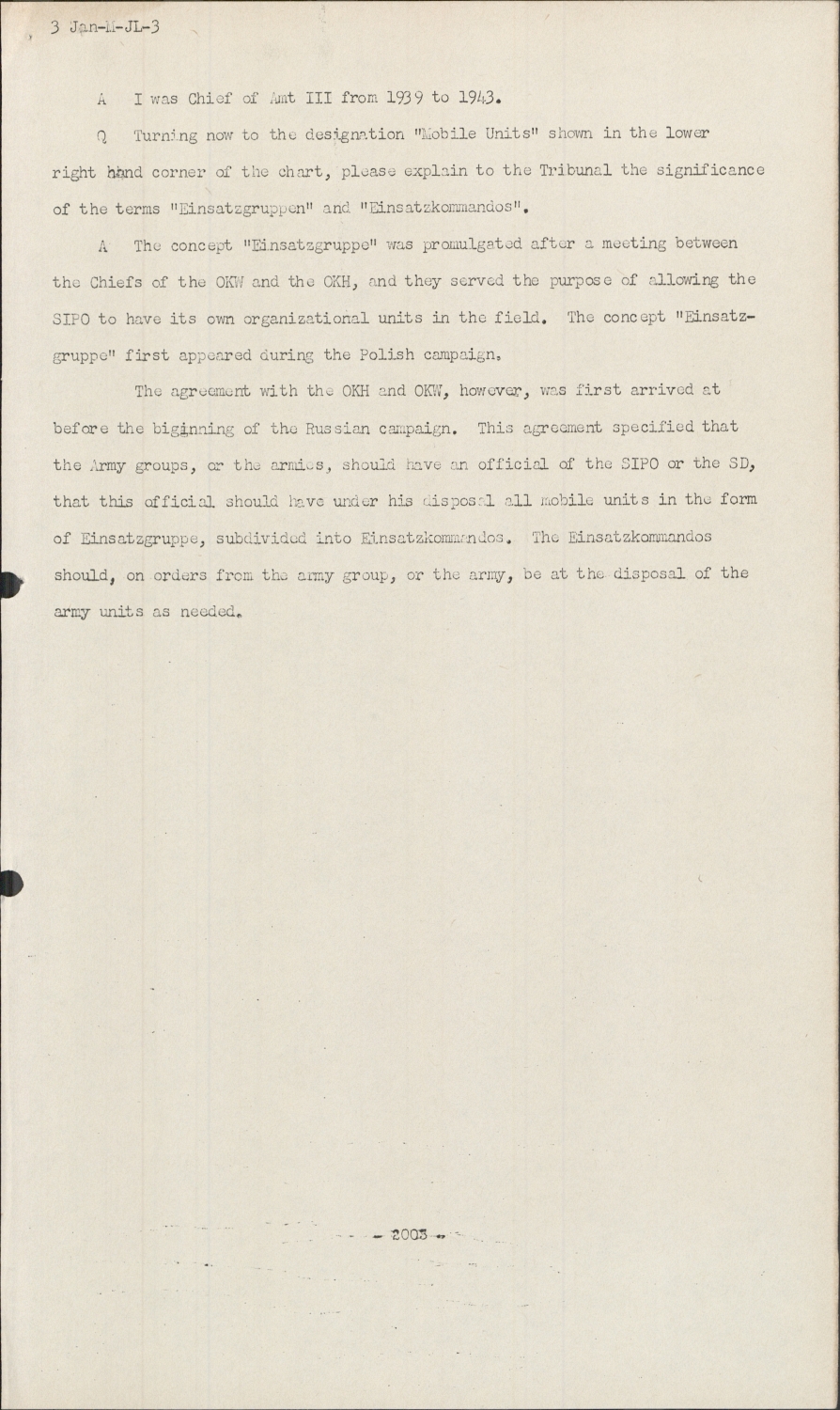
A I was Chief of Amt III from 1939 to 1943.
QTurning now to the designation "Mobile Units" shown in the lower right hand corner of the chart, please explain to the Tribunal the significance of the terms "Einsatzgruppen" and "Einsatzkommandos".
AThe concept "Einsatzgruppe" was promulgated after a meeting between the Chiefs of the OKW and the OKH, and they served the purpose of allowing the SIPO to have its own organizational units in the field. The concept "Einsatzgruppe" first appeared during the Polish campaign.
The agreement with the OKH and OKW, however, was first arrived at before the biginning of the Russian campaign. This agreement specified that the Army groups, or the armies, should have an official of the SIPO or the SD, that this official should have under his disposal all mobile units in the form of Einsatzgruppe, subdivided into Einsatzkommandos. The Einsatzkommandos should, on orders from the army group, or the army, be at the disposal of the army units as needed.
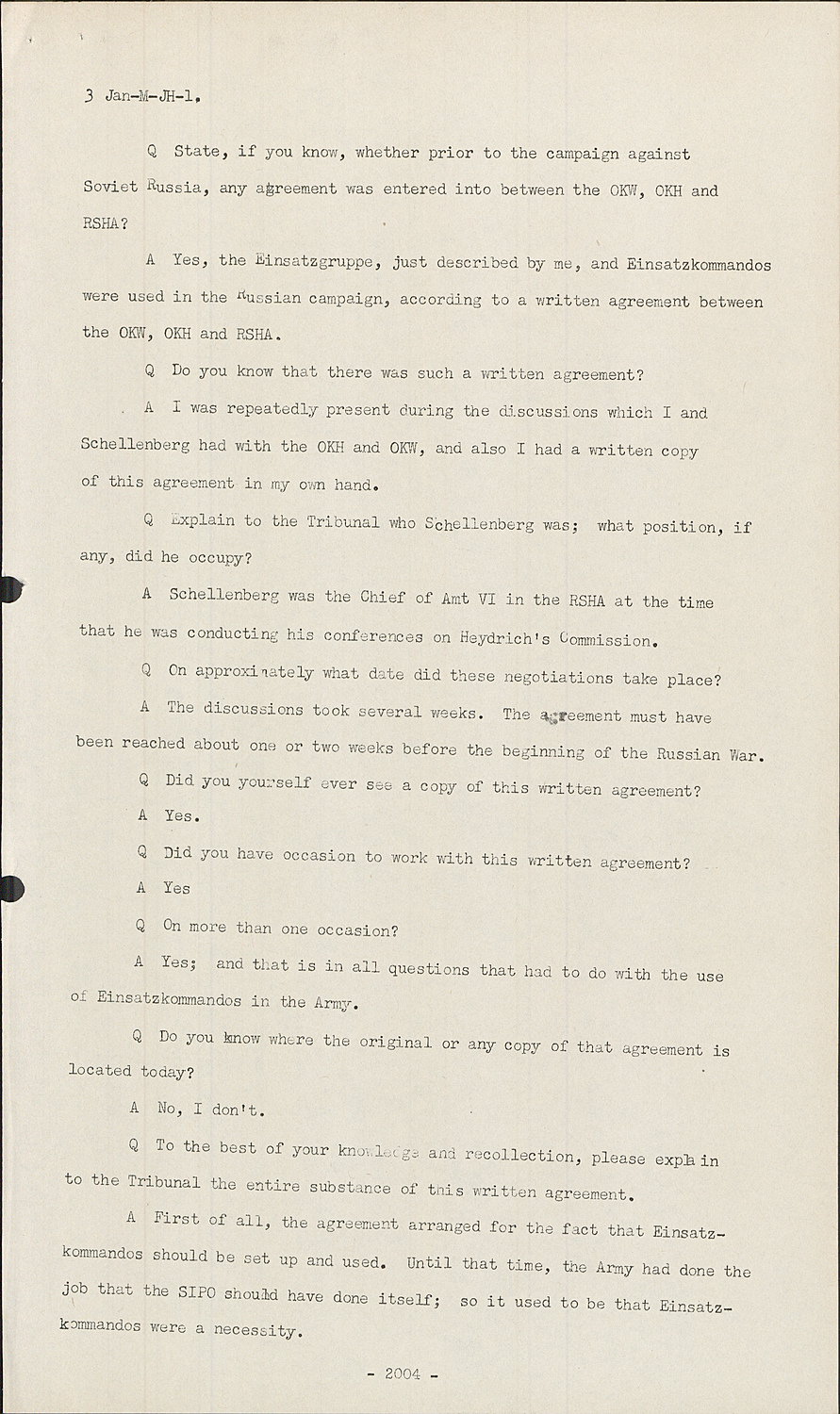
Q State, if you know, whether prior to the campaign against Soviet Russia, any agreement was entered into between the OKW, OKH and RSHA?
AYes, the Einsatzgruppe, just described by me, and Einsatzkommandos were used in the Russian campaign, according to a written agreement between the OKW, OKH and RSHA.
QDo you know that there was such a written agreement?
AI was repeatedly present during the discussions which I and Schellenberg had with the OKH and OKW, and also I had a written copy of this agreement in my own hand.
QExplain to the Tribunal who Schellenberg was; what position, if any, did he occupy?
ASchellenberg was the Chief of Amt VI in the RSHA at the time that he was conducting his conferences on Heydrich's Commission.
QOn approximately what date did these negotiations take place?
AThe discussions took several weeks. The agreement must have been reached about one or two weeks before the beginning of the Russian War.
QDid you yourself ever see a copy of this written agreement?
AYes.
QDid you have occasion to work with this written agreement?
AYes
QOn more than one occasion?
AYes; and that is in all questions that had to do with the use of Einsatzkommandos in the Army.
QDo you know where the original or any copy of that agreement is located today?
ANo, I don't.
QTo the best of your knowledge and recollection, please explain to the Tribunal the entire substance of this written agreement.
AFirst of all, the agreement arranged for the fact that Einsatzkommandos should be set up and used. Until that time, the Army had done the job that the SIPO should have done itself; so it used to be that Einsatzkommandos were a nacessity.
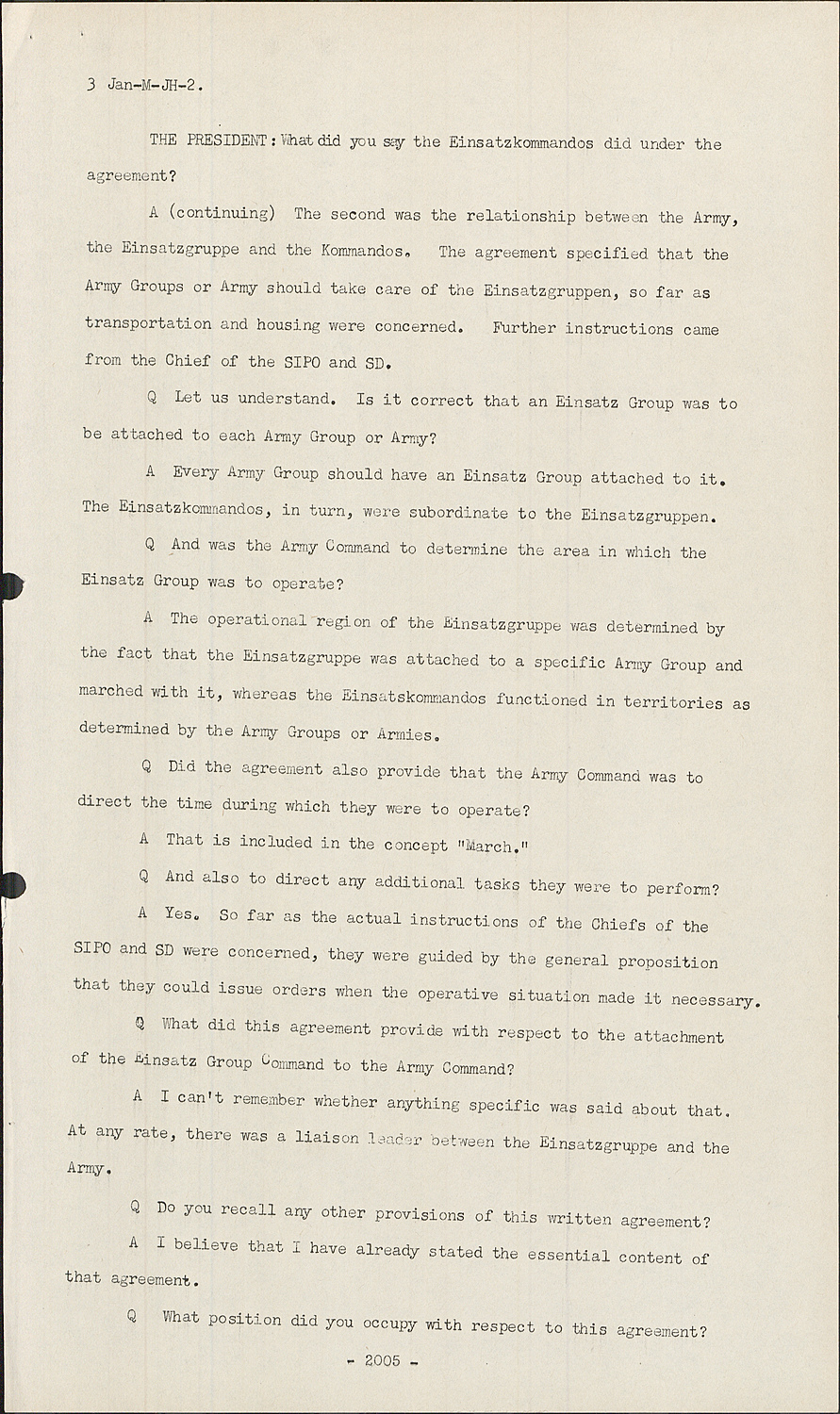
THE PRESIDENT: What did you say the Einsatzkommandos did under the agreement?
A (continuing) The second was the relationship between the Army, the Einsatzgruppe and the Kommandos. The agreement specified that the Army Groups or Army should take care of the Einsatzgruppen, so far as transportation and housing were concerned. Further instructions came from the Chief of the SIPO and SD.
QLet us understand. Is it correct that an Einsatz Group was to be attached to each Army Group or Army?
AEvery Army Group should have an Einsatz Group attached to it.
The Einsatzkommandos, in turn, were subordinate to the Einsatzgruppen.
QAnd was the Army Command to determine the area in which the Einsatz Group was to operate?
AThe operational region of the Einsatzgruppe was determined by the fact that the Einsatzgruppe was attached to a specific Army Group and marched with it, whereas the Einsatskommandos functioned in territories as determined by the Army Groups or Armies.
QDid the agreement also provide that the Army Command was to direct the time during which they were to operate?
AThat is included in the concept "March."
QAnd also to direct any additional tasks they were to perform?
AYes. So far as the actual instructions of the Chiefs of the SIPO and SD were concerned, they were guided by the general proposition that they could issue orders when the operative situation made it necessary.
QWhat did this agreement provide with respect to the attachment of the Einsatz Group Command to the Army Command?
AI can't remember whether anything specific was said about that. At any rate, there was a liaison leader between the Einsatzgruppe and the Army.
QDo you recall any other provisions of this written agreement?
AI believe that I have already stated the essential content of that agreement.
QWhat position did you occupy with respect to this agreement?
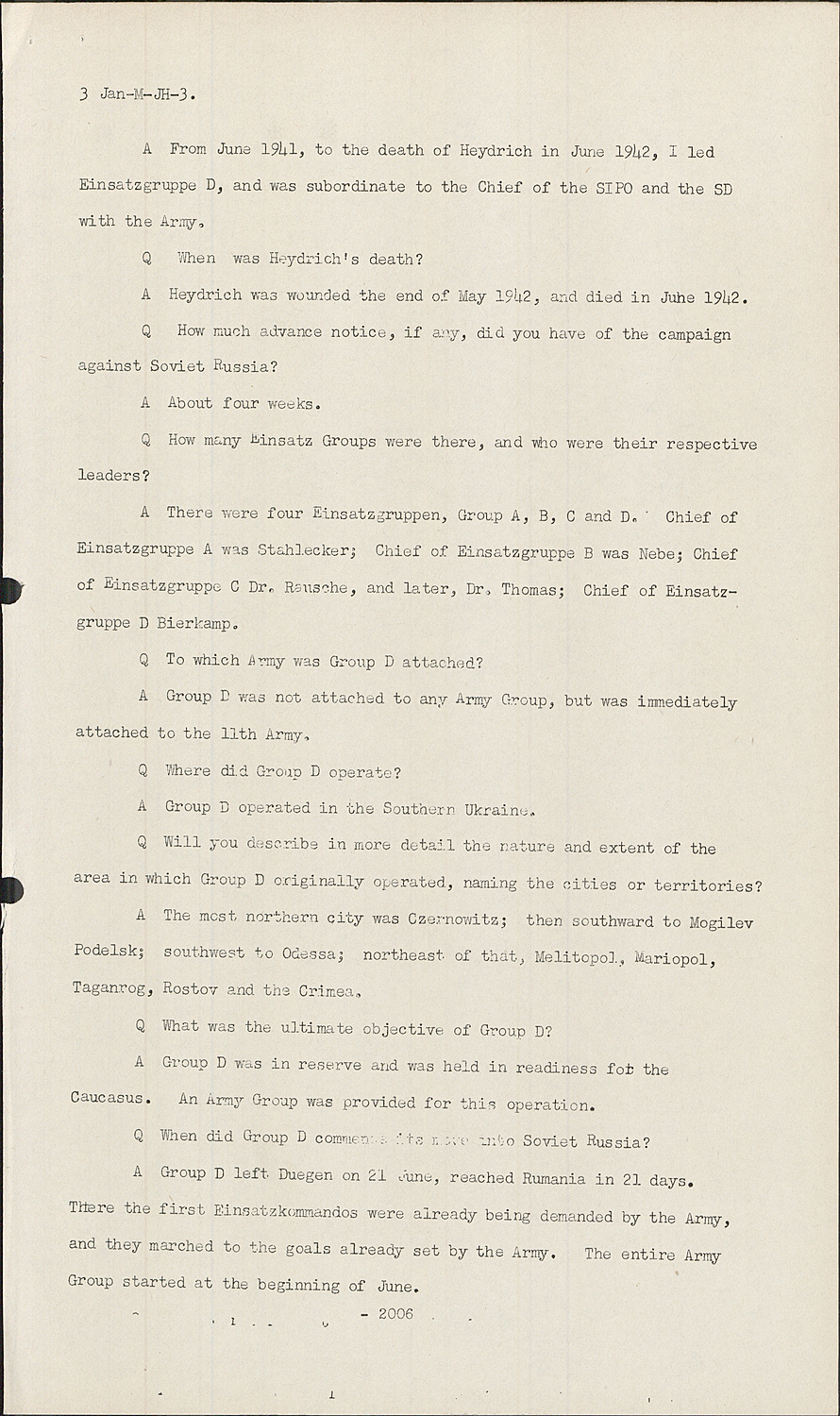
A From June 1941, to the death of Heydrich in June 1942, I led Einsatzgruppe D, and was subordinate to the Chief of the SIPO and the SD with the Army.
QWhen was Heydrich's death?
AHeydrich was wounded the end of May 1942, and died in June 1942.
QHow much advance notice, if any, did you have of the campaign against Soviet Russia?
AAbout four weeks.
QHow many Einsatz Groups were there, and who were their respective leaders?
AThere were four Einsatzgruppen, Group A, B, C and D. Chief of Einsatzgruppe A was Stahlecker; Chief of Einsatzgruppe B was Nebe; Chief of Einsatzgruppe C Dr. Rausche, and later, Dr. Thomas; Chief of Einsatzgruppe D Bierkamp.
QTo which Army was Group D attached?
AGroup D was not attached to any Army Group, but was immediately attached to the 11th Army.
QWhere did Group D operate?
AGroup D operated in the Southern Ukraine.
QWill you describe in more detail the nature and extent of the area in which Group D originally operated, naming the cities or territories?
AThe most northern city was Czernowitz; then southward to Mogilev Podelsk; southwest to Odessa; northeast of that, Melitopol, Mariopol, Taganrog, Rostov and the Crimea.
QWhat was the ultimate objective of Group D?
AGroup D was in reserve and was held in readiness for the Caucasus. An Army Group was provided for this operation.
QWhen did Group D commence its move into Soviet Russia?
AGroup D left Duegen on 21 June, reached Rumania in 21 days.
There the first Einsatzkommandos were already being demanded by the Army, and they marched to the goals already set by the Army. The entire Army Group started at the beginning of June.
Q You are referring to the 11th Army?
AYes.
QIn what respects, if any, were the official duties of the Einsatz Groups concerned with Jews and Communist Commissars?
AAs far as the question of Jews and Communists is concerned, the Einsatz Groups and Kommando leaders were hourly instructed.
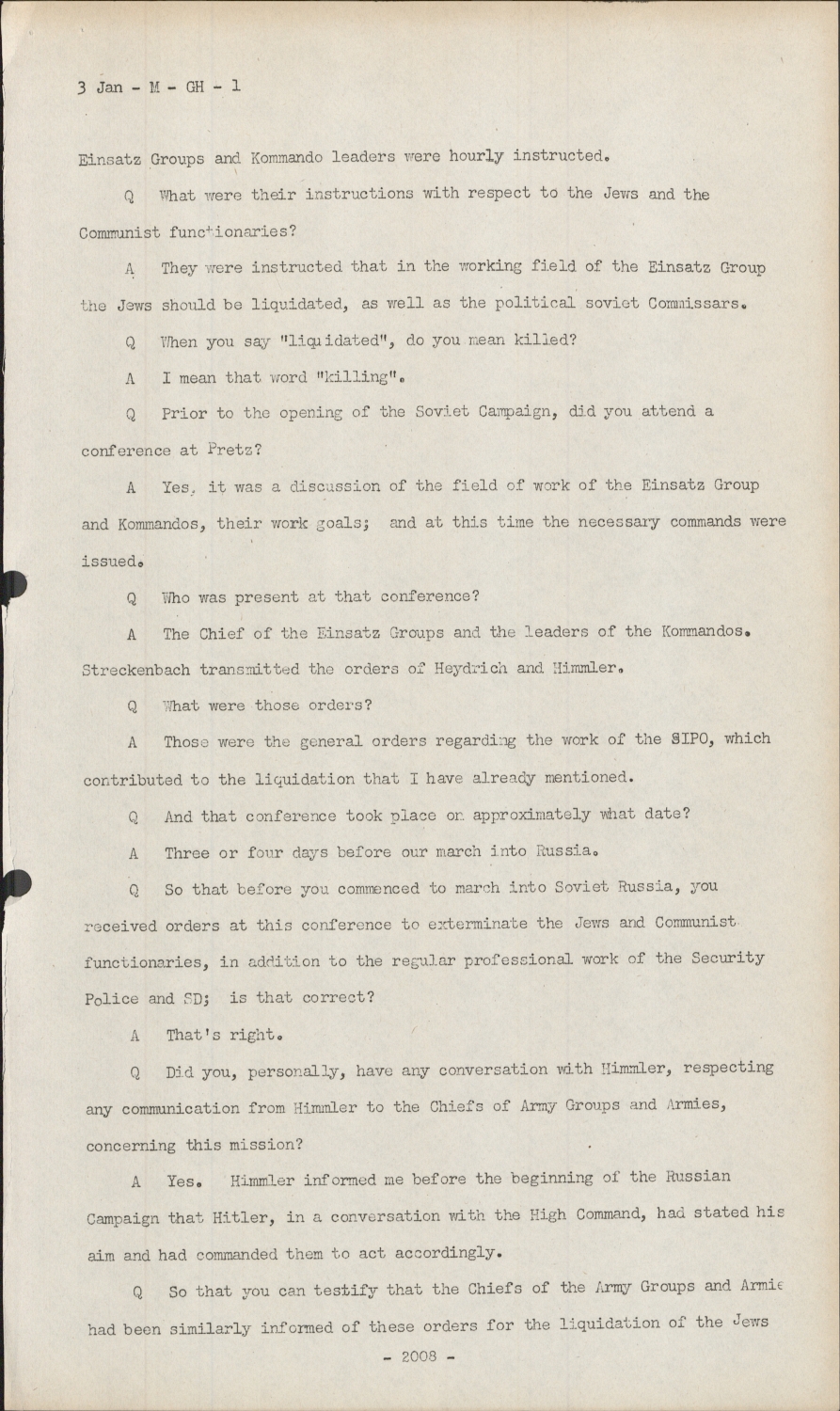
QWhat were their instructions with respect to the Jews and the Communist functionaries?
AThey were instructed that in the working field of the Einsatz Group the Jews should be liquidated, as well as the political soviet Commissars.
QWhen you say "liquidated", do you mean killed?
AI mean that word "killing".
QPrior to the opening of the Soviet Campaign, did you attend a conference at Pretz?
AYes, it was a discussion of the field of work of the Einsatz Group and Kommandos, their work goals; and at this time the necessary commands were issued.
QWho was present at that conference?
AThe Chief of the Einsatz Groups and the leaders of the Kommandos.
Streckenbach transmitted the orders of Heydrich and Himmler.
QWhat were those orders?
AThose were the general orders regarding the work of the SIPO, which contributed to the liquidation that I have already mentioned.
QAnd that conference took place on approximately what date?
AThree or four days before our march into Russia.
QSo that before you commenced to march into Soviet Russia, you received orders at this conference to exterminate the Jews and Communist functionaries, in addition to the regular professional work of the Security Police and SD; is that correct?
AThat's right.
QDid you, personally, have any conversation with Himmler, respecting any communication from Himmler to the Chiefs of Army Groups and Armies, concerning this mission?
AYes. Himmler informed me before the beginning of the Russian Campaign that Hitler, in a conversation with the High Command, had stated his aim and had commanded them to act accordingly.
QSo that you can testify that the Chiefs of the Army Groups and Armie had been similarly informed of these orders for the liquidation of the Jews and Soviet functionaries?
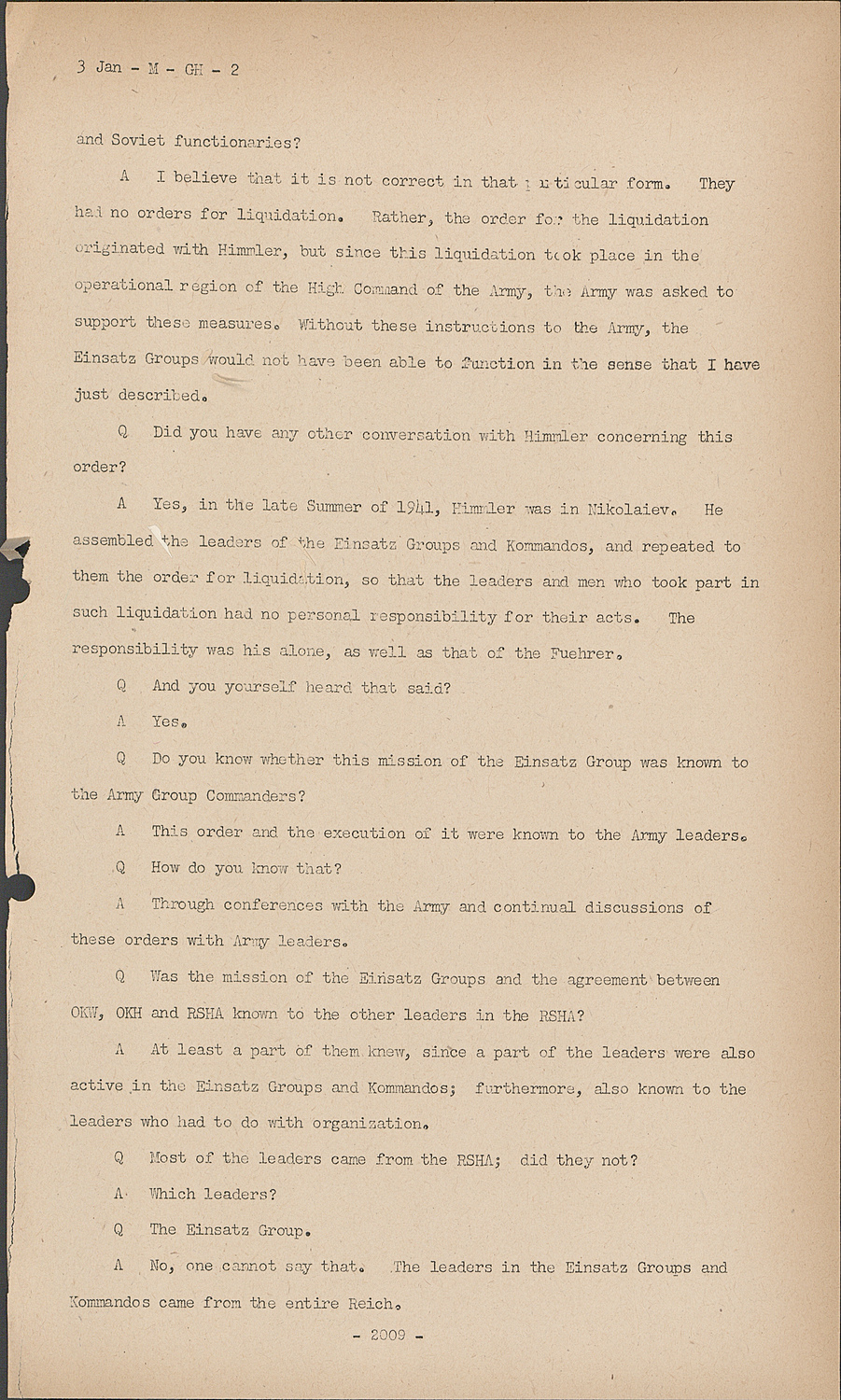
AI believe that it is not correct in that particular form. They had no orders for liquidation. Rather, the order for the liquidation originated with Himmler, but since this liquidation took place in the operational region of the High Command of the Army, the Army was asked to support these measures. Without these instructions to the Army, the Einsatz Groups would not have been able to function in the sense that I have just described.
QDid you have any other conversation with Himmler concerning this order?
AYes, in the late Summer of 1941, Himmler was in Nikolaiev. He assembled, the leaders of the Einsatz Groups and Kommandos, and repeated to them the order for liquidation, so that the leaders and men who took part in such liquidation had no personal responsibility for their acts. The responsibility was his alone, as well as that of the Fuehrer.
QAnd you yourself heard that said?
AYes.
QDo you know whether this mission of the Einsatz Group was known to the Army Group Commanders?
AThis order and the execution of it were known to the Army leaders.
QHow do you know that?
AThrough conferences with the Army and continual discussions of these orders with Army leaders.
QWas the mission of the Einsatz Groups and the agreement between OKW, OKH and RSHA known to the other leaders in the RSHA?
AAt least a part of them knew, since a part of the leaders were also active in the Einsatz Groups and Kommandos; furthermore, also known to the leaders who had to do with organization.
QMost of the leaders came from the RSHA; did they not?
AWhich leaders?
QThe Einsatz Group.
ANo, one cannot say that. The leaders in the Einsatz Groups and Kommandos came from the entire Reich.
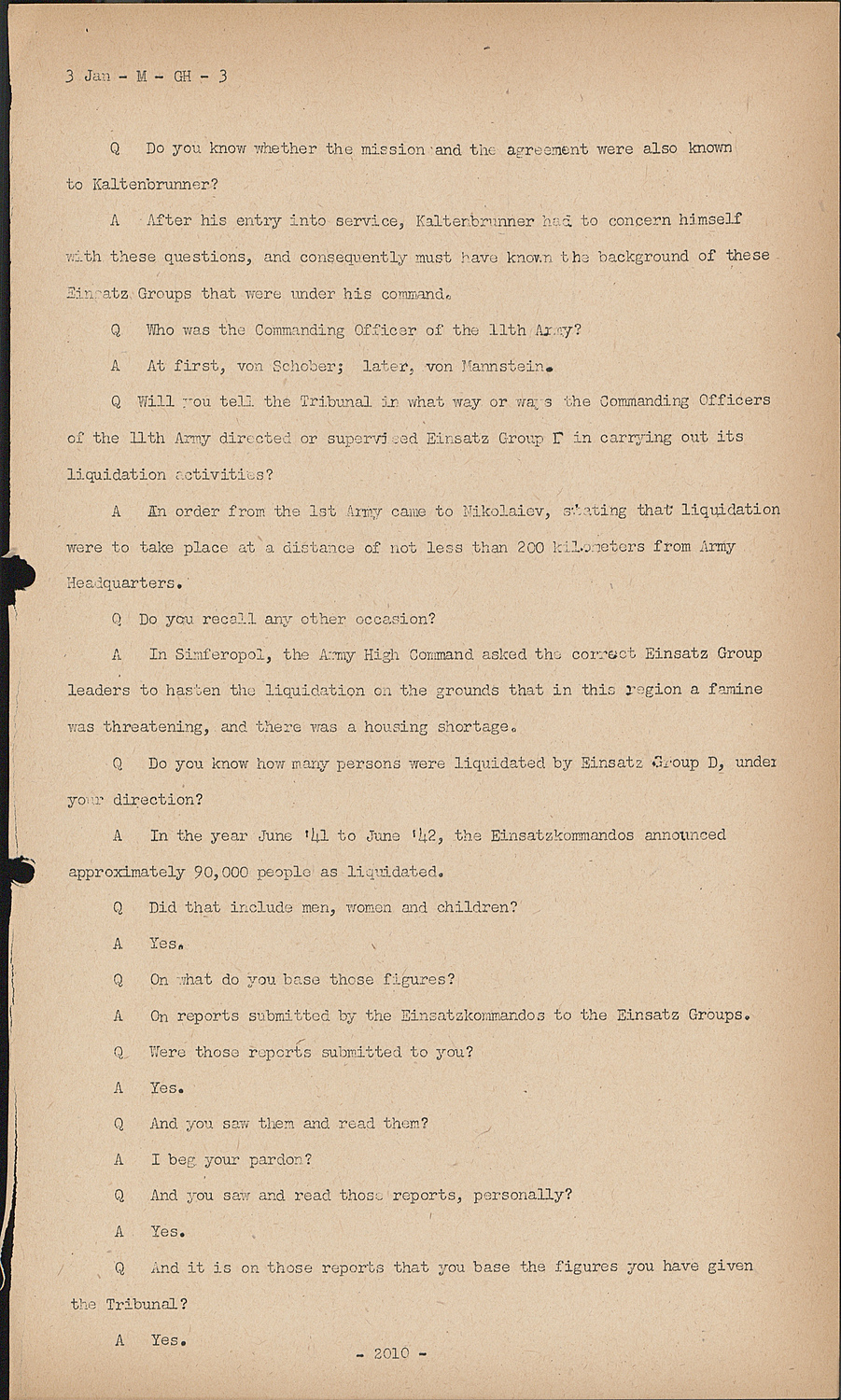
Q Do you know whether the mission and the agreement were also known to Kaltenbrunner?
AAfter his entry into service, Kaltenbrunner had to concern himself with these questions, and consequently must have known the background of these Einsatz Groups that were under his command.
QWho was the Commanding Officer of the 11th Army?
AAt first, von Schober; later, von Mannstein.
QWill you tell, the Tribunal in what way or ways the Commanding Officers of the 11th Army directed or supervised Einsatz Group D in carrying out its liquidation activities?
AIn order from the 1st Army came to Nikolaiev, stating that liquidation were to take place at a distance of not less than 200 kilometers from Army Headquarters.
QDo you recall any other occasion?
AIn Simferopol, the Army High Command asked the correct Einsatz Group leaders to hasten the liquidation on the grounds that in this region a famine was threatening, and there was a housing shortage.
QDo you know how many persons were liquidated by Einsatz Group D, under your direction?
AIn the year June '41 to June '42, the Einsatzkommandos announced approximately 90,000 people as liquidated.
QDid that include men, women and children?
AYes.
QOn what do you base those figures?
AOn reports submitted by the Einsatzkommandos to the Einsatz Groups.
QWere those reports submitted to you?
AYes.
QAnd you saw them and read them?
AI beg your pardon?
QAnd you saw and read those reports, personally?
AYes.
QAnd it is on those reports that you base the figures you have given the Tribunal?
AYes.
Q Do you know how those figures compare with the number of persons liquidated by other Einsatz Groups?
AThe figures known to me from other Einsatz Groups are materially larger.
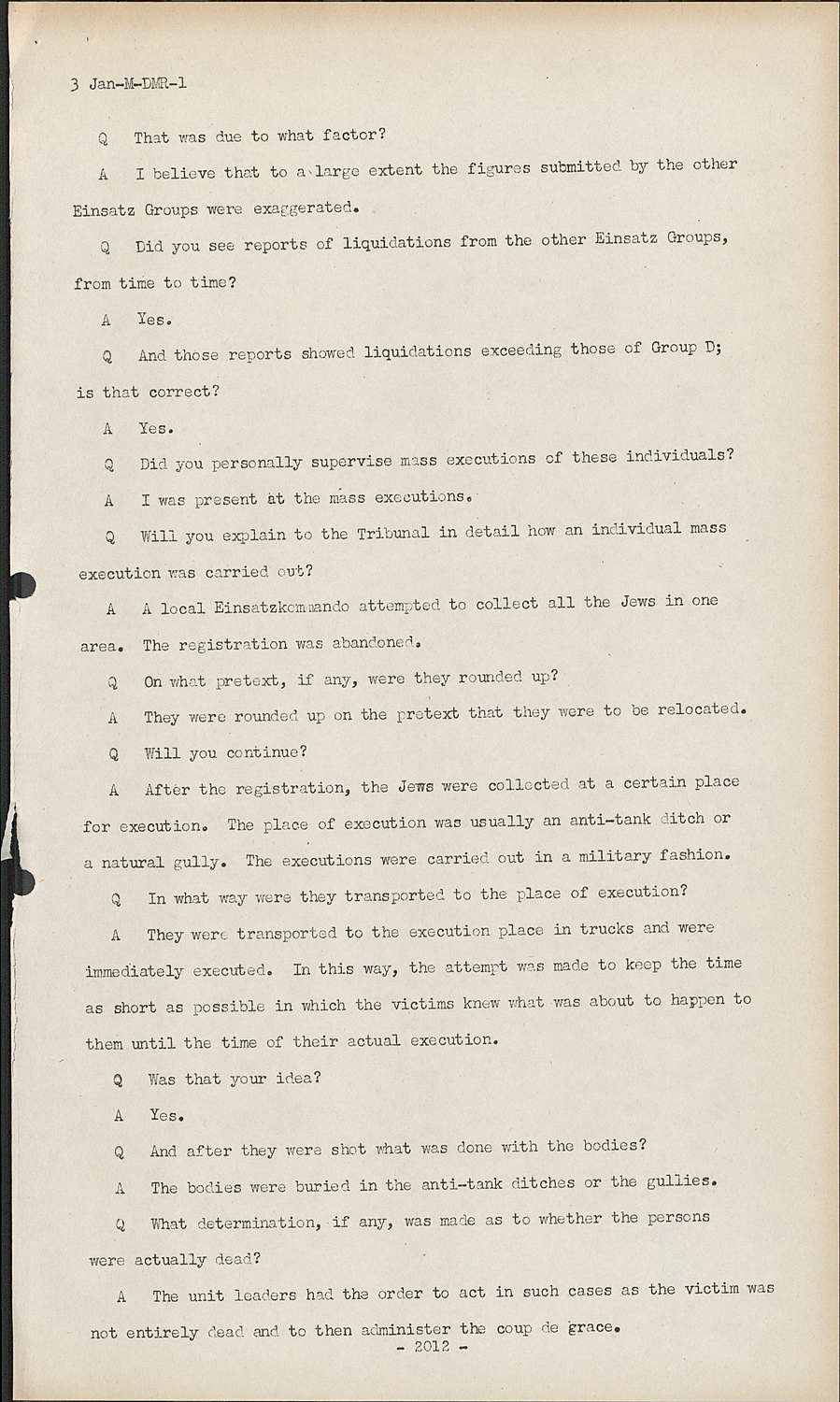
Q That was due to what factor?
AI believe that to a large extent the figures submitted by the other Einsatz Groups were exaggerated.
QDid you see reports of liquidations from the other Einsatz Groups, from time to time?
AYes.
QAnd those reports showed liquidations exceeding those of Group D; is that correct?
AYes.
QDid you personally supervise mass executions of these individuals?
AI was present at the mass executions.
QWill you explain to the Tribunal in detail how an individual mass execution was carried out?
AA local Einsatzkommando attempted to collect all the Jews in one area. The registration was abandoned.
QOn what pretext, if any, were they rounded up?
AThey were rounded up on the pretext that they were to be relocated.
QWill you continue?
AAfter the registration, the Jews were collected at a certain place for execution. The place of execution was usually an anti-tank ditch or a natural gully. The executions were carried out in a military fashion.
QIn what way were they transported to the place of execution?
AThey were transported to the execution place in trucks and were immediately executed. In this way, the attempt was made to keep the time as short as possible in which the victims knew what was about to happen to them until the time of their actual execution.
QWas that your idea?
AYes.
QAnd after they were shot what was done with the bodies?
AThe bodies were buried in the anti-tank ditches or the gullies.
QWhat determination, if any, was made as to whether the persons were actually dead?
AThe unit leaders had the order to act in such cases as the victim was not entirely dead and to then administer the coup de grace.
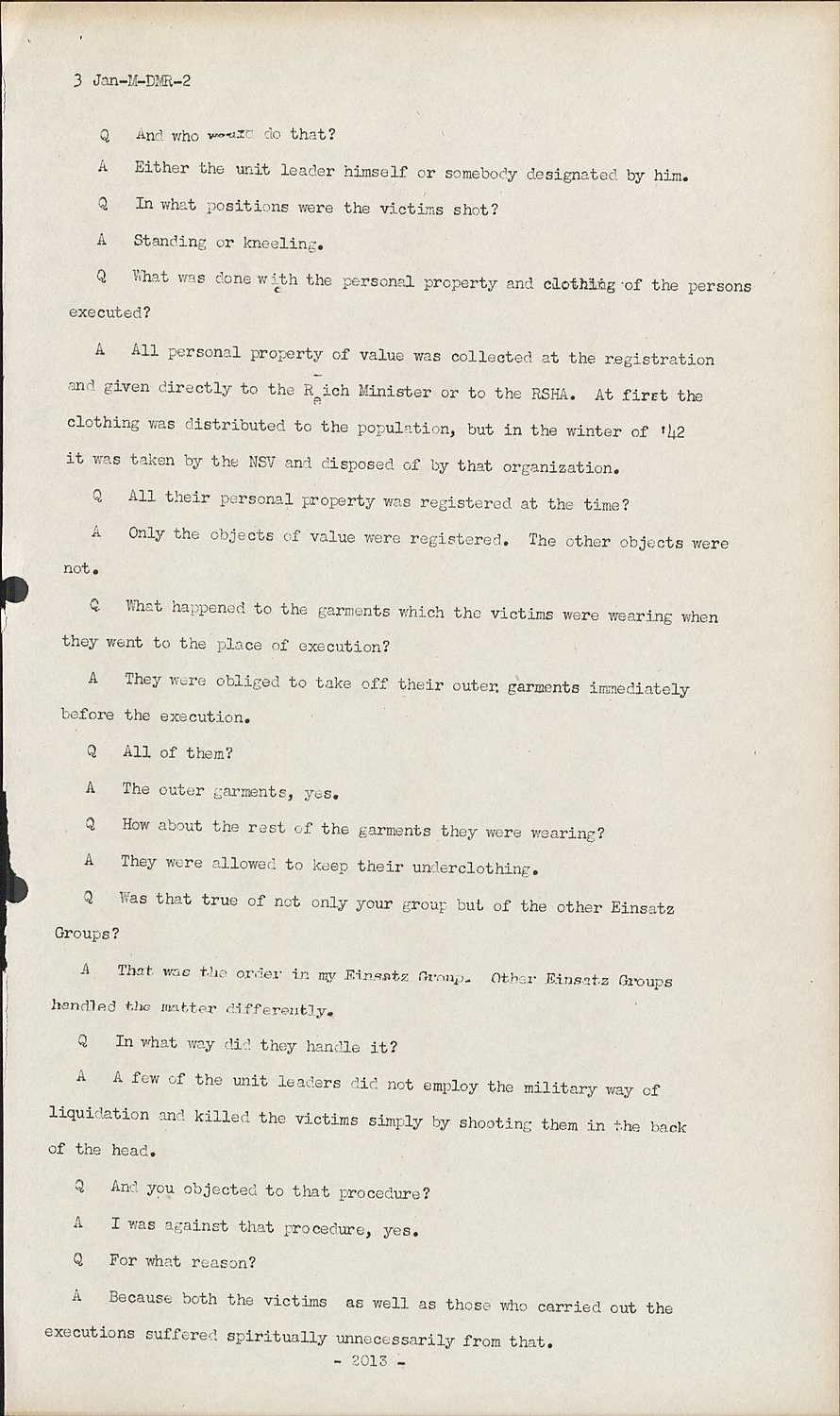
Q And who would do that?
AEither the unit leader himself or somebody designated by him.
QIn what positions were the victims shot?
AStanding or kneeling.
QWhat was done with the personal property and clothing of the persons executed?
AAll personal property of value was collected at the registration and given directly to the Reich Minister or to the RSHA. At first the clothing was distributed to the population, but in the winter of '42 it was taken by the NSV and disposed of by that organization.
QAll their personal property was registered at the time?
AOnly the objects of value were registered. The other objects were not.
Q.What happened to the garments which the victims were wearing when they went to the place of execution?
AThey were obliged to take off their outer garments immediately before the execution.
QAll of them?
AThe outer garments, yes.
QHow about the rest of the garments they were wearing?
AThey were allowed to keep their underclothing.
QWas that true of not only your group but of the other Einsatz Groups?
AThat was the order in my Einsatz Group. Other Einsatz Groups handled the matter differently.
QIn what way did they handle it?
AA few of the unit leaders did not employ the military way of liquidation and killed the victims simply by shooting them in the back of the head.
QAnd you objected to that procedure?
AI was against that procedure, yes.
QFor what reason?
ABecause both the victims as well as those who carried out the executions suffered spiritually unnecessarily from that.
Q Now, what was done with the property collected by the Einstaz Kommandos from these victims?
ASo far as the question of objects of value they were sent to the RSHA in Berlin or the Reich Minister of Finance. As to the extent they could be used immediately on hand, they were so used.
QFor example, what happened to gold and silver taken from the victims?
AThat was, as I just said, turned over to the Reich Minister of Finance in Berlin.
QHow do you know that?
AI can remember how that was actually handled in Simferopol.
QHow about watches, for example, taken from the victims?
AOn the request of the Army the watches were put at their disposal.
QWere all victims, including the men, women and children, executed in the same manner?
AUntil the spring of '42, yes. Then an order came from Himmler that in the future women and children should only be killed in gas vans.
QHow had the women and children been killed previously?
APrecisely as the men were - by shooting.
QWhat, if anything, was done about burying the victims after they had been executed?
AAt first the Kommandos buried the victims completely so that the signs of the execution could not be seen, and then the population financed the burial later - the local population.
QReferring to the gas vans which you said you received in the spring of '42, what order did you receive with respect to the use of these vans?
AThese gas vans should be used in the future for the killing of women and children.
QWill you explain to the Tribunal the construction of these vans and their appearance?
AThe actual purpose of these vans could not be recognized from outside.
They were disguised as trailers. They were so constructed that when the motor was running the gas was conducted to the van and brought about the death of the occupants in 10 to 15 minutes.
QExplain in detail just how one of these vans was used for an execution.
AThe vans were loaded with the victims and driven to the place of burial, which usually was the same as that used for the mass executions.
The time needed for the transportation was long enough for their death.
QHow were the victims induced to enter the vans?
AThey were told that they were to be transported to another locality.
QHow was the gas turned on?
AI am not familiar with the technical details.
QHow long did it take to kill the victims ordinarily?
A About 10 to 15 minutes, and the victims suffered no pain.
QHow many persons could be killed simultaneously in one such van?
AThe vans were various sizes, anywhere from 15 to 25 persons.
QDid you receive reports from those persons operating these vans from time to time?
AI didn't understand the question.
QDid you receive reports from those who Were working on the vans?
AI received the report that the Einsatz Kommandos did not like to use the vans.
QWhy not?
ABecause the burial of the occupants of it was unpleasant to the members of the Einsatz Kommandos.
QWill you tell the Tribunal who furnished these vans to the Einsatz Groups?
AThe gas vans did not belong to the motor pool of the Einsatz Group but came from a special Kommando. This Kommando was led by the man who made these vans. The vans were given to the individual groups by the RSHA.
QWere the vans supplied to all of the different Einsatz Groups.
AI can't say about that. I only know about Einsatz Group D, and indirectly about Einsatz Group C.
QAre you familiar with the letter from Becker to Rauf with respect to these gas vans?
AI saw this letter during my interrogation.
COLONEL AMEN:May it please the Tribunal, I am referring to Exhibit 501-PS, US Exhibit No. 288, being a letter already in evidence, a letter from Becker to Rauf.
Q Will you tell the Tribunal who Becker was?
AAs far as I recall, Becker was the builder of the vans. It was he who was in charge of the construction of the vans for Einsatz Group D.
QWho was Rauf?
ARauf was group leader in Amt II. He was in charge of motor vehicles at that time.
QCan you identify that letter in any way?
AAs far as I can recall the content-
(A document was handed to the witness.)
QWill you look at the letter before you and tell us whether you can identify it in any way?
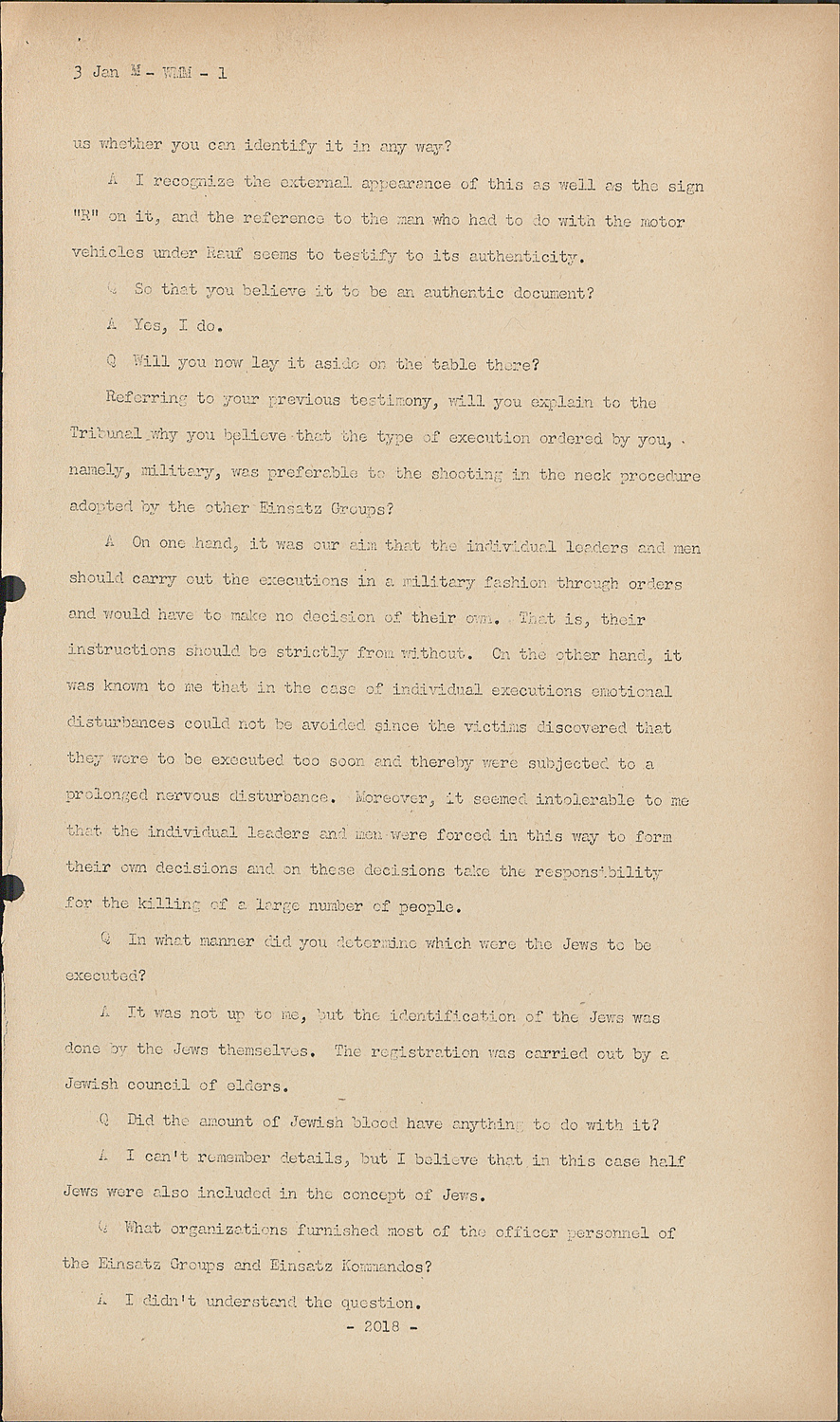
AI recognize the external appearance of this as well as the sign "R" on it, and the reference to the man who had to do with the motor vehicles under Rauf seems to testify to its authenticity.
QSo that you believe it to be an authentic document?
AYes, I do.
QWill you now lay it aside on the table there?
Referring to your previous testimony, will you explain to the Tribunal why you believe that the type of execution ordered by you, namely, military, was preferable to the shooting in the neck procedure adopted by the other Einsatz Groups?
AOn one hand, it was our aim that the individual leaders and men should carry out the executions in a military fashion through orders and would have to make no decision of their own. That is, their instructions should be strictly from without. On the other hand, it was known to me that in the case of individual executions emotional disturbances could not be avoided, since the victims discovered that they were to be executed too soon and thereby were subjected to a prolonged nervous disturbance. Moreover, it seemed intolerable to me that the individual leaders and men were forced in this way to form their own decisions and on these decisions take the responsibility for the killing of a large number of people.
QIn what manner did you determine which were the Jews to be executed?
AIt was not up to me, but the identification of the Jews was done by the Jews themselves. The registration was carried out by a Jewish council of elders.
QDid the amount of Jewish blood have anything to do with it?
AI can't remember details, but I believe that in this case half Jews were also included in the concept of Jews.
QWhat organizations furnished most of the officer personnel of the Einsatz Groups and Einsatz Kommandos?
AI didn't understand the question.
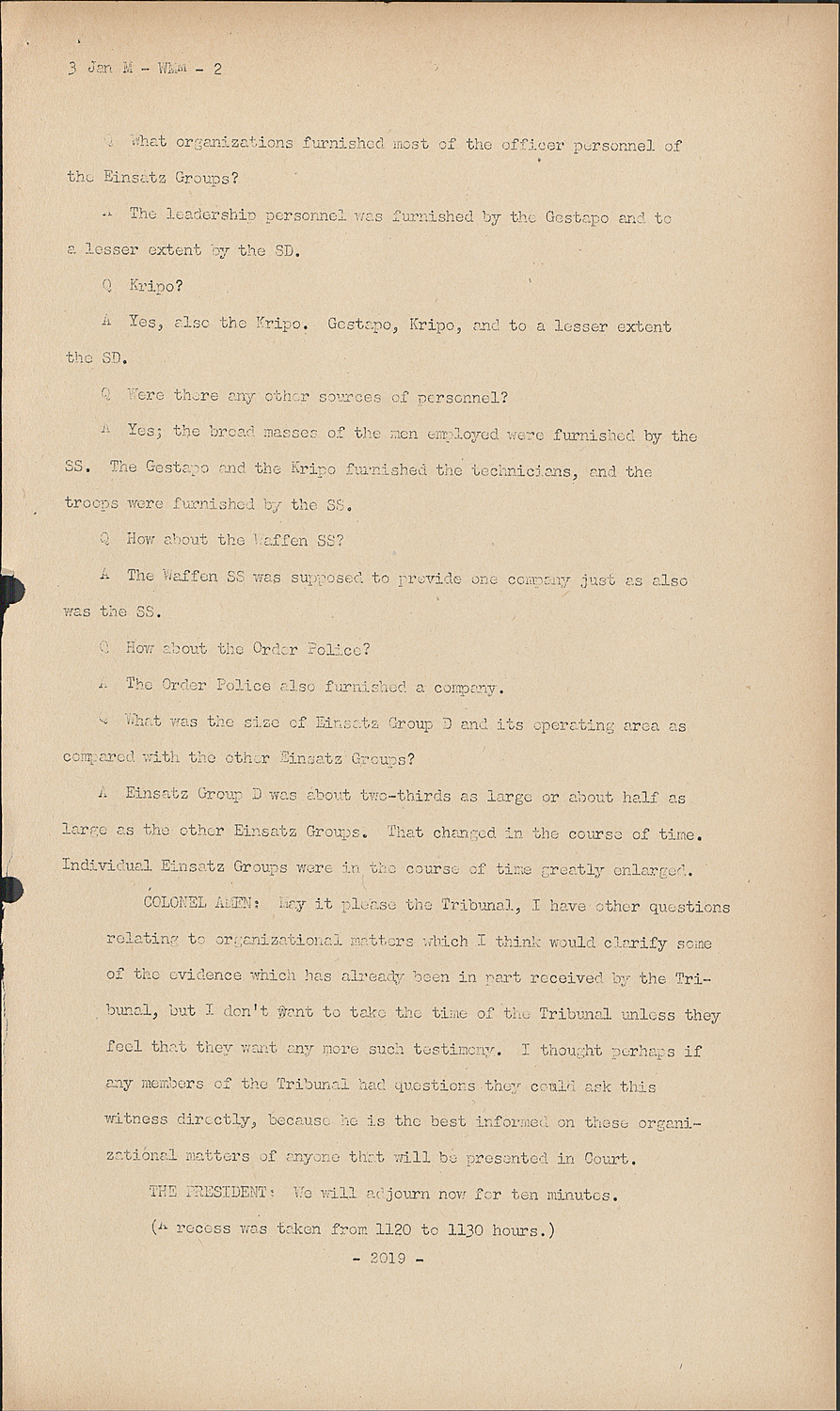
Q What organizations furnished most of the officer personnel of the Einsatz Groups?
AThe leadership personnel was furnished by the Gestapo and to a lesser extent by the SD.
QKripo?
AYes, also the Kripo. Gestapo, Kripo, and to a lesser extent the SD.
QWere there any other sources of personnel?
AYes; the bread masses of the men employed were furnished by the SS. The Gestapo and the Kripo furnished the technicians, and the troops were furnished by the SS.
QHow about the Waffen SS?
AThe Waffen SS was supposed to provide one company just as also was the SS.
QHow about the Order Police?
AThe Order Police also furnished a company.
QWhat was the size of Einsatz Group D and its operating area as compared with the other Einsatz Groups?
AEinsatz Group D was about two-thirds as large or about half as large as the other Einsatz Groups. That changed in the course of time. Individual Einsatz Groups were in the course of time greatly enlarged.
COLONEL AMEN:May it please the Tribunal, I have other questions relating to organizational, matters which I think would clarify some of the evidence which has already been in part received by the Tri bunal, but I don't want to take the time of the Tribunal unless they feel that they want any more such testimony.
I thought perhaps if any members of the Tribunal had questions they could ask this witness directly, because he is the best informed on these organi zational matters of anyone that will be presented in Court.
THE PRESIDENT:We will adjourn now for ten minutes.
(A recess was taken from 1120 to 1130 hours.)
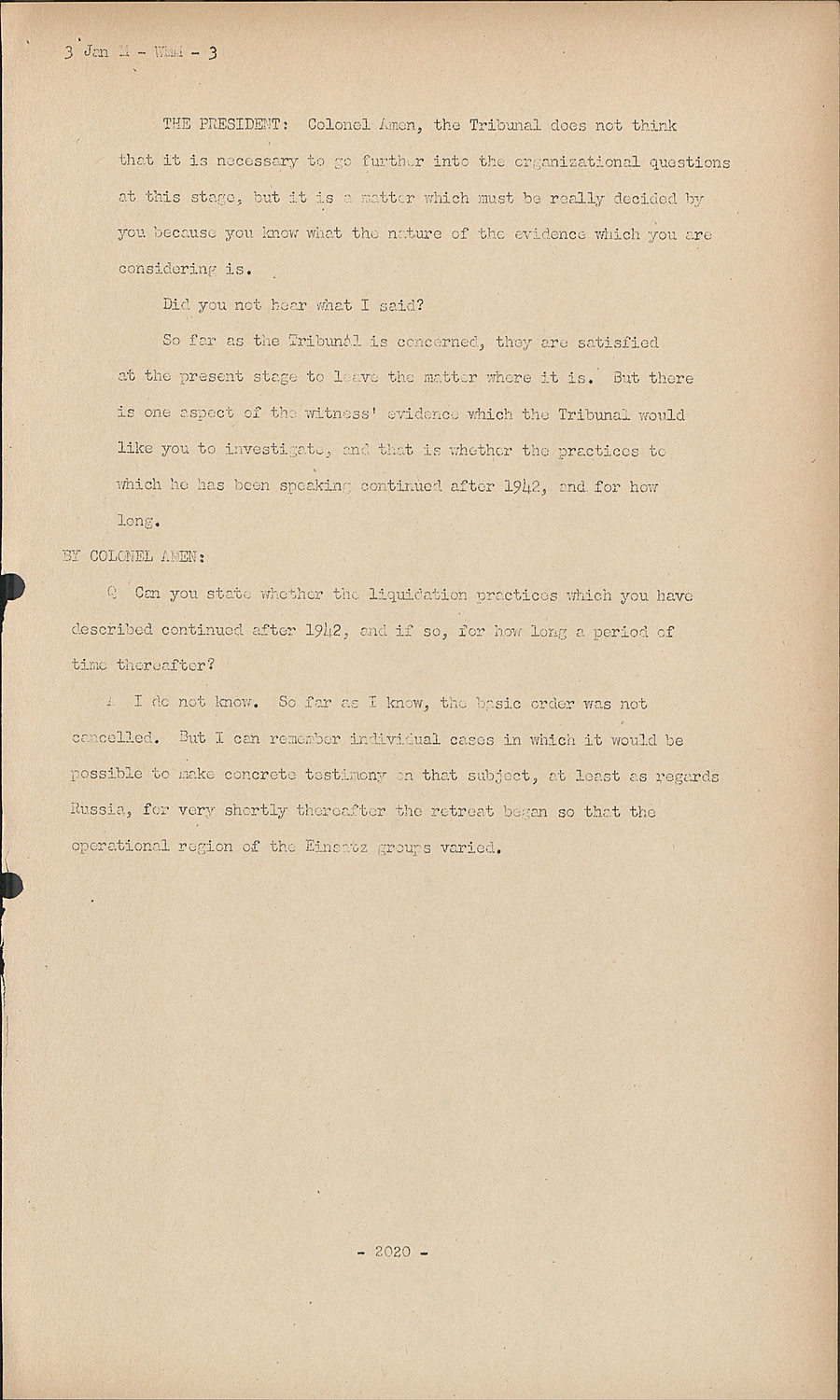
THE PRESIDENT: Colonel Amen, the Tribunal does not think that it is necessary to go further into the organizational questions at this stage, but it is a matter which must be really decided by you because you know what the nature of the evidence which you are considering is.
Did you not hear what I said?
So far as the Tribunal is concerned, they are satisfied at the present stage to leave the matter where it is.
But there is one aspect of the witness' evidence which the Tribunal would like you to investigate, and that is whether the practices to which he has been speaking continued after 1942, and for how long.
BY COLONEL AMEN:
QCan you state whether the liquidation practices which you have described continued after 1942, and if so, for how long a period of time thereafter?
AI de not know. So far as I know, the basic order was not cancelled. But I can remember individual cases in which it would be possible to make concrete testimony on that subject, at least as regards Russia, for very shortly thereafter the retreat began so that the operational region of the Einsatz groups varied.

I do know that further Einsatz groups, with corresponding orders, were put into action in other regions.
QYour personal knowledge extends up to what date?
AThe question did not come, through to me.
QYour personal knowledge of these activities extends up to what date?
AI still haven't got the question.
THE PRESIDENT:Will you repeat the question.
QYour personal knowledge of these activities extends up to what date?
THE PRESIDENT:There must be some technical defect.
THE WITNESS:I can hear now.
THE PRESIDENT:Can you hear now?
THE WITNESS:Yes, I can. BY COLONEL AMEN:
QThe question was, your personal knowledge of these liquidation activities goes up to what date?
ASo far as the liquidation of Jews is concerned, I know that appropriate withdrawals of the order were made about six months before the conclusion of the war. furthermore, I saw a document according to which the liquidation of Soviet Commissars was to be terminated. I cannot recall a specific date.
QDo you know whether in fact it was so terminated?
AI believe yes. BY THE PRESIDENT:
QThe Tribunal would like to know the number of men in your Einsatz group.
AThere were about 500 people in my Einsatz group, besides those who were added to the group from the country itself.
QIncluding them, did you say?
AExcluding those who were brought into the group from the land itself.
QDo you know how many there would be in other groups?
AI should estimate that at the beginning, seven to eight hundred men; but, as I said before, this number changed rapidly in the course of time, for this reason, that individual chiefs of groups asked for additional personnel and got it.