Next we mention GUSTAV KRUPP von BOHLEN und HALBACH, the action against whom has been severed from this proceeding.
Nevertheless, it should be noted that documentary proof has been offered and will be offered in support of the allegations of the Indict ment that implicate both Ley and Krupp as co-conspirators for whose crimes the remaining defendants also must accept responsibility.
We next consider the defendant FRITZ SAUCKEL. The case against Sauckel has been completely stated and supported by a wealth of damning evidence, by my learned colleague Mr. Dodd, in his presentation of the case on slave labor.
We submit that it is unnecessary to add anything further to the case against Sauckel to demonstrate how completely he filled his place in the stream of the conspiracy.
The next defendant to be considered is ALBERT SPEER. Like his fellow conspirator Sauckel, Speer is deeply implicated as a member of the con spiracy and much of the case against him has been presented by Mr. Dodd in his presentation of the case on slave labor.
But unlike Sauckel, Speer's criminal activity went substantially beyond the realm of slave labor.
His was one of the master minds in the plan for the systematic robbery and despoliation of the lands overrun by the German war machine.
Documentary proof of Speer's participation in the spoliation practices in the countries of Western Europe, as well as in the Eastern territories occupied by them, will be presented subsequently by our learned colleagues, the Chief Prosecutor representing the Soviet Union and by the Chief French Prosecutor, under the remaining counts of the Indictment.
That is essentially the case that proves Speer to have been a member of the conspiracy.
There is, however, one additional exhibit that I would like to offer into evidence at this time.
It was received only a few days ago from the Ministerial Document Center at Kassel, and, it is the dossier maintained on the defendant Speer in the office of the Reichsfuehrer SS.
I offer this file as USA Exhibit 575.
It is our document 3568, and I shall read from the dossier.
THE PRESIDENT: 3568-PS?
MR. ALBRECHT:Yes, sir, if your Honor please.
THETRIBUNAL (Mr. Biddle): What book is it in?
MR. ALBRECHT:Volume three, your Honor. It is volume three, if it may please the Court, of Document Books DD.
THE PRESIDENT:Yes.
MR. ALBRECHT:I shall read from the letter dated the 25th of July 1942, from the second paragraph:
"Reich Minister Speer was enrolled as an SS man on the personal staff of the Reich Fuehrer SS under SS No. 46104, with effect from the 20th of July 1942, by order of the Reich Fuehrer SS" and I think that is all I need to read from that letter.
But I should like to call the Tribunal's attention to the annexed document, which is a questionnaire, and right at the beginning of the sae it is related that Albert Speer was in the SS since the Autumn of 1932. He was in the SA from March 1, 1931, until autumn 1932, and that his membership number in the Party was 47481.
I next mention the Defendant Ernst Kaltenbrunner, whose case has been completely presented in connection with the presentation on the Gestapo and the SD as criminal organizations. We submit that further proof is not needed to prove how completely this enemy of his own fatherland, Austria, had been carried along in the stream of the conspiracy.
We pass then to the case of, perhaps, the most important conspirator on trial before this Tribunal the number two Nazi - the Nazi who stood next to the Fuhrer himself; the Nazi who was in some respects even more dangerous than the Fuhrer and other leading Party leaders.
We say that he was more dangerous because unlike many leading Nazis, including Hitler, - who were morally and socially on the fringes of society before the Nazi Party rode to success in 1933, - this conspirator was known to come of substantial family which had furnished officers to the army and important civil servants to the country in the past. Moreover he was possessed of substantial appearance, an ingratiating manner, a certain affability. But all of these facets of character were but deceptions, because they helped to conceal the man's core of steel, his vindictiveness, his cruelty, his lust for self-adornment, self-glorification and power.
This man was most dangerous, furthermore, because the outward characteristics to which I have called attention and which he has to some extent demonstated here in the presence of the Tribunal, were useful in deceiving the representatives of foreign states who, in their concern, sought to learn from him the true intentions of the Nazi State which, by its repeated flouting of its international commitments, had so seriously disturbed the tranquility of the world since 1933.
And I think that the record should show how, throughout the earlier stages of this trial, that is, before the nature of the documentary evidence offered by the prosecution became too grim and almost implausible, much of the benevolence of this conspirator, his ever-ready smile end ingratiating manner, were daily in evidence in this chamber.
His ready affirmation, by a pleasant nod for all to see, of the correctness of statements made or the contents of documents offered by counsel, his chiding shake of the head when he disagreed with such facts, were commonplace.
THE PRESIDENT:I don't think the Tribunal is interested in this.
MR. ALBRECHT:I shall pass on, then, with the presentation, with the permission of the Tribunal, and I shall give an account of certain facts already established by the documents in evidence; and with the permission of the Tribunal I shall not, unless it is so wished, refer to the exhibit numbers or citations of most of the old evidence that I shall allude to.
Against the background of this factual account, into which we have drawn the main threads of the case already presented that show the complicity of the defendant Goering, we shall offer certain additional documentary evidence which we believe necessary to demonstrate Goering's connection with and responsibility for certain phases of the conspiracy.
I should have said before, if your Honors please, that there has been distributed and is now before you three volumes of document books bearing the heading "DD," which contain substantially all the documents, new as well as old, bearing on the individual responsibility of this defendant.
THE PRESIDENT:Did you say they ought to be marked "DD"?
MR. ALBRECHT:I said, "It is so understood", if your Honors please.
THE PRESIDENT:Very well.
MR. ALBRECHT:We shall first deal with the individual responsibility of this conspirator for crimes against peace. These crimes include Goering's participation in the acquisition and consolidation of power in Germany, the economic and military preparations for war and the waging of aggressive war.
For more than two decides Goering's activities extended over nearly every phase of the conspiracy. He was one of the conspirators associated with Hitler from the very beginning. A member of the Party since 1922, he participated in the Munich Putsch of November 1923 at the head of the SA, a Nazi organization shown to have been committed to the use of violence.
Goering fled the country after the Putsch in order to escape arrest. After his return, be became more than a commander of street fighters, was designated Hitler's first political assistant. A measure of the man may be gleaned from an exhibit already in evidence, namely, Gritzbach's official biography of Goering, in which are recorded his dealings with the Bruening Government, his attempts to break down the barrier around President von Hindenburg, and his coup as Reichstag President in September 1932 in procuring a vote of no confidence against the von Papen government just before the Reichstag was dissolved.
Goering's writings show him not to be backward in taking credit for for his efforts to advance the cause of the Party.
Full credit has also been accorded him by Hitler, and Goering has boasted that no title and no decoration could make him so proud as the designation given to him by the German people and I quote "the most faithful paladin of our Fuehrer". That short quotation, may it please the Court, comes from our U.S.A. Exhibit 233, our Document 3251 PS.
With the advent of the Nazis to power in January 1933 Goering became Acting Minister of the Interior and Prime Minister of Prussia.
In these capacities he proceeded promptly to establish a regime of terror in Prussia designed to suppress all opposition to the Nazi program.
His chief tool in that connection was the Prussian Police which remained under his jurisdiction until 1936.
As early as February 1933 he directed the entire police force to render unqualified assistance to the para military organizations supporting the new Government, such as the SA and the SS, and to crush all political opponents with firearms, if necessary, and regardless of the consequences.
The Tribunal will take judicial notice of the Directives of 10 and 17 February 1933, which are cited on page seven of our brief and which appear in that collection of decrees known as Ministerialblatt Preussische Innere Verwaltung of 1933.
Goering has frequently and proudly acknowledged his personal respons ibility for the crimes committed pursuant to orders of this character, and I recall his words which he uttered before thousands of his fellow Germans:
"....each bullet which leaves the barrel of a police pistol now is my bullet.
If one calls this murder, then I have murdered; I ordered all this, I back it up.
I assume the responsibility, and I am not afraid to do so".That quotation, may it please the Tribunal, comes from our Exhibit U.S.A. 233, already in evidence.
Soon after he became Prime Minister of Prussia, in pursuance of the conspiracy, Goering began to develop the Gestapo or Secret State Police, the details of which organization of terror were presented to the Court by my learned colleague, Colonel Storey.
As early as 26 April 1933 he signed the first law officially establishing the Gestapo in Prussia; and pursuant to a decree which he signed, he named himself as Prime Minister, Chief of the Prussian Secret State Police.
Goering was undoubtedly an efficient conspirator. He was impatient to consolidate the power of the Party at home. Already in Spring 1933 the concentration camps were established in Prussia. Men and women so-called "Marxists", and other political opponents, taken into custody by the Gestapo, were thrown into concentration camps without trial. Goering said, "Against the enemies of the State we must proceed ruthlessly." That statement appears our document 2344-PS, which is already in evidence as U.S.A. Exhibit 233.
The range of political terrorism under his leadership was almost limitless. A glance at a few of his police directives in those early days will indicate the extent and thoroughness with which every dissident voice was silenced.
I ask the Tribunal to take judicial notice of some of these decrees in the same collection I mentioned a short while ago, entitled Ministerialblatt Preussische Innere Verwaltung, and we have cited these decrees on pages 9 and 10 of our brief.
These include:
(a) Directive of 22 June 1933, which required all officials to watch the statements of civil servants and to denounce to the Defendant Goering those who made critical remarks.
The failure to make such reports was to be regarded as proof of hostile attitude.
Then there was the directive of 23 June 1933, which suppressed all activities of the Social Democratic Party, including meetings and the Party Press, and ordered the confiscation of its property.
There was the directive of 30 June 1933, which directed the Gestapo authorities to report to the Labor Trustees on the political attitude of the workers.
There was the directive of January 1934, which ordered the Gestapo and the frontier police to keep track of emigres, particularly political emigres and Jews residing in neighbouring countries, and to arrest them and put them in concentration camps if they returned to Germany.
The essential ruthlessness of Goering is further illustrated by a well-known bloody episode.
After the elimination of forces of the opposition, the Nazis felt it necessary to dispose of nonconformists within their own ranks.
This they accomplished in what has become known as the Roehm purge of 30 June, 1934.
The Defendant Frick, a chief conspirator in his own right, stated in that connection, in an affidavit, that many people were murdered who had nothing to do with the internal SA revolt, but who were "just not liked very well."
Goering's role in this sordid affair was related less than two weeks after the event by Hitler in a speech to the Reichstag, and I would like to offer in evidence as USA Exhibit 576 our document 3442-PS, in which is contained the speech of Hitler, made on the 13th of July, 1934 in the Reichstag.
It is published in "Das Archiv," Vol. 4-6, at page 505. I quote.
"Meanwhile Minister-President Goering had already received my instructions that in case of a purge he was to take analagous measures at once in Berlin and in Prussia. With an iron fist he beat down the attack on the National Socialist State before it could develop."
With the accession of the Nazis to power, Goering at once assumed a number of the highest and most influential positions also in the Reich. The proof already presented on the composition and functions of the Reich Cabinet, and of the offices held by Goering, shows him to have been, in fact, the most important executive of the Nazi State.
A member of the Reichstag since 1928, and its President since 1932, he was a member of the Cabinet from the beginning as Reich Minister without portfolio. Shortly thereafter, he received the portfolio as Reich Minister for Air. When, in an early meetings the Cabinet discussed the pending Enabling Act, which gave the Cabinet plenary powers of legislation, he offered the suggestion that the required two-thirds majority might be obtained simply by refusing admittance to Social Democratic delegates. I offer in evidence, as USA Exhibit 578, our document 2962-PS, which contains the minutes of that meeting. If your Honors will note, that meeting was held on the 15th of March, 1933, and there were present, besides the Defendant Goering, the Defendants von Papen, von Neurath, Frick and Funk. I read from page 6 of that document.
"Reich Minister Goering expressed his conviction that the Enabling Act would be passed with the necessary two-thirds majority.
Possibly a majority could be obtained by banishing several Social Democrats from the hall.
Possibly the Social Democrats would even refrain from voting on the Enabling Act."
In 1935, with the unmasking of a secret Luftwaffe, Goering became its Commander-in-Chief. He sat as a member and the Fuehrer's Deputy on the Reich Defense Council, established by the secret law of the 21st of May, 1933. The purpose of that Council was, as stated by the Defendant Frick, in an affidavit that is in evidence--and I quote:
"To plan preparations and decrees in case of war which later on were published by the Ministerial Council for the Defense of the Reich."
His assumption of ever greater responsibility seemed limitless. In 1936 Goering was made Plenipotentiary for the Four Year Plan, whereby he acquired plenary legislative and administrative powers over all German economic life.
In 1938 he became a member of the Secret Cabinet Council, which had been established to act as "an advisory board in the direction of foreign policy."
The Ministerial Council for the Defense of the Reich, created in 1939, took over, in effect, all of the legislative powers of the Cabinet, which had not been reserved otherwise, and Goering became its Chairman.
His efficient and ruthless services were recognized by Hitler in 1939, when he designated Goering as his successor, as heir apparent to the "New Order".
In April, 1936, Goering was appointed Coordinator for Raw Materials and Foreign Exchange and empowered to supervise all State and Party activities in these fields. I offer in support of that fact as U.S.A. Exhibit 577, our Document 2827, which is an excerpt from "Ruehle, Das Dritte Reich." I read from the fourth paragraph of the excerpt, if your Honor please, which is an excerpt from a decree signed by Hitler, and it reads as follows!
"Prime Minister Col. General Goering will take the measures necessary for the accomplishment of the tasks given to him, and has the authority to issue decrees and general administrative directives. He, for this purpose, is authorized to question and issue directives to all authorities, including the highest Reich authorities, and all agencies of the Party, its formations and attached organizations."
In this capacity Goering convened the War Minister, the Defendant Schacht, as Minister of Economics, and President of the Reichsbank, and the Finance Minister for the Reich, and State of Prussia, to discuss inter-agency problems, connected with mar mobilization. At a meeting of this group on the 12th of May, 1936, when the question of the prohibitive cost of synthetic raw material substitutes arose, Goering decided:
"If we have war tomorrow we must help ourselves by substitutes. Then money will not play any role at all. If that is the case, then we must be ready to create the prerequisites for that, in peace."
A few days later, on the 27th of May, 1936, at a meeting of the same group, Goering opposed any limitations dictated by orthodox financial policies.
He said that "all measures are to be considered from the standpoint of an assured waging of war."
The well-known Four Year Plan was proclaimed by Hitler at the 1936 Nurnberg Party Day. Goering was appointed plenipotentiary in charge of the program, which was intended to achieve national self-sufficiency. Furthermore, Goering commented in 1936 that his chief task as Plenipotentiary was "to put the whole economy on a war footing within four years." I would like to offer into evidence as U.S.A. Exhibit 579, our Document EC 408, so that I may direct the Tribunal's attention to a memorandum, dated the 30th of December, 1936, of the defense Division of the Wehrmacht, entitled. "Memorandum on the Four Year Plan and Preparation of the War Economy" and in the third paragraph of the translation or at page 2, in the middle of paragraph numbered 3 in the German original, there is the statement registered in the protocol, in the memorandum, that:
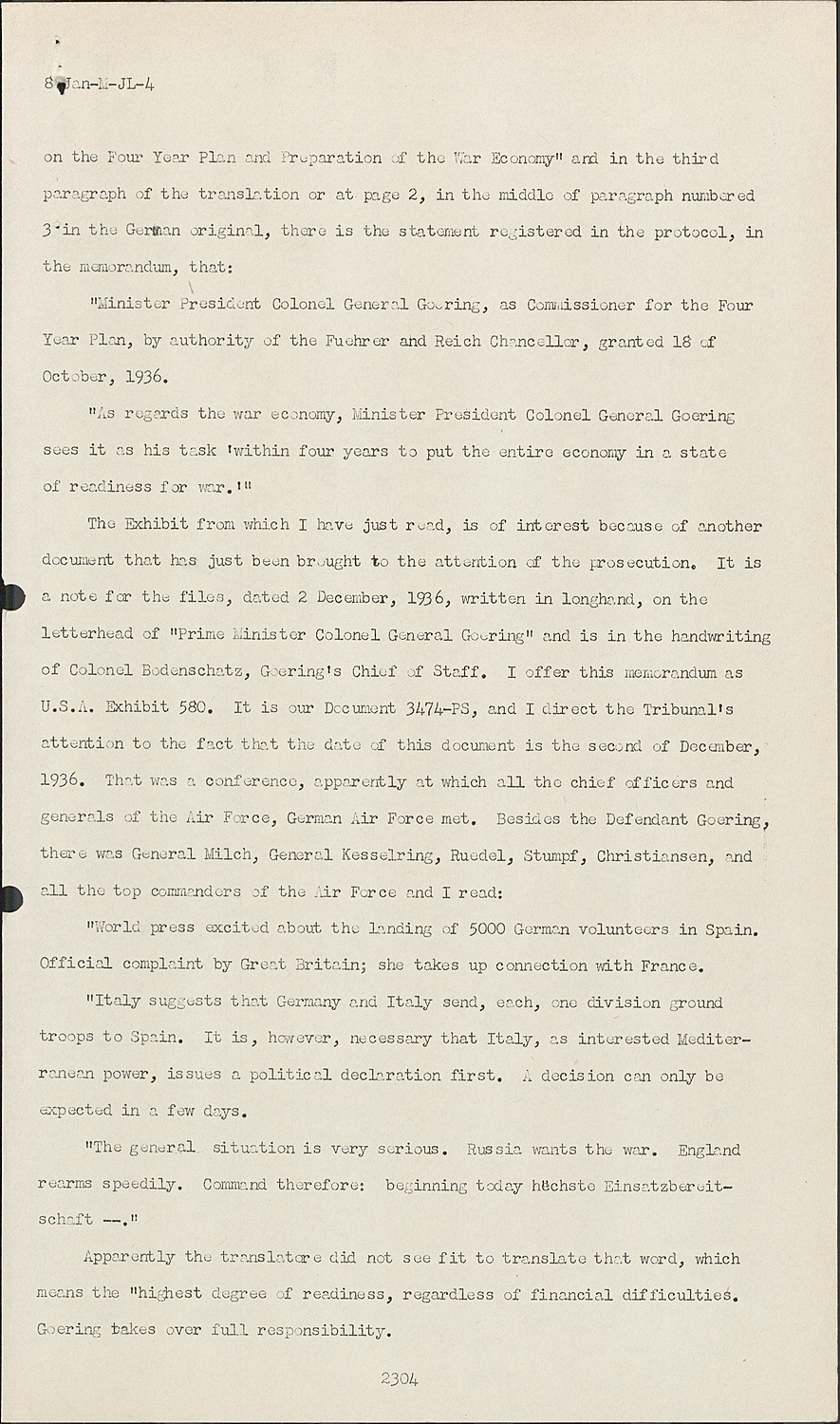
"Minister President Colonel General Goering, as Commissioner for the Four Year Plan, by authority of the Fuehrer and Reich Chancellor, granted 18 of October, 1936.
"As regards the war economy, Minister President Colonel General Goering sees it as his task 'within four years to put the entire economy in a state of readiness for war.'" The Exhibit from which I have just read, is of interest because of another document that has just been brought to the attention of the prosecution.
It is a note for the files, dated 2 December, 1936, written in longhand, on the letterhead of "Prime Minister Colonel General Goering" and is in the handwriting of Colonel Bodenschatz, Goering's Chief of Staff. I offer this memorandum as U.S.A. Exhibit 580. It is our Document 3474-PS, and I direct the Tribunal's attention to the fact that the date of this document is the second of December, 1936. That was a conference, apparently at which all the chief officers and generals of the Air Force, German Air Force met. Besides the Defendant Goering, there was General Milch, General Kesselring, Ruedel, Stumpf, Christiansen, and all the top commanders of the Air Force and I read:
"World press excited about the landing of 5000 German volunteers in Spain. Official complaint by Great Britain; she takes up connection with France.
"Italy suggests that Germany and Italy send, each, one division ground troops to Spain. It is, however, necessary that Italy, as interested Mediterranean power, issues a political declaration first. A decision can only be expected in a few days.
"The general situation is very serious. Russia wants the war. England rearms speedily. Command therefore: beginning today hechste Einsatzbereitschaft --."
Apparently the translatore did not see fit to translate that word, which means the "highest degree of readiness, regardless of financial difficulties. Goering takes over full responsibility.
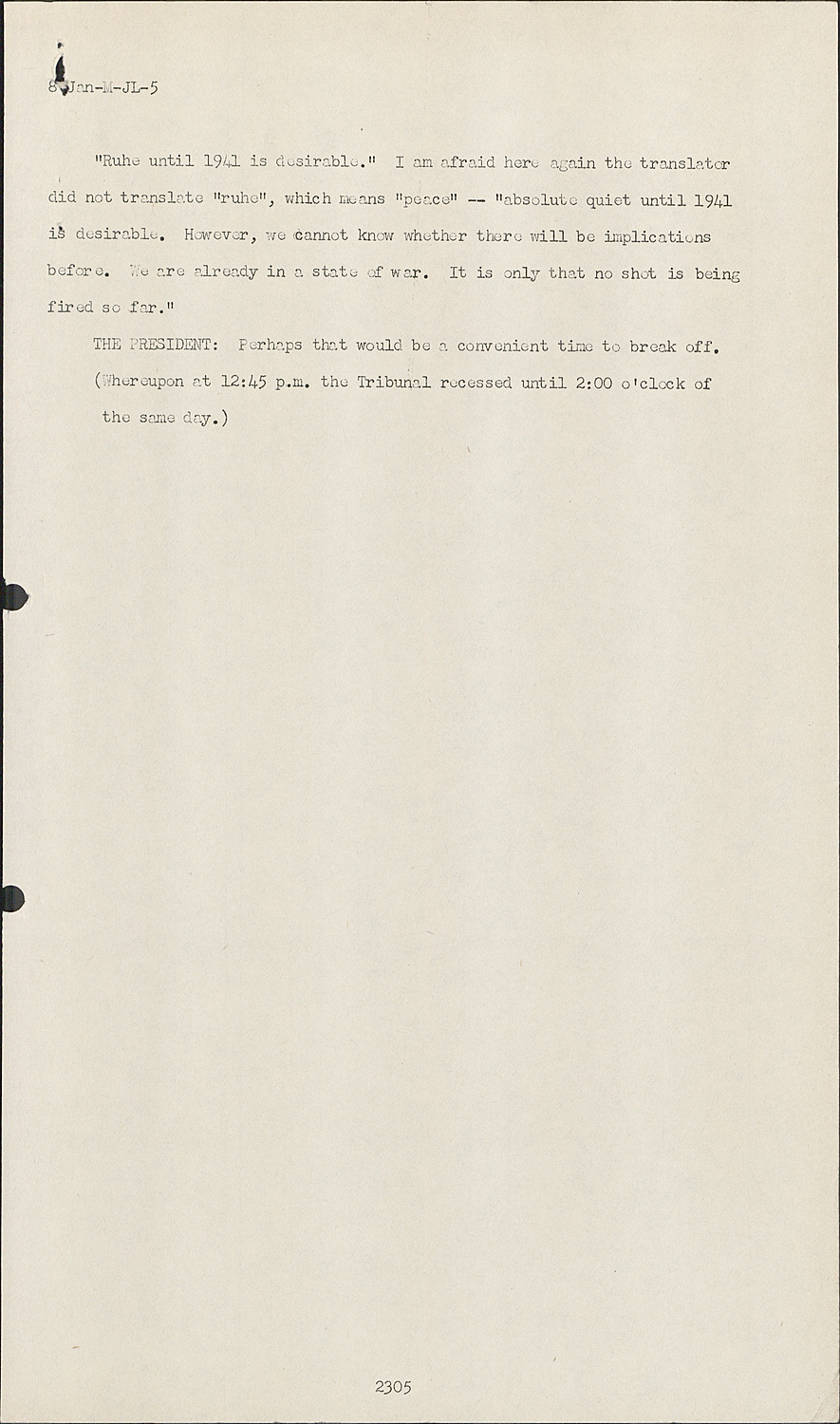
"Ruhe until 1941 is desirable." I an afraid hen, again the translator did not translate "ruhe", which means "peace" -- "absolute quiet until 1941 is desirable.
However, we cannot know whether there will be implications before. We are already in a state of war. It is only that no shot is being fired so far."
THE PRESIDENT:Perhaps that would be a convenient time to break off.
(Whereupon at 12:45 P.m. the Tribunal recessed until 2:00 o'clock of the same day.)
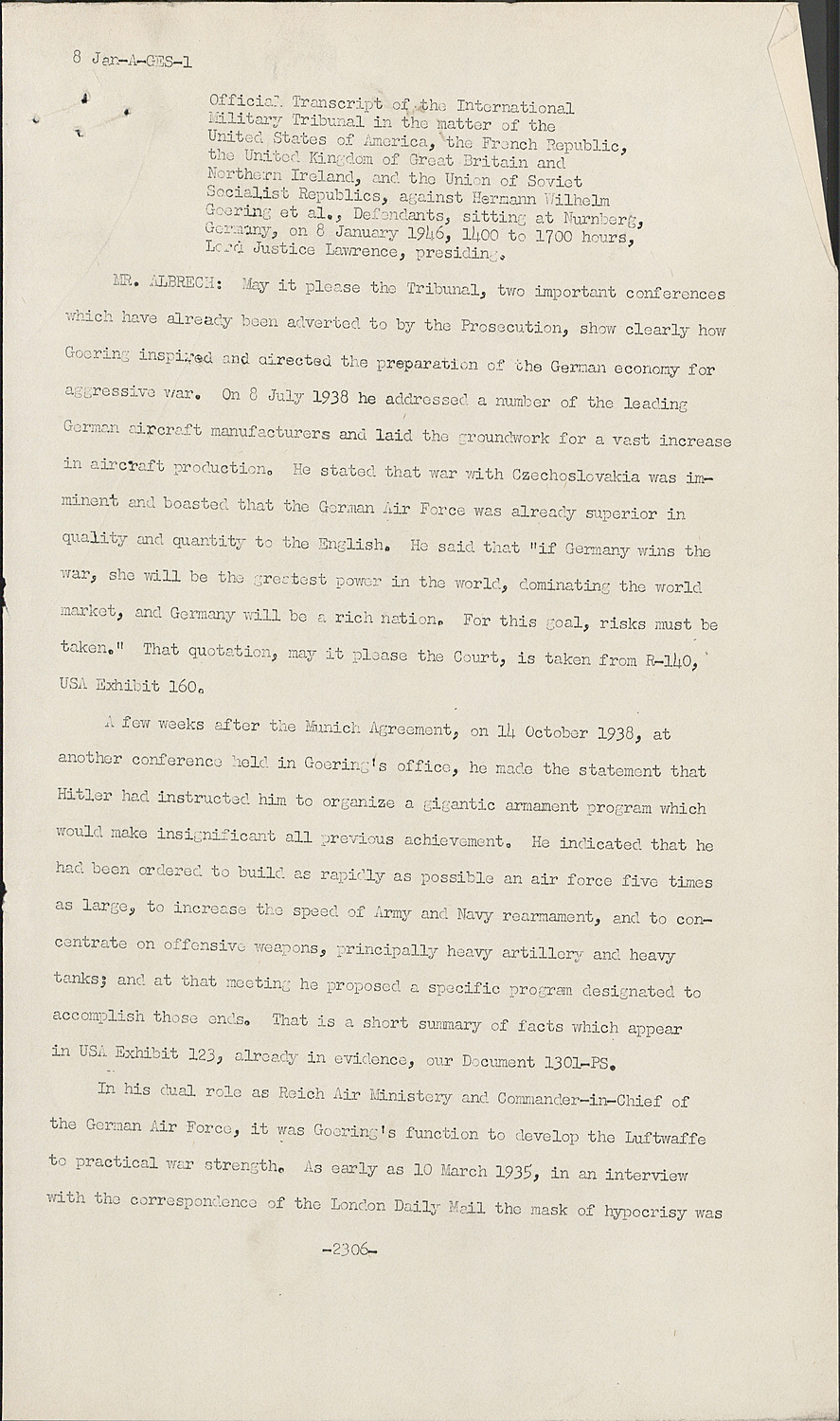
Official Transcript of the International Military Tribunal in the matter of the United States of America, the French Republic, the United Kingdom of Great Britain and Northern Ireland, and the Union of Soviet Socialist Republics, against Hermann Wilhelm Goering et al.
, Defendants, sitting at Nurnberg, Germany, on 8 January 1946, 1400 to 1700 hours, Lord Justice Lawrence, presiding.
MR. ALBRECH:May it please the Tribunal, two important conferences which have already been adverted to by the Prosecution, show clearly how Goering inspired and directed the preparation of the German economy for aggressive war. On 8 July 1938 he addressed a number of the leading German aircraft manufacturers and laid the groundwork for a vast increase in aircraft production. He stated that war with Czechoslovakia was imminent and boasted that the German Air Force was already superior in quality and quantity to the English. He said that "if Germany wins the war, she will be the greatest power in the world, dominating the world market, and Germany will be a rich nation. For this goal, risks must be taken." That quotation, may it please the Court, is taken from R-140, USA Exhibit 160.
A few weeks after the Munich Agreement, on 14 October 1938, at another conference held in Goering's office, he made the statement that Hitler had instructed him to organize a gigantic armament program which would make insignificant all previous achievement. He indicated that he had been ordered to build as rapidly as possible an air force five times as large, to increase the speed of Army and Navy rearmament, and to concentrate on offensive weapons, principally heavy artillery and heavy tanks; and at that meeting he proposed a specific program designated to accomplish those ends. That is a short summary of facts which appear in USA Exhibit 123, already in evidence, our Document 1301-PS.
In his dual role as Reich Air Ministery and Commander-in-Chief of the German Air Force, it was Goering's function to develop the Luftwaffe to practical war strength. As early as 10 March 1935, in an interview with the correspondence of the London Daily Mail the mask of hypocrisy was removed and Goering frankly announced to the world that he was in the process of building true military air force.
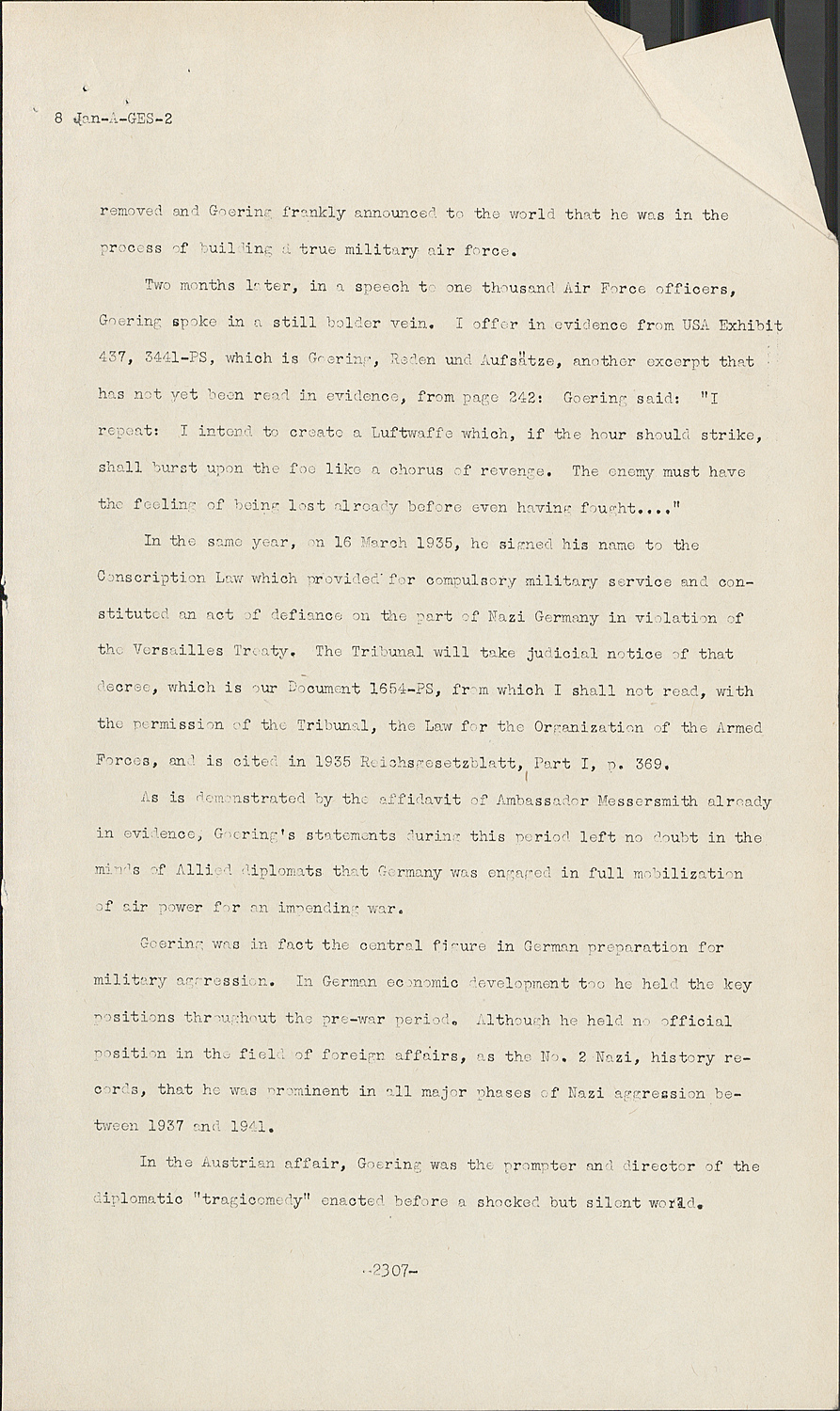
Two months later, in a speech to one thousand Air Force officers, Goering spoke in a still bolder vein. I offer in evidence from USA Exhibit 437, 3441-PS, which is Goering. Reden und Aufsaetze, another excerpt that has not yet been read in evidence, from page 242: Goering said: "I repeat: I intend to create a Luftwaffe which, if the hour should strike, shall burst upon the foe like a chorus of revenge. The enemy must have the feeling of being lost already before even having fought...."
In the same year, on 16 March 1935, he signed his name to the Conscription Law which provided for compulsory military service and constituted an not of defiance on the part of Nazi Germany in violation of the Versailles Treaty. The Tribunal will take judicial notice of that decree, which is our Document 1654-PS, from which I shall not read, with the permission of the Tribunal, the Law for the Organization of the Armed Forces, and is cited in 1935 Reichsgesetzblatt, Part I, p. 369.
As is demonstrated by the affidavit of Ambassador Messersmith already in evidence, Goering's statements during this period left no doubt in the minds of Allied diplomats that Germany was engaged in full mobilization of air power for an impending war.
Goering was in fact the control figure in German preparation for military aggression. In German economic development too he held the key positions throughout the pre-war period. Although he held no official position in the field of foreign affairs, as the No. 2 Nazi, history records, that he was prominent in all major phases of Nazi aggression between 1937 and 1941.
In the Austrian affair, Goering was the prompter and director of the diplomatic "tragicomedy" enacted before a shocked but silent world.
The Tribunal is fully familiar with Goering's complicity in the aggression against Austria, However, some additional documents have now come to our notice that show Goering not alone participated actively, but may even have been in direct charge of the German plan to bring about the Austrian Anschluss.
I will offer the first of these documents, our Document 3473-PS, as USA Exhibit 581. I shall not read from that exhibit, if your Honors please, but I would like to call the attention of the Tribunal to the letter from Keppler, who was one of Goering's agents, addressed to the Defendant Goering, It is dated 6 January 1938. From its context it would seem that a valid inference can be drawn that Goering was already active in the Austrian matter in 1937. Our prior evidence brought him into the picture much later, The prosecution believes it to be of great significance as it shows that the defendant Seyss-Inquart actually had Goering's mandate to carry out the orders of the Nazi conspirators in Vienna. The document itself will be read and discussed in the presentation of the case showing the individual responsibility of the defendant Seyss-Inquart; and I shall not take the time of the Tribunal at this time.
The second document, I wish to introduce as USA Exhibit 582, our Document 3472-PS. This exhibit would seem to show that the conspirators attempted to create the impression that the Anschluss, when it took place, was achieved by "legal" means. The command apparently was given to members of the NSDAP in Austria to keep "hands off" in order to permit the deviltry to be worked out by the official Reich agencies, i.e. the defendant Goering and presumably the defendant von Papen, by direct contact with the Austrian officials.
I read from that document:
"Yesterday, information reached me to the effect, that Landesleiter Leopold" -- and may I advert for the moment to point out that the word "Landesleiter" is the title of the Leader of the Nazi Community in Austria - "also on his part has started negotiations with Chancellor Schuschnigg, Thereupon I have asked the Foreign Office to investigate the truth of this information and, in case it was true, to take care that such negotiations not be held because they would merely disturb the proceedings of the other negotiations.
"Just now I got word from the Foreign Office that they received a report from the embassy in Vienna confirming the facts. I therefore would like to know, whether it would not be more appropriate to forbid Landesleiter Leopold and the other members of the country's leadership to negotiate with Chancellor Schuschnigg as well as with any Austrian government authorities as to the execution of the pact of 11 July 1936 if it is not done after contacting and in agreement with the authorities in charge in the Reich".
Now, below, may I call the attention of the Tribunal to the note that appears in this letter. It is typewritten in blue pencil, and while the translator has not indicated the initial below that note, it is a large "G"; and I have no doubt that that note was written by the Defendant Goering, It reads:
"Agreed, Minister Hess or Mr. Bormann can give this order best! Keppler ought to ask therefore by telephone!"
If I may direct your attention to the upper righthand corner, there is another note in pencil, "Transmitted to Mr. Keppler on 11 February 1938 by Miss Cest," and it is signed with initial "G", which in this case, however, we are quite sure is the initial of Miss Grundmann who was one of Goering's secretaries.
The third document I offer an USA Exhibit 538, our Document 3471-PS, The first letter of this exhibit is written by the same Keppler to the same Bodenschatz mentioned a short while ago, but who is now a general. I shall not read from this exhibit, with the permission of the Tribunal, but I shall briefly summarize it. This letter and the annexes show that Leopold, the Nazi Landesleiter in Austria, was apparently not completely amenable to the orders given by Berlin, and pursued his own methods for accomplishing an Anschluss. The second annex to this letter, addressed to Keppler, who appears from this letter to have been an SS Obergruppenfuehrer, shows that prominent Nazis had declared themselves in favor of a Major Klaussner to succeed Leopold as Landesleiter; and I would like to call the Tribunal's attention to the fact that in the left margin of the covering letter appear some red crayon marks in the characteristic color employed on several occasions, to our knowledge, by Goering and they would seem to show that Goering personally had seen these documents and that General Bodenschatz had brought them to his attention.
In any event these letters again demonstrate that Goering was one of the principle conspirators in the Austrian affair.
When the time finally came on 11 March 1938, to consummate the Anschluss, Goering was in complete command. Throughout the afternoon and evening of that day lie directed by telephone the activities of the Defendant Seyss-Inquart and of the other Nazi conspirators in Vienna. The pertinent portions of these telephone conversations, it will be remembered, were read into the record.
It will be recalled that early on the same evening of 11 March 1938 he dictated to the defendant Seyss-Inquart the telegram, which the letter was sent to Berlin, requesting the Nazi Government to send German troops to "prevent bloodshed." Two days later he was able to call the defendant Ribbentrop in London and gleefully relate to him of his success, and that "this story that we had given an ultimatum is just foolish gossip."
If I may advert for a moment, that passage I just alluded to was read into the record as page 581.
Similarly Goering played an important role in the attack on Czechoslovakia. In March of 1938, at the time of the "Anschluss", he had given a solemn assurance to the Czechoslovakian Minister in Berlin that the developments in Austria would in no way have a detrimental influence on the relations between Germany and Czechoslovakia, and he had emphasized the continued earnest endeavor on the part of Germany to improve these relations. In this connection, Goering had used the expression: "Ich gebe Ihnen mein Ehrenwort" (I give you my word of honor).
That expression was read previously into the record at page 962.
On the other hand, in his address to German airplane manufacturers on 8 July 1938, which I have already mentioned, he made his private views on this subject, which were hardly consistent with his solemn official statements, abundantly clear.
On 14 October 1938, shortly after the Munich agreement, at a conference in the Air Ministry, Goering stated that the Sudetenland had to be exploited with all means, and that he counted upon a complete industrial assimilation of Czechoslovakia. Meanwhile, as pr of before the Tribunal shows, he was deceiving the representatives of the puppet Slovakian government to the same end.
In the following year, with the rape of Czechoslovakia complete, Goering frankly stated what Germany's purpose had been throughout the whole affair. He explained that the incorporation of Bohemia and Moravia into the German economy had taken place, among other reasons, in order to increase the German war potential by exploitation of the industry there.
Goering was also a moving force in the later crimes against the peace. As the successor designate to Hitler, Chief of the Air Forces and Economic Czar of Greater Germany, he was a party to all the planning for military operations of the Nazi forces in the east and in the west.
In the Polish affair, for example, it was Goering who on 31 January 1935 gave assurances to the Polish Government through Count Czembek as revealed in the Polish White Book, of which I ask the Tribunal to take Judicial notice that "there should he not the slightest fear in Poland that on the German side it (meaning the German-Polish alliance) would not be continued in the future." Yet, four years later, Goering helped to formulate plans for the ruthless invasion of Polish territory.
In respect of the attack upon the Soviet Union, the documents already introduced prove that plans for the ruthless exploitation of Soviet territory were made months in advance of the opening of hostilities. Goering was placed in charge of this army of spoliation, whose mission was that of "seizing raw materials and taking over all important concerns."
But these specific instances cited are merely illustrative of Goering's activities in the field of aggressive war. On pages 20, 21 and 22 of our brief there appears a list of documents - by no means exhaustive - previously offered by the prosecution, which demonstrate Goering's knowledge of and continued participation in the Nazi war program.