LT. BRYSON: And the cause was not his unwillingness to go along with the aggressive intentions of the Nazis at that time, I'll be perfectly satisfied to confine our evidence to interrogations of Schacht and Goering.
THE PRESIDENT:Does he suggest that in his interrogation? That that might have been the reason?
LT. BRYSON:Not to my knowledge, Sir, but our case against Schacht is premised upon conspiracy.
THE PRESIDENT:If the defendant Schacht wants to set up such a case as that, you could apply to be heard in rebuttal.
LT. BRYSON:Well, we'll be satisfied then to eliminate a number of our items of evidence, including the controversy between Goering and Schacht, and satisfy ourselves with the interrogations.
THE PRESIDENT:Yes.
LT. BRYSON:If the Court please, we are almost at the time of the break. Perhaps during the break we can arrange our evidence.
THE PRESIDENT:Yes, we will adjourn for ten minutes.
(A recess was taken from 1120 to 1130 hours.)
PROFESSOR HERBERT KRAUS (Counsel for Defendant Schacht): We agree that the question of the disagreement between Goering and Schacht is not to be discussed at this time.
But we shall come back to the question as to what extent this disagreement affected the plan of aggressive war.
THE PRESIDENT:Go ahead.
PROFESSOR KRAUS:To what extent this disagreement affected it -concerned the plan of a war of aggression; to that question we shall refer extensively later.
LIEUTENANT BRYSON:If the Tribunal please:
We have eliminated part of our proof. I would simply like to put in a letter from Goering and an interrogation of Schacht, which will finish up on the question of the disagreement.
Under date of 5 August, 1937, Schacht wrote a critical letter to Goering, who replied with a twenty-four page letter on 22 August, 1937. Goering's letter reviews their many differences in detail. I offer it as EC 493, US Exhibit No. 642, and I Wish to read simply one statement, found in the middle of page 13:
"In conclusion I should like to refer to remarks which you made in a paragraph of your letter entitled 'The Four Year Plan' about your general attitude"-
THE PRESIDENT:Is this EC 493?
LIEUTENANTBRYSON: 493, sir, page 13, in the middle of the page.
THE PRESIDENT:Yes.
LIEUTENANTBRYSON: "In conclusion, I should like to refer to remarks which you made in a paragraph of your letter entitled 'The Four-Year Plan' about your general attitude toward my work in regard to the economic policy. I know and am pleased that at the beginning of the Four-Year Plan you promised me your loyal support and cooperation and that you repeatedly renewed this promise even after the first differences of opinion had occurred and had been removed in exhaustive discussions. I deplore all the more having the impression recently, which is confirmed by your letter, that you are increasingly antagonistic toward my work in the Four-Year Plan.
This explains the fact that our collaboration has gradually become less close."
Schacht and Goering were reconciled by written agreement on 7 July 1937, but subsequently again fell into disagreement, and Hitler finally accepted Schacht's resignation as Minister of Economics on 26 November, 1937, simultaneously appointing him as Minister with Portfolio and later Schacht's resignation was extended to his position as Plenipotentiary for War Economy. Without reading it, I offer in evidence EC 494, US Exhibit No. 643, as proof of this fact.
Now finally, I wish to refer the Tribunal to the interrogation of Schacht, under date of 16 October 1945, US Exhibit 636, and I wish to read from page 12 of the document near the bottom:
"A. It may amuse you if I told you that the last conversation --" this is Schact speaking -- "the last conversation I had with Goering on these topics was in November 1937, when Luther for two months had endeavored to unite Goering and myself and to induce me to further cooperate with Goering and maintain my position as Minister of Economics. Then I had a last talk with Goering, and at the end of this talk Goering said, 'but I must have the right to give orders to you'. Then I said, 'not to me, but to my successor.' I never have taken orders from Goering, and I would never have done it because he was a fool in economics and I know something about it, at least.
"Q. Well, I gather that was a culminating, progressive personal business between you and Goering. That seems perfectly obvious.
"A. Certainly," In all this abundant and consistent evidence, there is not the slightest suggestion that Schacht's withdrawal from these two posts represented a break with Hitler on the ground of contemplated military aggression.
Indeed, Hitler was gratified that Schacht would still be active in the Government as Presi dent of the Reichsbank and as Minister without Portfolio. I offer in evidence L-104, U.S. Exhibit No. 644, consisting of a letter to the United States Secretary of State from Ambassador Dodd, under date of 29 November, 1937, enclosing a translation of Hitler's letter of 26 -November 1937 to Schacht.
I quote the last two sentences of Hitler's letter, found on page two of the document:
"If I accede to your wish it is with the expression of deepest gratitude for your so excellent achievements and in the happy consciousness that, as President of the Reichsbank Directorium, you will make available for the German people and me for many years more your outstanding knowledge and ability and your untiring strength.
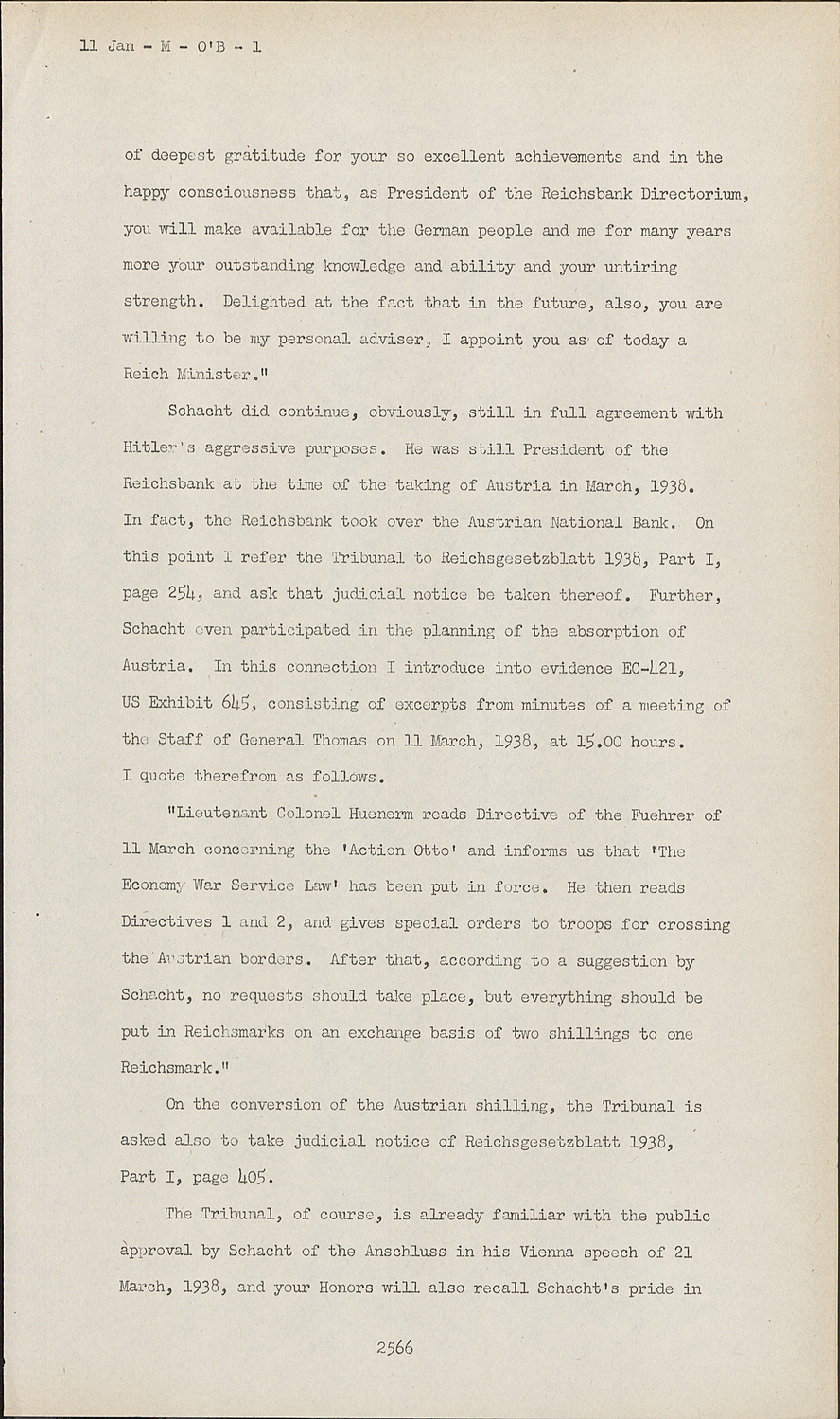
Delighted at the fact that in the future, also, you are willing to be my personal adviser, I appoint you as of today a Reich Minister."
Schacht did continue, obviously, still in full agreement with Hitler's aggressive purposes. He was still President of the Reichsbank at the time of the taking of Austria in March, 1938. In fact, the Reichsbank took over the Austrian National Bank. On this point I refer the Tribunal to Reichsgesetzblatt 1938, Part I, page 254, and ask that judicial notice be taken thereof. Further, Schacht even participated in the planning of the absorption of Austria. In this connection I introduce into evidence EC-421, US Exhibit 645, consisting of excerpts from minutes of a meeting of the Staff of General Thomas on 11 March, 1938, at 15.00 hours. I quote therefrom as follows.
"Lieutenant Colonel Huenerm reads Directive of the Fuehrer of 11 March concerning the 'Action Otto' and informs us that 'The Economy War Service Law' has been put in force. He then reads Directives 1 and 2, and gives special orders to troops for crossing the Austrian borders. After that, according to a suggestion by Schacht, no requests should take place, but everything should be put in Reichsmarks on an exchange basis of two shillings to one Reichsmark."
On the conversion of the Austrian shilling, the Tribunal is asked also to take judicial notice of Reichsgesetzblatt 1938, Part I, page 405.
The Tribunal, of course, is already familiar with the public approval by Schacht of the Anschluss in his Vienna speech of 21 March, 1938, and your Honors will also recall Schacht's pride in Hitler's use of the rearmed Wehrmacht at Munich, as expressed in his speech of 29 November, 1938.
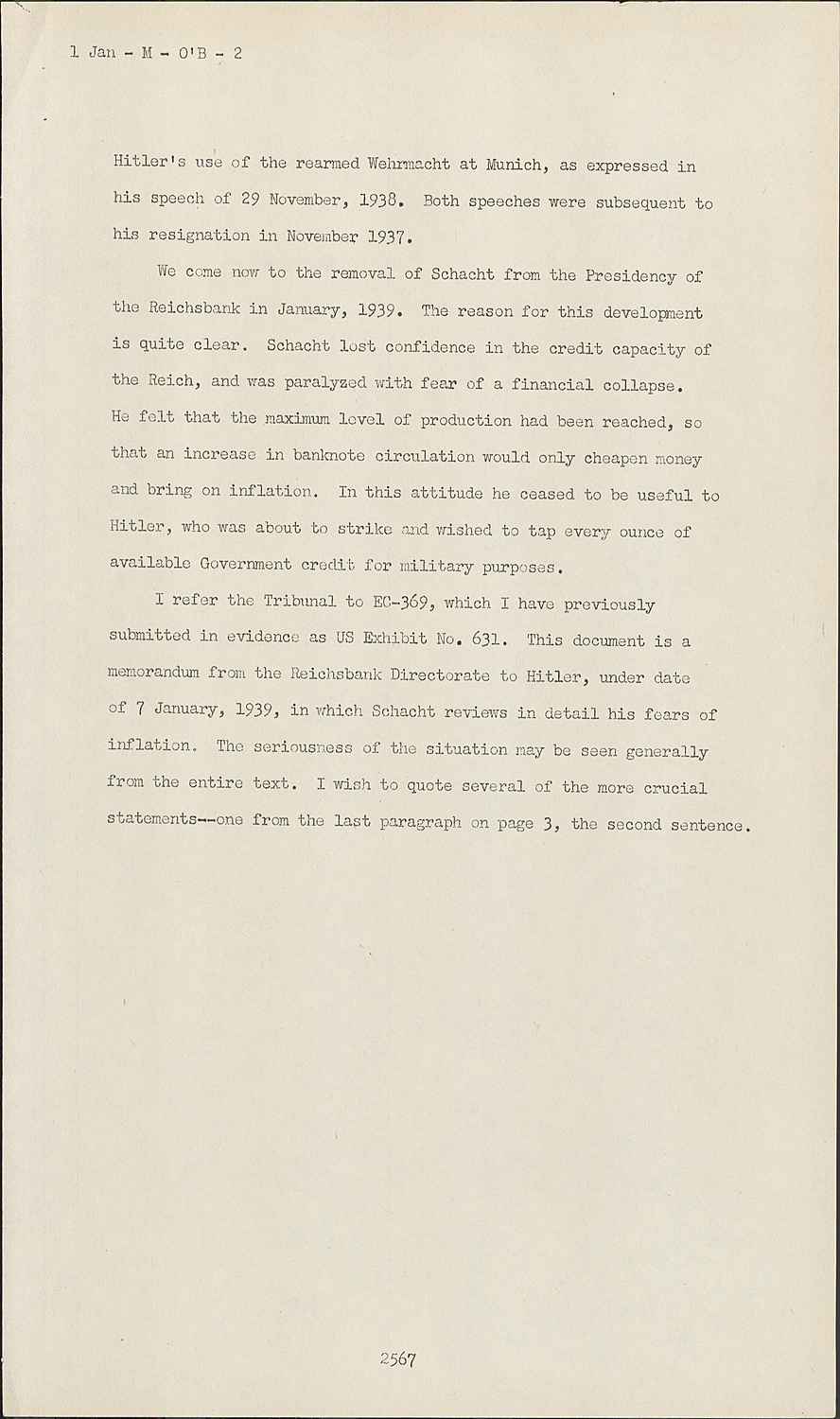
Both speeches were subsequent to his resignation in November 1937.
We come now to the removal of Schacht from the Presidency of the Reichsbank in January, 1939.
The reason for this development is quite clear.
Schacht lost confidence in the credit capacity of the Reich, and was paralyzed with fear of a financial collapse.
He felt that the maximum level of production had been reached, so that an increase in banknote circulation would only cheapen money and bring on inflation.
In this attitude he ceased to be useful to Hitler, who was about to strike and wished to tap every ounce of available Government credit for military purposes.
I refer the Tribunal to EC-369, which I have previously submitted in evidence as US Exhibit No. 631.
This document is a memorandum from the Reichsbank Directorate to Hitler, under date of 7 January, 1939, in which Schacht reviews in detail his fears of inflation.
The seriousness of the situation may be seen generally from the entire text.
I wish to quote several of the more crucial statements--one from the last paragraph on page 3, the second sentence.
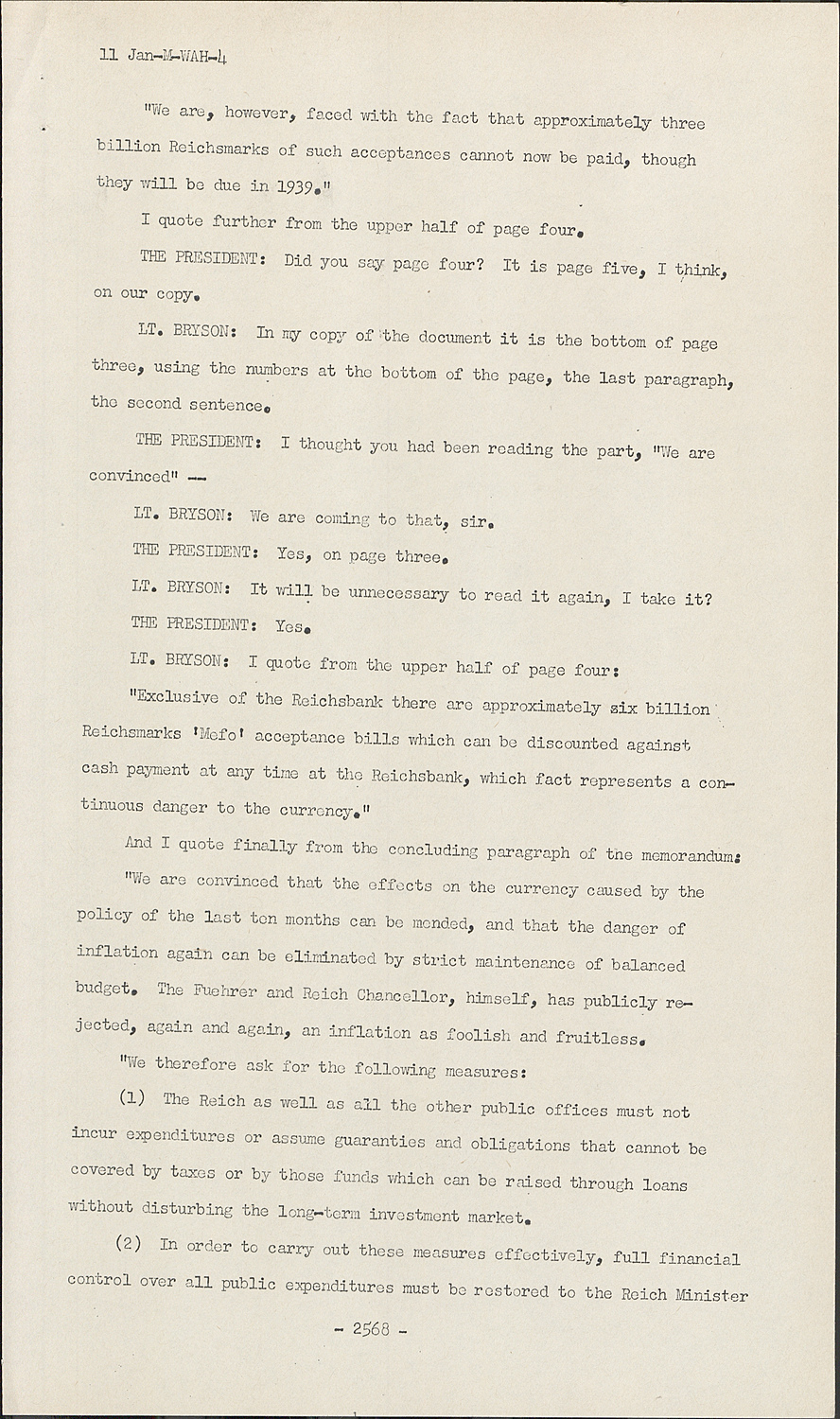
"We are, however, faced with the fact that approximately three billion Reichsmarks of such acceptances cannot now be paid, though they will be due in 1939."
I quote further from the upper half of page four.
THE PRESIDENT:Did you say page four? It is page five, I think, on our copy.
LT. BRYSON:In my copy of the document it is the bottom of page three, using the numbers at the bottom of the page, the last paragraph, the second sentence.
THE PRESIDENT:I thought you had been reading the part, "We are convinced" -
LT. BRYSON:We are coming to that, sir.
THE PRESIDENT:Yes, on page three.
LT. BRYSON:It will be unnecessary to read it again, I take it?
THE PRESIDENT:Yes.
LT. BRYSON:I quote from the upper half of page four:
"Exclusive of the Reichsbank there are approximately six billion Reichsmarks 'Mefo' acceptance bills which can be discounted against cash payment at any time at the Reichsbank, which fact represents a continuous danger to the currency."
And I quote finally from the concluding paragraph of the memorandum:
"We are convinced that the effects on the currency caused by the policy of the last ten months can be mended, and that the danger of inflation again can be eliminated by strict maintenance of balanced budget. The Fuehrer and Reich Chancellor, himself, has publicly rejected, again and again, an inflation as foolish and fruitless.
"We therefore ask for the following measures:
(1) The Reich as well as all the other public offices must not incur expenditures or assume guaranties and obligations that cannot be covered by taxes or by those funds which can be raised through loans without disturbing the long-term investment market.
(2) In order to carry out these measures effectively, full financial control over all public expenditures must be restored to the Reich Minister of Finance.
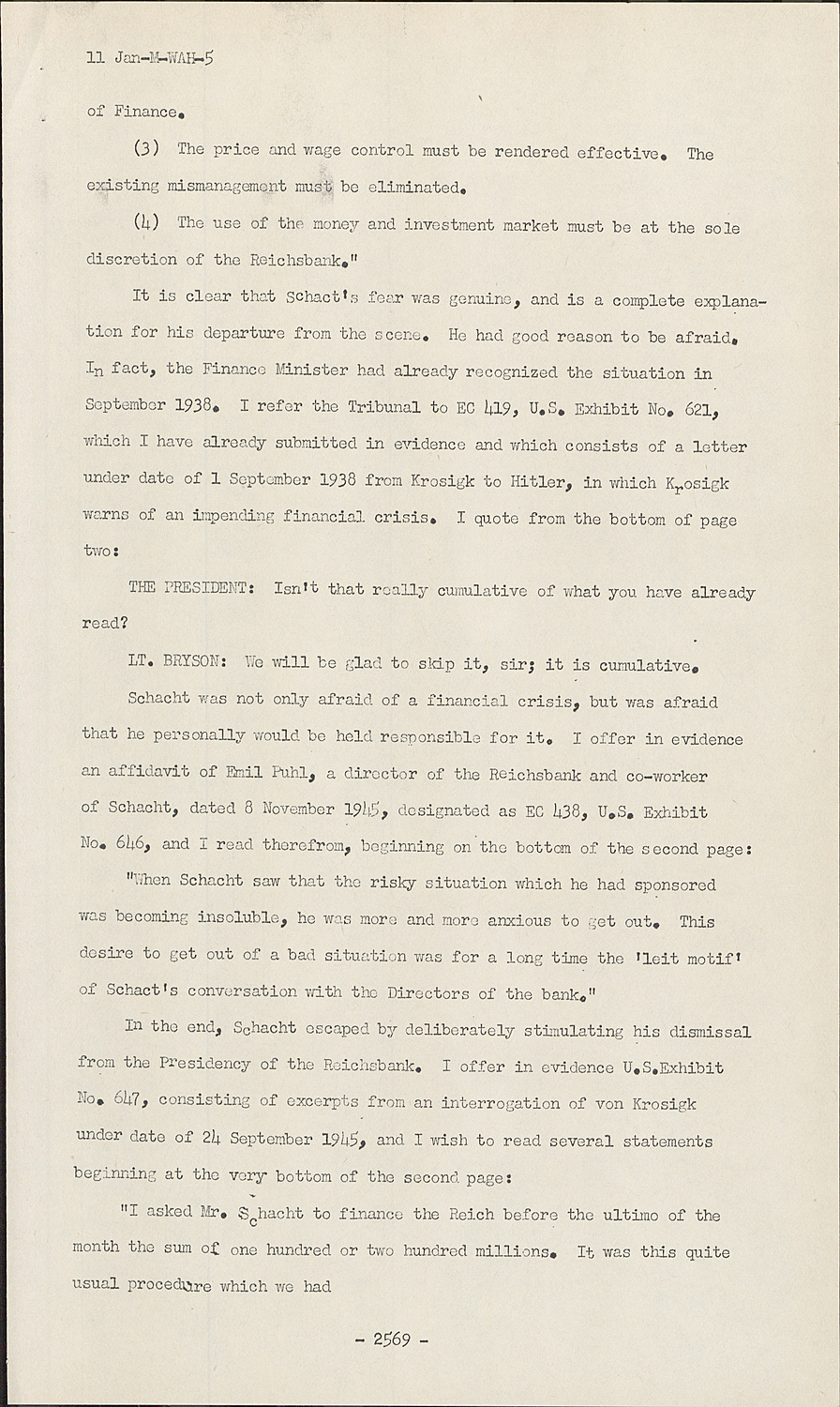
(3) The price and wage control must be rendered effective. The existing mismanagement must be eliminated.
(4) The use of the money and investment market must be at the sole discretion of the Reichsbank."
It is clear that Schact's fear was genuine, and is a complete explanation for his departure from the scene. He had good reason to be afraid. In fact, the Finance Minister had already recognized the situation in September 1938. I refer the Tribunal to EC 419, U.S. Exhibit No. 621, which I have already submitted in evidence and which consists of a letter under date of 1 September 1938 from Krosigk to Hitler, in which Krosigk warns of an Impending financial crisis. I quote from the bottom of page two :
THE PRESIDENT:Isn't that really cumulative of what you have already read?
LT. BRYSON:We will be glad to slap it, sir; it is cumulative.
Schacht was not only afraid of a financial crisis, but was afraid that he personally would be held responsible for it. I offer in evidence an affidavit of Emil Puhl, a director of the Reichsbank and co-worker of Schacht, dated 8 November 1945, designated as EC 438, U.S. Exhibit No. 646, and I read therefrom, beginning on the bottom of the second page:
"When Schacht saw that the risky situation which he had sponsored was becoming insoluble, he was more and more anxious to get out. This desire to get out of a bad situation was for a long time the 'leit motif' of Schact's conversation with the Directors of the bank."
In the end, Schacht escaped by deliberately stimulating his dismissal from the Presidency of the Reichsbank. I offer in evidence U.S. Exhibit No. 647, consisting of excerpts from an interrogation of von Krosigk under date of 24 September 1945, and I wish to read several statements beginning at the very bottom of the second page:
"I asked Mr. Schacht to finance the Reich before the ultimo of the month the sum of one hundred or two hundred millions. It was this quite usual procedure which we had used for years and years, and we used to give back this money after a couple of days.
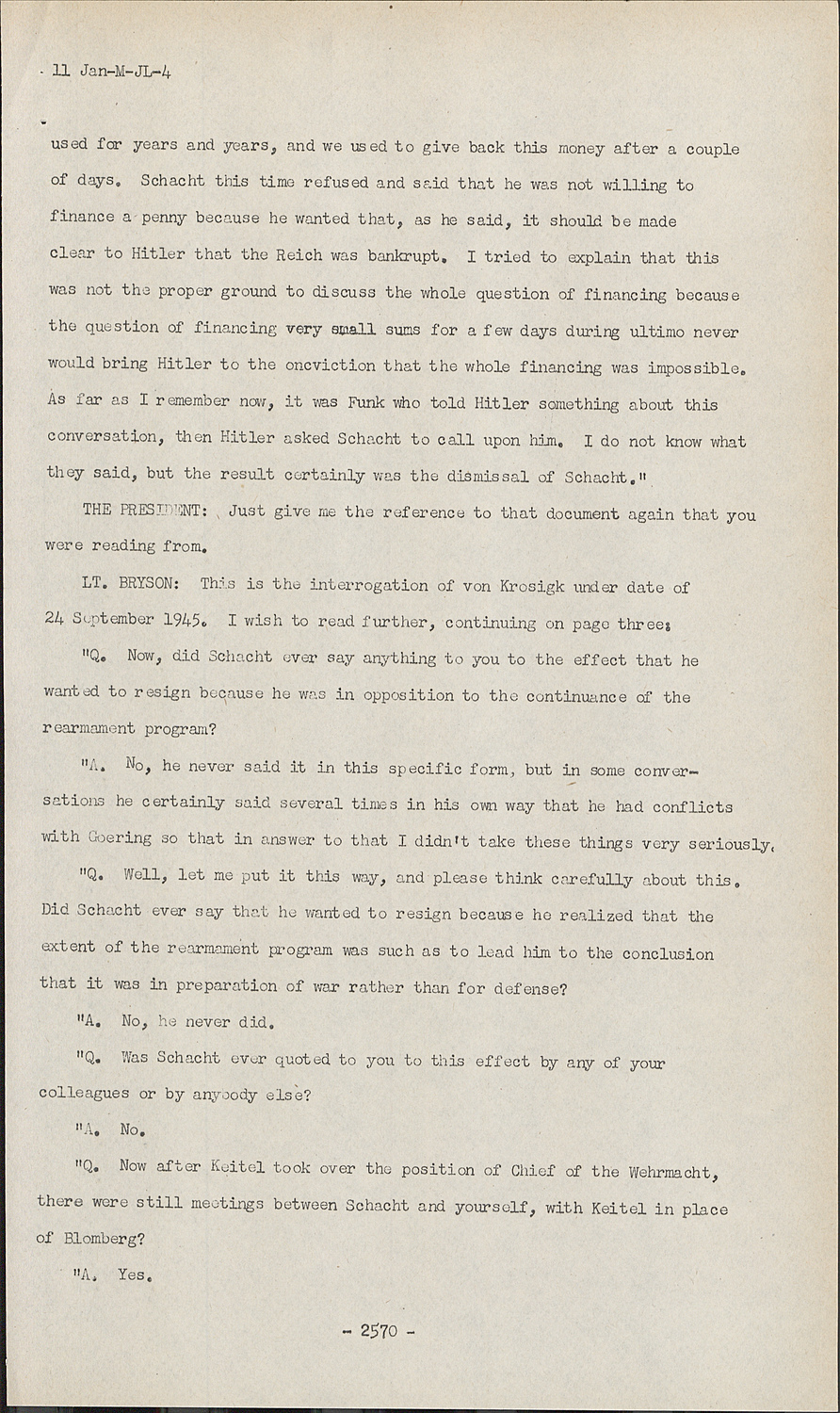
Schacht this time refused and said that he was not willing to finance a penny because he wanted that, as he said, it should be made clear to Hitler that the Reich was bankrupt. I tried to explain that this was not the proper ground to discuss the whole question of financing because the question of financing very small sums for a few days during ultimo never would bring Hitler to the oncviction that the whole financing was impossible. As far as I remember now, it was Funk who told Hitler something about this conversation, then Hitler asked Schacht to call upon him. I do not know what they said, but the result certainly was the dismissal of Schacht."
THE PRESIDENT:Just give me the reference to that document again that you were reading from.
LT. BRYSON:This is the interrogation of von Krosigk under date of 24 September 1945. I wish to read further, continuing on page three:
"Q. Now, did Schacht ever say anything to you to the effect that he wanted to resign because he was in opposition to the continuance of the rearmament program?
"A. No, he never said it in this specific form, but in some conversations he certainly said several times in his own way that he had conflicts with Goering so that in answer to that I didn't take these things very seriously.
"Q. Well, let me put it this way, and please think carefully about this. Did Schacht ever say that he wanted to resign because he realized that the extent of the rearmament program was such as to lead him to the conclusion that it was in preparation of war rather than for defense?
"A. No, he never did.
"Q. Was Schacht ever quoted to you to this effect by any of your colleagues or by anybody else?
"A. No.
"Q. Now after Keitel took over the position of Chief of the Wehrmacht, there were still meetings between Schacht and yourself, with Keitel in place of Blomberg?
"A. Yes.
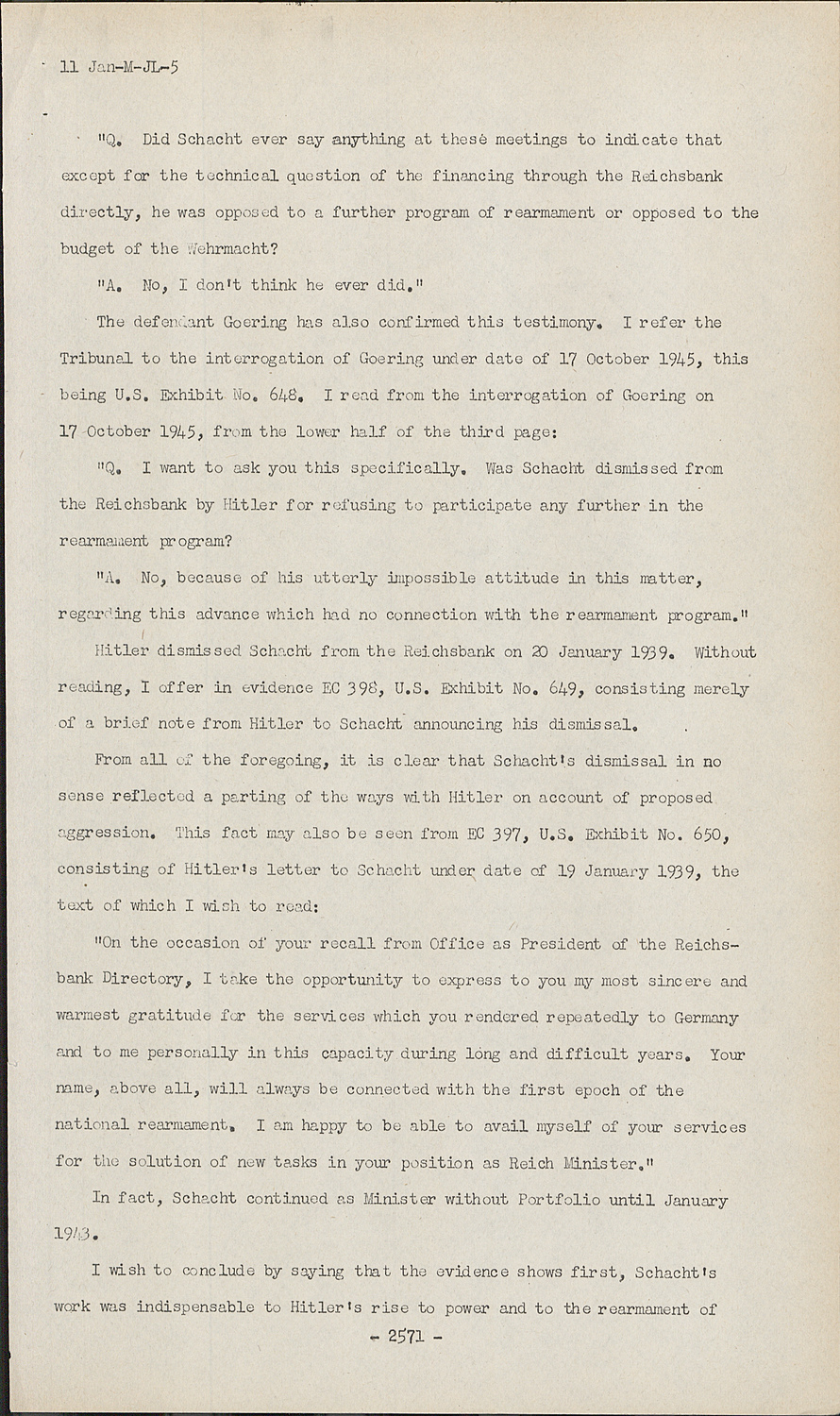
"Q. Did Schacht ever say anything at these meetings to indicate that except for the technical question of the financing through the Reichsbank directly, he was opposed to a further program of rearmament or opposed to the budget of the Wehrmacht?
"A. No, I don't think he ever did."
The defendant Goering has also confirmed this testimony, I refer the Tribunal to the interrogation of Goering under date of 17 October 1945, this being U.S. Exhibit No. 648. I read from the interrogation of Goering on 17 October 1945, from the lower half of the third page:
"Q. I want to ask you this specifically. Was Schacht dismissed from the Reichsbank by Hitler for refusing to participate any further in the rearmament program?
"A. No, because of his utterly impossible attitude in this matter, regarding this advance which had no connection with the rearmament program," Hitler dismissed Schacht from the Reichsbank on 20 January 1939.
Without reading, I offer in evidence EC 398, U.S. Exhibit No. 649, consisting merely of a brief note from Hitler to Schacht announcing his dismissal.
From all of the foregoing, it is clear that Schacht's dismissal in no sense reflected a parting of the ways with Hitler on account of proposed aggression. This fact may also be seen from EC 397, U.S. Exhibit No. 650, consisting of Hitler's letter to Schacht under date of 19 January 1939, the text of which I wish to read:
"On the occasion of your recall from Office as President of the Reichsbank Directory, I take the opportunity to express to you my most sincere and warmest gratitude for the services which you rendered repeatedly to Germany and to me personally in this capacity during long and difficult years. Your name, above all, will always be connected with the first epoch of the national rearmament. I am happy to be able to avail myself of your services for the solution of new tasks in your position as Reich Minister."
In fact, Schacht continued as Minister without Portfolio until January 1943.
I wish to conclude by saying that the evidence shows first, Schacht's work was indispensable to Hitler's rise to power and to the rearmament of Germany; secondly, Schacht personally was favorably disposed towards ag-gression and knew Hitler intended to and would break the peace; and third, Schacht retired from the scene for reasons wholly unrelated to the imminence of illegal aggression.
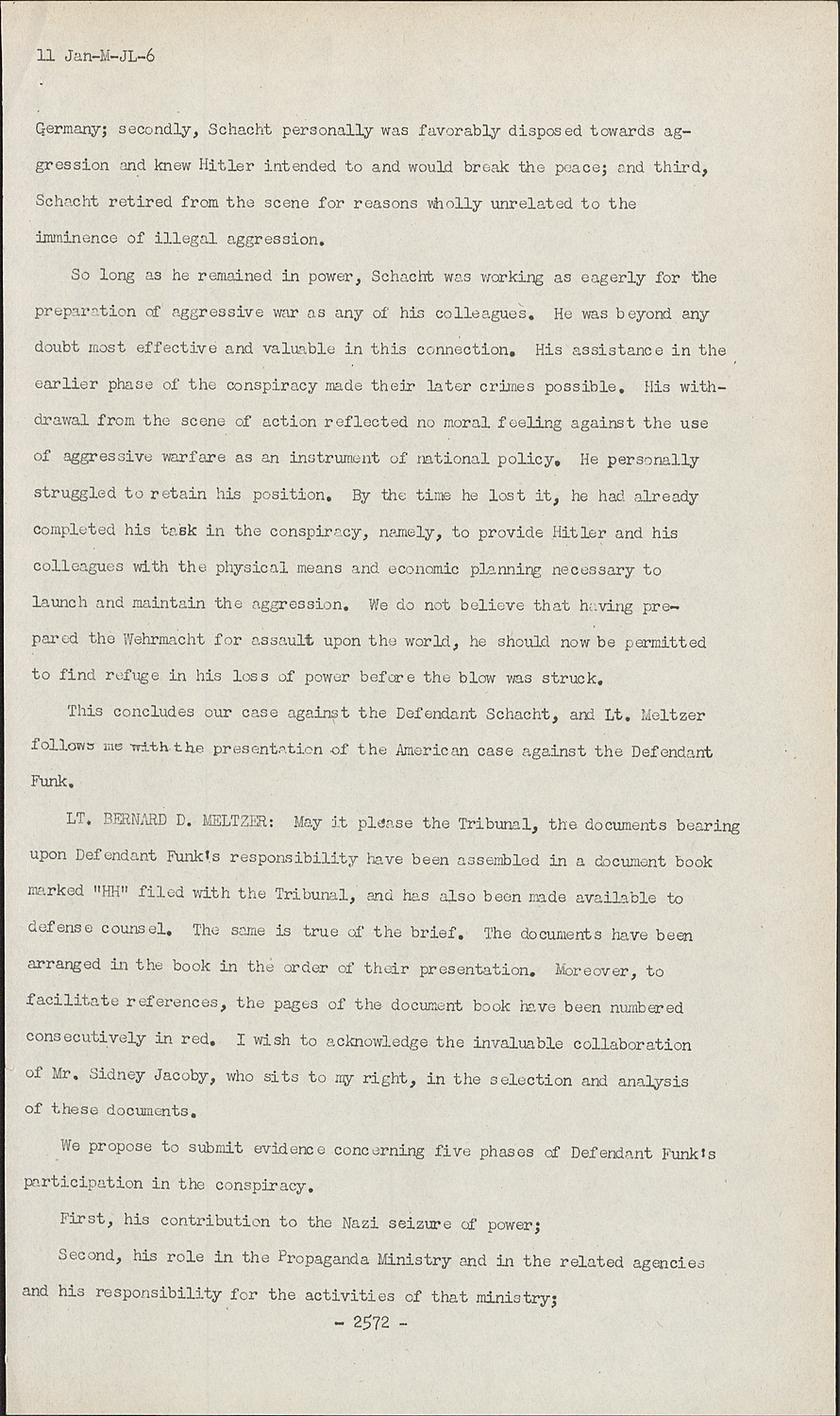
So long as he remained in power, Schacht was working as eagerly for the preparation of aggressive war as any of his colleagues. He was beyond any doubt most effective and valuable in this connection. His assistance in the earlier phase of the conspiracy made their later crimes possible. His withdrawal from the scene of action reflected no moral feeling against the use of aggressive warfare as an instrument of national policy. He personally struggled to retain his position. By the time he lost it, he had already completed his task in the conspiracy, namely, to provide Hitler and his colleagues with the physical means and economic planning necessary to launch and maintain the aggression. We do not believe that having prepared the Wehrmacht for assault upon the world, he should now be permitted to find refuge in his loss of power before the blow was struck.
This concludes our case against the Defendant Schacht, and Lt. Meltzer follows mo with the presentation of the American case against the Defendant Funk.
LT. BERNARD D. MELTZER:May it please the Tribunal, the documents bearing upon Defendant Funk's responsibility have been assembled in a document book marked "HH" filed with the Tribunal, and has also been made available to defense counsel. The some is true of the brief. The documents have been arranged in the book in the order of their presentation. Moreover, to facilitate references, the pages of the document book have been numbered consecutively in red. I wish to acknowledge the invaluable collaboration of Mr. Sidney Jacoby, who sits to my right, in the selection and analysis of these documents.
We propose to submit evidence concerning five phases of Defendant Funk's participation in the conspiracy.
First, his contribution to the Nazi seizure of power;
Second, his role in the Propaganda Ministry and in the related agencies and his responsibility for the activities of that ministry;
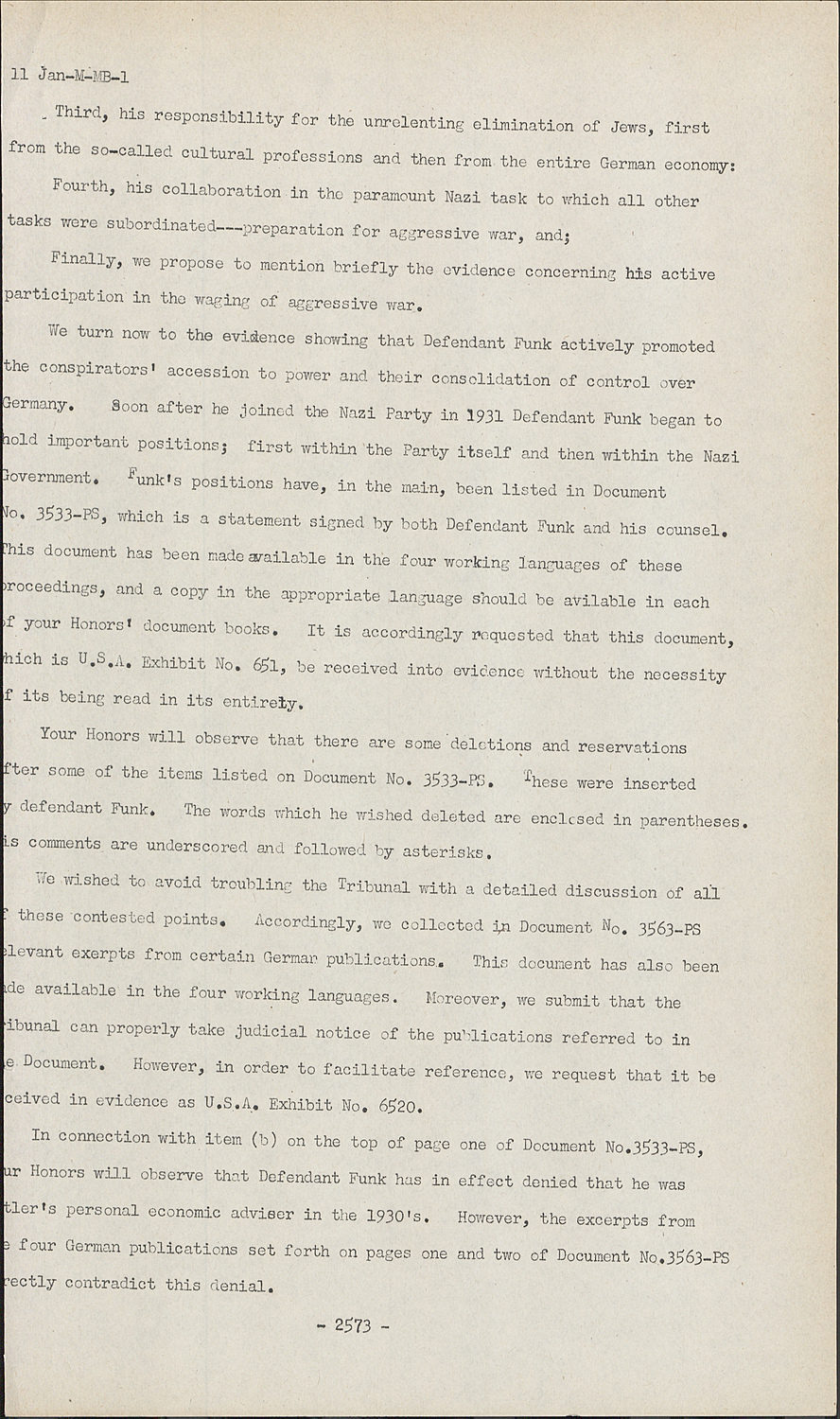
Third, his responsibility for the unrelenting elimination of Jews, first from the so-called cultural professions and then from the entire German economy:
Fourth, his collaboration in the paramount Nazi task to which all other tasks were subordinated--preparation for aggressive war, and;
Finally, we propose to mention briefly the evidence concerning his active participation in the waging of aggressive war.
We turn now to the evidence showing that Defendant Funk actively promoted the conspirators' accession to power and their consolidation of control over Germany. Soon after he joined the Nazi Party in 1931 Defendant Funk began to hold important positions; first within the Party itself and then within the Nazi Government. Funk's positions have, in the main, been listed in Document No. 3533-PS, which is a statement signed by both Defendant Funk and his counsel. This document has been made available in the four working languages of these Proceedings, and a copy in the appropriate language should be avilable in each of your Honors' document books. It is accordingly requested that this document, which is U.S.A. Exhibit No. 651, be received into evidence without the necessity if its being read in its entirely.
Your Honors will observe that there are some deletions and reservations after some of the items listed on Document No. 3533-PS. These were inserted by defendant Funk. The words which he wished deleted are enclosed in parentheses. This comments are underscored and followed by asterisks.
We wished to avoid troubling the Tribunal with a detailed discussion of all of these contested points. Accordingly, we collected in Document No. 3563-PS relevant exerpts from certain German publications. This document has also been made available in the four working languages. Moreover, we submit that the Tribunal can properly take judicial notice of the publications referred to in the Document. However, in order to facilitate reference, we request that it be received in evidence as U.S.A. Exhibit No. 6520.
In connection with item (b) on the top of page one of Document No.3533-PS, your Honors will observe that Defendant Funk has in effect denied that he was Hitler's personal economic adviser in the 1930's. However, the excerpts from the four German publications set forth on pages one and two of Document No.3563-PS directly contradict this denial.
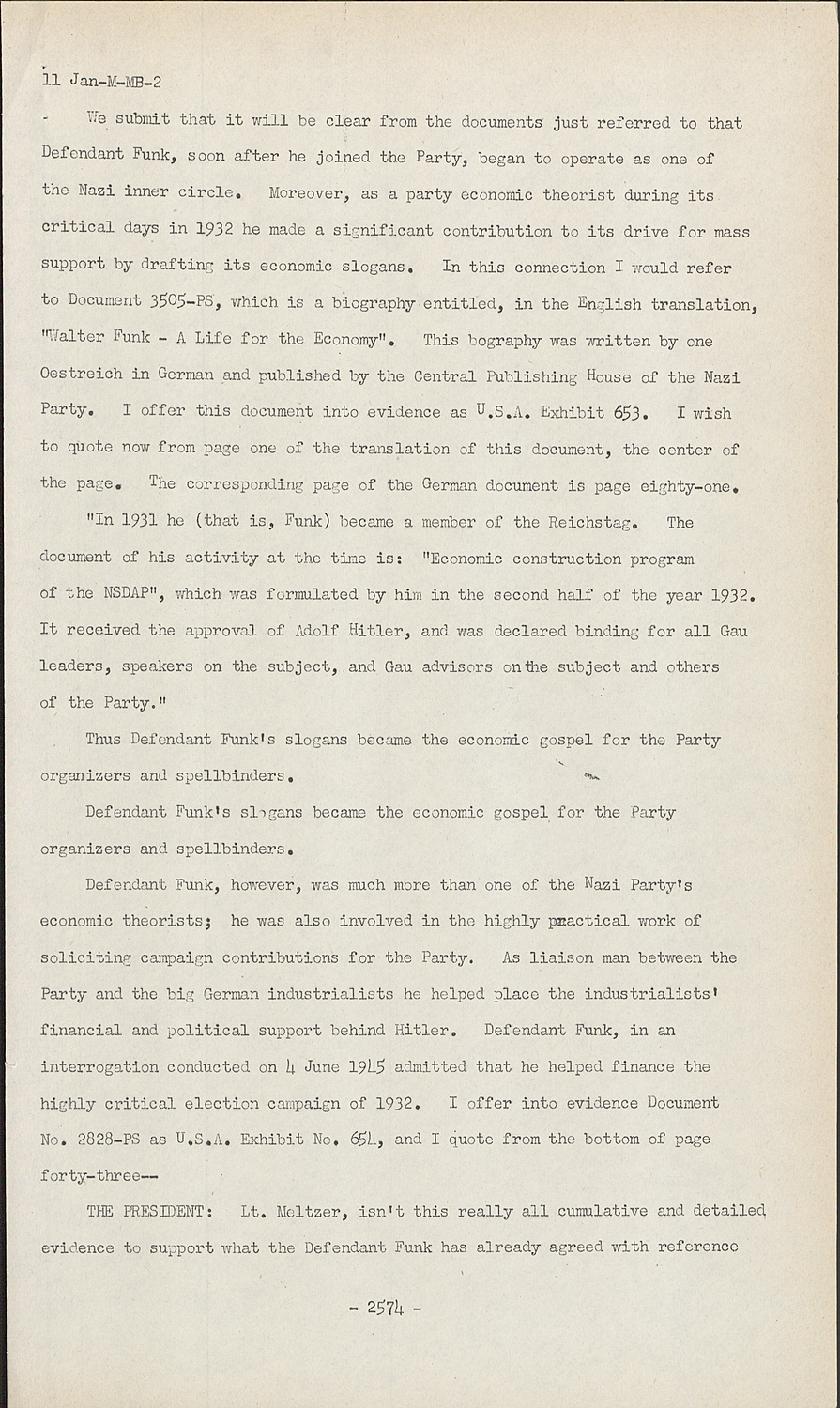
We submit that it will be clear from the documents just referred to that Defendant Funk, soon after he joined the Party, began to operate as one of the Nazi inner circle.
Moreover, as a party economic theorist during its critical days in 1932 he made a significant contribution to its drive for mass support by drafting its economic slogans. In this connection I would refer to Document 3505-PS, which is a biography entitled, in the English translation, "Walter Funk - A Life for the Economy". This bography was written by one Oestreich in German and published by the Central Publishing House of the Nazi Party. I offer this document into evidence as U.S.A. Exhibit 653. I wish to quote now from page one of the translation of this document, the center of the page. The corresponding page of the German document is page eighty-one.
"In 1931 he (that is, Funk) became a member of the Reichstag. The document of his activity at the time is: "Economic construction program of the NSDAP", which was formulated by him in the second half of the year 1932. It received the approval of Adolf Hitler, and was declared binding for all Gau leaders, speakers on the subject, and Gau advisors on the subject and others of the Party."
Thus Defendant Funk's slogans became the economic gospel for the Party organizers and spellbinders.
Defendant Funk's slogans became the economic gospel for the Party organizers and spellbinders.
Defendant Funk, however, was much more than one of the Nazi Party's economic theorists; he was also involved in the highly practical work of soliciting campaign contributions for the Party. As liaison man between the Party and the big German industrialists he helped place the industrialists' financial and political support behind Hitler. Defendant Funk, in an interrogation conducted on 4 June 1945 admitted that he helped finance the highly critical election campaign of 1932. I offer into evidence Document No. 2828-PS as U.S.A. Exhibit No. 654, and I quote from the bottom of page forty-three-
THE PRESIDENT:Lt. Meltzer, isn't this really all cumulative and detailed evidence to support what the Defendant Funk has already agreed with reference to his office?
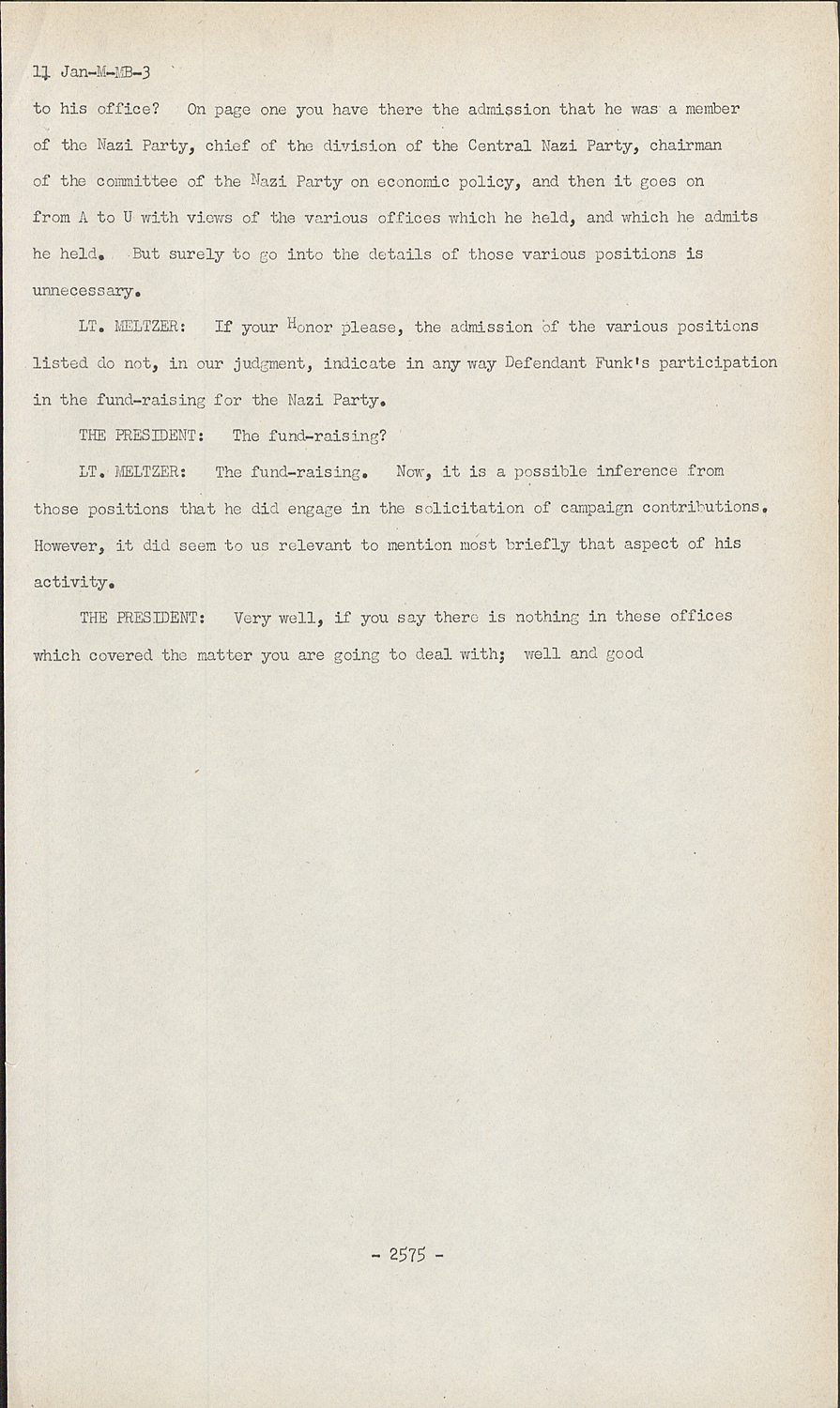
On page one you have there the admission that he was a member of the Nazi Party, chief of the division of the Central Nazi Party, chairman of the committee of the Nazi Party on economic policy, and then it goes on from A to U with views of the various offices which he held, and which he admits he held.
But surely to go into the details of those various positions is unnecessary.
LT. MELTZER:If your Honor please, the admission of the various positions listed do not, in our judgment, indicate in any way Defendant Funk's participation in the fund-raising for the Nazi Party.
THE PRESIDENT:The fund-raising?
LT. MELTZER:The fund-raising. Now, it is a possible inference from those positions that he did engage in the solicitation of campaign contributions. However, it did seem to us relevant to mention most briefly that aspect of his activity.
THE PRESIDENT:Very well, if you say there is nothing in these offices which covered the matter you are going to deal with; well and good LT.
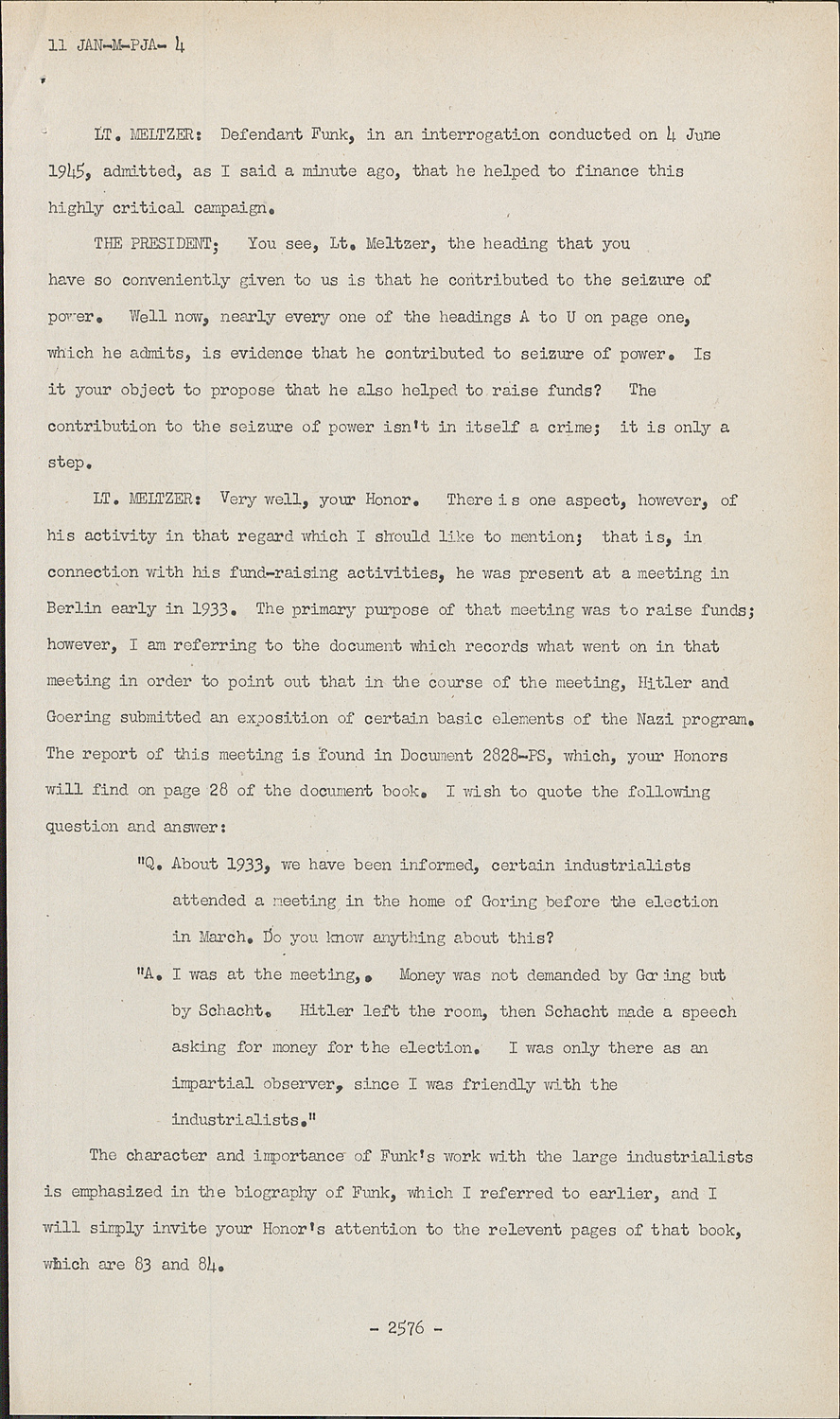
MELTZER: Defendant Funk, in an interrogation conducted on 4 June 1945, admitted, as I said a minute ago, that he helped to finance this highly critical campaign.
THEPRESIDENT; You see, Lt. Meltzer, the heading that you have so conveniently given to us is that he contributed to the seizure of power. Well now, nearly every one of the headings A to U on page one, which he admits, is evidence that he contributed to seizure of power. Is it your object to propose that he also helped to raise funds? The contribution to the seizure of power isn't in itself a crime; it is only a step.
LT. MELTZER:Very well, your Honor, There is one aspect, however, of his activity in that regard which I should like to mention; that is, in connection with his fund-raising activities, he was present at a meeting in Berlin early in 1933. The primary purpose of that meeting was to raise funds; however, I am referring to the document which records what went on in that meeting in order to point out that in the course of the meeting, Hitler and Goering submitted an exposition of certain basic elements of the Nazi program. The report of this meeting is found in Document 2828-PS, which, your Honors will find on page 28 of the document book. I wish to quote the following question and answer:
"Q. About 1933, we have been informed, certain industrialists attended a meeting in the home of Goring before the election in March.
Do you know anything about this?
"A. I was at the meeting,. Money was not demanded by Goring but by Schacht.
Hitler left the room, then Schacht made a speech asking for money for the election.
I was only there as an impartial observer, since I was friendly with the industrialists."
The character and importance of Funk's work with the large industrialists is emphasized in the biography of Funk, which I referred to earlier, and I will simply invite your Honor's attention to the relevent pages of that book, which are 83 and 84.
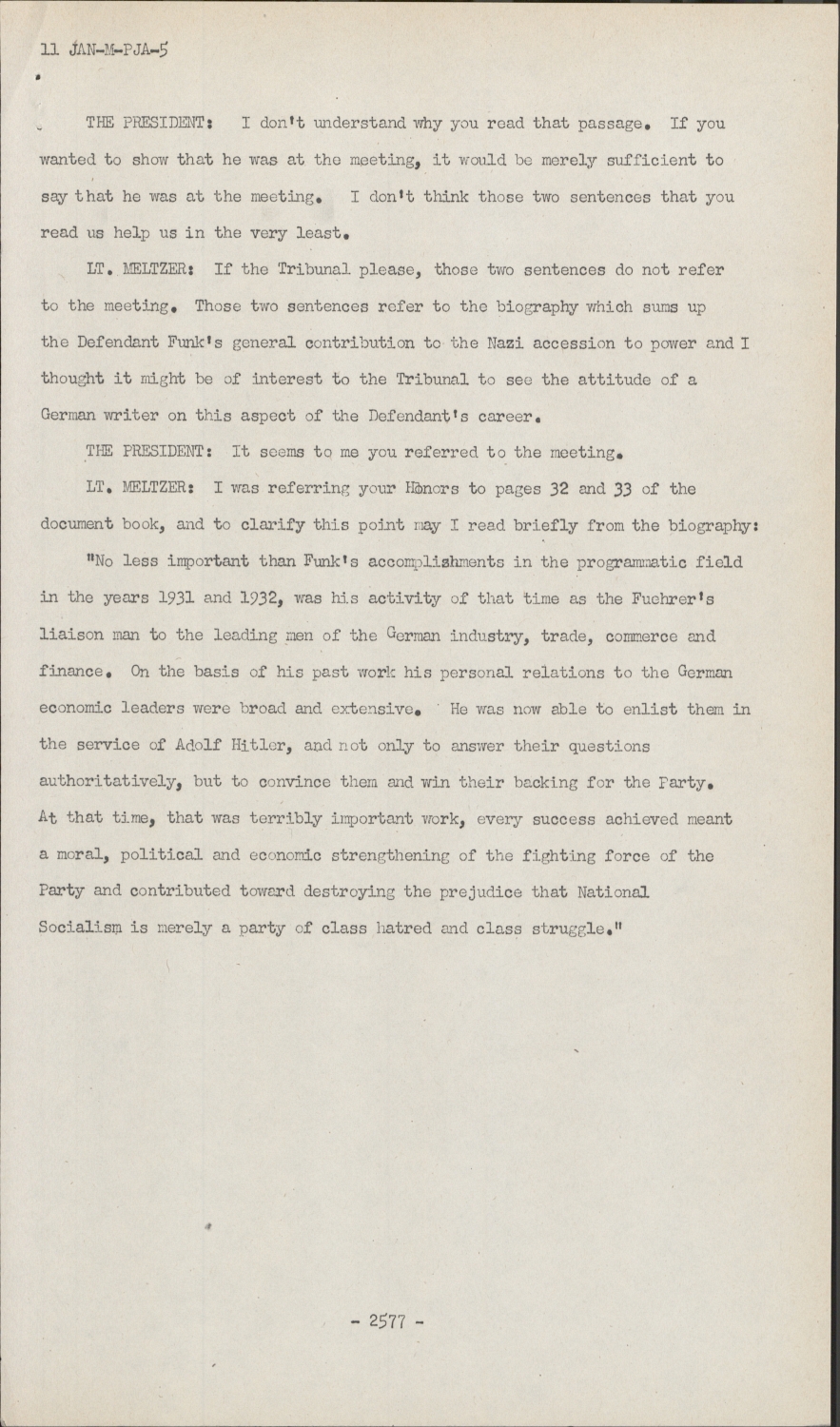
THE PRESIDENT: I don't understand why you read that passage. If you wanted to show that he was at the meeting, it would be merely sufficient to say that he was at the meeting.
I don't think those two sentences that you read us help us in the very least.
LT. MELTZER:If the Tribunal please, those two sentences do not refer to the meeting. Those two sentences refer to the biography which sums up the Defendant Funk's general contribution to the Nazi accession to power and I thought it might be of interest to the Tribunal to see the attitude of a German writer on this aspect of the Defendant's career.
THE PRESIDENT:It seems to me you referred to the meeting.
LT. MELTZER:I was referring your Honors to pages 32 and 33 of the document book, and to clarify this point may I read briefly from the biography:
"No less important than Funk's accomplishments in the programmatic field in the years 1931 and 1932, was his activity of that time as the Fuehrer's liaison man to the leading men of the German industry, trade, commerce and finance. On the basis of his past work his personal relations to the German economic leaders were broad and extensive. He was now able to enlist them in the service of Adolf Hitler, and not only to answer their questions authoritatively, but to convince them and win their backing for the Party. At that time, that was terribly important work, every success achieved meant a moral, political and economic strengthening of the fighting force of the Party and contributed toward destroying the prejudice that National Socialism is merely a party of class hatred and class struggle."
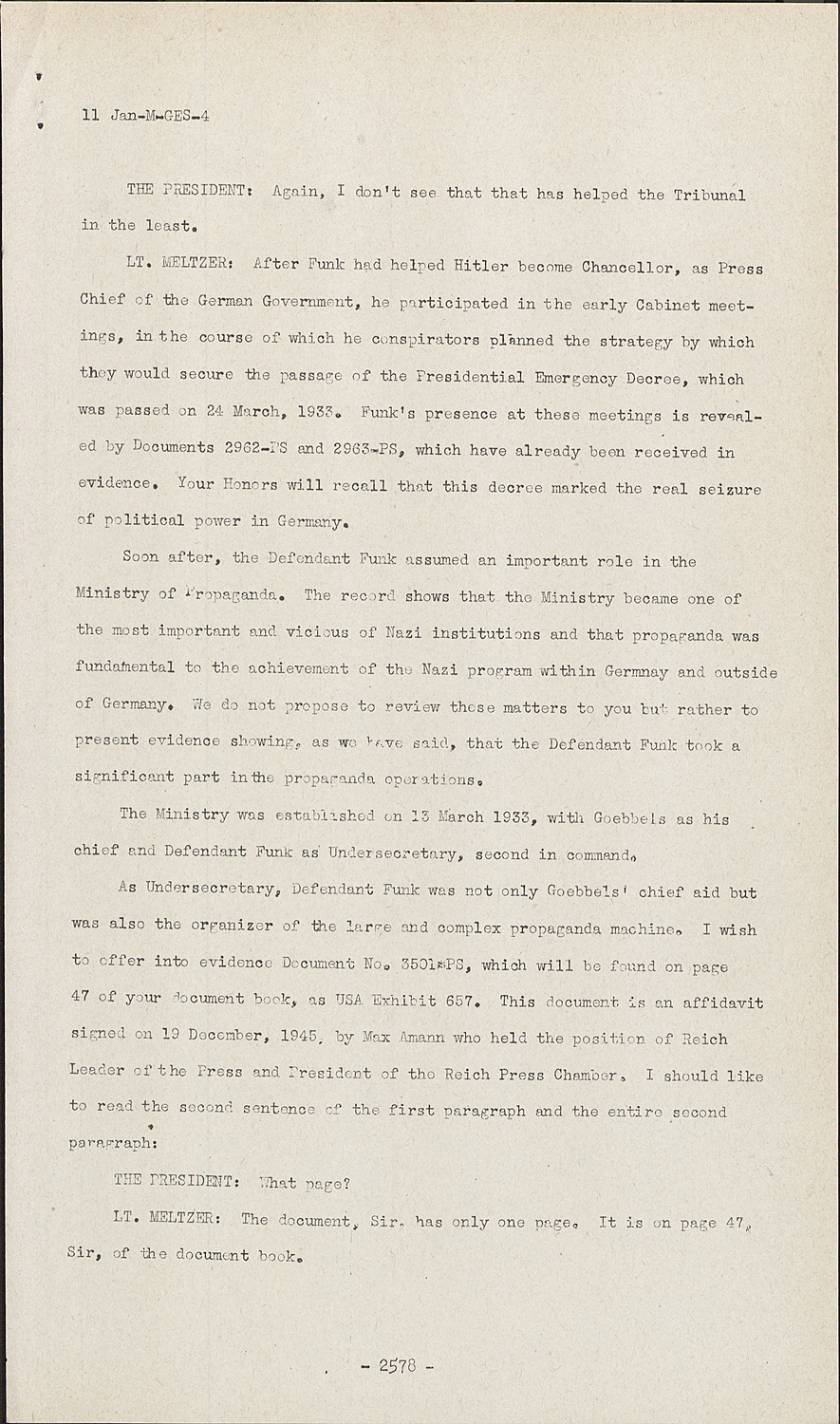
THE PRESIDENT: Again, I don't see that that has helped the Tribunal in the least.
LT. MELTZER:After Funk had helped Hitler become Chancellor, as Press Chief of the German Government, he participated in the early Cabinet meetings, in the course of which he conspirators planned the strategy by which they would secure the passage of the Presidential Emergency Decree, which was passed on 24 March, 1933. Funk's presence at these meetings is revealed by Documents 2962-PS and 2963-PS, which have already been received in evidence. Your Honors will recall that this decree marked the real seizure of political power in Germany.
Soon after, the Defendant Funk assumed an important role in the Ministry of Propaganda. The record shows that the Ministry became one of the most important and vicious of Nazi institutions and that propaganda was fundamental to the achievement of the Nazi program within Germnay and outside of Germany. We do not propose to review these matters to you but rather to present evidence showing, as we have said, that the Defendant Funk took a significant part in the propaganda operations.
The Ministry was established on 13 March 1933, with Goebbels as his chief and Defendant Funk as Undersecretary, second in command.
As Undersecretary, Defendant Funk was not only Goebbels' chief aid but was also the organizer of the large and complex propaganda machine. I wish to offer into evidence Document No. 3501-PS, which will be found on page 47 of your document book, as USA Exhibit 657. This document is an affidavit signed on 19 December, 1945, by Max Amann who held the position of Reich Leader of the Press and President of the Reich Press Chamber. I should like to read the second sentence of the first paragraph and the entire second paragraph:
THE PRESIDENT:What page?
LT. MELTZER:The document. Sir, has only one page. It is on page 47. Sir, of the document book.
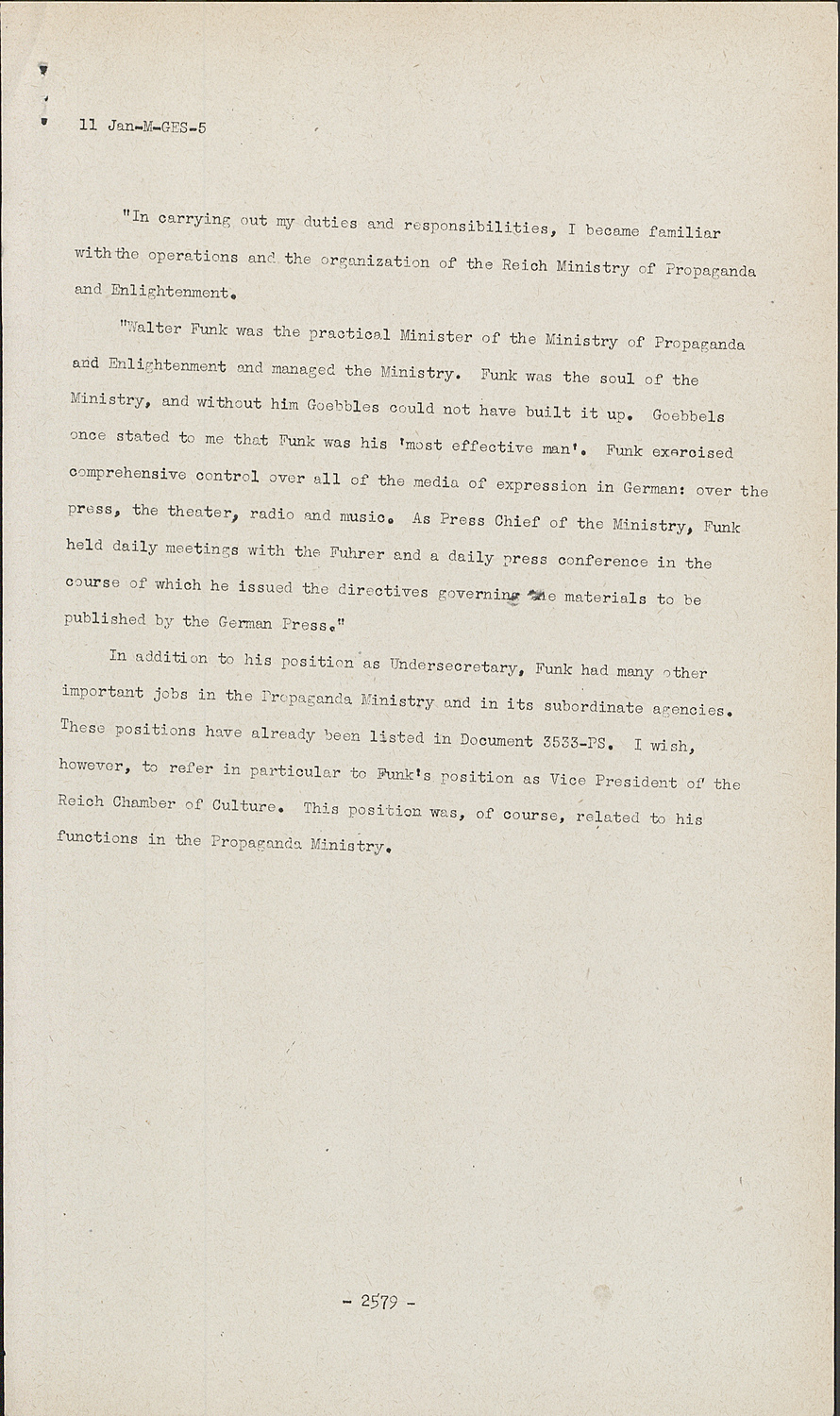
"In carrying out my duties and responsibilities, I became familiar with the operations and the organization of the Reich Ministry of Propaganda and Enlightenment.
"Walter Funk was the practical Minister of the Ministry of Propaganda and Enlightenment and managed the Ministry. Funk was the soul of the Ministry, and without him Goebbles could not have built it up. Goebbels once stated to me that Funk was his 'most effective man'. Funk exercised comprehensive control over all of the media of expression in German: over the press, the theater, radio and music. As Press Chief of the Ministry, Funk held daily meetings with the Fuhrer and a daily press conference in the course of which he issued the directives governing the materials to be published by the German Press."
In addition to his position as Undersecretary, Funk had many other important jobs in the Propaganda Ministry and in its subordinate agencies. These positions have already been listed in Document 3533-PS. I wish, however, to refer in particular to Punk's position as Vice President of the Reich Chamber of Culture. This position was, of course, related to his functions in the Propaganda Ministry.
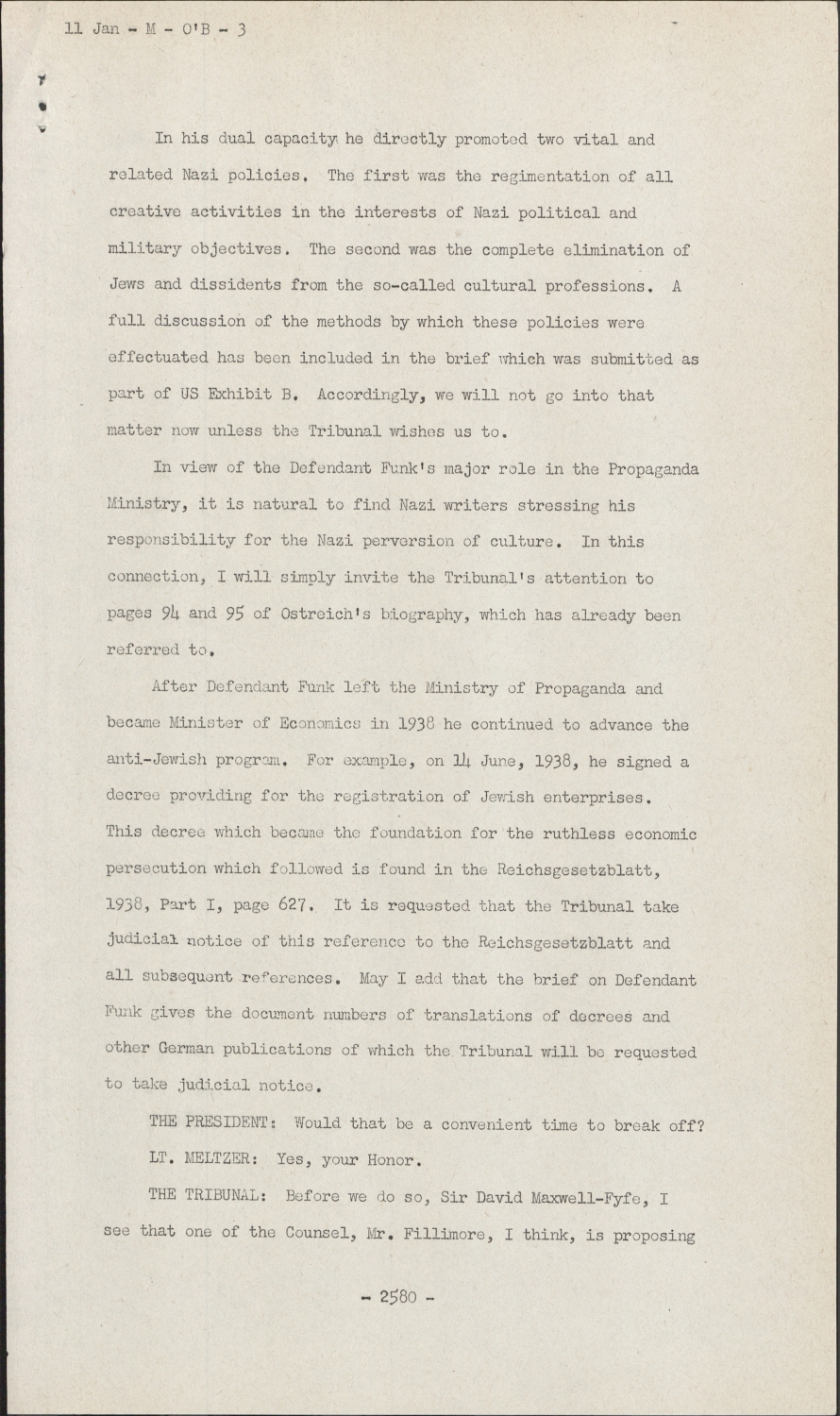
In his dual capacity he directly promoted two vital and related Nazi policies.
The first was the regimentation of all creative activities in the interests of Nazi political and military objectives.
The second was the complete elimination of Jews and dissidents from the so-called cultural professions.
A full discussion of the methods by which these policies were effectuated has been included in the brief which was submitted as part of US Exhibit B. Accordingly, we will not go into that matter now unless the Tribunal wishes us to.
In view of the Defendant Funk's major role in the Propaganda Ministry, it is natural to find Nazi writers stressing his responsibility for the Nazi perversion of culture.
In this connection, I will simply invite the Tribunal's attention to pages 94 and 95 of Ostreich's biography, which has already been referred to.
After Defendant Funk left the Ministry of Propaganda and became Minister of Economics in 1938 he continued to advance the anti-Jewish program.
For example, on 14 June, 1938, he signed a decree providing for the registration of Jewish enterprises.
This decree which became the foundation for the ruthless economic persecution which followed is found in the Reichsgesetzblatt, 1938, Part I, page 627.
It is requested that the Tribunal take judicial notice of this reference to the Reichsgesetzblatt and all subsequent references.
May I add that the brief on Defendant Funk gives the document numbers of translations of decrees and other German publications of which the Tribunal will be requested to take judicial notice.
THE PRESIDENT:Would that be a convenient time to break off?
LT. MELTZER:Yes, your Honor.
THE TRIBUNAL:Before we do so, Sir David Maxwell-Fyfe, I see that one of the Counsel, Mr. Fillimore, I think, is proposing to call certain-witnesses.
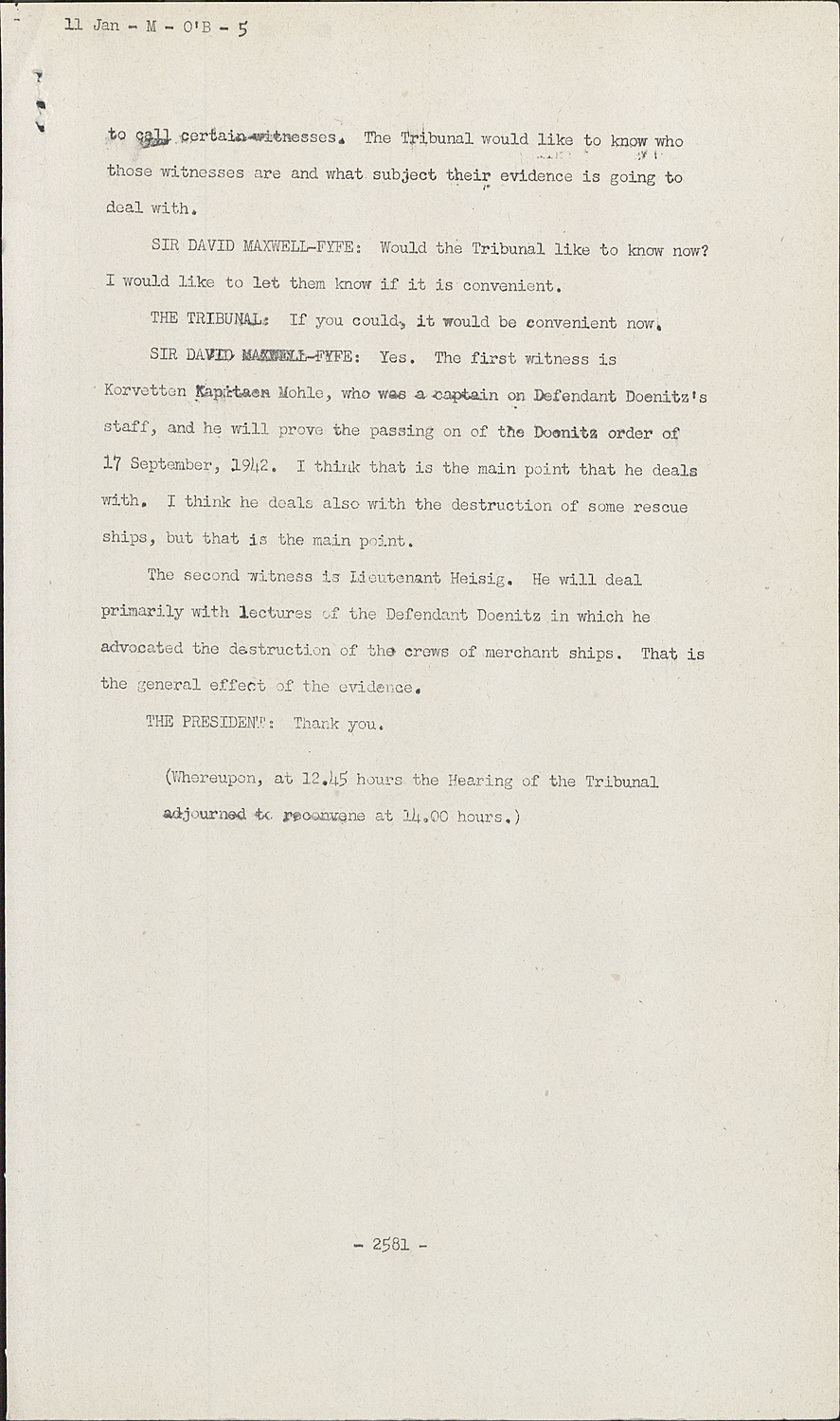
The Tribunal would like to know who those witnesses are and what subject their evidence is going to deal with.
SIR DAVIDMAXWELL-FYFE: Would the Tribunal like to know now?
I would like to let them know if it is convenient.
THE TRIBUNAL:If you could, it would be convenient now.
SIR DAVIDMAXWELL-FYFE: Yes. The first witness is Korvetten Kapitaen Mohle, who was a captain on Defendant Doenitz's staff, and he will prove the passing on of the Doenitz order of 17 September, 1942.
I think that is the main point that he deals with.
I think he deals also with the destruction of some rescue ships, but that is the main point.
The second witness is Lieutenant Heisig. He will deal primarily with lectures of the Defendant Doenitz in which he advocated the destruction of the crews of merchant ships.
That is the general effect of the evidence.
THE PRESIDENT:Thank you.
(Whereupon, at 12.45 hours the Hearing of the Tribunal adjourned to reconvene at 14.
00 hours.)