A Yes, sir.
QI show you that document and ask you to say whether that is your affidavit.
A (Looking at paper) Yes, this is my affidavit, sworn to.
COLONEL PHILLIMORE:I put that document in, which is 382 PS, and it becomes GB 202.
QIn the autumn of 1942 were you head: of the Fifth U-Boat Flotilla?
AYes, I was.
QWere you stationed at Kiel?
AYes, sir.
QHow long did you hold that appointment altogether?
AFor four years.
QWas that from June 1941, until the capitulation?
AThat is correct.
QWhat were your duties as Commander of that Flotilla?
AMy main duties as Chief covered the fitting out of U-Boats which were to be sent to the front, and giving them the orders as well as necessary equipment.
QHad you any special responsibility to U-Boat Commanders in respect of the orders?
AYes, sir, I was responsible for the U-Boat Commanders getting all the orders and knowing the latest orders of the U-Boat Command.
QHad you any responsibility in explaining the orders?
AThe orders of the U-Boat Command were always very clear and unambiguous If there were any ambiguities I used to clarify these ambiguities through the Command itself.
QDid you personally see Commanders before they went out on patrol?
AYes, each Commandant before leaving for the front participated in briefing.
QI will go back, if I may, for two or three questions. Did you personally see Commanders before they went out on patrol?
AYes, sir, each commandant before sailing on patrol participated in a briefing session at my office.
Q And what did that briefing session consist of? Were there any questions on the orders?
AYes, sir, all experiences of previous patrols and any questions of equipment, fitting out, were discussed with the Commander at that session. Also, the Commanders had an opportunity at the briefing to clarify any ambiguities which might have existed in their minds.
QApart from your briefing sessions, did Commanders also go to Admiral Doenitz's headquarters for briefing?
AAs far as that was possible, it was done, especially from the moment on that the U-Boat Commander had transferred his command post from Paris to Berlin.
QDid you remember an order in the autumn of 1942 dealing with lifeboats
AYes, sir; in September, 1942, I received a message for the Commanders at sea, and it dealt with that question.
QI show you this document -- My Lord, that is the exhibit I have already put in as GB 199
THEPRESIDENT: what other number has it?
COLONEL PHILLIMORE:It is D 630.
QIs that the order you are referring to?
AYes, that is the order?
QFrom the time When you were captured until last Friday had you seen that order?
ANo, sir.
QIt follows, I think, that the account of the order in your statement was given from recollection?
AYes, sir, only by recollection.
Q Now, after you got that order did you go to Admiral Doenitz's headquarters?
AYes, at my next visit at headquarters. I there spoke to Corvette Captain Kuppisch who was in charge, and took the opportunity to discuss that order with him.
QWill you tell the Tribunal what was said at that meeting?
AAt that meeting I asked Corvette Captain Kuppisch how the ambiguity contained in that order -- or I might say, lack of clarity -- should be cleared up and defined. He explained the order on that occasion by two illustrations.
The first example was that of a U-Boat in the Bay of Biscay. It was sailing onpatrol when it sighted a raft carrying survivors of a B ritish plane. The Commander had an opportunity to rescue this airplane crew, but it was considered perfectly useless to rescue them and bring them home, especially as they were from an enemy airplane. He avoided the raft by making a wife circle and continued on his mission. After he returned from his mission he reported this incident to the flag officer of U-Boats and he was thereupon reproached by the staff, for the reason that if he was unable to bring these specialists home it would have been the right thing to do to fight this crew, as it could be expected that in less than twenty-four hours the raft would be found and rescued by British reconnaissance planes,
QI don't quite get what you said would have been the correct action to take. You were saying the correct thing to do would have been -
ASince it was not possible to rescue the airplane specialists, to fight them, as it could be expected that this airplane crew would be found and rescued in a short time by British reconnaissance planes and it could be that in the meantime they could be on another mission and destroy one or two German boats. The second example -
QDid he give you any second example?
AYes, sir. The second example I am going to recount now. Example 2.
During the first month of the U-Boat war against the United States a great quantity of tonnage sunk -- I don't recollect the exact number -had been sunk in the shallow waters off the American coast. In these sinkings the crews were for the greater part rescued, because of the proximity of land.
That was exceedingly regrettable, as the merchant marine not only required tonnage but also crews, and these crews were able in the meantime to man newly built ships.
QYou have told us about the ambiguity of the order. Are you familiar with the way Admiral Doenitz worded his orders?
AI don't quite understand the question.
QAre you familiar with the way that Admiral Doenitz normally worded his orders?
AYes. In my opinion, the order -- it had been necessary only to read the reference -- the reference is made again or pointed out again that rescue measures should not be taken for reasons of U-Boat safety. In this way the order wuld have been worded -- if only rescue measures had been forbidden.
QAre you saying that if it had been intended only to prohibit rescue measures it would have been sufficient to refer to the previous order?
AYes, sir, that would have been enough.
QWas that previous order also marked "top secret"?
AI don't remember that exactly.
QWhat was the propaganda at the time with regard to crews?
AThe propaganda at that time said that the enemy had great difficulties -
THE PRESIDENT:The question as to the propaganda at a certain time is far too wide a question.
COLONEL PHILLIMORE:If your Honor pleases, I don't press it.
QFrom your knowledge of the way orders were worded, can you tell the Tribunal what you understood this order to mean?
AThe order said, in my own opinion, that rescue measures were prohibited, that on the other hand it was desirable that in the case of sinkings of merchantmen there be no survivors.
QAnd was it because you understood this to be the meaning that you went to Admiral Doenitz's headquarters?
AI did not go only for the reason of this order to the headquarters of the Flag Officer U-boats, but these visits took place rather frequently in order to discuss also other questions and in order to have the opportunity to get information on ideas of the U-boat command and to keep abreast with developments, as I had to transmit them to the commanders.

QNow, did you brief commanders on this order?
AAt these briefing sessions I read this radio message to the commanders without any commentary. In some few instances commanders have inquired of me what the order meant. In such cases I gave the commander the lead inquiry. I have read to him the two examples. However, I pointed out that the Flag Officer U-boat could not officially give him such an order, and that he had to act according to his own conscience.
QDo you remember an order about rescue ships?
AYes, sir.
QCan you say what was the date of that order?
AI don't remember the exact date. However, I think the order was given at the same time as the order of September 19, 1942.
COL. PHILLIMORE:May the witness see the document D-663 which I put in yesterday?
THE PRESIDENT:Yes.
COL. PHILLIMORE:It is the German copy of the document that I am showing him;
the original is being held.
THEWITNESS (After examining document): Yes, sir, I recognize that order.
QYou will note that the date on that document is the 7th of October 1943.
AYes, this order is laid down there in the general Operation Order "Atlantic" No. 56. According to my recollection, this order was issued previously than the Operational Order 54. It covers the general radius of instructions.
THE PRESIDENT:Col. Phillimore, is that order in the index here?
COL. PHILLIMORE:Yes, My Lord, that is the document 663, which I put in yesterday as GB-200. If it is ommitted from the index, your Lordship will remember it is the document we just received, as I explained yesterday.
THE PRESIDENT:Where does it come in?
COL. PHILLIMORE:It comes in after D-6630.
THE PRESIDENT:Thank you.
COL. PHILLIMORE:Your Lordship will remember the order; it deals with rescue ships attached to convoys, and it was on the last sentence that I replied.
THE PRESIDENT:Yes, I only wanted to get the words of it.
COL. PHILLIMORE:Yes, sir. My Lord, I have the original here now if it is thought necessary that the witness should see it, but he has seen a copy.
QDo you remember an order about entries in logs?
AYes, sir. At the time, the exact date I don't remember, it had been ordered that sinkings and other acts which were in contravention of international conventions should not be entered in the log but should be reported orally after return to the home port.
QWill you care to say why it is that you are giving evidence in this case?
AYes, sir; because when I was taken prisoner it was claimed that I was the author of these orders, and I don't want to have this charge connected with my name.
COL. PHILLIMORE:My Lord, the witness is available for examination.
THE PRESIDENT:Does any counsel for any defendant wish to ask the witness any questions?
DR. OTTO KRANZBUEHLER (Counsel for Admiral Doenitz): I am Dr. Kranz-
buehler, counsel for Doenitz.
QCorvette Captain Moehle, since when have you been in the U-boat arm?
ASince the end of 1936.
QDo you know personally Grand Admiral Doenitz?
AYes.
QSince when?
ASince October, 1937.
QDo you see him here in this room?
AYes.
QWhere?
ATo the left in the rear.
QDo you know that Grand Admiral Doenitz is an Admiral who was never to be spoken to by his subordinates?
ANo, he could be reached by everybody at any time.
QHave you been commander on a U-boat yourself on missions?
AYes, on nine missions.
QFrom when to when?
AFrom the beginning of the war until -
QHow many ships did you sink?
AI sank twenty ships.
QAfter sinking ships, have you destroyed the rescue possibilities or have you fired at the survivors?
ANo, I had no orders to do that.
QDid you have an order to do that?
ANo.
QWas it dangerous to the U-boat? Had the danger passed after the attack by the U-boat?
ANo, the danger to the U-boat had no passed after the attack was over.
QWhy not?
ABecause in most instances when a ship is sunk, the ship is in a position to send a radio message with its position, and therefore in a last minute is able to get other ships onto the spot.
Q Was there a principle in the U-boat command to the effect that fight-
ing comes before rescuing?
AI never heard of that principle in that formulation.
QPrior to the order of September, 1942, do you know of other orders in which the rescuing was prohibited if there was danger to your own boat?
AYes, but I do not know when and in which documents this order has been put down. It was ordered that the safety of your own boat was your main concern.
QWas it ordered only once, or on several instances?
AThat I can't say.
QDo you know that the order of September, 1942, was given in consequence of an incident in which German U-boats, contrary to orders, had undertaken rescue measures?
AYes, sir.
QAnd the U-boats were then attacked by Allied aircraft?
AYes, sir.
QA minute ago you classified the order of September, 1942 as ambiguous.
AYes, sir.
QYou interpreted it to the commanders in the sence that the order should comprise the destruction of rescue facilities and of its crews?
ANo, not quite, since I gave the two examples to the commanders only if they made an inquiry, and they themselves could draw that conclusion from those two examples.
QIn which sentence of the order do you see a hidden request to kill survivors? Just a second, I shall read to you a sentence of the order. I read from the document D-630: "1. No attempt of any kind must be made at rescuing members of ships sunk, and this includes picking up persons in the water and putting them in lifeboats, righting capsized lifeboats and handing over food and water. These are absolutely forbidden."
Do you see it in this sentence?
ANo.
Q "All rescue measures contradict the primitive demands of warfare that ships and crews should be destroyed."
Do you see that in this sentence?
AYes.
QDoes that sentence contain anything as to the destruction of shipwrecked sailors?
ANo, of crews.
QIn the order, at the end of the sentence: "Be harsh". Have you seen that sentence there for the first time?
A.No.
Q.Was that sentence used by the Flag Officer U-boats in order to harden the commanders and their crews against themselves?
A.Yes
Q.You have discussed that order with Corvette Captain Kuppisch?
A.Yes.
Q.Do you remember that really, exactly and correctly?
A.As far as I can rely upon my recollection after such a long time.
Q.Where did that conference take place?
A.At the staff of the Flag Officer U-boats, probably in Paris.
Q.What position did Kuppisch occupy at the time?
A.As far as I can remember, he was the man in charge of enemy convoys, but I couldn't say that with any definiteness.
Q.The superior officer of Kuppisch was Hessler?
A.As to the superior, one couldn't say that; Hessler was on the same level as Kuppisch.
Q.Was Kuppisch's superior Admiral Goth?
A.Yes, in his activity as Chief of Staff.
Q.Have you spoken to Hessler or Admiral Goth or with the Grand Admiral himself? Have you discussed the interpretation to be given to that order?
A.Whether it was with Hessler, I do not remember, but certainly not with Goth or the Grand Admiral himself.
Q.You said Capt. Kuppisch had told you of the opinion which was prevalent at the staff as far as the attitude of the flotilla chiefs was concerned?
A.Yes.
Q.Did he tell you that that was the opinion of the Grand Amiral himself?
A.I don't remember that. It is too far back. It was for us, the chiefs of the flotillas, of course, a matter of course, that if a responsible member of the staff uttered an opinion, that that was the official opinion of the Flag Officer U-boats. Normally such conferences took place if the other mem bers of the staff didn't want to bind themselves and couldn't give a responsible answer.
Then it was referred to Admiral Goth.
Q.Didn't you know that the affair with these flyers in the Bay of Biscay had really been just the opposite?
A.I don't understand it.
Q.I continue: that the commander had been reproached because he didn't bring home these flyers after terminating his mission and coming back?
A.No, I don't remember that.
Q.In that first example which you gave or which you mentioned, were you told by Corvette Captain Kuppisch that the shipwreck and rescue facilities should be destroyed near the American coast?
A.No, he only said it was regrettable that the crews had been rescued.
Q.And you concluded from that that it was desirable that the shipwrecked should be killed?
A.I didn't draw any conclusions since I passed on these examples without any commentary.
Q.Do you know the standing orders of the Flag Officer U-boats? Do they contain "the general principles of U-boat warfare?
A.Yes.
Q.Are there to be found in the standing orders any orders in which the killing of shipwrecked sailors or the destruction of rescue facilities is ordered or recommended?
A.As far as I know, no.
Q.What kind of secrecy was attached to these standing orders?
A.As far as I remember, "Geheime Kommandosache" -- Top Secret.
Q.Do you remember that in Standing Order 511, the following was ordered:
DR. KRANZBUEHLER:Mr. President, I read from an order which I shall submit in evidence later on. I cannot do it yet beacuse I have not as yet the original in hand.
Q. (Reading) "Standing Order of Flag Officer U-boats No. 511, 20th of May, 1943. Taking on board of officers of subken ships.
"1. As far as conditions of accomodation allow on board, Captains and Chief Engineers of sunk ships are to be brought in.
The enemy tries to contravene this intention and has issued the following order: 'a. Masters are not allowed to make themselves known if questioned, but should if possible push on other sailors selected especially for this purpose, b. Crew has to state that Masters and Chief Engineers remained on board in spite of energetic questioning. If it is not possible to find out the Masters or the Chief Engineers, then other ship officers should be taken aboard.'" I skip No. 2 and pass on to No. 3 -- no, I am going to read No. 2. as well.
"No bringing in is allowed of masters and officers of neutral ships, which, according to Standing Order No. 101, can be sunk (e.g., Swedish ships outside Goeteborg traffic), because internment of these officers would contravene international law.
"3. Ship officers cannot be taken prisoners. Otherwise, members of the crew should be taken along as far as accommodation facilities and further operations pernit. The purpose is interrogation of prisoners for military and propagandistic purposes.
"4. In the case of sinking single cruising destroyer, corvette, or trawler, try in all events to take prisoners, if that can be done without endangering the boat. Interrogation, at interrogation camp, can produce valuable hints as to anti-submarine tactics and weapons of the enemy; and the same applies to air crews of shot down planes." BY DR. KRANZBUEHLER:
Q.Do you know that order?
A.The order seems familiar to me.
Q.Do you know the order 513?
"Standing order of Flag Officer, U-Boats, 1 June 1944, Bringing in of Prisoners.
"1. Statements of prisoners are most certain best source for interrogation regarding enemy tactics, weapons, location sets and location methods.
Prisoners from planes and destroyers can be put to use of the greatest importance.
Therefore, as far as possible, without endangering the boat, do the utmost to take such prisoners.
"2. As prisoners are extremely willing to talk under the impression of being captured, interrogate them at once on board. This is of special interest: In which manner the location of U-Boats is done by aircraft, whether by radar or by passive location; for instance, by ascertaining, through electricity or heat, the location of the boat. Report prisoners taken in order to hand them over to returning boats."
Do you know that order? Have you noticed and tried to clarify a contradiction between these orders concerning the rescue of air crews in each instance and the passing on of your story about the construction of air crews?
ANo, not in that. In the order of September 1942 it was also said that the order remains valid as to the taking of prisoners the master and the chief engineer.
QDid you hear of any instance in which a U-Boat has brought home masters and chief engineers but has killed the rest of the crew?
ANo.
QDo you consider it possible at all that such an order can be given -- that is, that part of the crew should be rescued under orders and the rest of the crew should be killed?
ANo, sir. Such an order cannot be given.
QDid you hear that, on the basis of the other instructions you gave, any commander has destroyed rescue facilities or has killed shipwrecked sailors?
ANo.
QWas it permissible to attack neutral vseels outside of the blockade region?
AOnly in case they were not marked according to specifications,
QWas the flag office, U-Boats, very severe in enforcing these orders concerning neutral ships?
A Since such cases are not known to me, I cannot say anything on that subject.
QDo you know that the commanders were threatened with courtmartial if they did not obey the orders which had been given for the protection of neutrals?
AYes; I remember one case which happened in the Caribbean Sea
QDo you remember an order of 1944 in which the stopping of neutral ships for investigation was ordered?
AYes, but I do not remember the date. It was ordered that in particular Spanish and Portugese ships in the North Atlantic should be stopped and searched.
QHave you passed on that order to the commanders?
AAs far as I recollect, this order was given in writing and is contained in one of the official collections of orders. I have passed on orders to commanders only in such instances where they were not contained in a collection of orders.
QIn passing that order on, have you made an addition as to whether that order should be executed or not?
AYes, I remember that I said -- when that order came by radio and the commanders did not know of it yet -- that they should be exceedingly careful, as far as the stepping of neutrals was concerned, since there was always the danger that a neutral ship could, by radio, report the position of the U-Boat. And owing to the air superiority of the enemy in the North Atlantic, it was always safer or better if the U-Boat was not forced to such stopping.
QHad you orders as far as that addition was concerned?
ANo. As far as I remember, one of the members of the staff -- I think it was Captain Hessler -- told me that he emphasized that all stopping of ships, also neutrals, involved a considerable endangering of the boat.
QBecause of the air superiority?
AYes.
QYour attention has been called to the order concerning the rescue ships. You remember that?
A Yes.
QWere these rescue ships recognized under international law as hospital ships, with special markings?
AAs far as I know, no.
QWhich orders had been issued concerning hospital ships?
AWhere these orders were laid down -- I do not remember whether in writing or not; I only remember that "the flag office, U-Boat, very often called the attention of the commanders to the fact that hospital ships should be respected under all circumstances.
QDo you know of any case in which a hospital ship was attacked by U-Boats?
ANo; I don't know of such a case.
QIf the BDU had been interested in contravention of international law to destroy helpless human beings, would, in such a case, the destruction of hospital ships have been an excellent measure?
AWithout any doubt.
DR. KRANZBUEHLER: No further questions.
THE PRESIDENT: Does any other Defense Counsel wish to cross-examine this witness?
(No response.)
BY THETRIBUNAL (Judge Biddle):
QDid you ever save any of the survivors of the vessels that you torpedoed?
ANo, sir. I have not been in a position to do that owing to the circumstances, the military circumstances, of the case.
QYou mean it was dangerous to your boat to do it?
ANot only that. A great part of the sinkings which I did took place in a convoy or at high sea, rough sea, so that it was impossible to undertake any rescue measures.
THE TRIBUNAL (Judge Biddle): That is all.
THE PRESIDENT: Colonel Phillimore, do you wish to re-examine?
COLONEL PHILLIMORE: My Lord, I have about three questions.
THE PRESIDENT: Very well.
BY COLONEL PHILLIMORE:
QWhen you were a U-boat commander yourself, what were the orders with regard to rescue?
AAt the beginning of the war we had been told that the safety of your own boat was the decisive thing, and that the boat should not be endangered by rescue measures.
Whether these orders had been laid down in writing at the outbreak of the war I do not remember.
QWhen you got this order of the 17th of September, 1942, did you take it merely as prohibiting rescue or as going further?
AWhen I received that order I noticed that it was not unambiguous, as orders of the BDU normally were, that in this order there was a definite ambiguity.
Q You haven't answered my question. Did you take the order to mean that a U-boat commander should merely abstain from rescue measures, or as something further?
A I interpreted that order to go further in some way, although not as an order but that it was considered desirable.
Q The instance you were given about the Bay of Biscay, had you any knowledge of the facts of that incident?
A No, the surrounding circumstances of that case were not known to me.
Q What were the actual words with which you passed that order on to commanders?
AI told the commanders, literally the following. "We approach now a very delicate and difficult chapter; it is the question of the treatment of life boats.
The flag officer U-boats has issued the following radio message in September, 1942.
' Thereupon I read the radio message of September 1942 in full.
In most instances the chapter was closed thereupon; no commander had any question to ask.
In some few instances the commanders asked, "How should that order be interpreted?"
In that case I gave the two examples as a means of interpretation.
And then I added that officially such a thing cannot be ordered, that everybody has to reconcile with his own conscience.
QDo you remember any comment being made by commanding officers after they had read the order?
AYes, sir. Several commanders, following the reading of the order without any commentary being given, uttered the opinion, "That is very clear, but damned hard."
COLONEL PHILLIMORE: My Lord, I have no further questions.
THE PRESIDENT: The Tribunal will adjourn for ten minutes.
(Whereupon a recess was taken from 11.20 to 11.
30 hours.)
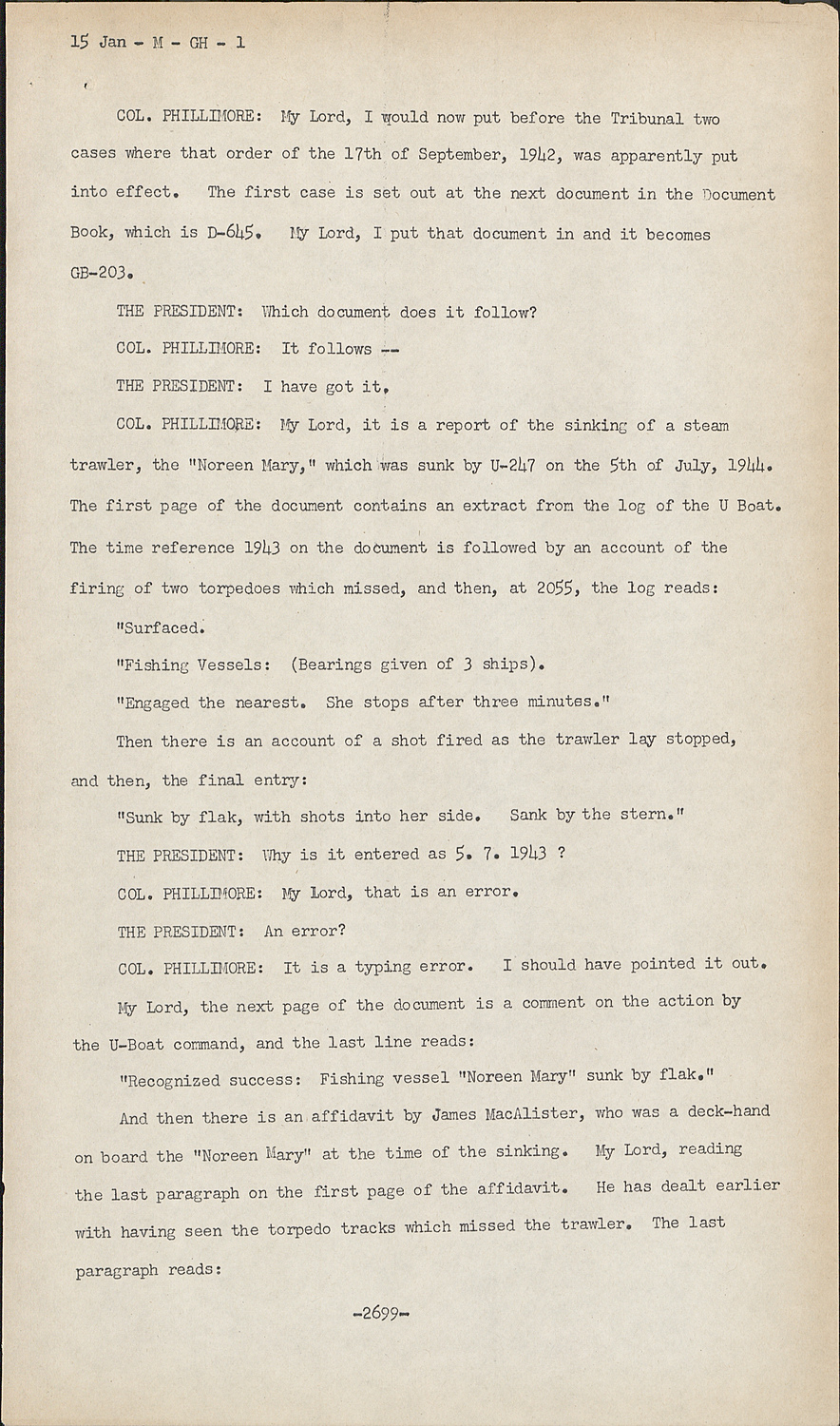
COL. PHILLIMORE: My Lord, I would now put before the Tribunal two cases where that order of the 17th of September, 1942, was apparently put into effect.
The first case is set out at the next document in the Document Book, which is D-645. My Lord, I put that document in and it becomes GB-203.
THE PRESIDENT:Which document does it follow?
COL. PHILLIMORE:It follows -
THE PRESIDENT:I have got it.
COL. PHILLIMORE:My Lord, it is a report of the sinking of a steam trawler, the "Noreen Mary," which was sunk by U-247 on the 5th of July, 1944. The first page of the document contains an extract from the log of the U Boat. The time reference 1943 on the document is followed by an account of the firing of two torpedoes which missed, and then, at 2055, the log reads:
"Surfaced.
"Fishing Vessels: (Bearings given of 3 ships).
"Engaged the nearest. She stops after three minutes."
Then there is an account of a shot fired as the trawler lay stopped, and then, the final entry:
"Sunk by flak, with shots into her side. Sank by the stern."
THE PRESIDENT:Why is it entered as 5. 7. 1943 ?
COL. PHILLIMORE:My Lord, that is an error.
THE PRESIDENT:An error?
COL. PHILLIMORE:It is a typing error. I should have pointed it out.
My Lord, the next page of the document is a comment on the action by the U-Boat command, and the last line reads:
"Recognized success: Fishing vessel "Noreen Mary" sunk by flak."
And then there is an affidavit by James MacAlister, who was a deck-hand on board the "Noreen Mary" at the time of the sinking. My Lord, reading the last paragraph on the first page of the affidavit. He has dealt earlier with having seen the torpedo tracks which missed the trawler. The last paragraph reads:
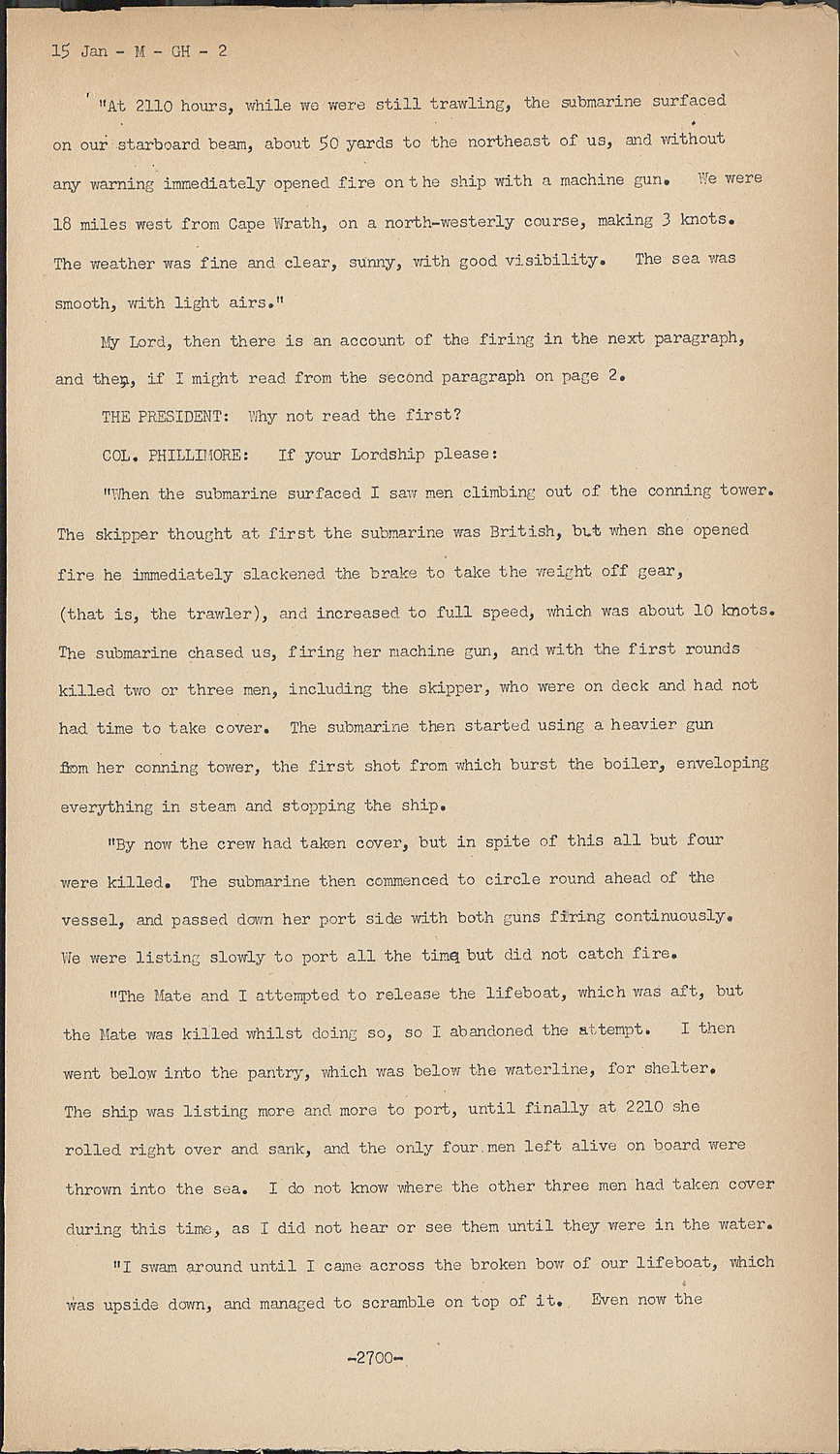
"At 2110 hours, while we were still trawling, the submarine surfaced on our starboard beam, about 50 yards to the northeast of us, and without any warning immediately opened fire on the ship with a machine gun.
We were 18 miles west from Cape Wrath, on a north-westerly course, making 3 knots. The weather was fine and clear, sunny, with good visibility. The sea was smooth, with light airs."
My Lord, then there is an account of the firing in the next paragraph, and then, if I might read from the second paragraph on page 2.
THE PRESIDENT:Why not read the first?
COL. PHILLIMORE:If your Lordship please:
"When the submarine surfaced I saw men climbing out of the conning tower. The skipper thought at first the submarine was British, but when she opened fire he immediately slackened the brake to take the weight off gear, (that is, the trawler), and increased to full speed, which was about 10 knots. The submarine chased us, firing her machine gun, and with the first rounds killed two or three men, including the skipper, who were on deck and had not had time to take cover. The submarine then started using a heavier gun from her conning tower, the first shot from which burst the boiler, enveloping everything in steam and stopping the ship.
"By now the crew had taken cover, but in spite of this all but four were killed. The submarine then commenced to circle round ahead of the vessel, and passed down her port side with both guns firing continuously. We were listing slowly to port all the time but did not catch fire.
"The Mate and I attempted to release the lifeboat, which was aft, but the Mate was killed whilst doing so, so I abandoned the attempt. I then went below into the pantry, which was below the waterline, for shelter. The ship was listing more and more to port, until finally at 2210 she rolled right over and sank, and the only four men left alive on board were thrown into the sea. I do not know where the other three men had taken cover during this time, as I did not hear or see them until they were in the water.
"I swam around until I came across the broken bow of our lifeboat, which was upside down, and managed to scramble on top of it. Even now the submarine did not submerge, but deliberately steamed in my direction and when only 60 to 70 yards away fired directly at me with a short burst from the machine gun.
As their intention was quite obvious, I fell into the water and remained there until the submarine ceased firing and submerged, after which I climbed back on to the bottom of the boat. The submarine had been firing her guns for a full hour."
My Lord, then the affidavit goes on to describe the Second Engineer and others attempting to rescue themselves and to help each other, and then they were picked up by another trawler.