I quote a brief excerpt from these instructions, beginning with the third sentence of the third numbered paragraph of page 2 of the English translation of Document 656-PS, which reads as follows, and I quotes "Should the prisoners of war not fulfill his order, then he has "--that is the guard unit, the guard personnel--"then he has in the case of the most pressing need and danger, the right to force obedience with the weapon if he has no other means.
He can use the weapon as much as is necessary to attain his goal. If the assistant guard is not armed, then he is authorized in forcing obedience by other applicable means."
The Tribunal knows that under the Geneva Prisoners of War Convention of 1929 when prisoners of war proved derelict and refuse to carry out proper orders of the captive power or its forces, such prisoners of war are subject to court martial and military proceedings as if they were serving under their own forces. Here is a decree which on its face authorizes or attempts to authorize guard personnel to use the rifle or other suitable means of violence, and of course your Lordship will understand it was this type of document we had in mind when we suggested that the decree of Bormann should be considered in the light of his other orders relating to the treatment of prisoners of war.
THE PRESIDENT:The Tribunal will adjourn now.
(Whereupon at 1245 hours the hearing of the Tribunal adjourned to reconvene at 1400 hours).

Official transcript of the International Military Tribunal, in the matter of:
The United States of America, the French Re public, the United Kingdom of Great Britain and Northern Ireland, and Union of Soviet Socialist Republic, against Hermann Wilhelm Goering, et al, Defendants, sitting at Nurn berg, Germany, on 16 January 1946, 1400-1720, Lord Justice Lawrence, presiding.
LT. THOMAS LAMBERT:The Tribunal will recall that at the close of the morning session I had been putting in a series of decrees of the Defendant Bormann in which he called for increasingly harsh and severe treatment of Allied prisoners of war. These instruction issued by the Defendant Bormann cluminated in his decree of 30 September 1944. The attention of the Tribunal is invited to Document 058-PS, previously put in as U.S.A. Exhibit 456. The Tribunal will recall that this decree of the Defendant Bormann removed jurisdiction over all prisoners of war from the Nazi high command and transferred it to Himmler. The decree also provided that all PW capt commanders should be under the orders of the local SS commanders. By virtue of this order of the Defendant Bormann, Hitler was enabled to proceed with his program of inhumane treatment and even extermination of Allied prisoners of war.
We now proceed to put in what the prosecution conceives to be extremely important and extremely incriminating evidence against Bormann and the coconspirators, that is, the responsibility of the Defendant Bormann for the organized lynching of Allied airman. I offer in evidence Document 062-PS, U.S.A. Exhibit 669, and I very respectfully request the Tribunal turn to this document. On its face it is an order dated 13 March 1940 from the Defendant Hess addressed to Reichsleiters, Gauleiters, and other Nazi officials and organization. In this order these Party officials are instructed by the Defendant Hess to instruct all German civil population to arrest or liquidate all bailed-out Allied fliers. I call the attention of the Tribunal to the third paragraph on the first page of the English translation of Document 062-PS. In the third paragraph Hess directs that these instructions, which I shall soon read, are to be passed out only orally to all -- will the Tribunal please mark that -- to all district leaders of kreisleiters, ortsgruppenleiter, cell leaders, and even the block leaders; that is to say, this order must be passed out by all the officials of the Leadership Corps in the Hoheitstraeger, ranging from reichsleiter down to and including the blockleiter.
Now, turn the page of 062-PS, and the Tribunal will find the instructions which Hess demanded be disseminated by the Leadership Corps orally, the lynching of Allied fliers. These directions are headed up, "About behaviour in case of landings of enemy planes or parachutists." The first three instructions I omit as not material to the basic point now being made. Instruction four reads, and I quote:
"Likewise enemy parachutists are immediately to be arrested or liquidated. It speaks for itself and requires no further commend from the prosecution.
Now, in order to insure the success of this scheme ordered by the Defendant He as, Bormann issued a secret letter dated 30 May 1944 to the officials -- if the Tribunal will please mark -- of the Leadership Corps of the Nazi Party, prohibiting any police measures or criminal proceedings against German civilians who had lynched or murdered Allied airmen. This document, our 057-PS, has been previously put in and received by the Tribunal in connection with the prosecution's case against the alleged criminal organization, the Leadership Corps of the Nazi Party.
Now, may it please the Tribunal, that such lynchings organized, authorize and consented to by Defendant Bormann actually took place has since been fully and indisputably demonstrated by trials by American Military Commissions which have resulted in the conviction of German civilians for the murder of Allied fliers. I request the Tribunal to take judicial notice of Military Commission Order No. 2, Headquarters 15th U. S. Army, dated 23 June 1945. This order is our Document 2559-PS. This order imposed the sentence of death upon a German civilian for violation of the laws and usages of war in murdering an American airman who bailed out and landed without any means of defense.
The Tribunal will note that order of the American Military Commission dated 15 August 1944, and Bormann's order was dated May 1944.
I request the Tribunal to notice judicially Military Commission Order No. 5, Headquarters 3rd U. S. Army and Eastern Military District, dated 18 October 1945.
This order is set forth in Document 2560-PS. This order imposed a sentence of death upon a German national for violating the laws and usages of war by murdering on or about 12 December 1944 an American airman who landed in German territory.
We coult cite further orders of American and other Allied Military Commissions sentencing German civilians to death for the lynching and murdering of Allied airmen who had bailed out and landed without means of defense on German territory. We think our point is made by taking the time of the Tribunal to cite those two orders.
As previously mentioned in the trial address, on 20 October 1944, when Nazi defeat in the war had become certain, Bormann assumed political and organizational command of the newly-formed Volkssturm, the Peoples' Army. By virtue of organizing the continued resistance by the Volkssturm, Bormann bears some responsibility for the resistance which prolonged the aggressive war four months.
I come now, if it please the Tribunal, to present the proofs showin g that Bormann authorized, directed, and participated in a wide variety of crimes against humanity in aid of the conspiracy. Bormann played an important role in the administration of the forced labor program. I offer in ecidence Document D-226, U.S.A. Exhibit 697. This is a Speer circular, a circular of the Defendant Speer, of 10 November 1944, transmitting Himmler's instructions that the Party and the Gestapo should cooperate in securing a larger productivity from the millions of impressed foreign workers in Germany. I quote the second numbered paragraph of page two of the English translation of Document D-226, which reads as follows:
"All men and women of the NSDAP its subsidiaries and affiliated bodies in the works (meaning of course factories), will, in accoordance with instructions from the Kreisleiters, be warned by their local group leaders (we intrude to say that means ortsgruppenleiters), and be put under obligation to play their part in keeping foreigners under the most careful observation. They will report the least suspicion to the works foreman, which he will pass on to the Defense Deputy, or, where such a deputy has not been appointed, to the Police Department concerned, whilst at the same time reporting to the works manager and the local group leader (the ortsgruppenleiter) to exert untiringly and continuously their influence on foreigners, both in word and deed in regard to the certainty of German victory and the German will to resist, thus producing a further increase of output in the works.
Party members, both men and women, and members of Party organizations and affiliated bodies, must be expected more than ever before to conduct themselves in an exemplary manner."
Now, in a word, the significance of that decree. It is true it is a circular of Speers' reciting an arrangement between himself and Himmler, but the effect of the arrangement is to impose the onus to continue the task of supplying foreign workers on Party members, a party which, as the Tribunal knows, Bormann headed up as executive chief.
Under the decree of 24 January 1942 no such directive could have been issued without the participation of Bormann both in its preparation and its enactment.
I now offer in evidence Document 025-PS as U.S.A. Exhibit 698. This is a conference report dated 4 September 1942 which states that the recruitment, importation, mobilization, and processing of 500,000 female domestic workers from the East would be handled exclusively by Sauckel, the Defendant, Himmler, and the Defendant Bormann. I quote the first two sentences of the third paragraph of the English translation of Document 025-PS, which reads as follow "The Fuehrer has ordered the immediate importation of 400,000 to 500,000 female domestic Eastern workers from the Ukraine between the ages of 15 and 35, and has charged the General Deputy for Labor Mobilization with the execution of this action which is to end in about three months.
In connection with this -- this is also approved by Reichsleiter Bormann, the illegal bringing of female housekeepers into the Reich by members of the armed forces, or various other agencies, is to be allowed subsequently, and furthermore, irrespective of the official recruiting, is not to be prevented."
And I now quote from the first sentence of the last paragraph on page four of the English translation of 025-PS, and this is the part that hooks in the Defendant Bormann with the scheme:
"Generally one gathered from this conference that the questions con-
cerning the recruitment and mobilization as well as the treatment of the female domestic workers from the Fast are being handled by the General Deputy for Labor Mobilization, the Reichsfuehrer SS, and the Chief of the German police and the Party Chancery, and that the Reichs's ministry for the occupied territories of the East is not considered as competent or only as half competent," The Party Chancery is here mentioned in terms, and Bormann was the leader of the Party Chancery, as the Tribunal knows.
Now, the Defendant imposed his will on the administration of the German-occupied areas and insisted on the ruthless exploitation of the inhabitants of the occupied East. The attention of the Tribunal is respectfully invited to Document R-36, previously put in as U.S.A. Exhibit 344. The Tribunal is well acquainted with this document, for it has been referred to several times in these proceedings, and knows that this is an official memorandum of the Ministry for Eastern Territories dated 19 August 1942, which states that the repressive views of the Defendant Bormann with respect to the inhabitants of the Eastern areas actually determined German occupational policies in the East. The Tribunal recalls the now almost notorious quotation from this document R-36, which purports to paraphrase and constitute the essence of Bormann's views with respect to German occupational policy in the East. So often has it been quoted that I shall resist the temptation to repeat it, but in essence it comes to this. Bormann in effect says:
"The Slavs are to work for us. In so far as we don't need them, they may die. They should not receive the benefits of the German public health system. We do not care about their fertility. They may practice abortion and use contraceptives; the more the better. We don't want them educated; it is enough if they can count up to one hundred. Such stooges will be the more useful to us. Religion we leave to them as a diversion. As to food, they won't get any more than is absolutely necessary. We are the masters; we come first."
The Document R-36 -- we respectfully submit this as an accurate paraphrase and summary of the text of that document.
The attention of the Tribunal is next respectfully invited to Document 654-PS, previously put in as U.S.A. Exhibit No. 218.
The Tribunal will recall that this is a conference report dated 18 November 1942 embodying an agreement between the Minister of Justice and Himmler entered into by Bormann's suggestion under which all inhabitants of the Eastern occupied areas are subjected to a brutal police regime in the place of an organized, judicious system, And the agreement refers all disputes between the Party Reich Minister for Justice and Himmler to Bormann for settlement.
Now, because Bormann issued these and related orders, we submit that he bears a large share of the responsibility for the discriminatory treatment and the extermination of great numbers of persons in the German-occupied areas of the East.
With the indulgence of the Tribunal, I put the substance of what I have been privileged to present in a few words. We have shown that Bormann, only forty-five years old at the time of German's defeat, contributed his entire adult life to the furtherance of the conspiracy. His crucial contribution to the conspiracy lay in his direction of the vast powers of the Nazi Party in advancing the multiple objectives of the conspiracy. First, as Chief of Staff to the Defendant Hess and then as leader in his own name of the Party Chancery subject only to Hitler's supreme authority. These two positions he applied, and directed the total power of the Party and allegiances to carry into execution the plans of the conspirators. He used his great powers to persecute the Christian church and clergy, and was an unrepentant foe of the fundamentals of Christianity with which he warred.
He actively authorized and participated in measures designed to persecute the Jews, and his was a strong hand in pressing down the crown of thorns of misery on the brow of the Jewish people both in Germany and in German-occupied Europe.
As Chief of the Party Chancery, and Secretary to the Fuehrer, Bormann authorized, directed, and participated in a wide variety of war crimes and crimes against humanity, including without limitation the lynching of Allied airmen, the enslavement and inhuman treatment of the inhabitants of German-occupied Europe, the cruelty of impressed labor, the breaking up of homes contrary to the clear provisions of the Hague regulations, and the planned persecution and extermination of the civil population of Eastern Europe.
May it please this Tribunal, every school boy knows that Hitler was an evil man. The point we respectfully emphasize is that without chieftains like Bormann, Hitler would never have been able to seize and consolidate total power in Germany, but he would have been left to walk the wilderness alone.
He was in truth an evil accomplice of Hitler, and although he may remain a fugitive from the justice of this Tribunal, with an empty chair in the dock, Bormann cannot escape responsibility for his illegal conduct.
We close with what seems to us an extremely important point.
Bormann may not be here, but under the last sentence of Article VI of the Charter every Defendant shown in our evidence, or Defendant in this dock shown in our evidence to have been a leader and organizer and inciter and accomplice of this conspiracy is responsible for the acts of all persons in furtherance of the general scope of the conspiracy.
And resting squarely on this proposition we submit, even though Bormann is not here, every man in the dock shares responsibility for his criminal acts, and with this we close.
The name of Bormann is not written in water, but will be remembered as long as the record of your Honors' Tribunal is preserved.
I now have the privilege of introducing Lt. Henry Atherton, who will present the case for the Prosecution against the individual Defendant Seyss-Inquart.
LT. HENRY ATHERTON:May it please the Tribunal, the Prosecution has prepared a trial brief for the convenience of the Tribunal, showing the individual responsibility of the Defendant Seyss-Inquart.
Copies of this brief are now being handed to the Tribunal.
At the same time the document books which bear the letters KK and which contain translation of the evidence referred to in the brief, or to be introduced in evidence at this time, are also being handed to the Tribunal.
At the outset I wish to make clear my intention to deal at this time only with the individual responsibility of the Defendant Seyss-Inquart for the crimes charged in Counts I and II of the Indictment.
Evidence to show his guilt as charged under Counts III and IV of the Indictment, that is, evidence specifically directed thereunto is to be introduced later by the Prosecutors of the French Republic and the Soviet Union.
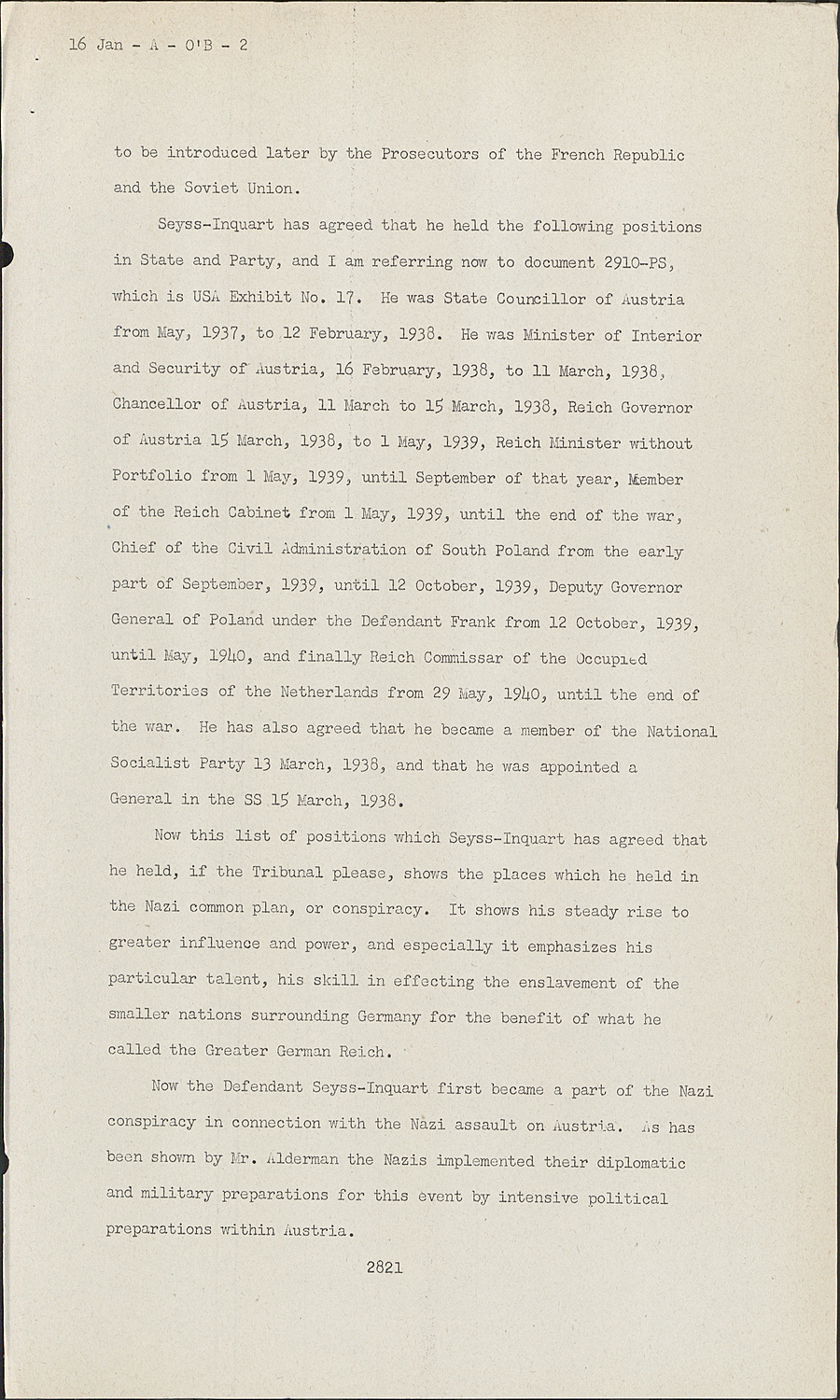
Seyss-Inquart has agreed that he held the following positions in State and Party, and I am referring now to document 2910-PS, which is USA Exhibit No. 17.
He was State Councilor of Austria from May, 1937, to 12 February, 1938.
He was Minister of Interior and Security of Austria, 16 February, 1938, to 11 March, 1938, Chancellor of Austria, 11 March to 15 March, 1933, Reich Governor of Austria 15 March, 1938, to 1 May, 1939, Reich Minister without Portfolio from 1 May, 1939, until September of that year, Member of the Reich Cabinet from 1 May, 1939, until the end of the war, Chief of the Civil Administration of South Poland from the early part of September, 1939, until 12 October, 1939, Deputy Governor General of Poland under the Defendant Frank from 12 October, 1939, until May, 1940, and finally Reich Commissar of the Occupied Territories of the Netherlands from 29 May, 1940, until the end of the war.
He has also agreed that he became a member of the National Socialist Party 13 March, 1938, and that he was appointed a General in the SS 15 March, 1938.
Now this list of positions which Seyss-Inquart has agreed that he held, if the Tribunal please, shows the places which he held in the Nazi common plan, or conspiracy.
It shows his steady rise to greater influence and power, and especially it emphasizes his particular talent, his skill in effecting the enslavement of the smaller nations surrounding Germany for the benefit of what he called the Greater German Reich.
Now the Defendant Seyss-Inquart first became a part of the Nazi conspiracy in connection with the Nazi assault on Austria.
As has been Shown by Mr. Alderman the Nazis implemented their diplomatic and military preparations for this event by intensive political preparations within Austria.
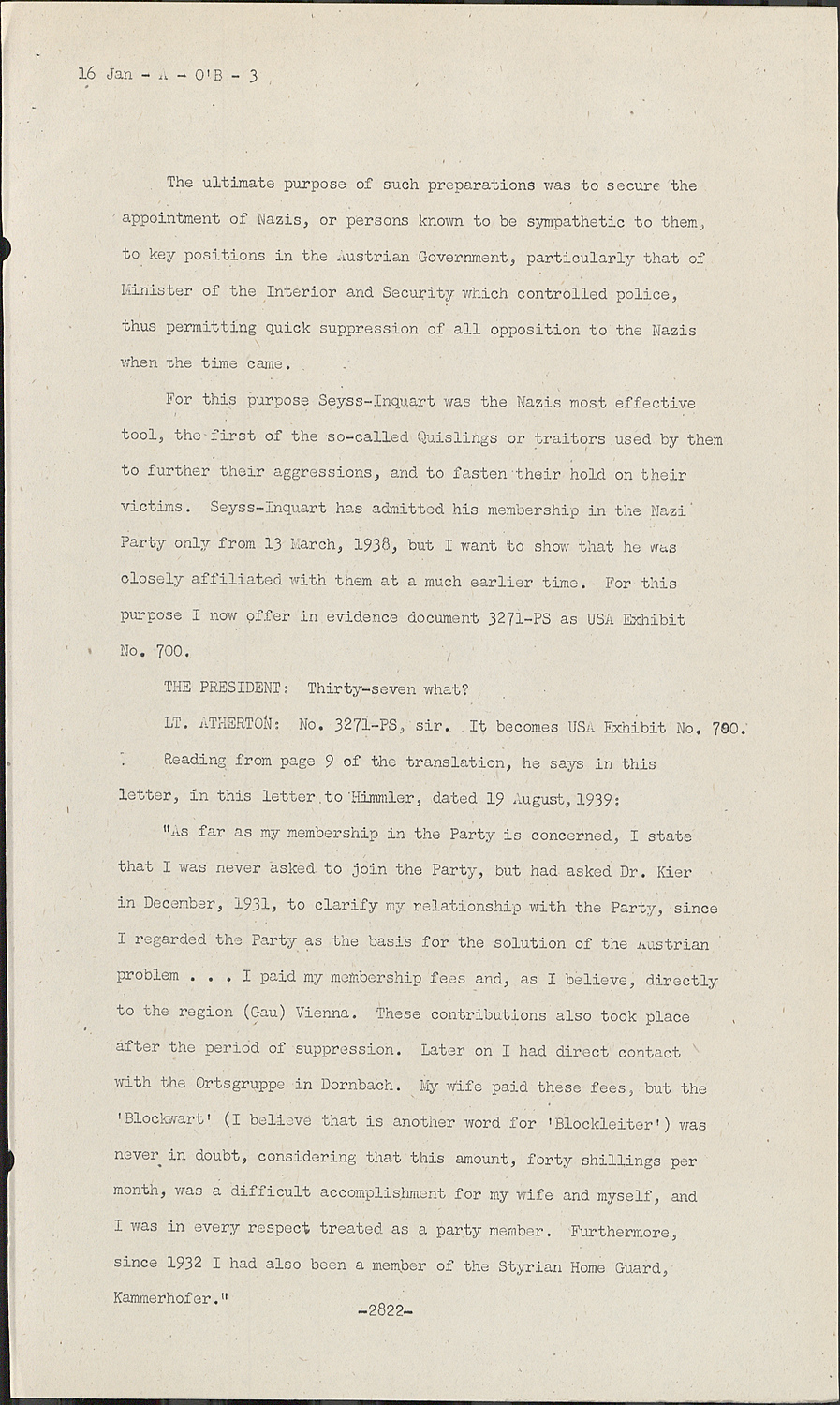
The ultimate purpose of such preparations was to secure the appointment of Nazis, or persons known to be sympathetic to them, to key positions in the Austrian Government, particularly that of Minister of the Interior and Security which controlled police, thus permitting quick suppression of all opposition to the Nazis when the time came.
For this purpose Seyss-Inquart was the Nazis most effective tool, the first of the so-called Quislings or traitors used by them to further their aggressions, and to fasten their hold on their victims.
Seyss-Inquart has admitted his membership in the Nazi Party only from 13 larch, 1938, but I want to show that he was closely affiliated with them at a much earlier time.
For this purpose I now offer in evidence document 3271-PS as USA Exhibit No. 700.
THE PRESIDENT:Thirty-seven what?
LT. ATHERTON:No. 3271-PS, sir. It becomes USA Exhibit No. 700.
Reading from page 9 of the translation, he says in this letter, In this letter to Himmler, dated 19 August, 1939:
"As far as my membership in the Party is concerned, I state that I was never asked to join the Party, but had asked Dr. Kier in December, 1931, to clarify my relationship with the Party, since I regarded the Party as the basis for the solution of the Austrian problem . . . I paid my membership fees and, as I believe, directly to the region (Gau) Vienna.
These contributions also took place after the period of suppression.
Later on I had direct contact with the Ortsgruppe in Dornbach.
My wife paid these fees, but the 'Blockwart' (I believe that is another word for 'Blockleiter') was never in doubt, considering that this amount, forty shillings per month, was a difficult accomplishment for my wife and myself, and I was in every respect treated as a party member.
Furthermore, since 1932 I had also been a member of the Styrian Home Guard, Kammerhofer."
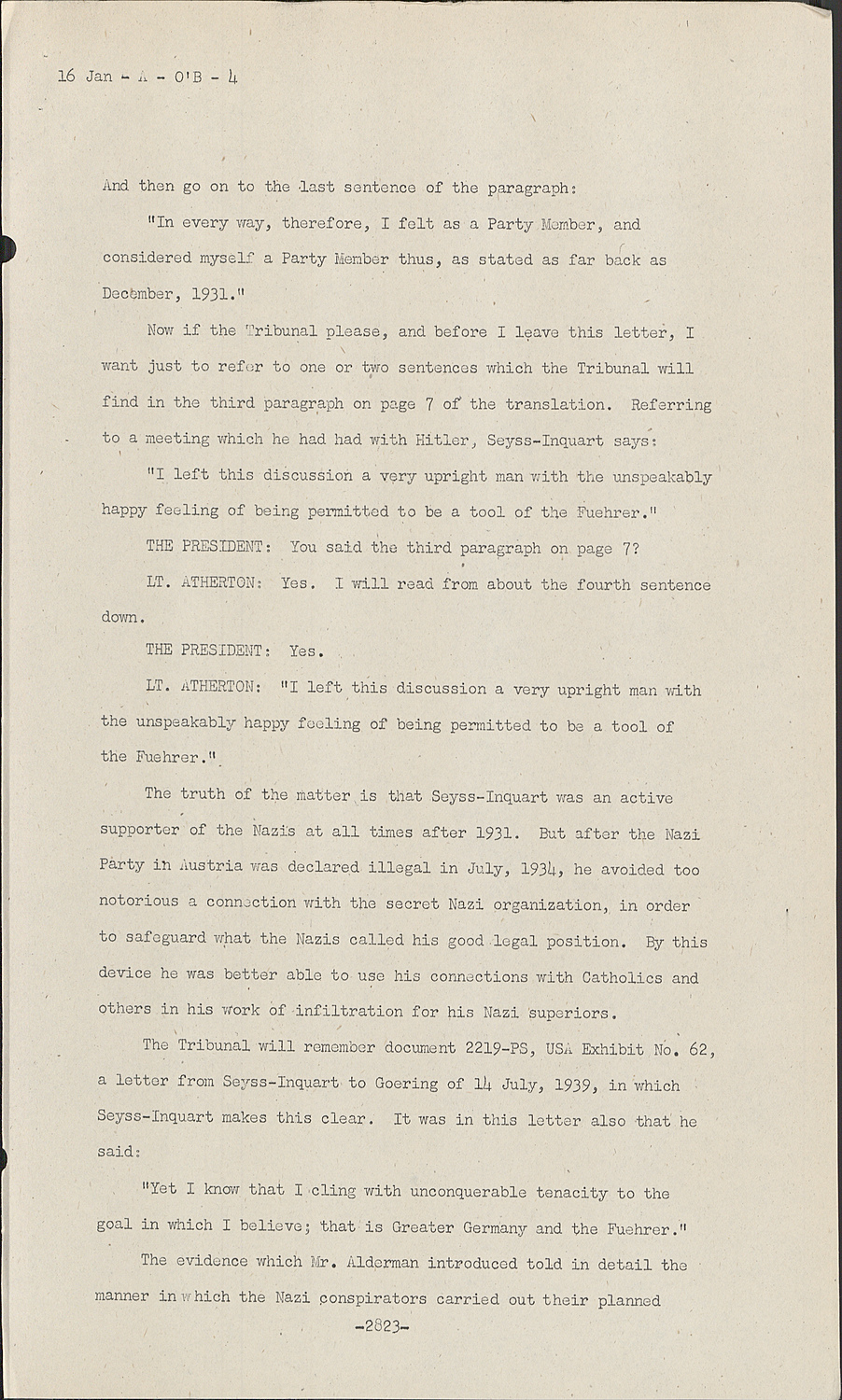
And then go on to the last sentence of the paragraph:
"In every way, therefore, I felt as a Party Member, and considered myself a Party Member thus, as stated as far back as December, 1931."
Now if the Tribunal please, and before I leave this letter, I want just to refer to one or two sentences which the Tribunal will find in the third paragraph on page 7 of the translation.
Referring to a meeting which he had had with Hitler, Seyss-Inquart says:
"I left this discussion a very upright man with the unspeakably happy feeling of being permitted to be a tool of the Fuehrer."
THE PRESIDENT:You said the third paragraph on page 7?
LT. ATHERTON:Yes. I will read from about the fourth sentence down.
THE PRESIDENT:Yes.
LT.ATHERTON: "I left this discussion a very upright man with the unspeakably happy feeling of being permitted to be a tool of the Fuehrer.
The truth of the matter is that Seyss-Inquart was an active supporter of the Nazis at all times after 1931.
But after the Nazi Party in Austria was declared illegal in July, 1934 he avoided too notorious a connection with the secret Nazi organization, in order to safeguard what the Nazis called his good legal position.
By this device he was better able to use his connections with Catholics and others in his work of infiltration for his Nazi superiors.
The Tribunal will remember document 2219-PS, USA Exhibit No. 62, a letter from Seyss-Inquart to Goering of 14 July, 1939, in which Seyss-Inquart makes this clear.
It was in this letter also that he said:
"Yet I know that I cling with unconquerable tenacity to the goal in which I believe; that is Greater Germany and the Fuehrer."
The evidence which Mr. Alderman introduced told in detail the manner in which the Nazi conspirators carried out their planned assault on Austria.
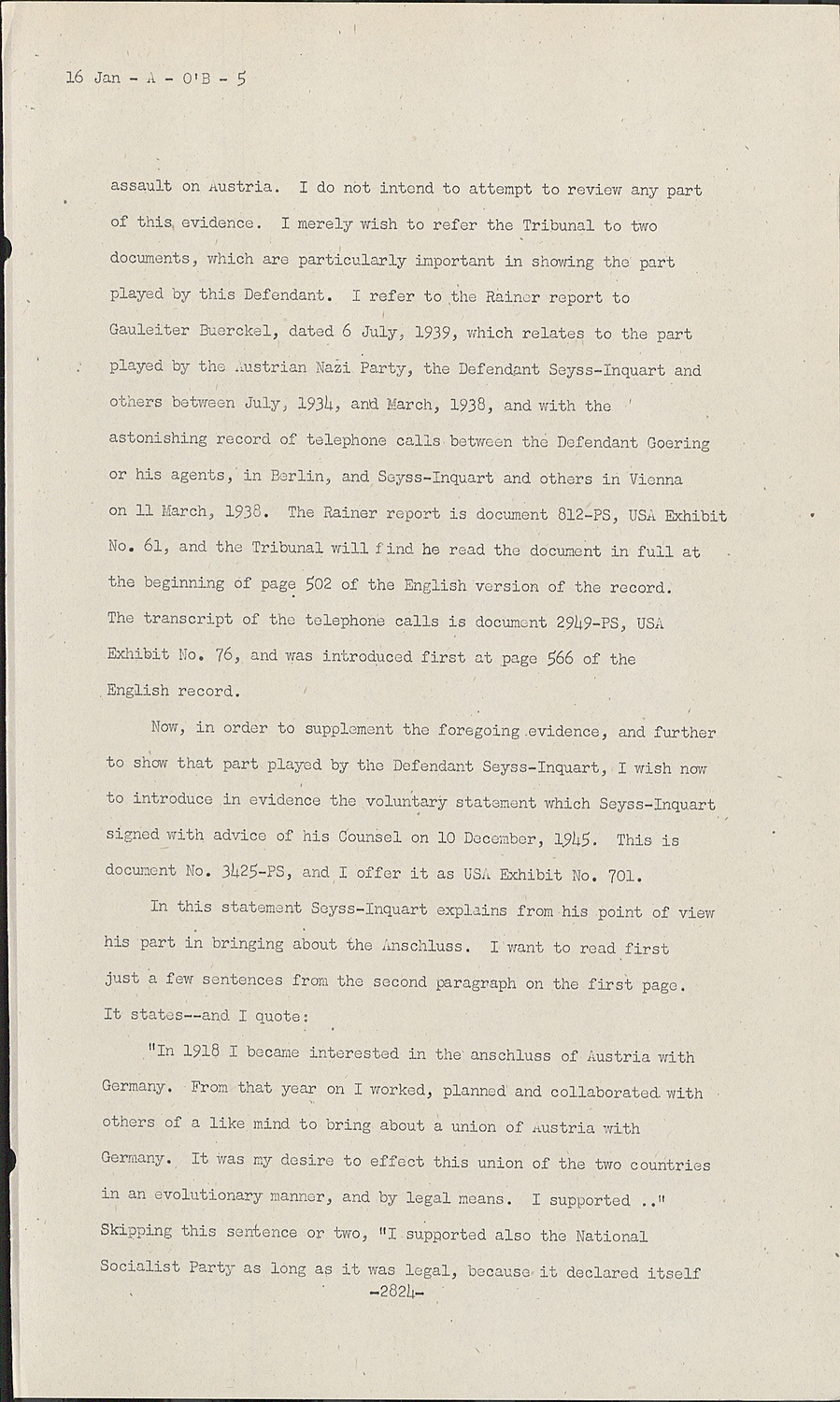
I do not intend to attempt to review any part of this evidence.
I merely wish to refer the Tribunal to two documents, which are particularly important in showing the part played by this Defendant.
I refer to the Rainer report to Gauleiter Buerckel, dated 6 July, 1939, which relates to the part played by the Austrian Nazi Party, the Defendant Seyss-Inquart and others between July, 1934, and March, 1938, and with the astonishing record of telephone calls between the Defendant Goering or his agents, in Berlin, and Seyss-Inquart and others in Vienna on 11 March, 1938.
The Rainer report is document 812-PS, USA Exhibit No. 61, and the Tribunal will find he read the document in full at the beginning of page 502 of the English version of the record.
The transcript of the telephone calls is document 2949-PS, USA Exhibit No. 76, and was introduced first at page 566 of the English record.
Now, in order to supplement the foregoing evidence, and further to show that part played by the Defendant Seyss-Inquart, I wish now to introduce in evidence the voluntary statement which Seyss-Inquart signed with advice of his Counsel on 10 December, 1945.
This is document No. 3425-PS, and I offer it as USA Exhibit No. 701.
In this statement Seyss-Inquart explains from his point of view his part in bringing about the Anschluss.
I want to read first just a few sentences from the second paragraph on the first page.
It states--and I quote:
"In 1918 I became interested in the anschluss of Austria with Germany.
From that year on I worked, planned and collaborated, with others of a like mind to bring about a union of Austria with Germany.
It was my desire to effect this union of the two countries in an evolutionary manner, and by legal means.
I supported .."
Skipping this sentence or two, "I supported also the National Socialist Party as long as it was legal, because it declared itself With particular determination in favor of the anschluss.
From 1932 onwards I made financial contributions to this party, but I discontinued financial support when it was declared illegal in 1934."
Then skipping down another couple of sentences:
"From July onwards I endeavored to help the National Socialists to regain their legal status, and finally to participate in the Austrian Government.
During this time, particularly after the Party was forbidden in July, 1934, I knew that the radical element of the Party was engaged in terroristic activities, such as attacks on railroads, bridges, telephone communications, etc.
I knew that the Governments of both Chancellors Dollfuss and Schuschnigg, although they held the same total German viewpoint in principle were opposed to the anschluss then, because of the National Socialist regime in the Reich.
I was sympathetic towards the efforts of the Austrian Nazi Party to gain political power and corresponding influence, because they were in favor of the anschluss."
Now briefly summarizing, the Tribunal will note that the Defendant tells how his appointment as State Councilor in May, 1937, was the result of agreement between Austria and Germany in July, 1936, and that was the agreement which Rainer agreed Seyss-Inquart had helped to bring about, that is, his appointment as Minister of the Interior and Security was one of the results of the agreement between Schuschnigg and Hitler at Berchtesgaden, 12 February, 1938, and he admitted after that appointment and the agreement the Austrian National Socialists engaged in more and more widespread demonstrations.
He tells us how immediately after this appointment as Minister of the Interior and Security he went directly to Berlin and talked with Himmler and Hitler, and then finally he described the events of that day, of 11 March, 1938, when with the full support Of the German military power he became Chancellor.
I don't want to quote at length from that description, because the Tribunal knows already what happened.
Reading a little from on page 3, he says:
"At 10 o'clock in the morning Glaise-Horstenau and I went to the Bundes Chancellory and conferred for about two hours with Dr. Schuschnigg.
We told him of all that we knew, particularly about the possibility of disturbances and preparations by the Reich.
"The Chancellor said that he would give his decision by 1400 hours.
While I was with Glaise-Horstenau and Dr. Schuschnigg, I was repeatedly called to the telephone to speak to Goering."
THE PRESIDENT:Has this been read already?
LT. ATHERTON:No, sir, this document has not been in before.
THE PRESIDENT:Very well.
LT.ATHERTON: "He informed me that the agreement of 12.2 had been cancelled, and demanded Dr. Schuschnigg's resignation and my appointment as Chancellor." The Tribunal has heard the other side of the story, the actual telephone conversations. Then finally in comes the two paragraphs in which he tells how Keppler repeatedly urged him to send a telegram calling on Germany to send troops, and that request he refused, but finally, and I now read from the next to the last paragraph:
"As I am able to gather from the records available, I was again requested around 10 p.m. to give my sanction to another somewhat altered telegram, about which I informed President Milas and Dr. Schuschnigg.
Finally President Miklas appointed me Chancellor, and a little while later he approved my list of proposed ministers."
If the Tribunal will recall the telegram in question when Hitler on behalf of the Provisional Austrian Government was to send German troops as soon as possible in order to assist in its task, and help it to put down disorders. The telegram told him of the appointment of Seyss-Inquart, which if the Tribunal will refer to document 2463 of the document book. It is interesting to know the text of this telegram is substantially identical with that dictated by Goering over the phone to Keppler on the evening of 11 March, which is in the latter part of page 575 of the record.
Now the next morning, again referring to statement of the defendant, he admitted that he telephoned Hitler -
THETRIBUNAL (Mr. Biddle): Are you reading?
LT. ATHERTON:No, sir, I am summarizing.
MR. BIDDLE:Don't read it in evidence.
LT. ATHERTON:In that event I will read a little further. I read now the last paragraph on page three:
"During the morning 12 March I had a telephone conversation with Hitler in which I suggested that while German troops were entering Austria, Austrian troops as assembled should march on the Reich, and Hitler agreed to this suggestion."
He also agreed to meet in Linz of Upper Austria later on of the same day. He then flew to Linz with Himmler, who had arrived in Vienna from Berlin. "I greeted Hitler on the balcony of the City Hall, and said that the Article 88 of the Treaty of St. Germain is now inoperative," and I close the quotes. I have referred to the slavish manner in which the evidence has shown, I would say, the manner in which Seyss-Inquart carried out orders conveyed to him by telephone from Goering on 11 March 1938 in his negotiations with Chancellor Schuschnigg and President Miklas on that day. This relationship had in fact existed for some time. Early in January 1938, Seyss-Inquart, although he then held an important position in the Austrian Government, considered himself as holding a mandate from the Nazi conspirators in Berlin in his negotiations with his own government. As evidence as to the way in which this happened, I offer Document No. 3473-PS as USA Exhibit No. 581. This is a letter -pardon me, that has already been in evidence, it has been offered. This is a letter from Keppler to Goering, dated 6 January 1938. In this letter he states, and I quote:
"Most honorable General:
Councillor of State, Dr. Seyss-Inquart, has sent a courier to me with the-report that his negotiations with the Federal Chancellor Dr. Schuschnigg have run aground, so that he feels compelled to return the mandate entrusted to him."
THE PRESIDENT:Yes. Go ahead.
LT.ATHERTON: "Dr. Seyss-Inquart desires to have a discussion with me regarding this before he acts accordingly.
May I ask your advice, whether at this moment such a step entailing automatically als o the re signation of the Federal Minister Glaise von Horstenau appears indicated or whether I should put forth efforts to postpone such an action."
The letter is signed by Keppler. On top of the original is attached a brief note signed by G. Limberger, apparently it was the secretary of the defendant Goering, and dated Carinhall, January 6, 1938, reading as follows:
"Keppler should be told by telephone:
1) He should do everything to avoid the resignation of Councillor of State Dr. Seyss-Inquart and State Minister Glaise von Horstenau.
If some difficulties should arise, Mr. Seyss-Inquart should come to him first of all."
Now as the result of this directive apparently telephoned to Keppler, Keppler on 8 January 1938 wrote a letter to Seyss-Inquart. I now offer this letter with is Document No. 3397-PS, in evidence as USA Exhibit No. 702. The Tribunal will remember that Keppler was at that time Secretary of State in charge of Austrian affairs of the German Government:
"Very esteemed State Councillor:
Today I had a visit from Mr. Pl. who gave us a report of the state of affairs and informed us, that you are seriously considering the question of whether or not you are forced to hand back the mandate entrusted to you.
I informed General Goering of the situation in writing, and G. has just had me informed that I should try my utmost to prevent you, or any one else, from taking this step.
This is also in the same vein as G.'s conversation with Dr. J. before Christmas, at any rate, G. requests you to undertake nothing of this nature under any circumstances before he himself has the opportunity of speaking with you once more.
I can also inform you that G. is, furthermore, making an effort to speak to Ll., in order that certain improper conditions be eliminated by him."
Then the letter is signed by Keppler.
The two letters together, if the Tribunal please, show clearly enough the extent to which this Defendant was a tool, the extent to which he was being used at that time by the conspirators in their planning for their assault on Austria. Once troops were in Austria and Seyss-Inquart had become Chancellor, he lost no time carrying out the plans of his Nazi masters.
I next offer in evidence Document 3254-PS, which is a memorandum written by the Defendant, Seyss-Inquart, entitled "The Austrian Question." It is USA Exhibit No. 704.
I offer it only because of the description which he gives of the manner in which he secured the passage of an Austrian Act in annexing Austria to Germany.
He said that on March 13 German officials brought him a proposal for inviting Austria into Germany. They reported that -
THE PRESIDENT:Are you quoting?
LT. ATHERTON:I now quote from the middle of page 20 of the English text:
"I called up a Council of Ministers, after having been told by Wolff that the Bund President would make no difficulties against that realization; he was to return to his home in the meantime and should await me there. On my proposal, the assembled Council of Ministers assembled in the meantime adopted the proposal of the bill to which my law section had made some formal modifications. The votes on the 26th of April had been planned already in the first draft. According to the provisions of the Constitution of May 1, 1934, any fundamental modification of the Constitution could be decided by the Council of Ministers with the approbation of the Bund President. A vote or a confirmation by the nation was in no ways provided for. In the case where the Bund President would, for any reason, either have resigned his functions or be for some time impeded in fulfilling them, his prerogatives were to go over to the Bund Chancellor. I went to the Bund President with Dr. Wolff. The President told me that he did not know whether this development would be of welfare to the Austrian Nation, but that he did not wish to interfere and preferred to resign his functions, so that all rights would come into my hands, according to the Constitution."
Then skipping two or three sentences to the top of page 21:
"Thereafter I drove to Kinz, where I arrived around midnight and reported to the Fuehrer the accomplishment of the Anschluss Law."
The same day Germany formally incorporated Austria into the Reich by a decree and declared it to be a province of the German Reich, in violation of Article 80 of the Treaty of Versailles. I ask the Court to take judicial notice of Document No. 2307-PS, which is the decree to this effect, published in 1938 Reichsgesetzblatt, Part I, page 237.
If the Defendant, Seyss-Inquart, seems unduly modest as to the part which he played in undermining the Government to which he owed allegiance, his fel low conspirators were quick to recognize the importance of his contributions.
In a speech in Vienna on the 26th of March, 1938, the Defendant, Goering, said -- and I am reading now from Document 3270-PS, which is an extract from the Dokumente der Deutschen Politik, volume 6, page 183:
"A complete unanimity between the Fuehrer and the N.S. confidants inside of Austria existed. . . .If the N.S. rising succeeded so quickly and thoroughly and without bloodshed, it is first of all due to the intelligent and decisive firmness of the present Reichsstatthalter Seyss-Inquart and his confidants."
Before leaving the matter of the anschluss I want to stress this once more, because this was a time of great importance and it was Seyss-Inquart who held the key position in this first open attack on another country. Had it not been for his part -- as has been shown -- things might have gone very differently, and if there were no other place where he were connected with the conspirators for aggression, this would be sufficient to rank him with the foremost of the conspirators.
Now, passing on, Mr. Alderman has shown the way in which Seyss-Inquart cooperated with the conspirators in integrating Austria as fully as possible into the Reich, making its resources available to the Reich -- its resources of wealth, its resources of manpower.
In furtherance of the general plans of the conspirators, Seyss-Inquart, as Reichstatthalter, demonstrated his talent for persecution of Jews. In an address in Vienna on the 26th of March, 1938, which will be found at page 2326 of the record, and as Document No. 3460-PS, USA Exhibit No. 437, the Defendant, Goering, expressly commissioned this Defendant to institute anti-Semitic measures.
And the Tribunal will remember from previous evidence the kind of wholesale larceny such measures involved. So successfully did Seyss-Inquart perform his task that at the meeting at the Air Ministry under the Chairmanship of the Defendant, Goering, on the 12th of November, 1938, Fischboeck, a member of Seyss-Inquart's official family, was able to relate the efficiency with which the Civil Administration of Austria dealt with the so-called "Jewish Question."