1) Affirming that acts of violence thus committed against civilian populations have nothing in common with the conceptions of an act of war or a political crime as this is understood by civilized nations,
2) They take note of the declarations made in this respect on 25 October 1941, by the President of the United States of America and the British Prime Minister,
3) They place among their chief war aims, the punishment by means of organized justice of those guilty of or responsible for these crimes, whether they ordered, or perpetrated, or shared in them,
4) They have decided to see to it in a spirit of international solidarity that: a) those guilty or responsible, whatever their responsibility, shall be sought out, brought to justice, and be judged. b) that the sentences pronounced shall be executed.
In faith of which, the undersigned, being duly authorized, to this effect have signed this declaration".
The leaders of National Socialist Germany received other warnings. I refer to the speech of General de GAULLE of 13 January 1942; that of CHURCHILL on 8 September 1942, the note of Mr. Molotov, Commissar of the People for Foreign Affairs of the Soviet Union, of 14 October 1942 and the second inter-allied declaration of 17 December 1942. The latter was made simultaneously at London, Moscow and Washington after receipt of information according to which the German authorities were engaged in exterminating the Jewish minorities in Europe. In this declaration, the Governments of Belgium, Czechoslovakia, Greece, Luxembourg, the Netherlands, Norawy, Poland, the United States of America, the United Kingdom, the Soviet Union, Jugoslavia, and the French National Committee which represented the permanence of France, solemnly reaffirmed their will to punish the war criminals who are responsible for this extermination.
THE PRESIDENT: Would this be a convenient time to break off?
(A recess was taken from 1315 to 1325 hours.)
M. MENTHON:The elements of a just repression are thus found to be joined together. The accused, at the time when they committed their crimes knew the will of the United Nations to bring about the punishment for them.
The warnings which were given to them show that definition was previous to repression.
The accused, moreover, could not be ignorant of the criminal nature of their activities. The warnings of these allied governments translated, in effect, in a political form, the fundamental principles of international and of national law which permit the punishment of war criminals to be established on positive precedents and rules.
The founders of international law had an inkling of the concept of war crime, particularly Grotius who elucidated the criminal character of needless acts of war. The Hague Conventions, after the lapse of several centuries, established the first norms imperative for the laws of war. They regulated the conduct of hostilities and occupation procedures; they formulated positive rules in order to limit recourse to force and to bring the necessities of war into agreement with the requirements of human conscience. War crimes thus received the first definition under which it may be considered; it became a violation of laws and customs of war as codified by the Hague Convention.
Came the war of 1914. Imperial Germany waged the first World war with a brutality perhaps less systematic and frenzied than that of the National Socialist Reich, but just as deliberate. The deportation of workers, looting of public and private property, the taking and killing of hostages, the demoralization of the occupied territories constituted, in 1914 as in 1939, the political methods of German warfare.
The Treaty of Versailles was based on the Hague Convention as to the organization of the repression of war crimes. Under the title "Sanctions", chapter VII of the Treaty of Versailles discusses criminal responsibility incurred in the launching and waging of the conflict which was then the Great War. Article 227 accused William of Hohenzollern, previously emperor of Germany of a supreme offense against international morality and against the sacred character of treaties.
Article 228 acknowledged the right of the Allied and Associated Powers to bring persons guilty of acts contrary to the laws and customs of war before military tribunals.
Article 229 provided that criminals whose acts were not of precise geographical location were to be referred to inter-allied jurisdiction. The provisions of the Treaty of Versailles were repeated in the conventions which were signed in 1919 and 1920 with the powers allied with Germany, in particular in the Treaty of Saint-Germain and in that of Neuilly. That is how the idea of war crime was affirmed in international law. The peace treaties of 1919 not only defined the concept of infringement; they formulated the term of its repression. The defendants were aware of this, just as they were aware of the warnings of the governments of the United Nations. They no doubt hoped that the renewal of the circumstances of fact which hampered the repression of the criminals in 1914 would permit them to escape their just punishment. Their presence before this Tribunal is the symbol of the constant progress which international law is making in spite of all obstacles.
International law had given a still more precise definition of the term "war crime." This definition was formulated by the Commission which the preliminary peace conference appointed on 25 January 1919 to disentangle the various responsibilities incurred in the course of the war. The report of the Commission of Fifteen of 29 March 1919 constitutes the historical basis of Article 227 and following of the Treaty of Versailles. The Commission of fifteen based its investigation of penal responsibilities on an analysis of the crimes suitable to engage their attention.
A material element enters into the juridical settle-
ment of any infraction. Its definition is therefore, the more precise as it includes an enumeration of the facts which it encompasses. That is why the Commission of Fifteen set up a list of war crimes. This list includes 32 infractions. These are particularly:
Murders, massacres, systematic terrorism.
Killing of hostages.
Torture of civilians.
Burying of civilians in inhuman conditions.
Forced labor of civilians in connection with military operations of the enemy.
Usurpation of sovereignty during the occupation of occupied territories.
Forced conscription of soldiers among the inhabitants of the occupied territories.
Attempts to denationalize the inhabitants of occupied territories, looting.
Confiscation of property.
Imposition of collective fines.
Wilful devastation and destruction of property.
Violation of other rules concerning the Red Cross.
Ill-treatment of wounded and prisoners-of-war.
Use of prisoners-of-war for unauthorized work.
This list, which already includes the grievances against the defendants enumerated in the indictment, is significant because the war crimes which it encompasses all present a composite character. They are crimes against both international law and national law. Some of these crimes constitute attacks on the fundamental liberties and constitutional rights of peoples and of individuals; they consist of the violation of public guarantees which are recognized by the constitutional Charter of the Nations whose territories were occupied; violation of the principles of liberty, equality and fraternity which France proclaimed in 1789 and which the civilized States guarantee in in perpetuity.
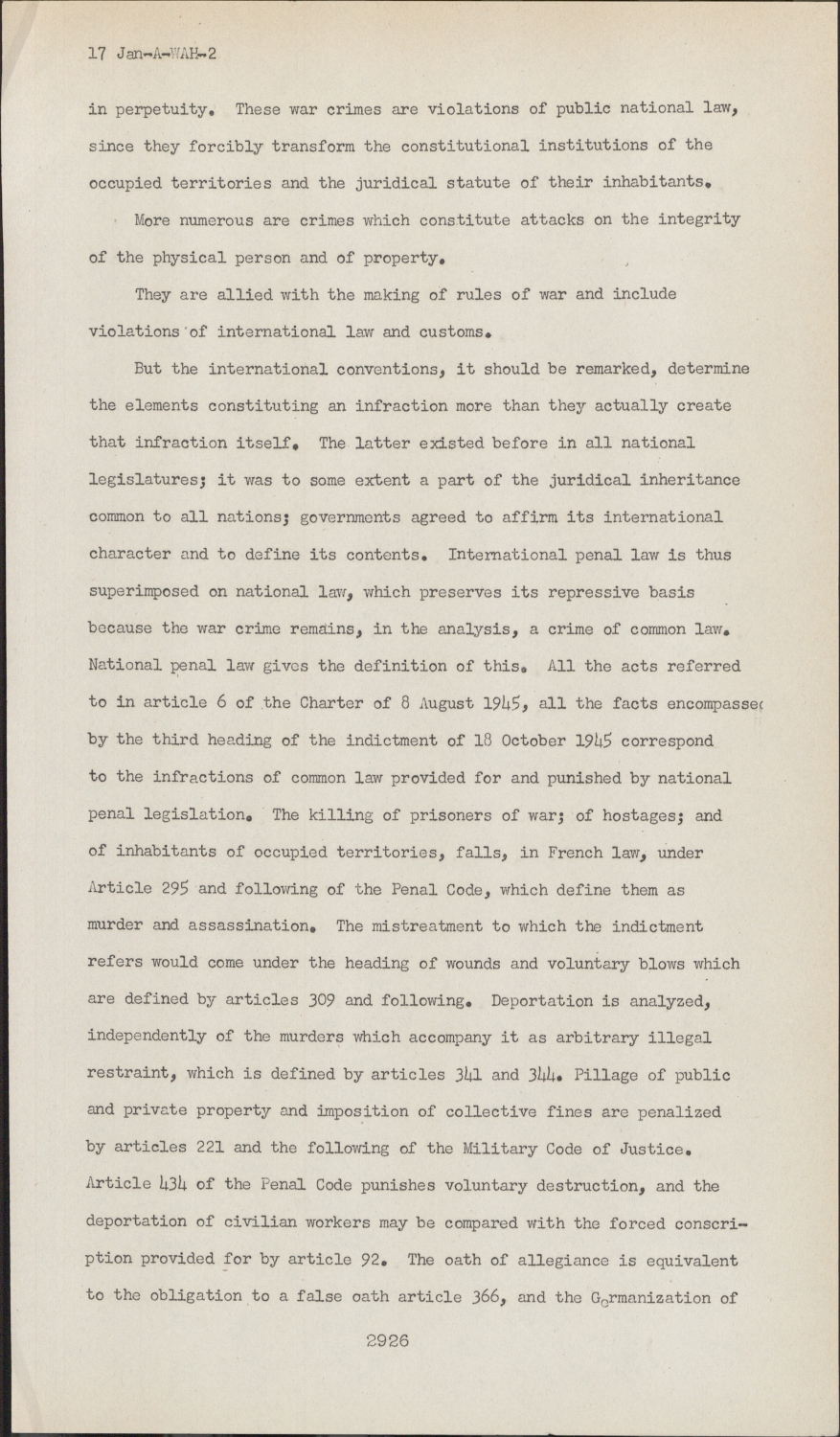
These war crimes are violations of public national law, since they forcibly transform the constitutional institutions of the occupied territories and the juridical statute of their inhabitants.
More numerous are crimes which constitute attacks on the integrity of the physical person and of property.
They are allied with the making of rules of war and include violations of international law and customs.
But the international conventions, it should be remarked, determine the elements constituting an infraction more than they actually create that infraction itself. The latter existed before in all national legislatures; it was to some extent a part of the juridical inheritance common to all nations; governments agreed to affirm its international character and to define its contents. International penal law is thus superimposed on national law, which preserves its repressive basis because the war crime remains, in the analysis, a crime of common law. National penal law gives the definition of this. All the acts referred to in article 6 of the Charter of 8 August 1945, all the facts encompassed by the third heading of the indictment of 18 October 1945 correspond to the infractions of common law provided for and punished by national penal legislation. The killing of prisoners of war; of hostages; and of inhabitants of occupied territories, falls, in French law, under Article 295 and following of the Penal Code, which define them as murder and assassination. The mistreatment to which the indictment refers would come under the heading of wounds and voluntary blows which are defined by articles 309 and following. Deportation is analyzed, independently of the murders which accompany it as arbitrary illegal restraint, which is defined by articles 341 and 344 Pillage of public and private property and imposition of collective fines are penalized by articles 221 and the following of the Military Code of Justice, Article 434 of the Penal Code punishes voluntary destruction, and the deportation of civilian workers may be compared with the forced conscription provided for by article 92, The oath of allegiance is equivalent to the obligation to a false oath article 366, and the Germanization of occupied territories may be applied to a number of crimes, the most obvious of which is forced incorporation in the Wehrmacht in violation of article 92.
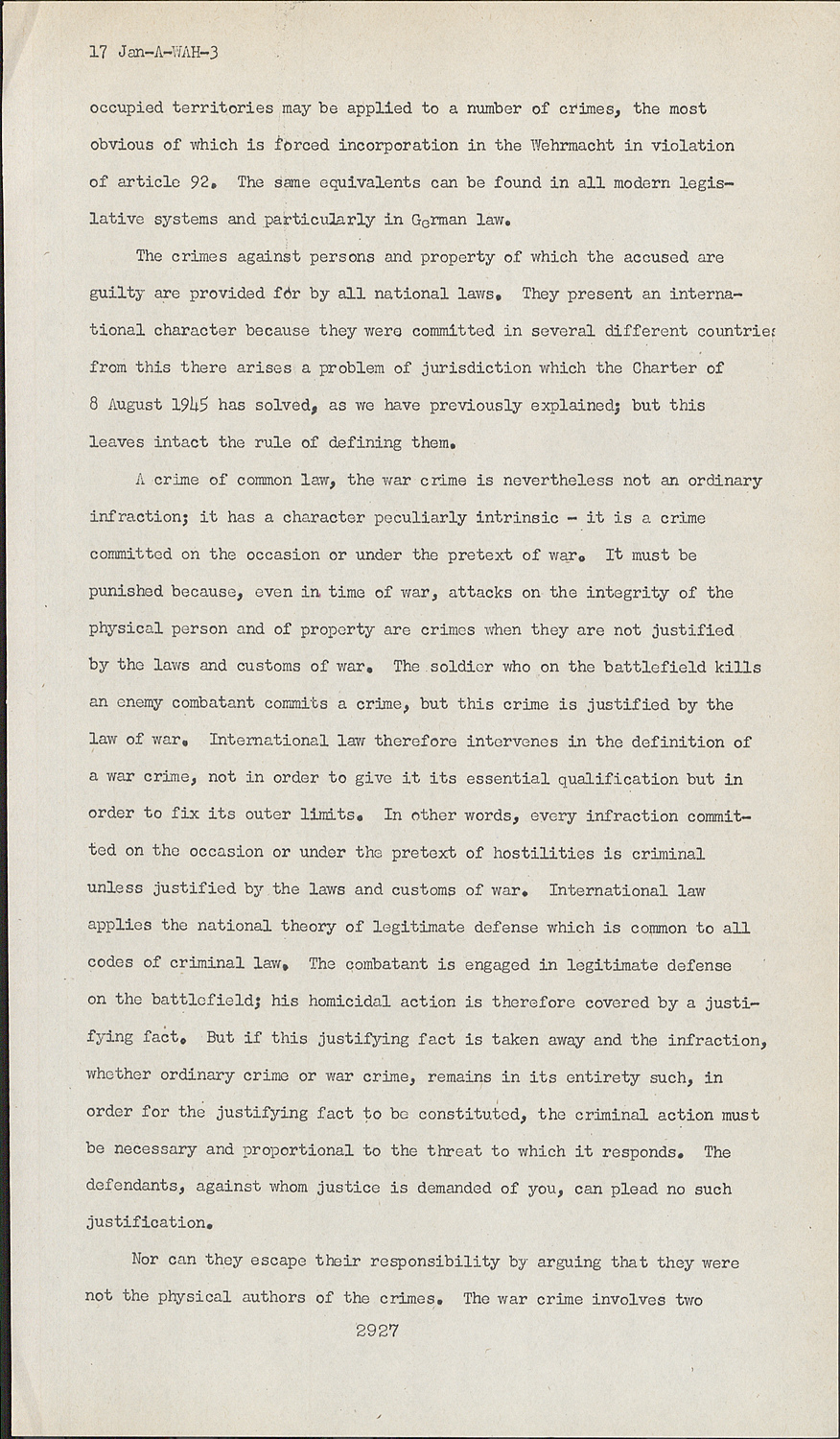
The same equivalents can be found in all modern legislative systems and particularly in German law.
The crimes against persons and property of which the accused are guilty are provided for by all national laws. They present an international character because they were committed in several different countries from this there arises a problem of jurisdiction which the Charter of 8 August 1945 has solved, as we have previously explained; but this leaves intact the rule of defining them.
A crime of common law, the war crime is nevertheless not an ordinary infraction; it has a character peculiarly intrinsic - it is a crime committed on the occasion or under the pretext of war. It must be punished because, even in time of war, attacks on the integrity of the physical person and of property are crimes when they are not justified by the laws and customs of war. The soldier who on the battlefield kills an enemy combatant commits a crime, but this crime is justified by the law of war. International law therefore intervenes in the definition of a war crime, not in order to give it its essential qualification but in order to fix its outer limits. In other words, every infraction committed on the occasion or under the pretext of hostilities is criminal unless justified by the laws and customs of war. International law applies the national theory of legitimate defense which is common to all codes of criminal law. The combatant is engaged in legitimate defense on the battlefield; his homicidal action is therefore covered by a justifying fact. But if this justifying fact is taken away and the infraction, whether ordinary crime or war crime, remains in its entirety such, in order for the justifying fact to be constituted, the criminal action must be necessary and proportional to the threat to which it responds. The defendants, against whom justice is demanded of you, can plead no such justification.
Nor can they escape their responsibility by arguing that they were not the physical authors of the crimes. The war crime involves two responsibilities, distinct and complementary that of the physical author and that of the instigator.
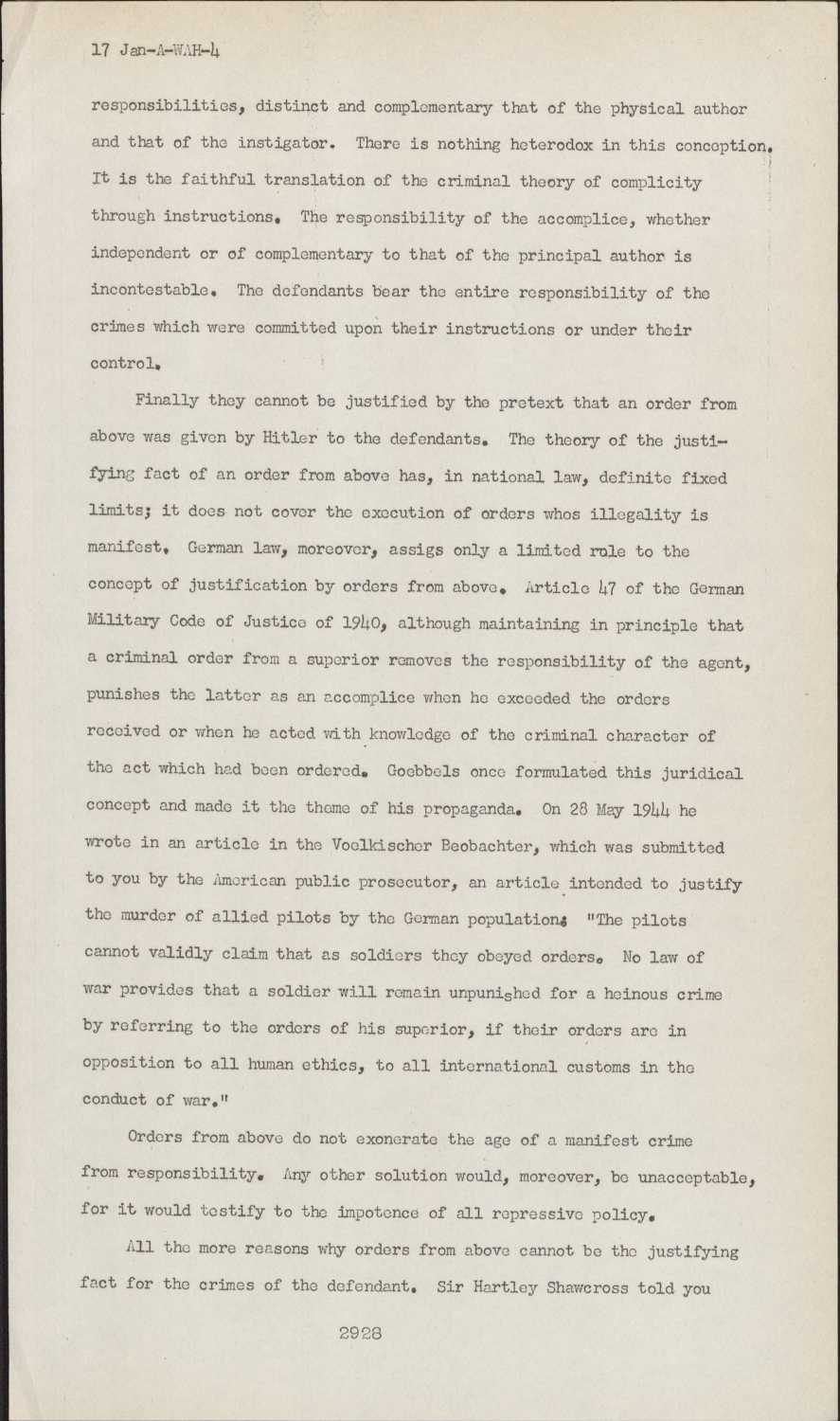
There is nothing heterodox in this conception. It is the faithful translation of the criminal theory of complicity through instructions. The responsibility of the accomplice, whether independent or of complementary to that of the principal author is incontestable. The defendants bear the entire responsibility of the crimes which were committed upon their instructions or under their control.
Finally they cannot be justified by the pretext that an order from above was given by Hitler to the defendants. The theory of the justifying fact of an order from above has, in national law, definite fixed limits; it does not cover the execution of orders whos illegality is manifest, German law, moreover, assigs only a limited rule to the concept of justification by orders from above. Article 47 of the German Military Code of Justice of 1940, although maintaining in principle that a criminal order from a superior removes the responsibility of the agent, punishes the latter as an accomplice when he exceeded the orders received or when he acted with knowledge of the criminal character of the act which had been ordered. Goebbels once formulated this juridical concept and made it the theme of his propaganda. On 28 May 1944 he wrote in an article in the Voelkischer Beobachter, which was submitted to you by the American public prosecutor, an article intended to justify the murder of allied pilots by the German population. "The pilots cannot validly claim that as soldiers they obeyed orders. No law of war provides that a soldier will remain unpunished for a heinous crime by referring to the orders of his superior, if their orders are in opposition to all human ethics, to all international customs in the conduct of war."
Orders from above do not exonerate the age of a manifest crime from responsibility. Any other solution would, moreover, be unacceptable, for it would testify to the impotence of all repressive policy.
All the more reasons why orders from above cannot be the justifying fact for the crimes of the defendant. Sir Hartley Shawcross told you with eloquence that the accused cannot claim that the crime against the peace was the doing of Hitler alone and that they limited themselves to transmitting the general directives.
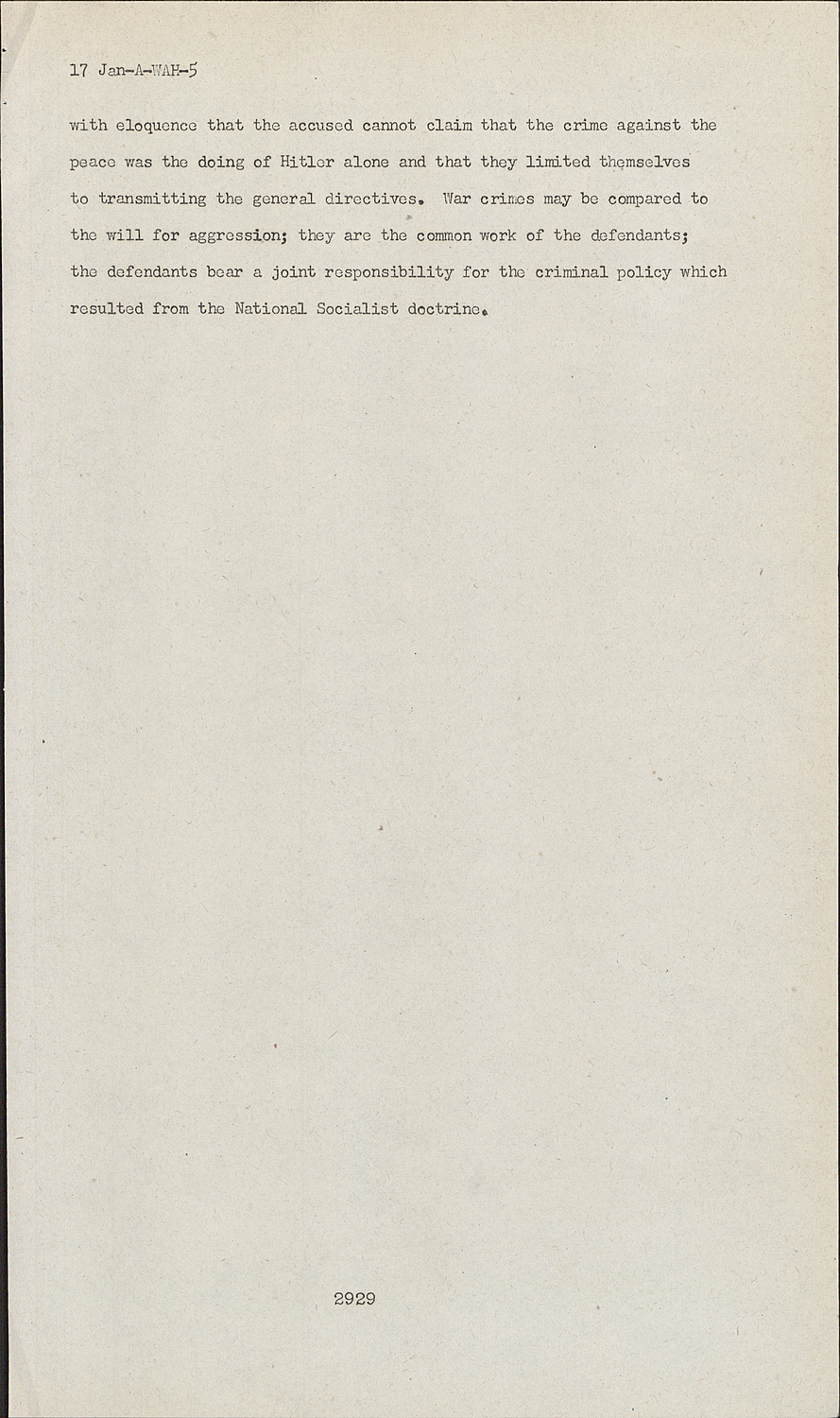
War crimes may be compared to the will for aggression; they are the common work of the defendants; the defendants bear a joint responsibility for the criminal policy which resulted from the National Socialist doctrine.
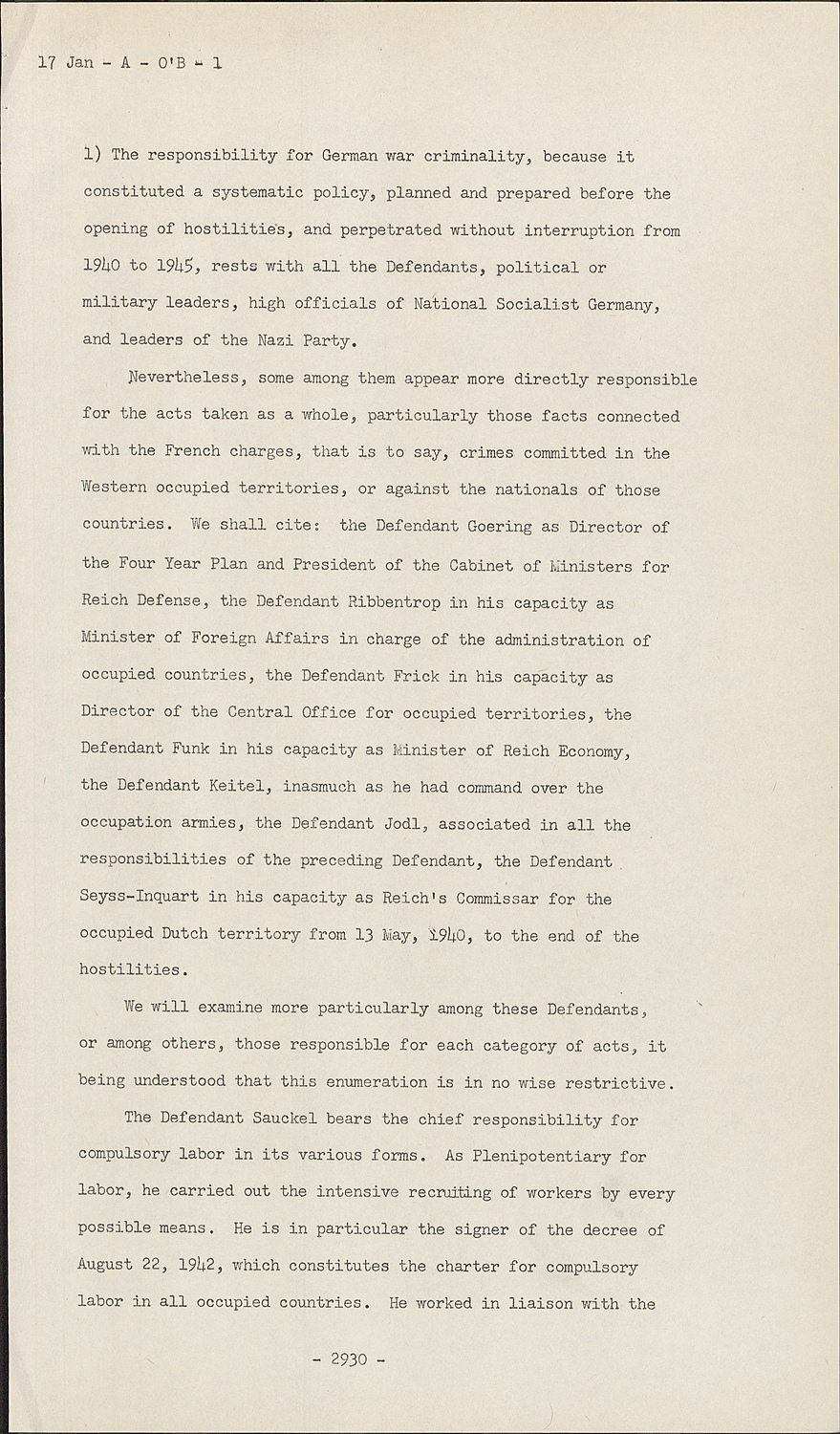
1) The responsibility for German war criminality, because it constituted a systematic policy, planned and prepared before the opening of hostilities, and perpetrated without interruption from 1940 to 1945, rests with all the Defendants, political or military leaders, high officials of National Socialist Germany, and leaders of the Nazi Party.
Nevertheless, some among them appear more directly responsible for the acts taken as a whole, particularly those facts connected with the French charges, that is to say, crimes committed in the Western occupied territories, or against the nationals of those countries.
We shall cite: the Defendant Goering as Director of the Four Year Plan and President of the Cabinet of Ministers for Reich Defense, the Defendant Ribbentrop in his capacity as Minister of Foreign Affairs in charge of the administration of occupied countries, the Defendant Frick in his capacity as Director of the Central Office for occupied territories, the Defendant Funk in his capacity as Minister of Reich Economy, the Defendant Keitel, inasmuch as he had command over the occupation armies, the Defendant Jodl, associated in all the responsibilities of the preceding Defendant, the Defendant Seyss-Inquart in his capacity as Reich's Commissar for the occupied Dutch territory from 13 May, 1940, to the end of the hostilities.
We will examine more particularly among these Defendants, or among others, those responsible for each category of acts, it being understood that this enumeration is in no wise restrictive.
The Defendant Sauckel bears the chief responsibility for compulsory labor in its various forms.
As Plenipotentiary for labor, he carried out the intensive recruiting of workers by every possible means.
He is in particular the signer of the decree of August 22, 1942, which constitutes the charter for compulsory labor in all occupied countries.
He worked in liaison with the Defendant Speer, Chief of the Todt Organization, as General Plenipotentiary for Armament in the office of the Four Year Plan, as well as with the Defendant Funk, Minister of Reich Economy, and with the Defendant Goering, Chief of the Four Year Plan.
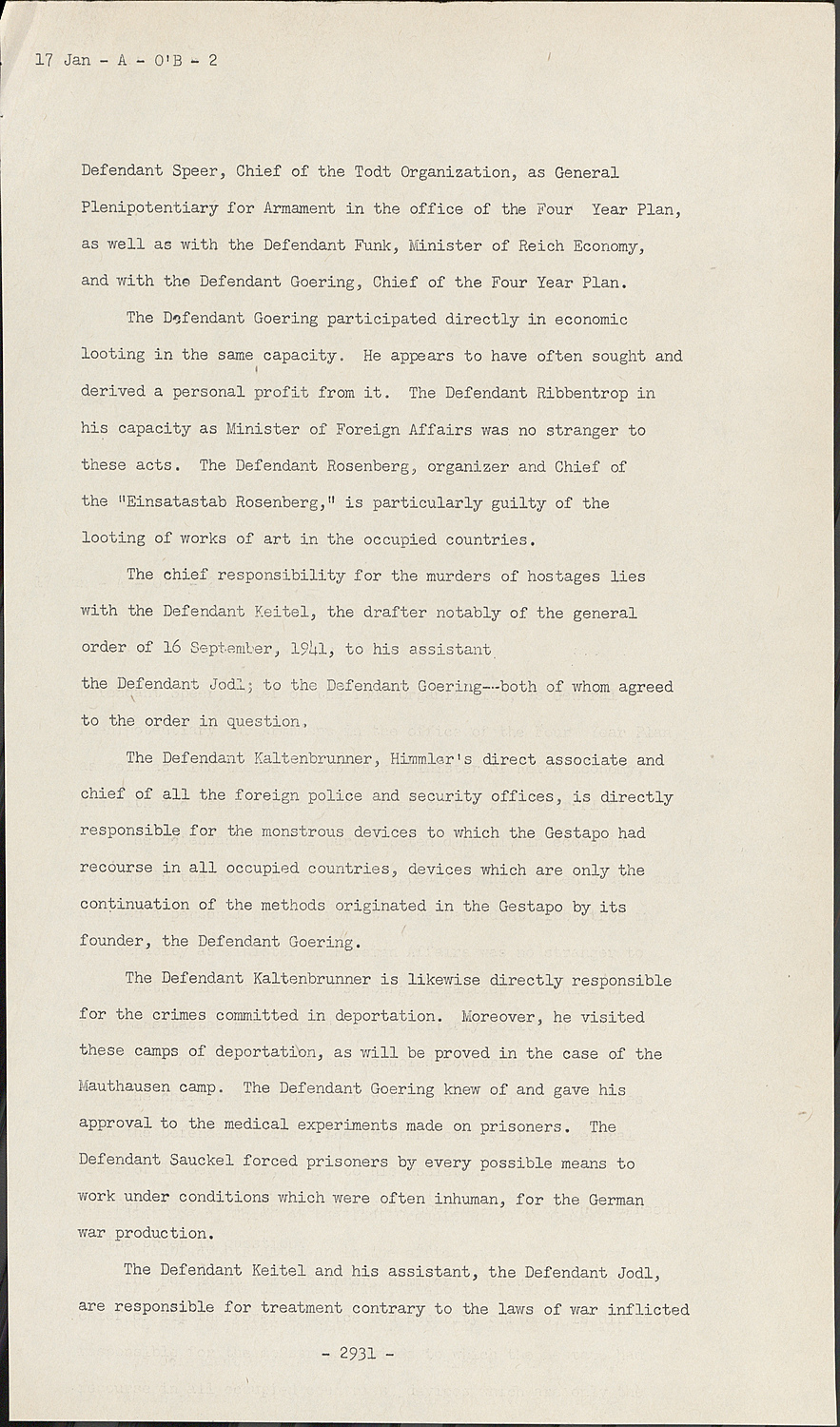
The Defendant Goering participated directly in economic looting in the same capacity.
He appears to have often sought and derived a personal profit from it.
The Defendant Ribbentrop in his capacity as Minister of Foreign Affairs was no stranger to these acts.
The Defendant Rosenberg, organizer and Chief of the "Einsatastab Rosenberg," is particularly guilty of the looting of works of art in the occupied countries.
The chief responsibility for the murders of hostages lies with the Defendant Keitel, the drafter notably of the general order of 16 September, 1941, to his assistant the Defendant Jodl; to the Defendant Goering--both of whom agreed to the order in question.
The Defendant Kaltenbrunner, Himmler's direct associate and chief of all the foreign police and security offices, is directly responsible for the monstrous devices to which the Gestapo had recourse in all occupied countries, devices which are only the continuation of the methods originated in the Gestapo by its founder, the Defendant Goering.
The Defendant Kaltenbrunner is likewise directly responsible for the crimes committed in deportation.
Moreover, he visited these camps of deportation, as will be proved in the case of the Mauthausen camp.
The Defendant Goering knew of and gave his approval to the medical experiments made on prisoners.
The Defendant Sauckel forced prisoners by every possible means to work under conditions which were often inhuman, for the German war production.
The Defendant Keitel and his assistant, the Defendant Jodl, are responsible for treatment contrary to the laws of war inflicted upon war prisoners, for murders and killings to which they were subjected as well as for handing over great numbers of them to the Gestapo.
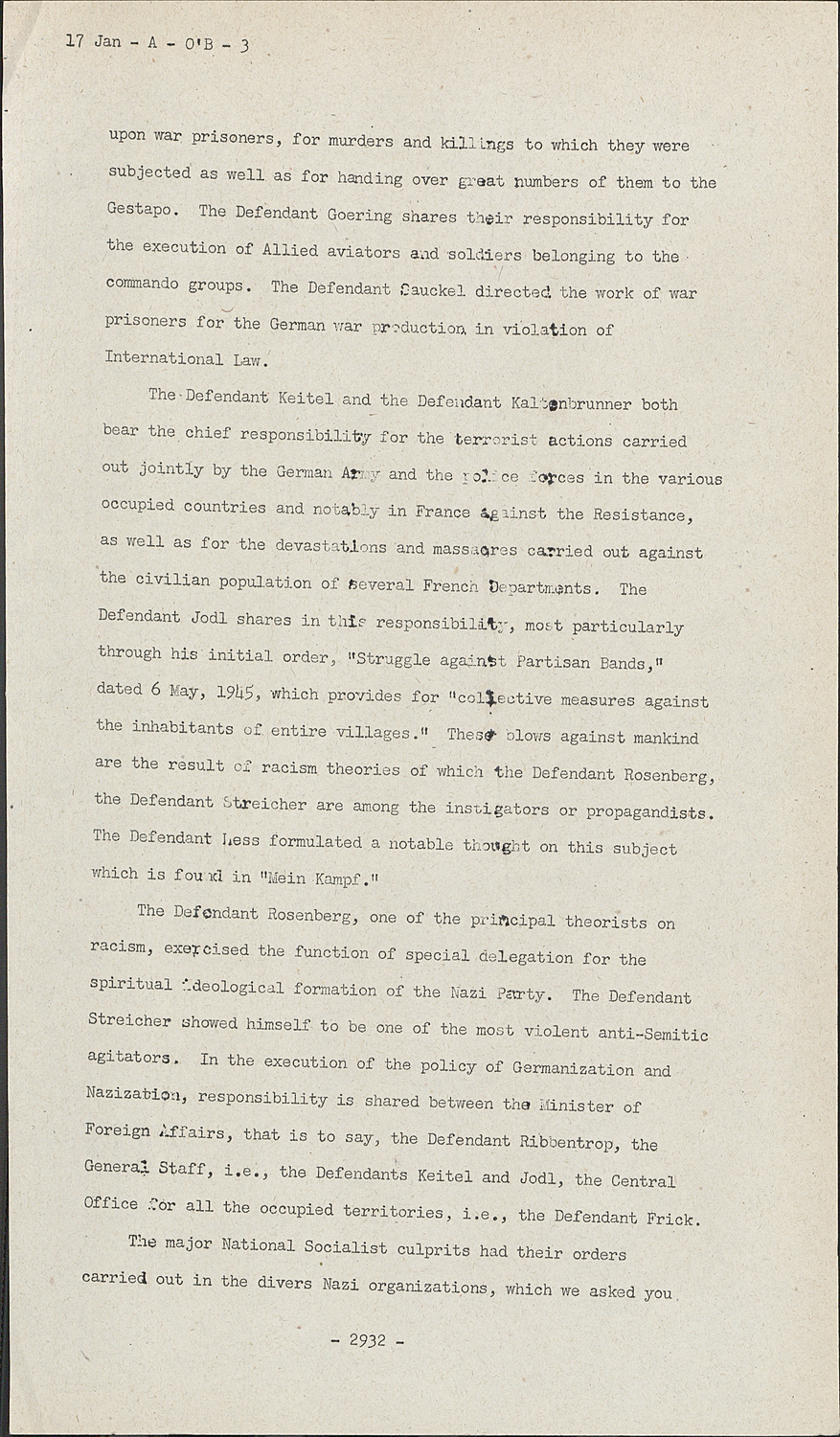
The Defendant Goering shares their responsibility for the execution of Allied aviators and soldiers belonging to the commando groups.
The Defendant Sauckel directed the work of war prisoners for the German war production in violation of International Law.
The Defendant Keitel and the Defendant Kaltenbrunner both bear the chief responsibility for the terrorist actions carried out jointly by the German Army and the police forces in the various occupied countries and notably in France against the Resistance, as well as for the devastations and massacres carried out against the civilian population of several French Departments.
The Defendant Jodl shares in this responsibility, most particularly through his initial order, "Struggle against Partisan Bands," dated 6 May, 1945, which provides for "collective measures against the inhabitants of entire villages."
These blows against mankind are the result of racism theories of which the Defendant Rosenberg, the Defendant Streicher are among the instigators or propagandists.
The Defendant less formulated a notable thought on this subject which is found in "Mein Kampf."
The Defendant Rosenberg, one of the principal theorists on racism, exercised the function of special delegation for the spiritual ideological formation of the Nazi Party.
The Defendant Streicher showed himself to be one of the most violent anti-Semitic agitators.
In the execution of the policy of Germanization and Nazization, responsibility is shared between the Minister of Foreign Affairs, that is to say, the Defendant Ribbentrop, the General Staff, i.e., the Defendants Keitel and Jodl, the Central Office for all the occupied territories, i.e., the Defendant Frick.
The major National Socialist culprits had their orders carried out in the divers Nazi organizations, which we asked you to declare criminal, in order that each of their members may be then apprehended and punished.
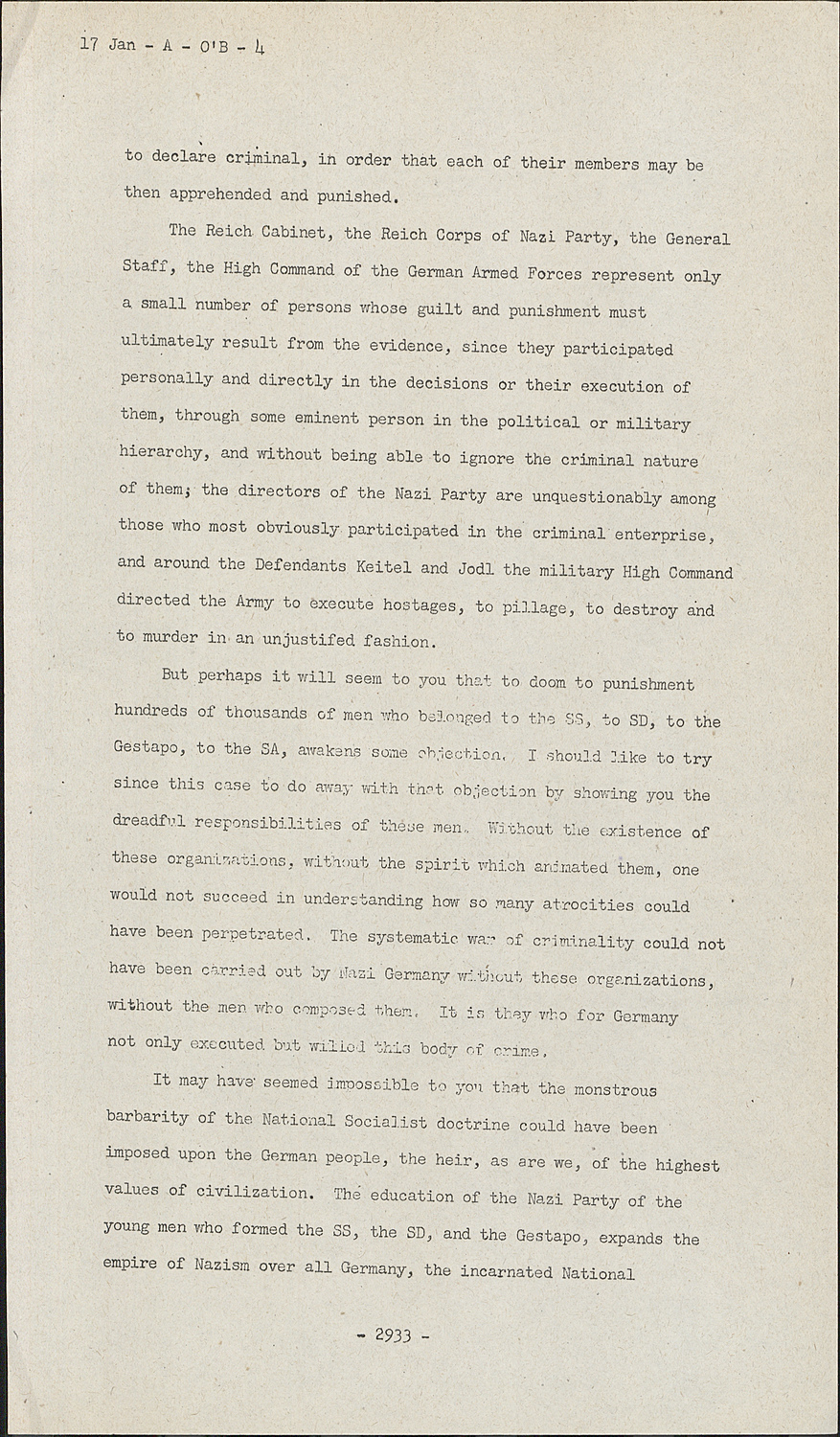
The Reich Cabinet, the Reich Corps of Nazi Party, the General Staff, the High Command of the German Armed Forces represent only a small number of persons whose guilt and punishment must ultimately result from the evidence, since they participated personally and directly in the decisions or their execution of them, through some eminent person in the political or military hierarchy, and without being able to ignore the criminal nature of them; the directors of the Nazi Party are unquestionably among those who most obviously participated in the criminal enterprise, and around the Defendants Keitel and Jodl the military High Command directed the Army to execute hostages, to pillage, to destroy and to murder in an unjustifed fashion.
But perhaps it will seem to you that to doom to punishment hundreds of thousands of men who belonged to the SS, to SD, to the Gestapo, to the SA, awakens some objection I should like to try since this case to do away with that objection by showing you the dreadful responsibilities of these men.
Without the existence of these organizations, without the spirit which animated them, one would not succeed in understanding how so many atrocities could have been perpetrated.
The systematic war of criminality could not have been carried out by Nazi Germany without these organizations, without the men who composed then.
It is they who for Germany not only executed but willed this body of crime.
It may have seemed impossible to you that the monstrous barbarity of the.
National Socialist doctrine could have been imposed upon the German people, the heir, as are we, of the highest values of civilization.
The education of the Nazi Party of the young men who formed the SS, the SD, and the Gestapo, expands the empire of Nazism over all Germany, the incarnated National Socialism, and permitted it to accomplish, thanks to the guilty passiveness of the whole German population, a part of his purpose.
This youth, those who carried out the tenets of the regime were formed in a veritable doctrine of immoralism, which results from a notion of the world which served as inspiration for the regime.
The myth of race in the years of these disciples of Nazism removed from criminal war its criminal character.
If it proved that a superior race is to annihilate races and peoples that are considered inferior and decadent, incapable of living a life as it should be lived, before what means of extermination will they recoil?
The ethics of immorality, the result of the most authentic Nietscheism, which considers the destruction of all conventional ethics is the supreme attitude of man.
The crime against race is punished without pity. The crime on behalf of race is exalted without limit.
The regime truly creates a logic of crime which obeys its own laws, which has no connection whatsoever with what we consider ethical.
With such a point of view, all horrors could have been justified and authorized.
So many acts which appear incomprehensible to us, so greatly do they clash with our customary notions, were explained, were formulated in advance in the name of the racial community.
Add that these atrocities, and these cruelties were perpetrated within the rigid framework created by the espirit de corps by the soldierly solidarity which bound individuals and insured through the regimency of the crime an unlimited theme of action, the individual who committed them would not only be covered by the regime itself, but spurred on by the discipline and the camaraderie of these established corps of Nazi criminality.
German youth was invited by these organizations to live an extraordinary adventure. By the Party and its massive grip, dispensing mercy to itself with the unlimited power the Nazi youth were asked to carry out on the highest echelon of grandiose dreams of the National Socialist Pan-Germanism.
The Party exercised a high selectivity among its youth, and neglected no simulation. It solicited from its youth the desire to distinguish itself to accomplish exploits beyond the common order and beyond nature. The Hitlerion youth, the Gestapo, and the SS that knew that their acts, no matter how cruel or how inhumane they might be, would always be judged by the regime in the name of the racial community of its needs and of its triumphs. The Nazi Party, thanks to the youngmen of the SS, of the SD, and of the Gestapo had thus become culpable on a criminal plane where before no one nor any nation would ever have been able to commit.
The members of these organizations became voluntarily the authors of this inequitable mass of crimes executed frequently with the disconcerting synacism, and with a refined sadism, not only in the concentration camps of Germany, but also in the divers occupied countries, and especially in those of Western Europe.
The crimes are monstrous. The crimes ore sure, and their responsibility is established. There is no possible doubt.
But nevertheless throughout these serene sessions of this trial, extraordinary in the history of the world, before the exceptional nature, on the justice of which your high Tribunal is asked to render for the United Nations, and the German people, and before all humanity, a few objections have arisen in our minds.
It is our duty to explore all the aspects of this trial, even if it is still only unconscious within us, for soon a pseudo-patriotic propaganda may arise in Germany, and even may echo in some of our countries.
Who can say: "I have a clean conscience, I am without fault? To have two weights and two measures are both abhored by God." This text from the scripture already arisen here and there; it will serve tomorrow as a theme of propaganda, but above all, it is profoundly written in our soul by raising us in the name of our immortal peoples as accusers of Nazi Germany. We have never for a moment held it in check as an unwanted appeal.
Yes, no nation is without reproach in its history, just as no individual is faultless in his life. Yes, every war in itself generates iniquitous evils, and entails almost necessarily individual and collective crimes, because it easily unleashes in man the evil passions which always slumber there.
But viewing the Nazi German culprits, we can examine our conscience fearlessly; we find no common measure between them and ourselves.
If this criminality was accidental; if Germany had been forced into war; if crimes had been committed only in the excitement of combat; we might question ourselves on the text of the Scriptures. But the war was prepared and deliberated upon long in advance, and up to the very last day it would have been easy to avoid it without sacrificing any of the legitimate interests of the German people. And the atrocities were perpetrated during the war, not under the influence of a mad passion, nor of a warlike anger, nor of an avenging resentment, but as a result of cold calculation, of perfectly conscious methods, of a pre-existing doctrine.
The truly diabolical enterprise of Hitler, and of his companions, was to assemble in a body of dogmas formed around the concept of race, all the instincts of barbarism, repressed by centuries of civilization, but always present within the depths of men, all the negations of the traditional values of humanity, without which nations, as Well as individuals, question their conscience in the troubled hours of their evolution and of their life; to construct and to propagate a doctrine which organizes, regulates, and aspires to command crime.
The diabolical enterprise of Hitler, and of his companions, was also to appeal to the forces of evil in order to establish his domination over the German people, and subsequently the domination of Germany over Europe, and perhaps over the world.
They planned to incorporate organized criminality into a system of government, into a system of international relation, and into a system of war conduct, by unleashing within the whole nation the most savage passions.
Nationalism, and the service of their people and of their country, will perhaps be their explanation; far from constituting an excuse, if any excuse were possible in view of the enormity of their crime, these determining causes would make it still greater. They have profaned the sacred concept of country, linking it to a willed return to barbarism.
In its name they obtained half by force, half by persuasion the adhesion of a whole country, formerly among the greatest in the order of spiritual value, and have lowered it to the lowest level. The moral confusion, the economic difficulties, the obsession of the defeat of 1918, the loss of might and the Pan-Germanic tradition are the basis of the empire of Hitler and of his companions over the dis-oriented people; to abandon oneself to force, to renounce moral concern, to satisfy a love of collectivity, to revel in lack of measure are the natural temptations strongly emplanted in the German, which the Nazi leaders exploited with cynicism. The intoxication of success, the madness of greatness completed the picture, and put practically all Germans, some without doubt unconsciously, in the service of the National Socialist Doctrine by associating them with the diabolical enterprise of their Fuehrer and his companions.
Opposing this enterprise arose men of various countries and different societies, but all animated with the common bond of their human lot, France and Great Britain entered the war only to remain faithful to their word. The peoples of the occupied countries, tortured in their flesh, and in their souls, never renounced their liberty, nor their cultural values, and it was a magnificent epic of clandestine opposition and of Resistance which through a splendid heroism, testifies to the spontaneous refusal of the populations to accept the Nazi myths. Millions and millions of men of the Soviet Union fell to defend not only the soil and independence of their country, but also their humanitarian universalism. The millions of British and American soldiers, who landed on our unhappy continent carried in their hearts the ideal of freeing from Nazi oppression, both the occupied countries, and the peoples who willingly or by force became the satellites of the Axis and of the German people itself.
These partisans and those soldiers separately and collectively were with or without uniforms, soldiers of great hope with throughout centuries has fed on popular suffering, the great hope of a better future for mankind.
Sometimes this great hope expresses itself with difficulty or loses its way, or tires to deceive itself, or known the dread return of barbarism, but it persists always, and finally constitutes the powerful lever which brings about the progress of humanity. These aspirations always reborn, these concerns constantly awakened, this anguish uncessingly present, this perpetual combat against evil, form in a permanent fashion the submlime grandeur of man. National Socialism only yesterday imperiled all of this.
After that gigantic struggle where two idealogies, two conceptions of life were at grips, in the name of the people whom we represent here, and in the name of the great human hope for which they have so greatly suffered, so greatly fought, we can without fear and with a clean conscience arise as accusers of the leaders of Nazi Germany.
As Mr. Justice Jackson said so eloquantly at the opening of this trial: "Civilization could not survive if these crimes were to be committed again." and he added: "The true plaintiff in this court is civilization."
Civilization requires from you after this unleashing of barbarism, a verdict which will also be a sort of supreme warning at the hour when humanity appears still at times to enter the path of the organization of peace only with apprehension and hesitation.
If we wish that on the morrow of the cataclysm of war, the sufferings of martyred countries, the sacrifices of victorious nations, end also the expiation of guilty people, will engender a better humanity, justice must strike those guilty of the enterprise of barbarism from which we have just escaped. The reign of Justice is the most exact expression of the great human hope. Your decision can mark a decisive stage in its difficult pursuit.
Undoubtedly even today, this justice and this punishment have become possible only because as a first condition free peoples emerged victorious from the conflict. There is a relationship in the facts between the force of the victors, and the guilt of the vanguished leaders who appear before your high Tribunal.
But this relationship signifies nothing except that this evidence of the wisdom of nations that justice, in order to impose itself effectively and constantly upon individuals, and upon nations, must have force at its disposal. The common will to put force in the service of justice animates our nations and commands all our civilization.
This resolution is brilliantly strengthened today in a judicial case where the facts are examined scrupously under all their aspects. The penal nature of the offense rigorously established, the competency of the Tribunal incontestable, the rights of the defense intact, total publicity insured.
Your verdict intervening under these conditions can serve as a foundation for the moral uplist of the German people, first stage in its integration into the communicyt of free countries. Without your verdict, history might incur the risk of repeating itself, crime would become epic, and the National Socialist enterprise a last Wagnerian tragedy; and new Pan-Germanists would soon say to the Germans: "Hitler and his companions were wrong because they finally failed, out we must begin again some day on other foundations the extraordinary adventure of Germanism."
After your verdict, if we know how to enlighten this people, and watch over their first steps on the road to liberty, National Socialism will be Inscribed permanently in their history, as the crime of crimes which could only Lead it to material and moral perdition, as the doctrine which they should forever avoid with horror and scorn in order to remain faithful to the great forms of communal civilization.
The eminent international jurist and noble European, Politis, in his posthumous book entitled "International Ethics" reminds us that, as all ethical rules, those which should rule international relations will never be definitely established unless all peoples succeed in convincing themselves once and for all that there is greater profit to be gained through their observation than through their transgression. That is why your judgment can contribute to enlighten the German people and all peoples.
Your decision must be inscribed as a decisive act in the history of International Law in order to prepare the establishment of a true international society excluding recourse to war, and putting force permanently in service of the justice of nations; it will be one of the foundations of this peaceful new order to which nations aspire on the morrow of this frightful torment.
The need for justice of the martyred peoples will be satisified, and their sufferings will not have been useless for the progress of mankind.
THE PRESIDENT:Mr. Menthon, would you prefer to continue the case on behalf of France this afternoon, or would you prefer to adjourn?
M. MENTHON:We are at the disposal of the Court.
THE PRESIDENT:Well then, if that is so, I think that we had better go on until five o'clock.
M. MENTHON:We are preferable to adjournment, because the brief which is going to be presented will last at least an hour. Perhaps it is better to adjourn until tomorrow morning. However, we will remain at the disposal of the Court.
THE PRESIDENT:When you said the proof shich now will be presented will take an hour, did you mean, when you said that the proof which you are going to present would take an hour, is that an introductory proof, or is it a part of the main case?
M. MENTHON:It is part of the general case. Your Honor, that is part of the general case, this brief.
THE PRESIDENT:Would it not be possible then to go ahead until five o'clock?
M. MENTHON:Yes, quite so.
THE PRESIDENT:We would prefer to go on until five o'clock.
M. MENTHON:All right, agreed.
MR. FAURE:Mr. President, and your Honors, I propose to submit to the Tribunal an introduction common to the first and the second course of the French case.
The first part relates to forced labor; the second part to economic looting. These two over-all questions are complementary to each other and form a whole. Manpower on the one hand, and material property on the other, constitute the two aspects of the riches of a country and the conditions of existence in that country. Measures taken with regard to the one necessarily react on the other, and it is understandable that in the occupied countries, German policy with regard to economic property were inspired, from the very beginning, by common directing principles.
For this reason the French prosecution has deemed it logical to submit successively to the Tribunal those two briefs corresponding to the letters "h" and "e" of the third Count of the Indictment. My present purpose is to define the initial directives covering the German procedure in regard to manpower and to material in the occupied territories.
When the Germans occupied the territories of Denmark, Norway, Holland, Belgium, Luxemburg, and, in part, continental France, they thereby assumed a material power of constraint with regard to the inhabitants and the material power of acquisition with regard to its property. They thus had in fact the possibility of utilizing these dual resources on behalf of the war effort.
On the other hand, in law, they were confronted with precise rules as to International Law relating to the occupation of territories by the military forces of a belligerent State.