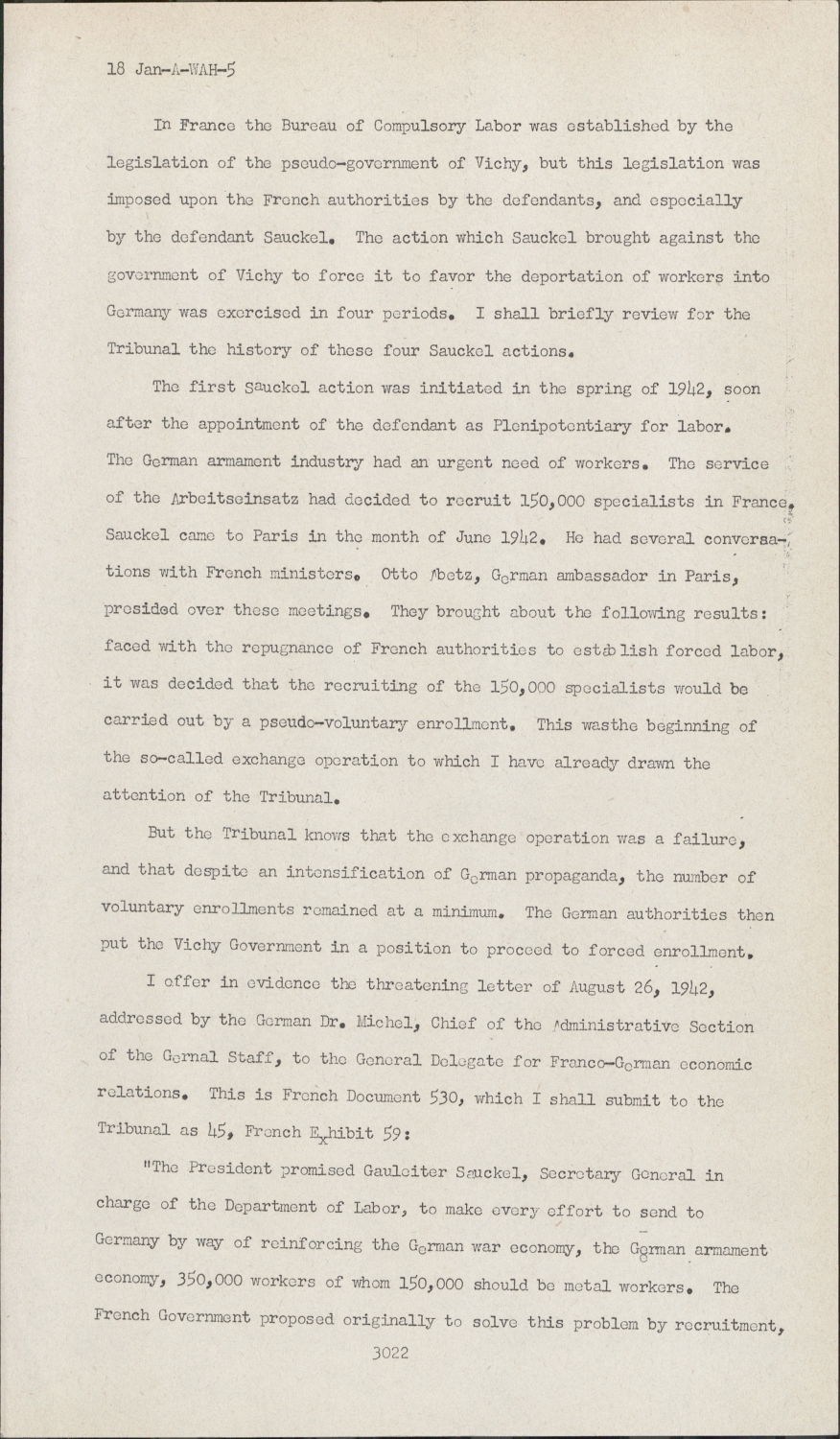
In France the Bureau of Compulsory Labor was established by the legislation of the pseudo-government of Vichy, but this legislation was imposed upon the French authorities by the defendants, and especially by the defendant Sauckel.
The action which Sauckel brought against the government of Vichy to force it to favor the deportation of workers into Germany was exercised in four periods. I shall briefly review for the Tribunal the history of these four Sauckel actions.
The first Sauckel action was initiated in the spring of 1942, soon after the appointment of the defendant as Plenipotentiary for labor. The German armament industry had an urgent need of workers. The service of the Arbeitseinsatz had decided to recruit 150,000 specialists in France. Sauckel came to Paris in the month of Juno 1942. He had several conversations with French ministers. Otto Abetz, German ambassador in Paris, presided over these meetings. They brought about the following results: faced with the repugnance of French authorities to establish forced labor, it was decided that the recruiting of the 150,000 specialists would be carried out by a pseudo-voluntary enrollment. This wasthe beginning of the so-called exchange operation to which I have already drawn the attention of the Tribunal.
But the Tribunal knows that the exchange operation was a failure, and that despite an intensification of German propaganda, the number of voluntary enrollments remained at a minimum. The German authorities then put the Vichy Government in a position to proceed to forced enrollment.
I offer in evidence the threatening letter of August 26, 1942, addressed by the German Dr. Michel, Chief of the Administrative Section of the Gernal Staff, to the General Delegate for Franco-German economic relations. This is French Document 530, which I shall submit to the Tribunal as 45, French Exhibit 59:
"The President promised Gauleiter Sauckel, Secretary General in charge of the Department of Labor, to make every effort to send to Germany by way of reinforcing the German war economy, the German armament economy, 350,000 workers of whom 150,000 should be metal workers. The French Government proposed originally to solve this problem by recruitment, in particular by special offers.

This method has been abandoned and that of voluntary enrollment has been attempted with a view to the liberation of prisoners.
The months which have passed have demonstrated that the end in viewcannot be achieved by means of voluntary recruiting. In France, German armament orders have increased in volume and assumed a more marked and urgent character. Besides, the accomplishment of special tasks has been asked, which can be successfully carried out only by having recourse to a very considerable number of workers. In order to assure the realization of the tasks for which France is responsible in the domain of labor supply, the French Government must be asked henceforth to put into execution the following measures: First of all, the publication of a decree relative to the change of place of work. By virtue of this decree, the place of work cannot be abandoned and labor cannot be hired without the approval of certain specified services. Second, the institution of the obligatory dedaration of all persons out of work, as well as those who do not work during the whole working day or in a permanent manner. This obligatory statement will make it possible to determine as fully as possible the reserves that are still available. Third, the publication of a decree for the mobilization of workers for important tasks relating tothe policy of State. This decree is to furnish (a) the necessary labor for Germany; (b) the workers necessary in France for the carrying out of orders which have been transferred here for special tasks. Fourth, publication of a decree safeguarding the formation of young specialists. This decree must impose upon French enterprise, French factories and industry the obligation of forming by means of apprenticeship and systematic professional education, young workers possessing adequate special qualifications for the military commander. Signed: Dr. Michel."
Dr. Michel's letter forms the basis for the law relative to the utilization and the orientation of labor. It is the law of September 4, 1942, which I have just filed with the Tribunal.
In application of the law of September 4, all Frenchmen between 18 and 50 who did not have employment susceptible of occupying them more than 30 hours a week were forced to state this at the city hall where they resided.
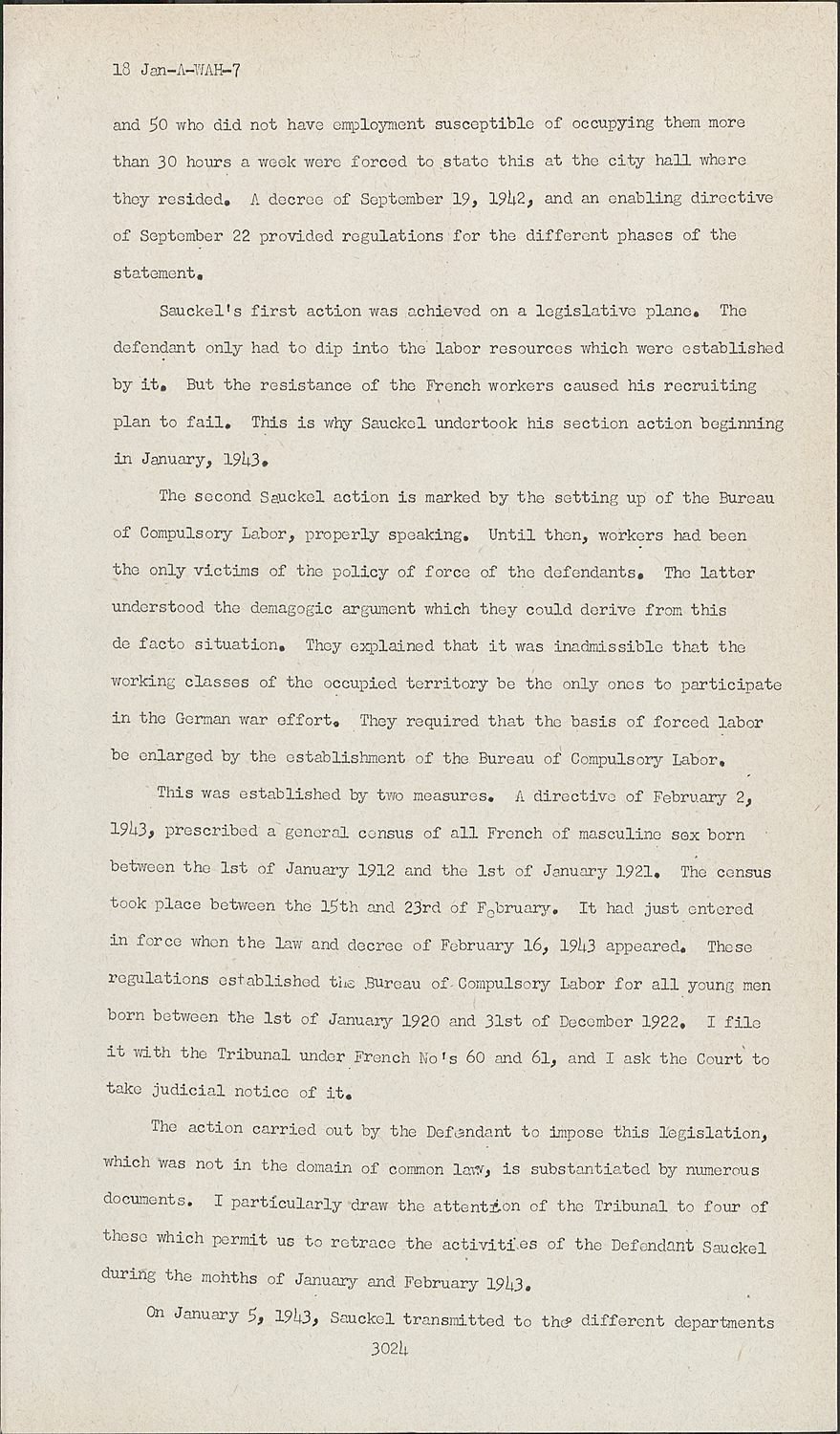
A decree of September 19, 1942, and an enabling directive of September 22 provided regulations for the different phases of the statement.
Sauckel's first action was achieved on a legislative plane. The defendant only had to dip into the labor resources which were established by it. But the resistance of the French workers caused his recruiting plan to fail. This is why Sauckel undertook his section action beginning in January, 1943.
The second Sauckel action is marked by the setting up of the Bureau of Compulsory Labor, properly speaking. Until then, workers had been the only victims of the policy of force of the defendants. The latter understood the demagogic argument which they could derive from this de facto situation. They explained that it was inadmissible that the working classes of the occupied territory be the only ones to participate in the German war effort. They required that the basis of forced labor be enlarged by the establishment of the Bureau of Compulsory Labor.
This was established by two measures. A directive of February 2, 1943, prescribed a general census of all French of masculine sex born between the 1st of January 1912 and the 1st of January 1921. The census took place between the 15th and 23rd of February. It had just entered in force when the law and decree of February 16, 1943 appeared. These regulations established the Bureau of Compulsory Labor for all young men born between the 1st of January 1920 and 31st of December 1922. I file it with the Tribunal under French No's 60 and 61, and I ask the Court to take judicial notice of it.
The action carried out by the Defendant to impose this legislation, which was not in the domain of common law, is substantiated by numerous documents. I particularly draw the attention of the Tribunal to four of these which permit us to retrace the activities of the Defendant Sauckel during the months of January and February 1943.
On January 5,1943, Sauckel transmitted to the different departments of his administration an order of the Fuehrer which the Defendant Speer had communicated to him.
This is Document 556-PS-13, which I file with the Tribunal under No. 62. I shall read its first paragraph. First of all:
"1. On January 4, 1943, at 8:00 o'clock in the evening THE PRESIDENT:
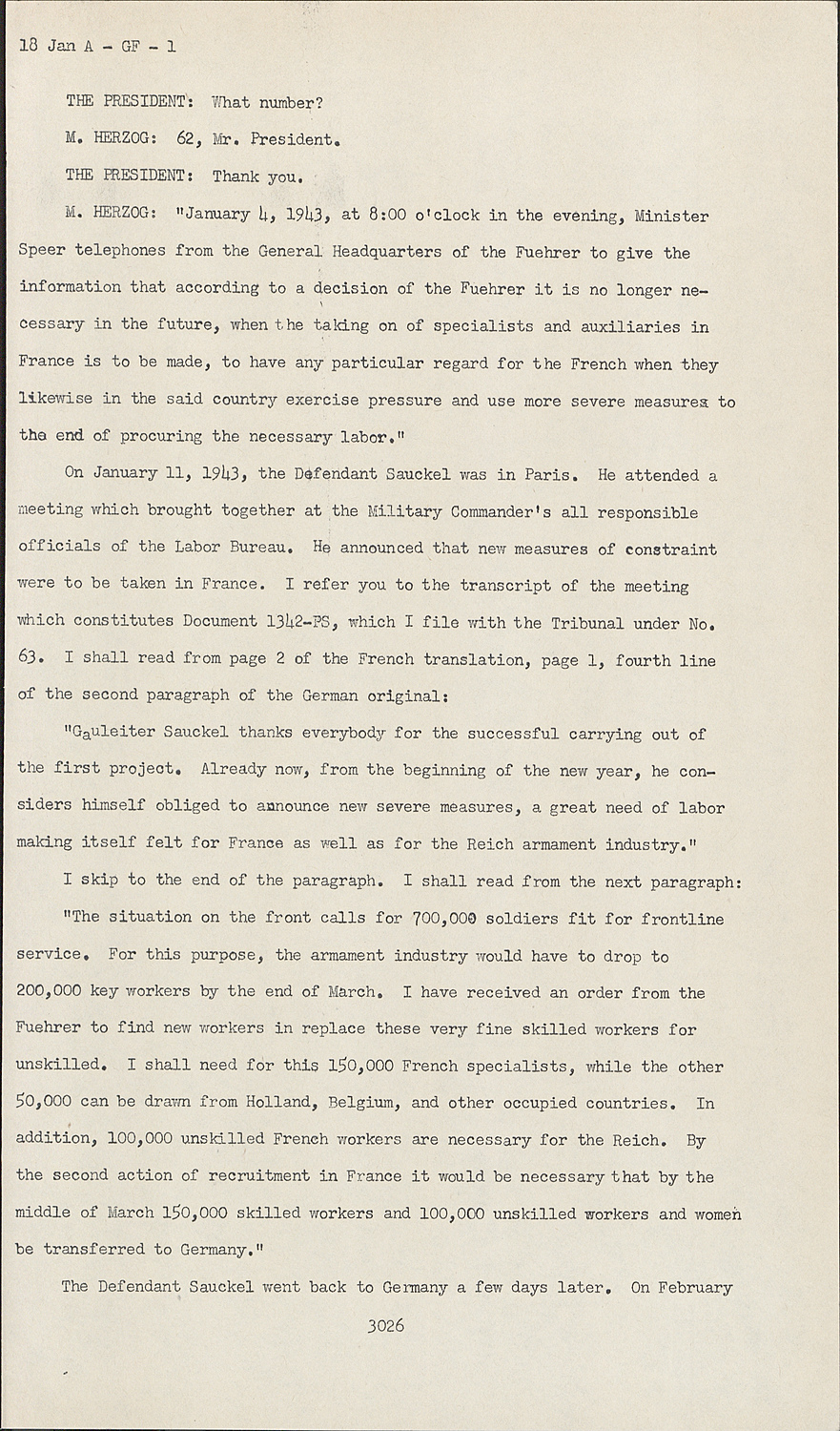
What number?
M.HERZOG: 62, Mr. President.
THE PRESIDENT:Thank you.
M.HERZOG: "January 4, 1943, at 8:00 o'clock in the evening, Minister Speer telephones from the General Headquarters of the Fuehrer to give the information that according to a decision of the Fuehrer it is no longer necessary in the future, when the taking on of specialists and auxiliaries in France is to be made, to have any particular regard for the French when they likewise in the said country exercise pressure and use more severe measures to the end of procuring the necessary labor."
On January 11, 1943, the Defendant Sauckel was in Paris. He attended a meeting which brought together at the Military Commander's all responsible officials of the Labor Bureau. He announced that new measures of constraint were to be taken in France. I refer you to the transcript of the meeting which constitutes Document 1342-PS, which I file with the Tribunal under No. 63. I shall read from page 2 of the French translation, page 1, fourth line of the second paragraph of the German original:
"Gauleiter Sauckel thanks everybody for the successful carrying out of the first project. Already now, from the beginning of the new year, he considers himself obliged to announce new severe measures, a great need of labor making itself felt for France as well as for the Reich armament industry."
I skip to the end of the paragraph. I shall read from the next paragraph:
"The situation on the front calls for 700,000 soldiers fit for frontline service. For this purpose, the armament industry would have to drop to 200,000 key workers by the end of March, I have received an order from the Fuehrer to find new workers in replace these very fine skilled workers for unskilled, I shall need for this 150,000 French specialists, while the other 50,000 can be drawn from Holland, Belgium, and other occupied countries. In addition, 100,000 unskilled French workers are necessary for the Reich. By the second action of recruitment in France it would be necessary that by the middle of March 150,000 skilled workers and 100,000 unskilled workers and women be transferred to Germany."
The Defendant Sauckel went back to Germany a few days later. On February 16 he was in Berlin at the meeting of the Central Office of the Four Year Plan.
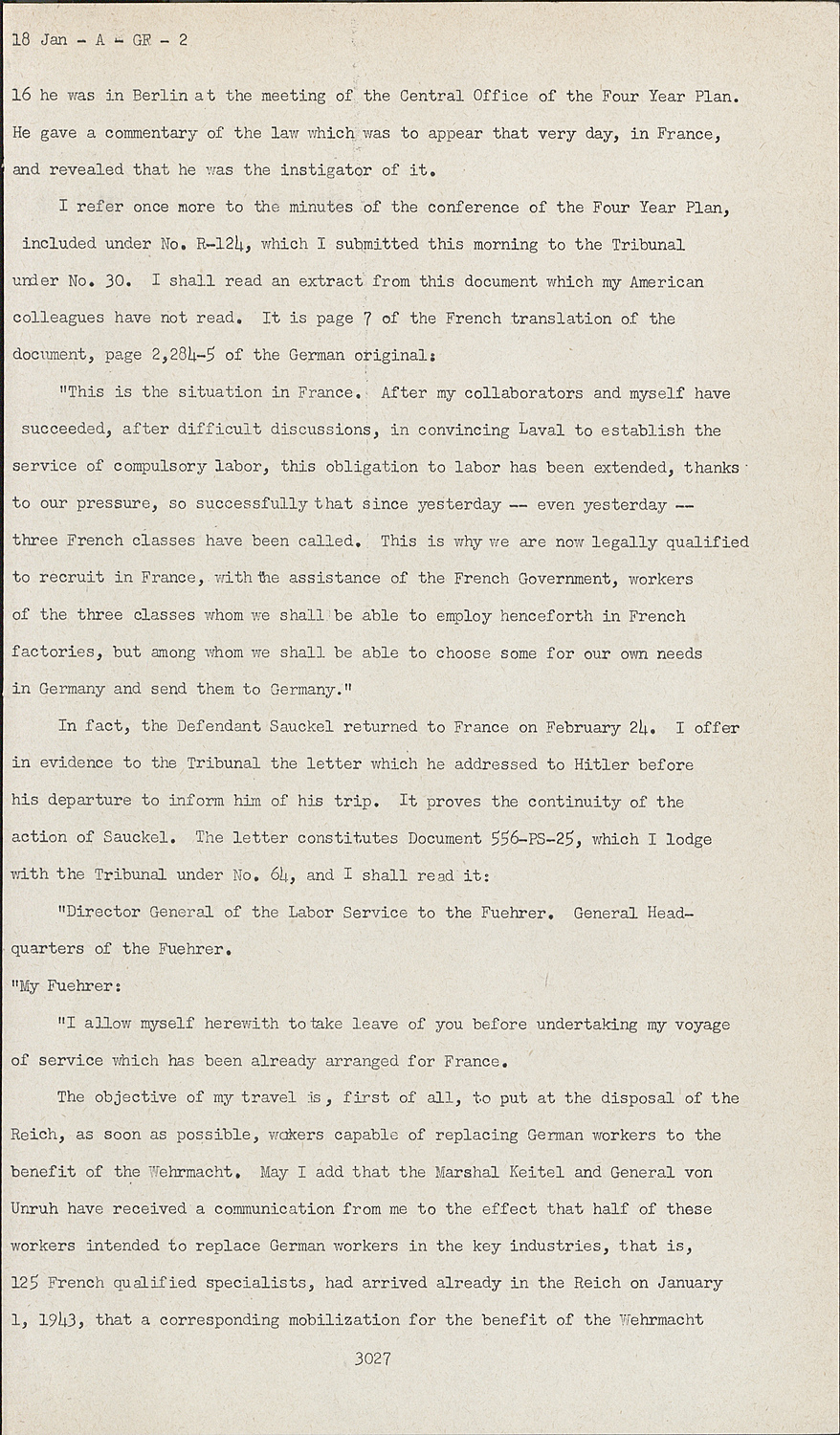
He gave a commentary of the law which was to appear that very day, in France, and revealed that he was the instigator of it.
I refer once more to the minutes of the conference of the Four Year Plan, included under No. R-124, which I submitted this morning to the Tribunal under No. 30. I shall read an extract from this document which my American colleagues have not read. It is page 7 of the French translation of the document, page 2,284-5 of the German original.
"This is the situation in France. After my collaborators and myself have succeeded, after difficult discussions, in convincing Laval to establish the service of compulsory labor, this obligation to labor has been extended, thanks to our pressure, so successfully that since yesterday -- even yesterday -three French classes have been called. This is why we are now legally qualified to recruit in France, with the assistance of the French Government, workers of the three classes whom we shall be able to employ henceforth in French factories, but among whom we shall be able to choose some for our own needs in Germany and send them to Germany."
In fact, the Defendant Sauckel returned to France on February 24. I offer in evidence to the Tribunal the letter which he addressed to Hitler before his departure to inform him of his trip. It proves the continuity of the action of Sauckel. The letter constitutes Document 556-PS-25, which I lodge with the Tribunal under No. 64, and I shall read it:
"Director General of the Labor Service to the Fuehrer. General Headquarters of the Fuehrer. "My Fuehrer:
"I allow myself herewith to take leave of you before undertaking my voyage of service which has been already arranged for France.
The objective of my travel is, first of all, to put at the disposal of the Reich, as soon as possible, workers capable of replacing German workers to the benefit of the Wehrmacht. May I add that the Marshal Keitel and General von Unruh have received a communication from me to the effect that half of these workers intended to replace German workers in the key industries, that is, 125 French qualified specialists, had arrived already in the Reich on January 1, 1943, that a corresponding mobilization for the benefit of the Wehrmacht might take place.
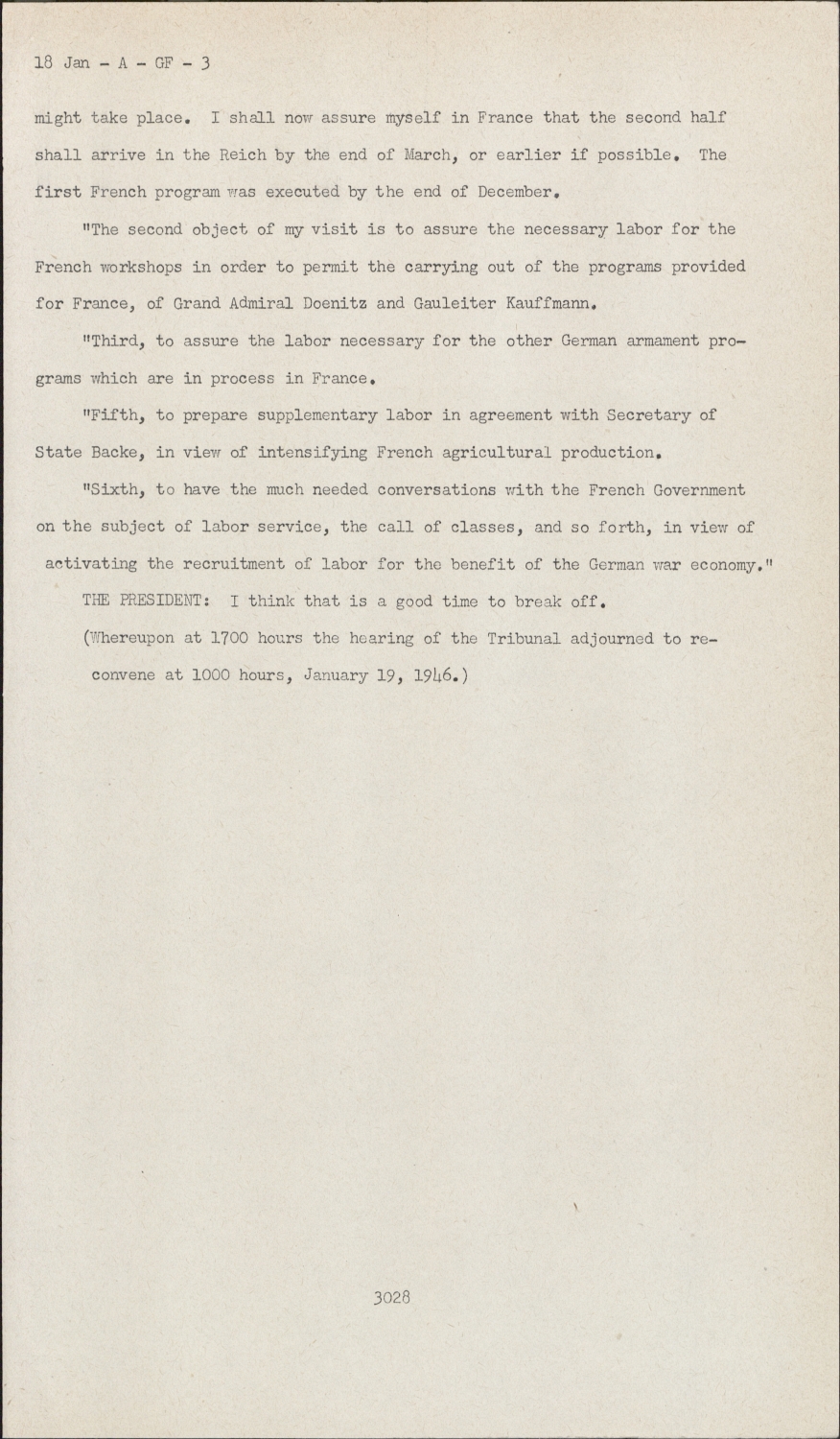
I shall now assure myself in France that the second half shall arrive in the Reich by the end of March, or earlier if possible.
The first French program was executed by the end of December.
"The second object of my visit is to assure the necessary labor for the French workshops in order to permit the carrying out of the programs provided for France, of Grand Admiral Doenitz and Gauleiter Kauffmann.
"Third, to assure the labor necessary for the other German armament programs which are in process in France.
"Fifth, to prepare supplementary labor in agreement with Secretary of State Backe, in view of intensifying French agricultural production.
"Sixth, to have the much needed conversations with the French Government on the subject of labor service, the call of classes, and so forth, in view of activating the recruitment of labor for the benefit of the German war economy."
THE PRESIDENT:I think that is a good time to break off.
(Whereupon at 1700 hours the hearing of the Tribunal adjourned to re convene at 1000 hours, January 19, 1946.)
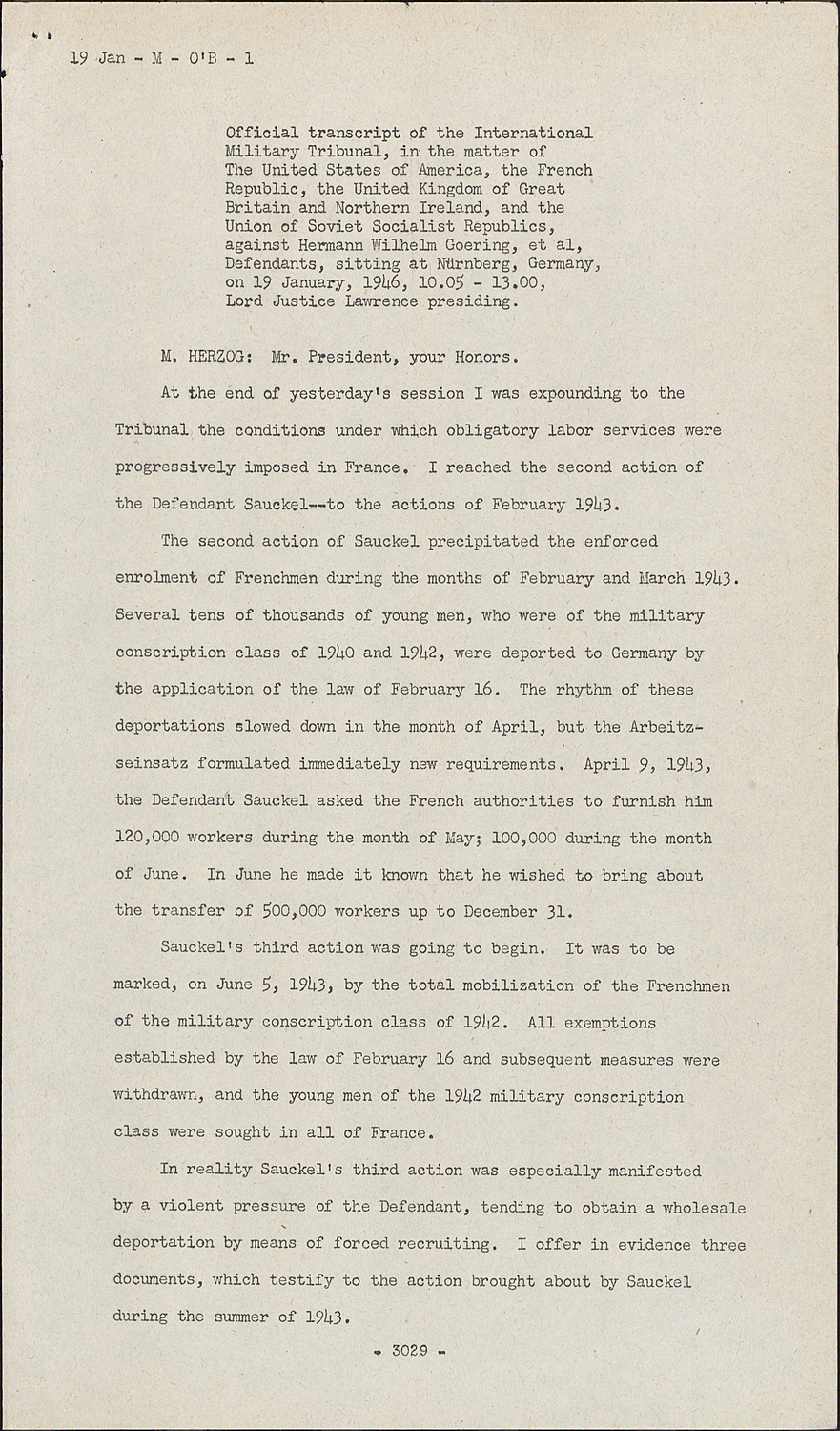
Official transcript of the International Military Tribunal, in the matter of The United States of America, the French Republic, the United Kingdom of Great Britain and Northern Ireland, and the Union of Soviet Socialist Republics, against Hermann Wilhelm Goering, et al, Defendants, sitting at Nurnberg, Germany, on 19 January, 1946, 10.
05 - 13.00, Lord Justice Lawrence presiding.
M. HERZOG:Mr. President, your Honors.
At the end of yesterday's session I was expounding to the Tribunal the conditions under which obligatory labor services were progressively imposed in France.
I reached the second action of the Defendant Sauckel--to the actions of February 1943.
The second action of Sauckel precipitated the enforced enrolment of Frenchmen during the months of February and March 1943.
Several tens of thousands of young men, who were of the military conscription class of 1940 and 1942, were deported to Germany by the application of the law of February 16.
The rhythm of these deportations slowed down in the month of April, but the Arbeitz seinsatz formulated immediately new requirements.
April 9, 1943, the Defendant Sauckel asked the French authorities to furnish him 120,000 workers during the month of May; 100,000 during the month of June.
In June he made it known that he wished to bring about the transfer of 500,000 workers up to December 31.
Sauckel's third action was going to begin. It was to be marked, on June 5, 1943, by the total mobilization of the Frenchmen of the military conscription class of 1942.
All exemptions established by the law of February 16 and subsequent measures were withdrawn, and the young men of the 1942 military conscription class were sought in all of France.
In reality Sauckel's third action was especially manifested by a violent pressure of the Defendant, tending to obtain a wholesale deportation by means of forced recruiting.
I offer in evidence three documents, which testify to the action brought about by Sauckel during the summer of 1943.
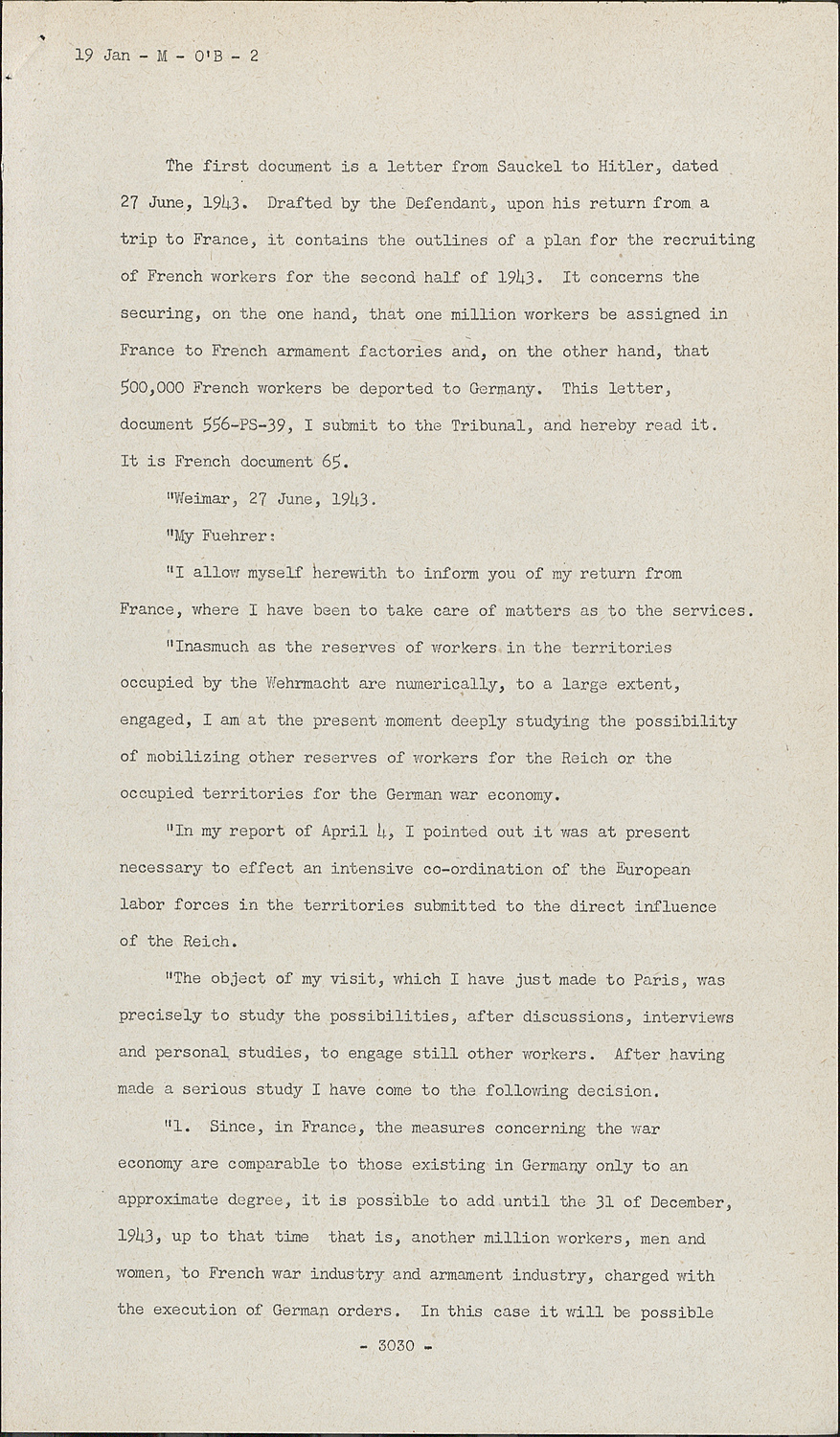
The first document is a letter from Sauckel to Hitler, dated 27 June, 1943.
Drafted by the Defendant, upon his return from a trip to France, it contains the outlines of a plan for the recruiting of French workers for the second half of 1943.
It concerns the securing, on the one hand, that one million workers be assigned in France to French armament factories and, on the other hand, that 500,000 French workers be deported to Germany.
This letter, document 556-PS-39, I submit to the Tribunal, and hereby read it.
It is French document 65.
"Weimar, 27 June, 1943.
"My Fuehrer:
"I allow myself herewith to inform you of my return from France, where I have been to take care of matters as to the services.
"Inasmuch as the reserves of workers in the territories occupied by the Wehrmacht are numerically, to a large extent, engaged, I am at the present moment deeply studying the possibility of mobilizing other reserves of workers for the Reich or the occupied territories for the German war economy.
"In my report of April 4, I pointed out it was at present necessary to effect an intensive co-ordination of the European labor forces in the territories submitted to the direct influence of the Reich.
"The object of my visit, which I have just made to Paris, was precisely to study the possibilities, after discussions, interviews and personal studies, to engage still other workers.
After having made a serious study I have come to the following decision.
"1. Since, in France, the measures concerning the war economy are comparable to those existing in Germany only to an approximate degree, it is possible to add until the 31 of December, 1943, up to that time that is, another million workers, men and women, to French war industry and armament industry, charged with the execution of German orders.
In this case it will be possible to place further orders in France.

"2. While taking account of those measures, it is possible, after a detailed study and with the co-operation of our German armament services and obligatory labor, to transfer between now and the end of the year another 500,000 workers, men and women, from France to the Reich.
"The necessary conditions for the carrying out of this program established by myself are the following.
"1. A close collaboration of all the German services, especially with regard to the French services.
"2. A constant study of the French economy and by means of combined commissions, as they have been provided for by Mr. Speer, Minister of the Reich of Armaments and Munitions and by myself.
"3. Constant, skillful propaganda producing its effect against the cliques of De Gaulle and Giraud.
"4. The providing of an adequate food supply for the French population working for Germany.
"5. An energetic demonstration of these necessities before the French Government, in particular Marshal Petain, who still constitutes the chief obstacle to obligatory work of French women.
"6. A perceptible development of the program which I have already introduced in France, consisting in teaching the population trades useful to the war economy."
I skip the next paragraph and I read the last paragraph.
"I beg you in consequence, my Fuehrer, please to be good enough to grant me a million Frenchmen and Frenchwomen, for the German war economy in France, and this in the course of the second half of 1943, and in addition 500,000 Frenchmen and Frenchwomen, to be transferred to the Reich before the end of the year.
"Yours faithfully and obediently, Fritz Sauckel."
The document to which I would now like to draw the Tribunal's attention proves that the Fuehrer gave his approval to Sauckel's program.
A note drawn up on 28 July, 1943, by Dr. Stothfaug, under the stamp of the Delegation of Employment Service, gives a report on a discussion Sauckel had with the Fuehrer.
It is the report of a discussion Sauckel had with the Fuehrer.
It is document 566-PS-41, which I bring forward to the Tribunal under the French document number 66.
I shall limit myself to reading the last paragraph.
"Paragraph D. The transfer provided for the end of the year of 500,000 French workers for industries in France and of 500,000 other French workers within the Reich has been approved by the Fuehrer."
A document finally establishes that the Defendant Sauckel, on the strength of Hitler's approval, attempted to realize his program by working on the French Government.
This document is a letter from Sauckel to Hitler.
It is dated 13 August, 1943, upon the Defendant's return from a trip to France, Belgium and Holland.
It is document 556-PS-43. I shall read it to the Tribunal. It is French document number 67.
"Weimar, August 13, 1943.
"My Fuehrer:
"I will allow myself to inform you of my return from France, Belgium and Holland, where I have made a trip.
In the course of long, hard negotiations I have imposed upon the occupied territories of the West, for the last five months of the year 1943, the program indicated herewith and have prepared very detailed measures for its carrying out:
in France with the military commandant, the embassy of Germany, the French Government; in Belgium with the military commandant and in Holland with the services of the Reichskommissar.
"The progran provides:
"1. The transfer to France of one million workers, men and women French workers, of the civil industry to the German war industry in France.
This measure is to permit a new and important displacement to France of the execution of German commands.
"2. The taking on of 500,000 French workers for Germany.
This figure is not to be made public.
"3. In order to make futile any passive resistance of numerous groups of French functionaries, I have ordered under an agreement with the military commandant in France, the creation of labor service commissions, exercising their functions in two departments at once and placed under the control and the direction of labor services of the German Gau.
It is only in this manner that it will be possible to utilize the whole French labor potential and to obtain its full activity.
The French Government has accepted."
If the Tribunal will allow me, I shall quote the rest of this letter, which will allow me later to refer back to it.
"4. A program was established in Belgium for the employment in the Reich of 150,000 workers as well as an organization for obligatory labor, similar to that provided for in France, and this has been done in agreement with the military commandant in Belgium."
I skip and proceed to the fifth paragraph.
"A program has likewise been worked out for Holland, providing for the sending to Germany of 150,000 workers and the employment for German war production 100,000 workers, men and women, drawn from the Dutch civil industries."
Such was Sauckel's program in 1943. His plan was partly thwarted by the resistance of the officials and patriotic workers.
The proof of this is furnished by a statement of the Defendant.
I am referring to the report on a conference of the Central Office for the Four Year Plan on March 1, 1944.
The Tribunal will remember that it concerns document R-124., which I read yesterday.
I shall read from the first page of the French translation, second paragraph--German text 1768-1769.
THE PRESIDENT: What is the number of that?
M. HERZOG:Document number 30, second paragraph, first page.
"In autumn of last year the recruiting program, to the extent to which it concerned supply from abroad, was frustrated to a very great extent.
I need not give the reasons in this circular. We have talked enough about this, but I have to state the program has been smashed."
Sauckel was not discouraged, however, by the difficulties which he had encountered in 1943.
In 1944 he attempted to realize a new program by means of the fourth action.
The National Socialist authorities decided to assure in 1944 the transfer of four million foreign workers to Germany.
This decision was made on 4 January, 1944, in the course of a conference held at the headquarters of the Fuehrer in the presence of the latter.
The report on this conference makes up document 1292-PS.
I submit it herewith to the Tribunal under French document number 68, and I read from this page 3 of the French translation--the German original page 6, last paragraph.
"The results of the conference:
"1. The Plenipotentiary for Employment of Labor shall procure at least four million new workers from occupied territories."
The details about the required contingents from each occupied territory must have been determined on 16 February, 1944, in a conference of the Central Office for the Four Year Plan.
Yesterday I submitted the report of this session at the outset of my explanation, under the document number 20.
I read today from page 2 of the translation, the second page of the German original.
"Conclusion of the 53rd session of the Office of the Central Plan.
THE PRESIDENT:Did you say document 20?
M. HERZOG:Yes, document 20.
"Campaign of labor recruiting in 1944.
"1. Among the German internal reserves one might, with an extraordinary" effort, mobilize approximately 500,000."
I skip now to the second.
"2. Recruiting of Italian labor to the number of 1,500,000, of which from January to April 250,000 per month and from May to December 500,000 per month.
"3. Recruiting of French labor in monthly quantities., to the number of one million from the first of February to 31 December, 1944, approximately 91,000 per month.
"4. Recruiting of labor in Belgium 250,000.
"5. Recruiting of labor in Low Countries 250,000."
I stop the quotation here as the other paragraphs concern the countries of Eastern Europe.
The Tribunal has seen that France was called upon to furnish an important contingent of workers.
Since the 15th of January Sauckel went to Paris to dictate his demands to the French authorities.
The fourth Sauckel action was effected by two distinct measures:
the adoption of the procedure called the combing of industries, and the publication of a law of 1 February, 1944, which widened the field of application of the service of forced labor.
The system of combing industries led the administration of labor to conduct direct recruiting in the industrial enterprises.
Mixed French-German commissions were set up in each Department.
They decided on the percentage of workers they thought it appropriate to deport.
They proceeded to claim them and to have them transferred.
The practice of combing the industries represents since 1943 the realization of the elaborate projects by the accused Sauckel.
In the documents which I have read to the Tribunal Sauckel announced his intention of creating mixed labor commissions.

The law of 1 February, 1944, marked the culminating point on the legislative plan of the actions led by Sauckel.
It extends the scope of application of the law of 4 September, 1942.
Beginning with February 1944 all men between the ages of 16 to 60, and all women between the ages of 18 and 45 were subject to compulsory work.
I present before the Tribunal the law of 1 February, 1944, No. 69, and I request that it take judicial note of it.
The proof of the pressure that Sauckel exerted on the French authorities to impose on them the publication of this law is furnished by a report of the Defendant to Hitler.
This report bears the date of 25 January, 1944.
It was, therefore, prepared during the course of the negotiations which characterized the fourth Sauckel action.
It constitutes document 556-PS-55. I present it before the Tribunal No. 70.
I shall read this document.
"25 January, 1944.
"My Fuehrer:
"The French Government, as well as Marshal Petain, have on the 22nd of January, 1944, to a great extent accepted my demands in regard to the increase in hours of labor--to extend it from 40 to 48 hours a week--as well as the law providing for an extension of the labor service in France and the sending of French workers to Germany.
"The Marshal did not express himself in agreement on the subject of the use of the work of women in the Reich, but solely within France itself, and this to be limited to women aged 26 to 45 years.
Women aged from 15 to 25 are to be employed only at the place of their residence "Inasmuch as this constitutes nevertheless a great progress, if one considers, the extremely difficult negotiations which I have been obliged to conduct in Paris, I accepted the law in order to avoid any loss of time and on condition that the German demands are applied and carried out with energy.
"The French Government likewise accepted my demand that French officials sabotaging the application of the law of obligatory labor service should be condemned to very severe penalties that might even include the death sentence.
I have not allowed a doubt to exist as to the rigor of the measures that would be taken in case the requirements concerning the transfer of workers were not carried out.
"Your ever devoted and faithful, Fritz Sauckel."
I call the attention of the Tribunal to the problem of compulsory labor of women to which the two preceding documents have reference.
For a long time the French authorities expressed categorical opposition to the introduction of feminine labor.
The Defendant Sauckel did not cease to exercise violent action.
On the 27th of June, 1943, in a letter to Hitler, he suggested that a strong representation of German interests be made before the French Government.
I have already read this letter to the Tribunal, No. 65.
I shall not revert to it, but I do wish to emphasize that the law of February I did not satisfy Sauckel and did not appease his demands.
His miscontent and his will to pursue his policy of constraint are translated and expressed in a report of 26 April, 1944, which has his signature and presentation of which is assured by Berk, one of his assistants.
There are four reports involved in this same batch, and they constitute 1289-PS.
I present them under French document number 71, and I read from the second page of the French translation.
"(1) The problem of women. At the time of the promulgation of the French law instituting obligatory labor service, the French authorities, Marshal Petain in particular, have urgently insisted on the exemption of women from obligatory service in Germany.
After long hesitation the G.B.A. responsible for the work gave its agreement to this exemption.

"This agreement was granted under the reservation, however, that the provisions of contingents demanded were met.
In the contrary case the G.B.A. would reserve to itself the right of taking new measures.
Inasmuch as the contingents were far from being met, a demand must be addressed to the French Government in order that it extend the service of obligatory labor to women."
The fourth Sauckel action, therefore, was led in such a manner as to utilize all of France's manpower.
The French resistance and the development of the military operations hindered the execution of the Sauckel plan.
The Defendant, however, had planned extraordinary measures which he contemplated applying on the day of the landing of the allied armies.
I quote again document 1289-PS, French document 71, and I read on page 3."Measures for the utilization of labor in the case of invasion.
In the occupied territories there have already been partly established dispositions to evacuate the population of regions menaced by invasion and to save in this manner a precious labor reserve.
In view of the actual situation of labor in Germany, it is necessary to bring labor to the greatest possible potential of production in the Reich.
"Orders for the Wehrmacht to assure the security in the carrying out of these measures are indispensable.
For an ordinance of the Fuehrer the following text is proposed."
I shall not read the text of the ordinance proposed by the Defendant Sauckel.
The rapidity of the Allied victory was of such a nature that Sauckel did not have the possibility to carry out his plan of mass deportation.
However, he undertook its execution. The deportations of workers were prolonged up to the day of liberation of the territory.
Several hundred thousand French workers were at that time stationed in Germany as a result of the various actions of Sauckel, and I demand of the Tribunal that it retain him as a Defendant.
The compulsory labor service was introduced in Norway in the same manner as in France.
The Defendants imposed upon the Norwegian authorities the publication of a law instituting the compulsory registration of Norwegian citizens, and ordering their enrolment by force.
I cite in this respect the preliminary report on the crimes of Germany against Norway, a report prepared by the Government of Norway.
I submit it to the Tribunal, and I quote an excerpt from it that bears the number UK-19.
It is French document number 72, and I read from the first page, the third paragraph.
"The result of Sauckel's order in Norway has been the promulgation of the Quisling law of 3 February, 1943, concerning the obligatory enrolment of Norwegian men and women for the so-called effort of national labor.
"Terboven and Quisling have openly admitted that the law had been promulgated to enable the Norwegian people to utilize its labor for the benefit of the German war effort.
"In a speech of 2 February Terboven declared among other things that he himself and the German Reich supported this law with their authority, and he threatened the use of force against one who would attempt to oppose its execution."
In Belgium and in the Netherlands the German authorities made use of a direct procedure.
The compulsory labor service was organized by decrees of the occupying power.
In Belgium these are decrees of the military commander and in the Netherlands decrees of the Reich Commissar.
I remind the Tribunal of the fact that the authority of the military commander in Belgium extended to the north of France.
This is a decree of March 6, 1942, which established the principle of compulsory labor in Belgium.
It appeared in the Belgium Verordnungsblatt of 1942, page 845.
I submit it to the Tribunal under number 73, and I ask the Tribunal to take judicial notice of it.
The decree of March 6 excluded the possibility of forced deportation of workers to Germany.
This deportation was ordered by a decree of October 6, 1942, which appeared in the Belgium Verordnungsblatt of 1942, page 1060.
I submitted it to the Tribunal under number 67 in the course of my explanations.
The German activities in Belgium gave rise to protests of the leading Belgian personalities, among others the King of Belgium.
The decrees instituting compulsory labor in Belgium and the North of France bear the signature of General von Falkenhausen, but the latter proclaimed his decree of October 6 on the order of Sauckel.
I relate again to the testimony of General von Falkenhausen, which I submitted to the Tribunal yesterday under the French document 15.
I beg the Tribunal permission to read from the following passages, first page, fifth paragraph.
"Q On 6 October, 1942, there appeared an ordinance which instituted forced labor in Belgium and in the Departments of the North of France for men of 18 to 50 years old and for single women from 21 to 25 years old.
"A I was commander-in-chief for Northern France and Belgium.
"Q Does the witness recall having promulgated this ordinance?
"A I do not remember exactly the text of this ordinance because it was made following a long dispute with the labor deputy Sauckel.
"Q Did you have any trouble with Sauckel?
"A I was fundamentally opposed to the establishment of compulsory labor, and consented promulgating the ordinance only after receiving orders.
"Q Then this ordinance was not brought up on the initiative of von Falkenhausen himself?
"A On the contrary.
"Q Who gave instructions in such matters?
"A I suppose that at that time Sauckel was already in possession of the responsibility for manpower and that at that time he gave me all instructions on Hitler's orders."
I skip and take up the quotation again on Page 3 of the French translation, the fourth paragraph:
"Q Since you were opposed to this idea of compulsory labor, didn't you react when you received these instructions?
"A There were unending battles between Sauckel and myself. In the end this contributed to a large extent to my resignation."
End of the quotation.
The violence of the pressure exerted against the German administrators in Belgium by the defendant Sauckel in order to impose on them his plan of recruitment by force is equally demonstrated by two documents which I have produced to the Tribunal. Under Number 67 the Tribunal will remember that it is the report addressed on the 13th of August 1943 by Sauckel to Hitler on his return from France, from Belgium and from Holland.
Finally, I have to report on the introduction of forced labor in the Netherlands. I request the Tribunal to retain the institution of forced enrollment in the occupied Netherland territories for the accusation of the defendant Seyss-Inquart just as well as for the accusation of Sauckel.
Decrees of the Reich Kommissar have really organized the deportation of the Netherland workers. Whether they bear his signature of were issued at his order they established all the more the responsibility of the def-endant who in his quality as Reich Kommissar derived his powers directly from the Fuehrer.