
BY DR. BABEL (Counsel for SS and SD):
Q.I should like to know which block you belonged to. Perhaps you can tell the Court how the prisoners were divided in the blocks. They were marked with certain exterior signs. Some of them had a red spot on their uniforms, and others a green spot, and so on.
A.As a matter of fact, there were a number of escutcheons or insignia of individuals who were all in the same kommandos. I am going to make this clear. In the kommando of the terrace where I was, I was working side by side with German common-law criminals. I was under the orders of German commonlaw criminals who had a green insignia. From the point of view of nationality in those kommandos, there were Russians, Czechs, Belgians, and French. The badges were different; the clothing was identical, and in this particular case we were even under the orders of common-law criminals.
Q.I didn't quite understand your answer. My question was whether the prisoners were divided into specific categories that were distinguished by some sort of sign or insignia, blue or yellow, or what not.
A.I said that in the camps there were different badges, triangular insignia, which were in principle assigned to different categories, but all these men were exposed to the same regime finally.
Q.I didn't ask anything about their treatment but about their distinguis ing insignia.
A.For the French -
Q. (Interpolating) I speak of all nationalities, bot only the French.
A.I answer for the French, whom I best knew. The red escutcheon, or badge, for political prisoners was given to all, including the attorneys, who had been interned for common-law crimes. I observed the same thing among the Czechs and the same thing also among the Russians. That there had been different badges planned for may be correct, but that it was effectively used is not so. I come back to my earlier statement: Even if they had different badges, they were all mixed together and exposed to the same treatment and to the same results.
Q. We have already heard that the prisoners of various nationalities were mixed together.
That is not what my question was.
THE PRESIDENT:You are speaking too fast
DR. BABEL:Yes. Thank you. BY DR. BABEL:
Q.You were in the camp a long enough time to be able to answer my question. How were the prisoners divided? As far as I know, they were divided into criminal, political, and other groups, and each of these groups was characterized by specific insignia and their clothing was green colored or red or some other color?
A.There were different badges or insignia for different categories, but that had been merely provided for. These categories were mixed together. Those who belonged to the categories of common-law criminals were mixed with those who belonged to the political group. However, there were blocks where certain specific groups were distributed, but they were not specifically distributed according to their categories, their individualities, or external insignia.
Q.I have been told that political prisoners wore blue insignia and that the criminals wore red ones. Now, you have already said that the criminals wore a green sign and that other people wore other insignia. I want to know about all these different groups of prisoners and what insignia they wore.
A.It is correct to say that different insignia did exist. It is exact to say that there had been provided different categories, but to remain within the truth, it must be emphasized that the use of these insignia wasn't applied with respect to the French physically. They only had political insignia, which added to the confusion, because any one was considered as political prisoner, those who were common-law criminals. The insignia did exist. They were intend ed to separate the different categories, but they were not systematically employed. They didn't use them at all with respect to the French prisoners.
Q.If I have understood you correctly, you have stated that the French prisoners were all registered as political prisoners?
A.That is correct.
Q.Now, among these French prisoners you said that there were not only political prisoners but also common prisoners?
A.There were.
Q.Have I expressed your previous answer correct? Is that what you have said?
A.That is exactly what I said. I said that there were common-law criminals who had not merely green insignia, which they should have worn, but they wore the political insignia.
Q.What was your activity in the camp? You are a physician.
A.I arrived in January, and for three months I was assigned to the quarry and the terrace. Then I was assigned to the infirmary, that is to say, in the infirmary of the camp.
Q.What was your function there?
A.I was assigned to the service of ambulance for internal diseases.
Q.Were you able to act on your own? What sort of orders did you receive regarding the treatment of the patients in the infirmary?
A.We acted under the control of an SS doctor. We had a certain number of places to hospitalize some of the patients. In the proportion of one out of twenty, patients could be hospitalized. As far as medicines were concerned, we had practically nothing. I practised in the infirmary until the liberation.
Did you receive instructions regarding the treatment of the patients? Did you receive any sort of orders regarding the treatment of the prisoners or any orders to the effect that they should be allowed to die?
A.In this connection I received the order to select the patients who could not be cured and to send them to extermination. This order I have never executed.
Q.Were you told to choose those who were to be exterminated? I didn't understand. Will you please repeat your answer? I didn't understand.
A.As far as orders are concerned, I did receive the order to select the most serious cases of sickness to be sent to Block 61, where they were to be exterminated. It is the only order which I received concerning patients.
Q.Where they were to be exterminated? Were you told that they were to be chosen and selected for extermination? You said they were to be sent to Block 61.
Were you told what was to happen to them in Block 61?
A.Block 61 was under the control of a non-commissioned officer by the name of Wilhelm, who himself supervised the executions, and he gave the order to select the patients to be sent to that block. I suppose that the situation is sufficiently clear.
Q.That is the conclusion that you draw. You didn't receive specific instructions in this regard?
A.The statement that incurable patients were to be sent -
Q. (Interrupting) I am struck by the fact that you are not able to answer my question simply with yes or no.
A It has been stated that these patients were to be sent to Block 61.
Nothing more was added. All who were sent to Block 61 were executed.
QThat is something different. But you didn't observe that yourself? That you found out by hearsay? All you know is that those who were sent to Block 61 was under the control of an attorney by the name of Remisch. I was only the doctor who could enter there. I was able to remove a few of the patients; the others died,
QThen, if such a thing was told to you, why did you not declare that you would have nothing to do with it?
AIf I understood the question correctly, I was asked why
ABecause it would have meant death to me.
Q (Interrupting) If you received instructions to take people from your infirmary to Block 61 and know what was going to happen to those people, how is it that you participated in that?
QI see. And if Germans had received such an order, what would have happened to them?
AWhat Germans are you speaking of? German internees?
QAny German physicians or an intern in your infirmary or any one who was employed there. If he received such instructions and had refused to follow them, what would have happened to him?
AIf an internee refused in a categorical manner to execute such an order, it meant death. In fact, however, we could fail to carry out those orders. I insist upon the fact that I never sent any one to Block 61.
QI should then like to ask a general question regarding the conditions in the camp. If one has never seen a camp it is difficult for one to imagine the actual conditions. Perhaps you could give the Tribunal a short description of how the camp was divided, how it was organized?
AI think I went into sufficient detail some time ago into the organization of the camp. I should like to ask the President whether it is useful for me to return to this subject.
THE PRESIDENT:If you want to put any particular cross examination to him to show he is not telling the truth, you can, but not to ask him for a general description.
BY DR. BABEL:
QThe camp consists of an inner camp surrounded by barbed wire and is guarded. Within this camp there were barracks in which the prisoners were housed. How was this inner camp guarded?
THE PRESIDENT:Will you kindly put one question at a time? The question you just put involves throe or four matters.
QThe camp itself in which the barracks are to be found, how is that part of the camp separated from all the rest of the camp? and how is it guarded?
AThe camp for Internees was one complete unit which was separated from the rest of the world by an electrified barbed wire network.
QWhere were the guards?
AThe guards of the camp were in towers that were situated all around the Camp and at the gate; and they had patrols within the camp itself.
QWithin the camp? Within the barbed wire enclosure?
AObviously within the camp. And also within the barracks. They had the right to enter anywhere.
QI have been informed that each individual barrack was under the supervision of one German SS and that within this enclosed inner camp there were no guards, that the Germans - who were there, were not for the purpose guarding, but just on general duties of keeping the place in order, and that these Germans within the enclosure were assisted by so-called Kapos who also aided them. It could be that the situation was somewhat different in Buchenwald. I had this information from Dachau.
AI have already answered most of these questions in my original testimony, by indicating that the camps were under the direction of the SS in a manner sufficiently known, and moreover we know that the SS utilized the internees as intermediaries in many instances, as I suppose was the procedure in all of the other concentration camps.
QThe answer to the question has again been very indirect, but I must proceed - because I can see right away that I cannot get any clear answers. But I should like to ask one question:
You stated that in Block 58 in connection with the circumstances you described regarding the professor who belonged there, it was a block in which a hundred people were housed and then later that it was twelve hundred.
Is that so?
AThere were twelve hundred men in Block 58 when I found Dr. Kindberg there.
QYes. And as far as I can recall, and if I understood you correctly, you said that in this block there were not only French, but also Czechs, Jews, Russians, Poles and it was unpleasant to be there, not because so many people were there, but because people of so many different nationalities were packed in there, is that so?
AI wish to emphasize that the fact of nixing together elements or groups of different languages who were unable to understand each other - I didn't indicate that that was a crime, but it was one factor, and with all the other measures employed it brought about a human degradation amongst the internees.
QSo in your opinion the presence of French, Russians and Czechs together can constitute a degradation?
AI do not say that. The point of this question - the fact of the proximinity
QYou do not need to know what my reasons are for putting the question, I know what they are.
AAnd the fact of saying groups of different languages to ether is not degrading. I did not either think or state such a thing, but the mixing together of groups entirely different from one another, by including differences of language, made living conditions that were already difficult, more difficult, in that this facilitated the application of other measures on which I have already spoken, and the purpose of which was to bring about the segregation of the internees.
QI still cannot understand why the segregation - the association of people whose languages happen to be different
THE PRESIDENT:Dr. Babel, he has given his answer, that he considers it tended to degradation.
It doesn't matter whether you understand it or not.
DR. BABEL:Mr. President, the transmission through the earphones is in some cases so difficult that one has difficulty in understanding exactly what is said, and that is why I have occasionally had to have an answer repeated.
DR. DUBOST:I do not wish, gentlemen, that the Tribunal should consider my interventions as an interruption of the cross examination. However, I consider it necessary to emphasize the fact that a conclusion was in the mind of Defense Counsel because of an error of interpretation, which was brought to my attention.
He put an insidious question to my witness, asking whether the French groups who were deported were for the most part criminals, and the translation was, whether the French elements who were deported were criminals for the major part.
The witness answered the question as translated in French and not the original question in German.
I therefore ask that the question be formulated once more by Defense Counsel and correctly translated.
DR. BABEL:I am very sorry-
THE PRESIDENT:Do you understand what Mr. Dubost said, Dr. Babel?
DR. BABEL:I believe that in general I did understand it;
that the translation was false in one particular. So far as that is concerned, I cannot judge to what extent it was true, since I am not in a position to follow that.
THE PRESIDENT:I think the best course is to continue your cross-examination, if you have any more questions to ask, and Mr. Dubost can clear up the difficulty in re-examination.
(M. Dubost approached the lectern.)
What is the matter, Mr. Dubost? Why do you come forward again?
M. DUBOST:I repeat, Mr. President, that the question was translated in the following manner-
THE PRESIDENT:I have said that Dr. Babel can continue his cross-examination.
You may clear up this point about the translation in re-examination.
M. DUBOST:Thank you.
DR. BABEL:Mr. President, the Defense Counsel for Kaltenbrunner already explained that the Defense has great difficulty in cross examining a witness if it has not at least found out the day before on what subjects the witness is to be heard.
The testimony given by witnesses today was so extensive that it is impossible for us to follow it without previous preparation, and conduct any effective cross-examination.

Now, as a Defense Counsel for Organizations, and for my colleagues, I wish to have an opportunity to supplement our cross examination, or at least to be able to call the witness later as our own witness.
THE PRESIDENT:I have already said what I have to say on behalf of the Tribunal on that point, but as Counsel for the Defense must have anticipated that witnesses would be called as to the conditions in the concentration camps, I should have thought they could have prepared their cross-examination during the forty or more days during which the trial has taken.
DR. BABEL:Mr. President, I believe that now is perhaps not the proper time to come to a conclusion on this question, but I should like to ask an opportunity in a closed session to discuss this matter further, in order that we may expedite the progress of the trial.
I am altogether concerned not to slow down the process of the trial.
I am greatly concerned that it should proceed rapidly.
But I do have this concern on the part of the Defenders of Organizations-
THE PRESIDENT:Dr. Babel, I have already pointed out to you that you must have anticipated that the witnesses might be called to state the conditions in concentration camps.
You must therefore have had full opportunity during the days the trial has taken for making up your mind on what points you would cross-examine, and I see no reason to discuss the matter with you.
DR. BABEL:Very well. I thank you for these instructions, but I cannot of course know ahead of time just what the witness is going to say, but only after I have heard him.
That a witness was to be heard on concentration camps I knew, but what he was going to say, that I could not pre-divine.
M. DUBOST: The Defense used certain terms in putting a question to the French witness, certain words that are translatable literally by "for the major part."
This had to do with the character of the French deportees.
"Were they for the most part common criminals?"
That was the question. The witness understood, as I did:
"Did you say that they were criminals?" and not that the convoys were for the most part composed of criminals.
His reply was "Normal," and he said, "I so stated."
The Tribunal will allow me to ask the witness if he can state what proportion of common criminals there were then; what proportions of patriots there were among the deportees; whether he himself was a common criminal, or patriot, or whether in a general way the criminals in another way were criminals or patriots?
AThe proportion of common criminals in the French groups was extremely small.
The common criminal came in one convoy coming from Fort Barreaux.
I cannot indicate the exact figure, but on the whole of the internees a few hundred; that is all.
Moreover, in other convoys there arrived in the proportion of two to three per thousand, where they were introduced in our convoys.
There were, therefore, so few common law criminals in our transports.
THE PRESIDENT:The witness can retire.
M.Dubost, are you proposing or asking to call other witnesses on concentration camps because, as I have already pointed out to you, the evidence, with the exception of Dr. Babel's recent cross examination, has practically now been cross-examined, and it is supported by other film evidence.
We are instructed by Article 18 of the Charter to conduct the trial in as expeditious a way as possible, and I will point out to you, as ordered under 24-E under the Charter, you have the opportunity of calling rebutting evidence, if it were necessary, and, therefore, if the evidence which has been so fully gone into as to the condition in concentration camps-Is what I say not coming through to you?

M. DUBOST: I probably do not understand correctly, because the witness that I would like the Tribunal to hear is going to bring some testimony on a specific point which has been held in abeyance for several weeks.
The Tribunal will remember that at the beginning our American colleague--the problem arose of knowing whether Kaltenbrunner had gone to Mauthausen.
I am going to bring a witness who is going to prove to the Tribunal that Kaltenbrunner had gone at that time.
This witness took the pictures, and the Tribunal may wish to hear him and we shall show the pictures.
(FRANCOIS BOIX took the stand.)
BY THE PRESIDENT:
QWhat is your name?
AFrancois Boix.
QAre you French?
AI am a Spanish refugee.
THE PRESIDENT: Will you repeat this oath after me. I swear to speak without hate nor fear, to say the truth, all the truth, only the truth. (The witness repeated the oath)
THE PRESIDENT:Raise your right hand and say, "I swear".
THE WITNESS:I swear.
THE PRESIDENT:You may sit down.
M.Dubost, will you spell the name.
M. DUBOST: B-O-I-X. BY M. DUBOST:
QYou were born 14 August 1920?
AYes.
QIn what place?
AIn Barcelona.
QYou are a photographic reporter?
AI am.
QAnd you were interned in the camp of Mauthausen?
AYes.
QSince when?
ASince the 27th of January 1941.
QYou delivered to the inquirers a certain number of photographies which are going to be projected on the screen and you will state under oath under what circumstances and where these pictures were taken?
AI am ready to do so.
QHow did you obtain these photographs.
AAs a result of my profession I went to the camp at Mauthausen and I worked in the identity service of the camp. The service was that of photography, where the SS were certain of licking the whole world and they took pictures of everything taking place in the camp to send to the High Command.
QWhat is this picture before you?
AThat is the view of the quarry, that is, the general aspect of the quarry.
QIs this where the internees were working?
AThe majority of the intennees.
QWhere is the stairway?
AIn the rear.
QHow many steps?
AAt that time the stairway had about 160 steps. It was then rebuilt and there were 186.
QWe can proceed with the next picture.
AThis is a courtyard of the quarry during a visit of Reichsfuehrer Himmler, Kaltenbrunner, Fritz Kornacz, and a few other leaders whose names are unknown to me. I took that picture from seventeen meters from the top. There were 2,000 war prisoners working in there each day.
QWe proceed with the next picture. What is this picture?
AThis was in 1941, in April. My Spanish comrades, Spanish refugees in France who were pushing the lorries.
QAnd this picture was taken by whom?
ABy Paul Ricken, a professor from Essen, who was assistant leader of the SS.
QWe may proceed with the next picture.
AThis was a masquerade with an Austrian who had escaped. The one who had escaped worked in the garage and he took a box where it was possible for him to hide. He got outside the camp and then he was recaptured. Then they put him on a wheelbarrow which they used to carry the bodies to the crematorium. There were some signs in German which said, "All birds come home to roost." Then he was paraded in front of the 10,000 deportees and there was the band of the Gypsies who at that time were playing the tune of "J 'attendrai", and then he continued to swing after he was hanged, and at that moment the Gypsy band played the "Beer Barrel Polka".
A (Referring to new slide) This is the parade. On the right and the left you can see the deportees. On the left are the Spaniards.
The fellow who is in front with the beret is a common law criminal from Berlin by the name of Schulz, who was used for this sort of spectacle.
In the rear you can see the man who is about to be hanged.
QNext picture. Who took this picture?
AThese were taken by SS Oberscharfuehrer Fritz Kornacz. He was jailed by American forces in Holland in 1944. This is a Russian who was forced to climb on the barbed wire to make believe that he was seeking to escape, then they shot him in the head.
QThe next picture.
AHere you can see two Dutch Jews. That is the quarantine barracks in the rear. On the very day of their arrival they were frequently forced to hurl themselves against the barbed wire because they realized that there would be no escape.
QThese pictures were taken by whom?
AAt this time it was Paul Ricken, a professor from Essen, assistant SS leader.
(Referring to new slide) These are Dutch Jews. You can see the red star that they were wearing. That was supposedly an attempt to escape.
QIn reality what was it?
AThe SS sent them to pick up stones near the barbed wire, and the guards were all around the camps, and they would shoot among them, because they received a premium for every man whom they brought down.
Q (Referring to new slide) What is that picture?
AThat is a Russian Jew. That was in 1942, at the time the Russian camp, the so-called Russian camp, was built, which later became the sanitary camp. He was hanged with the string which he used to hold up his trousers.
QWas it suicide?
ASupposedly.
QWhat is it?
AIt was a man pushed to desperation because of the beatings and the hard labor to which he was subjected and who could see no way out.
QWho took that picture?
AFritz Kornacz was the man who took the picture. He was assistant SS leader.
Q (Referring to new slide) What is this picture?
AThis is a Jew also. I don't knew the nationality. He was in the so-called quarantine block, reserved for the Jews. He was put in a barrel full of water, and then he was beaten nearly to the point of death. Then he was given ten minutes to hang himself. He utilized his own belt to do that. Failing to do so, he knew full well what would await him.
QWho took that picture?
A Paul Ricken again, assistant SS leader.
Q (Referring to new slide) And what is this?
AThere you see the Viennese police visiting the quarry. This was in the month of June or July 1941. You can see two of my Spanish comrades there.
QWhat is happening?
AThey are showing to the policemen the manner in which they had to lift the stones because they had no other means to lift those stones.
QDid you know any policemen among these who visited there?
ANo, because they came only once. We only had time to have a look at them.
(Referring to new slide) That is in September 1944. No, I am sorry, 1943. It was the birthday of an SS leader. He is surrounded by the whole staff of Mauthausen camp. I can give you practically all the names of those who are there on the picture.
(Referring to new slide) That is Ziehreiss, also for his birthday, taken on the same day. Paul Ricken of Essen is also there, another SS assistant leader, adjutant to the former. I am sorry. The adjutant belonged to the Wehrmacht, and when he came into the camp he put on the SS uniform.
Q (Referring to new slide) Who is that?
AThat is the same visit of the police officials in June or July 1941. This is the door to the kitchen. This is a deportee of the disciplinary company. He carried stones as heavy as 80 kilos until he was exhausted.
Very few men ever emerged from the disciplinary company.
(Referring to new slide) That is for the visit of Himmler in April 1941 at the home of the leaders at Camp Mauthausen. There is the governor of Linz, Heilgruber next to him to the left, Sturmbannfuehrer Ziehreiss, who was the commanding officer of Mauthausen.
(Referring to new slide) This is in the quarry. In the rear to the left you can see a group of workers there. The fellow who is pointing is Ziehreiss. Next to him is Himmler, and to the left of him, the man on the left, Kaltenbrunner. He was wearing one of the insignia of the Party. This is in the quarry.
QThis was taken by whom?
A In the quarry. This was at the time of Paul Ricken, sometime around April or May 1941.
At that time this man frequently came to the camp to see how similar camps could be organized in Germany and in the occupied countries.
QYou are quite certain that is Kaltenbrunner?
AI affirm it.
QAnd this picture was taken at the camp?
AI so affirm.
QYou were taken to Mauthausen as a prisoner of war?
AWhat?
QYou were a prisoner of war?
AI was a prisoner of war.
QYou had fought as a volunteer in the French Army?
AI was a volunteer, as were most of the Spanish refugees in the French Army, in different places, either in Commando groups or in the Foreign Legion or in the labor companies for the Army. I was in the area of Vosges with the French Army. We were in retreat down to Belfort where I was taken prisoner during the night of the 20th to the 21st of June 1940. I was put together with a few other Spanish friends, and we were transferred to Muelhausen. We were all former Spanish Republicans. We were reputed to be anti-Fascist, and we were put with the Communists. Then we were considered along with them as sub-human.
We were for six months considered as prisoners of war, and at that time we realized that M. Sorano Sonier, foreign minister of Spain, had an interview with Hitler to deal with the problem of Spanish deportees. We heard that our own fate had been discussed by these people. They had specifically inquired about what disposition should be made of the Spanish prisoners. These Spaniards were Republicans. They belonged to the Republican Army.
QSo although you were a prisoner of war you were sent to a camp under the control of the Army. Was it under the control of the Army?
AWe were in Muelhausen as prisoners of war. Then we were to work in a commando like all the other Frenchmen. Then we were transferred to Mauthausen. We saw that there were no soldiers of the Wehrmacht, and they were SS men guarding us.
Then we understood that we were in an extermination camp.
QHow many of you were there?
AThere were several hundred.
QIn all, how many were there of you Spaniards?
AAbout 8,000.
QHow many were there when you left?
AAbout 1600 left.
QI have no more questions to ask.
THE PRESIDENT:Do you want to ask any questions?
GEN. RUDENKO:I shall have some questions. If the President will permit me I shall propound them in tomorrow's session.
THE PRESIDENT:We will adjourn now.
(Whereupon at 1700 hours the hearing of the Tribunal adjourned).
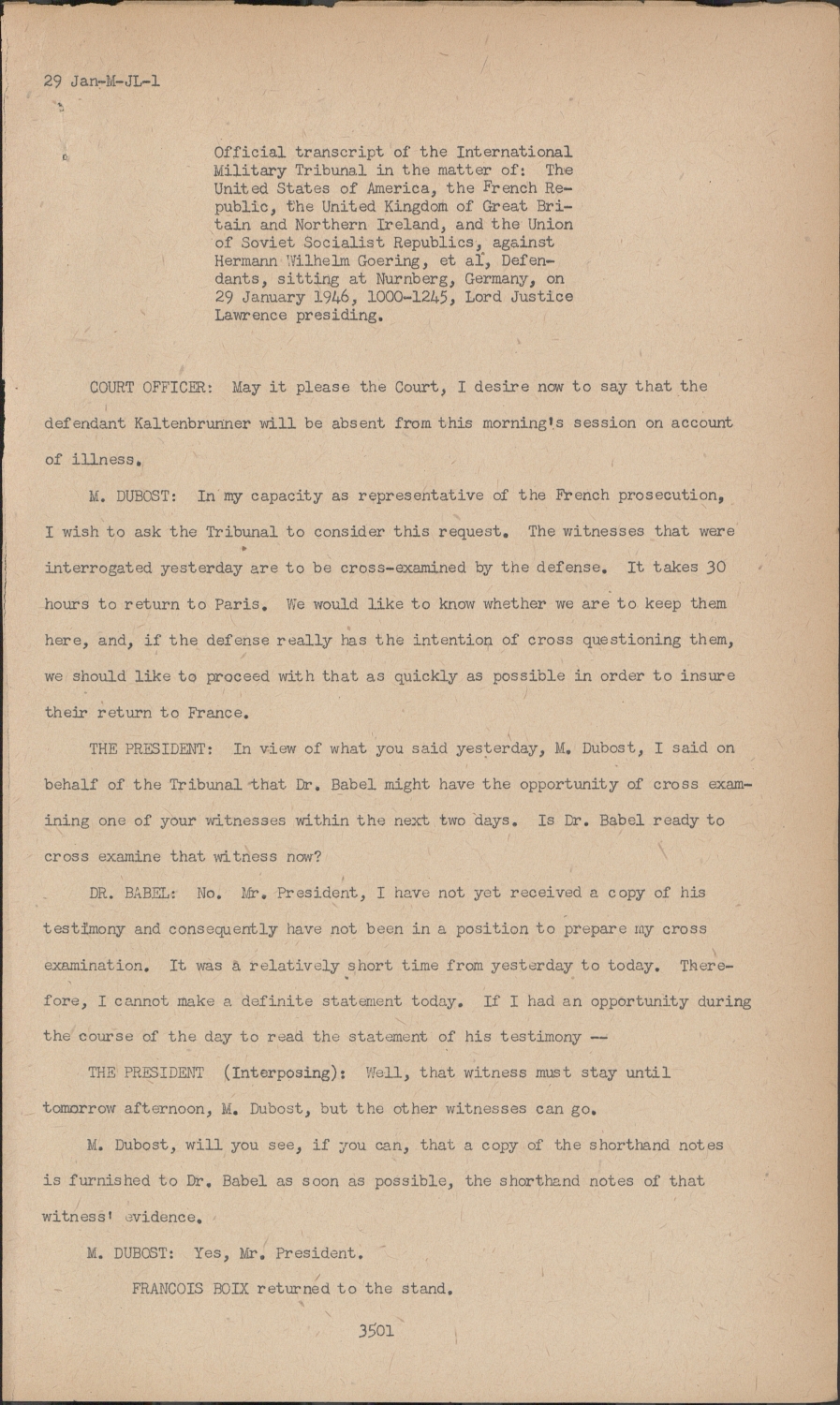
Official transcript of the International Military Tribunal in the matter of:
The United States of America, the French Re public, the United Kingdom of Great Bri tain and Northern Ireland, and the Union of Soviet Socialist Republics, against Hermann Wilhelm Goering, et al, Defen dants, sitting at Nurnberg, Germany, on 29 January 1946, 1000-1245, Lord Justice Lawrence presiding.
COURT OFFICER:May it please the Court, I desire now to say that the defendant Kaltenbrunner will be absent from this morning's session on account of illness.
M. DUBOST:In my capacity as representative of the French prosecution, I wish to ask the Tribunal to consider this request. The witnesses that were interrogated yesterday are to be cross-examined by the defense. It takes 30 hours to return to Paris. We would like to know whether we are to keep them here, and, if the defense really has the intention of cross questioning them, we should like to proceed with that as quickly as possible in order to insure their return to France.
THE PRESIDENT:In view of what you said yesterday, M. Dubost, I said on behalf of the Tribunal that Dr. Babel might have the opportunity of cross examining one of your witnesses within the next two days. Is Dr. Babel ready to cross examine that witness now?
DR. BABEL:No. Mr. President, I have not yet received a copy of his testimony and consequently have not been in a position to prepare my cross examination. It was a relatively short time from yesterday to today. Therefore, I cannot make a definite statement today. If I had an opportunity during the course of the day to read the statement of his testimony -
THEPRESIDENT (interposing): Well, that witness must stay until tomorrow afternoon, M. Dubost, but the other witnesses can go.
M.Dubost, will you see, if you can, that a copy of the shorthand notes is furnished to Dr. Babel as soon as possible, the shorthand notes of that witness' evidence.
M. DUBOST:Yes, Mr. President.
FRANCOIS BOIX returned to the stand.