Of the SA members, those, at any rate, should be excluded or exempted who entered after 1933, and of whom it can be demonstrated that they took no part in the events of the 10th of November, 1938.
In regard to the distinctions that should be made in terms of categories, I should like to request a double limitation.
First, single SA members up to the rank of Sturmfuehrer should be exempted under any circumstances and, wherever possible, soon.
I mentioned previously why, in the interests of justice, at least in the American Zone, this appears advisable to me.
Perhaps-
and I should be very glad to see this--Justice Jackson would have the kindness to give this matter his personal consideration.
I have expressed the desire for such limitation because in this way the number is considerably reduced by a large number of innocent hangers-on, and also the technical difficulties, which seem almost insurmountable, would be considerably lightened.
The Prosecution yesterday was kind enough to exempt the Wehrmannschaften of the SA.
In the interests of justice and equality before law, which apply to this high Court, all those special units that only performed organizational functions in the SA should also be separated from the SA.
It is here a question of the Marine SA and the Reiter SA.
The Court has a number of applications before it, and it is well known in Germany that precisely these units were concerned with sports, on the one hand, with horsemanship and the holding of tournaments, and that these were their prime interests.
when the Party achieved power, it attempted to take over all the sport life in Germany.
Consequently, the various sport groups were affiliated with the SA, but they had nothing to do with the SA's political activities.
1st Mar - M - O'B - 2 Organizationally speaking, they were subordinate to the SA, but they were actually a completely closed group within the SA.
None of the main Defendants here present was ever a member of one of these sporting groups.
Members of the Higher SA felt themselves to be at a particular disadvantage because the N. S. Kraftfahrkorps and the N. S. Fliegerkorps, with perfect right, are not here indicted, since their sporting character was recognized.
The N. S. Kraftfahr korps and the N. S. Fliegerkorps were, however, until the year 1934 exactly as in the case of the Reiterkorps, subdivisions of the SA.
The N. S. Kraftfahrkorps had the same duties as the N. S. Fliegerkorps.
The N. S. Reiterkorps, on the other hand, could not withdraw itself from this political influence, and only succeeded in establishing itself in the year 1936 as a self-contained unit.
However, it still remained connected in its leadership with the SA; through the Chief of the SA it was organizationally connected with the SA.
About a hundred thousand persons who enjoyed sport opportunities in this Organization are here indicted, but they never took part in any of the activities with which the SA is usually identified.
Even after the first world war it was obvious that the horse had no further role in war; and as to the Kraftfahrkorps and the Flieger korps, the Prosecution stated, with right, the non-political nature of these Organizations.
I should be thankful to the Prosecution if the cases I have mentioned would be reviewed again by then to see whether or not the same conditions are not present in the case of these Organizations as in the case of the SA Wehrmannschaften and the SA Reserve.
I mention last the SA Hochschulsturme, for this reason, that almost without exception they were simply Organizations for such students who, without any proof of activity in such Organizations, would not be admissible to state examinations.

The same is true of the SA Sanitaetssturme, which was a 1st Mar - M - O'B - 3 recreational activity group for many physicians.
I should like to correct myself on one point, which has been called to lay attention by one of my colleagues, because I wanted to set a time limit regarding SA membership after 1933. I should have said after the 30th of January, 1933, the day of the seizure of power.
In conclusion, I should like to say a few words about the recruitment of SA members.
Most of the members of the SA are now free. If only a few so far have written to the Court, this is almost explicitly to be traced back to the fact that since the SA is generally considered in the country to be harmless, they can hardly imagine that a Court with the experience and significance of this Tribunal could reach any other conclusion but that one. This, however, the Court should decide against the SA.
Then I should like to refer to the application made yesterday by the Prosecution to the effect that the members should make an effort to appear in their own defense. I refer to remarks made by the Defense Counsel for the Leadership Corps, that direct contact between Defense Counsel and his clients is here lacking. In the case of the SA and their people, a subsidiary authority should be appointed, for the various departments to carry out different trials against members of the SA. Every individual member of an organization could, with the help of this official, answer those questions to the Court which are to be found relevant. In a way, we were glad to hear Justice Jackson's statement yesterday. If I understood him correctly, he stated that in the trial of the organizations, because of its fateful importance for millions of people, the consideration of justice is much more important than the consideration of speed.
I should therefore like to make reference now to the statements made by the Defense for the Leadership Corps, that the trial of the organizations should be viewed from a different point of view from the trial against the main Defendants.
Members of the Tribunal, I am at the conclusion of my remarks. I should like, however, to reply to the words uttered by Jackson at the beginning of his address. He said that for the first time in history a modern state had completely collapsed and that this capitulation presented the victor nations with completely new problems; that the most important thing was to destroy the structure of those organizations and to prevent this country from ever again waging aggressive war. All persons of good will must welcome this goal and will support Justice Jackson, but it is questionable whether this is a correct means toward that end -- to condemn all organization members as such, involving millions of people.
I ask the High Court to consider that there is hardly one family in the whole country who does not have near relatives that were in some way connected with one of these organizations at some time or other. The organizations are dead, the system of terror and lying has disintegrated, millions of deceived people have turned away from those who led and seduced them; but if now they find themselves branded and ostracized, the effect would probably be the opposite of that which we all had hoped for.
Justice Jackson correctly pointed out in his speech yesterday that the Control Council believed -- and we are in favor -- that in the problem of denazification, in this case previous experience should be helpful, namely that a schematic treatment of such a problem is an offense against one's sense of justice and consequently a challenge to solidarity. The individual hanger-on of an organization would in such a verdict find less manifestation of justice than an active revenge; but the leaders could conceal their real guilt behind the backs of millions of people. The effect of such a verdict would consequently be weakened and would not any longer be that of just punishment.
(A recess was taken).
DR. LOEFFLER:I ask the Tribunal that I be permitted to make one more remark.
In my previous motions, I did not mention an entire group, that is the Stahlhelm, and only for the reason that according to my material at hand, the Stahlhelm organization after the accession to power was absorbed in its entirety into the SA. Therefore, in my opinion, it was included in the declaration made yesterday by Justice Jackson to exclude certain groups.
DR.BABEL (Counsel for the SS and SD): May it please the Court, also in the interest of a speedy trial I wouldhave considered it essential that the Defense should take a position on the statements of the Tribunal and the Prosecution and that only then, when the numerous statements of the Prosecution will have been received in writing by the Defense, will the Defense be in a position to take a conclusive attitude toward all the questions.
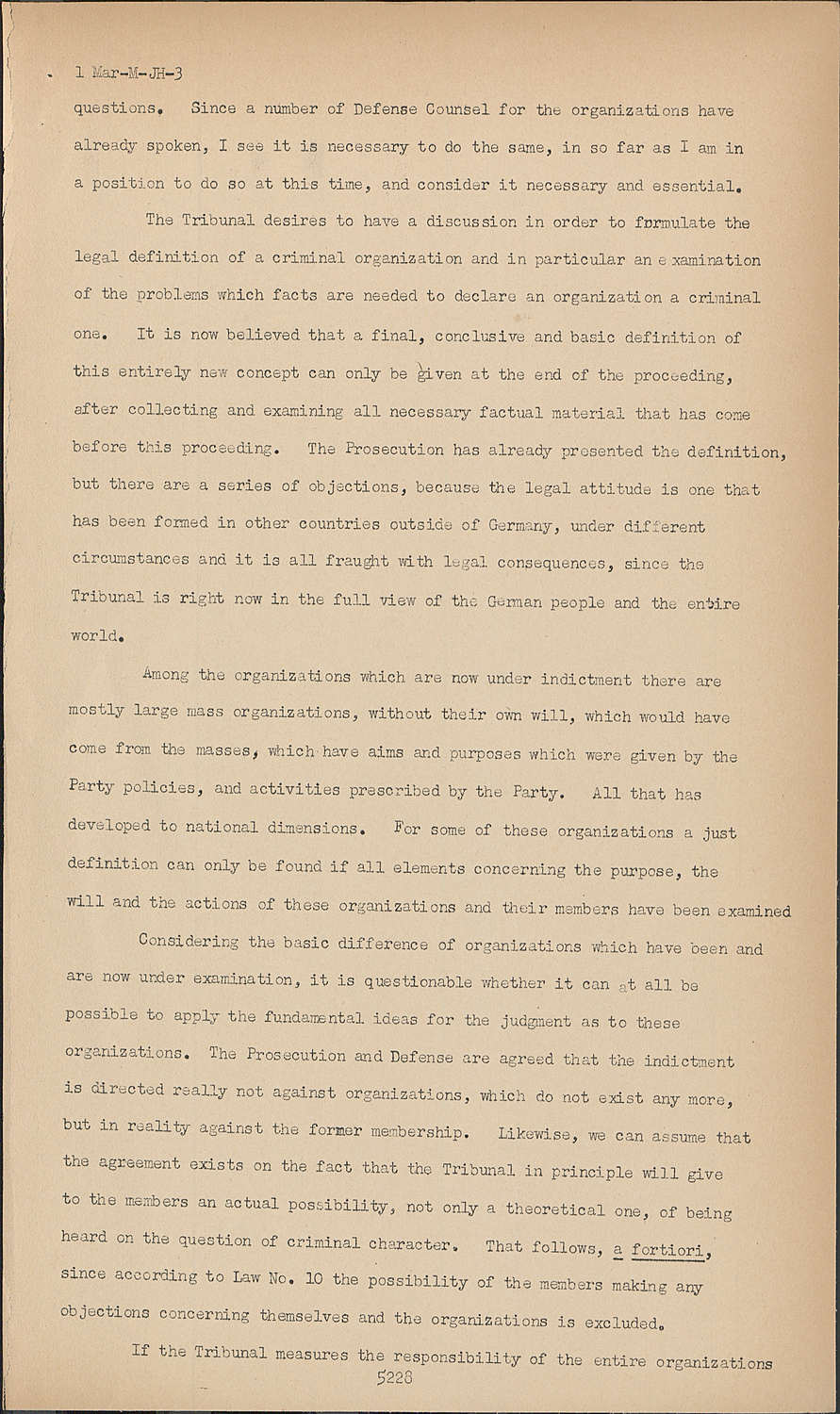
Since a number of Defense Counsel for the organizations have already spoken, I see it is necessary to do the same, in so far as I am in a position to do so at this time, and consider it necessary and essential.
The Tribunal desires to have a discussion in order to formulate the legal definition of a criminal organization and in particular an examination of the problems which facts are needed to declare an organization a criminal one. It is now believed that a final, conclusive and basic definition of this entirely new concept can only be given at the end of the proceeding, after collecting and examining all necessary factual material that has come before this proceeding. The Prosecution has already presented the definition, but there are a series of objections, because the legal attitude is one that has been formed in other countries outside of Germany, under different circumstances and it is all fraught with legal consequences, since the Tribunal is right now in the full view of the German people and the entire world.
Among the organizations which are now under indictment there are mostly large mass organizations, without their own will, which would have come from the masses, which have aims and purposes which were given by the Party policies, and activities prescribed by the Party. All that has developed to national dimensions. For some of these organizations a just definition can only be found if all elements concerning the purpose, the will and the actions of these organizations and their members have been examined Considering the basic difference of organizations which have been and are now under examination, it is questionable whether it can at all be possible to apply the fundamental ideas for the judgment as to these organizations.
The Prosecution and Defense are agreed that the indictment is directed really not against organizations, which do not exist any more, but in reality against the former membership. Likewise, we can assume that the agreement exists on the fact that the Tribunal in principle will give to the members an actual possibility, not only a theoretical one, of being heard on the question of criminal character. That follows, a fortiori, since according to Law No. 10 the possibility of the members making any objections concerning themselves and the organizations is excluded.
If the Tribunal measures the responsibility of the entire organizations as the responsibility of the individuals, there exists a danger of a generali-zation which in its extent would be much worse than the so-called Sippenhaftung of the Third Reich which included innocent members of the families in proceeding against a member of the family which was accused of criminal acts.

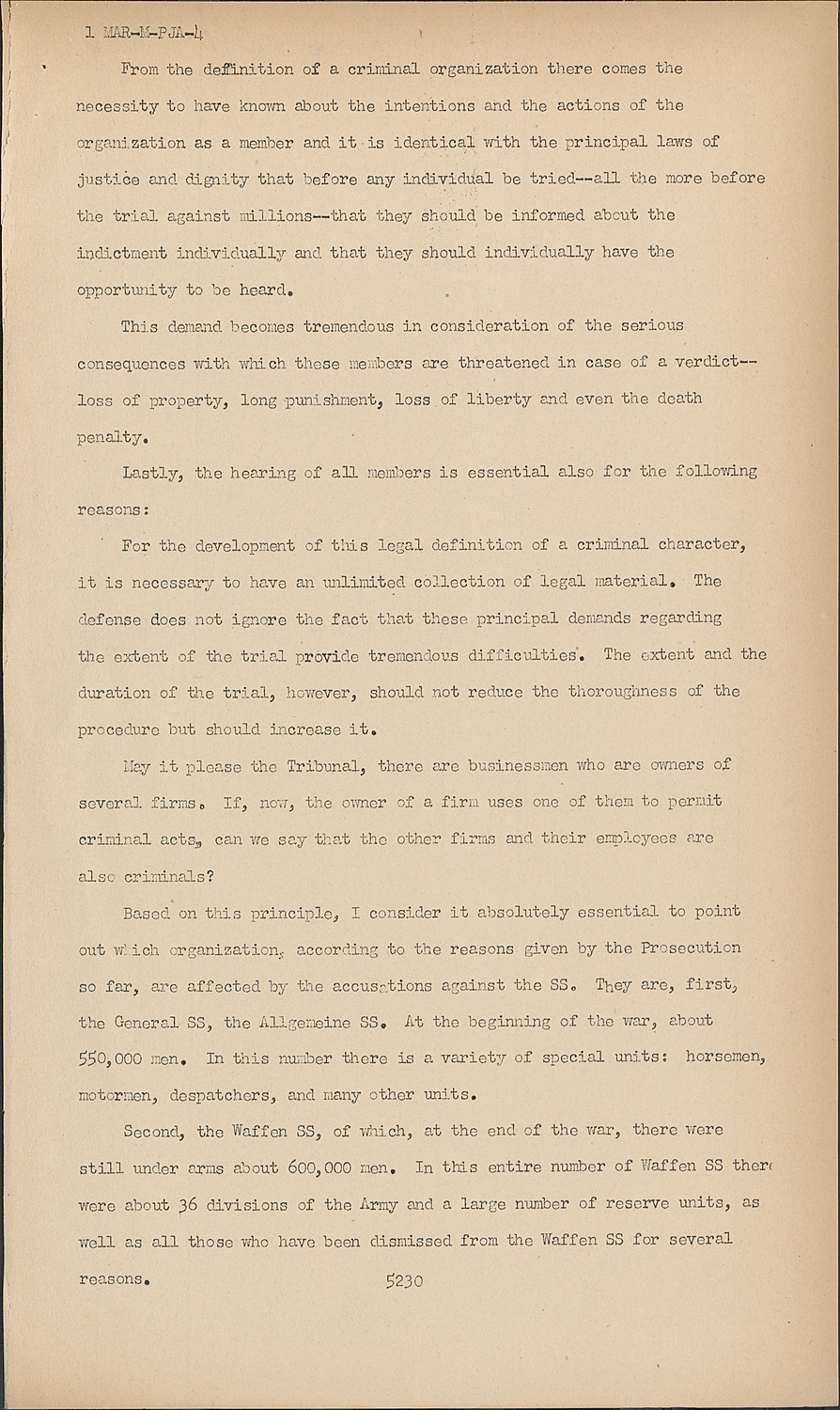
From the definition of a criminal organization there comes the necessity to have known about the intentions and the actions of the organization as a member and it is identical with the principal laws of justice and dignity that before any individual be tried--all the more before the trial against millions--that they should be informed about the indictment individually and that they should individually have the opportunity to be heard.
This demand becomes tremendous in consideration of the serious consequences with which these members are threatened in case of a verdict-loss of property, long punishment, loss of liberty and even the death penalty.
Lastly, the hearing of all members is essential also for the following reasons:
For the development of this legal definition of a criminal character, it is necessary to have an unlimited collection of legal material. The defense does not ignore the fact that these principal demands regarding the extent of the trial provide tremendous difficulties. The extent and the duration of the trial, however, should not reduce the thoroughness of the procedure but should increase it.
May it please the Tribunal, there are businessmen who are owners of several firms. If, now, the owner of a firm uses one of them to permit criminal acts, can we say that the other firms and their employees are also criminals?
Based on this principle, I consider it absolutely essential to point out which organization, according to the reasons given by the Prosecution so far, are affected by the accusations against the SS. They are, first, the General SS, the Allgemeine SS. At the beginning of the war, about 550,000 men. In this number there is a variety of special units: horsemen, motormen, despatchers, and many other units.
Second, the Waffen SS, of which, at the end of the war, there were still under arms about 600,000 men. In this entire number of Waffen SS there were about 36 divisions of the Army and a large number of reserve units, as well as all those who have been dismissed from the Waffen SS for several reasons.
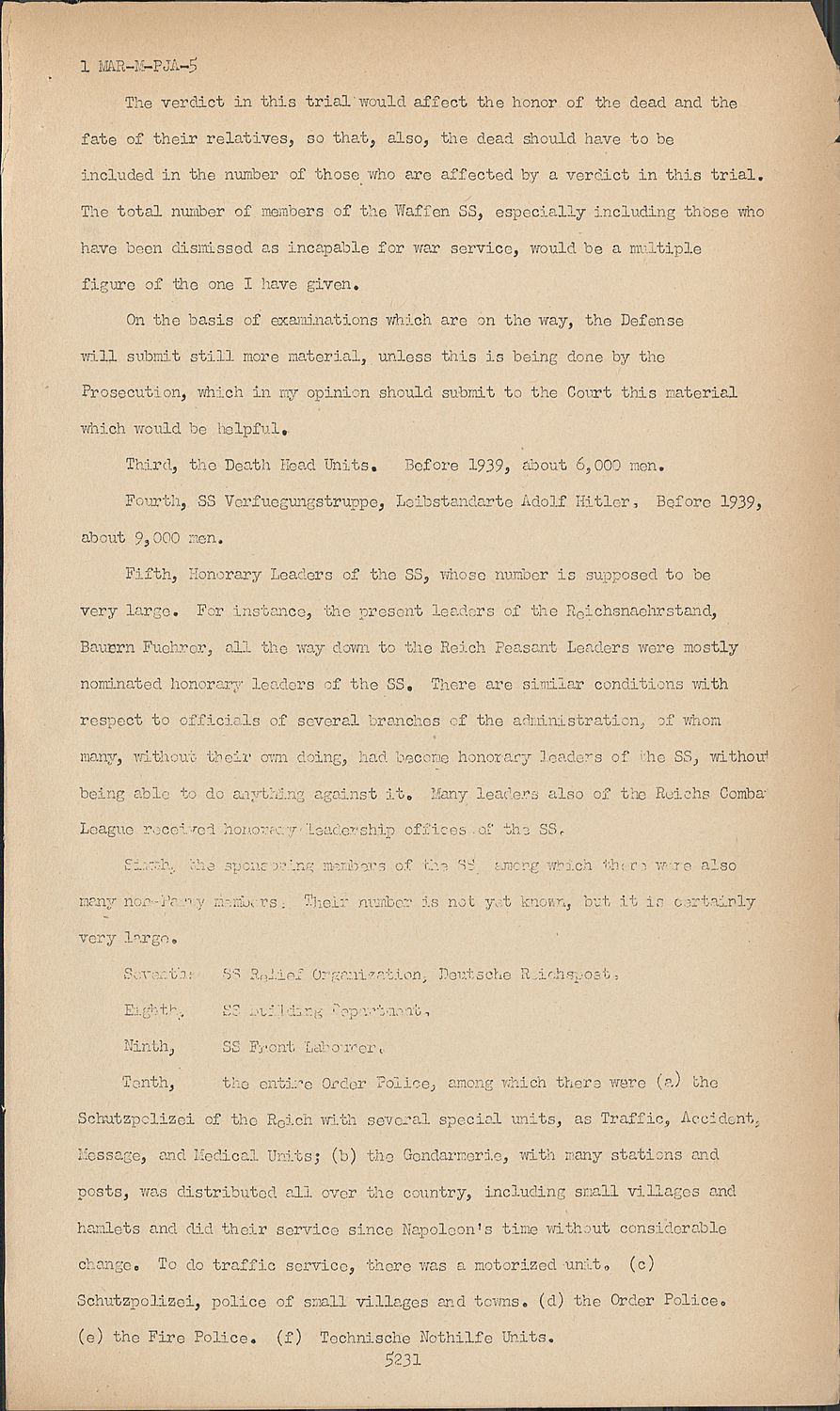
The verdict in this trial would affect the honor of the dead and the fate of their relatives, so that, also, the dead should have to be included in the number of those who are affected by a verdict in this trial.
The total number of members of the Waffen SS, especially including those who have been dismissed as incapable for war service, would be a multiple figure of the one I have given.
On the basis of examinations which are on the way, the Defense will submit still more material, unless this is being done by the Prosecution, which in my opinion should submit to the Court this material which would be helpful.
Third, the Death Head Units. Before 1939, about 6,000 men.
Fourth, SS Verfuegungstruppe, Leibstandarte Adolf Hitler. Before 1939, about 9,000 men.
Fifth, Honorary Leaders of the SS, whose number is supposed to be very large. For instance, the present leaders of the Reichsnaehrstand, Bauern Fuehrer, all the way down to the Reich Peasant Leaders were mostly nominated honorary leaders of the SS. There are similar conditions with respect to officials of several branches of the administration, of whom many, without their own doing, had become honorary leaders of the SS, withou* being able to do anything against it. Many leaders also of the Reichs Comba* League received honorary leadership offices of the SS.
Sixth, the sponsoring members of the SS* among which there were also many non-Party members: Their number is not yet known, but it is certainly very large.
Seventh, SS Relief Organization, Deutsche Reichspost.
Eighth, SS Building Department.
Ninth, SS Front Laborers.
Tenth, the entire Order Police, among which there were (a) the Schutzpolizei of the Reich with several special units, as Traffic, Accident, Message, and Medical Units; (b) the Gendarmerie, with many stations and posts, was distributed all over the country, including small villages and hamlets and did their service since Napoleon's time without considerable change. To do traffic service, there was a motorized unit. (c) Schutzpolizei, police of small villages and towns. (d) the Order Police. (e) the Fire Police. (f) Technische Nothilfe Units.

THE PRESIDENT: Dr. Babel, you are going rather fast if you want us to take down these categories.
DR. BABEL:Mr. President, I will present a copy to the Tribunal containing all these various units.
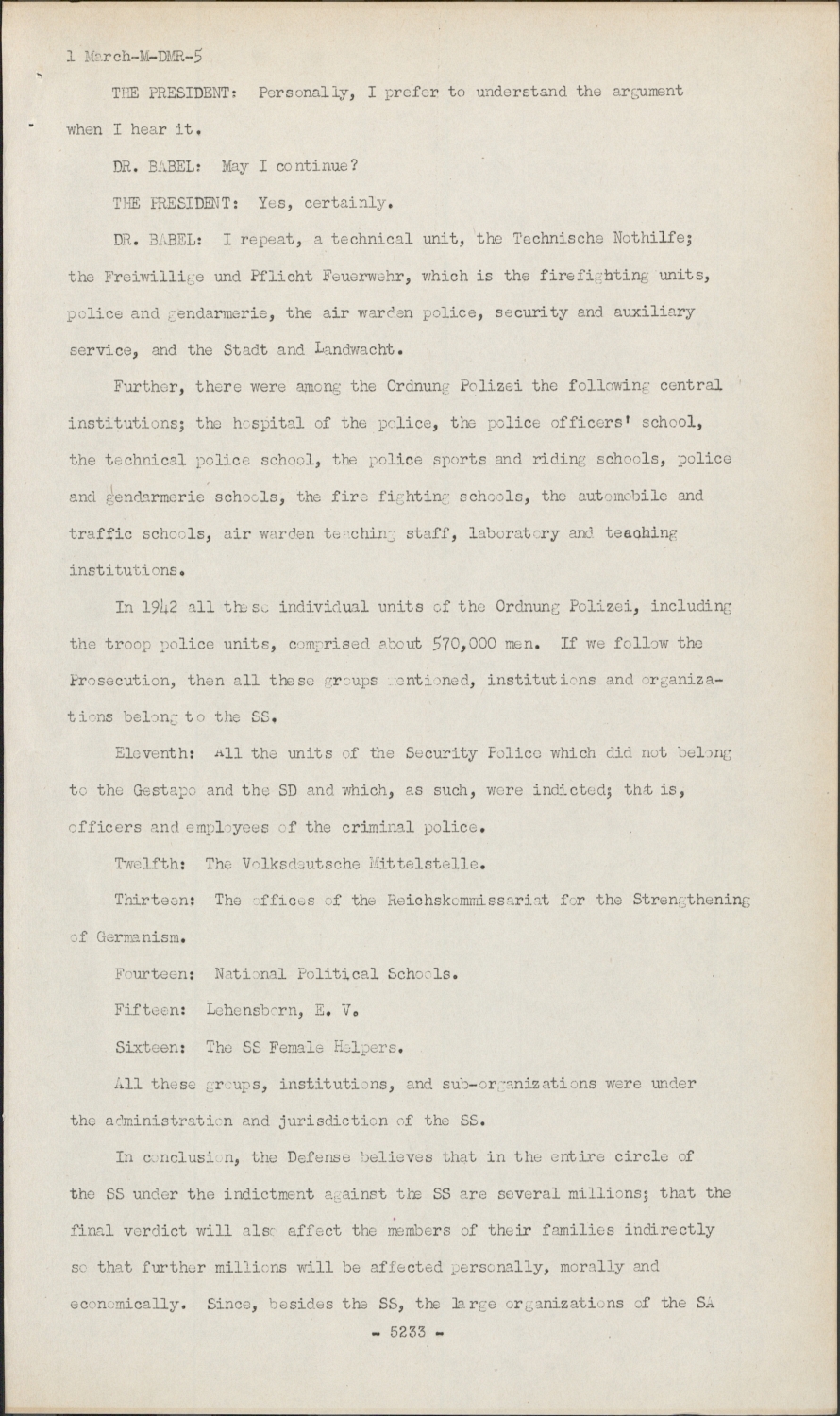
THE PRESIDENT: Personally, I prefer to understand the argument when I hear it.
DR. BABEL:May I continue?
THE PRESIDENT:Yes, certainly.
DR. BABEL:I repeat, a technical unit, the Technische Nothilfe; the Freiwillige and Pflicht Feuerwehr, which is the fire fighting units, police and gendarmerie, the air warden police, security and auxiliary service, and the Stadt and Landwacht.
Further, there were among the Ordnung Polizei the following central institutions; the hospital of the police, the police officers' school, the technical police school, the police sports and riding schools, police and gendarmerie schools, the fire fighting schools, the automobile and traffic schools, air warden teaching staff, laboratory and teaching institutions.
In 1942 all these individual units of the Ordnung Polizei, including the troop police units, comprised about 570,000 men. If we follow the Prosecution, then all these groups mentioned, institutions and organizations belong to the SS.
Eleventh: All the units of the Security Police which did not belong to the Gestapo and the SD and which, as such, were indicted; that is, officers and employees of the criminal police.
Twelfth: The Volksdeutsche Mittelstelle.
Thirteen: The offices of the Reichskommissariat for the Strengthening of Germanism.
Fourteen: National Political Schools.
Fifteen: Lehensborn, E. V.
Sixteen: The SS Female Helpers.
All these groups, institutions, and sub-organizations were under the administration and jurisdiction of the SS.
In conclusion, the Defense believes that in the entire circle of the SS under the indictment against the SS are several millions; that the final verdict will also affect the members of their families indirectly so that further millions will be affected personally, morally and economically. Since, besides the SS, the large organizations of the SA and the Leadership Corps are under indictment, a verdict against these organizations would mean a discrimination against a considerable part of the German nation.
According to Law No. 10 of the Control Council, every member may be, merely for being a member of an organization which has been considered criminal, punished with all punishments, including death. That Law No. 10 answers the question which has been put to discussion as to which objections could be made in this collective procedure and which objections could be made later in the individual. This has been decided by the mentioned law -- that the objections of defendants, for instance, who had no knowledge of the criminal nature of the organization could not be accepted. It is, therefore, necessary that the extent of the procedure in this trial should be stretched as far as possible.
It should be made possible for the Defense, with regard to conclusions which the Prosecution is drawing now, retroactively, to counteract these conclusions. The Tribunal has already, on the occasion of the submission of material against individual defendants, ruled to accept evidence if there is only the slightest possibility of its relevancy. Considering the importance of the decision of this Court for millions of people affected and their families, the admission of evidence to the furthest extent in order to facilitate a just verdict, in order to clarify the facts and in order to state to what extent members of the SS were connected with any criminal acts according to Article 6 of the Charter, that would be absolutely necessary.
Concerning the question whether, based on the fact of the extent of the actions which the Prosecution has mentioned, that the members knew about these things, it would be necessary to admit matters of proof in a large number concerning the question if and to what extent the members of theSS knew about its actions, and these facts will prove that the members of the SS, as well as the majority of the German people, did not know anything about these facts because they were kept highly secret.
The discussion which the trial has suggested concerning the question of proof would mean that the Court would come to a decision on many questions already now without the presentation of evidence by the Defense.
The law has not defined the fact of criminal organizations. That can not be helped by the fact that proof will only be admitted from one side, for thereby the trial would exclude a large amount of counterproof.
After what I have said, I believe that it will be necessary that the procedure should take into consideration all elements which had to do with the decision of the question whether the SS is a criminal organization.
Within this trial, however, which according to the Charter, should be conducted expeditiously, expedition would not be possible. Therefore, I move that the procedure against the SS and the SD be separated from the trial against the individual defendants.
On 15 January 1946, partly for other reasons, I made that motion. As far as I know, that has not been decided yet. I repeat this motion, and it is this:
On the basis of the procedure up to now I have come to the opinion that the accusation against the organizations of the SS and the SD, for which I have been selected as counsel--and probably the other organizations under indictment--within this trial is not possible for factual and legal reasons.
First, from the legal point of view, I only say the following:
A, The competence of the International Military Tribunal is not given. On this I want to say that a few days age I saw in a newspaper article that the objection of incompetence has already been made on 20 November 1945 and has been rejected by the Court. I asked for a copy of the transcript of this date and also for the following days, and I have not received it as of this date. Therefore, I could neither check on the motion nor the reasons given, nor the decision of the Tribunal.
B.A penal procedure against an organization is not admissible, especially against an organization which has been dissolved.
C. To select a defendant's counsel for an organisation which does not exist is not admissible and not possible.
Second, I am forced to make more detailed statements in order to give reasons for my motion.
On the 19th of November 1945 I was told that the International Military Tribunal requested my nomination as the defendant's counsel for the Leadership Corps. I declared my agreement in writing.
On the 20th of November 1945 I was told that I had to accept the defense of the organizations of the SS and SD. On the 21st of November 1945 I was told again that I was selected as defense counsel for the SS and SD, and that I would receive the written declaration to that effect soon. On the 23rd of November 1945 I received that letter. It was written on the 22nd in the English language, and a few days later I received, as requested, a German translation. This is the text of the letter and the translation which I have received:
"According to the decision of the International Military Tribunal, you are hereby requested in the case against Goering and accomplices to take the defense of the members of the SS, including the Sicherheits Dienst, known as SD. Motions filed with the General Secretary are to be made according to the decree of the International Military Tribunal."
A few days later I received a file with about twenty-five letters from members of the SS and from relatives to the General Secretary of the International Military Tribunal. When I asked about my position and the position of these people who had made these motions, I was told that these applications were to be presented to the Tribunal in an adequate form.
On the 23rd of November 1945 there was a discussion, a conference, during which a number of questions and suggestions about the duties and privileges of the members of the organizations were made, and also about the defense counsel who had been provided for them.
Beginning from the 28th of November 1945 until the 11 of December I have examined applications by members of the SS and SD. At that time about twenty-five applications which I received daily, upon request, I had to return on the evening of the same day, and then I couldn't receive any more, although I asked several times each day to get them. I was told every time that the Tribunal needs them and that they had not been returned.
When I received that folder again on the 11th of December 1945 there were many more applications in there.
In December 1945, according to the translation which I have received, the Tribunal decided that a member of the organizations in the Indictment who had made application to be heard concerning the criminal character of the organization was not to be considered as a defendant but was to have only the individual status of a witness, although he has the right to present evidence; furthermore, that defense counsel who are defending one of the groups of organizations may, for this group or organization, exercise the rights which, according to the Charter, are reserved for the defense of individual defendants.
After the 11th of December, in a closed session of the Court, in which also counsel for the organizations were present, the Tribunal issued the decree of 17 December 1945, of which I received a German translation only a few days later. In this decree the Court ruled that the respective defense counsel, that is, of the organizations, should only represent the groups and organizations and not individual applicants. From this day on only the extent of my duties was definitely limited and defined.
THE PRESIDENT:Can you hear what I say? The Tribunal would like to know what your application now is. The object of this session is to have an argument from counsel for the prosecution and counsel for the defense in order that the legal questions with reference to these organizations should be clear, and what your personal experience during November and December of 1945 has to do with it the Tribunal is unable to see.
DR. BABEL:Mr. President, before I started the reading of this motion I pointed out that already on the 15th of January I made a motion to separate the procedure against the organizations, and there was no decision made until now. I have tried to repeat the reasons for this motion which I then made. If the Court does not think it necessary, I do not have to do it.
THE PRESIDENT:I don't see any relevance in what you have been reading to us now either to the question of whether there should be a separate trial or to any other questions with reference to the criminal organizations.
DR. BABEL: Mr. President, under the circumstances I will omit the further statement, which is known to the Court by my written application, and.
I will come to the end of what I still want to say as such.
THE PRESIDENT:Dr. Babel, the Court will, of course, consider the suggestion which has been made, I think, by other counsel for the organization as will as the suggestion which I understand you are now making, that it is necessary to have a separate trial. The Court will consider that. But what you have been saying to us does not appear to me to have any relevance to that.
DR. BASEL:Mr. President, with my former motion I wanted only to point out the difficulties I had, since I was all alone and had no assistance-difficulties I had until I was at all in a position to dedicate myself to my real task; and also for that reason at that time, in my opinion, my motion for separating the trial was well founded.
What I said then I repeat now, at least most of it. What I have read so far and what I still have written in my motion would have more meaning to it, but I will not read it now, since the question of the separation of the procedures has already been brought up by other defense counsel. Therefore, I can also express my agreement with the motions my colleagues have made.
In this connection I would like to point out that on the 17th of January 1946 I made a motion to be relieved of the defense of the SD. I think I will have to point out I have two points to this, because I am not speaking of the SA today, because I have still been waiting for a decision on that motion. After I receive a transcript of the 18th of February I will be able to say acme more about the question of the membership of individuals in the SS as to limitations in time, and, as far as the organization is concerned, the question of voluntary membership and other reasons, and the jurisdiction of the SS Corps.
In view of the tremendous amount of work which I had to do, it was not possible for me until today to make detailed statements about all these questions. I also want to say that the suggestions which have been made by the Prosecution and several of the defense counsel do not seem acceptabl to me, because they mean a definite limitation of the defense, and that does not seem to be possible.

This is the end of my statement.
THE PRESIDENT:The Tribunal will now adjourn.
(A recess was taken until 1400 hours.)
Official transcript of the International 1 *ar-A-JH-1 Military Tribunal in the matter of The United States of America, the French Re public, the United Kingdom of Great Britain and Northern Ireland, and the Union of Soviet Socialist Republics against Hermann Wilhelm Goering et al, Defendants, sitting at Nurnberg, Germany, on 1 March 1946, 1400-700, Lord Justice Lawrence presiding.
THE PRESIDENT:The Tribunal has decided to alter the order of procedure and they will therefore not sit in open session tomorrow but sit in closed session tomorrow, Saturday, and sit on Monday in order to hear the applications for witnesses and documents by the next four defendants in open session; and also, if necessary, on Monday to hear the other next defendants in order, their applications for witnesses and documents.
Now, there is another counsel for the organizations to be heard, is there not?
DR.LATERNSER (counsel for General Staff and OKW): The main subject of the discussion that has taken place today and yesterday, on the wishes of the Court, is the question as to what is relevant evidence in the case against the accused organizations. As a preliminary question to that, particularly the concept of the criminal organization must be clarified.
It is not the task of the defense counsel for the organization to hold down defense arguments -- that should be reserved for the later conclusive briefs -- rather the subject of discussion is limited for the defense to the above-mentioned question of the relevance of evidence, and also to certain basic questions which must be touched upon for any valuation of the relevance of evidence in this case.
According to the sequence the indictment is drawn up in, Dr. Kubuschok spoke first as defense counsel for the Reich Government. In his address he treated the general question associated with the decision of the Court on the 15th of December 1945. In order to avoid unnecessary repetition I should like in my statement to state my attitude, and like to refer in every respect to my colleague Kubuschok. I associate that with my request that the Tribunal directed particular attention to the content of the address delivered yesterday by Dr. Kubuschok.
To the question of the definition of the concept "criminal organization", I should like to make a few short remarks and additions.
It is obviously a well-considered provision in the Charter that the Tribunal can declare the indicted organizations all criminal: that in other words, it is not obliged to do so but can exercise its free and obligatory discretion.
If the Tribunal comes to the conclusion that a declaration that the organizations are criminal would lead to impossible, untenable, and unjust conclusions or consequences, then the rejection of the prosecution's application would be simply a matter of course.
It has already been stated by those who have spoken what enormous legal difficulties a declaration that the organizations are criminal would accomplish for the members of those organizations, and that also the vast majority of the innocent members would be affected by that decision. So far as these consequences concern the members, it can not be asserted vigorously enough that all the members of the organization will be affected immediately by a declaration that the organizations are criminal. Insofar as the verdict of the Court is concerned it would be irrefutably established that they are accused of a crime, namely a crime of having belonged to an organization that has been declared criminal; That this membership is a crime is to be seen in all clarity in Articles X and XI of the Charter. In Article X it is stated that the authorized courts of the individual occupation zones have the right to put on trial all members of organizations that have been declared criminal. It is further specified that in this trial the criminal character of the organization can no longer be disputed. if, in other words, the members can be accused because of membership in the organization, and if every indictment before a court can, of course, have only a crime as its object, then it is already established that membership in the organization is a crime. Furthermore, in Article XI of the Charter membership in an organization declared criminal is specifically named as a crime. That is to be seen in the words of the Article itself, which reads:
"Because of another crime than the membership in a criminal group or organization."
In the same way, in the law passed to implement the Charter on the 20th of December 1945, membership in an organization declared criminal is specifically called a crime.
From this it can be seen that the declaration of the criminal character of the organization by the Tribunal will have the immediate effect, immediate consequences, for all members that they through their membership in the organization have committed a crime. That must necessarily lead to untenable consequences.
It is not correct to say that these members can exculpate themselves in the subsequent trials in the individual military courts. If the mere membership in the organization is defined as a crime, they can object when they are accused only that they were not members of the organization.
If Justice Jackson is of the opinion that they could in the subsequent trials object that they became members through coercion or through deception, the admissibility of this objection seems to be highly questionable.
Justice Jackson himself pointed out that the appeal to personal or economic disadvantage could not serve as ground for such a coercion. What coercion then could be considered a valid excuse? According to German law only physical coercion could come into consideration here, and that only for the period of the thing. Here too the fear of personal or economic disadvantage could be no exoneration for the persons remaining in the organization. Thus a member of an organization declared criminal has in his subsequent trial only the possibility of presenting certain grounds of exoneration which might influence the extent of his punishment. The question is now whether according to the principles of justice these necessary consequences are tolerable. So far as it is a question of innocent members, this question can be answered only with a decided negation.
Justice Jackson is further of the opinion that innocent members of the organization probably can not be found at all because it is simply not comprehensible to a healthy human understanding that anyone would have entered the indicated organization without having known from the very beginning or at least from soon after the beginning what goals and methods the organizations were pursuing.