Q Was this trip undertaken with Hitler's understanding?
AThat I could not say.
QWith whom then did you have a discussion in London on the 25th?
ABefore the evening. It was late in the afternoon, 6.30, with Lord Halifax.
QWhat did Halifax tell you then?
AI was informed that the same day Henderson had seen Hitler, and Henderson was expected in London on Saturday, the 26th.
Then he expressed his hope that, since now the official channels had been opened, a settlement should be possible.
He thanked me for what I had done, and told me he did not think I would be required any longer.
QDid you on the same evening have a long distance telephone call with Goering?
AYes.
Q What did you say?
AI tried at 8 o'clock in the evening to get him on the telephone, but only after I had obtained help from the Foreign Office was it possible to establish connection.
Goering then told me that the situation was extremely grave and asked me to do anything possible I could to arrange for a conference between delegates from Britain and Germany.
QDid you inform Lord Halifax of this conversation?
AYes. Mr. Roberts, from the Foreign Office, obtained immediately the exact wording of our conversation and before midnight Lord Halifax obtained the report.
QDid you then on the next morning, Sunday, the 26th--rather, Saturday, the 26th, ask for a new conference with Lord Halifax, and what was the content of that discussion?
AI met Lord Halifax on Saturday, the 26th, at 11 o'clock.
I told him that I heard the German Government was trying to rush a decision through and emphasized the importance of trying to make clear to then that in such a serious situation it was necessary to act with great responsibility and care, and asked him to emphasize to the German Government the desire of the British to come to an understanding.
QDid anyone state that Goering was the only German who could prevent war?
AWell, I personally had the impression that Goering was a member of the German Government who was most likely to work for peace.
I based this impression on the conversations I had with him.
QWhat suggestion did you make to Lord Halifax?
AI suggested to Lord Halifax that if he could write a letter to Goering I should at once proceed to Berlin and hand it over.
QDid he agree to your proposal?
AYes, with reference to Chamberlain, and afterwards wrote an excellent letter in which he, in clear and distinct words, pointed out the desire of His Majesty's Government to obtain a peaceful settlement.
Q Did you then fly back to Berlin with this letter?
AYes. I reached Berlin in the evening and met Goering about 10 o'clock in the evening.
QDescribe to the Tribunal what happened during this conference with Goering regarding your conference with Halifax?
AI met Goering in his train which was just on the way to headquarters.
I told him about conditions in London and emphasized that there was no doubt that, if the German Government took a step against Danzig, they would be involved with Great Britain, but that I was satisfied the German Government would do what it possibly could to avoid a crisis.
After having explained to him, I handed him the letter.
He tore it open, and after having read through it, he put it before me and asked me to carefully translate it, because it was of great Importance that the contents were clearly understood.
Immediately he told the adjutant to order the train to stop at the next station and declared that he felt it was necessary immediately to inform Hitler of the letter.
I followed him in the car to Berlin, and exactly at 12 o'clock midnight he stopped outside the Reichkanzlei, where Goering started out to see Hitler and I proceeded to my hotel.
QThat was on the 27th of August, in the evening or early morning of the 27th of August?
Did you have a conference with Hitler?
AI was called on by two officers about a quarter past 12 midnight, who asked me to come to Hitler, and upon immediately arriving I was received by him, and with him was only Goering.
QPlease describe this discussion more exactly.
AWell, Hitler started in his usual way with a long explanation of German policy.
It lasted about twenty minutes, and I thought that no useful purpose would be served by my visit.
At a suitable opportunity, when he was running down the British Nation and Great Britain, I interrupted and told him I have been working as a working man, an engineer, and in charge of industries in Great Britain, and I knew the people well, and I had to disagree with his statements.
We came into a long discussion when he asked lots of questions about England and the British people.
Afterwards, he started to explain to me how well the armed forces of Germany had been equipped.
He then looked rather excited, walked up and down, and in the end he got in a very excitable stage and told me that, if it same to war, "I will build U boats, U boats, U boats--U boats I will build," and he seemed to be speaking as if he didn't realize somebody was present.
After a while he shouted that he would, build airplanes, airplanes--airplanes he would build and he would win the war.
After a while he calmed down and began to speak about England and said, Mr. Dahlerus, tell me why I never succeed to come to an arrangement with the British Government.
You seem to know England so well, you might be able to explain?
I hesitated, but told him that with my intimate knowledge of the British people I was satisfied that the lack of confidence in him and his Government was the reason.
QContinue.
AThe conversation went on. He gave me a long resume about his discussion on Friday with Henderson, and at the end he asked me to go ever to London at once and explain his viewpoints.
I naturally refuse, telling him that I could not go as an emissary for the German Government, but if the British Government expressed the desire that I should came over I was prepared to go.
The condition was, however, that I had full knowledge of the exact conditions and proposals that he wanted to make.
We spent an hour and a half, during which he fully explained the various points much more in detail than he had the time to explain to Henderson.
Q What specific proposals did you make?
AIn condensed form, they are as follows:
(1) German to sign a pact or alliance with Great Britain.
(2) England was to help Germany to obtain Danzig and to obtain Corridor, (3) Germany pledged herself to care for Poland's populace.
(4) An agreement should be reached about Germany's colonies.
(5) Adequate provisions should be made for the treatment of the German minority in Poland.
(6) Germany pledged herself to defend the British Empire with the German Wiermacht whenever the former might be attacked.
QRegarding point (2), was not Poland assured that it would have a free harbor in Danzig?
AYes. That is true. This is only a condensed form of the proposals, of course.
QIs it true that Poland did have a free harbor?
AThat is what Hitler said, Yes.
QWhat was the further course of this conversation?
AI left on a special plane in the morning, after having been in contact with London, and met Mr. Chamberlain, Lord Halifax, Sir Horace Wilson, and Sir Alexander Cadogan.
QThis is or the 27th of August, is that not so?
AThe 27th of August, at Downing Street No. 10.
QWhat took place during this conference with Lord Halifax and Mr. Chamberlain?
AWe discussed the proposals made in great detail. On certain points, as will be seen from the blue books, these proposals differed from these made to Henderson. I therefore suggested to the British Government, if they had full confidence in me as an intermediary, they should tell me how far they could accept he proposals or not, and I should go back to Berlin the same day and discuss the British viewpoints with Hitler and Goering. They should retain Henderson in London until Monday so that their reply could be given after they knew how Hitler viewed the British standpoint.
QDuring these days, did you also have a conference with Sir Alexander adegan?
A After the meeting with members of the Government I mentioned above, I had a long conversation with Cadogan.
QDid you receive specific proposals from him?
AYes.
QWhat were they?
AThe British Government took a lot of trouble to deal in a fair and respectable way with the various points. Naturally, point (6), the offer of defending the British Empire, was turned down. Similarly, they refused to discuss colonies before Germany had demobilized, and in reference to the boundaries of Poland, they wanted these boundaries to be carried by five great powers: Russia, Germany, England, Prance and Italy.
In reference to the Corridor, they recommended immediate negotiations with Poland.
In reference to point (8), rather to point (1), England was in principle willing to come to some agreement with Germany.
QDid you then return to Germany with these proposals?
AYes, after having telephoned to Berlin, because the British Government promised to send Henderson back the same day, and obtaining confirmation from Berlin that they agreed with Henderson's delay in returning on Monday, I left that evening and arrived shortly before midnight at Berlin.
QDid you then immediately have a conversation with Goering?
AI met Goering about 11:10 on Sunday evening and told him about the results.
QCan you describe that conversation a little more exactly?
AHe replied that it was fatal, but I explained to him that considering events during recent years, he could hardly expect Great Britain to be satisfied with the Corridor of Poland. And in reference to the colonial question, I explained to him that any British Government trying to force this point in Parliament as long as Germany's forces were mobilized would be bound to fall at once.
In reference to the 6th point, I would like to make it clear that Great Britain, or the British Empire, wouldprefer to look after their own interests.
In the end, he said that it would be better if he saw Hitler alone. He left for Reichskenzlei and I went back to my hotel.
About 1:00 on Monday morning, the 28th, I received a telephone call that Hitler accepted the British viewpoints subject to the reply Henderson gave the next day would in general be the same as I had given.
QDid you not then, on the same evening, talk to the English Ambassador?
AYes. I went straight to the British Ambassador and reported to Sir George Ogilive Forbes the results of my conversation with Goering and he cabled to London.
QDid you inform Goering of what happened during that conversation?
AWell, naturally I was acting quite openly, so I told Goering what I intended to do so it was with full knowledge of the German Government that I discussed it with Forbes.
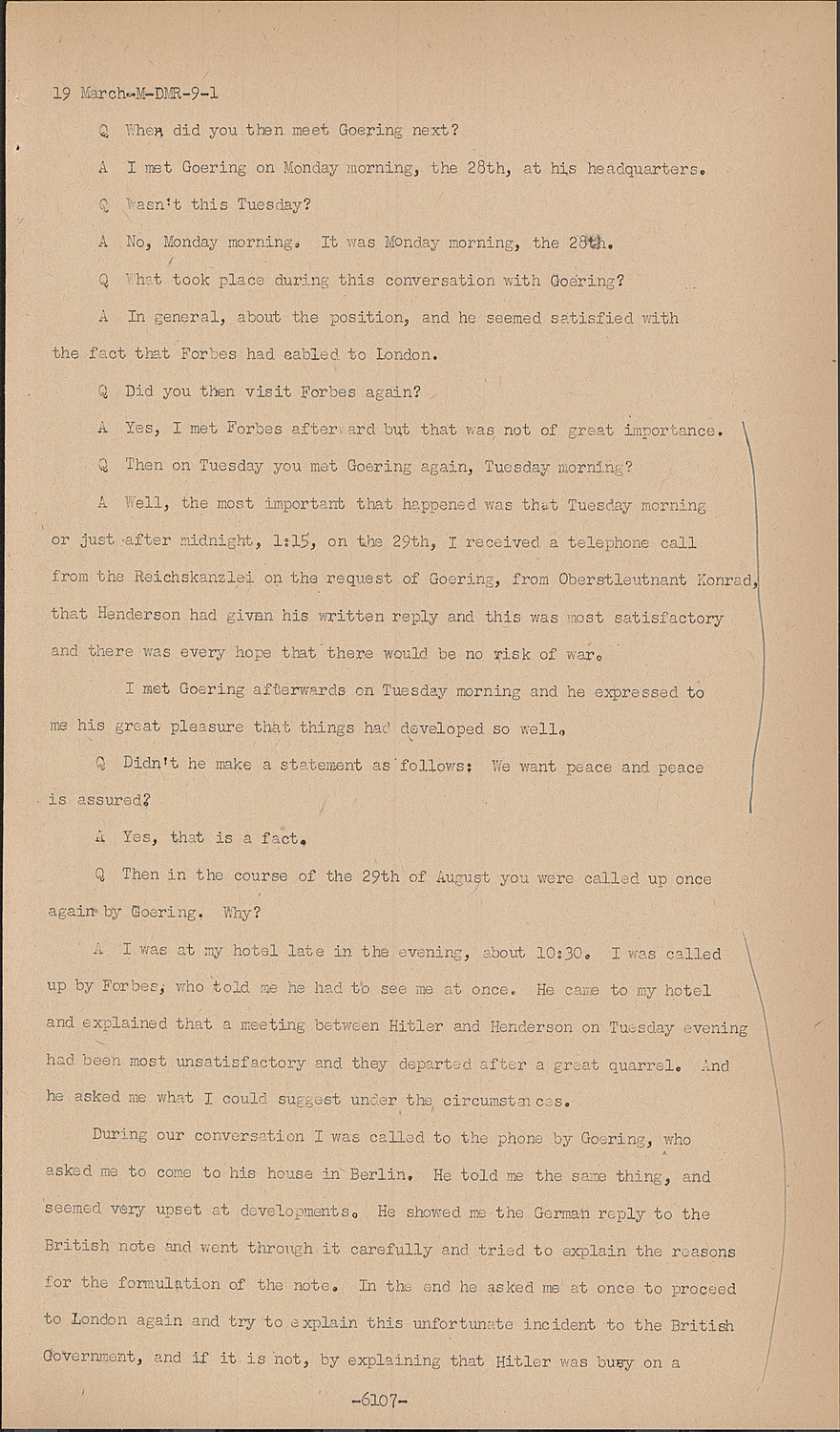
Q When did you then meet Goering next?
AI met Goering on Monday morning, the 28th, at his headquarters.
QWasn't this Tuesday?
ANo, Monday morning. It was Monday morning, the 28th.
QWhat took place during this conversation with Goering?
AIn general, about the position, and he seemed satisfied with the fact that Forbes had cabled to London.
QDid you then visit Forbes again?
AYes, I met Forbes afterward but that was not of great importance.
QThen on Tuesday you met Goering again, Tuesday morning?
AWell, the most important that happened was that Tuesday morning or just after midnight, 1:15, on the 29th, I received a telephone call from the Reichskanzlei on the request of Goering, from Oberstleutnant Konrad, that Henderson had given his written reply and this was most satisfactory and there was every hope that there would be no risk of war.
I met Goering afterwards on Tuesday morning and he expressed to me his great pleasure that things had developed so well.
QDidn't he make a statement as follows: We want peace and peace is assured?
AYes, that is a fact.
QThen in the course of the 29th of August you were called up once again by Goering. Why?
AI was at my hotel late in the evening, about 10:30. I was called up by Forbes, who told me he had to see me at once. He came to my hotel and explained that a meeting between Hitler and Henderson on Tuesday evening had been most unsatisfactory and they departed after a great quarrel. And he asked me what I could suggest under the circumstances.
During our conversation I was called to the phone by Goering, who asked me to come to his house in Berlin. He told me the same thing, and seemed very upset at developments. He showed me the German reply to the British note and went through it carefully and tried to explain the reasons for the formulation of the note. In the end he asked me at once to proceed to London again and try to explain this unfortunate incident to the British Government, and if it is not, by explaining that Hitler was busy on a proposal to Poland that probably would be ready the next day.
After consultation through Sir Kingsley Wood, the Air Minister, about a new visit to England, I left on Wednesday morning, 5 o'clock. Immediately after my arrival in London I met the same members of His Majesty's Government.
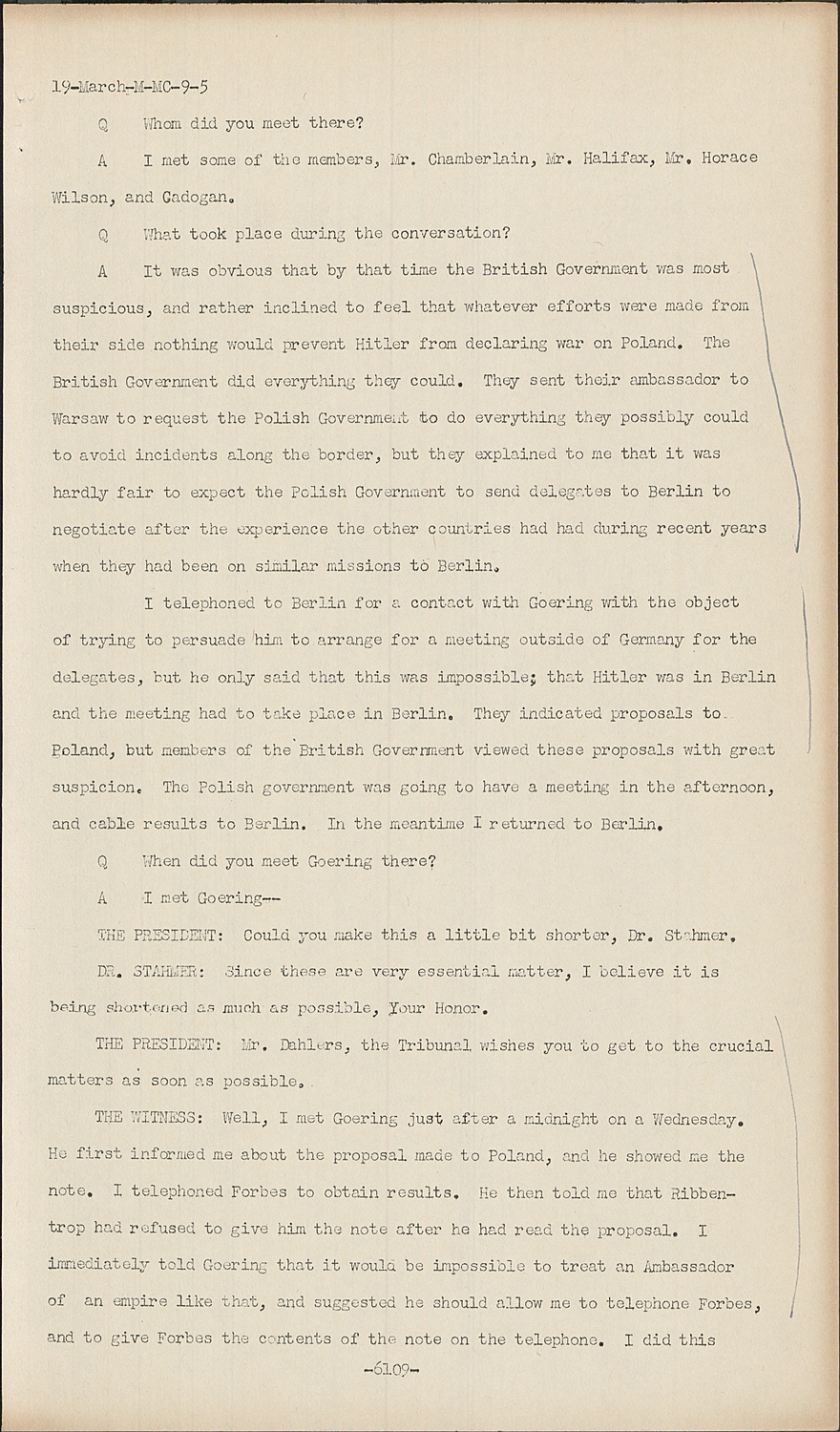
Q Whom did you meet there?
AI met some of the members, Mr. Chamberlain, Mr. Halifax, Mr. Horace Wilson, and Cadogan.
QWhat took place during the conversation?
AIt was obvious that by that time the British Government was most suspicious, and rather inclined to feel that whatever efforts were made from their side nothing would prevent Hitler from declaring war on Poland. The British Government did everything they could. They sent their ambassador to Warsaw to request the Polish Government to do everything they possibly could to avoid incidents along the border, but they explained to me that it was hardly fair to expect the Polish Government to send delegates to Berlin to negotiate after the experience the other countries had had during recent years when they had been on similar missions to Berlin.
I telephoned to Berlin for a contact with Goering with the object of trying to persuade him to arrange for a meeting outside of Germany for the delegates, but he only said that this was impossible; that Hitler was in Berlin and the meeting had to take place in Berlin. They indicated proposals to Poland, but members of the British Government viewed these proposals with great suspicion. The Polish government was going to have a meeting in the afternoon, and cable results to Berlin. In the meantime I returned to Berlin.
QWhen did you meet Goering there?
AI met Goering-
THE PRESIDENT:Could you make this a little bit shorter, Dr. Stahmer.
DR. STAHMER:Since these are very essential matter, I believe it is being shortened as much as possible, Your Honor.
THE PRESIDENT:Mr. Dahlers, the Tribunal wishes you to get to the crucial matters as soon as possible.
THE WITNESS:Well, I met Goering just after a midnight on a Wednesday. He first informed me about the proposal made to Poland, and he showed me the note. I telephoned Forbes to obtain results. He then told me that Ribbentrop had refused to give him the note after he had read the proposal. I immediately told Goering that it would be impossible to treat an Ambassador of an empire like that, and suggested he should allow me to telephone Forbes, and to give Forbes the contents of the note on the telephone. I did this about one o'clock on Thursday morning.
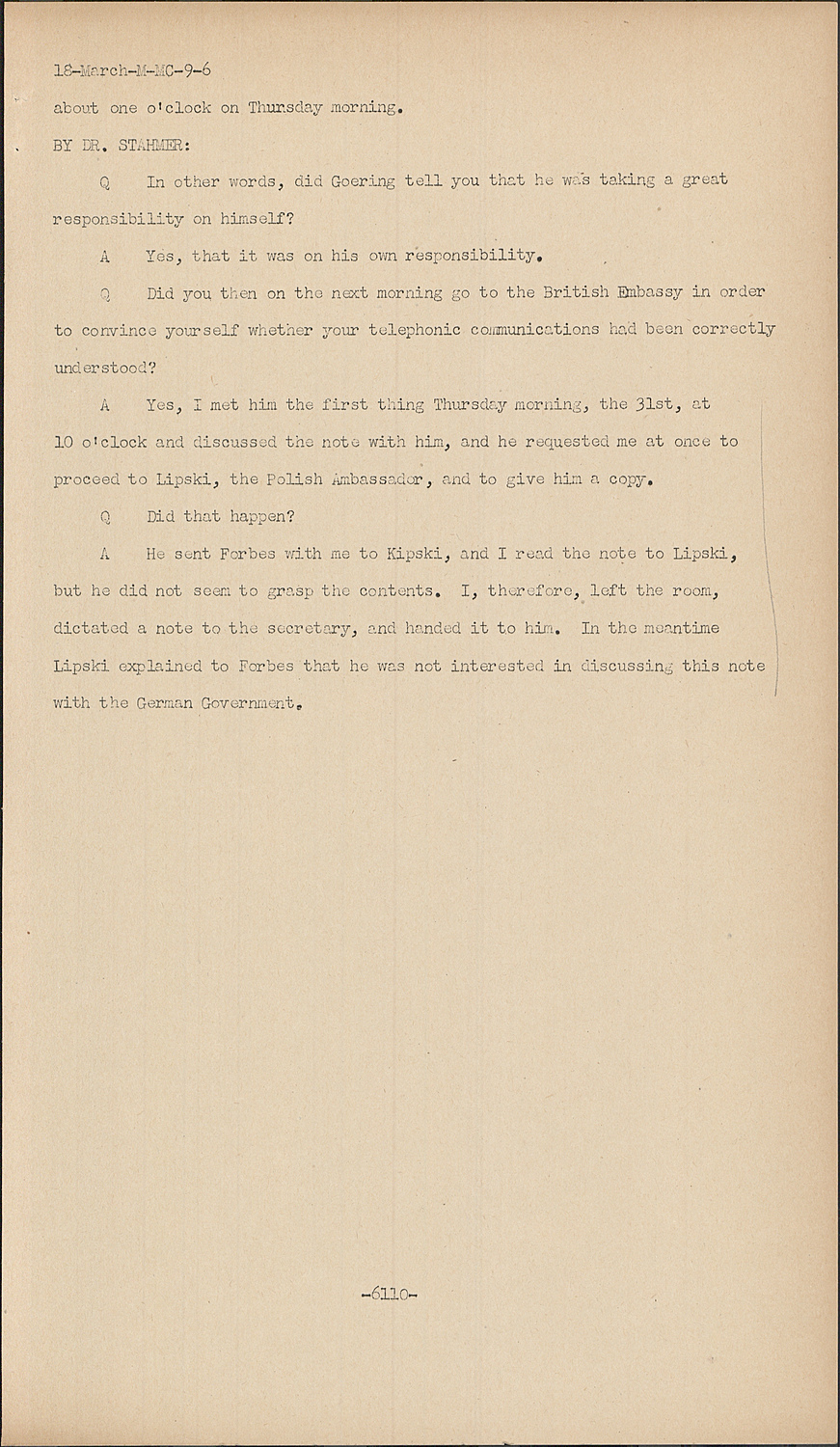
BY DR. STAHMER:
QIn other words, did Goering tell you that he was taking a great responsibility on himself?
AYes, that it was on his own responsibility.
QDid you then on the next morning go to the British Embassy in order to convince yourself whether your telephonic communications had been correctly understood?
AYes, I met him the first thing Thursday morning, the 31st, at 10 o'clock and discussed the note with him, and he requested me at once to proceed to Lipski, the Polish Ambassador, and to give him a copy.
QDid that happen?
AHe sent Forbes with me to Kipski, and I read the note to Lipski, but he did not seem to grasp the contents. I, therefore, left the room, dictated a note to the secretary, and handed it to him. In the meantime Lipski explained to Forbes that he was not interested in discussing this note with the German Government.
Q Did you give this conversation as closely verbatim as you can?
It seems very important to me.
AWhen he said that he had no reason to negotiate with the German Government if it came to war between Poland and Germany he knew because he had been living for five and a half years in Poland, that there would be a revolution in Germany and they would march on Berlin.
THE PRESIDENT:Yes, Dr. Stahmer, are you not going on? BY DR. STAHMER:
QPlease continue, witness.
Did you then inform London of your conversation by telephone?
AI did phone at once from the British Embassy and told Sir Horace Wilson about the conference we had.
QWas there another discussion with Goering in the afternoon?
AI saw Goering at one o'clock in the afternoon. He then received a copy of a cablegram from the Polish Government to Lipski, to the effect that Lipski should not without special instructions from Warsaw negotiate with the German Government. It is obvious that the Poles during the existing circumstances were most scared what actions they took but this telegram did upset the German Government very much.
QOn that afternoon did you again meet Goering along with the British Ambassador?
AThe situation seemed to be impossible. Hitler called Sir Nevil Henderson. Ribbentrop had quarreled with him and I thought the only possibility was if Goering could come to an understanding with Henderson. I suggested a meeting between them. It took place at 4:50 in the afternoon at Goering's house. Forbes was present and I was present myself.
QWhat took place during that talk?
AAlready before the meeting Henderson expressed his suspicion that the German Government would try to arrange a settlement with England and make a split between England and Poland. Hendersonwas therefore very careful during the two hours conversation and the result of the conversation was only that both parties agreed it would be necessary to arrange for a meeting between delegates from both countries if that possibly should avoid war.
QOn this occasion did you suggest that Goering should meet English delegates immediately?
AI suggested that a meeting should at once be arranged in Holland and Goering should represent Germany.
QWhat was Henderson's attitude to this proposal?
AHenderson promised to submit the proposal to his government. But I had the impression that he already knew that the German forces were moving and it did not seem as if he put great faith in the possibilities.
QDo you know of a statement on the part of Goering that if the Poles did not submit Germany would crush these people and is quite prepared and "if we had to declare war we would regret it but that would simply be Great Britain's fault?
AI can't recollect those words but it is possible that during the two hour conversation they were uttered.
QHow did this talk conclude?
AAt 7 o'clock in the evening they parted and both parties agreed but tried to arrange for the meeting in Holland.
QDid you then on the first of September meet Goering again?
AOn the first of September I met Goering at eight o'clock in his headquarters. After some hesitation he told me that war had broken out due to the fact that the Poles had attacked the radio station at Gleiwitz and blown up the bridge at Birschau. Later he gave me more details from which I gathered that the full force of the German Army was attacking Poland.
QDid you then on the 3rd of September meet Goering again, and did you on that occasion, make the suggestion that Goering should fly to London for a direct conference?
AWell, before I mentioned what happened then, I think I should mention that I met Hitler in the Reichskanzlei on the first of September immediately after his speech before the Reichstag in the corridor. He was then exceedingly nervous and very agitated and he told me that he had all the time suspected that England wanted a war and he told me that he was going to smash up Poland and take the wholecountry.
Goering interrupted, indicating that they would advance to certain points. But Hitler was in an uncontrollable frame of mind and started to shout he would fight one year, two years and he started up in a great excitement saying that he would fight ten years.
Then on Sunday, the third of September, I obtained early in the morning information from Forbes that an ultimatum would be given at nine o'clock. Conditions immediately ceased and withdrew the forces to the German border. I immediately went off to Goering's headquarters near Potsdam. He was there and not with Hitler. I appealed to him at least to try to arrange for a sensible reply to the ultimatum. I had the impression that certain members of the German Government were in favor of war and I was afraid if a written reply was given it would not be framed to help to prevent war with England. I therefore suggested that Goering should declare himself prepared to go to England at once before eleven o'clock to negotiate.
QHow did Goering react to this suggestion?
AHe was -- he accepted the proposal and phoned Hitler and Hitler agreed
QDid you then telephone London?
AYes, I phoned up London, obtained contact with the Foreign Office and they gave the replythat I did expect, that they could not consider this proposal before they received a written reply to the ultimatum.
QDid you communicate this to Goering?
AYes, I told Goering.
QWhat impression did that make on him?
AGoering seemed to be sorry it was not accepted.
QThen on the 4 of September did you speak once more with Goering?
AYes, I had a short interview with Goering on the 4th but not of any great importance.
Q On this occasion did Goering say to you that, come what may, we would carry out the war as humanely as possible and that Germany would under no circumstances undertake war action against England but if England should shoot on Germany then Germany's answer would be inevitable?
AYes, that is correct.
QDid you publish a book called "Last Attempt"?
AYes.
QIs the account you give there true?
AYes, it is written with great care. The record as far as I humanly could is absolutely exact and correct.
QIs what you say there based on notes that you took at the time?
AYes.
QWhen did you finish these notes?
AI made them immediately on my return to Sweden on the 5th of September, 1939.
DR. STAHMER:Mr. President, I have three more small questions. Should I ask them now or should we now adjourn?
THE PRESIDENT:I think you could ask them now.
DR. STAHMER:Very well. BY DR. STAHMER:
QOn the 24th of September, 1939, did you speak with Forbes in Stockholm?
ANo, I met Forbes on the 24th of September in Oslo, that was after the occupation of Poland, in an endeavor to try to ascertain if there still was a possibility of preventing a world war. He gave me in writing the viewpoint of the British Government, summarized as follows: "The British Government had to put up -- "
THE PRESIDENT:Wait a moment. What has this to do with the defendant Goering?
DR. STAHMER:This is evidence that he made efforts even later to bring about peace.
I have now only one more question which affects Goering immediately.
THE PRESIDENT: The fact that he met Sir George Ogilvie Forbes in Oslo on the 24th of September does not at present appear to have anything to do with Goering.
DR. STAHMER:It is significant to the extent that Dahlerus did this in order to put London and Berlin once more in touch with each other in order at this stage of events to bring about peace.
THE PRESIDENT:Well, go on with your next question then.
THE WITNESS:The provisions were: "To redeem Europe from perpetually recurring fear of German aggression and to enable peoples of Europe --"
THE PRESIDENT:Wait a minute. What has the letter that Sir George Ogilvie Forbes wrote got to do with Goering?
DR. STAHMER:The content of this letter was told to Herr Dahlerus on the 22 of September and Dahlerus discussed it with Goering and he attempted to reach some sort of agreement on that basis.
MR. JUSTICE JACKSON:Your Honor, may I enter a further objection?
It has nothing to do with the Indictment. We have not charged that a war against England was an aggressive war. The charge is that the war against Poland was an aggressive war. All of this negotiation to keep England out of the war while they took Poland is utterly irrelevant to the Indictment. I respectfully submit, and that because it has nothing to do with the Indictment, with the charge, it should be rejected.
THE PRESIDENT:Dr. Stahmer, if the witness had an interview with Goering afterwards you can come to that but not to preliminary conferences with Sir George Ogilvie Forbes.
DR. STAHMER:It would not be comprehensible unless I do so. He had to tell Goering what Forbes told him. Forbes made certain suggestions to him and Dahlerus took these suggestions to Berlin and communicated them to Goering, told him what Forbes had told him.
THE PRESIDENT:Let the witness give the account of his meeting with Goering.
DR. STAHMER:Very well.
BY DR. STAHMER:
QHerr Dahlerus, it was on the 26th of September that you looked up Goering in Berlin?
AWell, I met both Goering and Hitler on the 26th of September.
QDid you inform Goering of what suggestions Forbes had made to you?
AI had discussed with Hitler on what conditions he was prepared to make good the harm he had done to Poland and make peace, and to my great disappointment he then definitely declared that he was not prepared at all to discuss the question of Poland. Poland was occupied and that was no business any longer of Great Britain. I then realized that the aim, his aim had been to split Poland and England and with the consent of Great Britain have the opportunity of occupying Poland without running the risk of war with Great Britain and France.
QIn July 1940 did you again meet Goering?
AYes, Goering suggested in July, 1940, that His Majesty, the King of Sweden, should endeavor to approach the various powers for negotiations about peace.
DR. STAHMER:No further questions.
THE PRESIDENT:The Tribunal will adjourn until 2:10 p.m.
(A recess was taken until 1410 hours).
Official transcript of the International Military Tribunal in the matter of:
The United States of America, the French Re public, the United Kingdom of Great Bri tain and Northern Ireland, and the Union of Soviet Socialist Republics, against Hormann Wilhelm G oering et al, Defen dants, sitting at Nurnberg, Germany,on 19 March 1946, 1400-1700, Lord Justice Lawrence, presiding.
BIRGER DAHLERUS -- resumed.
THE PRESIDENT:Does any member of the defendants' coun sel wish to ask any questions?
DIRECTEXAMINATION--Continued.
BY DR. HORN: (counsel for the Defendant Ribbentrop)
Q.Witness, can you tell us the reason why the conference between Hitler and Henderson on the 29th of August had no res ults?
A.No, I only had the report that they disagreed and got into a quarrel.
Q.Do you know about which of the six points the quarrel started?
A.As far as I recollect, it was on the wordking of the G erman reply saying that they expected representatives from Poland during the next 24 hours.
A.Were you not later told by Hitler in the presence of Goering that he put these demands because the two armies, the Polish and the German, were already standing in readiness,and at any moment a serious conflict was to be expected, and there fore Hitler did not want to put an ultimatum regarding the calling of a man from Poland, but only wanted to avoid the outbreak of a conflict A. Yes, explanations to that effect were given.
Q.Is it correct, witness, as you wrote in your book, that in the Polish Embassy, the Polish Ambassador, N. Lipski, told you that in case of a war the Polish Army would march to Berlin in triumph?
A.No, he did not say that to me, but he made remarks to that effect before Forbes.
Q.And Forbes transmitted these rewards to you. How did it come about that you had a meeting with Mr. Forbes on the 24th of September in Oslo?
A.I took the initiative and went to Oslo to see him.
Q.Please, could you tell us about the content of the letter from Forbes, briefly?
A.I read that -
THE PRESIDENT:The Tribunal have already said that they don't want to hear that. And I don't see what it has to do with von Ribbentrop.
DR. HORN:Foreign Minister von Ribbentrop is under indictment on the basis of leading the entire German policy. I consider it, therefore, important that this letter which will give information about the further course of the foreign policy such as Ribbentrop saw it, that this letter was decisive for his later attempts toward peace, for instance.
THE WITNESS:To redeem Europe from perpetual German aggression BY THE PRESIDENT:
Q.Was this letter ever shown to von Ribbentrop?
A.No.
THE PRESIDENT:The Tribunal has already ruled that they will not have the letter read. BY DR. HORN :
Q.Then on the 26th of September 1939 you had a conference with Hitler. Is it correct that at that time Hitler told you he could negotiate with England concerning Poland because the major part of Poland was occupied by Russia and Russia to his knowledge would not ceded it?