Q I will ask that the witness be shonw a document, 3786-PS (U.S.A.787) of which there are no extra copies available because it came to us so late.
I will ask you to examine that and tell me whether you recall the meeting to which those minutes refer ?
AWe are here apparently concerned with a report dealing with a situation which arose daily with the Fuehrer, perhaps once or twice a day. Since a situation occurred once or twice daily, I cannot, with any accuracy, make any statement without first having read the report. I cannot recall the report of 27 January 1945 for I experienced any number of these situations during the course of the war.
QI shall call your attention to specific incidents in it. The minutes indicate that the Fuehrer, yourself, Keitel and Jodl were present, were they not?
AYes, it's according to the notes.
QAnd I will call your attention to page 31 and ask you to follow with me the notes and see if it refreshes your recollection. Now, this relates to 10.000 imprisoned air force officers. I quote what is attributed to you.
"Goering: Dear Chief, there are 10,000 imprisoned air force officers. The commander of the replacement army is in charge of guarding. The transportation forces are supposedly non-available. The thought was expressed if one should not leave the prisoners to the Soviet Russian Armies, they would receive 10,000 fliers.
"The Fuehrer: Why were they not shipped away earlier. This is an unheard of neglect.
"Goering: That is the business of the commander of the RTA. We have nothing to do with it. I can only report it.
"The Fuehrer: They must be removed and if they have to march in the dirt the Volkssturm Fegelein must be called in. Whoever tries to escape will be shot. It must be done by all means.
"Goering: That is, from Sagan, there are 10,000 men.
"Gluecke: When transferring, the 4th Armored Division moved out completely, also the 227th Division, and also the remainder of the 32nd Division is now moving. The next in line is HQ, of the 3rd SS Panzer Corps.
During the night, from today to tomorrow, and from tomorrow to after tomorrow.
The Division Niederland has already pulled out. Parts of the Division Nordland have alse been pulled out from the front lines.
"Fuehrer: Are you getting replacements now? Are they already on the move?
"Goering: Fegelein took care of that. He has already ordered that htey should be reinforded.
"The Fuehrer: Is it absolutely clear that the army group Weichsel has nothing, for the time being, except the Corps Maehren, and the one group, and it is at the River Weichsel? This is to be worked first. It will come from here and partly from Germany. It must be done, nevertheless.
"Goering: How many box cars areneeded for 10,000 men?
"The Fuehrer: If we transport them according to German standadrs, then we need at least 20 freight trails for 10,000 men. If we transport them according to Russian standards, we need 5 or 3.
"Goering: Take their pants and boots off so that they cannot run in the snow."
Do you recall that incident?
AI believe that I remember this incident but vaguely. After I have given the answer I would like to qualify and give my opinion of the value of this document. I understood that this document just now arrived, but I have already been interrogated with respect to this document long before the beginning of the proceedings, and at that time I pointed out that the stenographic record of the situation -- two stenographers were active and the situation often took place over a period of 4 or 5 hours -had to be worked over or gone over afterwards and that frequently, because of the presence of many people, inaccuracies occurred in translation that expressions used by one were accredited to another in the minutes. For that reason, at that time I mentioned the fact that I not only did not remember this expression, but that according to my conviction and view, I have never made this expression. We were concerned solely with the making ready of freight trains for transporting.
Q Well, I must say that you were interrogated with reference to the incident, but not with reference to these notes which were not transcribed.
AIn respect to the writing down and this incident, it was emphasiced that we were concerned with a stenotype record of this report and I already uttered my opinion a t that time in a light manner, but it was not submitted to me. But that, of course, is correct.
QNot stenotype, but stenograhic.
You are also referred to page 35. I call your attention to this and ask you, is it attributed to you mistakenly?
"Goering: The 10.000 prisoners in Sagan should be transported away by Obergruppenfuehrer Juettner." Perhaps I do not pronounce the word as you would.
"the Fuehrer: These prisoners must be removed by all available means.
Volksturm must be employed -with the more energetic people. All who attempt to flee will be shot.
"Fegelein: We have a man for that who guards the concentration camp. This is Gruppenfuehrer Gluecks. He must do the job."
Did that occur?
AThat I cannot say. I have already testified that BDE had to take over the transporting away of these prisoners. We were not concerned with it, and what arguments or clarifications the other gentlemen made in the conversation I cannot testify completely at this point. We are concerned with the question of whether these 10.000 men were to be surrendered or transported off.
QI will ask you a question or two about the Warsaw bombing. Was it known to you that on the 3rd of September, the House of the Ambassador of the United States, situated some 17 Kilometers out of Warsaw, was bombed by the German Air Force?
ANo, that is unknown to me.
QYour Air Force took a good many pictures of the Polish vilages and of Warsaw and used them for distribution among the German people, did'nt they?
AThat is possible, but I was not concerned with the vilages, In any event, the Luftwaffe did not distribute pictures to the German people. It is possible that pictures taken by the Luftwaffe might have gone into the German press, but distribution, in the sense of the Luftwaffe distributing photographs or forms of leaflets, that never took place.
QThe Luftwaffe did take the pictures for the purpose of determining the afficien of its hits, did it not?
AThe Luftwaffe took pictures before the target had been attached and after the target had been attached to determine whether the target had actually been hit.
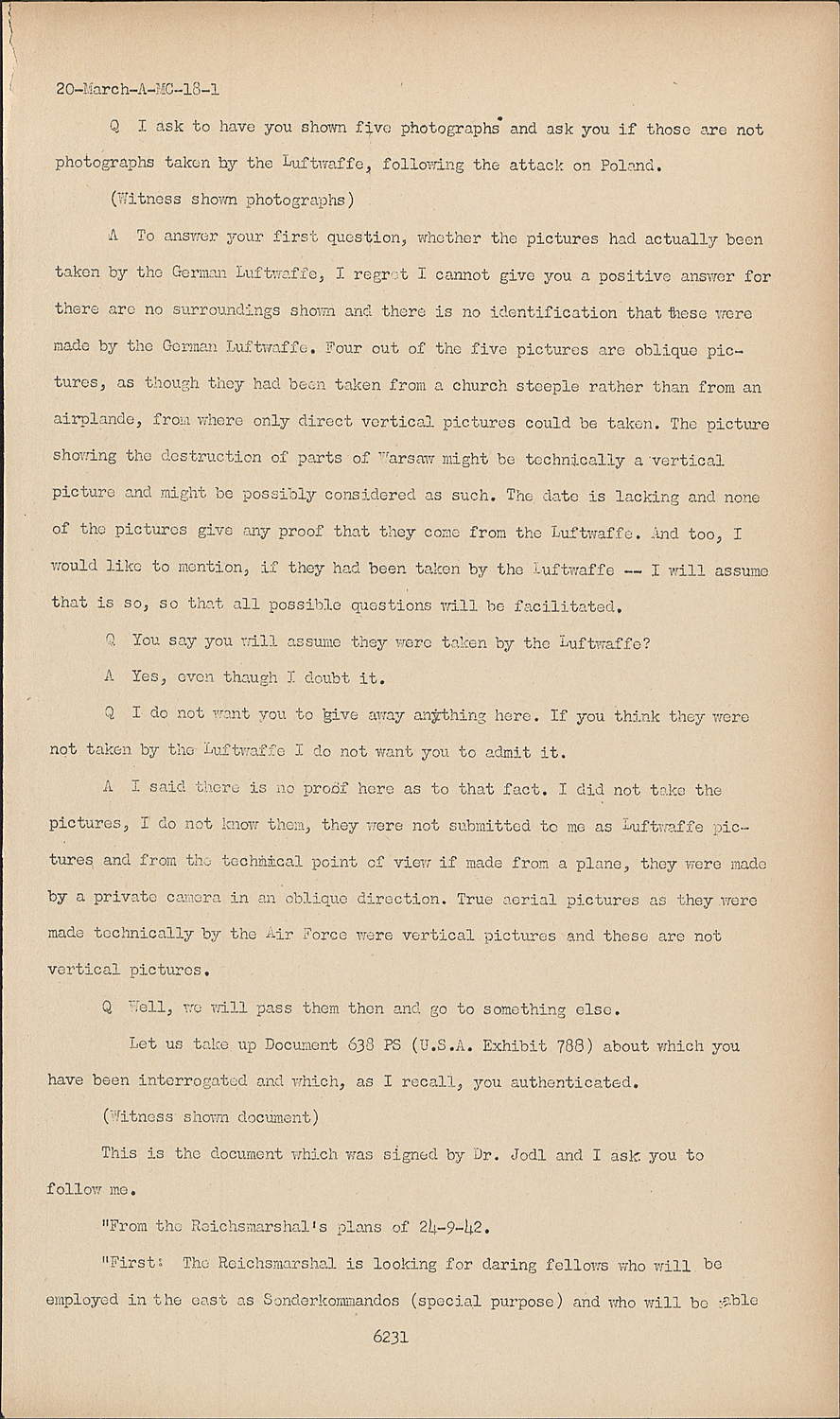
Q I ask to have you shown five photographs and ask you if those are not photographs taken by the Luftwaffe, following the attack on Poland.
(Witness shown photographs)
ATo answer your first question, whether the pictures had actually been taken by the German Luftwaffe, I regret I cannot give you a positive answer for there are no surroundings shorn and there is no identification that these were made by the German Luftwaffe. Four out of the five pictures are oblique pictures, as though they had been taken from a church steeple rather than from an airplande, from where only direct vertical pictures could be taken. The picture showing the destruction of parts of Warsaw might be technically a vertical picture and might be possibly considered as such. The date is lacking and none of the pictures give any proof that they come from the Luftwaffe. And too, I would like to mention, if they had been taken by the Luftwaffe -- I will assume that is so, so that all possible questions will be facilitated.
QYou say you will assume they were taken by the Luftwaffe?
AYes, even thaugh I doubt it.
QI do not want you to give away anything here. If you think they were not taken by the Luftwaffe I do not want you to admit it.
AI said there is no proof here as to that fact. I did not take the pictures, I do not know them, they were not submitted to me as Luftwaffe pictures and from the technical point of view if made from a plane, they were made by a private camera in an oblique direction. True aerial pictures as they were made technically by the Air Force were vertical pictures and these are not vertical pictures.
QWell, we will pass them then and go to something else.
Let us take up Document 633 PS (U.S.A. Exhibit 788) about which you have been interrogated and which, as I recall, you authenticated.
(Witness shown document)
This is the document which was signed by Dr. Jodl and I ask you to follow me.
"From the Reichsmarshal's plans of 24-9-42.
"First: The Reichsmarshal is looking for daring fellows who will be employed in the east as Sonderkommandos (special purpose) and who will be able to carry out the task of creating confusion behind the lines.
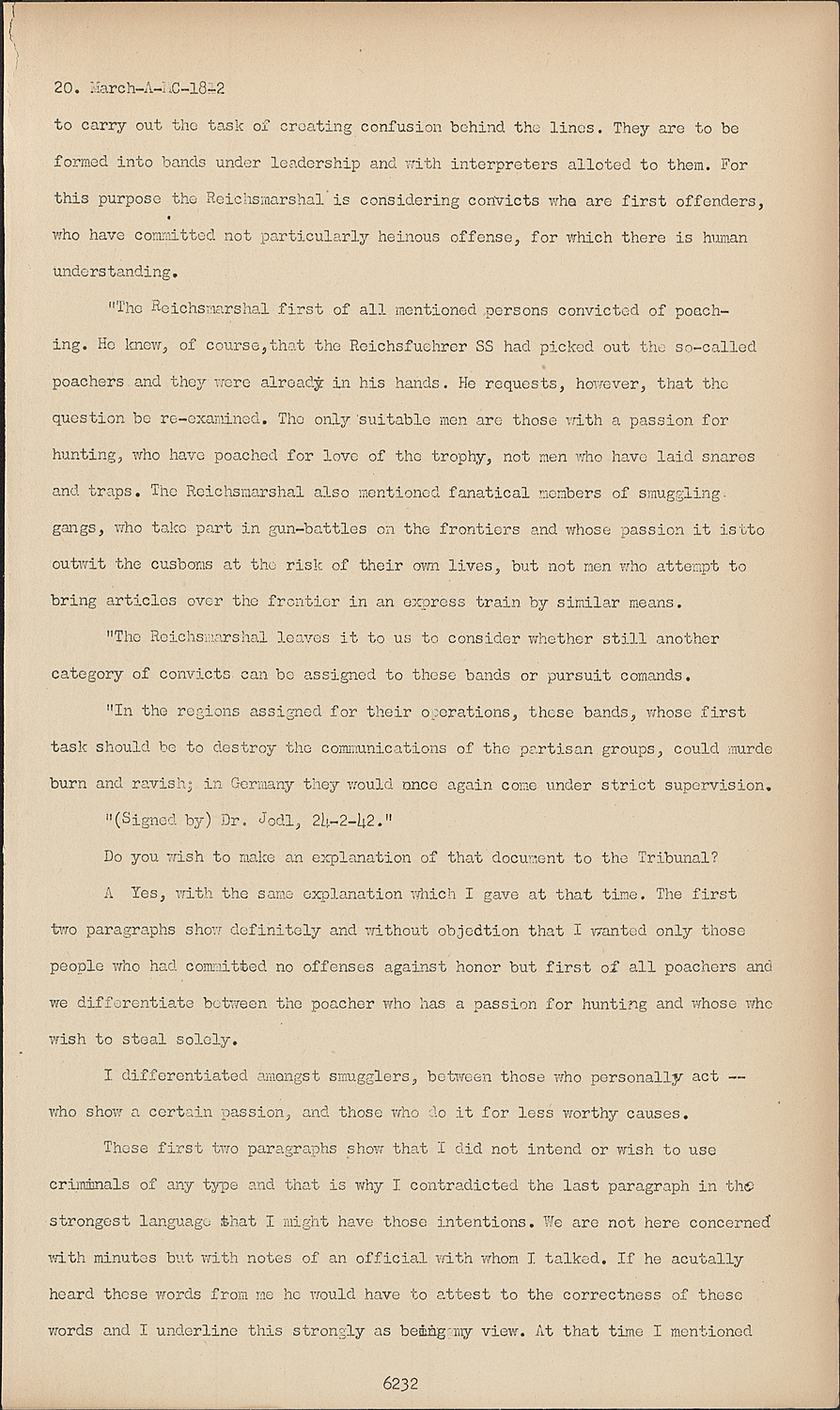
They are to be formed into bands under leadership and with interpreters alloted to them.
For this purpose the Reichsmarshal is considering convicts who are first offenders, who have committed not particularly heinous offense, for which there is human understanding.
"The Reichsmarshal first of all mentioned persons convicted of poaching. He knew, of course,that the Reichsfuehrer SS had picked out the so-called poachers and they were already in his hands. He requests, however, that the question be re-examined. The only suitable men are those with a passion for hunting, who have poached for love of the trophy, not men who have laid snares and traps. The Reichsmarshal also mentioned fanatical members of smuggling, gangs, who take part in gun-battles on the frontiers and whose passion it is to outwit the cusboms at the risk of their own lives, but not men who attempt to bring articles over the frontier in an express train by similar means.
"The Reichsmarshal leaves it to us to consider whether still another category of convicts can be assigned to these bands or pursuit comands.
"In the regions assigned for their operations, these bands, whose first task should be to destroy the communications of the partisan groups, could murde burn and ravish; in Germany they would once again come under strict supervision.
"(Signed by) Dr. Jodl, 24-2-42."
Do you wish to make an explanation of that document to the Tribunal?
AYes, with the same explanation which I gave at that time. The first two paragraphs show definitely and without objection that I wanted only those people who had committed no offenses against honor but first of all poachers and we differentiate between the poacher who has a passion for hunting and whose who wish to steal solely.
I differentiated amongst smugglers, between those who personally act -who show a certain passion, and those who do it for less worthy causes.
These first two paragraphs show that I did not intend or wish to use criminals of any type and that is why I contradicted the last paragraph in the strongest language that I might have those intentions. We are not here concerned with minutes but with notes of an official with whom I talked. If he acutally heard these words from me he would have to attest to the correctness of these words and I underline this strongly as being my view. At that time I mentioned the concept of violation which I alwats punished with death even if members of hostile states were concerned and I denied and refused that expression and I again point out that the main paragraphs are to the utmost a contradiction of the last remark because if it had been a matter of indifference to me I could have selected criminals.
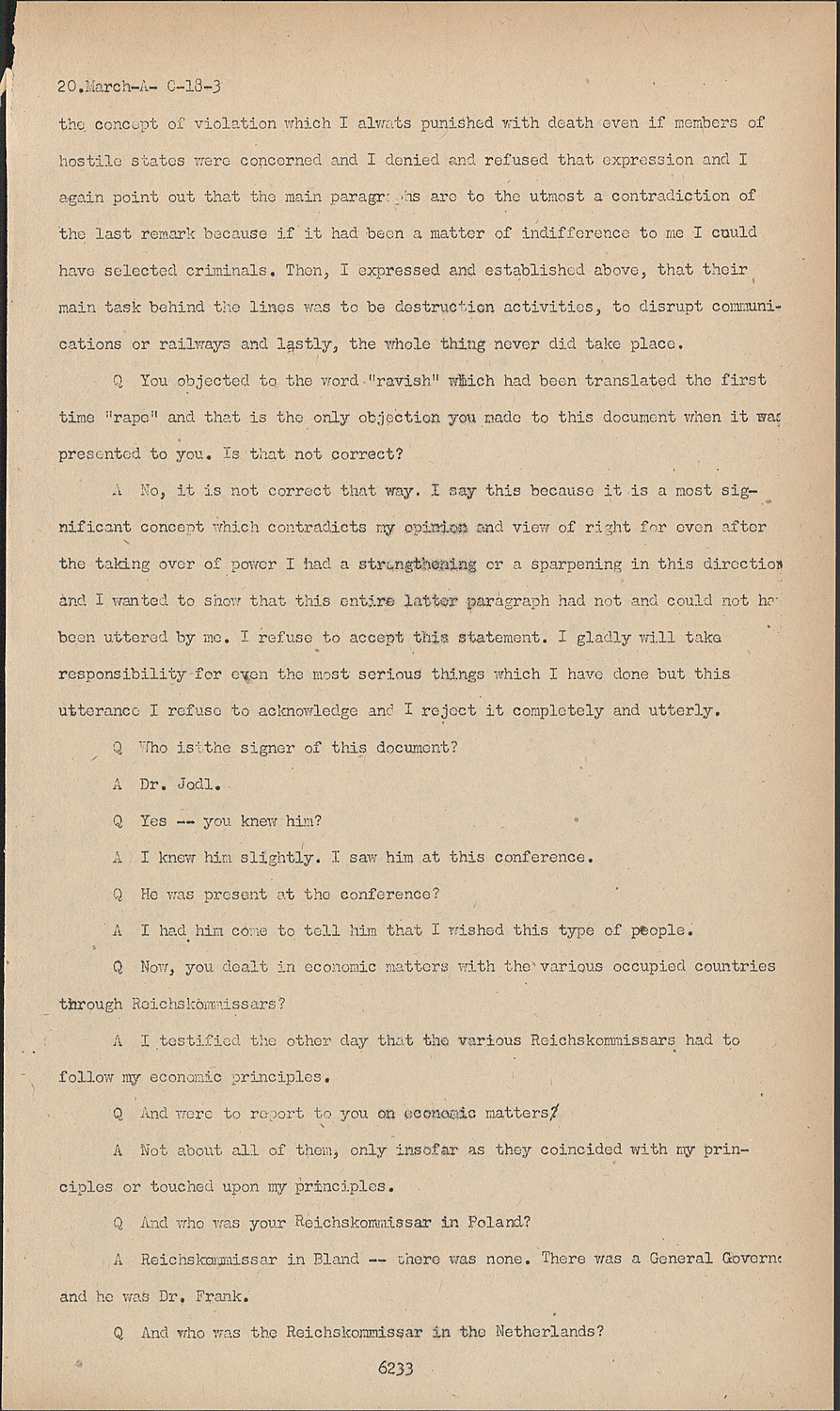
Then, I expressed and established above, that their main task behind the lines was to be destruction activities, to disrupt communications or railways and lastly, the whole thing never did take place.
QYou objected to the word "ravish" which had been translated the first time "rape" and that is the only objection you made to this document when it was presented to you. Is that not correct?
ANo, it is not correct that way. I say this because it is a most significant concept which contradicts my opinion and view of right for even after the taking over of power I had a strengthening or a sparpening in this direction and I wanted to show that this entire latter paragraph had not and could not ha* been uttered by me. I refuse to accept this statement. I gladly will take responsibility for even the most serious things which I have done but this utterance I refuse to acknowledge and I reject it completely and utterly.
QWho is the signer of this document?
ADr. Jodl.
QYes -- you knew him?
AI knew him slightly. I saw him at this conference.
QHe was present at the conference?
AI had him come to tell him that I wished this type of people.
QNow, you dealt in economic matters with the various occupied countries through Reichskommissars?
AI testified the other day that the various Reichskommissars had to follow my economic principles.
QAnd were to report to you on economic matters?
ANow about all of them, only insofar as they coincided with my principles or touched upon my principles.
QAnd who was your Reichskommissar in Poland?
AReichskommissar in Bland -- chore was none. There was a General Govern* and he was Dr. Frank.
QAnd who was the Reichskommissar in the Netherlands?
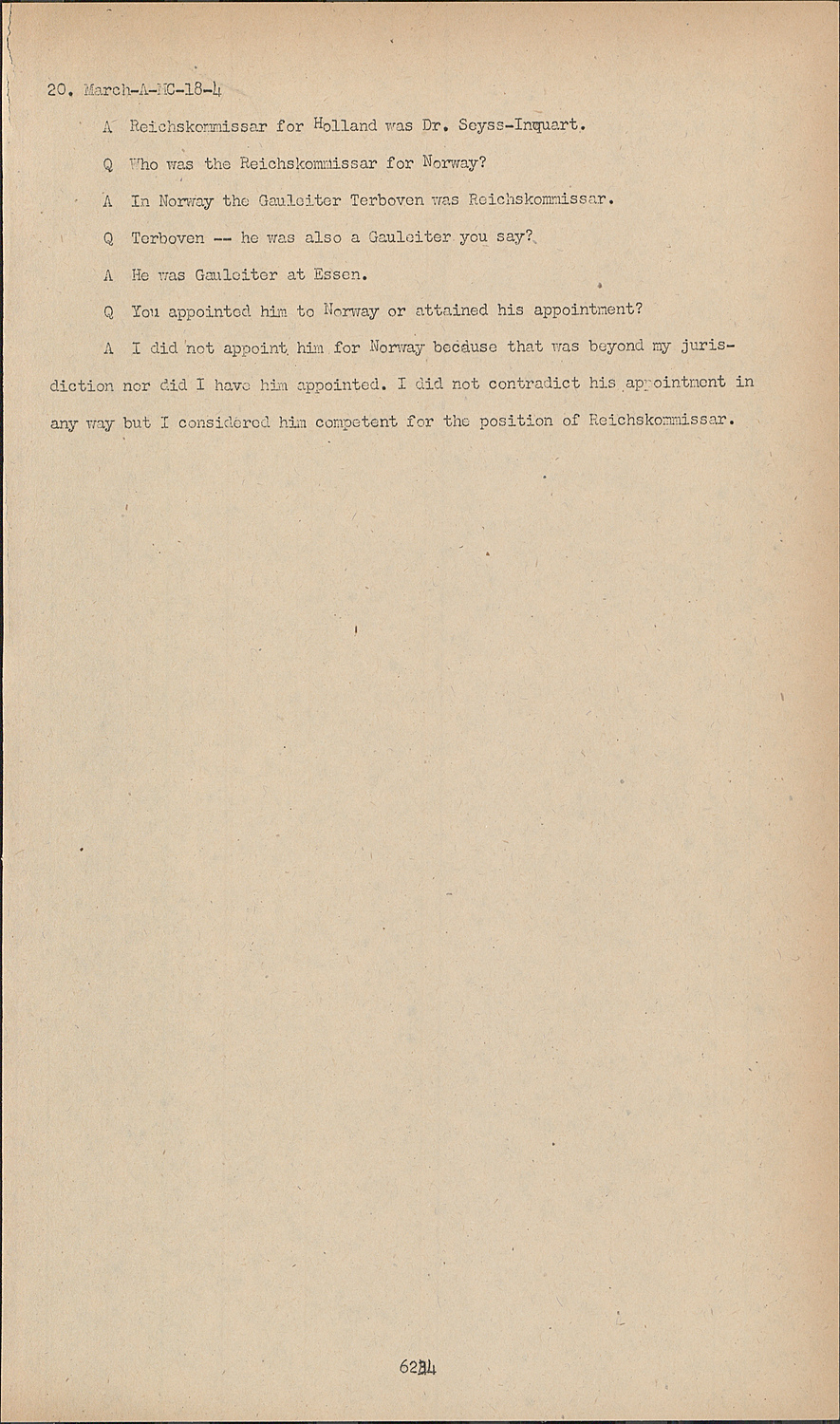
A Reichskommissar for Holland was Dr. Seyss-Inquart.
QWho was the Reichskommissar for Norway?
AIn Norway the Gauleiter Terboven was Reichskommissar.
QTerboven -- he was also a Gauleiter you say?
AHe was Gauleiter at Essen.
QYou appointed him to Norway or attained his appointment?
AI did not appoint, him for Norway because that was beyond my jurisdiction nor did I have him appointed. I did not contradict his appointment in any way but I considered him competent for the position of Reichskommissar.
Q And he was there from 1:40 until 1:45.
AI believe that is correct.
QNow, I will ask to have you shown Document R-134, communication from Terboven to you.
(The document was handed to the witness).
That is a communication of the 1st of May, 1942, is it not?
AI noted the date, yes,
QAnd that reports to you as follows, does it not -- it is addressed to you as Reichsmarshall, "My esteemed Reichsmarshall", is that right?
AYes.
QOmitting the first paragraph, unless you care to give it, "Several days ago on an island west of Bergen we have flushed out a Norwegian sabotage unit which was trained by the Secret Service, and have found that during this, extensive stores of sabotage instruments, some of them of a new kind, among which poison and bacteria can probably be found, and which so far as they are known have been forwarded to the Reich Security Main Office for closer examination, Besides other tasks, this sabotage unit was to begin with their sabotage work with the explosive devices of which a sample is available on Sola and Herdla. This can be constructed from fine written directives, Since it must be assumed that similar actions are under way on air fields of the remaining European coast, and assuming that a means of sabotage actually unknown until now is in question here, I forward it to you by the fastest means in order to beve you the opportunity to be sure to issue the appropriate warning order. Unfortunately, two especially deserving officers of the Security Police were killed in the fight against the sabotage unit. We buried them this morning at about 1000 hours in the Heroes' Cemetery in Bergen. On the same day and at the same hour eighteen Norwegians were shot on my order. These had been captured some time previously in the attempt to go to England illegally. Also, on the same day, the entire community which granted a hiding place to the sabotage unit was burned down and the population was deported. All males were sent to a German concentration camp without their families receiving any notification about it. The women were sent to a female forced-labor camp in Norway and the children not capable of working to a children's home.
Heil Hitler. Yours obediently,Terbove Is that correct?
A It says so in the letter, of which I have just seen a copy.
Q Terboven remained after that report until 1945, didn't he?
A That's correct.
Q Now, later in the same year, 1942, you adopted very similar mean to those reported by Terboven to you, did you not?
A I did not understand the question.
Q Well, you adopted later in the same year the name means as Terboven, didn't you, in substance?
A I -- where?
Q Well, I will ask that you be shown Document 1742-PS.
(Document U.S.A. 789, handed to the witness).
Now, this is a decree of October, 1942, by Goering. I ask you to follow me:
"Simultaneously with the intensified combatting of gang activity ordered by the Fuehrer and the cleaning up of the hinderland, in particular that behind the Army Group Middle, I request that the following aspects are taken into consideration and that the deductions drawn therefrom are put into practice:
"One, during the combatting of the Underground and the combing through of the areas contaminaded by them, all available cattleesto* there must simultaneously be driven off to safe areas. Food supplies are to be evacuated and protected similarly, so that there will be no more accessible to the bands.
"Second, all masculine and feminine labor which can be consider for some kind of employment must be seized by force and transported to the plenipoteniary, chef, of the labor exchange, who will then employ them in safe areas of the hinterland or at home. The accommo dation of the children in the hinterland camps is to be regulated separately."
Is that right?
AAbsolutely. We were concerned with those areas of bands, and no man could demand of me that I have foodstuffs and cattle for the bands who harrassed us so tremendously and bands -- those people who might have been used if band activity had to be taken into regions which were assured us and had to be used for manpower.
I would like to emphasize that this is an absolute necessity of life, for the security of the fighting forces. But I would like to emphasize again that you said I decreed the same which you read from the letter of Terboven. I did not ask villages to be fired I did not ask for the shooting of hostages. We are concerned with two diametrically opposed matters.
QYou simply meant as to men and women and children, and moved them out.
By May of 1944 your problem in the loss of fighter aircraft and fighter personal was becoming serious?
AYes.
QOn the 19th of May, 1944, you had a conference in your office, on the subject of fighter aircraft and the losses of fighter personal did you not?
AYes.
QAnd you have been shown the minutes of that meeting and authenticated them, your interrogations?
AIt is not minutes of the conference. It is a summary of a meeting which took place in two days and it is summarized in just a few sentences.
QI will ask to have you shown Document L-166. It is entitled, "Most Secret Document ," isn't it?
AThat is correct.
QAnd it is also entitled, "Minutes of conference on fighter aircraft with the Reichsmarshal on the 15th and 16th of May, 1944," the is correct, too, is it not?
ANo, they are notices as to a conversation, about fighter aircraft discussion.
QNotices, you translate it notices?
ANotes. Notes of conference on fighter aircraft. Lasting two day
QAnd at first General Gallant described in detail the situation regarding fighter personal, that took place, didn't he, and reviewed the losses?
AYes.
QAnd reviewed the losses?
AYes.
QAnd then he reviewed at some length under Item 2, "Remedial Measures," is that right?
A According to the notes, yes, but whether that actually took pla-
ce I cannot say.
QThis conference took place, didn't it?
AAbsolutely, yes. For two days,
QAnd under Item 3 General Gallant made certain proposals, did he not?
AYes.
QAnd then after considerable discussion General Schmidt made certain proposals, Items 12 and 13, is that right?
AIt must have been so. It is so according to the notes.
QYou recommended a conference between the chief of the General Staff and as the chief of artillery as soon as possible, did you not?
AYes.
QAnd General Schmidt's recommendations and requests appear in It 14 and 15 and 16 and 17 and 18 ?
AYes.
QThen you decided, "The Reichsmarshal decides that only the three groups of the fighter squadrons can remain in the rank by the drafting of those pilots and planes operationally fit in accordance with or ders Already given."
That correct, did it not?
AYes, operationally.
QThen "the Reichsmarshal wishes the testing of defense and dispersal measures on low level atteack on air fields causing considerable loss in personnel and material." No. 19. That accurred, did it not?
AYes.
QItem 20 reads, "The Reichsmarshal will propose to the Fuehrer that American and English crews who shoot indiscriminately at times moving civilian pianos or parchuting soldiers will be shoot immediate ly on the scene of action." Have I correctly read, that?
AIt says so here. And I objected at entreat that time that this was not correct; from the whole connection of these notes, 1921, this passages has no connection, but beyond that the expression,",pa rach ting soldiers" is entirely misleading and is not properly used.
I contemplated for a long time as to how this expression got into the notes, which I never saw.
which was, how it could get into a summary of two days' activity, and could explain it only in that I referred or pointed out that we could gather from other testi mony that the Fuehrer could have given a directive in this respect, that there must he mistake, not that the Reichsmarshal will wish to propose to the Fuehrer, but that I suggested that the Fuehrer had are such intention.
But about this we would have to talk to and have to consult the author of those notes. No other point is contained in th notes. Even the next point is entirely different. Everything else is in connection and is coherent, but this one point seems to be extran ous.
QIn all the notes of the two days, this is the one thing that you say is mistaken.
Now I ask to have you shown Document 731-PS.
(Paper handed to the witness ).
Now, the conference the notes of which I have just read you, was followed within, a week by the order, 731-PS., was it not, the memorandum, 731-PS., which reads: "The Fuehrer has rendered the following decisions in regard to measures to be taken against Anglo-American air crews in special instances: Downed airmen are tobe shot without court martial proceedings"-
THE PRESIDENT:Mr. Justice Jackson, didn't you refer to a passage four lines above that, after "Report of the Reichsmarshal"?
MR. JUSTICE JACKSON:Iddid not, but perhaps for the record it ought to be in full.
"Chief of the Command Staff of the Armed Forces, chief WEST. Please direct drafting of order. (Warlimont). (Keitel), deputy chief of staff of the armed forces. Must go to Reichsfuehrer SS. After a report of the Reichsmarshall General Korten makes the following statement: Memorandum" -- I think the next line is not in the original -- "the Fueh rer has rendered the following decision in regard to measures to be taken against Anglo-American air crews in special instances. Downed enemy airmen are to be shot without court martial proceedings in the following instances: One, in the event of the shooting of our own downed airmen while they are parachuting to earth; second, in the event of aerial attacks upon German planes which have made emergency landings and whose crews are in the immediate vicinity; third, in the event of attacks upon railway trains engaged in public transportation ; fourth, in the event of low-level aerial attack upon individual civilians, farmers, workers, single vehicles and so forth."
Now , there es a note on that, " In the event of low-level serial attacks upon the civilian population, single civilian vehickles and so forth, " is there not ?
A :Here weapons which were on board -- something is crossed out here and there are some words which I cannot read, which are written up above. Before the expression, " single planes ", the word civilian, to point 2, it says : I would have some doubts about that, that the destruction of an emergency -- for the destrucktion of a plane which has made an emergency landing is not permissible, according to the laws of war. We are concerned with the total complex Which took part in these days or weeks and which von Brauchitsch testified to the other day.
Q.That note about that emergency landing is signed by "J," is it, which stads for Jodl ?
A :Certainly.
MR. JUSTICE JACKSON :I think that es all I care to ask.
THere are a number of documents which should be introduced in this connection, and I think it will be best perhaps if we tabulate them and get them ready over the evening and present the to morning.
THE PRESIDENT :Certainly, Mr. Justice Jackson, you can put them all in then. BY SIR DAVID MAXWLL*FYFE :
Q.I want to ask you first some questions about the matter of the Britis Air Force officers who escaped from Stalag Luft 3. Do you rembember that you said in giving your evidence that you knew this incident very completely and very minutely ? Do you remember saying that ?
A :No, that I had received accurate knowledge; not that I had accurate knowledge -- that I received accurate knowledge
Q :Let me quote your own words, as they were taken down, "I know this incident very completely, very minutely, but it came to my attention unfortunately at a later period of time."
That is what you said the other day, is that right ?
AYes, that is what I meant, that I knew the incident but heard of it much later.
QYou told the Tribunal that you were on leave at this time, in the last period of March, 1944, is that right ?
A :Yes, as far as I was on leave in March up until just afew days before Easter.
QAnd you said, " As I can prove." I want you to tell the Tribunal the dates of your leave.
AI wish to say again that all of March, according to my definate memory, is part of this leave, and for that proof I would like to mention the people who were present or who accompanied me on this leave.
QWhat I want to know is, where you were on leave.
AHere, in the vicinity of Nuernberg.
QSo you were within easy reach of the telephone from the Air Ministry or, indeed, from Breslau, if you were wanted ?
AI wold have been easily accessible by phone if someone wanted to communicate with me
QI want you to help me with regard to one or two other dates of which you have spoken. You say you heard one or two days later about this escape. Do you understand, Witness, that I am asking you not about the shooting for the moment, I want to make it quite clear. Did you mean by that, that you heard about the actual escape one or two days after it happened ?
A , Yes.
QDid you hear about it from the office of your adjutant or from your director of operations ?
AI heard this through my adjutant. Several other escapes had preceded this one.
QYes, that's right. There had been a number of escapes from this camp.
AI can't tell you exactly whether it es from this camp, but several large escapes dad taken place. I heard of them through channels to the adjutant.
QI want you to tell the Tribunal another date: You say that on your return from leave your chief of staff made a communication to you. Who was your chief of staff ?
AGeneral Korten was my chief of staff at that time
QCan you tell us the date at which he made this communication to you ?
ANo, I cannot tell you that exactly. About this incident I talked with my chief of staff later. I had heard about it prior to my spaeking with him.
QWho was the first to tell you about it ? Was it your chief or staff who told you about the shootings ? Do you mean that someone else had told you about the shooting ?
AI cannot tell you exactly whether I heard about the shooting from the chief of staff or from other sources, but in any event I talked about this with the chief of staff. I talked about this fact with him.
QWhat was the date that you talked about it with your chief of staff ?
AI cannot tell you exactly from memery the day. It Must have been around Easter.
QThat would be just about the end of March, wouldn't it ?
ANo. Might have been at the beginning of April or the firs half of April.
QAnd then you had an interview with Himmler, you have told
AYes, I talked with Himmler about this.
QCan you fix that ?
AOf course I cannot establish this date with certainty. I s Himmler, and at my first opportunity after I had heard about this incedent talked to him about it.
Q So that you can't fix the date in relation to your coming b from leave, or the interview with your chief of staff, or any other date, or Easter ?
AWithout referring to documents it es absolutely impossible for me to establish the day. I can give you the epproximate period of time ; and that I have done.
QYou said the other day that you could prove when you were on leave. Am I to take it that you haven't taken the trouble to look up what your leave dates were ?
AI have already said that I was on leave during March. Whether the 26 th or the 28th or the 29th of March was the day or my return, that I cannot tell you. For the proof of that you would have to ask the people who accompanied me, who perhaps can fix this date a little more definitely. I don't recall the fact that I was there in March.
QWitness, will it be perfectly fair to you if I take the latest of your dates, the 29th of March, to work on ?
AIt would be more expedient if you were to tell me when Easter was that year, because I do not recall it. It will be easier for me to specify the date, because I do recall that a few days before master I returned to Berchtesgaden in order to celebrate this holiday with my family.
QA few days before Easter you went back to Berechtesgaden.
AYes.
QSo you had come back from leave some day before that. Before you went to Berchtesgaden you had come back from your March leave ?
ABerchtesgaden was the headquarters of the Fuehrer. I returned from my leave to Berechtesgaden, and with my retur ended my leave. I returned to duty. The return to Berechtesgaden is identical with the termination of my leave.
QWell, I can't give you Easter offhand, but I happen to remember Whitsunday was the 28th of May, so that Easter would be early, somewhere about the 5th of April so that your leave wo finish somewhere about the end of March, maybe the 26th or the 29th; that is right, isn't it ?
Now, that shootings of these officers went on from the 25th o March to the 13th of April; do you know that?
A I do not know that exactly as that.
QYou may take that from me, because there is an official report of the shooting, and I want to be quite fair with you. Only forty-nine of these officers were shot on dates, as far as we can fix, the 6th of April, and one was shot either on the 13th of April or later. But the critical period is the end of March, and we may take it you were back from leave by about the 29th of March. I just want you to tell the Tribunal this was a matter of great importance, wasn't it ? Considered a matter of great importance ?
AIt was a very important matter.
QGeneral Milch -- I beg his pardon -- Fieldmarshal Milch has said that it was a matter which would require the highest authority, and I think you have said that you know it was Hitler's decision that these officers should be shot; is that so ?
AThe question did not come through clearly.
QIt was Hitler's decision that these officers should be shot ?
AThat is correct; and I was notified of it, that it was Hitler's decree.
QI want you just to remember one thing, that immediately it was pusbilished the British Foreign Secretary,Mr.Eden, at once said that Great Britain would demand justice of the perpetrators of these murders; do you remember that ?
AThe speech to the Lower House given by Eden I cannot remember. I do not know the substance of this speech. I just heard that he spoke in Parliament about this incedent.
QI want you to tell the Tribunal just who the persons in your ministry involved were. I will tell you; I think it would be shorter in the end. If you disagree you can correct me. The commandant of Stalag Luft 3 was Oberst von Lindeiner of your service, was he not ?
AThat is completely possible, but I aid not know these commandants in particular. There was a court-martial against him for the escape. He was not connected with the shootings.
QNo, but he was commandant of the camp, and I suppose you had to review and confirm the proceedings of the Zentral Luftwaffen Gericht which convicted him and sentenced him to a year's imprisonment for neglect of duty.
That would come to you, woldn't it ? Wouldn't that come to you forreview ?
ANo, only if larger penalties were involved. One year would not come to my attention. But I know, and I would like to certify, that the court procedures were made for him because of neglect of duty.
QIn May of 1943, Inspectorate No.17 had been interposed between the Luftwaffe and the Department of the OKW, the Kriegsgefangenen Wesen; do you remember that ?
AI do not know the details about inspection.
QI want to remind you of who your own officers were. You understand, witness, that your own officers are involved in this matter.I want to remind you who they were, Was the head of Inspectorate 17, Major General Grosch of the Luftwaffe ?
AMajor General Grosch is of the Luftwaffe.
QYou told the Tribunal the other day - I am quoting your own words that you knew from information, you knew this incident very completely and very minutely. You are now telling the Tribunal you don't know whether Major Genral Grosch was head of Inspectorate No. 17 of the Luftwaffe.
AThat has no connection with it. I told the high Tribunal that I know the incident of the shooting of those air force officer's and was advised of it, but that has no connection with General Grosch and his inspectorate, for he did not participate in the shooting.
QI will show you that connection in one minute if you will just answer my question. Was Grosch's second in command Oberst Welter; do you remember that ?
AThe particulars of organization of prisoners of war and the leaders; I do not know that ramification, at least not by heart. I would like to underline again, so that no confusion willtake place, that when I said I know this matter I meant that I knew how the decree came about. I knew that the people were shot, and I know that for certain. But I did not mean the complete ramification as far as inspectorates are concerned.
QAnd did General Grosch, as head of Inspectorate 17, have to report to General Foerster, your director of operations at the Luftwaffe Ministeri um ?
AThat I cannot tell you without the diagram of subordination before me. General Foerster was, I believe, chief of the Luftwehr or some similar capacity in the ministry. In itself I did not concern myself with these matters, because they were not practical, strategic, or of armament natuere. It is entirely possible that be belonged to this department.
QI put to you quite shortly, and if you don't know I willleave it for the moment; Did you know that Major General Graevenitz was head of the Defendant Keitel's department, the Kriegsgefangenen Wesen, that dealt with prsisoners of war ?
AGraevenitz name I just heard about now, for this division had no direct touch with me. I could not know all of these many military subleaders and their divisions and branches.
QSo I take it that you didn't know Colonel, now General, Westhoff, of the deprartment under von Graevenitz ?
AGeneral Westhoff I never saw, and he did not belong to the Luftwaffe.
QI am not suggesting that von Graevenitz and Westhoff belonged to the Luftwaffe. I wanted to make it clear that I was suggesting they belonged to General Keitel's organization.
AI didn't know either; I did not know their position or rank.
QUp to that time you still had a considerable influence in the Reich, didn't you ?
AIn this period of time, no longer. We are concerned with 1944, and at that time not at all.
QBut you were still head of the Luftwaffe and head of the Air Ministry, weren't you ?
AYes, I was that.
QAnd you had, as head of the Luftwaffe and head of the Air Ministry, been responsible for six prisoners of war camps for the whole of the war up to that time, hadn't you ?
AHow many I do not know, but I am responsible for those which belonged to my ministry.
QTo the air force ?
AThose which belonged to the Luftwaffe and were subordinate to it.